Claude, Slack and Salesforce: A Governance Architecture for Wealth Management
How to make Salesforce the durable data, permission and audit layer beneath whichever AI assistant advisors use.
Written by Rory Galvin, CEO, Navirum · Salesforce and AI Architecture · Financial Services
Explore the Architecture ↓Salesforce · Slack · Claude · Agentforce · Financial Services Cloud
Salesforce Ridge Partner · ★★★★★ 5.0 on Salesforce AppExchange · 1,000+ Projects · North American Financial Services Specialists
Claude + Slack + Salesforce Integration
By Rory Galvin, CEO at Navirum
Expert in Claude, Slack, Agentforce & Salesforce integration for wealth management · Salesforce Ridge Partner · 7+ years delivering trusted AI architecture to wealth managers across North America
What is the safest way to connect Claude, Slack and Salesforce?
Use Salesforce as the governance and trusted-data layer, Slack as the advisor interface, and Claude or another approved model as the replaceable intelligence layer.
- Data processing: confirm where client information is sent and where model inference occurs.
- Permissions: validate that Salesforce access controls govern what the model can retrieve and act on.
- Identity: preserve the individual advisor’s identity rather than authenticating through a shared account or API key.
- Auditability: log every request, response, action and exception in a form compliance teams can inspect.
Navirum designs Salesforce and AI architectures for regulated financial-services firms, with governance, integration and long-term model portability built in from the start.
Advisors want Claude in Slack. Here’s why the Salesforce governance foundation underneath matters more than the interface or the model, and how to architect it so Claude works in Slack, email, and Agentforce interchangeably, all governed by the same Salesforce data foundation.
Key Takeaways
- AI does not solve messy data; it makes the mess faster and more confident.
- The lasting competitive advantage is a Salesforce data foundation, not which model or interface you pick.
- Trust comes down to four concrete boundaries: data travel, permissions, authentication, and audit trails, no matter where Claude is called from.
- Testing and ongoing validation matter more than initial vendor selection, because models change, and your assurance process keeps you safe.
- Financial services leaders should govern this as a data governance question, not a Slack, Claude, or tooling question.
Why advisors want Claude in Slack, and why that’s not the win
Many wealth firms are asking: “Should we connect Claude to Salesforce?” The right answer depends on a prior question they’re not asking: “Are we set up to give Claude a trusted data foundation, wherever advisors reach it from?”
Step back from any single product and the direction of travel is clear. We are moving toward a world where advisors do their work across many AI assistants and chat surfaces, Claude in Slack, ChatGPT in email, Agentforce inside Salesforce, where increasingly autonomous agents read, reason, and act on business systems on our behalf, and where the interface to your data is no longer a single application you log into. The number of front doors is multiplying. We cover how Slack itself fits into the unified Salesforce-Slack ecosystem in more detail elsewhere.
It is tempting to assume AI will simplify all of this. It usually does the opposite. Most financial services firms already have client information spread across:
- CRM systems (Salesforce, legacy platforms)
- Portfolio systems (Morningstar, Advent, Tamarac, eMoney)
- Planning tools (Advyzon, Wealthtech suites)
- Custodians (Schwab, Fidelity, TD, etc., separate logins, separate data)
- Email (Outlook, Gmail, unstructured, unsearchable without human memory)
- Documents (Google Drive, OneDrive, shared folders)
- Spreadsheets (Excel, Sheets, the real source of truth for many firms)
- Service platforms (Help desk, ticketing, communication history)
- Data warehouses (If mature; most firms skip this layer entirely)
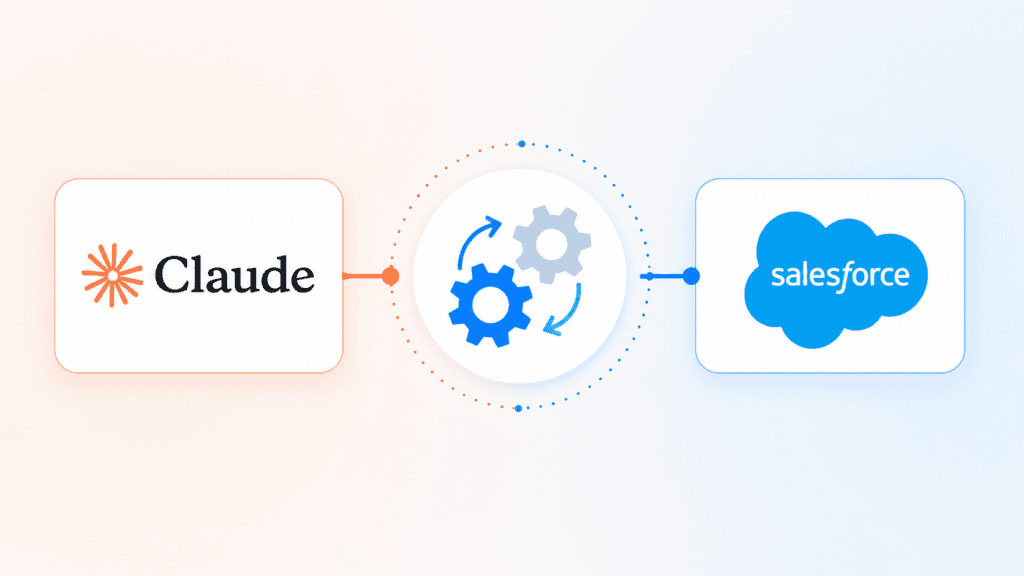
Claude in Slack adds one more interface on top of that already fragmented picture. It does not remove the fragmentation. In many cases, it exposes it, and it lets everyone act on it faster.
The fragmentation cost is concrete: an advisor opens Slack and asks Claude, “What’s the client’s current portfolio allocation?” If Claude is wired directly to the custodian API (or no API at all), it sees only the custodial view. It misses the separately held securities, the charitable accounts, the spousal IRA, the tax strategy documented in Salesforce. Claude gives a confident, incomplete answer. The advisor acts on it. The client gets poor advice, delivered fast, with no audit trail in Salesforce of what Claude said.
The good scenario looks different: Claude in Slack is wired to Salesforce, via Agentforce or a governed direct connection. When the advisor asks, Claude reads from the unified Salesforce view, the custodial holdings, the planning assumptions, the recent notes, the open tasks. Same question, same interface, complete picture. Salesforce logs the interaction: which advisor asked, what Claude returned, when.
This is the strategic problem leaders should be solving for: not which assistant to pick, or which chat surface advisors prefer, but how to give every one of them a single, trusted place to stand: Salesforce.
FIGURE 1 • AI GOVERNANCE ARCHITECTURE
How Salesforce Governs the AI Data Journey
Salesforce sits between your advisors and external LLMs to enforce permissions and audit trails.
01. Front-End Interfaces
The digital surfaces where advisors and wealth managers trigger AI requests during their daily workflows.
02. Salesforce Governance Layer
The central governance layer that intercepts requests, authenticates the user, and enforces data boundaries before the model processes anything.
03. Model Processing
The secure environment where models generate responses using only permission-scoped data after validated controls.
The durable asset: Salesforce as the trusted data foundation
Here is the durable point. The technology underneath churns constantly; the obligations sitting on top of it do not. Your clients still need their data kept private and used appropriately. You still need an auditable record of who, or what, did what and why. You still answer to the same regulators against the same principles.
The models you read about today will likely have evolved significantly by next quarter. Your duty of care will not change.
Here’s the critical insight: Salesforce is where you should wire Claude, ChatGPT, or Agentforce, not the other way around. This isn’t about Salesforce versus other platforms. It’s about where the control surface lives. When Claude is connected to Salesforce, your governance rules, permission model, and audit trails are already in place. When Claude is wired directly to a custodian, Slack, or email, you’re building governance from scratch for every connection. None of this holds up without the data platform your foundation runs on underneath it.
For wealth management, Salesforce is the natural integration hub because field-level security already restricts what each advisor sees, sharing rules control access at the account and household level, audit trails log everything, and Financial Services Cloud is purpose-built for this. Salesforce provides the permission model that can govern Claude’s access, but inheritance must be explicitly validated for the chosen integration architecture..
The evidence is increasingly strong that this is an operating-model question, not a tooling one. IBM finds that 78% of C-suite executives now say achieving the maximum benefit from agentic AI requires an entirely new operating model, not merely a software update, yet 78% of AI investment to date has gone into improving existing processes. IBM reports that transformation-led organisations are 32 times more likely to reach top-tier business performance than those stuck in minimal implementation.
Bolting Claude in Slack onto today’s fragmented setup is the cheap move. Building the Salesforce foundation it stands on is the one that compounds.
The strategic asset, in other words, is not Claude, and it is not Slack. It is the trusted client database underneath both.
The independent research points the same way:
CIO Insight
Why Salesforce is the right governance center when advisors use Claude in Slack
Slack is the interface. Salesforce is the control plane. Betting on one model as your permanent AI layer is a losing strategy, so the governance center needs to outlast whichever assistant is fashionable this year.
Where Claude in Salesforce creates value, and where it destroys it
For wealth management leaders, the value of connecting Claude to Salesforce is never Claude itself. It’s what the integration lets your people do: prepare for client meetings faster using a unified Salesforce view, run compliance audits that cross Salesforce, custodian, and activity data, and know that every interaction is governed and audited because Claude is acting as your advisor, not around your advisor. The line between good adoption and poor adoption is sharp, and it is worth naming plainly.
The uncomfortable truth: AI does not solve a messy data problem. It makes the mess faster, whether it’s answering in Slack, email, or Agentforce.
A confident assistant working from incomplete or ungoverned data does not give you better decisions; it gives you wrong decisions, delivered with conviction, at scale, wherever the advisor happened to ask the question. The quality of the Salesforce foundation sets the ceiling on the value of Claude in Slack.
This is also where the real performance gap opens up. McKinsey finds that AI high performers are nearly three times as likely as their peers to fundamentally redesign workflows from scratch rather than graft AI onto the process they already had. The value is not in answering faster inside a broken workflow. It is in rebuilding the workflow on a trusted Salesforce foundation so the answer, wherever it’s delivered, is worth having.
Where trust actually lives: the four integration boundaries
When you integrate Claude into Salesforce, the trust question resolves into four concrete control points. Being precise about each one is what separates a controlled deployment from an audit risk.
Where client data travels, where inference occurs and which contractual or residency controls apply.
How Salesforce field-level security, sharing rules and user access govern retrieval and actions.
How each Slack or AI request maps to a real, revocable Salesforce user identity.
How prompts, outputs, actions, exceptions and human reviews are logged and reconstructed.
1. Data travel and processing boundary
The strongest configurations keep the model’s processing inside the Salesforce trust boundary, so sensitive data is governed by the same controls, grounding, and filtering that already wrap your org, rather than being shipped to an external service. For regulated work this is the difference between a pilot and something compliance will approve.
Three model deployment paths
There is no single “best” configuration; the right one depends on data sensitivity, use case, and residency requirements. Verify the specific model, region, and hosting arrangement with Salesforce directly rather than assuming any one path applies by default.
- Salesforce-managed model within the trust boundary: certain Salesforce-managed models, including supported Anthropic configurations, can operate within Salesforce’s trust boundary. When configured this way, data and processing remain inside Salesforce with no external API calls for inference.
- External model through the Einstein Trust Layer: prompts pass to external model providers under Salesforce’s zero-data-retention agreements. Data is encrypted in transit and not retained by the provider, but processing briefly leaves Salesforce infrastructure.
- Direct external API: data passes from Salesforce (or another system) directly to the model provider’s API. This carries the highest data exposure and needs its own review of retention, residency, authentication, and contractual protections.
Source: Salesforce Generative AI Trust Architecture
When you evaluate any option, the first thing to establish is exactly where your client data travels and where the inference happens, whether the request came in through Slack or anywhere else. Ask your vendor:
- Does all client data stay inside Salesforce infrastructure?
- If external LLMs are called, what data is sent, and under what DPA?
- Are there data residency requirements (e.g., EU data must stay in EU)? Does this configuration respect them?
- Can you inspect the call logs to see what was sent where?
2. Permission model
Salesforce can ground Claude’s actions in a user’s existing permissions through secure configuration, but the actual access path depends on how Claude is called (Agentforce, native connector, custom integration), whether the integration uses a named credential, service account, or user delegation, and how any custom actions are scoped. “Salesforce permissions automatically apply to Claude” is not something to assume; it requires explicit architectural validation for your specific setup. Source: Salesforce Generative AI Trust Layer
3. Identity and authentication
Connections should authenticate through a proper, revocable mechanism such as OAuth, configured through a managed client app, so access can be scoped, monitored, and switched off. Avoid anything that depends on long-lived credentials pasted into a tool or a shared “Claude app” service account that authenticates as itself rather than as the advisor. The audit trail should be able to show which advisor asked Claude what, via which channel, and what Claude returned, not just “an API key performed an action.” If you cannot reconstruct what an agent did, you cannot supervise it.
4. Audit trails
Salesforce provides a foundation for centralised AI audit and feedback data, but teams must configure, validate, and monitor the specific logging their use case requires. What gets captured depends on the product (Agentforce, Einstein), the model path (Salesforce-managed vs. external), the action type, and your logging and data-collection settings. “All Claude interactions are logged by default” is not a safe assumption. Verify your logging configuration before relying on auditability as a control. Source: Salesforce Copilot Trust and Compliance
Key Risk
Silent model updates shift your risk posture faster than you can test
Claude in Slack without Salesforce governance means the audit trail lives nowhere, and a compliance audit discovers that later, not sooner. The mitigation isn’t picking the “safest” model once; it’s a regression suite you re-run every time a model updates.
Example: preparing an advisor for a client meeting
The framework becomes concrete when applied to an actual workflow. Here’s what a well-governed request looks like end to end.
- Advisor initiates in Slack. “Prepare me for my 2pm meeting with the Smith household.”
- Identity maps to a Salesforce user. The Slack message carries the advisor’s Salesforce user ID; Salesforce verifies identity and permissions before anything else happens.
- Salesforce permissions determine retrieval scope. Claude queries only what that advisor can already see: the linked household account, associated holdings, recent meeting notes, and any outstanding compliance flags.
- The model receives only grounded, permissioned data. No client data the advisor cannot see in Salesforce is included in the prompt.
- The response includes sources and record links. A meeting summary, suggested talking points, links back to the underlying Salesforce records, and any compliance alerts.
- No CRM changes without explicit approval. If Claude suggests logging a note or creating a follow-up task, the advisor approves it before anything is written back.
- The interaction is logged per your audit configuration. Advisor identity, timestamp, records accessed, the response, and any actions taken, captured according to whatever logging you’ve configured, not assumed by default.
- Exceptions route to a human. An unusual data request, a possible compliance concern, ambiguous permissions, or low model confidence gets escalated rather than answered.
This is what the four trust boundaries look like in practice: identity flows from Slack to Salesforce, permissions are enforced at the data-retrieval layer, the model operates inside the advisor’s existing data scope, human oversight covers anything high-stakes, and auditability is built in from the start rather than bolted on after.
The integration checklist: eight questions before you wire Claude to Salesforce
You do not need to be an architect to govern this well. Before connecting Claude to Salesforce, a leader should be able to get clear answers to eight questions:
- Integration path: Is Claude wired through Agentforce, or directly to a Salesforce API? (Agentforce is simpler and more governed.)
- Data residency: Does your data stay inside Salesforce infrastructure, or does Claude call external models? (Affects DPA requirements.)
- User authentication: Is the Claude connection authenticated as the logged-in user, or via a shared API key?
- Permission inheritance: Does Salesforce field-level security, sharing rules, and profile restrictions apply to Claude’s data access?
- What Claude can do: Can it read only, or can it write back to Salesforce? (Write access needs stronger testing.)
- Audit and logging: Is every Claude interaction logged in Salesforce’s audit trail, regardless of channel?
- Who reviews exceptions: If Claude’s output looks wrong, who validates it before it’s used?
- Regression testing: When Claude updates, how do you re-test the integration?
If those answers exist and hold up, you have a foundation you can build on. If they do not, you have a risk you have not priced yet.
Testing the Claude + Salesforce integration: the discipline most firms skip
When you integrate Claude with Salesforce, you’re creating a new system. Testing has three phases. This is not a one-time exercise. It needs ongoing managed governance and regression testing every time the model or the workflow changes.
Compliance testing (first)
Verify Claude is wired where you think it is, logs should show Agentforce or Salesforce, not direct external calls. Deliberately attempt access that a given user should not have and confirm the connection refuses it. Confirm field-level security genuinely masks the fields you expect. Run your standard vendor-risk assessment against the integration exactly as you would against any system processing client information, because that is what it is.
Functional testing (second)
Agentic systems are probabilistic, so they need to be tested differently from deterministic software. Build real test cases: “Summarize this client’s holdings” (should pull from the Salesforce view, not just the custodian). Test write operations: “Update this client’s risk profile to Conservative,” does Salesforce accept it, log it, and honor the user’s permission? Test edge cases: ambiguous questions, requests Claude should refuse, requests for data Claude doesn’t have access to.
The single biggest contributor to business impact, McKinsey reports, is not raw model capability but “hybrid intelligence,” explicit, deliberate processes for when and how an AI’s output hands back to a human for validation. Confirm Claude flags confidence issues and routes to advisor review within the Salesforce workflow, not outside it. In a regulated firm that is not a nice-to-have; it is the supervision model.
Ongoing validation (continuous)
Anthropic updates Claude regularly, and Salesforce updates Agentforce. A connection that passed every test in January can behave differently in March because the underlying model changed. So your test set becomes a regression suite. Re-run it on a schedule and whenever anything in the chain updates:
- Monthly minimum: re-run your functional test suite (representative tasks, edge cases, write operations)
- After any model update: if Claude, GPT, or Agentforce updates significantly, re-test before relying on it
- Quarterly for compliance: re-run data-residency and permission tests to confirm boundaries still hold
- Ongoing audit log monitoring: watch for drift in access patterns, failed permission checks, or unexpected model behavior
Treat a change in behaviour as an incident to investigate, not a curiosity. Monitor Salesforce audit logs for unexpected behavior, Claude accessing data it shouldn’t, write operations without user permission, and treat model updates the same way you treat security patches: scheduled, gated, tested before production.
This is the strongest reason not to over-invest in any one configuration: the ground moves, and your assurance process, especially your hybrid intelligence design, is what keeps you safe.
Architecture and governance: Navirum’s view
There are several ways to wire Claude into Salesforce, and they suit different jobs. Some put the model inside a governed, customer-facing agent. Some give your team conversational, read-and-write access to the org from Slack or the tools they already use. Some are aimed at developers building on the platform.
The right starting point: name the problem, apply Salesforce governance, then let Claude be the replaceable part. See how firms like yours have applied this in practice.
- Design the Salesforce governance layer first. Map what data Claude needs, define which user roles can ask which questions, design the integration point (Agentforce? Direct API?), and build the audit trail.
- Build the Claude integration. Wire Claude, or ChatGPT, or Agentforce into the governance layer you just built. Test compliance, functional, and ongoing validation, the three phases above.
- Plan for replaceability. Your regression test suite is your insurance policy. When a new model arrives, run the suite. If it passes, swap the model; if it fails, stick with the current one until the issue is fixed.
Navirum Perspective
The durable architecture is the governance layer, not the model
Navirum Perspective
Why this integration matters: advisors want Claude in Slack, they work there all day. Compliance needs governance in Salesforce, audit trails, permissions, logging. The firms that wire Claude in Slack through Salesforce will scale safely. The firms that wire Claude directly to custodians and APIs will rebuild governance for every new tool and every new advisor. The browser wars teach us this pattern: Netscape dominated, lost to Internet Explorer, which lost to Firefox, which lost to Chrome. Each had its era and believed it would be permanent. None were.
What this looks like at Navirum:
- We start with Salesforce governance, not Claude’s capabilities or interfaces. Where do advisors work? What data do they need? Who can see what? What audit trail is required? Then we wire Claude in, via Slack, via Agentforce, into that governance layer.
- We architect for multi-tool adoption. Claude in Slack today, ChatGPT in email tomorrow, Agentforce in Salesforce next year, governance stays the same: same Salesforce foundation, same permissions, same audit trail.
- We test integration, not just models. The regression suite asks: does Claude in Slack still respect Salesforce field-level security? Does the audit trail still log every interaction? Do write-backs still honor user identity?
- We build hybrid intelligence into the integration. For high-stakes decisions, Claude surfaces confidence and routes to human review within the Salesforce workflow, not outside it.
That is the real deliverable. Not a connection. A trust posture, and a data foundation, that outlive the technology. This is what shapes our M3 (Agentic AI) practice: governance-first, tool-agnostic architecture for wealth management, not interface chasing.
Common questions: AI trust in Salesforce
Governance questions from wealth management leaders. Get quick answers on model selection, testing cadence, and compliance.
Architecture and Model Choice
Should we standardize on Claude for all our AI work?
No. Standardizing on a single LLM is a bet that Claude will be the market leader in 2027+. Historical cycles show this bet fails. That’s the same bet firms lost every prior platform cycle. Instead, design your Salesforce foundation for model-agnostic architecture: a single trusted data layer that any LLM can plug into without rebuilding the foundation.
Can we swap LLMs mid-implementation if we build this way?
Illustrative migration pattern, not a verified client example: a firm using Claude through Agentforce could move to a different model if it redesigns prompts for that model’s response patterns, re-tests tools and actions (models differ in tool-calling behavior), re-validates safety and latency, and runs both models in parallel during the transition. Model-agnostic architecture can reduce switching costs, but models are not perfectly interchangeable, Salesforce itself advises retesting prompts and actions whenever the selected model changes. This is why the foundation matters more than the model choice. The model will change. The foundation should not. Source: Salesforce Model Selection & Testing
Can we use this approach with Agentforce instead of Claude?
Absolutely. Agentforce is built on Salesforce, so the trust boundaries are already defined. The same eight-question checklist applies. Agentforce has some advantages (data stays inside Salesforce by default, permissions are inherited automatically), but you still need compliance testing and ongoing validation. The framework is the same whether you’re wiring Agentforce, Claude, or ChatGPT.
Compliance and Operations
Does this approach cost more than just wiring up Claude directly?
Initial setup is similar. The difference is in long-term ownership of risk. Wiring Claude directly costs less upfront but locks you in; wiring through Salesforce costs a little more but keeps you in control and makes future model changes routine. Most firms find the “control cost” pays for itself in the first model upgrade cycle.
What if our compliance team blocks this?
That is a signal you have not answered the eight-question trust checklist yet. Compliance teams block AI adoption that cannot be supervised. If you can show them the four boundaries are real (data doesn’t leave Salesforce, permissions apply, every action is logged, and you have a regression suite), most compliance teams will approve. Start with the trust checklist before you go to compliance.
How often do we need to re-test when models change?
Whenever a model version updates significantly (Anthropic’s Claude updates, OpenAI’s GPT versions, etc.) and whenever your connectors or Salesforce configuration changes. Many firms treat this as a quarterly discipline at minimum. Treat it the same way you handle security patching: scheduled, structured, and non-negotiable.
Sources & References
Assess Your AI Governance Architecture
Review how data, identity, permissions, model access, logging and human oversight work across Salesforce, Slack and your chosen AI models.
A focused discussion with Navirum’s Salesforce and AI architecture team. No commitment. We will respond within one business day.