Agentforce for Wealth Management:
AI Governance & Compliant Automation
Agents Grounded in Your Wealth Tech Stack
Agents without live portfolio data are blind. By combining Salesforce Data Cloud with deep ecosystem integrations, we ensure your AI agents actually know your clients and their financial standing.
Portfolio Management
Ground AI agents in live accounting details, asset allocations, performance metrics, and transactional data.


Financial Planning
Map client goals, tax planning models, and retirement projections directly to agent interaction boundaries.

Custodian Feeds
Orchestrate custodian queries across premier back-office providers, ensuring exact holdings are safely referenced.



Workflows & E-Sign
Initiate automated document generation, track approvals, and trigger secure signatures with zero advisor friction.






Agentforce & Agentic Enterprise
Explore what Agentforce can do for your financial services firm:
Orchestration Layer
Autonomous coordination connecting standard objects directly to Salesforce Data Cloud data flows.

Slack Integration Hub
Connecting back-office compliance and operations with instant, single-click approvals inside Slack channels.
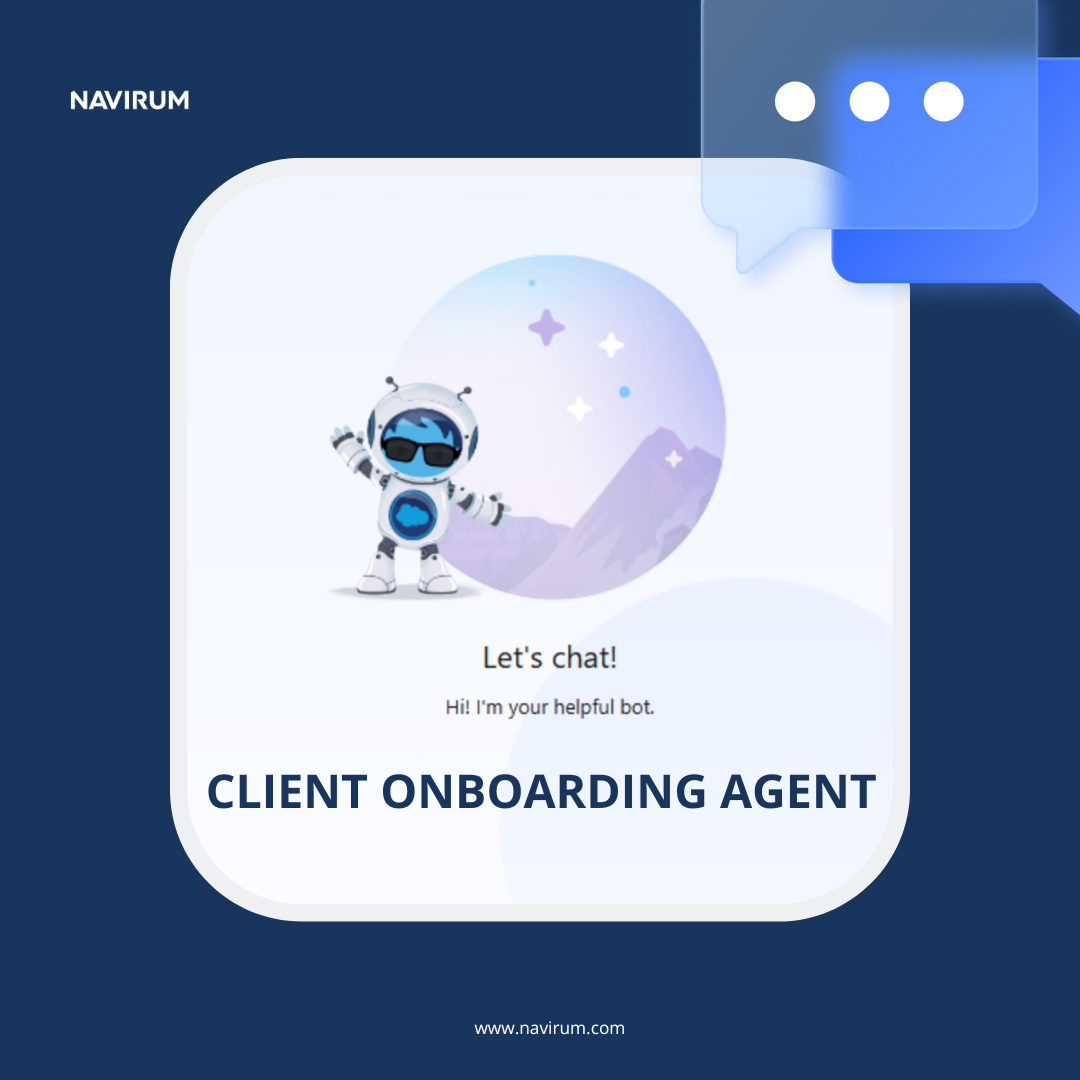
Account Onboarding
Automated client validation, KYC check pipelines, and document collection workflows.
Meeting Prep Briefs
Instantly query Unified Data Profiles to compile compliant pre-meeting strategic portfolios.

Portfolio Insights
Enable unified, real-time analytics to track portfolio drift, compliance exceptions, and active team pipeline metrics.
Proven Impact
We help wealth and asset management firms move from fragmented systems and manual processes to unified, intelligent, and scalable client relationship platforms powered by Salesforce.

Wealth Manager Cuts Back-Office Waste with Navirum and Salesforce
Agentforce for Wealth Management: FAQ
Straight answers on AI governance, compliance, portfolio integration, and cost for wealth and asset management firms evaluating Agentforce.
View all 12 questions
What Agentforce Can Do
What can Agentforce do for financial advisors?
Agentforce handles the operational and administrative work that consumes advisor time without adding client value. It can:
- Prepare comprehensive meeting briefs by pulling data from your CRM, custodian feeds, and portfolio systems in seconds rather than the 30 to 45 minutes it takes manually
- Draft follow-up emails and action items after client meetings
- Monitor portfolios for drift, life events, or service triggers and alert the advisor when action is needed
- Orchestrate client onboarding by routing documents, triggering compliance checks, and updating records without manual handoffs
- Triage inbound service requests by client tier, issue type, and urgency so nothing falls through the cracks
The result is more time spent advising clients and less time spent on data gathering and administration.
Will Agentforce replace financial advisors or client-service employees?
No. Agentforce is designed to augment your team, not replace it. The relationship between an advisor and their client is built on trust, judgment, and personal understanding — no AI agent replaces that. What Agentforce does is remove the operational friction that prevents advisors from spending more time on those relationships: data gathering, document routing, compliance checks, and administrative follow-up. Firms using Agentforce are not reducing headcount. They are increasing capacity and improving client experience without adding staff.
Can Agentforce prepare client-meeting summaries and follow-up actions?
Yes. This is one of the most popular and immediately impactful use cases. An Agentforce agent can compile a pre-meeting brief covering household overview, recent interactions, open service cases, portfolio performance, recent transactions, upcoming life events, and compliance notes. After the meeting, it can draft follow-up actions, next steps, and email summaries based on meeting notes or transcripts — the advisor reviews and approves before anything is sent. What used to take 30 to 45 minutes of manual preparation across multiple systems is reduced to seconds.
Can Agentforce use portfolio and custodian data?
Yes. Agentforce agents can access external data through Data Cloud connections, MuleSoft integrations, or direct API calls to custodians and portfolio platforms such as Schwab, Fidelity, Pershing, Orion, Addepar, and Black Diamond. This means agents can surface real-time holdings, account balances, performance data, transaction history, and billing information when preparing meeting briefs, generating alerts, or answering internal queries. Navirum designs the integration architecture so agents have access to the context they need while respecting data governance rules about what can be surfaced, to whom, and under what conditions.
Getting Started
Which wealth-management workflows are safest to automate first?
The best starting points are workflows that are high-volume, rules-based, and low-risk if an error occurs. Strong candidates include:
- Meeting preparation — read-only, the agent gathers and summarizes data but does not change anything
- Service request triage and routing
- Onboarding task orchestration — document checklist tracking, status updates, internal notifications
- Data quality monitoring — flagging missing fields, stale contact information, or incomplete KYC records
- Post-meeting follow-up drafting, reviewed by the advisor before anything is sent
These use cases deliver immediate time savings while keeping humans in control of all client-facing communication and financial decisions.
Do we need Financial Services Cloud and Data Cloud before using Agentforce?
Not necessarily, but both significantly improve what Agentforce can do. Financial Services Cloud provides the relationship structures (households, financial accounts, life events, advisor books) that make agents contextually aware of how your practice operates. Data Cloud unifies records from multiple systems into a single trusted profile that agents can reason over. Without them, agents are limited to whatever data already lives in standard Salesforce objects; with them, agents produce richer, more accurate, and more relevant outputs. Most FSC Enterprise and Unlimited clients already have Salesforce Foundations on their licence, which includes basic Data Cloud and Agent Builder capabilities. Navirum helps you determine whether activating these is a prerequisite or a future phase based on your specific use cases.
Governance, Compliance, and Risk
How do you prevent an AI agent from providing unauthorized financial advice?
Every Agentforce agent operates within explicitly defined guardrails configured during design. For wealth management, agents are prohibited from making investment recommendations, providing tax or legal guidance, or communicating anything that could be construed as personalized financial advice. Agents can gather data, summarize information, route tasks, and draft content for advisor review — but they cannot autonomously deliver advice to clients. These boundaries are enforced through Salesforce's trust layer, topic restrictions, and custom escalation logic. They are hard constraints, not suggestions.
When must an advisor or compliance employee approve an Agentforce action?
Escalation rules are defined during the design phase and tailored to your firm's compliance policies. Common escalation triggers include:
- Any outbound client communication (email, letter, or message)
- Any action that could be interpreted as a recommendation or solicitation
- Changes to client account records or financial data
- Exceptions flagged by compliance monitoring
- Any scenario where the agent's confidence is below a defined threshold
The principle is simple: agents handle preparation and orchestration autonomously, but anything client-facing or compliance-sensitive requires human approval before execution.
How are Agentforce interactions recorded and audited?
Every action an Agentforce agent takes is logged with full traceability: what was done, when, why, what data was accessed, and what output was produced. These logs are stored within Salesforce and accessible for compliance review, supervisory oversight, and regulatory examination. Navirum builds monitoring dashboards that track agent activity, escalation rates, error rates, and output quality. For firms subject to FINRA books-and-records requirements or SEC recordkeeping obligations, these audit trails provide the documentation needed to demonstrate that AI activity is supervised, governed, and compliant.
Can Agentforce support SEC, FINRA, and Canadian regulatory requirements?
Yes. Navirum designs Agentforce implementations with regulatory compliance built in from the start. For SEC-registered firms, recordkeeping, advertising review, and fiduciary documentation requirements are reflected in agent guardrails and audit trails. For FINRA-regulated broker-dealers, supervisory review workflows and communication archiving are embedded. For Canadian firms subject to CSA, IIROC (now CIRO), or provincial securities regulations, data residency, suitability documentation, and supervisory controls are addressed in the architecture. Compliance is not an afterthought — it is a design constraint that shapes how every agent is built.
Suitability, Cost, and Engagement
What size wealth-management firm is Agentforce suitable for?
Agentforce scales from boutique RIAs with a handful of advisors to large national wealth platforms with thousands of users. For smaller firms, a single focused agent (such as meeting prep or onboarding orchestration) can deliver immediate time savings with a modest investment. For larger firms, multiple agents can be deployed across different workflows, business lines, and client segments. The licensing model, implementation approach, and governance complexity flex to match your size, with a clear path to scale.
How much does an Agentforce implementation for a wealth firm cost?
Navirum works on a time-and-materials basis. A focused Agentforce Quickstart (single use case such as meeting prep, limited integrations) typically falls in the range of $15,000 to $40,000. A more comprehensive engagement involving multiple agents, Data Cloud setup, and integrations with custodians or portfolio platforms can range from $50,000 to $150,000 or more depending on scope. Every engagement begins with a scoped design phase where budget, timeline, and deliverables are agreed before build work starts. Post-launch, ongoing support and enhancement is provided through Orbit managed services on a flexible, month-to-month basis.