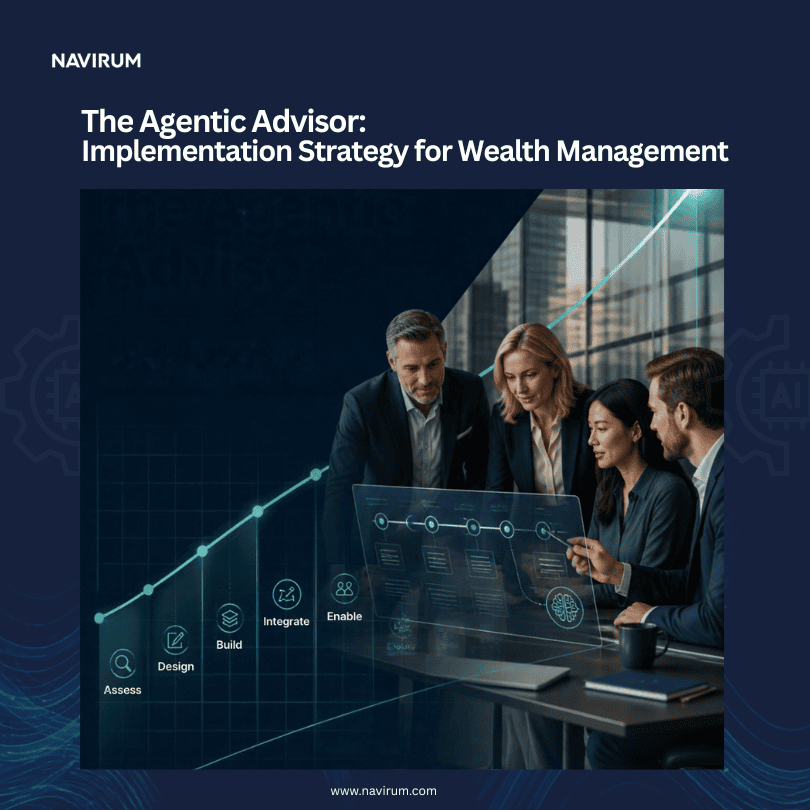
AI Summary
This article outlines a practical roadmap for wealth management firms to move from AI experimentation to production-ready agentic AI. Key topics include:
- Assess AI maturity: Evaluate data quality, system integrations, workflow readiness, security, and governance before introducing greater AI autonomy.
- Follow a 90-day implementation roadmap: Assess readiness and define use cases in days 1–30, build and test in days 31–60, and pilot and measure results in days 61–90.
- Choose the right implementation strategy: Determine whether to configure Salesforce and Agentforce, customize existing capabilities, buy a standalone application, or build a custom solution.
- Keep advisors in control: Use AI to consolidate information, prepare meeting briefings, and recommend actions while preserving human judgment and fiduciary oversight.
- Scale based on evidence: Measure advisor time saved, adoption, output quality, operational risk, and business impact before expanding deployment.
- Optimize continuously: Use advisor feedback and performance data to improve agent reliability, workflows, and long-term business value.
Key Takeaways
- Build the right foundations first: Trusted data, reliable integrations, clear permissions, and effective governance are prerequisites for successful agentic AI.
- Start with a focused use case: Prioritize high-value workflows, such as meeting preparation, client summaries, information retrieval, and follow-up tasks.
- Prove value within 90 days: Establish baseline metrics, test realistic scenarios, and use measurable outcomes to decide whether to scale, improve, redesign, or stop.
- Match technology to business needs: Choose the simplest architecture that meets requirements for functionality, security, integration, and total cost of ownership.
- Empower advisors, don’t replace them: Let AI reduce administrative work while advisors retain responsibility for client relationships and professional decisions.
- Scale gradually and responsibly: Expand from a small pilot to teams and business units only when performance, adoption, governance, and costs remain under control.
- Treat AI as an ongoing operating capability: Continuous monitoring, feedback, and optimization are essential to maintaining reliability and delivering sustainable business value.
The Path to Production Readiness
For wealth management firms, the core challenge with agentic AI is no longer simply understanding capability—it is bridging the gap between isolated experimentation and enterprise scale.
How do we move from an AI experiment to a production-ready capability that advisors can trust and the business can scale?
An effective strategy requires more than selecting a platform or building a demonstration. Firms need to understand their maturity level, establish a realistic implementation roadmap, and make deliberate decisions about what to configure, customize, buy, or build.
Unifying Wealth Management System Complexity
Advisors operate across heavily fragmented tech stacks daily. Agentic AI acts as the connective fabric:
CRM Systems
Portfolio Management
Financial Planning
Custodial Platforms
Document Vaults
Service Desk
Client Portals
Communication Channels
Foundational Prerequisite: AI connects this multi-system complexity effectively only when underlying data grounding, integrations, workflows, permissions, and governance frameworks are fully prepared.
The Three Strategic Implementation Questions
Execution Framework1. Where are we today?
Rigorously assess current organizational maturity, data quality, integration readiness, and existing workflow friction.
2. What can we realistically implement in 90 days?
Define tightly scoped, high-impact initial workflows that deliver quick advisor wins without overwhelming risk controls.
3. Configure, customize, buy, or build?
Make deliberate architectural decisions on technology sourcing to accelerate time-to-value while preserving enterprise control.
Start With the Agentic Advisor Maturity Model
Not every wealth management firm is ready for the same level of AI autonomy. The Agentic Advisor Maturity Model provides a structured framework to evaluate current readiness and chart a safe, progressive path toward scaled agentic execution.
Underlying Capability Progression
Technical FoundationStore
Clean, structured CRM data
Integrate
Unified multi-system context
Predict
Intelligent insights & prompts
Reason & Execute
Controlled agentic action
Fragmented
Foundational Preparation
Data and workflows exist across disconnected systems (CRM, custodial, planning, email). The priority is not deploying autonomous agents, but establishing core operational foundations.
Connected
Unified Client Context
Core systems work together with clear systems of record. Relevant CRM information connects seamlessly with portfolio, planning, service, and document platforms so advisors no longer assemble data manually.
Intelligent
Advisor Assistance & Insight
AI actively assists advisors by retrieving information, surfacing client insights, summarizing meeting briefs, and recommending next actions. The advisor retains full responsibility for all decisions.
Agentic
Controlled Autonomy
AI moves beyond insight to perform defined actions—preparing outputs, staging tasks, and executing specific workflows within strict boundaries (Read, Recommend, Prepare, Execute).
Orchestrated
Enterprise Operating Model
Multiple agents and workflows operate across the enterprise under a common governance model. AI becomes an integral part of the operating model rather than a series of isolated pilots.
Resist the Temptation to Jump to Autonomous AI: Agentic reasoning is only as reliable as the data, integrations, and permission architecture beneath it. Attempting stage 4 execution on stage 1 data foundations creates unacceptable fiduciary risk.
The 90-Day Agentic Advisor Roadmap
Once maturity is evaluated, moving from strategy to execution requires a structured pilot cadence. A 90-day implementation plan validates advisor value, safety, and operational fit before committing to enterprise-wide rollout.
The Strategic Objective: A 90-day pilot is not simply an exercise in building an agent—it is designed to conclusively prove whether the agent solves a meaningful advisor workflow problem reliably, safely, and measurably.
Days 1–30: Assess & Establish Foundation
Phase 01› Define High-Value Use Case
Target high-impact starting points combining data readiness and business value: meeting prep, CRM summaries, info retrieval, task staging, onboarding, or follow-ups.
› Document Current Workflow
Map systems accessed, manual handoffs, friction points, and time required today to build an accurate baseline before deploying AI.
› Map Data & Systems of Record
Identify data owners, critical elements, permission boundaries, and integration points to confirm what information the agent can reliably access.
› Assess Risk & Establish Baselines
Define failure modes (missing data, conflicts, escalations) and baseline metrics (prep time, systems opened, CRM completion) to quantify future ROI.
AI Readiness & Opportunity Assessment Report
Days 31–60: Build, Integrate & Test
Phase 02› Configure Agent & Permissions
Set instructions, data feeds, tools, and human escalation gates. Optimize for appropriate autonomy rather than maximum autonomy.
› Integrate into Salesforce FSC
Embed the agent directly into existing advisor UI (e.g., FSC) so “Prepare me for tomorrow’s client meeting” executes behind a single interface.
› Establish Autonomy Guardrails
Enforce explicit progression rules (Retrieve → Summarize → Recommend → Prepare → Execute) with mandatory approval gates on higher-risk steps.
› Stress-Test Real Scenarios
Evaluate performance under imperfect conditions: missing records, conflicting custodial feeds, ambiguous prompts, and unauthorized requests.
Functional Agent Prototype (Integrated & Stress-Tested)
Days 61–90: Pilot, Measure & Refine
Phase 03› Controlled Cohort Pilot
Deploy the agent to a focused pilot group (e.g., 10 advisors) to evaluate real-world utility and gather immediate feedback in daily practice.
› Track Value & Litmus Signals
Measure time saved, first-pass acceptance rate, corrections, and user feedback. Ask advisors: “If we turned this off tomorrow, would you want it back?”
4 Executive Governance Decisions at 90 Days:
1. Scale
Proved value; expand to firm.
2. Improve
Refine data or prompts.
3. Redesign
Adjust underlying architecture.
4. Stop
Value does not justify cost.
Capacity Reclamation & Executive Pilot Report
Build vs. Configure vs. Buy
Once a firm identifies high-value agentic use cases, leadership faces a critical architectural choice: Should we configure existing capabilities, customize Agentforce, buy a standalone application, or build a custom platform?
The 8-Factor Decision Matrix
Evaluation Framework| Consideration Factor | Key Executive Question |
|---|---|
| 1. Salesforce Investment | Can the existing environment already support the intended use case? |
| 2. Data Architecture | Where does the required information live, and is it accessible? |
| 3. Integration Complexity | How complex are the required connections across custodial and planning systems? |
| 4. Security & Permissions | What access control, entitlement, and audit requirements exist? |
| 5. Use Case Specificity | Is the workflow standard across wealth management or highly proprietary? |
| 6. Internal Capabilities | Does the firm have the technical expertise to build, maintain, and govern it long term? |
| 7. Governance & Telemetry | Can the solution be effectively monitored, audited, and controlled? |
| 8. Total Cost of Ownership | What will it cost to implement, operate, maintain, and scale over time? |
Keep the Advisor at the Center
Regardless of whether a firm configures, customizes, buys, or builds, implementation must remain anchored to the advisor’s actual workflow. Technology should absorb administrative friction while keeping the human advisor firmly in control of client relationships.
Traditional Meeting Prep
High FrictionAgentic Meeting Prep
Consolidated“Prepare me for tomorrow’s Smith household meeting.”
Automated Background Consolidation:
Absorbs Administrative Complexity
The agent connects systems behind the scenes, aggregates fragmented context, highlights anomalies, and stages prepared drafts—eliminating manual multi-app swivel-chair friction.
Owns Fiduciary Judgment & Relationships
The advisor reviews synthesized briefings, applies professional judgment, approves staged actions, and delivers empathetic, high-touch guidance directly to the client.
From Pilot to Production
A successful pilot should not automatically trigger an immediate enterprise-wide rollout. Expansion must be deliberate, measured, and systematically gated to maintain fiduciary control at every stage.
Deliberate Expansion Pipeline
Controlled Rollout10 Advisors
One Advisory Team
One Business Unit
Multiple Business Units
Enterprise Rollout
Stage-Gate Verification Framework
Mandatory CriteriaAt every transition stage, leadership must explicitly verify that all core metrics hold firm:
Data Quality Remains Consistent
Agent Performance Remains Stable
Adoption & Usage Remain High
Governance Scales Appropriately
Operating Costs Remain Predictable
User Experience & Speed Remain Strong
Operational & Fiduciary Risk Remains Strictly Controlled
The Multiplier Effect of Scale: Scaling AI does not simply multiply the number of active users—it exponentially multiplies the consequences of both success and failure. Unchecked scaling on unverified foundations magnifies risk across the entire firm.
The Continuous Improvement Loop
Production deployment should not mark the end of development—it creates an ongoing, virtuous cycle of refinement. Capturing advisor feedback in real time allows the firm to continuously optimize agent behavior based on actual field usage rather than static assumptions.
The Closed-Loop Feedback Cadence
Iterative RefinementAdvisor Uses Agent
Agent Produces Result
Accepts, Corrects, or Rejects
Feedback Is Captured
Data / Workflow Issue Identified
Agent or Process Improved
Performance Measured Again
Real-World Telemetry Over Assumptions
By capturing advisor edits, rejections, and manual overrides at the moment of interaction, the organization uncovers hidden data quality gaps, missing prompt context, and workflow bottlenecks that could never be anticipated in a sandbox environment.
Version 1.0 Is Never the Final Product
An agentic workflow is an evolving asset. Treating initial release as a starting baseline ensures that each iteration grows progressively more accurate, reliable, and aligned with fiduciary standards as advisor usage expands.
How to Know When You Are Ready to Scale
Scaling agentic AI across a wealth management firm requires an evidence-based trigger. Capital expansion should follow verified operational impact rather than synthetic demonstrations or pilot enthusiasm.
The True Scaling Signal: The strongest signal for enterprise deployment is not the number of successful internal demonstrations. It is tangible, repeatable, and measurable improvement in day-to-day business operations.
10 Empirical Evidence Signals
Verification MetricsBefore scaling, a firm should demonstrate a combination of these operational outcomes:
Advisor Time Reclaimed
Reduced Administrative Burden
Faster Meeting Preparation
Improved Information Retrieval
Higher Workflow Completion Rates
Strong, Sustained Advisor Adoption
Improved Client Responsiveness
Reliable & Consistent Output Quality
Controlled Fiduciary & Operational Risk
Predictable & Sustainable Operating Costs
“Did the agent measurably improve the way advisors work?”
If the answer is positive, measurable, and repeatable across pilot cohorts, leadership has the empirical justification required to expand deployment enterprise-wide.
The Implementation Strategy in One Framework
Moving from isolated AI experimentation to a sustainable, agentic operating model requires aligning maturity, execution speed, and architectural sourcing into a single unified framework.
1. Understand Your Maturity
Phase 01 • ReadinessEstablish the foundational data quality, systems-of-record integration, advisor workflows, permission boundaries, and governance controls required before advancing to higher levels of AI autonomy.
2. Prove Value in 90 Days
Phase 02 • ExecutionStart with a tightly defined advisor problem, establish baseline operational metrics, build within controlled boundaries, stress-test realistic scenarios, measure empirical outcomes, and make a clear scale-or-stop decision.
3. Choose the Right Architecture
Phase 03 • SourcingSelect the simplest architecture capable of solving the core business problem while satisfying enterprise requirements for multi-system integration, security, audit governance, scalability, and operating cost.
The Future of the Agentic Advisor
The future of wealth management will not be defined simply by how many AI agents a firm deploys. It will be defined by whether those agents are grounded in trust, embedded in real advisor workflows, and disciplined by clear business outcomes.
Essential Benchmarks of Enterprise Readiness
Success CriteriaBuilt on Trusted Data
Embedded in Real Advisor Workflows
Governed Appropriately
Designed with the Right Level of Autonomy
Measured Against Business Outcomes
Continuously Improved
The Real Implementation Opportunity
The most valuable agent is rarely the one performing the most flashy demonstration. It is the one that quietly eliminates hundreds of small, friction-filled administrative tasks every day:
Finding the Record
Reading the History
Checking the Status
Preparing the Meeting
Creating the Task
Drafting the Note
Remembering Follow-Up
Connecting the Dots
Create a More Capable Advisor
The goal is not to replace the advisor—it is to create a more capable advisor who spends less time searching for information and more time advising clients, building relationships, and applying professional fiduciary judgment.
The Path to an Operating Model
Implementing the Agentic Advisor: A Practical Roadmap for Wealth Management Firms
Transitioning your firm to an agentic operating model requires more than deploying technology. It demands a disciplined roadmap, grounded data architecture, and advisor-centric workflow design built for Financial Services Cloud.
1. Assess Maturity
Establish data quality, integration readiness, and permission boundaries before scaling autonomy.
2. Pilot Deliberately
Execute a controlled 90-day pilot with clear First-Pass Acceptance and capacity recovery baselines.
3. Scale Discipline
Deploy a central AI Control Tower to manage autonomy permissions, compliance, and enterprise TCO.

From AI Experiment to Business Value: Measuring and Scaling Agentic AI in Wealth Management
Part 6 – The Ageetic AI ROI

The Agentic Advisor: Governing AI Autonomy in Wealth Management
Part 5 — AI Governance, Autonomy & Risk Controls

The Agentic Advisor: Data Foundation and Quality in Wealth Management
Part 4 — Data Foundation & Quality

The Agentic Advisor: Architecting Salesforce and Data Cloud for Safe AI Deployment in Wealth Management
Part 3 — The Agentic Advisor Architecture
The Agentic Advisor: Architecting Salesforce and Data Cloud for Safe AI Deployment in Wealth Management
Part 2 — Main Challenges Faced By Advisors in Wealth Management

The Agentic Advisor: Architecting Salesforce and Data Cloud for Safe AI Deployment in Wealth Management
Part 1 — The Agentic Advisor Is Coming to Wealth Management
The Agentic Advisor: Architecting Salesforce and Data Cloud for Safe AI Deployment in Wealth Management
Download the white paper on building a unified data foundation, calibrating autonomy, and establishing risk-governed AI workflows.
Online Resources — Knowledge & Insights
Explore strategic perspectives, executive roadmaps, customer success stories, and deep dives into agentic AI implementations for wealth management.

Wealth Management Trends 2026: Challenges For Advisors and The Role of AI and Salesforce

Building the Agentic Financial Enterprise

Wealth Management Salesforce Success Stories
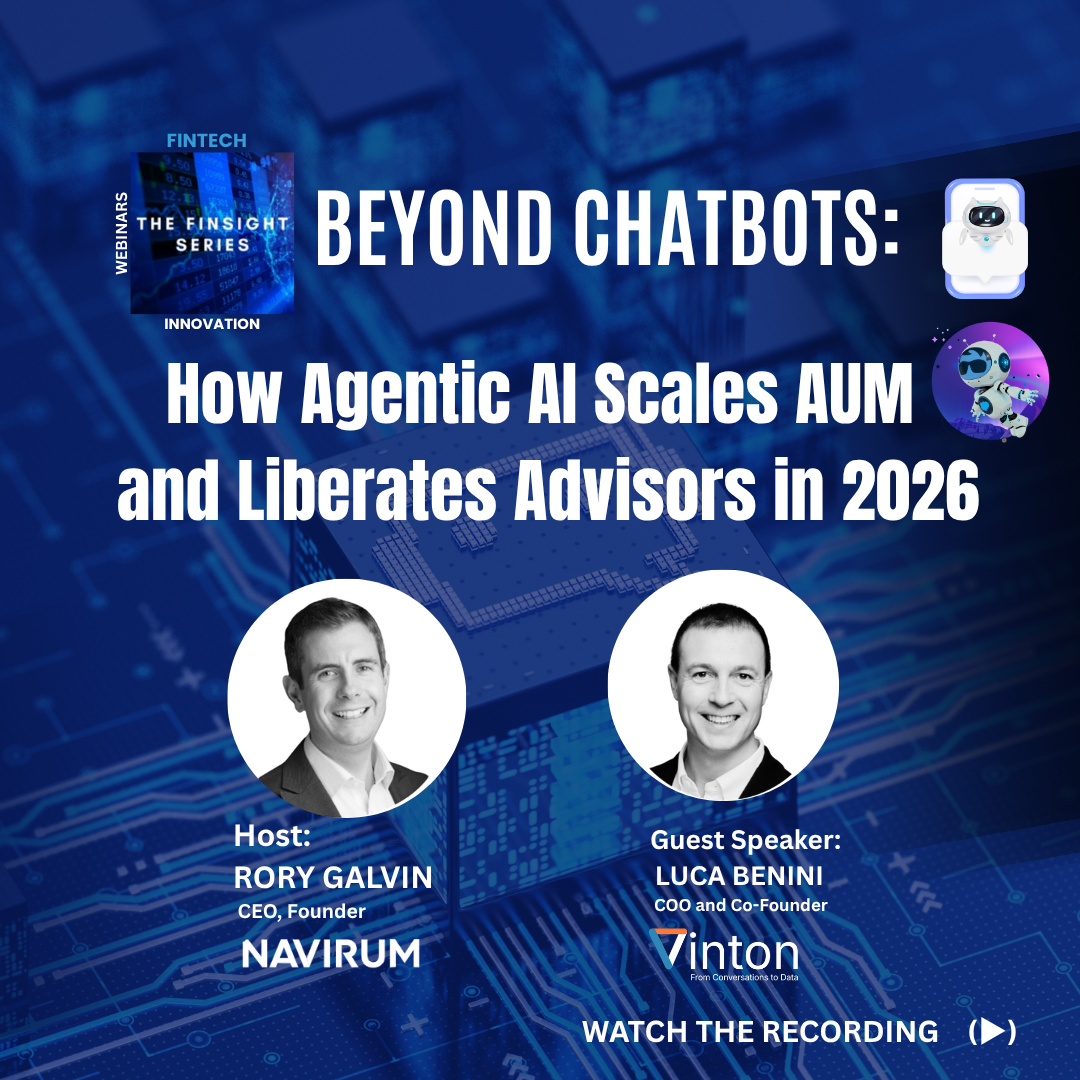

Join the conversation