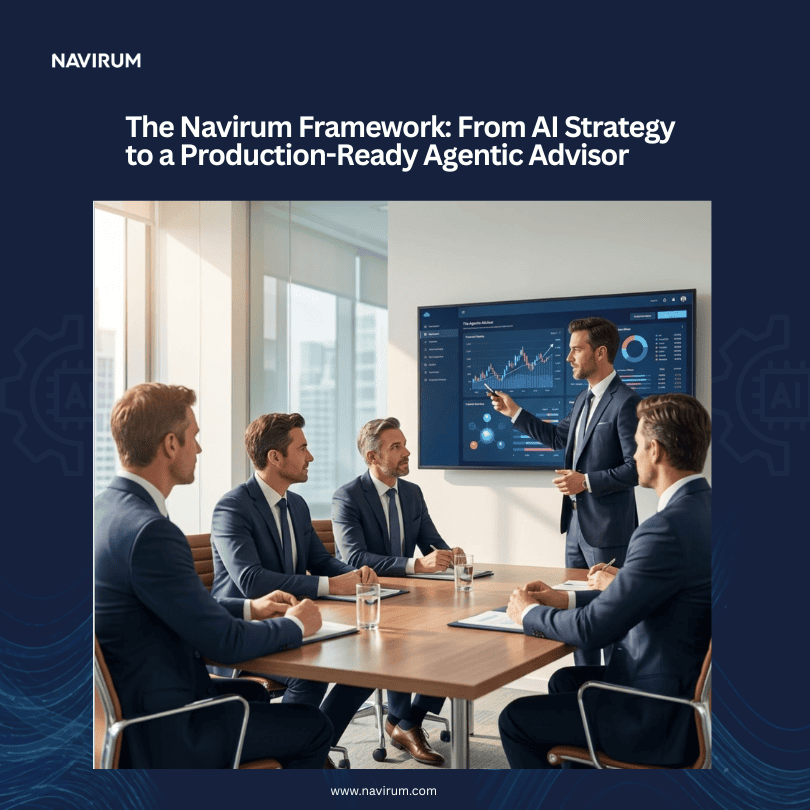
What Is The Navirum Agentic Framework?
Suggested Key Takeaways
- Start with the advisor, not the technology. Identify a specific workflow where AI can remove meaningful friction.
- Choose one high-value use case. Prioritize workflows based on business impact, frequency, data readiness, risk, and measurability.
- Build trusted data before deploying agents. Define systems of record, data requirements, permissions, and data quality.
- Architect for integration. Connect Salesforce, Data 360, Agentforce, and existing wealth-management systems without trying to replace every platform.
- Introduce autonomy gradually. Move from read and summarize to recommend, prepare, and eventually execute as trust and controls mature.
- Keep humans in the loop. Advisors remain accountable for judgment and higher-risk decisions.
- Pilot with real advisors. Test AI alongside existing processes and measure time savings, quality, accuracy, adoption, and trust.
- Govern AI throughout its lifecycle. Governance should be part of design, deployment, monitoring, and continuous improvement—not a final checkpoint.
- Scale based on evidence. Expand only after the first use case demonstrates measurable value and operational reliability.
- Start small, architect for scale. The objective is not one impressive AI demo, but a repeatable foundation for an agentic advisor operating model.
How Wealth Management Firms Move from AI Experimentation to Scale
Agentic AI is changing the conversation around technology in wealth management. The opportunity is no longer limited to using generative AI to answer questions or summarize information.
Expanding Capability & The Production Challenge
AI agents can increasingly retrieve information, reason across business context, prepare work, recommend next steps, and—within carefully defined boundaries—execute actions. This creates a compelling possibility: an advisor experience in which technology handles information processing and administrative work while the advisor remains focused on judgment, trust, and the client relationship.
Five Core Questions for Production Deployment:
Where should AI be applied?
What information should it access?
How should it interact with existing systems?
What execution authority should it hold?
How will the firm know if it creates value?
The Navirum Agentic Advisor Framework
5 Interconnected DisciplinesSixth Core Outcome: Measurable Value. Sequence matters. A firm should never begin with the agent and work backward toward the business problem.
The Disciplined Path to Production Scale
Begin with the advisor, understand the workflow, establish the data foundation, design the architecture, define autonomy, and embed governance before scaling:
Why an Implementation Framework Matters
The business case for agentic AI is clear: reducing administrative friction, automating meeting prep, accelerating retrieval, and surfacing high-priority client insights. However, identifying an attractive use case is only the beginning.
Connecting Capabilities to Outcomes
A successful production implementation requires far more than selecting an AI model or an agent platform. It demands an integrated connection across seven critical operational dimensions:
The Challenge: Fragmented Data vs. Human Judgment
10 Disconnected Data SourcesIn wealth management, an advisor’s work sits at the intersection of complex, fragmented information systems. A single client household relationship routinely spans:
Agentforce & Data 360 Contextual Grounding
Salesforce’s modern architecture positions Agentforce directly around business data, metadata, workflows, and governed actions, while Data 360 connects and contextualizes information across disparate sources to create trusted advisor context.
How do you turn fragmented enterprise information into a secure, useful, measurable agentic experience for advisors?
Answering this question requires moving beyond simple model availability to establish a disciplined, end-to-end framework that guarantees fiduciary control, data grounding, and sustainable ROI.
The Navirum Agentic Advisor Framework
To bridge the gap between AI experimentation and a production-grade operating model, wealth management firms must balance five core disciplines to deliver measurable enterprise value.
Advisor
Workflow-First Design
Data
Trusted Client Context
Architecture
System Integration
Agents
Appropriate Autonomy
Governance
Active Risk Controls
Measurable Value
The objective is not to deploy the most sophisticated agent—it is to create a meaningful, proven improvement in the advisor experience and demonstrate that improvement with evidence.
Pillar One: Start With the Advisor
The first step in an agentic AI initiative should not be selecting an agent—it should be understanding the advisor’s day. Executive process maps rarely reveal where information friction, duplicate entry, and administrative delays actually consume valuable relationship time.
The Flawed “AI Idea”
Begins with technology capabilities looking for a purpose. Leads to vague requirements, low advisor adoption, and difficult ROI measurement.
The True “AI Opportunity”
Begins with an explicit business problem and measurable time-loss. Provides a concrete workflow that can be designed, tested, and systematically improved.
Advisor Workflow Assessment Discovery Questions
Discovery FrameworkObserving the Advisor Through a Day
Mapping points where skilled professionals spend time on work below their highest-value expertise:
Prioritization & Review
How does the advisor determine which client households, alerts, and service cases require immediate attention?
Meeting Preparation
Which systems must be opened, and how much information is manually retrieved and assembled across platforms?
Client Interaction
How is client context referenced in real time, and how are new requests, action items, and financial notes captured?
Documentation & Staging
How are interaction notes, follow-up letters, task assignments, and CRM record updates processed?
Service Requests
How are ad-hoc client inquiries, custodial status checks, and operational follow-ups researched and resolved?
Remaining Backlog
How much administrative friction remains incomplete, creating spillover into evening or morning preparation?
Pillar Two: Choose the Right First Use Case
Not every AI opportunity should become the first production agent. High-impact starting points prioritize frequent, administrative tasks with manageable risk profiles—allowing the organization to validate advisor adoption before granting higher execution privileges.
Anatomy of an Ideal First Use Case
Initial production candidates must possess eight core operational characteristics:
The 1–5 Use Case Prioritization Scoring Matrix
Prioritization Model| Criterion | Key Prioritization Question |
|---|---|
| 1. Advisor Impact | Does the workflow meaningfully improve the day-to-day advisor experience? |
| 2. Task Frequency | How often does the target task occur across advisory teams? |
| 3. Time Consumption | How much administrative time does the task currently consume? |
| 4. Data Readiness | Is the required underlying information accessible, clean, and trustworthy? |
| 5. Risk Profile | How manageable and contained are the consequences of potential agent error? |
| 6. Measurability | Can baseline metrics and capacity gains be cleanly demonstrated? |
| 7. Scalability | Can the core workflow architecture eventually expand to support secondary use cases? |
Define the Agent’s Job Before Building It
Avoid vague directives like “Build an AI assistant.” Instead, define a precise job: “Prepare a concise, source-grounded briefing for an advisor before a scheduled meeting.”
What the Agent DOES:
What the Agent NEVER DOES:
The Production Agent Charter
Lifecycle GovernanceWhy does the agent exist?
Who can access & invoke it?
What information can it retrieve?
What tasks can it perform?
What can it never execute?
When must it route to a human?
Who is accountable for output?
How is success measured?
How frequently is it reviewed?
Pillar Three: Build the Data Foundation Before the Experience
An agent cannot create trustworthy context from unreliable or poorly understood information. Before building the user interface or prompt interactions, wealth management firms must map the minimum trusted data required for the workflow.
The “Connect Everything” Trap
Flooding the agent with excessive irrelevant data makes reasoning harder, increases latency, heightens security exposure, and creates unmanageable governance requirements.
Minimum Trusted Context
Maximizes output relevance while minimizing integration complexity. Expand the data footprint only when a use case proves additional context is genuinely required.
System of Record Architecture Definition
Authority Mapping| Information Domain | Authoritative System of Record |
|---|---|
| Client Relationship & Profile | Salesforce Financial Services Cloud |
| Household Structure & Entitlements | Salesforce Financial Services Cloud |
| Advisor Activity & Tasks | Salesforce Financial Services Cloud |
| Service History & Cases | Salesforce Financial Services Cloud |
| Portfolio Positions, Allocations & Performance | Portfolio Accounting Platform |
| Account Balances & Transactions | Custodial Data Feeds |
| Financial Plan Goals & Assumptions | Financial Planning Platform |
| Signed Client Agreements & Reports | Document Management Platform |
Minimum Trusted Context for Meeting Prep
Example data domains required for pre-meeting briefing generation:
3 Strategic Advantages of Purpose-Driven Data Access
1. Superior Agent Accuracy
Focusing strictly on relevant context eliminates noise and prevents hallucination during reasoning.
2. Heightened Security
The agent receives only authorized data, minimizing accidental exposure of sensitive enterprise records.
3. Reduced TCO & Latency
Fewer integrations and streamlined data movement accelerate execution speed while lowering costs.
Pillar Four: Design the Architecture Around the Workflow
The agentic advisor is not a standalone application—it is an orchestrated experience across your existing enterprise landscape. The goal is to coordinate the systems advisors rely on daily through a unified, secure architecture.
The Enterprise Orchestration Layer
Salesforce EcosystemBringing together platform capabilities around the specific advisor workflow:
› Salesforce FSC
Serves as the core CRM foundation for household structures, activities, and client relationships.
› Data 360
Connects data and business context across disparate enterprise systems to ground AI workflows.
› Agentforce
Provides the reasoning engine to build, test, and deploy autonomous AI agents.
› Salesforce Flow
Executes structured deterministic actions, approvals, and workflow updates safely.
› Integration Layer
Connects custodial feeds, portfolio systems, and document vaults in real time.
› Existing Wealth Tech
Coordinates financial planning and portfolio accounting platforms seamlessly.
Integrations Are AI Reliability Questions
In wealth management, integration quality directly dictates agent reliability. For every connected system, architecture teams must determine:
Security Design Before Deployment
“An agent should inherit the appropriate security and permission boundaries of the business process it supports.”
Before deploying an agent, security teams must resolve six explicit access controls:
Pillar Five: Introduce Autonomy Gradually
A production agent does not need to be fully autonomous on day one—and in wealth management, it frequently should not be. Advancing through a structured autonomy progression ensures each stage is supported by empirical proof before granting higher execution privileges.
The 6-Level Autonomy Progression Model
Controlled ProgressionRead
Agent retrieves authorized records across systems.
Summarize
Organizes, synthesizes, and explains client context.
Recommend
Identifies potential next steps and highlights anomalies.
Prepare
Creates staged drafts, pre-meeting briefs, or task updates.
Execute
Performs approved actions within bounded guardrails.
Optimize
Continuously evaluates feedback & refines performance.
🛡️ Human-in-the-Loop Design
Human oversight is not a temporary patch until technology improves—it is a core fiduciary design principle. The strategic goal is not eliminating humans, but focusing human judgment where it creates the highest value.
👁️ Shadow Mode Validation
Higher-risk workflows run initially in shadow mode. Proposed agent outputs are generated silently and compared against human decisions to catch edge cases prior to release:
Pilot With Advisors & Run Parallel Process Testing
Technical testing determines if code functions; advisor testing determines if it is useful. During pilots, run the AI-assisted process directly alongside traditional manual workflows to measure real-world performance:
Traditional Manual Process
Advisor logs into 6 applications, manually searches, copy-pastes context, and manually constructs meeting notes and follow-up tasks.
AI-Assisted Agentic Process
Advisor reviews single-prompt pre-meeting briefing staged by Agentforce, validates source links, and approves automated CRM follow-ups.
Empirical Evidence Measurement Matrix
Never scale based on an impressive demonstration alone. Establish a baseline before implementation and measure post-pilot change:
| Target Workflow Metric | Baseline (Pre-Pilot) | Post-Pilot Result |
|---|---|---|
| Meeting Preparation Time | 35 Minutes / Meeting | 15 Minutes / Meeting |
| Systems Accessed per Prep | 6 Fragmented Apps | 2 Unified Workspaces |
| Manual Data Searching | High Swivel-Chair Friction | Low / Automated Consolidation |
| Follow-Up Task Creation | 100% Manual Entry | Agent-Staged / Advisor Approved |
| First-Pass Acceptance Rate | Not Measured | > 85% Accuracy Threshold |
Go / No-Go Decision Gate Categories
Six mandatory thresholds required before approving enterprise expansion:
1. Productivity
Preparation time decreases by defined threshold.
2. Output Quality
Accuracy rate is high enough for consistent reliance.
3. Advisor Adoption
Advisors actively use workflow without reversion.
4. Risk & Security
Zero control violations or unauthorized data leaks.
5. User Experience
Advisors rate the tool as highly valuable.
6. Reliability
Consistent speed & uptime across scenarios.
10-Stage Production Agent Lifecycle
Enforcing governance across the full lifecycle prevents unmanaged AI sprawl:
Central Agent Registry Standard: Document name, purpose, business/technical owners, authorized user roles, data sources, permissions, risk classification, and review cadence in a central governance registry.
Scaling to an Agentic Workforce
Expand sequentially into adjacent specialized workflows sharing common governance standards:
Meeting Concierge
Prepares pre-meeting client briefs.
Follow-Up Agent
Creates post-meeting CRM actions.
Service Agent
Assists with service requests.
Knowledge Agent
Retrieves policy & process data.
Operations Agent
Automates admin workflows.
Prospecting Agent
Prioritizes pipeline opportunities.
A Practical 12-Month Agentic AI Roadmap
Translating the Agentic Advisor Framework into an actionable first-year implementation schedule ensures wealth management firms systematically progress from discovery to a fully governed enterprise operating model.
The 12-Month Agentic AI Implementation Schedule
First-Year TimelineDiscover & Pilot
Core Focus Areas:Optimize
Core Focus Areas:Expand
Introduce Additional Use Cases:Scale & Govern
Core Focus Areas:The Wealth Management AI Readiness Checklist
Before moving an AI agent into production, leadership should be able to answer “Yes” to each of the following foundational criteria across business, technical, operational, and fiduciary risk domains.
Production Readiness Verification Criteria
8 Core DomainsVerify every item across all eight categories before releasing an agentic capability to wealth advisors:
1. Business
2. Data
3. Security
4. Agent
5. Autonomy
6. Operations
7. Adoption
8. Measurement
Checklist Guidance: A “No” answer does not necessarily mean the use case should be abandoned. It simply signals that the organization needs to address a specific foundational gap—such as data accuracy, explicit guardrails, or ownership—before moving forward into production.

Is Your Firm Ready for The Agentic Advisor?
Benchmark your organization across 20 core requirements spanning Data 360 quality, Salesforce CRM adoption, AI governance, and executive alignment.
Start Small, But Architect for Scale
The first agent does not need to solve every advisor problem. By establishing reusable data, integration, and security patterns from day one, your initial investment turns a single AI project into a scalable enterprise platform.
From an AI Project to an AI Platform
Pattern ReuseA meeting-preparation agent establishes core architectural patterns that scale across adjacent workflows:
Drives Reusable Expansion Across:
7 Core Reusable Platform Foundations:
Who is the client?
Who is connected?
What info exists?
Who can access?
How interpreted?
What can it do?
What controls apply?
The Long-Term Vision: An AI-Enabled Advisor Desktop
Unified WorkspaceImagine an advisor beginning the day in Salesforce—where an intelligent workspace automatically surfaces priorities, exceptions, and context while technology handles information processing:
Transformation Happens One Workflow at a Time
Cumulative ProgressThe future is ambitious, but execution remains focused and step-by-step:
The Competitive Advantage Is Not the Agent
Execution ExcellenceHaving an AI model is no longer a differentiator. Long-term competitive advantage belongs to firms that execute better across eight core operational dimensions:
Build for Trust From Day One
Fiduciary FoundationTrust is the most valuable asset in wealth management. Trust cannot be added after deployment—it must be designed directly into the system across six pillars:
The Navirum Framework: The Complete Picture
The Agentic Advisor framework brings together six connected ideas into a cohesive strategy. Redesigning how advisors access information, prepare for client conversations, and execute follow-up requires aligning technology to the human relationship.
Six Connected Disciplines & Strategic Order
Framework Pillars1. Advisor
Start with the work advisors actually do every day.
2. Data
Create trusted, permissioned client context.
3. Architecture
Connect Salesforce, Data 360, Agentforce & enterprise systems.
4. Agents
Automate the work that can safely be automated.
5. Governance
Control data, access, actions, risk, & accountability.
6. Measurable Value
Prove that the new workflow is better than the old one.
The Strategic Sequence Principles:
From AI Ambition to a Production-Ready Operating Model
Enterprise ReadinessThe opportunity is no longer simply adding AI to Salesforce—it is building a production-grade operating environment across seven critical foundational layers:
Partnering with Navirum
Navirum helps wealth management organizations connect these pieces. The focus is not AI for its own sake—it is identifying where agentic AI removes meaningful friction from the advisor experience and building the technical and governance foundation required to make that improvement sustainable.
Start With One Workflow: Initial Execution Questions
Practical Starting PointA firm’s agentic journey does not need to begin with a massive transformation. Start with one workflow, one advisor problem, and one measurable outcome by addressing seven practical discovery questions:
Ready to Move from AI Experimentation to Scaled Operating Value?
Transitioning your firm to an agentic operating model requires a disciplined roadmap, grounded data architecture, and advisor-centered workflow design built for Salesforce Financial Services Cloud and Agentforce.
1. Evaluate Workflow
Identify high-friction advisor touchpoints and measure baseline preparation time.
2. Pilot Safely
Deploy a bounded 90-day pilot with shadow mode validation and advisor feedback loops.
3. Scale Discipline
Establish reusable security, data governance, and an Agent Registry across the enterprise.
Implementing Agentforce in Wealth Management?
Partner with Navirum’s Advisory Team.
The Agentic Advisor: Architecting Salesforce and Data Cloud for Safe AI Deployment in Wealth Management
Download the white paper on building a unified data foundation, calibrating autonomy, and establishing risk-governed AI workflows.
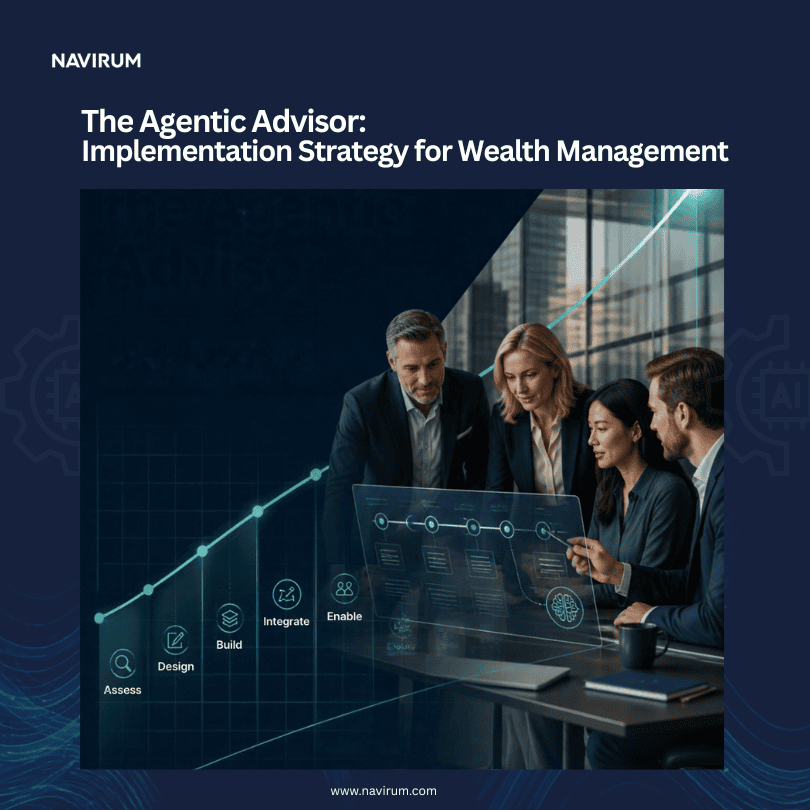
The Agentic Advisor Implementation Strategy for Wealth Management
Read Part 7 on building a practical roadmap, establishing data foundations, and scaling agentic AI across wealth management firms.

From AI Experiment to Business Value: Measuring and Scaling Agentic AI in Wealth Management
Part 6 – The Ageetic AI ROI

The Agentic Advisor: Governing AI Autonomy in Wealth Management
Part 5 — AI Governance, Autonomy & Risk Controls

The Agentic Advisor: Data Foundation and Quality in Wealth Management
Part 4 — Data Foundation & Quality

The Agentic Advisor: Architecting Salesforce and Data Cloud for Safe AI Deployment in Wealth Management
Part 3 — The Agentic Advisor Architecture
The Agentic Advisor: Architecting Salesforce and Data Cloud for Safe AI Deployment in Wealth Management
Part 2 — Main Challenges Faced By Advisors in Wealth Management

The Agentic Advisor: Architecting Salesforce and Data Cloud for Safe AI Deployment in Wealth Management
Part 1 — The Agentic Advisor Is Coming to Wealth Management
Online Resources — Knowledge & Insights
Explore strategic perspectives, executive roadmaps, customer success stories, and deep dives into agentic AI implementations for wealth management.

Wealth Management Trends 2026: Challenges For Advisors and The Role of AI and Salesforce

Building the Agentic Financial Enterprise

Wealth Management Salesforce Success Stories

Join the conversation