What Salesforce Financial Services Cloud Actually Covers for Compliance
Salesforce Financial Services Cloud embeds compliance directly into financial services operations through structured data models, KYC and identity controls, relationship intelligence (ARC), standardized Action Plans, and supervisory guardrails. Built on Salesforce’s Trust principles, it delivers enterprise-grade security, auditability, data residency transparency, and governance-ready AI. In a nutshell, FSC is a regulator-aligned, adaptable financial services compliance software platform that helps North American financial institutions scale innovation without compromising trust or compliance.
What FSC Provides vs. What You Still Own
Financial Services Cloud gives compliance and risk teams a strong native foundation, but it is a platform, not an automated compliance program. The table below separates what ships out of the box from what your firm still has to configure, govern, or file.
| Compliance Capability | What FSC Provides Natively | What You Still Configure or Own |
|---|---|---|
| KYC and Identity | Party Profile data model, identity verification fields, Caller ID matching | Your firm’s KYC policy, risk scoring rules, and refresh cadence |
| Audit Trails | Field-level history tracking, Shield Event Monitoring (add-on), login and access logs | Retention schedules, audit report packaging for examiners |
| Access Controls | Role hierarchies, permission sets, sharing rules, supervisory approval flows | Mapping controls to your actual org chart and licensing requirements (e.g. FINRA, IIROC) |
| Data Residency & Security | Regional data center options, encryption at rest and in transit, Salesforce Trust infrastructure | Confirming residency choices meet your specific regulatory jurisdiction |
| Regulatory Reporting | Reportable data captured in structured objects (Action Plans, Discovery Framework) | Building the actual regulator-ready reports and filing workflows |
| AI Governance | Einstein Trust Layer safeguards, audit logging for AI actions | Your firm’s AI use policy and human-in-the-loop review process |
Is your Salesforce FSC setup compliance-ready?
Get the Salesforce FSC Implementation Readiness Checklist, a practical checklist of the compliance controls a well-governed FSC org should have in place.
A Trust-First, Regulator-Ready Blueprint for North American Financial Institutions
Salesforce has become one of the most widely adopted enterprise platforms across banks, insurers, credit unions, wealth managers, and asset managers in North America. This is not accidental. Salesforce’s position has been earned by consistently operating at the highest levels of trust, security, compliance, and transparency, long before AI and digital transformation became board-level mandates.
In an era defined by regulatory change, heightened privacy expectations, operational resilience requirements, and accelerating AI adoption, financial institutions need more than innovation. They need defensible, repeatable, regulator-aligned systems. Salesforce delivers this through Salesforce Financial Services Cloud (FSC), an industry-specific platform designed to embed compliance directly into how financial institutions operate.
Salesforce Trust: The Non-Negotiable Foundation
Salesforce’s platform is anchored in its public Trust principles: Security, Availability, Privacy, and Transparency. Through Salesforce Trust , institutions and regulators can view real-time system status, historical uptime, incident communications, and data-center locations.
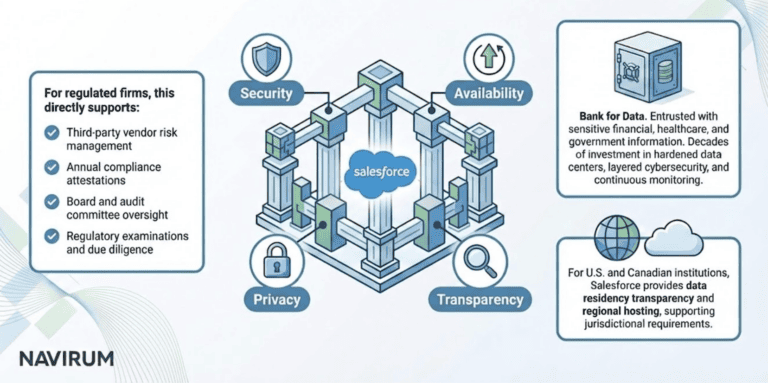
For regulated firms, this directly supports:
- Third-party vendor risk management
- Annual compliance attestations and SOC 2 audit reviews
- Board and audit committee oversight
- Regulatory examinations and due diligence
Salesforce can credibly be thought of as a bank for data, entrusted with some of the most sensitive financial, healthcare, and government information in the world. As one of the original innovators in enterprise cloud computing, Salesforce has invested for decades in hardened data centers, layered cybersecurity controls, continuous monitoring, and independent certifications.
For U.S. and Canadian institutions, Salesforce also provides data residency transparency and regional hosting, supporting jurisdictional requirements.
Need to assess KYC, audit trails, permissions, and supervisory workflows?
Request a quick FSC compliance readiness review. We’ll help you identify gaps before they become audit findings.
Mastering Financial Services Cloud
In modern financial services, “Customer 360” is no longer a buzzword. It is a regulatory and operational requirement. FSC extends Salesforce beyond generic CRM by providing industry-specific data models, workflows, and compliance controls that bridge front-office personalization with back-office governance.
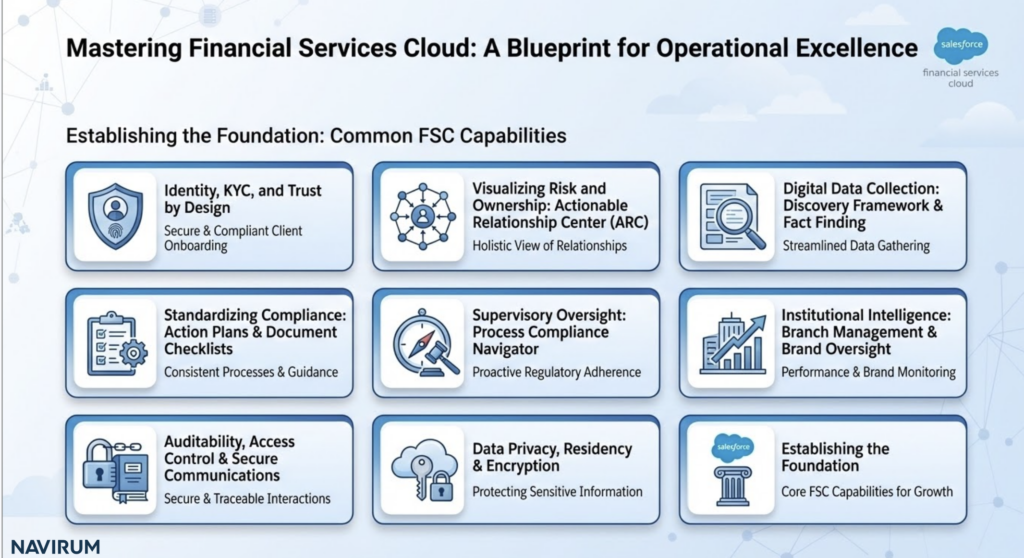
1. Establishing the Foundation: Common FSC Capabilities
Before advanced workflows can be implemented, institutions must understand FSC’s Common Capabilities. These foundational components allow Salesforce to natively model financial services operations.
Key elements include:
- Financial Account objects
- Household and relationship groupings
- Lead-to-Referral tracking
- Industry-specific record types and page layouts
These capabilities allow firms to operate in the language regulators and auditors expect, rather than forcing financial data into generic CRM constructs.
Getting this data model right the first time matters more than it looks. Our Salesforce consulting team maps legacy financial data into FSC correctly from day one, rather than leaving institutions to retrofit it later.
Admin Resource: Common Capabilities in Financial Services Cloud
2. Identity, KYC, and Trust by Design
KYC with Party Profile Assessment
Salesforce has significantly streamlined KYC and AML compliance through the Party Profile Assessment framework. This allows firms to capture regulatory data points directly within client and entity profiles, embedding KYC into onboarding rather than managing it as a separate compliance exercise.
This approach supports:
- Structured identity data capture
- Beneficial ownership tracking
- Review and approval workflows
- Auditable KYC status enforcement
KYC Deep Dive: Streamline the Know Your Customer Process For Your Users
Identity Verification & Caller ID
For service and contact-center interactions, FSC includes Identity Verification (Caller ID) capabilities. When a client calls in, agents are guided through verification questions tied directly to the client record, balancing security with client experience.
Identity Verification Setup: Caller Identity Verification
Together, these capabilities ensure identity controls are applied consistently across digital, branch, and call-center channels.
Streamline Onboarding
Transform digital onboarding for financial services with a solution designed specifically for the industry. Create a strong first impression while minimizing abandonment by simplifying applications through AI-driven insights and data integration. Automate manual tasks and connect systems to lower operational costs in what is traditionally a labor-intensive process.
Streamline Onboarding: Power client onboarding in financial services.
3. Visualizing Risk and Ownership: Actionable Relationship Center (ARC)
Modern AML compliance and risk frameworks require institutions to understand networks, not just individuals, including beneficial ownership tracking across related entities.
The Actionable Relationship Center (ARC) provides a visual, interactive map of relationships between people, households, trusts, and businesses. Users can immediately see ownership structures, affiliations, and exposure, and take action directly from the relationship view.
ARC supports:
- Beneficial ownership mapping
- Related-party risk identification
- Cross-entity exposure analysis
- Relationship-driven workflows
ARC Overview: Actionable Relationship Center (ARC) in Financial Services Cloud
This capability is particularly valuable for AML programs and complex wealth or commercial banking scenarios.
Mapping beneficial ownership and related-party risk by hand? See how an FSC compliance audit surfaces AML and KYC gaps before an examiner does. jump to the Readiness Review.
4. Digital Data Collection: Discovery Framework & Fact Finding
Manual data entry is one of the largest sources of operational risk.
Discovery Framework
The Discovery Framework allows firms to replace PDFs and spreadsheets with digital, validated forms. Data is captured once, validated in real time, and written directly into Salesforce, reducing errors and improving auditability.
Discovery Framework Guide: Fact Finding for Wealth Managers
Fact Finding Questionnaire
Built on the Discovery Framework, the Fact Finding Questionnaire enables wealth managers to capture comprehensive financial information about a client’s assets, liabilities, income, goals, and risk tolerance.
This data can then drive:
- Suitability assessments
- Needs analysis
- Portfolio recommendations
- Compliance reporting
Fact Finding Details: Discovery of Client Wealth Goals Using a Fact Finding Questionnaire
For credit unions specifically, this digital data collection layer is what turns member onboarding from a paperwork bottleneck into a same-day process. See our credit union digital transformation overview for what that looks like in practice.
5. Standardizing Compliance: Action Plans & Document Checklists
Action Plans
Action Plans are reusable templates that enforce repeatability across complex processes such as onboarding, lending, claims, or wealth planning. Each Action Plan defines tasks, owners, sequencing, and deadlines, ensuring consistency regardless of who executes the process.
Document Checklist Items
Financial services compliance depends on documentation. Document Checklist Items allow firms to define required document types (e.g., proof of income, ID, tax forms) and manage their review and approval lifecycle.
Document Management: Document Checklist Items in Financial Services Cloud
Together, Action Plans and document checklists transform compliance from institutional memory into system-enforced execution.
6. Supervisory Oversight: Process Compliance Navigator
The Process Compliance Navigator provides a visual roadmap of regulatory workflows, preventing users from skipping required steps. It acts as a compliance guardrail, ensuring disclosures, checks, and approvals are completed before progression.
This is particularly important for regulators who expect demonstrable supervision, not implied control.
Process Compliance Navigator: Article Here
7. Institutional Intelligence: Branch Management & Brand Oversight
Branch Management
For retail and advisory networks, FSC includes Branch Management capabilities. Executives can associate staff with branches, track performance, and monitor operational consistency across regions.
Branch Management Admin Guide: Branch Management
Tear Sheets
Tear Sheets provide concise, structured summaries of client information, relationships, recent activity, and key stakeholders. These are invaluable for executive reviews, client meetings, and regulatory examinations.
Tear Sheets Configuration: Tear Sheets Generation
8. Auditability, Access Control & Secure Communications
Salesforce enforces security through:
- Role-based access controls
- Field-level security
- Permission sets
A defensible Salesforce compliance audit trail, the kind SOX and internal audit teams expect to see, is supported through:
- Field History Tracking
- Setup Audit Trail
- Event Monitoring
All client interactions, calls, emails, meetings, trade instructions, and money movement requests, can be logged and retained. Secure SMS integrations further reduce off-channel communication risk.
Not sure your Salesforce audit trail would hold up under review? Talk to Navirum about your permission sets, field history tracking, and event monitoring setup. skip to Talk to a Specialist.
9. Transaction Dispute Management

Empower service agents with AI-driven tools that automate and streamline the dispute process. Reduce manual effort, minimize application switching, and simplify customer communication, all while lowering call volume and accelerating resolution for a more efficient, seamless experience.
- Dispute Resolution Email
- Dispute Ackowndgement Email
Fraud and dispute management is only half the picture. For the member-facing side of this problem, identity verification and synthetic fraud, see our breakdown of the fraud trends credit unions are facing right now.
10. Data Privacy, Residency & Encryption
As part of a broader Salesforce data governance program built to satisfy FINRA and SEC recordkeeping expectations, the platform supports GDPR and CCPA through:
- Consent management
- Data classification
- Retention policies
- Right-to-erasure workflows
With Salesforce Shield, firms gain:
- Encryption at rest
- Platform encryption
- Advanced monitoring
Data residency transparency and regional hosting options support U.S. and Canadian regulatory expectations.
AI Innovation Built on Trust, Not Trade-Offs
While many financial services firms are innovating rapidly with AI, trust and compliance remain the primary gating factors. Salesforce is building its AI capabilities on top of its long-standing governance foundation.
AI operates within: role-based access controls, audit trails, data residency requirements, encryption standards, human-in-the-loop oversight.

Unlike many AI-native vendors where governance commitments remain unclear, Salesforce places trust at the center of its AI strategy, making it suitable for regulated environments.
Built to Adapt as Regulations Evolve
Regulatory requirements will continue to change. Salesforce’s greatest advantage is adaptability. Because it is a configurable platform rather than a fixed compliance tool, firms can update workflows, approval chains, reporting structures, and controls without re-platforming.
This reduces:
- Vendor sprawl
- Cost of regulatory change
- Operational disruption
This is also the case for who monitors the platform day to day. Regulations, integrations, and Salesforce releases all keep moving after go-live, which is exactly what Orbit Managed Services is built to handle on an ongoing basis, not just at launch.
Final Perspective
Salesforce Financial Services Cloud is not just a CRM. It is financial services compliance software: a compliance-ready operating platform. Through structured data models, repeatable Action Plans, relationship intelligence via ARC, supervisory tooling, enterprise-grade security, and responsible AI governance, Salesforce has become the compliance backbone for many North American financial institutions.
In a market crowded with innovation, Salesforce remains the benchmark for trust, governance, and security at scale.
Related Reading
Salesforce FSC compliance: your questions answered
Wondering whether FSC is compliant out of the box? How it handles FINRA, SOX, KYC, and audit trails? Where your current setup falls short? These are the compliance questions we hear most.
View all 8 questions
Compliance coverage and capabilities
Is Salesforce Financial Services Cloud compliant out of the box?
No CRM is compliant on its own, and FSC is no exception. What FSC gives you is the building blocks for compliance: structured KYC and identity data, access controls, encryption, data residency options, and an audit trail. Compliance comes from configuring those controls against your specific regulatory obligations, which is the work we do with financial services firms.
How does Salesforce FSC support KYC and AML compliance?
FSC captures identity, beneficial ownership tracking, and relationship data in a structured model, then uses Actionable Relationship Center to visualise ownership and risk across related parties. Standardised Action Plans and document checklists make each KYC and AML step repeatable and evidenced, so nothing depends on one person remembering the process.
Can Salesforce FSC give regulators a complete audit trail?
Yes. With Salesforce Shield field audit trail, event monitoring, and access controls configured correctly, FSC records who changed what and when, and supports supervisory oversight of that activity. This is the kind of evidence SOC 2, SOX, and FINRA audit reviews expect to see.
FINRA, SEC, SOX and data privacy
How do I ensure FINRA and SEC compliance in Salesforce?
FINRA and SEC compliance in Salesforce comes from configuring supervisory workflows, communication capture, recordkeeping, and access controls to your obligations, then evidencing them. FSC supports supervisory oversight and secure communications; the compliance itself is in mapping those capabilities to FINRA and SEC books-and-records and supervision rules, which is where implementation experience matters.
Does Salesforce FSC support SOX compliance and access controls?
Yes. SOX is fundamentally about control over financial data integrity and who can access it. FSC’s permission model, field-level security, and audit trail provide the segregation-of-duties and change-tracking evidence a SOX review requires, once they are configured to your control framework rather than left at defaults.
How does Salesforce FSC handle data privacy, residency, and encryption?
FSC supports encryption at rest and in transit, data residency options, and Salesforce data governance tooling for consent and data handling. For North American and cross-border financial institutions, this means you can align the platform with privacy obligations across jurisdictions rather than treating privacy as an afterthought.
Working with Navirum
How do we find the compliance gaps in our current FSC setup?
A compliance readiness review maps your existing FSC configuration against KYC, audit-trail, permissions, and supervisory requirements and pinpoints exactly where the gaps are. If you would like Navirum to run one, you can request a readiness review lower on this page.
How long does a compliance-focused FSC implementation take?
It varies based on the complexity of your data and the number of systems you need to integrate, so there is no single answer that fits every firm. We scope a firm timeline in the first phase of the project, once we understand your current setup and obligations, so you are not committing to a date before the work is understood.
Find the compliance gaps in your Salesforce FSC setup
Talk to Navirum about FSC compliance, governance, and AI readiness, no cost, no commitment.