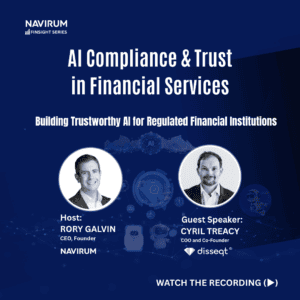
AI Compliance & Trust in Financial Services: Proving Your AI Agents Are Safe, Secure, and Compliant
What Does This FinSight Series Webinar Talk About?
AI agents are moving into real financial services workflows, but how do you know they’re behaving the way they should?
This on-demand FinSight Series webinar explores why the next challenge in enterprise AI isn’t simply building capable agents. It’s being able to test, monitor, control, and prove what those agents do in production.
Our guest speaker for this Finsight Series episode is Cyril Tracy, Co-Founder and COO ofDissect AI, and we’re delighted he has joined us for a practical conversation about AI assurance, security, governance, and regulatory readiness.
You’ll hear real-world examples from banking, insurance, and enterprise operations, including the risks of AI drift, hallucinations, prompt injection, over-permissioned agents, and weak production visibility.
What Is AI Assurance?
AI assurance is the technology and processes organizations use to make sure AI systems behave safely, reliably, and within defined boundaries.
For financial services organizations, this includes:
Testing AI agents before deployment
Red teaming and adversarial testing
Real-time monitoring and guardrails
Controlling agent permissions and access
Maintaining audit trails and production logs
Detecting unexpected behavior and AI drift
Supporting regulatory and compliance requirements
The goal isn’t to slow down AI adoption.
It’s to make production AI safer and more observable.
Why AI Agents Create New Risks
Unlike traditional software, AI agents can respond differently depending on the situation, the data they encounter, and the instructions they receive.
Agents can:
Hallucinate or generate incorrect information
Drift from expected behavior
Be manipulated through prompt injection
Access more data than necessary
Take actions outside their intended scope
Create new risks when connected to enterprise systems
For regulated financial institutions, the question is no longer just “Can we deploy AI?”
It’s “Can we prove what our AI is doing?”
What This Webinar Covers
In this on-demand session, you’ll discover:
Why AI agents drift, hallucinate, and go off-script
How to test agents using adversarial prompts and red teaming
What air-gapped AI infrastructure means for financial institutions
How validators and guardrails can control AI behavior in real time
Why production monitoring and audit trails matter
New risks created by voice AI, including prompt injection and bias
How chargeback and mortgage workflows can be automated while maintaining human oversight
Why over-permissioned agents can create significant security risks
How the EU AI Act is changing expectations around AI monitoring and evidence
AI Compliance Is Becoming an Ongoing Process
AI governance doesn’t end when an agent goes live.
Financial institutions need visibility into what their AI systems are actually doing in production—and the ability to produce evidence when something goes wrong.
As regulatory expectations evolve, organizations need to think about:
Monitoring
Documentation
Production logs
Evidence
Post-deployment oversight
Lifecycle compliance
Trust in AI needs to be measurable, observable, and provable.
What You Will Get
After accessing this webinar, you’ll receive:
Full on-demand recording
Real-world financial services examples
Practical AI assurance insights
AI testing and red teaming considerations
Guidance on monitoring and guardrails
Insights into AI security and regulatory readiness
Key Insight
The future of enterprise AI isn’t just about building smarter agents.
It’s about building AI systems that organizations can see, control, and trust.
As AI moves into increasingly important financial workflows, knowing what an agent did, when it failed, and how to stop it will become just as important as what the agent can accomplish.
Access the Webinar
Watch the full conversation with Cyril Tracy to learn how financial services organizations can move from AI experimentation to production with confidence.
AI Assurance in Financial Services: Proving Your AI Agents Are Safe, Secure, and Compliant
Get Access to the Webinar Recording!
F.A.Q.
<strong class="schema-faq-question">What is AI assurance?</strong>
AI assurance is the process of testing, monitoring, and validating AI systems to ensure they behave safely, reliably, and within defined boundaries throughout their lifecycle.
<strong class="schema-faq-question">How can financial institutions test AI agents before deployment?</strong>
Financial institutions can use adversarial prompts, red teaming, and specialized validators to identify vulnerabilities, unexpected behaviors, and potential failures before an AI agent reaches production.
<strong class="schema-faq-question">What risks can AI agents create in production?</strong>
AI agents can hallucinate, drift from expected behavior, follow malicious instructions, access excessive permissions, or take unintended actions. The webinar explores how monitoring and real-time guardrails can help manage these risks.
<strong class="schema-faq-question">Why are AI audit trails and production logs important?</strong>
Organizations need to know what an AI agent did, what information it accessed, and how it behaved. Audit trails and production logs provide visibility and evidence that can support investigations, governance, and regulatory requirements.
<strong class="schema-faq-question">What does the EU AI Act mean for AI agents?</strong>
The EU AI Act is increasing the focus on AI risk management, evidence, monitoring, and lifecycle oversight. The webinar explores why financial institutions need the ability to demonstrate how their AI systems behave—not just document how they are supposed to behave.
<strong class="schema-faq-question">What does the EU AI Act mean for financial institutions in North America?</strong>
The EU AI Act is increasing global expectations around AI risk management, monitoring, and evidence. While North America does not currently have a single equivalent regulation, financial institutions in the U.S. and Canada are also facing growing expectations around AI governance, transparency, security, and responsible deployment.
Ready to Move from AI Experimentation to Production? | Navirum
AI Implementation & Production Scale
Ready to move from AI experimentation to production?
Navirum helps financial institutions implement Salesforce, Agentforce, and AI solutions designed for real-world workflows—with the data, governance, and operational foundation needed to scale responsibly.
Salesforce Ridge Partner · ★★★★★ 5.0 on Salesforce AppExchange · 1,000+ Projects · North American Financial Services Specialists
By Rory Galvin · Published June 3, 2026 · Updated July 23, 2026 · 24 min read
Claude + Slack + Salesforce Integration
By Rory Galvin, CEO at Navirum Expert in Claude, Slack, Agentforce & Salesforce integration for wealth management · Salesforce Ridge Partner · 7+ years delivering trusted AI architecture to wealth managers across North America
What is the safest way to connect Claude, Slack and Salesforce?
Use Salesforce as the governance and trusted-data layer, Slack as the advisor interface, and Claude or another approved model as the replaceable intelligence layer.
Data processing: confirm where client information is sent and where model inference occurs.
Permissions: validate that Salesforce access controls govern what the model can retrieve and act on.
Identity: preserve the individual advisor’s identity rather than authenticating through a shared account or API key.
Auditability: log every request, response, action and exception in a form compliance teams can inspect.
Navirum designs Salesforce and AI architectures for regulated financial-services firms, with governance, integration and long-term model portability built in from the start.
Advisors want Claude in Slack. Here’s why the Salesforce governance foundation underneath matters more than the interface or the model, and how to architect it so Claude works in Slack, email, and Agentforce interchangeably, all governed by the same Salesforce data foundation.
Key Takeaways
AI does not solve messy data; it makes the mess faster and more confident.
The lasting competitive advantage is a Salesforce data foundation, not which model or interface you pick.
Trust comes down to four concrete boundaries: data travel, permissions, authentication, and audit trails, no matter where Claude is called from.
Testing and ongoing validation matter more than initial vendor selection, because models change, and your assurance process keeps you safe.
Financial services leaders should govern this as a data governance question, not a Slack, Claude, or tooling question.
Why advisors want Claude in Slack, and why that’s not the win
Many wealth firms are asking: “Should we connect Claude to Salesforce?” The right answer depends on a prior question they’re not asking: “Are we set up to give Claude a trusted data foundation, wherever advisors reach it from?”
Step back from any single product and the direction of travel is clear. We are moving toward a world where advisors do their work across many AI assistants and chat surfaces, Claude in Slack, ChatGPT in email, Agentforce inside Salesforce, where increasingly autonomous agents read, reason, and act on business systems on our behalf, and where the interface to your data is no longer a single application you log into. The number of front doors is multiplying. We cover how Slack itself fits into the unified Salesforce-Slack ecosystem in more detail elsewhere.
It is tempting to assume AI will simplify all of this. It usually does the opposite. Most financial services firms already have client information spread across:
CRM systems (Salesforce, legacy platforms)
Portfolio systems (Morningstar, Advent, Tamarac, eMoney)
Planning tools (Advyzon, Wealthtech suites)
Custodians (Schwab, Fidelity, TD, etc., separate logins, separate data)
Email (Outlook, Gmail, unstructured, unsearchable without human memory)
Spreadsheets (Excel, Sheets, the real source of truth for many firms)
Service platforms (Help desk, ticketing, communication history)
Data warehouses (If mature; most firms skip this layer entirely)
Claude in Slack adds one more interface on top of that already fragmented picture. It does not remove the fragmentation. In many cases, it exposes it, and it lets everyone act on it faster.
The fragmentation cost is concrete: an advisor opens Slack and asks Claude, “What’s the client’s current portfolio allocation?” If Claude is wired directly to the custodian API (or no API at all), it sees only the custodial view. It misses the separately held securities, the charitable accounts, the spousal IRA, the tax strategy documented in Salesforce. Claude gives a confident, incomplete answer. The advisor acts on it. The client gets poor advice, delivered fast, with no audit trail in Salesforce of what Claude said.
The good scenario looks different: Claude in Slack is wired to Salesforce, via Agentforce or a governed direct connection. When the advisor asks, Claude reads from the unified Salesforce view, the custodial holdings, the planning assumptions, the recent notes, the open tasks. Same question, same interface, complete picture. Salesforce logs the interaction: which advisor asked, what Claude returned, when.
This is the strategic problem leaders should be solving for: not which assistant to pick, or which chat surface advisors prefer, but how to give every one of them a single, trusted place to stand: Salesforce.
FIGURE 1 • AI GOVERNANCE ARCHITECTURE
How Salesforce Governs the AI Data Journey
Salesforce sits between your advisors and external LLMs to enforce permissions and audit trails.
Select a layer to explore
Advisor request
Salesforce identity, permissions & data controls
Approved model processing
Logged response
TIER 1
01. Front-End Interfaces
The digital surfaces where advisors and wealth managers trigger AI requests during their daily workflows.
Slack Channels & DMs
Outlook / Gmail Integrations
Advisor Service Consoles
Mobile Wealth Apps
Client Portal Chatbots
Planning Tool Dashboards
TIER 2 • CORE ASSET
02. Salesforce Governance Layer
The central governance layer that intercepts requests, authenticates the user, and enforces data boundaries before the model processes anything.
User Authentication & Identity
Field-Level Security Checks
Data Masking & Sensitive Controls
Dynamic Grounding (RAG)
Toxicity & Bias Filtering
Configured Interaction & Audit Logging
TIER 3
03. Model Processing
The secure environment where models generate responses using only permission-scoped data after validated controls.
Approved Claude Deployment Path
Approved OpenAI Deployment Path
Private Hosted Models
Agentic API Callouts
02 · THE TRUSTED FOUNDATION
The durable asset: Salesforce as the trusted data foundation
Here is the durable point. The technology underneath churns constantly; the obligations sitting on top of it do not. Your clients still need their data kept private and used appropriately. You still need an auditable record of who, or what, did what and why. You still answer to the same regulators against the same principles.
The models you read about today will likely have evolved significantly by next quarter. Your duty of care will not change.
Here’s the critical insight: Salesforce is where you should wire Claude, ChatGPT, or Agentforce, not the other way around. This isn’t about Salesforce versus other platforms. It’s about where the control surface lives. When Claude is connected to Salesforce, your governance rules, permission model, and audit trails are already in place. When Claude is wired directly to a custodian, Slack, or email, you’re building governance from scratch for every connection. None of this holds up without the data platform your foundation runs on underneath it.
For wealth management, Salesforce is the natural integration hub because field-level security already restricts what each advisor sees, sharing rules control access at the account and household level, audit trails log everything, and Financial Services Cloud is purpose-built for this. Salesforce provides the permission model that can govern Claude’s access, but inheritance must be explicitly validated for the chosen integration architecture..
The evidence is increasingly strong that this is an operating-model question, not a tooling one. IBM finds that 78% of C-suite executives now say achieving the maximum benefit from agentic AI requires an entirely new operating model, not merely a software update, yet 78% of AI investment to date has gone into improving existing processes. IBM reports that transformation-led organisations are 32 times more likely to reach top-tier business performance than those stuck in minimal implementation.
Bolting Claude in Slack onto today’s fragmented setup is the cheap move. Building the Salesforce foundation it stands on is the one that compounds.
The strategic asset, in other words, is not Claude, and it is not Slack. It is the trusted client database underneath both.
The independent research points the same way:
78%
of C-suite execs say agentic AI needs a new operating model, not just new software
IBM IBV, 2025-2026
32x
more likely for transformation-led firms to reach top-tier business performance
IBM IBV, 2025-2026
3x
more likely for AI high performers to redesign workflows instead of automating old ones
McKinsey QuantumBlack, Nov 2025
CIO Insight
Why Salesforce is the right governance center when advisors use Claude in Slack
Slack is the interface. Salesforce is the control plane. Betting on one model as your permanent AI layer is a losing strategy, so the governance center needs to outlast whichever assistant is fashionable this year.
Where Claude in Salesforce creates value, and where it destroys it
For wealth management leaders, the value of connecting Claude to Salesforce is never Claude itself. It’s what the integration lets your people do: prepare for client meetings faster using a unified Salesforce view, run compliance audits that cross Salesforce, custodian, and activity data, and know that every interaction is governed and audited because Claude is acting as your advisor, not around your advisor. The line between good adoption and poor adoption is sharp, and it is worth naming plainly.
Creates Value
Destroys Value
It’s wired through Salesforce, not around it, so data stays governed
Claude is wired directly to a custodian, email, or other external system, so governance lives nowhere
It inherits user permissions, so it can’t see what the advisor can’t see
Long-lived API keys authenticate “the Claude app,” not the user, and nothing is traceable
Every action is logged in Salesforce, giving a full audit trail for compliance
Model updates silently change behavior with no regression testing in place
It’s replaceable, so your test suite works for Claude today and a different model tomorrow
You’ve hardcoded assumptions about Claude’s capabilities and locked yourself into one model
Humans validate high-stakes outputs, the hybrid intelligence design
The uncomfortable truth: AI does not solve a messy data problem. It makes the mess faster, whether it’s answering in Slack, email, or Agentforce.
A confident assistant working from incomplete or ungoverned data does not give you better decisions; it gives you wrong decisions, delivered with conviction, at scale, wherever the advisor happened to ask the question. The quality of the Salesforce foundation sets the ceiling on the value of Claude in Slack.
This is also where the real performance gap opens up. McKinsey finds that AI high performers are nearly three times as likely as their peers to fundamentally redesign workflows from scratch rather than graft AI onto the process they already had. The value is not in answering faster inside a broken workflow. It is in rebuilding the workflow on a trusted Salesforce foundation so the answer, wherever it’s delivered, is worth having.
03 · TRUST BOUNDARIES
Where trust actually lives: the four integration boundaries
When you integrate Claude into Salesforce, the trust question resolves into four concrete control points. Being precise about each one is what separates a controlled deployment from an audit risk.
01 · Data Processing
Where client data travels, where inference occurs and which contractual or residency controls apply.
02 · Permissions
How Salesforce field-level security, sharing rules and user access govern retrieval and actions.
03 · Identity
How each Slack or AI request maps to a real, revocable Salesforce user identity.
04 · Auditability
How prompts, outputs, actions, exceptions and human reviews are logged and reconstructed.
1. Data travel and processing boundary
The strongest configurations keep the model’s processing inside the Salesforce trust boundary, so sensitive data is governed by the same controls, grounding, and filtering that already wrap your org, rather than being shipped to an external service. For regulated work this is the difference between a pilot and something compliance will approve.
Three model deployment paths
There is no single “best” configuration; the right one depends on data sensitivity, use case, and residency requirements. Verify the specific model, region, and hosting arrangement with Salesforce directly rather than assuming any one path applies by default.
Salesforce-managed model within the trust boundary: certain Salesforce-managed models, including supported Anthropic configurations, can operate within Salesforce’s trust boundary. When configured this way, data and processing remain inside Salesforce with no external API calls for inference.
External model through the Einstein Trust Layer: prompts pass to external model providers under Salesforce’s zero-data-retention agreements. Data is encrypted in transit and not retained by the provider, but processing briefly leaves Salesforce infrastructure.
Direct external API: data passes from Salesforce (or another system) directly to the model provider’s API. This carries the highest data exposure and needs its own review of retention, residency, authentication, and contractual protections.
When you evaluate any option, the first thing to establish is exactly where your client data travels and where the inference happens, whether the request came in through Slack or anywhere else. Ask your vendor:
Does all client data stay inside Salesforce infrastructure?
If external LLMs are called, what data is sent, and under what DPA?
Are there data residency requirements (e.g., EU data must stay in EU)? Does this configuration respect them?
Can you inspect the call logs to see what was sent where?
2. Permission model
Salesforce can ground Claude’s actions in a user’s existing permissions through secure configuration, but the actual access path depends on how Claude is called (Agentforce, native connector, custom integration), whether the integration uses a named credential, service account, or user delegation, and how any custom actions are scoped. “Salesforce permissions automatically apply to Claude” is not something to assume; it requires explicit architectural validation for your specific setup. Source: Salesforce Generative AI Trust Layer
3. Identity and authentication
Connections should authenticate through a proper, revocable mechanism such as OAuth, configured through a managed client app, so access can be scoped, monitored, and switched off. Avoid anything that depends on long-lived credentials pasted into a tool or a shared “Claude app” service account that authenticates as itself rather than as the advisor. The audit trail should be able to show which advisor asked Claude what, via which channel, and what Claude returned, not just “an API key performed an action.” If you cannot reconstruct what an agent did, you cannot supervise it.
4. Audit trails
Salesforce provides a foundation for centralised AI audit and feedback data, but teams must configure, validate, and monitor the specific logging their use case requires. What gets captured depends on the product (Agentforce, Einstein), the model path (Salesforce-managed vs. external), the action type, and your logging and data-collection settings. “All Claude interactions are logged by default” is not a safe assumption. Verify your logging configuration before relying on auditability as a control. Source: Salesforce Copilot Trust and Compliance
Key Risk
Silent model updates shift your risk posture faster than you can test
Claude in Slack without Salesforce governance means the audit trail lives nowhere, and a compliance audit discovers that later, not sooner. The mitigation isn’t picking the “safest” model once; it’s a regression suite you re-run every time a model updates.
Example: preparing an advisor for a client meeting
The framework becomes concrete when applied to an actual workflow. Here’s what a well-governed request looks like end to end.
Advisor initiates in Slack. “Prepare me for my 2pm meeting with the Smith household.”
Identity maps to a Salesforce user. The Slack message carries the advisor’s Salesforce user ID; Salesforce verifies identity and permissions before anything else happens.
Salesforce permissions determine retrieval scope. Claude queries only what that advisor can already see: the linked household account, associated holdings, recent meeting notes, and any outstanding compliance flags.
The model receives only grounded, permissioned data. No client data the advisor cannot see in Salesforce is included in the prompt.
The response includes sources and record links. A meeting summary, suggested talking points, links back to the underlying Salesforce records, and any compliance alerts.
No CRM changes without explicit approval. If Claude suggests logging a note or creating a follow-up task, the advisor approves it before anything is written back.
The interaction is logged per your audit configuration. Advisor identity, timestamp, records accessed, the response, and any actions taken, captured according to whatever logging you’ve configured, not assumed by default.
Exceptions route to a human. An unusual data request, a possible compliance concern, ambiguous permissions, or low model confidence gets escalated rather than answered.
This is what the four trust boundaries look like in practice: identity flows from Slack to Salesforce, permissions are enforced at the data-retrieval layer, the model operates inside the advisor’s existing data scope, human oversight covers anything high-stakes, and auditability is built in from the start rather than bolted on after.
The integration checklist: eight questions before you wire Claude to Salesforce
You do not need to be an architect to govern this well. Before connecting Claude to Salesforce, a leader should be able to get clear answers to eight questions:
Integration path: Is Claude wired through Agentforce, or directly to a Salesforce API? (Agentforce is simpler and more governed.)
Data residency: Does your data stay inside Salesforce infrastructure, or does Claude call external models? (Affects DPA requirements.)
User authentication: Is the Claude connection authenticated as the logged-in user, or via a shared API key?
Permission inheritance: Does Salesforce field-level security, sharing rules, and profile restrictions apply to Claude’s data access?
What Claude can do: Can it read only, or can it write back to Salesforce? (Write access needs stronger testing.)
Audit and logging: Is every Claude interaction logged in Salesforce’s audit trail, regardless of channel?
Who reviews exceptions: If Claude’s output looks wrong, who validates it before it’s used?
Regression testing: When Claude updates, how do you re-test the integration?
If those answers exist and hold up, you have a foundation you can build on. If they do not, you have a risk you have not priced yet.
04 · TESTING & VALIDATION
Testing the Claude + Salesforce integration: the discipline most firms skip
When you integrate Claude with Salesforce, you’re creating a new system. Testing has three phases. This is not a one-time exercise. It needs ongoing managed governance and regression testing every time the model or the workflow changes.
Compliance testing (first)
Verify Claude is wired where you think it is, logs should show Agentforce or Salesforce, not direct external calls. Deliberately attempt access that a given user should not have and confirm the connection refuses it. Confirm field-level security genuinely masks the fields you expect. Run your standard vendor-risk assessment against the integration exactly as you would against any system processing client information, because that is what it is.
Functional testing (second)
Agentic systems are probabilistic, so they need to be tested differently from deterministic software. Build real test cases: “Summarize this client’s holdings” (should pull from the Salesforce view, not just the custodian). Test write operations: “Update this client’s risk profile to Conservative,” does Salesforce accept it, log it, and honor the user’s permission? Test edge cases: ambiguous questions, requests Claude should refuse, requests for data Claude doesn’t have access to.
The single biggest contributor to business impact, McKinsey reports, is not raw model capability but “hybrid intelligence,” explicit, deliberate processes for when and how an AI’s output hands back to a human for validation. Confirm Claude flags confidence issues and routes to advisor review within the Salesforce workflow, not outside it. In a regulated firm that is not a nice-to-have; it is the supervision model.
Ongoing validation (continuous)
Anthropic updates Claude regularly, and Salesforce updates Agentforce. A connection that passed every test in January can behave differently in March because the underlying model changed. So your test set becomes a regression suite. Re-run it on a schedule and whenever anything in the chain updates:
Monthly minimum: re-run your functional test suite (representative tasks, edge cases, write operations)
After any model update: if Claude, GPT, or Agentforce updates significantly, re-test before relying on it
Quarterly for compliance: re-run data-residency and permission tests to confirm boundaries still hold
Ongoing audit log monitoring: watch for drift in access patterns, failed permission checks, or unexpected model behavior
Treat a change in behaviour as an incident to investigate, not a curiosity. Monitor Salesforce audit logs for unexpected behavior, Claude accessing data it shouldn’t, write operations without user permission, and treat model updates the same way you treat security patches: scheduled, gated, tested before production.
This is the strongest reason not to over-invest in any one configuration: the ground moves, and your assurance process, especially your hybrid intelligence design, is what keeps you safe.
Architecture and governance: Navirum’s view
There are several ways to wire Claude into Salesforce, and they suit different jobs. Some put the model inside a governed, customer-facing agent. Some give your team conversational, read-and-write access to the org from Slack or the tools they already use. Some are aimed at developers building on the platform.
The right starting point: name the problem, apply Salesforce governance, then let Claude be the replaceable part. See how firms like yours have applied this in practice.
Design the Salesforce governance layer first. Map what data Claude needs, define which user roles can ask which questions, design the integration point (Agentforce? Direct API?), and build the audit trail.
Build the Claude integration. Wire Claude, or ChatGPT, or Agentforce into the governance layer you just built. Test compliance, functional, and ongoing validation, the three phases above.
Plan for replaceability. Your regression test suite is your insurance policy. When a new model arrives, run the suite. If it passes, swap the model; if it fails, stick with the current one until the issue is fixed.
Navirum Perspective
The durable architecture is the governance layer, not the model
Navirum Perspective
<strong style="color:#fff;">Why this integration matters:</strong> advisors want Claude in Slack, they work there all day. Compliance needs governance in Salesforce, audit trails, permissions, logging. The firms that wire Claude in Slack through Salesforce will scale safely. The firms that wire Claude directly to custodians and APIs will rebuild governance for every new tool and every new advisor. The browser wars teach us this pattern: Netscape dominated, lost to Internet Explorer, which lost to Firefox, which lost to Chrome. Each had its era and believed it would be permanent. None were.
<strong style="color:#fff;">What this looks like at Navirum:</strong>
We start with Salesforce governance, not Claude’s capabilities or interfaces. Where do advisors work? What data do they need? Who can see what? What audit trail is required? Then we wire Claude in, via Slack, via Agentforce, into that governance layer.
We architect for multi-tool adoption. Claude in Slack today, ChatGPT in email tomorrow, Agentforce in Salesforce next year, governance stays the same: same Salesforce foundation, same permissions, same audit trail.
We test integration, not just models. The regression suite asks: does Claude in Slack still respect Salesforce field-level security? Does the audit trail still log every interaction? Do write-backs still honor user identity?
We build hybrid intelligence into the integration. For high-stakes decisions, Claude surfaces confidence and routes to human review within the Salesforce workflow, not outside it.
<strong style="color:#fff;">That is the real deliverable. Not a connection. A trust posture, and a data foundation, that outlive the technology.</strong> This is what shapes our M3 (Agentic AI) practice: governance-first, tool-agnostic architecture for wealth management, not interface chasing.
05 · FAQ & NEXT STEPS
Common questions: AI trust in Salesforce
Governance questions from wealth management leaders. Get quick answers on model selection, testing cadence, and compliance.
Architecture and Model Choice
Should we standardize on Claude for all our AI work?
No. Standardizing on a single LLM is a bet that Claude will be the market leader in 2027+. Historical cycles show this bet fails. That’s the same bet firms lost every prior platform cycle. Instead, design your Salesforce foundation for model-agnostic architecture: a single trusted data layer that any LLM can plug into without rebuilding the foundation.
Can we swap LLMs mid-implementation if we build this way?
Illustrative migration pattern, not a verified client example: a firm using Claude through Agentforce could move to a different model if it redesigns prompts for that model’s response patterns, re-tests tools and actions (models differ in tool-calling behavior), re-validates safety and latency, and runs both models in parallel during the transition. Model-agnostic architecture can reduce switching costs, but models are not perfectly interchangeable, Salesforce itself advises retesting prompts and actions whenever the selected model changes. This is why the foundation matters more than the model choice. The model will change. The foundation should not. Source: Salesforce Model Selection & Testing
Can we use this approach with Agentforce instead of Claude?
Absolutely. Agentforce is built on Salesforce, so the trust boundaries are already defined. The same eight-question checklist applies. Agentforce has some advantages (data stays inside Salesforce by default, permissions are inherited automatically), but you still need compliance testing and ongoing validation. The framework is the same whether you’re wiring Agentforce, Claude, or ChatGPT.
Compliance and Operations
Does this approach cost more than just wiring up Claude directly?
Initial setup is similar. The difference is in long-term ownership of risk. Wiring Claude directly costs less upfront but locks you in; wiring through Salesforce costs a little more but keeps you in control and makes future model changes routine. Most firms find the “control cost” pays for itself in the first model upgrade cycle.
What if our compliance team blocks this?
That is a signal you have not answered the eight-question trust checklist yet. Compliance teams block AI adoption that cannot be supervised. If you can show them the four boundaries are real (data doesn’t leave Salesforce, permissions apply, every action is logged, and you have a regression suite), most compliance teams will approve. Start with the trust checklist before you go to compliance.
How often do we need to re-test when models change?
Whenever a model version updates significantly (Anthropic’s Claude updates, OpenAI’s GPT versions, etc.) and whenever your connectors or Salesforce configuration changes. Many firms treat this as a quarterly discipline at minimum. Treat it the same way you handle security patching: scheduled, structured, and non-negotiable.
IBM Institute for Business Value, Agentic AI’s strategic ascent: Shifting operations from incremental gains to net-new impact (2025-2026). More than three-quarters of surveyed executives say their AI investment has gone strictly into optimising existing processes, while 78% of C-suite executives agree that realising the full benefit of agentic AI requires an entirely new operating model. The “transformation-driven” cohort pioneering net-new capabilities is reported to be 32 times more likely to reach top-tier business performance. https://www.ibm.com/thought-leadership/institute-business-value/en-us/report/agentic-ai-operating-model
McKinsey (QuantumBlack), The State of AI in 2025: Agents, innovation, and transformation (November 2025). Across nearly 2,000 organisations, the 6% of “AI high performers” (deriving 5%+ of EBIT from AI) are nearly three times as likely as their peers to redesign workflows from scratch rather than automate existing steps; intentional workflow redesign was among the strongest contributors to business impact. The study also identifies clearly defined governance for when model outputs require human validation as a primary differentiator between high performers and firms stuck in pilots. https://www.mckinsey.com/capabilities/quantumblack/our-insights/the-state-of-ai-in-2025
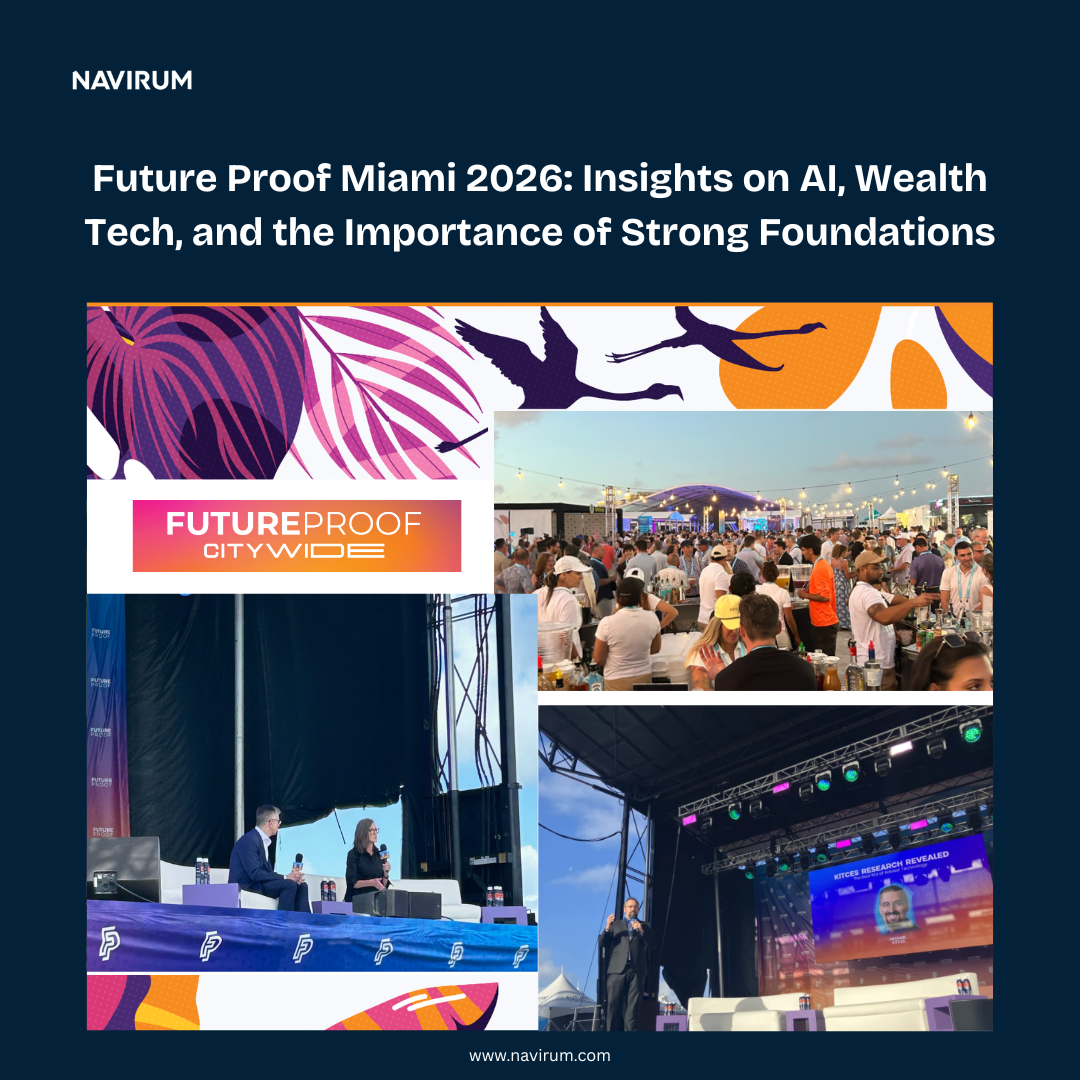
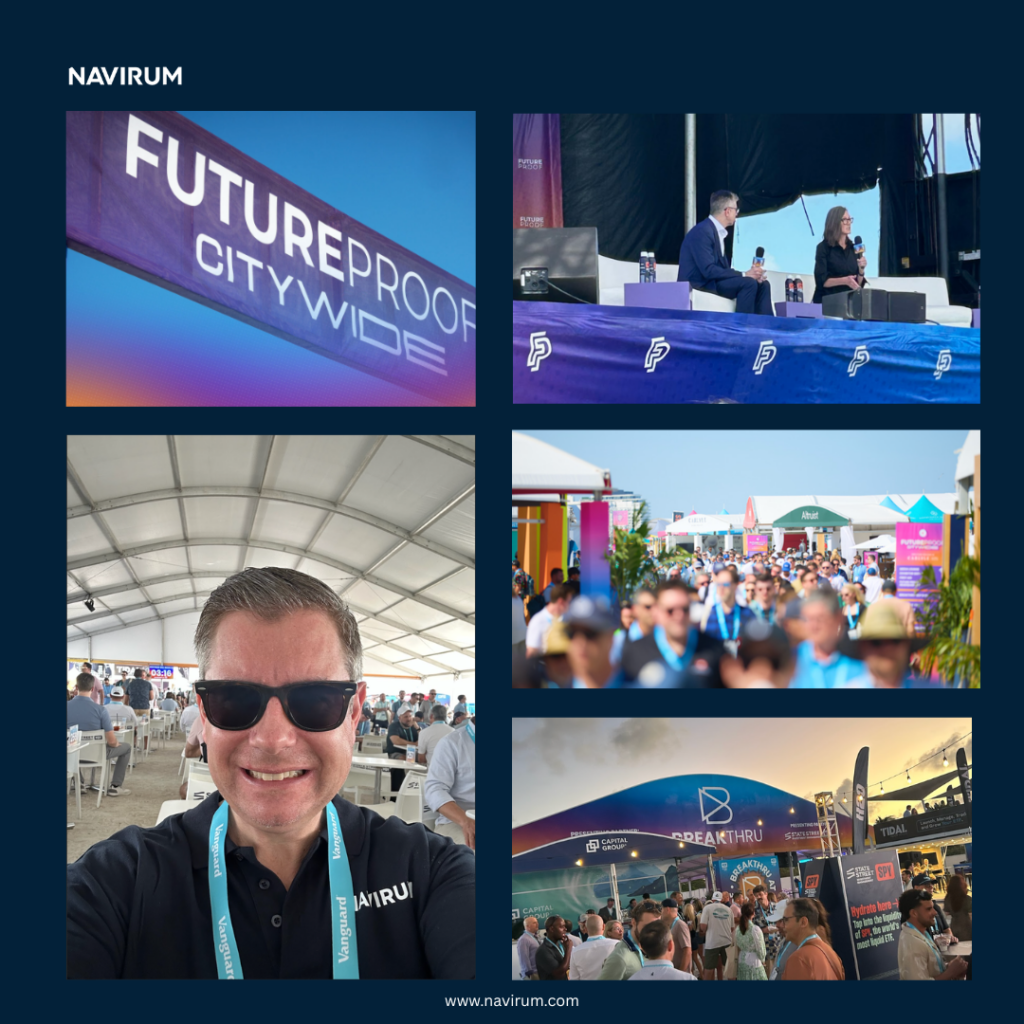
Future Proof Festival (Citywide) is a high-energy, in-person gathering that brings together advisors, technology providers, and leaders across the wealth management industry. It serves as a platform for real conversations, focusing less on pitching and more on sharing insights, challenges, and strategies. The event acts as a pulse check on the industry, with key themes like AI adoption, data strategy, and operational execution shaping discussions. Practical innovation stands out, particularly around improving advisor productivity and enhancing the client experience. Ultimately, FutureProof provides a space for collaboration where the future of wealth management is shaped through peer exchange and lived experience.
FutureProof Miami — industry reflections from Navirum
Sun, sand, music—and most importantly, meaningful conversations. At this year’s Future Proof Festival in Miami, the energy across the wealth management industry was unmistakable. Attendance was strong, conversations were constant, and the overall momentum felt like a clear signal: the industry is not just back, it’s evolving quickly.
Attending a major industry event such as FutureProof enables us to stay close to the real challenges financial advisors and firms are facing. Beyond the setting, what matters most is the opportunity to listen, exchange ideas, and better understand where the industry is heading.
A return to in-person engagement—and meaningful dialogue
Across packed schedules and fast-moving meetings, one thing stood out: the value of face-to-face interaction. Formats like short “breakthrough sessions” encouraged more listening than pitching—creating space for genuine, high-value conversations.
For advisors and firms navigating constant change, these moments of focused dialogue are critical. They allow leaders to step back from day-to-day operations and engage with peers facing similar challenges.
AI: high interest, evolving direction
Unsurprisingly, artificial intelligence was one of the most discussed topics throughout the event.
Across firms ranging from $500M to $50B in AUM, the level of interest is high, but direction is still forming. Many organizations are actively exploring AI but are still defining what practical implementation looks like in their specific context.
The common sentiment: opportunity is clear, but the path forward is not always.
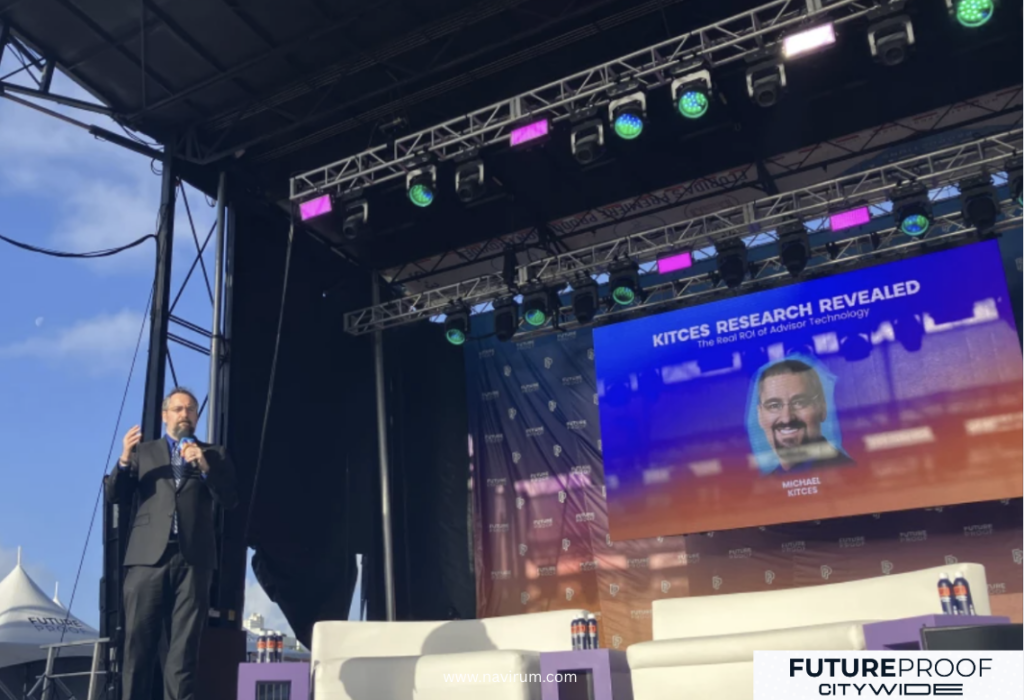
Great insights from Michael Kitces on how to drive improved advisor margins through greater productivity.
The “final mile” challenge in wealth tech
Another recurring theme was execution.
Many solutions today feel close to complete—but not fully operationalized within real-world environments. That last step—embedding technology into compliant, client-facing workflows—is often the hardest.
In wealth management, innovation must move at the pace of trust. Accuracy, compliance, and reliability are non-negotiable, especially when dealing with client assets, transfers, and regulatory oversight.
Foundations first: data, governance, and architecture
One of the most consistent insights across conversations was the importance of strong foundations.
Many firms are still navigating complex, fragmented technology ecosystems, where data is spread across:
Custodians
Portfolio management systems
CRM platforms
Compliance tools
Reporting solutions
Bringing this data together into a unified, reliable foundation remains a top priority.
At the same time, governance is becoming just as critical. As AI tools become more embedded in daily workflows, firms need clear policies to ensure safe, compliant usage across teams.
Without these foundations, scaling AI effectively becomes extremely difficult.
Practical AI use cases are leading adoption
While AI hype is everywhere, the most impactful use cases today are grounded in practicality. The strongest adoption is happening in areas such as:
Enhancing client meetings
Automating internal workflows
Supporting advisors with real-time insights
Strengthening CRM and data processes
Solutions like Zocks.io et Jump.io are gaining traction for advisor productivity, while Wealth.com and Vanilla were present with strong AI offerings on the estimate management front. As well as reporting and portfolio management products like Addepar with their new AI solution Addison working along side the platform itself.
The key takeaway: AI amplifies what already exists. Strong organizations see strong results.
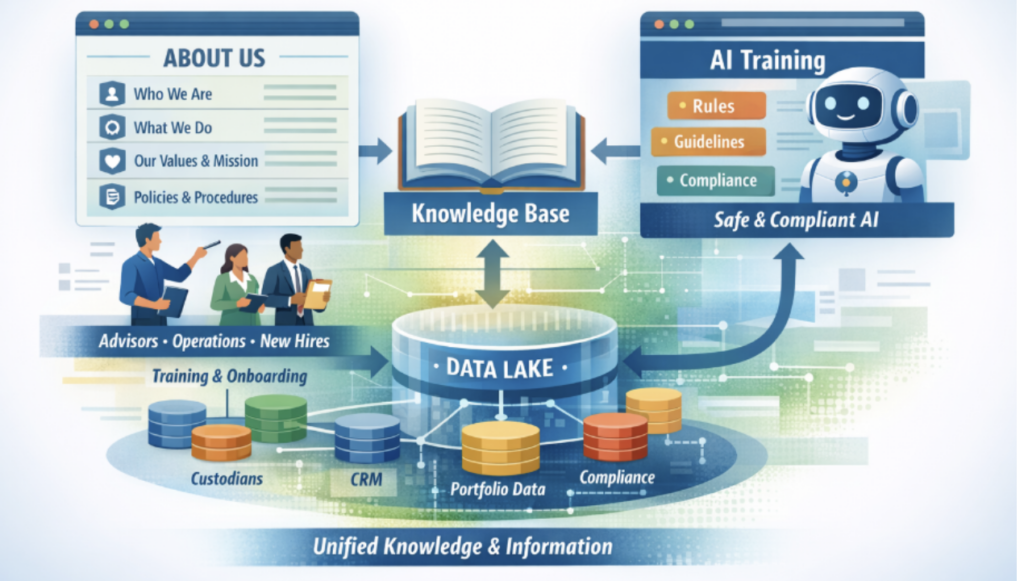
A particularly important trend is the growing focus on structured internal knowledge.
Firms are increasingly recognizing the need for centralized knowledge bases—not just for training employees, but for enabling consistent, compliant AI usage.
These systems serve as:
A source of truth for processes and procedures
A training environment for advisors and operations teams
A foundation for AI agents to operate safely within firm guidelines
In many cases, this is evolving toward broader data strategies, including integrated data lakes that unify knowledge and operational data.
Advisors need knowledge bases to empower AI.
The common thread: fundamentals still win
Across all discussions—AI, integration, operations—one theme remained constant:
Success depends on strong fundamentals.
Clean, reliable data
A single source of truth
Clear processes and governance
AI is not a shortcut around these—it depends on them.
Why events like this matter
For Navirum, events like FutureProof are more than networking opportunities. They are a way to stay deeply connected to the realities of financial advisors and wealth management firms.
The most valuable insights don’t come from presentations—they come from conversations:
Leaders comparing approaches
Teams sharing lessons learned
Firms exploring what’s next together
In a rapidly evolving landscape, that exchange of ideas is what drives real progress.
Looking ahead
As the industry continues to evolve, one thing is clear: technology alone is not the differentiator—how firms implement, govern, and operationalize it is.
We’re continuing these conversations with advisors and firms across the industry, helping translate these trends into practical, scalable strategies.
If you’re navigating similar challenges around AI, data, or platform integration, we’re always open to continuing the discussion.
What Salesforce Financial Services Cloud Actually Covers for Compliance
Salesforce Financial Services Cloud embeds compliance directly into financial services operations through structured data models, KYC and identity controls, relationship intelligence (ARC), standardized Action Plans, and supervisory guardrails. Built on Salesforce’s Trust principles, it delivers enterprise-grade security, auditability, data residency transparency, and governance-ready AI. In a nutshell, FSC is a regulator-aligned, adaptable financial services compliance software platform that helps North American financial institutions scale innovation without compromising trust or compliance.
What FSC Provides vs. What You Still Own
Financial Services Cloud gives compliance and risk teams a strong native foundation, but it is a platform, not an automated compliance program. The table below separates what ships out of the box from what your firm still has to configure, govern, or file.
Compliance Capability
What FSC Provides Natively
What You Still Configure or Own
KYC and Identity
Party Profile data model, identity verification fields, Caller ID matching
Your firm’s KYC policy, risk scoring rules, and refresh cadence
Audit Trails
Field-level history tracking, Shield Event Monitoring (add-on), login and access logs
Retention schedules, audit report packaging for examiners
Access Controls
Role hierarchies, permission sets, sharing rules, supervisory approval flows
Mapping controls to your actual org chart and licensing requirements (e.g. FINRA, IIROC)
Data Residency & Security
Regional data center options, encryption at rest and in transit, Salesforce Trust infrastructure
Confirming residency choices meet your specific regulatory jurisdiction
Regulatory Reporting
Reportable data captured in structured objects (Action Plans, Discovery Framework)
Building the actual regulator-ready reports and filing workflows
AI Governance
Einstein Trust Layer safeguards, audit logging for AI actions
Your firm’s AI use policy and human-in-the-loop review process
FSC Compliance Readiness
Is your Salesforce FSC setup compliance-ready?
Get the Salesforce FSC Implementation Readiness Checklist, a practical checklist of the compliance controls a well-governed FSC org should have in place.
A Trust-First, Regulator-Ready Blueprint for North American Financial Institutions
Salesforce has become one of the most widely adopted enterprise platforms across banks, insurers, credit unions, wealth managers, and asset managers in North America. This is not accidental. Salesforce’s position has been earned by consistently operating at the highest levels of trust, security, compliance, and transparency, long before AI and digital transformation became board-level mandates.
In an era defined by regulatory change, heightened privacy expectations, operational resilience requirements, and accelerating AI adoption, financial institutions need more than innovation. They need defensible, repeatable, regulator-aligned systems. Salesforce delivers this through Salesforce Financial Services Cloud (FSC), an industry-specific platform designed to embed compliance directly into how financial institutions operate.
Salesforce Trust: The Non-Negotiable Foundation
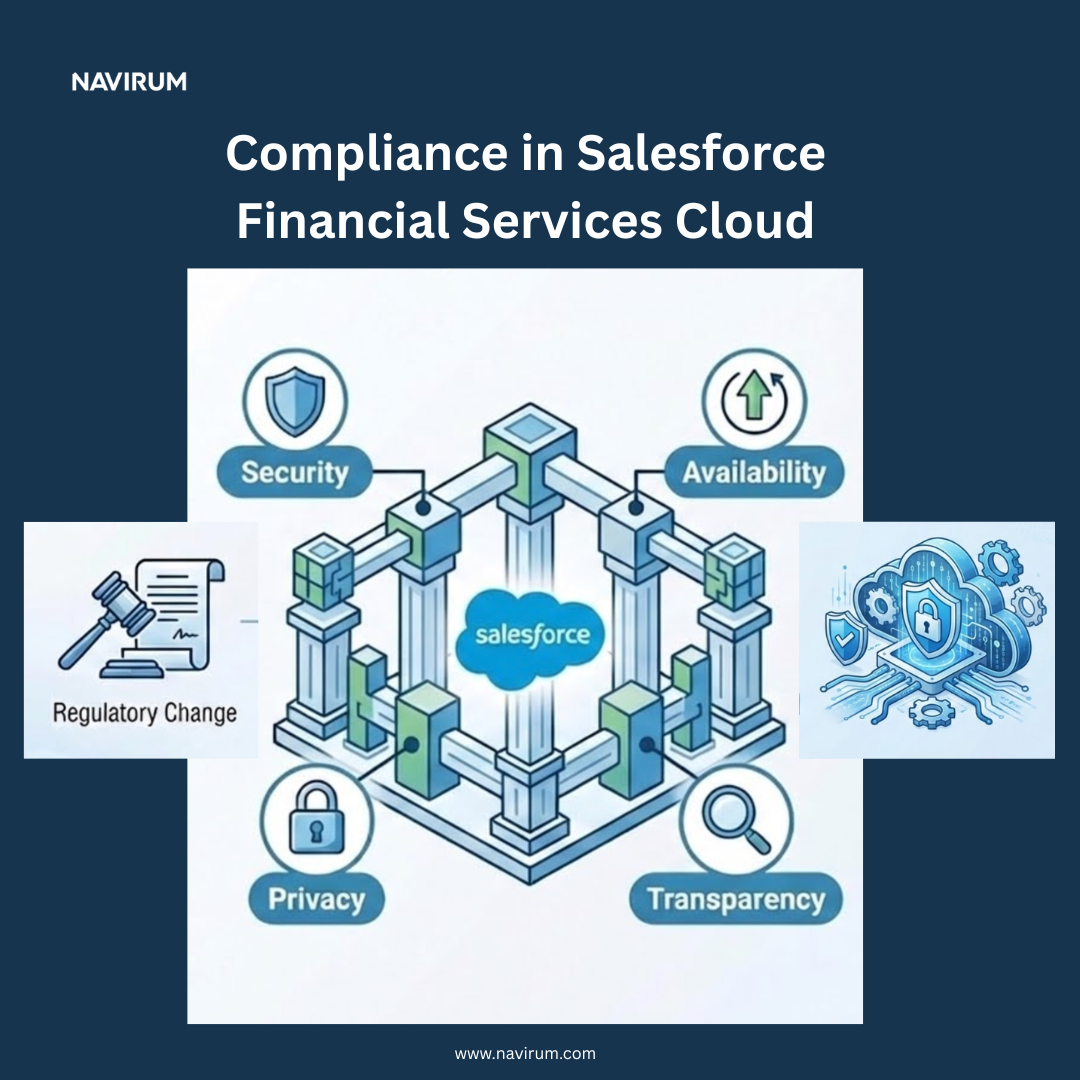
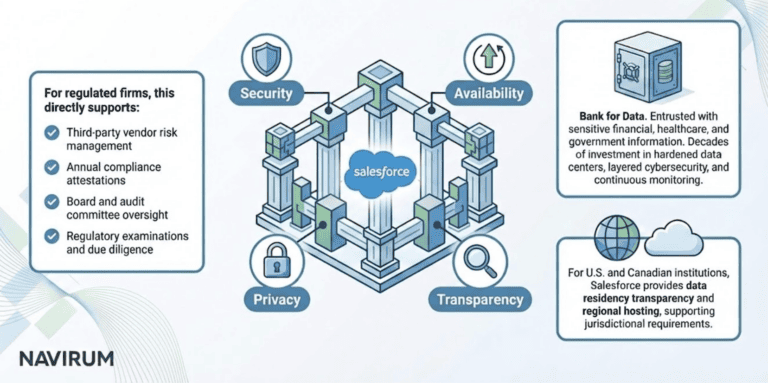
Salesforce’s platform is anchored in its public Trust principles: Security, Availability, Privacy, and Transparency. Through Salesforce Trust , institutions and regulators can view real-time system status, historical uptime, incident communications, and data-center locations.
For regulated firms, this directly supports:
Third-party vendor risk management
Annual compliance attestations and SOC 2 audit reviews
Board and audit committee oversight
Regulatory examinations and due diligence
Salesforce can credibly be thought of as a bank for data, entrusted with some of the most sensitive financial, healthcare, and government information in the world. As one of the original innovators in enterprise cloud computing, Salesforce has invested for decades in hardened data centers, layered cybersecurity controls, continuous monitoring, and independent certifications.
For U.S. and Canadian institutions, Salesforce also provides data residency transparency and regional hosting, supporting jurisdictional requirements.
FSC Compliance Readiness
Need to assess KYC, audit trails, permissions, and supervisory workflows?
Request a quick FSC compliance readiness review. We’ll help you identify gaps before they become audit findings.
Mastering Financial Services Cloud
In modern financial services, “Customer 360” is no longer a buzzword. It is a regulatory and operational requirement. FSC extends Salesforce beyond generic CRM by providing industry-specific data models, workflows, and compliance controls that bridge front-office personalization with back-office governance.
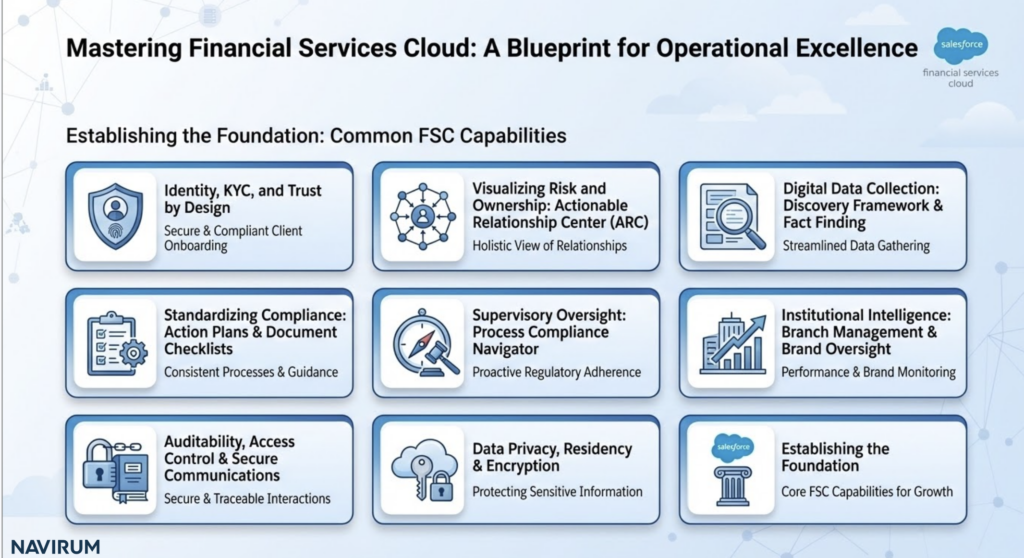
1. Establishing the Foundation: Common FSC Capabilities
Before advanced workflows can be implemented, institutions must understand FSC’s Common Capabilities. These foundational components allow Salesforce to natively model financial services operations.
Key elements include:
Financial Account objects
Household and relationship groupings
Lead-to-Referral tracking
Industry-specific record types and page layouts
These capabilities allow firms to operate in the language regulators and auditors expect, rather than forcing financial data into generic CRM constructs.
Getting this data model right the first time matters more than it looks. Our Salesforce consulting team maps legacy financial data into FSC correctly from day one, rather than leaving institutions to retrofit it later.
Salesforce has significantly streamlined KYC and AML compliance through the Party Profile Assessment framework. This allows firms to capture regulatory data points directly within client and entity profiles, embedding KYC into onboarding rather than managing it as a separate compliance exercise.
For service and contact-center interactions, FSC includes Identity Verification (Caller ID) capabilities. When a client calls in, agents are guided through verification questions tied directly to the client record, balancing security with client experience.
Together, these capabilities ensure identity controls are applied consistently across digital, branch, and call-center channels.
Streamline Onboarding
Transform digital onboarding for financial services with a solution designed specifically for the industry. Create a strong first impression while minimizing abandonment by simplifying applications through AI-driven insights and data integration. Automate manual tasks and connect systems to lower operational costs in what is traditionally a labor-intensive process.
3. Visualizing Risk and Ownership: Actionable Relationship Center (ARC)
Modern AML compliance and risk frameworks require institutions to understand networks, not just individuals, including beneficial ownership tracking across related entities.
The Actionable Relationship Center (ARC) provides a visual, interactive map of relationships between people, households, trusts, and businesses. Users can immediately see ownership structures, affiliations, and exposure, and take action directly from the relationship view.
This capability is particularly valuable for AML programs and complex wealth or commercial banking scenarios.
Mapping beneficial ownership and related-party risk by hand? See how an FSC compliance audit surfaces AML and KYC gaps before an examiner does. jump to the Readiness Review.
4. Digital Data Collection: Discovery Framework & Fact Finding
Manual data entry is one of the largest sources of operational risk.
Discovery Framework
The Discovery Framework allows firms to replace PDFs and spreadsheets with digital, validated forms. Data is captured once, validated in real time, and written directly into Salesforce, reducing errors and improving auditability.
Built on the Discovery Framework, the Fact Finding Questionnaire enables wealth managers to capture comprehensive financial information about a client’s assets, liabilities, income, goals, and risk tolerance.
For credit unions specifically, this digital data collection layer is what turns member onboarding from a paperwork bottleneck into a same-day process. See our credit union digital transformation overview for what that looks like in practice.
Action Plans are reusable templates that enforce repeatability across complex processes such as onboarding, lending, claims, or wealth planning. Each Action Plan defines tasks, owners, sequencing, and deadlines, ensuring consistency regardless of who executes the process.
Document Checklist Items
Financial services compliance depends on documentation. Document Checklist Items allow firms to define required document types (e.g., proof of income, ID, tax forms) and manage their review and approval lifecycle.
Together, Action Plans and document checklists transform compliance from institutional memory into system-enforced execution.
6. Supervisory Oversight: Process Compliance Navigator
TheProcess Compliance Navigator provides a visual roadmap of regulatory workflows, preventing users from skipping required steps. It acts as a compliance guardrail, ensuring disclosures, checks, and approvals are completed before progression.
This is particularly important for regulators who expect demonstrable supervision, not implied control.
For retail and advisory networks, FSC includes Branch Management capabilities. Executives can associate staff with branches, track performance, and monitor operational consistency across regions.
Tear Sheets provide concise, structured summaries of client information, relationships, recent activity, and key stakeholders. These are invaluable for executive reviews, client meetings, and regulatory examinations.
8. Auditability, Access Control & Secure Communications
Salesforce enforces security through:
Role-based access controls
Field-level security
Permission sets
A defensible Salesforce compliance audit trail, the kind SOX and internal audit teams expect to see, is supported through:
Field History Tracking
Setup Audit Trail
Event Monitoring
All client interactions, calls, emails, meetings, trade instructions, and money movement requests, can be logged and retained. Secure SMS integrations further reduce off-channel communication risk.
Not sure your Salesforce audit trail would hold up under review? Talk to Navirum about your permission sets, field history tracking, and event monitoring setup. skip to Talk to a Specialist.
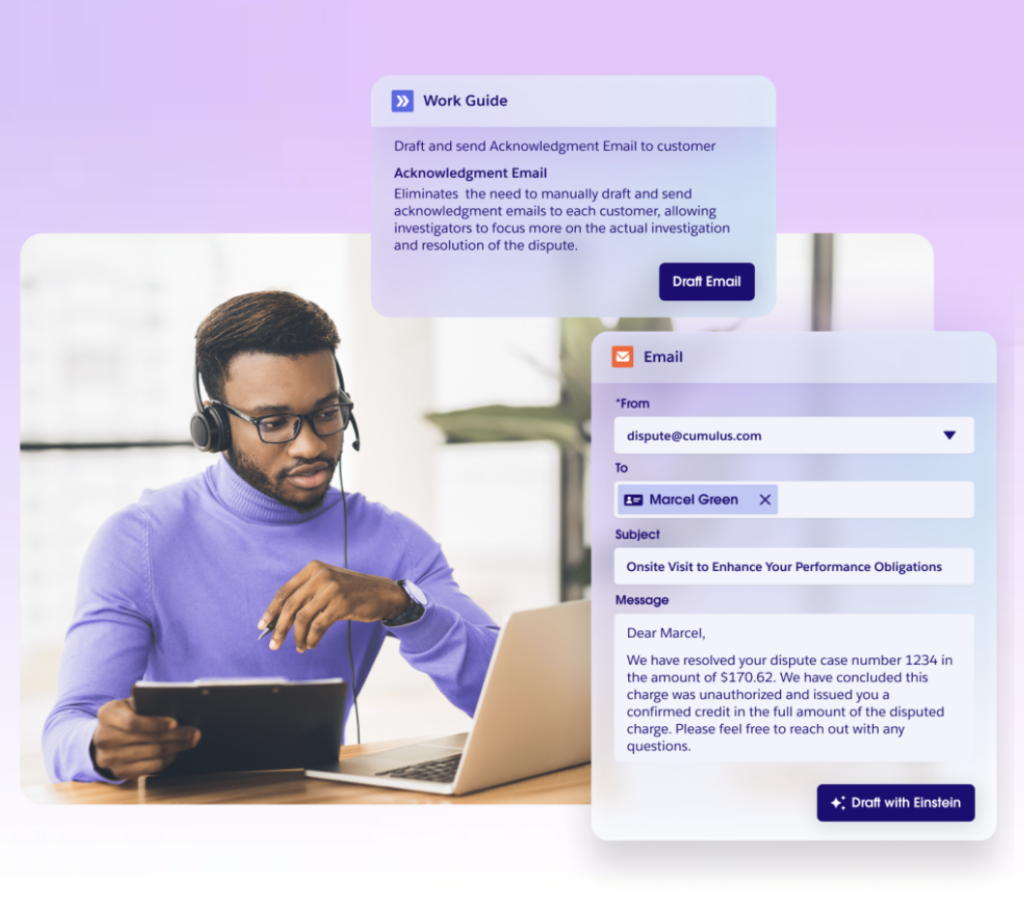
9. Transaction Dispute Management
Empower service agents with AI-driven tools that automate and streamline the dispute process. Reduce manual effort, minimize application switching, and simplify customer communication, all while lowering call volume and accelerating resolution for a more efficient, seamless experience.
As part of a broader Salesforce data governance program built to satisfy FINRA and SEC recordkeeping expectations, the platform supports GDPR and CCPA through:
Consent management
Data classification
Retention policies
Right-to-erasure workflows
With Salesforce Shield, firms gain:
Encryption at rest
Platform encryption
Advanced monitoring
Data residency transparency and regional hosting options support U.S. and Canadian regulatory expectations.
AI Innovation Built on Trust, Not Trade-Offs
While many financial services firms are innovating rapidly with AI, trust and compliance remain the primary gating factors. Salesforce is building its AI capabilities on top of its long-standing governance foundation.
AI operates within: role-based access controls, audit trails, data residency requirements, encryption standards, human-in-the-loop oversight.
Unlike many AI-native vendors where governance commitments remain unclear, Salesforce places trust at the center of its AI strategy, making it suitable for regulated environments.
Built to Adapt as Regulations Evolve
Regulatory requirements will continue to change. Salesforce’s greatest advantage is adaptability. Because it is a configurable platform rather than a fixed compliance tool, firms can update workflows, approval chains, reporting structures, and controls without re-platforming.
This reduces:
Vendor sprawl
Cost of regulatory change
Operational disruption
This is also the case for who monitors the platform day to day. Regulations, integrations, and Salesforce releases all keep moving after go-live, which is exactly what Orbit Managed Services is built to handle on an ongoing basis, not just at launch.
Final Perspective
Salesforce Financial Services Cloud is not just a CRM. It is financial services compliance software: a compliance-ready operating platform. Through structured data models, repeatable Action Plans, relationship intelligence via ARC, supervisory tooling, enterprise-grade security, and responsible AI governance, Salesforce has become the compliance backbone for many North American financial institutions.
In a market crowded with innovation, Salesforce remains the benchmark for trust, governance, and security at scale.
Salesforce FSC compliance: your questions answered
Wondering whether FSC is compliant out of the box? How it handles FINRA, SOX, KYC, and audit trails? Where your current setup falls short? These are the compliance questions we hear most.
View all 8 questions
Compliance coverage and capabilities
Is Salesforce Financial Services Cloud compliant out of the box?
No CRM is compliant on its own, and FSC is no exception. What FSC gives you is the building blocks for compliance: structured KYC and identity data, access controls, encryption, data residency options, and an audit trail. Compliance comes from configuring those controls against your specific regulatory obligations, which is the work we do with financial services firms.
How does Salesforce FSC support KYC and AML compliance?
FSC captures identity, beneficial ownership tracking, and relationship data in a structured model, then uses Actionable Relationship Center to visualise ownership and risk across related parties. Standardised Action Plans and document checklists make each KYC and AML step repeatable and evidenced, so nothing depends on one person remembering the process.
Can Salesforce FSC give regulators a complete audit trail?
Yes. With Salesforce Shield field audit trail, event monitoring, and access controls configured correctly, FSC records who changed what and when, and supports supervisory oversight of that activity. This is the kind of evidence SOC 2, SOX, and FINRA audit reviews expect to see.
FINRA, SEC, SOX and data privacy
How do I ensure FINRA and SEC compliance in Salesforce?
FINRA and SEC compliance in Salesforce comes from configuring supervisory workflows, communication capture, recordkeeping, and access controls to your obligations, then evidencing them. FSC supports supervisory oversight and secure communications; the compliance itself is in mapping those capabilities to FINRA and SEC books-and-records and supervision rules, which is where implementation experience matters.
Does Salesforce FSC support SOX compliance and access controls?
Yes. SOX is fundamentally about control over financial data integrity and who can access it. FSC’s permission model, field-level security, and audit trail provide the segregation-of-duties and change-tracking evidence a SOX review requires, once they are configured to your control framework rather than left at defaults.
How does Salesforce FSC handle data privacy, residency, and encryption?
FSC supports encryption at rest and in transit, data residency options, and Salesforce data governance tooling for consent and data handling. For North American and cross-border financial institutions, this means you can align the platform with privacy obligations across jurisdictions rather than treating privacy as an afterthought.
Working with Navirum
How do we find the compliance gaps in our current FSC setup?
A compliance readiness review maps your existing FSC configuration against KYC, audit-trail, permissions, and supervisory requirements and pinpoints exactly where the gaps are. If you would like Navirum to run one, you can request a readiness review lower on this page.
How long does a compliance-focused FSC implementation take?
It varies based on the complexity of your data and the number of systems you need to integrate, so there is no single answer that fits every firm. We scope a firm timeline in the first phase of the project, once we understand your current setup and obligations, so you are not committing to a date before the work is understood.
Talk to Navirum
Find the compliance gaps in your Salesforce FSC setup
Talk to Navirum about FSC compliance, governance, and AI readiness, no cost, no commitment.
Succession planning for financial advisors and RIAs is critical to protecting client relationships, preserving enterprise value, and ensuring long-term business continuity. Our free ebook, “30 Succession Planning Tips for Advisors, RIAs & Wealth Managers,” delivers actionable guidance on building a structured succession strategy, improving advisory firm valuation, strengthening continuity planning, and aligning CRM and operational systems for a smooth ownership transition. Designed for wealth management firms and growth-focused RIAs, this resource helps leadership teams move from informal planning to a documented, valuation-ready succession roadmap.
Guide to Succession Planning for Financial Advisors, RIAs & Wealth Managers
Succession planning for financial advisors is one of the most important — and most delayed — strategic decisions facing RIAs and wealth management firms today.
Whether you’re planning for retirement, preparing for internal succession, exploring external sale options, or building a long-term continuity plan, a structured RIA succession strategy protects your clients, strengthens firm valuation, and ensures business continuity.
Our free ebook, “30 Succession Planning Tips for Advisors, RIAs & Wealth Managers,” provides practical, actionable guidance to help you design and execute a succession plan that aligns with your growth strategy.
Why Succession Planning Is Critical for RIAs and Wealth Management Firms
In today’s competitive advisory landscape:
Aging advisor demographics are accelerating transition timelines
Clients expect continuity and stability
Firm valuations depend heavily on operational maturity and CRM data quality
Buyers demand structured processes and documented succession plans
Regulators expect formal continuity planning
Without a defined succession strategy, advisory firms risk revenue disruption, client attrition, and reduced enterprise value.
A proactive wealth management succession plan gives you control over timing, valuation, and legacy.
What You’ll Learn in This Succession Planning Guide
This ebook delivers 30 focused insights covering:
Strategic Succession Planning
When to start succession planning for financial advisors
Internal vs. external succession options
Equity structuring and phased transitions
Preparing your firm for acquisition
RIA Continuity & Risk Management
Business continuity planning best practices
Protecting client relationships during advisor transitions
Communication strategies for succession events
Advisory Firm Valuation & Growth
How succession planning impacts firm valuation
Operational maturity and scalability
Building transferable enterprise value
Technology & CRM Readiness
Why clean, structured CRM data increases valuation
How Salesforce and modern systems support transition planning
Creating a centralized client data strategy
Each tip is designed to help advisors and RIA leadership teams move from informal planning to a documented, executable succession roadmap.
Who Should Download This Succession Planning Ebook?
This guide is ideal for:
Financial advisors within 5–10 years of retirement
RIAs exploring internal buyouts or external acquisition
Multi-advisor wealth management firms
Firms modernizing operations and CRM infrastructure
Executive teams focused on long-term enterprise value
If you are thinking about advisory firm continuity, ownership transition, or growth through acquisition, this resource was built for you.
Navirum Recommendation:
At Navirum, we specialize in digital transformation and Salesforce strategy for financial services firms. Through our work with RIAs, wealth managers, and financial institutions, we’ve seen how succession planning directly impacts:
CRM architecture
Data governance
Client lifecycle visibility
Operational scalability
Firm valuation during M&A
Too often, succession planning discussions happen without considering technology readiness. A strong CRM foundation — particularly within Salesforce Financial Services Cloud — can significantly enhance transferability, reporting clarity, and buyer confidence.
This ebook bridges strategy and execution by combining business planning principles with operational best practices.
Secure Your Legacy. Strengthen Your Firm’s Future.
Effective succession planning for financial advisors is about more than retirement — it’s about building a durable, transferable enterprise.
The earlier you start, the more strategic options you create.
Download the Free Ebook: 30 Succession Planning Tips for Advisors, RIAs & Wealth Managers
Take the first step toward a structured, scalable, and valuation-ready succession strategy today.
The Definitive Guide to Succession Planning for Financial Advisors, RIAs & Wealth Managers
Protect Your Firm’s Legacy and Ensure Business Continuity
The future of your financial advisory firm or Registered Investment Advisor (RIA) is not guaranteed; it must be planned. In an industry defined by trust and long-term client relationships, the transition of leadership—whether due to retirement, partnership changes, or strategic acquisition—is the single most critical event that determines your firm’s enduring value.
Don’t let succession planning be a one-time, reactive event. This guide written by Navirum’s consultants offers a proactive, strategic approach. Our comprehensive ebook, “30 Succession Planning Tips for Advisors, RIAs & Wealth Managers,” provides the actionable framework your firm needs to navigate these complex transitions with confidence. This guide is built to protect your client relationships, secure your Assets Under Management (AUM), and ensure seamless operational continuity.
At Navirum, we work closely with advisors, RIAs, and wealth managers every day. We’ve seen how challenging succession planning can be—from protecting client relationships to ensuring a smooth transition for teams. This ebook was created to share practical, actionable tips based on our experience helping firms like yours plan for the future, preserve their legacy, and unlock opportunities for growth.
Inside, you’ll find strategies to:
Plan a smooth transition for your clients and team
Protect your firm’s legacy and value
Avoid common succession planning pitfalls
Identify opportunities for growth during succession
We hope this guide helps you confidently plan for the future of your firm.
Here’s a glimpse into our FREE ebook, your complete guide to succession planning for advisors, RIAs, and wealth managers. Inside, you’ll find carefully curated strategies, real-world tips, and actionable insights designed to help you navigate every step of the succession process—from protecting your client relationships to ensuring a smooth transition for your team. These excerpts give you a taste of what’s inside, but to explore all 30 expert tips and gain the full roadmap for securing your firm’s future, be sure to download the complete ebook today.
Chapter 1: Team Preparation for a Seamless Transition
A successful succession plan starts and ends with your people. Preparation builds resilience, reduces confusion during the transition phase, and safeguards client confidence. You can’t transfer a business built on personal relationships without meticulously preparing your team.Tip #1: Assign a Dedicated Succession Planning Lead
Why it Matters: Succession planning is a “living strategy,” not a checklist item to be sidelined by daily client demands. Without a central owner, accountability evaporates. McKinsey research indicates that firms with clearly defined leadership roles during strategic transitions are demonstrably more resilient. This role is the hub for momentum and oversight.
How to Implement: The lead, often a Chief Operating Officer (COO), senior advisor, or rising next-gen leader, must have cross-functional visibility and the authority to coordinate between departments.
Key Responsibilities: Managing timelines, facilitating stakeholder alignment (Compliance, HR, Client Service), tracking internal successors, and ensuring all key policies are documented and accessible.
Pro Tip: Reinforce the role’s importance by tying a portion of the lead’s compensation or Key Performance Indicators (KPIs) directly to the progress of the succession plan.
Tip #4: Develop a Leadership Shadowing Program
Why it Matters: Succession is a transfer of confidence as much as a transfer of credentials. Technical knowledge is necessary, but the soft skills of high-level decision-making—negotiating, crisis management, and empathetic client interaction—can only be absorbed through direct exposure. This high-impact, low-cost method prepares the next generation by letting them absorb the demeanor of great leadership.
How to Implement: Design a structured 3–6 month mentorship.
Focus on High-Value Interactions: Schedule observation time during strategic client meetings, internal planning sessions, and difficult conversations.
Phase Engagement: Start with passive observation, then gradually move the junior advisor to contributing input and leading smaller parts of the agenda.
Reassure Clients: Inform clients about the shadowing, framing it as part of your firm’s commitment to long-term service and continuity.
Chapter 2: Client Relationship Continuity in Succession Planning
Your client base is your core asset. The way you manage communication and continuity during a transition directly impacts client retention and protects your Assets Under Management (AUM)
Tip #7: Cross-Train a Secondary Advisor Early
Why it Matters: Trust doesn’t happen overnight. Clients are significantly more likely to stay with your firm if they already know and trust the incoming advisor. Co-advising at least 12–24 months before a planned transition is highlighted by Investopedia as a best practice for smoothing transitions, especially for High-Net-Worth (HNW) and multi-generational accounts.
How to Implement: Integrate the successor into the relationship, not just the client file.
Phased Approach: Introduce the secondary advisor in meetings (Months 0–6), share responsibilities for follow-ups and prep (Months 6–12), and gradually shift the lead role (Months 12–24).
Focus on Fit: Select a successor whose personality and communication style aligns well with the specific client segment they will inherit.
Encourage Informal Touchpoints: Trust builds through casual interactions. Encourage the successor to handle small touchpoints like birthday calls or personal check-ins.
Tip #11: Schedule Overlapping Client Reviews
Why it Matters: For high-net-worth clients who expect highly personalized service, joint meetings with both the outgoing and incoming advisors are essential. The Kitces Report emphasizes that these dual-attendance meetings allow the successor to absorb relationship nuances and investment history firsthand, building client confidence in the partnership and ensuring a shared understanding of the client’s long-term goals.
How to Implement: Conduct 1-2 joint reviews per client, ideally 6–12 months out from the transition date.
Coordinated Agenda: The outgoing advisor provides context and relationship history, while the incoming advisor focuses on future strategy and goals.
Active Engagement: The incoming advisor should ask thoughtful, probing questions to demonstrate their engagement and quickly build a personal connection.
Demonstrate Unity: Seeing the advisors work in partnership reassures the client that the change is a collaborative evolution, not a disruptive handoff.
Chapter 3: IT & CRM Systems for Succession Planning in Wealth Management
Your digital infrastructure is the unsung hero of operational continuity. Inadequate system preparation can create compliance gaps, cause operational downtime, and lead to client friction. Your CRM for Succession is the foundation.Tip #13: Centralize Client Data in a Cloud-Based CRM
Why it Matters: Client data is your lifeblood, encompassing not just portfolio holdings, but every note, preference, and compliance document. When this data is scattered across email inboxes, local drives, or personal spreadsheets, your firm is exposed to significant risk during an advisor exit. Forbes identifies a cloud-based CRM as a foundational investment for succession scalability. It ensures a single source of truth accessible anytime, anywhere, by authorized personnel.
How to Implement:
Migrate and Audit: Implement a clear data migration plan, including a thorough audit to clean and consolidate outdated or duplicated files.
Ensure Adoption: Train all advisors and support staff on consistent, high-quality data entry, enforcing the CRM as the primary hub for all client interactions.
Benefits: Real-time updates, security features, and compliance-ready audit trails are critical for regulatory reviews during personnel shifts.
Tip #15: Set Tiered Access Permissions for Sensitive Client Data
Why it Matters: Data security and compliance are paramount, especially during the onboarding of new team members or successors. Role-Based Access Controls (RBAC) are a FINRA best practice for preventing insider threats and limiting data exposure. Not every team member requires—or should have—full access to all client data. Properly tiered permissions safeguard sensitive, confidential client information and maintain client trust.
How to Implement:
Define Roles: Clearly define tiered roles (e.g., Advisor, Support Staff, Compliance, Operations) and map their minimum necessary access levels to client files, historical data, and privileged documents.
Audit Logs: Ensure your CRM and document management system maintains detailed audit logs of who accessed what and when, which is critical for compliance reporting.
Review: Access levels must be reviewed and adjusted immediately when roles change, ensuring former employees or those in transitioning roles are appropriately restricted.
Your Future is Calling. Are You Ready?
Succession planning is the ultimate expression of long-term strategic vision. It is how you ensure that the firm you built not only survives but thrives for generations to come. This e-book compiles the most essential steps—from team development and soft skill transfer to IT system resilience—into a single, easy-to-follow guide.
Women in Tech Spotlight: Insights on Salesforce for Financial Services
At Navirum, we pride ourselves on the deep industry expertise and technical leadership of our team. This month, we sat down with Cinchana Pushparaj, our Technical Services Manager, to discuss her journey in the Salesforce ecosystem, her experience delivering high-impact solutions for financial services clients, and her perspective on driving transformation with purpose.
With over a decade in IT and seven years of hands-on experience in Salesforce, Cinchana brings unmatched insight, leadership, and dedication to every client engagement.
From Accenture to Navirum: A Journey Built on Purpose
Q1: What inspired your journey into the Salesforce ecosystem, and what continues to excite you about working in this space?
I was drawn to Salesforce early in my career because of its ability to connect technology with real business outcomes. Coming from a traditional IT background, I saw how Salesforce empowered teams to innovate faster and bring customer-centricity to the heart of operations. What continues to excite me is how the platform keeps evolving—AI, automation, and data intelligence are now redefining how businesses serve their clients. There’s always something new to learn and a bigger impact to make.
Q2: You’ve led complex Salesforce implementations within financial services. What are some of the unique challenges financial institutions face, and how does Salesforce help solve them?
One of the biggest challenges I see is that many financial advisors struggle to serve their clients effectively because they’re weighed down by administrative tasks and disconnected data. Ideally, advisors should be focused on guiding clients through financial planning and investment strategies—but that’s difficult when critical information is scattered across multiple systems.
Salesforce addresses this by consolidating all relevant data into a single, unified platform, giving advisors the insights they need instantly. Having worked extensively with legacy systems, I’ve seen firsthand how limited they can be in meeting modern expectations. Salesforce’s ability to integrate with these older systems while providing a modern, intuitive interface fundamentally transforms how advisors work and significantly enhances the client experience.
Q3: Prior to joining Navirum, you played a key role at Accenture in global Salesforce rollouts. What lessons from that experience shape your approach today?
At Accenture, I worked on Salesforce implementations across industries and geographies, which taught me that technology is only as good as its adoption. Success requires understanding each stakeholder’s unique needs, balancing standardization with flexibility, and keeping the end user’s experience at the center of every decision. I also learned the importance of scalability, structured processes, and breaking complex initiatives into manageable phases. These lessons shape how I approach every project at Navirum—I prioritize understanding the “why” before the “how,” ensure solutions are intuitive, and focus on governance and flexibility so teams can adopt them seamlessly and achieve lasting value.
Meet The Navirum Team | Salesforce & Financial Services Specialists
Leadership & Expertise
Meet the Navirum Team: Salesforce & Financial Services Specialists
Staffed by certified Salesforce architects, former financial operators, and dedicated consultants, our team understands the unique technical, operational, and regulatory demands of financial institutions. Discover the experts guiding your digital transformation.
Salesforce in Financial Services: Challenges & Opportunities
Q4: How do you approach designing scalable Salesforce solutions for banking, wealth management, or insurance clients?
Designing scalable Salesforce solutions begins with a deep understanding of the industry, the business, its users, and long-term objectives. I map workflows, identify pain points, and incorporate regulatory and compliance requirements specific to banking, wealth management, or insurance. Scalability is built in from the start through robust data architecture, modular design, and flexible integration with legacy systems. I prioritize user adoption by involving teams early, gathering feedback, and creating intuitive, role-based experiences that minimize repetitive tasks. By balancing technical excellence, usability, and compliance, I deliver solutions that are flexible, efficient, and empower advisors and operations teams to serve their clients effectively.
Q5: Compliance and security are top priorities in financial services. How do you ensure Salesforce implementations stay compliant while remaining flexible?
Compliance and security are core to every Salesforce implementation I lead. I begin by understanding each client’s regulatory requirements—including Canadian legal standards for forms—and incorporate them into the solution from day one. This includes role-based access controls, data segregation, encryption, audit trails, and configurable validation rules to ensure compliance while maintaining flexibility. I also design modular frameworks and governance processes so the system can adapt as regulations or business needs evolve. The result is a solution that is secure, compliant, and practical, enabling advisors to work efficiently without compromising regulatory standards.
Q6: What Salesforce features or tools are making the biggest impact in financial services right now?
Salesforce is transforming financial services with tools built for the industry. Financial Services Cloud (FSC), which provides relationship mapping, household management, and compliance tracking, they enable advisors to work efficiently, stay on top of client needs, and deliver proactive, personalized service. Alongside Agentforce , it also supports advisors in building review meeting templates, fetching recent wire transfers or deposits, and providing relevant client information, enabling more informed and timely client interactions.
Leading with Impact at Navirum
Q7: As Technical Services Manager, how do you maintain technical excellence across all client projects?
What sets Navirum apart is our deep focus on financial services, combined with technical expertise and a client-first approach. We understand the challenges advisors face, the regulatory requirements, and the complexity of integrating with legacy systems or with custodian systems which lets us build solutions that are scalable and compliant. We take the time to understand each client’s needs and long-term goals, rather than offering one-size-fits-all solutions. Across all projects, we maintain technical excellence through best practices, team collaboration, and staying up to date with Salesforce innovations. The goal isn’t just to implement technology—it’s to make work easier, improve efficiency, and help advisors serve their clients better.
Q8: Navirum is known for its specialization in financial services. What do you think sets the company apart in this space?
What distinguishes our Salesforce consulting firm is our unique blend of financial services expertise and technical mastery in Salesforce solutions. We don’t just implement technology—we design solutions that truly align with the unique needs, regulations, and processes of financial institutions. Our team understands the complexities of banking, wealth management, and insurance, which allows us to anticipate challenges, streamline workflows, and deliver outcomes that drive real business value. Coupled with our collaborative approach and focus on customer success, this specialization enables us to provide solutions that are both scalable and practical, helping clients transform how they serve their customers.
Cinchana specializes in leading complex Salesforce implementations, optimizing Financial Services Cloud environments, and helping financial institutions turn technology into a strategic engine for growth.
Q9: Your work with a Canadian NGO shows a deep commitment to social good. How has that shaped your leadership style?
Working with a Canadian NGO reinforced a belief I’ve long held: technology should serve people, not the other way around. Teaching Salesforce to women in Montreal was particularly rewarding, as it showed me how the right tools can open opportunities and build confidence. That experience shaped my leadership style, teaching me to lead with empathy and consider the human impact of every technical decision. It’s made me a more patient listener, a thoughtful problem-solver, and deeply committed to building solutions that are accessible and genuinely improve people’s lives.
Q10: How do you stay focused and purposeful in such a fast-paced, high-stakes industry?
I stay focused in a fast-paced, high-stakes industry by keeping purpose and structure at the center of my work. I constantly reconnect with the “why/purpose” behind each project, and I’ve learned a lot from the mistakes I’ve made along the way. Breaking complex initiatives into clear steps, reflecting regularly, and staying aligned with outcomes helps me stay energized, resilient, and effective—even when things get busy.
Final Thoughts
Q11: What advice would you give to young professionals — especially women — aspiring to build a career in Salesforce and fintech?
Stay curious, confident, and persistent—Salesforce and fintech are constantly evolving, so a willingness to learn and adapt is key. Seek out challenging projects where you can see the real impact of your work, and don’t be intimidated by technical complexity. Build both your technical and business knowledge, especially in financial services, because understanding the bigger picture makes you invaluable.
For women in particular, trust your perspective, speak up, and own your expertise. Soft skills like communication, empathy, and collaboration are just as important as technical ability. Find mentors, build your network, and remember that diverse voices drive better solutions.
Q12: What’s one trend in the Salesforce world that financial services firms should be paying close attention to right now?
Two major trends are changing how financial companies work today: AI automation and connected data. Agentforce is helping advisors by taking care of repetitive, time-consuming tasks, so they can spend more time focusing on their clients and planning for their future. At the same time, Data Cloud brings information from different systems into one place, giving firms a clear, up-to-date picture of each client instead of having data scattered in different tools.
Stay Connected with Cinchana and Navirum
At Navirum, we’re passionate about helping financial institutions transform their operations through scalable, secure, and strategic Salesforce solutions. If you’d like to speak with one of our experts — or with Cinchana directly — don’t hesitate to book a consultation.
Main Navigation CTA Showcase | Navirum
Next Steps & Impact
Explore Navirum Success, Culture & Team
Discover real-world outcomes, learn about our collaborative company culture, and meet the financial technology specialists leading your digital transformation.
Proven Results & Impact
Explore Our Success Stories
See how we help financial institutions, wealth managers, and fintechs turn Salesforce and AI into measurable business outcomes and operational growth.
Subscribe to the Navirum Newsletter | Financial Services Tech Insights
Financial Tech Insights
Sign Up for the Navirum Newsletter
Get the latest perspectives on Salesforce Financial Services Cloud, Agentforce AI, data strategy, and compliance frameworks delivered directly to your inbox.
Tech Due Diligence in Financial Services Consolidation:
How to avoid the new deal-breaker and turn DD into an efficient roadmap that paves the way to growth
In today’s technology-driven market, the risk of overlooking the target firm’s technology infrastructure and savyness, is a direct path to inheriting crippling security liabilities, uncontrollable integration costs and debilitating technical debt.
Financial Services firms in North America are facing growing pressures from compressing fees, rising regulatory costs, and fierce competition both from local and international firms. This environment is driving increased market consolidation, as firms seek to achieve the critical mass necessary for survival and growth. Traditionally, due diligence exercises focused on the commercial advantages, talent pool, sound legal standing and healthy financial ratios, but the technology stack has increasingly become a decisive factor in greenlighting mergers and acquisitions and determining the price tag associated with those.
This article makes the case for partnering with a technology expert like Navirum to perform a deep and strategic due diligence to give peace of mind to companies exploring an acquisition and uncover hidden potential before, during and after the integration. Navirum’s Salesforce Financial Services cloud expertise can transform a standard risk assessment into a clear roadmap aiming for operational excellence and accelerated deployment. Read on to learn how to de-risk your next consolidation and maximize your growth ambitions.
The Imperative for Diligence in a Fast-Paced Environment
The investment management landscape groups participants in those big institutions offering many if not most services, and the boutique providers offering differentiation and personal touch to their clients. However, we have been witnessing an increased willingness from large firms to access differentiated and/or more profitable products and services. Traditionally, the most attractive path to access these differentiators is through acquisitions, in order to quickly integrate the new offerings and resources and drive growth.
Boutique asset managers, specialized hedge funds, and private capital allocators offer enticing potential for synergies and market differentiation resulting in more consolidation in the market. Moreover, reputable firms focusing on niche strategies are scrambling to meet new and enhanced regulatory requirements, highlighting the need for a bigger critical mass to keep operating efficiently.
However, these smaller, more agile firms can also come with potential pitfalls such as less-refined tech stacks, outdated systems and patchwork integrations that can present integration challenges and overspending, scalability limitations and significant security vulnerabilities.
What to look for when assessing the target firm’s tech stack
A sound technology due diligence must evaluate existing systems, their data workflows and interoperability across multiple teams and processes. Client, fund and transaction data ideally are already integrated and optimized for scale. If the potential acquisition has a growth ambition, then the existing systems should be able to handle 2x or 3x their current Assets Under Management (AUM).
Another area of focus is regulatory adherence in terms of data residency and privacy laws, considering the keen interest of both the public and regulators in cybersecurity risks and robots protocols for the future. Financial Services firms are more aware than ever about the reputational risks associated with data breaches. A reputable technology partner like Navirum helps you navigate the complexities of existing protocols and potential operational improvements.
A sound DD should not just flag gaps but also include an integration roadmap, with estimations of lead times and costs associated with achieving the acquisition goals. For this, the experience of your technology partner can be the deciding factor between lagging, meeting, or exceeding the expectations of the amalgamation.
When assessing the synergy potential and integration roadmap, a reputable technology partner like Navirum is essential for uncovering the additive or detracting value of the target firm’s tech stack. This valuable information effectively de-risk the transaction, stripping away unwanted surprises that may arise when an adequate DD is not performed.
Moreover, Navirum provides actionable recommendations aimed at boosting the ROI of your partnership. Our experience with Salesforce Financial Services Cloud provides us with an unmatched innovation mindset to enable firms to eliminate data silos and automate compliance workflows and client reporting, supporting efficient operations while driving down cost pressures.
In today’s landscape, a re-acquisition technology due diligence is a competitive necessity. It not only prevents bitter surprises down the road, but also steers the integration toward success. Navirum ensures that the technology due diligence is performed through the lens of modern, best-in-class technology platforms like Salesforce, providing the acquiring firm with a clear path to an efficient and scalable growth.
What is the best AI Meeting Assistant for Financial Firms?
The best AI meeting assistant depends on your firm type, regulatory environment, CRM and data requirements. Advisor-focused platforms such as Jump, Zocks and Vinton can support meeting capture and follow-up, while tools such as Focal AI and Fellow place greater emphasis on data residency, retention and enterprise controls. For firms operating on Salesforce, Agentforce for Financial Services provides a more contextual, CRM-native approach to preparing for meetings, organizing client information and automating follow-up.
No Single Tool Is Right for Every Financial Firm
This guide compares the options based on where they fit, how they integrate and what firms should verify before deploying them, whether or not Salesforce is part of your stack. Before picking a specific tool, it is worth taking a step back to assess whether the firm is ready for AI more broadly.
Why Navirum wrote this?
Navirum helps financial firms evaluate AI tools through the combined lenses of business workflow, CRM integration, data architecture, security and regulatory requirements. Our perspective comes from implementation, integration and advisory work across financial-services technology environments, on Salesforce and off it. This guide is built from that experience, not marketing copy.
We look at each tool the way a firm actually has to live with it: how it fits your CRM, what it requires from a compliance standpoint, and what changes once it is deployed. Where we reference our own experience below, we say so explicitly rather than folding it into a headline statistic.
The best AI meeting assistant depends on your firm type, regulatory environment, CRM and data requirements. Answer a few quick questions below to find your shortlist, or view the full comparison for a detailed matrix.
Find your AI meeting assistant shortlist
Step 1 of 3
Answer three quick sets of questions to identify tools that may align with your firm, systems and priorities.
View the full comparison
Note: Time-savings and adoption-rate figures in this guide are vendor-reported estimates, not independently verified by Navirum. For independently verified metrics, refer to each vendor’s SOC 2 or third-party audit documentation (see the compliance/security column above).
A note on general-purpose tools like Fireflies and Otter: they’re solid for everyday business meetings, but they weren’t built with financial services compliance in mind the way the tools above were. Before using one for client meetings, ask the vendor directly about training-data policies, retention controls, and whether their CRM integration is a native connector or a Zapier workaround, the answer varies by tool and can change without notice. If Jump is on your shortlist, see how firms are integrating Jump with the wider stack.
FREE DOWNLOAD
AI Meeting Assistant Evaluation Scorecard for Financial Firms
A single scorecard covering Salesforce integration, other CRM integrations, data residency, retention, consent, audit logs, security documentation, meeting capture, pre-meeting prep, post-meeting automation, implementation effort, vendor support, and estimated total cost, the same criteria used in this guide.
Delivered by email · Usually within a few minutes
AI Meeting Assistants Comparison
How to Choose the Right AI Meeting Assistant
There is no single “best” AI meeting assistant for financial firms, the right pick depends on your CRM, your regulatory environment and what you actually need the tool to do before, during and after a meeting. Here is how the tools above tend to sort by what a firm is optimizing for:
Best for advisor-specific workflows: Jump, Zocks Best for firms already operating on Salesforce: Salesforce Agentforce Best for Canadian data-residency requirements: Vinton, Focal AI Best for strict retention and redaction controls: Fellow Best for broad CRM flexibility beyond Salesforce: Zocks, Focal AI Worth evaluating for accounting and bookkeeping workflows: Jump, Zocks, depending on your practice-management environment
Recordkeeping, supervision, consent and retention obligations vary according to the firm, the employee’s role, the communication type and the applicable jurisdiction, this can include CIRO-related requirements for Canadian advisors, and SEC or FINRA obligations for US RIAs and broker-dealers. Map any proposed tool against your own policies and confirm the final configuration with compliance or legal counsel before deploying it. Ask any vendor for their compliance documentation, data residency options, and audit log access before deploying. For a deeper look at how this plays out on Salesforce specifically, see our guide to Salesforce FSC compliance & governance.
What About Claude, ChatGPT, Gemini, or Slack?
You’ll often see general-purpose AI assistants mentioned in the same breath as the tools above. They’re useful, but they’re solving a different problem, and it’s worth being clear on the difference before you shortlist anything. For a broader view beyond meeting assistants, see other Agentforce/AI use cases financial firms are adopting.
Claude, ChatGPT, and Cowork don’t join or transcribe live calls. They’re genuinely useful for pre-meeting prep (summarizing a client’s file, drafting an agenda) and post-meeting follow-up (turning your own notes into a task list or email), but they aren’t a substitute for a purpose-built meeting assistant. If you’re evaluating how AI fits into your firm’s broader data and security posture, our guide to putting AI to work on trusted data covers that ground. If Salesforce is already central to your firm, see our Agentforce consulting guide.
Google Gemini is the exception among general assistants: its “Take notes for me” feature genuinely transcribes live inside Google Meet for Google AI Pro/Ultra subscribers (as of April 2026, it requires all-participant consent). But it’s a generic Workspace feature, not an advisor-specific tool. It won’t sync structured notes to your CRM or flag compliance requirements the way the tools above do.
Slack’s AI Notes only covers internal Slack Huddles, not client meetings, and has no CRM sync. If your team is on Slack, it’s worth knowing about, but it doesn’t compete with the tools in the table above.
Navirum’s Perspective on AI Meeting Assistant
This guide is built for financial services firms, RIAs, wealth managers, banks, and fintech operations teams evaluating AI meeting tools for client-facing and compliance-sensitive work. It isn’t written for individuals looking for a general-purpose note-taking app.
That distinction matters because the requirements are genuinely different. Your firm needs CRM sync (ideally native Salesforce), documented compliance controls (CIRO, SEC, FINRA depending on where you operate), and a vendor relationship you can point to during an audit. A tool built for consumer note-taking won’t hold up to that scrutiny, no matter how good its transcription is. If compliance documentation is part of your evaluation, our Salesforce FSC compliance guide is a useful companion to this page.
Switching From Your Current Assistant
If your firm adopted an AI meeting assistant back in 2024, it’s worth taking a fresh look. The market has matured a lot since then: several of the tools in this guide (Zocks, Focal AI, Fellow’s financial-services controls) either didn’t exist yet or weren’t mature enough to be a serious option two years ago.
Switching has real costs, and we won’t pretend otherwise: retraining your team, migrating historical notes, re-establishing CRM sync, and getting compliance sign-off on the new vendor all take time. But for most firms, that cost is smaller than the ongoing risk of staying on a tool that was never built for financial services compliance in the first place, especially if your original tool can’t answer basic questions about training-data policy or audit logging. If migration support would help, that’s a service Navirum provides directly, including CRM re-sync and compliance documentation as part of the switch.
Where Does Your Meeting Data Actually Live?
Once you’ve picked a tool, it’s worth asking a question most firms skip: where does the transcript, the notes, and everything the AI pulled out of the meeting actually end up, and can you find it again later?
Building on trusted, governed client data matters most for firms combining meeting information with CRM, service, portfolio, marketing and other customer data, Salesforce Data Cloud can provide a governed retrieval and activation layer for Agentforce. Smaller firms may be better served initially by writing structured summaries, tasks and follow-up actions directly to Salesforce records, and layering in Data Cloud later if their needs grow. This is a real Navirum practice area, not a hypothetical: it’s the same architecture behind our broader Agentforce work.
It also helps to separate two different jobs: operational storage (the notes and action items your team actively works from day to day) and archival storage (the recordkeeping copy you’re required to retain, whether or not anyone ever opens it again). Most firms end up needing both, and conflating them is a common source of both compliance gaps and unnecessary storage cost. Full retention specifics vary by record type and jurisdiction, see the references below for the detail.
Frequently Asked Questions
Wondering how these tools handle compliance? CRM sync? Which one fits a Canadian firm? Here’s what firms ask us most.
How do I choose the right AI meeting assistant for my firm?−
Look for three things: compliance alignment (CIRO (formerly IIROC/MFDA) for Canada, SEC for US), CRM integration (native Salesforce is best), and your business model (RIAs need deep Salesforce integration, fintech needs speed). See our comparison table above.
Do AI meeting assistants integrate with Salesforce?+
Yes, but depth matters. Jump, Vinton, and Agentforce have native Salesforce connectors that auto-sync tasks and notes. Fireflies and OtterPilot use Zapier or API connections, which require manual setup and carry more failure risk. Salesforce is the industry standard for RIAs and advisory firms.
What are the compliance requirements for AI meeting assistants in financial services?+
Requirements vary by firm, role and jurisdiction: CIRO-related supervision and recordkeeping obligations for Canadian advisors, and SEC or FINRA obligations for US RIAs and broker-dealers, among others. Most tools offer SOC 2 certification, encryption, and audit logs, but a vendor’s certifications alone don’t make your firm compliant. Confirm the specific requirements that apply to your firm with compliance or legal counsel, and check with each vendor directly for their current certifications before deploying.
How much time can an AI meeting assistant save?+
Time savings depend on your current process. Firms moving from manual note-taking and CRM entry to an AI-assisted workflow typically see meaningful reductions in post-meeting admin time. Ask any vendor for time-tracking data from comparable deployments before you commit.
Which AI meeting assistant is best for Canadian advisors?+
Vinton and Focal AI are both built with Canadian data residency and CIRO-related supervision needs in mind. Jump also works for Canadian firms. Requirements differ by jurisdiction and firm type, so check with your compliance team on what specifically applies before choosing.
Can AI meeting assistants update my CRM automatically?+
Yes, if your tool has native CRM integration. Jump, Vinton, and Agentforce auto-sync tasks, notes, and action items to Salesforce. Fireflies and OtterPilot typically require Zapier or manual entry.
What if I don’t use Salesforce, can I still use an AI assistant?+
Yes. Fireflies works with most CRMs via Zapier, HubSpot, and Pipedrive. OtterPilot is largely CRM-agnostic. If you’re on Redtail, Wealthbox, or another advisor platform, check with your vendor about integration options.
How do I know if an AI meeting assistant meets my compliance needs?+
Ask the vendor for SOC 2 Type II certification, data residency options (Canada vs. US), audit log access, and encryption details (AES-256 minimum). Navirum can help you evaluate options across the tools we’ve deployed.
Navirum Client Success Stories in Financial Services
FREE CONSULTATION
Need help evaluating or integrating an AI meeting assistant?
Navirum can help you assess the options, connect the selected platform to Salesforce or another system, and design the governance and follow-up workflows around it. Prefer to just talk it through? discuss your AI-assistant requirements directly with our team.
No commitment · We follow up within one business day
References
CIRO (Canadian Investment Regulatory Organization) was formed in 2023 from the merger of IIROC and the MFDA. Firm-level supervision and recordkeeping obligations that previously fell under IIROC/MFDA now fall under CIRO.
SEC Rule 17a-4 historically required WORM (write-once, read-many) storage for broker-dealer records. The SEC amended the rule in 2022 (compliance date May 2023) to also permit an audit-trail alternative in place of strict WORM.
Retention periods for financial services records commonly run around six years, but the exact period varies by record type, role (RIA vs. broker-dealer), and jurisdiction. Confirm specifics with your compliance counsel rather than treating any single number as universal.
FINRA Rule 4511 sets parallel recordkeeping requirements for FINRA member firms.
Archival storage examples (AWS S3 Glacier, Smarsh, Global Relay, and similar) are mentioned as illustrative categories of vendor, not as Navirum partnerships or endorsements.
Online Resources, Knowledge & Insights | Navirum
Explore Related Insights
Online Resources, Knowledge & Insights
Discover similar articles on Salesforce Financial Services Cloud, Agentforce AI assistants, and enterprise digital workflow strategies.
Discover real-world outcomes, learn about our collaborative company culture, and meet the financial technology specialists leading your digital transformation.
Proven Results & Impact
Explore Our Success Stories
See how we help financial institutions, wealth managers, and fintechs turn Salesforce and AI into measurable business outcomes and operational growth.
Au Navirum, we’ve partnered with thousands of advisors across North America, and succession planning consistently stands out as the most important – and most difficult – initiative they face. Not because of markets or products, but because it’s about legacy, clients, and the business built over decades.
Yet, 60% of Financial Advisors have no succession plan, even when they’re within 10 years of retirement? [Ref 1, Ref 2]
Some thoughts on what Advisors can do…
The Strategic Approach
Succession works best when it’s treated as a strategic goal, not an afterthought. Advisors who set a clear retirement horizon and work backwards build firms that are fit for today and resilient for tomorrow. A practical rule of thumb: allow at least one month of preparation for every year your practice has been in business. If your systems and processes are solid, plan to reinvest 1-5% of annual revenue to get succession-ready.
The Personal Reality
At Navirum, we’ve seen how personal these projects are – particularly for advisors nearing retirement, knowing they may be engaging in the last major initiative of their careers. Wealth management is fundamentally a people business. Succession is about building a platform so those client relationships can live on beyond any one advisor. Even when legacy isn’t the stated goal, every step taken is building one. A clear reality check on what you want – whether a clean exit, phased transition, or lasting platform – should guide your priorities and investments.
Capturing Institutional Knowledge
Succession isn’t just about the founder’s expertise. Long-time staff and managers also hold critical knowledge that must be captured and built into a living knowledge base. In many firms, consolidating the founder’s institutional knowledge – along with decades of physical and digital information – is the largest task. But it’s equally important to document the insights of other senior team members. Succession is the opportunity to bring all that knowledge into one central place, integrating it into systems and processes. This is one of the most strategic steps in the entire project
The Valuation Impact
Finally, succession is about valuation. Firms with clean data, documented processes, and modern systems don’t just transition smoothly – they also command higher multiples when buyers step in. Below this article I’ve provided answers to 20 FAQs and common questions I success from Advisors on their succession journey
So succession isn’t about leaving. It’s about what you leave behind – and how strong a foundation you create for the next chapter.
– Rory, Navirum Founder and CEO
Interested in discussing solutions further we would be delighted to help
<strong class="schema-faq-question">How should an RIA name successors and build a real bench?</strong>
Name a primary successor and 1 – 2 deputies by function (lead advisor, ops, compliance), then publish a simple RACI so Day-1 decisions are unambiguous. Example: “Prospects → A, Planning → B, Trading → C.” This clarity cuts execution risk and keeps the team focused.
<strong class="schema-faq-question">How do we communicate the change internally without drama?</strong>
Write a one-page “why now / what changes / how we’ll win,” attach a timeline, and schedule short touchpoints. Use a lightweight change model (e.g., awareness → adoption → reinforcement). Consistent messaging kills rumors and accelerates adoption.
<strong class="schema-faq-question">How should we segment clients by retention risk during succession?</strong>
Tier households by risk (e.g., AUM, complexity, multiple relationships) and set outreach cadence by tier. Example: Tier-1 monthly touches, Tier-2 bi-monthly. Proactive communication reduces churn at inflection points.
<strong class="schema-faq-question">Why clean the CRM before any hand-off?</strong>
Standardize fields, dedupe records, and fix ownership now; publish data standards. Clean data drives adoption and enables automation. It also boosts firm valuation in diligence.
<strong class="schema-faq-question">How do we capture “how we do things here”</strong>
Build a knowledge base. This is critical! Write short SOPs for onboarding, KYC, trading, billing, complaints, and store them in a searchable hub. Include links, forms, and owners. This preserves institutional memory beyond any single person. Develop playbooks that bring these SOPs and FAQs together into usable tools
<strong class="schema-faq-question">What makes a playbook usable in real life?</strong>
Keep it to one page with triggers, steps, owners, and “if/then” branches. Add screenshots and the top 3 pitfalls. Short, contextual guidance gets used—long manuals don’t.