AI Governance in Canadian Financial Services – Canada currently lacks a federal AI law; financial services are governed by regulators’ guidelines and privacy laws effective in 2027.
OSFI E-23 explicitly includes AI in model risk management, impacting all federally regulated financial institutions starting May 1, 2027.
The AMF has issued a dedicated guideline for AI use, requiring risk classification and lifecycle management for numerous Quebec firms by May 1, 2027.
Quebec Law 25 mandates transparency around automated decisions and impacts any business using personal information about Quebec residents.
Firms should prioritize building an AI and model inventory to comply with emerging regulations and guidelines.
Overview of AI Governance in Canadian Financial Services (2026)
OSFI E-23, AMF, CSA and Quebec Law 25
Canada has no federal AI law in force. The proposed Artificial Intelligence and Data Act (AIDA), part of Bill C-27, died on the order paper when Parliament was prorogued in January 2025. Therefore, AI in financial services is instead governed by financial regulators’ guidelines, securities guidance and privacy law, several of which take effect in 2027.
This guide sets out what applies to banks, insurers, wealth managers and dealers as of late 2026, and the evidence firms should keep.
Any business using personal information of Quebec residents
Commission d’accès à l’information
Quebec Law 25, section 12.1 (automated decisions)
A Quebec-based wealth firm with a dealer arm and a federally regulated parent can sit in four of these rows at once.
OSFI Guideline E-23: model risk management now covers AI
OSFI published the final Guideline E-23 – Model Risk Management on September 11, 2025. It takes effect for all federally regulated financial institutions on May 1, 2027, giving an 18-month transition.
What changed from the 2017 version:
AI is explicitly a model. The definition of “model” now includes AI and machine learning methods, not only financial and actuarial models.
Scope widened. E-23 now applies to all FRFIs, including life and P&C insurers, not only deposit-taking institutions.
Enterprise-wide and proportionate. Expectations scale with an institution’s size, complexity and risk, but every institution needs an enterprise model risk framework and a current model inventory.
Third-party models count. OSFI did not give a grace period for third-party model risk, so vendor AI (including AI features inside platforms you license) needs to be inventoried and governed.
In practice, E-23 expects a firm to identify every model, rate its risk, validate it, monitor it after deployment and document all of this. A static, one-time compliance exercise will not meet it.
Related OSFI guidelines. E-23 is read alongside Guideline B-13 Technology and Cyber Risk Management (in effect since January 1, 2024) and the updated Guideline B-10 Third-Party Risk Management (in effect since May 1, 2024). An AI tool from a vendor touches all three.
Quebec AMF: a dedicated AI guideline
On April 7, 2026, the Autorité des marchés financiers published the final version of its Guideline for the Use of Artificial Intelligence, the first AI guideline issued by a provincial financial regulator. It takes effect on May 1, 2027.
It applies to authorized insurers, financial services cooperatives, authorized trust companies and other authorized deposit institutions in Quebec. The AMF expects these institutions to:
Classify AI systems by risk and manage them across their full lifecycle, from justifying the use case to decommissioning
Define the roles of the board and senior management for AI
Produce reliable outputs suited to each system’s intended use, and monitor them
Treat clients fairly where AI is used in client interactions, building on the AMF’s Fair Consumer Practices Guideline
Apply all of this in proportion to the institution’s size, complexity and risk profile
The guideline supplements the AMF’s model risk management guideline. The AMF has also published a Third-Party Risk Management Guideline, effective April 1, 2027.
Securities regulators: CSA Staff Notice 11-348 and CIRO
CSA Staff Notice and Consultation 11-348. Published December 5, 2024, the notice explains how existing securities law applies to AI systems used by registrants, issuers, marketplaces and others. It does not create new legal requirements. Its key points for registrants:
Governance and risk management practices should account for the specific AI system and its risks
Supervisory controls, policies and procedures should cover AI use
Firms remain responsible and accountable for outsourced functions, including AI services
“Black box” AI that cannot be explained sits poorly with a market built on transparency
Disclosures about AI use must be fair, balanced and not misleading
The CSA’s consultation closed March 31, 2025, and responses will shape any future rules.
CIRO. CIRO’s Compliance Report for 2026, published February 17, 2026, names the use of AI among the operational and compliance issues dealers should prioritize. For AI services provided by third parties, CIRO points dealers to its existing Guidance Note on outsourcing arrangements.
Quebec Law 25: automated decisions
Since September 22, 2023, section 12.1 of Quebec’s private-sector privacy act has required any business that makes a decision about a person based exclusively on automated processing of their personal information to:
Tell the person, no later than when they are informed of the decision, that it was automated
On request, explain the personal information used and the main factors and parameters behind the decision
Let the person have their information corrected and submit observations to someone who can review the decision
The trigger is “exclusively” automated. Keeping a meaningful human review step in client-facing decisions (account opening, suitability flags, underwriting) changes which obligations apply. Law 25 also requires privacy impact assessments before acquiring or developing new information systems, which includes most new AI tools.
The evidence to keep: a checklist
Across OSFI, the AMF, the CSA, CIRO and Law 25, regulators ask for the same core evidence:
AI and model inventory. Every AI system, model and AI feature in use, including those inside vendor platforms, with an owner for each.
Risk classification. A documented rating for each system, reviewed when its use changes.
Board and senior management roles. Who approves AI use and who is accountable.
Validation and testing. Before deployment and again after vendor updates, model version changes or workflow edits.
Ongoing monitoring. Output quality, drift and errors, with records of what was found and fixed.
Vendor and third-party oversight. Due diligence, contract terms and monitoring aligned with B-10 or the AMF third-party guideline.
Privacy impact assessments. Completed for new AI systems that handle personal information.
Automated-decision notices. Where any decision is exclusively automated, the Law 25 notice and human review path.
Accurate disclosures. Client and marketing statements about AI that match what the tools do.
Training and conduct. Staff trained on approved use; code of ethics updated to cover AI.
How Navirum Orbit helps
The 2027 dates leave Canadian firms roughly six months to move from policy to evidence. Navirum Orbit is a managed service for financial services firms, based in Montréal, that runs AI governance and AI assurance as part of day-to-day operations:
Builds and maintains your AI inventory across Salesforce, Agentforce and connected advisor and insurance tools
Re-tests AI behaviour after each release and configuration change
Keeps the monitoring records, version history and review evidence your risk and compliance teams need
Supports vendor oversight with documentation for each AI provider
Works in English and French
Orbit supports your compliance and model risk programs; it does not replace your compliance team or legal counsel.
<strong class="schema-faq-question"><strong>Does OSFI E-23 apply to wealth management firms?</strong>
E-23 applies to federally regulated financial institutions: banks, foreign bank branches, federally regulated insurers and trust and loan companies. A standalone portfolio manager or dealer is regulated provincially and through CIRO instead, but a wealth arm inside a bank or insurer falls under E-23 through its parent.
<strong class="schema-faq-question"><strong>When does OSFI E-23 take effect?</strong>
May 1, 2027. The final guideline was published September 11, 2025. Is AIDA still coming? AIDA died with Bill C-27 in January 2025. There is no federal AI statute in force. Financial firms should plan around the sector guidelines and privacy law instead.
<strong class="schema-faq-question"><strong>Does Quebec Law 25 apply to firms outside Quebec?</strong>
It applies to businesses that collect, hold or use personal information about Quebec residents, wherever the business is based.
<strong class="schema-faq-question"><strong>What should a firm do first?</strong>
Build the AI and model inventory, including AI features inside platforms you already license. E-23, the AMF guideline and Law 25 all depend on it.
This guide is for general information and is not legal advice. Rules and dates change; confirm current requirements with your compliance team or counsel.
REGULATORY & RISK MANAGEMENT
AI Governance Framework for US Financial Services Firms
Establish robust risk controls, model auditability, and regulatory compliance across SEC, FINRA, and banking oversight standards as you deploy agentic systems and generative AI.
The AI Governance Framework for US Financial Services Firms outlines how existing regulations govern AI tools in the industry.
Each regulator, including the SEC and FINRA, has different rules regarding AI usage, requiring firms to consistently maintain oversight and documentation.
Firms must keep comprehensive evidence such as AI inventories, risk ratings, written policies, and incident response plans, which regulators will evaluate.
Regulation S-P requires oversight of AI service providers, and firms must comply with amendments by June 2026 depending on their size.
Colorado’s updated AI law introduces a notice-based system for automated decision-making, starting January 1, 2027, adding specific obligations for financial firms.
Estimated reading time: 12 minutes
Overview
AI Governance Framework for US Financial Services Firms (2026): SEC, FINRA and State Insurance Rules
No single US law governs AI in financial services. Instead, existing rules on supervision, record keeping, privacy and fair treatment now apply to AI tools, and regulators are saying so in their exam priorities, reports and bulletins. For a wealth management firm, broker-dealer or insurer, the practical question is the same: can you show what your AI tools do, who checks them, and what happens when they change?
This guide sets out what each US regulator expects as of late 2026, and the evidence firms should keep.
Which rules apply to your firm
Firm type
Main regulator
What applies to AI use
SEC-registered investment adviser (RIA)
SEC
Fiduciary duty, 2026 exam priorities on AI, Regulation S-P (amended)
Broker-dealer
FINRA and SEC
FINRA Rule 3110 (supervision), communications and recordkeeping rules, Regulation S-P
Insurer or insurance agency
State insurance departments
NAIC AI Model Bulletin where adopted; NAIC AI Systems Evaluation Tool in exams
Any firm making consequential decisions about Colorado consumers
Colorado Attorney General
Colorado SB 26-189 from January 1, 2027
Many firms sit in more than one row. A dual registrant, for example, answers to both the SEC and FINRA.
SEC: AI is an exam priority, and Regulation S-P now covers your vendors
2026 examination priorities. The SEC’s Division of Examinations released its 2026 priorities on November 17, 2025. AI and other emerging technologies are a named focus. Examiners review whether a firm’s public statements about its AI are accurate, and whether governance, controls and human oversight of AI tools are in place. Be ready to show a written framework covering oversight, monitoring and staff training.
Regulation S-P amendments. The SEC amended Regulation S-P in May 2024, the first major update in over 20 years. Larger entities (including RIAs with $1.5 billion or more in assets under management) had to comply by December 3, 2025. Smaller entities, including RIAs below $1.5 billion, had to comply by June 3, 2026. The amendments require:
A written incident response program for unauthorized access to customer information
Notice to affected individuals within 30 days of certain breaches
Oversight of service providers that hold customer information, through due diligence and monitoring
Records documenting compliance
Why this matters for AI: an AI meeting assistant, CRM agent or document tool that touches client data is a service provider arrangement. Your incident response program and vendor oversight need to cover it. The SEC has named Regulation S-P compliance as a 2026 exam focus.
FINRA: supervision and record keeping rules apply to GenAI
FINRA’s 2026 Annual Regulatory Oversight Report, released December 9, 2025, has a standalone section on generative AI. FINRA’s rules are technology-neutral: firms remain responsible for compliance whether a person or a GenAI tool does the work. The report links GenAI to rules on supervision (Rule 3110), communications with the public, recordkeeping and fair dealing.
Among the practices FINRA says firms may want to consider for ongoing monitoring:
Storing prompt and output logs for accountability and troubleshooting
Tracking which model version was used, and when
Validating outputs and keeping a human in the loop, including regular checks for errors
Testing GenAI tools, including AI agents, for privacy, integrity, reliability and accuracy
These are framed as considerations rather than new rule text. In practice, they describe what an examiner will ask to see when reviewing how a firm supervises an AI tool. FINRA also flags AI agents as a rapidly evolving area with novel supervisory questions.
Related guidance: FINRA Regulatory Notice 24-09 reminded members of their obligations when using generative AI and large language models.
Insurance: the NAIC Model Bulletin and the new Evaluation Tool
NAIC Model Bulletin on the Use of AI Systems by Insurers. Adopted by the NAIC in December 2023, the bulletin asks insurers to maintain a written AI Systems (AIS) Program covering governance, risk management, and third-party systems. By late 2025, 24 states plus DC had adopted it.
NAIC AI Systems Evaluation Tool. This is a structured set of exhibits that state examiners use to understand how an insurer uses AI and to assess its governance. It covers how extensively a company uses AI, a governance risk assessment, high-risk AI system details, and model data details. A pilot ran in 12 states (California, Colorado, Connecticut, Florida, Iowa, Louisiana, Maryland, Pennsylvania, Rhode Island, Vermont, Virginia and Wisconsin) from March to September 2026. The NAIC planned to consider an updated tool for adoption at its November 2026 Fall National Meeting, for voluntary use by states in 2027.
The tool is an examination aid, not a new testing mandate. But it turns the bulletin’s principles into specific questions an examiner can ask. Small carriers answer the same exhibits as national carriers, and agencies that use AI on a carrier’s behalf can expect questions through that carrier’s third-party oversight.
State AI laws: Colorado’s rewrite
Colorado’s original AI Act (SB 24-205) never took effect. On May 14, 2026, Colorado signed SB 26-189, which repealed and replaced it with a narrower, notice-based framework for automated decision-making technology. It applies to consequential decisions made on or after January 1, 2027, with Attorney General rules due by that date.
For financial firms, the burden is lighter than under the 2024 law, but notice, disclosure and consumer appeal processes still need to be built. Other states are moving on similar rules, so track where your clients live.
The evidence to keep: a checklist
Across these regimes, regulators ask for the same core evidence. If you can produce these on request, you are in a strong position:
AI inventory. Every AI tool and agent in use, including features switched on inside Salesforce, Microsoft 365 and advisor platforms, with an owner for each.
Risk rating. Which tools touch client data, make or influence client decisions, or produce client communications.
Written policies. How AI is approved, used, supervised and retired.
Prompt and output logs. Retained where AI is used in supervision, recommendations or client communications.
Model and version log. Which model and configuration ran, and when it changed.
Testing before and after change. Re-test when a vendor ships an update, a model version changes or a prompt or workflow is edited.
Human review. Who checks outputs, how often, and what they found.
Vendor oversight. Due diligence, contract terms and monitoring for each AI provider, aligned with Regulation S-P.
Incident response. What happens when an AI tool exposes data or produces a harmful output.
Accurate disclosures. Marketing and client statements about AI that match what the tools actually do.
Training. Staff trained on approved use and escalation.
How Navirum Orbit helps
Most firms already have the policy. What they lack is the ongoing work of keeping the evidence current as tools change every month. Orbite de Navirumis a managed service for financial services firms that runs AI governance and AI assurance as part of day-to-day operations:
Keeps your AI inventory and risk ratings current across Salesforce, Agentforce and connected advisor tools
Re-tests AI behaviour after each release and configuration change
Maintains the logs, version history and review records your compliance team needs
Supports vendor oversight with documentation for each AI provider
Orbit supports your compliance program; it does not replace your compliance team or legal counsel.
<strong class="schema-faq-question"><strong>Is there a federal AI law for financial services firms in the US?</strong>
No. Federal regulators apply existing rules on supervision, recordkeeping, privacy and fiduciary duty to AI tools. State laws such as Colorado’s add specific obligations.
<strong class="schema-faq-question"><strong>Do RIAs need to keep prompt and output logs?</strong>
The SEC has not issued an AI-specific logging rule. FINRA’s 2026 report describes prompt and output logging as a practice broker-dealers may want to consider. For RIAs, logs are the most practical way to show examiners how AI tools are supervised, and they may be required records where AI produces client communications or recommendations.
<strong class="schema-faq-question"><strong>Does the NAIC AI Systems Evaluation Tool apply to small insurers?</strong>
The tool is used by state examiners. During the pilot, it did not distinguish between small and large carriers. Agencies are reached indirectly, through the carriers they work for. Insurers in states that adopted the Model Bulletin should already have a written AI Systems Program.
<strong class="schema-faq-question"><strong>What should a firm do first?</strong>
Build the AI inventory. Every other item on the checklist depends on knowing which AI tools are in use and who owns them. This guide is for general information and is not legal advice. Rules and dates change; confirm current requirements with your compliance team or counsel.
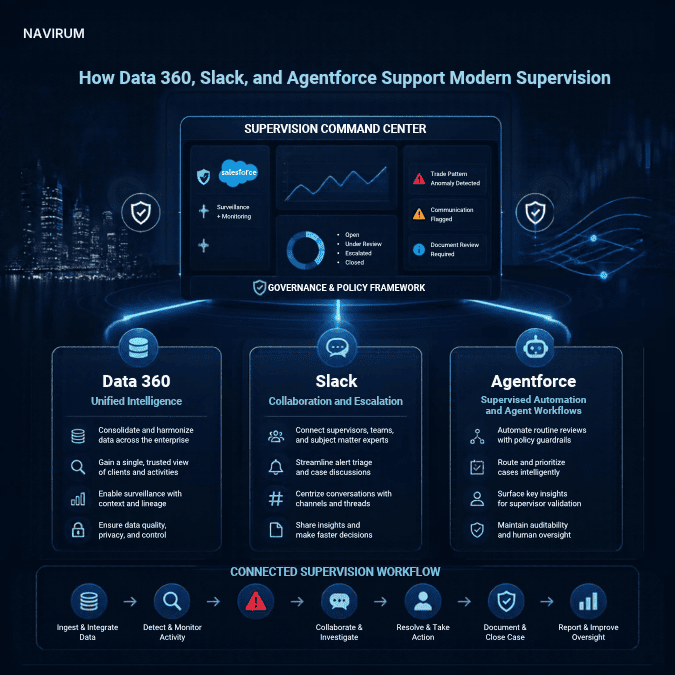
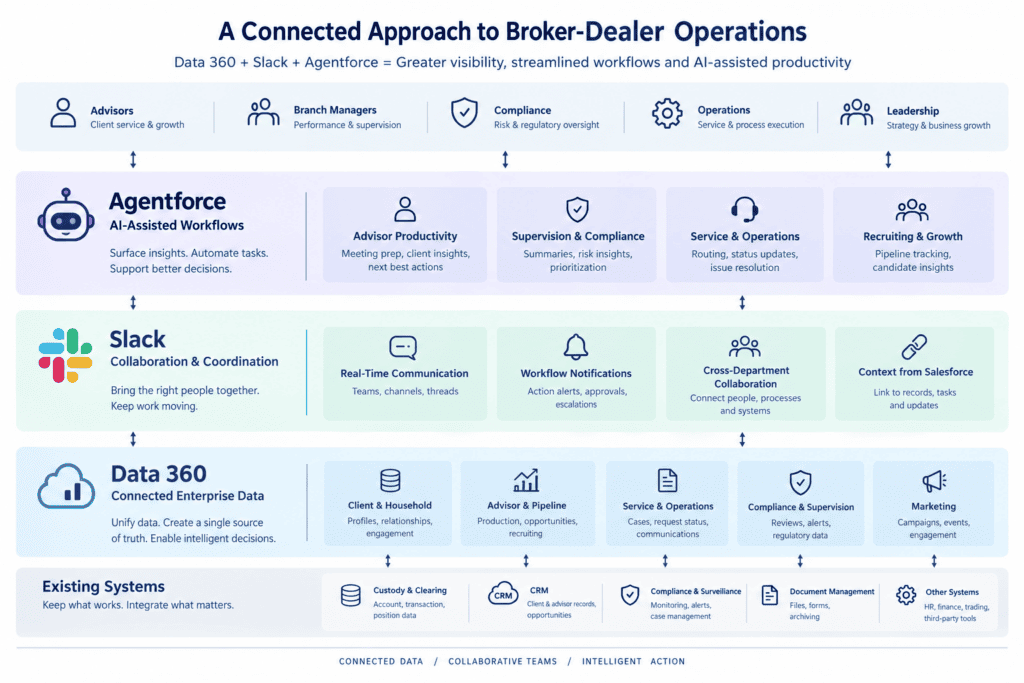
Broker-dealers can connect Salesforce Data 360, Slack, and Agentforce to improve operational visibility, coordinate workflows, and support responsible AI adoption while retaining their existing systems.
Connect enterprise data: Bring relevant client, advisor, operational, and supervisory information together from supported systems.
Improve collaboration: Use Slack to coordinate teams, notifications, and workflow handoffs.
Support AI-assisted supervision: Use Agentforce to summarize information, flag items for review, and assist with defined tasks.
Streamline operations: Automate appropriate onboarding, service, and administrative workflows.
Maintain governance: Establish data access controls, human oversight, auditability, and measurable performance objectives.
Transforming Broker-Dealer Operations: How Data 360, Slack, and Agentforce Support Modern Supervision
The Next Evolution of Broker-Dealer Technology
Broker-dealers operate across complex technology environments that include CRM platforms, clearing and custody systems, compliance and surveillance tools, advisor workstations, document management applications, and digital communication channels.
Although these systems serve essential purposes, information often remains fragmented across platforms and departments. Supervisors may need to consult multiple sources to understand advisor activity. Operations teams coordinate requests through email and manual follow-ups. Advisors navigate disconnected systems to manage client relationships, opportunities, and service needs.
These challenges create friction across the organization. They can make it harder to obtain a consistent view of business activity, identify issues requiring attention, and coordinate timely action.
Artificial intelligence offers opportunities to improve how broker-dealers access information and manage operational processes. But AI alone does not resolve fragmented data, inconsistent workflows, or unclear accountability.
To realize meaningful value, firms need an approach that connects trusted data, collaboration, and automation while preserving the controls required in a regulated environment.
Salesforce Data Cloud, now branded Salesforce Data 360, Slack, and Agentforce can contribute to this approach. Together, they can support connected workflows, contextual insights, and AI-assisted operations when the appropriate integrations, permissions, and governance are in place.
The opportunity is not to replace every system a broker-dealer already uses. It is to help existing systems work together more effectively.
The Broker-Dealer Challenge: Fragmented Data and Disconnected Workflows
Broker-dealers rely on multiple systems to manage client relationships, advisor performance, account servicing, recruiting, compliance, and supervision.
The challenge is that information available in one system may not be readily accessible to the team responsible for the next step.
Consider a few common scenarios:
Branch supervision: A branch manager needs to review advisor activity, production trends, outstanding tasks, and other relevant information drawn from different systems.
Compliance operations: A reviewer must gather records and supporting information before completing a supervisory review.
Advisor onboarding: Operations, compliance, technology, and branch personnel coordinate account setup, documentation, approvals, and training.
Client servicing: A request moves between an advisor and several internal teams, with progress tracked through separate emails or applications.
Recruiting and growth: Leadership wants to understand recruiting pipeline activity, candidate progression, and potential branch expansion opportunities.
Each process can involve several handoffs, multiple sources of information, and manual coordination.
The result may be duplicated work, inconsistent records, delayed decisions, and limited visibility into outstanding responsibilities.
Adding AI to this environment without addressing the underlying process can simply introduce another interface or information source.
A more effective strategy starts by identifying where better data access, clearer workflows, and targeted automation can solve a specific business problem.
Salesforce Data 360: Connecting Data Across the Enterprise
Salesforce Data 360, formerly Salesforce Data Cloud, provides capabilities for connecting, ingesting, harmonizing, and unifying data from supported sources. Depending on the architecture, firms can use batch or streaming ingestion, integrations, and zero-copy data federation to make information available for supported use cases.
BROKER-DEALER DATA ARCHITECTURE
Salesforce Data 360
For broker-dealers, the potential value lies in connecting relevant information without assuming that every source system must be replaced.
Potential Data Sources
Client, household, and advisor records
Account and custody information
Advisor production and pipeline metrics
Recruiting and onboarding records
Client service interactions
Operational workflow status
Selected compliance and supervisory data
Marketing and engagement activity
* Note: Availability and freshness depend on source systems, integration methods, permissions, and update frequencies.
What a Connected Data Foundation Can Enable
A More Complete View of Advisor Activity
Leadership can bring together relevant production, pipeline, and operational indicators to support business reviews and capacity planning.
Better Access to Client Context
Authorized users and supported AI applications can access relevant information from connected sources, subject to permissions and architecture.
More Informed Operational Decisions
Teams can identify patterns, monitor workflow status, and prioritize actions using data from multiple systems rather than relying on manual reports.
A Foundation for AI-Assisted Workflows
Agentforce and other supported Salesforce capabilities can use appropriately configured data and business context to support defined tasks.
GOVERNANCE & ARCHITECTURE CONSIDERATIONS
Establishing Control Beyond Technology
A unified data layer does not automatically create a complete or real-time supervisory record. Firms must establish which sources are authoritative, how records are matched, how data quality is monitored, and which users and applications are permitted to access the information. For broker-dealers, these decisions are as important as the technology itself.
Slack: Connecting Teams to the Work That Needs Attention
Email remains important in broker-dealer operations, but it is not always the most effective way to coordinate time-sensitive work across departments.
COLLABORATIVE WORKSPACE INTEGRATION
Slack
Slack can provide a collaborative workspace connected to Salesforce records and supported workflows. With appropriate integrations and configuration, teams can receive notifications, discuss operational issues, and coordinate next steps without relying entirely on lengthy email exchanges.
Potential Use Cases
New account onboarding and outstanding documentation
Operational service requests and escalations
Recruiting coordination
Internal approvals and handoffs
Branch performance discussions
Follow-up actions arising from business reviews
Workflow Collaboration in Practice
PRACTICAL EXAMPLE
When an onboarding workflow reaches a stage requiring an operations review, an integration can automatically notify the responsible team in Slack. Team members coordinate the next steps in real time while the underlying request status and assigned responsibilities remain tracked in Salesforce.
<strong style="color: #38bdf8;">Crucial Distinction:</strong> Slack facilitates collaboration, but a conversation in Slack should not automatically be treated as the official record of an approval, supervisory review, or regulated communication.
COMPLIANCE & ARCHITECTURE POLICY
Designing Collaboration Around Governance
Broker-dealers should establish clear policies for which information can be shared in Slack, who can access relevant channels, and how decisions and approvals are documented. Where a process requires a formal record, the workflow should capture the required outcome in the designated system of record. Regulated communications may also require approved retention and archiving arrangements.
The Goal: Reduce coordination friction without creating another uncontrolled source of important business records.
Agentforce: Applying AI to Defined Broker-Dealer Workflows
Agentforce enables organizations to build AI agents that can use configured instructions, actions, data, and business logic to assist with or perform defined tasks.
In broker-dealer environments, useful starting points are often workflows that involve repeated information gathering, summarization, routing, and follow-up.
AI WORKFLOW AUTOMATION
Agentforce
The scope of each agent should be clearly defined, with appropriate access permissions, testing, monitoring, and human oversight.
WORKFLOW 01
Advisor Productivity
Advisors and support teams spend substantial time preparing for meetings and gathering data. AI-assisted workflows help streamline routine preparation:
Summarize relevant client and account information
Prepare meeting briefs for advisor review
Draft follow-up communications for approval
Identify incomplete records or outstanding tasks
Surface relevant information from connected sources
Control Note: Outputs must be validated. Recommendations and client communications must follow approved firm controls.
WORKFLOW 02
Supervisory Support
Assists supervisors carrying out reviews by organizing authorized records for branch manager review:
Summarize authorized records for branch managers
Organize information and document review materials
Identify missing documentation across accounts
Prioritize review items by firm-defined criteria
Supervisory Rule: AI supports established procedures and human review—it does not replace required surveillance or compliance determinations.
WORKFLOW 03
Service & Operations
Operational requests span multiple departments and approvals. Agentforce streamlines multi-step case execution:
Categorize and route incoming service requests
Summarize case history for operations specialists
Identify missing information on submissions
Draft status updates and flag overdue tasks
Initiate approved workflow actions
Governance Rule: Processes must explicitly specify independent agent actions versus steps requiring human approval.
WORKFLOW 04
Recruiting & Branch Growth
Branch development involves repetitive coordination and candidate tracking across growth pipelines:
Summarize recruiting pipeline activity
Prepare candidate briefs for leadership
Highlight stalled opportunities and pending tasks
Coordinate outreach and follow-up schedules
Advisory Rule: AI capabilities support human decision-making rather than making assumptions on candidate suitability.
HUMAN-IN-THE-LOOP ARCHITECTURE
Defined Scope & Accountable Oversight
Deploying AI in regulated financial environments requires maintaining clear boundaries. Every Agentforce agent must operate under well-defined permission sets, continuous output validation, and human accountability to align with firm policies and regulatory obligations.
How Data 360, Slack, and Agentforce Can Work Together
The greatest opportunity comes from connecting data, collaboration, and AI within a clearly defined business process.
PRACTICAL SCENARIO
Hypothetical Broker-Dealer Branch Review Workflow
Consider a hypothetical broker-dealer preparing for a weekly branch performance review. Below is an end-to-end illustration of how integrated data, AI assistance, collaborative workspaces, and automated system-of-record updates connect across the process.
STEP 01
Connect the Relevant Information
Data 360 makes selected information from supported systems available for the configured use case. This might include advisor pipeline activity, production indicators, open service requests, and task status.
STEP 02
Prepare an AI-Assisted Summary
An appropriately configured Agentforce agent uses authorized data and defined instructions to prepare a summary of key changes, outstanding actions, and areas requiring further review.
STEP 03
Coordinate the Next Steps
Slack can notify the relevant stakeholders and provide a space for discussion. Access controls determine who can see the information, and the firm’s policies govern what may be shared.
STEP 04
Record Decisions and Actions
Following the review, assigned tasks and approved outcomes are recorded in the appropriate system of record. Workflow automation can help route actions, send reminders, and monitor completion.
STEP 05
Measure the Results
The firm evaluates whether the process has reduced preparation effort, improved follow-up completion, or increased visibility into outstanding work.
This example illustrates a potential architecture, not an automatic out-of-the-box capability. Its feasibility depends on the data sources, Salesforce products, integrations, agent configuration, permissions, and controls selected.
The objective is to make relevant information easier to act on while retaining clear ownership of decisions and records.
Business Outcomes: What Broker-Dealers Should Measure
The value of this approach should be assessed through operational outcomes rather than technology adoption alone.
Advisor productivity
Measure time spent preparing for meetings, gathering information, updating records, and completing administrative tasks.
Supervisory workflow efficiency
Track review preparation time, review completion rates, overdue items, and the effort required to gather supporting documentation. Efficiency metrics should not come at the expense of review quality or required controls.
Service delivery
Monitor request resolution times, handoff delays, outstanding service cases, and completion rates.
Recruiting and growth
Evaluate pipeline progression, time between recruiting stages, follow-up completion, and the quality of information available to leadership.
Data quality and governance
Track missing or inconsistent records, data freshness, access exceptions, and the completion of required control activities.
AI reliability and adoption
Measure the accuracy of outputs, frequency of human corrections, exception rates, usage by intended users, and the business impact of the workflow.
Baseline measurements are important. Firms should compare performance before and after implementation, accounting for changes in workload and other relevant factors. Benefits should be demonstrated rather than assumed.
A Practical Approach to Modernizing Broker-Dealer Operations
A successful transformation does not require a broker-dealer to implement every available AI capability at once.
A phased approach allows firms to establish the right foundations, test assumptions, and learn from a focused use case before expanding.
IMPLEMENTATION METHODOLOGY
A Practical Framework for Execution
To ensure successful deployment, broker-dealers and financial institutions should follow a disciplined phased approach that aligns business requirements, technology controls, and governance.
01
Identify the Operational Problem
Start with a specific challenge, such as onboarding delays, manual preparation for business reviews, fragmented service requests, or repetitive information gathering. Document the current process, stakeholders, handoffs, and measurable pain points.
02
Map the Data and Systems
Identify the systems that contain the required information, which sources are authoritative, how often data changes, and what integrations are available. Assess data quality, access permissions, retention requirements, and any restrictions on using information with AI.
03
Define the Workflow and Controls
Determine which tasks can be automated, which actions require human approval, how exceptions will be handled, and where the official record must be maintained. Involve operations, compliance, technology, and business stakeholders before deployment.
04
Pilot a Focused Use Case
Select a workflow with a clear business objective and manageable scope. Test it with representative users and realistic scenarios, including incomplete data, unexpected inputs, and exceptions. Establish appropriate testing, monitoring, and rollback procedures.
05
Measure, Refine, and Scale
Compare results against the baseline. Evaluate operational efficiency, output quality, user adoption, and control effectiveness. Expand the solution only when the results justify doing so and the firm has the governance and operational capacity to support it.
RISK MITIGATION VALUE
This structured approach reduces the risk of investing in technology before the underlying business problem has been clearly defined.
Navirum’s Perspective: Start with Operational Friction, Not Technology
For broker-dealers, digital transformation should begin with the challenges that matter most to advisors, supervisors, operations teams, and firm leadership.
In some organizations, the priority may be connecting fragmented client and advisor information. In others, it may be simplifying onboarding, improving service coordination, or reducing the manual effort involved in preparing business reviews.
Navirum helps financial services organizations design and optimize Salesforce solutions, connect business systems, and evaluate opportunities for intelligent automation and AI.
The starting point is understanding the firm’s operating model, data environment, existing technology, and governance requirements. From there, organizations can identify where Salesforce, Data 360, Slack, and Agentforce may fit—and where existing specialist systems should remain in place.
The objective is not to deploy AI everywhere. It is to apply technology where it can solve a defined problem, improve a measurable outcome, and operate within the firm’s control framework.
Final Takeaway
Broker-dealers face growing pressure to improve advisor productivity, coordinate operations, support effective supervision, and deliver consistent client experiences.
Disconnected systems and manual processes can make these goals more difficult to achieve. Yet adding new technology without addressing data quality, workflow design, and governance can introduce further complexity.
Salesforce Data 360, Slack, and Agentforce offer complementary capabilities for connecting data, coordinating work, and supporting AI-assisted processes.
The value comes from how these capabilities are designed and implemented: with trusted data, clearly defined workflows, appropriate permissions, human oversight, and measurable business objectives.
For broker-dealers considering their next stage of digital transformation, the most effective starting point is a specific operational challenge—and a clear plan for solving it.
FINANCIAL SERVICES ADVISORY
Explore how Navirum helps financial services organizations connect Salesforce, data, and intelligent automation to improve operational performance.
Book time with Navirum to discuss your firm’s priorities and identify potential opportunities for improvement.
<strong class="schema-faq-question">How can broker-dealers use AI without increasing regulatory risk?</strong>
Broker-dealers should establish clear governance, access controls, testing, monitoring, and human oversight before deploying AI in regulated workflows. AI can assist with information gathering, summarization, task routing, and review prioritization, but firms must ensure that their use of AI aligns with applicable obligations and established supervisory procedures.
<strong class="schema-faq-question">What broker-dealer functions are good candidates for AI automation?</strong>
Potential starting points include advisor meeting preparation, onboarding coordination, service request routing, documentation checks, workflow summaries, and administrative follow-ups. The best candidates are processes with a clear business problem, suitable data, measurable outcomes, and manageable risks.
<strong class="schema-faq-question">What is Salesforce Data 360, and how does it relate to Data Cloud?</strong>
Salesforce Data 360 is the current name for Salesforce Data Cloud, following the rebranding announced in October 2025. It provides capabilities for connecting, ingesting, harmonizing, and unifying data from supported sources. Its suitability for a broker-dealer depends on the firm’s data architecture, integrations, requirements, and licensing.
<strong class="schema-faq-question">How can a connected data strategy improve branch operations?</strong>
Connecting relevant data from supported systems can give branch managers and leadership a more consistent view of advisor activity, pipeline indicators, service requests, and workflow status. The usefulness of that view depends on data quality, integration coverage, freshness, and appropriate access controls.
<strong class="schema-faq-question">What role does Slack play in broker-dealer operations?</strong>
Slack can help teams coordinate work, discuss operational issues, and receive workflow notifications when connected to Salesforce and other supported systems. Firms should define which information may be shared in Slack and ensure that required approvals, official records, and regulated communications are managed according to their policies.
Agentforce may assist with tasks such as summarizing authorized information, identifying missing documentation, and prioritizing items for review. The extent of automation depends on the configuration and risk controls. Firms must determine which activities require human review and ensure that AI does not bypass required supervisory procedures.
<strong class="schema-faq-question"> Can Salesforce Data 360 connect to existing custody and compliance systems?</strong>
Data 360 supports different approaches to connecting data, including available connectors, integrations, and zero-copy data federation. Whether a specific custodian or compliance platform can be connected depends on its APIs, available connectors, data access arrangements, technical architecture, and applicable permissions.
<strong class="schema-faq-question">How should broker-dealers measure the success of AI initiatives?</strong>
Firms should establish baseline metrics and measure outcomes such as time saved, workflow completion rates, service resolution times, data quality, output accuracy, user adoption, and exception rates. Supervisory and compliance-related metrics should also reflect the quality and effectiveness of required controls, not just processing speed.
<strong class="schema-faq-question">Should broker-dealers replace their existing systems to adopt AI?</strong>
Not necessarily. A firm’s existing CRM, custody, surveillance, compliance, and document management platforms may remain essential systems of record. Integration and targeted workflow improvements may provide value without requiring wholesale replacement. The appropriate architecture depends on business requirements, system capabilities, and governance constraints.
<strong class="schema-faq-question">What is the best way to begin an AI transformation?<br></strong>
Start by identifying a specific operational challenge, documenting the current process, assessing the relevant data and systems, and defining measurable success criteria. Pilot a focused use case with appropriate controls, evaluate the results, and scale only when the benefits and risks are understood.
<strong class="schema-faq-question">How can broker-dealers prepare for the future of AI-assisted supervision?</strong>
Firms can prepare by improving data quality, documenting supervisory workflows, clarifying accountability, strengthening access controls, and establishing policies for AI testing and monitoring. These foundations make it easier to evaluate new capabilities without compromising established governance and supervisory responsibilities.
ONLINE RESOURCES
Knowledge & Insights
Explore expert guides on AI, Data Cloud, Slack, and Agentforce transformations for financial services.
Discover real-world outcomes, learn about our collaborative company culture, and meet the financial technology specialists leading your digital transformation.
Proven Results & Impact
Explore Our Success Stories
See how we help financial institutions, wealth managers, and fintechs turn Salesforce and AI into measurable business outcomes and operational growth.
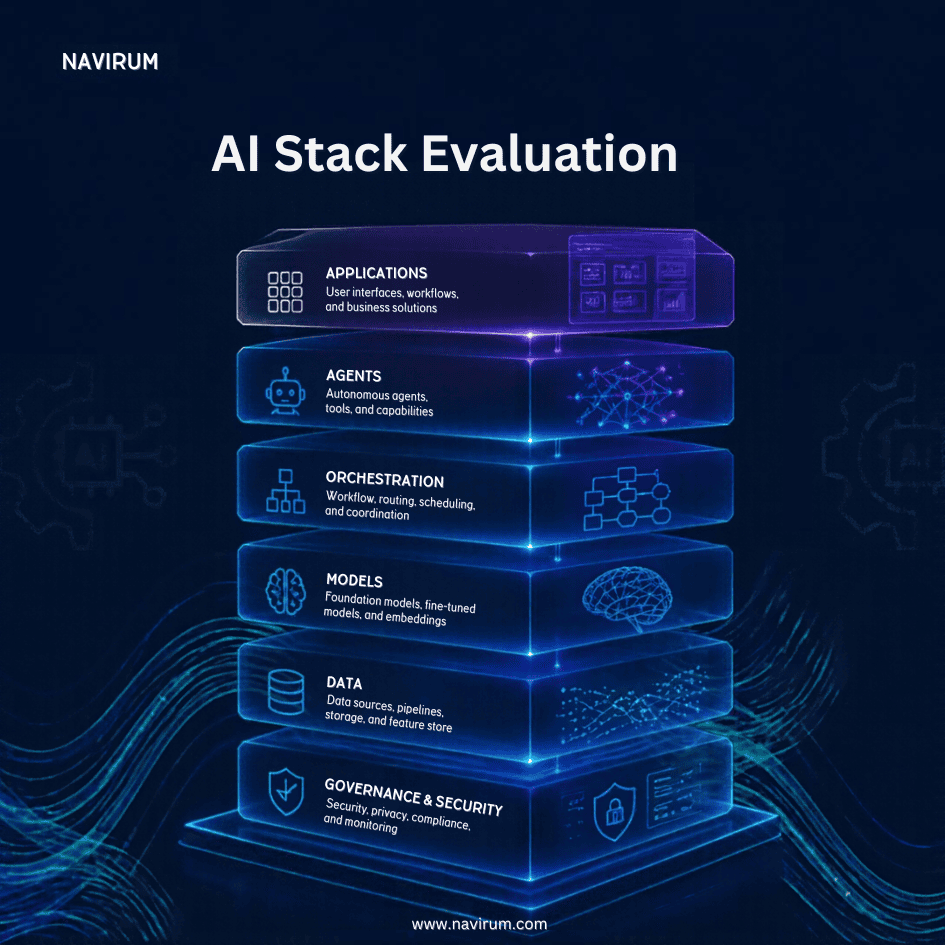
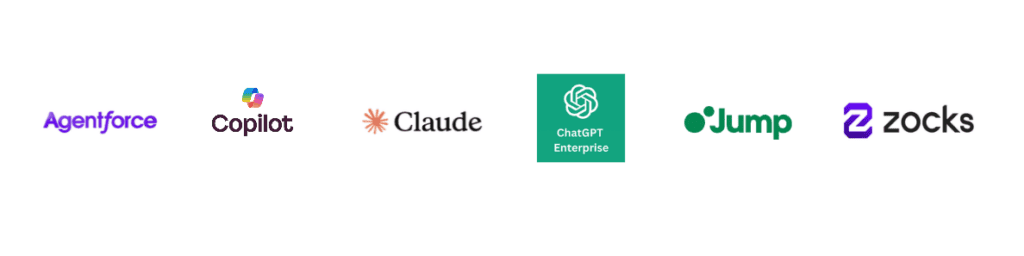
This guide compares six AI platforms for financial services: Salesforce Agentforce, Microsoft Copilot, Claude, ChatGPT Enterprise, Jump, and Zocks, across security, compliance, integration, and cost. Learn how each tool supports different financial workflows and what to consider when building a secure, cost-effective AI strategy for regulated environments. Discover how Navirum’s AI Assurance framework helps financial institutions validate AI controls, identify overlapping tools, and strengthen governance.
Key Takeaways
Evaluate AI beyond model performance. Financial institutions must consider security, data boundaries, regulatory requirements, auditability, integration, and cost when selecting enterprise AI tools.
Match each platform to the right workflow. Salesforce Agentforce supports CRM-based automation, Microsoft Copilot enhances workplace productivity, Claude supports complex document analysis, ChatGPT Enterprise enables general-purpose knowledge work, and Jump and Zocks focus on wealth advisory workflows.
Treat governance as a deployment requirement. User permissions, data access controls, logging, and appropriate safeguards should be validated for each implementation rather than assumed from a platform’s enterprise positioning.
Understand the total cost of ownership. Seat-based subscriptions and usage-based pricing create different cost profiles. Reviewing utilization, overlapping capabilities, and consumption is essential as adoption grows.
Build an integrated AI strategy. A combination of general-purpose assistants, workflow agents, analytical tools, and specialized applications may serve financial institutions better than a single-platform approach.
Validate before scaling. AI assurance can help organizations test model behavior, verify access boundaries, identify unnecessary tool overlap, and strengthen operational readiness.
EXECUTIVE BRIEFING • FINANCIAL SERVICES AI
Financial AI Stack Evaluation: Side-by-Side Comparison for Regulated Work
A comprehensive executive guide analyzing Salesforce Agentforce, Microsoft Copilot, Claude, ChatGPT Enterprise, Jump, and Zocks across security, compliance, data boundary handling, and operational cost.
Navigating the Financial Services AI Explosion
Financial institutions—from regional banks and credit unions to wealth management practices, insurers, and private equity firms—are facing an overwhelming array of artificial intelligence offerings. Every major cloud provider, enterprise software vendor, and boutique fintech startup is pitching AI capabilities designed to boost productivity and automate client interactions.
However, financial services leadership cannot evaluate AI purely on conversational fluency or feature velocity. Selecting an AI tool in a regulated institution requires balancing transformative operational efficiency against stringently enforced compliance, data residency, and fiduciary mandates.
“The fundamental question for financial executives isn’t whether an AI model can summarize a document or answer a question—it is whether that model operates safely within your enterprise security boundary, respects entitlement controls, and leaves an auditable trail.”
The Four Non-Negotiable Evaluation Dimensions
When evaluating AI platforms for banking, wealth management, insurance, or private equity, Navirum assesses solutions across four core operational criteria:
Dimension 01
1. Security & Data Boundaries
Guarantees that proprietary customer PII/NPI, portfolio ledgers, and trade secrets are never used for public model retraining, with strict SOC2 Type II, Reg S-P, and ISO27001 compliance.
Dimension 02
2. Fit for Regulated Work
In-line enforcement of user permissions, role-based field entitlements, immutable interaction logging, and audit trail generation required for SEC, FINRA, and OCC examination.
Dimension 03
3. Action Velocity & Systems Integration
The distinction between passive information retrieval (chatbots) vs. autonomous agentic execution capable of executing multi-system workflows directly in core platforms.
Dimension 04
4. Total Cost & Subscription Predictability
Understanding fixed seat licensing versus consumption-based billing (e.g., per-conversation credits), avoiding unexpected cost overruns as usage scales.
Executive AI Comparison Matrix
Below is a side-by-side comparative analysis of the six primary AI platforms frequently evaluated by financial organizations, formatted so all details are immediately visible without horizontal scrolling.
Salesforce Agentforce
Autonomous Enterprise Agent
Regulated Fit: Native High
Target Financial Workflows
FSC Onboarding, Client Service, KYC, Lead Triage, CRM Automation
Data Boundary & Privacy
Grounded in Data 360 with Trust Layer mask; zero public model training.
Licensing Model
Flex / Consumption ($2 per conversation credit)
Microsoft Copilot
Desktop & Productivity Assistant
Regulated Fit: Native High
Target Financial Workflows
Office 365 drafting, M365 email summary, Teams notes, Excel analysis
Data Boundary & Privacy
Protected within Microsoft 365 tenant boundary; commercial data protection.
Licensing Model
Fixed Seat ($30 / user / month add-on)
Claude (Anthropic)
Advanced Reasoning Engine
Regulated Fit: Requires Setup
Target Financial Workflows
Complex document analysis, regulatory text parsing, deal DD narrative
Data Boundary & Privacy
API/Bedrock tenant boundary isolated. Zero retention agreements available.
Licensing Model
Seat or Token Consumption (API volume pricing)
ChatGPT Enterprise
General Purpose Assistant
Regulated Fit: Requires Setup
Target Financial Workflows
Ad-hoc research, code generation, initial draft content, general Q&A
Data Boundary & Privacy
Enterprise privacy controls; customer data excluded from training. SOC2 compliant.
No audio recording storage option; structured wealth note extraction.
Licensing Model
Fixed Seat (Per advisor / month subscription)
In-Depth Analysis by Platform
1. Salesforce Agentforce
Autonomous Agent Platform
Agentforce represents a shift from passive prompt-and-response AI to autonomous execution. Embedded directly inside Salesforce Financial Services Cloud (FSC), Agentforce agents operate on structured financial records, executing multi-step tasks like onboarding verification, policy changes, and service case resolution without leaving the system of record.
Primary Strengths
Native access to FSC data, atomic permission enforcement, autonomous action execution via Flow, grounded zero-retention Trust Layer.
Key Consideration
Requires well-architected data foundations (Data 360) and defined guardrails to ensure agents operate within intended operational boundaries.
2. Microsoft 360 Copilot
Desktop Productivity Assistant
Copilot excels at individual employee productivity across Word, Excel, PowerPoint, Outlook, and Teams. For financial analysts drafting investment memos or wealth managers summarizing lengthy Teams client calls, Copilot delivers immediate personal efficiency within the existing M365 security perimeter.
Primary Strengths
Seamless integration with M365 suite, leverage existing Azure AD permissions, fixed predictable monthly seat pricing.
Key Consideration
Limited capability to execute transactional workflows in core banking engines or update external CRM systems automatically.
3. Claude (Anthropic via AWS Bedrock / GCP)
Deep Reasoning & Document Analysis
Claude (specifically Sonnet and Opus models) leads the industry in processing large context windows (200k+ tokens) with high nuance and reasoning fidelity. In private equity due diligence, insurance policy comparison, or complex regulatory document analysis, Claude minimizes hallucinations and handles dense financial prose exceptionally well.
Requires enterprise API orchestration or integration wrapper; lacks an out-of-the-box user interface tailored for non-technical business staff.
4. ChatGPT Enterprise (OpenAI)
General Purpose Enterprise AI
ChatGPT Enterprise provides a dedicated, privacy-shielded workspace for general knowledge work, coding assistance, and ad-hoc analysis. While popular for individual team research, financial institutions must enforce strict governance to prevent employees from pasting unverified client information into free-form prompts.
Primary Strengths
High user familiarity, versatile across multi-modal data, enterprise admin console with SSO and data encryption.
Key Consideration
Operates as a separate browser tab silo away from core financial applications, making workflow automation difficult without custom API engineering.
5. Specialized Wealth Tools: Jump & Zocks
Wealth Advisory Vertical AI
Jump and Zocks address the specific pain point of wealth managers and advisors: meeting preparation, dictation, and CRM note entry. By capturing advisor-client dialogues and auto-formatting structured notes into compliance-ready formats, these tools eliminate administrative burdens for advisory practices.
Primary Strengths
Turnkey wealth advisor workflows, FINRA note formatting, direct integration into wealth CRMs like Salesforce FSC.
Key Consideration
Niche point solutions that address meeting capture but do not extend to enterprise banking automation or cross-departmental operations.
Architecting a Balanced Multi-Tool Strategy
Most mature financial institutions do not settle on a single AI tool. Instead, executive teams deploy a multi-layered stack:
1. Core System Agentic Layer (Salesforce Agentforce): Handles structured client interactions, automated workflow execution, and CRM task fulfillment. 2. Desktop Productivity Layer (Microsoft Copilot): Assists individual employees with email drafting, document synthesis, and internal communication. 3. Deep Analytical Reasoning Layer (Claude / Bedrock): Powers specialized document intelligence, underwriting analysis, and legal text processing. 4. Specialized Front-Office Layer (Jump / Zocks): Streamlines advisor-client meeting capture and compliance documentation.
PROACTIVE GOVERNANCE & ASSURANCE
Evaluating or Deploying AI Tools in Your Financial Institution?
Navirum’s AI Assurance framework helps banks, wealth managers, insurers, and PE firms test model behavior, verify permission boundaries, eliminate overlapping tool costs, and maintain audit readiness.
Explore our latest research, frameworks, and strategic analysis on AI governance, Salesforce innovation, and technology adoption in financial services.
In briefSalesforce managed services provide financial-services firms with ongoing administration, development, security, release management, integration, data, and AI expertise after go-live. Navirum Orbit is a flexible, long-term partnership that helps regulated firms keep Salesforce secure, useful, and closely aligned with changing technology.
Continuous post-go-live evolution for regulated environments
Salesforce managed services are the ongoing administration, development, security, release management, integration, data, and AI work that keeps a Salesforce platform running well after go-live — covering day-to-day admin support, seasonal release testing, data quality, third-party integrations, licensing guidance, and increasingly AI governance, delivered as an outsourced or co-sourced service rather than a one-time project.
Chapter 01
Why ongoing management matters
Salesforce go-live is only the starting line. Without continuous care, a highly customized environment inevitably drifts from how the active business operates.
Navirum is a Salesforce Ridge Partner with a 5.0 rating on the Salesforce AppExchange, 1,000+ Salesforce projects, 400+ clients and 40+ Salesforce certifications, and has hosted the FinSight Series since 2021.
Let's be honest: Salesforce is hard. Whether you are an executive whose firm has scaled past its current setup with no dedicated technical lead, or an in-house administrator sinking under a mountain of backlog demands, managing this powerful operating system without institutional support is a recipe for system friction.
Salesforce is one of the most powerful technology investments a financial services firm can make, improving client relationships, advisor productivity, and reporting accuracy. However, after going live, the system's footprint naturally expands as team structures, custodians, and API parameters change over time.
⚠️
Platform Drift
Salesforce gradually stops matching how advisors and operations teams operate, resulting in manual workarounds.
👥
Capacity & Knowledge Gaps
Crucial system ownership becomes concentrated within a single point of failure, leaving you vulnerable during talent transitions.
🤖
Change, Security & AI
Frequent releases, complex integrations, and new AI initiatives demand rigorous testing and sandbox governance.
Diagnostics
Common Warning Signs
If your organization flags two or more of these signals, your Salesforce investment is bleeding value daily.
✕ Reports and pipelines are not trusted
✕ High-value workflows remain manual
✕ Integrations require manual syncing
✕ Seasonal releases are ignored
✕ Advisors return to spreadsheets
✕ AI plans are blocked by messy data
Chapter 02
What is a Salesforce Org Health Check?
Evaluate if your Salesforce instance is configured optimally to safely scale operations, secure client trust, and embrace CRM automation.
Interactive Diagnosis
60-Second Salesforce Platform Check
Which best describes your firm?
What is your primary platform challenge?
How are you currently supporting Salesforce?
📋 FSC Strategy Recommendation
FSC Hybrid Co-Delivery Model Assessment
Your combination of sector requirements and platform challenges highlights critical system friction that standard point-and-click teams miss.
Priority Phase 01
Establish Sandbox Regression Cycles
Configure locked sandboxes with representative dummy records to validate seasonal API releases.
Priority Phase 02
Unify Relationship Matrix Hierarchies
Standardize household mapping structures to prevent fragmented reporting views.
Priority Phase 03
Formalize Role-Based Access Controls
Enforce strict custom profiles ensuring only verified compliance users modify critical field parameters.
Get practical, bi-weekly insights covering Salesforce FSC upgrades, AI security protocols, and operational workflows built for modern financial services. Get our Post-Go-Live Value Checklist delivered straight to your inbox.
✓ Agentforce guidelines
✓ Real integration stories
✓ Sandbox testing tips
✓ FinTech development news
✓
Thank you, !
We've sent your verification link and the Post Go-Live Value Checklist to .
Chapter 03
What Is Orbit Services & How Do Managed Services Work?
Managed services must go beyond reactive ticket management. The right model delivers ongoing, programmatic platform improvements month-over-month.
Our FSC certified experts take over user provisioning, troubleshooting, minor configuration tweaks, report setup, and access reviews so internal IT resources stay ahead of backlog.
Capabilities Included
• User licensing & access control
• Custom profiles and permission sets
• Page layout adjustments
CRM Storage Cost Optimization & Adoption
We audit page speeds, database schemas, and workflows to eliminate data bloat, keeping ongoing Salesforce licensing costs in check while supporting long-term data retention needs.
Capabilities Included
• Runaway file storage audits
• Retention-aligned log archiving
• Flow automation cleanups
Controlled Release Management
Seasonal upgrades are evaluated in isolated sandboxes before deployment, reducing the risk of impact on active production features.
Capabilities Included
• Sandbox regression testing
• Change impact mapping
• Deployment validation checks
Access, Security & Compliance Governance
We maintain clear data parameters to protect consumer privacy, restrict layouts based on department roles, and track audit paths.
Capabilities Included
• Field-level access checks
• Multi-factor authentication setups
• Access audit tracking logs
Technical & Licensing Roadmaps
Ongoing strategy reviews align software costs and licensing agreements with long-term technological goals.
Capabilities Included
• Agentforce planning and architecture design
• License usage optimization audits
• Specialized developer capacity scaling
Safe Change Sequences
Controlled Seasonal Release Management
01
Review
02
Assess
03
Test
04
Validate
05
Deploy
06
Notify
07
Log
08
Monitor
1Review platform changes.
2Assess security, access, and workflow implications.
3Test configurations within clean sandbox parameters.
4Validate layouts alongside end users.
5Deploy live during safe scheduled windows.
6Notify platform updates directly to advisors.
7Log architecture updates and data logs.
8Monitor adoption patterns to identify user gaps.
What drives the cost of Salesforce managed services?
Pricing for managed services is not one number — it moves with four variables: how many hours of hands-on work your org needs each month, how many Salesforce clouds and third-party integrations are in scope, how fast you need response and resolution (your SLA), and how much proactive work (release testing, security reviews, roadmap planning) you want built in versus billed separately.
⏱️
Hours of monthly capacity
A small firm with a stable org may need under two hours a month; a firm mid-migration or running multiple integrations can need 20+.
☁️
Cloud and integration footprint
Each additional Salesforce cloud or custodian/portfolio integration adds ongoing maintenance surface.
🚦
Response and resolution SLA
Faster, committed response times and dedicated capacity cost more than best-effort, queue-based support.
🧭
Proactive vs. reactive scope
Release testing, security audits and a quarterly roadmap are cheaper built into a retainer than purchased as one-off projects after something breaks.
Orbit’s three plans (Standard, Flex and Enterprise, from $200/month) are built around exactly these variables — see current plans and pricing for the full breakdown by tier.
What a managed-services engagement actually looks like month to month
Most firms evaluating managed services want to know what the relationship looks like in practice, not just what is included on paper. A typical Orbit engagement runs in four recurring phases:
Onboarding (first 90 days). Access to the Orbit portal and knowledge base from day one; an initial ticket-volume and scope review around day 30; alignment with your business roadmap and a check on whether your tier still fits around day 60; and a full outcomes review — SLA performance, completed work, budget and recommendations — at day 90.
Monthly cadence. Ticket-based support against the agreed SLA, a monthly status report, and a priorities check-in.
Seasonal releases (three times a year, Flex and above). Each Salesforce release is reviewed, tested in sandbox, and validated before it reaches production.
Quarterly roadmap (Enterprise). Enterprise engagements add a dedicated quarterly roadmap session; Standard and Flex engagements review priorities monthly instead.
Capacity scales up or down inside this same structure — firms move between Orbit plans as their Salesforce footprint changes, without re-signing a new type of contract.
Chapter 04
Why financial-services firms choose Orbit
Financial firms require certified Salesforce competence mapped specifically to regulated business scenarios, compliance guidelines, and complex third-party tools.
🏆
Financial-services expertise
Deep knowledge of FSC, wealth advisor pipelines, broker networks, and regulated custodian integrations.
🔒
Secure, controlled change
Release management, sandbox staging, and access management, built to keep upgrades from disrupting active production flows.
👥
Long-term continuity
A dedicated, structured support team that retains business logic knowledge, reducing key-person dependency risk.
Challenge: Fragmented pipeline management and slow advisor support responses. Result: Boosted platform adoption and streamlined compliance logs.
Cuddy Financial
FSC & Envestnet Integration
Challenge: Broken Envestnet portfolio syncs disrupting operations. Result: Unified household data views with no routine page-switching.
Berry Wealth
LPL Migration Partner
Challenge: Migrating legacy data stores off client terminals without system downtime. Result: Successful migration with no business interruption during cutover.
West Coast Wealth Firm
iA Private Wealth Advisor
Challenge: Fragmented systems and an existing Salesforce org not customized for wealth management workflows. Result: Streamlined advisor tools and a scalable architecture built for future growth.
Armada Capital Partners
Multifamily & Commercial Real Estate
Challenge: Complex workflows spanning asset management, accounting, and investor relations. Result: A scalable, efficient system driving growth across the portfolio.
Verified Success Case
Signet Financial Deep Dive
The Challenge: Signet Financial had a highly customized environment but lacked direct internal resources to govern user adoption, support queries, or pipeline data integrity, leading to reporting errors.
The Orbit Intervention: Navirum assigned a dedicated Orbit account team to govern releases and centralize pipeline automation inside clean dashboards built around their compliance requirements.
The Outcome: Restored pipeline accuracy and consistent client records across advisor teams, supporting higher platform adoption.
The Challenge: Cuddy Financial's advisors had to cycle through multiple windows to reconcile portfolio data from Envestnet against client profiles in Salesforce.
The Orbit Intervention: Navirum restructured account relationship data models and standardized sync processes so custodial data populated directly into native Financial Services Cloud groupings.
The Outcome: Reduced manual entry duplication and restored advisor confidence in pipeline data across branch desks.
Often the strongest model is both: an internal platform owner supported by an external engineering backup squad.
Operating Area
Internal Administrator
Orbit Managed Services
Daily ownership
Immediate daily response
Adds massive technical capacity
Business knowledge
Deep, organic understanding
Documented and systematically retained
Specialist expertise
Limited to general administration
Architectural and development depth
Releases & security
Resource-constrained setups
Structured, regression-tested deployments
Continuity & capacity
Single point of failure risk
Backup coverage; depth depends on the selected plan
Data and AI
Varies by individual experience
Certified FSC and Data Cloud experts
Daily ownership
AdminImmediate response
OrbitAdded capacity
Business knowledge
AdminOrganic
OrbitSystematically retained
Specialist expertise
AdminGeneral scope
OrbitArchitect depth
Releases & security
AdminConstrained
OrbitRegression-tested
Continuity
AdminSingle point of failure
OrbitMulti-person backup
Data and AI
AdminVaries
OrbitCertified specialists
The business value Orbit delivers
Each stage of the model exists to move a number your firm already watches:
💰
Predictable run cost
A monthly plan from $200 can replace ad hoc consulting invoices, and licensing guidance at every renewal keeps the Salesforce bill honest.
🙌
Advisor hours back
AI is pointed at the work where the hours actually go: meeting prep, client follow-ups and service requests inside Salesforce.
🛡️
Fewer surprises
Three Salesforce releases a year land tested, and monitored custodian and portfolio integrations catch breaks before advisors do.
📉
AI spend under control
Agentforce and Data Cloud are billed by usage; Orbit tracks what drives the spend and cuts waste before it compounds.
📋
Compliance support that holds up
Permissions, Einstein Trust Layer settings and an audit trail, reviewed after every release and change — evidence for your compliance programme, not a substitute for it.
A managed-services SLA is only useful if it names real numbers. Orbit’s published service levels are:
🟢
Access issues (Standard plan)
1 business day response.
⚡
Orbit Flex
Accelerated response times above the Standard baseline, with managed release testing included for three major Salesforce updates a year.
🏛️
Orbit Enterprise
Extended-hours, weekend and holiday coverage on top of Flex.
Hours used, tickets closed and SLA performance are reported monthly through the Orbit Portal, not reconstructed after the fact.
How to evaluate a Salesforce managed-services provider
Whether or not you choose Orbit, these are the questions worth asking any managed-services provider before signing:
☑️Do they name actual response and review times in writing, or only describe support as responsive?
☑️Do they have certified depth in your specific Salesforce cloud rather than general Salesforce administration only?
☑️Is there a named point of contact, or do requests go into an anonymous queue?
☑️How is institutional knowledge retained if your account manager or their engineer leaves?
☑️Do they test releases in a sandbox before deploying to production, with a documented process?
☑️Can they show audit trails and permission reviews for AI tools already in production, not just roadmap slides?
What financial-services firms specifically need from a provider
Regulated firms carry requirements general Salesforce administrators rarely meet day to day: audit trails on client-record changes that support FINRA/SEC recordkeeping obligations, custodian and portfolio-platform integrations built to minimize silent failures, and documentation your compliance function can review for any AI feature that touches client data. Orbit’s financial-services specialization means release testing and access reviews are built around these constraints by default, rather than bolted on after an incident — the compliance determination itself stays with your firm’s own compliance programme, not Orbit.
Do you need managed services, an in-house hire, or both?
There is no universally right answer, but the trade-offs are consistent:
In-house only gives you immediate, organic business knowledge, but concentrates risk in one person and rarely covers specialist development, release engineering, or AI governance depth.
Managed services only gives you broad, documented expertise and continuity, but can be slower on same-day, in-the-room requests than someone sitting beside the business.
Both together is the most common pattern among established Orbit clients: an internal admin owns daily relationships and immediate response, while Orbit carries architecture, releases, security and overflow capacity.
The right mix usually comes down to firm size, how customized your org is, and how much of your team’s time is currently going to Salesforce firefighting versus the business itself.
Chapter 05
What do AI managed services cover after go-live?
AI does not reduce the importance of your CRM foundation. It exponentially increases it. To deploy systems like Agentforce safely, you require governed client data.
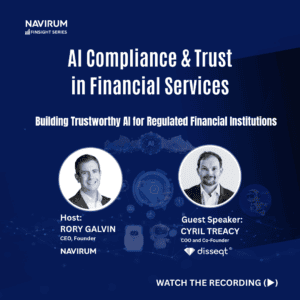
On the Orbit page these are the five AI managed services jobs: putting AI into daily work, piloting it safely, cost management, governance with the Einstein Trust Layer, and change management. The tiers below are what make those jobs safe to run, and the governance discipline is the same one we put on stage in the FinSight session on AI compliance and trust. Partners such as CloudFiles keep document storage costs off the Salesforce bill; see how that works, or browse the full Navirum partner ecosystem.
The Salesforce AI Trust Stack
Tier 5 Details
AI Outcomes & Agentforce
The pinnacle of active ROI: safe automated client scheduling, summarization, and real-time support insights designed to respect your compliance programme’s boundaries. Rolling out Agentforce reliably requires this baseline.
Tier 4 Details
Governed Processes
Standardized service paths designed so AI modules do not execute unreviewed updates without correct logging, user overrides, or supervisor authorization.
Tier 3 Details
Secure Permissions & FSC Relationship Maps
Field-level permissions and sharing configurations that prevent automated systems from revealing sensitive client records to unauthorized users.
Tier 2 Details
Trusted Connected Data
Harmonized client records fed from active custodian sync points, eliminating duplication so AI engines don't reference outdated addresses or balances.
Tier 1 Details
Well-Managed CRM Foundation
The critical baseline: clean database schemas, documented relationship matrices, and active sandbox workflows managed directly by Orbit certified experts.
Before Navirum Orbit
Fragmented data architectures, security gaps, and frequent sandbox regression errors.
With Navirum Orbit
Continuous roadmapping, secure permissions, clean datasets, and controls that support your compliance programme.
This matters even more under the EU AI Act, whose high-risk AI requirements (transparency, human oversight, and auditability for systems like credit scoring and fraud detection) become enforceable on August 2, 2026. Firms will need to show not just that an AI-driven decision was compliant, but why. A Trust Stack built directly into your Salesforce data model, rather than bolted on as a separate audit layer, is what makes that explanation available on demand instead of reconstructed after the fact.
Salesforce managed services provide ongoing platform support, active optimization, secure release management, and (on Enterprise engagements) a quarterly technology roadmap — bridging critical functional architecture with day-to-day business change for regulated environments.
No. While we deploy custom setups directly, we also inherit and standardize platforms initially implemented by other vendors, running security and configuration audits during the transition.
Yes. Orbit is built to extend internal teams, not replace them. Your in-house admin retains core system ownership while routing complex development, custodian integrations, and compliance-related work to Navirum's specialized team.
Yes. We monitor and maintain third-party data connections with common wealth-management tools and custodians as part of ongoing managed services.
Orbit audits system schemas, clears database bloat, and helps architect a data retention approach aligned with your compliance obligations — aimed at avoiding unnecessary storage spend as your org grows. Read more: How to Cut Salesforce Storage Costs by Up to 90% with AWS.
Orbit Standard commits to a 1-business-day response on access issues and a 3–5-business-day review on enhancement requests; Orbit Flex adds accelerated response times, and Orbit Enterprise adds extended-hours and weekend coverage. SLA performance is reported monthly through the Orbit Portal.
Orbit runs on three plans from $200/month — Standard, Flex and Enterprise — sized by monthly support hours, SLA tier, and how many Salesforce clouds and integrations are in scope. See current plans and pricing on the Orbit page for the full breakdown.
Get More Value from Salesforce
Ready to Optimize Your Platform?
If any of the warning signs or SLA gaps covered in this guide sound familiar, the fastest next step is the 60-second Salesforce Platform Check above — or talk to us about Orbit directly.
From AI experimentation to secure, scalable AI execution in wealth management.
How can wealth management firms move beyond AI chatbots to intelligent, governed workflows that improve advisor productivity and enhance client experiences?
Navirum’s white paper explores how Salesforce Financial Services Cloud, Data Cloud, and Agentforce can work together to unify client data, automate operational workflows, and enable responsible AI adoption in a regulated environment.
What you’ll learn
Architecture: The five layers required to build an effective Agentic Advisor ecosystem.
Data readiness: How to establish a trusted data foundation for reliable AI.
Governance: How to balance AI autonomy with security, compliance, and human oversight.
Business impact: Practical use cases to improve advisor productivity and operational efficiency.
Implementation strategy: A five-stage maturity model and a 90-day roadmap to get started.
Discover how to turn AI potential into a practical strategy for wealth management.
Discover how leading wealth management practices partnered with Navirum to implement Financial Services Cloud, streamline advisor operations, and accelerate growth.
The Navirum Framework is an implementation framework for helping wealth management firms move from AI strategy and experimentation to secure, measurable Agentic AI deployment. It centers on five pillars—Advisor, Data, Architecture, Agents, and Governance, and follows an eight-stage implementation process: Discover, Prioritize, Prepare, Architect, Build, Pilot, Measure, and Scale.
Suggested Key Takeaways
Start with the advisor, not the technology. Identify a specific workflow where AI can remove meaningful friction.
Choose one high-value use case. Prioritize workflows based on business impact, frequency, data readiness, risk, and measurability.
Build trusted data before deploying agents. Define systems of record, data requirements, permissions, and data quality.
Architect for integration. Connect Salesforce, Data 360, Agentforce, and existing wealth-management systems without trying to replace every platform.
Introduce autonomy gradually. Move from read and summarize to recommend, prepare, and eventually execute as trust and controls mature.
Keep humans in the loop. Advisors remain accountable for judgment and higher-risk decisions.
Pilot with real advisors. Test AI alongside existing processes and measure time savings, quality, accuracy, adoption, and trust.
Govern AI throughout its lifecycle. Governance should be part of design, deployment, monitoring, and continuous improvement—not a final checkpoint.
Scale based on evidence. Expand only after the first use case demonstrates measurable value and operational reliability.
Start small, architect for scale. The objective is not one impressive AI demo, but a repeatable foundation for an agentic advisor operating model.
STRATEGIC OPERATING MODEL
How Wealth Management Firms Move from AI Experimentation to Scale
Agentic AI is changing the conversation around technology in wealth management. The opportunity is no longer limited to using generative AI to answer questions or summarize information.
Expanding Capability & The Production Challenge
AI agents can increasingly retrieve information, reason across business context, prepare work, recommend next steps, and—within carefully defined boundaries—execute actions. This creates a compelling possibility: an advisor experience in which technology handles information processing and administrative work while the advisor remains focused on judgment, trust, and the client relationship.
Five Core Questions for Production Deployment:
›
Where should AI be applied?
›
What information should it access?
›
How should it interact with existing systems?
›
What execution authority should it hold?
›
How will the firm know if it creates value?
The Navirum Agentic Advisor Framework
5 Interconnected Disciplines
Advisor→Data→Architecture→Agents→Governance
🎯
Sixth Core Outcome: Measurable Value. Sequence matters. A firm should never begin with the agent and work backward toward the business problem.
The Disciplined Path to Production Scale
Begin with the advisor, understand the workflow, establish the data foundation, design the architecture, define autonomy, and embed governance before scaling:
Business Problem→Data Foundation→Architecture→Governance→Agent Design→Controlled Pilot→Measurement→Enterprise Scale
Strategic Roadmap
Operational Discipline Bridges Experimentation to Value
Adopting a structured framework ensures that wealth management firms move safely from isolated AI pilots into a trusted, measurable, advisor-centered operating model that scales across the enterprise.
The business case for agentic AI is clear: reducing administrative friction, automating meeting prep, accelerating retrieval, and surfacing high-priority client insights. However, identifying an attractive use case is only the beginning.
Connecting Capabilities to Outcomes
A successful production implementation requires far more than selecting an AI model or an agent platform. It demands an integrated connection across seven critical operational dimensions:
› Business Processes
› Data Foundations
› Enterprise Architecture
› Security Boundaries
› Active Governance
› User Adoption
The Challenge: Fragmented Data vs. Human Judgment
10 Disconnected Data Sources
In wealth management, an advisor’s work sits at the intersection of complex, fragmented information systems. A single client household relationship routinely spans:
CRM & Household Records
Portfolio & Performance Data
Custodian Records
Financial Planning Context
Service Ticket History
Client Document Vaults
Omnichannel Communications
Tasks & Open Activities
Marketing Engagements
Internal Knowledge & Policies
⚙️
Salesforce Ecosystem Alignment
Agentforce & Data 360 Contextual Grounding
Salesforce’s modern architecture positions Agentforce directly around business data, metadata, workflows, and governed actions, while Data 360 connects and contextualizes information across disparate sources to create trusted advisor context.
The Core Implementation Question
How do you turn fragmented enterprise information into a secure, useful, measurable agentic experience for advisors?
Answering this question requires moving beyond simple model availability to establish a disciplined, end-to-end framework that guarantees fiduciary control, data grounding, and sustainable ROI.
CORE DISCIPLINARY ARCHITECTURE
The Navirum Agentic Advisor Framework
To bridge the gap between AI experimentation and a production-grade operating model, wealth management firms must balance five core disciplines to deliver measurable enterprise value.
Pillar 01
Advisor
Workflow-First Design
Start with the actual workflow. Before selecting technology, understand what advisors are trying to accomplish, where they lose time, which systems they use, and where professional judgment is genuinely required.
Pillar 02
Data
Trusted Client Context
Create trusted client context. Identify the information the selected workflow requires, where it lives, which system is authoritative, how current it is, and what the agent is actually permitted to access.
Pillar 03
Architecture
System Integration
Connect Salesforce and enterprise systems. Design the Salesforce, Data 360, Agentforce, integration, workflow, and external-system architecture around the specific business problem.
Pillar 04
Agents
Appropriate Autonomy
Automate appropriate tasks. Define what the agent should retrieve, summarize, recommend, prepare, or execute—and establish explicit boundaries around its role.
Pillar 05
Governance
Active Risk Controls
Control risk, access, actions, and outcomes. Build security, permissions, human approval, monitoring, accountability, testing, and review into the implementation rather than adding them after deployment.
🎯
Pillar 6 Outcome
Measurable Value
The objective is not to deploy the most sophisticated agent—it is to create a meaningful, proven improvement in the advisor experience and demonstrate that improvement with evidence.
Strategic Imperative
Balanced Pillars Drive Enterprise Scale
Aligning workflow design, data context, system architecture, bounded autonomy, and risk governance ensures that wealth management firms transform AI experimentation into a sustainable operating model.
FRAMEWORK PILLAR 01
Pillar One: Start With the Advisor
The first step in an agentic AI initiative should not be selecting an agent—it should be understanding the advisor’s day. Executive process maps rarely reveal where information friction, duplicate entry, and administrative delays actually consume valuable relationship time.
Technology-First Approach
The Flawed “AI Idea”
“Could we build an AI assistant for our advisors?”
Begins with technology capabilities looking for a purpose. Leads to vague requirements, low advisor adoption, and difficult ROI measurement.
Workflow-First Approach
The True “AI Opportunity”
“Advisors spend 30 minutes preparing for every meeting because data is split across six systems.”
Begins with an explicit business problem and measurable time-loss. Provides a concrete workflow that can be designed, tested, and systematically improved.
Advisor Workflow Assessment Discovery Questions
Discovery Framework
› What is the target outcome?
› What data is required?
› Where does that data live?
› How many systems are accessed?
› What decisions are made?
› What repetitive steps follow?
› Where do delays occur?
› Where do errors occur?
› What can safely be automated?
Observing the Advisor Through a Day
Mapping points where skilled professionals spend time on work below their highest-value expertise:
Morning
Prioritization & Review
How does the advisor determine which client households, alerts, and service cases require immediate attention?
Pre-Meeting
Meeting Preparation
Which systems must be opened, and how much information is manually retrieved and assembled across platforms?
During Meeting
Client Interaction
How is client context referenced in real time, and how are new requests, action items, and financial notes captured?
Post-Meeting
Documentation & Staging
How are interaction notes, follow-up letters, task assignments, and CRM record updates processed?
Between Meetings
Service Requests
How are ad-hoc client inquiries, custodial status checks, and operational follow-ups researched and resolved?
End of Day
Remaining Backlog
How much administrative friction remains incomplete, creating spillover into evening or morning preparation?
Strategic Imperative
Target High-Loss Administrative Points to Create Leverage
Anchoring AI deployment directly to the advisor’s daily operational reality ensures technology absorbs administrative friction while empowering advisors to spend more time building client relationships and applying fiduciary judgment.
FRAMEWORK PILLAR 02
Pillar Two: Choose the Right First Use Case
Not every AI opportunity should become the first production agent. High-impact starting points prioritize frequent, administrative tasks with manageable risk profiles—allowing the organization to validate advisor adoption before granting higher execution privileges.
Anatomy of an Ideal First Use Case
Initial production candidates must possess eight core operational characteristics:
› Defined Business Problem
› Meaningful Task Frequency
› Significant Time Consumption
› Reliable or Remediable Data
› Manageable Risk Profile
› Measurable Outcome
› Strong Advisor Relevance
› Realistic Implementation Scope
The 1–5 Use Case Prioritization Scoring Matrix
Prioritization Model
Criterion
Key Prioritization Question
1. Advisor Impact
Does the workflow meaningfully improve the day-to-day advisor experience?
2. Task Frequency
How often does the target task occur across advisory teams?
3. Time Consumption
How much administrative time does the task currently consume?
4. Data Readiness
Is the required underlying information accessible, clean, and trustworthy?
5. Risk Profile
How manageable and contained are the consequences of potential agent error?
6. Measurability
Can baseline metrics and capacity gains be cleanly demonstrated?
7. Scalability
Can the core workflow architecture eventually expand to support secondary use cases?
Define the Agent’s Job Before Building It
Avoid vague directives like “Build an AI assistant.” Instead, define a precise job: “Prepare a concise, source-grounded briefing for an advisor before a scheduled meeting.”
Explicit Responsibilities
What the Agent DOES:
› Identify correct client & household records
› Retrieve authorized portfolio & CRM data
› Review recent interactions & service tickets
› Surface open tasks & highlight missing data
› Draft pre-meeting briefing for advisor review
Explicit Boundaries
What the Agent NEVER DOES:
× Make discretionary investment decisions
× Modify client portfolio allocations
× Authorize or execute money movement
× Send unapproved external communications
× Alter master client records without approval
The Production Agent Charter
Lifecycle Governance
1. Purpose
Why does the agent exist?
2. Authorized Users
Who can access & invoke it?
3. Data Entitlements
What information can it retrieve?
4. Allowed Actions
What tasks can it perform?
5. Hard Restrictions
What can it never execute?
6. Human Escalation
When must it route to a human?
7. Business Owner
Who is accountable for output?
8. Performance KPIs
How is success measured?
9. Audit Cadence
How frequently is it reviewed?
Strategic Imperative
Scope Precision Guarantees Operational Control
Defining a precise job, enforcing strict scope boundaries, and establishing an Agent Charter ensures that initial AI deployments deliver immediate advisor value while maintaining audit-ready fiduciary safety.
FRAMEWORK PILLAR 03
Pillar Three: Build the Data Foundation Before the Experience
An agent cannot create trustworthy context from unreliable or poorly understood information. Before building the user interface or prompt interactions, wealth management firms must map the minimum trusted data required for the workflow.
High-Risk Strategy
The “Connect Everything” Trap
“Let’s connect all of our enterprise data sources to the agent.”
Flooding the agent with excessive irrelevant data makes reasoning harder, increases latency, heightens security exposure, and creates unmanageable governance requirements.
Purpose-Driven Access
Minimum Trusted Context
“Connect only the data required to answer the business question reliably.”
Maximizes output relevance while minimizing integration complexity. Expand the data footprint only when a use case proves additional context is genuinely required.
System of Record Architecture Definition
Authority Mapping
Information Domain
Authoritative System of Record
Client Relationship & Profile
Salesforce Financial Services Cloud
Household Structure & Entitlements
Salesforce Financial Services Cloud
Advisor Activity & Tasks
Salesforce Financial Services Cloud
Service History & Cases
Salesforce Financial Services Cloud
Portfolio Positions, Allocations & Performance
Portfolio Accounting Platform
Account Balances & Transactions
Custodial Data Feeds
Financial Plan Goals & Assumptions
Financial Planning Platform
Signed Client Agreements & Reports
Document Management Platform
Minimum Trusted Context for Meeting Prep
Example data domains required for pre-meeting briefing generation:
Salesforce FSCCRM
› Household structure
› Advisor relationships
› Recent activities & notes
› Open service tickets
Portfolio PlatformPAM
› Current holdings & cash
› Asset allocation summary
› YTD portfolio performance
› Major position changes
Custodian & PlanningEXT
› Account status & balances
› Planning assumptions
› Signed client agreements
› Approved correspondence
3 Strategic Advantages of Purpose-Driven Data Access
1. Superior Agent Accuracy
Focusing strictly on relevant context eliminates noise and prevents hallucination during reasoning.
2. Heightened Security
The agent receives only authorized data, minimizing accidental exposure of sensitive enterprise records.
3. Reduced TCO & Latency
Fewer integrations and streamlined data movement accelerate execution speed while lowering costs.
Strategic Imperative
Sufficient, Trusted Context Outperforms Maximum Data Access
Establishing explicit systems of record and limiting agents to purpose-driven data context ensures AI output is accurate, secure, and fully aligned with fiduciary governance standards.
FRAMEWORK PILLAR 04
Pillar Four: Design the Architecture Around the Workflow
The agentic advisor is not a standalone application—it is an orchestrated experience across your existing enterprise landscape. The goal is to coordinate the systems advisors rely on daily through a unified, secure architecture.
The Enterprise Orchestration Layer
Salesforce Ecosystem
Bringing together platform capabilities around the specific advisor workflow:
› Salesforce FSC
Serves as the core CRM foundation for household structures, activities, and client relationships.
› Data 360
Connects data and business context across disparate enterprise systems to ground AI workflows.
› Agentforce
Provides the reasoning engine to build, test, and deploy autonomous AI agents.
› Salesforce Flow
Executes structured deterministic actions, approvals, and workflow updates safely.
› Integration Layer
Connects custodial feeds, portfolio systems, and document vaults in real time.
› Existing Wealth Tech
Coordinates financial planning and portfolio accounting platforms seamlessly.
Integrations Are AI Reliability Questions
In wealth management, integration quality directly dictates agent reliability. For every connected system, architecture teams must determine:
› What data is exchanged?
› How frequently is it updated?
› One-way or bidirectional sync?
› Which system owns the data?
› What happens when sync fails?
› How are sync errors detected?
› How are duplicates handled?
› How are record deletes handled?
› Can agent verify last-update time?
Security Design Before Deployment
Core Security Principle
“An agent should inherit the appropriate security and permission boundaries of the business process it supports.”
Before deploying an agent, security teams must resolve six explicit access controls:
› Who can access & invoke the agent?
› What data can each user role retrieve?
› Which specific fields are restricted?
› Which external systems can it query?
› Which actions require human approval?
› What information must never be exposed?
Strategic Governance
Orchestration and Security Build Operational Trust
Designing enterprise architecture around advisor workflows ensures that agentic interactions remain grounded in real-time data, bounded by strict security policies, and fully compliant with wealth management standards.
FRAMEWORK PILLAR 05
Pillar Five: Introduce Autonomy Gradually
A production agent does not need to be fully autonomous on day one—and in wealth management, it frequently should not be. Advancing through a structured autonomy progression ensures each stage is supported by empirical proof before granting higher execution privileges.
The 6-Level Autonomy Progression Model
Controlled Progression
Level 01
Read
Agent retrieves authorized records across systems.
Level 02
Summarize
Organizes, synthesizes, and explains client context.
Level 03
Recommend
Identifies potential next steps and highlights anomalies.
Level 04
Prepare
Creates staged drafts, pre-meeting briefs, or task updates.
Level 05
Execute
Performs approved actions within bounded guardrails.
Human oversight is not a temporary patch until technology improves—it is a core fiduciary design principle. The strategic goal is not eliminating humans, but focusing human judgment where it creates the highest value.
👁️ Shadow Mode Validation
Higher-risk workflows run initially in shadow mode. Proposed agent outputs are generated silently and compared against human decisions to catch edge cases prior to release:
• False Positives
• False Negatives
• Data Gaps
• Permission Errors
Pilot With Advisors & Run Parallel Process Testing
Technical testing determines if code functions; advisor testing determines if it is useful. During pilots, run the AI-assisted process directly alongside traditional manual workflows to measure real-world performance:
Baseline Workflow
Traditional Manual Process
Advisor logs into 6 applications, manually searches, copy-pastes context, and manually constructs meeting notes and follow-up tasks.
Experimental Workflow
AI-Assisted Agentic Process
Advisor reviews single-prompt pre-meeting briefing staged by Agentforce, validates source links, and approves automated CRM follow-ups.
Empirical Evidence Measurement Matrix
Never scale based on an impressive demonstration alone. Establish a baseline before implementation and measure post-pilot change:
Target Workflow Metric
Baseline (Pre-Pilot)
Post-Pilot Result
Meeting Preparation Time
35 Minutes / Meeting
15 Minutes / Meeting
Systems Accessed per Prep
6 Fragmented Apps
2 Unified Workspaces
Manual Data Searching
High Swivel-Chair Friction
Low / Automated Consolidation
Follow-Up Task Creation
100% Manual Entry
Agent-Staged / Advisor Approved
First-Pass Acceptance Rate
Not Measured
> 85% Accuracy Threshold
Go / No-Go Decision Gate Categories
Six mandatory thresholds required before approving enterprise expansion:
1. Productivity
Preparation time decreases by defined threshold.
2. Output Quality
Accuracy rate is high enough for consistent reliance.
3. Advisor Adoption
Advisors actively use workflow without reversion.
4. Risk & Security
Zero control violations or unauthorized data leaks.
5. User Experience
Advisors rate the tool as highly valuable.
6. Reliability
Consistent speed & uptime across scenarios.
10-Stage Production Agent Lifecycle
Enforcing governance across the full lifecycle prevents unmanaged AI sprawl:
Central Agent Registry Standard: Document name, purpose, business/technical owners, authorized user roles, data sources, permissions, risk classification, and review cadence in a central governance registry.
Scaling to an Agentic Workforce
Expand sequentially into adjacent specialized workflows sharing common governance standards:
Meeting Concierge
Prepares pre-meeting client briefs.
Follow-Up Agent
Creates post-meeting CRM actions.
Service Agent
Assists with service requests.
Knowledge Agent
Retrieves policy & process data.
Operations Agent
Automates admin workflows.
Prospecting Agent
Prioritizes pipeline opportunities.
Strategic Imperative
Evidence-Based Autonomy Preserves Enterprise Value
Gradually releasing agent autonomy based on empirical pilot evidence ensures wealth management firms scale AI safely—maximizing advisor capacity gains while maintaining total fiduciary control.
EXECUTIVE EXECUTION PLAN
A Practical 12-Month Agentic AI Roadmap
Translating the Agentic Advisor Framework into an actionable first-year implementation schedule ensures wealth management firms systematically progress from discovery to a fully governed enterprise operating model.
The 12-Month Agentic AI Implementation Schedule
First-Year Timeline
Months 1–3
Discover & Pilot
Core Focus Areas:
› Advisor Interviews
› Workflow Assessment
› Use-Case Prioritization
› Data Readiness
› Architecture
› Governance
› First Agent
› Controlled Pilot
Objective: Prove Value
Months 4–6
Optimize
Core Focus Areas:
› Advisor Feedback
› Data-Quality Improvements
› Integration Refinement
› Agent Performance
› Workflow Optimization
› Broader Adoption
Objective: Prove Repeatability
Months 7–9
Expand
Introduce Additional Use Cases:
› Follow-Up
› Service
› Knowledge
› Operations
› Prospecting
Objective: Build Agent Portfolio
Months 10–12
Scale & Govern
Core Focus Areas:
› Enterprise Rollout
› Agent Registry
› Central Monitoring
› Governance Processes
› ROI Measurement
› Additional Autonomy Where Justified
Objective: Establish Operating Model
Strategic Roadmap
Structured Execution Turns Innovation into Operating Assets
A disciplined 12-month roadmap ensures wealth management firms transition AI from an experimental pilot capability into a safe, high-value, enterprise-wide operating model.
PRODUCTION READINESS FRAMEWORK
The Wealth Management AI Readiness Checklist
Before moving an AI agent into production, leadership should be able to answer “Yes” to each of the following foundational criteria across business, technical, operational, and fiduciary risk domains.
Production Readiness Verification Criteria
8 Core Domains
Verify every item across all eight categories before releasing an agentic capability to wealth advisors:
1. Business
✓ Is the problem clearly defined?
✓ Does it matter to advisors or clients?
✓ Is the expected value measurable?
2. Data
✓ Is the required data available?
✓ Is it sufficiently accurate?
✓ Are relationships correctly modeled?
✓ Are systems of record defined?
✓ Is data freshness appropriate?
3. Security
✓ Are permissions defined?
✓ Is sensitive information protected?
✓ Is access limited to what the agent requires?
4. Agent
✓ Is the agent’s role clearly defined?
✓ Are instructions explicit?
✓ Are prohibited actions documented?
✓ Does the agent know when to escalate?
5. Autonomy
✓ Is the autonomy level appropriate?
✓ Are high-risk actions controlled?
✓ Are approval workflows defined?
6. Operations
✓ Is there a business owner?
✓ Is there a technical owner?
✓ Is monitoring in place?
✓ Is there an escalation process?
7. Adoption
✓ Have advisors tested the workflow?
✓ Has training been provided?
✓ Is feedback being captured?
8. Measurement
✓ Is there a baseline?
✓ Are KPIs defined?
✓ Can ROI be demonstrated?
💡
Checklist Guidance: A “No” answer does not necessarily mean the use case should be abandoned. It simply signals that the organization needs to address a specific foundational gap—such as data accuracy, explicit guardrails, or ownership—before moving forward into production.
Strategic Governance
Disciplined Readiness Verification Ensures Value
Systematically reviewing candidates against this checklist guarantees that every agentic deployment is grounded in trustworthy context, bounded by strict security, and capable of generating proven ROI.
The first agent does not need to solve every advisor problem. By establishing reusable data, integration, and security patterns from day one, your initial investment turns a single AI project into a scalable enterprise platform.
From an AI Project to an AI Platform
Pattern Reuse
A meeting-preparation agent establishes core architectural patterns that scale across adjacent workflows:
The Long-Term Vision: An AI-Enabled Advisor Desktop
Unified Workspace
Imagine an advisor beginning the day in Salesforce—where an intelligent workspace automatically surfaces priorities, exceptions, and context while technology handles information processing:
• Clients Requiring Attention
• Upcoming Meeting Prep
• Recent Portfolio Changes
• Open Service Issues
• Outstanding Follow-Ups
• Potential Client Opportunities
• Critical System Alerts
• Staged Administrative Tasks
Transformation Happens One Workflow at a Time
Cumulative Progress
The future is ambitious, but execution remains focused and step-by-step:
Having an AI model is no longer a differentiator. Long-term competitive advantage belongs to firms that execute better across eight core operational dimensions:
Better Data
Better Workflows
Better Integration
Better Governance
Better Adoption
Better Client Context
Better Execution
Proven ROI
Build for Trust From Day One
Fiduciary Foundation
Trust is the most valuable asset in wealth management. Trust cannot be added after deployment—it must be designed directly into the system across six pillars:
Trusted Data
Transparent Workflows
Appropriate Permissions
Human Oversight
Clear Accountability
Measurable Outcomes
Strategic Imperative
A Disciplined Path from Experimentation to Production
Starting small while architecting for scale ensures wealth management firms build reusable platform foundations—transforming individual AI projects into an enterprise-wide agentic operating model.
FRAMEWORK SYNTHESIS
The Navirum Framework: The Complete Picture
The Agentic Advisor framework brings together six connected ideas into a cohesive strategy. Redesigning how advisors access information, prepare for client conversations, and execute follow-up requires aligning technology to the human relationship.
Six Connected Disciplines & Strategic Order
Framework Pillars
1. Advisor
Start with the work advisors actually do every day.
2. Data
Create trusted, permissioned client context.
3. Architecture
Connect Salesforce, Data 360, Agentforce & enterprise systems.
4. Agents
Automate the work that can safely be automated.
5. Governance
Control data, access, actions, risk, & accountability.
6. Measurable Value
Prove that the new workflow is better than the old one.
The Strategic Sequence Principles:
Business Problem = StrategyThe technology is not the strategy.
Data = FoundationGrounded context powers reasoning.
Outcomes = Proof of ValueDemonstrates measurable ROI.
From AI Ambition to a Production-Ready Operating Model
Enterprise Readiness
The opportunity is no longer simply adding AI to Salesforce—it is building a production-grade operating environment across seven critical foundational layers:
• Data Foundation
• Salesforce Architecture
• System Integrations
• Active Governance
• Optimized Workflows
• Advisor Experience
• Measurement Framework
• Sustainable ROI
Partnering with Navirum
Navirum helps wealth management organizations connect these pieces. The focus is not AI for its own sake—it is identifying where agentic AI removes meaningful friction from the advisor experience and building the technical and governance foundation required to make that improvement sustainable.
Start With One Workflow: Initial Execution Questions
Practical Starting Point
A firm’s agentic journey does not need to begin with a massive transformation. Start with one workflow, one advisor problem, and one measurable outcome by addressing seven practical discovery questions:
› Where are advisors losing the most time?
› Which workflows are ideal candidates for AI?
› Is the Salesforce and data foundation ready?
› What information would an agent need?
› Where should human approval remain mandatory?
› What should the first pilot accomplish?
› How will success be measured & scaled?
The Future of the Advisor Experience
Automate the Right Work to Build Sustainable Value
The firms that gain the most from agentic AI will be the ones that automate the right work—starting with the advisor, building around trusted data, designing resilient architecture, introducing autonomy deliberately, and proving value before scaling.
TAKE THE NEXT STEP
Ready to Move from AI Experimentation to Scaled Operating Value?
Transitioning your firm to an agentic operating model requires a disciplined roadmap, grounded data architecture, and advisor-centered workflow design built for Salesforce Financial Services Cloud and Agentforce.
1. Evaluate Workflow
Identify high-friction advisor touchpoints and measure baseline preparation time.
2. Pilot Safely
Deploy a bounded 90-day pilot with shadow mode validation and advisor feedback loops.
3. Scale Discipline
Establish reusable security, data governance, and an Agent Registry across the enterprise.
This article outlines a practical roadmap for wealth management firms to move from AI experimentation to production-ready agentic AI. Key topics include:
Assess AI maturity: Evaluate data quality, system integrations, workflow readiness, security, and governance before introducing greater AI autonomy.
Follow a 90-day implementation roadmap: Assess readiness and define use cases in days 1–30, build and test in days 31–60, and pilot and measure results in days 61–90.
Choose the right implementation strategy: Determine whether to configure Salesforce and Agentforce, customize existing capabilities, buy a standalone application, or build a custom solution.
Keep advisors in control: Use AI to consolidate information, prepare meeting briefings, and recommend actions while preserving human judgment and fiduciary oversight.
Scale based on evidence: Measure advisor time saved, adoption, output quality, operational risk, and business impact before expanding deployment.
Optimize continuously: Use advisor feedback and performance data to improve agent reliability, workflows, and long-term business value.
Key Takeaways
Build the right foundations first: Trusted data, reliable integrations, clear permissions, and effective governance are prerequisites for successful agentic AI.
Start with a focused use case: Prioritize high-value workflows, such as meeting preparation, client summaries, information retrieval, and follow-up tasks.
Prove value within 90 days: Establish baseline metrics, test realistic scenarios, and use measurable outcomes to decide whether to scale, improve, redesign, or stop.
Match technology to business needs: Choose the simplest architecture that meets requirements for functionality, security, integration, and total cost of ownership.
Empower advisors, don’t replace them: Let AI reduce administrative work while advisors retain responsibility for client relationships and professional decisions.
Scale gradually and responsibly: Expand from a small pilot to teams and business units only when performance, adoption, governance, and costs remain under control.
Treat AI as an ongoing operating capability: Continuous monitoring, feedback, and optimization are essential to maintaining reliability and delivering sustainable business value.
EXECUTION STRATEGY & ROADMAP
The Path to Production Readiness
For wealth management firms, the core challenge with agentic AI is no longer simply understanding capability—it is bridging the gap between isolated experimentation and enterprise scale.
🎯
The Core Implementation Question
How do we move from an AI experiment to a production-ready capability that advisors can trust and the business can scale?
An effective strategy requires more than selecting a platform or building a demonstration. Firms need to understand their maturity level, establish a realistic implementation roadmap, and make deliberate decisions about what to configure, customize, buy, or build.
Unifying Wealth Management System Complexity
Advisors operate across heavily fragmented tech stacks daily. Agentic AI acts as the connective fabric:
›
CRM Systems
›
Portfolio Management
›
Financial Planning
›
Custodial Platforms
›
Document Vaults
›
Service Desk
›
Client Portals
›
Communication Channels
🛡️
Foundational Prerequisite: AI connects this multi-system complexity effectively only when underlying data grounding, integrations, workflows, permissions, and governance frameworks are fully prepared.
The Three Strategic Implementation Questions
Execution Framework
STAGE 01
1. Where are we today?
Rigorously assess current organizational maturity, data quality, integration readiness, and existing workflow friction.
STAGE 02
2. What can we realistically implement in 90 days?
Define tightly scoped, high-impact initial workflows that deliver quick advisor wins without overwhelming risk controls.
STAGE 03
3. Configure, customize, buy, or build?
Make deliberate architectural decisions on technology sourcing to accelerate time-to-value while preserving enterprise control.
Strategic Imperative
A Practical Path to the Agentic Advisor
Answering these three core questions transforms abstract AI ambitions into a structured, executable roadmap—enabling wealth management firms to deploy trusted digital employees that advisors embrace and the business can scale.
STRATEGIC MATURITY FRAMEWORK
Start With the Agentic Advisor Maturity Model
Not every wealth management firm is ready for the same level of AI autonomy. The Agentic Advisor Maturity Model provides a structured framework to evaluate current readiness and chart a safe, progressive path toward scaled agentic execution.
Underlying Capability Progression
Technical Foundation
Step 01
Store
Clean, structured CRM data
Step 02
Integrate
Unified multi-system context
Step 03
Predict
Intelligent insights & prompts
Step 04
Reason & Execute
Controlled agentic action
Stage 01
Fragmented
Foundational Preparation
Data and workflows exist across disconnected systems (CRM, custodial, planning, email). The priority is not deploying autonomous agents, but establishing core operational foundations.
› Data Quality & Ownership
› Systems of Record Rules
› Integration Architecture
› Permissions & Security
Stage 02
Connected
Unified Client Context
Core systems work together with clear systems of record. Relevant CRM information connects seamlessly with portfolio, planning, service, and document platforms so advisors no longer assemble data manually.
Stage 03
Intelligent
Advisor Assistance & Insight
AI actively assists advisors by retrieving information, surfacing client insights, summarizing meeting briefs, and recommending next actions. The advisor retains full responsibility for all decisions.
› Client Summaries
› Meeting Briefings
› Trend Detection
› Next-Best-Action Prompts
Stage 04
Agentic
Controlled Autonomy
AI moves beyond insight to perform defined actions—preparing outputs, staging tasks, and executing specific workflows within strict boundaries (Read, Recommend, Prepare, Execute).
Stage 05
Orchestrated
Enterprise Operating Model
Multiple agents and workflows operate across the enterprise under a common governance model. AI becomes an integral part of the operating model rather than a series of isolated pilots.
› Capacity & Adoption Telemetry
› Risk & Exception Oversight
› Responsiveness Tracking
› Enterprise ROI Alignment
⚠️
Resist the Temptation to Jump to Autonomous AI: Agentic reasoning is only as reliable as the data, integrations, and permission architecture beneath it. Attempting stage 4 execution on stage 1 data foundations creates unacceptable fiduciary risk.
Strategic Roadmap
A Disciplined Maturity Journey to Scale
By assessing current maturity accurately and advancing systematically through each stage, wealth management leadership builds the technical grounding and institutional trust required to operate a fully orchestrated agentic firm.
EXECUTION FRAMEWORK
The 90-Day Agentic Advisor Roadmap
Once maturity is evaluated, moving from strategy to execution requires a structured pilot cadence. A 90-day implementation plan validates advisor value, safety, and operational fit before committing to enterprise-wide rollout.
🎯
The Strategic Objective: A 90-day pilot is not simply an exercise in building an agent—it is designed to conclusively prove whether the agent solves a meaningful advisor workflow problem reliably, safely, and measurably.
Days 1–30: Assess & Establish Foundation
Phase 01
› Define High-Value Use Case
Target high-impact starting points combining data readiness and business value: meeting prep, CRM summaries, info retrieval, task staging, onboarding, or follow-ups.
› Document Current Workflow
Map systems accessed, manual handoffs, friction points, and time required today to build an accurate baseline before deploying AI.
› Map Data & Systems of Record
Identify data owners, critical elements, permission boundaries, and integration points to confirm what information the agent can reliably access.
› Assess Risk & Establish Baselines
Define failure modes (missing data, conflicts, escalations) and baseline metrics (prep time, systems opened, CRM completion) to quantify future ROI.
📋
Phase 1 Key Deliverable
AI Readiness & Opportunity Assessment Report
Days 31–60: Build, Integrate & Test
Phase 02
› Configure Agent & Permissions
Set instructions, data feeds, tools, and human escalation gates. Optimize for appropriate autonomy rather than maximum autonomy.
› Integrate into Salesforce FSC
Embed the agent directly into existing advisor UI (e.g., FSC) so “Prepare me for tomorrow’s client meeting” executes behind a single interface.
› Establish Autonomy Guardrails
Enforce explicit progression rules (Retrieve → Summarize → Recommend → Prepare → Execute) with mandatory approval gates on higher-risk steps.
› Stress-Test Real Scenarios
Evaluate performance under imperfect conditions: missing records, conflicting custodial feeds, ambiguous prompts, and unauthorized requests.
Deploy the agent to a focused pilot group (e.g., 10 advisors) to evaluate real-world utility and gather immediate feedback in daily practice.
› Track Value & Litmus Signals
Measure time saved, first-pass acceptance rate, corrections, and user feedback. Ask advisors: “If we turned this off tomorrow, would you want it back?”
4 Executive Governance Decisions at 90 Days:
1. Scale
Proved value; expand to firm.
2. Improve
Refine data or prompts.
3. Redesign
Adjust underlying architecture.
4. Stop
Value does not justify cost.
📊
Phase 3 Key Deliverable
Capacity Reclamation & Executive Pilot Report
Strategic Governance
Evidence-Based Scaling Prevents Capital Waste
Executing a disciplined 90-day pilot ensures that wealth management firms invest capital only in agentic workflows with verified advisor adoption, grounded data quality, and measurable business impact.
ARCHITECTURAL SOURCING STRATEGY
Build vs. Configure vs. Buy
Once a firm identifies high-value agentic use cases, leadership faces a critical architectural choice: Should we configure existing capabilities, customize Agentforce, buy a standalone application, or build a custom platform?
Option 01 • Lowest Disruption
Configure Salesforce & Agentforce
Extend existing workflows within your mature Salesforce environment without introducing another technology layer.
Acquire specialized third-party software for narrowly defined, highly specific functional problems.
› Rapid deployment for niche capability
› Out-of-the-box vendor functionality
› Risk: Potential data silos & vendor overhead
⚠️ Architectural Risk: Solves one problem while potentially adding integration & security fragmentation.
Option 04 • Internal Engineering
Build a Custom AI Platform
Develop proprietary AI infrastructure for highly specialized requirements and deep internal engineering teams.
› Maximum architectural & model control
› Complete custom workflow ownership
› High TCO: Dev, infrastructure, & security burden
⚠️ Core Question: Does building create enough strategic value to justify long-term maintenance TCO?
The 8-Factor Decision Matrix
Evaluation Framework
Consideration Factor
Key Executive Question
1. Salesforce Investment
Can the existing environment already support the intended use case?
2. Data Architecture
Where does the required information live, and is it accessible?
3. Integration Complexity
How complex are the required connections across custodial and planning systems?
4. Security & Permissions
What access control, entitlement, and audit requirements exist?
5. Use Case Specificity
Is the workflow standard across wealth management or highly proprietary?
6. Internal Capabilities
Does the firm have the technical expertise to build, maintain, and govern it long term?
7. Governance & Telemetry
Can the solution be effectively monitored, audited, and controlled?
8. Total Cost of Ownership
What will it cost to implement, operate, maintain, and scale over time?
Strategic Governance
Match Complexity to Business Impact
The objective of AI architecture sourcing is not to select the most complex technology. It is to choose the option that solves the business problem reliably with an appropriate level of technical complexity and long-term operating cost.
ADVISOR-CENTRIC IMPLEMENTATION
Keep the Advisor at the Center
Regardless of whether a firm configures, customizes, buys, or builds, implementation must remain anchored to the advisor’s actual workflow. Technology should absorb administrative friction while keeping the human advisor firmly in control of client relationships.
Traditional Meeting Prep
High Friction
01 Open Salesforce & search for household
02 Review activity notes & recent CRM tasks
03 Open portfolio platform & check balances
04 Open planning system & locate current plan
05 Search email for recent client correspondence
06 Check open custodian/service cases & status
07 Search document vault for signed agreements
08 Manually draft agenda & log prep notes
09 Update CRM records & set follow-up tasks
Agentic Meeting Prep
Consolidated
Single Advisor Prompt:
“Prepare me for tomorrow’s Smith household meeting.”
Automated Background Consolidation:
› Retrieves approved records across CRM, portfolio & planning
› Connects recent email threads & custodian service cases
› Recommends follow-up actions for advisor sign-off
The Technology Role
Absorbs Administrative Complexity
The agent connects systems behind the scenes, aggregates fragmented context, highlights anomalies, and stages prepared drafts—eliminating manual multi-app swivel-chair friction.
The Advisor Role
Owns Fiduciary Judgment & Relationships
The advisor reviews synthesized briefings, applies professional judgment, approves staged actions, and delivers empathetic, high-touch guidance directly to the client.
Strategic Imperative
Empower Advisors, Don’t Replace Them
Keeping the advisor at the center ensures AI deployment elevates relationship capacity without compromising fiduciary oversight. Every architectural decision must reinforce this core boundary: technology handles complexity, while advisors own the relationship.
ENTERPRISE ROLLOUT CADENCE
From Pilot to Production
A successful pilot should not automatically trigger an immediate enterprise-wide rollout. Expansion must be deliberate, measured, and systematically gated to maintain fiduciary control at every stage.
Deliberate Expansion Pipeline
Controlled Rollout
Stage 01
10 Advisors
Stage 02
One Advisory Team
Stage 03
One Business Unit
Stage 04
Multiple Business Units
Stage 05
Enterprise Rollout
Stage-Gate Verification Framework
Mandatory Criteria
At every transition stage, leadership must explicitly verify that all core metrics hold firm:
The Multiplier Effect of Scale: Scaling AI does not simply multiply the number of active users—it exponentially multiplies the consequences of both success and failure. Unchecked scaling on unverified foundations magnifies risk across the entire firm.
Enforcing strict stage gates ensures that agentic AI expanding across the enterprise preserves client trust, satisfies regulatory standards, and delivers sustainable, high-margin capacity growth.
LONG-TERM STRATEGIC EVOLUTION
Implementation Is the Beginning of the Operating Model
The initial 90-day roadmap establishes whether a use case works, but it is not the end of the journey. Once agentic AI moves into production, it transitions from a technical deployment into an enduring component of the firm’s core operating model.
🚀
Beyond the Initial Pilot: A successful pilot proves technical feasibility, but true enterprise scale requires embedding agentic workflows directly into organizational governance, daily operations, and long-term business strategy.
The 10 Pillars of Enterprise AI Integration
Operating Architecture
To achieve sustainable value, agentic AI must be fully incorporated across ten core business dimensions:
›
Technology Strategy
›
Data Strategy
›
Advisor Experience
›
Operations
›
Risk Management
›
Compliance
›
Security & Permissions
›
Change Management
›
Vendor Management
›
Business Planning
💼
Business Ownership Standard: AI should not be owned exclusively by IT. While the underlying technology platform may sit within Salesforce, the business outcomes, capacity gains, and client experiences belong directly to business leadership.
Strategic Imperative
Transform AI into an Enterprise Operating Asset
Integrating agentic capabilities across the full operating model ensures that technology investments deliver sustainable capacity growth, heightened advisor productivity, and long-term institutional value.
CONTINUOUS OPTIMIZATION
The Continuous Improvement Loop
Production deployment should not mark the end of development—it creates an ongoing, virtuous cycle of refinement. Capturing advisor feedback in real time allows the firm to continuously optimize agent behavior based on actual field usage rather than static assumptions.
The Closed-Loop Feedback Cadence
Iterative Refinement
Step 01
Advisor Uses Agent
Step 02
Agent Produces Result
Step 03
Accepts, Corrects, or Rejects
Step 04
Feedback Is Captured
Step 05
Data / Workflow Issue Identified
Step 06
Agent or Process Improved
Step 07
Performance Measured Again
Real-World Telemetry Over Assumptions
By capturing advisor edits, rejections, and manual overrides at the moment of interaction, the organization uncovers hidden data quality gaps, missing prompt context, and workflow bottlenecks that could never be anticipated in a sandbox environment.
Version 1.0 Is Never the Final Product
An agentic workflow is an evolving asset. Treating initial release as a starting baseline ensures that each iteration grows progressively more accurate, reliable, and aligned with fiduciary standards as advisor usage expands.
Strategic Imperative
Turn Field Usage into System Intelligence
Operationalizing the continuous improvement loop ensures that every advisor interaction contributes directly to firm-wide capability—refining ground data, sharpening guardrails, and multiplying long-term capacity.
ENTERPRISE EXPANSION CRITERIA
How to Know When You Are Ready to Scale
Scaling agentic AI across a wealth management firm requires an evidence-based trigger. Capital expansion should follow verified operational impact rather than synthetic demonstrations or pilot enthusiasm.
📈
The True Scaling Signal: The strongest signal for enterprise deployment is not the number of successful internal demonstrations. It is tangible, repeatable, and measurable improvement in day-to-day business operations.
10 Empirical Evidence Signals
Verification Metrics
Before scaling, a firm should demonstrate a combination of these operational outcomes:
›
Advisor Time Reclaimed
›
Reduced Administrative Burden
›
Faster Meeting Preparation
›
Improved Information Retrieval
›
Higher Workflow Completion Rates
›
Strong, Sustained Advisor Adoption
›
Improved Client Responsiveness
›
Reliable & Consistent Output Quality
›
Controlled Fiduciary & Operational Risk
›
Predictable & Sustainable Operating Costs
🎯
The Executive Litmus Question
“Did the agent measurably improve the way advisors work?”
If the answer is positive, measurable, and repeatable across pilot cohorts, leadership has the empirical justification required to expand deployment enterprise-wide.
Strategic Imperative
Evidence-Based Scaling Capitalizes Value
Anchoring scaling decisions to concrete business improvements guarantees that capital investment translates directly into expanded advisory capacity, heightened client responsiveness, and durable enterprise ROI.
EXECUTIVE SUMMARY FRAMEWORK
The Implementation Strategy in One Framework
Moving from isolated AI experimentation to a sustainable, agentic operating model requires aligning maturity, execution speed, and architectural sourcing into a single unified framework.
Establish the foundational data quality, systems-of-record integration, advisor workflows, permission boundaries, and governance controls required before advancing to higher levels of AI autonomy.
Start with a tightly defined advisor problem, establish baseline operational metrics, build within controlled boundaries, stress-test realistic scenarios, measure empirical outcomes, and make a clear scale-or-stop decision.
3. Choose the Right Architecture
Phase 03 • Sourcing
Configure→Customize→Buy→Build
Select the simplest architecture capable of solving the core business problem while satisfying enterprise requirements for multi-system integration, security, audit governance, scalability, and operating cost.
Strategic Roadmap
A Practical Path from Experimentation to Production
Aligning these three core decisions transforms abstract AI ambitions into a managed, enterprise-grade operating model—unlocking measurable advisor capacity while preserving fiduciary control.
STRATEGIC HORIZON
The Future of the Agentic Advisor
The future of wealth management will not be defined simply by how many AI agents a firm deploys. It will be defined by whether those agents are grounded in trust, embedded in real advisor workflows, and disciplined by clear business outcomes.
Essential Benchmarks of Enterprise Readiness
Success Criteria
›
Built on Trusted Data
›
Embedded in Real Advisor Workflows
›
Governed Appropriately
›
Designed with the Right Level of Autonomy
›
Measured Against Business Outcomes
›
Continuously Improved
The Real Implementation Opportunity
The most valuable agent is rarely the one performing the most flashy demonstration. It is the one that quietly eliminates hundreds of small, friction-filled administrative tasks every day:
›
Finding the Record
›
Reading the History
›
Checking the Status
›
Preparing the Meeting
›
Creating the Task
›
Drafting the Note
›
Remembering Follow-Up
›
Connecting the Dots
🎯
The Core Purpose
Create a More Capable Advisor
The goal is not to replace the advisor—it is to create a more capable advisor who spends less time searching for information and more time advising clients, building relationships, and applying professional fiduciary judgment.
The Path to an Operating Model
Assess Maturity→Build Foundation→Pilot Deliberately→Choose Architecture→Measure Outcome→Improve Continuously→Scale What Works
Strategic Paradigm
From AI Experiment to Enterprise Operating Model
Implementation discipline transforms agentic AI from an isolated technology pilot into a permanent, high-value operating capability—empowering advisors, safeguarding fiduciary integrity, and driving sustained competitive advantage across the firm.
EXECUTIVE SUMMARY & NEXT STEPS
Implementing the Agentic Advisor: A Practical Roadmap for Wealth Management Firms
Transitioning your firm to an agentic operating model requires more than deploying technology. It demands a disciplined roadmap, grounded data architecture, and advisor-centric workflow design built for Financial Services Cloud.
1. Assess Maturity
Establish data quality, integration readiness, and permission boundaries before scaling autonomy.
2. Pilot Deliberately
Execute a controlled 90-day pilot with clear First-Pass Acceptance and capacity recovery baselines.
3. Scale Discipline
Deploy a central AI Control Tower to manage autonomy permissions, compliance, and enterprise TCO.
AI success should be measured by business outcomes, not usage activity.
Establishing a baseline makes it possible to quantify time and advisor capacity recovered through AI.
A comprehensive framework should measure productivity, quality, adoption, risk, and business outcomes.
Recovered advisor capacity can create opportunities for more client interactions, planning, prospecting, and relationship development.
AI governance must continue after deployment, with clear ownership, monitoring, testing, and performance reviews.
The strongest AI business cases connect technology investment to measurable advisor capacity and client outcomes.
OPERATIONALIZING AGENTIC AI
From AI Experiment to Business Value: Measuring, Governing, and Scaling the Agentic Advisor
Launching an AI agent is not the finish line—for a wealth management firm, it is the beginning of a new operating model. While early version agents produce impressive speed, early enthusiasm is not sustainable business value.
💡
The Real Question: Can your firm demonstrate that agentic AI is measurably improving the way advisors and their teams serve clients?
STAGE 01
MEASURE
Move beyond vanity metrics like total prompt count. Track actual time saved per meeting preparation, task elimination, and workflow speed across Salesforce FSC.
Connecting raw AI model performance directly to wealth management business outcomes:
⏱ Productivity
Hours reclaimed per advisor per week from automated meeting briefs & routine CRM logging.
🎯 Quality
Elimination of data entry errors, concept drift, and ungrounded client record summaries.
📈 Adoption
Sustained daily active utilization across advisory, service, and paraplanning staff.
🛡 Risk & Compliance
100% auditability across prompt histories, SEC 17a-4 compliance, and FINRA 3110 review gates.
🤝 Client Experience
Faster response times for service tickets and more personalized, proactive advisor outreach.
💼 Business Outcomes
Increased capacity per advisor household, improved client retention, and accelerated organic growth.
EXECUTIVE ROI PARADIGM
The AI Success Problem: Activity Is Not Value
One of the easiest mistakes wealth management leadership can make when evaluating AI is measuring activity instead of business outcomes. High usage volume does not automatically equal high enterprise value.
Activity Metrics
Flawed Proxy
500
Employees Enabled
300
Monthly Active Users
10k
Prompts Submitted
20k
Summaries Generated
The Reality Check: These numbers look impressive on paper, but tell the firm very little. An advisor may prompt an AI frequently simply out of novelty while taking the exact same time to prepare for meetings.
Outcome Metrics
Credible ROI
✓
Reclaimed Capacity: Saving several hours per week per advisor on routine prep and logging.
✓
Client Velocity: Accelerating client onboarding turnaround times and service resolution.
✓
Organic Growth: Expanding household capacity per advisory team without inflating overhead.
The Strategic Truth: An advisor using an agent only a few times a week—and saving 3 hours of high-value preparation time—delivers far higher ROI than 1,000 idle prompts.
Strategic Shift
From “How much AI are we using?” to “What business outcome is AI changing?”
Re-anchoring your measurement framework around outcomes rather than usage volume is fundamental to building a credible, executive-grade AI business case.
PROCESS-LEVEL EVALUATION
Measure the Workflow, Not Just the Agent
An AI agent should never be evaluated as an isolated piece of software. Its true business impact only becomes visible when measured across the end-to-end operational workflow it modifies.
Before AI (Siloed Review)
30–60 Mins / Prep
1
Receive client meeting invitation
2
Manually search CRM records
3
Open & query portfolio platform
4
Cross-reference financial planning tool
5
Search inbox for recent client emails
6
Review open service tickets & tasks
7
Synthesize findings & draft prep notes
With Agent (Streamlined)
5–10 Mins / Prep
1
Advisor opens upcoming meeting
2
Agent automatically synthesizes unified context
3
Advisor reviews generated briefing
4
Advisor investigates flagged exceptions
5
Advisor enters client conversation fully prepared
🎯
The Core Metric That Matters
The value is not that a summary was generated.
The value is that the advisor recovered meaningful operational capacity. Redesigning manual multi-system navigation into a streamlined human-in-the-loop workflow converts technical execution into true business performance.
PRE-DEPLOYMENT BENCHMARKING
Establish a Baseline Before Deployment
One of the most valuable things a firm can do before launching an agent is establish a baseline. Without one, it becomes difficult to demonstrate improvement.
For a meeting-preparation workflow, a firm can measure these indicators before deployment and measure the same indicators after deployment to create an objective comparison between the old process and the new one:
›
Average preparation time
›
Number of systems accessed
›
Time spent searching for client information
›
Number of meetings prepared per advisor
›
Follow-up completion rate
›
Time spent on post-meeting administration
›
Advisor satisfaction with the process
›
Objective comparison against the new process
A Simple Example
Capacity Recovery Model
Imagine an advisor currently spends 35 minutes preparing for an average client meeting. After the introduction of an AI-enabled meeting-preparation workflow, that time falls to 15 minutes. That represents approximately 20 minutes recovered per meeting.
35m → 15m
Time Per Meeting
20 minutes recovered per meeting
15
Client Meetings / Week
Average weekly advisor volume
5 Hours
Theoretical Capacity Recovered
300 minutes recovered per week
What is the value of five additional advisor hours per week? Those hours could potentially be redirected toward:
• Additional client meetings• Prospecting• Relationship development• Financial planning• Business development• Team leadership• Strategic work
The Executive Business Case
Translating AI Value into Advisor Capacity
Demonstrating that an AI workflow recovers 5 hours of advisor time per week is much more meaningful than saying the firm has deployed an AI agent. AI value becomes easier to understand when it is translated into advisor capacity.
CAPACITY MODELING
The Advisor Capacity Equation
To evaluate the economic return of agentic AI, wealth management firms need a practical framework that connects time recovered directly to the strategic value of advisor capacity.
The Core Value Framework
AI Value = Time Recovered × Value of Advisor Capacity
Important Qualification: Recovered time does not automatically become revenue. The firm must actively determine and guide what advisors do with the capacity they gain.
How Capacity Converts to Strategic Value
A productivity improvement becomes strategically important when the organization changes how it uses the capacity it recovers:
STEP 01
Recovered Admin Time
STEP 02
More Client Meetings
STEP 03
Faster Follow-Up
STEP 04
More Prospecting
STEP 05
Higher Service & CX
RESULT
Potential Revenue Impact
Enterprise Capacity Scale Calculation
Organization-Wide Impact
Hours Recovered × Number of Advisors × Working Weeks = Annual Advisor Capacity
This calculation creates a clear, quantifiable connection between an AI workflow and the organization’s total economic opportunity. It does not imply that every recovered hour becomes instant top-line revenue—rather, it quantifies the total additional advisory capacity unlocked across the enterprise.
Strategic Imperative
Organizing for Reclaimed Capacity
The distinction between raw time saved and intentional capacity reallocation is critical. Wealth management leadership must design operational pathways so that reclaimed administrative hours are systematically redirected toward high-value client relationships and organic firm growth.
COMPREHENSIVE SUCCESS METRICS
Measure Five Categories of AI Success
A robust measurement framework cannot rely on a single metric. To truly evaluate the performance and impact of an AI agent, wealth management firms must track across five interconnected dimensions.
DIMENSION 01
1. Productivity
Is AI reducing the amount of time required to complete work?
Evaluates time savings across meeting preparation, post-meeting administration, information retrieval, follow-up, and routine operational activities.
DIMENSION 02
2. Quality
Is the work accurate, complete, relevant, and useful?
Saving time is not a success if the resulting output introduces data errors, inaccurate client details, or requires extensive manual rework by staff.
DIMENSION 03
3. Adoption
Are advisors incorporating technology into daily workflows?
Usage statistics can provide initial visibility, but genuine adoption occurs when AI becomes a seamless, habituated part of how people perform their jobs.
DIMENSION 04
4. Risk
Is the system operating strictly within firm controls?
Monitors role-based data access, permissions, human escalation protocols, exception handling, and appropriate management of contextual uncertainty.
DIMENSION 05
5. Business Outcomes
Is AI improving client service, capacity, revenue opportunity, or operational efficiency?
Connects operational AI execution directly to high-level strategic objectives, advisor capacity expansion, client retention, and firm growth.
Speed vs. Quality: A system that saves significant time but introduces unacceptable data errors or hallucinations is not successful.
⚠️
Accuracy vs. Adoption: A system that is 100% accurate but so cumbersome that nobody uses it is also not successful.
Strategic Balance
The Ultimate Goal: Value, Adoption, and Control
These five dimensions must be evaluated as a cohesive system. True enterprise success is achieved only when an AI deployment strikes a sustainable balance between business value creation, genuine user adoption, and strict fiduciary control.
ADVISOR-CENTRIC ROI
Productivity Metrics Advisors Will Actually Care About
Executives may want enterprise-level dashboards, but advisors often care about something much simpler: Does this make my day easier? Grounding AI evaluation in daily advisor friction translates abstract technology investments into felt reality.
The Advisor Experience Metric Map
Translating daily operational friction into unlocked advisory capacity
⏱
1. Meeting Preparation Time
How long does it take to prepare for a client meeting?
Measures the reduction in pre-meeting research across custodial holdings, CRM notes, and planning tools.
📝
2. Post-Meeting Administration
How long does it take to document notes and create follow-ups?
Tracks time spent logging meeting outcomes, updating CRM fields, and assigning team tasks.
🔄
3. System Switching
How many applications must be opened to understand a client?
Quantifies the consolidation of disparate systems into a single grounded Salesforce Data 360 view.
🔍
4. Search Time
How long does it take to find a particular piece of information?
Measures instant retrieval of buried client facts, estate notes, or custodial status updates.
✅
5. Follow-Up Completion
How consistently are agreed client actions completed?
Evaluates follow-through reliability on client commitments and multi-step onboarding workflows.
📋
6. Administrative Hours
How much time is spent on repetitive operational work?
Measures overall reduction in low-value, manual data entry and routine document formatting.
🚀
7. Advisor Capacity Expansion
How many additional client interactions can the advisor support?
The ultimate advisor-centric outcome: converting reclaimed administrative hours into expanded client relationship bandwidth, proactive outreach, and sustainable practice growth.
The Human Reality
Translating Abstract Software into Advisor Reality
Advisors do not adopt AI because of corporate technology metrics. They adopt AI when it noticeably eliminates operational friction, reduces system switching, and gives them back control of their working day.
OPERATIONAL BENCHMARK
The Five-Minute Test
A simple, practical litmus test evaluates whether an agentic AI deployment has truly solved operational complexity or merely added another technology layer.
≤ 5Minutes
The Core Litmus Question:
Can an advisor get the complete context they need for a client conversation in five minutes or less? While exact target times vary by firm and workflow complexity, this operational principle defines true architectural effectiveness.
Failed Architecture
Added Friction
✕
Advisor still opens six different systems before a meeting
✕
Manual searching through scattered email threads continues
✕
Staff must manually reconcile conflicting data sources
The Diagnosis: The underlying architecture has not solved the problem; it has simply added another interface for advisors to manage.
Solved Architecture
Reduced Burden
✓
Unified Data 360 context surfaces instantly in Salesforce FSC
✓
Agent synthesizes custodial, CRM, and planning notes into one brief
✓
Advisor focuses exclusively on high-value client preparation
The Result: Cognitive and operational burdens are drastically reduced, unlocking true advisory capacity in under five minutes.
Strategic Principle
Reduce Burden, Don’t Multiply Interfaces
An effective AI agent does not ask advisors to adapt to new software complexity. Its primary purpose is to eliminate friction, collapse multi-system navigation, and deliver actionable client intelligence in five minutes or less.
QUALITY & RISK CONTROL
Quality Is More Important Than Speed
Speed is easy to measure. Quality is harder. But in wealth management, quality matters more.
⚠️
An AI-generated client summary that saves 20 minutes but contains incorrect information can create more work—or risk—than the original manual process. In wealth management, unverified speed is an operational liability.
Essential Quality Metrics
To evaluate AI outputs rigorously, quality tracking should include:
›
Accuracy
›
Completeness
›
Relevance
›
Source Reliability
›
Appropriate Handling of Uncertainty
›
Advisor Corrections
›
Escalation Rates
🔍
One particularly useful question: How often does the advisor need to correct the AI?
Corrections as Learning Signals
Repeated corrections are not simply an AI performance problem. They are vital diagnostic signals that reveal deeper systemic issues across:
↳
Data Quality
↳
Integrations
↳
Agent Instructions
↳
Business Context
↳
Information Sources
↳
Workflow Design
Strategic Imperative
Treat Advisor Corrections as Systemic Feedback
Corrections should be treated as essential learning signals. Tracking advisor edits systematically enables firms to refine underlying data feeds, tune prompt instructions, and continually elevate quality above simple processing speed.
WORKFLOW EFFICIENCY METRIC
Measure “Right the First Time”
Another powerful metric for evaluating agentic workflows is the First-Pass Acceptance Rate—tracking how effectively AI handles groundwork so human professionals can focus on fiduciary judgment.
🎯
First-Pass Acceptance Rate
Measures the percentage of AI-generated outputs (such as meeting briefs, follow-up notes, or email drafts) that advisors accept and approve with minimal modification.
High Acceptance Benchmark
Strong Usefulness
90 / 100
Accepted with Minimal Editing
Workflow Status: Out of 100 meeting summaries prepared by the agent, advisors accept 90 with minor or zero changes. The workflow demonstrates high reliability, grounded context, and strong practical utility.
Low Acceptance Benchmark
Needs Improvement
60 / 100
Heavily Rewritten or Rejected
Workflow Status: Advisors are forced to heavily rewrite or correct 60 out of 100 outputs. The workflow introduces cognitive fatigue and signals underlying gaps in data quality, prompt instructions, or context grounding.
🛡️
The Strategic Objective: Quality Groundwork, Uncompromised Judgment
The goal of tracking First-Pass Acceptance is not to eliminate human review. In wealth management, licensed human judgment remains essential. The goal is to ensure that AI performs enough of the groundwork correctly that advisors can concentrate their time on judgment, relationships, and higher-value work.
Strategic Imperative
Optimize for High-Confidence Groundwork
High First-Pass Acceptance Rates prove that an AI agent is truly taking on administrative weight. By measuring and tuning first-pass success, wealth management firms maximize recovered advisor capacity while safeguarding fiduciary accuracy.
OPERATIONAL FIT & ADOPTION
Adoption Is a Workflow Problem
When advisors are not using an AI agent, the immediate instinct is often to assume they need more training. Sometimes that is true—but more often, the fundamental issue is the workflow design itself.
Workflow Alignment Diagnostic
Before assuming a training gap, evaluate whether the technology truly fits the work:
❓
Does the agent appear where the advisor already works?
❓
Does it solve a real, felt problem in their daily routine?
❓
Is the AI output consistently trustworthy and grounded?
❓
Is it demonstrably faster than the existing process?
❓
Does the advisor clearly understand what it can do?
❓
Does it require too many manual steps or clicks?
❓
Does it interrupt or break the flow of advisor work?
❓
Does it produce information the advisor actually needs?
⚠️
If several answers are “No,” additional training will not solve the adoption gap. The technology needs to fit the work.
The “Would You Miss It?” Test
A simple, qualitative litmus test to assess true adoption quality across advisory teams:
Genuine Adoption
High Value
“Absolutely. I don’t want to go back to the old process.”
Strategic Signal: The firm has achieved true operational integration. AI is delivering clear, indispensable value that advisors actively protect.
Shallow Adoption
Workflow Gap
“I suppose we could live without it.”
Strategic Signal: The technology is not yet delivering enough felt value. It remains an optional add-on rather than an essential workflow driver.
Strategic Imperative
Embed AI into the Flow of Work
Adoption should never be measured solely by login statistics or portal clicks. True adoption is proved when AI becomes seamlessly embedded in the advisor’s daily operating model.
CLIENT-CENTRIC MEASUREMENT
Client Experience Belongs in the Measurement Framework
The ultimate purpose of wealth management technology is not simply to make internal operations more efficient—it is to fundamentally elevate how the firm serves its clients.
How Agentic AI Elevates Client Experience
By reducing internal administrative noise, AI empowers advisors to transform daily client interactions:
⚡
Respond faster to client inquiries and operational requests
📋
Prepare more effectively for review meetings
✅
Follow up more consistently on agreed action items
🎯
Personalize interactions with grounded client context
🔍
Identify and address unresolved service issues proactively
⏱
Spend drastically less time on manual administration
Observable Client Experience Indicators
External Impact
Firms must measure whether clients actually experience a tangible improvement across these key indicators:
›
Response Times
›
Follow-Up Completion
›
Service Resolution Times
›
Client Satisfaction
›
Advisor Responsiveness
›
Meeting Prep Quality
›
Client Engagement
›
Proactive Outreach
✨
Strategic Ideal
The Best AI Is Invisible to the Client
The best AI implementations make the underlying technology nearly invisible. The client does not see algorithms or automated engines—they simply experience a more responsive, attentive, and fully prepared advisor.
RELATIONSHIP INTEGRITY
Don’t Automate the Relationship
There is a temptation to use AI everywhere once initial use cases succeed. That temptation can be counterproductive. The advisor-client relationship is one of the firm’s most valuable assets—AI should strengthen that relationship, not make it feel automated.
⚠️
The Over-Automation Trap: Deploying autonomous communication or unvetted AI interactions risks eroding client trust. Technology should handle administrative groundwork, while the advisor remains the central human voice.
The Division of Responsibility
Maintaining human centrality as agentic AI scales across the firm:
AI Identifies
Surfaces that a client has an upcoming milestone or life event.
Advisor Decides
Determines the best personal strategy to approach the conversation.
AI Prepares
Drafts follow-up communications and key summary notes.
Advisor Evaluates
Ensures tone, nuances, and messages are appropriate before sending.
AI Surfaces
Retrieves relevant accounts, holdings, and history context.
Advisor Connects
Brings essential human relationship context, empathy, and judgment.
Strategic Imperative
Amplify the Advisor, Preserve the Human Touch
This clear distinction between AI synthesis and human decision-making must remain central as wealth management firms scale. AI provides the scale and context; the advisor delivers the empathy, relationship, and trust.
CONTINUOUS LIFECYCLE GOVERNANCE
Governance Must Continue After Launch
AI governance cannot end when an agent passes initial testing. Deploying an agent is not a static software release—it requires continuous operational oversight to maintain safety and performance.
Why Continuous Monitoring Is Mandatory
Production environments constantly evolve across seven core dimensions:
🔄
Data Changes
🔄
Integrations Shift
🔄
Salesforce Configs
🔄
Instruction Updates
🔄
Process Evolutions
🔄
Regulatory Rules
🔄
Client Behaviors
🔄
Model Updates
The Ongoing Governance Review Cadence
Mature Operating Model
A mature operating model enforces systematic, regular reviews across these nine operational areas:
›
Agent Performance
›
Data Quality
›
Permissions
›
Prompt & Instruction Changes
›
Tool Access
›
Escalations
›
Exceptions
›
User Feedback
›
Business Outcomes
Strategic Paradigm
From One-Time Launch to Ongoing Discipline
Continuous monitoring and periodic reviews transform AI governance from a one-time launch milestone into an active, ongoing enterprise discipline—ensuring sustained alignment with business objectives and fiduciary standards.
ENTERPRISE GOVERNANCE & ACCOUNTABILITY
The Agent Needs an Owner
Every production AI agent must have a clearly identified owner. Having clear ownership does not mean one person manages everything—it means accountability is intentionally distributed across appropriate functional roles.
⚠️
The Risk of Orphaned Applications: Without explicit ownership, AI agents risk becoming “orphaned” systems that quietly run in production without anyone actively evaluating whether their outputs, data feeds, or guardrails remain appropriate for the firm.
Distributed Accountability Framework
Assigning distinct operational responsibilities across the agent lifecycle:
💼
Business Owner
Responsible for ensuring the agent successfully solves the intended business problem and delivers tangible operational value.
⚙️
Technology Owner
Responsible for system architecture, integrations, uptime, platform configuration, and technical reliability.
📊
Data Owner
Responsible for the underlying quality, harmonization, and governance of key information grounding the agent.
🛡️️
Risk & Compliance
Responsible for appropriate regulatory oversight, auditability, permission boundaries, and higher-risk workflow controls.
👥
Advisor or User Group
Responsible for providing continuous real-world feedback on usability, output quality, and practical day-to-day performance in the field.
Strategic Principle
Accountability Prevents System Drift
Establishing explicit, multi-disciplinary ownership guarantees that every production agent is actively monitored, regularly refined, and continuously aligned with fiduciary standards and advisor needs.
OPERATIONAL GOVERNANCE MODEL
Treat Agents Like Digital Employees
A highly effective mental model for wealth management leadership is to treat an AI agent somewhat like a digital employee. Applying proven human governance principles simplifies AI oversight for business leaders to understand and operationalize.
Human Employee Governance
Traditional
›
What is this person responsible for?
›
What information can they access?
›
What systems are they allowed to use?
›
What decisions can they make autonomously?
›
What scenarios require mandatory escalation?
›
Who supervises them and measures performance?
Digital Agent Governance
Agentic AI
↳
What is this agent’s specific job?
↳
What data is it allowed to access?
↳
What actions is it allowed to do?
↳
What actions is it strictly NOT allowed to do?
↳
Who supervises its outputs and exceptions?
↳
How do we know it is performing well over time?
Strategic Advantage
Operationalize Governance Through Familiar Principles
Framing agentic AI as digital employees translates abstract technical parameters into concrete operational boundaries—enabling business leaders, risk stewards, and advisory managers to govern AI with clarity and confidence.
PRODUCTION READINESS & QA
Test Real Advisor Scenarios
Agent testing must go far beyond verifying whether a workflow technically functions. To ensure fiduciary safety and operational resilience, wealth management firms must evaluate agents against realistic, messy production scenarios.
🧪
Moving Beyond Happy Path Testing: A successful test case with pristine data proves technical connectivity, but real production environments feature incomplete records, conflicting sources, and ambiguous user prompts. Scenario-based testing reveals how agents handle real-world operational friction.
The 6 Production-Realistic Scenarios
Rigorously evaluate agent behavior across these edge-case conditions before deployment:
1. Complete Data
Baseline
Does the agent produce an accurate, comprehensive summary when all required client information is fully available?
2. Missing Data
Zero-Hallucination
Does the agent explicitly identify data gaps and request missing inputs rather than inventing or inferring an answer?
3. Conflicting Data
System of Record
Does the agent follow established System-of-Record rules when custodial feeds and CRM notes present contradictory balances?
4. Unauthorized Request
Entitlements
Does the agent respect object- and field-level permissions, blocking access when an unentitled user requests sensitive client data?
5. Ambiguous Request
Clarification Protocol
Does the agent prompt the user for necessary clarification when faced with vague or multi-faceted instructions?
6. High-Risk Action & Boundary Breaches
Human Escalation Gate
Does the agent stop, enforce a human-in-the-loop gate, and route to compliance whenever a request falls outside its authorized autonomy tier?
Strategic Imperative
Stress-Test Boundary Conditions Before Production
Testing edge-case scenarios closely mirrors real-world production conditions. Guaranteeing that an agent gracefully halts, asks for clarification, or escalates when faced with missing or high-risk inputs establishes true institutional trust.
RISK & ANOMALY TELEMETRY
Measure Failure, Not Just Success
Organizations often track successful interactions. They should also track failures. A comprehensive management dashboard must elevate negative signals to maintain risk controls and operational health.
🚨
Early Indicator Advantage: A rising failure rate across production agents reveals hidden system friction or data drift long before it manifests as a major, client-impacting incident or regulatory breach.
Essential Telemetry: 10 Failure Indicators
Incorporate these critical failure metrics directly into the enterprise executive dashboard:
✕
Incorrect Answers
✕
Unsupported Claims
✕
Escalations
✕
Failed Actions
✕
Data Conflicts
✕
Permission Denials
✕
User Corrections
✕
Abandoned Workflows
✕
Agent Timeouts
✕
Integration Failures
Strategic Governance
Failure Data Is Management Data
Treating failure metrics as core operational telemetry transforms risk oversight from reactive damage control into proactive system refinement—safeguarding firm reputation and advisor trust.
ENTERPRISE VISIBILITY & CONTROL
Build an AI Control Tower
As agentic AI expands across the firm, wealth management leadership requires a centralized operational view of their entire AI ecosystem to ensure alignment, safety, and business value.
🎛️
The Multi-Agent Scaling Challenge: Centralized governance becomes critical when firms transition from one or two isolated pilots to deploying dozens of specialized digital employees across advisory, compliance, and operations teams.
Control Tower Visibility Dimensions
Centralized Oversight
🤖
Agents
Which agents exist across production and sandbox environments?
👤
Owners
Who is explicitly accountable for each active deployment?
📊
Data
What internal systems and ground data sources do they consume?
🔐
Permissions
What sensitive object and field entitlements can they access?
⚡
Actions
What automated tasks and workflows are they authorized to perform?
🎯
Performance
Are they producing accurate, high-quality, and useful outputs?
🛡️
Risk
Are there recurring exceptions, failures, or boundary breaches?
👥
Adoption
Are advisors actively incorporating them into daily practice?
📈
Value & Return on Investment
What quantifiable business outcomes, recovered advisory capacity, and client experience improvements are being generated across the enterprise?
Strategic Imperative
Centralized Oversight for Scaled Intelligence
An AI Control Tower transforms fragmented agent deployments into a managed, transparent enterprise asset. By unifying visibility across permissions, risks, adoption, and value, leadership maintains fiduciary control while unlocking exponential operational capacity.
STRATEGIC PORTFOLIO GOVERNANCE
Build an Agent Portfolio, Not a Collection of Experiments
Successful AI programs eventually require formal portfolio management. Instead of evaluating each agent independently as an isolated pilot, leadership must govern the overall agentic ecosystem.
Core Portfolio Transparency Dimensions
For every deployed agent, executive leadership must clearly track and understand eight vital attributes:
👥
Primary Users
📈
Business Value
🛡️
Risk Level
📊
Adoption Rate
🔄
Current Status
👤
Ownership
🎯
Performance
💵
Cost & TCO
Strategic Portfolio Decisions
Active Governance
Comprehensive portfolio visibility empowers leadership to make clear, data-driven decisions on where to:
›
Scale
Expand high-value, high-adoption agents across teams.
›
Improve
Refine data sources or instructions to address gaps.
›
Pause
Halt deployments facing unexpected edge-case risks.
›
Retire
Decommission redundant or low-utility agents.
›
Increase Autonomy
Grant higher action authority to proven agents.
›
Add Controls
Enforce tighter human gates on rising risk profiles.
Strategic Imperative
From Disconnected Projects to a Managed Enterprise Capability
Transitioning from ad-hoc experimentation to structured portfolio management elevates AI from a collection of tactical projects into an organized, strategic enterprise capability—driving long-term value, accountability, and fiduciary control.
VALUE EVALUATION FRAMEWORK
Calculate ROI Beyond Headcount Reduction
Measuring AI ROI exclusively by headcount reduction misinterprets the economic model of wealth management. True strategic ROI stems from increasing output and client-facing bandwidth with existing advisory capacity.
The Wrong Metric
“How many employees can we eliminate?”
The Strategic Metric
“How much additional value can the organization create with the same or better capacity?”
Strategic Value Creation Drivers for Advisors
›
More Client Interactions
›
More Proactive Outreach
›
More Time for Planning
›
More Active Prospecting
›
Faster Client Service
›
Greater Client Capacity
›
Reduced Admin Burden
›
Increased Output Quality
The Advisor Capacity Multiplier
Enterprise Scale Model
100
Firm Advisors
Enterprise baseline cohort
3 Hrs
Recovered / Week
Per advisor via AI workflows
15,600
Annual Hours Unlocked
300 hours weekly capacity
The Strategic ROI Question:
What can the firm accomplish with 15,600 recovered hours? When redirected toward client-facing growth and financial planning, the top-line revenue impact far exceeds the cost of the underlying technology investment.
Strategic Imperative
View Productivity as a Capacity Multiplier
AI value is maximized when firms treat productivity gains as a capacity multiplier rather than a cost-cutting mechanism. Increasing output, elevating service quality, and expanding advisor relationship capacity delivers sustainable, long-term enterprise value.
FINANCIAL & OPERATIONAL TCO
Cost Matters Too
Determining true AI value requires accounting for the full cost of operating the underlying architecture. Evaluating economic return demands balancing total cost of ownership against measurable business outcomes.
Total Cost of Ownership (TCO) Drivers
Relevant direct and indirect operating costs include:
›
Salesforce Licensing
›
Data 360 / Data Cloud
›
Agentforce Usage
›
Integration Infrastructure
›
Data Storage
›
Implementation
›
Monitoring Telemetry
›
Ongoing Governance
›
System Maintenance
›
Advisor Training
›
Change Management
›
Audit & Compliance
⚠️
The Architectural Vanity Trap: A sophisticated architecture that creates little measurable business value is not a successful deployment. Technical elegance must be justified by practical impact.
Unit Cost & Efficiency Metrics
Financial Discipline
To maintain financial rigor, firms must calculate and monitor:
›
Cost per Workflow
›
Cost per Advisor
›
Cost per Successful Interaction
The Definitive ROI Standard
Value Generated Per Dollar Invested
Strategic Governance
Align Technology Investment with Economic Return
Evaluating unit economics ensures that AI scaling remains financially sustainable. Tracking cost per workflow and value per dollar invested empowers leadership to allocate capital effectively across high-impact advisory workflows.
EXECUTIVE SUMMARY & NEXT STEPS
From AI Experimentation to Measured Business Value
Moving from isolated AI pilots to a scaled, enterprise-grade agentic capability requires disciplined workflow design, advisor-centric metrics, and continuous fiduciary governance.
Evaluate your organization’s readiness to deploy Agentforce across 20 key operational benchmarks spanning Data, Salesforce adoption, AI governance, and executive alignment.
Interactive Whitepaper Assessment
Score each statement from 1 (Strongly Disagree) to 5 (Strongly Agree) to determine your readiness tier.
60
TOTAL SCORE / 100
Foundation Stage
Foundation Stage (60–79)
Your firm has established solid operational foundations and CRM usage. You are well-positioned to begin piloting low-risk, high-frequency agentic use cases like meeting preparation and internal knowledge retrieval.
Pillar 01
Data Foundations
12 / 20
Our client data is reliable.
Household relationships are accurately maintained.
We know the system of record for critical data.
Our integrations are reliable.
Pillar 02
Salesforce Maturity
12 / 20
Advisors consistently use Salesforce.
CRM workflows are standardized.
Permissions are appropriately configured.
Important client interactions are captured.
Pillar 03
AI Strategy & Evaluation
12 / 20
We have identified high-value AI use cases.
We have defined appropriate levels of AI autonomy.
We can evaluate AI output quality.
We have a process for handling AI errors.
Pillar 04
Governance & Risk Controls
12 / 20
AI ownership is clearly defined.
We have AI usage policies.
Sensitive data access is controlled.
Human review requirements are defined.
Pillar 05
Business Alignment & ROI
12 / 20
We can measure advisor productivity.
We can quantify administrative burden.
Leadership has defined AI objectives.
We have executive sponsorship.
Readiness Score Rubric
80–100 Points
Agentic Ready
Fully prepared for production Agentforce deployment across bounded execution workflows.
60–79 Points
Foundation Stage
Ready for Level 1–2 assistant tools; continue refining Data 360 and approval gates.
40–59 Points
Preparation Required
Focus on standardizing CRM adoption and formalizing AI governance policies.
Below 40 Points
Start With Foundations
Prioritize unifying client data, defining systems of record, and securing executive alignment.
Assessment Executive Summary
Grounded Assessment Drives Predictable Deployment
Successful AI transformation requires honest self-assessment. Addressing identified gaps across data, adoption, and governance empowers wealth management firms to deploy Agentforce safely, predictably, and with maximum executive impact.
Take Action on Your Readiness Score
Turn Your Assessment Into an Actionable Agentforce Roadmap
Whether your firm is at the Data Foundation stage or Agentic Ready, Navirum helps wealth management leaders bridge assessment gaps, configure Data 360, and deploy risk-calibrated Agentforce guardrails.