Key Summary:
- Agentic Advisor requires a connected architecture, not just an AI tool: advisor experience, AI agents, data, enterprise systems, and governance.
- Keep AI within the advisor workflow by embedding intelligence directly in Salesforce FSC.
- Use purpose-built agents with clearly defined roles, permissions, actions, and guardrails.
- Build on trusted, contextualized data by connecting Salesforce, portfolio, custody, planning, and document systems.
- Define clear systems of record to prevent conflicting or outdated information from reaching advisors.
- Embed governance and human oversight through permissions, monitoring, auditability, and approval gates.
- Design for uncertainty and failure so agents flag missing or conflicting data and escalate rather than guess.
- The takeaway: A strong architecture enables safe, scalable Agentic AI while keeping the human advisor in control.
The Agentic Advisor Architecture
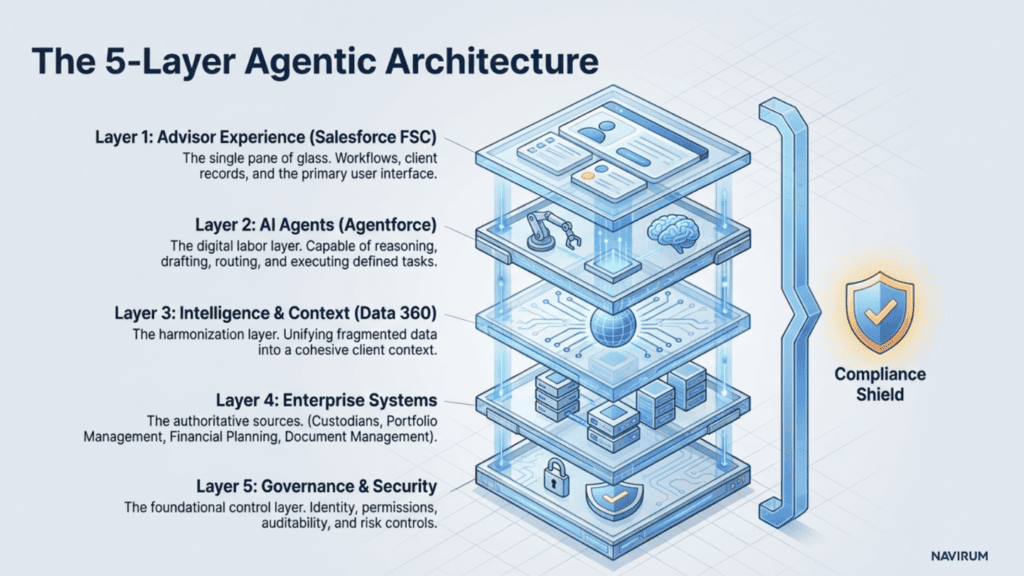
To the wealth management advisor, asking “Prepare me for my client meetings today” and receiving a response in seconds looks deceptively simple. Behind that interaction lies a robust 5-layer architecture connecting identity, contextual data, reasoning agents, enterprise back-ends, and strict human governance.
Advisor Experience
The conversational or in-flow interface where advisors ask questions and receive structured context without jumping across applications.
AI Agents
Autonomous reasoning components (e.g., Agentforce) that process prompts, evaluate business logic, and assemble briefings or recommended tasks.
Data & Context
The semantic integration layer (Data 360) that connects structured and unstructured household records, emails, and notes into unified context.
Enterprise Financial Systems
Core underlying systems of record, including Financial Services Cloud, portfolio management tools, custodians, and document vaults.
Security, Governance & Human Oversight
Strict permission frameworks, audit logging, and human approval steps that ensure safe execution and fiduciary compliance.
Beyond a Feature: A Strategic Architecture
An agentic advisor experience cannot be bolted on as a standalone point solution. To deliver rapid, safe, and context-aware outcomes, firms must connect all 5 layers—ensuring technology performs the heavy lifting while governance and human advisors retain full control.
The Five-Layer Agentic Advisor Architecture
These layers are not independent silos; their true value is unlocked through orchestrating end-to-end flow. The resulting experience feels effortlessly simple to the advisor, even while complex enterprise systems, data layers, and safety boundaries operate behind the scenes.
Advisor Experience
The advisor interacts naturally within their primary interface without switching systems.
Agentforce
The AI agent interprets the request, evaluates intent, and orchestrates execution steps.
Data 360 / Context
The data layer synthesizes relationship history, notes, and unstructured signals.
Financial Systems
Enterprise systems supply authoritative, ground-truth financial records and balances.
Security & Oversight
Governance policies control access permissions and enforce human sign-off for actions.
Simplicity for the Advisor Through Integrated Governance
The layers must not be treated as independent point solutions. The true value stems from how seamlessly they work together—enabling the underlying architecture to handle data retrieval and security checks so the resulting experience feels fast, safe, and intuitive to the advisor.
Layer 1 — The Advisor Experience
The first layer is where the advisor actually interacts with the system. For wealth management organizations, Salesforce serves as this operational environment. The objective is not to create another AI destination, but to inject agentic intelligence directly into the native workflow where advisors already work.
9 Operational Pillars Contained in Salesforce FSC
Client Records
Household Relationships
Activities & Schedules
Tasks & Action Items
Opportunities & Pipelines
Service Cases & Tickets
Client Notes & History
Client Communications
Workflow Information
Creating Another AI Destination
Forcing advisors to open a separate AI browser tab or standalone application introduces tab-switching fatigue and breaks context. When AI lives outside the operational core, adoption drops significantly because advisors resist changing proven routines.
Agentic Advisor Positioning
Salesforce’s positioning for Salesforce: Agentic Advisor for Wealth & Asset Management brings AI-powered capabilities like Run My Day and Meeting Concierge directly into existing advisor workflows. Advisors adopt AI rapidly when it accomplishes their daily tasks faster inside Salesforce without requiring a new learning curve.
Bring Intelligence to Where the Advisor Already Works
An advisor is far more likely to embrace agentic AI when it helps them complete existing client tasks faster within Salesforce, rather than forcing them to navigate an entirely new external tool.
Layer 2 — AI Agents
The second layer represents the intelligence and action core where Agentforce operates. Salesforce describes Agentforce as a platform for building and deploying AI agents that can interact with users, access business data, and perform defined actions. Its financial-services capabilities provide purpose-built skills and actions for wealth management workflows.
Anatomy of an Enterprise Agentforce Worker
Defined Purpose
Scoped specifically to wealth workflows rather than ambiguous open tasks.
Appropriate Info
Bound strictly to trusted CRM and Data Cloud records the advisor is permitted to view.
Defined Instructions
Guided by explicit business rules, firm compliance standards, and operating logic.
Specific Skills
Equipped with specialized actions like drafting briefs, logging tasks, and fetching holdings.
Approved Actions
Restricted to pre-authorized system calls and updates within Financial Services Cloud.
Guardrails
Protected by the Einstein Trust Layer to prevent data leaks, bias, and unauthorized changes.
Clear Escalation Path
Automatically routes out-of-bounds requests or low-confidence decisions to human advisor review.
Agents Need a Defined Job: Avoid the “Everything” Trap
Creating an overly broad agent that promises to “help advisors with everything” creates ambiguity around data access, permissions, and decision boundaries. A well-controlled architecture defines specialized agents centered on concrete business outcomes:
Meeting Preparation Agent
Helps advisors prepare comprehensive briefings for client meetings.
Client Service Agent
Helps service teams retrieve records and manage defined service workflows.
Onboarding Agent
Coordinates client onboarding tasks and identifies missing documentation.
Advisor Knowledge Agent
Helps employees retrieve answers from approved internal knowledge sources.
Follow-Up Agent
Identifies and prepares appropriate post-meeting activities and action items.
Agent Skills & Actions: What an Agent Knows vs. What It Can Do
An agentic architecture explicitly separates information retrieval from action execution. Agent capabilities must be intentionally designed with strict boundaries, ensuring an agent does not inherit blanket permissions across Salesforce.
Retrieve
- Client & Household Info
- Activities & History
- Service Cases & Tasks
- Relevant Portfolio Data
Analyze
- Recent Account Deltas
- Outstanding Service Items
- Client Interaction Logs
- Relationship Milestones
Prepare
- Meeting Briefings
- Follow-Up Drafts
- Next-Best-Action Prompts
- Context Summaries
Act
- Create Approved Tasks
- Update Designated Fields
- Initiate Approved Flows
- Queue Draft Emails
Open Text Box over CRM
Giving an unconstrained chatbot raw access to a CRM creates significant compliance risks and operational confusion.
- Lacks understanding of financial business logic and workflow state
- Generates unstructured text without triggering real system actions
- Exposes firms to hallucination risks during client-facing preparation
Agentforce for Financial Services
As detailed in Salesforce Trailhead: Agentforce for Financial Services, purpose-built agents combine data, automation, and AI to scale advisor capacity safely.
- Pre-configured with industry-specific skills and data models
- Automates repeatable meeting prep, onboarding, and service workflows
- Operates under strict human oversight and compliance guardrails
Intentional Design over Inherited Permissions
An agent should not automatically gain permission to perform every action available within Salesforce. Capabilities, skills, and execution rights must be intentionally designed and bounded around specific business outcomes—ensuring safe, fiduciary-compliant agentic AI deployment.
Layer 3 — Data & Context
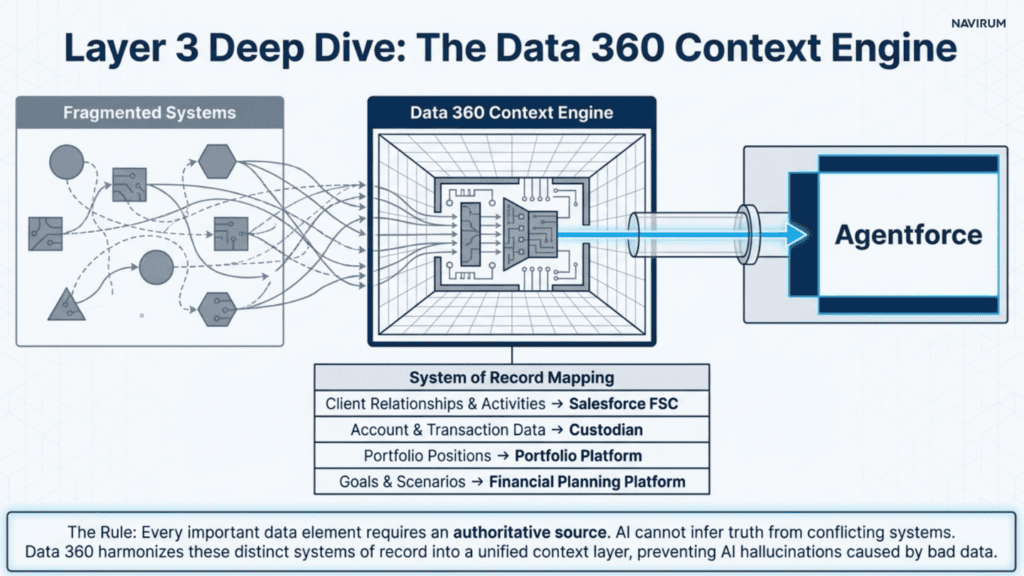
The third layer is perhaps the most important foundation. An AI agent cannot provide useful answers if it lacks the information required to understand the situation. As highlighted in Salesforce: Data 360 for Financial Services, connected data acts as the engine for contextual, intelligence-driven wealth experiences.
Data 360 Unifies 9 Key Enterprise Systems
Plateformes de gestion de portefeuille
Custodian Data Feeds
Financial Planning Tools
Client Investor Portals
Service & Ticketing Systems
Automatisation du marketing
Document Repositories
Enterprise Data Warehouses
Legacy Core Systems
7 Questions for Context Architecture
Required Info
What information does the agent actually need for this specific workflow?
Data Location
Where does that information currently live across the tech stack?
System Ownership
Which authoritative backend system owns and maintains the record?
Change Frequency
How frequently does this underlying data change or update?
Access Method
How should it be accessed—via direct query, zero-copy, or API call?
Sync Strategy
Does it require continuous replication or real-time federated lookup?
Governance & Entitlements
How is this specific piece of client data governed and restricted to authorized users?
Copying Everything into Salesforce
Blindly replicating all enterprise data into CRM creates severe operational friction and technical debt.
- Excessive custom storage costs & database bloating
- Complex synchronization lag and duplicate record conflicts
- Significant compliance and data governance maintenance overhead
Stored Data vs. Accessible Data
Modern agentic data architecture separates data storage from real-time data accessibility.
- Stores core relationship entities inside Salesforce FSC
- Leverages Data 360 & Zero-Copy federation for authoritative external feeds
- Provides exact context required by AI agents without data clutter
Data Architecture Must Follow the Business Use Case
Data stored is not the same as data accessible. An effective Data 360 context layer focuses on making authoritative information available at the moment of decision—avoiding unnecessary replication while giving AI agents complete relationship context.
Layer 4 — Enterprise Financial Systems
The fourth layer contains the specialized backend applications where much of a wealth management firm’s authoritative data actually lives. Because Salesforce is rarely the sole platform involved, an agentic architecture must define exact systems of record so AI agents always know which source to trust.
Enterprise Wealth Tech Stack & Roles
Salesforce FSC
Houses relationship records, household structures, tasks, notes, and advisor workflow history.
Portfolio Platform
Manages active holdings, asset allocations, performance metrics, and investment models.
Custodian Feeds
Supplies authoritative account numbers, cash balances, trades, and clearing transactions.
Financial Planning
Contains client financial goals, retirement assumptions, cash flow projections, and scenarios.
Document Vault
Stores signed agreements, custodial statements, tax filings, advisory forms, and legal vaults.
Service Platform
Tracks operational cases, back-office processing tickets, and client service inquiries.
Marketing & Engagement Platform
Captures marketing campaign history, client portal engagement, digital touches, and communication preferences.
System-of-Record Architectural Mapping
Connecting data via Salesforce: Data 360 for Financial Services allows firms to federate information across applications without forcing a single platform to act as the repository for everything:
| Data Domain | Authoritative System of Record (SoR) |
|---|---|
| Client Relationships & Profiles | Salesforce FSC |
| Household Structures & Relational Maps | Salesforce FSC |
| Advisor Activities & Task Histories | Salesforce FSC |
| Service Interactions & Operational Tickets | Salesforce FSC / Service Platform |
| Portfolio Positions & Investment Holdings | Portfolio Management Platform |
| Account Transactions & Clearing Balances | Custodian Platform |
| Financial Plans, Goals & Scenarios | Financial Planning Platform |
| Statements, Agreements & Vault Files | Document Management Platform |
The Single Source of Truth Problem
Using multiple best-of-breed systems is natural. Problematic architecture arises when no clear precedence rules define which system owns specific data items.
- AI agents evaluate arbitrary or outdated cached data
- Risk of presenting conflicting balances during client reviews
- Causes advisor distrust in AI outputs and automated summaries
Better-Organized, Trusted Data
Data 360 enforces explicit domain precedence, routing requests to authoritative backends without duplicating every field into Salesforce.
- Establishes crystal-clear system-of-record boundaries
- Guarantees AI agents always utilize authoritative ground truth
- Delivers contextualized, reliable, and fiduciary-safe AI briefings
More Data Does Not Mean Better AI — Trusted Data Does
Simply feeding more data into an AI engine produces confusion. Success requires better-organized, trusted, and contextualized data with explicit system-of-record rules so AI agents deliver accurate, authoritative answers every time.
Layer 5 — Security, Governance & Human Oversight
The fifth layer surrounds the entire architecture. Security and governance cannot be treated as an afterthought; they must be embedded into the core design. As detailed in Salesforce Help: Data 360 Setup and Permissions, configuring strict user boundaries and data entitlements is mandatory when deploying actionable AI workers.
11 Embedded Pillars of Enterprise Governance
Identity Verification
Validates user login context, single sign-on claims, and active session identity.
User Permissions
Restricts user capabilities based on functional role and organizational hierarchy.
Data Access Boundaries
Defines which client accounts and household portfolios are visible to the advisor.
Field-Level Access (FLS)
Hides sensitive fields (e.g., SSN, net worth details) from unauthorized agents or users.
Record-Level Access
Ensures agents only evaluate records shared explicitly with the advisor’s team.
Agent Permissions
Explicitly caps the agent’s internal reasoning rights to match assigned skills.
Action Entitlements
Governs which API endpoints, flows, or database writes the agent is permitted to call.
Auditability & Logging
Records every prompt, data query, reasoning chain, and action for compliance audits.
Real-Time Monitoring
Tracks agent performance, hallucination rates, and latency across enterprise sessions.
Human Approval
Mandates advisor sign-off before executing tasks, updating CRM fields, or sending emails.
Exception Handling & Safe Escalation
Automatically halts execution and routes ambiguous requests to human compliance officers.
The End-to-End Data-to-Action Flow
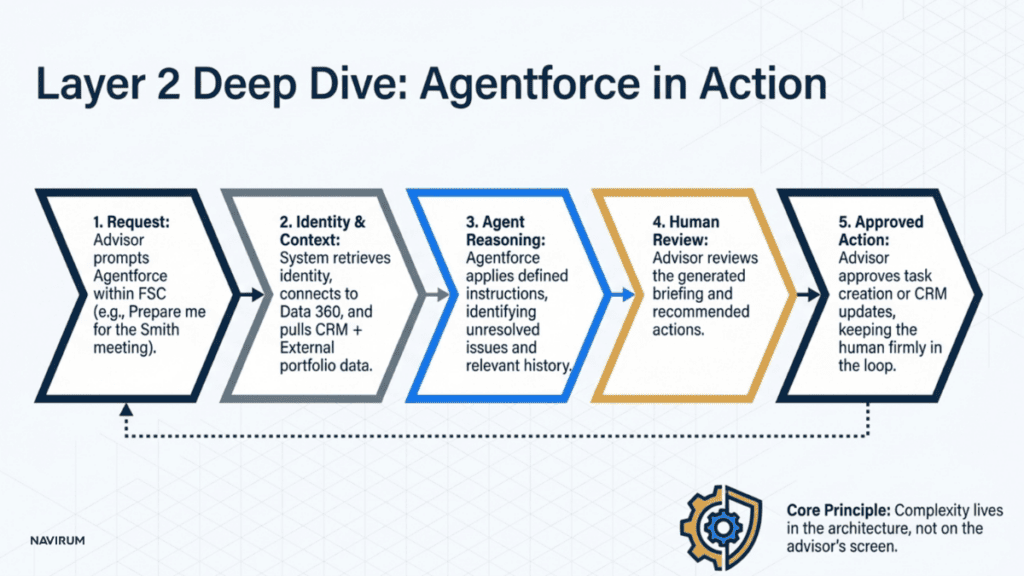
To the advisor, typing “Prepare me for my meeting with the Smith household” appears as a single request. Architecturally, it executes a 10-step coordinated workflow across all 5 layers:
Identity & Target Resolution
Salesforce identifies the requesting advisor and resolves the exact “Smith Household” account ID based on sharing rules.
CRM Context Retrieval
The system retrieves household member profiles, activities, tasks, open service tickets, and recent meeting notes.
External Systems Federation
Queries portfolio management platforms and custodial feeds for live balances and holdings data.
Data 360 Contextualization
Data 360 synthesizes structured balances and unstructured notes into a unified, time-sensitive relationship view.
Agentforce Reasoning
Agentforce applies meeting-prep instructions, evaluating open service issues and portfolio deltas.
Briefing Output Generation
The agent produces a concise, structured 15-minute meeting briefing directly inside the FSC workspace.
Recommended Actions Queue
The agent identifies and queues appropriate follow-up tasks (e.g., schedule financial plan review, update KYC date).
Human Advisor Review (Governance Gate)
The advisor inspects the meeting briefing and reviews the queued recommendations before taking action.
Human Approval & Authorization
The advisor explicitly approves or edits the recommended tasks with one-click authorization.
Salesforce & System Execution
Approved actions are committed to Salesforce FSC records, creating audit-logged tasks and initiating workflows.
Orchestrated Execution Under Full Human Control
Simple interactions require sophisticated architecture. By anchoring the 10-step flow inside strict permission chains and human-in-the-loop sign-offs, wealth management firms deliver effortless advisor experiences while upholding fiduciary compliance.
Example: The “What Changed?” Agent
To see how the 5-layer model functions in daily advisor workflows, consider a common advisor query: “What changed for this household since our last review?” This scenario demonstrates why an agentic architecture is fundamentally a context architecture—evaluating relationships across disparate systems to deliver actionable insights.
4 Enterprise Data Streams Evaluated by the Agent
CRM Data (FSC)
- New activities & call logs
- Advisor meeting notes
- Service interactions & tickets
- Tasks & relationship updates
Portfolio & Custody
- Relevant portfolio value changes
- Asset allocation shifts
- Account cash flow movements
- Custodian transaction feeds
Financial Planning
- Updated plan assumptions
- New financial goal entries
- Planning activity milestones
- Cash flow projection deltas
Document Vault
- Newly uploaded client forms
- Signed advisory agreements
- Custodial statements
- Tax & legal documentation
5 Categorized Outputs for Immediate Advisor Review
Relationship Changes
Highlights household member updates, new contact roles, or life event notices.
Financial Changes
Summarizes portfolio performance deltas, large deposits, or market movements.
Service Issues
Surfaces open custodial inquiries, pending address changes, or service delays.
Outstanding Actions
Flags overdue client tasks, missing compliance forms, or unassigned follow-ups.
Items to Discuss
Prepares recommended talking points based on financial plan updates and client goals.
An Agentic Architecture is Fundamentally a Context Architecture
The agent becomes invaluable to the advisor not because it generates text, but because it understands the relationships between different pieces of underlying information—synthesizing data across CRM, portfolio, planning, and document systems into clear, drillable context.
Real-Time vs. Batch Data
Data freshness is a critical architectural consideration. Not every data point needs to be updated in real time. Defining data freshness requirements strictly by business use case avoids unnecessary infrastructure costs and reduces system complexity.
3 Architectural Freshness Tiers
Real-Time or Near Real-Time
Continuous streaming and event-driven synchronization for time-critical operational data.
- Account status & opening checks
- Service case escalations
- Critical portfolio holding changes
- Time-sensitive operational triggers
Scheduled Batch
Periodic interval batch syncing for stable reference records and aggregated metrics.
- Enterprise reference data
- Historical performance analytics
- Periodic client profile attributes
- Standard reporting aggregations
On Demand / Zero-Copy
Direct query pass-through fetching data at the moment of request without persistent storage.
- Finalized client document vaults
- Historical custodial statements
- Specialized external risk scores
- Infrequently accessed archive files
Freshness Matrix across 4 Wealth Data Use Cases
Client Relationships
Changes occasionally. Stored natively in FSC and updated on change.
Portfolio Values
Changes frequently. Updated near-real-time or on-demand at meeting prep.
Service Cases
Requires near-real-time updates to prevent advisor miscommunication.
Historical Documents
Static once finalized. Accessed on demand via document vault APIs.
Align Tech Capabilities directly to Business Value
Avoid over-engineering data pipelines. Matching data freshness to actual business requirements reduces architectural complexity, minimizes cloud storage costs, and keeps the Salesforce and Data Cloud infrastructure performant and maintainable.
APIs, Integrations, and the Agentic Layer
The agentic architecture depends heavily on reliable integrations across custodians, portfolio engines, and planning systems. However, an AI agent introduces a new requirement: information must be accessible, freshness-aware, and fully observable through tooling like Salesforce Agentforce Observability to prevent silent integration failures in production.
10 Integration Evaluation Criteria for AI Workflows
API Availability
REST/GraphQL availability for real-time query execution.
Authentication
OAuth2 & Named Credentials passing user identity.
Data Formats
JSON/XML schema standardization for agent parsing.
Data Latency
Response times aligned to interactive advisor speed.
Error Handling
Explicit status codes mapped to fallback AI prompts.
Monitoring
Telemetry tracking uptime, payload errors, and timeouts.
Rate Limits
Throttling limits managed during peak prep hours.
Transformation
Normalization into Data Cloud Standard Data Models.
Security & FLS
Encryption in transit and field-level masking.
System Ownership
Explicit system-of-record precedence definition.
6 Controls to Prevent Stale Data AI Disasters
Last-Updated Timestamps
Exposes raw timestamp metadata to the agent reasoning prompt before outputting calculations.
Integration Health Indicators
Monitors endpoint status; if an API is down, the agent notifies the advisor immediately.
Data Freshness Rules
Rejects records older than defined thresholds (e.g., portfolio values older than 24 hours).
Exception Monitoring
Triggers administrative alerts whenever an integration fails during an agentic session.
Explicit Fallback Behavior
Directs the agent to gracefully state missing data availability rather than guessing values.
Unavailable Info Handling
Configures strict boundaries preventing the AI from presenting unverified fallback text.
Agentforce Observability: Answering 6 Operational Questions
1. What happened?
Tracks the complete conversational timeline, session status, and user interaction latency.
2. Why did it happen?
Traces the step-by-step LLM reasoning spans and intent classification choices.
3. What info was used?
Audits the exact Data Cloud queries, RAG context chunks, and external API payloads accessed.
4. What action was taken?
Records tool call spans, flow executions, task creations, and database updates.
5. Was it appropriate?
Evaluates output quality, toxicity scores, instruction adherence, and user feedback ratings.
6. Where did it fail?
Pinpoints exact reasoning loops, broken API endpoints, or unhandled exceptions for fast remediation.
Full Reasoning Chain Transparency Unlocks Enterprise AI Trust
As AI agents move from simple information retrieval to executing financial workflows, deep integration observability and session tracing become mandatory—ensuring firms can explain every action, detect stale data, and uphold fiduciary standards.
Designing for Failure
A mature enterprise architecture assumes that something will eventually go wrong. External APIs time out, records contain missing or contradictory data, and agents encounter out-of-scope requests. Building explicit failure paths ensures the system behaves safely and predictably under uncertainty.
6 Potential Points of Failure in Wealth Tech Stacks
External System Unavailable
Custodial API or portfolio engine suffers downtime during morning meeting prep.
Incomplete Client Data
Required KYC information, risk tolerance scores, or plan parameters are missing.
API Execution Failure
HTTP status errors, authentication token expirations, or payload transformation issues.
Contradictory Information
Salesforce shows a legacy balance while custodial feeds show a different updated figure.
Ambiguous Advisor Prompt
An advisor asks a vague question where the agent cannot determine intent with confidence.
Out-of-Scope Workflow
The advisor requests an action that falls outside the agent’s pre-approved entitlements.
5 Explicit Safe Fallback Rules
If data is unavailable
Tell the advisor explicitly rather than inventing or hallucinating an answer.
If required information is missing
Identify what specific records are missing and request human advisor input.
If action exceeds agent authority
Escalate the request immediately to a human advisor or compliance manager.
If systems contain conflicting info
Apply the defined system-of-record rule or explicitly flag the conflict to the user.
If the agent is uncertain
Do not force an action or guess; present options and await human authorization.
A Safe Agent Knows When Not to Act
In wealth management, silent errors and forced guesses carry unacceptable regulatory and client risks. Building explicit failure paths ensures AI agents halt safely and escalate gracefully when encountering uncertainty—protecting firm compliance and advisor trust.
Architecture Should Follow Risk
Not every workflow requires the same architectural controls. Low-risk information lookups can execute quickly, while high-impact financial transactions demand rigorous validation, multi-layer permissions, and human approval. The higher the potential impact of an action, the stronger the controls around it must be.
3 Workflows Categorized by Operational Risk
Internal Knowledge Requests
Simple retrieval of approved internal documents, policy FAQs, or public reference records.
- Basic user identity verification
- Standard object permission checks
- Automated data retrieval & summary
- Zero direct system modification
Client-Facing Actions
Preparing meeting briefings, drafting client emails, or queuing task assignments.
- Field-level data validation
- Draft briefing generation
- Mandatory human advisor approval
- Session auditability & logging
Financial Transactions
Rebalancing portfolios, initiating money movements, or submitting account edits.
- Multiple authorization controls
- Strong system-of-record validation
- Restricted action entitlements
- Real-time exception monitoring
The Agentic Advisor Architecture in Practice
Advisor (Start)
Defines the goal and provides conversational prompt or workflow input.
Salesforce FSC
Provides core relationship context, household structures, and active CRM history.
Agentforce
Interprets advisor intent, plans reasoning steps, and orchestrates approved capabilities.
Data 360
Connects, harmonizes, and contextualizes relevant structured and unstructured data sources.
Enterprise Financial Systems
Provide authoritative systems of record for portfolio holdings, accounts, and plans.
Governance & Oversight Layer
Controls data access, action entitlements, logging, and human sign-off gates.
Advisor (Close Loop)
Reviews briefing, decides, and authorizes final actions. The loop returns to the advisor.
The Architecture Returns Control to the Human Advisor
The entire 5-layer agentic architecture is intentionally designed to augment advisor capacity—not replace human judgment. By anchoring automation inside risk-sensitive controls and human approval loops, wealth management firms empower advisors to deliver superior, high-touch client outcomes safely.
The Architecture Is the Competitive Advantage
AI models will continue to evolve, with today’s frontier models continuously replaced by more capable tools. The underlying architecture, however, is durable. A firm’s ability to connect trusted data, standardized business processes, and AI directly into the advisor workflow creates a lasting competitive advantage.
9 Durable Foundations of a Prepared Wealth Enterprise
Clean Client Data
Well-Defined Systems of Record
Reliable Enterprise Integrations
Strong Salesforce FSC Setup
Connected Data 360 Fabric
Standardized Advisor Workflows
Appropriate Field & Action Permissions
Embedded Governance & Controls
Measurable Outcome Processes
Why Sophisticated Agents Fail Without Architecture
Incomplete Underlying Data
Missing client attributes or unmapped fields cause hallucinations and incomplete meeting briefs.
Inaccurate Household Structures
Flawed relationship mapping leads to wrong account aggregations and client privacy breaches.
Unreliable Portfolio Integrations
API sync failures or unmonitored rate limits leave the AI evaluating stale portfolio holdings.
Unclear System-of-Record Rules
Conflicting data sources force the AI to select arbitrary values, eroding advisor trust.
Inconsistent Advisor Workflows
Forcing advisors to leave Salesforce FSC to use external AI chatbots creates tab-switching fatigue.
Restricted Information Access
Lacking a Data 360 context layer prevents the agent from connecting notes, cases, and planning data.
Absence of Governance & Oversight Controls
Deploying action-capable AI without human approval gates and session tracing creates unacceptable fiduciary and compliance exposure.
The Better the Architecture, the More Useful the Agent
The Architecture Behind The Agentic Advisor
Deploying Agentforce for wealth management requires more than prompt engineering—it demands a trusted, 5-layer architecture. Connect your data, unify systems of record, and empower advisors with safe, AI-driven workflows.
Evaluate Data Readiness
Assess data quality, household relationship modeling, and system-of-record rules across your Salesforce FSC and Data Cloud environments.
Define High-Value Use Cases
Start small with focused workflows—such as Advisor Meeting Preparation or Client Service Support—to establish immediate ROI.
Embed Governance & Controls
Anchor agent permissions, risk-sensitive approval gates, and session tracing to guarantee fiduciary safety and full compliance.
Ready to Build Your Agentic Advisor Roadmap?
Schedule an executive briefing to assess your firm’s readiness or explore how Navirum can help you architect Agentforce and Financial Services Cloud.
The Agentic Advisor : Conception de solutions Salesforce et Data Cloud pour un déploiement sécurisé de l'IA dans la gestion de patrimoine
Part 2 — Main Challenges Faced By Advisors in Wealth Management

The Agentic Advisor : Conception de solutions Salesforce et Data Cloud pour un déploiement sécurisé de l'IA dans la gestion de patrimoine
Part 1 — The Agentic Advisor Is Coming to Wealth Management
Online Resources — Knowledge & Insights
Explore strategic perspectives, executive roadmaps, customer success stories, and deep dives into agentic AI implementations for wealth management.

Wealth Management Trends 2026: Challenges For Advisors and The Role of AI and Salesforce

Building the Agentic Financial Enterprise

Wealth Management Salesforce Success Stories