Key Summary:
- Agentic AI in wealth management requires a clear autonomy framework that defines what AI can do independently, what requires approval, and where human judgment must remain central.
- Risk should determine autonomy. Workflows should be evaluated based on reversibility, potential impact, and blast radius before agents are given authority to act.
- Governance must be built into the architecture. Guardrails, approval matrices, permissions, agent instructions, monitoring, and escalation paths should be designed into workflows rather than added later.
- Regulatory and fiduciary responsibilities remain with the advisor and firm. AI can support decision-making and automate work, but it does not replace human accountability.
- Human oversight should be intentional, not reactive. Agents need defined escalation paths and clear exit strategies when a task exceeds their authority or confidence.
- The safest path to adoption is progressive. Start with low-risk, high-frequency activities such as meeting preparation and administrative workflows, then expand autonomy as controls and governance mature. The goal is a symbiotic wealth management practice where AI handles appropriate operational work while advisors retain responsibility for judgment, relationships, and client outcomes.
- A structured governance and architecture roadmap provides a practical framework for scaling agentic AI safely across the wealth management organization.
The Agent Autonomy Framework: How Much Should AI Actually Do?
The most important question in agentic AI for wealth management is not “What can the AI do?”—it is “What should the AI be allowed to do?” Capability does not automatically equal permission. The goal is not maximum automation, but establishing the right level of autonomy for the risk, complexity, and business value of each workflow.
“What CAN the AI do?”
Modern AI agents can retrieve data, summarize client records, reason across systems, recommend next steps, initiate workflows, and execute backend actions.
The 5 Governance Questions
What can it SEE?
Defines user-level object and field access to ensure zero unauthorized data leakage.
What can it UNDERSTAND?
Harmonizes structured balances and unstructured notes via Data 360 relationship graphs.
What can it RECOMMEND?
Surfaces next-best-action prompts and life event alerts for advisor consideration.
What can it PREPARE?
Generates email drafts, meeting summaries, and onboarding packages for human review.
What can it EXECUTE?
Limits direct execution to routine CRM tasks while barring fiduciary trade decisions.
Controlled Autonomy Accelerates Safe Adoption
Defining what AI should be allowed to do is the hallmark of mature enterprise architecture. Designing explicit boundaries across all five autonomy questions protects your firm, empowers advisors, and ensures fiduciary compliance across Agentforce implementations.
Architectural Principles for the Agentic Advisor
Deploying Agentforce successfully in wealth management requires unifying isolated data silos, defining clear systems of record, and enforcing strict boundaries of autonomy. Below is the blueprint connecting Data 360 context to safe advisor productivity.
Key Architectural Pillars
Authoritative Data Foundations
Define clear Systems of Record across CRM, custodial feeds, and portfolio platforms. Data 360 harmonizes structured and unstructured context to eliminate concept drift.
Value-Driven Use Cases
Focus initial Agentforce deployments on daily advisor pain points like meeting prep, service ticket summaries, and onboarding orchestration to drive rapid ROI.
Explicit Autonomy Boundaries
Implement a 4-level autonomy framework that enforces human-in-the-loop sign-offs for client communications while barring AI from fiduciary trade decisions.
Grounded Systems Drive Modern Advisor Capacity
AI readiness is fundamentally a data and governance challenge. Building on Salesforce FSC, Data 360, and bounded Agentforce permissions allows wealth management firms to scale advisor productivity safely without sacrificing regulatory compliance.
The 4-Level AI Autonomy Framework
Deploying Agentforce requires establishing explicit, risk-sensitive boundaries for agentic operation. Wealth management firms must govern AI progression through four distinct tiers of autonomy—balancing rapid advisor assistance with strict fiduciary human-in-the-loop oversight.
Level Breakdown & Scope
Assist
(Read-Only Intelligence)
AI retrieves and summarizes scattered relationship context, custodial data, and meeting histories without altering backend records.
Recommend
(Suggest Next Steps)
AI identifies life event changes, liquidity shifts, or plan gaps and suggests actionable next best steps for advisor approval.
Prepare & Route
(Human Review Gate)
AI drafts complete onboarding workflows, service responses, or task packages and queues them for mandatory employee review.
Execute
(Bounded Autonomy)
AI automatically executes pre-approved, routine administrative tasks within strict system-of-record guardrails and telemetry logs.
McKinsey Executive Leadership Perspective
McKinsey’s enterprise research indicates that 53% of business leaders view AI strictly as a support tool in the short term, with only 25% expecting fully autonomous agentic roles in the near future. Notably, younger business leaders exhibit significantly higher optimism for autonomous workflows—with 27% of younger executives anticipating agentic autonomy versus just 19% among leaders aged 55 and older.
View AI strictly as a support/assistant tool short-term
Expect autonomous agentic roles in the near future
Younger leaders optimism vs. leaders aged 55+
Governance Defines the Pace of AI Autonomy
Scaling AI across wealth management requires matching workflow risk to the appropriate autonomy level. Mastering Level 1 summarization and Level 3 human-gated drafting builds the institutional trust needed to safely advance toward bounded Level 4 execution.
The AI Decision Boundary
Establishing systematic boundaries is critical for wealth management firms adopting agentic workflows. By clearly categorizing operational tasks into autonomous capabilities, human-guided reviews, and strictly prohibited human-only domains, organizations ensure compliance, protect client trust, and maintain fiduciary integrity.
Decision Domain Breakdown
AI Can Do
- ✓ Retrieve & Organize Data: Fetch structured account balances, holdings, and client attributes across systems.
- ✓ Summarize Notes & History: Condense meeting transcripts, emails, and service logs into rapid advisor briefs.
- ✓ Classify & Draft Tasks: Automatically update standard CRM fields, categorize inquiries, and create internal follow-ups.
- ✓ Recommend Actions: Surface internal proactive outreach prompts for advisor consideration.
AI Prepares / Human Approves
- ⚙ Client Communications: Generate personalized email responses or onboarding follow-ups for advisor review.
- ⚙ Workflow Decisions: Route multi-step onboarding packages, custodial agreements, and forms.
- ⚙ Sensitive Service Cases: Prepare draft resolutions for complex client operational inquiries.
- ⚙ Exception Handling: Flag data discrepancies across custodians for human operational sign-off.
Human Only
- 🚫 Fiduciary Investment Advice: Formulating asset allocation advice or wealth planning strategies.
- 🚫 Final Portfolio Decisions: Executing rebalancing trades, money movements, or account liquidations.
- 🚫 Complex Compliance Exceptions: Granting regulatory overrides, KYC waivers, or legal risk exceptions.
- 🚫 Sensitive Client Relationship Decisions: Negotiating advisory fees, billing disputes, or conflict resolutions.
Explicit Boundaries Protect Enterprise Value
While the exact boundary varies by organization, establishing a clear decision matrix prevents regulatory overreach. Restricting AI to retrieval, summarization, and human-gated drafting unlocks transformative operational efficiency while guaranteeing fiduciary compliance.
Not All Advisor Workflows Have the Same Risk
A wealth management firm should never apply a single, blanket autonomy policy to every AI use case. Instead, each workflow must be rigorously evaluated across operational, financial, and regulatory risk dimensions.
9 Evaluation Factors for Workflow Risk
1. Financial Impact
Direct dollar value and capital exposure of potential errors.
2. Client Impact
Effect on relationship trust, satisfaction, and public perception.
3. Regulatory Implications
FINRA, SEC, and Reg S-P compliance oversight requirements.
4. Data Sensitivity
Presence of PII, tax identifiers, and confidential holdings.
5. Reversibility
Ease of correcting an automated mistake without permanent loss.
6. Complexity
Number of system integrations and data logic dependencies.
7. Task Frequency
Repetitive volume versus rare, high-leverage edge cases.
8. Potential for Error
Probability of prompt misinterpretation or data ambiguity.
9. Professional Judgment
Degree of licensed fiduciary expertise required for execution.
Workflow Autonomy Allocation Matrix
Suggested autonomy levels based on risk profile and required human oversight:
Internal Knowledge Search
Meeting Preparation
Meeting Summary
Internal Task Creation
CRM Data Suggestions
Client Email Drafting
Service Issue Routing
Client Email Sending
Financial Recommendation
Investment Decision
Regulatory / Compliance Decision
Money Movement
Custom Classification Aligns Compliance and Value
While exact classifications are defined by each firm’s legal and compliance leadership, systematic risk evaluation prevents operational bottlenecks. Granting high autonomy to internal research and human-led gates to financial decisions maximizes productivity while maintaining total fiduciary control.
Reversibility Is a Powerful Test
One of the most practical ways to establish autonomy boundaries is to evaluate the cost of correction. Before granting an AI agent execution authority, governance teams must ask a fundamental operational question:
Evaluating Reversibility Spectrum
Create an Internal Task
Reversibility: Instant / Zero CostThe agent creates or updates an internal CRM task, categorizes an inquiry, or drafts a meeting preparation brief.
Send Client Email
Reversibility: Difficult / PermanentThe agent directly dispatches an outbound email or onboarding message to a client or prospect.
Execute Financial Trade
Reversibility: Highly Complex / High RiskThe agent executes portfolio rebalancing, account transfers, or money movement directly at the custodian.
Match Autonomy to Reversibility Risk
Workflows with different error consequences should never receive the same autonomy level. Using reversibility as a primary governance criterion allows wealth management firms to confidently maximize internal automation while safeguarding client trust and fiduciary integrity.
The Blast Radius Test
Alongside reversibility, governance teams must evaluate the potential scale of failure. When AI operates across large client bases or enterprise systems, evaluating the scope of impact becomes essential for determining safe autonomy levels.
Evaluating Potential Impact at Scale
Single Internal Task
Blast Radius: Small / ContainedAn agent creates one incorrect internal CRM task or generates an inaccurate meeting prep draft for a single advisor.
Mass Client Communication
Blast Radius: Large / Multi-ClientAn agent dispatches an email campaign or portfolio alert containing incorrect tax or plan details to 10,000 clients simultaneously.
Account Level Execution
Blast Radius: Critical / EnterpriseAn agent executes unauthorized portfolio changes, account updates, or money movement across client accounts.
Constrain Autonomy by Potential Blast Radius
As AI agents operate at greater scale across wealth management firms, failure impact multiplies exponentially. Calibrating agent permissions based on blast radius ensures that high-volume or high-stakes actions remain guarded by human oversight.
Build an Approval Matrix
A wealth management firm can formalize autonomy by mapping operational actions against explicit preparation, approval, and execution boundaries. This matrix ensures clarity across business, compliance, legal, risk, and technology teams.
Action Approval Matrix
Meeting Summary
Internal Task
CRM Update
Client Email
Service Escalation
Financial Recommendation
Investment Decision
Money Movement
Compliance Decision
The matrix should be reviewed with business, compliance, legal, risk, and technology stakeholders, evolving continuously as the firm learns how agents behave in production.
Don’t Give an Agent More Authority Than It Needs
A common mistake in AI implementations is granting broad permissions simply because it simplifies initial setup. The best practice is least-privilege autonomy—restricting agent boundaries across four critical dimensions:
Minimum Data
Only expose required objects and fields needed for the specific task.
Minimum Tools
Limit API tools and actions strictly to the workflow’s scope.
Minimum Actions
Do not assign write or execute permissions when read access suffices.
Minimum Duration
Restrict time-based access tokens to immediate execution windows.
- • If an agent only needs to create an internal task, it shouldn’t automatically receive permission to modify unrelated client information.
- • If an agent only needs read access, do not grant write access.
- • If an agent needs to draft a communication, do not assume it should be allowed to send it.
Least-Privilege Autonomy Builds Lasting Trust
As AI capabilities expand, maintaining strict access boundaries becomes paramount. Combining a formal approval matrix with least-privilege permissions guarantees that AI deployments remain safe, audit-ready, and aligned with fiduciary standards.
The Guardrail Model
An autonomous AI agent cannot operate in an unconstrained environment. To transform agentic capability into a safe, reliable enterprise asset, wealth management firms must implement an explicit 8-point Guardrail Model. These controls convert abstract AI reasoning into a transparent, audit-ready, and strictly governed business process.
THE ENTERPRISE AGENT GUARDRAIL BLUEPRINT
OPERATIONAL BOUNDARIES
Scope, Data & Actions
Controls 01–03: Scope, Data Access & Action Entitlements
• Scope: Explicit process boundaries defining where the agent is authorized to function.
• Data & Actions: Role-based field and object entitlements restricting API and write access.
EXECUTION RULES
Conditions & Escalation
Controls 04–06: Conditions, Threshold Limits & Human Escalation
• Conditions & Limits: Contextual triggers and hard thresholds blocking auto-execution.
• Escalation: Immediate failover to human advisors when ambiguity or limits are breached.
AUDIT & TELEMETRY
Logging & Monitoring
Controls 07–08: Full Session Logging & Real-time Telemetry
• Logging: Complete, immutable record of what occurred, timestamp, and reasoning chain.
• Monitoring: Enterprise telemetry catching unexpected agent behavior or drift in real time.
The 8 Essential Agent Controls
Scope
Defines the specific business processes and operational boundaries within which the agent is authorized to function.
Données
Establishes explicit user and field-level permissions determining what client information the agent can access.
Actions
Restricts what backend CRM fields, tasks, or external system APIs the agent can modify or trigger.
Conditions
Specifies the exact operational circumstances and contextual prerequisites under which the agent is permitted to act.
Limits
Imposes strict quantitative and qualitative thresholds that halt autonomous execution whenever exceeded.
Escalation
Mandates clear human-in-the-loop protocols for when a complex or out-of-bounds scenario must involve an employee.
Logging
Maintains an immutable, timestamped record detailing exactly what occurred, when, and the underlying reasoning chain.
Monitoring
Provides real-time enterprise telemetry and anomaly detection to identify and correct unexpected agent behavior.
Structured Controls Create Fiduciary Safety
Autonomous capability without governance introduces unacceptable risk. Implementing explicit guardrails across all 8 control dimensions turns AI from an unpredictable technology experiment into a secure, predictable, and fully compliant wealth management asset.
Agent Instructions Are Part of Governance
Agent instructions are not merely creative prompts—they define strict behavioral expectations. A production-ready agent in wealth management requires crystal-clear boundaries that explicitly translate governance rules into agent behavior.
10 Instruction Requirements for Production Agents
Role Definition
Explicit functional identity and persona boundaries.
Core Purpose
Primary objective and intended business outcome.
Approved Sources
Strict system-of-record whitelist for data retrieval.
Required Context
Prerequisite relationship and portfolio inputs.
Allowed Actions
Explicitly authorized tasks and API executions.
Prohibited Actions
Forbidden operations, advice, and money movements.
Clarification Prompts
Triggers asking the user to clarify missing parameters.
Escalation Gates
Mandatory routing to licensed human advisors.
Uncertainty Handling
Zero-hallucination rule when data is unverified.
Conflict Resolution
Protocol for handling contradictory source data.
“If required client information cannot be verified from an authorized source, do not infer the information. Identify the missing information and recommend that the advisor verify it.”
The Agent Needs an Exit Strategy
A sophisticated agent must know when to stop. Rather than attempting to answer every query or hallucinatively fill gaps, a governed agent evaluates explicit exit conditions:
“I don’t have enough information.”
“The data sources conflict.”
“The request exceeds my permissions.”
“The action exceeds my authority.”
“The information may be outdated.”
“This requires professional judgment.”
“This requires human approval.”
Explicit Instructions Build Fiduciary Safety
Prompt engineering in enterprise wealth management is behavioral governance. Embedding clear boundary rules and graceful exit strategies into agent instructions protects firm compliance, prevents hallucinations, and establishes institutional trust.
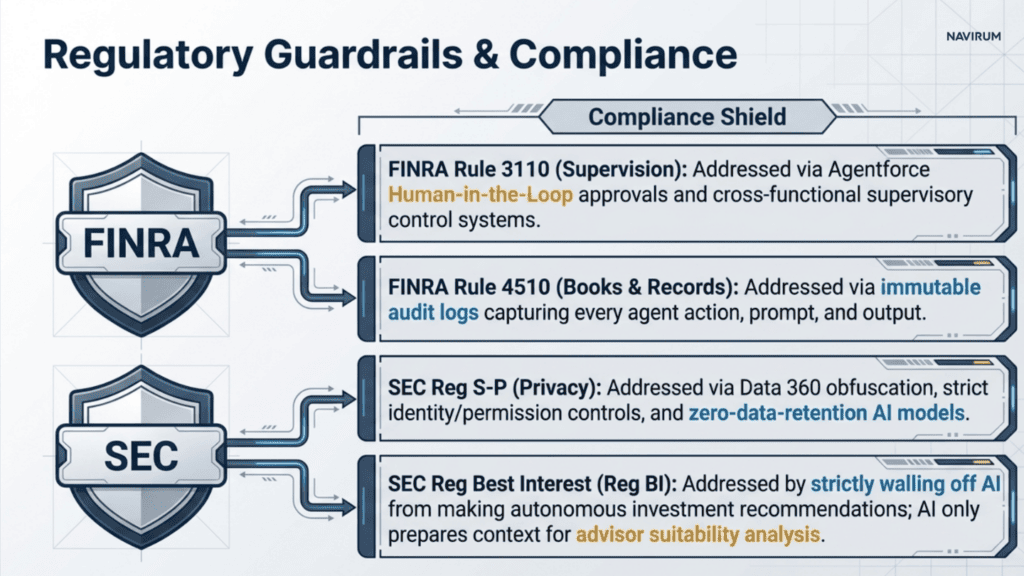
Governance, Risk, and Regulatory Compliance
Deterministic guardrails are a strategic necessity in wealth management. Agentic deployments must align with the evolving regulatory landscape to safeguard the firm’s license, protect client trust, and ensure strict fiduciary adherence.
Alignment with Key Regulatory Standards
FINRA Rule 3110 — Supervisory Oversight
Agentforce enforces mandatory “Human-in-the-Loop” approval gates for all client communications, ensuring that all outbound interaction undergoes licensed advisor review prior to dispatch.
SEC Rule 17a-4 — Temporal Record Auditability
Salesforce provides an immutable, timestamped Temporal Record detailing the exact prompt context, grounded data, and model parameters known at the precise moment a recommendation was generated.
SEC Regulation S-P — PII Protection & Obfuscation
Data Cloud automatically detects and masks Personally Identifiable Information (PII) before any prompt is processed, ensuring sensitive client identifiers never reach external Large Language Models.
SEC Regulation Best Interest (Reg BI)
Strict architectural guardrails prevent autonomous product recommendations or discretionary execution, keeping the human advisor positioned as the sole accountable fiduciary.
Agents Monitoring Agents: Supervisory AI
To systematically mitigate hallucinations and policy drift, firms deploy independent Supervisory Agents. These dedicated AI entities continuously audit primary agent outputs against firm-specific planning philosophies and compliance guidelines.
- • Real-Time Policy Auditing: Scans generated drafts against firm compliance rules before human review.
- • Planning Philosophy Verification: Flag deviations from approved asset allocation strategies.
- • Automated Exception Alerts: Instantly alerts compliance stewards when out-of-bound logic is detected.
The Einstein Trust Layer
The Einstein Trust Layer acts as an enterprise secure proxy between private wealth management data and LLMs. It enforces technical controls that guarantee complete data privacy and zero retention.
- 🔒 Zero Data Retention: Client data is never stored, cached, or used to train third-party global models.
- 🔒 Dynamic PII Masking: Anonymizes names, SSNs, and account numbers prior to LLM submission.
- 🔒 Toxicity & Hallucination Detection: Filters responses for compliance tone and grounded accuracy.
Compliance-First Architecture Secures Enterprise Scale
Regulatory compliance is not an obstacle to AI adoption—it is the blueprint for safe deployment. Anchoring Agentforce inside the Einstein Trust Layer while enforcing SEC and FINRA alignment allows wealth management firms to scale productivity with total risk confidence.
AI Risk Categories for Wealth Management
Deploying enterprise AI requires identifying specific operational, technical, and regulatory risk dimensions. Every AI failure mode must be mapped directly to targeted architectural mitigations to ensure total fiduciary safety.
AI Risk & Mitigation Matrix
Hallucination
Output RiskGenerating incorrect or unverified client portfolio information.
Data Leakage
Security RiskExposing unauthorized client data across advisor boundaries.
Bias
Algorithmic RiskGenerating unequal or skewed planning recommendations.
Automation Risk
Execution RiskExecuting an incorrect backend CRM or system action.
Model Risk
Quality RiskPoor or low-quality prompt outputs and reasoning drift.
Privacy
Regulatory RiskExposing sensitive PII identifiers to external models.
Conformité
Regulatory RiskDispatching inappropriate or unapproved client communications.
Operational Risk
System RiskFailed backend API integration or data sync errors.
Mapped Mitigations Ensure Fiduciary Protection
Every AI capability introduces specific failure vectors. Pairing each risk dimension with strict grounding, permissions, approval gates, and telemetry monitoring creates a secure operational foundation for Agentforce deployments.
AI and the Advisor’s Fiduciary / Regulatory Responsibilities
Firms must evaluate AI deployment within their existing regulatory and fiduciary obligations. Rather than assuming technology mandates specific tools, governance leadership must scrutinize how autonomous models interact with advisor duties, investor interest, and supervisory controls.
Predictive Analytics & Conflict Alignment
The SEC has specifically discussed the potential for conflicts when predictive analytics and artificial intelligence are used to influence investor interactions. Regulatory scrutiny centers on the possibility that firms could inadvertently or explicitly optimize technology around their own financial interests rather than investors’ best interests.
Addressing this challenge requires a more sophisticated approach than stating “AI must be compliant.” Wealth management leadership must establish governance frameworks that scrutinize model objectives, data inputs, and execution boundaries to ensure complete alignment with fiduciary standards.
Evaluating AI Within Existing Obligations
Optimization Auditability
Regularly evaluate model prompts, parameters, and grounded sources to verify that AI reasoning prioritizes client outcomes above firm revenue drivers.
Fiduciary Oversight
Maintain licensed human advisors as the sole accountable entity for financial recommendations, preventing autonomous, unvetted advice generation.
Supervisory Alignment
Integrate AI output tracking into existing FINRA 3110 supervisory systems, establishing clear audit trails for prompts, sources, and advisor approvals.
Grounded Governance Protects Fiduciary Trust
Compliance is not a static checkbox—it is a continuous evaluation of model behavior and alignment. Understanding AI optimization functions and maintaining human fiduciary accountability ensures that technology expansion actively reinforces investor trust and regulatory compliance.
Human Oversight Should Be Designed Into the Workflow
Human oversight should never feel like an afterthought or a tedious manual burden. Strategic workflow design positions advisors precisely where their professional judgment, fiduciary accountability, and high-touch relationship skills create the greatest business value.
Case Study: Designed Human Oversight in Client Communications
Client Information
AI Analyzes Context
AI Drafts Communication
Advisor Reviews
Advisor Approves
Communication Sent
The Advisor Should Not Become the AI’s Proofreader
If an AI system produces unreliable or ungrounded outputs that advisors must meticulously verify line-by-line every single time, the technology creates more administrative work, not less.
AI generates work → Advisor checks everything
Creates extreme cognitive fatigue, slows down operational turnaround, and breeds distrust in agentic workflows.
AI handles low-value work → Advisor focuses on expertise
Reclaims advisor capacity for client relationships, strategy, and judgment while AI reliably handles administrative synthesis.
Position Humans for High-Value Judgment
Well-designed agentic workflows do not eliminate human involvement—they elevate it. Automating data gathering and draft preparation while reserving human approval for critical decision gates scales wealth management productivity safely and sustainably.
Build a Human Escalation Framework
An intelligent agent must never hit an operational dead end. Every production Agentforce deployment requires explicit routing paths that turn AI limitations into seamless human business processes.
Defined Production Escalation Paths
Explicit routing targets when an agent reaches contextual or permission boundaries:
Data Issue / Discrepancy
Technical / System Issue
Service Exception
Compliance Concern
Financial Planning Inquiry
Investment / Trade Decision
Client-Sensitive / High-Touch Situation
Replacing dead-end chatbot responses with structured escalation tickets turns AI limits into reliable operational workflows.
Understanding the Difference Between “Can” and “May”
An agent may technically possess the capability to execute an API action, but business governance dictates whether it is authorized to do so. This separation between technical capability and business authority must be central to enterprise AI architecture:
Update a Salesforce FSC record.
Update only designated, non-critical fields.
Send an outbound email communication.
Draft emails, but require advisor sign-off.
Retrieve portfolio holdings & balance data.
Retrieve only info the advisor is entitled to see.
Trigger a multi-step backend workflow.
Trigger approved flows under defined conditions.
Authority Design Creates Fiduciary Safety
Capability without entitlement introduces unacceptable enterprise risk. Combining clear human escalation paths with strict business authority boundaries ensures Agentforce operates safely and seamlessly within wealth management practices.
The Symbiotic Wealth Management Practice
The ultimate objective of agentic AI is not replacing human professionals, but establishing an optimal symbiosis where AI scales operational bandwidth and advisors focus exclusively on high-touch client relationships, strategic advice, and fiduciary oversight.
Division of Responsibility
AI Handles Scale & Synthesis
- ⚙ Cross-System Retrieval: Querying CRM, custodial feeds, and portfolio tools instantly.
- ⚙ Data Summarization: Condensing complex case histories, meeting transcripts, and emails.
- ⚙ Pattern Recognition: Identifying life event signals, liquidity shifts, and planning gaps.
- ⚙ Draft Preparation: Preparing onboarding task packages, meeting briefs, and email follow-ups.
Advisor Retains Judgment & Accountability
- ✦ Fiduciary Investment Advice: Formulating customized wealth strategies and asset allocations.
- ✦ Client Relationship Empathy: Navigating complex family dynamics, goals, and life transitions.
- ✦ Final Decision Approval: Reviewing and signing off on AI-prepared drafts and communications.
- ✦ Regulatory Oversight: Serving as the final accountable entity for all financial recommendations.
Human-in-the-Loop Interaction Patterns
Human-in-the-Loop (HITL)
AI prepares drafts or recommendations, but mandatory human approval is required before any execution occurs.
Human-on-the-Loop (HOTL)
AI executes routine internal actions autonomously within strict guardrails, while humans monitor telemetry and retain override authority.
Human-Out-of-the-Loop
Prohibited for fiduciary financial advice, portfolio trades, or client-facing communications in wealth management.
The Future Belongs to the Agentic Advisor
AI does not replace the relationship advisor—it amplifies their capacity. Combining automated synthesis with human fiduciary judgment enables advisory teams to deliver higher-touch, proactive service across larger client books with complete confidence.
Start With Low-Risk, High-Frequency Work
The most successful agentic AI deployments do not start with complex, autonomous rebalancing or multi-step execution. They begin by targeting high-frequency, predictable advisor tasks where errors carry minimal risk and recovery is seamless.
The 3 Characteristics of Ideal Starting Use Cases
High Frequency
Tasks that advisors, service teams, and paraplanners perform regularly every single day.
Clear Inputs & Outputs
Workflows with highly structured, predictable data triggers and well-defined expected results.
Low / Manageable Risk
Errors are instantly recoverable and create zero disproportionate client or regulatory consequences.
Prime Candidates for Early Experimentation
These foundational activities offer the highest immediate ROI with zero fiduciary exposure:
Advisor Meeting Preparation
Client Relationship Summaries
Internal Knowledge Retrieval
Follow-Up Preparation
Internal CRM Task Creation
Service Ticket Routing
Why Meeting Preparation Is Such a Strong Starting Point
Meeting preparation combines several of the core capabilities that make agentic AI uniquely valuable, synthesizing data across CRM, custodial feeds, and planning tools into a single actionable briefing:
Cross-System Data Retrieval
Interaction & Note Summarization
Household Relationship Understanding
Contextual Reasoning Across Data
Natural-Language Interaction
Open Task Identification
Personalized Outreach Recommendations
The Perfect Bridge to Autonomous Workflows
Keeping the advisor firmly in control during meeting preparation creates a compelling bridge between traditional automation and advanced autonomy. Demonstrating immediate, daily value in low-risk tasks builds firm-wide confidence and establishes the foundation for scaling Agentforce.
AI Governance for Wealth Management
To establish trustworthy, responsible, and audit-ready agentic systems, wealth management firms can adapt the National Institute of Standards and Technology (NIST) AI Risk Management Framework (AI RMF 1.0) and its Generative AI Profile to structure operational governance.
The Wealth Management Adaptation of NIST AI RMF
Gouverner
Establishes organizational accountability, cross-functional oversight, and culture around trustworthy AI adoption.
- Executive Sponsorship: Joint ownership across Legal, Compliance, Risk, Operations, and Tech.
- Policy Definition: Formalizing least-privilege permissions and acceptable usage policies.
- Role Allocation: Explicitly assigning system steward and human-in-the-loop oversight roles.
Map
Categorizes use cases, system dependencies, data flows, and contextual risks across advisor workflows.
- Inventory Mapping: Registering every active Agentforce agent, tool, and prompt template.
- Contextual Risk Categorization: Classifying workflows by reversibility, data sensitivity, and blast radius.
- Data Origin Tracking: Mapping System of Record feeds in Data 360 to prevent ungrounded inputs.
Measure
Employs quantitative and qualitative metrics to evaluate agent quality, accuracy, drift, and regulatory safety.
- Supervisory Auditing: Deploying independent Supervisory Agents to scan outputs for hallucination.
- Temporal Audit Trail: Logging immutable SEC 17a-4 prompt and context records for every interaction.
- Error Rate Monitoring: Tracking advisor rejection and edit rates across drafted communications.
Gérer
Allocates resources and implements deterministic controls to respond to, mitigate, and remediate identified AI risks.
- Escalation Frameworks: Directing out-of-bound scenarios to compliance, operations, or data stewards.
- Behavioral Exit Strategies: Encoding explicit instruction triggers for agents to stop when uncertain.
- Real-Time Telemetry Controls: Utilizing Einstein Trust Layer proxy boundaries for zero data retention.
NIST AI RMF 1.0 & Generative AI Profile (NIST AI 600-1)
This wealth management adaptation incorporates the guidance from NIST’s Generative AI Profile, addressing risks unique to LLMs including hallucination, data privacy, concept drift, and automated action authority.
Structured Frameworks Ensure Responsible AI Scale
Managing AI risk is an ongoing operational discipline. Aligning Agentforce deployments with the 4 NIST pillars—Govern, Map, Measure, and Manage—ensures wealth management firms maintain regulatory compliance, fiduciary integrity, and institutional trust.
The Agentic Governance & Architecture Roadmap
Synthesizing autonomy levels, approval matrices, guardrail controls, and behavioral instructions into an integrated enterprise strategy. Safe AI deployment in wealth management is fundamentally a risk-calibrated architecture built on clear fiduciary boundaries.
THE 4 PILLARS OF SAFE AGENTIC DEPLOYMENT
AUTONOMY BOUNDARIES
The 4-Level Framework
Calibrating Autonomy to Workflow Risk
Classifies AI operations across four tiers: Level 1 (Assist/Read-Only), Level 2 (Recommend), Level 3 (Prepare & Route), and Level 4 (Bounded Execution).
RISK EVALUATION
Reversibility & Blast Radius
Evaluating Correction Cost & Impact at Scale
Applies litmus tests: “How easily can a decision be reversed?” and “What is the potential failure radius across accounts?”
APPROVAL & PERMISSIONS
Matrix & Least-Privilege
Formalizing Approval Gates & Minimal Access
Maintains explicit action matrices while enforcing minimum required data, tools, permissions, and duration for every agent.
BEHAVIORAL CONTROL
Instructions & Exit Strategy
Translating Fiduciary Policy into Agent Instructions
Embeds explicit instruction rules for unverified data and equips agents with clear stopping and escalation triggers.
3 Implementation Imperatives for Wealth Firms
Cross-Functional Sign-Off
Review and approve all agent autonomy matrices and guardrails jointly with legal, compliance, risk, operations, and technology leaders.
Grounded Systems of Record
Unify structured custodial feeds and unstructured CRM notes inside Data 360 to eliminate hallucinations and concept drift.
Continuous Matrix Evolution
Treat approval matrices as living governance documents, iteratively adjusting permissions as agent performance matures in production.
Governance Unlocks True Advisor Productivity
Scaling AI across wealth management is not a race for maximum automation, but a strategy of controlled capacity. Combining authoritative Data 360 foundations with explicit guardrails and least-privilege autonomy allows advisory teams to reclaim valuable time while preserving regulatory compliance and fiduciary trust.

Is Your Firm Ready for The Agentic Advisor?
Benchmark your organization across 20 core requirements spanning Data 360 quality, Salesforce CRM adoption, AI governance, and executive alignment.
Ready to Architect Your Data Foundation for Agentforce?
Unifying Data 360, establishing strict Systems of Record, and harmonizing zero-copy feeds build the trusted core required for safe agentic AI deployment in wealth management.

The Agentic Advisor: Data Foundation and Quality in Wealth Management
Part 4 — Data Foundation & Quality

The Agentic Advisor : Conception de solutions Salesforce et Data Cloud pour un déploiement sécurisé de l'IA dans la gestion de patrimoine
Part 3 — The Agentic Advisor Architecture
The Agentic Advisor : Conception de solutions Salesforce et Data Cloud pour un déploiement sécurisé de l'IA dans la gestion de patrimoine
Part 2 — Main Challenges Faced By Advisors in Wealth Management

The Agentic Advisor : Conception de solutions Salesforce et Data Cloud pour un déploiement sécurisé de l'IA dans la gestion de patrimoine
Part 1 — The Agentic Advisor Is Coming to Wealth Management
The Agentic Advisor : Conception de solutions Salesforce et Data Cloud pour un déploiement sécurisé de l'IA dans la gestion de patrimoine
Download the white paper on building a unified data foundation, calibrating autonomy, and establishing risk-governed AI workflows.
Online Resources — Knowledge & Insights
Explore strategic perspectives, executive roadmaps, customer success stories, and deep dives into agentic AI implementations for wealth management.

Wealth Management Trends 2026: Challenges For Advisors and The Role of AI and Salesforce

Building the Agentic Financial Enterprise

Wealth Management Salesforce Success Stories