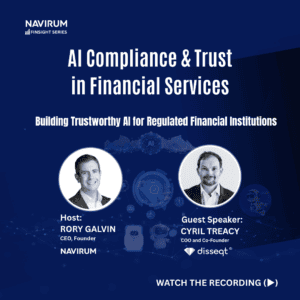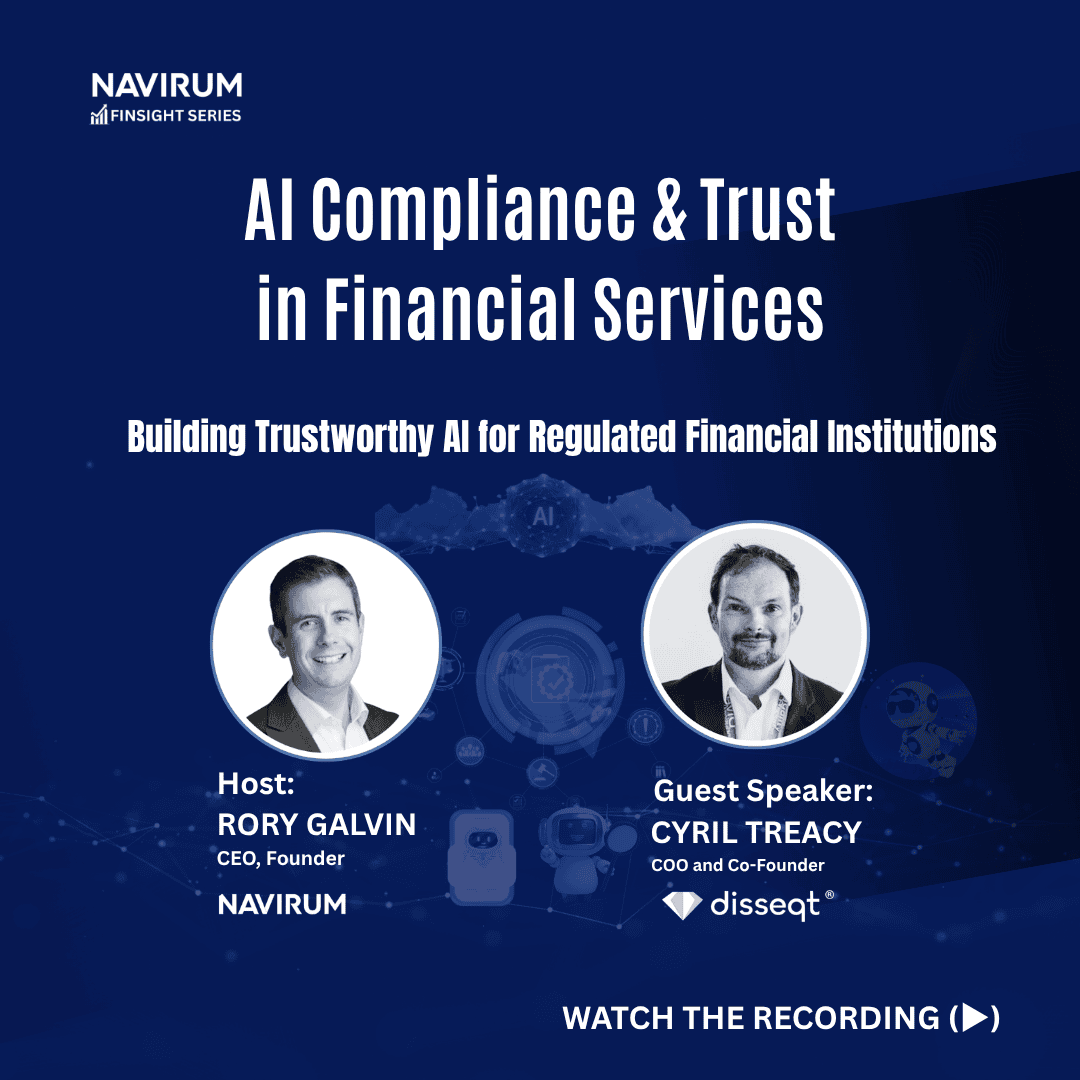
AI Compliance & Trust in Financial Services: Proving Your AI Agents Are Safe, Secure, and Compliant
What Does This FinSight Series Webinar Talk About?
AI agents are moving into real financial services workflows, but how do you know they’re behaving the way they should?
This on-demand FinSight Series webinar explores why the next challenge in enterprise AI isn’t simply building capable agents. It’s being able to test, monitor, control, and prove what those agents do in production.
Our guest speaker for this Finsight Series episode is Cyril Tracy, Co-Founder and COO of Dissect AI, and we’re delighted he has joined us for a practical conversation about AI assurance, security, governance, and regulatory readiness.
You’ll hear real-world examples from banking, insurance, and enterprise operations, including the risks of AI drift, hallucinations, prompt injection, over-permissioned agents, and weak production visibility.
What Is AI Assurance?
AI assurance is the technology and processes organizations use to make sure AI systems behave safely, reliably, and within defined boundaries.
For financial services organizations, this includes:
- Testing AI agents before deployment
- Red teaming and adversarial testing
- Real-time monitoring and guardrails
- Controlling agent permissions and access
- Maintaining audit trails and production logs
- Detecting unexpected behavior and AI drift
- Supporting regulatory and compliance requirements
The goal isn’t to slow down AI adoption.
It’s to make production AI safer and more observable.
Why AI Agents Create New Risks
Unlike traditional software, AI agents can respond differently depending on the situation, the data they encounter, and the instructions they receive.
Agents can:
- Hallucinate or generate incorrect information
- Drift from expected behavior
- Be manipulated through prompt injection
- Access more data than necessary
- Take actions outside their intended scope
- Create new risks when connected to enterprise systems
For regulated financial institutions, the question is no longer just “Can we deploy AI?”
It’s “Can we prove what our AI is doing?”
What This Webinar Covers
In this on-demand session, you’ll discover:
- Why AI agents drift, hallucinate, and go off-script
- How to test agents using adversarial prompts and red teaming
- What air-gapped AI infrastructure means for financial institutions
- How validators and guardrails can control AI behavior in real time
- Why production monitoring and audit trails matter
- New risks created by voice AI, including prompt injection and bias
- How chargeback and mortgage workflows can be automated while maintaining human oversight
- Why over-permissioned agents can create significant security risks
- How the EU AI Act is changing expectations around AI monitoring and evidence
AI Compliance Is Becoming an Ongoing Process
AI governance doesn’t end when an agent goes live.
Financial institutions need visibility into what their AI systems are actually doing in production—and the ability to produce evidence when something goes wrong.
As regulatory expectations evolve, organizations need to think about:
- Monitoring
- Documentation
- Production logs
- Evidence
- Post-deployment oversight
- Lifecycle compliance
Trust in AI needs to be measurable, observable, and provable.
What You Will Get
After accessing this webinar, you’ll receive:
- Full on-demand recording
- Real-world financial services examples
- Practical AI assurance insights
- AI testing and red teaming considerations
- Guidance on monitoring and guardrails
- Insights into AI security and regulatory readiness
Key Insight
The future of enterprise AI isn’t just about building smarter agents.
It’s about building AI systems that organizations can see, control, and trust.
As AI moves into increasingly important financial workflows, knowing what an agent did, when it failed, and how to stop it will become just as important as what the agent can accomplish.
Access the Webinar
Watch the full conversation with Cyril Tracy to learn how financial services organizations can move from AI experimentation to production with confidence.
AI Assurance in Financial Services: Proving Your AI Agents Are Safe, Secure, and Compliant
Get Access to the Webinar Recording!
F.A.Q.
AI assurance is the process of testing, monitoring, and validating AI systems to ensure they behave safely, reliably, and within defined boundaries throughout their lifecycle.
Financial institutions can use adversarial prompts, red teaming, and specialized validators to identify vulnerabilities, unexpected behaviors, and potential failures before an AI agent reaches production.
AI agents can hallucinate, drift from expected behavior, follow malicious instructions, access excessive permissions, or take unintended actions. The webinar explores how monitoring and real-time guardrails can help manage these risks.
Organizations need to know what an AI agent did, what information it accessed, and how it behaved. Audit trails and production logs provide visibility and evidence that can support investigations, governance, and regulatory requirements.
The EU AI Act is increasing the focus on AI risk management, evidence, monitoring, and lifecycle oversight. The webinar explores why financial institutions need the ability to demonstrate how their AI systems behave—not just document how they are supposed to behave.
The EU AI Act is increasing global expectations around AI risk management, monitoring, and evidence. While North America does not currently have a single equivalent regulation, financial institutions in the U.S. and Canada are also facing growing expectations around AI governance, transparency, security, and responsible deployment.