
Charles Schwab Salesforce integration connects Schwab custodial data, accounts, balances, and holdings, with Salesforce Financial Services Cloud, so wealth management firms and RIAs get client records, account opening status, and compliance data in one system instead of two. Most firms connect through Schwab’s free, native Salesforce app, which syncs daily; real-time sync is available separately through Schwab’s OpenView Gateway API.
Key Takeaways
- Core Integration Timeline: A custodial data link can be established quickly, but full implementation of Salesforce Financial Services Cloud alongside complete data clean-up ranges from 8 to 12 weeks for smaller RIAs, while multi-advisor firms with custom workflows often need 3 to 6 months.
- Platform Choice Benefits: Integrating Schwab with standard Salesforce Sales Cloud requires heavy custom development. Utilizing Financial Services Cloud delivers native household objects and banking structures out of the box.
- Middleware for Scale: While direct custom API scripts are possible, utilizing a robust middleware tier provides error tracking and easier data normalisation if your firm adds secondary custodians down the road.
- Onboarding Optimization: The highest immediate return on investment comes from automating new account openings. Pulling data directly from Salesforce to pre-populate Schwab custodial forms cuts administrative friction down significantly.
The Bottom Line
TL;DR: Siloed tech stacks create administrative drag that blocks firm growth. Combining your Charles Schwab custodial records with Salesforce converts your CRM into a single operational hub, freeing advisors from duplicate data entry and manual system switching.
Charles Schwab Salesforce integration allows RIAs, wealth management firms, and broker-dealers to synchronize custodial data with Salesforce Financial Services Cloud (FSC). By connecting Schwab Advisor Center with Salesforce, firms can centralize client records, automate account opening, enhance compliance oversight, and improve advisor productivity. This guide explains integration options, architecture considerations, business benefits, compliance implications, and best practices for financial services organizations seeking scalable digital transformation.
Why Integration Is No Longer Optional?
In today’s wealth management environment, technology fragmentation is one of the biggest barriers to scale.
Getting the Schwab integration live is only the first step. Keeping it reliable as both platforms evolve is where ongoing Salesforce managed services comes in.
Most independent advisors and wealth management firms rely on Charles Schwab as custodian while using Salesforce as their CRM platform, often Salesforce Financial Services Cloud (FSC). Both systems are powerful. However, when they operate independently, inefficiencies quickly surface:
- Advisors toggling between systems during client meetings
- Manual entry of account data into Salesforce
- Reconciliation delays
- Inconsistent reporting across leadership teams
- Increased compliance exposure
As firms grow, these inefficiencies multiply.
A thoughtful Charles Schwab Salesforce integration eliminates these silos by connecting custodial data directly into Salesforce. The result is a unified client view, automated workflows, and stronger operational control.
For firms aiming to scale assets under management (AUM) while maintaining compliance and service excellence, integration becomes a strategic initiative, not just a technical enhancement.
Understanding the Strategic Value of Schwab–Salesforce Integration
At its core, integration solves one fundamental problem: disconnected data.
In many firms today:
- Client relationship details live in Salesforce
- Account balances and holdings live in Schwab Advisor Center
- Planning data lives in a third system
- Reporting tools pull data independently
This creates friction.
When Schwab and Salesforce are integrated properly, Salesforce becomes the operational command center, while Schwab remains the custodial system of record for investment data.
Instead of advisors working across systems, the system works for the advisor.
What Data Is Typically Integrated?
A mature Charles Schwab Salesforce integration does more than import account balances. It enables structured, ongoing synchronization of multiple data layers.
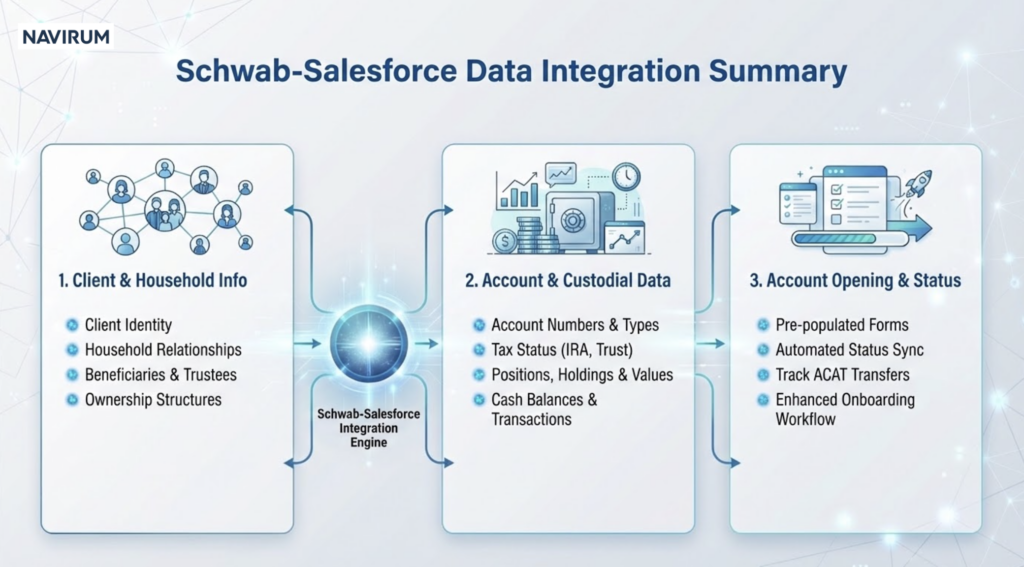
1. Client and Household Information
Client identity and relationship modeling are critical in wealth management. Integration can synchronize:
- Account holder names
- Contact details
- Household relationships
- Beneficiaries and trustees
- Joint account ownership structures
When aligned with Salesforce Financial Services Cloud, this information enhances household modeling and relationship mapping, two critical FSC capabilities.
2. Account and Custodial Data
Custodial data typically includes:
- Account numbers and types
- Tax status (IRA, trust, taxable, etc.)
- Positions and holdings
- Market values
- Cash balances
- Transaction history
When mapped properly to FSC Financial Account objects, this data feeds dashboards, client reviews, and compliance monitoring workflows.
Key Charles Schwab Banking Integration Features
Beyond brokerage and advisory accounts, Schwab’s banking integration features are increasingly part of what firms sync into Salesforce. Real-time cash balance data is available specifically through the Schwab OpenView Gateway API; other banking data points, such as margin account details, cash sweep programs, and lines of credit, vary by integration route and should be confirmed against your specific Schwab connection before you build reporting around them.
When these banking data points live inside FSC alongside brokerage holdings, advisors get a genuine 360-degree view of the household balance sheet, not just its investment portfolio. That combination turns a client review from a portfolio update into a full financial-picture conversation, and it is a capability firms increasingly expect as Schwab continues to expand its banking integration features for RIAs.
3. Account Opening and Transfer Status
One of the most impactful areas of integration involves onboarding workflows. By connecting Schwab account opening processes to Salesforce:
- Forms can be pre-populated
- Status updates can sync automatically
- Advisors can track ACAT transfers
- Operations teams gain visibility without leaving Salesforce
This reduces onboarding friction and shortens time-to-funding.
Scaling Multi-Custodial Operations: Schwab, Fidelity, and Salesforce FSC
Most mid-market RIAs do not run on a single custodian for long. As firms grow, whether organically or through acquisition, it is common to see Schwab alongside Fidelity, Pershing, or another custodial partner within the same practice.
This is where Salesforce Financial Services Cloud earns its keep. Rather than building separate reporting views for each custodian, FSC acts as the aggregation layer: Schwab and Fidelity custodial data integration into Salesforce Financial Services Cloud lets operations teams normalize account structures, tax statuses, and household relationships into a single data model, regardless of where the assets are held.
For firms scaling through acquisition, this matters even more. A well-architected middleware tier makes onboarding an acquired book of business, with its own custodian and its own data quirks, a matter of configuration rather than a custom build. Advisors get one household view. Operations gets one system of record. Leadership gets one reporting layer, not three.
Integration Architecture: How It Works in Practice
There is no single way to implement Charles Schwab Salesforce integration. The right architecture depends on firm size, growth trajectory, and long-term technology strategy.
| Integration Route | Cadence | Effort | Best For |
|---|---|---|---|
| Schwab Advisor Center Integration for Salesforce (native app) | Daily batch (prior business day) | Low, point-and-click setup | Most RIAs; standard reporting and account data needs |
| Schwab OpenView Gateway® API | Real-time custody data, supports bidirectional workflows | High, custom build and ongoing maintenance | Firms needing real-time balances or automated workflows |
| Middleware-based integration | Configurable, typically scheduled batch | Medium to high | Multi-system or multi-custodian environments |
| Pre-built accelerators | Varies by accelerator, usually daily or scheduled batch | Medium | Firms wanting faster time-to-value with some customization |
| Daily data files | Batch | Low to medium | Simple, file-based reporting needs |
Schwab Advisor Center Integration for Salesforce (Native App)
For most RIAs, the starting point is Schwab’s own Schwab Advisor Center Integration for Salesforce, a free, native managed package available on the Salesforce AppExchange. It syncs account and custodial data on a daily batch basis (prior business day; there is no intraday update), and it is typically the lowest-effort path since it does not require custom development. Firms that need real-time data or bidirectional workflows beyond what the native app supports typically move to the Schwab OpenView Gateway API described below.
Schwab OpenView Gateway® API Integration for RIAs
Schwab offers APIs that allow firms to retrieve custodial data programmatically.
For RIAs evaluating this route, a primary benefit of API connectivity is reducing manual data entry and operational risk, since data moves directly from Schwab into Salesforce rather than being re-keyed by hand.
This approach, built on the Schwab OpenView Gateway® API, offers flexibility and can support real-time synchronization for supported data types and bidirectional workflows, but it requires technical expertise and ongoing maintenance. Firms pursuing this route typically:
- Have internal development teams
- Work with a Salesforce consulting partner
- Require custom workflows beyond standard connectors
While powerful, API-based integrations must account for version changes, authentication management, and API limits.
Middleware-Based Integration
For firms with a multi-system ecosystem, middleware often provides the most scalable architecture.
Middleware solutions can:
- Transform and normalize data
- Handle error monitoring
- Manage retries and synchronization schedules
- Support additional integrations beyond Schwab
This approach reduces dependency on direct system-to-system connections and supports long-term scalability.
Pre-Built Accelerators
Many Salesforce consulting firms specializing in financial services offer pre-built accelerators for Schwab integration.
These solutions typically include:
- Pre-mapped FSC data structures
- Standardized field mapping
- Proven onboarding workflows
- Reduced implementation timelines
For growing RIAs, this approach balances speed and customization.
How Does the Salesforce Charles Schwab Integration Connection Process Work?
At Navirum, we’ve implemented countless Schwab Salesforce integrations across wealth management firms. While the connection between Salesforce Financial Services Cloud (FSC) and the Charles Schwab custodial platform is well-supported, it does require hands-on experience with Salesforce to complete successfully.
Schwab provides guided support throughout the process, working directly with the Salesforce owner to configure the connection. In our experience, their team is highly responsive and patient, and ensures the setup is completed correctly – particularly when enabling key Charles Schwab banking integration features such as account data synchronization, onboarding status tracking, and custodial data visibility. This reflects our proven track record with custodial integrations.
The setup involves configuring a number of Salesforce components, including fields, roles, profiles, and permissions, followed by structured testing and validation. The full process typically takes a few days (for the technical API data connection itself; full Salesforce FSC implementation typically runs 8–12 weeks) to complete, including initial configuration and data synchronization.
Given the level of detail involved, this is best handled by a Salesforce Administrator or someone highly comfortable with system configuration and your firm’s data model.
Recommended Approach:
We strongly recommend completing the setup collaboratively with:
- Schwab’s integration team
- The internal project lead at your firm
- Your Salesforce consultant
Having all parties aligned on the same calls ensures faster setup, fewer errors, and a smoother path to go-live.
Business Impact: Beyond Technical Efficiency
Integration is not just about moving data. It fundamentally changes how advisors and operations teams work.
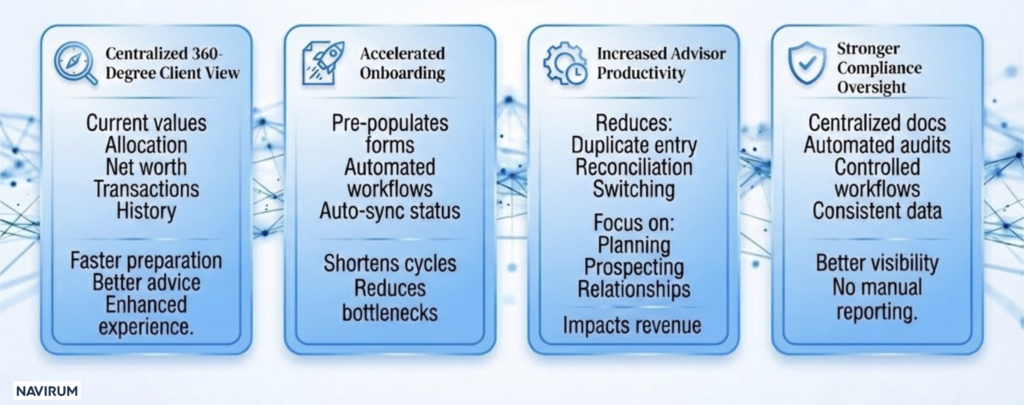
Centralized 360-Degree Client View
When Schwab data flows into Salesforce, advisors gain immediate access to:
- Current account values
- Asset allocation
- Household net worth
- Recent transactions
- Relationship history
During client meetings, advisors can prepare faster and deliver more personalized advice.
The ability to see relationship history alongside custodial data significantly enhances client experience.
Onboarding Automation and DocuSign Workflow Integration
Manual account onboarding is one of the most resource-intensive processes in wealth management.
Without integration:
- Advisors fill forms manually
- Operations re-enter data
- Status updates require email follow-ups
With integration:
- Client data pre-populates forms
- Salesforce workflows manage approvals
- Status changes sync automatically
This shortens onboarding cycles and reduces operational bottlenecks.
Many firms extend this further with a DocuSign workflow: once forms are pre-populated from Salesforce, they route automatically into an e-signature process, and completed, signed documents flow back into Salesforce, closing the loop without a single manual file upload.
Increased Advisor Productivity
Every hour spent reconciling data is an hour not spent advising clients.
Integration reduces:
- Duplicate data entry
- Manual reconciliation
- System switching
Advisors can focus on:
- Financial planning
- Prospecting
- Deepening client relationships
For firms scaling AUM, advisor productivity improvements directly impact revenue.
Stronger Compliance Oversight
Regulatory scrutiny in financial services continues to increase. Integration helps firms maintain compliance through:
- Centralized documentation
- Automated audit trails
- Controlled approval workflows
- Data consistency across systems
Compliance officers gain better visibility without depending on manual reporting.
Schwab + Salesforce
Seeing this opportunity in your firm?
We work exclusively with wealth management firms on Salesforce. Tell us about your setup, and we respond within 1 business day.
Salesforce Financial Services Cloud: Why It Matters
While Schwab can integrate with standard Salesforce Sales Cloud, Financial Services Cloud (FSC) provides structural advantages for wealth management firms.
FSC includes:
- Household data modeling
- Financial Account objects
- Relationship maps
- Action plans
- Client lifecycle tracking
When Schwab custodial data maps directly into FSC Financial Accounts, firms unlock structured reporting and automation that generic CRM configurations cannot easily replicate.
For firms planning long-term digital transformation, FSC alignment is critical.
Data Governance and Security Considerations
Financial data is highly sensitive. A Schwab–Salesforce integration must prioritize governance from day one. As AI agents enter the picture, that same governance extends to governing AI access to Schwab data.
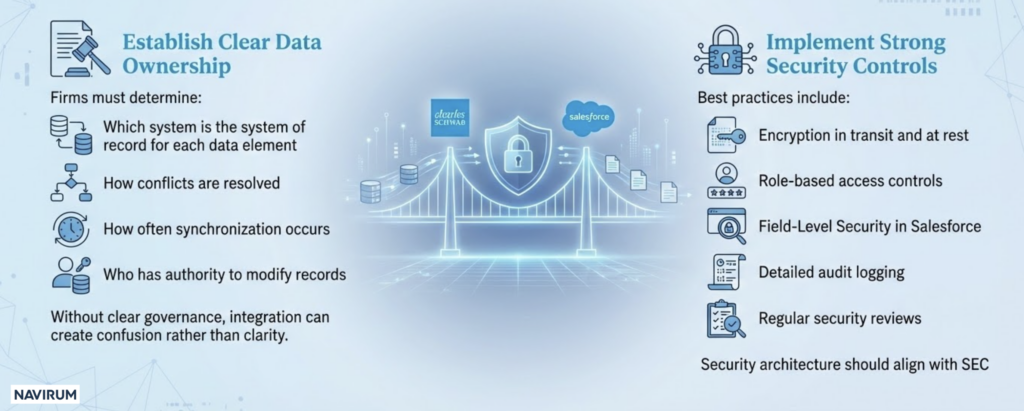
Establish Clear Data Ownership
Firms must determine:
- Which system is the system of record for each data element
- How conflicts are resolved
- How often synchronization occurs
- Who has authority to modify records
Without clear governance, integration can create confusion rather than clarity.
Implement Strong Security Controls
Best practices include:
- Encryption in transit and at rest
- Role-based access controls
- Field-level security in Salesforce
- Detailed audit logging
- Regular security reviews
Security architecture should align with SEC and FINRA requirements, as well as internal compliance frameworks.
Common Pitfalls to Avoid
Even well-intentioned integration projects can face challenges.
Over-Customization
Excessive custom objects or logic increases maintenance complexity. Whenever possible, leverage standard FSC structures.
Inadequate Data Cleanup
Migrating inconsistent or incomplete data into Salesforce undermines reporting accuracy. Data normalization should precede integration.
Lack of User Adoption
Technology alone does not create efficiency. Training, documentation, and phased rollout are essential.
Measuring Return on Investment
Integration ROI should be measured across operational and revenue metrics.
Common indicators include:
- Reduced manual data entry time
- Faster account funding cycles
- Increased advisor capacity
- Improved compliance reporting
- Enhanced client retention
In Navirum’s implementation experience, the fastest, most measurable ROI usually comes from onboarding automation: firms that pre-populate Schwab account-opening forms from Salesforce typically cut manual data entry on new accounts within the first one to two billing cycles after go-live. Results vary by firm size, starting data quality, and how much of the onboarding workflow is automated versus manual.
Who Benefits Most from Charles Schwab Salesforce Integration?
While any Schwab-custodied firm can benefit, integration delivers the greatest value to:
- Growing RIAs scaling beyond 3–5 advisors
- Multi-location wealth management firms
- Broker-dealers centralizing reporting
- Firms implementing Salesforce Financial Services Cloud
- Organizations transitioning from legacy CRMs
At scale, manual processes become operational risks. Integration reduces that risk while enabling sustainable growth.
Built for RIA Roll-Up and Aggregator Strategies
Private equity-backed aggregators and regional roll-up firms face a distinct version of this problem: they are absorbing data from multiple acquired firms on an ongoing basis, not managing just one set of records.
For these firms, Salesforce Financial Services Cloud can be configured to filter and report on advisor movement analytics by custodian, surfacing which acquired books are still Schwab-custodied, which have moved, and where consolidation work remains. The same reporting layer can track Form ADV Part 1 filings and flag book-of-business transfers following recent representative departures, giving deal teams and integration leads a single view of what has been absorbed and what is still in flight.
Built-in workflow automation extends this further: as new acquisitions close, standardized onboarding sequences can bring newly acquired advisors and their Schwab-custodied accounts into the same Salesforce instance as every other office, without a one-off integration project each time.
The Future of Wealth Management Is Connected
Digital transformation in financial services is accelerating. Clients expect seamless onboarding, real-time visibility, and personalized advice. Advisors expect intuitive systems that reduce administrative burden.
Charles Schwab Salesforce integration supports both.
By aligning custodial data with CRM workflows, firms create a connected ecosystem that supports:
- Data-driven insights
- Operational scalability
- Regulatory compliance
- Superior client experience
For firms serious about modernization, integration is not simply an IT project. It is a strategic growth initiative.
Schwab + Salesforce
Working with Schwab and Salesforce today?
Tell us your situation, and we’ll respond within 1 business day.
Takeaway
Charles Schwab Salesforce integration empowers financial services firms to unify custodial intelligence with CRM workflows. When implemented strategically, it enhances advisor productivity, accelerates onboarding, strengthens compliance oversight, and provides leadership with actionable reporting.
As wealth management firms compete in an increasingly digital marketplace, integrated systems become foundational to long-term success.
For RIAs, broker-dealers, and wealth management organizations leveraging Schwab and Salesforce, integration is no longer optional. It is the infrastructure for scalable growth.
Navirum Recommendations: Make Schwab–Salesforce Integration Work for Your Firm
Who we work with
Navirum implements Schwab–Salesforce integrations exclusively for wealth management and financial services firms. Our clients manage between $500M and $5B+ in AUM, with senior consultants on every engagement, no exceptions.
Integrating Charles Schwab with Salesforce isn’t just a technical project. It’s a strategic opportunity to boost advisor productivity, streamline operations, and ensure compliance. Firms often attempt integration without specialized guidance, resulting in delays, duplicated data, or poor adoption.

Navirum’s approach ensures integration drives real business outcomes:
Reduce Compliance Risk: Embed audit trails, approval workflows, and role-based access from day one, minimizing regulatory exposure.
Start with Outcomes, Not APIs: Identify advisor pain points, onboarding bottlenecks, and reporting gaps first. The technology should solve problems, not just move data.
Design for Advisors: Present curated dashboards, automated workflows, and structured data to simplify daily operations and improve adoption.
Plan for Growth: Build a scalable architecture that supports multi-custodian environments, advanced analytics, and future expansion.
Why Navirum? We specialize exclusively in Salesforce for financial services. That means we understand Schwab data, advisor workflows, and regulatory requirements, and we know how to turn integration into measurable ROI.
Next Step: Don’t let your integration become a manual burden. Schedule a Salesforce Readiness Assessment with Navirum. We’ll evaluate your Schwab–Salesforce setup, surface operational gaps, and build a clear path to go-live.
Ready to assess your Schwab integration?
Get a structured review of your current setup: where the gaps are, what to fix first, and what a full integration would unlock for your firm.
FAQ: Charles Schwab Salesforce Integration
Can Charles Schwab integration work with any Salesforce edition?
While technically possible with Salesforce Sales Cloud, Financial Services Cloud (FSC) provides pre-built objects, household modeling, and financial account structures optimized for wealth management. Integration is smoother and more scalable with FSC.
How long does a typical integration project take?
Project duration varies based on complexity, firm size, and workflow requirements. Small RIAs may complete integration in 8–12 weeks, while multi-advisor firms with custom workflows may require 3–6 months.
Do I need middleware to connect Schwab to Salesforce?
Middleware is recommended for scalability, data transformation, and error monitoring, but smaller firms with limited data complexity may integrate directly via Schwab APIs or pre-built connectors.
Will integration impact compliance reporting?
When designed properly, integration enhances compliance by centralizing custodial data, creating audit trails, and ensuring structured approval workflows. It reduces manual reporting errors rather than creating new compliance burdens.
Can advisors access Schwab data from Salesforce on mobile devices?
Yes. Salesforce mobile apps allow advisors to view integrated account data, balances, and workflows securely, enabling real-time client discussions even when remote.
How is data security managed in this integration?
Security best practices include encryption in transit and at rest, role-based access, field-level security, and audit logging. Compliance with FINRA, SEC, and internal governance policies is essential.
Can this integration automate account opening processes?
Yes. Integrating Schwab with Salesforce allows pre-population of forms, workflow-driven approvals, and status tracking, significantly reducing account opening time and errors.
How do I maintain data accuracy over time?
Regular data audits, defined system-of-record rules, and clear sync schedules ensure ongoing accuracy. Middleware or automated reconciliation processes further reduce the risk of duplicate or outdated records.
Can I integrate multiple custodians in addition to Schwab?
Absolutely. A scalable architecture can accommodate additional custodians, enabling multi-custodian visibility and reporting from a single Salesforce instance.
What are the signs my firm needs this integration?
Typical indicators include:
- Repetitive manual data entry
- Advisors toggling between systems frequently
- Delayed or inconsistent reporting
- Compliance inefficiencies
- Difficulty scaling operations without adding headcount
If you see these patterns, integration can deliver measurable ROI and operational efficiency.
Stay connected
Not ready to talk yet?
Join 400+ wealth management leaders on the FinSights newsletter, Navirum’s monthly take on Salesforce, AI, and digital transformation in financial services.
Join FinSights on LinkedIn →Free. Unsubscribe any time.
Also using other custodians?