Want more insights like this?
Join the Navirum newsletter for bi-weekly Salesforce FSC, Agentforce, and AI security insights — plus the Post-Go-Live Value Checklist.
Join the Newsletter →How Salesforce and AI Managed Services Work: Inside Navirum Orbit
Keep your platform secure, compliant, and optimized for strategic business goals.
Orbit Lifecycle Ecosystem
Why ongoing management matters
Salesforce go-live is only the starting line. Without continuous care, a highly customized environment inevitably drifts from how the active business operates.
Navirum is a Salesforce Ridge Partner with a 5.0 rating on the Salesforce AppExchange, 1,000+ Salesforce projects, 400+ clients and 40+ Salesforce certifications, and has hosted the FinSight Series since 2021.
Salesforce is one of the most powerful technology investments a financial services firm can make, improving client relationships, advisor productivity, and reporting accuracy. However, after going live, the system's footprint naturally expands as team structures, custodians, and API parameters change over time.
Platform Drift
Salesforce gradually stops matching how advisors and operations teams operate, resulting in manual workarounds.
Capacity & Knowledge Gaps
Crucial system ownership becomes concentrated within a single point of failure, leaving you vulnerable during talent transitions.
Change, Security & AI
Frequent releases, complex integrations, and new AI initiatives demand rigorous testing and sandbox governance.
Common Warning Signs
If your organization flags two or more of these signals, your Salesforce investment is bleeding value daily.
- ✕ Reports and pipelines are not trusted
- ✕ High-value workflows remain manual
- ✕ Integrations require manual syncing
- ✕ Seasonal releases are ignored
- ✕ Advisors return to spreadsheets
- ✕ AI plans are blocked by messy data
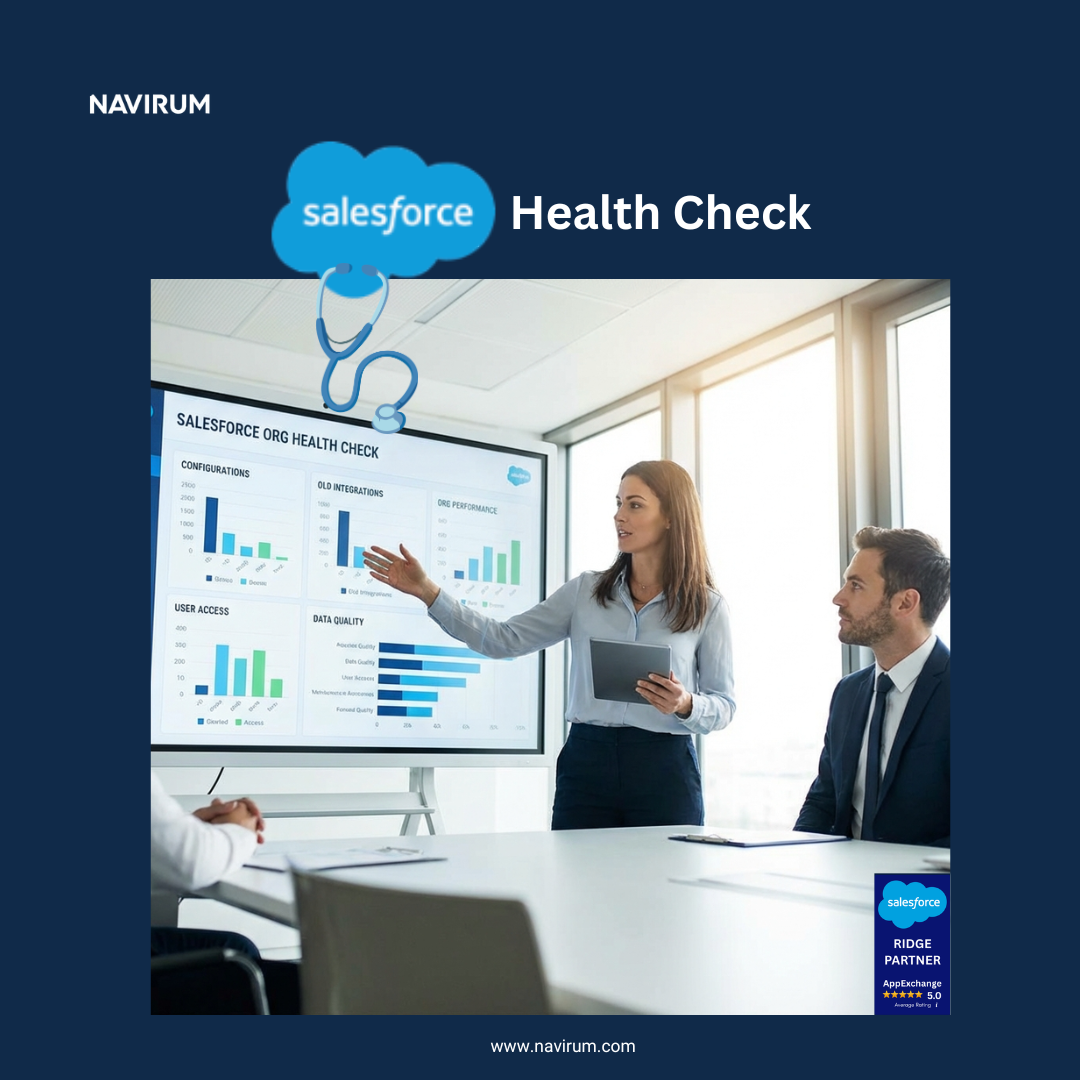
What is a Salesforce Org Health Check?
Evaluate if your Salesforce instance is configured optimally to safely scale operations, secure client trust, and embrace CRM automation.
60-Second Salesforce Platform Check
Which best describes your firm?
What is your primary platform challenge?
How are you currently supporting Salesforce?
FSC Hybrid Co-Delivery Model Assessment
Your combination of sector requirements and platform challenges highlights critical system friction that standard point-and-click teams miss.
Establish Sandbox Regression Cycles
Configure locked sandboxes with representative dummy records to validate seasonal API releases.
Unify Relationship Matrix Hierarchies
Standardize household mapping structures to prevent fragmented reporting views.
Formalize Role-Based Access Controls
Enforce strict custom profiles ensuring only verified compliance users modify critical field parameters.
“Navirum Orbit resolved our recurring syncing errors. Our advisors finally trust the dashboards.”
— Operations Lead, Cuddy Financial ServicesJoin the Navirum Newsletter
Get practical, bi-weekly insights covering Salesforce FSC upgrades, AI security protocols, and operational workflows built for modern financial services. Get our Post-Go-Live Value Checklist delivered straight to your inbox.
- ✓ Agentforce guidelines
- ✓ Real integration stories
- ✓ Sandbox testing tips
- ✓ FinTech development news
What Is Orbit Services & How Do Managed Services Work?
Managed services must go beyond reactive ticket management. The right model delivers ongoing, programmatic platform improvements month-over-month.
On the Orbit page this layer is called the Salesforce managed services underneath: the five stages below are how that work runs month to month. Orbit comes in three plans, Standard, Flex and Enterprise, from $200 per month; see current plans and pricing.
The Orbit Five-Stage Operating Model
User Assistance & Daily Administration
Our FSC certified experts take over user provisioning, troubleshooting, minor configuration tweaks, report setup, and access reviews so internal IT resources are never backlogged.
- • User licensing & access control
- • Custom profiles and permission sets
- • Page layout adjustments
CRM Storage Cost Optimization & Adoption
We audit page speeds, database schemas, and workflows to eliminate data bloat, keeping ongoing Salesforce licensing costs flat while supporting long-term data retention needs.
- • Runaway file storage audits
- • Retention-aligned log archiving
- • Flow automation cleanups
Controlled Release Management
Seasonal upgrades are fully evaluated in isolated sandboxes, ensuring zero impact on active production features.
- • Sandbox regression testing
- • Change impact mapping
- • Deployment validation checks
Access, Security & Compliance Governance
We maintain clear data parameters to protect consumer privacy, restrict layouts based on department roles, and track audit paths.
- • Field-level access checks
- • Multi-factor authentication setups
- • Access audit tracking logs
Technical & Licensing Roadmaps
Ongoing strategy reviews align software costs and licensing agreements with long-term technological goals.
- • Agentforce planning and architecture design
- • License usage optimization audits
- • Specialized developer capacity scaling
Controlled Seasonal Release Management
Why financial-services firms choose Orbit
Financial firms require certified Salesforce competence mapped specifically to regulated business scenarios, compliance guidelines, and complex third-party tools.
Financial-services expertise
Deep knowledge of FSC, wealth advisor pipelines, broker networks, and regulated custodian integrations.
Secure, controlled change
Release management, sandbox staging, and access management. We ensure upgrades never disrupt active production flows.
Long-term continuity
A dedicated, structured support team that retains business logic knowledge, eliminating key-person dependency risks.
Strategic licensing guidance
Platform audits, commercial planning, licensing cost controls, and future AI readiness assessments.
Certified Salesforce Specializations
Signet Financial
Florida • Wealth ManagementChallenge: Fragmented pipeline management and slow advisor support responses.
Result: Boosted platform adoption and streamlined compliance logs.
Cuddy Financial
FSC & Envestnet IntegrationChallenge: Broken Envestnet portfolio syncs disrupting operations.
Result: Unified household data views with zero page switching.
Berry Wealth
LPL Migration PartnerChallenge: Migrating legacy data stores off client terminals without system downtime.
Result: Successful migration with zero operational downtime.
West Coast Wealth Firm
iA Private Wealth AdvisorChallenge: Fragmented systems and an existing Salesforce org not customized for wealth management workflows.
Result: Streamlined advisor tools and a scalable architecture built for future growth.
Armada Capital Partners
Multifamily & Commercial Real EstateChallenge: Complex workflows spanning asset management, accounting, and investor relations.
Result: A scalable, efficient system driving growth across the portfolio.
| Operating Area | Internal Administrator | Orbit Managed Services |
|---|---|---|
| Daily ownership | Immediate daily response | Adds massive technical capacity |
| Business knowledge | Deep, organic understanding | Documented and systematically retained |
| Specialist expertise | Limited to general administration | Architectural and development depth |
| Releases & security | Resource-constrained setups | Structured, regression-tested deployments |
| Continuity & capacity | Single point of failure risk | Always-on backup, zero vacancy risk |
| Data and AI | Varies by individual experience | Certified FSC and Data Cloud experts |
The business value Orbit delivers
Each stage of the model exists to move a number your firm already watches:
- Predictable run cost. A monthly plan from $200 replaces ad hoc consulting invoices, and licensing guidance at every renewal keeps the Salesforce bill honest.
- Advisor hours back. AI is pointed at the work where the hours actually go: meeting prep, client follow-ups and service requests inside Salesforce.
- Fewer surprises. Three Salesforce releases a year land tested, and monitored custodian and portfolio integrations catch breaks before advisors do.
- AI spend under control. Agentforce and Data Cloud are billed by usage; Orbit tracks what drives the spend and cuts waste before it compounds.
- Compliance that holds up. Permissions, Einstein Trust Layer settings and an audit trail, reviewed after every release and change.
- Proof, not promises. The outcomes behind these claims are published as verified client success stories.
What do AI managed services cover after go-live?
AI does not reduce the importance of your CRM foundation. It exponentially increases it. To deploy systems like Agentforce safely, you require governed client data.
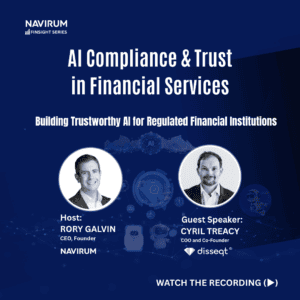
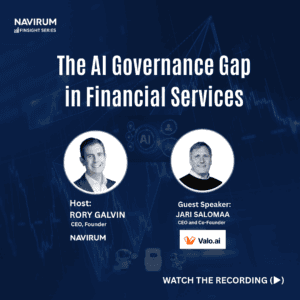
On the Orbit page these are the five AI managed services jobs: putting AI into daily work, piloting it safely, cost management, governance with the Einstein Trust Layer, and change management. The tiers below are what make those jobs safe to run, and the governance discipline is the same one we put on stage in the FinSight session on AI compliance and trust. Partners such as CloudFiles keep document storage costs off the Salesforce bill; see how that works, or browse the full Navirum partner ecosystem.
AI Outcomes & Agentforce
The pinnacle of active ROI: safe automated client scheduling, summarization, and real-time support insights executed within compliance boundaries. Rolling out Agentforce reliably requires this baseline.
Governed Processes
Standardized service paths that guarantee AI modules do not execute unreviewed updates without correct logging, user overrides, or supervisor authorization.
Secure Permissions & FSC Relationship Maps
Field-level permissions and sharing configurations that prevent automated systems from revealing sensitive client records to unauthorized users.
Trusted Connected Data
Harmonized client records fed from active custodian sync points, eliminating duplication so AI engines don't reference outdated addresses or balances.
Well-Managed CRM Foundation
The critical baseline: clean database schemas, documented relationship matrices, and active sandbox workflows managed directly by Orbit certified experts.
Fragmented data architectures, security gaps, and frequent sandbox regression errors.
Continuous roadmapping, secure permissions, clean datasets, and robust compliance controls.
This matters even more under the EU AI Act, whose high-risk AI requirements (transparency, human oversight, and auditability for systems like credit scoring and fraud detection) become enforceable on August 2, 2026. Firms will need to show not just that an AI-driven decision was compliant, but why. A Trust Stack built directly into your Salesforce data model, rather than bolted on as a separate audit layer, is what makes that explanation available on demand instead of reconstructed after the fact.
Frequently Asked Questions
Explore answers regarding Salesforce Financial Services Cloud support, third-party custody integrations, onboarding, and compliance.
Ready to Optimize Your Platform?
Regulated systems require clean database architectures, safe pipeline stages, and programmatic roadmaps. Partner with consultants who understand your industry's language.