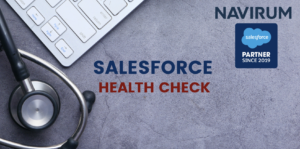

What Is A Salesforce Health Check? Why do I need one?
Estimated reading time: 13 minutes
Key Takeaways
- A Salesforce Health Check assesses your Salesforce environment to enhance efficiency, security, and compliance for financial services.
- It identifies critical areas like regulatory compliance, data integrity, and operational efficiency for executives in finance.
- Navirum provides actionable deliverables, including an executive summary, risk analysis, and a strategic roadmap.
- Firms trust Navirum due to its deep expertise in Salesforce for financial services and tailored assessments that drive business outcomes.
- The Salesforce Health Check helps uncover risks, streamline operations, and maximize your Salesforce investment.
Is Your Salesforce Org Truly Optimized for Financial Services in 2026? Unlock Efficiency, Security, and Compliance Across Your Salesforce Environment
In today’s fast-paced financial services landscape, your Salesforce platform is more than a CRM—it’s a strategic asset. Yet even high-performing organizations risk inefficiencies, security vulnerabilities, and compliance gaps as business requirements evolve. A Salesforce Health Check provides a comprehensive, expert-led assessment that ensures your platform is not only fit for today but positioned to drive growth tomorrow.
Salesforce Org Health Check – The Imperative for Financial Services Leaders
For executives in banking, insurance, wealth management, and fintech, the stakes are high:
- Regulatory Compliance: Misaligned permissions or incomplete audit trails can expose your organization to significant risk.
- Data Integrity: Duplicate records, outdated client data, or fragmented reporting hinder confident decision-making.
- Operational Efficiency: Complex workflows, over-customization, or underutilized functionality can slow your teams.
- Platform ROI: Without proactive oversight, organizations risk exceeding limits or underleveraging Salesforce investments.
A Salesforce Health Check provides visibility into these critical areas, benchmarking your organization against industry best practices and delivering actionable recommendations that mitigate risk while unlocking untapped potential.
What a Financial Services-Focused Salesforce Health Check Looks Like

Navirum’s Health Check is designed specifically for the nuanced operational, regulatory, and architectural needs of financial services organizations.
We provide a detailed evaluation across security, data privacy, internal governance, peer benchmarking, custom architecture, and platform limits to ensure your CRM is built to scale safely.
Security & Access Control
Ensure only authorized personnel can access sensitive financial records. We audit role hierarchies, profile permissions, permission sets, multi-factor authentication (MFA), and session security.
Data Privacy & Regulatory Alignment
Verify compliance with global and regional regulatory frameworks relevant to financial institutions, including PCI-DSS, HIPAA, GDPR, FINRA, SEC, and Canadian CRM3/TCR rules.
Internal Data Sharing & Governance
Implement effective “who sees what” sharing policies. We evaluate sharing rules, team settings, and restricted structures like Chinese Walls for deal advisory or compliance.
Benchmarking Against FS Best Practices
Compare your Salesforce implementation directly against peer benchmarks across Wealth Management, Insurance, Commercial Banking, Fintech, Lending, and Private Equity.
Customizations & System Architecture
Assess custom Apex code, Salesforce Flows, legacy Process Builders, triggers, and integrations to optimize platform scalability, maintainability, and execution speed.
Capacity & Platform Limits
Comprehensive review of data storage, file storage, API call limits, custom object thresholds, and automation limits to uncover cost-saving opportunities and avoid outages.
Mitigate Compliance & Security Risks
Protect your organization and clients with industry-aligned security controls.
Elevate Data Confidence
Drive strategic insights and decision-making from accurate, reliable CRM data.
Streamline Operations
Reduce bottlenecks, simplify workflows, and enhance employee productivity.
Maximize Platform ROI
Ensure your Salesforce environment supports business growth without unnecessary spend.
Future-Proof Your Org
Position your platform to scale smoothly as business demands and technology evolve.
Deliverables for Executives
Engaging Navirum provides you with clear, actionable insights:
- Executive Summary: Key opportunities for optimization and risk mitigation.
- Detailed Risk Analysis: Specific actions to address vulnerabilities and inefficiencies.
- Strategic Roadmap: A high-level plan to enhance performance, adoption, and compliance.
These deliverables give leadership the confidence to make informed, strategic decisions about Salesforce investments and operations.
Why Financial Services Firms Trust Navirum

- Deep expertise in Salesforce for financial services, across banking, insurance, wealth management, fintech, and private equity.
- Tailored assessments designed to drive measurable business outcomes, not just technical improvements.
- Guidance for ongoing optimization, ensuring your Salesforce org remains agile, secure, and compliant in a constantly evolving market.
The Salesforce Health Check can help uncover risks, streamline operations, and maximize your Salesforce investment.
F.A.Q. – Health Check for Financial Services
Yes. A Salesforce environment can remain technically functional while becoming increasingly disconnected from the way a financial services organization actually operates. Business models evolve through acquisitions, new service offerings, changes in advisor structures, new client segments, and shifts in operating models.
A deeper assessment can compare the Salesforce experience against current business processes and identify where the platform no longer reflects how teams work. This can reveal unnecessary steps, outdated assumptions in the data model, redundant functionality, or processes that were designed for an earlier stage of the organization’s growth.
Not every process belongs in Salesforce, and forcing every workflow into the platform can create unnecessary complexity. The more important question is whether Salesforce is being used where it provides the greatest business value.
An assessment can examine which processes are managed in Salesforce, which remain in other applications, and where information or activities cross between systems. This can help organizations determine which processes should remain in Salesforce, which should be integrated with another platform, and which may be better handled elsewhere.
This is particularly useful when a firm has accumulated Salesforce functionality over many years.
A Salesforce org can contain functionality that is individually useful but collectively overwhelming. Users may encounter too many fields, screens, notifications, tasks, approval steps, or navigation options.
A health assessment can look at Salesforce from the perspective of different user groups rather than evaluating the system solely from an administrator’s perspective. Advisors, service associates, relationship managers, operations teams, and executives may all require very different experiences.
The objective is to identify where Salesforce can be made more intuitive and focused so users can complete important tasks with less friction.
Organizations considering Salesforce consolidation should first understand why separate orgs exist and what dependencies would be affected by bringing them together.
Important questions include:
Which business units genuinely require separate environments?
Are there differences in operating models or regulatory requirements?
Which applications and integrations depend on each org?
How different are the underlying data models?
What functionality has been independently developed?
What would users gain or lose through consolidation?
What migration and change-management implications would result?
The decision should therefore be based on business and technical requirements rather than simply assuming that fewer Salesforce orgs are always better.
Acquisitions frequently introduce multiple CRM environments, inconsistent processes, different Salesforce configurations, and overlapping technology investments.
Rather than immediately migrating everything into a single environment, organizations can use an assessment to understand the differences between the acquired and existing Salesforce environments.
This can help leadership identify which capabilities should become standardized, which processes are unique to a business unit, which applications should be retained, and where consolidation could create unnecessary disruption.
For financial services firms pursuing ongoing M&A activity, this can also become part of a repeatable technology integration strategy.
This is an important architectural decision that becomes more difficult as an org matures.
A useful assessment considers the business value of the requirement, the longevity of the process, the maintenance implications, integration dependencies, user experience, and the availability of native Salesforce capabilities.
The question isn’t simply “Can Salesforce do this?” It is:
“Is Salesforce the right place to do this?”
That distinction can help prevent organizations from introducing unnecessary complexity when a native capability, integration, or external application may provide a better long-term solution.
A Salesforce assessment should not be conducted exclusively by the Salesforce administrator or IT team. Business stakeholders provide critical context about how the platform affects day-to-day operations and strategic priorities.
Depending on the organization, this may include representatives from:
Wealth management
Advisory teams
Client service
Operations
Compliance
Marketing
Technology
Data teams
Executive leadership
Their input helps distinguish between issues that are technically interesting and issues that actually affect business performance.
Financial services organizations often have more potential Salesforce initiatives than available budget or internal capacity. A health assessment can provide a framework for deciding what should happen first.
Instead of treating every requested enhancement as equally important, initiatives can be evaluated according to factors such as business impact, complexity, dependencies, risk, strategic importance, and expected effort.
This can help leadership build a practical sequence—for example, determining whether to address a foundational issue before investing in a new customer-facing capability or advanced technology initiative.
Executives don’t necessarily need to monitor Salesforce configuration details themselves. Instead, they can track indicators that show whether the platform continues to support the organization effectively.
Useful indicators can include:
Adoption trends by user group
Time required to complete key Salesforce processes
Volume of enhancement requests
Growth in Salesforce-related support issues
Dependency on manual workarounds
Number of critical integrations
Time required to deliver Salesforce changes
Growth in technology costs
Business processes increasingly being handled outside Salesforce
Progress against the organization’s Salesforce roadmap
Monitoring these indicators can help leadership identify when another deeper assessment may be warranted.
The best time is before a major Salesforce decision becomes difficult to reverse.
An assessment can be particularly valuable when an organization is preparing for a major transformation, entering a period of rapid growth, integrating an acquisition, changing its operating model, or evaluating a significant new Salesforce investment.
It can also be useful when leadership feels that Salesforce has become increasingly difficult to change or that the organization is not getting the expected value from the platform—even when there is no obvious technical failure.
The purpose is not to wait until Salesforce becomes a problem. A proactive assessment gives leadership a clearer understanding of the current environment before making the next major investment.