Durée estimée de lecture : 13 minutes
Points clés à retenir
- Institutional integrations Salesforce Financial Services Cloud enhance the management of financial data by connecting various systems like custodians and portfolio management platforms.
- These integrations create a complete client view, reduce manual work, and ensure data consistency across all systems.
- Key integration options include Fidelity, Charles Schwab, SS&C Salentica, and LPL Financial, each offering unique benefits for advisors and firms.
- Multi-custodial integrations streamline data from different sources, providing a holistic view of client relationships and reducing manual reconciliation.
- Security, data governance, and regulatory compliance are critical considerations in designing effective integrations.
For wealth management firms and financial institutions, Salesforce Financial Services Cloud (FSC) can serve as more than a customer relationship management platform. When connected to custodians, portfolio management systems, financial planning tools, and banking platforms, it can help create a more complete view of client relationships and bring important information into everyday workflows.
The challenge is that financial data rarely lives in one place. Advisors and relationship managers may need to navigate multiple systems to understand a client’s holdings, review account activity, prepare for meetings, or coordinate service requests. Disconnected systems create extra work, introduce opportunities for data inconsistencies, and make it harder to deliver a consistent client experience.
Institutional integrations help address this challenge by connecting Salesforce with the systems that hold and manage financial data. Through prebuilt connectors, integration platforms, and APIs, firms can reduce manual data handling, streamline workflows, and make relevant information more accessible to the people who need it.
Table of contents
- Why Institutional Integrations Matter
- Key Institutional Integration Options for Salesforce FSC
- Multi-Custodial Integrations: Connecting the Broader Financial Picture
- Banking APIs and Institutional Connectivity
- Security, Data Governance, and Compliance Considerations
- How Navirum Helps Financial Institutions Connect Salesforce
- Build a More Connected Salesforce Environment
- Foire aux questions
Why Institutional Integrations Matter
Salesforce FSC provides financial services-specific capabilities for managing client relationships, financial accounts, and business processes. Its value increases when those capabilities are connected to the systems that support an institution’s day-to-day operations.
Well-designed integrations can help firms:
- Create a more complete client view. Bring relevant relationship, account, and portfolio information together to support more informed conversations.
- Reduce manual work. Minimize repetitive data entry and the need to switch between applications.
- Improve data consistency. Synchronize information between systems and reduce discrepancies caused by manual updates.
- Streamline advisor workflows. Connect client information to onboarding, service requests, meeting preparation, and follow-up activities.
- Strengthen operational oversight. Improve the availability and traceability of information used in business processes, subject to appropriate controls.
- Support more personalized service. Give advisors and relationship managers better context for understanding client needs and identifying opportunities.
The goal is not necessarily to move every piece of financial data into Salesforce. It is to make the right information available in the right workflow, with clear ownership and appropriate security.
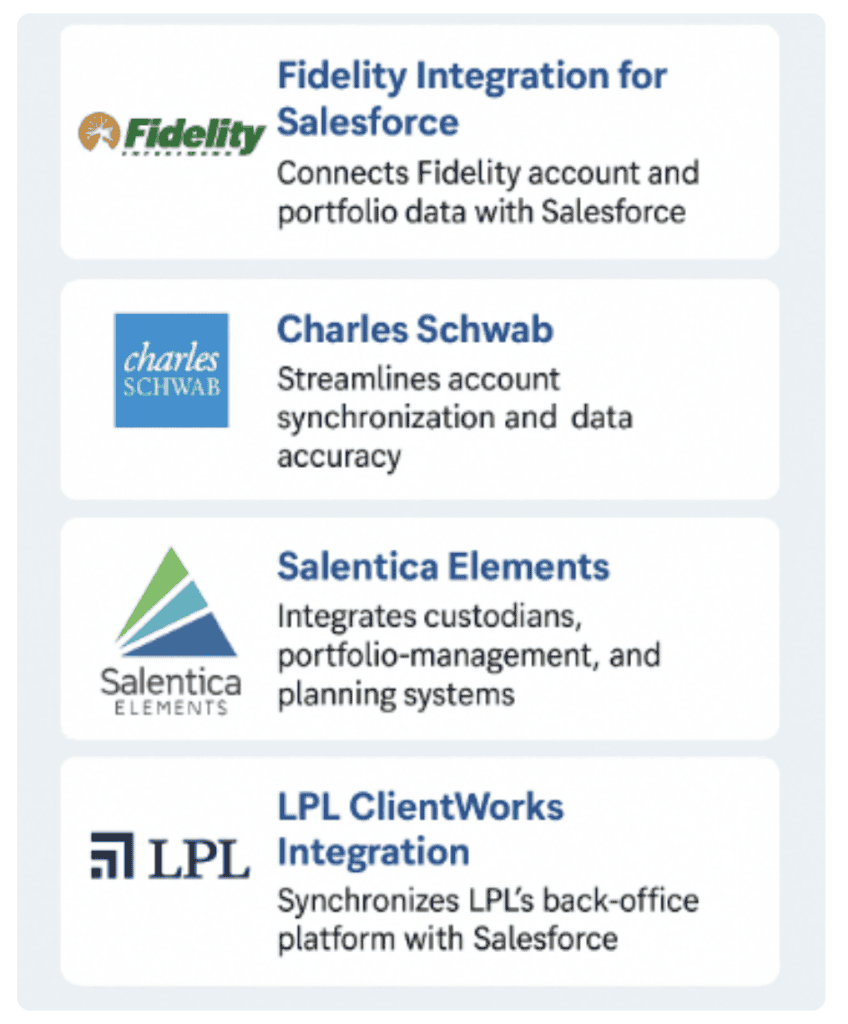
Key Institutional Integration Options for Salesforce FSC
The Salesforce ecosystem offers multiple approaches to connecting custodial, portfolio, and banking data. The best option depends on the firm’s technology stack, custodial relationships, data requirements, and operating model.
1. Fidelity Institutional Integration
Fidelity Institutional announced an integration built on Financial Services Cloud to help registered investment advisors (RIAs) and family offices create a more connected digital experience.
The integration illustrates how custodial information can be brought closer to the CRM environment, helping advisors work with client and account context in a more unified way.
Potential benefits include:
- Better visibility into relevant account and portfolio information.
- Less manual switching between CRM and custodial systems.
- More connected client relationship workflows.
- Improved access to financial context when preparing for client interactions.
Learn more about the Fidelity Institutional Salesforce integration.
Availability and functionality should be confirmed with Fidelity for the firm’s specific environment and requirements.
2. Charles Schwab Integrations
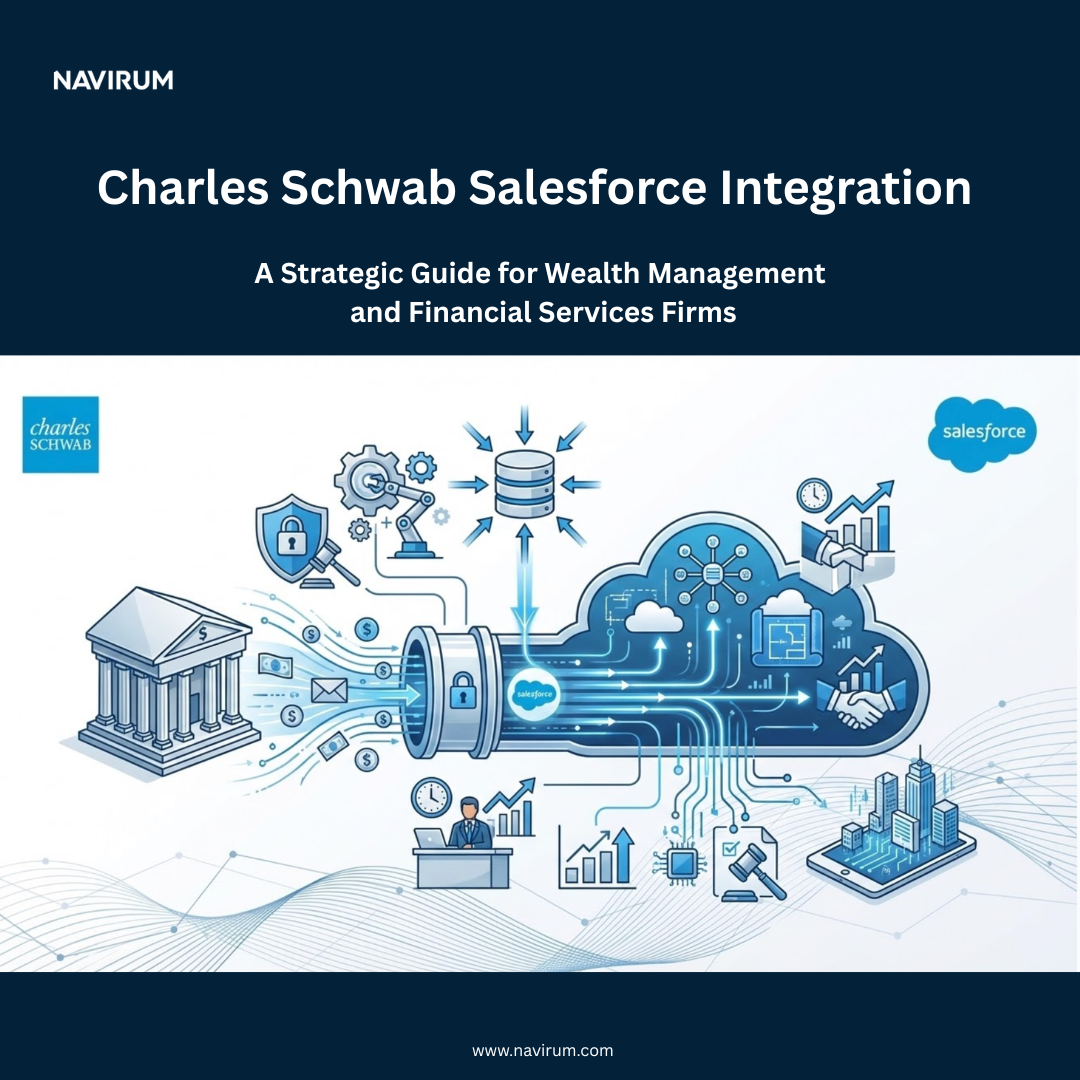
For wealth management firms using Schwab Advisor Services, connecting custodial data to Salesforce can help reduce fragmentation between relationship management and account operations.
Schwab’s technology ecosystem includes the Schwab OpenView Gateway, which supports integrations with third-party platforms. Solutions such as SS&C Salentica Data Broker can use custodial connectivity to bring relevant information into Salesforce-based environments.
Depending on the integration and configuration, firms may be able to improve access to account information, streamline workflows, and reduce the need to maintain the same information manually across multiple systems.
Explore Schwab-related Salesforce solutions on AppExchange.
The specific data available, synchronization frequency, and supported workflows depend on the selected solution and the firm’s access arrangements.
3. SS&C Salentica Elements and Data Broker
SS&C Salentica offers financial services CRM solutions and integration capabilities designed to connect Salesforce environments with custodians, portfolio management systems, and financial planning applications.
Its Data Broker integrations support systems including Fidelity, Schwab, Black Diamond, Addepar, Orion, SS&C Advent, and Envestnet Tamarac.
For firms working with several financial technology platforms, this type of integration layer can help coordinate data flows without requiring every connection to be developed independently.
Potential benefits include:
- Connecting custodial and portfolio data to client records.
- Reducing duplicate data entry across systems.
- Supporting a more consistent view of financial accounts.
- Simplifying integration management across a firm’s technology stack.
Learn more about Salentica Elements integration options.
The available connectors and capabilities depend on the selected product, licensing, and configuration.
4. LPL Financial ClientWorks Integration
For advisors operating within the LPL Financial ecosystem, connecting ClientWorks with Salesforce can help bridge relationship management and the operational systems advisors use to manage their practices.
A well-designed integration can reduce the need to move manually between platforms, improve the availability of client information, and support more connected workflows.
The implementation approach depends on the specific LPL environment, supported interfaces, and the firm’s requirements. Firms should confirm available connectivity and data permissions before selecting an integration design.
Read more about transforming the advisor experience with LPL ClientWorks and Salesforce.
Multi-Custodial Integrations: Connecting the Broader Financial Picture
Many wealth management firms work with more than one custodian or portfolio management platform. A single connector may address one important data source, but it may not provide the complete view advisors need.
Multi-custodial integration brings information from multiple sources into a coordinated environment. Depending on the architecture, this may involve prebuilt connectors, an integration platform, APIs, or a combination of approaches.
For example, an advisor’s client relationship may involve:
- Assets held across multiple custodians.
- Portfolio data managed through a portfolio management system.
- Financial plans maintained in a planning application.
- Client interactions and service activities recorded in Salesforce.
- Banking relationships and account information maintained in separate systems.
Connecting these sources can give advisors a more complete picture of the relationship while helping operations teams reduce manual reconciliation.
However, multi-custodial integration requires careful planning. Different providers may use different identifiers, data structures, update schedules, and definitions for accounts or holdings. Firms must establish how records are matched, which system is authoritative for each data element, how exceptions are handled, and how discrepancies are resolved.
The result can be a more consistent client experience and a stronger operational foundation—but only when the underlying data and integration processes are designed well.
Banking APIs and Institutional Connectivity
The same principles apply beyond wealth management. Banks and financial institutions increasingly use APIs to make selected services and data available to authorized applications and partners.
For example, Goldman Sachs provides developer resources for institutional services and custody-related capabilities, while Morgan Stanley offers an API developer portal for institutional clients and third-party partners. J.P. Morgan also provides secure account-data sharing capabilities for eligible use cases.
These examples demonstrate the broader potential of API-driven financial connectivity. They do not mean that every service is available to every organization or that a direct Salesforce connector exists for every API.
Depending on the institution, commercial arrangement, and permitted access, APIs may support use cases involving:
- Account and relationship information.
- Client onboarding and account maintenance.
- Banking and payment workflows.
- Investment and portfolio data.
- Financial analytics and reporting.
For Salesforce FSC, the key question is how to incorporate relevant data and services into business processes without compromising security, data governance, or operational reliability.
A direct integration may be appropriate in some cases. In others, an integration platform such as MuleSoft or a purpose-built connector may provide the necessary orchestration, transformation, and monitoring.
Learn more about Goldman Sachs developer resources, the Morgan Stanley API Developer Portalet J.P. Morgan’s secure account-data sharing approach.
Choosing the Right Integration Architecture
Not every institutional integration needs to be built from scratch. The right approach depends on the complexity of the environment, the data being exchanged, and the level of control the firm needs.
Prebuilt Connectors
Useful when a supported integration already exists for the required custodian or platform. They can reduce development effort, although configuration and ongoing administration may still be necessary.
Integration Platforms & Middleware
Tools such as MuleSoft can help coordinate data movement across multiple systems, transform data into consistent formats, and manage more complex integration patterns.
Direct APIs
Appropriate when an institution provides supported interfaces that meet business and technical requirements. Offers high flexibility but requires development, testing, monitoring, and maintenance.
Hybrid Architectures
Many firms combine prebuilt connectors with APIs and middleware to accommodate legacy platforms, specialist applications, and unique business processes.
Salesforce Financial Services Integration Capabilities
Salesforce provides financial services data capabilities and integration approaches for connecting core banking, custodial, financial planning, and portfolio management systems. The appropriate design depends on the required data flows and whether information needs to be synchronized, queried, or made available through a broader data platform.
Assess total cost of ownership (TCO), data freshness requirements, scalability, vendor dependencies, and support responsibilities.
Security, Data Governance, and Compliance Considerations
Financial data integration requires more than establishing a successful technical connection. Firms must also determine how information is authorized, accessed, transformed, stored, and monitored.
Parmi les éléments clés à prendre en compte, on peut citer :
- Data access and permissions: Ensure users and systems can access only the information they are authorized to see.
- Data ownership: Establish which platform is authoritative for each data element and how updates are managed.
- Data quality: Validate record matching, field mapping, completeness, and reconciliation processes.
- Security: Apply appropriate authentication, encryption, secrets management, and monitoring.
- Auditability: Maintain suitable records of data transfers, access, failures, and material changes.
- Resilience: Plan for API limits, service interruptions, failed synchronization, and recovery.
- Regulatory obligations: Assess applicable privacy, retention, recordkeeping, and third-party risk requirements.
These controls are particularly important when integrations support client onboarding, account servicing, financial reporting, or other regulated processes.
A successful integration should make information more useful without creating new blind spots in security or governance.
How Navirum Helps Financial Institutions Connect Salesforce
Connecting Salesforce Financial Services Cloud to custodians, portfolio management systems, and banking platforms requires a clear understanding of both the technology and the business processes it supports.

Navirum helps financial services organizations assess their Salesforce environments, plan integration architecture, connect systems, and improve workflows around client relationships.
Our approach begins with the business outcome. We work with organizations to identify where disconnected data creates friction, determine which integrations are appropriate, and develop an implementation plan that accounts for data quality, security, governance, and ongoing support.
Whether your organization is evaluating a single custodial connector, coordinating data from multiple platforms, or modernizing a broader Salesforce architecture, the goal is the same: make trusted information more accessible and useful across the client lifecycle.
Build a More Connected Salesforce Environment
Institutional integrations can help transform Salesforce FSC from a relationship management platform into a more connected operational environment—bringing client context, financial account information, and business workflows closer together.
The best results come from choosing integrations that fit the firm’s technology landscape, establishing clear data governance, and designing workflows around the needs of advisors, operations teams, and clients.
Looking to connect Salesforce Financial Services Cloud with your custodians, portfolio systems, or banking platforms?
Book time with Navirum to discuss your integration requirements and identify practical ways to get more value from your Salesforce investment.
Foire aux questions
Salesforce Financial Services Cloud integration connects Salesforce with external systems such as custodians, portfolio management platforms, financial planning applications, and banking systems. These connections help financial institutions access relevant client and account information, reduce manual data entry, and streamline advisor and operational workflows.
Integration options depend on the provider, the firm’s technology environment, and available connectors. Commonly supported ecosystems include Fidelity Institutional, Charles Schwab Advisor Services, and other custodial and portfolio platforms through solutions such as SS&C Salentica. Firms should confirm current product compatibility, licensing, and supported functionality before selecting an integration.
Yes. Salesforce can be connected to multiple custodians using compatible connectors, APIs, middleware, or a combination of integration approaches. Multi-custodial implementations require careful planning for data mapping, client and account matching, reconciliation, security, and system ownership.
Integrations can use prebuilt connectors, APIs, or integration platforms such as MuleSoft to exchange data between Salesforce and external systems. The appropriate approach depends on the institution’s available interfaces, data access permissions, security requirements, and desired workflows. Not every banking or portfolio platform offers a ready-made Salesforce connector.
Financial institutions should evaluate authentication, encryption, access controls, data ownership, audit trails, data quality, and failure monitoring. Integration designs should also account for applicable privacy, recordkeeping, regulatory, and third-party risk requirements. Controls should reflect the sensitivity of the information and the workflows being supported.
Navirum helps financial services organizations assess integration requirements, plan Salesforce architecture, connect external systems, and optimize workflows. We help firms evaluate their existing technology landscape and identify practical approaches to improving data accessibility, operational efficiency, and the overall client experience.
Connaissances et perspectives
Explore expert guides and strategic architectures for custodian integrations with Salesforce Financial Services Cloud.