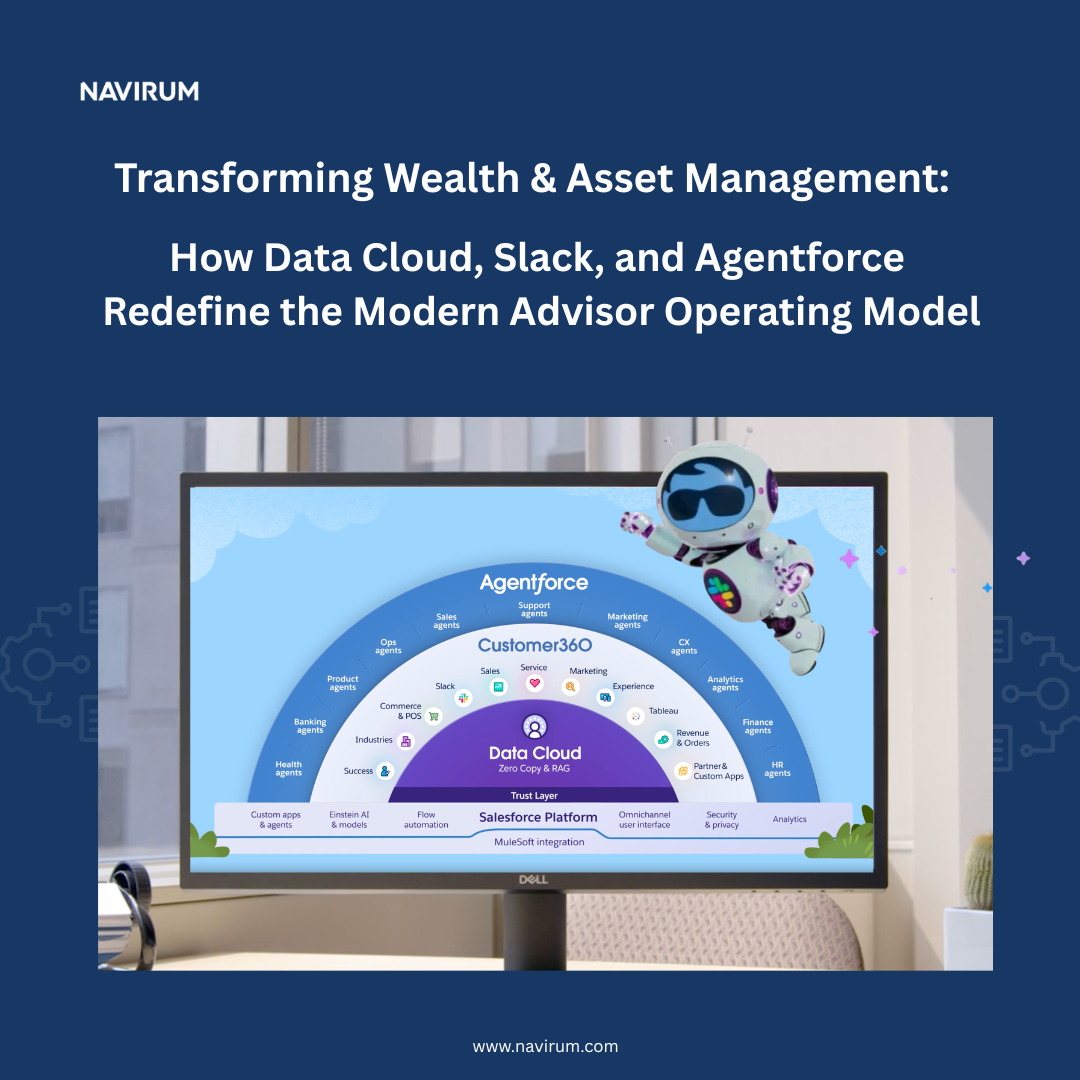

This article explains how wealth and asset management firms are evolving into agentic enterprises using Salesforce Data 360 (formerly Data Cloud) , Slacket Agentforce. Data Cloud unifies fragmented custodial, CRM, and portfolio data into a real-time client and household view. Slack enables real-time collaboration across advisors, operations, and compliance through event-driven workflows. Agentforce automates key advisor tasks such as meeting preparation, onboarding, and client summaries using unified data. Together, the stack creates a connected operating model that improves advisor productivity, accelerates onboarding, and strengthens compliance. The article emphasizes that success depends less on tools and more on data readiness, workflow design, and governance.
How Data Cloud, Slack, and Agentforce Redefine the Modern Advisor Operating Model
Wealth and asset management firms are entering a structural shift that goes far beyond digital transformation. The industry is moving toward an agentic operating model, where data, intelligence, and execution are continuously connected across the enterprise.
In this new model, competitive advantage no longer comes from having more tools. It comes from how effectively a firm can unify its data, coordinate teams in real time, and embed AI directly into advisor workflows.
Most firms today still operate with fragmented systems: CRM platforms, custodial feeds, portfolio accounting tools, document repositories, and communication channels that were never designed to work together. This fragmentation creates delays, inefficiencies, and inconsistent client experiences.
The solution is not another application layer. It is a connected enterprise architecture built on three foundational technologies: Salesforce Data Cloud, Slack, and Agentforce. Together, they form a modern wealth management operating system that transforms how advisors work, how decisions are made, and how client value is delivered.
1. The Core Problem: Wealth Management Is Still Fragmented and Manual
Despite years of investment in CRM systems and digital platforms, most wealth and asset management firms continue to struggle with operational fragmentation. Client data is spread across multiple systems, and no single source of truth exists that reflects the full financial picture in real time.
This leads to a persistent operational burden where advisors must manually reconstruct client context before every interaction. Instead of focusing on advice and relationship building, they spend significant time gathering data, validating information, and switching between systems.
The downstream impact is material. Firms experience slower onboarding cycles, inconsistent servicing standards, and higher operational costs per client. Even more critically, the advisor experience suffers, leading to reduced capacity for proactive engagement and growth-oriented conversations.
While AI is often positioned as the solution, most AI initiatives fail at this stage because they lack clean, unified, and real-time data foundations. Without solving the data fragmentation problem first, AI simply amplifies inefficiency rather than eliminating it.
This is why Data Cloud becomes the essential starting point for any modern wealth transformation strategy.
2. Data Cloud: Building the Unified Intelligence Layer for Wealth Management
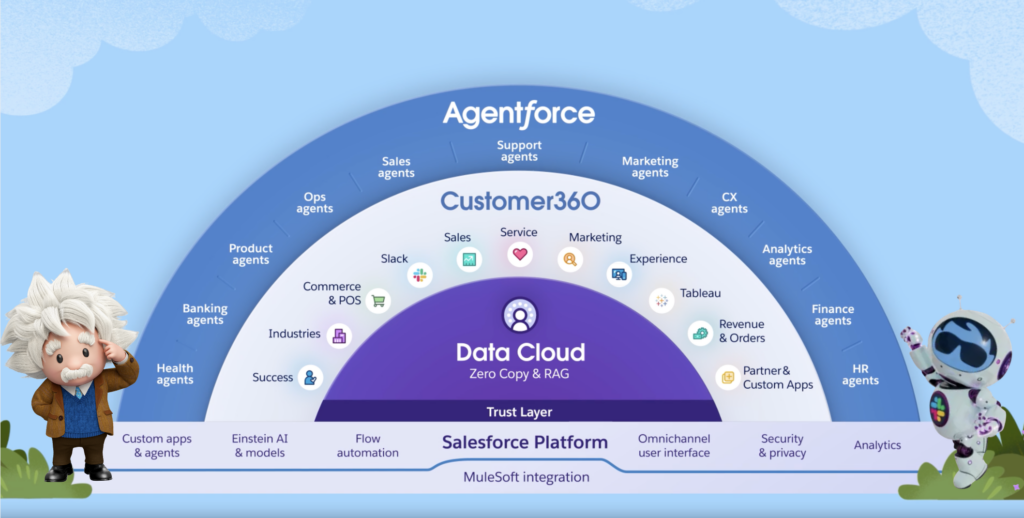
Salesforce Data Cloud serves as the foundational intelligence layer that unifies fragmented financial data into a real-time, governed client profile. In wealth and asset management, this is not just a technical upgrade—it fundamentally changes how firms understand their clients.
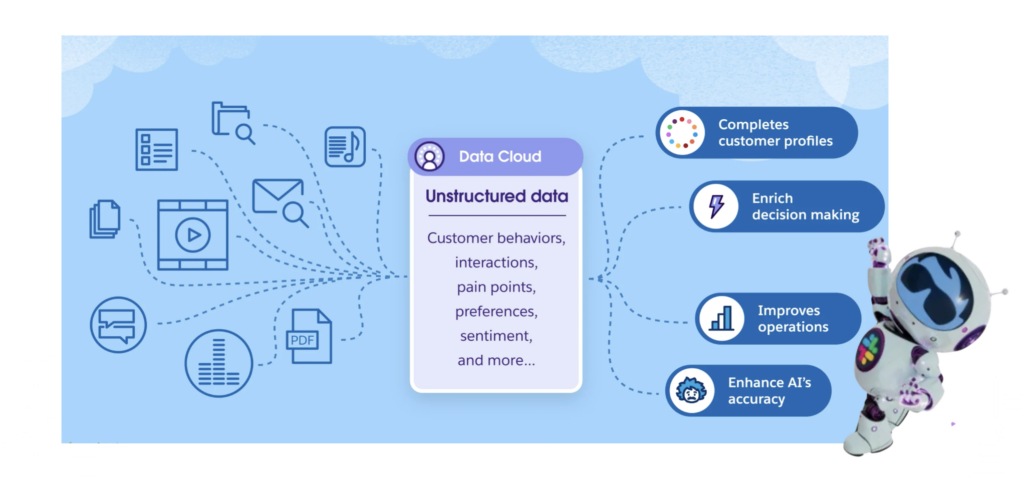
Data Cloud integrates and harmonizes data from custodians, portfolio systems, CRM records, and digital engagement channels into a single, continuously updated data model. This enables firms to move from static client snapshots to a dynamic, living representation of financial reality.
One of the most important outcomes is the creation of a true household-centric view of wealth. Instead of treating accounts in isolation, advisors gain visibility into entire financial ecosystems, including family relationships, trusts, and external advisors. This enables far more accurate planning and opportunity identification.
This unified data foundation eliminates one of the most time-consuming aspects of advisory work: assembling the client story before each meeting. With Data Cloud, that story is always current, always contextual, and always accessible across every touchpoint.
More importantly, Data Cloud becomes the trusted input layer for downstream systems. It ensures that both Slack workflows and Agentforce AI agents operate on consistent, validated, and governed data—reducing risk while increasing automation accuracy.
3. Slack: The Real-Time Execution and Collaboration Layer for Advisory Teams
In a modern wealth management operating model, Slack evolves far beyond communication. It becomes the real-time execution layer where teams coordinate work, resolve issues, and respond to client needs as they happen.
This is what a real Salesforce Slack integration looks like in practice: when integrated with Data Cloud and Salesforce Financial Services Cloud, Slack transforms into a structured operational environment rather than a messaging tool. Each client, onboarding process, or service request can be represented as a dedicated workspace where all relevant stakeholders collaborate in context.
This shift replaces fragmented email chains and manual status updates with event-driven collaboration. Instead of searching for information, teams receive real-time alerts triggered by client or operational events.
For example, when Data Cloud detects a material portfolio change or missing documentation, Slack automatically surfaces the issue to the right team. Compliance, operations, and advisors can immediately coordinate resolution without waiting for scheduled meetings or manual escalation.
This creates what can be described as an incident-to-insight-to-action loop, where operational issues are identified, discussed, and resolved in a single continuous workflow.
The impact is significant. Firms experience faster service resolution times, reduced operational bottlenecks, and improved advisor productivity. Most importantly, Slack aligns the entire organization around live client activity rather than static reporting cycles.
4. Agentforce: Embedding Intelligence and Automation into Wealth Workflows
Agentforce represents the intelligence and automation layer of the modern wealth management stack. It brings AI directly into advisor workflows, not as an external tool, but as an embedded operational capability.
Rather than simply assisting with isolated tasks, Agentforce agents are designed to execute multi-step workflows across onboarding, servicing, preparation, and client engagement. These agents operate continuously, using Data Cloud as their source of truth and Slack as their coordination channel.
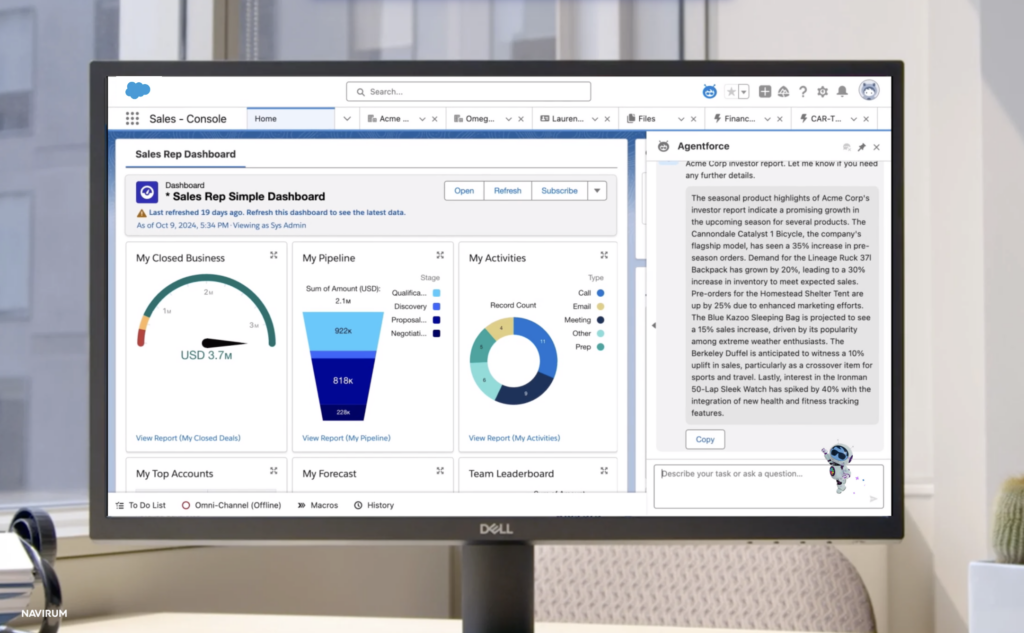
Advisor preparation is one of the most immediate and high-impact use cases. Agentforce can automatically generate comprehensive pre-meeting briefs that include portfolio performance, household summaries, recent interactions, and open service items. This ensures advisors enter every client interaction fully prepared without manual effort.
In onboarding workflows, Agentforce orchestrates document collection, KYC validation, task routing, and status tracking across teams. This reduces onboarding friction and significantly accelerates time-to-value for new clients.
Service automation is another critical area. Agentforce continuously monitors data signals from Data Cloud to detect inconsistencies, missing information, or operational risks. It then triggers corrective workflows automatically and ensures issues are routed through Slack for resolution.
Perhaps most importantly, Agentforce introduces next-best-action intelligence, surfacing personalized recommendations such as rebalancing opportunities, cross-sell potential, or retention risks. This shifts advisors from reactive service delivery to proactive wealth management.
The result is not replacement of advisors, but a dramatic increase in their capacity, consistency, and impact.
5. The Unified Workflow: How Data Cloud, Slack, and Agentforce Operate Together
The true transformation occurs when all three systems operate as a single, interconnected workflow rather than standalone tools. This creates a continuous loop between data, intelligence, and execution.
Consider a typical client meeting scenario. Data Cloud continuously updates the client profile with new portfolio data, interaction history, and external financial signals. This ensures that the system always reflects the most current client state.
Agentforce then builds on this foundation by generating a detailed, structured meeting brief. This includes risks, opportunities, and contextual insights that would normally require hours of manual preparation by the advisor.
Slack then distributes this intelligence to the relevant team members, enabling pre-meeting collaboration across compliance, investment, and service teams. Each stakeholder contributes asynchronously, ensuring that the advisor enters the meeting fully supported.
After the meeting, Agentforce automatically summarizes key outcomes, generates follow-up tasks, and updates the client record in Salesforce. Slack continues to coordinate execution until all actions are completed.
This integrated workflow can meaningfully cut manual meeting preparation time, improve execution speed, and support a more consistent client experience across the organization. In Navirum implementations, the biggest single time cost in meeting prep usually is not gathering the data, it is reconciling conflicting versions of it across custodial feeds and CRM records.
6. Strategic Impact for Wealth and Asset Management Firms
When properly implemented, this architecture delivers measurable transformation across the core dimensions of wealth management operations.
Advisor productivity increases significantly because time spent on manual data gathering is replaced with automated intelligence and pre-built workflows. Advisors can focus more on relationship management and strategic advisory work.
Operational efficiency improves as firms reduce reliance on manual reconciliation, email-driven coordination, and disconnected systems. Processes such as onboarding and servicing become faster, more consistent, and easier to scale.
Data governance and compliance are strengthened through Data Cloud’s unified data model and Agentforce’s embedded audit trails. This ensures regulatory alignment while reducing operational risk.
Client experience also improves materially. Advisors are able to deliver faster responses, more personalized engagement, and more proactive advice based on real-time insights.
Together, these outcomes create a scalable model for growth without proportional increases in headcount or operational complexity.
7. From Tools to Operating System: The Future of Wealth Management Technology
The most important shift in this transformation is conceptual rather than technical. Wealth firms must move away from thinking in terms of individual tools and instead adopt an operating system mindset.
In this model, Data Cloud becomes the trusted data foundation, Slack becomes the coordination and execution layer, and Agentforce becomes the intelligence and automation engine. Each layer reinforces the others, creating a continuous flow from data to decision to action.
This eliminates the traditional gap between insight and execution that has historically slowed down financial institutions. Instead of static systems that require manual intervention, firms operate with a dynamic, self-coordinating infrastructure.
The result is a fundamentally different way of working. Advisors are no longer burdened by fragmented systems or manual workflows. Instead, they operate within a unified environment where intelligence is always available, collaboration is always active, and execution is increasingly automated.
Final Takeaway
Wealth and asset management firms are no longer competing on product access or distribution reach alone. They are competing on operational intelligence and execution speed.
The combination of Salesforce Data Cloud, Slack, and Agentforce enables firms to build a truly modern advisory operating model—one that is data-driven, AI-enabled, and collaboration-first.
This is not incremental improvement. It is a structural shift in how wealth management operates.
Firms that embrace this model early will unlock higher advisor productivity, stronger compliance, and significantly improved client experiences. More importantly, they will define the next standard for what modern wealth and asset management looks like.
Navirum Recommendation: Execution Blueprint for a Connected Wealth Operating Model

Transforming wealth and asset management with Data Cloud, Slack, and Agentforce is not a technology selection exercise—it is an execution discipline challenge. The primary reason most transformations stall is not platform capability, but the inability to translate architecture into consistent advisor workflows at scale.
Navirum’s approach focuses on closing this execution gap by ensuring that data readiness, workflow design, and AI deployment are implemented as a single, sequenced operating model transformation, rather than isolated workstreams.
A typical engagement begins with Data Cloud readiness validation inside Financial Services Cloud, focusing on household structure integrity, custodial alignment, and resolution of fragmented or inconsistent client records. This step is treated as a prerequisite to any automation or AI activation, ensuring downstream reliability of all intelligence and workflow orchestration.
Once the data foundation is stabilized, the focus shifts to workflow decomposition across the advisor lifecycle. This includes mapping how meeting preparation, onboarding, servicing, and investment collaboration actually occur within the firm today, and redesigning these processes before introducing automation. This ensures that technology amplifies well-designed processes rather than scaling existing inefficiencies.
With workflows defined, Slack is implemented as the execution coordination layer for structured advisory operations, not informal communication. The design principle is simple: every Slack workflow is anchored to a real operational event originating in Salesforce and Data Cloud, ensuring that collaboration is directly tied to client activity, not ad hoc discussion.
On the AI side, Agentforce is deployed through a use-case sequencing model focused on immediate advisor productivity gains. Early deployments typically target meeting preparation, client summarization, onboarding orchestration, and next-best-action surfacing. These are intentionally prioritized because they create visible time savings, which drives adoption in regulated advisory environments.
A critical component across all implementations is embedded governance-by-design. This includes auditability, permissioning structures, approval workflows, and full data lineage tracking across AI-generated outputs and automated actions. In wealth and asset management, this governance layer is not optional. It is what enables scale without introducing regulatory risk.
The delivery model is intentionally incremental. Rather than large-scale transformation programs, Navirum applies a phased deployment approach that sequences data foundation, workflow redesign, collaboration layer activation, and AI enablement in controlled iterations. This reduces change fatigue while ensuring measurable value is delivered at each stage.
The outcome is a shift from fragmented CRM usage and manual coordination to a fully connected advisory operating model where Data Cloud provides trusted intelligence, Slack orchestrates execution, and Agentforce drives automation of high-value advisory work.
Ultimately, Navirum’s role is to ensure that firms do not simply adopt Salesforce technologies, but successfully operationalize them into a sustainable wealth management operating model—one that improves advisor productivity, strengthens compliance posture, and enables scalable, personalized client engagement.
Frequently Asked Questions
1. How does an agentic operating model differ from traditional CRM-led wealth management?
An agentic operating model goes beyond CRM as a system of record and introduces autonomous execution into advisor workflows. Instead of systems storing and displaying client data, AI agents actively trigger actions, coordinate tasks, and surface insights in real time. This shifts CRM from a passive repository into an active operational layer that supports decision-making and execution.
2. What is the biggest risk when implementing AI in wealth management firms?
The biggest risk is deploying AI on top of inconsistent or ungoverned data. Without standardized household structures, validated custodial inputs, and clear data lineage, AI outputs can become unreliable. This leads to advisor distrust, compliance exposure, and low adoption, even if the underlying AI model is technically advanced.
3. Why do most wealth management AI initiatives fail to scale beyond pilot phases?
Most initiatives fail because they focus on isolated use cases instead of end-to-end workflows. Pilots often demonstrate productivity gains in controlled environments, but they do not address cross-team dependencies, compliance constraints, or system integration complexity required for enterprise-scale adoption.
4. How does workflow design impact advisor adoption of AI tools?
Advisor adoption is directly tied to how naturally AI integrates into daily routines. If AI requires advisors to change behavior or switch systems, adoption slows significantly. When AI is embedded into existing workflows—such as meeting prep, onboarding, or service resolution—it becomes part of the operating rhythm rather than an additional tool.
5. What role does data governance play in scaling AI across a wealth firm?
Data governance ensures that AI operates within defined compliance, security, and operational boundaries. It establishes rules for data access, usage, and auditability, which is essential in regulated environments. Without governance, firms face regulatory risk and inconsistent decision-making across advisor teams.
6. How should firms prioritize AI use cases in wealth management transformation?
Firms should prioritize use cases based on frequency, time savings, and advisor visibility. High-frequency tasks such as meeting preparation, client updates, and onboarding typically deliver the fastest ROI. These use cases also help build organizational confidence in AI before expanding into more complex automation scenarios.
7. What is the role of custodial integrations in a modern wealth technology stack?
Custodial integrations ensure that portfolio and account-level data remains accurate and up to date across systems. They are critical for maintaining a real-time view of AUM and client holdings. Without these integrations, advisors are forced to rely on delayed or manually reconciled data, which limits both AI accuracy and operational efficiency.
8. How does an event-driven architecture improve wealth management operations?
An event-driven architecture enables systems to react in real time to changes such as portfolio updates, client requests, or compliance triggers. Instead of relying on scheduled reports or manual updates, firms can automate responses and notifications as events occur. This significantly improves responsiveness and reduces operational lag.
9. What organizational changes are required to support an agentic wealth management model?
Firms must shift from functionally siloed teams (operations, compliance, advisors, IT) to cross-functional workflow ownership. This includes redefining responsibilities around client journeys rather than systems, and aligning teams to end-to-end processes such as onboarding or servicing instead of individual departmental tasks.
10. How can firms measure ROI from Data Cloud, Slack, and Agentforce implementations?
ROI should be measured across three dimensions: advisor productivity (time saved per client interaction), operational efficiency (reduction in manual tasks and handoffs), and client experience (speed and consistency of service delivery). The most meaningful metric is not tool usage, but reduction in time-to-action across key advisor workflows.
Explore the future of wealth management technology
Schedule a session with our experts to learn how leading firms are using Agentforce, Financial Services Cloud, and Slack to build a more connected, intelligent, and scalable wealth management ecosystem.

Related Readings
Transforming Financial Services with Slackbot: The Unified Salesforce-Slack Ecosystem
Unlock the Agentic Enterprise: Transform Your Financial Firm with Navirum and Salesforce FSC
Transforming Wealth Management: The Power of Agentforce, FSC, and Slack
Salesforce Slack Integration? 6 Powerful Reasons To Connect
The Trusted Data Advantage: Turning AI Into Business Value in Financial Services
What Are Most Used Agentforce And AI Solutions in Financial Services in 2026?