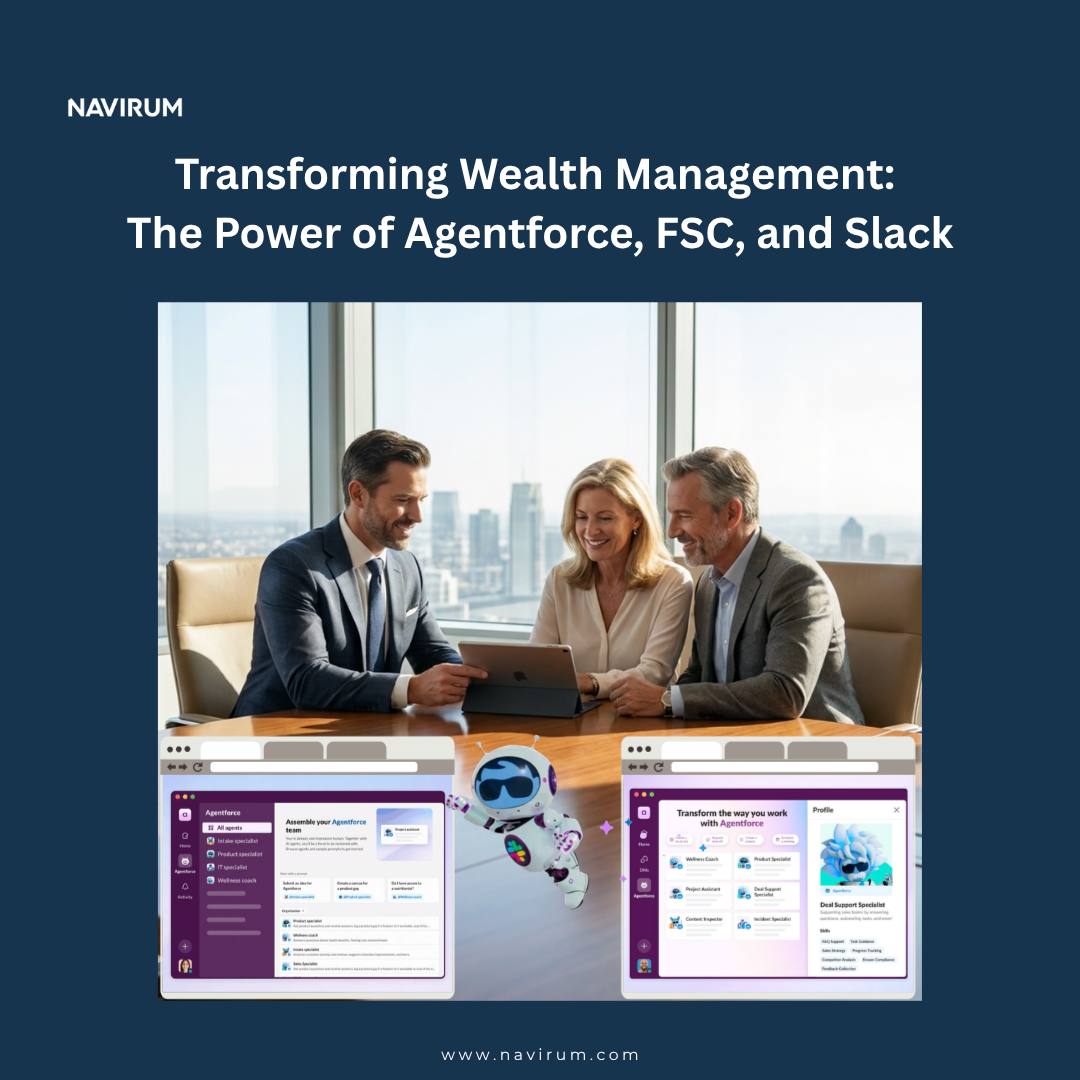
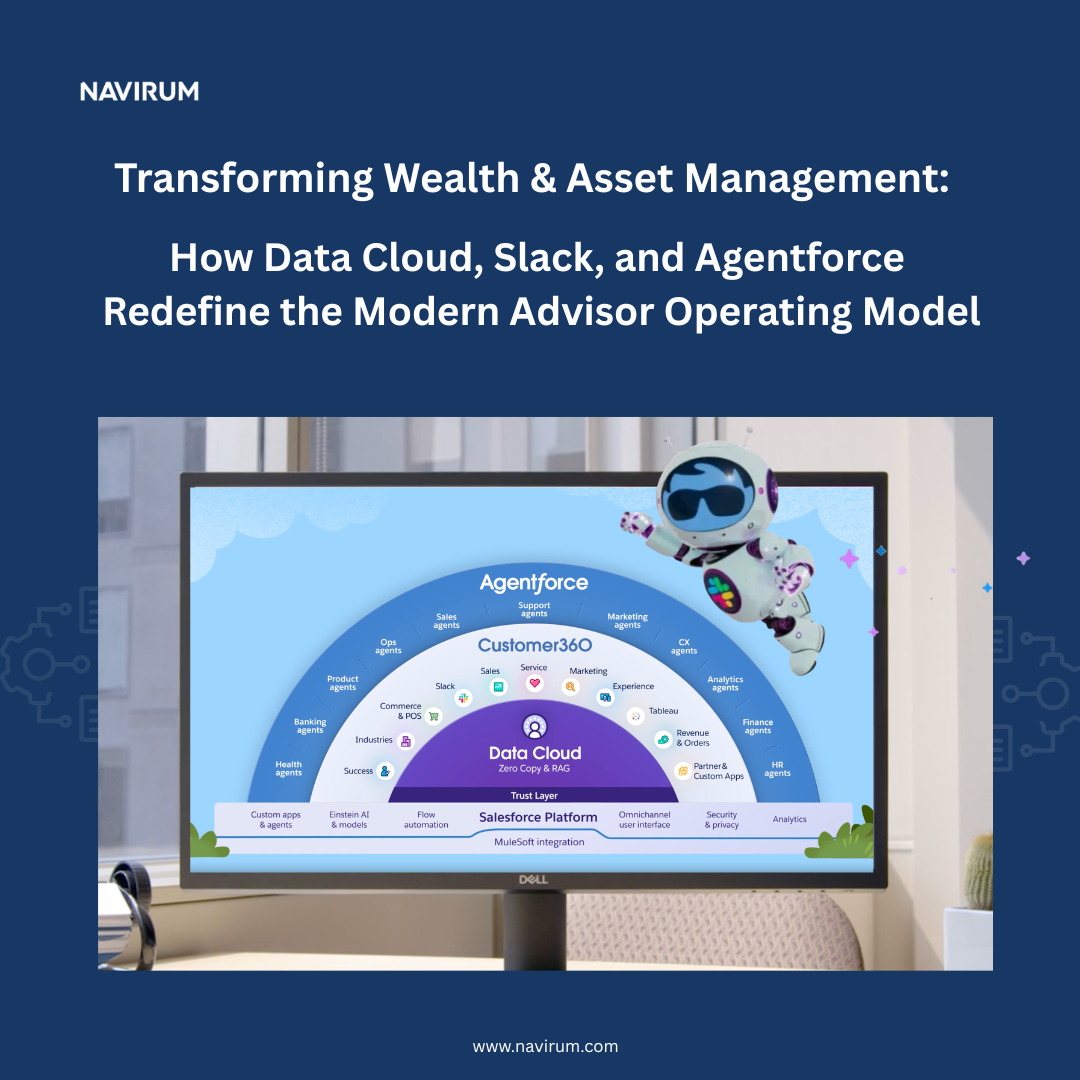
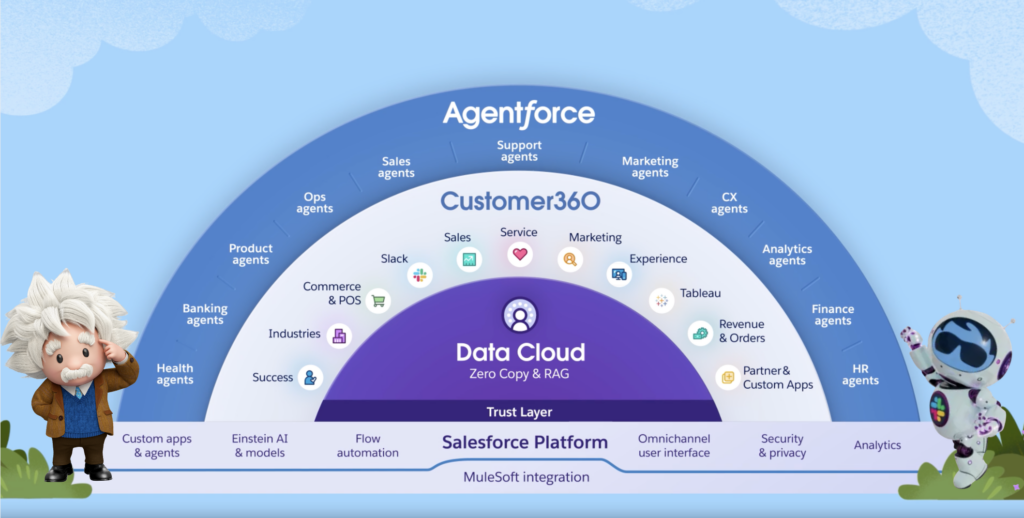
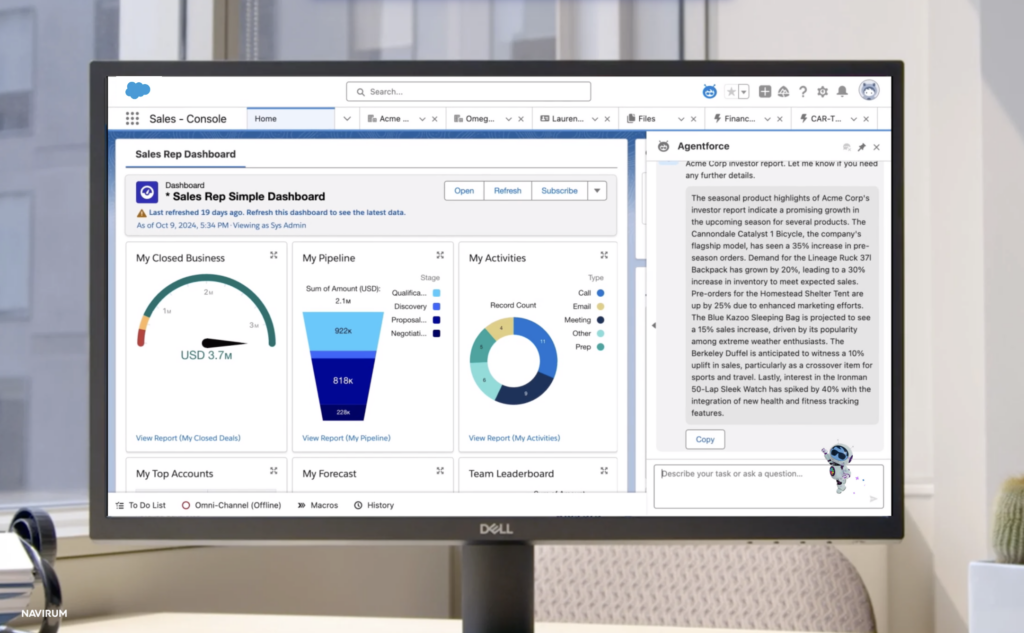
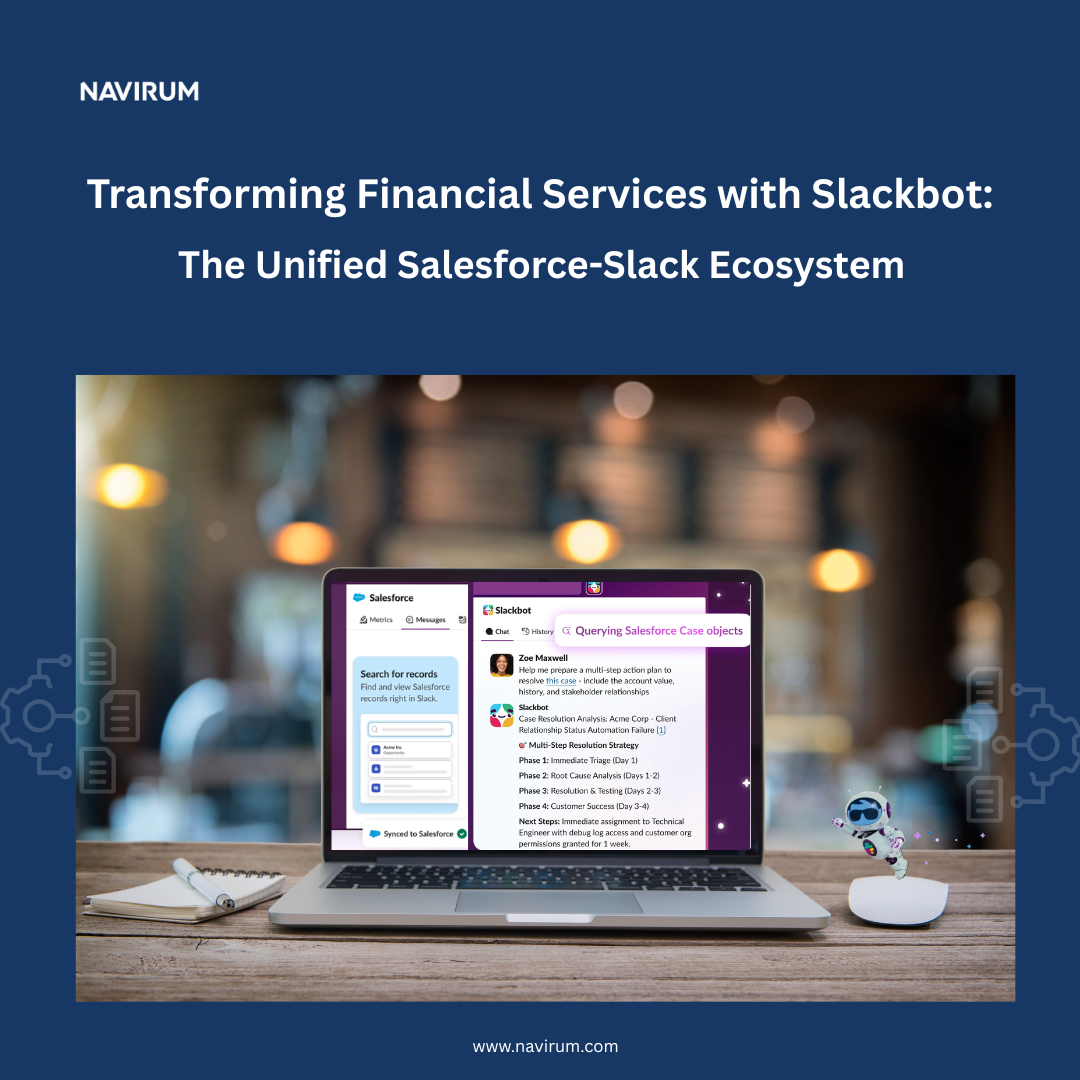
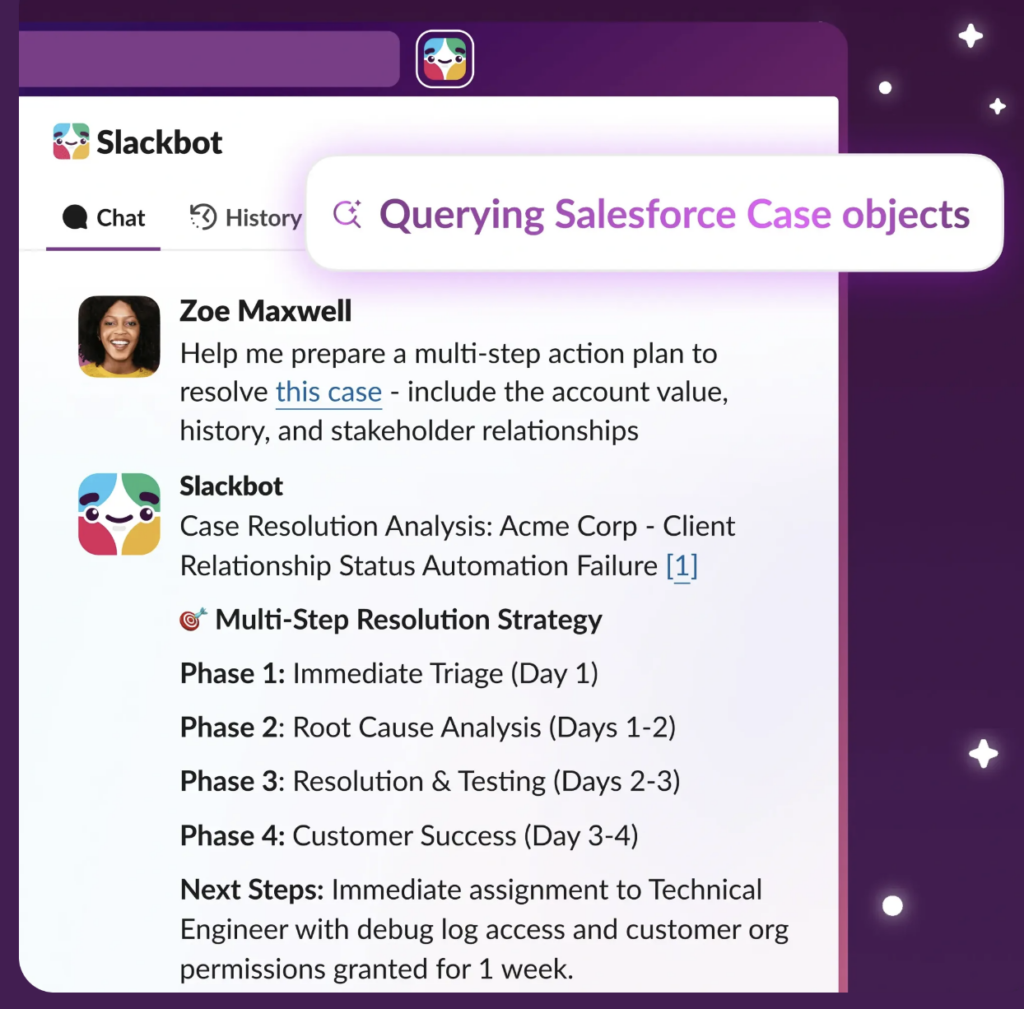
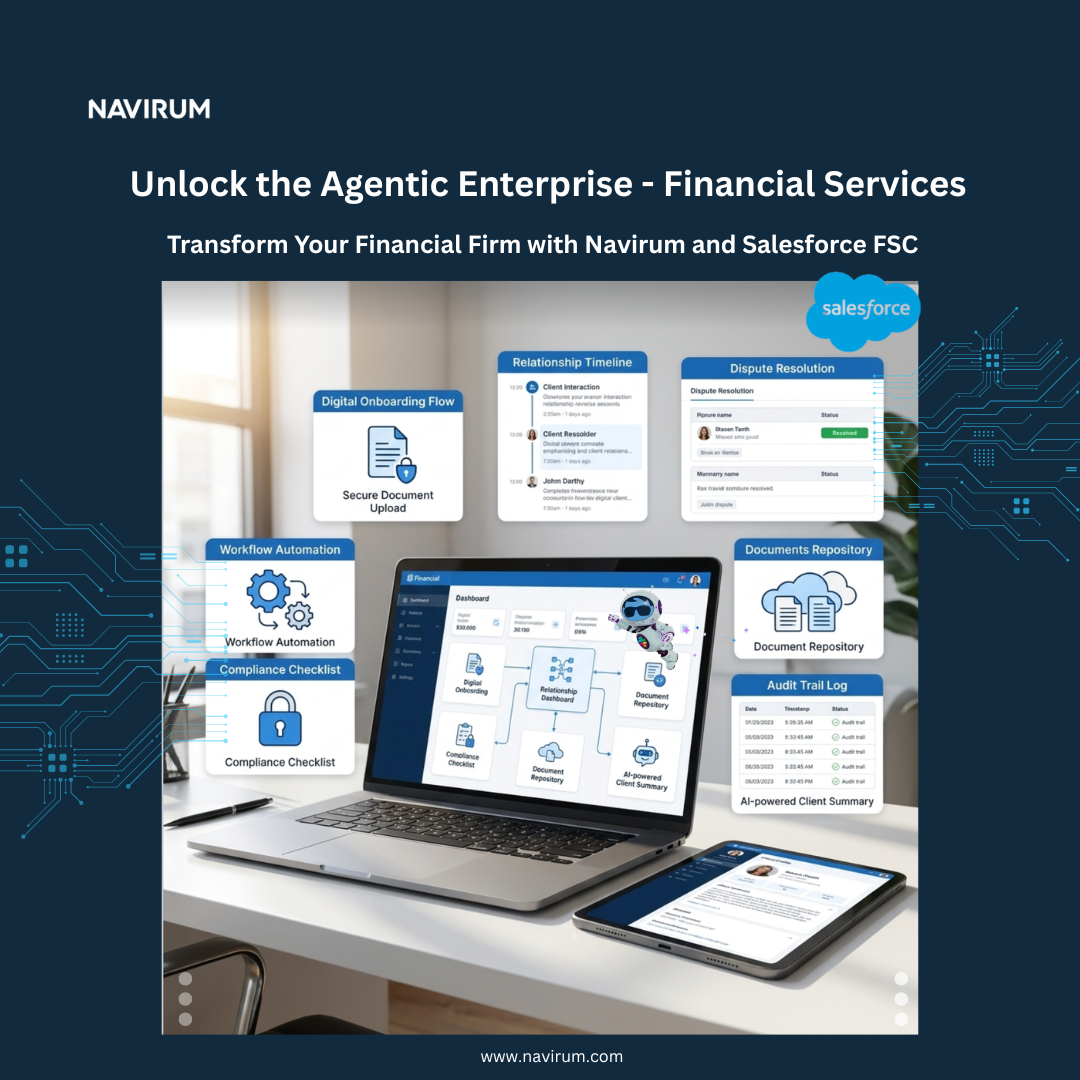
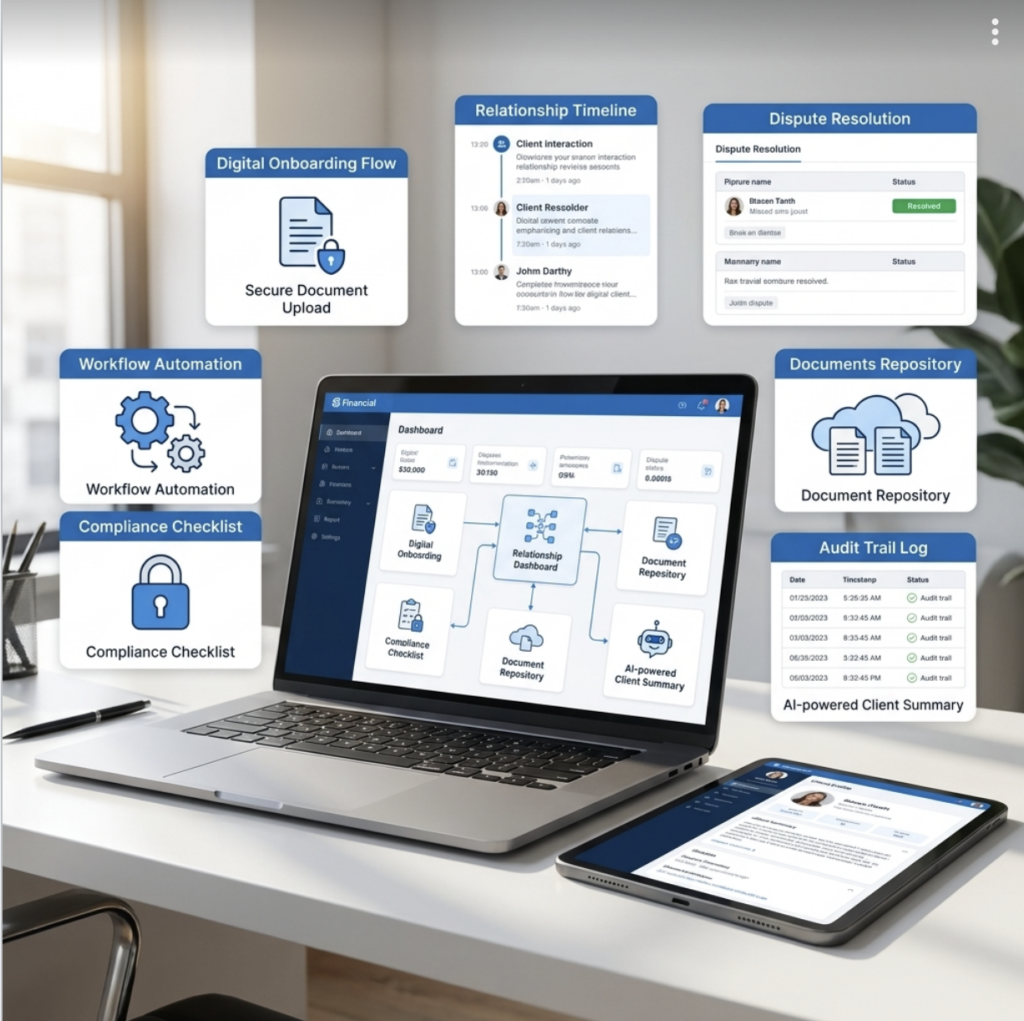
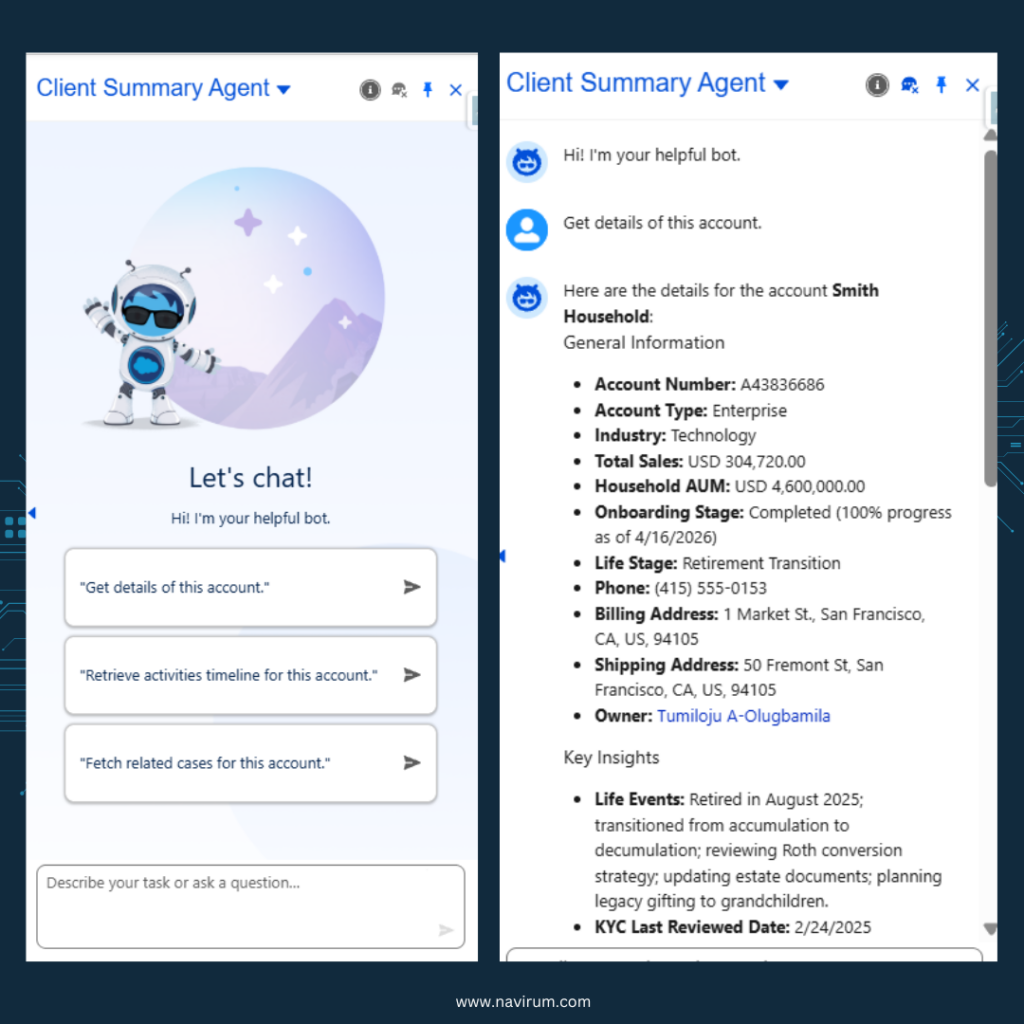
Registered Investment Advisors (RIAs) face rising client expectations, operational complexity, and strict compliance requirements. Traditional CRMs often fall short in scaling advisory operations and delivering personalized client experiences. Agentforce, integrated with Salesforce Financial Services Cloud (FSC), offers RIAs a solution to automate workflows, enhance compliance, and empower advisors to focus on high-value client engagement.
Automates repetitive advisor tasks
Provides AI-driven insights for proactive client engagement
Advisors spend significant time on administrative tasks such as preparing reports, updating client records, and scheduling meetings. This reduces time spent on revenue-generating activities and strategic client engagement. Without intelligent automation, RIAs struggle to scale efficiently.
Advisors spend 30–40% of time on non-revenue tasks
Manual workflows create bottlenecks in client service
Compliance documentation can be time-consuming and error-prone
What is Agentforce?
Agentforce is an AI and automation layer that works on top of Salesforce FSC. It transforms data into actionable insights, orchestrates multi-step workflows, and enables predictive client engagement. For RIAs, it turns a CRM into a dynamic operational platform. Navirum’s Agentforce Consulting team helps RIAs plan, build, and manage this layer end to end.
Automates repetitive tasks and workflows
Provides AI-driven recommendations for advisors
Enhances compliance and risk management
Delivers hyper-personalized client experiences
Key Benefits of Agentforce for RIAs
1. Streamlined Advisor Workflows
Agentforce automates essential workflows, reducing manual effort and improving efficiency. Advisors can spend more time on strategic client interactions instead of administrative tasks.
Prepares quarterly review materials automatically
Schedules follow-ups and client reminders
Triggers compliance approvals without manual intervention
2. Enhanced Client Experience
Clients expect personalized, timely, and proactive communication. Agentforce enables RIAs to deliver consistent experiences across all channels while maintaining a high-touch relationship. This is the focus of Navirum’s Agentforce for Wealth Management practice.
Sends proactive alerts on portfolio changes or milestones
Automates reporting and personalized communications
Ensures consistent messaging across email, portal, and mobile
Agentforce helps advisors focus on high-value opportunities by prioritizing tasks based on predictive insights. AI identifies clients who need attention and recommends next steps.
Flags clients with unusual activity or high churn risk
Suggests next-best actions based on client behavior
Improves efficiency and strategic decision-making
4. Compliance and Risk Management
Compliance is embedded into every workflow. Agentforce ensures all interactions meet regulatory standards while maintaining audit trails.
Enforces approvals for communications and trades
Logs every interaction for audit readiness
Reduces operational risk and human error
5. Multi-System Integration
RIAs use multiple platforms, including portfolio management, planning, and document storage. Agentforce connects these systems, providing a unified workflow and a complete view of clients. Navirum’s network of Salesforce and fintech partners supports these integrations across the RIA tech stack.
Updates client records across all systems automatically
Preparing for quarterly reviews can be labor-intensive. Agentforce streamlines the process, allowing advisors to focus on strategy rather than data compilation.
Consolidates account balances, transactions, and notes
Generates automated review decks
Schedules meetings and sends reminders
Use Case 2: Lead Nurturing and Client Expansion
Agentforce helps identify cross-sell and upsell opportunities by monitoring client needs and life events. This enables targeted, personalized outreach.
Detects clients with additional investment needs
Triggers personalized messages based on client behavior
Prepares advisor briefs for high-value interactions
Use Case 3: Compliance Automation
Agentforce ensures all client communications and documentation are compliant and auditable, reducing regulatory risk.
Map out existing workflows to identify areas for automation. This ensures that Agentforce is deployed strategically. Firms that want to move quickly can start with Navirum’s Agentforce Quickstart program instead of a ground-up rollout.
Identify repetitive manual tasks
Highlight advisor and operations handoffs
Define compliance checkpoints
2. Clean and Centralize Data
Data integrity is critical. Clean, normalized, and centralized data ensures that AI-driven recommendations are accurate.
Remove duplicates and normalize records
Consolidate data from multiple systems
Implement ongoing data quality monitoring
3. Segment Advisors by Operating Model
Not all advisors operate the same way. Tailoring workflows for high-touch vs. scaled advisory models ensures adoption and efficiency.
4. Establish Governance and Continuous Improvement
A governance framework ensures workflows evolve with business needs and remain compliant.
Implement a CRM governance board
Monitor adoption and workflow performance
Adjust AI recommendations based on outcomes
5. Measure Performance and ROI
Track key metrics to demonstrate value and optimize workflows continuously.
Advisor time saved from administrative tasks
Client engagement and satisfaction
Workflow completion rates and compliance adherence
Revenue impact from proactive engagement
The Future of RIAs with Agentforce
Agentforce positions RIAs for the future of wealth management. With AI-driven advisory, hyper-personalized client engagement, and operational resilience, RIAs can scale without compromising service quality.
Predictive insights for proactive client engagement
Automated workflows for operational efficiency
Scalable and compliant processes supporting growth
Takeaway
Agentforce is a game-changer for RIAs, enabling advisors to focus on high-value client relationships while automating repetitive tasks. Integrated with Salesforce FSC, it delivers operational efficiency, regulatory compliance, and hyper-personalized client engagement. RIAs adopting Agentforce today are positioning their firms for scalable growth, competitive differentiation, and long-term success.
Navirum Recommendations: Maximizing Agentforce for RIAs
At Navirum, we view Agentforce adoption as more than a technology upgrade. It’s a strategic opportunity to modernize advisory operations and elevate client engagement. RIAs that approach implementation thoughtfully can unlock efficiency, compliance, and growth simultaneously.
Redesign Workflows Before Automating
Focus on Predictive Insights, Not Just Task Automation
Tailor Adoption to Advisor Operating Models
Establish a CRM Governance Framework
Measure Strategic Value, Not Just Time Savings
1. Redesign Workflows Before Automating
Before deploying Agentforce, review all key processes from client onboarding to portfolio review. Identify repetitive tasks, decision points, and compliance touchpoints to ensure automation supports the business rather than replicating inefficiencies.
Eliminate redundant approval steps
Standardize client lifecycle stages
Embed compliance and quality checks directly into workflows
2. Focus on Predictive Insights, Not Just Task Automation
Agentforce’s AI capabilities are most powerful when data is used to anticipate client needs. Use predictive analytics to guide outreach, prioritize client interactions, and surface opportunities for upsell or risk mitigation.
Set up alerts for milestone achievements, portfolio changes, and client behavior patterns
Align AI recommendations with advisor objectives and client goals
Integrate predictive insights with client engagement planning
3. Tailor Adoption to Advisor Operating Models
RIAs have diverse advisory models. Customize dashboards, alerts, and workflows based on advisor style, whether high-touch or scaled advisory teams, to maximize adoption and efficiency.
Create role-based dashboards and task prioritization
Align automation intensity with advisor capacity and client portfolio complexity
Monitor adoption metrics and provide ongoing support
4. Establish a CRM Governance Framework
Long-term success requires governance. Assign responsibility for workflow updates, compliance monitoring, and AI tuning to ensure the system evolves with business needs.
Implement a CRM board or center of excellence
Schedule quarterly reviews for workflow and AI performance
Provide ongoing training and support for advisors
5. Measure Strategic Value, Not Just Time Savings
ROI should include operational, compliance, and client engagement metrics. Track advisor efficiency, client retention, and revenue impact alongside traditional time savings to evaluate the full impact of Agentforce.
Monitor workflow completion rates and compliance adherence
Track client engagement, satisfaction, and retention
Quantify revenue generated from proactive advisor actions
Navirum Perspective: By approaching Agentforce as a strategic platform rather than a tool, RIAs can create a scalable, compliant, and client-centric advisory model, positioning their firms for growth, differentiation, and long-term success.
Wondering how Agentforce differs from basic automation, what it takes to get compliant, or how to measure ROI? Here is what RIAs ask us most about Agentforce, Salesforce FSC, and advisor adoption.
View all 10 questions
How does Agentforce differentiate itself from basic RIA automation tools?
Agentforce goes beyond simple task automation. It is context-aware, integrates with Salesforce FSC, orchestrates multi-step workflows, leverages AI for predictive insights, and ensures compliance is embedded in all processes, transforming CRM from a static database into an intelligent operational platform.
Can Agentforce improve both advisor productivity and client satisfaction simultaneously?
Yes. By automating repetitive tasks and generating actionable insights, advisors can focus on strategic engagement while clients receive timely, personalized interactions. This dual impact enhances retention, deepens relationships, and increases revenue opportunities.
What data prerequisites are necessary for Agentforce to function effectively in an RIA environment?
Success depends on clean, normalized, and centralized client data across all systems: CRM, portfolio management, financial planning, and document storage. Poor-quality or siloed data can lead to inaccurate AI recommendations, compliance gaps, and reduced client trust.
How does Agentforce support compliance in highly regulated RIA workflows?
Compliance is embedded into workflows via automated approvals, real-time validation of client communications, audit logging, and alerts for regulatory exceptions. This ensures advisors maintain adherence without manual oversight, reducing risk and operational burden.
How can Agentforce identify growth opportunities for RIAs?
AI-driven analytics can flag cross-sell and upsell opportunities, detect dormant relationships, and suggest next-best actions based on client portfolios, behavior, and lifecycle events. This ensures advisors focus on high-value opportunities strategically.
What are the key considerations when integrating Agentforce with multiple RIA systems?
Integration strategy must account for data consistency, API compatibility, latency, and workflow continuity. Properly connecting CRM, financial planning, custodial platforms, and marketing systems ensures a seamless, real-time view of clients.
How can firms measure the ROI of Agentforce adoption?
ROI can be measured by tracking:
Advisor time freed from administrative work
Increased client engagement and satisfaction
Workflow completion and compliance adherence
Revenue impact from proactive engagement
Regular measurement ensures continuous optimization and demonstrates tangible business value.
How should RIAs segment advisors when deploying Agentforce?
Not all advisors operate the same way. Firms should tailor workflows and dashboards for:
Scaled advisory teams with higher client volumes and automated processes
Segmentation maximizes adoption, efficiency, and client service quality.
How does Agentforce future-proof RIA operations?
With AI-driven insights, predictive alerts, and scalable automation, Agentforce positions RIAs to adapt to evolving client expectations, regulatory changes, and growth strategies. It supports M&A integration, operational resilience, and proactive advisory models.
What organizational changes are necessary to maximize Agentforce value?
Successful adoption requires executive sponsorship, a CRM governance board, ongoing training programs, and clearly defined metrics for advisor performance and compliance. Cultural alignment ensures technology becomes a growth enabler rather than a static tool.
What is Compliance in Salesforce Financial Services Cloud?
Salesforce Financial Services Cloud embeds compliance directly into financial services operations through structured data models, KYC and identity controls, relationship intelligence (ARC), standardized Action Plans, and supervisory guardrails. Built on Salesforce’s Trust principles, it delivers enterprise-grade security, auditability, data residency transparency, and governance-ready AI. In a nutshell, FSC is a regulator-aligned, adaptable financial services compliance software platform that helps North American financial institutions scale innovation without compromising trust or compliance.
FSC Compliance Readiness
Is your Salesforce FSC setup compliance-ready?
Get the Salesforce FSC Implementation Readiness Checklist, a practical checklist of the compliance controls a well-governed FSC org should have in place.
A Trust-First, Regulator-Ready Blueprint for North American Financial Institutions
Salesforce has become one of the most widely adopted enterprise platforms across banks, insurers, credit unions, wealth managers, and asset managers in North America. This is not accidental. Salesforce’s position has been earned by consistently operating at the highest levels of trust, security, compliance, and transparency, long before AI and digital transformation became board-level mandates.
In an era defined by regulatory change, heightened privacy expectations, operational resilience requirements, and accelerating AI adoption, financial institutions need more than innovation. They need defensible, repeatable, regulator-aligned systems. Salesforce delivers this through Salesforce Financial Services Cloud (FSC), an industry-specific platform designed to embed compliance directly into how financial institutions operate.
Salesforce Trust: The Non-Negotiable Foundation
Salesforce’s platform is anchored in its public Trust principles: Security, Availability, Privacy, and Transparency. Through Salesforce Trust , institutions and regulators can view real-time system status, historical uptime, incident communications, and data-center locations.
For regulated firms, this directly supports:
Third-party vendor risk management
Annual compliance attestations and SOC 2 audit reviews
Board and audit committee oversight
Regulatory examinations and due diligence
Salesforce can credibly be thought of as a bank for data, entrusted with some of the most sensitive financial, healthcare, and government information in the world. As one of the original innovators in enterprise cloud computing, Salesforce has invested for decades in hardened data centers, layered cybersecurity controls, continuous monitoring, and independent certifications.
For U.S. and Canadian institutions, Salesforce also provides data residency transparency and regional hosting, supporting jurisdictional requirements.
FSC Compliance Readiness
Need to assess KYC, audit trails, permissions, and supervisory workflows?
Request a quick FSC compliance readiness review. We’ll help you identify gaps before they become audit findings.
Mastering Financial Services Cloud
In modern financial services, “Customer 360” is no longer a buzzword. It is a regulatory and operational requirement. FSC extends Salesforce beyond generic CRM by providing industry-specific data models, workflows, and compliance controls that bridge front-office personalization with back-office governance.
1. Establishing the Foundation: Common FSC Capabilities
Before advanced workflows can be implemented, institutions must understand FSC’s Common Capabilities. These foundational components allow Salesforce to natively model financial services operations.
Key elements include:
Financial Account objects
Household and relationship groupings
Lead-to-Referral tracking
Industry-specific record types and page layouts
These capabilities allow firms to operate in the language regulators and auditors expect, rather than forcing financial data into generic CRM constructs.
Getting this data model right the first time matters more than it looks. Our Salesforce consulting team maps legacy financial data into FSC correctly from day one, rather than leaving institutions to retrofit it later.
Salesforce has significantly streamlined KYC and AML compliance through the Party Profile Assessment framework. This allows firms to capture regulatory data points directly within client and entity profiles, embedding KYC into onboarding rather than managing it as a separate compliance exercise.
For service and contact-center interactions, FSC includes Identity Verification (Caller ID) capabilities. When a client calls in, agents are guided through verification questions tied directly to the client record, balancing security with client experience.
Together, these capabilities ensure identity controls are applied consistently across digital, branch, and call-center channels.
Streamline Onboarding
Transform digital onboarding for financial services with a solution designed specifically for the industry. Create a strong first impression while minimizing abandonment by simplifying applications through AI-driven insights and data integration. Automate manual tasks and connect systems to lower operational costs in what is traditionally a labor-intensive process.
3. Visualizing Risk and Ownership: Actionable Relationship Center (ARC)
Modern AML compliance and risk frameworks require institutions to understand networks, not just individuals, including beneficial ownership tracking across related entities.
The Actionable Relationship Center (ARC) provides a visual, interactive map of relationships between people, households, trusts, and businesses. Users can immediately see ownership structures, affiliations, and exposure, and take action directly from the relationship view.
This capability is particularly valuable for AML programs and complex wealth or commercial banking scenarios.
Mapping beneficial ownership and related-party risk by hand? See how an FSC compliance audit surfaces AML and KYC gaps before an examiner does. jump to the Readiness Review.
4. Digital Data Collection: Discovery Framework & Fact Finding
Manual data entry is one of the largest sources of operational risk.
Discovery Framework
The Discovery Framework allows firms to replace PDFs and spreadsheets with digital, validated forms. Data is captured once, validated in real time, and written directly into Salesforce, reducing errors and improving auditability.
Built on the Discovery Framework, the Fact Finding Questionnaire enables wealth managers to capture comprehensive financial information about a client’s assets, liabilities, income, goals, and risk tolerance.
For credit unions specifically, this digital data collection layer is what turns member onboarding from a paperwork bottleneck into a same-day process. See our credit union digital transformation overview for what that looks like in practice.
Action Plans are reusable templates that enforce repeatability across complex processes such as onboarding, lending, claims, or wealth planning. Each Action Plan defines tasks, owners, sequencing, and deadlines, ensuring consistency regardless of who executes the process.
Document Checklist Items
Financial services compliance depends on documentation. Document Checklist Items allow firms to define required document types (e.g., proof of income, ID, tax forms) and manage their review and approval lifecycle.
Together, Action Plans and document checklists transform compliance from institutional memory into system-enforced execution.
6. Supervisory Oversight: Process Compliance Navigator
TheProcess Compliance Navigator provides a visual roadmap of regulatory workflows, preventing users from skipping required steps. It acts as a compliance guardrail, ensuring disclosures, checks, and approvals are completed before progression.
This is particularly important for regulators who expect demonstrable supervision, not implied control.
For retail and advisory networks, FSC includes Branch Management capabilities. Executives can associate staff with branches, track performance, and monitor operational consistency across regions.
Tear Sheets provide concise, structured summaries of client information, relationships, recent activity, and key stakeholders. These are invaluable for executive reviews, client meetings, and regulatory examinations.
8. Auditability, Access Control & Secure Communications
Salesforce enforces security through:
Role-based access controls
Field-level security
Permission sets
A defensible Salesforce compliance audit trail, the kind SOX and internal audit teams expect to see, is supported through:
Field History Tracking
Setup Audit Trail
Event Monitoring
All client interactions, calls, emails, meetings, trade instructions, and money movement requests, can be logged and retained. Secure SMS integrations further reduce off-channel communication risk.
Not sure your Salesforce audit trail would hold up under review? Talk to Navirum about your permission sets, field history tracking, and event monitoring setup. skip to Talk to a Specialist.
9. Transaction Dispute Management
Empower service agents with AI-driven tools that automate and streamline the dispute process. Reduce manual effort, minimize application switching, and simplify customer communication, all while lowering call volume and accelerating resolution for a more efficient, seamless experience.
As part of a broader Salesforce data governance program built to satisfy FINRA and SEC recordkeeping expectations, the platform supports GDPR and CCPA through:
Consent management
Data classification
Retention policies
Right-to-erasure workflows
With Salesforce Shield, firms gain:
Encryption at rest
Platform encryption
Advanced monitoring
Data residency transparency and regional hosting options support U.S. and Canadian regulatory expectations.
AI Innovation Built on Trust, Not Trade-Offs
While many financial services firms are innovating rapidly with AI, trust and compliance remain the primary gating factors. Salesforce is building its AI capabilities on top of its long-standing governance foundation.
AI operates within: role-based access controls, audit trails, data residency requirements, encryption standards, human-in-the-loop oversight.
Unlike many AI-native vendors where governance commitments remain unclear, Salesforce places trust at the center of its AI strategy, making it suitable for regulated environments.
Built to Adapt as Regulations Evolve
Regulatory requirements will continue to change. Salesforce’s greatest advantage is adaptability. Because it is a configurable platform rather than a fixed compliance tool, firms can update workflows, approval chains, reporting structures, and controls without re-platforming.
This reduces:
Vendor sprawl
Cost of regulatory change
Operational disruption
This is also the case for who monitors the platform day to day. Regulations, integrations, and Salesforce releases all keep moving after go-live, which is exactly what Orbit Managed Services is built to handle on an ongoing basis, not just at launch.
Final Perspective
Salesforce Financial Services Cloud is not just a CRM. It is financial services compliance software: a compliance-ready operating platform. Through structured data models, repeatable Action Plans, relationship intelligence via ARC, supervisory tooling, enterprise-grade security, and responsible AI governance, Salesforce has become the compliance backbone for many North American financial institutions.
In a market crowded with innovation, Salesforce remains the benchmark for trust, governance, and security at scale.
Salesforce FSC compliance: your questions answered
Wondering whether FSC is compliant out of the box? How it handles FINRA, SOX, KYC, and audit trails? Where your current setup falls short? These are the compliance questions we hear most.
View all 8 questions
Compliance coverage and capabilities
Is Salesforce Financial Services Cloud compliant out of the box?
No CRM is compliant on its own, and FSC is no exception. What FSC gives you is the building blocks for compliance: structured KYC and identity data, access controls, encryption, data residency options, and an audit trail. Compliance comes from configuring those controls against your specific regulatory obligations, which is the work we do with financial services firms.
How does Salesforce FSC support KYC and AML compliance?
FSC captures identity, beneficial ownership tracking, and relationship data in a structured model, then uses Actionable Relationship Center to visualise ownership and risk across related parties. Standardised Action Plans and document checklists make each KYC and AML step repeatable and evidenced, so nothing depends on one person remembering the process.
Can Salesforce FSC give regulators a complete audit trail?
Yes. With Salesforce Shield field audit trail, event monitoring, and access controls configured correctly, FSC records who changed what and when, and supports supervisory oversight of that activity. This is the kind of evidence SOC 2, SOX, and FINRA audit reviews expect to see.
FINRA, SEC, SOX and data privacy
How do I ensure FINRA and SEC compliance in Salesforce?
FINRA and SEC compliance in Salesforce comes from configuring supervisory workflows, communication capture, recordkeeping, and access controls to your obligations, then evidencing them. FSC supports supervisory oversight and secure communications; the compliance itself is in mapping those capabilities to FINRA and SEC books-and-records and supervision rules, which is where implementation experience matters.
Does Salesforce FSC support SOX compliance and access controls?
Yes. SOX is fundamentally about control over financial data integrity and who can access it. FSC’s permission model, field-level security, and audit trail provide the segregation-of-duties and change-tracking evidence a SOX review requires, once they are configured to your control framework rather than left at defaults.
How does Salesforce FSC handle data privacy, residency, and encryption?
FSC supports encryption at rest and in transit, data residency options, and Salesforce data governance tooling for consent and data handling. For North American and cross-border financial institutions, this means you can align the platform with privacy obligations across jurisdictions rather than treating privacy as an afterthought.
Working with Navirum
How do we find the compliance gaps in our current FSC setup?
A compliance readiness review maps your existing FSC configuration against KYC, audit-trail, permissions, and supervisory requirements and pinpoints exactly where the gaps are. If you would like Navirum to run one, you can request a readiness review lower on this page.
How long does a compliance-focused FSC implementation take?
It varies based on the complexity of your data and the number of systems you need to integrate, so there is no single answer that fits every firm. We scope a firm timeline in the first phase of the project, once we understand your current setup and obligations, so you are not committing to a date before the work is understood.
Talk to Navirum
Find the compliance gaps in your Salesforce FSC setup
Talk to Navirum about FSC compliance, governance, and AI readiness, no cost, no commitment.
The 2026 Roadmap: Building the Agentic Financial Enterprise
If 2025 was the year the financial sector explored the “vision” of AI, 2026 will be the year of operational reality. The shift is no longer about deploying chatbots to deflect queries; it is about architecting an Agentic Enterprise where digital workers operate alongside humans to drive revenue, ensure compliance, and deepen client loyalty.
Drawing on insights from the Navirum ecosystem, here are four pillars for Canadian firms to navigate 2026 successfully.
1. The Foundation: Data 360 and “Intelligent Context”
The era of fragmented data is over. As highlighted in our analysis of the Agentforce World Tour, the engine of the future is Data 360 (formerly Data Cloud). For 2026, the priority is activation, not just storage.
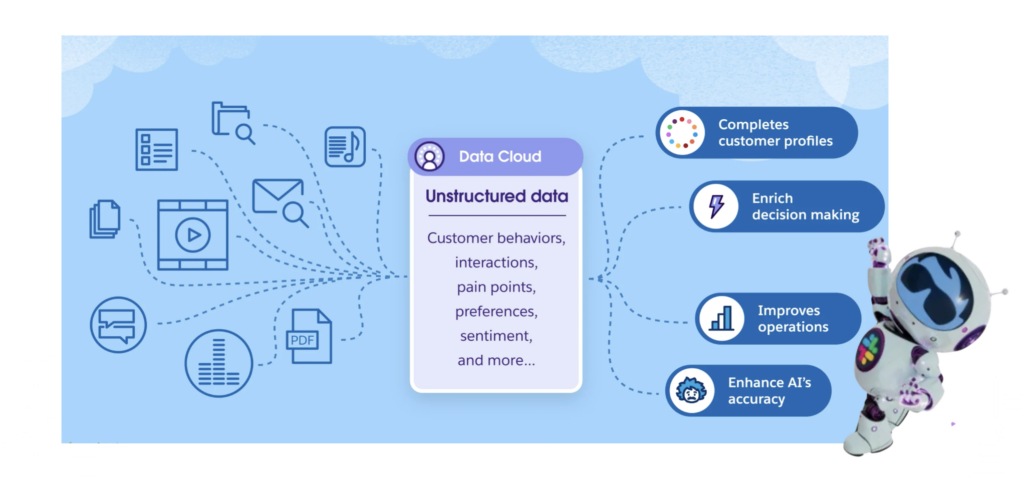
Context is King: AI agents cannot function on hallucinations. They require “Intelligent Context”—the ability to ingest unstructured data (PDFs, product manuals, trust deeds) and map it to structured CRM data.
Zero Copy Architecture: You no longer need to move data to use it. The roadmap involves connecting Snowflake or Databricks directly to Salesforce, allowing agents to access a “Golden Record” of the client without creating security risks.
2. The Workforce: Deploying the “Hybrid” Team
In 2026, firms will continue to move from “human-only” workflows to hybrid teams where agents handle the heavy lifting.
Wealth Management: Advisors will utilize Prep Agents to synthesize hours of research into 360-degree meeting briefings instantly. Nurturing Agents will manage “middle-of-the-pack” leads, engaging in two-way conversations until a prospect is ready to buy.
Marketing: The boundary between sales and marketing will blur. Agents will not just blast emails; they will craft personalized responses based on client intent and behavioral data, effectively nurturing leads 24/7.
A major theme for 2026 is shifting compliance from a reactive “cleanup” function to a proactive design feature.
Deterministic AI: Financial firms cannot afford probabilistic guesses. Tools like Agentforce Script allow you to hard-code strict rules into agents, ensuring they follow regulatory processes exactly.
Process Compliance Navigator: As seen in the Dreamforce event in October, this innovation maps regulations directly to workflows. Instead of auditing for errors after the fact, the system prevents non-compliant actions in real-time.
4. The Growth Engine: Loyalty and Ecosystems
Growth in 2026 will come from breaking down silos between organizations.
Clean Rooms: Using Data 360 Clean Rooms, financial firms can securely partner with other brands (e.g., an airline or accounting firm) to identify shared high-value customers without ever exposing PII. This unlocks precise co-marketing opportunities previously impossible due to privacy concerns.
Total Cost Reporting (CRM3): In Canada, new transparency regulations are an opportunity, not a burden. By using Salesforce FSC to centralize fee and performance data, advisors can proactively demonstrate value, turning a regulatory hurdle into a trust-building conversation.
Conclusion
The roadmap for 2026 is clear: Unify your data, agentify your workflows, and automate your compliance. The technology is no longer theoretical—it is ready to be implemented.
References & Further Reading
For a deeper dive into these concepts, please refer to our original analysis:
Disclaimer: This article draws on information provided by Navirum regarding Salesforce capabilities and industry trends. Readers should verify specific regulatory requirements regarding CRM3 and TCR independently.
The Agentforce World Tour in New York highlights how Salesforce Data 360 and Agentforce are transforming marketing from campaigns into real-time, personalized conversations. Data 360 enables marketers to activate structured and unstructured data, bridging context gaps, while Clean Rooms allow secure, privacy-compliant collaboration with partners to create high-value audience segments.
AI-powered Agents act as lead nurturers, handling personalized interactions, automating follow-ups, and ensuring no opportunity is overlooked—turning traditional funnels into dynamic, automated dialogues. For wealth managers and financial institutions, integrating these tools with Salesforce Financial Services Cloud enables intelligent, hyper-personalized client engagement, driving loyalty, operational efficiency, and data-driven growth.
How Data 360 and Agents are Rewriting the Marketing Playbook
In our recent analysis, we explored how Salesforce Marketing Cloud and Agentforce are converging to redefine customer loyalty. The Agentforce World Tour in New York has provided us with a tactical playbook to elaborate upon the overarching strategy.
The headline from NYC isn’t just about “better bots”—it’s about a fundamental shift in how customer data is activated. With the introduction of Data 360 (the evolution of Data Cloud) and live examples from Salesforce customers, we now have a clearer picture of how marketers can move from “campaigns” to “conversations.”
Here is your update on what Agentforce means for the future of marketing, based on the latest reveals from New York.
1. Data 360: The New Engine for Marketing Cloud
The biggest branding shift in New York was the evolution of Data Cloud into Data 360. While the core “Zero Copy” architecture remains—allowing you to access data in Snowflake or Databricks without moving it—the focus has shifted aggressively toward activation.
For marketers, this solves the “context gap.” As Salesforce’s Paul Cordasco noted, “If you don’t provide the right data, the prompts aren’t going to get you there”. AI needs trusted data to ground its queries so responses are appropriate and free of hallucinations.
Why this matters for CX: You can now bring in unstructured data—like product manuals or PDFs—using Intelligent Context. This means your marketing and service agents can “read” complex documents (preserving charts and tables) to answer detailed customer questions instantly, ensuring your brand voice is consistent and accurate.
2. The Loyalty Game-Changer: Data 360 Clean Rooms
In our previous article, we discussed loyalty ecosystems. The New York event showcased the ultimate tool for this: Data 360 Clean Rooms.
Imagine a wealth manager wanting to partner with an accounting firm to target high-value customers. Historically, sharing lists was a privacy nightmare. With Clean Rooms, these brands can now collaborate in a secure “vault” where data is encrypted and Personal Identifiable Information (PII) is never shared.
The process involves both parties agreeing on data segments for exchange, followed by the system querying to find the overlapping audience. The outcome is a highly precise, jointly branded audience segment ready for immediate marketing activation, ensuring optimized spending by targeting only relevant travelers.
For Navirum clients looking to expand loyalty partnerships, this feature allows you to unlock second-party data insights without risk.
Perhaps the most striking example of “Agentic Marketing” came from PepsiCo. They are using Agentforce not just for support, but to ensure “no lead is left behind”.
In a typical B2B scenario, sales teams ignore smaller leads to focus on big accounts. PepsiCo is flipping this by having AI agents handle the initial nurturing.
Beyond Templates: These agents aren’t just sending canned emails. They are crafting personalized messages based on the prospect’s intent, business size, and region.
Two-Way Conversations: The agent engages in a back-and-forth conversation. It only hands off to a human seller when the lead is qualified and ready to book a meeting, complete with a prepared briefing for the sales rep.
This blurs the line between Marketing Cloud and Sales Cloud, turning the “funnel” into an active, automated dialogue.
Furthermore, a great example of hyper-personalization across channels came from Williams-Sonoma. If a customer buys a Dutch oven, their agent, “Olive” remembers this and later recommends recipes tailored for that specific pot. Agentforce Voice ensures agents retain complete customer history and context. This capability facilitates a smooth transition to a human designer when addressing more complex inquiries.
The Takeaway
The Agentforce World Tour in NYC confirmed that the tools to build a “Customer Company” are ready today.
Unify your data with Data 360.
Collaborate securely with partners using Clean Rooms.
Automate the conversation with Agents that act as an extension of your marketing team.
Want to activate Data 360 in your marketing strategy? Contact Navirum today.
The Navirum Advantage: Powering the Agentic Financial Enterprise
Since 2018, Navirum has been delivering outstanding customer satisfaction, resulting in repeat business and accelerated success for our clients.
At Navirum, we specialize in helping wealth managers and banks activate their data and modernize client engagement. Our founders bring deep experience from investment firms and Salesforce’s Financial Services team to help you navigate the shift to the Agentic Enterprise. On every project, we engage our:
Strategic Consulting – Align Salesforce to your business goals, compliance needs, and Data 360 activation strategies to drive client loyalty.
Technical Implementation – Deep expertise in FSC, Marketing Cloud, and Agentforce setup, ensuring your AI agents are grounded in trusted data and integrated with banking admin systems.
Managed Services – Continuous optimization and adoption support to ensure your agents perform effectively and your data remains actionable.
Contact us for an initial consultation to explore the ways Navirum can help your organization reach new heights with the combined power of Data 360, Agentforce, and Salesforce Financial Services Cloud.
The theme of the NYC event was clear: moving from “visionary demos” to “practical reality” For wealth management firms and financial institutions grappling with the “overwhelming sea of AI options”, Salesforce demonstrated that the Agentic Enterprise is not a future state—it is happening now.
Here is what the Navirum community needs to know about the latest updates from New York, and how they apply to the wealth management mega-trends we are seeing in the market.
1. The End of “Black Box” AI: Predictability and Compliance
One of the most significant barriers to AI adoption in Canadian and US financial sectors is the fear of the “hallucinating” bot. Financial services require deterministic outcomes, not probabilistic guesses.
At the NYC event, Salesforce tackled this head-on with the introduction of Agentforce Script and the Process Compliance Navigator.
Agentforce Script: This allows firms to configure deterministic rules directly into the agent. Instead of relying solely on an LLM to “figure it out,” you can code specific guardrails. This ensures that when an agent interacts with a client, it follows business processes to the letter of the law.
Process Compliance Navigator: This innovation maps regulations directly to the workflows they impact. The goal is to “flip the script” from reactive risk assurance (cleaning up spills) to proactive risk avoidance (preventing spills entirely).
Auditability: As mentioned by different experts at the event, regulators want a “glass box,” not a black box. The new tools provide audit trails for agent actions, allowing firms to prove compliance with detailed records of every transaction.
For wealth firms, this answers the critical question: How can we automate without compromising our regulatory standing?
2. Real-World Success: The Hybrid Workforce
We have previously written aboutuse cases for the agentic firm, such as client onboarding and meeting prep. The NYC event showcased live examples of this “hybrid workforce” in action.
Baxter Credit Union (BCU) shared how they deployed “Frida,” a financial freedom agent. Unlike legacy chatbots that hit dead ends with complex questions, Frida uses contextual knowledge to answer member questions about nuances like Power of Attorney requirements.
The Result: BCU saw a 10-15% improvement in human escalation rates (meaning the bot solved the issue without human help).
Lead Nurturing: BCU is also building agents to handle the “middle of the pack” leads that loan officers don’t have time to call. The agent nurtures the lead via email and text, and only loops in the human officer when the client is ready to book a meeting.
CMG Financial highlighted how agents are reducing the “manufacturing cost” of loans. Their goal isn’t to replace Loan Officers, but to make them “omnipresent” by automating rote tasks so they can focus on high-value advisory work.
3. Data is the Fuel: The “Data 360” Advantage
A recurring theme in our analysis ofSalesforce FSC for Canadian firms is the importance of unified data. In NYC, Salesforce doubled down on this with Agentforce 360 and the integration of Informatica.
Agents are only as good as the data they can access. The new Intelligent Context capabilities allow agents to ingest unstructured data—like PDF product manuals or regulatory documents—without losing the meaning of charts, tables, and headers.
For a wealth firm, this means an agent could theoretically read a complex PDF of a new investment product and accurately answer advisor questions about it immediately, without manual data entry. With the Informatica partnership, Salesforce is ensuring that this data is governed, traced, and trusted.
4. Accelerating Deployment with “Agentforce Vibes”
Speed to market is critical. Salesforce introduced Agentforce Vibes, a tool that allows developers and admins to conversationally build prototypes in minutes.
Instead of writing code from scratch, teams can upload a Product Requirements Document (PRD), and the agent helps generate the necessary code, metadata, and dashboards grounded in the firm’s actual schema.
This significantly lowers the barrier to entry for firms looking to test AI concepts before a full rollout.
The Agentforce World Tour in New York confirmed the rapid pace of industry change. As Matthew McConaughey’s voice suggests, the central question has evolved from speculating on “What if?” to determining “How soon?”
However, the event also reinforced that data maturity and governance are prerequisites for success. As Salesforce noted, legacy technology and fragmented data are merely “fodder” for this new agentic capability.
For our clients, the path forward involves three steps:
Unify Your Data: Leverage Data Cloud (Data 360) to ensure your agents have a “Golden Record” of the client.
Define Your Guardrails: Use Agentforce Script to ensure your agents stay within compliance boundaries.
Start Small, Scale Fast: Like BCU, which started with 5% of interactions and grew to 50%, pick a high-impact use case (like lead nurturing or meeting prep) and iterate.
The Agentic Enterprise is open for business. Are you ready to build?
Ready to explore how Agentforce can transform your firm? Contact Navirum today.
The Navirum Advantage: Expertise that achieves results
Since 2018, Navirum has been delivering outstanding customer satisfaction, resulting in repeat business and accelerated success for our clients.
At Navirum, we specialize in implementing and optimizing Salesforce FSC for wealth managers and banks. Our founders bring deep experience from investment firms, and Salesforce’s Financial Services team. On every project, we engage our:
Strategic Consulting – Align Salesforce to your business goals, compliance needs, and client engagement strategy.
Technical Implementation – Expertise in FSC setup, AI, automation, and integrations with banking admin systems.
Managed Services – Continuous optimization and adoption support to maximize your Salesforce ROI.
Contact us for an initial consultation to explore the ways Navirum can help your organization reach new heights, with the combined power of Salesforce Financial Services Cloud and Agentforce.
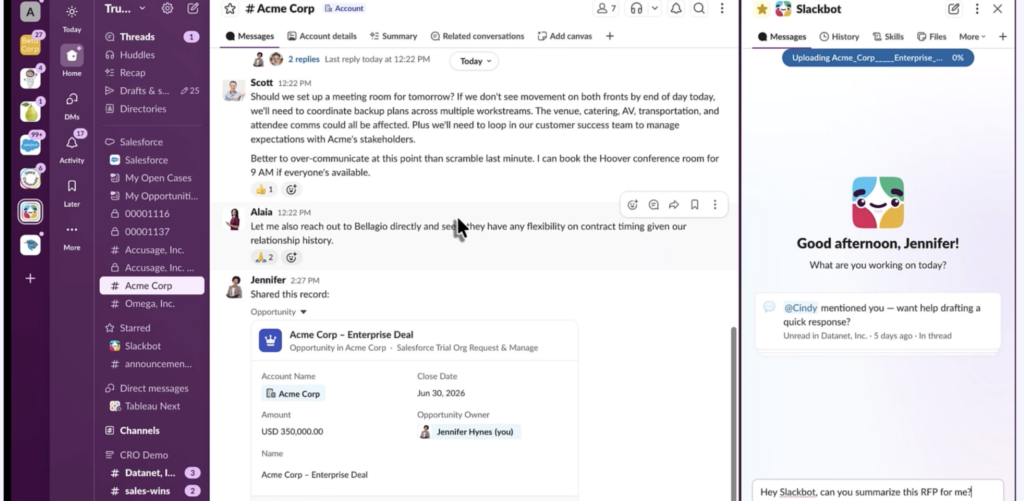
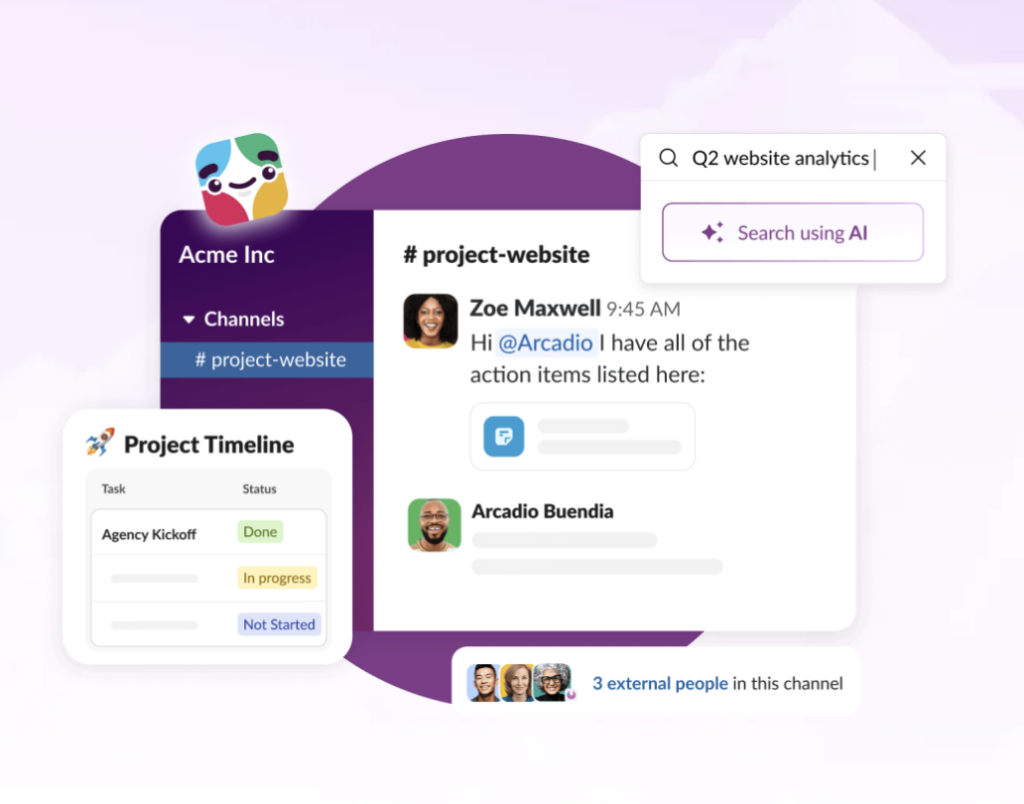
In today’s fast-paced world, productivity hinges on seamless collaboration. That’s why more and more financial services firms and enterprises are turning to Salesforce Slack integration.
By connecting Salesforce and Slack, teams can share data, automate workflows, and make faster decisions without switching between platforms.
Whether you call it Slack and Salesforce integration, Salesforce to Slack integration, or simply Salesforce integration Slack, the result is the same: less friction, more focus, and better outcomes.
When you integrate Slack with Salesforce, updates on new leads, opportunity stage changes, or deal approvals show up instantly in Slack channels. Instead of refreshing dashboards, sales teams respond in real time—shortening the path from prospect to closed deal.
#2 – Streamlined Collaboration Across Teams
With Slack and Salesforce connected, every account, opportunity, or case can have its own dedicated Slack channel. This keeps conversations, files, and context together. Whether you’re in sales, service, or marketing, the integration eliminates silos and helps everyone stay aligned.
What is Slack Anyway?
#3 – Automated Workflows That Save Time
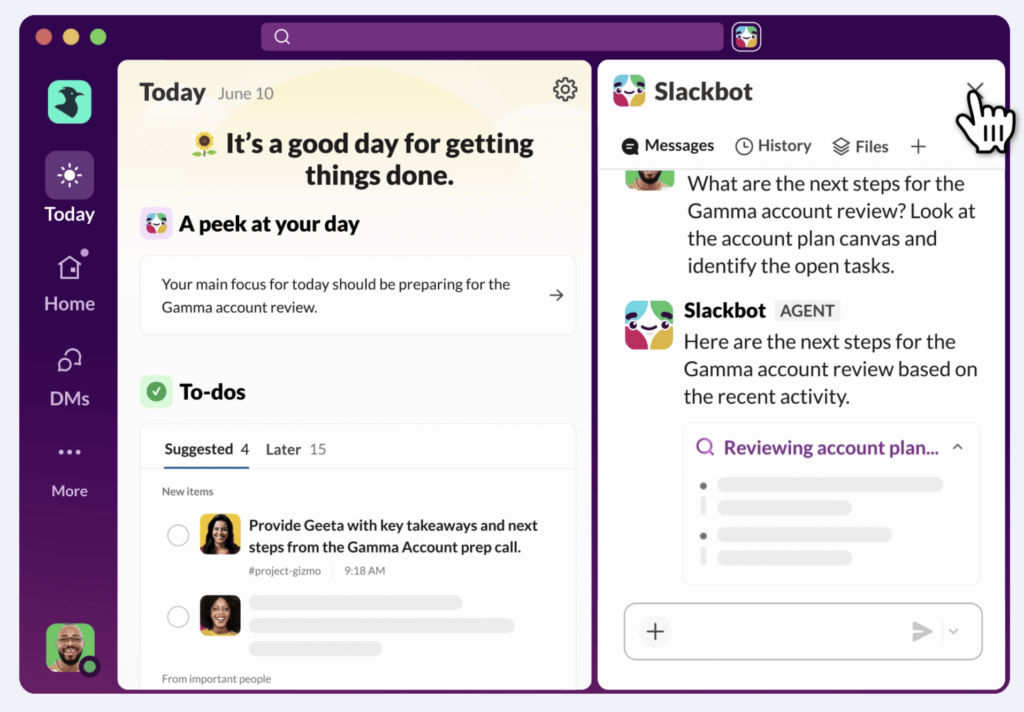
The Salesforce app for Slack allows you to automate routine tasks—such as escalating cases, reminding reps of follow-ups, or assigning handoffs. Notifications arrive directly in Slack, ensuring that nothing slips through the cracks.
#4 – Smarter Decisions with Data on Demand
Leaders no longer have to wait for weekly reports. With sales force and Slack connected, pipeline metrics, forecasts, and service dashboards can be pulled into Slack with a quick command. This provides decision-makers with live data to act faster.
#5 – Enhanced Customer Support
Service Cloud users can set up Salesforce to Slack integration so high-priority cases trigger immediate alerts. Support teams can then swarm the issue in Slack, loop in subject matter experts, and resolve it quickly—boosting customer satisfaction.
#6 – A Unified Platform for Growth
From slack sales force notifications to executive-level snapshots, the integration brings CRM data into Slack where people are already working. The connect Slack to Salesforce setup creates transparency, accountability, and better alignment across the business.
Salesforce Slack Demo (Credits to Salesforce Ben)
No Slacking, The Summary
Investing in Salesforce Slack integration is more than just a technical upgrade. It’s about creating a unified digital workspace where deals move faster, support becomes proactive, and teams stay aligned.
With Salesforce continuing to enhance its ecosystem – including the fast-growing Salesforce app for Slack – organizations that adopt early gain a competitive edge.
Contact Us for Salesforce Slack Integration Consultation Today
Navirum Client Success Stories
Salesforce Slack Integration FAQ
<strong class="schema-faq-question">Where can I get the integration?<br/></strong>
<strong class="schema-faq-question">How long does the integration take to setup?</strong>
For a Salesforce professional, about 2-4 hours with testing. This doesn’t include template design, workflows, approvals. A proper implementation can be any from 20 to 50 hours so the RoI needs to start up!
<strong class="schema-faq-question">What is a Salesforce partner?</strong>
A Salesforce partner is a company or organization that has been officially recognized by Salesforce for its expertise in delivering Salesforce-related services, solutions, or products. Salesforce partners may provide consulting, implementation, customization, integration, or third-party applications (AppExchange apps) to help clients maximize the value of the Salesforce platform. They are part of the Salesforce Partner Program, have access to specialized training and resources, and are recognized for meeting Salesforce’s standards for quality, technical capability, and customer success. Navirum is a certified Salesforce partner.
<strong class="schema-faq-question"><strong>How do financial advisors use S</strong>lack<strong> within Salesforce?</strong>
Financial advisors use Slack integrated with Salesforce to collaborate in real time, coordinate client tasks across teams, and receive automated updates on deals and accounts. This streamlines workflows, reduces email traffic, and ensures faster, more efficient client service by keeping conversations and Salesforce data in one place.
<strong class="schema-faq-question"><strong>How does the integration improve compliance?</strong>
The integration provides automated audit trails, status tracking, and secure storage of signed documents within Salesforce, ensuring that regulatory requirements are consistently met and easily verifiable.3
Navirum is a certified Salesforce and Slack partner, specializing in delivering integrated solutions that streamline digital workflows for financial services and other industries. With deep expertise in both platforms, Navirum helps clients automate processes, accelerate agreements, and maximize value from their Salesforce and Slack investments.
In today’s fast-paced business world, optimization is key. Companies strive to streamline processes and boost productivity. Integrating Salesforce, a leading CRM, with DocuSign, an e-signature innovator, unlocks efficient workflows and improved collaboration. Explore the benefits and features of Salesforce and DocuSign integration.
Discover The Power of Salesforce Integration with DocuSign!
Are you evaluating the best way to streamline your organization’s document workflows? Here’s why choosing Salesforce and DocuSign integration stands out among leading document management solutions:
Salesforce DocuSign Integration – Credits to Salesforce Ben
1. Superior Efficiency Compared to Manual or Other Tools
Integrating DocuSign with Salesforce eliminates the need to print, sign, scan, or email documents back and forth. Unlike standalone e-signature tools or traditional methods, this integration lets users send, sign, and manage documents entirely within Salesforce. The result: shorter turnaround times and major productivity gains versus competing processes.
2. Best-In-Class Collaboration and User Experience
Salesforce and DocuSign enable multiple stakeholders—sales, legal, operations—to review, edit, and sign contracts or NDAs right from your CRM. This is much more efficient than file-based approaches or endless email threads. With real-time notifications and activity tracking, everyone stays aligned and projects move forward faster.
3. Unmatched Visibility and Real-Time Document Tracking
Unlike generic document platforms, DocuSign Salesforce integration gives users full transparency: track every document’s status (sent, signed, returned) directly in Salesforce. This live dashboard approach helps you spot delays, identify bottlenecks, and keep deals on track—advantages you won’t find in disconnected tools.
DocuSign’s industry-leading security and compliance solutions (including robust audit trails and encryption) are embedded right into Salesforce workflows. This reduces risk compared to less-secure signing tools and supports regulatory requirements in finance, insurance, and other regulated sectors.
5. Seamless Digital Customer Journey
Customers today expect fast, hassle-free digital interactions. Salesforce and DocuSign deliver a seamless, branded experience—whether for onboarding, contracts, or order processing—improving satisfaction and giving your business a competitive edge over slower, less integrated processes.
How Does Salesforce + DocuSign Stack Up?
When compared to alternative document management strategies, Salesforce and DocuSign integration consistently delivers:
Faster document turnaround and approval cycles
Centralized tracking and transparency
Higher security and compliance (vs. email or simple e-signature apps)
Improved collaboration across teams and with clients
Ready to see how this integration outperforms other options for your organization? Contact our Salesforce–DocuSign certified consultants today for a personalized assessment and start unlocking the full potential of your business workflows.
Contact Us for Salesforce DocuSign Consultation Today
Navirum Client Success Stories
Salesforce DocuSign Integration FAQ
<strong class="schema-faq-question">Where can I get the integration?<br/></strong>
<strong class="schema-faq-question">How long does the integration take to setup?</strong>
For a Salesforce professional, about 2-4 hours with testing. This doesn’t include template design, workflows, approvals. A proper implementation can be any from 20 to 50 hours so the RoI needs to start up!
<strong class="schema-faq-question"><strong>Is the DocuSign Salesforce integration secure and compliant with regulatory requirements?</strong>
DocuSign provides robust security, encryption, and audit trails for all documents processed through its platform. The integration with Salesforce maintains these standards and helps you comply with industry regulations such as eIDAS, ESIGN Act, and GDPR, depending on your organizational needs.
<strong class="schema-faq-question">What is a DocuSign implementation partner</strong>
A DocuSign implementation partner is a certified consulting firm or service provider that specializes in helping organizations successfully deploy and integrate DocuSign solutions – such as eSignature or DocuSign CLM – into their existing business systems, including Salesforce. These partners have expertise in configuration, technical integration, workflow customization, user training, and best practices to ensure a smooth and effective rollout of DocuSign products tailored to your organization’s needs.
<strong class="schema-faq-question">What is a Salesforce partner?</strong>
A Salesforce partner is a company or organization that has been officially recognized by Salesforce for its expertise in delivering Salesforce-related services, solutions, or products. Salesforce partners may provide consulting, implementation, customization, integration, or third-party applications (AppExchange apps) to help clients maximize the value of the Salesforce platform. They are part of the Salesforce Partner Program, have access to specialized training and resources, and are recognized for meeting Salesforce’s standards for quality, technical capability, and customer success.
<strong class="schema-faq-question"><strong>How do financial advisors use DocuSign within Salesforce?</strong>
Financial advisors send, track, and manage client agreements (such as onboarding forms, investment mandates, or compliance documents) for electronic signature directly from Salesforce, streamlining client interactions and accelerating paperwork.
<strong class="schema-faq-question"><strong>How does the integration improve compliance?</strong>
The integration provides automated audit trails, status tracking, and secure storage of signed documents within Salesforce, ensuring that regulatory requirements are consistently met and easily verifiable.
<strong class="schema-faq-question"><strong>Does the integration support mobile use for advisors and clients?</strong>
Absolutely. Both advisors and clients can initiate and complete signature processes from any device, providing the flexibility needed for remote or on-the-go client service.
Navirum is a certified Salesforce and DocuSign partner, specializing in delivering integrated solutions that streamline digital workflows for financial services and other industries. With deep expertise in both platforms, Navirum helps clients automate processes, accelerate agreements, and maximize value from their Salesforce and DocuSign investments.
Why Financial Services Firms Need to Be AI Ready? Advisors, credit unions, and regional banks are all facing the same question: are we ready for AI? AI isn’t futuristic-it’s here, and it’s transforming financial services right now.
Much like the internet in the 1990s, AI is a permanent shift. Those who prepare today will win tomorrow.
“It’ll be unthinkable not to have intelligence integrated into every product and service. It’ll just be expected.” — Sam Altman, CEO, OpenAI
The Risks of Rushing In
AI isn’t just another app you plug in. Without a plan, you risk wasted time, spiraling costs, and compliance headaches
Privacy & Data – AI models don’t just process information, they learn from it. You need to know where your data lives, how it’s stored, and if it meets regulations.
Costs & Scale – Licenses are the easy part. The real costs come from storage, access, and security of the data AI creates.
Compatibility – If your AI doesn’t work with Microsoft, Google, Salesforce, or your banking platforms, adoption will stall.
Use Cases – Some AI apps deliver real value. Others are distractions. Focus is critical.
As Timnit Gebru, AI researcher, warns:
“We’re seeing a Wild West with AI regulation. Adoption is outpacing clear guidelines, leaving businesses exposed.”
Identity fraud isn’t slowing down. In fact, it’s accelerating – and credit unions are finding themselves on the front line of this battle. Unlike large banks with extensive fraud budgets and dedicated security teams, credit unions often face unique vulnerabilities that sophisticated fraudsters are quick to exploit.
Request a credit union fraud & CRM consultation
A 60-second start: tell us where to reach you and we’ll show you how a unified Salesforce view helps your team spot fraud red flags siloed systems miss.
AI: A Double-Edged Sword in Fraud Prevention
Artificial Intelligence presents both opportunities and challenges in this fight. While AI helps credit unions strengthen identity verification and detect anomalies in real time, fraudsters are weaponizing the same technology to :
Create hyper-realistic fake IDs that fool traditional verification systems
Automate sophisticated phishing campaigns at unprecedented scale
Mimic legitimate customer behavior patterns to bypass security protocols
Fraud detection rules that were airtight last year are not necessarily airtight today. Our Orbit Managed Services team keeps identity verification logic current as fraud tactics shift, rather than leaving it configured once and forgotten.
The Rise of Synthetic Identity Fraud: A Silent Epidemic
The threat landscape has evolved beyond simple identity theft. Fraudsters are now creating entirely synthetic identities by combining real data elements — like Social Security Numbers — with fabricated names and addresses. These phantom identities pass verification checks, establish credit histories, and then execute devastating “bust out” schemes with large loans before vanishing without a trace.
New synthetic account creation surged 18% year-over-year
Every one of these numbers is a member trust problem before it is a security problem. See how a unified Salesforce view of the member relationship helps staff spot the behavioral red flags that siloed systems miss, in our guide to Salesforce for credit union member experience.
Data Breaches: Fueling the Fraud Engine
Recent data breaches have armed fraudsters with vast troves of Personally Identifiable Information, and credit unions aren’t immune to these attacks:
A September 2024 Massachusetts breach exposed Social Security Numbers and driver’s license details
A two-month breach in Maine compromised sensitive data for approximately 240,000 individuals
Adding to these concerns, credit unions using CRMs like Salesforce face risks from Scattered Spider attacks. This sophisticated threat group targets SaaS platforms to access member data and financial records, exploiting administrative permissions for lateral movement within credit union networks and establishing persistent backdoors for ongoing data theft and potential ransomware deployment.
Attacks like this usually exploit administrative permissions that were never properly scoped in the first place. Our Salesforce consulting team configures permission sets and access controls with this exact risk in mind, not just for launch day.
The Path Forward
Credit unions must recognize that traditional fraud prevention methods are no longer sufficient. The combination of AI-powered fraud tools, synthetic identity creation, and massive data breaches requires a fundamental shift in how we approach member security and identity verification. Will members and their staff be the solution?
The honest answer is both: better-trained staff and deterministic guardrails on the AI tools doing the screening. This is the AI risk governance gap most credit unions have not closed yet, and it is the same gap we walk through in our guide to compliance in Salesforce Financial Services Cloud, including KYC, identity verification, and audit-ready AI.
– Rory – Founder – NAVIRUMHelping financial services firms lead with CRM, AI, and digital transformation.
What strategies is your organization implementing to stay ahead of these evolving threats?
See where your fraud controls stand
Book a short review of your identity-verification logic, permission scoping, and AI governance gaps with our credit union team.
Data Platforms for Wealth Management: Which One Fits Your Stack?
AI is transforming financial services, but success depends on having the right data foundation. This guide compares Salesforce Data Cloud, Snowflake, and Databricks, helping financial institutions understand how each platform supports customer engagement, enterprise data management, analytics, and AI initiatives, and how to choose the right architecture for long-term growth and competitive advantage.
Financial services firms are entering a new era, one where competitive advantage increasingly depends on the ability to turn data into intelligence, and intelligence into action.
From personalized wealth management experiences and AI-powered customer service to fraud detection, risk management, and regulatory compliance, data has become the foundation of modern financial institutions. Yet many banks, credit unions, insurers, wealth management firms, and asset managers still struggle with fragmented systems, disconnected customer records, and data architectures that were never designed for today’s AI-driven environment.
As organizations modernize their technology stacks, one question continues to emerge:
What is the right data platform for financial services? Data Cloud, Snowflake and Databricks? Which one is a more suitable platform for your firm?
Book Strategy Session
Schedule Your Session
Let’s find a time to chat about your Salesforce strategy and AUM growth.
Quick Answer: Which Platform for Wealth Management?
Just need the answer?
Use Salesforce Data Cloud if you are a Salesforce-first firm (Financial Services Cloud, Agentforce) and want real-time advisor personalization plus compliance audit trails.
Use Snowflake if you need a secure enterprise data warehouse for custodian feeds, transaction history, and regulatory reporting (SEC, FINRA compliance).
Use Databricks if you are building ML models for churn prediction, fraud detection, or portfolio risk modeling over complex datasets.
Most wealth management firms use all three. Keep reading to see why, and in what sequence.
Is Your Data Stack Holding Back Growth?
Book a 15-minute call with a Navirum architect. We will audit your current platforms and identify the single biggest blocker to advisor productivity or AI adoption.
The answer is not always straightforward. Three platforms dominate the conversation today:
Three names dominate the conversation right now: Salesforce Data Cloud, Snowflakeet Databricks. Each platform solves different business challenges. Each offers unique capabilities. And each can play an important role in a modern financial services data strategy.
This guide explores the strengths, use cases, and considerations for each platform, helping financial services leaders determine which solution best aligns with their goals.
What is Salesforce Data Cloud?
Salesforce Data Cloud: Powering Real-Time Personalization
If your business already runs on Salesforce, Data Cloud is a natural fit. It connects data from across your systems, including banking platforms, marketing tools, and third-party feeds, and creates real-time, unified customer profiles.
For financial services firms, this is a game-changer. Imagine a wealth advisor logging into Salesforce and seeing a client’s full history, preferences, risk level, and recent interactions in one place. Or an insurance agent triggering automated outreach when a policyholder’s data suggests a change in life circumstances.
Because it’s fully embedded in the Salesforce ecosystem, Data Cloud doesn’t just analyze data. It acts on it. You can personalize emails, trigger service actions, or alert advisors instantly, all within the same platform.
Snowflake: The Scalable, Secure Data Backbone
What is Snowflake?
Snowflake excels as a centralized data warehouse, especially for highly regulated industries like banking and asset management. It’s designed for organizations that need to consolidate massive volumes of structured data, enforce tight governance, and power analytics across departments.
Think of a large bank that wants to bring together customer data from branches, mobile apps, trading desks, and third-party partners. With Snowflake, they can create a single source of truth and ensure access is controlled by role, geography, or compliance status.
It’s also a favorite for enterprise reporting and integrates smoothly with tools like Tableau, making it ideal for CDOs and compliance teams.
Databricks: The Powerhouse for Advanced Analytics and AI
What is Databricks?
Databricks is built for the most ambitious use cases. If your institution is investing heavily in machine learning, predictive analytics, or real-time decisioning, this is where you want to be.
Databricks combines the flexibility of data lakes with the performance of data warehouses, in what it calls a “lakehouse” architecture. It handles both structured and unstructured data and is designed for data science teams.
An insurance firm might use Databricks to build fraud detection algorithms using claims data, emails, call transcripts, and even images. An investment management company could use it to model trading strategies based on market signals, news feeds, and client sentiment.
So, Which One?
It depends on your goals:
Use Data Cloud if you want to unify data for sales, service, and marketing teams, and trigger real-time action.
Use Snowflake if you’re building a secure, scalable enterprise data warehouse that feeds analytics and reporting.
Use Databricks if you’re investing in AI, machine learning, or advanced analytics across complex, diverse datasets.
At Navirum, we help financial services leaders build out data strategies that align with where they are, and where they’re going. Often, it’s not about choosing just one of these platforms, but connecting them strategically.
If you’re rethinking your data architecture, let’s talk. The right data foundation today is your AI advantage tomorrow.
Why Data Platforms Matter More Than Ever in Financial Services
Financial institutions generate enormous volumes of data every day.
Customer transactions, portfolio activity, CRM records, market feeds, loan applications, policy data, service interactions, digital engagement metrics, compliance records, and third-party datasets all contribute to an increasingly complex information ecosystem.
At the same time, organizations face growing pressure to:
Deliver personalized customer experiences
Improve advisor and employee productivity
Strengthen regulatory compliance
Reduce operational costs
Accelerate AI initiatives
Improve decision-making in real time
The challenge is that data often remains trapped in silos.
Customer information may live in CRM systems. Transaction data may reside in core banking platforms. Marketing engagement data may be stored elsewhere. Compliance teams often maintain separate reporting environments. Data science teams frequently build their own isolated analytics platforms.
Without a unified approach, firms struggle to unlock the full value of their information assets.
This is where modern data platforms come in.
The right platform creates a foundation for:
Unified customer views
Real-time insights
Advanced analytics
AI and machine learning
Data governance and compliance
Operational efficiency
However, not all platforms are designed for the same purpose.
Let’s examine how Salesforce Data Cloud, Snowflake, and Databricks differ.
Salesforce Data Cloud: The Customer Intelligence Platform
Already have questions about cost, migration timeline, or where Agentforce fits in? Jump straight to the FAQ section below for quick answers.
What Is Salesforce Data Cloud?
Salesforce Data Cloud is a real-time customer data platform designed to unify information across systems and make it immediately actionable within the Salesforce ecosystem.
Unlike traditional data warehouses, Data Cloud focuses on creating comprehensive customer profiles that can be used directly by business teams.
Salesforce Data Cloud Connections | Navirum
Interactive Blueprint: Hover or tap nodes to explore Data Cloud feeds
★ Continuous Customer Harmonization
Salesforce Data Cloud acts as the central engine. It ingests, maps, and harmonizes multi-source financial and digital profiles in real time. The ultimate result is a continuously updated, unified 360° view of each customer.
01 Core Banking Systems
Ingests real-time checking, savings, term-deposit ledger transactions, and current balances directly into Data Cloud to reflect up-to-the-second financial standing.
02 Wealth Management Platforms
Streams active asset allocations, portfolio holdings, custodian feeds, household balances, and investment risks to maintain accurate net worth intelligence.
03 Insurance Policy Systems
Integrates active policy limits, premium renewals, underwriting risks, claims histories, and coverage boundaries to align financial advice with liability safeguards.
04 Marketing Automation Tools
Harmonizes outbound email clicks, campaign interactions, landing page visits, preference maps, and marketing consent statuses to optimize journey relevance.
05 Customer Service Applications
Captures live support tickets, chatbot session history, contact center call transcripts, and CSAT scores to alert RMs of open service cases before meetings.
06 Third-Party Data Providers
Bridges external credit scores, demographic enrichment records, market valuations, and KYC identity verification systems natively into your core profiles.
07 Digital Engagement Channels
Streams raw portal clicks, mobile app telemetry, secure message exchanges, and live web interactions to dynamically trigger next-best-action alerts.
Why Financial Services Firms Are Adopting Data Cloud
For financial institutions already invested in Salesforce, Data Cloud provides a powerful way to connect fragmented customer data without creating additional complexity.
Consider a wealth management firm.
An advisor preparing for a client meeting may need information from multiple systems:
Investment portfolios
Banking relationships
Service history
Marketing engagement
Risk tolerance assessments
Family or household relationships
Without a unified platform, gathering this information can be time-consuming. With Data Cloud, all relevant data becomes available within Salesforce, giving advisors a complete view of the client in real time. This enables more meaningful conversations and better outcomes.
Key Benefits of Salesforce Data Cloud
Real-Time Customer Profiles
Data Cloud continuously updates customer records as new information enters the system. This allows organizations to make decisions based on current conditions rather than outdated reports.
Embedded Activation
One of Data Cloud’s biggest advantages is that insights can immediately trigger action.
For example:
A banker receives an alert when a customer reaches a significant account milestone.
A wealth advisor is notified when a client’s investment behavior changes.
An insurer automatically initiates outreach after a life event is detected.
The platform bridges the gap between insight and execution.
Native Salesforce Integration
Organizations using Salesforce Financial Services Cloud, Sales Cloud, Service Cloud, Marketing Cloud, or Agentforce benefit from seamless integration. Business users can access data without switching between systems.
AI Readiness
Data Cloud serves as the foundation for Salesforce’s AI capabilities, including Agentforce. By providing trusted, unified data, organizations can deploy AI agents and predictive models with greater confidence.
Ideal Use Cases for Data Cloud
Data Cloud is particularly effective for:
Wealth management personalization
Relationship banking
Insurance customer engagement
Advisor productivity enhancement
Marketing segmentation
Service automation
Agentforce implementations
Potential Limitations
While Data Cloud excels at customer intelligence and activation, it is not intended to replace enterprise-scale data engineering platforms. Organizations with extensive data science requirements may require complementary technologies for advanced analytics and machine learning.
Snowflake: The Enterprise Data Foundation
What Is Snowflake?
Snowflake is a cloud-native data platform built primarily for enterprise data warehousing, analytics, governance, and data sharing.
It enables organizations to consolidate massive amounts of data into a centralized environment while maintaining strict security and compliance controls.
For many financial institutions, Snowflake serves as the foundation of their enterprise data architecture.
Why Snowflake Is Popular in Financial Services | Navirum
Interactive Blueprint: Hover or tap nodes to explore financial solutions
★ Independent Scaling Architecture
Snowflake separates storage from compute resources entirely. This allows financial institutions to scale computing power up and down on demand, ensuring optimal query performance while strictly controlling storage costs.
01 Large Transaction Volumes
Financial firms process massive daily volumes of trades, ledger bookings, and telemetry data. Snowflake dynamically provisions infinite multi-cluster compute warehouses to execute complex queries against billions of records in seconds.
02 Strict Regulatory Requirements
Auditing frameworks (such as SEC and FINRA) require absolute tracking of historical data states. On Enterprise Edition and above, Snowflake’s built-in Time Travel feature can be configured to let compliance officers query historical table states for up to 90 days. The default retention on lower tiers is far shorter.
03 Complex Reporting Obligations
Preparing quarterly financial statements and quantitative risk metrics requires compiling heavy, multi-layered queries. Snowflake executes these heavy-compute reports in minutes rather than hours, avoiding system-wide delays.
04 Multiple Lines of Business
Silos between retail banking, commercial lending, and asset divisions cause costly replication. Snowflake’s Secure Data Sharing enables different units to safely query single-copy, live records without copy overhead.
05 Highly Sensitive Customer Information
Financial data requires ironclad protection. Snowflake enforces always-on end-to-end encryption (at rest and in transit), Column-Level Data Masking, and Row-Access Policies to keep PII and account balances completely secure.
Why Snowflake Is Popular in Financial Services
Financial services organizations face unique data challenges.
They must manage:
Large transaction volumes
Strict regulatory requirements
Complex reporting obligations
Multiple lines of business
Highly sensitive customer information
Snowflake was designed to address many of these challenges.
Its architecture allows organizations to scale storage and computing resources independently, improving performance while controlling costs.
Key Benefits of Snowflake
Centralized Data Management
Snowflake creates a single source of truth across the enterprise. Data from multiple systems can be consolidated into one governed environment. This reduces inconsistencies and improves reporting accuracy.
These features help organizations maintain security while enabling broader data access.
Scalability
Whether managing millions or billions of records, Snowflake scales efficiently. This makes it particularly attractive for large banks and multinational financial institutions.
Analytics Enablement
Snowflake integrates with leading business intelligence platforms, enabling organizations to deliver dashboards, reports, and analytics across departments.
Financial Services Use Cases
Snowflake is commonly used for:
Enterprise data warehousing
Regulatory reporting
Risk management analytics
Executive dashboards
Customer profitability analysis
Data sharing across business units
Enterprise-wide reporting initiatives
Example Scenario
Imagine a national bank operating retail, commercial, wealth management, and lending divisions. Each business unit generates large amounts of data. Snowflake enables the bank to consolidate information from all divisions into a centralized platform while maintaining strict access controls. Executives gain a unified view of performance, risk teams improve visibility, and compliance teams streamline reporting processes.
Potential Limitations
Snowflake is excellent for storing, governing, and analyzing data, but it is less focused on activating customer insights directly within business workflows.
Organizations often pair Snowflake with CRM platforms, customer engagement tools, or AI applications to operationalize insights.
Databricks: The AI and Advanced Analytics Platform
What Is Databricks?
Databricks is a unified analytics platform designed for data engineering, machine learning, and artificial intelligence.
It pioneered the concept of the “lakehouse” architecture, combining the flexibility of data lakes with the governance and performance capabilities of data warehouses.
Unlike traditional analytics platforms, Databricks was built with data scientists and AI teams in mind.
Interactive Blueprint: Hover or tap nodes to explore financial solutions
★ Databricks Unified Lakehouse Engine
Traditional reporting platforms struggle to support advanced analytical workloads. Databricks addresses this challenge by combining the best elements of data lakes and data warehouses into a single, unified Lakehouse Architecture.
01 Structured Data
Manage traditional databases, relational tables, customer transactional history, and standard SQL schemas with optimal performance, keeping query times incredibly fast.
02 Unstructured Data
Store and process massive pools of raw, unformatted, and complex files directly within the Lakehouse framework, removing the need for separate siloed data pools.
03 Streaming Data
Process high-velocity streaming computations, event-driven message arrays, and transactional message pipelines smoothly with instant zero-loss synchronization.
04 Text Documents
Process unstructured text files, PDF statements, contractual agreements, and emails. Databricks makes this textual data easily searchable and ready for NLP models.
05 Images
Store, categorize, and process image files at scale, enabling advanced computer vision applications, document extraction, and ID verification pipelines.
06 Audio
Directly analyze and process audio recordings, customer service call logs, voice verifications, and dictations, turning raw soundwaves into valuable text-based data.
07 Real-Time Data Feeds
Ingest live market rates, telemetry signals, fraud signals, and application activity feeds, creating a robust, real-time dataset ideal for sophisticated AI use cases.
Why Financial Institutions Choose Databricks
As financial services firms accelerate AI initiatives, many discover that traditional reporting platforms cannot support advanced analytical workloads.
Databricks addresses this challenge by enabling organizations to work with:
Structured data
Unstructured data
Streaming data
Text documents
Images
Audio
Real-time data feeds
This flexibility makes it ideal for sophisticated AI use cases.
Key Benefits of Databricks
Advanced Machine Learning
Databricks provides a collaborative environment for developing, training, and deploying machine learning models. Teams can move from experimentation to production more efficiently.
Support for Diverse Data Types
Modern AI initiatives often require more than traditional tabular data. Databricks allows organizations to combine structured and unstructured data sources within a single platform.
Real-Time Analytics
The platform supports streaming data and real-time processing, enabling faster decision-making.
AI and Generative AI Development
Databricks has become a leading platform for organizations building generative AI applications, large language models, and intelligent automation solutions.
Financial Services Use Cases
Common use cases include:
Fraud Detection. Banks and insurers use Databricks to identify suspicious patterns across transactions, claims, communications, and digital interactions.
Risk Modeling. Financial institutions can build sophisticated predictive models to evaluate risk exposure and market scenarios.
Customer Churn Prediction. Organizations can identify customers at risk of leaving and proactively intervene.
Investment Analytics. Asset managers use Databricks to analyze market data, alternative datasets, and client behavior.
AI-Powered Decisioning. Real-time models can support lending decisions, underwriting processes, and portfolio recommendations.
Example Scenario
An insurance company wants to improve fraud detection. The organization combines:
Claims data
Call center transcripts
Email communications
Image submissions
Historical fraud records
Databricks allows data scientists to analyze all these data sources together and create AI models that identify suspicious claims more accurately.
Potential Limitations
Databricks is highly powerful but can be more complex than customer-focused platforms like Data Cloud. Organizations often require specialized data engineering and data science expertise to maximize value.
Data Cloud vs. Snowflake vs. Databricks: Which One Should You Choose?
The answer depends on your primary business objective.
Salesforce vs. Snowflake vs. Databricks | Navirum
Interactive Matrix: Hover or tap platforms to compare objectives
01 Choose Salesforce Data Cloud if:
This platform is ideal for **customer-centric transformation initiatives**, helping wealth advisors and operations managers continuously harmonize disparate client datasets in real time.
✓
Create unified customer profiles
✓
Improve advisor productivity
✓
Personalize customer experiences
✓
Enable Agentforce AI agents
✓
Trigger real-time business actions
✓
Maximize Salesforce investments
02 Choose Snowflake if:
This platform is ideal for organizations focused on **scalability, governance, and heavy corporate analytics**. It excels at centralizing massive, structured records under a secure, shared backbone.
✓
Create an enterprise data warehouse
✓
Consolidate data across departments
✓
Improve governance and compliance
✓
Support enterprise-wide reporting
✓
Build a trusted data foundation
03 Choose Databricks if:
This platform is ideal for organizations pursuing **advanced AI and data science initiatives**. Its lakehouse architecture combines data lakes and warehouses, empowering deep quantitative research.
✓
Build custom machine learning models
✓
Develop generative AI applications
✓
Enable heavy predictive analytics
✓
Analyze large and complex datasets
✓
Support advanced data science teams
The Reality: Most Financial Institutions Need More Than One Platform
One of the biggest misconceptions in the market is that organizations must choose a single platform. In reality, many leading financial institutions use all three. A modern architecture might look like this:
Snowflake serves as the enterprise data foundation.
Databricks powers AI and machine learning initiatives.
Salesforce Data Cloud activates customer insights across sales, service, marketing, and advisor workflows.
Together, these platforms create an ecosystem where data is collected, governed, analyzed, and activated. The key is ensuring they work together strategically rather than operating as isolated technology investments.
Building Your AI-Ready Data Strategy
As AI adoption accelerates across financial services, the quality of your data architecture becomes increasingly important. The organizations seeing the greatest value from AI are not necessarily those with the most advanced algorithms. They are the ones with the most trusted, accessible, and actionable data.
Before selecting a platform, financial services leaders should ask:
What business outcomes are we trying to achieve?
Who will use the data?
How quickly do insights need to be activated?
What governance requirements must we support?
What AI capabilities do we plan to implement over the next three years?
The answers will help determine whether Data Cloud, Snowflake, Databricks, or a combination of all three, provides the strongest foundation.
At Navirum, we help banks, credit unions, insurers, wealth management firms, and asset managers design data strategies that align technology investments with measurable business outcomes.
Because when it comes to AI, personalization, and digital transformation, the right data foundation today becomes your competitive advantage tomorrow.
Takeaway
The future of financial services will be shaped by organizations that can turn data into actionable intelligence faster than their competitors.
Whether you’re pursuing personalized client experiences, operational efficiency, regulatory compliance, or AI-driven innovation, your data platform strategy will play a central role in determining success.
Salesforce Data Cloud, Snowflake, and Databricks each solve different challenges. The most successful firms understand how to leverage the strengths of each platform while creating a connected, scalable, and AI-ready data ecosystem.
At Navirum, we help financial institutions assess their current state, define their target architecture, and build a practical roadmap that aligns data investments with measurable business outcomes. The result is a stronger data foundation, more trusted AI, and a competitive advantage that scales with the business.
Navirum’s Recommendations
How Financial Services Leaders Should Evaluate Data Platforms?
Choosing the right data platform is not simply a technology decision. It is a business strategy decision.
At Navirum, we frequently see organizations focus on platform features before clearly defining the business outcomes they want to achieve. The result is often a costly implementation that delivers limited value.
Before selecting Salesforce Data Cloud, Snowflake, Databricks, or a combination of platforms, we recommend financial services leaders consider the following:
Start With Business Outcomes, Not Technology
Ask yourself:
Are we trying to improve advisor productivity?
Do we need a single customer view?
Are we focused on regulatory reporting?
Are we investing in AI and predictive analytics?
Do we need better customer engagement and personalization?
Different objectives require different data capabilities. Organizations that begin with business goals typically achieve faster ROI than those that start with platform selection.
Don’t Build an AI Strategy Without a Data Strategy
Many firms are rushing to deploy AI tools and agents. However, AI is only as effective as the data behind it. Before launching AI initiatives, organizations should ensure they have:
Trusted data sources
Clear governance policies
Data quality controls
Unified customer records
Security and compliance frameworks
A strong data foundation reduces AI risk while improving outcomes.
Consider Your Existing Technology Investments
Financial institutions rarely start from scratch. If Salesforce is already central to your customer engagement strategy, Salesforce Data Cloud may provide faster time-to-value than introducing an entirely new ecosystem.
Similarly, organizations already invested in enterprise data warehousing may benefit from expanding Snowflake or Databricks rather than replacing existing infrastructure. Technology decisions should build upon existing strengths whenever possible.
Think Beyond Today’s Requirements
Many organizations evaluate platforms based on current needs. The better question is:
Where will your business be three years from now?
Consider future requirements such as:
Agentic AI
Hyper-personalization
Real-time decisioning
Digital servicing
Predictive customer engagement
Regulatory reporting automation
Your data architecture should support both current priorities and future growth.
Avoid Creating New Data Silos
One of the most common mistakes we see is implementing new platforms that create additional silos. Every technology decision should contribute to a connected ecosystem where data can move securely between platforms and teams. The most successful financial institutions focus on integration and interoperability from the beginning.
Recognize That the Answer Is Often “All Three”
The question isn’t always:
“Which platform should we choose?”
Instead, it may be:
“How should these platforms work together?”
Many leading banks, insurers, and wealth management firms use:
Snowflake for enterprise data management
Databricks for AI and machine learning
Salesforce Data Cloud for customer engagement and activation
The competitive advantage comes from connecting these technologies strategically.
Building an AI Strategy? | Navirum Banner CTA
Building an AI strategy but unsure where to start?
Discover which combination of Data Cloud, Snowflake, and Databricks best supports your business goals. Book a complimentary data strategy consultation with Navirum today.
Your Data Cloud, Snowflake, and Databricks Questions, Answered
Wondering which platform fits your wealth management stack, how they work together, or where AI comes in? The questions financial services leaders ask us most, answered in one place.
View all 10 questions
What is the best data platform for financial services?
There is no single best platform for every financial institution. Salesforce Data Cloud is ideal for customer engagement and personalization, Snowflake excels at enterprise data management and governance, and Databricks is best suited for advanced analytics and AI initiatives.
Is Salesforce Data Cloud a data warehouse?
No. Salesforce Data Cloud is not a traditional enterprise data warehouse.
Its primary purpose is to unify customer data and activate insights in real time across Salesforce applications such as Financial Services Cloud, Service Cloud, Marketing Cloud, and Agentforce.
What is the difference between Snowflake and Databricks?
Snowflake is primarily focused on data warehousing, governance, analytics, and data sharing. Databricks focuses on data engineering, machine learning, artificial intelligence, and advanced analytics. While there is overlap, Databricks generally provides greater flexibility for AI and data science workloads.
Can Salesforce Data Cloud work with Snowflake?
Yes. Many organizations integrate Salesforce Data Cloud with Snowflake to combine enterprise-grade data storage and governance with real-time customer engagement and activation capabilities. This approach enables a seamless flow of trusted customer data between systems.
Can Databricks and Snowflake be used together?
Absolutely. Many financial services firms use Snowflake as their centralized data repository and Databricks for advanced analytics, machine learning, and AI model development. The two platforms are often complementary rather than competitive.
Which platform is best for AI in financial services?
Databricks is typically the strongest choice for organizations focused on building machine learning models, predictive analytics solutions, and generative AI applications.
However, AI success also depends on data quality, governance, and accessibility, which may require platforms such as Snowflake and Data Cloud as part of the broader architecture.
Is Salesforce Data Cloud necessary for Agentforce?
While Agentforce can access information from multiple sources, Salesforce Data Cloud significantly improves Agentforce’s effectiveness by providing unified, trusted, real-time customer data.
For many organizations, Data Cloud becomes the foundation for scalable and trustworthy AI experiences.
What should banks prioritize when selecting a data platform?
Banks should evaluate platforms based on:
Regulatory requirements
Security needs
Scalability
Customer experience goals
Analytics requirements
AI strategy
Existing technology investments
The right platform should align with both operational and strategic objectives.
What data platform is best for wealth management firms?
For wealth management firms focused on advisor productivity, client personalization, and relationship management, Salesforce Data Cloud is often a strong fit.
Firms pursuing advanced analytics or AI-driven investment insights may also benefit from Snowflake and Databricks.
How do financial institutions create a future-proof data architecture?
A future-ready architecture typically includes:
Strong data governance
Unified customer data
Enterprise-scale storage
AI and analytics capabilities
Integration across systems
Real-time activation of insights
The goal is to create a flexible ecosystem that can evolve alongside business requirements and emerging technologies.
Ready to Build Your AI Strategy? | Navirum Final CTA
Ready to build your AI strategy but unsure where to start?
Discover which combination of Data Cloud, Snowflake, and Databricks best supports your business goals. Book a complimentary data strategy consultation with Navirum today.