The 2026 Roadmap: Building the Agentic Financial Enterprise
If 2025 was the year the financial sector explored the “vision” of AI, 2026 will be the year of operational reality. The shift is no longer about deploying chatbots to deflect queries; it is about architecting an Agentic Enterprise where digital workers operate alongside humans to drive revenue, ensure compliance, and deepen client loyalty.
Drawing on insights from the Navirum ecosystem, here are four pillars for Canadian firms to navigate 2026 successfully.
1. The Foundation: Data 360 and “Intelligent Context”
The era of fragmented data is over. As highlighted in our analysis of the Agentforce World Tour, the engine of the future is Data 360 (formerly Data Cloud). For 2026, the priority is activation, not just storage.
Context is King: AI agents cannot function on hallucinations. They require “Intelligent Context”—the ability to ingest unstructured data (PDFs, product manuals, trust deeds) and map it to structured CRM data.
Zero Copy Architecture: You no longer need to move data to use it. The roadmap involves connecting Snowflake or Databricks directly to Salesforce, allowing agents to access a “Golden Record” of the client without creating security risks.
2. The Workforce: Deploying the “Hybrid” Team
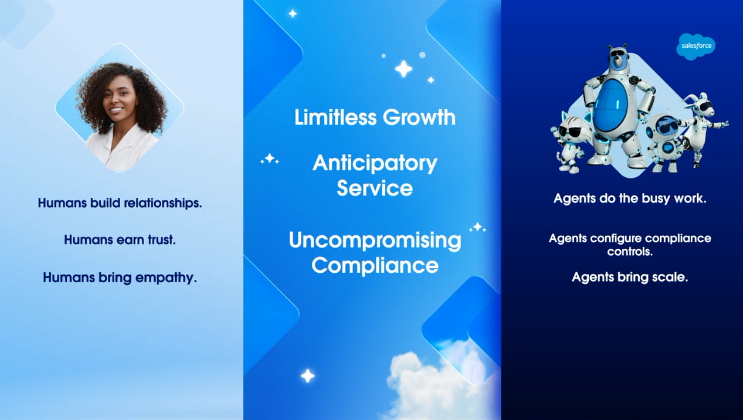
In 2026, firms will continue to move from “human-only” workflows to hybrid teams where agents handle the heavy lifting.
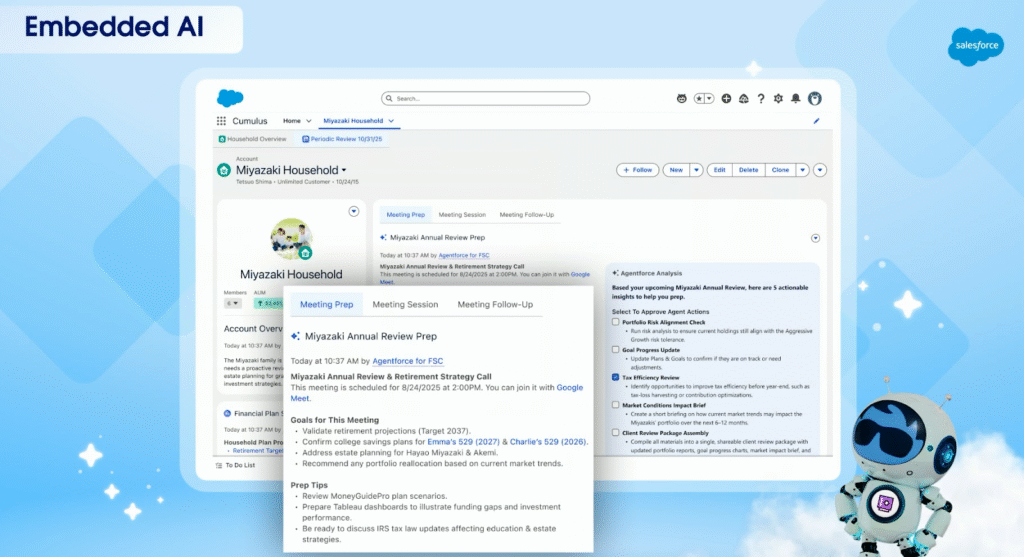
Wealth Management: Advisors will utilize Prep Agents to synthesize hours of research into 360-degree meeting briefings instantly. Nurturing Agents will manage “middle-of-the-pack” leads, engaging in two-way conversations until a prospect is ready to buy.
Marketing: The boundary between sales and marketing will blur. Agents will not just blast emails; they will craft personalized responses based on client intent and behavioral data, effectively nurturing leads 24/7.
A major theme for 2026 is shifting compliance from a reactive “cleanup” function to a proactive design feature.
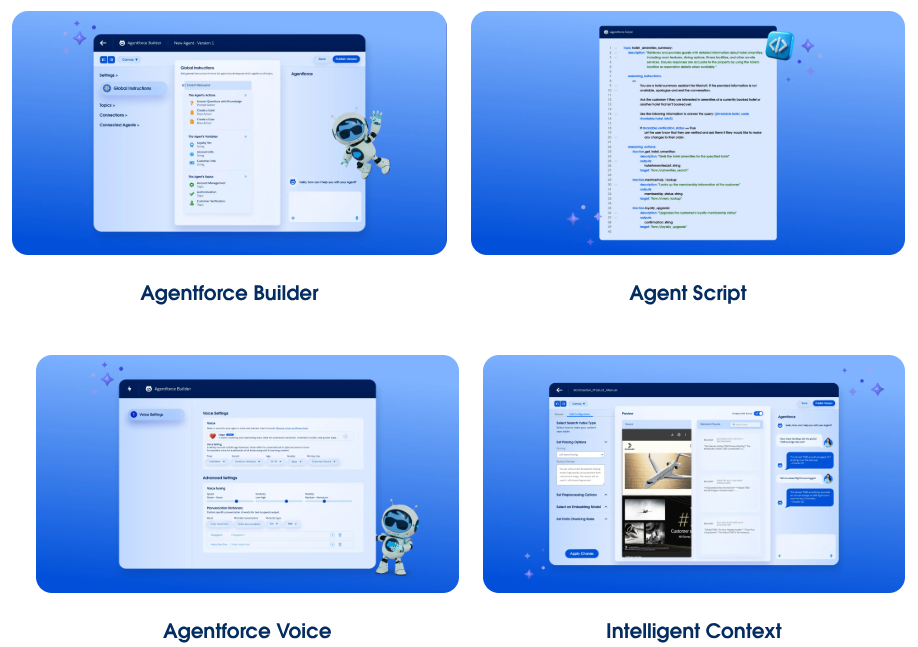
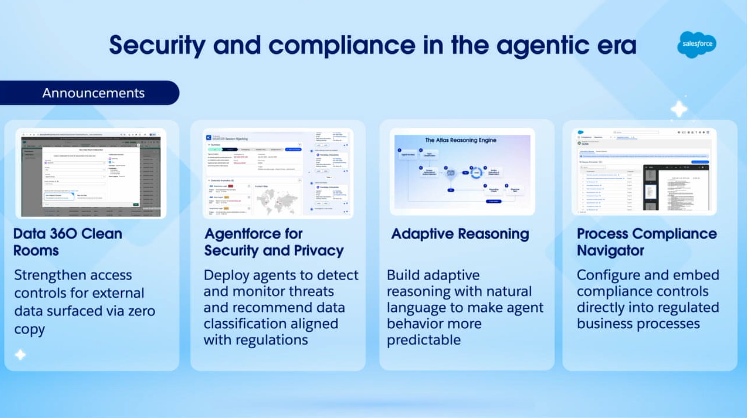
Deterministic AI: Financial firms cannot afford probabilistic guesses. Tools like Agentforce Script allow you to hard-code strict rules into agents, ensuring they follow regulatory processes exactly.
Process Compliance Navigator: As seen in the Dreamforce event in October, this innovation maps regulations directly to workflows. Instead of auditing for errors after the fact, the system prevents non-compliant actions in real-time.
4. The Growth Engine: Loyalty and Ecosystems
Growth in 2026 will come from breaking down silos between organizations.
Clean Rooms: Using Data 360 Clean Rooms, financial firms can securely partner with other brands (e.g., an airline or accounting firm) to identify shared high-value customers without ever exposing PII. This unlocks precise co-marketing opportunities previously impossible due to privacy concerns.
Total Cost Reporting (CRM3): In Canada, new transparency regulations are an opportunity, not a burden. By using Salesforce FSC to centralize fee and performance data, advisors can proactively demonstrate value, turning a regulatory hurdle into a trust-building conversation.
Conclusion
The roadmap for 2026 is clear: Unify your data, agentify your workflows, and automate your compliance. The technology is no longer theoretical—it is ready to be implemented.
References & Further Reading
For a deeper dive into these concepts, please refer to our original analysis:
Disclaimer: This article draws on information provided by Navirum regarding Salesforce capabilities and industry trends. Readers should verify specific regulatory requirements regarding CRM3 and TCR independently.
The Agentforce World Tour in New York highlights how Salesforce Data 360 and Agentforce are transforming marketing from campaigns into real-time, personalized conversations. Data 360 enables marketers to activate structured and unstructured data, bridging context gaps, while Clean Rooms allow secure, privacy-compliant collaboration with partners to create high-value audience segments.
AI-powered Agents act as lead nurturers, handling personalized interactions, automating follow-ups, and ensuring no opportunity is overlooked—turning traditional funnels into dynamic, automated dialogues. For wealth managers and financial institutions, integrating these tools with Salesforce Financial Services Cloud enables intelligent, hyper-personalized client engagement, driving loyalty, operational efficiency, and data-driven growth.
How Data 360 and Agents are Rewriting the Marketing Playbook
In our recent analysis, we explored how Salesforce Marketing Cloud and Agentforce are converging to redefine customer loyalty. The Agentforce World Tour in New York has provided us with a tactical playbook to elaborate upon the overarching strategy.
The headline from NYC isn’t just about “better bots”—it’s about a fundamental shift in how customer data is activated. With the introduction of Data 360 (the evolution of Data Cloud) and live examples from Salesforce customers, we now have a clearer picture of how marketers can move from “campaigns” to “conversations.”
Here is your update on what Agentforce means for the future of marketing, based on the latest reveals from New York.
1. Data 360: The New Engine for Marketing Cloud
The biggest branding shift in New York was the evolution of Data Cloud into Data 360. While the core “Zero Copy” architecture remains—allowing you to access data in Snowflake or Databricks without moving it—the focus has shifted aggressively toward activation.
For marketers, this solves the “context gap.” As Salesforce’s Paul Cordasco noted, “If you don’t provide the right data, the prompts aren’t going to get you there”. AI needs trusted data to ground its queries so responses are appropriate and free of hallucinations.
Why this matters for CX: You can now bring in unstructured data—like product manuals or PDFs—using Intelligent Context. This means your marketing and service agents can “read” complex documents (preserving charts and tables) to answer detailed customer questions instantly, ensuring your brand voice is consistent and accurate.
2. The Loyalty Game-Changer: Data 360 Clean Rooms
In our previous article, we discussed loyalty ecosystems. The New York event showcased the ultimate tool for this: Data 360 Clean Rooms.
Imagine a wealth manager wanting to partner with an accounting firm to target high-value customers. Historically, sharing lists was a privacy nightmare. With Clean Rooms, these brands can now collaborate in a secure “vault” where data is encrypted and Personal Identifiable Information (PII) is never shared.
The process involves both parties agreeing on data segments for exchange, followed by the system querying to find the overlapping audience. The outcome is a highly precise, jointly branded audience segment ready for immediate marketing activation, ensuring optimized spending by targeting only relevant travelers.
For Navirum clients looking to expand loyalty partnerships, this feature allows you to unlock second-party data insights without risk.
Perhaps the most striking example of “Agentic Marketing” came from PepsiCo. They are using Agentforce not just for support, but to ensure “no lead is left behind”.
In a typical B2B scenario, sales teams ignore smaller leads to focus on big accounts. PepsiCo is flipping this by having AI agents handle the initial nurturing.
Beyond Templates: These agents aren’t just sending canned emails. They are crafting personalized messages based on the prospect’s intent, business size, and region.
Two-Way Conversations: The agent engages in a back-and-forth conversation. It only hands off to a human seller when the lead is qualified and ready to book a meeting, complete with a prepared briefing for the sales rep.
This blurs the line between Marketing Cloud and Sales Cloud, turning the “funnel” into an active, automated dialogue.
Furthermore, a great example of hyper-personalization across channels came from Williams-Sonoma. If a customer buys a Dutch oven, their agent, “Olive” remembers this and later recommends recipes tailored for that specific pot. Agentforce Voice ensures agents retain complete customer history and context. This capability facilitates a smooth transition to a human designer when addressing more complex inquiries.
The Takeaway
The Agentforce World Tour in NYC confirmed that the tools to build a “Customer Company” are ready today.
Unify your data with Data 360.
Collaborate securely with partners using Clean Rooms.
Automate the conversation with Agents that act as an extension of your marketing team.
Want to activate Data 360 in your marketing strategy? Contact Navirum today.
The Navirum Advantage: Powering the Agentic Financial Enterprise
Since 2018, Navirum has been delivering outstanding customer satisfaction, resulting in repeat business and accelerated success for our clients.
At Navirum, we specialize in helping wealth managers and banks activate their data and modernize client engagement. Our founders bring deep experience from investment firms and Salesforce’s Financial Services team to help you navigate the shift to the Agentic Enterprise. On every project, we engage our:
Strategic Consulting – Align Salesforce to your business goals, compliance needs, and Data 360 activation strategies to drive client loyalty.
Technical Implementation – Deep expertise in FSC, Marketing Cloud, and Agentforce setup, ensuring your AI agents are grounded in trusted data and integrated with banking admin systems.
Managed Services – Continuous optimization and adoption support to ensure your agents perform effectively and your data remains actionable.
Contact us for an initial consultation to explore the ways Navirum can help your organization reach new heights with the combined power of Data 360, Agentforce, and Salesforce Financial Services Cloud.
The theme of the NYC event was clear: moving from “visionary demos” to “practical reality” For wealth management firms and financial institutions grappling with the “overwhelming sea of AI options”, Salesforce demonstrated that the Agentic Enterprise is not a future state—it is happening now.
Here is what the Navirum community needs to know about the latest updates from New York, and how they apply to the wealth management mega-trends we are seeing in the market.
1. The End of “Black Box” AI: Predictability and Compliance
One of the most significant barriers to AI adoption in Canadian and US financial sectors is the fear of the “hallucinating” bot. Financial services require deterministic outcomes, not probabilistic guesses.
At the NYC event, Salesforce tackled this head-on with the introduction of Agentforce Script and the Process Compliance Navigator.
Agentforce Script: This allows firms to configure deterministic rules directly into the agent. Instead of relying solely on an LLM to “figure it out,” you can code specific guardrails. This ensures that when an agent interacts with a client, it follows business processes to the letter of the law.
Process Compliance Navigator: This innovation maps regulations directly to the workflows they impact. The goal is to “flip the script” from reactive risk assurance (cleaning up spills) to proactive risk avoidance (preventing spills entirely).
Auditability: As mentioned by different experts at the event, regulators want a “glass box,” not a black box. The new tools provide audit trails for agent actions, allowing firms to prove compliance with detailed records of every transaction.
For wealth firms, this answers the critical question: How can we automate without compromising our regulatory standing?
2. Real-World Success: The Hybrid Workforce
We have previously written aboutuse cases for the agentic firm, such as client onboarding and meeting prep. The NYC event showcased live examples of this “hybrid workforce” in action.
Baxter Credit Union (BCU) shared how they deployed “Frida,” a financial freedom agent. Unlike legacy chatbots that hit dead ends with complex questions, Frida uses contextual knowledge to answer member questions about nuances like Power of Attorney requirements.
The Result: BCU saw a 10-15% improvement in human escalation rates (meaning the bot solved the issue without human help).
Lead Nurturing: BCU is also building agents to handle the “middle of the pack” leads that loan officers don’t have time to call. The agent nurtures the lead via email and text, and only loops in the human officer when the client is ready to book a meeting.
CMG Financial highlighted how agents are reducing the “manufacturing cost” of loans. Their goal isn’t to replace Loan Officers, but to make them “omnipresent” by automating rote tasks so they can focus on high-value advisory work.
3. Data is the Fuel: The “Data 360” Advantage
A recurring theme in our analysis ofSalesforce FSC for Canadian firms is the importance of unified data. In NYC, Salesforce doubled down on this with Agentforce 360 and the integration of Informatica.
Agents are only as good as the data they can access. The new Intelligent Context capabilities allow agents to ingest unstructured data—like PDF product manuals or regulatory documents—without losing the meaning of charts, tables, and headers.
For a wealth firm, this means an agent could theoretically read a complex PDF of a new investment product and accurately answer advisor questions about it immediately, without manual data entry. With the Informatica partnership, Salesforce is ensuring that this data is governed, traced, and trusted.
4. Accelerating Deployment with “Agentforce Vibes”
Speed to market is critical. Salesforce introduced Agentforce Vibes, a tool that allows developers and admins to conversationally build prototypes in minutes.
Instead of writing code from scratch, teams can upload a Product Requirements Document (PRD), and the agent helps generate the necessary code, metadata, and dashboards grounded in the firm’s actual schema.
This significantly lowers the barrier to entry for firms looking to test AI concepts before a full rollout.
The Agentforce World Tour in New York confirmed the rapid pace of industry change. As Matthew McConaughey’s voice suggests, the central question has evolved from speculating on “What if?” to determining “How soon?”
However, the event also reinforced that data maturity and governance are prerequisites for success. As Salesforce noted, legacy technology and fragmented data are merely “fodder” for this new agentic capability.
For our clients, the path forward involves three steps:
Unify Your Data: Leverage Data Cloud (Data 360) to ensure your agents have a “Golden Record” of the client.
Define Your Guardrails: Use Agentforce Script to ensure your agents stay within compliance boundaries.
Start Small, Scale Fast: Like BCU, which started with 5% of interactions and grew to 50%, pick a high-impact use case (like lead nurturing or meeting prep) and iterate.
The Agentic Enterprise is open for business. Are you ready to build?
Ready to explore how Agentforce can transform your firm? Contact Navirum today.
The Navirum Advantage: Expertise that achieves results
Since 2018, Navirum has been delivering outstanding customer satisfaction, resulting in repeat business and accelerated success for our clients.
At Navirum, we specialize in implementing and optimizing Salesforce FSC for wealth managers and banks. Our founders bring deep experience from investment firms, and Salesforce’s Financial Services team. On every project, we engage our:
Strategic Consulting – Align Salesforce to your business goals, compliance needs, and client engagement strategy.
Technical Implementation – Expertise in FSC setup, AI, automation, and integrations with banking admin systems.
Managed Services – Continuous optimization and adoption support to maximize your Salesforce ROI.
Contact us for an initial consultation to explore the ways Navirum can help your organization reach new heights, with the combined power of Salesforce Financial Services Cloud and Agentforce.
Modernizing Canadian Finance: Leveraging Salesforce Marketing Cloud and Agentforce for Customer Experience and Loyalty
The Canadian financial services sector, much like its global counterparts, is facing intense competition and higher customer demands for interactions that are personalized, relevant, and secure. As the hurdles to switching financial institutions decrease, clients are more willing to seek out alternatives that offer a superior customer experience.
To foster loyalty and build trust, Canadian financial institutions must bridge the gap between their traditionally strong internal systems for capital and risk management and the evolving digital demands of today’s consumers. The key to this transformation is the strategic integration of Salesforce Marketing Cloud (SFMC), Cloud pour les services financiers (FSC), and sophisticated AI solutions such as Einstein and Agentforce.
Here are the three great uses for a financial services firm leveraging these technologies to drive growth, compliance, and loyalty.
#1 The Trust-Building Onboarding Journey
First impressions are always important, and a dry “thank you” email is no longer sufficient when competing with agile fintech challengers. A very effective use of SFMC is to automate smart onboarding journeys that educate rather than just confirm.
Using Journey Builder, banks can trigger multi-step flows the moment a new account is opened. Instead of a generic blast, the system delivers educational content tailored to the customer’s specific product usage—such as setting up auto-transfers for a new savings account or explaining treasury services to a new business client.
The AI & Agentforce Edge: This process is accelerated by Agentforce for Financial Services, which is designed to streamline banking and wealth management operations. By integrating Agentforce, banks can deploy autonomous agents to handle routine inquiries during the onboarding phase, while Einstein AI analyzes engagement in real-time. If a high-value client stops engaging with the onboarding emails, the system can automatically pivot to other touchpoints that the advisor decides, such as an SMS with a personal callback offer or an invitation to connect with the advisor.
#2 The Hyper-Relevant Cross-Sell with Lifecycle Logic
Cross-selling is often viewed as intrusive because it is frequently mistimed. A customer who just paid off a student loan does not want another loan promo; they are more likely to need investment advice. SFMC transforms cross-selling by using lifecycle awareness to ensure offers are relevant and timed correctly.
Through Customer 360 Integration, banks can unify data from website interactions, mobile app usage, and transaction history to see the full context of a client’s financial life. This enables precise segmentation, moving beyond broad demographics (e.g., “Millennials”) to behavioural segments (e.g., “Active mobile users who viewed mortgage rates this week”),.
The AI & Agentforce Edge: This is where Data Cloud and Einstein Analytics become essential. They move marketing from “reactive” to “predictive.” Einstein can identify customers likely to respond to specific offers and recommend the “next best action” instantly,. Furthermore, Agentforce solutions can be employed to autonomously draft personalized outreach for advisors based on these predictive insights, ensuring the communication feels human and contextually aware.
#3 Proactive Churn Prevention and Retention
In the competitive Canadian market, insights and proactive actions can help identify and retain disengaged customers. SFMC allows banks to set up retention workflows that detect early warning signs, such as low interaction with emails, websites and apps. If a previously active user hasn’t logged in for 45 days, the system can automatically trigger a re-engagement path, starting with a gentle check-in email and escalating to a tailored incentive, such as a waived fee.
The AI & Agentforce Edge: By utilizing Agentforce, financial institutions can automate the remediation of these at-risk accounts more efficiently. For instance, Agentforce agents can independently manage service inquiries or navigate complex data strategies to uncover why churn is happening, allowing the company to implement effective measures to retain their clients.
The Bottom Line for Canadian Financial Institutions
Implementing this integrated solution is like moving from a generic loudspeaker announcement to giving every client a personal concierge who knows their destination, taps them only when relevant, and hands them exactly the right ticket.
Partner with Navirum to Activate Your Intelligence Strategy
The integration of Salesforce Marketing Cloud, Financial Services Cloud, Einstein AIet Agentforce is more than just a technological upgrade and Navirum is your specialized partner, ready to help you convert these powerful innovations into real, measurable business value.
Contact Navirum today for an initial consultation. Let us explore how we can architect a personalized, intelligent, and scalable client experience strategy that drives loyalty and positions your organization for sustained growth.
Harnessing Wealth Management Mega-trends with Salesforce FSC helps stay ahead in a rapidly evolving market
The Wealth Management industry is rapidly evolving into a tech-first environment where advisors are continuously adapting to more savvy and demanding clients who require impactful, digital tools to facilitate their investment journeys and bring them closer to their financial goals. Consequently, banks and asset managers are integrating advanced solutions into their tech stacks to boost their advisors’ productivity and effectiveness. However, amalgamating the different tools presents unique organizational challenges in order to maximize their return on these technology investments as quickly and efficiently as possible.
Salesforce, the global leader in CRM solutions, has positioned its Cloud pour les services financiers (FSC) as the foundational platform where firms are building their entire ecosystem to capitalize on the industry’s mega trends. In this article we will discuss some of these mega trends and explore how partnering with Navirum, a top Salesforce ISV, can help your organization achieve its objectives by leveraging Salesforce as your foundation and strategically adding relevant AI tools to your tech stack.
Hyper-personalization with a Focus on Trust and Transparency:
Many investment products and services are becoming commoditized, as most firms and advisors can offer comparable solutions. The key to being a trustworthy advisor lies on how well you know your clients and how effectively you can leverage that KYC information to connect with them, and bring forth relevant advice for their current life stage and situation, and proactively anticipate actions that lead to superior client outcomes. Moreover, the client must perceive the added value of the advisory process.
For an advisor managing multiple clients, efficiently condensing available information and preparing for meaningful conversations can be a cumbersome and time-consuming task. Salesforce AI directly addresses this by quickly reviewing and summarizing all client data in a cohesive and concise way, while also suggesting next best actions. Additionally, available tools to segment your clients and anticipate their preferences can be the difference between sounding like any other TV commercial and acting as an advisor who truly understands and anticipates the client’s needs.
Moreover, with regulatory efforts underway focused on fee transparency and accountability, e.g. cracking down on greenwashing disguised as legitimate ESG claims, advisors are pressed to show the work that justifies the fees charged to the client. The hyper-personalization that the clients demand must be supported by a system capable of handling all the necessary information and then suggesting smart actions for the advantage of both clients and advisors.
Capitalizing on the Great Wealth Transfer using Salesforce Households
As the successful generations that currently amass the bigger portion of today’s wealth start to pass down these assets to their beneficiaries, advisors must focus on retaining those assets and capturing new ones. Multiple surveys have documented that spouses and children inhering this wealth are highly likely to explore different advisors, firms or platforms to conduct their investments. This poses a significant retention risk.
Savvy advisors need to actively pursue legacy discussions with their clients to gain deeper visibility into all the household members and be able to generate a communication strategy designed to entice beneficiaries to continue the relationship. To execute this, an advisor needs a system that facilitates:
Due diligence and constructive monitoring of all household members.
Executing targeted marketing and communication strategies created specifically for subsequent asset owners, complete with precise segmentation of leads and opportunities.
The Salesforce household architecture is the ideal configuration to help advisors concentrate their focus on the wealth transfer. It allows them to retain assets and even grow their book of business by leveraging this optimal, interconnected approach. For the assets under management (AUM) that are actively seeking a new advisor, the householding structure provides the evidence needed to highlight a holistic, fact-based approach, rather than relying on mere marketing slogans.
Scaling your business with Vetted Hybrid Tools
In today’s environment, defined by AI and hybrid advisory models where clients have instant access to their portfolio and market information, realizing your full value as an advisor requires more than a single tool. Anticipating these trends, Salesforce has pushed long ago to become an ecosystem of vetted solutions that can turbocharge your CRM data and day-to-day activities and take your firm to soaring new heights.
However, researching the right tools and partners to fully realize your firm’s vision can take countless hours. This is where Navirum’s expertise comes in. Our track record and continuous exposure to innovative solutions and complex projects give us a significant edge when helping clients strategically build out their tech stack.
Bonus: Doing so While Protecting your Data and Minimizing your Cybersecurity Risks
The continuous innovation in cloud-native platforms and mobile applications has understandably heightened concerns about cybersecurity threats and fraud. Robust security measures and compliant communication channels are critical for maintaining client trust and meeting regulatory requirements.
Salesforce has been a pioneer in this department considering the personal information it has handled since its origins, and now new developments such as the Einstein Trusted Layer ensure that AI outputs are safeguarded within the firm’s environment.
Partner with Navirum to Navigate the Great Wealth Transfer
Navirum is your trusted partner to transform the insights discussed in this article into real business value. We will help you assess your current data and architecture, identify high-value and compliant pathways, and build an integration blueprint.
Contact us for an initial consultation to explore the ways Navirum can help your organization reach new heights, with the combined power of Salesforce Financial Services Cloud and Agentforce.
Three High-Impact Use Cases for the Agentic Wealth Management Firm
Introduction: The Agentic Vision Realized
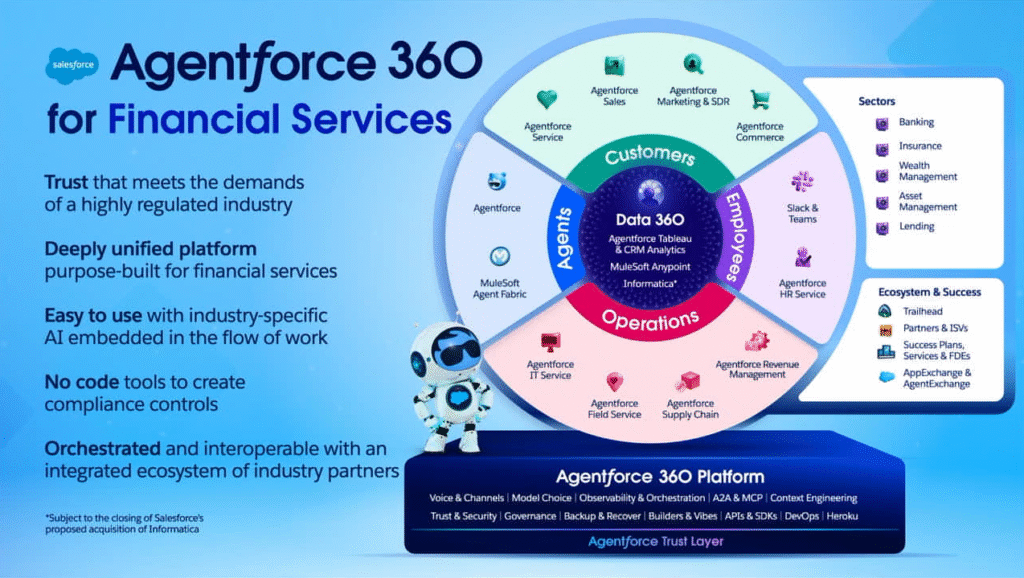
Last month we witnessed how Salesforce is further refining its AI-tools to boost adoption of Agentforce in the Financial Services industry. This revolutionary platform is already helping companies shift from conceptual blueprints to operational imperatives where humans can be removed from certain simple tasks and agents become the new operational backbone of the enterprise. This is the promise of Agentforce 360: a seamless, trusted layer of AI agents embedded directly within your Salesforce Environment.
Our previous articleestablished the wireframes of the agentic enterprise, and in this one we demonstrate the material value it can bring to your wealth management firm: scaling personalization and advice quality while mitigating the mounting burdens of administrative overhead and regulatory risk.
The Agentforce Advantage: Scaling the Human Touch
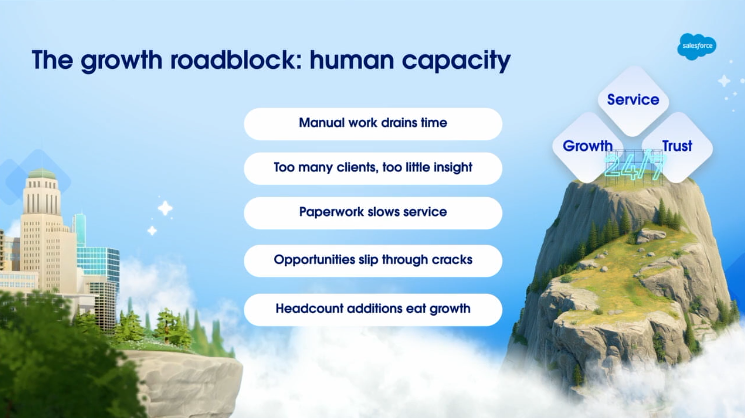
The core problem for advisors remains a persistent and costly one: they spend over 70% of their time on administrative tasks—from meeting prep to compliance documentation— or repetitive ones —drafting a marketing campaign for their clients and high-value contacts— rather than on client relationships or growth activities. Here’s where Agentforce directly addresses this productivity gap, by operating within the Einstein Trust Layer and grounded in Data 360 for unified client context with pre-built, role-based agents that amplify the human potential.
Three High-Impact Agentforce Use Cases in Wealth Management
Use Case 1: Hyper-Personalized Client Meeting Automation with a Prep Agent.
For an important meeting with a top client, an advisor traditionally spends hours synthesizing data from various systems: CRM, portfolio management, trust documents, and service history.
The Prep Agent automates this. Hours before a meeting, the agent accesses the unified client record (Data 360), processes all structured and unstructured data, and delivers a 360-Degree Briefing to the advisor’s workspace. This is not just a summary—it’s a prioritized, synthesized agenda that can highlight:
A suggested Next Best Action (e.g., “Propose RESP plan setup based on upcoming birth record in household.”)
Crucially, after the meeting’s happened, an agent will automatically draft the call report and follow-up tasks from the meeting transcript, logging them instantly in the client record in FSC and the advisor’s dashboard.
The result: Automating manual tasks such as research, meeting preparation, and account updates with industry-trained digital assistants boosts advisor productivity. This allows advisors to focus on clients and cultivate deeper, more strategic relationships by providing them with real-time insights and more time for what truly matters.
Use Case 2: Real-Time Suitability Assurance with a Compliance Agent
In a highly regulated environment, Salesforce offers the right to tools to ensure Compliance is an automated guardrail and not a manual bottleneck. A Compliance Oversight Agent can facilitate that every action is auditable and within policy.
For example, when an advisor suggests a new product or trade, this agent operates as a real-time risk filter, instantly verifying the recommendation against the client’s documented risk profile, liquidity needs, and long-term financial goals.
If the agent detects an exception (e.g., recommending a high-risk product to a conservative client), it proactively flags the discrepancy and triggers a clear, human-in-the-loop review process via Process Compliance Navigator.
Every agent action, every check, and every human override is logged in a secure, immutable audit trail—guaranteed by the Einstein Trust Layer.
The result: Seamless, embedded compliance that shifts the firm from reactive auditing to proactive, auditable risk mitigation. Deliver tailored advice at every touchpoint. By leveraging AI to surface timely insights and recommendations, while staying compliant in every step of the process.
Use Case 3: Next-Gen Client Service with Relationship Nurturing Agent
The goal of this Client Service Triage Agent is to scale service excellence without increasing human administrative load. Routine client requests can be addressed by automated processes that maintain the service quality and deliver the necessary information faster than what it would take the advisors to extract it from the right document or dashboard.
The Triage Agent can handle these requests 24/7 via chat, voice, or email. It uses pre-approved knowledge and actions to resolve up to 80% of routine inquiries independently.
For more complex requests, the agent will generate and escalate the ticket without mishandling the communication with the client. It packages the full conversational context, relevant account data, and proposed resolution path, and routes the case to the appropriate human specialist. The human adviser receives the ticket with the adequate contextual information, enabling a fast and informed resolution.
The result: Seamless client experiences, data-driven growth, and reduced costs, ultimately resulting in faster resolutions and increased client satisfaction. Unified data and AI are used to predict client needs, enabling optimal actions and integrated operations to scale high-touch service.
The New Operating Model: The Agentic Enterprise is here
Agentforce 360 allows wealth management firms to direct the human advisor toward high-judgment, high-empathy tasks that drive decisive growth. By deploying autonomous agents for prep, compliance, and routine service, firms can avoid spending capital on repetitive processes and instead invest in the exponential capacity of their superhuman teams.
The work of Navirum is to connect the Agentforce architecture to your firm’s unique business logic, moving you from AI ambition to quantifiable, trusted business transformation.
Agentforce is Salesforce’s new autonomous AI platform, designed to help organizations deploy trusted AI agents directly within the Salesforce ecosystem. For wealth management firms, that means virtual agents can now analyze portfolios, surface client insights, automate service requests, and even support advisors in real time — all while staying compliant and secure within your Salesforce environment.
Our consulting team helps firms design Agentforce agents that align with their client engagement strategy, data governance requirements, and compliance standards.
How does Agentforce work?
At its core, Agentforce combines Salesforce’s Atlas Reasoning Engine, Agent Builder, and Einstein Trust Layer. Together, they let firms build intelligent agents that understand client intent, pull relevant CRM and financial data, execute actions, and hand off to human advisors when needed.
We help clients configure Agent Builder to handle tasks such as lead qualification, account servicing, and personalized reporting — all integrated with your existing Salesforce Financial Services Cloud setup.
What are the key use cases for wealth management?
Agentforce opens up high-impact opportunities across the client lifecycle:
Operations: Streamline reporting and internal approvals through autonomous workflows.
Client onboarding: Automate KYC data collection and initial portfolio setup.
Every Salesforce customer can start experimenting with Agentforce for free under the Salesforce Foundations offering. Beyond that, pricing scales with usage — typically based on the number of AI interactions or data actions processed. Deployment follows Salesforce’s standard model, allowing firms to launch pilot agents within their existing org and expand incrementally.
Our consultants guide clients through sandbox testing, governance setup, and user adoption planning to ensure smooth rollouts.
What should wealth management firms consider before implementing Agentforce?
Data readiness: Ensure clean, accessible client and product data within Salesforce.
Compliance and guardrails: Define what agents can and cannot say or do.
Integration: Align Agentforce with financial planning tools, custodial platforms, and internal data systems.
Change management: Prepare advisors and support teams for new workflows and AI collaboration.
Our team specializes in financial services implementations, helping firms establish the right governance and security frameworks from day one.
Ready to Build Your Agentic Firm?
Agentforce represents a pivotal shift in how wealth management firms can scale personalized service, streamline advisor operations, and stay compliant in an AI-driven world.
Contact our Salesforce consulting team to explore an Agentforce readiness assessment or a tailored pilot project for your firm.
Why You Should Choose Salesforce FSC and Conquest Planning integration?
Advisors face increasing demands from compliance regulations, client expectations, and a growing array of software solutions designed to streamline operations. However, the common “swivel-chair” approach, where advisors juggle multiple disparate tools, significantly hinders their productivity and effectiveness.
Seamless integration between Salesforce Financial Services Cloud and leading financial planning solutions, such as Conquest Planning, significantly augments the advisor’s focus on both the immediate and the strategic priorities for each client and prospect.
This article explores how Navirum’s expertise can integrate your Conquest Planning client data into Salesforce Financial Services Cloud, transforming an operational hurdle into an essential platform unification, ultimately boosting advisor productivity and client satisfaction.
For organizations managing multiple clients, extensive data, and complex regulatory landscapes, Salesforce serves as the definitive single source of truth, providing a 360-degree client view. This advanced ecosystem centralizes all client information—including CRM specifics, financial objectives, and portfolio holdings—and in a coherent, actionable way for advisors to act on. This capability extends seamlessly to financial planning, making it an integral part of the platform.
The financial planning process extracts considerable valuable data that can be concentrated in Salesforce, enabling faster preparation and more valuable client conversations. Moreover, when a financial plan is created and the goals of the client have been defined, the advisor can track the progress of said plans and goals in the Salesforce dashboard to quickly identify the clients that need proactive, immediate, attention. Consistent data across platforms allow advisors to confidently see the complete client picture instantly. No more data duplication or deep dives for client information.
From Data to AI-Augmented Insights
Rich data sets are unlocking more added value for advisors and their clients. Deep financial plan metrics from Conquest can be combined with client information in the CRM to power Salesforce’s AI (Einstein) to create hyper-personalized experiences for the clients and prospects, whether it is a marketing campaign or a follow up email with specific call-to-actions. AI agents can suggest specific tasks related to cash flow milestones and future goals, unused cash or new insurance needs extrapolated from the plan.
Clients’ persistent need of being heard and understood is addressed with the help of rich data that is converted into relevant touchpoints for the clients. By optimizing workflows, Navirum helps financial advisors leverage rich data to create more meaningful client interactions. This approach fosters engagement and builds trust by ensuring that AI assistants enhance, rather than overshadow, human-led decisions. Advisors maintain critical visibility and control, maximizing the value derived from these tools.
Salesforce Financial Services Cloud (FSC) plays a pivotal role in helping banks and financial institutions proactively manage regulatory compliance, especially with increasing burdens like CRM3. Previously, financial planning and risk assessment workflows were siloed. However, new technologies and unified workflows now enable a more holistic approach to advisor activities. By streamlining compliance operations and aligning financial plan risk and return assumptions with client intake forms and annual reviews, financial services firms can unlock significant value.
Integrating financial plans with Salesforce Financial Services Cloud (FSC) establishes a seamless digital record for compliance, powering automated, real-time checks for investment risk and suitability. All pertinent departments can easily access and manage this information within Salesforce. The system also enhances Client Services and Compliance efficiency through time-stamped audit trails and monitoring dashboards, which streamline regulatory reviews and facilitate proactive oversight and intervention.
Navirum – Your Partner in Integrated Growth
Integrating Salesforce Financial Services Cloud with Conquest Planning creates a unified platform that enhances the value and scope of the advice provided to clients. The integration boosts advisor effectiveness, ensures compliance, and meets client expectations by centralizing financial plan data. It empowers proactive advice, increases client engagement, and significantly improves productivity and retention.
Navirum specializes in making this critical transition a reality. Partner with our integration experts to turn your dual systems into a singular, high-performance revenue engine, delivering a superior experience for both your advisors and your clients. Reach out to us to schedule an exploratory conversation and discuss a proof of concept.
Dreamforce 2025: The Blueprint for the Agentic Financial Enterprise (A Navirum Perspective)
Financial Institutions are adopting AI-based solutions at an increasingly fast pace, but the challenge now lies in integrating AI seamlessly into their core banking, wealth, and insurance solutions. More than a side project, AI is now perceived as the operational backbone that will unify all aspects of the business with the help of ‘digital workers’.
Dreamforce 2025 took place last week in San Francisco, CA, where CEO Mark Benioff introduced Salesforce’s latest innovations and launched Agentforce 360, reinforcing Salesforce’s role as the core system in a company’s efforts to harness AI solutions and benefits.
Salesforce is enhancing its AI-driven solutions by implementing additional guardrails. These measures ensure that AI integrations adhere to user-defined boundaries, whether through comprehensive compliance procedures for agents or leveraging Data360 (formerly Data Cloud) services. Data360 will significantly boost agents’ ability to utilize existing cloud information.
Turning AI Hype into Financial Value with an ‘Agentic Enterprise’
Collaboration and teamwork have a new meaning in the agentic era, where humans can leverage AI agents (like Banking Agents or Claims Agents) to handle up to 70% of routine tasks and cut service costs.
We’ve heard from firms like PenFed Credit Union who are already using these agents and empowering their employees to achieve better results and grow with their companies. Comprehensive 360-degree client views are being prepared effortlessly minutes before a meeting, including personalized reminders and “next best action” suggestions.
Navirum is the partner that can design and integrate Agentforce to align with existing business rules and systems, via MuleSoft and Financial Services Cloud, to ensure the agents can take action and not just provide information.
Powering Real-Time Compliance with Einstein Trust Layer and Process Compliance Navigator
Highly-regulated industries, such as Financial Services, need Salesforce to provide certainty on how AI is using their information in a responsible and compliant way. That’s why during the 2025 Dreamforce, Salesforce emphasized the continuous improvements and enhancements into its Einstein Trust Layer, a secure AI architecture that permeates the whole Salesforce ecosystem.
This robust set of features keeps sensitive information secure while maintaining audit trails intact, for KYC and AML purposes for example. Its data-masking and zero-data retention policies are helping companies mitigate risks by limiting agentic activities to be reviewed and approved by a human. Moreover, the introduction of the Process Compliance Navigator enables real-time checks into the compliance workflows for seamless oversight, reducing the risk of human error in complex, multi-step compliance tasks.
Navirum partners with financial institutions on optimization projects, leveraging our cybersecurity expertise and deep understanding of the regulatory landscape to address their key priorities.
Data360 for Financial Services as the AI Foundation
Data Cloud has been rebranded Data360 to align with the new Agentforce 360 platform. Financial Institutions know well that a 360-degree view is necessary to capitalize on existing opportunities with both clients and prospects, but to do that you need clean, unified data for successful AI adoption.
Data360 unifies unstructured data from various financial services systems like core banking, policy, CRM, and web traffic. This consolidation helps extract insights for AI tools such as Slack and Tableau, ultimately improving efficiency by breaking down traditional silos.
Navirum can map, migrate and consolidate disparate financial data and make it AI-ready for our clients, enabling the creation of hyper-personalized client experiences.
Partnering with Navirum to Navigate the AI Transformation
Dreamforce 2025 has been a great example of Salesforce delivering the tools to empower organizations in today’s AI transformation. Navirum is your trusted partner to assess your current data and architecture, identify high-value and compliant pathways and build an integration blueprint to turn these innovations into real business value.
Contact us for an initial consultation to explore the ways Navirum can help your organization reach new heights, with the power of Salesforce Financial Services Cloud and Agentforce.
Tech Due Diligence in Financial Services Consolidation:
How to avoid the new deal-breaker and turn DD into an efficient roadmap that paves the way to growth
In today’s technology-driven market, the risk of overlooking the target firm’s technology infrastructure and savyness, is a direct path to inheriting crippling security liabilities, uncontrollable integration costs and debilitating technical debt.
Financial Services firms in North America are facing growing pressures from compressing fees, rising regulatory costs, and fierce competition both from local and international firms. This environment is driving increased market consolidation, as firms seek to achieve the critical mass necessary for survival and growth. Traditionally, due diligence exercises focused on the commercial advantages, talent pool, sound legal standing and healthy financial ratios, but the technology stack has increasingly become a decisive factor in greenlighting mergers and acquisitions and determining the price tag associated with those.
This article makes the case for partnering with a technology expert like Navirum to perform a deep and strategic due diligence to give peace of mind to companies exploring an acquisition and uncover hidden potential before, during and after the integration. Navirum’s Salesforce Financial Services cloud expertise can transform a standard risk assessment into a clear roadmap aiming for operational excellence and accelerated deployment. Read on to learn how to de-risk your next consolidation and maximize your growth ambitions.
The Imperative for Diligence in a Fast-Paced Environment
The investment management landscape groups participants in those big institutions offering many if not most services, and the boutique providers offering differentiation and personal touch to their clients. However, we have been witnessing an increased willingness from large firms to access differentiated and/or more profitable products and services. Traditionally, the most attractive path to access these differentiators is through acquisitions, in order to quickly integrate the new offerings and resources and drive growth.
Boutique asset managers, specialized hedge funds, and private capital allocators offer enticing potential for synergies and market differentiation resulting in more consolidation in the market. Moreover, reputable firms focusing on niche strategies are scrambling to meet new and enhanced regulatory requirements, highlighting the need for a bigger critical mass to keep operating efficiently.
However, these smaller, more agile firms can also come with potential pitfalls such as less-refined tech stacks, outdated systems and patchwork integrations that can present integration challenges and overspending, scalability limitations and significant security vulnerabilities.
What to look for when assessing the target firm’s tech stack
A sound technology due diligence must evaluate existing systems, their data workflows and interoperability across multiple teams and processes. Client, fund and transaction data ideally are already integrated and optimized for scale. If the potential acquisition has a growth ambition, then the existing systems should be able to handle 2x or 3x their current Assets Under Management (AUM).
Another area of focus is regulatory adherence in terms of data residency and privacy laws, considering the keen interest of both the public and regulators in cybersecurity risks and robots protocols for the future. Financial Services firms are more aware than ever about the reputational risks associated with data breaches. A reputable technology partner like Navirum helps you navigate the complexities of existing protocols and potential operational improvements.
A sound DD should not just flag gaps but also include an integration roadmap, with estimations of lead times and costs associated with achieving the acquisition goals. For this, the experience of your technology partner can be the deciding factor between lagging, meeting, or exceeding the expectations of the amalgamation.
When assessing the synergy potential and integration roadmap, a reputable technology partner like Navirum is essential for uncovering the additive or detracting value of the target firm’s tech stack. This valuable information effectively de-risk the transaction, stripping away unwanted surprises that may arise when an adequate DD is not performed.
Moreover, Navirum provides actionable recommendations aimed at boosting the ROI of your partnership. Our experience with Salesforce Financial Services Cloud provides us with an unmatched innovation mindset to enable firms to eliminate data silos and automate compliance workflows and client reporting, supporting efficient operations while driving down cost pressures.
In today’s landscape, a re-acquisition technology due diligence is a competitive necessity. It not only prevents bitter surprises down the road, but also steers the integration toward success. Navirum ensures that the technology due diligence is performed through the lens of modern, best-in-class technology platforms like Salesforce, providing the acquiring firm with a clear path to an efficient and scalable growth.
Navirum Client Success Stories in Financial Services
Construisons l'avenir des services de confiance en toute assurance | Navirum
Modernisation de l'écosystème
Construire l'avenir des services de confiance en toute confiance
Les sociétés fiduciaires les plus performantes ne se contentent pas de moderniser leurs technologies : elles mettent en place des organisations connectées et centrées sur le client, prêtes à relever les défis de la prochaine génération de gestion de patrimoine. Grâce à Salesforce Financial Services Cloud, vous pouvez unifier la gestion de la relation client, rationaliser vos opérations, tirer parti de la productivité offerte par l'intelligence artificielle et positionner votre entreprise sur la voie d'une croissance à long terme.
Navirum aide les sociétés fiduciaires à franchir toutes les étapes de leur parcours de transformation, de la stratégie et du choix de la plateforme à la mise en œuvre, à l'intégration et à l'adoption.
Voyons ensemble quelles sont les possibilités pour votre organisation.
La norme CRM3, officiellement dénommée « Total Cost Reporting » (TCR), est une règle des Autorités canadiennes en valeurs mobilières (ACVM), reprise dans les règles applicables aux intermédiaires de l’OCRI, qui est entrée en vigueur le 1er janvier 2026. Les intermédiaires et les conseillers doivent désormais déclarer, en dollars, les coûts implicites récurrents des fonds d’investissement, en plus des frais directs. Les premiers rapports annuels établis en vertu de ces nouvelles règles portent sur l’année civile 2026 et seront communiqués aux clients en 2027.
Mise à jour : 1er novembre 2026
CRM3 / Aperçu des rapports sur les coûts totaux
Également appelé
CRM3, TCR
Les responsables de la réglementation
ACVM (modifications apportées à la norme NI 31-103), CIRO (règles harmonisées applicables aux courtiers), CCIR (directives parallèles relatives aux fonds distincts)
En vigueur
1er janvier 2026 (avis de la CSA et du CCIR, avril 2023 ; approbation par l'OSC des modifications apportées au CIRO, juillet 2025)
Premiers retours d'expérience des clients
Rapports annuels portant sur l'exercice clos le 31 décembre 2026, à remettre en 2027 (avis des ACVM et du CCRI, avril 2023)
Signaler un problème
Rapport annuel sur les honoraires et autres rémunérations (ARCC)
Nouvelles informations à fournir
Frais des fonds en dollars ; frais des fonds d'investissement directs ; coûts totaux d'investissement ; ratio des frais du fonds (FER) pour chaque fonds
FER
Taux des frais de gestion (TFG, qui inclut les commissions de suivi) + taux des frais de transaction (TFT)
Produits concernés
Les fonds d'investissement, y compris les fonds communs de placement, les ETF et les plans d'épargne-études ; les contrats de fonds distincts conformes aux directives du CCIR. Les fonds parrainés par des syndicats et les fonds exemptés de prospectus sont pour l'instant exclus (avis des CSA et du CCIR, avril 2023)
Qui est concerné ?
Courtiers en valeurs mobilières, distributeurs de fonds communs de placement, gestionnaires de portefeuille, gestionnaires de fonds d'investissement (qui fournissent les données), assureurs proposant des fonds distincts
Comment nous en sommes arrivés là : CRM2, les réformes axées sur le client, et CRM3
La norme CRM2, mise en œuvre progressivement entre 2014 et 2016, imposait aux distributeurs de fournir à leurs clients des rapports annuels sur les commissions qu’ils versaient directement et sur la performance des comptes. Les réformes axées sur le client (2021) ont ensuite renforcé les obligations en matière de conflits d’intérêts, de connaissance du client, de connaissance du produit et d’adéquation. Le CRM3 (déclaration du coût total) comble la lacune laissée par le CRM2 : les frais courants intégrés aux fonds, que les clients n’avaient jusqu’à présent jamais vus exprimés en dollars (Avis de la CSA et du CCIR, avril 2023; Avis de l'OSC approuvant les modifications apportées par le CIRO concernant l'amélioration des déclarations de coûts, juillet 2025).
Les rapports annuels des clients indiquent désormais le ratio des frais du fonds (FER) pour chaque fonds qu'ils détiennent, lequel regroupe le ratio des frais de gestion (MER) et le ratio des frais de transaction (TER), ainsi que le montant en dollars des frais liés aux fonds et les frais facturés par la société.
Ce que vos clients verront dans leurs rapports de 2027
Le rapport annuel de chaque client indique désormais, en dollars, le montant des frais de gestion payés sur l'ensemble de ses placements, les frais directs liés aux fonds (tels que les frais de rachat ou de négociation à court terme), ainsi qu'un coût total d'investissement unique qui regroupe ces éléments et les commissions versées au courtier. Un tableau présente le ratio des frais de gestion de chaque fonds détenu. Aucun de ces coûts n'est nouveau, mais pour de nombreux clients, ce sera la première fois qu'ils les verront regroupés sous la forme d'un chiffre unique.
Ce que le CRM3 va changer dans les échanges avec les clients
Ce changement dans la communication d'informations est mineur sur le papier, mais il fait beaucoup parler de lui. Un client qui n'a jamais vu les frais d'un fonds exprimés en dollars se voit présenter un chiffre pour la première fois, et les questions qui s'ensuivent sont suffisamment prévisibles pour qu'on puisse s'y préparer :
Pourquoi mes frais déclarés ont-ils augmenté ? Le chiffre indiqué est nouveau, mais le montant des frais ne l'est pas. Les frais du fonds ont toujours été payés, et la réglementation exige désormais qu'ils soient indiqués en dollars.
S'agit-il de nouveaux frais ? Non. Rien n'a été ajouté. Ce qui a changé, c'est la manière dont ces informations sont communiquées.
Quelle part revient à mon conseiller, quelle part au courtier et quelle part au gestionnaire de fonds ? Le montant total comprend les frais directs versés au courtier ainsi que les frais pris en charge par le fonds, et les clients souhaiteront obtenir des explications sur cette répartition.
Ces frais sont-ils déjà pris en compte dans mes rendements ? Oui. Les performances des fonds ont toujours été présentées après déduction des frais liés aux fonds.
Pourquoi est-ce que je conserve ce fonds plutôt qu'une alternative moins coûteuse ? Un produit choisi pour une raison précise a désormais un coût évident, et cette raison doit être clairement justifiée.
Quels services vais-je obtenir en contrepartie du montant total que je paie ? C'est la question la plus difficile parmi les six, et celle qui déterminera l'issue de la conversation.
C'est précisément sur cette dernière question que la valeur du conseil doit être clairement énoncée, plutôt que simplement supposée. Pour la plupart des ménages, la réponse se résume à une liste : planification financière, coordination fiscale entre les comptes et les membres de la famille, conseils en matière de revenus de retraite et de dépense du capital, gestion des risques et bilan des assurances, accompagnement comportemental visant à inciter les clients à conserver leurs placements malgré la volatilité des marchés, et service proactif entre deux bilans. Les cabinets capables de décrire ce travail par segment de clientèle, avec des exemples à l’appui, aborderont les entretiens de 2027 dans une position différente de celle des cabinets qui improvisent derrière leur bureau.
Les 90 premiers jours suivant la réception des relevés
Attendez-vous à trois choses dès la publication des rapports de 2026. Premièrement, une augmentation des questions des clients, principalement sous la forme de « pourquoi mes frais sont-ils plus élevés ? », qui parviendront simultanément aux conseillers et aux équipes de service. Deuxièmement, les conseillers devront se préparer aux entretiens sur les frais : quels ménages détiennent des produits à frais élevés, qui a déjà appelé et ce qui a été dit. Troisièmement, le rapprochement des données : des chiffres fournis par les gestionnaires de fonds, les distributeurs et les dépositaires qui ne concordent pas et doivent être localisés avant qu’un client ne reçoive de réponse.
Le défi opérationnel des sociétés de gestion de patrimoine
Les chiffres figurant dans le rapport consacré à un client donné sont compilés à partir de données stockées dans au moins six emplacements différents :
Les gestionnaires de fonds et les fournisseurs de données sur les coûts, qui fournissent les informations relatives aux frais des fonds
Les dépositaires, qui détiennent les positions et les transactions
Systèmes de comptabilité et de gestion de portefeuille, qui enregistrent les évaluations et l'historique des positions
Les plateformes de back-office des concessionnaires, qui prennent en charge les frais directs
Les systèmes de déclaration réglementaire, qui effectuent les calculs et établissent le rapport annuel
Les plateformes de CRM et de service client, où s'établit concrètement le dialogue avec le client
Un CRM ne constitue pas la source des calculs réglementaires et ne doit pas être présenté comme tel. C'est le système de reporting de référence qui effectue les calculs et génère le rapport annuel. Le défi opérationnel est d'une autre nature : il s'agit de relier des données de coûts précises au contexte du client, du foyer, du conseiller et du flux de travail, afin que l'entreprise puisse justifier un chiffre qu'elle n'a pas calculé elle-même.
Lorsque ces liens font défaut, les six mêmes problèmes reviennent à chaque cycle de reporting :
Des vues client incomplètes, dans lesquelles aucun écran ne présente à la fois le portefeuille, les frais et l'historique des relations d'un ménage
Rapprochement manuel entre les chiffres des fonds, de la conservation et des services administratifs qui ne concordent pas
Une préparation inégale des conseillers, la qualité d'un entretien sur les honoraires dépendant de la personne qui le mène
Des réponses lentes, car pour répondre à une seule question d'un client, il faut faire appel à trois systèmes et à deux collègues
Les processus de gestion des exceptions et de correction sont insuffisants, de sorte qu'un chiffre contesté ne fait l'objet d'aucun suivi jusqu'à sa résolution.
Visibilité limitée de la direction et des services chargés de la conformité sur les demandes des clients et la manière dont celles-ci sont traitées
Le rôle de Salesforce Financial Services Cloud
Conçu pour le secteur des services financiers, Salesforce FSC offre aux conseillers un espace unique pour gérer les informations relatives à leurs clients. Grâce à ses intégrations avec les données des dépositaires et des fonds, il regroupe les informations provenant de plusieurs dépositaires, fonds et stratégies, permettant ainsi aux conseillers de répondre rapidement et avec précision aux questions de leurs clients.
Principales fonctionnalités de Salesforce permettant de se préparer à CRM3 :
Une vue client : avec le dépositaire et intégrations de données relatives aux fonds, FSC regroupe les données relatives aux placements et aux coûts au niveau du foyer, ce qui permet à un conseiller de visualiser le coût total des investissements d'un client à côté de l'historique de la relation.
Suivi des demandes : enregistrer chaque question relative au CRM3 sous forme de dossier, l'acheminer et établir des rapports sur le volume et les thèmes abordés.
Préparation du conseiller : Agentforce permet de synthétiser la situation financière d'un ménage et les échanges antérieurs avant un entretien de bilan.
Cycle récurrent : le rapport sur les coûts totaux est établi chaque année ; les services gérés d'Orbit assurent la maintenance des flux de données, des rapports et des processus automatisés.
Accès basé sur les rôles et traçabilité : accès aux données relatives aux clients et aux coûts en fonction des rôles, historique des flux de travail indiquant qui a effectué quelle action et à quel moment, ainsi que des registres servant de base à l’audit et à la supervision internes de l’entreprise. Ces contrôles doivent être conçus, configurés et gérés ; la mise en œuvre de Salesforce ne les génère pas automatiquement et n’offre aucune garantie à cet égard.
Le FSC soutient le programme de conformité d'une entreprise ; il ne remplace pas le système de reporting du concessionnaire qui sert à établir le rapport annuel.
Transformer une plus grande transparence en valeur ajoutée pour le client
La déclaration des coûts totaux constitue une obligation d'information, mais elle impose également un dialogue que la plupart des cabinets souhaitaient approfondir. Un cabinet qui s'y prépare bien bénéficie de discussions plus claires sur les honoraires, plutôt que de discussions sur la défensive ; cela lui offre une occasion de démontrer la valeur de ses conseils plutôt que de simplement l'affirmer ; cela lui permet d'identifier rapidement les clients qui ont besoin d'un contact proactif avant même qu'ils n'appellent ; c'est également l'occasion de vérifier si les produits et les modèles de service restent adaptés à chaque segment, et d'obtenir de meilleures informations pour proposer un accompagnement personnalisé.
C'est pour mener ces actions à grande échelle qu'une plateforme s'avère utile. Lorsqu'elle est connectée à des systèmes sources fiables, Salesforce FSC permet de rendre cette préparation reproductible : les segments sont définis une seule fois, les arguments clés et les résumés de service sont disponibles au moment de l'entretien, les actions de prospection sont suivies et les thèmes sont visibles par la direction. La valeur réside dans la préparation et les données qui la sous-tendent ; la plateforme permet justement de ne pas dépendre des efforts individuels.
Rester prêt face à l'évolution constante de la réglementation canadienne
La norme CRM3 ne sera pas le dernier changement. Le rapport sur le coût total est un exercice annuel ; l’ACVM a indiqué qu’elle pourrait examiner des propositions visant à l’étendre aux fonds exemptés de prospectus et aux fonds parrainés par les salariés, et les entreprises canadiennes s’adaptent également aux nouvelles exigences en matière d’IA et de données. Chaque changement touche les mêmes systèmes : les données clients, les intégrations, les rapports et, de plus en plus, l’IA qui les sous-tend.
Deux types d'accompagnement continu aident les entreprises à rester à la page sans devoir lancer un nouveau projet à chaque fois :
Veillez à ce que la plateforme soit à jour. Orbit Services gérés Salesforce gère l'administration quotidienne, la préparation des publications, la qualité des données, ainsi que les intégrations surveillées avec les dépositaires et les portefeuilles. Lorsque les exigences en matière de reporting évoluent, le travail nécessaire à la mise à jour des champs, des rapports et des workflows est déjà prévu. Orbit ne rend pas une entreprise conforme ; il assure la gestion des contrôles d'accès, des pistes d'audit et des modifications documentées qui viennent étayer le programme de conformité propre à l'entreprise.
Vérifiez à nouveau l'IA chaque fois qu'un changement intervient. Si votre cabinet utilise Agentforce ou une autre IA pour répondre aux questions des clients concernant les honoraires ou pour former les conseillers, ces réponses doivent rester exactes à mesure que les règles et les données évoluent. Conseil en gouvernance de l'IA effectue un contrôle de qualité après chaque modification importante, portant sur la sécurité, la qualité du résultat et le coût, et vous fournit un rapport détaillé indiquant ce qui a été validé et ce qui ne l'a pas été.
Un programme concret de préparation au CRM3
Huit mesures, classées par ordre de priorité selon la plupart des entreprises, à mettre en œuvre avant la diffusion des premiers rapports aux clients en 2027 :
Vérifiez la validité de vos sources de données relatives aux frais des fonds et aux portefeuilles, notamment en précisant ce que fournit chaque prestataire et comment les données manquantes sont traitées.
Veuillez confirmer par écrit quel système effectue le calcul réglementaire et lequel génère le rapport annuel.
Vérifiez les rapports types en interne, avant qu'un client n'en prenne connaissance.
Identifiez les clients dont les coûts prévisionnels en dollars sont les plus élevés et qui sont les plus susceptibles d'appeler.
Préparez les arguments clés à l'intention des conseillers, en partant du principe qu'une plus grande visibilité n'implique pas de nouveaux frais.
Présentez les services et la valeur ajoutée apportés par votre cabinet, par segment de clientèle.
Mettre en place des procédures pour les questions, les divergences, les corrections et les réclamations, en désignant les responsables et en fixant des délais.
Vérifiez si votre CRM fournit aux conseillers suffisamment d'informations contextuelles pour répondre à une question relative aux coûts sans avoir à quitter le dossier.
Foire aux questions
Qu'est-ce que le CRM3 ?
CRM3 est le nom utilisé dans le secteur pour désigner le « Total Cost Reporting », c'est-à-dire les règles de l'ACVM et de l'OCRI en vigueur depuis le 1er janvier 2026, qui imposent aux distributeurs et aux conseillers de communiquer à leurs clients, en dollars, les coûts récurrents de leurs fonds d'investissement. Ce système est appelé CRM3 car il fait suite au CRM2, les règles relatives à la communication des informations sur les coûts et la performance mises en place progressivement entre 2014 et 2016.
Qu'est-ce que le reporting des coûts totaux ?
Une règle de la CSA, reprise par le CIRO, qui impose aux distributeurs et aux conseillers de mentionner, dans les rapports annuels destinés aux clients, les coûts implicites récurrents des fonds d'investissement exprimés en dollars, parallèlement aux frais directs. Elle est entrée en vigueur le 1er janvier 2026.
Quand les clients recevront-ils les premiers relevés CRM3 ?
Les premiers rapports annuels portent sur l'année civile 2026 et sont remis aux clients en 2027.
Qu'est-ce que le ratio des frais du fonds (FER) ?
Le FER correspond à la somme du ratio des frais de gestion (MER) d'un fonds et de son ratio des frais de transaction (TER). Le MER inclut les commissions de suivi éventuelles.
La déclaration des coûts totaux s'applique-t-elle aux fonds distincts ?
Oui, grâce aux recommandations du Conseil canadien des autorités de réglementation en assurance (CCIR). Ces recommandations n'ont pas en elles-mêmes de caractère contraignant ; chaque juridiction les met donc en œuvre par le biais de ses propres règles, mais elles imposent des obligations similaires en matière de déclaration des coûts et des performances pour les contrats de fonds distincts.
« CRM3 » est-il un nom officiel ?
Non. « CRM3 » est un acronyme utilisé dans le secteur. Les autorités de régulation l'appellent « Total Cost Reporting », c'est-à-dire les exigences renforcées en matière de divulgation des coûts.
En quoi Salesforce Financial Services Cloud peut-il faciliter la mise en œuvre de CRM3 ?
Grâce à l'intégration des données des dépositaires et des fonds, FSC associe les données relatives aux coûts de chaque foyer à l'historique de sa relation client, suit les questions des clients concernant les frais sous forme de dossiers et facilite la préparation des conseillers. FSC ne remplace pas le système de reporting du courtier qui génère le rapport annuel.
Comment les entreprises peuvent-elles bénéficier d'un accompagnement continu face à l'évolution de la réglementation canadienne ?
Les services gérés, tels que la solution Orbit de Navirum, assurent la mise à jour des données, des intégrations, des rapports et des pistes d’audit de Salesforce à mesure que les exigences évoluent, afin de soutenir le programme de conformité propre à l’entreprise. Les entreprises qui utilisent l’IA avec leurs clients peuvent mettre en place des contrôles de vérification récurrents basés sur l’IA après chaque changement significatif, afin de s’assurer que les résultats restent précis, sécurisés et maîtrisés en termes de coûts.
Cet article fournit des informations générales sur les exigences réglementaires canadiennes et ne constitue en aucun cas un conseil juridique, un conseil en matière de conformité ou un conseil en investissement. Vérifiez auprès de vos propres conseillers juridiques et en conformité comment les règles relatives à la déclaration du coût total s'appliquent à votre entreprise.
Vous avez besoin d'aide pour préparer la mise en place du CRM3 au sein de votre cabinet ?
Navirum aide les sociétés canadiennes de gestion de patrimoine à préparer les données clients, les intégrations avec les dépositaires et les rapports en vue du premier cycle de déclaration du coût total, puis assure la mise à jour de l'ensemble à mesure que la réglementation évolue. Un bon point de départ consiste à évaluer comment les informations relatives aux clients, aux dépositaires, aux portefeuilles et aux rapports circulent actuellement au sein de votre environnement, et ce que cela implique pour les conseillers lorsqu'un client les contacte au sujet d'un chiffre. Faites-nous part de votre situation actuelle et nous vous recommanderons la prochaine étape à suivre.
Vitrine des CTA de la navigation principale | Navirum
Prochaines étapes et impact
Découvrez Navirum Succès, culture et équipe
Découvrez nos réalisations concrètes, découvrez notre culture d'entreprise axée sur la collaboration et faites connaissance avec les spécialistes des technologies financières qui pilotent votre transformation numérique.
Des résultats et un impact avérés
Découvrez nos exemples de réussite
Découvrez comment nous aidons les établissements financiers, les gestionnaires de patrimoine et les fintechs à transformer Salesforce et l'IA en résultats commerciaux mesurables et en croissance opérationnelle.
Découvrez comment nous encourageons la reconnaissance au quotidien, favorisons la collaboration à distance et créons un environnement de travail solidaire au sein de notre équipe internationale.
Roger HernandezCRM3 et rapports sur le coût total : ce dont les sociétés canadiennes de gestion de patrimoine ont besoin pour les premiers rapports clients de 2027