Navirum partners with CloudFiles to enhance document management on Salesforce, enabling better file handling without using CRM storage.
Organizations can manage files, generate documents from live data, and automate workflows using CloudFiles in conjunction with Navirum’s Salesforce expertise.
This partnership simplifies critical processes in financial services, improving operational efficiency and client experience through better document connectivity.
CloudFiles utilizes AI to extract relevant information from documents, allowing for improved data usability and integration with Salesforce processes.
Navirum helps organizations integrate CloudFiles into their Salesforce strategy, identifying document-heavy processes suitable for automation.
Navirum Partners with CloudFiles
Navirum is proud to announce our official partnership with CloudFiles, a document management platform that helps organizations manage files directly on Salesforce records without relying on CRM storage.
CloudFiles enables organizations to manage every file on the record, generate documents from live data, extract information with AI, and automate document-driven workflows in Salesforce.
By combining CloudFiles’ capabilities with Navirum’s deep Salesforce and financial services expertise, we can help organizations simplify document-intensive processes, reduce manual work, and build more efficient Salesforce workflows.
Why This Partnership Matters
Documents are at the centre of many critical financial services processes — from client onboarding and account opening to compliance, contracts, reporting, and ongoing client service.
Yet documents and the data associated with them are often managed across disconnected systems. This can create manual work, limited visibility, and unnecessary complexity.
CloudFiles helps bring these processes closer to Salesforce, allowing organizations to manage documents in the context of the records and workflows they already use.
For organizations looking to get more value from Salesforce while controlling CRM storage, improving automation, and exploring practical applications of AI, this can provide a powerful addition to their technology ecosystem.
Key Capabilities for Salesforce Users
With CloudFiles and Navirum, organizations can leverage:
Document management without CRM storage: Manage files directly from Salesforce records without using Salesforce CRM storage for the files.
Document generation from live data: Generate documents using current Salesforce data, reducing manual data entry and document preparation.
AI-powered data extraction: Extract relevant information from documents using AI and bring that data into Salesforce processes.
Automated document workflows: Automate repetitive document-related activities, including document generation, processing, and workflow steps.
Connected Salesforce processes: Keep documents, data, and business workflows connected within the Salesforce environment.
Supporting Smarter Financial Services Workflows
For financial services organizations, document management is closely connected to operational efficiency, compliance, and client experience.
Whether the process involves onboarding a new client, collecting required documentation, preparing agreements, or extracting information from incoming files, organizations can benefit from reducing the number of manual steps involved.
CloudFiles provides the technology layer, while Navirum brings the financial services expertise, Salesforce consulting, and implementation experience needed to translate that technology into practical business solutions.
Together, we can help organizations identify document-heavy processes that are good candidates for automation and determine how they can be integrated into a broader Salesforce strategy.
Looking Ahead
Navirum is excited to welcome CloudFiles to our ecosystem of technology partners.
As financial services organizations continue to modernize their operations and adopt AI and automation, connecting documents, data, and workflows will become increasingly important.
Through this partnership, Navirum and CloudFiles can help organizations move beyond simply storing documents toward using documents as part of intelligent, automated Salesforce workflows.
Interested in exploring what CloudFiles could enable within your Salesforce environment?Connect with Navirumto learn more.
CloudFiles is a Salesforce document management platform that enables organizations to manage files on Salesforce records, generate documents from live data, extract information using AI, and automate document workflows.
Does CloudFiles use Salesforce CRM storage?
CloudFiles is designed to manage files on Salesforce records without using Salesforce CRM storage for those files, helping organizations manage document volumes while keeping files connected to their Salesforce processes.
Can CloudFiles generate documents from Salesforce data?
Yes. CloudFiles can generate documents using live data from Salesforce, helping reduce manual document preparation and improve consistency.
How does AI help with document management?
CloudFiles can use AI to extract relevant information from documents, helping organizations turn unstructured document content into usable data that can support Salesforce workflows and business processes.
How can CloudFiles support Salesforce automation?
By connecting documents and extracted data with Salesforce records and workflows, CloudFiles can help automate repetitive document-related processes and reduce manual intervention.
How can Navirum help with CloudFiles?
Navirum combines Salesforce consulting expertise with deep financial services knowledge to help organizations identify suitable use cases, design workflows, and integrate CloudFiles into their broader Salesforce strategy.
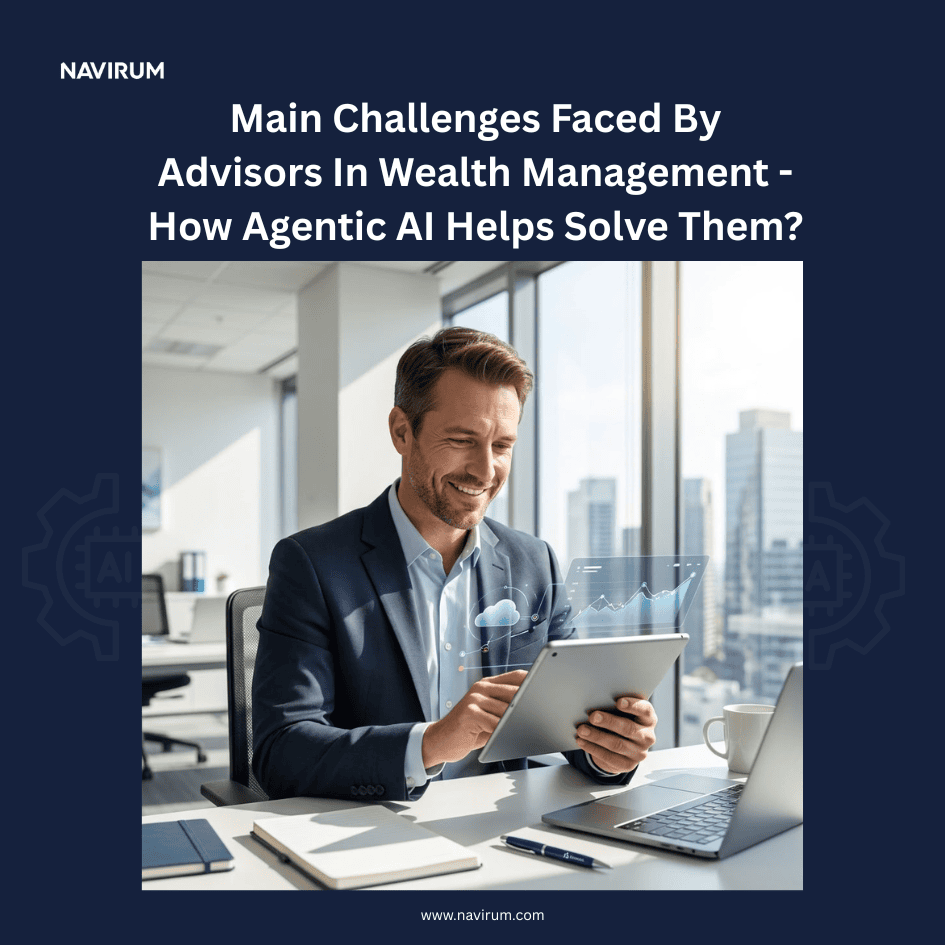
Wealth advisors face growing information overload, administrative work, fragmented data, and constant context-switching, all of which reduce the time available for clients.
Agentic AI can help by:
Automating repetitive administrative work
Connecting fragmented information
Providing relevant client context
Surfacing insights proactively
Reducing cognitive load
The goal is not to replace advisors, but to augment them—giving them more capacity to focus on clients, relationships, and higher-value decisions.
Advisor-Centric Innovation
Turning Information Overload Into Advisor Capacity
The promise of AI in wealth management is often framed in abstract buzzwords. For advisors, real value is simpler: eliminating the manual work of finding, validating, and organizing data before every client conversation.
The Industry Trap
Abstract Tech Promises
Terms like “automation,” “personalization,” and “data orchestration” sound good in executive strategy decks, but fail to address the advisor’s reality.
Focuses on technological capabilities over daily friction
Forces advisors to navigate increasingly complex stacks
Leaves advisors acting as the manual integration layer
The Agentic Solution
Solving Advisor Problems
Agentic AI addresses what advisors actually think about: client calls, meeting prep, outstanding follow-ups, and having instant context ready.
Gathers and validates information automatically
Prepares pre-meeting context across disparate systems
Executes administrative tasks within clear boundaries
The Core Philosophical Shift
Work Across Systems on the Advisor’s Behalf
Instead of asking advisors to work harder within increasingly complex tech stacks, firms can use Agentic AI to work across those environments on the advisor’s behalf—within clearly defined boundaries that protect trust and elevate judgment.
The Iceberg Dilemma
The Hidden Cost of Administrative Work
The work clients see is only a fraction of an advisor’s daily effort. Behind every meeting lies a massive, compounding administrative load that consumes finite cognitive capacity and steals attention from relationship building.
Visible Client Work
What the Client Experiences
Clients interact with the advisor during strategic conversations, planning sessions, and reviews. They evaluate the advisor on empathy, strategic clarity, and responsiveness.
Financial planning & goal review conversations
Portfolio strategy & market outlook discussions
Direct phone calls, emails, and proactive outreach
Hidden Administrative Burden
What Happens Behind the Scenes
Before and after every interaction, advisors must reconstruct context across fragmented applications, taking minutes that aggregate into hours of administrative overhead.
Pre-meeting prep: Checking CRM, notes, service tickets & goals
Operational coordination across custodian & portfolio systems
Finite Cognitive Capacity
The Challenge Is Not Time. It Is Attention.
Even the most experienced advisor has finite cognitive capacity. As client books grow, the effort required to reconstruct household context manually scales exponentially. Every minute an advisor spends searching for information is a minute of attention stolen from client relationships.
Operational Friction & Capacity
The Administrative Tax on the Client Relationship
For every hour a client experiences in a meeting, the firm pays an “administrative tax” in preparation, documentation, and follow-up. AI creates leverage not by shortening client time, but by eliminating the work surrounding it.
The Client Perspective
60 Minutes of Dedicated Advice
The client perceives a seamless 60-minute discussion focused entirely on their wealth, goals, and family situation.
High emotional and strategic value
Focuses on human trust, guidance, and relationship building
Time the client values and expects from a fiduciary advisor
The Operational Reality
120–150 Minutes of Total Drag
Behind that 60-minute meeting lies another 60+ minutes spent logging into systems, reconstructing context, documenting notes, and assigning tasks.
30–45 mins spent gathering scattered data prior to the call
30–45 mins spent typing notes, drafting emails, and updating CRM records
Creates the “Administrative Tax” that caps advisor capacity
The True Opportunity for AI Leverage
Compressing the Work Surrounding the Meeting
The goal of implementing AI in wealth management is not to rush client conversations or cut meeting times. The true leverage comes from compressing the 60+ minutes of manual pre-meeting preparation and post-meeting administrative work down to minutes—freeing advisor attention for what matters most.
Practical Operating Benchmark
The 15-Minute Meeting Preparation Challenge
Can an advisor prepare for a client meeting in 15 minutes using information already available to the firm? This is a practical test to determine if an advisor’s time is being spent searching for data or applying context.
Question 1
Who is this client?
Rapidly establishes relationship context without surfacing unnecessary noise.
Household & family structures
Advisor assignments & roles
Approved client preferences
Question 2
What has changed?
Compares historical data to summarize meaningful shifts over a defined period.
Recent interactions & service tickets
Account balance & planning updates
Newly added documents & items
Question 3
What happened recently?
Compresses large volumes of activity into a concise, reviewable timeline briefing.
Recent meetings & email threads
Phone calls & custodial logs
Drill-down capability when required
Question 4
What remains unresolved?
Surfaces hidden operational roadblocks before walking into the conversation.
Open service requests & cases
Missing forms & outstanding tasks
Unanswered client follow-ups
Question 5
What should I know?
Organizes relevant relationship signals around the advisor’s purpose.
Synthesizes open items into a story
Highlights client expectations
Guides advisor attention effectively
Question 6
What should I do next?
Moves from static information to actionable agentic execution.
Pre-drafted emails & follow-up tasks
Internal task routing & ops requests
Low-risk automated actions
The Agentic Operating Paradigm
Moving Systems From Information ➔ Context ➔ Action
The 15-Minute Readiness Framework represents a broader design philosophy for advisor AI. An effective technology environment does not simply return search queries—it transforms enterprise data into actionable context, ensuring advisors walk into every meeting prepared.
Architectural Reality
The Fragmentation Problem
The issue is rarely a complete absence of technology. Most wealth management firms already own robust systems—the challenge is that each system contains only a fragment of the household story.
State Comparison: Fragmented Operations vs. Agentic Integration
Efficiency Infogram
Metric
Current State (Fragmented)
Agentic State (Integrated)
Preparation Time
60–90 minutes per meeting
10–15 minutes per meeting
Data Retrieval
Manual (Logins to 5+ systems)
Automated Context Orchestration
Advisor Focus
Data gathering and verification
Advice Strategy & Deep Planning
Systems of Record
Disconnected silos (Latency-prone)
Unified Data Cloud “Source of Truth”
Single Household Data Distribution
Where a household’s critical information actually lives across the enterprise ecosystem:
Salesforce / CRM
Relationship
Relationship history
Advisor assignments
Previous interactions
Open activities & follow-ups
Portfolio Engine
Investments
Current holdings
Asset allocation breakdown
Performance data
Valuations & positions
Financial Planning
Goals
Financial goals & targets
Planning assumptions
Monte Carlo scenarios
Retirement projections
Custodial Platforms
Accounts
Account details & balances
Transaction records
Cash balances & wires
Operational status
Document Vault
Records
Account statements
Advisory agreements
Custodial forms
Estate & tax documents
Communication Apps
Touchpoints
Recent email exchanges
Service requests & tickets
Client portal messages
Meeting scheduling logs
Connecting the Silos with Agentic Architecture
The information already exists within your firm. What has been missing is the connective tissue that turns separate records into a timely, contextual understanding of the client. Rather than forcing advisors to navigate every system, agentic architecture orchestrates relevant information directly around the advisor’s workflow.
Architectural Shift
The Advisor as the “Human API”
Without systemic integration, advisors act as manual APIs connecting disconnected portals. An agentic architecture shifts the heavy burden of data assembly to technology—standardizing context while preserving human interpretation.
Legacy Operating Reality
Advisor as Human API
When a client asks a question, the advisor must log into multiple portals, request ops support, and manually piece together answers.
Acts as the manual middleware connecting unintegrated platforms
Highly inefficient use of expensive advisor capacity
Creates inconsistent client experiences across different team members
Agentic Architecture
Automated Assembly & Human Judgment
The agent queries approved enterprise data sources and compiles context briefs automatically, leaving the advisor to deliver strategic insight.
Replaces multi-step hopping with an integrated agentic pipeline
Standardizes source data retrieval across the entire firm
Frees advisors to focus on expert interpretation and fiduciary guidance
Core Operating Principle
Let Technology Assemble, Let Humans Interpret
Shifting from Advisor → Systems → Human Integration to Advisor → Agent → Context → Interpretation removes administrative friction. The advisor remains central to client judgment, but the heavy lifting of data assembly is handled entirely by the technology layer.
Cognitive Friction
The Advisor’s Context-Switching Problem
When systems don’t provide context, the human advisor is forced to construct it. Hopping across CRM, portfolio, planning, email, and document platforms turns high-value advisors into expensive integration middleware.
Current State Reality
Distributed Information Silos
Answering basic questions like “What changed with this client?” forces advisors to jump between 5+ applications to reconstruct history manually.
Constant app-switching creates severe cognitive drag
Advisor time is wasted on manual data retrieval
Increases risk of missing critical relationship updates
Agentic State Opportunity
Automated Context Assembly
Agentic systems orchestrate data across enterprise apps, delivering a complete, contextual household summary directly into the advisor’s workflow.
Eliminates application switching entirely
Instantly synthesizes CRM, portfolio, email, and planning signals
Frees advisor capacity for strategic advice and relationship building
Architectural Principle
Humans Are Expensive Integration Middleware
When enterprise systems fail to deliver unified context, human advisors are forced to bridge the gap. Agentic AI eliminates this context-switching tax—letting technology perform the integration work so advisors can focus purely on client advice.
Governance & Risk Principle
The Trust Problem
As AI transitions from generating text to taking action, operational, financial, and regulatory consequences scale rapidly. The level of AI autonomy must correspond directly to the level of business risk.
Tier 1: Search
Information Retrieval
Limited intervention required; safe for autonomous data aggregation.
Tier 2: Synthesis
Meeting Preparation
Requires advisor review before entering client interactions.
Tier 3: Outreach
Client Communications
Requires human approval prior to sending or publishing.
Tier 4: Planning
Financial Advice
Requires strong fiduciary controls and professional judgment.
Tier 5: Execution
Transactions & Trades
Requires explicit human authorization and audit trails.
The Fundamental Deployment Distinction
From “What CAN AI do?” to “What SHOULD AI be allowed to do?”
Moving from AI experimentation to responsible production deployment requires defining strict operational boundaries. An agentic advisor model protects trust by ensuring AI handles the operational work surrounding decisions, while keeping fiduciary judgment firmly under human control.
Cognitive Paradigm Shift
From “Find Information” to “Understand the Client”
There is a fundamental difference between search and intelligence. Traditional systems answer “where is the data?”, while intelligent systems answer “what does this data mean in the context of this client relationship?”
Synthesized Context Example
“Since the previous review, the household has had two service interactions, completed a planning update, and has an outstanding follow-up related to the upcoming review.”
Traditional Search
Where Is the Information?
Legacy CRM and enterprise systems index raw records. They display disconnected emails, isolated service tickets, and separate planning files.
Displays raw, unlinked database objects
Forces advisors to construct the context manually
Consumes preparation time before client conversations
Agentic Intelligence
What Does It Mean for the Relationship?
Intelligent AI layers connect disparate signals across portfolio engines, custodians, and CRM logs into a clear, cohesive situation summary.
Connects multiple data points into a single narrative
Surfaces immediate action items and relationship trends
Matches the natural way financial advisors think
Human-Centric Architecture
Advisors Think in Situations, Not Data Objects
Financial advisors do not naturally think in database rows and tables. They think in relationships and situations. True AI intelligence transforms fragmented record searches into actionable contextual narratives, aligning technology directly with advisor intuition.
Proactive Relationship Intelligence
Moving From Reactive Workflows to Proactive Attention
Traditional CRM systems wait for advisors to react to alerts or manually run searches. Relationship Intelligence flips the paradigm—proactively surfacing households and tasks that deserve attention before an advisor ever searches for them.
Practical Attention Recommendations
How proactive relationship intelligence guides an advisor’s daily focus across a large book of business:
Stale Activity Signal
“5 households in your book have unresolved activities older than 14 days.”
Surfaces stagnant operational tasks before clients call to complain about delays.
Follow-up Opportunity
“3 client relationships have had significant recent activity but no advisor follow-up.”
Identifies accounts with money movement or portal logins that warrant proactive outreach.
Meeting Readiness
“2 upcoming client reviews have missing preparation information.”
Flags missing custodial records or unlinked planning goals before review meetings begin.
Traditional Workflows
Reactive Record Lookup
Advisors must constantly remember which clients to check on, manually sorting through tasks, notifications, and inbox logs to find work.
Waits for inbound client service calls or explicit searches
Treats all task notifications with equal urgency
Creates blind spots across secondary & tertiary clients
Relationship Intelligence
Proactive Attention Guidance
The AI scans connected systems to highlight relationships requiring immediate attention—acting as a personal chief of staff for book management.
Helps advisors manage larger books without sacrificing touch points
Recommends operational focus without overstepping into investment advice
The Strategic Distinction
Guiding Attention, Preserving Professional Judgment
Attention recommendations are not financial or investment advice. The system isn’t telling the advisor which portfolio allocation to choose—it is answering “Where should I spend my time today?” For an advisor managing a large book, that proactive clarity is invaluable.
Information Synthesis
From Data Availability to Context
Having access to data does not mean having access to context. An advisor may have hundreds of fields associated with a client and still need to manually determine what matters for today’s conversation.
The Data Trap
Raw Fields vs. Actionable Meaning
Advisors are often drowning in data fields distributed across disparate records. Having hundreds of available fields does not equal operational clarity.
Data exists in isolated fields across platforms
Requires manual interpretation prior to meetings
Consumes valuable preparation time
The Agentic Opportunity
Connected Context Engine
Context emerges from the relationships between data points. An effective agentic system connects these nodes while preserving data meaning and security rules.
Synthesizes client, household, and goal relationships
Surfaces immediate priorities and open items
Delivers contextual insight directly into advisor workflow
The Connected Foundation: Salesforce Data 360
Architectural Strategy
Salesforce’s Data 360 strategy is engineered to connect data across disparate sources and make that information seamlessly available to applications, workflows, and AI agents. In a wealth management environment, this connected context powers highly relevant advisor experiences—not by building another data repository, but by making existing enterprise data exponentially more useful at the exact moment it is needed.
Operating Model Philosophy
The Difference Between Automation and Augmentation
In wealth management, the goal of AI is rarely to remove humans from the process. The highest-value outcome is often human augmentation—making advisors and service teams dramatically faster while preserving judgment, empathy, and oversight.
Pure Automation Myth
Removing Humans Entirely
Attempting straight-through processing for complex wealth services often fails because client situations are rarely standardized.
Struggles with missing documentation and exceptions
Lacks empathy and nuance in sensitive client interactions
Increases operational and compliance risk when left unmonitored
Augmentation Reality
Supercharging Human Performance
AI agents handle administrative orchestration, tracking, and summaries, giving advisors the exact context needed to make fast, informed decisions.
AI tracks requirements, routes tasks, and highlights gaps
Humans manage relationships, evaluate exceptions, and give advice
Dramatically reduces cycle times while elevating client satisfaction
The Core Strategic Principle
The Highest-Value Automation Is Not the Most Autonomous
The strategic goal of AI in wealth management is not maximizing autonomy for its own sake. Sometimes the best possible business outcome is simply making the human dramatically faster and more effective.
Strategic Value Mapping
Advisor Pain Point → Agentic Opportunity
A useful way to evaluate the opportunity is to map actual advisor pain points directly to potential AI capabilities. AI should always be evaluated against a tangible business problem—not a generic feature checklist.
Advisor Pain Point to Agentic Opportunity Mapping
10 Strategic Matrix Mappings
Advisor Pain Point
Agentic Opportunity
Potential Benefit
Too much meeting preparation
Meeting Concierge
Faster preparation
Searching multiple systems
Contextual information retrieval
Less application switching
Reviewing long client histories
Relationship summaries
Faster understanding
Forgotten follow-ups
Task identification
Greater consistency
Repetitive CRM updates
Automated or prepared updates
Less administrative work
Routine client questions
AI-assisted information retrieval
Faster response
Client onboarding coordination
Workflow orchestration
Better visibility
Large book of clients
Relationship intelligence
More proactive engagement
Repetitive communications
Draft generation
Faster communication
Internal coordination
Task routing
Reduced operational friction
The Deployment Rule
Evaluate AI Against Business Problems, Not Features
The fact that an AI agent can perform an action does not mean that action should be automated. Successful wealth management deployments evaluate technology strictly against concrete advisor friction points, ensuring every agentic capability delivers measurable operational relief.
Cognitive Design Principle
The Cognitive Load Problem
Replacing raw data searches with a 15-page AI narrative dump doesn’t save time—it shifts the bottleneck to reading comprehension. Effective advisor AI must optimize for decision relevance over information volume, delivering key signals with single-click drill-down verification.
Pillar 1
Relevance
Filters data to align explicitly with the upcoming conversation’s purpose.
Pillar 2
Recency
Prioritizes fresh interactions and recent communications over archived history.
Pillar 3
Exceptions
Highlights unusual account shifts, service anomalies, or missing documents.
Pillar 4
Changes
Summarizes deltas in portfolio balances, household members, or planning goals.
Pillar 5
Outstanding Actions
Surfaces open service tickets, pending tasks, and incomplete follow-ups.
Pillar 6
Source Drill-Down
Provides direct links to underlying CRM records and source files for verification.
The Volume Fallacy
Giving the Advisor Everything
Generating exhaustive AI summaries simply transfers the administrative burden from data collection to reading comprehension.
Forces advisors to wade through pages of unranked narrative text
Increases cognitive drag and reading fatigue before meetings
Hides crucial relationship signals inside dense blocks of prose
Decision Relevance
Giving What Matters + Drill-Down
Agentic systems prioritize actionable signals while maintaining full transparency to underlying records whenever deep verification is needed.
Surfaces concise, highly relevant relationship context in seconds
Focuses on recency, unresolved exceptions, and actionable next steps
Provides instant single-click access to original source documents
Core UI/UX Architecture Principle
Optimize for Decision Relevance, Not Information Volume
The objective of an agentic briefing experience is not to dump every available data point onto the screen. An effective system gives the advisor what matters most to the upcoming decision, with full freedom to drill down into underlying source data whenever verification is required.
Core Implementation Philosophy
The Advisor Experience Should Be the Design Principle
Technology implementations often fail by starting with platform capability rather than human objectives. By reversing the model—designing architecture directly around what the advisor is trying to accomplish—firms create true operational leverage.
Beginning with platform features (“What can Salesforce or Agentforce do?”) creates technology in search of a problem, forcing advisors to adapt to unnatural system steps.
Focuses on technological novelties rather than daily friction
Forces advisors into complex, non-linear system navigation
Leads to poor adoption, fatigue, and fragmented workarounds
Advisor-Centric Design
Outside-In Architecture
Starting with advisor goals (“How do I prepare in 15 minutes?”) designs data pipelines, agent actions, and governance boundaries explicitly around natural human workflows.
Delivers contextual data directly in the flow of work
Automates routine data gathering while reserving advice for humans
Ensures immediate platform adoption, high leverage, and trust
The Strategic Paradigm Shift
Design Systems Around the Advisor, Not the Platform
The most successful wealth management AI implementations flip the traditional model. Instead of forcing the advisor to adapt to system architecture, the architecture is designed entirely around the advisor’s daily objective.
The Business Case for AI
The Strategic Opportunity: Advisor Capacity
The value of an Agentic Advisor is ultimately measured not by the sophistication of the technology, but by the capacity it creates. Reducing administrative drag redirects advisor time toward high-value human relationships.
The Operational Challenge
Administrative Friction
Individually, small operational tasks seem minor. Collectively, they consume a massive portion of advisor and staff bandwidth every single day.
Searching across systems for records & documents
Updating CRM data, tasks, and follow-up activities
Manual pre-meeting prep & portfolio tracking
Coordinating operations & routine communications
The Value Realized
High-Value Relationship Focus
By offloading the administrative surrounding work to AI agents, advisors reclaim capacity to focus on expertise and deep client connection.
Deeper, more frequent client conversations
Comprehensive financial strategy & goal planning
Proactive outreach & business development
Navigating complex client situations & life events
The Core Strategic Paradigm
“How much unnecessary work can AI remove from the advisor’s day?”
The business case for Agentic AI is not simply asking if AI can answer questions. The strongest outcome is not merely stating that a firm has implemented AI—it is giving advisors more time to do the work that only human advisors can do.
Part 2 Conclusion & Strategic Roadmap
Turn Advisor Capacity Into Your Enterprise Growth Engine
Bridging the gap between data availability and true client context requires an agentic architecture built on governed autonomy. Partner with Navirum to eliminate administrative drag and unlock your advisors’ full strategic potential.
Pillar 1
Solve Fragmentation
Connect CRM, custodian, planning, and portfolio data into a single source of truth without forcing advisors to toggle across 12+ apps.
Pillar 2
Enforce Trust & Governance
Establish 5-tier risk controls so AI acts autonomously on routine search while reserving critical financial decisions for advisor review.
Pillar 3
Maximize High-Value Time
Automate meeting prep, note summaries, and task creation so advisors focus 100% on client relationship building and strategic planning.
Ready to Implement Agentic AI for Your Wealth Practice?
Navirum’s certified Salesforce consultants specialize in architecting Agentforce, Data 360, and Financial Services Cloud solutions built specifically for wealth management firms.
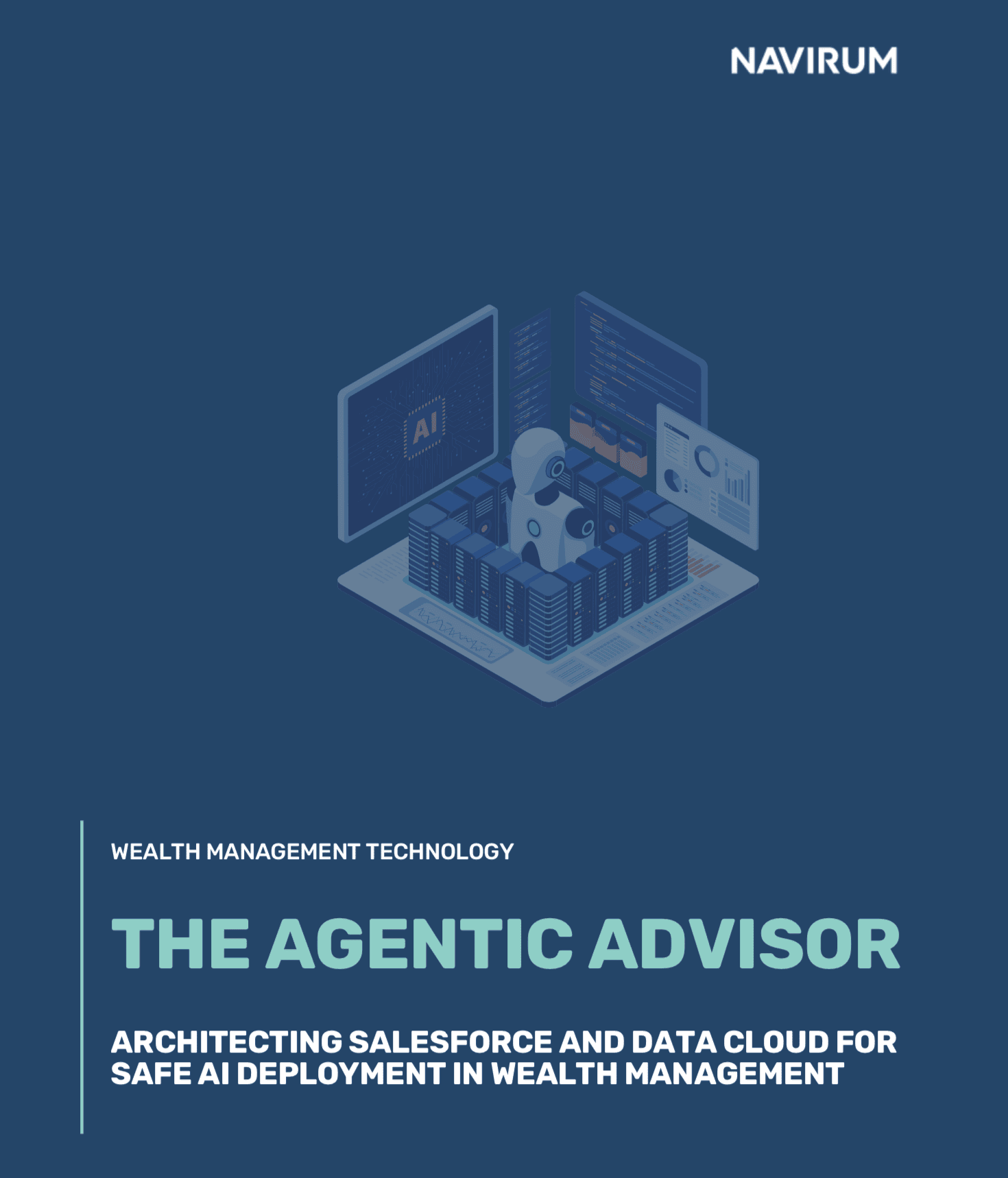
Wealth management technology has evolved to improve tools for advisors, but their experience remains fragmented across various systems.
The next phase focuses on making existing systems more intelligent and useful for advisors, leading to the concept of the agentic advisor.
An agentic advisor leverages AI agents to retrieve information, understand client context, and recommend actions within established rules.
Salesforce’s Agentic Advisor enhances workflow with features like Run My Day and Meeting Concierge, prioritizing tasks and preparation for meetings.
AI supports advisors by handling surrounding tasks, while the advisor retains responsibility for judgment and client relationships.
Technology Evolution Paradigm
From CRM to AI-Powered Advisor
Wealth management technology has evolved across four stages to manage information, relationships, and processes. The next evolution is not adding another system—it is making the systems a firm already has more intelligent and useful to the advisor.
The Next Evolution of Wealth Management Technology
An advisor may have access to hundreds of data points across Salesforce, portfolio platforms, custodians, documents, and email. The objective of the Agentic Advisor is not simply to add another system, but to make existing platforms exponentially more intelligent and useful to the advisor.
Technology Evolution Paradigm
The Four Generations of Wealth Management CRM
From centralizing client records to deploying autonomous AI agents, examine how technology paradigms have shifted from manual operational logging to intelligent execution.
Generation 1
CRM — Store the Relationship
The first major step was moving client information from spreadsheets, paper files, and individual employee knowledge into a centralized CRM platform.
Core Systems Structure:
Client & Household Information
Advisor Relationships & Opportunities
Tasks & Activities
Service Interactions & Notes
Communications & History
Core Limitation: The CRM created a digital representation of the client relationship, but the advisor still had to interpret all data. It recorded what happened, but couldn’t surface what mattered today.
Generation 2
Connected CRM — Bring the Systems Together
Integration connected CRM environments with portfolio management platforms, custodians, financial planning systems, document repositories, and marketing engines.
Portfolio platform acts as authoritative investment source
Custodian remains source for account & transaction data
Core Limitation: Data integration does not automatically eliminate complexity. Data was connected, but the operational experience remained fragmented across multiple applications.
Generation 3
Intelligent CRM — Help the Advisor Understand
Introduces Generative AI into the CRM workspace. Instead of merely storing data, natural language models process, query, and summarize large client records instantly.
AI Capabilities Introduced:
Summarize complex client records & meeting notes
Identify critical account changes & trends
Natural-language search across historical interactions
Draft communications & meeting prep briefs
Core Limitation: Provides answers, but leaves workflow unchanged. The advisor must still manually update Salesforce, open other systems, create tasks, and execute follow-ups.
Generation 4
Agentic Advisor — From Answers to Actions
Autonomous AI agents retrieve context, reason across defined rules, recommend decisions, and execute multi-step business tasks across the firm’s architecture.
Agentforce & Governed AI Capabilities:
Executes defined workflows across financial data
Combines advisors, AI agents, applications & custodial data
Proactively prepares pre-meeting briefings
Creates approved tasks & queues client actions
The Value Paradigm: Human advisors remain fully in control, while administrative burden and task orchestration surrounding advisor judgment are dramatically reduced.
Illustrating the Shift: Intelligent vs. Agentic
See how the interaction model transforms when shifting from answering questions to executing governed actions.
Gen 3: Intelligent CRM
Advisor Prompt:
“Summarize my meeting with the Smith household.”
System Output:
Provides a text summary of past notes and interaction logs.
Result: Advisor reads summary, then manually opens tasks, creates follow-up records, sends emails, and updates external applications.
Gen 4: Agentic Advisor
Advisor Prompt:
“Prepare me for my Smith household meeting and identify anything I need to follow up on.”
Result: Whole workflow completed in seconds under full advisor oversight.
Core Concept Defined
What Is an Agentic Advisor?
An agentic advisor is a financial professional supported by AI agents that retrieve relevant information, understand household context, recommend next steps, and perform approved tasks within defined governance rules.
Generative AI Assistant
Answers & Summaries
A conventional AI tool helps answer questions, draft static text, or summarize uploaded documents. While useful, it operates as an isolated utility that leaves business processes unchanged.
Summarizes isolated client files
Drafts email responses in a text box
Requires manual copy-pasting & system updates
Agentic Advisor Model
Context & Governed Execution
An AI agent is deeply connected to enterprise data, applications, and business logic. It proactively prepares context, surfaces relevant signals, and executes approved operational tasks.
Retrieves data across FSC, custodians & planning apps
Proactively prepares meeting briefs & agendas
Queues approved follow-up tasks under human oversight
The Advisor Retains Fiduciary Control
Salesforce Agentic Advisor
An agentic advisor model does not mean AI makes professional decisions. It means technology handles the heavy operational lift surrounding those decisions. Salesforce’s Agentic Advisor capabilities, including Run My Day and Meeting Concierge, help advisors prioritize workload, prepare for client interactions, and manage post-meeting actions—leaving the fiduciary advisor responsible for judgment and client relationships.
The Agentic Advisor Is Not an Autonomous Financial Advisor
Agentic AI operates on a governed spectrum. The objective is not to remove the advisor from the workflow, but to remove administrative overhead from professional judgment.
Prep & Research
Meeting Briefings
AI Agent Role
Prepares comprehensive client briefing from data across systems.
Advisor Role
Reviews context and applies professional judgment to decide what matters.
Communication
Client Follow-ups
AI Agent Role
Drafts personalized follow-up email based on meeting notes.
Advisor Role
Reviews, edits, and approves prior to sending.
Operations
Document Audit
AI Agent Role
Scans account and flags missing onboarding documentation.
Operations Team Role
Decides how to address and handle the exception.
The goal of Agentic AI is to support human judgment, not attempt to replace it.
Technology handles the administrative overhead—advisors retain full oversight of client strategy and relationships.
Strategic AI Deployment
Why Wealth Management Is an Ideal—and Difficult—Environment for Agentic AI
Wealth management is administrative-heavy yet relationship-dependent. Deploying agentic capabilities yields extraordinary productivity gains, but demands an uncompromised standard for trust, security, and fiduciary oversight.
The Core Opportunity
Information Intensity & Manual Overhead
Much of an advisor’s true value comes from interpreting complex client situations and crafting strategic guidance. However, gathering, synthesizing, and organizing household data across disconnected silos consumes the majority of an advisor’s working week.
Sensitive Context: Advisors track goals, preferences, and multi-generational histories.
Manual Friction: Transitioning data from records to client action remains heavy.
Impact: Agentic AI handles administrative prep so advisors focus on clients.
The Implementation Bar
The Task Spectrum & Fiduciary Risk
Risk escalates dramatically as AI moves from retrieving facts to executing business workflows. While answering a question is a low-risk read task, executing a transaction or sending client communications changes core operational state.
Read vs. Write Risk: “Summarize activity” vs. “Update record & send email.”
The Trust Gap: Hallucinations generate reputational and regulatory exposure.
Data Security: PII exposure to unauthorized roles creates compliance liability.
Core Principles for Wealth Management AI Design
1. Data must be verifiable & trustworthy
2. Access must enforce strict permissions
3. AI actions must have defined boundaries
4. Higher-risk tasks require human review
5. AI behavior must be continuously audited
6. Escalations must route to professionals
Bridging the “Trust Gap”: Industry Research & Architecture
2025 Kitces Report Analysis
Industry research highlights a polarized landscape: 38% of advisors are AI Optimists, while 22% remain AI Skeptics rightly fearing the “Trust Gap.” Bridging this gap requires an enterprise architecture built on zero-retention LLMs and PII masking. The Agentic Advisor model operates on a strict Human-in-the-Loop philosophy—AI initiates and expedites, but the fiduciary advisor remains the final gatekeeper for delivery.
Value Creation Driver
Why the Opportunity Is So Significant
Wealth management is fundamentally data-intensive. The primary challenge isn’t a lack of information—it’s distilling vast, multi-system household data into what is relevant right now.
Data Volume vs. Value
Interconnected Household Intelligence
A single household relationship generates dozens of discrete data points—from account transactions and portfolio balances to service tickets, meeting notes, and follow-up emails. Individually, each data point has limited utility. The true value emerges when those points are dynamically synthesized to show how they relate to one another.
The AI Paradigm Shift
Solving the Contextual Challenge
Advisors don’t want or need to wade through every raw piece of historical data. They need to know what demands their attention today. AI resolves this contextual problem by continuously auditing background data streams and bringing the right information forward at the exact moment of decision-making.
The goal is not to present more data—it’s to surface what matters right now.
AI transforms vast multi-system data streams into clear, contextual priorities for the financial advisor.
The Productivity Dilemma
The Advisor’s Reality: Too Much Information, Not Enough Time
Advisors have access to more client data than ever. The primary operational bottleneck isn’t the difficulty of any individual task—it’s manually retrieving, synthesizing, and documenting data across disconnected applications before and after every meeting.
The Operational Bottleneck
Manual Story Reconstruction
None of these individual steps is complicated. However, assembling a client’s complete picture across multiple platforms requires manual reconstruction before and after every meeting:
Searching emails for recent thread context
Cross-referencing custodians & planning apps
Logging notes & creating administrative tasks
Searching for missing vault documents
High-Impact Growth Drivers
Value-Creating Activities
Every minute spent navigating applications and logging data directly competes with core relationship and revenue-generating responsibilities:
Deep financial planning & strategic advice
Proactive outreach & client conversations
Relationship development & trust building
Referral generation & new business growth
Industry Positioning: Solving Disconnected Systems
Salesforce Insights
Salesforce identifies disconnected systems and administrative work as primary growth barriers for wealth management advisors. Their agentic wealth strategy focuses on uniting advisors, AI agents, applications, and enterprise data into a singular execution layer—eliminating manual friction while keeping the advisor firmly in control.
Experience how Sarah, a wealth management advisor, replaces hours of manual application switching and data search with unified, governed AI assistance throughout her workday.
8:15 AMMorning Priority
Run My Day
Sarah starts her morning reviewing client relationships and activities needing attention. Instead of checking multiple dashboards, tasks, alerts, and records, an AI-organized view surfaces relevant meetings and client alerts.
Salesforce Capability: Run My Day provides a prioritized view of meetings, client alerts, and AI-powered actions.
8:30 AM – 9:00 AMPrep & Meeting
Client Meeting & Context Assembly
Sarah asks: “Prepare me for my meeting with the Smith household.” The agent instantly pulls interactions, household relationships, financial details, open service tickets, and potential discussion points.
Result: Sarah enters the 9:00 AM meeting fully prepared, focusing 100% on the client rather than reconstructing past notes.
10:15 AMAutomated Execution
Post-Meeting Follow-Up
After the meeting, AI prepares notes, summarizes key decisions, drafts follow-up emails, and queues appropriate tasks. Sarah simply reviews and approves the relevant actions.
Salesforce Capability: Meeting Concierge manages the full meeting lifecycle from prep to follow-up execution.
11:30 AM – 2:00 PMFocused Action
Relationship Signals & Service Lookup
Defined signals surface relationships needing attention, answering: “Where should I spend my attention today?” Later, when a complex service question arises, Sarah retrieves approved multi-system data in seconds.
Value: Professional judgment guides which recommendations to act on, eliminating manual cross-system search.
4:30 PM — End-of-Day Review & Core Takeaway
By 4:30 PM, the AI agent helps Sarah identify outstanding follow-ups and unfinished activities. The result is not an autonomous advisor replacing human expertise. It is an advisor who spends drastically less time navigating technology and far more time exercising professional judgment.
The AI conversation often focuses on what technology can do. For wealth advisors, the true measure of success is simpler: eliminating unnecessary friction to maximize time spent with clients.
Less Administrative Work
Fewer Clicks Across Systems
Faster Access to Info
Better Meeting Preparation
More Reliable Follow-Up
Richer Household Context
Less Duplicate Data Entry
More Time With Clients
Advisor Pain Point
Potential AI Opportunity
Preparing for client meetings
Generate a relationship briefing
Searching across systems
Retrieve relevant information
Reviewing long histories
Summarize important changes
Managing follow-ups
Surface outstanding actions
Writing meeting notes
Draft structured summaries
Updating Salesforce
Prepare or execute approved updates
Routine service questions
Retrieve information and suggest next steps
Managing a large book
Surface relationships requiring attention
Drafting client communications
Prepare personalized messages for review
The value is not simply the ability to ask AI a question.
The true value lies in eliminating the manual friction required to find, organize, and interpret the answer.
Human-Centered Architecture
Wealth Management Is Also Highly Relationship Driven
Technology can automate transactional processes, but it cannot replicate the trust, empathy, and professional judgment of an advisor. The true power of AI lies in relationship augmentation—freeing advisors to focus entirely on human connection.
Know More
Instant access to comprehensive household intelligence.
Prepare Faster
Automated briefings synthesized across all systems.
Remember More
Surfacing key milestones, preferences, & past notes.
In transactional environments, AI can often replace human interactions entirely. Wealth management is fundamentally different. Client conversations involve multi-generational planning, major life events, and complex financial decisions that require human nuance.
Retirement transitions & family circumstances
Liquidity needs & business sales
Estate considerations & legacy planning
Core Philosophy
Relationship Augmentation
The highest-value application of AI is not replacing the professional, but augmenting their capacity to connect. By removing the administrative burden of finding and organizing data, advisors gain back the hours needed for meaningful engagement.
AI prepares the background context
Advisor brings empathy, wisdom, & trust
Fiduciary oversight remains 100% human
The Optimal Balance
AI handles information complexity. The advisor handles human complexity.
Technology supports professional judgment rather than attempting to replace it—delivering the ultimate advisor-client experience.
Part 1 Conclusion & Next Steps
Ready to Architect Your Agentic Wealth Enterprise?
From moving beyond Gen 1 storage to deploying governed Gen 4 AI agents, Navirum partners with leading wealth management firms to unlock productivity, bridge the trust gap, and empower advisors.
Pillar 1
Unify Disparate Data
Connect Salesforce Financial Services Cloud, portfolio management, custodians, and planning apps into a singular contextual layer.
Pillar 2
Enforce Governance
Deploy zero-retention architectures and human-in-the-loop workflows that maintain fiduciary standards and bridge the trust gap.
Pillar 3
Augment Advisors
Automate meeting preparation, relationship signals, and follow-ups so advisors can focus 100% on high-value client conversations.
Partner with Navirum for Your Salesforce & Agentforce Roadmap
Our certified Salesforce consultants specialize in designing, implementing, and securing Agentic AI solutions for financial services and wealth management firms.
Wealth management is transforming in 2026, with firms needing to integrate technology to enhance advisor productivity and client interactions.
Advisors spend too much time on administrative tasks; AI can help automate these processes to free up more time for client-facing activities.
Fragmented technology hinders advisors from getting a complete view of clients, leading to inefficiencies and errors.
Clients increasingly expect personalized service, making it essential for advisors to maintain context and understanding of their complex financial lives.
AI enhances financial information accessibility, but the human advisor’s role remains crucial for interpreting that information and maintaining client relationships.
Wealth Management Trends Overview
Wealth management is entering a new phase of transformation in 2026. Advisors are being asked to manage increasingly complex client relationships, deliver more personalized advice, improve productivity, and demonstrate greater value, all while dealing with fragmented technology, rising compliance expectations, and the rapid adoption of artificial intelligence.
The challenge is no longer simply whether wealth management firms should invest in technology. The bigger question is how firms can make their technology work together to give advisors better information, automate repetitive work, and create more meaningful client interactions.
Keeping that stack current after go-live is its own discipline; the Navirum Orbit guide explains the model firms use to manage Salesforce and AI month to month.
The urgency is reflected in recent industry research. MSCI’s 2026 Wealth Trends research found that 95% of firms expect to increase their investment in AI, yet only 27% believe wealth management is leading other financial-services segments in AI adoption. This gap suggests that firms recognize the potential of AI but are still working out how to translate that potential into practical improvements in advisor productivity, scale, personalization, and client engagement.
At the same time, Advisor360°’s 2026 Connected Wealth Report found that nearly three in four advisors say their firm’s technology is outdated or needs an upgrade. The report surveyed 300 advisors across RIAs, broker-dealers, and banks, highlighting a fundamental problem: wealth management firms may have plenty of technology, but that technology does not always work together in the way advisors need.
For wealth management organizations, this creates an opportunity to rethink the role of Salesforce, data, integrations, and AI. Salesforce Financial Services Cloud (FSC), Data 360, and Agentforce can help firms move toward a more connected operating model—but the greatest value comes when these technologies are built around real advisor and client needs.
Wealth Management Trends 2026 | Navirum
Wealth Management Trends 2026
Key Industry Forces Reshaping Advisory Practices
An overview of the 7 defining macro trends impacting wealth managers, advisor capacity, technology stacks, and AI governance in 2026.
01 / Administrative Burden
Advisors Spending Too Much Time on Admin Work
Advisors spend up to 70% of their workday on manual administrative duties, operational tasks, and rekeying data across applications instead of engaging clients.
02 / Tech Fragmentation
Difficult to Obtain a Complete Client View
Fragmented tech stacks spanning disconnected CRM, portfolio, and planning systems make obtaining a unified 360-degree household profile extremely difficult.
03 / Client Expectations
Rising Demands for Personalization
Investors expect hyper-personalized, real-time advice spanning wealth, tax, and estate goals rather than standardized quarterly reports.
04 / Growth Bottleneck
Advisor Capacity as a Strategic Growth Issue
Firm AUM growth is strictly bound by advisor time constraints. Automation is essential to scale client book sizes without inflating operational overhead.
05 / Shifting Behavior
Clients Already Using AI for Financial Info
Investors actively leverage retail AI tools for financial research. Advisors must validate insights and provide institutional-grade context clients trust.
06 / AI Foundation
Data Quality & Governance Becoming Critical
AI reliability depends entirely on data health. Robust data governance, permissioning, security, and human-in-the-loop oversight are mandatory.
07 / Strategic Pillar
Scaling Without Losing the Human Relationship
Technology handles routine operational workflows so advisors can double down on high-touch empathy, complex family governance, and building deep client trust—scaling the firm without sacrificing relationship quality.
1. Advisors Are Spending Too Much Time on Administrative Work
Advisors are expected to spend their time advising clients, developing relationships, identifying opportunities, and providing guidance. In practice, however, a considerable amount of their day can be consumed by administrative and information-management tasks.
Preparing for a client meeting may require reviewing CRM records, portfolio information, previous emails, service requests, financial plans, documents, and notes from previous conversations. After the meeting, the advisor may need to document the interaction, update records, create tasks, send follow-up communications, and coordinate with other teams.
The problem is not necessarily that any individual task is particularly difficult. The problem is the cumulative time and cognitive load created by dozens of small tasks.
Why this matters for wealth managers
Administrative work directly affects advisor capacity.
If an advisor spends less time on administrative work, the firm can potentially increase the amount of time available for client-facing activities without proportionally increasing headcount.
Recent research shows why firms are paying attention. In the Bank of Canada’s 2026 Financial System Survey, nearly all respondents reported using AI, with information gathering, analysis, and internal operations among the most common applications. Respondents generally viewed AI as a way to complete existing tasks faster rather than replace human judgment. They cited efficiency and productivity improvements as important benefits.
This is particularly relevant to wealth management. AI does not need to make investment decisions to create value. It can first take on the repetitive work surrounding the advisor’s decision-making process.
How Salesforce and AI Can Help | Navirum
Salesforce & AI Integration
How Salesforce & AI Empower Advisors
Salesforce provides a centralized workspace containing client relationships, activities, opportunities, and service histories. AI then automates and accelerates the operational tasks surrounding that intelligence.
Create and assign operational tasks to support teams
Update financial profiles and relevant CRM fields automatically
The Core Objective
The goal is not to automate the advisor out of the relationship. It is to eliminate the administrative friction surrounding the relationship so advisors can dedicate more time to high-value, relationship-building activities.
2. Fragmented Technology Is Making It Difficult to Get a Complete Client View
Wealth management firms have accumulated technology over many years. Advisors may use one system for CRM, another for portfolio management, another for financial planning, another for custody, and additional applications for documents, communications, compliance, reporting, and operations.
Each application may perform its job well. The challenge arises when these systems do not communicate effectively.
An advisor may need to switch between multiple applications simply to answer a basic question:
What has changed in this client’s financial life since our last conversation?
That creates application fatigue, duplicate data entry, inconsistent records, and unnecessary administrative work.
The scale of the problem
Advisor360°’s 2026 Connected Wealth Report found that nearly three in four advisors believe their firm’s technology is outdated or needs an upgrade. Its research also highlights disconnected systems as a major source of daily friction for advisors.
This is important because adding another standalone application does not necessarily solve the underlying problem.
If an advisor already has ten systems, giving them an eleventh AI tool may simply create another place to look for information.
The goal should instead be to create a connected advisor experience.
How Salesforce Can Help | Navirum
Connected Wealth Architecture
How Salesforce Can Help
Salesforce FSC acts as the relationship and workflow layer while integrating with specialized systems wealth management firms already use. This architecture connects critical information without requiring firms to replace existing infrastructure.
A Unified Advisor View
Connecting specialized systems into Salesforce FSC creates a single, comprehensive pane of glass for advisors across:
Households
Service interactions
People and relationships
Opportunities
Financial accounts
Goals
Activities
Planning information
Client communications
AI
The Foundation for Artificial Intelligence: A connected architecture is essential for AI adoption. An AI assistant cannot provide meaningful client intelligence or proactive recommendations if critical client information remains trapped in disconnected systems.
3. Client Expectations for Personalization Are Rising
Clients increasingly expect their wealth manager to understand more than their investment portfolio.
A client relationship may involve retirement planning, family relationships, education funding, estate planning, tax considerations, business ownership, liquidity needs, charitable giving, and major life events.
The more complex the client’s financial life becomes, the more difficult it is for an advisor to maintain all of that context manually.
This is particularly challenging as advisors manage larger books of business.
From data to context
Having more client data does not automatically create a better client experience.
The real challenge is turning data into usable context.
An advisor does not necessarily need to see hundreds of CRM fields before a meeting. They need to understand what matters.
For example:
“The Thompson household has experienced a significant increase in investable assets during the past six months. Their last financial planning review was more than a year ago, and there are outstanding tasks related to their recent account activity.”
That type of insight can help an advisor decide where to focus.
AI Workflow Personalization | Navirum
Salesforce & AI Intelligence
How AI Can Help Personalize Advisor Workflows
AI analyzes information across connected wealth systems to surface actionable, relevant signals—allowing advisors to deliver deeply personalized service based on real client relationships.
Beyond “Personalized Marketing”
The true value of AI in wealth management is not simply generating marketing content. It is delivering tailored advice and proactive service grounded in the client’s actual, full relationship history with the firm.
MSCI 2026 Wealth Trends Research
MSCI’s research highlights that wealth advisors evaluate AI success through scale, efficiency, personalization, and client engagement—rather than solely through investment performance or raw automation.
4. Advisor Capacity Is Becoming a Strategic Growth Issue
Wealth management firms want to grow assets under management and expand their client base. But growth creates a fundamental operational challenge: more clients require more advisor capacity.
Hiring additional advisors is one answer, but it can be difficult to scale indefinitely. Firms also face the challenge of transferring relationships and institutional knowledge as experienced advisors retire or transition out of the business.
Technology therefore has an increasingly important role to play in helping advisors serve more households without reducing the quality of the client experience.
How AI Creates Advisor Leverage | Navirum
Strategic Advisor Efficiency
How AI Can Create Advisor Leverage
AI helps advisors prioritize where human attention is most valuable. Rather than replacing human judgment, AI filters signal from noise across large client books to scale high-touch wealth advice.
Empowering Human Decision-Making
The AI does not make the advisor’s decisions or replace human judgment. Instead, it systematically helps the advisor answer a critical daily question:
“Where should I focus my attention today?”
This distinction ensures advisors maintain complete control while eliminating hours of manual account review.
Bank of Canada 2026 Survey Insights
The Bank of Canada’s 2026 survey found that financial-sector participants view AI as a tool for completing existing tasks faster rather than replacing human judgment. Respondents expect expanded AI adoption across investment research, operational workflows, customer service, and employee productivity.
What this means for wealth management: Advisor leverage. Reducing meeting prep, documentation, and admin allows advisors to spend more time on relationships without simply scaling headcount.
5. Clients Are Already Using AI for Financial Information
AI is no longer confined to the technology department.
Clients are using it.
A 2026 NerdWallet survey reported that 43% of Americans use AI for some form of financial guidance, including budgeting, retirement planning, and investment questions.
That changes the advisor-client dynamic.
Clients can now arrive at meetings having already researched investment strategies, retirement questions, tax concepts, or financial products using AI.
This does not necessarily reduce the need for advisors. Instead, it changes what clients may expect from them.
Information is becoming cheaper. Judgment becomes more valuable.
AI can generate an explanation of a financial concept in seconds.
What it cannot reliably provide is the full context of a client’s life.
A financial decision may depend on:
Family circumstances
Risk tolerance
Business ownership
Tax considerations
Estate plans
Personal priorities
Behavioral tendencies
Timing
Regulatory considerations
Two clients with similar portfolios may therefore require very different advice.
Recent research published in August 2026 found that expert financial advice was rated more favorably than AI advice across most measured outcomes in an experiment involving 285 participants.
This reinforces an important point for wealth managers:
AI may make financial information more accessible, but human advisors remain critical for interpretation, context, judgment, and trust.
Strengthening the Advisor’s Role | Navirum
Human-Centered AI Synergy
How Salesforce & AI Strengthen the Advisor’s Role
Rather than competing with AI-generated information, advisors can use AI to become significantly better prepared, combining automated intelligence with human professional judgment.
History Analysis
Conversation Summaries
Summarize complex notes and key details a client has discussed in previous meetings to ensure complete continuity.
Gap Detection
Identify Inconsistencies
Uncover logical gaps, missing data points, or unanswered questions across financial planning documents before meetings.
Client Education
Complex Concept Prep
Generate clear, plain-language explanations for intricate wealth, estate, or tax planning strategies tailored to client literacy.
Modeling
Alternative Scenarios
Model multiple prospective financial scenarios rapidly to present interactive “what-if” choices during planning sessions.
Intelligence
Research Summarization
Digest extensive market commentary, fund performance metrics, and economic updates into concise actionable briefs.
Execution
Draft Client Communications
Instantly compose draft follow-ups, meeting summaries, and personalized outreach emails for advisor review and approval.
Accountability & Professional Judgment
The advisor remains fully accountable for every final recommendation. AI serves as the assistant that improves preparation and productivity, not the replacement for professional fiduciary judgment.
6. Data Quality and AI Governance Are Becoming Critical
The rapid adoption of AI creates another challenge that wealth managers cannot ignore: the quality, security, and governance of the data feeding AI systems.
AI does not eliminate poor data.
If client records are incomplete, household relationships are inaccurate, information is duplicated, or important data exists outside the CRM, AI may produce incomplete or misleading outputs.
For financial services firms, this is more than a technology problem. It can become a compliance, privacy, operational, and reputational issue.
The 2026 Data and Governance Challenge | Navirum
Responsible AI Deployment
The 2026 Data & Governance Challenge
Deploying AI in wealth management requires far more than selecting a software vendor. Realizing sustainable AI value demands robust data foundations, strict security controls, and clear governance.
Bank of Canada 2026 Financial System Survey Highlights
5Who can access which specific client information?
6What should an AI agent be allowed to do autonomously?
7When should mandatory human approval be required?
8How are AI actions logged for compliance auditing?
9How will errors or hallucinations be detected?
10What happens if an AI-enabled system fails?
Salesforce Provides Part of the Foundation
FSC establishes structured households and security controls, Data 360 unifies sources, and Agentforce operates within strict boundaries.
7. Wealth Managers Need to Scale Without Losing the Human Relationship
Perhaps the biggest challenge facing wealth management is the tension between scale and personalization.
Firms need to become more efficient, but clients do not want to feel like another account number.
They want their advisor to know them.
They expect timely responses, relevant recommendations, proactive communication, and an understanding of their broader financial situation.
This means technology should not make wealth management feel more automated.
It should make the human relationship easier to deliver at scale.
The Advisor of the Future | Navirum
Wealth Management Evolution
What the Advisor of the Future May Look Like
The human advisor remains central to wealth management. As AI eliminates manual administrative friction, advisors pivot toward high-touch relationship building and strategic, judgment-based guidance.
74%
of advisors believe AI technology will measurably help their business grow.
93%
demand final say and oversight over all AI-generated client outputs.
55%
identify compliance and governance as the primary hurdle to AI adoption.
The Operating ModelAI Assists. The Advisor Decides.
Spending Less Time On
Automated Friction
Searching for scattered client information
Manual data rekeying, copying, and pasting
Updating routine CRM records and fields
Writing routine client follow-up emails
Summarizing lengthy meeting transcripts
Chasing internal operational & back-office tasks
Manually transferring data across disconnected tools
Spending More Time On
High-Value Advisory
Directly advising and guiding wealth clients
Interpreting complex financial signals & trends
Building multi-generational household relationships
The technology becomes less visible to the client while making the advisor dramatically more effective. By eliminating administrative noise, Salesforce and AI empower advisors to deliver high-touch advice rooted in human trust.
Where Salesforce and AI Create Value Across the Advisor Lifecycle | Navirum
Connected Workflow Intelligence
Where Salesforce & AI Create Value Across the Advisor Lifecycle
The strongest Salesforce and AI use cases are not isolated features. They connect together across the advisor’s entire workflow. Click through the lifecycle stages below to explore specific value drivers.
Before the Client Meeting
Stage 01 / Automated Preparation
An advisor begins the day with an AI-generated view of the households scheduled for meetings. Instead of manually searching through multiple disconnected systems, the advisor receives a concise summary covering recent interactions, account activity, outstanding issues, relevant goals, and key financial changes.
Substantially less meeting preparation time
Deeper, better-informed client conversations
More consistent preparation across team members
Greater visibility into holistic household needs
During the Client Relationship
Stage 02 / Proactive Guidance
Salesforce provides the advisor with a connected relationship view while AI surfaces critical context in real-time. For example, AI can highlight that a client recently contacted the support team, experienced a liquidity event, or hasn’t reviewed their financial plan in 12 months. The advisor retains full authority on how to steer the conversation.
More proactive, timely client service
Rich, unified relationship context
Highly relevant, personalized conversations
Significantly improved client experience
After the Meeting
Stage 03 / Post-Meeting Execution
Post-meeting administration is streamlined through automated intelligence. AI converts raw meeting transcripts into structured notes, extracts follow-up commitments, drafts client follow-up emails, and routes operational tasks to support staff—allowing the advisor to review and approve before logging.
Accelerated, same-day client follow-up
Comprehensive, compliant documentation
Elimination of manual CRM rekeying
Greater operational tracking & consistency
Client Onboarding
Stage 04 / Multi-Stakeholder Orchestration
Onboarding involves multiple stakeholders, documents, approvals, data requests, and follow-up communications. Salesforce workflows coordinate the end-to-end orchestration while AI identifies missing information, parses statement PDFs, drafts welcome communications, and routes tasks automatically.
AI continuously monitors connected data feeds to surface critical signals requiring human attention—such as major deposits/withdrawals, engagement shifts, planning milestones, or service tickets. The objective is not automated selling, but highlighting where the advisor can deliver timely human value.
Instant notification of significant asset changes
Proactive tracking of upcoming estate milestones
Early warning flags for uncontacted households
Identification of high-value planning opportunities
What Should Wealth Managers Do in 2026? | Navirum
Practical AI Action Plan
What Should Wealth Managers Do in 2026?
For wealth management firms considering AI, the first step is not purchasing an AI product—it is understanding where AI can solve a measurable business problem. Follow this practical five-step framework for sustainable adoption.
01Discovery
Assess the Current Technology Environment
Map where client data actually lives today
Identify duplicate manual data entry points
Highlight application switching fatigue
Understand real advisor experience vs paper architecture
Streamline onboarding document parsing and work routing
Evaluate AI based on business ROI rather than novelty
05Risk Management
Introduce AI With Appropriate Governance
Define explicit permissions: what AI accesses, recommends & executes
Enforce mandatory human approval for client recommendations
Log all AI activity for compliance auditing & error detection
Mitigate privacy, compliance, and reputational risk
Strategic Value First
Successful AI deployment in wealth management is not about rushing to launch an AI chatbot. It is about systematically addressing data health, workflow integration, and human-in-the-loop governance to deliver compounding, measurable advisor value.
The Future of Wealth Management Is Not Human vs. AI
The most important transformation taking place in wealth management isn’t that AI is replacing advisors.
It is that AI is changing what advisors can accomplish with the same amount of time.
The Bank of Canada’s 2026 research captures this direction well: financial-sector participants generally view AI as a way to complete existing tasks faster rather than as a replacement for human judgment.
That distinction is particularly important in wealth management.
AI can make information easier to find.
It can summarize thousands of pieces of information.
It can automate repetitive processes.
It can identify patterns.
It can prepare recommendations and drafts.
But the advisor remains responsible for understanding the client, interpreting information, applying professional judgment, and helping the client make important decisions.
The opportunity is therefore not:
Human OR AI
It is:
Human + AI + trusted data + connected workflows.
The Value Realization Architecture | Navirum
Ecosystem Architecture
How Salesforce, Data 360, Agentforce & Claudeforce Fit Into the Picture
For wealth management firms, Salesforce provides the foundation for a connected operating model. Specialized systems integrate seamlessly to transform raw data into intelligent, advisor-led workflows.
Core Foundation
Salesforce FSC
Provides the relationship and workflow foundation, establishing structured household entities, compliance controls, and operational workflows.
Unification Engine
Data 360
Brings relevant information together across custodians, portfolio management, and financial planning systems into a single unified client view.
Autonomous AI
Agentforce
Embeds AI directly into advisor and back-office workflows, automating administrative tasks within permissioned security boundaries.
Advanced Reasoning
Claudeforce
Powers deep contextual reasoning, complex document analysis, and sophisticated financial synthesis for advisor preparation.
The Value Realization Architecture
A structured six-step progression converting raw enterprise data into trusted client action
Step 01 / Input
Data
Raw holdings, transactions, and custodian feeds
Step 02 / Unified
Client Context
Data 360 household profiles and histories
Step 03 / Intelligence
AI Assistance
Agentforce & Claudeforce signal extraction
Step 04 / Enablement
Advisor Workflow
Embedded FSC tasks and meeting briefs
Step 05 / Oversight
Human Judgment
Advisor approval & fiduciary decision-making
Step 06 / Outcome
Client Action
High-touch advice execution & trust building
The Technology Is Not The Strategy
Technology alone does not solve wealth management challenges. The strategy is creating a more scalable, connected, and intelligent way for advisors to serve clients—empowering wealth professionals with tools that elevate human trust.
How Navirum Can Help Wealth Management Firms | Navirum
Salesforce & AI Strategic Execution
How Navirum Helps Wealth Managers Prepare for AI
The first step toward AI does not always need to be deploying an AI agent. For many wealth management firms, the true first step is ensuring their Salesforce environment, data architecture, integrations, and governance are built for success.
Phase 01 / Audit
AI Readiness Evaluation
Understanding whether your environment and governance are ready for autonomous AI deployment.
Salesforce FSC Setup Review
Household Data Architecture
Security & Compliance Audit
Phase 02 / Unify
Connected Ecosystems
Connecting specialized applications so advisors never have to leave their central Salesforce workspace.
Financial Services Cloud (FSC)
Data 360 & Custodian Feeds
Portfolio & Planning Integrations
Phase 03 / Automate
Agentforce & Advisor AI
Deploying AI agents within defined permission boundaries to automate administrative friction.
Agentforce AI Workflow Build
Automated Meeting Briefs
Human-in-the-Loop Guardrails
Ready to Identify Where Salesforce & AI Create the Most Value?
Talk to Navirum’s digital transformation consultants to evaluate your Salesforce setup, data architecture, and AI readiness.
Discover how leading wealth management practices partnered with Navirum to implement Financial Services Cloud, streamline advisor operations, and accelerate growth.
Explore our latest research, strategic frameworks, and practical guides on Salesforce Financial Services Cloud, Agentforce, Data 360, and enterprise AI transformation.
Whether you are getting to know our team, evaluating our Salesforce and AI offerings, or ready to discuss your firm's growth goals, we are here to guide your journey.
About Navirum
Discover our story, mission, and the experienced financial technology specialists guiding your digital transformation.
Claudeforce, a partnership between Salesforce and Anthropic, transforms AI operations in financial services by integrating advanced reasoning directly into CRM.
It mitigates compliance risks by keeping sensitive data and AI processing within the Salesforce Trust Boundary using Amazon Bedrock’s security features.
The Zero-Copy architecture eliminates data duplication risks and reduces costs by processing queries directly in data lakes.
Claudeforce implements a multi-agent orchestration model to enhance efficiency across financial personas, enabling faster workflows and decision-making.
The system ensures compliance with global regulations and provides an auditable record of AI actions, facilitating secure and efficient operations.
The ‘Claudeforce’ Revolution – How AI and CRM are Changing Financial Services
The trajectory of enterprise artificial intelligence fundamentally shifted in late 2026 when Salesforce and Anthropic deepened their partnership to launch what the industry now calls “Claudeforce”. For financial services, a sector grappling with the compliance nightmare of “shadow AI” as employees paste sensitive data into consumer-grade models, this isn’t just a software update. It is a structural rewiring of how regulated entities process and act upon proprietary data. By fusing Claude’s advanced reasoning directly with Salesforce’s rigidly governed CRM, firms can finally deploy autonomous agents at scale without compromising their security perimeter.
Resolving the Shadow IT Crisis: The Salesforce Trust Boundary
When wealth managers and bankers use decentralized generative AI, the risk of data leakage and regulatory exposure is immense. Claudeforce brings the AI directly into the CRM. Processing occurs entirely within the Salesforce Trust Boundary via Amazon Bedrock, ensuring sensitive client workloads and personally identifiable information (PII) never leave to train external models.
Amazon Bedrock’s guardrails automatically block up to 88% of harmful content, redact PII, and filter out over 75% of potential hallucinations in retrieval-augmented generation (RAG) tasks. This centralized ecosystem means institutions gain 100% auditability without having to manage disparate security patches across multiple AI vendors.
Deep Dive: The Non-Human Identity (NHI) Problem
Autonomous agents act as Non-Human Identities (NHIs) accessing core systems. Unmanaged AI can fall victim to “permission drift,” where an agent accidentally inherits broad read/write access, risking the exposure of material non-public information (MNPI) across institutional Chinese walls. Claudeforce mitigates these threats by functioning as a secure reverse proxy. Administrators map Model Context Protocol (MCP) capabilities centrally to existing organizational security frameworks, subjecting the agent’s NHI to strict Role-Based Access Control (RBAC). An agent simply cannot access or hallucinate data that its permission profile denies.
The Context Hub and Zero-Copy Architecture
For agentic AI to avoid confident inaccuracies, it needs an immaculate, unified data foundation. Salesforce Data Cloud serves as a real-time customer data platform, harmonizing structured and unstructured data so both human staff and AI agents share a singular organizational reality.
Traditionally, feeding massive external datasets (like tick-by-tick trading histories) into a CRM required Reverse ETL processes, physically copying data on 12-to-24-hour batch cycles. This inflates storage costs and creates a dangerous data drift window.
Data Cloud utilizes a Zero-Copy architecture via partnerships with Snowflake, Databricks, and BigQuery. Using open-source table formats like Apache Iceberg, Salesforce executes push-down queries directly into the data warehouse. The heavy computational filtering occurs inside the encrypted data lake, and the CRM only receives synthesized results in seconds. This entirely circumvents data duplication risks and slashes the total cost of ownership.
Orchestrating Digital Assistants as Governed Team Members
Salesforce Agentforce shifts AI from a passive software tool to an active, autonomous participant in business operations. Firms can deploy digital assistants that sit alongside human staff to execute complex workflows.
Multi-Agent Orchestration Topology (A2A Networks)
Instead of a single AI model attempting to do everything, Agentforce utilizes specialized multi-agent choreography to enforce a strict separation of duties:
Data Aggregator Agent: Securely pulls fragmented account metrics via Zero-Copy federation.
Reasoning Agent (Claude): Synthesizes data to draft policy terms or structure portfolio adjustments.
Human-on-the-Loop Gateway: The validated packet is pushed to a dedicated Slack channel where a human principal explicitly authorizes and signs off on the action before execution occurs.
Value Creation Across Financial Personas
By shifting from cumbersome “human-in-the-loop” bottlenecks to a sophisticated “human-on-the-loop” governance model, Claudeforce creates profound capacity gains across the sector.
Wealth Managers and Client Advisors
Advisors traditionally spend hours aggregating data across disconnected portals prior to client reviews. Now, a digital assistant simultaneously analyzes a client’s unified profile in Data Cloud, Slack history, and market dynamics to generate a comprehensive briefing, surfacing hidden risks instantly. Workflows that once took human advisors 2.5 hours pulling portfolio exposure across legacy systems can now be completed in seconds. Navirum is the boutique consultancy capable of deploying these specific agentic use cases viaFinancial Services Cloud Consulting.
Asset Managers and Institutional Investors
Investment teams use natural language to evaluate sector exposure globally. Claudeforce pulls real-time alternative data from external data lakes, merges it with CRM relationship data, and leverages Claude to identify macroeconomic correlations without ever risking under-reported exposure from duplicate spreadsheet records.
Bankers and Sales Professionals
With 37 prebuilt sales skills, Claudeforce operates as an AI Chief Revenue Officer. An agent can independently review the pipeline, analyze client interaction sentiment, and provide probabilistic health assessments, freeing bankers to focus on high-value client relationship management instead of manual data entry.
Insurance Professionals
Triage agents instantly ingest unstructured claims, verify policy coverage limitations against historical CRM data, and summarize findings. Secondary compliance agents enforce financial authority limits before authorizing payouts, drastically reducing contact center wrap-up times while strictly protecting claim budgets.
Ecosystem Governance and Document Compliance
Securing the unstructured documentation that AI analyzes is equally critical. The robust Salesforce ecosystem allows firms to augment Claudeforce with specialized plugins like SideDrawer. Functioning as a headless client exchange infrastructure, SideDrawer provides a dedicated, SOC 2 Type II compliant digital vault environment.
When an agent or advisor requests a massive financial plan, the interaction occurs in a physically segregated tenant environment. The system logs a 100% immutable audit trail detailing precisely who uploaded, accessed, or signed a file, keeping sensitive document exchanges entirely off vulnerable public email networks.
Global Regulatory Framework Alignment
The Claudeforce architecture natively maps to international compliance mandates:
FINRA Rules 3110 & 4511: AI outputs, document interactions, and human approvals are systematically captured in a non-erasable (WORM) format, effortlessly satisfying strict broker-dealer retention requirements.
EU AI Act: By using deterministic scripting and the mandatory “human-on-the-loop” gateway, firms maintain required algorithmic explainability and oversight for high-risk operations like credit scoring and underwriting.
DORA (Digital Operational Resilience Act): Utilizing Amazon Bedrock to intermediate the cloud infrastructure mitigates systemic concentration risk for European financial institutions.
The Economics of Enterprise AI: Optimizing the Token Barrier
Deploying frontier AI is notoriously expensive due to unmanaged token burn and extensive API calls. The Claudeforce partnership integrates basic query capabilities directly into the existing SaaS subscription, fundamentally shifting the economic calculus.
More importantly, it provides advanced token optimization. By caching static organizational context (like massive SEC filings or compliance handbooks), input token costs are explicitly reduced by up to 90%, cutting associated latency dramatically. For non-time-sensitive tasks, batch processing via flex mode yields an additional 50% discount on inference costs. Administrators can also use Agentforce Script to replace token-heavy probabilistic prompts with hard-coded, deterministic business logic, ensuring actions execute with zero ambiguity and minimal cost.
Slack as the Multiplayer Work OS
Slack serves as the collaborative engagement layer, with Claude cemented as its default intelligent backbone. Rather than toggling between tools, cross-functional teams can discuss an underwriting decision in a Slack channel, invoke Claude to reason over shared documents, and trigger a governed Salesforce status update without ever leaving their workflow.
Slack Code: Secure Software Development
Standalone AI coding tools operate in “single-player” mode and carry a 44% exploitable-vulnerability rate, an unacceptable risk for financial institutions. Slack Code renders AI development a collaborative, multiplayer activity. Teams can summon coding agents directly into project channels divided into Conversation, Plan, Code diffs, and live Previews. The AI produces a transparent plan that the human team must approve before code is generated. Upon completion, the channel automatically archives itself, providing administrators with a permanent, highly searchable audit log of every AI action and human approval granted.
The Paradigm of Dynamic Interfaces
The rise of agentic AI led many to fear the obsolescence of traditional software interfaces, but Salesforce’s “Headless CRM” strategy redefines the space. The company asserts that while static tabs are receding in importance, the underlying data models and compliance controls remain the true enterprise moat. In the Claudeforce paradigm, the UI is the AI. An employee expresses a natural language intent, and Claude dynamically generates a bespoke, interactive dashboard tailored exclusively to that moment in time. The software adapts to the user, ensuring financial institutions can drive unprecedented operational efficiency while confidently navigating modern finance’s complex regulatory landscape.
Frequently Asked Questions
Is Claudeforce an official Salesforce product?
“Claudeforce” is an industry shorthand for the combination of Salesforce technologies and Anthropic’s Claude AI capabilities. It should not be understood as a standalone Salesforce product. The value comes from connecting Claude’s reasoning capabilities with Salesforce’s CRM, Agentforce, data, workflow, and governance infrastructure.
What is the difference between Claude, Agentforce, and Salesforce Data Cloud?
The three technologies serve different roles within an enterprise AI architecture. Claude provides advanced AI reasoning and language capabilities. Agentforce provides the framework for creating and deploying AI agents that can perform tasks and interact with business systems. Data Cloud provides the unified data foundation that allows those agents to work with relevant customer and organizational information. Together, they can form an enterprise AI stack in which data provides the context, Claude provides reasoning, and Agentforce enables governed action.
Does a financial institution need Data Cloud to use Claude with Salesforce?
Not necessarily. The appropriate architecture depends on the organization’s existing Salesforce environment, data sources, integrations, and AI use cases. However, organizations pursuing more sophisticated agentic workflows may benefit from a unified data layer. The more systems an AI agent needs to understand, the more important it becomes to establish consistent data definitions, identity resolution, permissions, and data-access policies.
Can Claude actually take actions in Salesforce?
Claude itself should not be viewed as having unrestricted authority to execute business processes. When integrated into an agentic Salesforce architecture, an AI agent can be given specific tools, permissions, and actions that determine what it is allowed to do. For example, an agent might be permitted to create a task, update a record, prepare a document, or initiate a workflow while being prohibited from executing a high-risk transaction without human authorization.
Which financial-services processes should not be fully automated?
The answer depends on the risk, regulatory requirements, and potential impact of the decision. Processes involving investment recommendations, underwriting, credit decisions, regulatory determinations, material client communications, or financial transactions may require additional controls and human oversight. A useful approach is to classify processes according to risk rather than applying the same level of automation everywhere. Low-risk administrative tasks can generally tolerate more automation than decisions that could materially affect a client or the institution.
What happens when an AI agent makes a mistake?
A production-grade agentic system should be designed on the assumption that errors will occur. Organizations can reduce the impact of those errors through restricted permissions, validation rules, deterministic business logic, approval workflows, monitoring, logging, and the ability to reverse or remediate actions. The objective is therefore not to assume that an AI agent will always be correct. It is to ensure that an incorrect output does not automatically become an uncontrolled business action.
How should financial institutions measure the ROI of agentic AI?
AI ROI should extend beyond the number of automated tasks. Financial institutions can measure improvements across several dimensions, including: Time saved per workflow Reduction in manual data entry Faster client response times Increased advisor or banker capacity Reduced operational costs Lower workflow error rates Faster onboarding and case resolution Improved employee adoption Revenue generated or protected Compliance and audit-efficiency improvements The strongest business cases connect an AI use case to a measurable operational or financial outcome before the technology is deployed.
Should firms build one general-purpose AI agent or multiple specialized agents?
For complex financial-services workflows, specialized agents can provide stronger separation of responsibilities and more targeted permissions. Rather than creating one agent with broad access to every system, organizations can assign specific responsibilities to different agents, for example, research, data retrieval, client-service support, compliance validation, or workflow execution. This architecture can also make governance easier because each agent can have a clearly defined purpose, data scope, and permission set.
What Salesforce data needs to be ready before deploying AI agents?
AI agents are only as reliable as the business context they can access. Before deployment, firms should assess data quality, completeness, consistency, ownership, permissions, and integration health. Particular attention should be paid to duplicate client records, inconsistent account structures, outdated information, missing relationship data, and disconnected systems. AI can accelerate workflows, but it cannot compensate for fundamental weaknesses in the underlying operating model.
How does agentic AI change the role of Salesforce administrators?
As organizations move toward agentic AI, Salesforce administrators may spend less time configuring isolated workflows and more time managing the architecture, permissions, data access, agent behavior, and governance surrounding those workflows. This creates a new operational responsibility: ensuring that AI agents remain aligned with business processes and organizational policies as the Salesforce environment evolves.
What is the biggest implementation challenge for financial institutions?
The biggest challenge is rarely the AI model itself. It is usually the combination of data readiness, integration complexity, governance, security, and organizational adoption. Financial institutions often have decades of technology investments spread across CRM platforms, portfolio systems, custodians, data warehouses, document repositories, and other applications. Connecting those systems into a reliable AI operating environment requires careful architecture rather than simply activating an AI feature.
How should a financial institution start an agentic AI pilot?
Start with one well-defined, high-value workflow rather than attempting to transform the entire organization at once. A strong pilot should have a clearly measurable outcome, manageable risk, accessible data, defined human-approval requirements, and a limited number of users. Once the organization demonstrates that the workflow can operate reliably and securely, the same architecture can be extended to additional use cases.
What types of AI decisions should require human approval?
Human approval is particularly important when an AI-generated action could materially affect a client, financial position, regulatory obligation, or institutional risk. Examples may include approving certain transactions, making investment recommendations, changing material client information, authorizing claims or payments, or making decisions subject to regulatory oversight. The goal is not to put a human in front of every AI action. Instead, firms should identify risk thresholds that determine when autonomous execution is appropriate and when human authorization is mandatory.
How can financial institutions move from AI experimentation to production safely?
Moving from experimentation to production requires treating AI as part of the enterprise operating model rather than as an isolated technology project. Organizations should establish clear use cases, data and security requirements, agent permissions, governance policies, testing procedures, monitoring, human-approval rules, and success metrics before expanding deployment. A controlled pilot can then provide the evidence needed to determine whether an AI workflow is ready to scale. For financial institutions, the question is no longer simply “Can we use AI?” It is “Where can AI create measurable value, and what architecture and governance do we need to deploy it responsibly?”
Online Resources | Navirum
Thought Leadership, Knowledge & Insights
Online Resources
Explore our latest articles on trusted AI data strategies, Agentforce innovation in wealth management, and AI meeting assistants for financial practices.
At Navirum, our people are at the center of everything we do.
The knowledge, creativity, and experience our team brings to every engagement allow us to deliver meaningful outcomes for our clients. From strategic guidance to complex Salesforce implementations and AI-powered innovation, our experts turn ideas into solutions that create lasting business value.
Is Your Financial Institution Ready for Autonomous AI Agents?
In financial services, AI agents are only as reliable as the customer data, trust layer configuration, and process maturity supporting them.
Evaluate your org across 5 critical pillars: Data Health, Trust & Governance, Process Maturity, Technical Architecture, and Change Management.
10 Strategic Questions
5 Core Focus Pillars
Estimated time: 3 minutes
Section 1: Data Health & Identity ResolutionQuestion 1 of 10
Loading Question…
Agentforce Readiness
0%
Evaluating…
Your overall readiness score for Salesforce Agentforce deployment.
Readiness Score by Pillar
Scoring Guide & Next Steps
Evaluating your organizational tier…
Ready to Prepare Your Salesforce Org for Agentforce?
Navirum helps financial services organizations audit Data Cloud readiness, eliminate technical debt, configure the Einstein Trust Layer, and build autonomous AI agent architectures. Book a free 30-minute Salesforce Health Check to accelerate your AI strategy.
How ready is your financial services organization for Agentforce?
Get a copy of your Agentforce Readiness Assessment results and see how your organization measures across key areas including data readiness, Salesforce maturity, governance, security, automation, and AI preparedness.
Your results can help you identify where you’re ready to move forward—and where foundational gaps may need to be addressed first.
Get Your Results!
Want to go further? Navirum can help you turn your assessment results into a practical roadmap for deploying Agentforce securely, strategically, and at scale.
Book Strategy Session
Schedule Your Session
Let’s find a time to chat about your Salesforce strategy and AUM growth.
Learn About the AI Governance Gap in Financial Services
Key Takeaways
This webinar focuses on the AI Governance Gap in Financial Services, emphasizing security and governance.
Jari Salomaa, CEO of Valo.ai, discusses managing AI in a headless CRM environment.
Key topics include managing shadow AI, implementing least-privilege security, and post-deployment monitoring.
Participants will gain practical steps for securing AI agents and sensitive data.
The session provides a roadmap for balancing productivity with disciplined risk management.
This webinar dives into the critical intersection of AI, security, and governance within the Salesforce ecosystem, specifically tailored for financial services organizations. As AI adoption accelerates, so does the risk of “shadow AI,” compromised integrations, and data breaches.
In this session, we sit down with Jari Salomaa, the CEO and co-founder of Valo.ai, and we break down the challenges of maintaining control in a “headless CRM” environment and provide a practical roadmap for securing your AI agents and data.
Access the Webinar
Watch the full conversation with Jari Salomaa to learn how financial services can better manage the AI Governance Gap.
Get Access to the Webinar Recording!
What This Webinar Covers
On this on-demand session, you’ll discover:
The Governance Gap: Why treating AI agents like employees—with clear roles, limited permissions, and ongoing oversight, is essential.
Managing Shadow AI: Strategies for identifying and auditing every AI assistant, app, and extension accessing your sensitive business data.
Least-Privilege Security: Implementing granular access controls to minimize the blast radius of potential breaches.
Post-Deployment Monitoring: Moving beyond initial configuration to monitor for unusual API usage, unexpected data extraction, and AI behavior drift.
Platform Consolidation: The benefits of centralizing governance around trusted enterprise platforms rather than managing disparate, high-risk tools.
Practical Roadmap: Actionable steps to classify sensitive data, secure development environments, and automate your incident response.
Whether you are managing Salesforce security or looking to scale your AI initiatives safely, this webinar offers a blueprint for balancing enterprise productivity with disciplined risk management.
10 Tips for Moving from DealCloud to Salesforce Financial Services Cloud
Moving from DealCloud to Salesforce Financial Services Cloud enables financial services firms to unify relationship intelligence, deal data, and workflows on a single AI-powered platform. The article outlines 10 practical migration tips and highlights how Salesforce’s investments in Data Cloud, Einstein, Agentforce, and governance capabilities help firms scale innovation while maintaining compliance and control.
Why Financial Services Firms Are Reassessing Their CRM Strategy
For years, DealCloud has been a leading platform for relationship intelligence, deal management, and pipeline visibility across private equity, investment banking, private debt, venture capital, and institutional investment firms. Its purpose-built approach to managing relationships, transactions, and business development activities has made it a popular choice among deal-driven organizations.
However, the financial services landscape is changing rapidly. Firms are no longer evaluating CRM platforms solely on relationship management or pipeline tracking capabilities. Increasingly, they are looking for platforms that can unify client and deal data, automate complex workflows, support regulatory requirements, and provide a foundation for enterprise AI.
As artificial intelligence moves from experimentation to operational deployment, firms are asking a new question:
Can our CRM platform support AI-driven productivity while maintaining the governance, transparency, and compliance standards our industry requires?
This is where Salesforce Financial Services Cloud (FSC) is attracting growing attention. With Data Cloud, Einstein AI, Agentforce, and Salesforce Shield, the platform offers an ecosystem designed to help firms move beyond relationship management toward a more intelligent, connected, and scalable operating model.
For organizations considering a migration from DealCloud, success requires more than transferring records and workflows. It requires rethinking how client relationships, deal intelligence, compliance, and AI-powered processes will work together in the future.
Here are ten practical tips to help guide the transition.
DealCloud vs. WealthHub vs. Salesforce Financial Services Cloud
Before discussing migration best practices, it’s important to understand how these platforms compare.
Trust companies, family offices, fiduciary administration
Wealth management, banking, insurance, and financial services
Relationship Intelligence
Strong
Moderate
Strong
Deal & Pipeline Management
Strong
Limited
Strong with customization
Industry-Specific Data Model
Yes
Yes
Yes
Workflow Automation
Strong
Moderate
Extensive low-code automation
AI Capabilities
Relationship intelligence and AI insights
Limited
Einstein AI, Agentforce, predictive and generative AI
Customer Data Unification
Moderate
Limited
Data Cloud
Compliance & Governance
Strong workflow governance
Fiduciary controls
Shield, audit trails, Event Monitoring, AI governance controls
Ecosystem & Integrations
Moderate
Moderate
Extensive AppExchange ecosystem
Scalability
Strong
Mid-market focused
Enterprise-grade scalability
DealCloud remains highly effective for firms focused on relationship-driven deal origination and transaction management. WealthHub excels in trust and fiduciary administration workflows. Salesforce FSC takes a broader enterprise approach, combining CRM, automation, data unification, AI, and governance capabilities within a single platform.
For firms evaluating their long-term technology roadmap, Salesforce’s significant investments in Data Cloud, Einstein, Agentforce, and AI governance are increasingly becoming decisive factors.
1. Define the Future Operating Model Before Migrating
Many firms approach CRM migrations as technology replacement projects.
Instead, start by defining the future state you want to create.
Questions to consider include:
How should bankers, advisors, or deal teams work together?
How will AI support relationship management?
What data should be accessible across teams?
Where can manual processes be automated?
How can compliance oversight be strengthened?
The most successful migrations begin with business transformation goals rather than system requirements.
2. Inventory Relationship and Deal Data Thoroughly
DealCloud environments often contain years of valuable relationship intelligence.
This includes:
Contacts
Companies
Deals
Pipelines
Meetings
Interaction histories
Capital raising activities
Investor relationships
Before migration, firms should conduct a detailed audit of their data assets and determine:
What should be migrated
What can be archived
What requires cleansing
What should be restructured
A clean data foundation will improve reporting, automation, and future AI initiatives.
3. Map Deal Relationships to FSC’s Financial Services Data Model
One of the most important migration activities is translating DealCloud’s relationship-centric architecture into FSC’s industry-specific data model.
This often involves mapping:
Corporate entities
Investors
Sponsors
Advisors
Portfolio companies
Deal participants
Relationship networks
Rather than recreating DealCloud structures exactly as they exist today, firms should leverage FSC’s native capabilities wherever possible.
Doing so reduces customization and improves long-term scalability.
Mapping Deal Relationships to Salesforce FSC | Navirum
Interactive Blueprint: Hover or tap nodes to explore Data Model mapping
FSC Relational Mapping
01 Corporate Entities
DealCloud organizations and businesses map directly to **FSC Business Accounts**. This provides a compliant, centralized directory holding institutional profiles, financial structures, and primary operational records.
✓
Salesforce Native: Business Accounts (Account)
✓
Map legal entities, fund structures, and target businesses
✓
Preserves institutional interaction history and transaction records
02 Investors & LPs
General partners, limited partners, and institutional investors are mapped utilizing **FSC Person Accounts** or a structured Account-Contact model, enabling deep personalization while tracking unique capital profiles.
✓
Salesforce Native: Person Accounts / Contacts
✓
Captures individual and institutional LP investment criteria
✓
Linked directly to specific financial holding accounts
03 Sponsors
Sponsors, investment managers, and institutional backers are mapped using **FSC Account-Account Relationships** or customized reciprocal structures, maintaining strict compliance-by-design alignment.
✓
Salesforce Native: Account-Account Relationships
✓
Maps general partner (GP) to sponsor organization ties
✓
Tracks sponsorship roles and previous deal histories
04 Advisors
Legal teams, accounting experts, investment bankers, and consultants are organized as **FSC Contacts** and linked to deals using reciprocal role definitions to eliminate transaction gaps.
Groups portfolio investments under parent fund accounts
✓
Aggregates financial performance and valuation metrics
06 Deal Participants
Active deal team members, co-investors, and operational leads are mapped using **Opportunity Contact Roles** linked directly to FSC deal management pipelines.
Tracks active deal participant permissions and access bounds
✓
Integrates with Salesforce Action Plans for deal execution
07 Relationship Networks
Complex connection webs between organizations, contacts, and portfolios are orchestrated using **FSC Reciprocal Relationships** and Group/Household rollups.
✓
Salesforce Native: Reciprocal Relationships & Groups
✓
Maps Center of Influence (COI) and referral relationships
✓
Rolls up financial data and interactions to the network level
4. Reevaluate Reporting and Analytics Requirements
Many organizations use DealCloud heavily for pipeline reporting and relationship intelligence.
Migration presents an opportunity to rethink reporting strategies.
Salesforce offers powerful reporting and analytics capabilities through:
Native dashboards
CRM Analytics
Data Cloud insights
AI-generated recommendations
Predictive forecasting
Organizations should identify which reports are truly business-critical and determine how they can be enhanced using Salesforce’s broader analytics ecosystem.
5. Build a Data Cloud Strategy Early
One of Salesforce’s most significant differentiators is Data Cloud.
While DealCloud provides strong relationship intelligence, Data Cloud enables firms to unify information across a much broader set of systems.
Examples include:
CRM data
Portfolio systems
Marketing platforms
Investor portals
Custodian systems
Data providers
Client service platforms
The result is a real-time, unified data foundation that supports analytics, automation, and AI.
Firms that incorporate Data Cloud into their migration strategy are often better positioned to maximize future platform value.
6. Design for AI from the Beginning
The emergence of Agentforce is changing how financial services firms think about CRM.
Rather than simply managing relationships, organizations can now explore AI-powered capabilities such as:
Meeting preparation
Relationship research
Pipeline analysis
Client servicing
Workflow automation
Knowledge retrieval
Proposal generation
Agentforce, combined with Einstein AI and Data Cloud, allows firms to build AI-assisted workflows grounded in trusted enterprise data.
Organizations that design with AI in mind during migration will have a significant advantage as adoption accelerates across the industry.
Design for AI from the Beginning | Navirum
Interactive Blueprint: Hover or tap nodes to explore Agentforce Capabilities
Design for AI from the Beginning
01 Meeting Preparation
Provide advisors with complete, context-aware pre-read packages in seconds, eliminating manual data pulling across disconnected systems.
✓
Automated summary brief compilation
✓
Grounded directly in live Data Cloud profiles
✓
Eliminates manual administrative meeting prep
02 Relationship Research
Leverage autonomous AI research capabilities to track family trees, attorney networks, and corporate connections dynamically.
✓
Map complex family and household networks
✓
Identify hidden intergenerational wealth risks
✓
Surface referral sources and opportunities instantly
03 Pipeline Analysis
Generate real-time insights into deal velocity, pipeline health, and advisor business development performance.
✓
Automated forecast predictions & recommendations
✓
Detect bottlenecked opportunities before they stall
✓
Track conversion trends on customized dashboards
04 Client Servicing
Empower front-line operations with real-time support history, automated ticket routing, and AI-staged email drafts.
✓
24/7 active support via Agentforce agents
✓
Drastically reduced average customer handling times
✓
Human-in-the-loop validation for all outputs
05 Workflow Automation
Re-engineer repetitive back-office operations, document collection sequences, and compliance checklists.
✓
Low-code business process automation engines
✓
Standardized, audit-ready operational pipelines
✓
Prevent administrative drift during migration cycles
06 Knowledge Retrieval
Access critical firm data, policy rules, and compliance standards instantaneously via semantic vector search.
Keep information secure within PII-masked query walls
07 Proposal Generation
Draft investment proposals, wealth agreements, and welcome packages automatically based on core Salesforce metrics.
✓
Dynamic template compilation from CRM fields
✓
Seamless integration with e-sign platforms
✓
Decreased friction and faster account onboarding
7. Strengthen Compliance and Governance Frameworks
As firms deploy AI and increase automation, governance becomes increasingly important.
Financial services organizations must demonstrate:
Data security
Auditability
User accountability
Access controls
Regulatory compliance
Salesforce Shield provides advanced security, encryption, monitoring, and audit capabilities that help organizations strengthen governance across the platform.
In addition, Agentforce includes governance mechanisms designed to help organizations establish controls around AI interactions and actions.
For many firms, the ability to combine innovation with governance is becoming a critical platform selection criterion.
8. Simplify and Modernize Integrations
DealCloud often sits within a larger ecosystem of specialized financial services applications.
Migration presents an opportunity to assess:
Existing integrations
Data duplication
Manual processes
Workflow bottlenecks
Salesforce’s extensive API framework and AppExchange ecosystem often enable firms to consolidate technology stacks and reduce operational complexity.
The result is a more connected environment with fewer data silos.
9. Invest Heavily in User Adoption
Relationship managers, bankers, deal teams, and investor relations professionals rely heavily on CRM systems in their daily work.
Without strong adoption, even the best platform will fail to deliver value.
Successful organizations typically focus on:
Executive sponsorship
Role-based training
User champions
Clear success metrics
Ongoing optimization
Showing users how automation and AI can eliminate administrative work often accelerates adoption significantly.
10. Select a Partner with Financial Services and AI Expertise
Migrating from DealCloud to Salesforce FSC involves more than CRM implementation expertise.
Organizations should seek partners that understand:
Private capital workflows
Investment banking processes
Wealth management operations
Regulatory requirements
Data Cloud architecture
Agentforce implementation
AI governance frameworks
The right partner can help firms avoid common migration challenges while accelerating business outcomes.
The Salesforce Advantage: AI, Data, and Governance at Scale
When organizations compare DealCloud and Salesforce Financial Services Cloud, the discussion often extends beyond relationship management functionality.
DealCloud continues to excel at helping firms manage relationships, source opportunities, and track transactions. For many private capital organizations, it remains a highly capable platform.
However, Salesforce’s strategic investments are increasingly focused on a broader vision:
A unified financial services platform built around trusted data, enterprise AI, automation, and governance.
Through Financial Services Cloud, Data Cloud, Einstein AI, Agentforce, and Shield, organizations gain access to:
Unified client and relationship data
AI-powered productivity tools
Agentic workflow automation
Enterprise-grade security
Regulatory compliance controls
Extensive integration capabilities
Continuous platform innovation
As AI becomes embedded into front-office and middle-office operations, firms need platforms that can support innovation without introducing unacceptable risk.
This balance between intelligence and governance is where Salesforce increasingly differentiates itself.
Migrating from DealCloud to Salesforce FSC | Navirum
Ecosystem Migration
Migrating from DealCloud to Salesforce FSC?
Ensure a seamless transition of your private equity operations. Partner with Navirum’s financial technology experts to audit your deal flow pipelines, secure complex LP relationship histories, and configure your Salesforce FSC environment with maximum operational continuity.
A migration from DealCloud to Salesforce Financial Services Cloud is an opportunity to modernize more than just your CRM platform.
It is a chance to create a connected operating model that unifies relationship data, automates workflows, supports compliance requirements, and enables responsible AI adoption across the organization.
By focusing on business outcomes, data quality, governance, user adoption, and AI readiness, firms can position themselves for long-term success.
The future of financial services will belong to organizations that can effectively combine trusted data, intelligent automation, and strong governance. Salesforce’s investments in Data Cloud, Einstein, Agentforce, and Shield provide a foundation designed to help firms achieve exactly that.
Navirum Recommendations
A successful migration from DealCloud to Salesforce Financial Services Cloud requires more than a technical data transfer—it requires a strategy that aligns technology, data, processes, and people around your firm’s long-term business objectives. At Navirum, we recommend approaching the transition as a business transformation initiative rather than a CRM replacement project.
Our experience working with financial services organizations has shown that firms achieve the greatest value when they begin with a clear vision for how relationship management, deal execution, client servicing, compliance, and AI-enabled workflows should operate in the future. This future-state design should drive decisions around data architecture, automation, integrations, and user experience.
We also recommend evaluating Salesforce Data Cloud early in the planning process. By creating a unified data foundation that connects client, investor, portfolio, marketing, and operational data, firms can unlock significantly greater value from Financial Services Cloud, Einstein AI, and Agentforce. Organizations that invest in data quality and governance upfront are typically better positioned to scale analytics, automation, and AI initiatives over time.
Finally, firms should prioritize change management and user adoption alongside technology implementation. The most successful projects include executive sponsorship, stakeholder engagement, role-based training, and a roadmap for continuous optimization after go-live. With the right strategy, governance framework, and implementation partner, a move to Salesforce Financial Services Cloud can become the foundation for a more connected, intelligent, and scalable financial services organization.
How Navirum Can Help
Navirum specializes in helping financial services firms modernize their CRM and data ecosystems through Salesforce Financial Services Cloud, Data Cloud, Agentforce, and AI-driven solutions. Our team combines deep Salesforce expertise with real-world financial services experience to help organizations reduce risk, accelerate adoption, and maximize return on investment. From migration strategy and data architecture to AI governance and user enablement, we help firms build a trusted foundation for the future of financial services.
Book Your DealCloud to FSC Migration Session | Navirum
Migration Strategy Session
Planning Your Move From DealCloud to Salesforce FSC?
Don’t navigate your transition alone. Partner with Navirum’s certified trust technology architects to map out a seamless transition. During our 30-minute feasibility audit, we will evaluate your deal sourcing structures, protect your complex investor communication histories, and design a low-risk migration strategy.
A practical guide to moving large and infrequently used files out of Salesforce while preserving user access, security and retention controls
Salesforce is one of the most powerful platforms in enterprise technology, but it’s also one of the most expensive places to store large volumes of data and files. Most organizations don’t realize how quickly storage costs compound until they are already locked into scaling issues.
As AI adoption accelerates and customer data volumes explode, many organizations are quietly running into a costly problem: their Salesforce storage bill is growing faster than their revenue justification for it. This is not just a budgeting issue, it’s becoming an architectural constraint.
The good news? You don’t have to choose between cost control and keeping data accessible inside Salesforce. There are modern, proven ways to keep Salesforce as your system of engagement while offloading heavy storage to cheaper infrastructure like AWS, often reducing costs by up to 90%.
This guide explains why Salesforce storage gets so expensive, how AI is making the problem worse, and what practical architecture options exist to fix it without breaking workflows.
The Hidden Problem: Salesforce Storage Costs Don’t Scale Like Cloud Storage Should
At first glance, Salesforce looks like a standard SaaS platform where storage “just scales.” Many teams assume storage growth is linear and predictable, but in practice it compounds quickly under AI and automation workloads.
However, unlike modern cloud object storage, Salesforce pricing for storage is significantly higher because it’s tied to application performance, indexing, and metadata architecture.
While pricing varies by contract and edition, organizations commonly report Salesforce data storage overage costs of approximately $125–250 per GB per year, while additional file storage is often priced around $5 per GB per month. By comparison, Amazon S3 Standard storage typically costs approximately $0.023 per GB per month, depending on region and usage. This means that storing historical or file-based content in Salesforce can be hundreds to thousands of times more expensive than storing the same content in AWS S3. For this reason, many organizations use Salesforce as their system of engagement while leveraging AWS for long-term storage and retention.
That means:
Salesforce data storage overages can cost orders of magnitude more than cloud object storage platforms such as AWS S3.
Even file storage in Salesforce is roughly 200x more expensive than S3. This gap becomes financially significant even at modest data volumes, and it only accelerates with time.
Storage Audit Checklist
Know exactly what’s driving your storage bill.
A step by step audit to find what is consuming storage, and how to cut it without losing access or compliance.
Beyond operational data, enterprises frequently carry massive volumes of historical compliance records and remnants from legacy system migrations. Storing data that is more than seven years old inside Salesforce consumes premium CRM storage space for records that are rarely, if ever, accessed. By archiving this long-term data into AWS S3, organizations can satisfy statutory retention mandates and preserve historical audit trails at a near-zero cost tier, completely removing the financial burden from the core CRM environment.
Uncontrolled Growth Pattern
Why This Problem Is Getting Worse
The rapid rise of AI and workflow automation inside CRM platforms has triggered an explosion in unstructured data. Simple records are quickly mutating into large, persistent, and unmanaged file stores.
01 AI-Driven Data Capture
Tools like Salesforce AI assistants, Agentforce-style automation, chat logs, and case summarization generate more records than traditional workflows. This means every interaction becomes persistent data rather than transient activity.
Financial services organizations must retain large volumes of customer communications and documents for long periods. These retention obligations ensure data keeps accumulating rather than being deleted.
Prevents operational teams from utilizing simple delete scripts
✓
Ensures file archives accumulate continuously over decades
03 Rich Customer Engagement Data
Modern CRM usage includes PDFs, call recordings, chat transcripts, and marketing assets. These files are often large and multiply quickly across customer journeys, causing rapid storage inflation.
✓
Large binary attachments (PDFs, TIFFs) inflate databases
✓
Media captures (call recordings, chat logs) multiply quickly
✓
Overloads premium transactional storage tiers with cold files
The Real Cost: It’s Not Just Storage Fees
Most organizations underestimate the secondary financial and operational impact of storing everything in Salesforce. The storage bill itself is only part of the story.
High storage usage leads to performance degradation in reporting, search, and sandbox refreshes. As data grows, even simple CRM operations can become slower and less predictable.
It also increases license and infrastructure pressure, as teams often respond by buying more storage instead of fixing the underlying architecture. Over time, this creates technical debt that is expensive to unwind.
The Core Insight: Salesforce Should Be Your Brain, Not Your Warehouse
The fundamental architectural shift modern enterprises are adopting is separating active data from historical storage. This allows systems to specialize instead of trying to do everything at once.
Salesforce should store active, operational data that drives workflows and decision-making. Meanwhile, long-term and high-volume data should live in optimized storage systems designed for scale and cost efficiency.
This distinction is critical because it allows organizations to reduce cost without reducing accessibility or compliance.
Why AWS and Salesforce Work Well Together
A key advantage many organizations overlook is that AWS and Salesforce are not competing ecosystems, they are deeply complementary. This makes hybrid architecture both practical and strategic.
Salesforce focuses on CRM, workflows, and AI-driven engagement, while AWS focuses on scalable storage and infrastructure. Each platform is optimized for a different part of the data lifecycle.
AWS S3 in particular is designed for durability, scale, and extremely low-cost storage. When combined correctly, the result is a clean separation between real-time engagement and long-term retention.
What Data Should Stay in Salesforce vs Be Offloaded
Deciding what stays and what moves is one of the most important architectural decisions. The goal is not to minimize Salesforce usage, but to optimize it.
Active records such as open opportunities, ongoing cases, and frequently accessed documents should remain in Salesforce. These are the data points that directly support day-to-day workflows.
Older or infrequently accessed data, such as closed opportunities, historical cases, and large attachments, are better suited for external storage. This ensures Salesforce remains fast and focused on active business processes.
How Offloading Works (Without Breaking Salesforce)
A common misconception is that offloading data means losing visibility inside Salesforce. In modern architectures, that is not the case.
Instead, Salesforce stores metadata and references while the actual files reside in external storage like AWS. Users still interact with data inside Salesforce, but retrieval happens behind the scenes.
This approach preserves user experience while dramatically reducing storage costs and system load.
FREE CONSULTATION
Concerned about your Salesforce data costs?
Request a call to discuss your options.
No commitment · We follow up within one business day
Offloading Large Files and Rich Media
A primary driver of rapid storage consumption is the accumulation of heavy, uncompressed media within the CRM. This includes product demo videos, compliance audio logs, and massive multi-page financial statements. Storing these heavy files natively quickly exhausts standard quotas. By implementing a tiered architecture, these assets are offloaded to cost-effective object storage like AWS S3, allowing users to play videos or view documents directly within the CRM interface without inflating the platform’s storage bill.
Ecosystem Integration
Common Integration Approaches
There are several established ways enterprises implement Salesforce storage offloading, ranging from plug-and-play tools to fully custom architectures.
01 Purpose-Built Archiving Tools
Out-of-the-box software applications (such as XfilesPro) built specifically to migrate and sync binary files from Salesforce directly into S3 repositories.
✓
Minimal custom development required with rapid configuration
✓
Enforces secure governance, permissions, and links automatically
✓
Preferred approach for teams prioritizing rapid time-to-revenue
02 AWS S3 Direct Integration
Custom-engineered pipelines utilizing AWS S3 SDKs and Salesforce External Objects to establish customized file management.
✓
Maximum architectural control, custom security, and system flexibility
✓
Tailored directly to specific internal compliance guidelines
✓
Requires dedicated developer resourcing and ongoing code maintenance
03 Middleware-Driven Pipelines
Integration platforms (such as MuleSoft or Boomi) orchestrating complex, enterprise-wide data movements between CRM and storage layers.
✓
Ideal for larger companies with broad, multi-system environments
✓
Delivers robust payload transformations and security logging
✓
May introduce high setup overhead and API license management
04 Backup + Archive Hybrid
Combining deep data disaster recovery engines with cost-optimized cloud S3 archives for comprehensive records security.
✓
Delivers dual-layered security: active archiving + backup safeguards
Prevents core CRM database bloating without risking file losses
Comparing Integration Approaches at a Glance
No single approach is the right answer for every organization. The comparison below adds Salesforce Archive/Own, which is often left out of this conversation even though it is a legitimate option for teams who want to stay Salesforce native.
Complex or regulated requirements needing custom logic
Slow
High
High
Low at scale
Middleware (MuleSoft and similar)
Multi system architectures with complex data flows
Medium to slow
Very high
Medium to high
High
The right choice depends on your compliance requirements, existing integration footprint, and how deep the cost reduction needs to be. We recommend an audit before committing to one path.
The Financial Impact: Why 90% Savings Is Realistic
To understand the scale of savings, consider a simple example of 10 TB of Salesforce file storage. At typical Salesforce pricing, this can cost tens of thousands of dollars per month.
The same data stored in AWS S3 costs only a fraction of that amount. Even after adding integration and retrieval layers, the difference remains substantial.
In our engagements, clients have typically achieved 80–90% cost reductions after implementing proper offloading strategies.
Why Most Companies Haven’t Fixed This Yet
Despite clear financial incentives, many organizations still haven’t optimized their storage architecture. The reasons are more organizational than technical.
One major factor is mindset, many teams assume that keeping everything in Salesforce is the safest option. This leads to over-retention and unnecessary cost accumulation.
Another issue is lack of visibility into actual storage spend. In many cases, costs are hidden within broader CRM budgets and not actively monitored.
The Strategic Shift: From Storage Hoarding to Smart Data Architecture
Modern enterprise architecture is shifting from centralized storage to tiered, intelligent data systems. This allows organizations to balance performance, cost, and compliance more effectively.
Salesforce remains the engagement layer, while external systems handle scale and retention. This division of responsibility improves both performance and financial efficiency.
As AI becomes more central to CRM workflows, clean and well-structured data becomes even more important than raw volume.
The process typically involves assessing current storage usage, identifying high-cost data, and designing a compliant offloading strategy. Implementation then ensures seamless access from within Salesforce.
The result is lower cost, improved performance, and a scalable foundation for AI-driven CRM systems.
If you’re overpaying for Salesforce storage, it’s rarely due to misuse, it’s due to architecture that hasn’t evolved with data growth.
Salesforce storage is significantly more expensive than AWS S3, and AI is accelerating data growth across industries. Most organizations are storing far more data in Salesforce than they actually need.
By offloading historical and large file data to AWS, companies can reduce costs by up to 90% while maintaining full access and compliance.
Takeaway
The question is no longer whether Salesforce storage is expensive, it clearly is. The more important question is how long organizations will continue absorbing that cost unnecessarily.
For most enterprises, only a fraction of stored data actually needs to live inside Salesforce. Closing that gap is where meaningful cost optimization and architectural maturity begin.
Navirum Recommendations: A Founder’s Perspective on Reducing Salesforce Storage Costs
Most organizations already know their Salesforce costs are rising, but what’s often unclear is how much of that spend is tied to data that adds little day-to-day business value. In my experience, the opportunity here is not technical, it is about eliminating unnecessary infrastructure spend while protecting business continuity.
A practical starting point is simply to understand where your storage dollars are going. In most enterprises, a small portion of data, often older records and large files, accounts for a disproportionate share of cost. Identifying this quickly gives leadership a clear view of where savings can be achieved without impacting frontline users.
Equally important is ensuring that any cost optimization effort does not disrupt the business. The objective is to reduce cost without changing how employees work in Salesforce. In successful programs, users continue to access information exactly as they do today, while older or infrequently used data is managed more efficiently in the background.
From a prioritization standpoint, the fastest and least disruptive savings usually come from large, low-usage files such as documents, attachments, and historical records. These items typically accumulate over time, drive storage costs significantly, and are rarely accessed in daily operations. Addressing this category first often delivers immediate and measurable financial impact.
Organizations also benefit most from pragmatic, low-friction solutions rather than large-scale system change initiatives. The most effective approaches combine existing Salesforce capabilities with external storage options, ensuring cost reduction is achieved without introducing operational risk or requiring major system replacement.
Finally, it is important to view storage optimization as an ongoing financial control process rather than a one-time IT project. Without simple governance rules in place, data volumes naturally grow back over time. Establishing clear policies ensures that cost savings are sustained and continue to compound year over year.
Why is Salesforce storage so expensive compared to AWS?
Salesforce storage is priced as part of a high-performance CRM platform, not a commodity storage system. AWS S3, by contrast, is built purely for scalable, low-cost data storage, which is why the price difference is so significant.
What types of data are driving most Salesforce storage costs?
In most organizations, large files such as PDFs, email attachments, call recordings, and historical records are the main drivers. These tend to accumulate over time while being used less frequently in daily operations.
Will moving data out of Salesforce affect user experience?
No. When done correctly, users continue working in Salesforce as normal. Data is still accessible, but older or large files are retrieved from external storage only when needed.
Is this only relevant for large enterprises?
No. Any organization with growing CRM usage and file-heavy processes can benefit. However, cost impact is typically more significant at scale, especially in regulated industries.
Does this approach impact compliance or audit requirements?
It can affect compliance unless retention, security, residency and audit controls are designed correctly across both systems. Key responsibilities you own regardless of where the data lives: retention schedules, encryption and key management, access control synchronization, audit logging, legal hold procedures, data residency, and regular recovery testing. A properly governed external storage architecture can preserve or strengthen compliance, but it does not happen automatically. We recommend involving your compliance and legal teams in the design phase.
Do we still need Salesforce Backup and Recover if we are archiving data?
Yes. Archiving and backup solve different problems. Backup protects against user error, integration failures and data corruption. Archiving reduces storage cost by moving cold data out of Salesforce. You need both.
What happens if the connection between Salesforce and our archive breaks?
That is an integration failure risk, not a data loss risk if backup is in place. Salesforce Backup and Recover retains the metadata needed to restore the connection without re-uploading the archived files. We recommend testing recovery on a quarterly basis.
How quickly can cost savings be achieved?
Many organizations see meaningful savings within weeks once large file categories are identified and offloaded. The timeline depends on data volume and implementation approach.
What is the biggest risk in optimizing Salesforce storage?
The main risk is disrupting business processes if data is moved without ensuring seamless access. This is why most successful approaches prioritize transparency for end users.
Do we need to replace Salesforce or change our CRM processes?
No. Salesforce remains the core CRM system. The goal is to optimize where data is stored, not replace or reconfigure how teams use Salesforce.
What is the typical cost reduction achieved?
Organizations commonly reduce storage-related costs by 80–90%, depending on how much historical and file data can be moved out of Salesforce.
Why is this becoming more important now?
AI-driven processes, automation, and regulatory retention requirements are dramatically increasing data volumes. Without intervention, storage costs tend to grow continuously year over year.
Maximizing Your Salesforce ROI: A Strategic Approach to Data Storage with AWS
As Salesforce data volumes grow, financial services organizations face increasing storage costs that can reduce overall CRM ROI. By combining Salesforce with AWS for long-term data storage and archiving, firms can lower costs, improve system performance, strengthen compliance, and redirect budget toward AI and innovation initiatives.
As financial services organizations scale their use of Salesforce, data growth becomes both an opportunity and a cost challenge. Customer interactions, transactional records, documents, and automation outputs all accumulate quickly, creating continuous pressure on storage capacity and system performance. Over time, this growth directly impacts licensing costs and infrastructure planning.
For CIOs and CFOs, the question is no longer whether to manage Salesforce data growth, but how to do it strategically without compromising performance, compliance, or user experience. Effective data storage strategy is now a core component of digital transformation in regulated industries. Organizations that address it early tend to reduce long-term operational inefficiencies and avoid unexpected cost spikes.
A modern approach increasingly adopted by enterprise architects is to combine Salesforce with cloud-based external storage such as Amazon Web Services (AWS), creating a scalable, cost-efficient data architecture. This hybrid model separates operational CRM data from long-term storage, enabling better performance and cost control. It also allows organizations to align storage strategy with regulatory and business needs more effectively.
Why Salesforce Storage Costs Escalate Quickly
Salesforce storage is typically divided into three categories: data storage, file storage, and backup or archive copies. Each category grows at a different rate depending on business usage and system integrations. Without governance, all three can expand rapidly and unpredictably.
In financial institutions, growth is accelerated by regulatory retention requirements, often spanning 7–10+ years or more. Additional pressure comes from high volumes of client documentation such as KYC files, onboarding forms, and statements. Integration-heavy ecosystems also contribute, as multiple systems continuously write data into Salesforce.
The result is that storage consumption grows faster than CRM adoption value. This creates a scenario where organizations pay increasingly more for infrastructure without a proportional increase in business outcomes. Over time, this reduces overall Salesforce ROI.
The Strategic Shift: Externalizing Storage to AWS
Rather than storing all data directly in Salesforce, organizations are increasingly adopting a hybrid storage model. This model keeps Salesforce focused on real-time business processes while offloading large or historical data to external systems. The goal is to improve efficiency without disrupting user workflows.
In this architecture, Salesforce remains the system of engagement, supporting sales, service, and client interaction workflows. Meanwhile, AWS becomes the system of record for large-scale storage and long-term retention. This separation ensures that each platform is used for its optimal purpose.
This approach leverages Amazon S3 for scalable object storage and lifecycle policies for automated archival. It also enables organizations to store large volumes of data at significantly lower cost. Over time, this creates a more sustainable data management model.
Cost Comparison: Salesforce Native Storage vs AWS External Storage
Below is a simplified illustration of typical enterprise storage cost differences. The comparison highlights both cost structure and scalability differences between platforms. It also reflects how storage strategy impacts long-term financial planning.
Salesforce vs AWS Storage Cost Comparison | Navirum
Hybrid Storage Comparison
Interactive Storage Cost Matrix
Explore how storage tiers impact budget allocations and regulatory performance. Hover or click on the diagrams to view detailed operational specifications.
01 Salesforce Native Storage
Designed exclusively for live CRM workflows requiring high-speed transaction access. Overloading this tier with binary file attachments (PDFs, TIFFs, audio files) leads to expensive licensing costs.
✓
Case: Active CRM records
✓
Cost per GB: $$$$ (Very High)
✓
Scale: Limited by licensing
✓
Compliance: Built-in controls
02 AWS S3 Standard Storage
An ideal middle-tier destination for active but non-CRM-critical files. By integrating S3 with Salesforce, advisors retain immediate single-click access to files, while costs are reduced up to 90%.
✓
Case: Active documents, PDFs
✓
Cost per GB: $ (Low)
✓
Scale: Virtually unlimited
✓
Compliance: High (customizable)
03 AWS S3 Glacier Archive
The ultimate bottom-tier for historical compliance archives (e.g., SEC Books and Records, historical customer transaction logs). Ensures perfect legal auditability at a fraction of the cost.
✓
Case: Long-term audit archives
✓
Cost per GB: $ (Ultra Low)
✓
Scale: Virtually unlimited
✓
Compliance: Policy-driven lock
Key takeaway: Moving non-operational data out of Salesforce can reduce storage costs by 50–80% depending on usage profile. This creates immediate financial impact, especially for large-scale enterprises. It also improves predictability in annual IT budgeting.
Architecture Overview (High-Level)
A typical Salesforce–AWS storage architecture integrates CRM operations with external cloud storage. This design ensures seamless user experience while optimizing backend storage costs. It also supports compliance and audit requirements.
Data is created and managed in Salesforce during day-to-day operations. Large files or historical records are then offloaded via APIs, middleware, or integration layers. This ensures that only operational data remains in the CRM.
Data is stored in Amazon Web Services S3 buckets with structured governance policies. A metadata pointer remains in Salesforce, allowing users to access archived data without leaving the platform. Lifecycle rules automatically move older data into Glacier for cost optimization.
Business Benefits for Financial Services
FREE STRATEGY SESSION
Seeing These Benefits in Your Organisation?
Navirum’s Salesforce architects help financial services firms design Salesforce + AWS storage strategies that cut costs and unlock real performance. Let’s talk through your setup.
No commitment · We follow up within one business day
No commitment · We follow up within one business day
For banks, wealth managers, and capital markets firms, the benefits extend beyond cost savings. These organizations operate under strict regulatory and performance requirements. As a result, storage strategy directly affects both compliance and client experience.
One key benefit is improved Salesforce performance due to reduced data volume. Smaller datasets improve query speed and reduce system lag. This enhances productivity for frontline users such as relationship managers and service agents.
Another benefit is reduced licensing pressure as storage thresholds stabilize. This allows IT leaders to better forecast CRM costs over time. It also reduces the risk of unexpected overage charges.
Organizations also achieve stronger regulatory alignment through structured archival policies in AWS. Data retention becomes more consistent and auditable. This supports compliance with financial regulations and internal governance standards.
Finally, firms gain faster innovation cycles by freeing up CRM resources. Budget previously allocated to storage expansion can be redirected toward AI, analytics, and automation initiatives. This improves overall digital transformation velocity.
Key Considerations Before Implementation
While the model is powerful, success depends on careful planning and governance. Without clear rules, hybrid architectures can become fragmented and difficult to manage. A structured approach is essential.
Latency requirements must also be evaluated, especially for frequently accessed data. Organizations must ensure that archived data retrieval remains fast enough for business users. Poor latency design can negatively impact user experience.
Integration design between Salesforce and AWS is another key factor. A well-designed middleware layer ensures seamless data movement and retrieval. Poor integration can lead to data inconsistencies.
Finally, governance policies must be aligned with compliance teams. This ensures that retention rules, audit trails, and access controls are properly enforced. Strong governance is what makes the architecture sustainable long term.
Salesforce AWS Hybrid Storage Strategy | Navirum
Careful Planning & Governance
Key Considerations Before Implementation
While the hybrid model is powerful, success depends on careful planning and governance. Hover over or tap on the active nodes to review vital architectural considerations.
01 Data Classification
The first consideration is defining what stays in Salesforce and what moves to AWS. By establishing clear classification logic, only live, highly operational records remain in the CRM system.
✓
Prevents the risk of over-archiving critical client information
✓
Maximizes CRM storage space while keeping transaction rates fast
✓
Builds a clean boundary between transaction and storage layers
02 Latency Requirements
Retrieval times must be thoroughly evaluated, particularly for frequently accessed advisory documentation. Archived record calls must remain fast enough for internal business users.
✓
Eliminates negative impacts on front-line user experience
✓
Sets explicit SLAs for API-driven file reconstruction
✓
Matches retrieval triggers to appropriate user workflows
03 Security & Encryption Standards
In highly regulated environments, data security is non-negotiable. Strict encryption protocols must protect your records both in transit and at rest during the archiving cycle.
✓
Full alignment with complex internal security frameworks
✓
Complete compliance with external regulatory requirements
✓
Automated PII masking before passing boundaries
04 Integration Design
A robust, well-architected integration or middleware layer between Salesforce and AWS is essential. This ensures secure, seamless data movement and on-demand file retrieval.
✓
Eliminates the risk of database or record inconsistencies
✓
Automates exception tracking and integration health monitoring
✓
Reduces system-to-system call overhead costs
05 Governance Policies
Your storage strategy must align directly with your compliance teams. Strong, sustainable governance is what ensures long-term operational viability.
✓
Enforces proper retention rules and litigation holds
✓
Maintains tamper-proof audit trails for compliance validation
✓
Establishes strict role-based access control guidelines
Navirum Perspective: Turning Storage Strategy into ROI
At Navirum, we see data storage not as an infrastructure problem, but as a CRM value optimization lever. Treating storage strategically allows organizations to unlock hidden financial and operational value. It also improves long-term platform sustainability.
Organizations that treat Salesforce storage strategically can extend platform lifespan without escalating costs. They also improve user experience by reducing system clutter and improving performance. These improvements are often immediately visible to end users.
In addition, firms can reallocate budget from storage licensing to innovation initiatives such as AI, automation, and analytics. This shift directly supports digital transformation goals. It also increases overall return on Salesforce investment.
A well-architected Salesforce–AWS integration is not just a technical upgrade, it is a financial optimization strategy. It aligns IT architecture with business outcomes and cost efficiency. This is where long-term ROI is maximized.
Book Strategy Session
Schedule Your Session
Let’s find a time to chat about your Salesforce strategy and AUM growth.
What is Salesforce storage and why does it matter?
Salesforce storage refers to the capacity used within the Salesforce environment to store records, files, attachments, and system-generated data. It matters because storage consumption directly affects licensing costs, system performance, and long-term scalability. As usage grows, organizations often face higher costs and the need for more structured data management.
Why do Salesforce storage costs increase so quickly?
Costs increase due to continuous data accumulation from customer interactions, automation processes, integrations, and document uploads. In financial services, this is amplified by strict regulatory retention requirements that require keeping data for many years. Without active governance, both structured and unstructured data expand rapidly, leading to unexpected storage overages.
What types of data consume the most Salesforce storage?
The biggest contributors are typically file storage (such as PDFs, contracts, and onboarding documents), followed by transactional CRM records and email or case attachments. In regulated industries, these volumes are significantly higher due to KYC documentation, audit trails, and client communications. Over time, these large files tend to drive most of the storage cost increase.
What is the benefit of using AWS with Salesforce?
Using Amazon Web Services allows organizations to offload large, infrequently accessed, or historical data from Salesforce into a scalable and lower-cost environment. This reduces pressure on Salesforce storage limits while maintaining secure access through integrations. The result is a more cost-efficient and performance-optimized CRM architecture.
Does moving data to AWS impact Salesforce performance?
Yes, and typically in a positive way. By reducing the volume of data stored directly in Salesforce, organizations improve query performance, reduce page load times, and minimize system lag. Users experience a faster and more responsive CRM, especially in data-heavy environments like financial services.
Is data still accessible if stored in AWS instead of Salesforce?
Yes. In a well-architected solution, metadata or reference links remain within Salesforce, allowing users to access archived files stored in AWS without leaving the CRM interface. This ensures a seamless user experience while keeping large data assets outside the core CRM system.
Is this approach compliant with financial services regulations?
Yes, when properly designed and governed. AWS provides encryption at rest and in transit, detailed audit logging, and configurable retention policies that support regulatory compliance. Financial institutions typically align this architecture with internal governance frameworks and external regulatory requirements to ensure full audit readiness.
What is the difference between AWS S3 and Glacier?
AWS S3 is designed for frequently accessed or active data that requires fast retrieval. AWS Glacier, on the other hand, is optimized for long-term archival storage at significantly lower cost but with slower retrieval times. Many organizations use both together in a tiered storage strategy based on data lifecycle and access frequency.
How much cost savings can organizations expect?
Savings vary depending on data volume, retention policies, and usage patterns, but many enterprises see reductions of approximately 50–80% in storage-related costs. The biggest savings come from moving non-operational and historical data out of Salesforce into lower-cost AWS storage tiers. Over time, this also improves cost predictability and budget control.
10. Is this architecture suitable for all Salesforce users?
It is most suitable for mid-to-large enterprises, particularly in regulated industries such as banking, wealth management, and insurance. These organizations typically have high data volumes, strict retention requirements, and complex integration ecosystems. Smaller organizations may not see the same level of benefit, as their storage needs are usually more manageable within native Salesforce limits.
FREE CONSULTATION
Ready to Turn Storage Costs Into Innovation Budget?
Navirum specialises in Salesforce for wealth management and financial services. Get a free 30-minute review of your data architecture and find out exactly where you’re leaving money on the table.
No commitment · We follow up within one business day
No commitment · We follow up within one business day