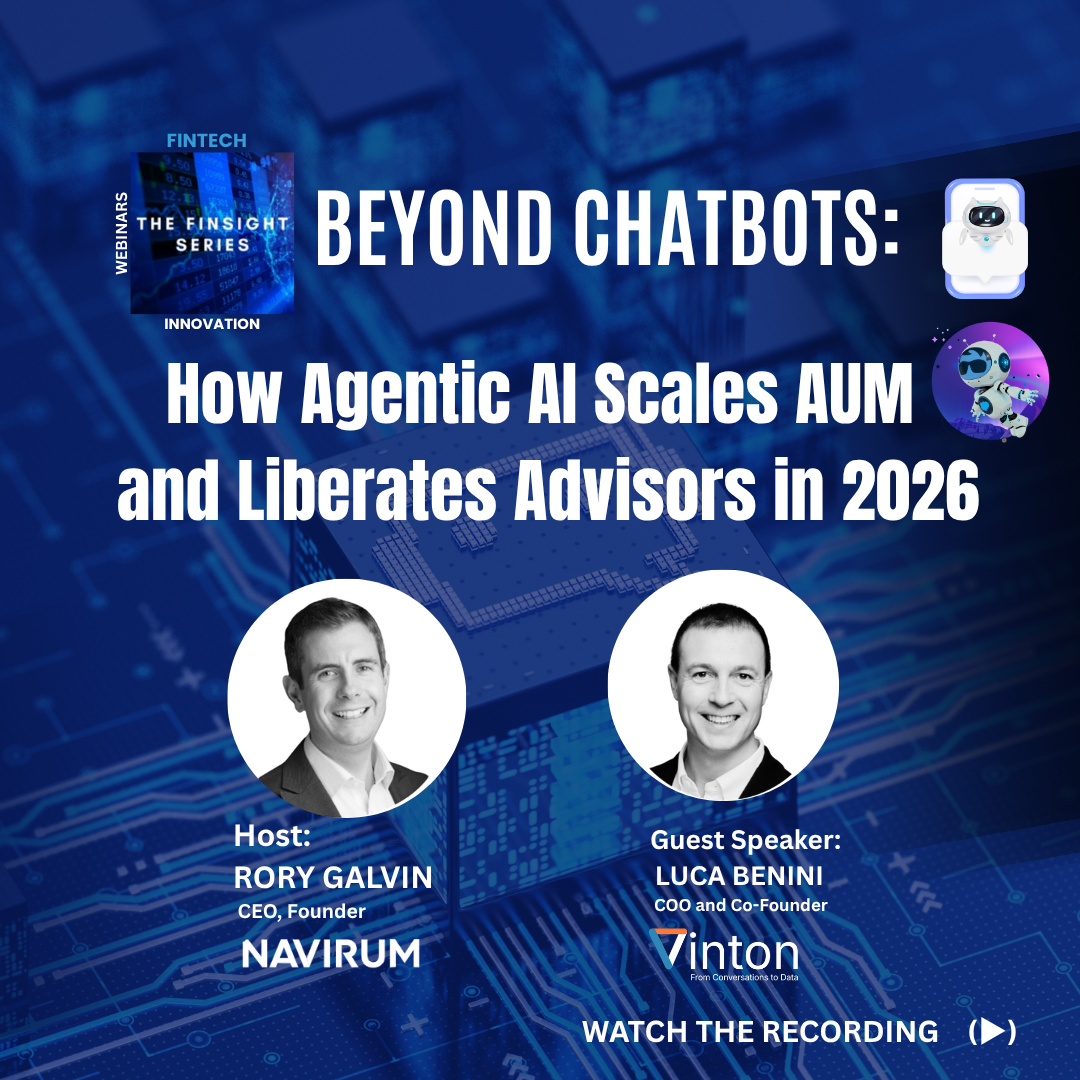
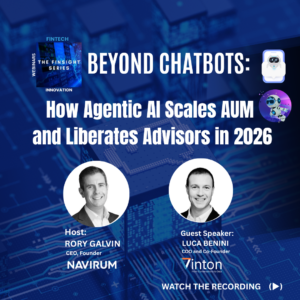
Beyond Chatbots: How Agentic AI scales AUM and Liberates Advisors in 2026 – What does this FinSight Series webinar talks about?
This on-demand webinar explains how wealth and asset management firms are using agentic AI to move beyond chatbots and pilots into production-grade automation. It focuses on real-world applications across onboarding, client servicing, compliance, and reporting, showing up to 90% reduction in manual processes. The session includes a live demo and practical frameworks for scaling assets under management (AUM) without increasing headcount.
What is Agentic AI in Financial Services?
Agentic AI refers to autonomous AI systems that can execute multi-step workflows across enterprise systems without constant human prompting.
In wealth and asset management, agentic AI is used to:
Automate onboarding workflows
Handle client servicing tasks
Support compliance and audit processes
Generate and distribute reporting outputs
Unlike chatbots or copilots, Agentic AI performs end-to-end operational execution, not just assistance.
Why Wealth Management Firms Are Moving Beyond Chatbots
Most financial institutions are still stuck in:
Chatbots for client interaction
Copilots for internal productivity
AI pilots that never reach production
These approaches fail because they do not:
Integrate across workflows
Automate full processes
Deliver measurable operational ROI
Leading firms are now shifting to agentic AI systems embedded in core operations.
Proven Impact of Agentic AI (Real Outcomes)
Firms implementing agentic AI in wealth management are achieving:
Up to 90% reduction in manual operational work
Faster client response times
Improved compliance consistency
Scalable operations without hiring additional staff
More audit-ready and standardized workflows
What This Webinar Covers (On-Demand)
This session provides practical, real-world insights into AI transformation in financial services.
You will learn:
Why 2026 is the inflection point for agentic AI adoption
How wealth managers are deploying AI agents in production
Real-world Salesforce + AI use cases in financial services
How to transition from AI pilots to enterprise-scale systems
Live demonstration of autonomous AI agents in action
Key operational and governance considerations
What You Will Get
After accessing this webinar, you will receive:
Full on-demand recording
Key insights and frameworks
Practical AI implementation examples
Guidance for scaling AI in financial services
Access to future sessions
Key Insight
The financial services industry is shifting from AI experimentation to autonomous execution systems.
The firms that succeed will be those that operationalize agentic AI across core workflows, not those stuck in chatbot and pilot-stage implementations. Operationalizing it safely starts with the governance foundation for agentic AI.
📥 Access the Webinar
Watch the full on-demand session to see how leading firms are scaling AUM with agentic AI.
Access recording below:
Frequently Asked Questions
What is agentic AI in wealth management?
Agentic AI refers to autonomous systems that execute workflows such as onboarding, servicing, compliance, and reporting without manual intervention.
How is agentic AI different from chatbots?
Chatbots respond to queries. Agentic AI executes complete business processes across systems.
What is the business impact of agentic AI?
Typical outcomes include up to 90% reduction in manual work, faster turnaround times, and scalable operations without hiring.
Is this relevant for Salesforce users?
Yes. Many implementations integrate directly with Salesforce to automate CRM-driven workflows.
🏦 About Navirum
Navirum helps financial institutions implement Salesforce-based AI and agentic automation systems that move beyond experimentation into production-scale execution. Orbit’s managed services are built for exactly that ongoing execution layer.
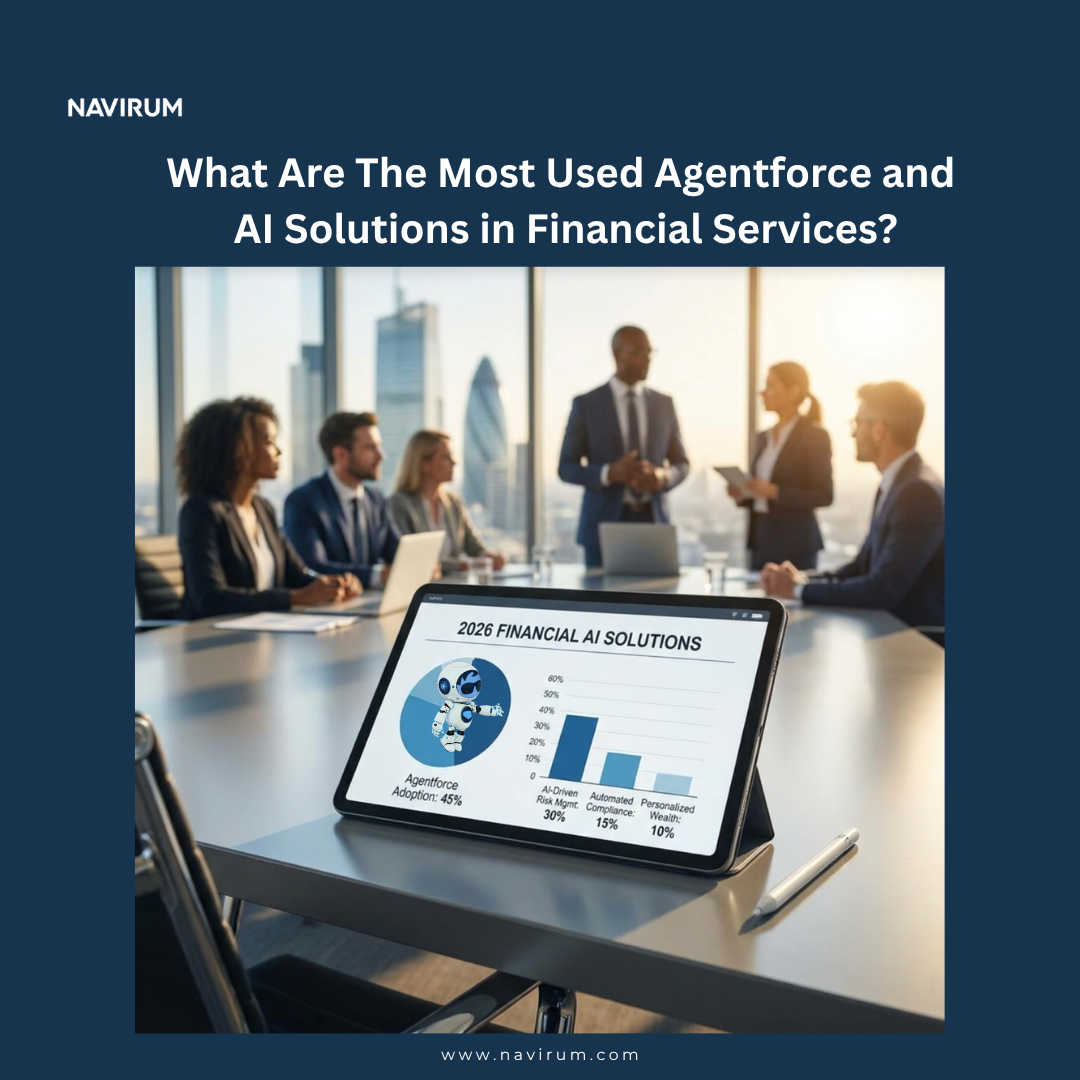
What Are Most Used Agentforce And AI Solutions in Financial Services in 2026?
This article explores the most used Agentforce and AI solutions shaping financial services in 2026, including Agentforce use cases, AppExchange integrations, and practical recommendations for advisors and wealth managers.
Agentforce and AI Solutions in Financial Services
Salesforce Agentforce is an AI agent platform from Salesforce that enables financial institutions to deploy autonomous AI agents that can execute workflows like onboarding, servicing, and compliance.
More broadly, AI solutions in financial services encompass predictive analytics, generative AI, and automation tools that help firms improve efficiency, manage risk, and deliver more personalized client experiences.
In today’s financial services landscape, artificial intelligence (AI) is no longer a futuristic option — it’s a core part of competitive strategy. From automating routine processes to surfacing predictive insights, AI solutions help banks, insurers, and wealth managers deliver superior experiences, reduce operational costs, and reinforce compliance. A leading example of this shift is Salesforce Agentforce, which powers autonomous AI agents capable of executing tasks directly within Salesforce workflows.
1) AI-Powered Autonomous Agents with Salesforce Agentforce
Capabilities & Value: Agentforce agents are autonomous, proactive AI applications that execute tasks like meeting follow-ups, customer outreach, and portfolio monitoring without human intervention. They can connect CRM data, apply business logic, and trigger workflows automatically, helping advisors save time and reduce errors.
Capabilities & Value: Predictive AI models forecast client risk, portfolio volatility, and market exposure. This allows advisors and risk teams to act proactively rather than reactively.
Use Cases & Examples:
Credit scoring: Integrate alternative client data to improve loan and investment suitability assessments.
Portfolio stress testing: Simulate market shocks or client life events to guide personalized recommendations.
Risk alerts: AI flags high-risk scenarios, supporting compliance and advisory decisions.
3) AI-Driven Fraud Detection and Transaction Monitoring
Capabilities & Value: AI monitors transactions across accounts in real-time, identifying unusual patterns and reducing false positives. This protects both clients and the firm while ensuring regulatory compliance.
Use Cases & Examples:
Real-time detection of suspicious account activity.
Automated alerts for unusual transfers or credit events.
Adaptive models that learn emerging fraud patterns over time.
Capabilities & Value: AI analyzes transactions, interactions, and engagement signals to create personalized client strategies, offers, and communications.
Use Cases & Examples:
Delivering tailored loan or investment product recommendations.
AI-generated next-best-action alerts for advisors.
Providing automated insights for client reviews and portfolio updates.
Capabilities & Value: AI-driven data unification consolidates client data across multiple systems, creating a 360° client view for better advisory decisions.
Use Cases & Examples:
Advisor dashboards with holistic portfolio insights.
Cross-system alerts for risk, churn, or engagement opportunities.
Automated, actionable insights from unified data streams.
Capabilities & Value: AI transforms FP&A with predictive scenario modeling, variance reporting, and real-time forecasting, helping advisors and executives plan confidently.
Use Cases & Examples:
Portfolio performance simulations under different market conditions.
Real-time forecasting updates as new data arrives.
AI-generated client reports and planning recommendations.
Navirum Recommendations for Wealth Managers & Financial Advisors
Start with high-impact AI use cases like client engagement automation, advisor productivity, and compliance monitoring before expanding to predictive or generative AI.
Invest in unified, high-quality data to ensure reliable AI insights and autonomous agent actions.
Leverage AppExchange and AgentExchange solutions to accelerate adoption and reduce implementation risk.
Embed governance and explainable AI controls to maintain compliance and advisor confidence.
Plan for change management and adoption, training staff to interpret AI insights and integrate them into client conversations.
FAQ
What is Salesforce Agentforce?
Agentforce is Salesforce’s autonomous AI agent platform that executes tasks, triggers workflows, and delivers insights directly within CRM systems.
How can AI improve client engagement for advisors?
AI monitors engagement, predicts client needs, and recommends next-best actions, enabling proactive conversations and personalized service.
What’s the biggest risk in adopting AI?
Poor data quality or unintegrated systems can lead to inaccurate predictions and ineffective workflows.
How do autonomous agents differ from chatbots?
Chatbots interact conversationally with clients, while autonomous agents execute actions automatically, such as updating portfolios, generating reports, or triggering workflows.
When should firms scale AI across the organization?
Once high-value use cases are proven, data is reliable, and governance processes are in place, AI can scale across advisors, operations, and compliance teams.
Strategic AI Deployment
Explore Agentforce and AI Solutions for Your Firm
Discover how Agentforce can enhance productivity, improve client experiences, and scale operations across your organization.
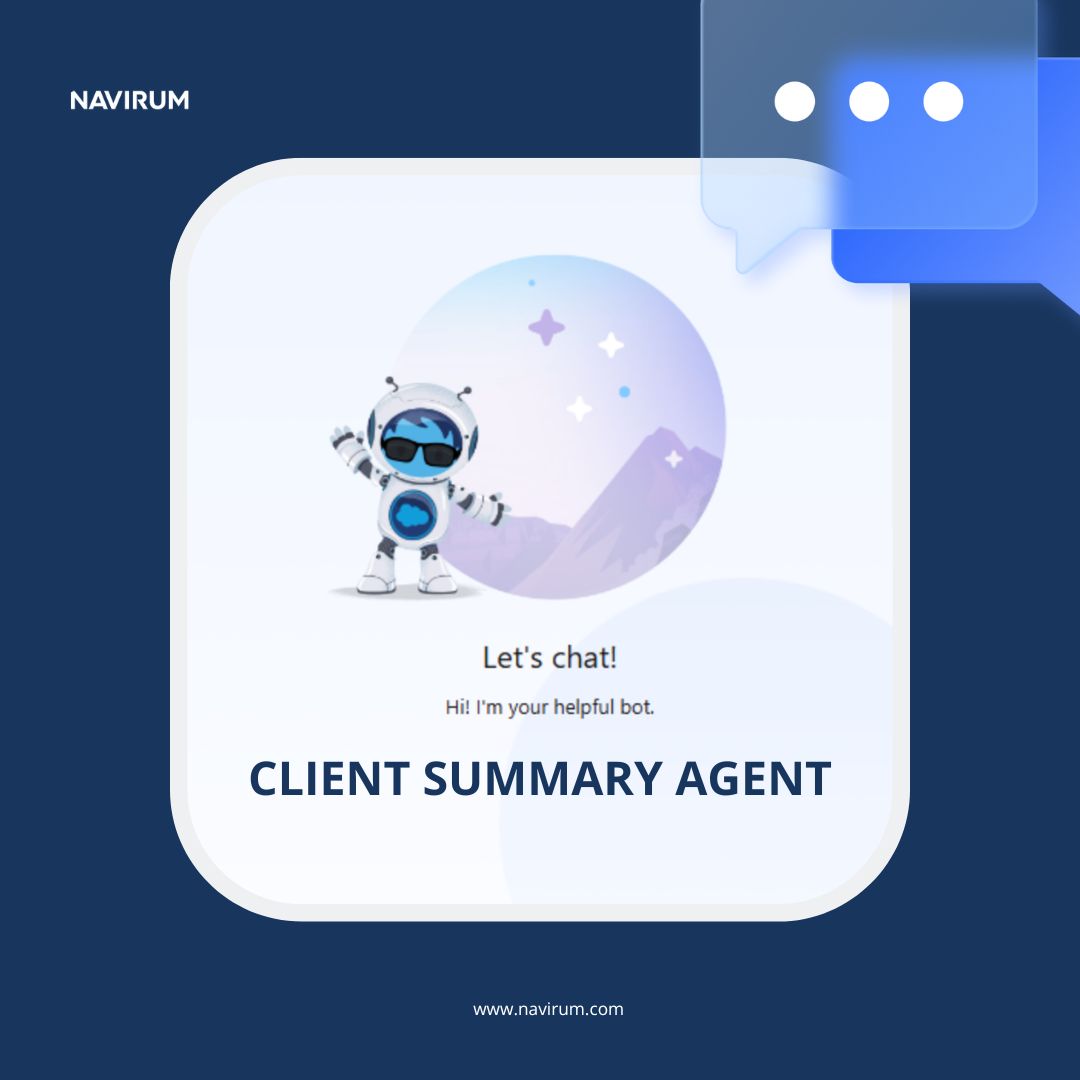
Client Summary Agent is an AI co-pilot designed for Salesforce FSC, proven to cut client meeting preparation time by over 80%.
The Navirum Agentforce Quickstart activates existing Salesforce FSC AI capabilities in a two-week, fixed-scope sprint to deliver the Client Summary Agent, which acts as a strategic co-pilot for wealth managers.cy gain in your sandbox environment. This agent replaces the 45 minutes of manual client meeting prep with a 5-minute review, proving an 80%+ efficiency gain in your sandbox environment.
Activate the AI capability already in your Salesforce FSC license, deploy your first working agent in two weeks, and prove a measurable time-saving of 80% or more.
In wealth management and banking, relationship managers and advisors spend 60–70% of their time on administrative work rather than client engagement. Your advisors likely spend 45 minutes preparing for every client meeting—digging through systems, reviewing interactions, and manually summarizing account histories.
Most FSC Enterprise and Unlimited clients already have Salesforce Foundations—including Agent Builder and basic Data Cloud—active on their license, but haven’t turned it on. The challenge is often complexity and knowing how to configure it for immediate business value. We eliminate that risk. With the Navirum Agentforce Quickstart, we activate what you already own and deliver a risk-controlled AI agent directly in your sandbox to prove the value.
⚡ The “80%+ Gain” Promise
We don’t just implement software; we prove a dramatic, measurable gain in efficiency. Our fixed-scope, fixed-price Quickstart is designed to take a high-effort task and shrink it.
Before: 45 minutes of manual meeting preparation pulling information from various systems.
After: A 3-5 minutes advisor review using Agentforce Client Summary Agent.
🤖 Meet Your First AI Assistant: The Client Summary Agent
Built specifically for wealth management, the Client Summary Agent leverages Salesforce FSC and Data Cloud to reason over household relationships, holdings, recent interactions, and total AUM (including held-away assets).
Instead of just listing data, it acts as a strategic co-pilot:
Operates with strict guardrails, ensuring no outbound client messaging happens without advisor sign-off.
Identifies “Wallet Share” gaps to highlight growth opportunities.
Surfaces life events and drafts personalized talking points.
Suggests the next best action and tailored opening questions for your upcoming client meeting.
Client Summary Agent Demo
Watch how our AI agent transforms complex financial data into strategic meeting briefs in seconds, powered by Salesforce Data Cloud.
🛠️ What’s Included in the 2-Week Sprint
Our Quickstart is a streamlined, two-week engagement requiring minimal executive time (just two decision touchpoints) and clearly defined engagement from your Operations/IT team.
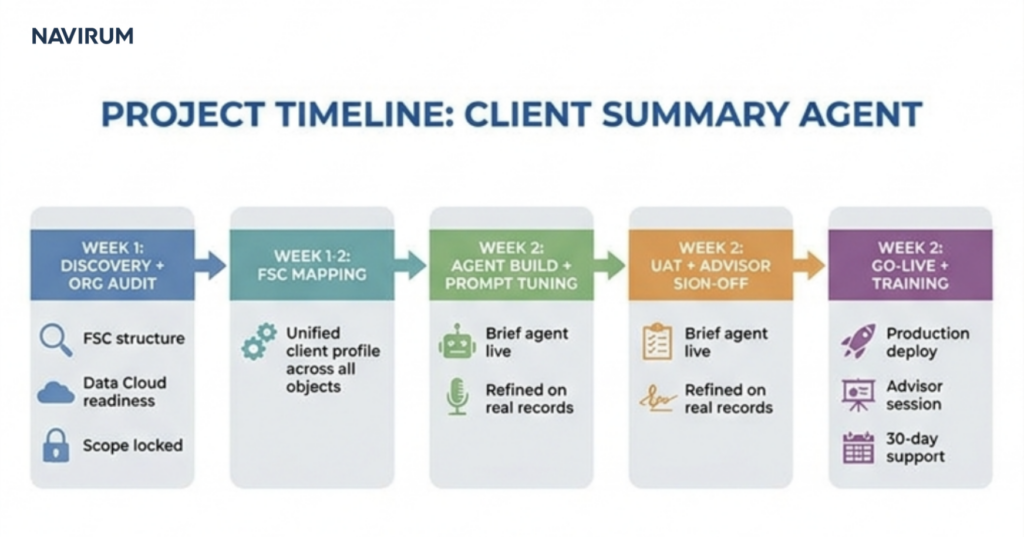
Week 1: Activate and Design
Health Check & Activation: We assess your org’s Foundations readiness and activate Data Cloud streams against core FSC objects (Account, Contact, Household, Financial Account).
90-Minute Workshop: We define your specific baseline, success metrics, and confirm the business problem.
Drafting: Agent topics, instructions, and action libraries are mapped out in Agent Builder.
Week 2: Build and Prove Value
Sandbox Deployment: The agent is built and deployed in your Salesforce sandbox (a risk-controlled environment, separate from production).
End-to-End Testing: We test the agent against anonymized client data to ensure quality and compliance.
Demonstrating the Gain: We capture the exact before/after timings to prove our target ≥80% time reduction.
Autonomous Meeting Preparation
Agentforce Client Summary Agent
Transform manual advisor research into a 3-minute review. Discover how autonomous meeting briefs can enhance productivity and scale your firm.
What specific Salesforce licenses are required for this Quickstart?
This Quickstart is designed for clients with Salesforce FSC Enterprise or Unlimited editions, as they typically include Salesforce Foundations, Agent Builder, and basic Data Cloud capabilities
Is the 80%+ time saving a guarantee?
It is our “80%+ Gain” Promise, and we prove the measurable time reduction during the 2-week sprint. We capture the exact before/after timings using your anonymized client data to demonstrate a target gain of 80% or more
What is the “fixed-scope” of this Quickstart?
The scope is fixed to activating your existing licenses, configuring the Client Summary Agent for the single use case of client meeting preparation, and proving the 80% time saving in a sandbox environment.
Does the Client Summary Agent require new data sources outside of Salesforce?
No, the Quickstart focuses on activating Data Cloud streams against your core FSC objects, such as Account, Contact, Household, and Financial Account, to reason over existing data, including held-away assets.
What kind of time commitment is required from our team during the two weeks?
We require minimal executive time (just two decision touchpoints). However, we will require clear engagement from your operations/IT team, especially for the 90-Minute Workshop in Week 1 to define specific metrics and the business problem.
Why do we need Navirum if we already own the necessary Salesforce licenses?
While most clients own the licenses, the challenge is often knowing how to configure the foundations for immediate business value. Navirum specializes in the Agentforce Quickstart process to rapidly activate, configure, and prove measurable value in just two weeks, eliminating the risk and complexity of starting from scratch.
How does the agent ensure client data remains private and secure?
The Quickstart involves deploying the agent only in your Salesforce sandbox (a risk-controlled environment), and all testing is performed against anonymized client data to ensure compliance. The agent also operates with strict guardrails, ensuring no outbound client messaging happens without advisor sign-off
Can we customize the agent to focus on specific talking points or actions unique to our firm?
Yes. The 90-Minute Workshop in Week 1 is specifically where we define your success metrics and map out the agent topics, instructions, and action libraries in Agent Builder to meet your firm’s specific needs.
What happens after the 2-week Quickstart is complete?
You will have a fully functional and proven Client Summary Agent in your sandbox environment. We will provide a demonstration of the quantified gain and outline the next steps for a full production rollout or expanding to other AI use cases. It is the same ongoing-value model behind Orbit’s managed services.
Which financial professionals is the Client Summary Agent designed for?
It is built specifically for relationship managers and advisors in wealth management and banking.
Ready to Unlock the AI You Already Own?
Stop waiting. Start proving AI value in your sandbox within two weeks with a fixed scope, fixed price, and a fixed outcome.
Discover how leading wealth management practices partnered with Navirum to implement Financial Services Cloud, streamline advisor operations, and accelerate growth.
Intellistack vs DocuSign vs FormAssembly: A Comparative Guide for Wealth Managers
Wealth managers and financial services firms rely on digital tools to streamline client onboarding, document management, and compliance workflows. With multiple options in the market, selecting the right platform can be challenging, especially when considering integration with Salesforce, data security, and client experience.
Three platforms commonly used by financial services firms areIntellistack (formerly Formstack), DocuSign, and FormAssembly. Each brings unique capabilities to the table, and all are partners of Navirum, allowing firms to implement solutions with confidence in alignment with Salesforce ecosystems.
This guide provides a clear comparison of these digital tools for wealth managers, showing their strengths, use cases, and customer insights to help them make informed decisions.
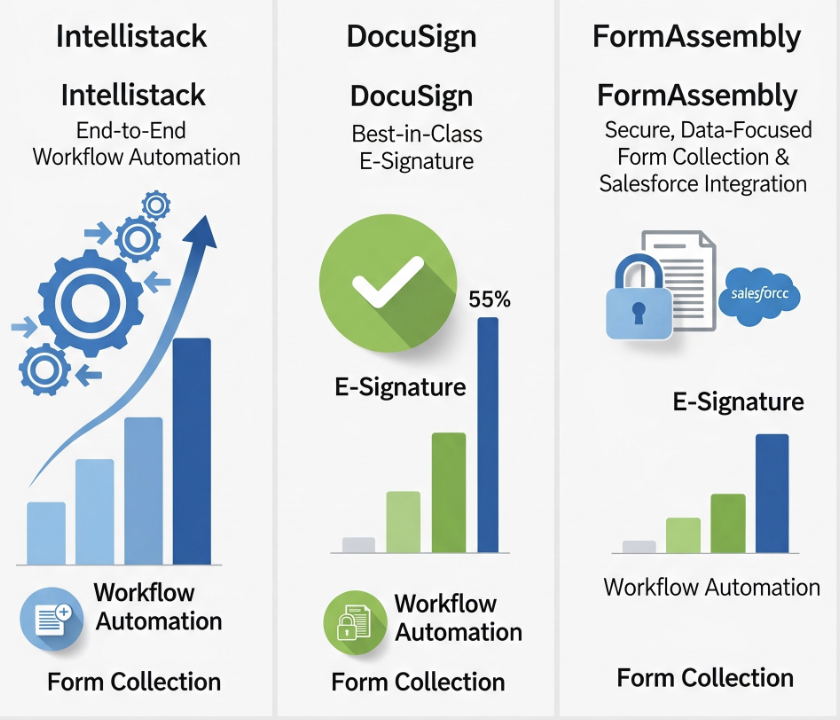
Intellistack is a comprehensive workflow automation platform that combines forms, document generation, e-signatures, and workflow orchestration in one solution. Its evolution from Formstack reflects a focus on AI-assisted automation and seamless Salesforce integration, making it well-suited for mid-market and enterprise organizations.
Intellistack allows firms to manage the full lifecycle of a document—from data collection to execution—within a single system.
Best Suited For
Intellistack is ideal for firms looking for an end-to-end workflow solution. Common use cases include:
Client onboarding and account opening
Compliance and KYC workflows
Multi-step forms and document automation
It is particularly effective when organizations want to reduce manual processes and connect data capture, workflow, and signature in a unified experience.
Customer Insight
Organizations using Intellistack appreciate its ability to centralize workflows and reduce reliance on multiple tools. Users note that its AI-driven automation and Salesforce connectivity help streamline complex processes. Some firms mention that setup can require initial guidance, but the payoff is a consolidated, efficient workflow.
DocuSign is a globally recognized leader in e-signatures and agreement management, offering secure and legally binding digital signature capabilities. Its focus is primarily on the execution phase of documents, ensuring compliance, security, and speed.
DocuSign integrates with a wide range of systems, including Salesforce, to facilitate a smooth client experience while maintaining regulatory adherence.
Best Suited For
DocuSign is ideal for organizations focused on secure, high-volume document signing. Typical use cases for wealth managers include:
Investment agreements and advisory contracts
Client consent forms and disclosure documents
Rapid, compliant execution of documents across multiple clients
DocuSign shines in environments where signature efficiency and legal compliance are the top priorities.
Customer Insight
Customers value DocuSign’s familiarity and trust, which reduces client friction during the signing process. While it does not offer full workflow automation like Intellistack, it is often deployed alongside other tools to complete the end-to-end process efficiently.
FormAssembly is a secure, data-focused platform for forms and data collection. Known for its robust Salesforce integration, FormAssembly enables firms to capture structured client data while maintaining high standards for compliance and data governance.
It is widely used by financial institutions, healthcare organizations, and educational institutions where secure, controlled data capture is essential.
Best Suited For
FormAssembly works best for firms that prioritize data integrity and complex form logic. Common use cases in wealth management include:
Client intake and onboarding forms
Risk profiling questionnaires
Multi-step forms with Salesforce integration
It allows firms to collect and manage structured data while ensuring compliance and security.
Customer Insight
Clients appreciate FormAssembly’s flexibility and customization options, particularly when complex forms or Salesforce workflows are required. While the platform may require technical expertise for advanced configurations, its capabilities in data capture and integration make it highly valuable for firms with sophisticated onboarding or reporting needs.
Firms needing robust data capture and Salesforce integration
How to Choose the Right Tool: Intellistack vs. DocuSign vs. FormAssembly
Technology Selection Framework
How to Choose the Right Tool: Intellistack vs. DocuSign vs. FormAssembly
The right choice depends on your firm’s priorities, workflow complexity, and technology strategy. Evaluate each platform’s core strengths below.
Consolidated Solution
End-to-End Workflow & Automation
If your goal is to unify client onboarding, form capture, document generation, and signature into one seamless process, Intellistack provides a consolidated solution.
All-in-One Onboarding Engine
Unified Forms + DocGen + eSign
Streamlined Wealth Management Flows
Industry Standard
Signature & Compliance Optimization
If the primary focus is fast, secure, and legally compliant document execution, DocuSign offers proven reliability and widespread client familiarity.
Proven Security & Compliance
Widespread Client Familiarity
Rapid eSignature Execution
Deep Data Capture
Complex Data Capture & Integration
If capturing structured client data with detailed form logic is critical, FormAssembly excels with its secure forms and strong integration capabilities.
Advanced Conditional Form Logic
Bi-Directional Salesforce Sync
Enterprise Security & Compliance
Strategic Considerations for Financial Services Firms
All three platforms are Navirum partners, which means they can be implemented with guidance from consultants experienced in financial services and Salesforce ecosystems.
Firms may find value in combining tools: for example, FormAssembly for complex forms, Intellistack for workflow orchestration, and DocuSign for signatures.
Evaluate based on client experience, internal workflow efficiency, regulatory requirements, and integration needs rather than only on features.
Takeaway
Intellistack, DocuSign, and FormAssembly each bring valuable capabilities to wealth management operations. Rather than thinking in terms of “better or worse,” firms should consider which platform aligns best with their business priorities.C
By understanding the differences—and opportunities—across workflow automation, document execution, and secure data capture, wealth managers can make informed technology decisions that improve efficiency, compliance, and client satisfaction. Ongoing platform support is what keeps those gains from fading after launch.
Ready to streamline your advisory workflows and maximize efficiency?
Explore how these digital tools can unify your Salesforce processes, automate tasks, and empower your team to focus on client growth. Request a demo today and see the difference in action.
Ready to transform your client onboarding into a competitive advantage?
Don’t let manual paperwork and disconnected data silos limit your growth. Build a seamless, automated firm today.
At Navirum, our people are at the center of everything we do.
The knowledge, creativity, and experience our team brings to every engagement allow us to deliver meaningful outcomes for our clients. From strategic guidance to complex Salesforce implementations and AI-powered innovation, our experts turn ideas into solutions that create lasting business value.
Whether you are getting to know our team, evaluating our Salesforce and AI offerings, or ready to discuss your firm's growth goals, we are here to guide your journey.
About Navirum
Discover our story, mission, and the experienced financial technology specialists guiding your digital transformation.
Subscribe to the Navirum Newsletter | Financial Services Tech Insights
Financial Tech Insights
Sign Up for the Navirum Newsletter
Get the latest perspectives on Salesforce Financial Services Cloud, Agentforce AI, data strategy, and compliance frameworks delivered directly to your inbox.
Wealth.com integration with Salesforce Financial Services Cloud connects client portfolios, financial goals, and CRM data in real time. Advisors gain a 360° client view, streamline workflows, and improve compliance, while firms boost efficiency and ROI. Secure API or middleware options ensure scalable, automated data sync.
1. What Is Wealth.com Integration with Salesforce?
Wealth.com integration with Salesforce connects digital wealth management capabilities with CRM-driven relationship management. It allows financial firms to synchronize portfolio data, client financial profiles, and investment insights into Salesforce so advisors can operate from a single system of record. Most firms deploy this within Salesforce Financial Services Cloud to unify households, financial accounts, and goals. The result is a consolidated 360-degree client view that combines engagement data with real-time wealth information.
Modern wealth management firms struggle with fragmented systems that separate relationship data from portfolio intelligence. Integrating Wealth.com with Salesforce removes these silos and ensures advisors can act on updated financial data during every client interaction. Instead of toggling between platforms, advisors operate from a unified interface that supports both strategic advice and operational execution. This alignment improves productivity, compliance oversight, and client experience simultaneously.
Strategic reasons firms integrate:
Eliminate duplicate data entry
Improve advisor preparation for meetings
Enable proactive portfolio conversations
Strengthen compliance visibility
Support scalable growth without adding headcount
3. What Does the Integration Include?
A comprehensive Wealth.com –Salesforce integration goes beyond simple data syncing. It often includes customized Salesforce objects, dashboards, automation workflows, and embedded components that display financial insights within the CRM interface. Firms frequently enhance Lightning pages to show holdings, net worth summaries, and performance trends directly within account records. Advanced implementations also incorporate alerts, triggers, and reporting layers.
Core components usually include:
Bi-directional data synchronization
Custom fields and objects
Embedded portfolio visualizations
Automated alerts and task creation
Executive dashboards and KPI tracking
4. Integration Methods and Technical Architecture
Technically, integration can be achieved through APIs, middleware platforms, or managed connectors. Most modern implementations rely on secure REST APIs with OAuth authentication to transmit financial data safely between systems. Middleware platforms like MuleSoft are often used to orchestrate data mapping, transformations, and monitoring. Architecture decisions depend on firm size, data volume, compliance requirements, and scalability goals.
Common technical methods:
Direct API-to-API integration
Middleware (iPaaS) orchestration
Batch data synchronization
Platform events and webhooks
Secure named credentials and OAuth 2.0 authentication
5. How the Integration Works Technically
At a technical level, Salesforce authenticates securely with Wealth.com via OAuth and requests structured financial data through APIs. The data is transformed, mapped to Salesforce objects (such as Accounts, Households, and Financial Accounts), and stored within Financial Services Cloud. Real-time integrations use webhooks or platform events to trigger updates instantly when portfolio data changes. Error handling and monitoring tools ensure failed syncs are logged and retried automatically.
While the integration benefits the entire organization, specific roles gain immediate value. Financial advisors and relationship managers benefit from unified visibility into both engagement history and portfolio performance. Operations and compliance teams benefit from automated audit trails and data consistency. Executives gain strategic insights through consolidated reporting.
Primary beneficiaries include:
Financial advisors and wealth managers
Relationship managers
Operations and back-office teams
Compliance and risk officers
Executive leadership
7. Key Business Benefits
The most significant benefit is the creation of a true client 360 model that supports proactive advice. Advisors can identify portfolio drift, concentration risk, or new opportunities without manually gathering data from multiple systems. Operational efficiency increases as automation reduces repetitive administrative tasks. Over time, firms see stronger retention, higher wallet share, and improved advisor productivity.
Major advantages include:
Real-time portfolio visibility
Faster client meeting preparation
Improved personalization
Reduced operational errors
8. Common Integration Challenges
Despite its advantages, integration is complex and must be carefully designed. Data mismatches between systems can create reconciliation issues if not properly mapped. Salesforce API limits and performance constraints must be considered, particularly for firms with large data volumes. Additionally, change management and user adoption can slow ROI if advisors resist new workflows.
Typical challenges:
Data normalization and mapping inconsistencies
API governor limits
Security and regulatory requirements
User adoption resistance
Ongoing maintenance and version updates
9. Best Practices for a Successful Integration
Successful integrations begin with a clearly defined business objective rather than a purely technical roadmap. Firms should build a data dictionary, define sync frequency, and design security controls before development begins. Phased rollouts help reduce risk and allow teams to test performance and usability incrementally. Continuous monitoring ensures integration health over time.
Recommended best practices:
Conduct a discovery and architecture assessment
Create detailed field mapping documentation
Implement phased deployment
Build dashboards for integration monitoring
Provide advisor training and change management support
10. Use Cases by Firm Type
Different firm types implement the integration differently based on scale and client complexity. Boutique RIAs often focus on advisor efficiency and personalized engagement. Large institutions prioritize scalability, centralized reporting, and regulatory oversight within platforms like Salesforce. Family offices and hybrid advisory firms leverage integration to consolidate multi-custodian investment data.
Examples by firm type:
Boutique RIAs: Meeting prep dashboards and goal tracking
Family offices: Consolidated alternative investment tracking
11. Measuring ROI from the Integration
Measuring ROI requires defining both hard and soft value metrics. Hard ROI often comes from time savings, reduced manual reconciliation, and operational cost reduction. Soft ROI includes improved client satisfaction, increased retention, and stronger advisor engagement. Dashboards within Salesforce can track KPIs before and after implementation to quantify impact.
Key ROI metrics:
Time saved per advisor per week
Reduction in data entry errors
Client retention improvements
Increase in cross-sell or upsell revenue
Operational cost reductions
12. Why You Need a Specialized Salesforce Consulting Partner
Wealth data is highly sensitive and subject to strict regulatory oversight, making expertise critical. A specialized Salesforce consulting partner understands Financial Services Cloud architecture, financial data modeling, and compliance frameworks. They can accelerate deployment while avoiding common pitfalls that delay ROI. Most importantly, they align technology decisions with strategic business outcomes rather than treating integration as a simple IT project.
Why partner with specialists:
Deep Financial Services Cloud expertise
Proven integration frameworks
Regulatory and security knowledge
Faster implementation timelines
Long-term optimization and innovation support
Takeaway
Wealth.com integration with Salesforce represents a strategic shift toward unified, data-driven wealth management. When implemented correctly, it empowers advisors with real-time intelligence, strengthens compliance oversight, and supports scalable growth. Firms that approach integration with clear objectives, strong architecture, and expert guidance consistently outperform those relying on disconnected systems. In a competitive wealth landscape, unified client intelligence is no longer optional—it is a strategic necessity.
Ready to unify estate planning and client data with Wealth.com and Salesforce?
Connect Wealth.com with Salesforce Financial Services Cloud to streamline estate workflows, automate record updates, and deliver modern estate planning experiences.
Below are 10 complex and strategic questions financial institutions often ask us when evaluating or implementing. Wealth.com –Salesforce integration. Each addresses technical, operational, and regulatory considerations relevant to sophisticated firms.
1. How does the integration handle multi-household and complex ownership structures?
In wealth management, clients often belong to multiple households, trusts, or business entities. Within Salesforce Financial Services Cloud, this is managed through Household objects, Account relationships, and role hierarchies. The integration must map Wealth.com account ownership data to FSC relationship models accurately to preserve reporting integrity and compliance transparency.
Key considerations:
Household-to-account relationship mapping
Trust and entity ownership structures
Beneficiary and power-of-attorney relationships
Cross-household reporting accuracy
2. Can the integration support real-time portfolio updates without hitting Salesforce governor limits?
Yes, but it requires architectural planning. Real-time updates using APIs and Platform Events must account for Salesforce governor limits such as API call volume and data processing thresholds. Many firms implement intelligent throttling or middleware layers to batch updates strategically.
Technical strategies include:
Event-driven architecture
Incremental data sync (delta-based updates)
Middleware buffering
API usage monitoring dashboards
3. How is sensitive financial data secured during integration?
Security is central to any financial services integration. Data is encrypted in transit using HTTPS/TLS protocols and authenticated using OAuth 2.0. Within Salesforce, role-based access controls and field-level security ensure only authorized personnel can access portfolio data. As AI agents get layered on top, the same principle extends to governing AI access to Wealth.com data.
Security controls typically include:
OAuth authentication
TLS encryption
Named Credentials configuration
Field-level security and permission sets
Audit logging and monitoring
4. How does the integration manage data reconciliation between systems?
Data reconciliation is often one of the most complex components of the integration. Differences in data structures, valuation timing, and formatting must be normalized to prevent inconsistencies. Middleware solutions like MuleSoft can transform and validate data before it enters Salesforce.
Best practices for reconciliation:
Build a comprehensive data dictionary
Define a single source of truth for each data element
Schedule reconciliation audits
Implement exception reporting workflows
5. Can firms customize dashboards and reporting for executive leadership?
Absolutely. Salesforce’s reporting engine allows firms to combine CRM engagement metrics with financial data from Wealth.com. Executives can monitor revenue trends, advisor performance, and asset allocation shifts in a unified dashboard.
Common executive dashboard metrics:
Assets under management (AUM) growth
Client retention and attrition
Advisor productivity metrics
Cross-sell and upsell performance
Portfolio risk distribution
6. How does the integration scale for large enterprises with thousands of advisors?
Enterprise scalability depends on architecture design. High-volume firms often rely on middleware orchestration, asynchronous processing, and optimized data models to prevent performance degradation. Proper indexing, selective sync strategies, and bulk APIs are critical.
Enterprise scaling techniques:
Bulk API usage
Asynchronous Apex processing
Data archiving strategies
Load testing prior to deployment
7. How does the integration support compliance and audit requirements?
Financial institutions operate under strict regulatory oversight. The integration can log all data updates, changes, and advisor interactions to maintain audit trails. Salesforce’s native tracking features support compliance reporting and supervisory reviews.
Compliance features include:
Field history tracking
Automated compliance alerts
Supervisory dashboards
Document and communication tracking
8. What happens when Wealth.com updates its API or data schema?
API version changes are a realistic operational risk. Firms must design integrations with version control and monitoring mechanisms to detect breaking changes early. A specialized consulting partner can maintain compatibility and manage upgrades proactively.
Mitigation strategies:
API version pinning
Regular vendor release reviews
Regression testing protocols
Staging environment validation
9. How long does a typical Wealth.com –Salesforce integration take?
Implementation timelines vary based on complexity, customization, and firm size. A basic integration may take 6–10 weeks, while enterprise-grade, multi-entity implementations can take several months. Phased rollouts reduce risk and allow early value realization.
Factors affecting timeline:
Number of data objects synchronized
Custom dashboard requirements
Compliance validation processes
User training and change management
10. How do firms ensure long-term ROI after integration?
Integration is not a one-time project—it requires optimization and governance. Firms should monitor KPIs, track user adoption, and continuously refine workflows. When aligned with strategic growth objectives, integration becomes a competitive advantage rather than just a technical upgrade.
Long-term ROI drivers:
Continuous dashboard optimization
Advisor adoption measurement
Periodic integration audits
Automation expansion initiatives
Strategic alignment with growth goals
Closing Note on Strategic Complexity
Wealth.com integration with Salesforce is both technically intricate and strategically transformative. Firms that approach it with clear governance, robust architecture, and financial domain expertise unlock significant operational leverage. When executed correctly, it strengthens advisor productivity, enhances client trust, and creates measurable enterprise value.
Navirum Recommendations
Overview
At Navirum, we view Wealth.com –Salesforce integration not as a systems project, but as a strategic operating model decision. It is the same thinking behind Orbit’s ongoing managed services model. The difference between a functional integration and a transformative one lies in governance, data ownership clarity, and long-term scalability planning. Based on our experience working with financial institutions, we recommend approaching integration as a structured program with executive sponsorship, measurable business outcomes, and phased enablement. Below are our strategic recommendations, backed by results firms like yours have seen, for firms seeking sustainable impact.
Start with an Operating Model Blueprint
Design for Advisor Experience First
Establish Clear Data Ownership
Implement Governance from Day One
Build Executive-Level Visibility Early
Plan for Regulatory Evolution
Prioritize Performance Testing at Scale
Adopt Continuous Optimization Cycles
Align Integration KPIs to Growth Strategy
Invest in Long-Term Partnership, Not Just Implementation
Strategic Recommendations:
Start with an Operating Model Blueprint Define how advisors, operations, and compliance teams will use integrated data before building technical workflows. Technology should support behavior, not dictate it.
Design for Advisor Experience First Ensure financial data surfaces naturally within Salesforce screens advisors already use. Minimize clicks, reduce screen switching, and prioritize actionable insights over raw data displays.
Establish Clear Data Ownership Determine which system is the authoritative source for each data category (e.g., client demographics, portfolio balances, risk scores). This prevents internal disputes and reporting discrepancies later.
Implement Governance from Day One Create a joint IT–business governance committee to oversee enhancements, API changes, and performance monitoring. Governance reduces long-term technical debt.
Build Executive-Level Visibility Early Include leadership dashboards in early phases so executives can see measurable progress and ROI signals quickly. This maintains alignment and continued investment support.
Plan for Regulatory Evolution Financial regulations evolve. Build flexibility into data retention policies, permission structures, and audit logging so adjustments can be made without major re-architecture.
Prioritize Performance Testing at Scale Simulate real-world advisor activity and peak market volatility scenarios before going live. Financial data spikes during market events can stress poorly designed integrations.
Adopt Continuous Optimization Cycles After deployment, conduct quarterly optimization reviews to assess adoption, workflow efficiency, and automation expansion opportunities.
Align Integration KPIs to Growth Strategy Tie integration success metrics directly to strategic goals such as AUM growth, client retention, advisor capacity expansion, or margin improvement.
Invest in Long-Term Partnership, Not Just Implementation The most successful firms treat integration as an evolving capability. Ongoing advisory support ensures architecture adapts to business growth, new products, and regulatory shifts.
When executed strategically, Wealth.com integration within Salesforce becomes a competitive differentiator rather than a back-office utility. Firms that combine disciplined governance, advisor-centric design, and long-term optimization consistently outperform peers relying on disconnected systems. Integration is not simply about moving data—it is about unlocking intelligent, scalable, and compliant growth across the entire wealth enterprise.
Online Resources| Navirum
Knowledge & Insights
Online Resources
Discover strategic guides on Salesforce Financial Services Cloud implementations, Agentforce value, custodian integrations, and financial planning tool optimization.
At Navirum, our people are at the center of everything we do.
The knowledge, creativity, and experience our team brings to every engagement allow us to deliver meaningful outcomes for our clients. From strategic guidance to complex Salesforce implementations and AI-powered innovation, our experts turn ideas into solutions that create lasting business value.
Whether you are getting to know our team, evaluating our Salesforce and AI offerings, or ready to discuss your firm's growth goals, we are here to guide your journey.
About Navirum
Discover our story, mission, and the experienced financial technology specialists guiding your digital transformation.
The Salesforce Partner Program sets a high standard for excellence. To reach the Ridge partnership level, consulting partners must demonstrate a deep expertise in the Salesforce ecosystem, extensive knowledge across Salesforce Clouds, consistently high customer satisfaction (CSAT) scores, and a strong, growing team of certified Salesforce professionals.
With a 5/5 rating on Salesforce AppExchange and numerous active Salesforce program certifications across areas including development, consulting, marketing, commerce, Financial Services Cloud, Sales Cloud, Service Cloud, administration, and multi-cloud, Navirum has consistently delivered real-world results while meeting stringent partner performance standards. This dedication has earned us the distinguished Salesforce Ridge Partner status.
Navirum as a Salesforce Ridge Partner
Navirum is proud to be recognized as a Salesforce Ridge Partner, a designation reflecting sustained expertise, delivery quality, and strong ecosystem engagement. This status highlights our continued focus on delivering Salesforce solutions for wealth management, asset management, and regulated financial institutions.
Ridge status reflects a sustained level of expertise, delivery quality, and ecosystem engagement within the Salesforce partner program. It’s not an announcement milestone — it’s a signal of where and how we operate.
Our Ridge standing is grounded in a few core areas:
Deep Financial Services focus
We specialize in Salesforce for wealth management, asset management, and regulated financial services firms, with extensive experience delivering Salesforce Financial Services Cloud in real-world, compliance-driven environments.
AI-enabled CRM delivery
Our work increasingly centres on AI and data-driven CRM — including Agentforce, Data Cloud, automation, and intelligent workflows designed to improve productivity, insight, and scale
Financial systems integration expertise
We regularly integrate Salesforce with custodians, portfolio management systems, data providers, and operational platforms — helping firms connect front, middle, and back office systems in a way that actually works.
Strong ecosystem relationships
Ridge reflects not just delivery capability, but collaboration. We work closely with Salesforce and the wider AppExchange ecosystem to support both successful project delivery and new client engagements.
Commitment to delivery excellence
Our current 5-out-of-5 rating on the Salesforce AppExchange reflects a consistent focus on quality, trust, and client outcomes.
We continuously invest in our people, our delivery standards, and our Salesforce capabilities, with a clear ambition to progress to the next partner tier over time.
Agentforce is Salesforce’s AI-powered automation platform — it uses AI agents to handle workflows, service requests, and data tasks natively inside Salesforce, without heavy custom code. For investors, the real question isn’t just what Agentforce is, but what its adoption signals. This guide breaks down how to evaluate its value, track measurable KPIs, and assess adoption impact across revenue growth, scalability, and customer experience — plus real-world use cases, risks, and NAVIRUM’s recommendations for maximizing ROI.
Unlocking Strategic Value & Competitive Advantage
In today’s digital economy, investors are constantly evaluating technology platforms that drive growth, efficiency, and measurable ROI. Agentforce is one such platform gaining attention—not because it’s just another tool, but because it delivers transformative results for organizations leveraging Salesforce and automation at scale. For investors, understanding the strategic value of Agentforce adoption can reveal opportunities to support companies that are not only modernizing operations but also generating measurable financial impact.
This deep-dive guide explains why investors should care about Agentforce, how it creates value, and what its adoption means for long-term growth prospects. We’ll cover:
What Agentforce is and why it matters
The problem it solves
Key benefits for investors
Real-world performance indicators
Market potential and competitive positioning
Risks and mitigation factors
What investors should ask before backing an Agentforce adoption
Agentforce is a Salesforce-native automation and workflow platform designed to streamline business operations. More than just another software tool, it provides companies with a single environment to automate complex tasks, orchestrate workflows, and enhance productivity—all without heavy custom coding. Built to integrate seamlessly with Salesforce CRM, Agentforce empowers organizations to leverage their existing systems while accelerating digital transformation, giving them an edge in competitive markets.
Unlike traditional automation tools, Agentforce operates directly within Salesforce, unlocking unified data, compliance tracking, and real-time insights that investors should see as strong indicators of scalable, high-value operations.
Agentforce Success Story – Prudential Wealth Management
Why Agents (and Their Organizations) Need Agentforce
Organizations often face challenges that directly impact profitability and growth: inefficient manual processes, siloed data, and rising customer expectations. Investors need to understand that these operational bottlenecks are costly in time, money, and market opportunity. Agentforce addresses these issues by providing a structured way to automate and optimize workflows, enabling agents and teams to focus on value-driven work instead of repetitive administrative tasks.
Some of the specific ways Agentforce addresses these challenges include:
Automating repetitive tasks
Routing work intelligently
Connecting Salesforce to external systems
Scaling processes without code
By tackling these inefficiencies, Agentforce allows businesses to deliver faster, more accurate results, which ultimately translates into stronger financial performance and competitive advantage.
Investors evaluate technologies not on features alone, but on how they drive measurable value. Agentforce is compelling because it creates direct business impact in ways that are visible in both operational and financial metrics. From boosting productivity to improving data quality, the platform enhances processes that investors can monitor and quantify.
Here are the primary ways Agentforce drives value:
1. Revenue Growth Through Increased Productivity
One of the clearest benefits of Agentforce is its ability to free teams from time-consuming manual work, allowing them to focus on revenue-generating activities. By automating routine tasks, agents can close deals faster, handle more clients, and reduce errors that slow business processes.
Faster deal cycles
Higher throughput per agent
Fewer human errors
These improvements directly increase revenue per employee, a key metric investors watch for scalable businesses.
2. Reduced Operational Costs
Operational inefficiencies are a hidden drain on profit margins. By automating processes, Agentforce reduces the need for oversight and manual intervention, helping companies spend less on administrative labor and avoid costly mistakes.
Automating task routing and approvals
Eliminating redundant work
Minimizing system maintenance
Lower operational costs mean higher profitability, which is a critical factor in investor evaluations.
3. Improved Data Quality and Visibility
High-quality data is the backbone of informed decision-making. Many organizations struggle with siloed systems and inconsistent records, which can mislead management and slow growth. Agentforce ensures that data is accurate, integrated, and accessible, empowering leaders to make faster, data-backed decisions.
Data flows automatically between touchpoints
Reporting becomes real-time and accurate
Dashboards reflect true performance metrics
For investors, this translates into more reliable performance metrics and confidence in the company’s growth story.
4. Scalability Without Heavy Engineering
Traditional custom-coded solutions are slow, expensive, and difficult to maintain. Agentforce offers a low-code solution that scales with the business, enabling companies to deploy new workflows quickly without overloading engineering teams.
Reduces reliance on engineering teams
Enables faster deployment of use cases
Supports rapid business pivots
Scalable, maintainable technology is a strong signal of sustainable growth potential for investors.
5. Customer Experience Differentiation
Customer experience is a direct driver of loyalty, retention, and long-term revenue. Companies that fail to respond quickly or accurately risk losing clients. Agentforce improves CX by automating responses, routing escalations intelligently, and personalizing workflows, which can set organizations apart from competitors.
Ensures timely responses
Automates service escalations
Generates personalized workflows
Better customer experience results in higher retention and lifetime value, metrics that investors closely monitor.
Investors considering Agentforce adoption need measurable signals to assess performance. Rather than relying on marketing claims, focus on metrics that show operational impact, scalability, and financial outcomes.
Some key indicators include productivity gains, time to value, customer retention, data accuracy, cost savings, user adoption. Tracking these KPIs helps investors determine whether a company is realizing the promised benefits of Agentforce.
Market Demand and Competitive Positioning
Agentforce occupies a growing market niche at the intersection of low-code automation, workflow orchestration, and Salesforce-native solutions. The platform’s adoption potential is amplified by strong market demand for flexible automation tools, particularly in organizations struggling with system fragmentation and operational inefficiency.
High Demand for Low-Code Platforms
Low-code solutions are growing because businesses need agility without relying on scarce technical talent. Investors should note that Agentforce aligns with broader digital transformation trends, making it a forward-looking investment opportunity.
Integration with Salesforce Ecosystem
Being Salesforce-native is a key differentiator. Agentforce can leverage existing Salesforce data, reduce friction in adoption, and unify workflows—advantages that competitors outside the Salesforce ecosystem cannot easily replicate.
Competitive Landscape
Agentforce competes conceptually with RPA tools, custom code, and other automation platforms. Its Salesforce-native design gives it an edge in ease of use, integration, and scalability, which can translate to higher ROI for companies.
No technology adoption is risk-free. Investors should understand the potential challenges of Agentforce deployments and the mitigation strategies companies employ.
Market Adoption & Awareness
Some organizations may underutilize Agentforce if they do not fully understand its capabilities. Without strong leadership buy-in and change management, adoption may lag.
Mitigation: Focus on proven verticals and showcase quantifiable ROI cases.
Competitive Pressure
Automation platforms are evolving rapidly. Agentforce must continually differentiate itself from RPA tools and low-code competitors.
Mitigation: Maintain a strong product roadmap and Salesforce integration strategy.
Dependency on Salesforce Ecosystem
Being tied to Salesforce is a strength, but it also creates dependency. Changes in Salesforce strategy or pricing could impact Agentforce adoption.
Mitigation: Maintain strategic alignment with Salesforce updates and policies.
Real-world applications help investors visualize how Agentforce drives operational efficiency, customer satisfaction, and financial performance.
Use Case 1: Automated Incident Escalation
Manual incident management causes delays and poor service quality. Agentforce can automate routing based on predefined criteria, ensuring issues are addressed quickly and efficiently, which boosts client satisfaction and reduces churn.
Use Case 2: Quote to Cash Automation
Sales and finance teams often face bottlenecks during deal approval and invoicing. Agentforce orchestrates these workflows automatically, reducing cycle times and increasing predictability in cash flows.
Use Case 3: Compliance & Audit Trail
Highly regulated industries require meticulous record-keeping. Agentforce automatically logs decisions, timestamps, and audit events directly in Salesforce, minimizing compliance risk and supporting governance transparency. That transparency is one piece of ecosystem-level AI governance across the tools your team already uses.
What Investors Should Ask Before Backing an Agentforce Deployment
Investors need to assess whether a company is strategically leveraging Agentforce rather than using it as a superficial technology investment. Questions should probe adoption, KPIs, and real business outcomes:
What baseline efficiencies existed prior to Agentforce?
What KPIs does leadership monitor post-adoption?
How fast are workflows iterated and who owns the process?
Is user adoption measured and encouraged?
Can executives tie automation directly to financial results?
High-quality answers indicate mature operations and effective use of automation, making the company a more attractive investment.
Agentforce delivers the most value when paired with deep Salesforce consulting expertise. Many organizations struggle to realize ROI because they lack the strategy, configuration, and adoption planning necessary for success.
Technical Alignment
Expert consultants ensure that Agentforce is configured for scalability, security, and performance, reducing technical debt and maximizing efficiency.
Process Optimization
Consultants help organizations align workflows with business objectives, establish KPIs, and manage change across teams, ensuring sustainable benefits.
Ongoing Support and Expansion
Agentforce requires monitoring, tuning, and ongoing expansion into new business units. Salesforce consulting partners provide the guidance needed to continuously drive operational improvements and ROI.
Latest Agentforce Updates (Updated July 2026)
Agentforce continues to expand across the Salesforce ecosystem. Recent developments investors should track: deeper Data Cloud integration for real-time agent decisioning, expanded prebuilt agent templates for wealth and asset management workflows, and growing adoption among Salesforce’s financial services partners. NAVIRUM tracks these updates as part of our ongoing Agentforce consulting work — check back for monthly refreshes.
Final Thoughts: Why Agentforce Matters to Investors
Agentforce is more than an automation tool—it’s a strategic enabler. Investors should focus on measurable benefits like increased revenue, reduced costs, enhanced customer experience, and scalable operations. Companies using Agentforce effectively signal operational maturity, strategic thinking, and forward-looking leadership, all key qualities for sustainable growth and long-term investment potential.
If you want to evaluate a company’s Agentforce adoption or accelerate ROI through expert Salesforce consulting, our team can help turn automation into a measurable competitive advantage.
Frequently Asked Questions (FAQ) About Agentforce for Investors
What is Agentforce, and why should investors care?
Agentforce is a Salesforce-native workflow automation platform that streamlines processes, reduces manual work, and improves data accuracy. Investors should care because it enables companies to scale efficiently, cut operational costs, and enhance customer experience, all of which translate into stronger financial performance.
What is Agentforce’s definition, in simple terms?
In simple terms, Agentforce is Salesforce’s AI agent platform — a suite of autonomous AI agents built natively on Salesforce that can complete tasks, answer questions, and take action across sales, service, and operations without constant human input.
What are Agentforce’s key features and benefits?
Agentforce’s key features include native Salesforce integration, low-code workflow automation, real-time data access, and configurable AI agents for service and sales tasks. The core benefits are faster deal cycles, lower operational costs, improved data accuracy, and better customer experience — metrics investors track directly.
How does Agentforce create measurable value?
Agentforce drives revenue growth, cost savings, and productivity improvements by automating tasks, improving workflow efficiency, and enhancing data quality. Investors can track KPIs like reduced cycle times, operational cost declines, and increased revenue per agent to measure impact.
Can Agentforce integrate with existing Salesforce systems?
Yes. Agentforce is designed to operate natively within Salesforce, providing seamless integration with existing CRM data, dashboards, and processes. This minimizes implementation risk and allows organizations to leverage their current technology stack.
What types of companies benefit most from Agentforce?
Organizations with complex workflows, high customer interaction volumes, or regulatory requirements tend to benefit most. Industries such as finance, insurance, and professional services see strong ROI due to operational efficiencies and improved customer experience.
How quickly can a company see results after implementing Agentforce?
Many companies begin to see measurable improvements within weeks to a few months, depending on workflow complexity and user adoption. Metrics like task automation rates, reduced manual errors, and faster approval cycles are early indicators of ROI.
What are the main risks associated with Agentforce adoption?
Risks include low user adoption, overreliance on Salesforce ecosystem changes, and competitive pressure from alternative automation tools. These risks are typically mitigated through strong leadership support, effective change management, and consulting expertise.
How does Agentforce improve customer experience?
By automating service escalations, routing tasks intelligently, and personalizing workflows, Agentforce ensures timely and accurate responses to customer inquiries. This leads to higher retention rates and increased lifetime value, which investors view favorably.
Does Agentforce require a technical team to manage?
While Agentforce is low-code, organizations often benefit from Salesforce consulting expertise for configuration, optimization, and expansion. Consultants help align the platform with business objectives, ensuring maximum ROI.
How can investors evaluate a company’s success with Agentforce?
Investors should monitor KPIs such as:
Data quality and reporting accuracy These metrics demonstrate real, quantifiable benefits from the platform.
Productivity gains per agent
Operational cost reductions
Customer retention and satisfaction
Is Agentforce a long-term strategic investment?
Yes. Companies that implement Agentforce effectively gain scalable processes, better data visibility, and improved operational efficiency, which supports sustainable growth. For investors, this indicates a mature, forward-thinking organization capable of delivering long-term returns.
NAVIRUM Recommendations for Investors and Companies Using Agentforce
Maximizing the value of Agentforce requires more than simply deploying the platform—it’s about strategic implementation, continuous optimization, and alignment with business goals. As a Salesforce consulting partner with deep experience in financial services, Navirum offers several recommendations for investors and organizations looking to leverage Agentforce effectively:
1. Prioritize Clear ROI Metrics. Before implementing Agentforce, define quantifiable KPIs that matter most to the business. This could include task automation rates, operational cost reductions, customer satisfaction scores, or revenue per agent. Establishing metrics upfront ensures investors can track performance and value creation over time.
2. Align Workflows With Strategic Objectives. Agentforce adoption should go beyond automating existing processes. Navirum recommends redesigning workflows to eliminate inefficiencies and support business priorities, ensuring that automation drives both operational excellence and strategic growth.
3. Leverage Salesforce Integration Expertise. Seamless integration with Salesforce is critical for success. Navirum advises engaging experienced consultants to configure the platform, synchronize data across systems, and maintain real-time reporting. This minimizes technical risk and maximizes the platform’s full potential.
4. Monitor Adoption and Change Management. Technology adoption is only as effective as its users. Navirum suggests tracking adoption rates and providing training to ensure agents and teams fully utilize Agentforce. This improves productivity, increases ROI, and reassures investors that the platform is delivering tangible benefits.
5. Plan for Continuous Optimization. Business needs evolve, and so should your automation strategy. Navirum recommends regularly reviewing workflows, reporting, and KPIs to identify new opportunities for efficiency, scalability, and competitive advantage.