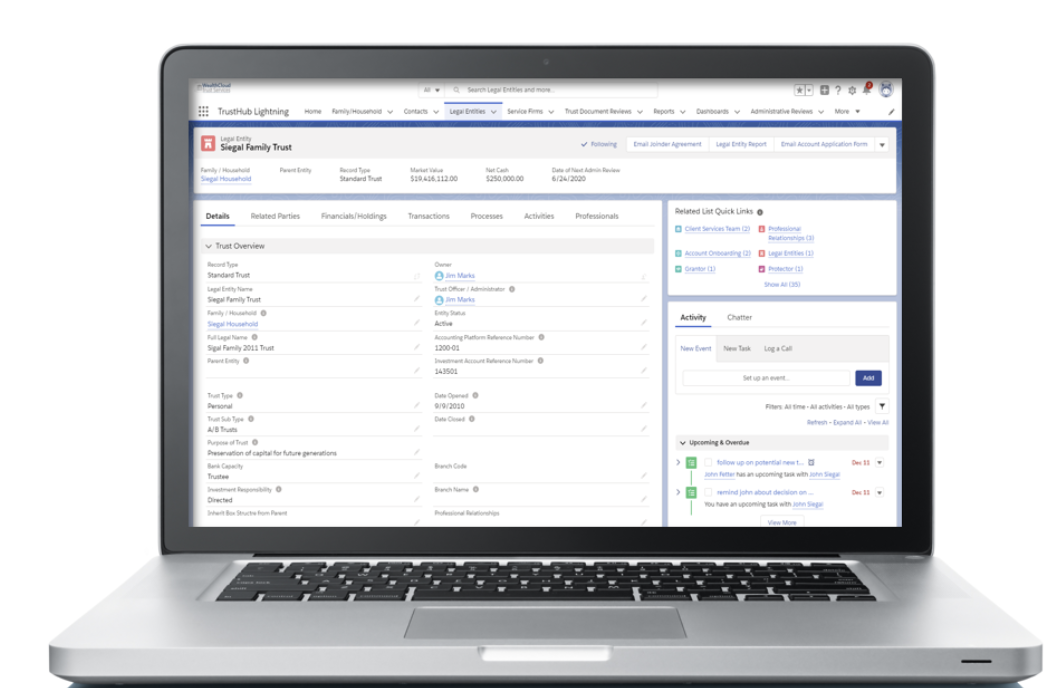
Cuddy Financial Services is a boutique wealth management and tax advisory firm based in the state of New York, committed to delivering personalized, tax-efficient strategies. As the firm grew, advisors struggled with a fundamental challenge: investment data from their core platform, Envestnet, was not easily accessible or reliable inside Salesforce. This resulted in a fragmented advisor experience, inconsistent and incomplete financial account data, and gaps in reporting that slowed operations and diminished confidence in the numbers.
To tackle this head-on, Cuddy Financial Services engaged Navirum, a Salesforce partner since 2018, to make Envestnet data first-class in Salesforce, improve data quality, and give advisors a single, reliable place to work. The goal was to transform their technical stack into a robust, advisor-centric platform.
Building a Unified Foundation
Salesforce became Cuddy Financial’s unified CRM, acting as the system of record for client relationships and accounts. This established the central hub where all client interactions and data points—including the firm’s proprietary CuddyBrain insights—would ultimately reside. The next challenge was ensuring the core investment data from Envestnet flowed into this foundation with integrity and seamless accessibility
Embedding Envestnet Insights Directly into Salesforce
Navirum partnered with the Cuddy Financial Services and Envestnet teams to engineer a deep, resilient integration, focusing on bringing investment insights directly to the advisor workflow:
Component on the Person Account: A custom Envestnet component was designed and implemented directly on the Person Account page, ensuring advisors see investment data immediately upon opening a client record without leaving Salesforce.
Reliable Data Sync: The team performed targeted troubleshooting to resolve critical missing data issues and edge-case sync problems, ensuring all financial accounts successfully synced into Production.
Hardened Integration: As part of a major Salesforce org migration and the introduction of CuddyBrain, the Envestnet integration was reviewed, mapped, and hardened to prevent disruption and ensure stability during a period of complex technical change.
This approach effectively embedded Envestnet data where advisors needed it most, turning the Person Account page into a “single pane of glass” for client insights.
A Resilient, Advisor-Centric Platform
The new solution aligned the technology stack with Cuddy Financial’s long-term strategy of delivering a unified, modern platform for client service. The integration is now resilient to the firm’s evolving environment, supporting growth and reducing the technical risk associated with future platform changes.
Impact at a glance
Salesforce was established as the unified system, centralizing the client record.
Envestnet data was integrated directly onto the Person Account page, ending the fragmented advisor experience.
Data quality and trust improved significantly through the resolution of sync issues and missing data.
Reporting and dashboards were refined in collaboration with Envestnet to align with Cuddy’s actual performance measurement needs.
By embedding Envestnet data directly into the Salesforce advisor workflow, Cuddy Financial Services eliminated system-jumping and built a modern, reliable foundation for productivity, trust, and scale.
⚠️ Fragmented advisor experience, forcing users to jump between Salesforce and Envestnet.
⚠️ Inconsistent and incomplete financial account data sync, leading to confidence issues.
⚠️ Missing data (e.g., December 2024 figures) and misaligned Envestnet dashboards.
⚠️ Risk of disruption due to an upcoming Salesforce org migration and introduction of CuddyBrain.
The Solutions
🛠️ Tight Envestnet–Salesforce Integration & Data Mapping, hardened for org migration.
🛠️ Custom Envestnet component designed and implemented on the Person Account page for immediate visibility.
🛠️ Resolved missing data and ensured reliable end-to-end financial account sync into Production.
🛠️ Reviewed and refined Envestnet dashboards to align with Cuddy’s real-world reporting needs.
The Results
✅ Advisors view Envestnet investment data in context, on every client record, without leaving Salesforce.
✅ Data quality and trust improved, providing advisors and management confidence in the numbers.
✅ Reporting became more meaningful, reflecting how Cuddy measures performance.
✅ Integration is resilient to change, supporting long-term strategy and reducing technical risk.
Ready to get more from your Salesforce investment?
Let’s talk about how Navirum can help your advisory firm work smarter, scale faster, and stay focused on what matters most — your clients. Contact us today to get started
Want to dive deeper into how Cuddy Financial transformed their Salesforce operations? Download the full customer success story as a PDF to explore the complete details of their journey, key outcomes. Fill out the contact form below on this page to get instant access.
Lavinia PicuSalesforce and Envestnet Integration: Cuddy Financial Unifies Data for a Better Advisor Experience
Future Proof Festival (Citywide) is a high-energy, in-person gathering that brings together advisors, technology providers, and leaders across the wealth management industry. It serves as a platform for real conversations, focusing less on pitching and more on sharing insights, challenges, and strategies. The event acts as a pulse check on the industry, with key themes like AI adoption, data strategy, and operational execution shaping discussions. Practical innovation stands out, particularly around improving advisor productivity and enhancing the client experience. Ultimately, FutureProof provides a space for collaboration where the future of wealth management is shaped through peer exchange and lived experience.
FutureProof Miami — industry reflections from Navirum
Sun, sand, music—and most importantly, meaningful conversations. At this year’s Future Proof Festival in Miami, the energy across the wealth management industry was unmistakable. Attendance was strong, conversations were constant, and the overall momentum felt like a clear signal: the industry is not just back, it’s evolving quickly.
Attending a major industry event such as FutureProof enables us to stay close to the real challenges financial advisors and firms are facing. Beyond the setting, what matters most is the opportunity to listen, exchange ideas, and better understand where the industry is heading.
A return to in-person engagement—and meaningful dialogue
Across packed schedules and fast-moving meetings, one thing stood out: the value of face-to-face interaction. Formats like short “breakthrough sessions” encouraged more listening than pitching—creating space for genuine, high-value conversations.
For advisors and firms navigating constant change, these moments of focused dialogue are critical. They allow leaders to step back from day-to-day operations and engage with peers facing similar challenges.
AI: high interest, evolving direction
Unsurprisingly, artificial intelligence was one of the most discussed topics throughout the event.
Across firms ranging from $500M to $50B in AUM, the level of interest is high, but direction is still forming. Many organizations are actively exploring AI but are still defining what practical implementation looks like in their specific context.
The common sentiment: opportunity is clear, but the path forward is not always.
Great insights from Michael Kitces on how to drive improved advisor margins through greater productivity.
The “final mile” challenge in wealth tech
Another recurring theme was execution.
Many solutions today feel close to complete—but not fully operationalized within real-world environments. That last step—embedding technology into compliant, client-facing workflows—is often the hardest.
In wealth management, innovation must move at the pace of trust. Accuracy, compliance, and reliability are non-negotiable, especially when dealing with client assets, transfers, and regulatory oversight.
Foundations first: data, governance, and architecture
One of the most consistent insights across conversations was the importance of strong foundations.
Many firms are still navigating complex, fragmented technology ecosystems, where data is spread across:
Custodians
Portfolio management systems
CRM platforms
Compliance tools
Reporting solutions
Bringing this data together into a unified, reliable foundation remains a top priority.
At the same time, governance is becoming just as critical. As AI tools become more embedded in daily workflows, firms need clear policies to ensure safe, compliant usage across teams.
Without these foundations, scaling AI effectively becomes extremely difficult.
Practical AI use cases are leading adoption
While AI hype is everywhere, the most impactful use cases today are grounded in practicality. The strongest adoption is happening in areas such as:
Enhancing client meetings
Automating internal workflows
Supporting advisors with real-time insights
Strengthening CRM and data processes
Solutions like Zocks.io et Jump.io are gaining traction for advisor productivity, while Wealth.com and Vanilla were present with strong AI offerings on the estimate management front. As well as reporting and portfolio management products like Addepar with their new AI solution Addison working along side the platform itself.
The key takeaway: AI amplifies what already exists. Strong organizations see strong results.
A particularly important trend is the growing focus on structured internal knowledge.
Firms are increasingly recognizing the need for centralized knowledge bases—not just for training employees, but for enabling consistent, compliant AI usage.
These systems serve as:
A source of truth for processes and procedures
A training environment for advisors and operations teams
A foundation for AI agents to operate safely within firm guidelines
In many cases, this is evolving toward broader data strategies, including integrated data lakes that unify knowledge and operational data.
Advisors need knowledge bases to empower AI.
The common thread: fundamentals still win
Across all discussions—AI, integration, operations—one theme remained constant:
Success depends on strong fundamentals.
Clean, reliable data
A single source of truth
Clear processes and governance
AI is not a shortcut around these—it depends on them.
Why events like this matter
For Navirum, events like FutureProof are more than networking opportunities. They are a way to stay deeply connected to the realities of financial advisors and wealth management firms.
The most valuable insights don’t come from presentations—they come from conversations:
Leaders comparing approaches
Teams sharing lessons learned
Firms exploring what’s next together
In a rapidly evolving landscape, that exchange of ideas is what drives real progress.
Looking ahead
As the industry continues to evolve, one thing is clear: technology alone is not the differentiator—how firms implement, govern, and operationalize it is.
We’re continuing these conversations with advisors and firms across the industry, helping translate these trends into practical, scalable strategies.
If you’re navigating similar challenges around AI, data, or platform integration, we’re always open to continuing the discussion.
The Envestnet Salesforce integration helps financial advisors unify CRM, portfolio management, and financial planning into a single platform. This guide focuses on integrating Salesforce with the broader Envestnet platform (including portfolio data, aggregation, and investment infrastructure), rather than specific advisor-facing tools like Tamarac or financial planning tools like MoneyGuide.
1. The Integration Imperative
Wealth management firms thrive or fail based on the quality, timeliness, and accessibility of their data. For many advisors, Envestnet serves as the powerful engine behind portfolio management, while Salesforce acts as the ultimate system of record for managing client relationships. However, many financial advisors still operate across disconnected platforms—switching between CRM, portfolio management, and financial planning tools.
The core challenge in wealth management today is data fragmentation. Advisors are expected to deliver holistic advice, yet the systems they rely on often operate in silos.
In practice, this means advisors constantly switch between tools—one for CRM, another for portfolio management, and another for planning. Each switch introduces friction, increases the risk of errors, and reduces the time available for meaningful client engagement.
When these systems do not communicate seamlessly, the impact is immediately felt: advisors waste valuable time hunting for data, lose trust in the accuracy of their client-facing metrics, and struggle with stalled workflows. To deliver the scalable, personalized, and efficient experience modern clients expect, firms must treat the integration between Envestnet and Salesforce not just as a technical point-connection, but as a strategic enterprise architecture decision.
The Envestnet–Salesforce integration addresses this by establishing a single source of truth. Instead of navigating multiple systems, advisors can operate from a centralized interface where all relevant data is accessible and actionable.
Beyond efficiency, integration is also about competitiveness. Firms that unify their data can respond faster to client needs, identify opportunities earlier, and deliver a more seamless digital experience—capabilities that are quickly becoming table stakes in the industry.
Most advisory firms already use both Envestnet and Salesforce, but the connection is often an overlooked afterthought. This forces you to bounce between two systems:
You log into Envestnet for up-to-the-minute portfolio details.
You log into Salesforce for your notes, tasks, and household context.
The impact of this separation is subtle, but it’s fundamentally inefficient:
Fragmented Advisor Workflows: Answering simple client questions like “What’s my total investable assets?” requires multiple clicks and systems.
Low Trust in Data: If a portfolio balance in Salesforce doesn’t match what you see in Envestnet, you—and your clients—stop trusting Salesforce as the single source of truth.
Manual Workarounds: You or your staff waste time creating spreadsheets, ad-hoc reports, and one-off dashboards to reconcile data behind the scenes.
A thoughtful, advisor-centric integration aims to:
Make Envestnet data visible, contextual, and reliableinside Salesforce.
Turn Salesforce into the single pane of glass for all client interactions.
Maximize your client-facing time by eliminating unnecessary data searches.
3. What does the Envestnet–Salesforce integration include?
The integration is not a single feature but a layered set of capabilities that connect CRM, planning, and investment management into a unified experience.
At its core, it enables data to flow between systems in a way that feels seamless to the advisor. Client information entered in one system becomes instantly available in another, eliminating duplication and ensuring consistency across the firm.
Another important aspect is contextual visibility. Advisors don’t just see raw data—they see insights in context. For example, portfolio performance can be viewed alongside client goals, making it easier to have meaningful conversations that tie investments back to outcomes.
This integration also supports end-to-end workflows, from prospecting to onboarding to ongoing relationship management. Rather than treating each stage as separate, the platform connects them into a continuous journey, improving both advisor efficiency and client experience.
From a technical perspective, the integration relies on APIs, data mapping, and middleware to connect systems that were not originally designed to work together.
While the underlying architecture can be complex, the goal is simple: ensure that the right data is available in the right place at the right time. This requires careful planning around data structures, synchronization frequency, and system dependencies.
One of the most critical components is data mapping. Wealth management data is inherently complex, with relationships between households, accounts, and beneficiaries. Mapping this accurately between Envestnet and Salesforce is essential to maintaining data integrity.
Additionally, firms must decide how data should flow—whether in real time or in scheduled batches. Real-time integrations support immediate insights but require more robust infrastructure, while batch processes are simpler but may introduce delays.
Ultimately, the technical implementation should align with business priorities. A well-designed integration is not just technically sound—it is optimized for how advisors actually work.
5. The Core Business Benefits of Integration
Integrating these two powerful platforms transforms Salesforce into a true “advisor workstation” powered by real-time portfolio data. The most immediate benefit of integration is improved efficiency. By eliminating manual data entry and reducing system switching, advisors can reclaim significant amounts of time.
However, the impact goes far beyond productivity. Integration enables a more holistic approach to advice, where decisions are informed by a complete view of the client’s financial situation.
This leads to stronger client relationships. Advisors can proactively reach out with relevant insights, rather than reacting to events after the fact. Over time, this shift from reactive to proactive service becomes a key differentiator.
There is also a clear link to revenue growth. With better data and insights, advisors can identify opportunities to expand relationships, increase wallet share, and improve client retention—all of which contribute to long-term AUM growth.
Even with a powerful Envestnet–Salesforce integration, there are hurdles advisors need to be aware of. Understanding these challenges early helps you plan smarter, avoid workflow disruptions, and maintain client trust.
6.1 Complexity of Financial Data
Wealth management data is inherently complex. You’re dealing with households, multiple accounts, custodians, beneficiaries, and constantly changing transactions. For advisors, this complexity can manifest as:
Missing or delayed account updates in Salesforce.
Inconsistent balances across systems.
Difficulty answering client questions quickly without double-checking multiple platforms.
A well-planned integration addresses these challenges by mapping data accurately, defining a canonical client model, and using layered data strategies so the numbers you see are reliable every time.
6.2 Organizational Alignment
Integration projects often span IT, operations, compliance, and advisory teams. Without clear ownership, decisions can stall and adoption suffers. For advisors, misalignment shows up as:
Confusion about which system holds the “truth.”
Workarounds and manual spreadsheets creeping back into your workflow.
Delayed access to critical client data.
Ensuring a clear RACI (Responsible, Accountable, Consulted, Informed) and collaborative governance model keeps advisors focused on clients, not administrative headaches.
Even the best technical integration fails if advisors aren’t using it. Resistance can stem from:
Comfort with legacy workflows.
Frustration with incomplete or confusing dashboards.
Lack of training or visibility into new features.
Address this with advisor-focused UX design, embedded Envestnet components, and iterative feedback loops. The goal is for Salesforce to feel like the natural hub of your client work, not a separate tool you have to check.
6.4 Don’t Underestimate Small Fixes
Sometimes, the biggest impact comes from small adjustments:
Fixing a sync issue affecting one account type.
Repositioning a dashboard component for easier visibility.
Adjusting field mappings for a handful of clients.
Individually, these seem minor—but collectively, they remove friction, build trust, and increase adoption, letting you spend more time on client strategy instead of troubleshooting.
6.5 Continuous Maintenance Builds Trust
Integration isn’t a one-time project. Advisors need ongoing reliability:
Data refreshes and account syncs must be monitored continuously.
Minor issues need immediate resolution to prevent erosion of confidence.
Dashboards and reports should be regularly reviewed to reflect changing client needs and portfolios.
A system you can trust day-to-day allows you to focus on advice, proactive client engagement, and portfolio growth, rather than double-checking numbers across platforms.
Every advisory firm is different, and the ways you use Envestnet–Salesforce integration should reflect your team size, client base, and service model. Here’s how advisors across different firm types can leverage the integration to streamline workflows, deliver personalized advice, and grow AUM.
17.1 RIAs: Efficiency and Scalability
For Registered Investment Advisors (RIAs), time is your most valuable resource. Integration helps you:
Manage more clients without sacrificing service quality by syncing key account balances, holdings, and household data directly into Salesforce.
Reduce manual work—no more exporting spreadsheets or toggling between platforms to answer client questions.
Deliver personalized advice at scale by combining Envestnet portfolio insights with client goals and risk profiles in a single view.
By embedding critical Envestnet data into Salesforce, RIAs can operate leaner teams while still providing a high-touch client experience.
7.2 Broker-Dealers: Standardization and Compliance
For broker-dealer firms, consistency across large networks of advisors is essential. Integration enables you to:
Enforce standardized workflows for onboarding, portfolio reviews, and reporting, ensuring all advisors follow compliance requirements.
Centralize data from multiple offices or advisors, giving management a single source of truth for client accounts and performance.
Simplify compliance monitoring by surfacing audit-ready metrics, supervisory flags, and account histories directly in Salesforce.
This ensures advisors can focus on client relationships, while management maintains control and compliance across the firm.
Large private banks and enterprise advisory teams prioritize delivering a high-touch, personalized client experience. Integration allows you to:
Provide holistic client views by combining Envestnet investment data, financial plans, and household information in one interface.
Enable proactive outreach using portfolio triggers and client goals to suggest timely recommendations.
Maintain consistency across teams by ensuring all advisors see the same data and can act on it reliably.
For advisors in these firms, the integration turns Salesforce into a true workstation, helping you strengthen relationships, retain high-net-worth clients, and differentiate your service offering.
7.4 Common Thread Across All Firms
Regardless of firm type, the integration connects your workflows, data, and insights, enabling advisors to:
Reduce time spent on administrative tasks.
Increase confidence in client data.
Focus more on strategic conversations and portfolio advice.
No matter the size or structure of your firm, a well-implemented Envestnet–Salesforce integration becomes the hub for all client engagement and portfolio management activities, empowering advisors to deliver more value in less time.
To successfully integrate Envestnet with Salesforce, it is crucial to understand the broader Envestnet ecosystem, which is a connected network of platforms, data, and integrations powering the entire wealth management lifecycle.
The ecosystem consists of several key layers:
The Core Platform: This is the engine managing investment data, operations, billing, trading, and performance reporting.
Advisor Platforms (Front-End Systems): Tools that sit on top of the data to make it actionable, including Salesforce for relationship management and Envestnet | Tamarac for RIAs.
Data Aggregation & Intelligence Layer: Provides the full household financial picture by pulling in held-away assets, multiple custodians, and financial planning data.
Investment Marketplace: Allows advisors to research and implement solutions like Managed Portfolios, SMAs, ETFs, and Alternative Investments.
Client Experience Tools: Enhances transparency through client portals and performance reports.
In this ecosystem, Salesforce acts as the CRM layer, and integrations/APIs connect everything so the systems communicate seamlessly.
8.1 Where Navirum fits in the Envestnet eco-system?
Navirum functions as the essential integration and enablement layer, positioned directly between the Salesforce CRM and the broader Envestnet ecosystem. Its core mission is to connect these systems, translating data into efficient workflows to significantly boost advisor productivity.
Navirum’s value is structured around four pillars: Orchestrating the complex integration between Envestnet and Salesforce, designing the underlying data model for clean and scalable data, creating an optimized Advisor Experience that transforms Salesforce into a true workstation, and driving Process Automation and Adoption to convert technology investments into measurable business outcomes.
In essence, Navirum acts as the crucial translator that unifies systems and data that would otherwise be connected but misaligned, ensuring advisors move from manual work to being more productive.
Takeaway
The integration between Envestnet and Salesforce represents a significant opportunity for wealth management firms to modernize their operations and enhance client service.
By connecting systems, data, and workflows, firms can move beyond fragmented processes and deliver a more seamless, personalized experience.
For financial advisors, this means less time on administrative tasks and more time focusing on what matters most: building relationships and helping clients achieve their financial goals.
As the industry continues to evolve, integration will no longer be optional—it will be a fundamental requirement for staying competitive in a digital-first world.
Ready to evaluate your Envestnet–Salesforce integration?
If you recognise some of the challenges described in this guide—fragmented advisor workflows, data discrepancies between Envestnet and Salesforce, or underused dashboards—Navirum can help.
A successful Envestnet–Salesforce integration is more than a technical connection—it is a competitive advantage for your advisory practice. Done well, it gives you:
A single view of the client where Envestnet data is front and center on the client record.
Complete and reliable financial account data that you can trust instantly.
Reporting and dashboards aligned with how you actually run your business.
Ready to transform your practice? Our expertise in wealth management technology and end-to-end Salesforce-Envestnet integration ensures you lay a strong foundation, design an advisor-centric experience, and achieve the data reliability you need.
Stop managing two systems and start managing more clients.
Contact Navirum today to discuss your integration needs and take the first step toward a flawless advisor workflow.
How can predictive analytics be applied to Envestnet–Salesforce data for proactive client management?
By unifying Envestnet’s portfolio and transactional data with Salesforce’s CRM and interaction history, advisors can implement predictive models to identify clients at risk of churn, detect cross-selling opportunities, and forecast cash flow needs. Using AI-driven insights directly in Salesforce, firms can deliver timely recommendations without manual data consolidation, turning integration into a strategic client-growth tool.
What is the impact of integration on regulatory audit readiness and compliance automation?
A robust Envestnet–Salesforce integration establishes a single source of truth with explicit data lineage, timestamps, and audit trails. Firms can automate compliance reporting and best-interest reviews by surfacing supervisory data and risk metrics in real time. This minimizes human error, accelerates internal audits, and simplifies regulatory submissions for SEC, FINRA, or MiFID II compliance.
How does an enterprise-wide integration strategy support multi-custodian and multi-platform environments?
Wealth management firms often manage client assets across multiple custodians and third-party platforms. A strategic integration ensures that Salesforce aggregates and normalizes these disparate datasets into a unified view, reducing fragmentation, enabling cross-custodian performance reporting, and maintaining data consistency across front-office and back-office systems.
Can integration drive personalized financial planning at scale, and if so, how?
Yes. By merging Envestnet financial planning data, portfolio holdings, and risk analytics with Salesforce client profiles, advisors can generate individualized plan recommendations programmatically. Scalable automation workflows can trigger alerts for rebalancing, goal milestones, or tax-loss harvesting, ensuring consistent personalized advice across hundreds of clients.
How should firms balance real-time versus batch data synchronization for different advisory use cases?
Real-time sync is critical for operational data like cash positions, account balances, and client interactions, enabling immediate advisory decisions. Batch processing is more efficient for historical performance reporting, analytical dashboards, and large-scale portfolio aggregates. Strategic design involves defining SLIs/SLOs for each use case to balance performance, cost, and system load.
How can integration enhance advisor adoption of Salesforce without disrupting client-facing workflows?
Adoption is maximized by embedding Envestnet insights directly into workflows advisors already use, minimizing “context switching.” Dynamic components, pre-populated fields, and contextual dashboards ensure that the advisor spends more time with clients rather than reconciling systems. Iterative UX testing with power users and skeptics ensures adoption across all experience levels.
What role does data governance play in scaling the integration for multi-office advisory firms?
In large firms, inconsistent definitions of accounts, household AUM, or risk scores can compromise trust. Integration design should include centralized governance frameworks, shared data dictionaries, and role-based access controls. This ensures that every office and advisor sees consistent, validated data and that supervisory requirements are uniformly enforced.
How can firms leverage Envestnet–Salesforce integration to accelerate M&A or advisor onboarding?
Integration provides a clear, structured client and account model, making it easier to assimilate acquired portfolios into Salesforce without manual reconciliation. Automated mapping, data validation, and workflow alignment allow new advisors to access consistent client data immediately, shortening onboarding cycles and preserving client experience during transitions.
What are best practices for integrating advanced analytics or AI tools on top of Envestnet–Salesforce data?
Advanced analytics and AI models require clean, canonical datasets. A layered data strategy ensures operational data is reliable for real-time decision-making, analytical layers feed dashboards and KPIs, and compliance layers feed regulatory analytics. Firms should integrate AI solutions in sandbox environments first, validate outputs against Envestnet records, and then embed insights into advisor workflows within Salesforce.
How does integration future-proof the advisory technology stack?
A well-designed Envestnet–Salesforce integration creates a modular, API-driven architecture that accommodates new tools, custodians, or fintech services. By defining canonical data models and layered synchronization strategies, firms can adopt new AI tools, financial planning software, or client experience platforms without rebuilding core workflows—ensuring long-term scalability, flexibility, and competitive advantage.
The Fidelity Investments Salesforce integration works effectively because it aligns four critical components: custodian support, platform capability, expert implementation, and firm adoption. Using Salesforce Financial Services Cloud, firms can bring Fidelity custodial data directly into Salesforce, allowing advisors to manage clients, accounts, and workflows in one operational system. When supported by a knowledgeable consulting partner and strong internal adoption, the integration becomes scalable, efficient, and widely used by advisory teams.
Fidelity Integration for Salesforce
What differentiates the Fidelity Salesforce integration from many financial system integrations is the level of alignment between the stakeholders involved.
In financial services, successful integrations rarely depend on technology alone. They require coordinated execution across multiple parties—the custodian, the CRM platform, the consulting partner, and the client firm.
In Fidelity’s case, that alignment is real and measurable.
A strong implementation is supported by four critical pillars working together:
1. Fidelity’s Commitment to the Integration
Fidelity is not simply a passive data provider in this ecosystem.
As a leading custodian, Fidelity Investments actively supports its Salesforce integration strategy, providing structured enablement paths and technical resources to help firms deploy the integration correctly.
This level of institutional commitment significantly reduces friction during onboarding and ongoing usage.
That matters—because integrations often fail when custodians treat connectivity as a secondary initiative rather than a strategic capability.
Fidelity’s engagement helps ensure that advisors and operations teams can reliably access custodial data within Salesforce.
2. Salesforce as the Platform Foundation
The integration works because Salesforce provides a highly extensible platform where custodial data can become operational—not just visible.
Industry-specific data models designed for wealth management
Relationship mapping between households, accounts, and advisors
Workflow automation for onboarding, servicing, and compliance
Secure data governance and permission controls
Instead of forcing firms to build custom structures, Financial Services Cloud provides purpose-built architecture for financial institutions.
This dramatically accelerates implementation and improves long-term scalability.
3. Your Salesforce Consulting Partner
A knowledgeable Salesforce consulting partner acts as the translation layer between business goals and technical execution.
Integrations succeed when implementation teams understand both Salesforce architecture and wealth management operations.
Key responsibilities include:
Training teams so Salesforce becomes the default system—not an optional one
Designing advisor workflows that teams will actually adopt
Aligning custodial data with Financial Services Cloud data structures
Embedding compliance and governance into operational processes
Configuring dashboards and reporting for advisor productivity
We consistently see that integrations succeed when consulting partners combine deep Salesforce expertise with financial services domain knowledge.
Without that dual expertise, integrations often become overly technical and fail to drive adoption.
If your firm is evaluating a Fidelity Salesforce integration, working with an experienced implementation partner can significantly reduce risk and accelerate adoption.
At Navirum, we help wealth management firms:
Design scalable Salesforce architectures
Integrate custodial data into Financial Services Cloud
Automate advisor workflows
Improve advisor productivity and client experience
4. The Client’s Engagement and Adoption
The final pillar is the firm itself.
Clients who invest in training, change management, and user adoption see immediate returns from their Salesforce investment.
Firms that treat integration as purely “IT plumbing” often fall back into old habits—such as logging into the Fidelity portal instead of working inside Salesforce.
True ROI only appears when Salesforce becomes the system advisors trust and use every day.
This requires:
Leadership buy-in
Structured onboarding and training
Clear operational workflows
Incentives that reinforce Salesforce usage
When firms commit to adoption, the integration quickly becomes a core operational engine rather than a background data feed.
Many financial system integrations struggle because one or more of these pillars is missing:
Custodian support is limited
Salesforce is underutilized
The consulting partner lacks financial services depth
Users aren’t trained or incentivized to change behavior
In the case of Fidelity, the alignment between:
Fidelity
Salesforce
A specialized Salesforce consulting partner
And an engaged client
This creates a rare situation where all contributors are invested in the outcome.
That alignment dramatically increases the likelihood of success — and explains why Fidelity Salesforce integrations tend to move faster and achieve higher adoption than many other financial system integrations.
Bottom Line
Integrating with a financial system is never trivial.
But when the custodian, the platform, the consulting partner, and the client are all aligned — as they are in the Fidelity Salesforce ecosystem — the integration becomes not just achievable, but repeatable and scalable.
That combination of shared ownership is what makes the Fidelity Salesforce integration work — and why it remains a strong recommendation for Fidelity-affiliated wealth management firms investing in Salesforce.
Registered Investment Advisors (RIAs) face rising client expectations, operational complexity, and strict compliance requirements. Traditional CRMs often fall short in scaling advisory operations and delivering personalized client experiences. Agentforce, integrated with Salesforce Financial Services Cloud (FSC), offers RIAs a solution to automate workflows, enhance compliance, and empower advisors to focus on high-value client engagement.
Automates repetitive advisor tasks
Provides AI-driven insights for proactive client engagement
Advisors spend significant time on administrative tasks such as preparing reports, updating client records, and scheduling meetings. This reduces time spent on revenue-generating activities and strategic client engagement. Without intelligent automation, RIAs struggle to scale efficiently.
Advisors spend 30–40% of time on non-revenue tasks
Manual workflows create bottlenecks in client service
Compliance documentation can be time-consuming and error-prone
What is Agentforce?
Agentforce is an AI and automation layer that works on top of Salesforce FSC. It transforms data into actionable insights, orchestrates multi-step workflows, and enables predictive client engagement. For RIAs, it turns a CRM into a dynamic operational platform.
Automates repetitive tasks and workflows
Provides AI-driven recommendations for advisors
Enhances compliance and risk management
Delivers hyper-personalized client experiences
Key Benefits of Agentforce for RIAs
1. Streamlined Advisor Workflows
Agentforce automates essential workflows, reducing manual effort and improving efficiency. Advisors can spend more time on strategic client interactions instead of administrative tasks.
Prepares quarterly review materials automatically
Schedules follow-ups and client reminders
Triggers compliance approvals without manual intervention
2. Enhanced Client Experience
Clients expect personalized, timely, and proactive communication. Agentforce enables RIAs to deliver consistent experiences across all channels while maintaining a high-touch relationship.
Sends proactive alerts on portfolio changes or milestones
Automates reporting and personalized communications
Ensures consistent messaging across email, portal, and mobile
Agentforce helps advisors focus on high-value opportunities by prioritizing tasks based on predictive insights. AI identifies clients who need attention and recommends next steps.
Flags clients with unusual activity or high churn risk
Suggests next-best actions based on client behavior
Improves efficiency and strategic decision-making
4. Compliance and Risk Management
Compliance is embedded into every workflow. Agentforce ensures all interactions meet regulatory standards while maintaining audit trails.
Enforces approvals for communications and trades
Logs every interaction for audit readiness
Reduces operational risk and human error
5. Multi-System Integration
RIAs use multiple platforms, including portfolio management, planning, and document storage. Agentforce connects these systems, providing a unified workflow and a complete view of clients.
Updates client records across all systems automatically
Preparing for quarterly reviews can be labor-intensive. Agentforce streamlines the process, allowing advisors to focus on strategy rather than data compilation.
Consolidates account balances, transactions, and notes
Generates automated review decks
Schedules meetings and sends reminders
Use Case 2: Lead Nurturing and Client Expansion
Agentforce helps identify cross-sell and upsell opportunities by monitoring client needs and life events. This enables targeted, personalized outreach.
Detects clients with additional investment needs
Triggers personalized messages based on client behavior
Prepares advisor briefs for high-value interactions
Use Case 3: Compliance Automation
Agentforce ensures all client communications and documentation are compliant and auditable, reducing regulatory risk.
4. Establish Governance and Continuous Improvement
A governance framework ensures workflows evolve with business needs and remain compliant.
Implement a CRM governance board
Monitor adoption and workflow performance
Adjust AI recommendations based on outcomes
5. Measure Performance and ROI
Track key metrics to demonstrate value and optimize workflows continuously.
Advisor time saved from administrative tasks
Client engagement and satisfaction
Workflow completion rates and compliance adherence
Revenue impact from proactive engagement
The Future of RIAs with Agentforce
Agentforce positions RIAs for the future of wealth management. With AI-driven advisory, hyper-personalized client engagement, and operational resilience, RIAs can scale without compromising service quality.
Predictive insights for proactive client engagement
Automated workflows for operational efficiency
Scalable and compliant processes supporting growth
Takeaway
Agentforce is a game-changer for RIAs, enabling advisors to focus on high-value client relationships while automating repetitive tasks. Integrated with Salesforce FSC, it delivers operational efficiency, regulatory compliance, and hyper-personalized client engagement. RIAs adopting Agentforce today are positioning their firms for scalable growth, competitive differentiation, and long-term success.
Navirum Recommendations: Maximizing Agentforce for RIAs
At Navirum, we view Agentforce adoption as more than a technology upgrade—it’s a strategic opportunity to modernize advisory operations and elevate client engagement. RIAs that approach implementation thoughtfully can unlock efficiency, compliance, and growth simultaneously.
Redesign Workflows Before Automating
Focus on Predictive Insights, Not Just Task Automation
Tailor Adoption to Advisor Operating Models
Establish a CRM Governance Framework
Measure Strategic Value, Not Just Time Savings
1. Redesign Workflows Before Automating
Before deploying Agentforce, review all key processes from client onboarding to portfolio review. Identify repetitive tasks, decision points, and compliance touchpoints to ensure automation supports the business rather than replicating inefficiencies.
Eliminate redundant approval steps
Standardize client lifecycle stages
Embed compliance and quality checks directly into workflows
2. Focus on Predictive Insights, Not Just Task Automation
Agentforce’s AI capabilities are most powerful when data is used to anticipate client needs. Use predictive analytics to guide outreach, prioritize client interactions, and surface opportunities for upsell or risk mitigation.
Set up alerts for milestone achievements, portfolio changes, and client behavior patterns
Align AI recommendations with advisor objectives and client goals
Integrate predictive insights with client engagement planning
3. Tailor Adoption to Advisor Operating Models
RIAs have diverse advisory models. Customize dashboards, alerts, and workflows based on advisor style—high-touch versus scaled advisory teams—to maximize adoption and efficiency.
Create role-based dashboards and task prioritization
Align automation intensity with advisor capacity and client portfolio complexity
Monitor adoption metrics and provide ongoing support
4. Establish a CRM Governance Framework
Long-term success requires governance. Assign responsibility for workflow updates, compliance monitoring, and AI tuning to ensure the system evolves with business needs.
Implement a CRM board or center of excellence
Schedule quarterly reviews for workflow and AI performance
Provide ongoing training and support for advisors
5. Measure Strategic Value, Not Just Time Savings
ROI should include operational, compliance, and client engagement metrics. Track advisor efficiency, client retention, and revenue impact alongside traditional time savings to evaluate the full impact of Agentforce.
Monitor workflow completion rates and compliance adherence
Track client engagement, satisfaction, and retention
Quantify revenue generated from proactive advisor actions
Navirum Perspective: By approaching Agentforce as a strategic platform rather than a tool, RIAs can create a scalable, compliant, and client-centric advisory model—positioning their firms for growth, differentiation, and long-term success.
How does Agentforce differentiate itself from basic RIA automation tools?
Agentforce goes beyond simple task automation. It is context-aware, integrates with Salesforce FSC, orchestrates multi-step workflows, leverages AI for predictive insights, and ensures compliance is embedded in all processes—transforming CRM from a static database into an intelligent operational platform.
Can Agentforce improve both advisor productivity and client satisfaction simultaneously?
Yes. By automating repetitive tasks and generating actionable insights, advisors can focus on strategic engagement while clients receive timely, personalized interactions. This dual impact enhances retention, deepens relationships, and increases revenue opportunities.
What data prerequisites are necessary for Agentforce to function effectively in an RIA environment?
Success depends on clean, normalized, and centralized client data across all systems—CRM, portfolio management, financial planning, and document storage. Poor-quality or siloed data can lead to inaccurate AI recommendations, compliance gaps, and reduced client trust.
How does Agentforce support compliance in highly regulated RIA workflows?
Compliance is embedded into workflows via automated approvals, real-time validation of client communications, audit logging, and alerts for regulatory exceptions. This ensures advisors maintain adherence without manual oversight, reducing risk and operational burden.
How can Agentforce identify growth opportunities for RIAs?
AI-driven analytics can flag cross-sell and upsell opportunities, detect dormant relationships, and suggest next-best actions based on client portfolios, behavior, and lifecycle events. This ensures advisors focus on high-value opportunities strategically.
What are the key considerations when integrating Agentforce with multiple RIA systems?
Integration strategy must account for data consistency, API compatibility, latency, and workflow continuity. Properly connecting CRM, financial planning, custodial platforms, and marketing systems ensures a seamless, real-time view of clients.
How can firms measure the ROI of Agentforce adoption?
ROI can be measured by tracking:
Advisor time freed from administrative work
Increased client engagement and satisfaction
Workflow completion and compliance adherence
Revenue impact from proactive engagement
Regular measurement ensures continuous optimization and demonstrates tangible business value.
How should RIAs segment advisors when deploying Agentforce?
Not all advisors operate the same way. Firms should tailor workflows and dashboards for:
Scaled advisory teams with higher client volumes and automated processes
Segmentation maximizes adoption, efficiency, and client service quality.
How does Agentforce future-proof RIA operations?
With AI-driven insights, predictive alerts, and scalable automation, Agentforce positions RIAs to adapt to evolving client expectations, regulatory changes, and growth strategies. It supports M&A integration, operational resilience, and proactive advisory models.
What organizational changes are necessary to maximize Agentforce value?
Successful adoption requires executive sponsorship, a CRM governance board, ongoing training programs, and clearly defined metrics for advisor performance and compliance. Cultural alignment ensures technology becomes a growth enabler rather than a static tool.
Wealth.com integration with Salesforce Financial Services Cloud connects client portfolios, financial goals, and CRM data in real time. Advisors gain a 360° client view, streamline workflows, and improve compliance, while firms boost efficiency and ROI. Secure API or middleware options ensure scalable, automated data sync.
1. What Is Wealth.com Integration with Salesforce?
Wealth.com integration with Salesforce connects digital wealth management capabilities with CRM-driven relationship management. It allows financial firms to synchronize portfolio data, client financial profiles, and investment insights into Salesforce so advisors can operate from a single system of record. Most firms deploy this within Salesforce Financial Services Cloud to unify households, financial accounts, and goals. The result is a consolidated 360-degree client view that combines engagement data with real-time wealth information.
Modern wealth management firms struggle with fragmented systems that separate relationship data from portfolio intelligence. Integrating Wealth.com with Salesforce removes these silos and ensures advisors can act on updated financial data during every client interaction. Instead of toggling between platforms, advisors operate from a unified interface that supports both strategic advice and operational execution. This alignment improves productivity, compliance oversight, and client experience simultaneously.
Strategic reasons firms integrate:
Eliminate duplicate data entry
Improve advisor preparation for meetings
Enable proactive portfolio conversations
Strengthen compliance visibility
Support scalable growth without adding headcount
3. What Does the Integration Include?
A comprehensive Wealth.com –Salesforce integration goes beyond simple data syncing. It often includes customized Salesforce objects, dashboards, automation workflows, and embedded components that display financial insights within the CRM interface. Firms frequently enhance Lightning pages to show holdings, net worth summaries, and performance trends directly within account records. Advanced implementations also incorporate alerts, triggers, and reporting layers.
Technically, integration can be achieved through APIs, middleware platforms, or managed connectors. Most modern implementations rely on secure REST APIs with OAuth authentication to transmit financial data safely between systems. Middleware platforms like MuleSoft are often used to orchestrate data mapping, transformations, and monitoring. Architecture decisions depend on firm size, data volume, compliance requirements, and scalability goals.
Common technical methods:
Direct API-to-API integration
Middleware (iPaaS) orchestration
Batch data synchronization
Platform events and webhooks
Secure named credentials and OAuth 2.0 authentication
5. How the Integration Works Technically
At a technical level, Salesforce authenticates securely with Wealth.com via OAuth and requests structured financial data through APIs. The data is transformed, mapped to Salesforce objects (such as Accounts, Households, and Financial Accounts), and stored within Financial Services Cloud. Real-time integrations use webhooks or platform events to trigger updates instantly when portfolio data changes. Error handling and monitoring tools ensure failed syncs are logged and retried automatically.
While the integration benefits the entire organization, specific roles gain immediate value. Financial advisors and relationship managers benefit from unified visibility into both engagement history and portfolio performance. Operations and compliance teams benefit from automated audit trails and data consistency. Executives gain strategic insights through consolidated reporting.
Primary beneficiaries include:
Financial advisors and wealth managers
Relationship managers
Operations and back-office teams
Compliance and risk officers
Executive leadership
7. Key Business Benefits
The most significant benefit is the creation of a true client 360 model that supports proactive advice. Advisors can identify portfolio drift, concentration risk, or new opportunities without manually gathering data from multiple systems. Operational efficiency increases as automation reduces repetitive administrative tasks. Over time, firms see stronger retention, higher wallet share, and improved advisor productivity.
Major advantages include:
Real-time portfolio visibility
Faster client meeting preparation
Improved personalization
Reduced operational errors
8. Common Integration Challenges
Despite its advantages, integration is complex and must be carefully designed. Data mismatches between systems can create reconciliation issues if not properly mapped. Salesforce API limits and performance constraints must be considered, particularly for firms with large data volumes. Additionally, change management and user adoption can slow ROI if advisors resist new workflows.
Successful integrations begin with a clearly defined business objective rather than a purely technical roadmap. Firms should build a data dictionary, define sync frequency, and design security controls before development begins. Phased rollouts help reduce risk and allow teams to test performance and usability incrementally. Continuous monitoring ensures integration health over time.
Recommended best practices:
Conduct a discovery and architecture assessment
Create detailed field mapping documentation
Implement phased deployment
Build dashboards for integration monitoring
Provide advisor training and change management support
10. Use Cases by Firm Type
Different firm types implement the integration differently based on scale and client complexity. Boutique RIAs often focus on advisor efficiency and personalized engagement. Large institutions prioritize scalability, centralized reporting, and regulatory oversight within platforms like Salesforce. Family offices and hybrid advisory firms leverage integration to consolidate multi-custodian investment data.
Examples by firm type:
Boutique RIAs: Meeting prep dashboards and goal tracking
Measuring ROI requires defining both hard and soft value metrics. Hard ROI often comes from time savings, reduced manual reconciliation, and operational cost reduction. Soft ROI includes improved client satisfaction, increased retention, and stronger advisor engagement. Dashboards within Salesforce can track KPIs before and after implementation to quantify impact.
Key ROI metrics:
Time saved per advisor per week
Reduction in data entry errors
Client retention improvements
Increase in cross-sell or upsell revenue
Operational cost reductions
12. Why You Need a Specialized Salesforce Consulting Partner
Wealth data is highly sensitive and subject to strict regulatory oversight, making expertise critical. A specialized Salesforce consulting partner understands Financial Services Cloud architecture, financial data modeling, and compliance frameworks. They can accelerate deployment while avoiding common pitfalls that delay ROI. Most importantly, they align technology decisions with strategic business outcomes rather than treating integration as a simple IT project.
Wealth.com integration with Salesforce represents a strategic shift toward unified, data-driven wealth management. When implemented correctly, it empowers advisors with real-time intelligence, strengthens compliance oversight, and supports scalable growth. Firms that approach integration with clear objectives, strong architecture, and expert guidance consistently outperform those relying on disconnected systems. In a competitive wealth landscape, unified client intelligence is no longer optional—it is a strategic necessity.
FAQ: Wealth.com Integration with Salesforce
Below are 10 complex and strategic questions financial institutions often ask us when evaluating or implementing. Wealth.com –Salesforce integration. Each addresses technical, operational, and regulatory considerations relevant to sophisticated firms.
1. How does the integration handle multi-household and complex ownership structures?
In wealth management, clients often belong to multiple households, trusts, or business entities. Within Salesforce Financial Services Cloud, this is managed through Household objects, Account relationships, and role hierarchies. The integration must map Wealth.com account ownership data to FSC relationship models accurately to preserve reporting integrity and compliance transparency.
Key considerations:
Household-to-account relationship mapping
Trust and entity ownership structures
Beneficiary and power-of-attorney relationships
Cross-household reporting accuracy
2. Can the integration support real-time portfolio updates without hitting Salesforce governor limits?
Yes, but it requires architectural planning. Real-time updates using APIs and Platform Events must account for Salesforce governor limits such as API call volume and data processing thresholds. Many firms implement intelligent throttling or middleware layers to batch updates strategically.
Technical strategies include:
Event-driven architecture
Incremental data sync (delta-based updates)
Middleware buffering
API usage monitoring dashboards
3. How is sensitive financial data secured during integration?
Security is central to any financial services integration. Data is encrypted in transit using HTTPS/TLS protocols and authenticated using OAuth 2.0. Within Salesforce, role-based access controls and field-level security ensure only authorized personnel can access portfolio data.
Security controls typically include:
OAuth authentication
TLS encryption
Named Credentials configuration
Field-level security and permission sets
Audit logging and monitoring
4. How does the integration manage data reconciliation between systems?
Data reconciliation is often one of the most complex components of the integration. Differences in data structures, valuation timing, and formatting must be normalized to prevent inconsistencies. Middleware solutions like MuleSoft can transform and validate data before it enters Salesforce.
Best practices for reconciliation:
Build a comprehensive data dictionary
Define a single source of truth for each data element
Schedule reconciliation audits
Implement exception reporting workflows
5. Can firms customize dashboards and reporting for executive leadership?
Absolutely. Salesforce’s reporting engine allows firms to combine CRM engagement metrics with financial data from Wealth.com. Executives can monitor revenue trends, advisor performance, and asset allocation shifts in a unified dashboard.
Common executive dashboard metrics:
Assets under management (AUM) growth
Client retention and attrition
Advisor productivity metrics
Cross-sell and upsell performance
Portfolio risk distribution
6. How does the integration scale for large enterprises with thousands of advisors?
Enterprise scalability depends on architecture design. High-volume firms often rely on middleware orchestration, asynchronous processing, and optimized data models to prevent performance degradation. Proper indexing, selective sync strategies, and bulk APIs are critical.
Enterprise scaling techniques:
Bulk API usage
Asynchronous Apex processing
Data archiving strategies
Load testing prior to deployment
7. How does the integration support compliance and audit requirements?
Financial institutions operate under strict regulatory oversight. The integration can log all data updates, changes, and advisor interactions to maintain audit trails. Salesforce’s native tracking features support compliance reporting and supervisory reviews.
Compliance features include:
Field history tracking
Automated compliance alerts
Supervisory dashboards
Document and communication tracking
8. What happens when Wealth.com updates its API or data schema?
API version changes are a realistic operational risk. Firms must design integrations with version control and monitoring mechanisms to detect breaking changes early. A specialized consulting partner can maintain compatibility and manage upgrades proactively.
Mitigation strategies:
API version pinning
Regular vendor release reviews
Regression testing protocols
Staging environment validation
9. How long does a typical Wealth.com –Salesforce integration take?
Implementation timelines vary based on complexity, customization, and firm size. A basic integration may take 6–10 weeks, while enterprise-grade, multi-entity implementations can take several months. Phased rollouts reduce risk and allow early value realization.
Factors affecting timeline:
Number of data objects synchronized
Custom dashboard requirements
Compliance validation processes
User training and change management
10. How do firms ensure long-term ROI after integration?
Integration is not a one-time project—it requires optimization and governance. Firms should monitor KPIs, track user adoption, and continuously refine workflows. When aligned with strategic growth objectives, integration becomes a competitive advantage rather than just a technical upgrade.
Long-term ROI drivers:
Continuous dashboard optimization
Advisor adoption measurement
Periodic integration audits
Automation expansion initiatives
Strategic alignment with growth goals
Closing Note on Strategic Complexity
Wealth.com integration with Salesforce is both technically intricate and strategically transformative. Firms that approach it with clear governance, robust architecture, and financial domain expertise unlock significant operational leverage. When executed correctly, it strengthens advisor productivity, enhances client trust, and creates measurable enterprise value.
Navirum Recommendations
At Navirum, we view Wealth.com –Salesforce integration not as a systems project, but as a strategic operating model decision. The difference between a functional integration and a transformative one lies in governance, data ownership clarity, and long-term scalability planning. Based on our experience working with financial institutions, we recommend approaching integration as a structured program with executive sponsorship, measurable business outcomes, and phased enablement. Below are our strategic recommendations for firms seeking sustainable impact.
Start with an Operating Model Blueprint
Design for Advisor Experience First
Establish Clear Data Ownership
Implement Governance from Day One
Build Executive-Level Visibility Early
Plan for Regulatory Evolution
Prioritize Performance Testing at Scale
Adopt Continuous Optimization Cycles
Align Integration KPIs to Growth Strategy
Invest in Long-Term Partnership, Not Just Implementation
Start with an Operating Model Blueprint Define how advisors, operations, and compliance teams will use integrated data before building technical workflows. Technology should support behavior, not dictate it.
Design for Advisor Experience First Ensure financial data surfaces naturally within Salesforce screens advisors already use. Minimize clicks, reduce screen switching, and prioritize actionable insights over raw data displays.
Establish Clear Data Ownership Determine which system is the authoritative source for each data category (e.g., client demographics, portfolio balances, risk scores). This prevents internal disputes and reporting discrepancies later.
Implement Governance from Day One Create a joint IT–business governance committee to oversee enhancements, API changes, and performance monitoring. Governance reduces long-term technical debt.
Build Executive-Level Visibility Early Include leadership dashboards in early phases so executives can see measurable progress and ROI signals quickly. This maintains alignment and continued investment support.
Plan for Regulatory Evolution Financial regulations evolve. Build flexibility into data retention policies, permission structures, and audit logging so adjustments can be made without major re-architecture.
Prioritize Performance Testing at Scale Simulate real-world advisor activity and peak market volatility scenarios before going live. Financial data spikes during market events can stress poorly designed integrations.
Adopt Continuous Optimization Cycles After deployment, conduct quarterly optimization reviews to assess adoption, workflow efficiency, and automation expansion opportunities.
Align Integration KPIs to Growth Strategy Tie integration success metrics directly to strategic goals such as AUM growth, client retention, advisor capacity expansion, or margin improvement.
Invest in Long-Term Partnership, Not Just Implementation The most successful firms treat integration as an evolving capability. Ongoing advisory support ensures architecture adapts to business growth, new products, and regulatory shifts.
When executed strategically, Wealth.com integration within Salesforce becomes a competitive differentiator rather than a back-office utility. Firms that combine disciplined governance, advisor-centric design, and long-term optimization consistently outperform peers relying on disconnected systems. Integration is not simply about moving data—it is about unlocking intelligent, scalable, and compliant growth across the entire wealth enterprise.
How To Eliminate Data Chaos with FormAssembly and Salesforce FSC for Compliant Growth?
One Wealth Advisors is an independent, fiduciary-focused Registered Investment Advisor committed to delivering client-first financial guidance. As the firm grew, it encountered a familiar industry challenge: client data was collected inconsistently, manually rekeyed, and difficult to govern—slowing operations and increasing compliance risk.
To tackle this head-on, One Wealth applied lessons from an industry-leading webinar on eliminating data chaos at the source, hosted by FormAssembly and experts in financial services data governance. The session emphasized a simple but powerful point: bad data doesn’t start in Salesforce—it starts at intake. Without structured, validated capture, firms are forced to clean and reconcile data downstream, wasting time and introducing risk.
Armed with that insight, One Wealth engaged Navirum—a Salesforce Financial Services Cloud specialist and FormAssembly partner—to redesign how data flowed into their systems, looking for a scalable and compliant data capture framework.
Building a Unified Foundation
Salesforce Financial Services Cloud became the firm’s unified CRM, giving One Wealth a purpose-built system of record for households, relationships, accounts, and client lifecycle stages. This addressed where data lived; the next challenge was how data entered the system.
Fixing Data at the Source
Following the webinar’s guidance, One Wealth integrated FormAssembly with Salesforce to enforce rigor at the first touchpoint, transforming client intake processes:
Structured digital forms replaced emails, PDFs, and spreadsheets.
Built-in validation ensured completeness and accuracy before data ever hit Salesforce.
Secure, compliant submission flows reduced manual intervention and minimized risk.
Automated mappings and audit trails ensured every data point was traceable and governance-ready.
This approach effectively “fixed data at the source,” preventing inconsistencies and unnecessary cleanup downstream—precisely the outcome the webinar outlined as essential for financial services firms.
A Scalable, Compliant Data Architecture
The new solution aligned with One Wealth’s fiduciary obligations and custody workflows, including integration Fidelity. The firm now operates with a cleaner, more efficient data architecture that supports growth without proportional increases in headcount or risk.
FormAssembly was integrated with Salesforce to enforce structured and validated data capture.
Manual intake methods replaced with secure digital workflows
Data accuracy enforced before entering Salesforce
By combining Salesforce Financial Services Cloud with FormAssembly—guided by best practices from the data chaos webinar and implemented by Navirum—One Wealth Advisors eliminated data chaos at the source and built a modern foundation for productivity, compliance, and scale.
🛠️ Automated mappings and audit trails enabled governance and traceability
The Results
✅ Client onboarding is faster and more reliable.
✅ Advisors spend more time with clients and less on administrative overhead.
✅ Greater confidence in data integrity and audit readiness
✅ A scalable, governed platform supports long-term growth.
Ready to get more from your Salesforce investment?
Let’s talk about how Navirum can help your advisory firm work smarter, scale faster, and stay focused on what matters most — your clients.. Contact us today to get started
The Salesforce Partner Program sets a high standard for excellence. To reach the Ridge partnership level, consulting partners must demonstrate a deep expertise in the Salesforce ecosystem, extensive knowledge across Salesforce Clouds, consistently high customer satisfaction (CSAT) scores, and a strong, growing team of certified Salesforce professionals.
With a 5/5 rating on Salesforce AppExchange and numerous active Salesforce program certifications across areas including development, consulting, marketing, commerce, Financial Services Cloud, Sales Cloud, Service Cloud, administration, and multi-cloud, Navirum has consistently delivered real-world results while meeting stringent partner performance standards. This dedication has earned us the distinguished Salesforce Ridge Partner status.
Navirum as a Salesforce Ridge Partner
Navirum is proud to be recognized as a Salesforce Ridge Partner, a designation reflecting sustained expertise, delivery quality, and strong ecosystem engagement. This status highlights our continued focus on delivering Salesforce solutions for wealth management, asset management, and regulated financial institutions.
Ridge status reflects a sustained level of expertise, delivery quality, and ecosystem engagement within the Salesforce partner program. It’s not an announcement milestone — it’s a signal of where and how we operate.
Our Ridge standing is grounded in a few core areas:
Deep Financial Services focus
We specialize in Salesforce for wealth management, asset management, and regulated financial services firms, with extensive experience delivering Salesforce Financial Services Cloud in real-world, compliance-driven environments.
AI-enabled CRM delivery
Our work increasingly centres on AI and data-driven CRM — including Agentforce, Data Cloud, automation, and intelligent workflows designed to improve productivity, insight, and scale
Financial systems integration expertise
We regularly integrate Salesforce with custodians, portfolio management systems, data providers, and operational platforms — helping firms connect front, middle, and back office systems in a way that actually works.
Strong ecosystem relationships
Ridge reflects not just delivery capability, but collaboration. We work closely with Salesforce and the wider AppExchange ecosystem to support both successful project delivery and new client engagements.
Commitment to delivery excellence
Our current 5-out-of-5 rating on the Salesforce AppExchange reflects a consistent focus on quality, trust, and client outcomes.
We continuously invest in our people, our delivery standards, and our Salesforce capabilities, with a clear ambition to progress to the next partner tier over time.
Navirum Partners with SumoScheduler to Unlock Limitless Scheduling Capabilities Directly in Salesforce
Navirum is thrilled to announce our official partnership with SumoScheduler, a leading Salesforce-native scheduling and appointment automation platform. This partnership combines Navirum’s deep Salesforce consulting expertise with SumoScheduler’s intelligent technology, allowing organizations to streamline scheduling, automate workflows, and improve overall operational efficiency — all within the Salesforce ecosystem.
Why This Partnership Matters
Scheduling is a critical component of client engagement and operational productivity. Many organizations struggle with manual coordination, double bookings, and inconsistent processes that slow down business operations. By integrating SumoScheduler into Salesforce implementations, we can now offer clients a fully automated, intelligent scheduling solution that eliminates these pain points.
Key Benefits for Our Clients
Through this partnership, Navirum clients can now leverage:
Automated Booking: Reduce the back-and-forth of manual scheduling by allowing clients and employees to book appointments directly through Salesforce.
Real-Time Availability: Ensure scheduling accuracy with live updates, avoiding conflicts and improving efficiency.
Enhanced Customer Experience: Provide a seamless, professional experience from the first touchpoint through ongoing interactions.
Centralized, Secure Data: Maintain all scheduling data securely within Salesforce, ensuring compliance and easy reporting.
Operational Efficiency: Free up teams from administrative tasks so they can focus on higher-value work.
Transforming How Organizations Work
This partnership isn’t just about scheduling — it’s about transforming the way organizations engage with clients and manage internal processes. Faster, smarter scheduling leads to improved productivity, more satisfied clients, and a more connected organization overall. With Navirum’s expertise and SumoScheduler’s technology, businesses can fully leverage Salesforce to its potential.
Looking Ahead
We’re proud to expand our ecosystem of trusted partners and continue delivering innovative solutions to our clients. In the coming months, we’ll be sharing use cases, insights, and best practices to showcase how SumoScheduler helps organizations unlock maximum value from Salesforce.
Ready to see how Navirum + SumoScheduler can transform your scheduling workflows? Contact us today to learn more.
Fidelity Integration for Salesforce: An In-Depth Guide for Financial Services Firms
This article explores how integrating Fidelity with Salesforce transforms wealth management operations. Learn best practices, technical approaches, ROI measurement, and expert recommendations from Navirum to streamline onboarding, improve compliance, and boost advisor productivity.
Why Integrate Fidelity with Salesforce?
In today’s wealth and asset management landscape, advisors and operations teams cannot afford fragmented systems. Client expectations for speed, transparency, and personalization are higher than ever—while regulatory and compliance pressures continue to intensify. Integrating Fidelity Investments with Salesforce creates a unified ecosystem that connects custodial data, advisor workflows, compliance processes, and client engagement in one intelligent platform.
This in-depth guide explains what Fidelity–Salesforce integration really means, why it matters, how it works technically and operationally, and best practices for financial services firms looking to modernize their tech stack.
For most RIAs, broker-dealers, and wealth management firms, Fidelity and Salesforce already play central roles in daily operations. However, without a seamless integration between the two, teams are often forced to operate across disconnected systems, which limits efficiency and increases risk.
Without proper integration, firms commonly face:
Manual data entry between systems
Inconsistent client records
Delays in account updates
Limited reporting visibility
Increased compliance risk
A strategic integration eliminates data silos and transforms Salesforce into a true operational command center, while Fidelity remains the authoritative source for custodial data.
What Does Fidelity–Salesforce Integration Include?
Integration is not simply about syncing balances or importing spreadsheets. A well-designed solution connects core custodial data with business workflows, ensuring that advisors and operations teams can act on information—not just view it.
1. Client & Household Data Synchronization
Accurate client and household data is the foundation of every advisory relationship. Ensuring that this information flows consistently between systems prevents discrepancies that can impact service and compliance.
Account registrations
Household structures
Beneficiaries
Contact details
Account status updates
This ensures advisors always work with accurate custodial data directly inside Salesforce.
2. Account & Holdings Data Integration
Advisors rely on up-to-date financial data to deliver timely, relevant advice. Bringing holdings and transaction data into Salesforce turns the CRM into a proactive advisory tool rather than a static database.
Account balances
Positions and holdings
Transaction history
Cash movements
Performance metrics
With this data integrated, firms can build dynamic dashboards, automate alerts, and trigger client engagement workflows.
Onboarding is often the most operationally intensive stage of the client lifecycle. Integrating workflows between Salesforce and Fidelity reduces friction, shortens time-to-funding, and improves the client experience.
New account applications
Document collection
E-signature workflows
Compliance review
Submission to Fidelity
When Salesforce acts as the workflow engine, onboarding becomes structured, trackable, and scalable.
4. Service & Case Management
Service excellence depends on visibility and accountability. By centralizing service requests and custodial interactions in Salesforce, firms create a transparent and auditable service model.
Track service requests
Monitor custodial transfers
Manage ACATs
Automate follow-ups
Maintain audit trails
This is critical for maintaining high client satisfaction and regulatory defensibility.
The technical architecture behind integration determines performance, scalability, and security. Choosing the right approach requires balancing current needs with long-term growth plans.
1. API-Based Integration
API-driven integrations provide the most flexibility and scalability for modern firms. They enable secure, structured communication between systems in near real time.
Near real-time data sync
Greater flexibility
Scalable architecture
Reduced manual intervention
This approach is often ideal for firms planning to expand or adopt advanced automation.
2. Middleware Integration
Middleware platforms act as orchestration layers between systems. They are especially useful when firms operate within complex ecosystems involving multiple custodians and portfolio management platforms.
Orchestrate complex workflows
Connect multiple systems simultaneously
Transform data formats
Implement error-handling protocols
This model supports enterprise-grade scalability and resilience.
3. Batch & File-Based Integration
Some firms continue to use scheduled data feeds or file transfers as an integration method. While this approach can work in stable environments, it lacks the agility required for firms seeking real-time insight.
Nightly data feeds
SFTP file transfers
CSV-based imports
Although functional, batch integrations often introduce reconciliation delays and limit proactive service capabilities.
Key Business Benefits
A properly executed Fidelity–Salesforce integration delivers measurable operational and strategic value. Beyond efficiency, it creates a platform for growth, insight, and improved client engagement.
1. A True 360° Client View
Client relationships are complex and multi-dimensional. Integration consolidates custodial, relationship, and service data into a single interface, empowering advisors with comprehensive insight.
Total assets
Account types
Recent transactions
Service cases
Household relationships
This eliminates swivel-chair workflows and enhances advisor confidence.
2. Improved Compliance & Audit Readiness
Regulatory scrutiny continues to intensify across financial services. Integrated systems provide structured documentation and transparent activity tracking that supports audit readiness.
Automated documentation
Workflow approvals
Activity tracking
Timestamped client communications
This significantly reduces operational and regulatory risk.
3. Operational Efficiency & Cost Reduction
Manual processes increase both cost and error rates. Integration reduces redundant tasks and allows operations teams to focus on higher-value initiatives.
Reduced back-office workload
Fewer reconciliation errors
Accelerated onboarding
Improved data accuracy
Over time, these efficiencies produce measurable ROI.
4. Better Advisor Productivity
Advisors perform best when systems support, rather than slow down, their work. Integrated dashboards and alerts transform data into actionable intelligence.
Automated client alerts
Trigger-based outreach
Service routing
Opportunity identification
This directly contributes to stronger client relationships and revenue growth.
While the benefits are substantial, integration projects require thoughtful planning and execution. Understanding common obstacles helps firms mitigate risk early in the process.
Data Mapping Complexity
Custodial and CRM data structures rarely align perfectly. Proper object modeling and transformation logic are essential to prevent inconsistencies.
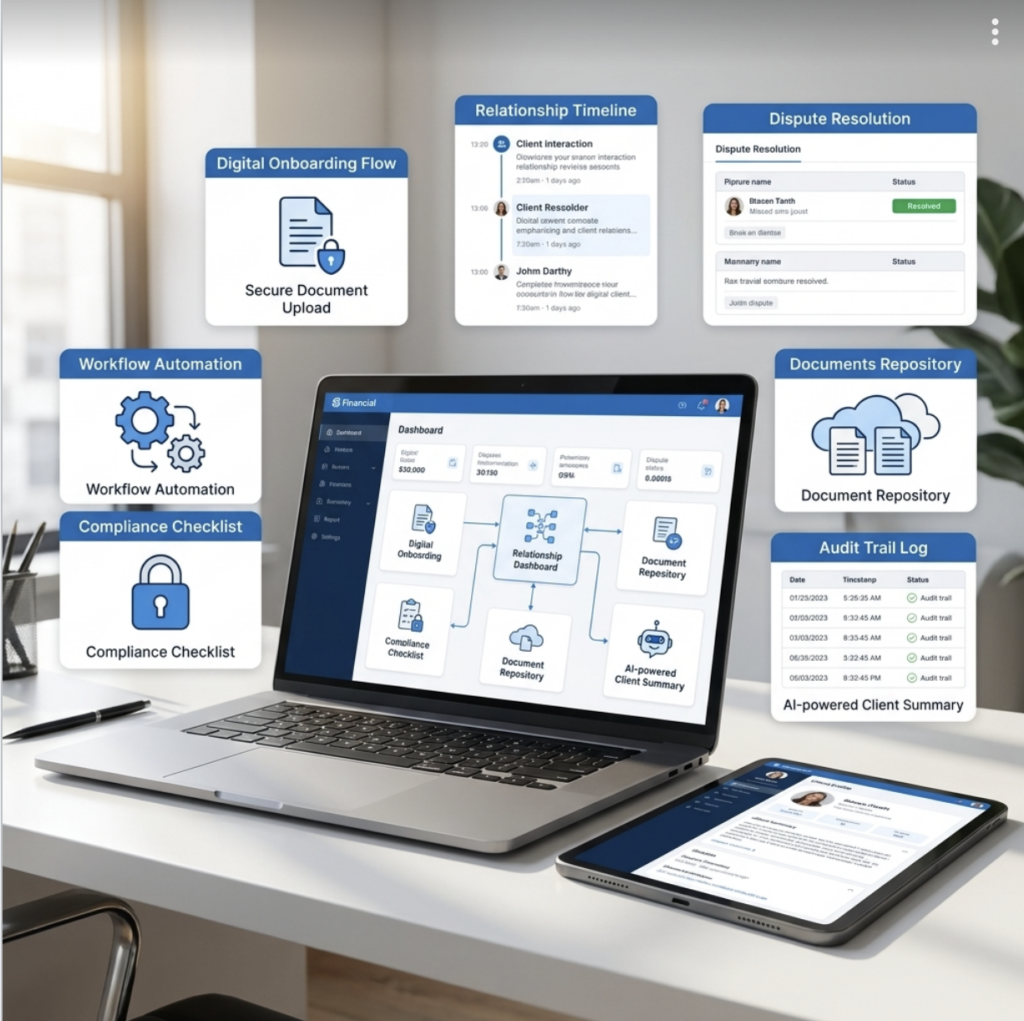
Security & Compliance Concerns
Financial data must be protected through encryption, role-based access controls, and governance frameworks. Security should be embedded in the architecture from day one.
Change Management
Even the most sophisticated integration will fail without user adoption. Clear communication, stakeholder alignment, and structured training are critical.
Scalability
Firms must design integrations that accommodate acquisitions, new custodians, and expanding advisor teams without requiring constant rework.
Best Practices for Fidelity–Salesforce Integration
A structured approach ensures that integration supports long-term strategy rather than creating technical debt. These best practices help align technology with business goals.
1. Start with a Clear Data Strategy
Define data ownership, synchronization frequency, and workflow triggers before development begins. Governance prevents downstream complications.
2. Design Around Business Processes—Not Just Technology
Integration should mirror real advisor and operations workflows. When technology reflects actual business processes, adoption and ROI increase significantly.
3. Prioritize Automation
Automation transforms static custodial data into meaningful action. Alerts, reminders, and triggered communications drive proactive client engagement.
4. Build Executive-Level Reporting
Leadership requires visibility into AUM, advisor productivity, and service metrics. Integrated dashboards provide real-time performance insight that supports strategic decision-making.
Different firm structures require tailored integration strategies. Aligning architecture with business model ensures maximum impact.
Independent RIAs
For growing RIAs, integration centralizes household data and reduces administrative overhead. This enables lean teams to scale without adding unnecessary operational complexity.
Broker-Dealers
Broker-dealers benefit from standardized workflows and multi-advisor oversight. Integration supports consistent compliance monitoring across teams.
Enterprise Wealth Managers
Large enterprises require scalable, multi-custodian orchestration. Advanced analytics and segmentation become possible when data flows seamlessly across systems.
A Fidelity–Salesforce integration should never be evaluated as a purely technical upgrade. It is a strategic investment that impacts revenue growth, operational efficiency, compliance posture, and client experience. To accurately measure return on investment (ROI), firms must define baseline metrics before implementation and track performance consistently after go-live.
Below are the core areas where ROI becomes measurable and meaningful.
1. Reduction in Onboarding Time
Client onboarding is one of the most resource-intensive processes in wealth management. By automating data flow between Fidelity Investments and Salesforce, firms eliminate manual rekeying, reduce documentation errors, and streamline compliance reviews.
Many firms see onboarding timelines decrease by 25–50%, which accelerates time-to-funding and revenue recognition. Faster onboarding also improves client satisfaction during the critical first impression phase.
2. Decrease in Manual Processing Hours
Operations teams often spend hours reconciling data, updating CRM records, and cross-checking custodial information. Integration reduces or eliminates these repetitive tasks, freeing staff to focus on higher-value activities such as proactive client service and exception management.
Firms can calculate ROI by measuring:
Hours saved per week
Reduction in data-entry errors
Lower overtime costs
Increased operational capacity without hiring
Over time, these efficiency gains compound into significant cost savings.
3. Improved Advisor Productivity & Revenue Growth
When advisors have real-time access to custodial data within Salesforce, they spend less time navigating systems and more time engaging clients. Automated alerts, balance changes, and life-event triggers create natural opportunities for outreach.
Key measurable impacts include:
Increased client touchpoints
Higher cross-sell and upsell rates
Improved asset retention
Faster response times to client requests
Even a modest increase in assets under management (AUM) per advisor can dramatically outweigh integration costs.
4. Compliance Risk Reduction
Compliance penalties, remediation costs, and reputational damage can be expensive. Integrated systems reduce risk by ensuring workflows are standardized, documentation is centralized, and audit trails are automatically maintained.
ROI in this area can be measured through:
Reduction in compliance exceptions
Fewer manual audit findings
Decreased time spent preparing for regulatory reviews
Improved supervisory oversight
While harder to quantify than operational savings, risk mitigation provides long-term financial protection.
5. Enhanced Data Accuracy & Reporting
Data inconsistencies often lead to reporting inaccuracies, strategic blind spots, and inefficient decision-making. Integration ensures that leadership dashboards reflect real custodial data rather than outdated or manually updated figures.
Executives can track ROI by measuring:
Reporting time reduction
Improved forecasting accuracy
Better pipeline visibility
Real-time AUM and revenue dashboards
Better data leads to better decisions—and better decisions drive growth.
6. Enhanced Data Accuracy & Reportingics
Client satisfaction is increasingly tied to responsiveness and transparency. When service requests, transfers, and account updates are tracked within Salesforce, firms can resolve issues faster and communicate more effectively.
Measurable improvements may include:
Higher CSAT or NPS scores
Faster case resolution times
Reduced client complaints
Increased retention rates
Retaining even a small percentage of high-value clients can justify the investment alone.
7. Scalability Without Linear Cost Growth
One of the most powerful ROI drivers is scalability. As firms grow—whether organically or through acquisition—integrated systems allow them to add advisors and clients without proportionally increasing operational headcount.
This means:
Higher revenue per operations employee
Standardized processes across teams
Faster integration of acquired books of business
Over time, this operational leverage becomes a strategic advantage.
Establishing a Clear ROI Framework
To maximize measurable impact, firms should:
Define baseline metrics before implementation
Set 6-, 12-, and 24-month performance targets
Track both quantitative (cost savings, revenue growth) and qualitative (advisor satisfaction, client experience) improvements
Conduct post-implementation reviews to identify optimization opportunities
When approached strategically, integration between Fidelity and Salesforce often delivers positive ROI within 12–24 months—while continuing to generate value for years beyond initial deployment.
Future-Proofing: AI & Intelligent Workflows
Integration lays the groundwork for intelligent automation and predictive analytics. Once custodial data lives inside Salesforce, firms can leverage AI to enhance decision-making.
Potential use cases include:
Predicting client churn
Identifying cross-sell opportunities
Automating portfolio review reminders
Generating AI-driven client summaries
This transforms Salesforce from a system of record into a system of intelligence.
Why Work with a Specialized Salesforce Consulting Partner?
Custodial integrations require deep financial services expertise. Technical skill alone is not enough—industry knowledge and compliance awareness are equally critical.
A specialized partner ensures the architecture is scalable, secure, and aligned with long-term growth objectives.
At Navirum, we do not approach a Fidelity–Salesforce integration as a simple technical connector between Fidelity Investments and Salesforce. We approach it as a business transformation initiative that impacts advisor productivity, compliance oversight, operations efficiency, and long-term scalability. As a Salesforce consulting firm specialized exclusively in financial services, we understand that custodial integrations must align with regulatory realities, advisor workflows, and growth objectives—not just data architecture.
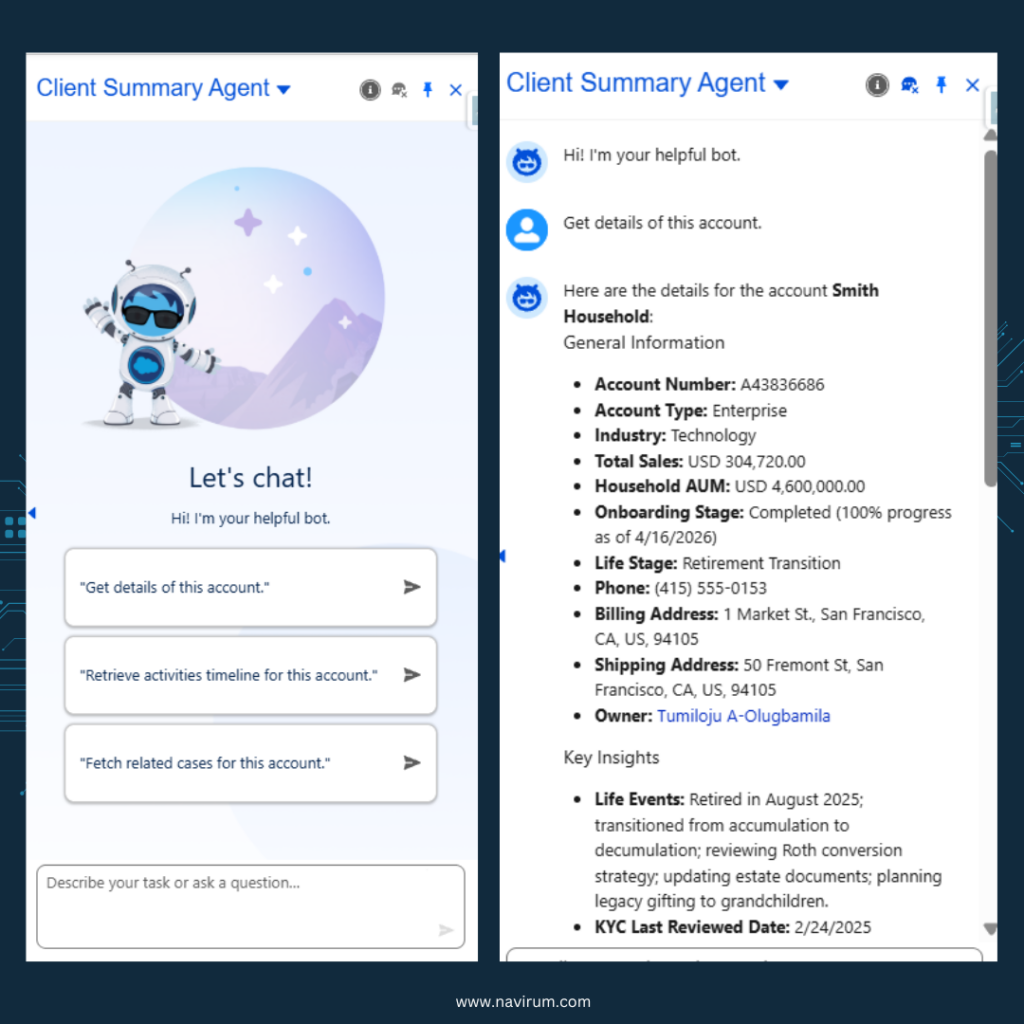
Below is the framework we recommend based on our experience working with wealth managers, RIAs, and financial institutions.
1. Start with Process, Not Technology
Many firms make the mistake of beginning with APIs and field mappings. We begin with discovery workshops that map your current-state advisor, operations, and compliance workflows.
This includes:
Client onboarding journey mapping
Service request lifecycle analysis
Compliance approval checkpoints
Reporting and supervisory requirements
By identifying inefficiencies and risk exposure before building the integration, we ensure Salesforce becomes an operational command center—not just a data repository.
2. Design a Scalable Data Architecture
Custodial data structures rarely align perfectly with CRM object models. Our team designs a normalized data architecture inside Salesforce that supports:
Household-level relationship modeling
Multi-account hierarchies
Beneficiary and trust structures
Historical transaction tracking
Multi-custodian expansion readiness
We architect with the future in mind—whether that means acquisitions, adding custodians, or expanding advisor teams. Scalability is built in from day one.
3. Prioritize Security & Compliance by Design
Financial services integrations demand enterprise-grade security. Navirum embeds compliance controls directly into the solution through:
Role-based access control frameworks
Field-level security modeling
Approval process automation
Full audit trail configuration
Secure API authentication and encryption standards

We work closely with compliance and supervisory stakeholders to ensure the solution meets internal policies and regulatory expectations.

4. Build Intelligent Automation Layers
Integration alone does not create competitive advantage—automation does. We design Salesforce workflows that convert custodial data into actionable triggers, including:
Balance change alerts
Inactivity monitoring
Review scheduling automation
Service-level agreement (SLA) tracking
Automated task routing
This ensures your advisors and operations teams operate proactively rather than reactively.
5. Deliver Executive Visibility & KPI Dashboards
Leadership teams require real-time insight into firm performance. We configure executive dashboards that provide:
Assets under management (AUM) by advisor and segment
Revenue tracking and forecasting
Onboarding pipeline visibility
Service case metrics
Compliance oversight dashboards
This transforms Salesforce into a strategic intelligence platform—not just an operational tool.
6. Implement in Phases to Accelerate Time-to-Value
Rather than attempting a “big bang” deployment, we typically recommend phased implementation:
Phase 1: Core account and balance integration Phase 2: Onboarding and workflow automation Phase 3: Advanced reporting and AI-driven enhancements
This approach minimizes disruption, accelerates ROI, and allows for iterative optimization.
7. Drive Adoption Through Structured Change Management
Even the most sophisticated integration will fail without user adoption. Navirum provides:
Role-based training programs
Executive alignment sessions
Post-launch optimization reviews
Continuous improvement roadmaps
We measure adoption metrics and gather user feedback to ensure the platform evolves alongside your business.
Our specialization in financial services gives us a unique perspective that generalist Salesforce consultancies often lack. We understand:
Custodial data structures
RIA and broker-dealer compliance workflows
Advisor compensation models
Regulatory documentation requirements
Multi-custodian operating environments
Because we focus on financial services, we design solutions that reflect real-world advisory operations—not generic CRM best practices.
Custodial data structures
RIA and broker-dealer compliance workflows
Advisor compensation models
Regulatory documentation requirements
Multi-custodian operating environments
The Outcome: More Than Integration
When executed properly, a Fidelity–Salesforce integration should deliver:
Increased advisor capacity
Reduced operational overhead
Strengthened compliance posture
Improved client satisfaction
A scalable foundation for growth
At Navirum, our goal is not simply to connect systems—it is to help you build a modern, intelligent wealth management platform that supports sustainable expansion and long-term competitive advantage.
Final Thoughts
Integrating Fidelity with Salesforce is a foundational step toward operational excellence and scalable growth. When executed strategically, it enhances advisor productivity, strengthens compliance posture, and elevates the client experience.
For financial services firms seeking to modernize their technology ecosystem, a well-designed integration transforms custodial data into strategic intelligence—creating a true competitive advantage.
To address common concerns in more depth, here are expanded answers to the most frequently asked questions about integrating Fidelity Investments with Salesforce.
1. Can Salesforce directly connect to Fidelity?
Yes, Salesforce can connect to Fidelity through secure APIs or via middleware platforms, depending on your firm’s technical architecture and integration strategy. API-based integrations allow structured, secure data exchange between systems and are typically the preferred approach for firms seeking scalability and automation. The exact configuration depends on your data requirements, compliance standards, and whether you are integrating additional custodians or platforms.
2. Is real-time syncing possible?
In most modern implementations, near real-time syncing is achievable using API-driven integrations. This allows account balances, holdings, transactions, and status updates to flow into Salesforce quickly, enabling advisors to act on current data. However, the frequency of updates can be configured based on business needs, performance considerations, and compliance policies.
3. How secure is the integration?
Security is a foundational component of any custodial integration. Properly implemented integrations use encryption in transit and at rest, secure authentication protocols (such as OAuth), and strict role-based access controls within Salesforce. Additionally, audit logging and monitoring tools ensure that data access and changes are fully traceable for compliance purposes.
4. Does integration replace Fidelity’s platform?
No, integration does not replace Fidelity’s custodial platform. Fidelity remains the system of record for assets, transactions, and account administration, while Salesforce serves as the relationship and workflow management layer. The goal is to enhance operational visibility and advisor productivity—not to duplicate custodial functionality.
5. How long does implementation take?
Implementation timelines typically range from three to six months, depending on scope, customization requirements, and data complexity. Firms with multiple custodians, legacy systems, or advanced workflow automation may require additional time for architecture design and testing. A phased rollout approach can accelerate time-to-value while minimizing operational disruption.
6. Can we integrate multiple custodians?
Yes, Salesforce can support multi-custodian integration when designed with a scalable architecture. Middleware solutions or well-structured API frameworks can orchestrate data flows from multiple custodians into a unified data model within Salesforce. This is particularly valuable for enterprises or broker-dealers managing diverse advisory teams and asset platforms.
7. What Salesforce products are typically used?
Most firms leverage Sales Cloud and Service Cloud as core components of their integration, often combined with industry-specific capabilities from Financial Services Cloud. These products enable relationship modeling, case management, automation, and advanced reporting. The final configuration depends on your firm’s size, regulatory complexity, and service model.
8. Will this reduce compliance risk?
Yes, a properly designed integration can significantly reduce compliance risk by centralizing documentation, approvals, and communication records. Automated workflows ensure required steps are completed before account submissions or changes are finalized. In addition, comprehensive audit trails provide defensibility during regulatory reviews or internal audits.
9. Can we automate account reviews?
Absolutely. Once custodial data is integrated into Salesforce, firms can configure automated triggers based on time intervals, balance thresholds, life events, or portfolio changes. These triggers can create tasks, notify advisors, or initiate review workflows—ensuring consistent client engagement and reducing reliance on manual reminders.
10. Is this suitable for small RIAs?
Yes, integration is often especially valuable for small and mid-sized RIAs looking to scale efficiently. By reducing manual administrative work and centralizing client data, smaller firms can operate with the sophistication of larger enterprises. A properly scoped implementation ensures the solution aligns with both budget and growth objectives.