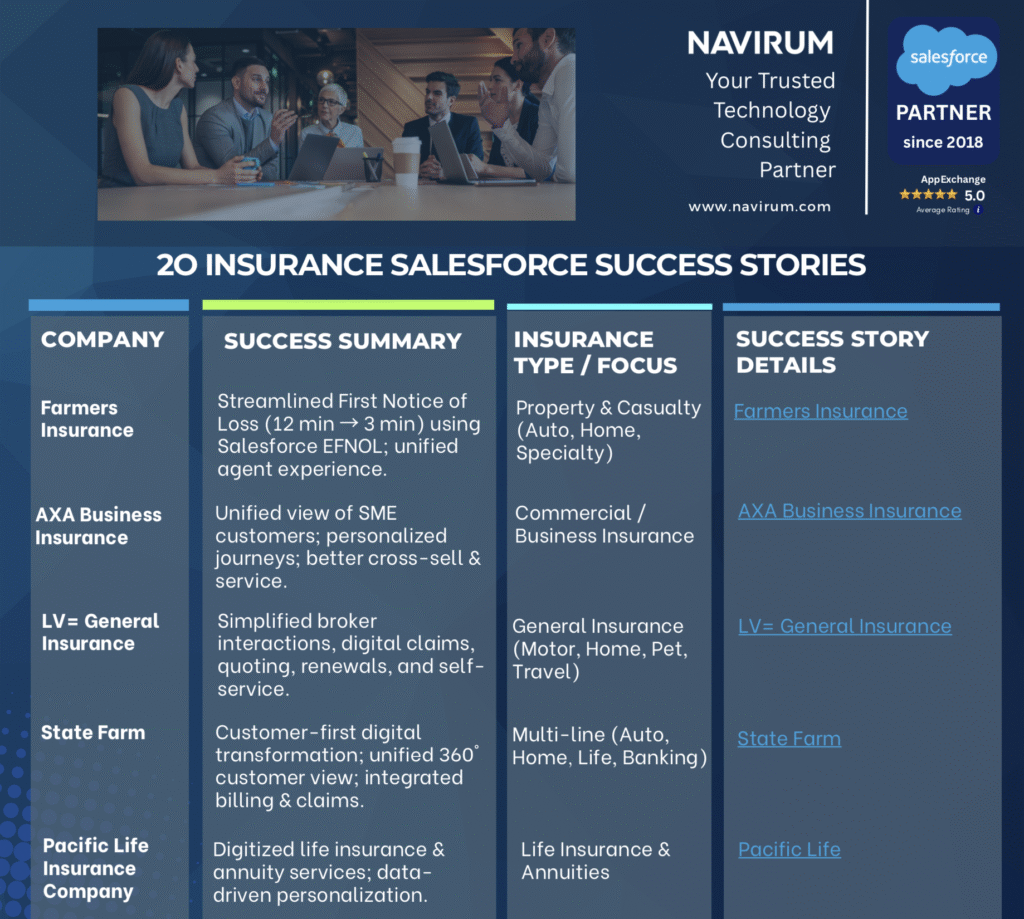
Discover how 20 leading insurance companies transformed their business with Salesforce.

Download our free guide: “20 Insurance Salesforce Success Stories” and discover how top insurers are transforming operations, boosting customer satisfaction, and driving growth with Salesforce.

Get exclusive access to their success stories and see what’s possible.
Download now.
NAVIRUM: LEADING EXPERTS IN SALESFORCE FINANCIAL SERVICES CLOUD IMPLEMENTATIONS AND SUPPORT
How Salesforce Financial Services Cloud Empowers RIAs to Deliver Exceptional Client Experiences
Discover why Registered Investment Advisors (RIAs) choose Salesforce Financial Services Cloud. Learn how FSC streamlines client management, ensures compliance, enables team collaboration, integrates with your tech stack, and delivers actionable analytics to grow AUM and enhance client experiences.
In today’s fast-paced, compliance-heavy financial landscape, Registered Investment Advisors (RIAs) face increasing pressure to deliver personalized client service, manage regulatory demands, and optimize internal workflows. For forward-thinking advisory firms, technology is no longer optional-it’s essential. The total AUM for RIAs, including Fisher Investments, Creative Planning, CAPTRUST, Hightower Advisors, Mariner Wealth Advisors, Osaic Wealth, LPL Financial, Beacon Pointe Advisors, Wealth Enhancement Group, Mercer Advisors, goes into trillions of dollars. The majority of these institutions and their armies of Advisors rely on on Salesforce FSC to run their practices.
Streamlined Client Management with a 360-Degree View
Managing complex client relationships is at the core of every successful RIA practice. Salesforce Financial Services Cloud delivers a real-time, 360-degree view of each client’s financial situation, including:
Investment portfolios
Financial goals
Insurance policies
Banking and custodial accounts
Key life events
This comprehensive visibility allows RIAs to personalize every interaction, anticipate client needs, and deliver high-touch service at scale. With automated workflows for onboarding, task management, and meeting scheduling, advisors can spend more time building relationships and less time on admin work.
Salesforce FSC for RIAs
Built-In Compliance Management Features
Navigating the regulatory landscape is a daily reality for RIAs. Salesforce Financial Services Cloud simplifies compliance by embedding it directly into the platform’s workflows. Key features include:
Automated KYC and AML workflows
Document management and audit trails
Activity tracking for client interactions
Pre-configured compliance templates
These tools make it easier to meet FINRA, SEC, and fiduciary obligations while reducing the risk of errors. RIAs can rest assured knowing that compliance is monitored, documented, and manageable—all within the same system used for daily operations.
Advisory firms thrive when their internal teams and external partners can collaborate effectively. Salesforce Financial Services Cloud enables seamless communication and alignment through:
Salesforce Chatter for real-time messaging
Shared client records and task assignments
Integrated workflows with custodians, CPAs, and estate planners
This unified platform ensures that everyone involved in the client experience is on the same page, improving responsiveness and service consistency. It’s especially powerful for distributed teams or multi-office firms.
Actionable Insights with Built-In Reporting and Analytics
Data is only valuable if you can act on it. Salesforce Financial Services Cloud includes powerful reporting and analytics tools that help RIAs:
Track client retention and satisfaction
Monitor AUM growth and performance
Evaluate advisor productivity
Analyze marketing ROI and sales pipeline trends
With customizable dashboards, firm leaders and advisors alike can make data-driven decisions, spot trends, and identify growth opportunities in real time.
Seamless Integration with Your Existing Tech Stack
Salesforce Financial Services Cloud doesn’t just stand alone—it integrates seamlessly with the tools you already use, such as:
Portfolio management systems (e.g., Orion, Black Diamond)
Document storage and digital signature platforms
Marketing automation tools
This centralization eliminates data silos, reduces errors, and ensures advisors always work with the most up-to-date information—saving time and reducing manual entry across platforms.
Why Choose Navirum to Implement Salesforce Financial Services Cloud?
Even with a powerful tool like Salesforce, successful implementation requires expertise. That’s where Navirum comes in.
Navirum is a Salesforce consulting partner that specializes in working with RIAs. Our team helps financial advisory firms implement, customize, and optimize Salesforce Financial Services Cloud to:
Align with your business model
Automate key workflows
Ensure full compliance readiness
Provide advisor training and change management support
Whether you’re just starting with Salesforce or looking to optimize your current setup, Navirum can help you unlock the full potential of your CRM investment.
Start Your Digital Transformation Today
Salesforce Financial Services Cloud empowers RIAs to modernize operations, deliver exceptional client experiences, and stay ahead of regulatory requirements—all in one platform.
If you’re ready to leverage the power of Salesforce and create a more scalable, compliant, and client-centric firm, contact Navirum today. Our team is ready to help you build the future of your advisory practice.
Not Sure If You’re Ready for Salesforce Financial Services Cloud?
Planning a Salesforce FSC implementation can feel overwhelming—but it doesn’t have to. Our Salesforce FSC Readiness Assessment is designed to help you evaluate your firm’s preparedness across critical areas such as business strategy alignment, data and system integration, compliance and security, user adoption, change management, and ongoing optimization.
This short, actionable quiz will highlight your strengths, pinpoint areas for improvement, and provide a clear framework to guide your implementation journey.
Take the first step—download the assessment today and build a smarter roadmap to Salesforce success.
Salesforce Financial Services Cloud (FSC) is a specialized version of Salesforce CRM designed for the financial services industry. It provides tools for client relationship management, compliance, data analytics, and workflow automation—tailored specifically for Registered Investment Advisors (RIAs), wealth managers, and financial planners.
How does Financial Services Cloud help RIAs manage clients more effectively?
FSC gives RIAs a 360-degree view of each client’s financial life, including accounts, goals, holdings, and key milestones. This enables advisors to personalize service, streamline onboarding, track life events, and deliver high-touch experiences that build lasting client relationships. Get these tips for implementing Salesforce FSC
Is Salesforce Financial Services Cloud compliant with financial regulations?
Yes, FSC includes built-in compliance tools such as automated workflows for KYC/AML, audit trails, document management, and activity logging. These features help RIAs meet regulatory standards set by the SEC, FINRA, and fiduciary obligations more efficiently.
Can Salesforce Financial Services Cloud integrate with other financial tools I already use?
Absolutely. FSC integrates with a wide range of third-party tools used by RIAs, including financial planning software (eMoney, MoneyGuidePro), portfolio management platforms (Orion, Black Diamond), custodians, marketing tools, and document storage systems.
What kind of reporting and analytics does FSC offer?
FSC provides robust reporting and dashboard features that allow RIAs to track KPIs such as assets under management (AUM), client acquisition, retention, investment performance, advisor productivity, and more. These insights support data-driven decision-making and business growth.
How does FSC support collaboration within my team and with external partners?
Salesforce Financial Services Cloud includes tools like Salesforce Chatter for real-time collaboration, shared client profiles, and workflow tracking. Teams can easily work together across departments, while securely collaborating with external partners like CPAs, attorneys, and custodians.
Is Salesforce Financial Services Cloud customizable for my RIA firm?
Yes, FSC is highly customizable. With the help of certified Salesforce partners like Navirum, RIAs can tailor the platform to match their unique business processes, client segmentation, compliance needs, and reporting requirements.
How long does it take to implement Salesforce Financial Services Cloud?
Implementation timelines vary depending on firm size, customization needs, and data migration complexity. However, with expert partners like Navirum, most firms can go live in 8–12 weeks with a phased rollout that minimizes disruption to daily operations.
What are the costs associated with Salesforce Financial Services Cloud?
Salesforce FSC pricing depends on your user count, features required, and customization level. While it is a premium solution, the return on investment is often high due to improved efficiency, compliance, and client retention. Navirum can help assess your needs and provide a cost-effective implementation plan.
Why should I work with Navirum to implement Salesforce?
Navirum specializes in Salesforce solutions for RIAs and financial advisors. We understand the regulatory, operational, and client service challenges in the industry. From initial setup to ongoing support, we help your firm unlock the full potential of Salesforce Financial Services Cloud, ensuring a smooth, strategic implementation.
In today’s fast-paced world, productivity hinges on seamless collaboration. That’s why more and more financial services firms and enterprises are turning to Salesforce Slack integration.
By connecting Salesforce and Slack, teams can share data, automate workflows, and make faster decisions without switching between platforms.
Whether you call it Slack and Salesforce integration, Salesforce to Slack integration, or simply Salesforce integration Slack, the result is the same: less friction, more focus, and better outcomes.
When you integrate Slack with Salesforce, updates on new leads, opportunity stage changes, or deal approvals show up instantly in Slack channels. Instead of refreshing dashboards, sales teams respond in real time—shortening the path from prospect to closed deal.
#2 – Streamlined Collaboration Across Teams
With Slack and Salesforce connected, every account, opportunity, or case can have its own dedicated Slack channel. This keeps conversations, files, and context together. Whether you’re in sales, service, or marketing, the integration eliminates silos and helps everyone stay aligned.
What is Slack Anyway?
#3 – Automated Workflows That Save Time
The Salesforce app for Slack allows you to automate routine tasks—such as escalating cases, reminding reps of follow-ups, or assigning handoffs. Notifications arrive directly in Slack, ensuring that nothing slips through the cracks.
#4 – Smarter Decisions with Data on Demand
Leaders no longer have to wait for weekly reports. With sales force and Slack connected, pipeline metrics, forecasts, and service dashboards can be pulled into Slack with a quick command. This provides decision-makers with live data to act faster.
#5 – Enhanced Customer Support
Service Cloud users can set up Salesforce to Slack integration so high-priority cases trigger immediate alerts. Support teams can then swarm the issue in Slack, loop in subject matter experts, and resolve it quickly—boosting customer satisfaction.
#6 – A Unified Platform for Growth
From slack sales force notifications to executive-level snapshots, the integration brings CRM data into Slack where people are already working. The connect Slack to Salesforce setup creates transparency, accountability, and better alignment across the business.
Salesforce Slack Demo (Credits to Salesforce Ben)
No Slacking, The Summary
Investing in Salesforce Slack integration is more than just a technical upgrade. It’s about creating a unified digital workspace where deals move faster, support becomes proactive, and teams stay aligned.
With Salesforce continuing to enhance its ecosystem – including the fast-growing Salesforce app for Slack – organizations that adopt early gain a competitive edge.
Contact Us for Salesforce Slack Integration Consultation Today
Navirum Client Success Stories
Salesforce Slack Integration FAQ
<strong class="schema-faq-question">Where can I get the integration?<br/></strong>
<strong class="schema-faq-question">How long does the integration take to setup?</strong>
For a Salesforce professional, about 2-4 hours with testing. This doesn’t include template design, workflows, approvals. A proper implementation can be any from 20 to 50 hours so the RoI needs to start up!
<strong class="schema-faq-question">What is a Salesforce partner?</strong>
A Salesforce partner is a company or organization that has been officially recognized by Salesforce for its expertise in delivering Salesforce-related services, solutions, or products. Salesforce partners may provide consulting, implementation, customization, integration, or third-party applications (AppExchange apps) to help clients maximize the value of the Salesforce platform. They are part of the Salesforce Partner Program, have access to specialized training and resources, and are recognized for meeting Salesforce’s standards for quality, technical capability, and customer success. Navirum is a certified Salesforce partner.
<strong class="schema-faq-question"><strong>How do financial advisors use S</strong>lack<strong> within Salesforce?</strong>
Financial advisors use Slack integrated with Salesforce to collaborate in real time, coordinate client tasks across teams, and receive automated updates on deals and accounts. This streamlines workflows, reduces email traffic, and ensures faster, more efficient client service by keeping conversations and Salesforce data in one place.
<strong class="schema-faq-question"><strong>How does the integration improve compliance?</strong>
The integration provides automated audit trails, status tracking, and secure storage of signed documents within Salesforce, ensuring that regulatory requirements are consistently met and easily verifiable.3
Navirum is a certified Salesforce and Slack partner, specializing in delivering integrated solutions that streamline digital workflows for financial services and other industries. With deep expertise in both platforms, Navirum helps clients automate processes, accelerate agreements, and maximize value from their Salesforce and Slack investments.
In today’s fast-paced business world, optimization is key. Companies strive to streamline processes and boost productivity. Integrating Salesforce, a leading CRM, with DocuSign, an e-signature innovator, unlocks efficient workflows and improved collaboration. Explore the benefits and features of Salesforce and DocuSign integration.
Discover The Power of Salesforce Integration with DocuSign!
Are you evaluating the best way to streamline your organization’s document workflows? Here’s why choosing Salesforce and DocuSign integration stands out among leading document management solutions:
Salesforce DocuSign Integration – Credits to Salesforce Ben
1. Superior Efficiency Compared to Manual or Other Tools
Integrating DocuSign with Salesforce eliminates the need to print, sign, scan, or email documents back and forth. Unlike standalone e-signature tools or traditional methods, this integration lets users send, sign, and manage documents entirely within Salesforce. The result: shorter turnaround times and major productivity gains versus competing processes.
2. Best-In-Class Collaboration and User Experience
Salesforce and DocuSign enable multiple stakeholders—sales, legal, operations—to review, edit, and sign contracts or NDAs right from your CRM. This is much more efficient than file-based approaches or endless email threads. With real-time notifications and activity tracking, everyone stays aligned and projects move forward faster.
3. Unmatched Visibility and Real-Time Document Tracking
Unlike generic document platforms, DocuSign Salesforce integration gives users full transparency: track every document’s status (sent, signed, returned) directly in Salesforce. This live dashboard approach helps you spot delays, identify bottlenecks, and keep deals on track—advantages you won’t find in disconnected tools.
DocuSign’s industry-leading security and compliance solutions (including robust audit trails and encryption) are embedded right into Salesforce workflows. This reduces risk compared to less-secure signing tools and supports regulatory requirements in finance, insurance, and other regulated sectors.
5. Seamless Digital Customer Journey
Customers today expect fast, hassle-free digital interactions. Salesforce and DocuSign deliver a seamless, branded experience—whether for onboarding, contracts, or order processing—improving satisfaction and giving your business a competitive edge over slower, less integrated processes.
How Does Salesforce + DocuSign Stack Up?
When compared to alternative document management strategies, Salesforce and DocuSign integration consistently delivers:
Faster document turnaround and approval cycles
Centralized tracking and transparency
Higher security and compliance (vs. email or simple e-signature apps)
Improved collaboration across teams and with clients
Ready to see how this integration outperforms other options for your organization? Contact our Salesforce–DocuSign certified consultants today for a personalized assessment and start unlocking the full potential of your business workflows.
Contact Us for Salesforce DocuSign Consultation Today
Navirum Client Success Stories
Salesforce DocuSign Integration FAQ
<strong class="schema-faq-question">Where can I get the integration?<br/></strong>
<strong class="schema-faq-question">How long does the integration take to setup?</strong>
For a Salesforce professional, about 2-4 hours with testing. This doesn’t include template design, workflows, approvals. A proper implementation can be any from 20 to 50 hours so the RoI needs to start up!
<strong class="schema-faq-question"><strong>Is the DocuSign Salesforce integration secure and compliant with regulatory requirements?</strong>
DocuSign provides robust security, encryption, and audit trails for all documents processed through its platform. The integration with Salesforce maintains these standards and helps you comply with industry regulations such as eIDAS, ESIGN Act, and GDPR, depending on your organizational needs.
<strong class="schema-faq-question">What is a DocuSign implementation partner</strong>
A DocuSign implementation partner is a certified consulting firm or service provider that specializes in helping organizations successfully deploy and integrate DocuSign solutions – such as eSignature or DocuSign CLM – into their existing business systems, including Salesforce. These partners have expertise in configuration, technical integration, workflow customization, user training, and best practices to ensure a smooth and effective rollout of DocuSign products tailored to your organization’s needs.
<strong class="schema-faq-question">What is a Salesforce partner?</strong>
A Salesforce partner is a company or organization that has been officially recognized by Salesforce for its expertise in delivering Salesforce-related services, solutions, or products. Salesforce partners may provide consulting, implementation, customization, integration, or third-party applications (AppExchange apps) to help clients maximize the value of the Salesforce platform. They are part of the Salesforce Partner Program, have access to specialized training and resources, and are recognized for meeting Salesforce’s standards for quality, technical capability, and customer success.
<strong class="schema-faq-question"><strong>How do financial advisors use DocuSign within Salesforce?</strong>
Financial advisors send, track, and manage client agreements (such as onboarding forms, investment mandates, or compliance documents) for electronic signature directly from Salesforce, streamlining client interactions and accelerating paperwork.
<strong class="schema-faq-question"><strong>How does the integration improve compliance?</strong>
The integration provides automated audit trails, status tracking, and secure storage of signed documents within Salesforce, ensuring that regulatory requirements are consistently met and easily verifiable.
<strong class="schema-faq-question"><strong>Does the integration support mobile use for advisors and clients?</strong>
Absolutely. Both advisors and clients can initiate and complete signature processes from any device, providing the flexibility needed for remote or on-the-go client service.
Navirum is a certified Salesforce and DocuSign partner, specializing in delivering integrated solutions that streamline digital workflows for financial services and other industries. With deep expertise in both platforms, Navirum helps clients automate processes, accelerate agreements, and maximize value from their Salesforce and DocuSign investments.
As Signet Financial Management expanded its footprint in the competitive wealth management space, it became clear that unlocking the full potential of Salesforce was critical to their growth strategy. Yet, persistent system hiccups, time-consuming admin tasks, and limited internal resources were holding them back. To remain focused on delivering exceptional client experiences, Signet needed a smarter, more scalable approach to managing Salesforce, and that’s where Orbit Project Assist came in.
The Challenges
Signet Financial Management, a growing wealth management firm, was facing key operational roadblocks in its use of Salesforce:
⚠️ Persistent technical issues were disrupting daily workflows and advisor productivity
⚠️ Routine monthly Salesforce tasks were consuming valuable time better spent with clients
⚠️ Strategic initiatives needed expert Salesforce consulting, but internal bandwidth was limited
⚠️ New advisors and staff required structured, consistent onboarding and CRM training
These challenges were slowing down day-to-day operations and reducing the overall value Signet was receiving from their Salesforce investment.
The Solutions
Navirum delivered a comprehensive Salesforce service model tailored to the fast-paced, relationship-driven world of wealth management:
🛠️ Ongoing Support: Rapid resolution of technical issues to keep the platform running smoothly
🛠️ Managed Services: Handling of routine monthly tasks and administrative support
🛠️ On-Demand Consulting: Flexible access to expert guidance for strategic Salesforce projects
🛠️ Training: Regular onboarding and skills training for new and existing users
The Results
With Orbit’s end-to-end support and consulting services, Signet Financial Management experienced measurable improvements:
✅ Reduced platform issues, freeing advisors to focus on client relationships
✅ Improved CRM adoption, as users became more confident and efficient
✅ Higher return on Salesforce investment, with more advisors fully leveraging the platform
✅ Faster onboarding, ensuring new team members could engage clients sooner
Ready to get more from your Salesforce investment?
Let’s talk about how Navirum can help your advisory firm work smarter, scale faster, and stay focused on what matters most, your clients. Contact us today to get started.
Want to dive deeper into how Signet transformed their Salesforce operations? Download the full customer success story as a PDF to explore the complete details of their journey, key outcomes, and how our Salesforce Support service made a lasting impact.
👉 Fill out the contact form below on this page to get instant access.
Curious what ongoing support like this actually includes? See the full breakdown on the Orbit Managed Services page.
Want more detail before reaching out? This companion piece is a deeper dive into Orbit, including our 60-Second Salesforce Platform Check to help you gauge your current managed service and support strategy.
Lavinia Picu5 Proven Ways Salesforce Support Empowers Wealth Advisors
Salesforce Insurance Cloud (Financial Services Cloud) can connect policy, claims, and relationship data with core systems such as Guidewire and Duck Creek, giving life, P&C, and specialty insurers a governed view of every policyholder as that integration comes online. This guide covers 3 key reasons insurers choose FSC, top use cases, core-system integration, and an FAQ, plus how Agentforce can support claims and service workflows once your data and controls are ready.
Can Salesforce Work with Your Core Insurance Systems?
Yes. Salesforce Insurance Cloud (part of Financial Services Cloud) is one of the leading insurance cloud platforms on the market. It can connect to the core policy administration systems insurers already run, including Guidewire, Duck Creek, and Applied Epic, through APIs, MuleSoft, or partner-built integrations, so this typically does not require a rip-and-replace of your PAS. The systems connected, sync frequency, and configuration effort depend on your existing architecture. Once connected, FSC brings policy, claims, and client data into a single governed view.
Salesforce’s insurance offering spans several components that work together. Here is what typically handles what:
Policy Administration / Digital Insurance, or a connected PAS
Claims lifecycle management
Insurance Claims Management, or a connected claims platform
Unified third-party and cross-system data
Data 360
System integration
MuleSoft, APIs, or partner connectors
AI-assisted service and workflows
Agentforce for Financial Services
Accelerate Policy and Claims Workflows with Salesforce FSC
Delivering a superior client experience is now the ultimate competitive edge in insurance. For life insurers, P&C carriers, MGAs, and brokers, success depends on offering fast, personalized service while ensuring strict compliance and risk management.
Continuous Innovation in Insurance CRM – 3 major platform releases each year ensure FSC evolves with changing regulations and market demands.
AI & Security in Financial Services Cloud for Insurers – With Salesforce AI and Agentforce, insurers can predict lapses, personalize coverage recommendations, and optimize claims processing. Find out more about AI insurance industry disruption here
Commitment to Security and Compliance – Trust, compliance, and transparency are core to Salesforce. See Salesforce’s Trust Commitment.
Our Top 5 Use Cases for Insurers Using Salesforce FSC
1. Streamlined Policy Administration
Traditional policy workflows can be fragmented, leading to delays and errors. Salesforce FSC enables:
Integration with core policy admin systems for end-to-end management.
Automated renewals, endorsements, and lapse prevention reminders.
Single client view for underwriting, policy servicing, and claims.
AI Analytics for insights, claims adjustment, and underwriting – more details here
Salesforce FSC is at the heart of modernizing policy management and digital transformation for the small and large insurers as discussed inthis thought leadership piece
Industry Example – GEICO: Deployed a modernized policy admin platform (Duck Creek) across all 50 states in about 12 months, outselling the entire prior year in the first month alone. A clear illustration of why moving off legacy PAS infrastructure pays off, whichever platform you standardize on.
Easier Policy Admin With Salesforce FSC
2. Claims Management Automation Reduces Costs
FSC transforms claims handling by:
Automating FNOL (First Notice of Loss) intake through omni-channel portals.
Integrating with claims systems to track status in real time.
Enabling AI-based fraud detection and prioritization of high-impact claims.
3. 360° Client View: Delivering an Unmatched Experience
FSC consolidates data from policy, CRM, and third-party systems to provide:
Complete view of coverage, claims history, premiums, and risk profile.
Real-time collaboration across underwriting, servicing, and claims teams.
Easy referral tracking for cross-selling wealth, lending, or additional coverage.
Unified via Salesforce Data 360 — harmonizes policy, claims, and third-party data into one governed profile so every view above stays current in real time.
Navirum Success Story – iA Financial Group: Unified insurance, wealth, and lending systems on Salesforce to improve transparency and engagement.
Customer Story – Hosket Ulen: Modernized operations with Salesforce, boosting client experiences and enabling a unified client view.
Configurable governance for AI-driven decisions. Approval thresholds and audit rules can be set around AI-assisted lapse and fraud recommendations, so automation stays within limits your compliance team defines.
Insurers can also use Marketing Cloud and Agentforce to turn policy renewal from a manual reminder into a coordinated retention journey. Personalized renewal journeys can trigger communications based on policy expiration, client preferences, service history and predicted lapse risk, while routing higher-risk cases to an advisor or service team. This helps carriers deliver more relevant reminders and retention offers instead of treating every policyholder the same. The result is a more proactive renewal process that supports both policyholder retention and customer experience.
Customer Story – Holmes Murphy: Connected systems and automated processes with FSC + MuleSoft, improving efficiency and data-driven decision-making.
Salesforce AI Enhances the Customer Experience Saving $$
Dashboards for policy pipeline, claims SLAs, and compliance metrics.
Collaboration tools for agents, brokers, and back-office teams.
Mobile access for field agents to issue quotes and process endorsements on-site.
Customer Story – AAA Washington: Consolidated member data into a single Salesforce platform to personalize service for millions of members.
Streamlines Agent and Broker Collaboration
Why Insurers Are Choosing Salesforce FSC
FSC helps insurers deliver exceptional service and long-lasting relationships by:
Speed – Faster policy servicing through automated workflows and a unified view of the client.
Compliance – Tools for KYC, AML, and audit readiness.
Security – Enterprise-grade Salesforce insurance security, including data encryption, role-based access, and audit trails built to meet insurer risk requirements.
Scalability – Grows with you, from local agencies to national carriers.
Innovation – AI-driven insights and continuous upgrades keep you ahead of the curve.
Insurers handling sensitive policyholder and claims data should treat Salesforce security as a layered architecture rather than a single feature. Salesforce Shield, available as an add-on, can extend native platform protections with Platform Encryption for selected sensitive data at rest, Event Monitoring and enhanced audit capabilities. A separate Salesforce backup solution can also help recover records following accidental deletion, data corruption or an unsuccessful system change. Together, these capabilities can strengthen encryption and audit-ready controls, although the exact configuration should reflect the insurer’s data, retention and regulatory requirements.
As well as many power use cases out of the box. FSC has incredible apps to integrate with, which bring immediate value and outcomes. Top choices include:
DocuSign, AirSlate, PDFButler – For compliant, digital policy issuance.
Fraud Detection Tools – ID-Pal, FRISS, or similar integrations.
Policy Admin Systems – Guidewire, Duck Creek, or proprietary PAS.
Meeting and Note Take AI Solutions – Vinton et Agentforce integrations
Customer Service and Contact Center Tools – Intercom, Vonage or Amazon Connect
Partner Referrals – Seamlessly track and manage cross-sell opportunities across insurance and financial products.
Team Collaboration and Messaging – Slack (SlackBot) et Microsoft Teams integrations, keeping agents and brokers connected without leaving their daily workflow.
Since 2018, Navirum has been delivering outstanding customer satisfaction, resulting in repeat business and accelerated success for our clients.
At Navirum, we specialize in implementing and optimizing Salesforce FSC for insurers. Our founders bring deep experience from the insurance sector and Salesforce’s Financial Services team. On every project, we engage our:
Managed Services – Continuous optimization and adoption support to maximize your Salesforce ROI.
Strategic Consulting – Align Salesforce to your business goals, compliance needs, and client engagement strategy.
Technical Implementation – Expertise in FSC setup, AI, automation, and integrations with policy admin systems.
Ready to transform your insurance business?
Still assessing your Salesforce FSC Implementation readiness?
Take the guesswork out of your planning. Download our Salesforce FSC Readiness Assessment to evaluate your preparedness across key business dimensions—including Business Alignment, Data & Integration, Compliance & Security, Adoption & Change Management, Continuous Improvement, and Time Commitment.
This quick, practical quiz will help you identify gaps, uncover strengths, and define a clear roadmap for a successful FSC implementation.
Salesforce Insurance Cloud Pricing: What Drives the Cost
Salesforce publishes pricing for several insurance products and add-ons, but there is no single total price for an insurer’s complete Salesforce environment. Total cost depends on the FSC edition, insurance capabilities selected, usage allocations, Data 360, MuleSoft, migration, and implementation scope. The drivers are consistent across implementations:
Cost Driver
What It Covers
FSC Edition (Enterprise vs. Unlimited)
Per-user licensing; Unlimited adds premium support, more sandboxes, and higher API limits
Implementation
Data migration from your PAS, configuration, and testing — typically the largest line item
Integration (MuleSoft)
Native connectors to Guidewire, Duck Creek, or Applied Epic where a pre-built connector isn’t sufficient
Data 360 add-on
Unifies policy, claims, and third-party data for real-time AI and Agentforce use cases
Ongoing Managed Services
Continuous optimization and adoption support post-launch
Navirum scopes pricing against your specific PAS, line-of-business mix, and AI ambitions during a free FSC Readiness Assessment — request one here for a real number, not a rate card.
Managing Insurance Data Storage Costs
Insurance carriers often accumulate Salesforce data faster than firms in other sectors because claims can include photographs, scanned documents, correspondence and years of policy history. Keeping all of this content in native Salesforce storage can become expensive and make the operational CRM more difficult to manage. A tiered architecture can retain active policy and claims information in Salesforce while offloading historical claims data and closed-policy files to Amazon S3 or S3 Glacier. This can reduce long-term storage costs while keeping retained records retrievable under defined access, governance and retention policies. Any archive design should also preserve the relationship between the stored content and the policyholder record in Salesforce.
Applied Epic vs. Salesforce Insurance Cloud (and What Reviews Say)
Applied Epic is a traditional agency management system (AMS) built for day-to-day policy and commission workflows. Salesforce Insurance Cloud is an enterprise CRM and AI platform built for the full client relationship, sales, service, and cross-sell, across policy, claims, and household data. Many insurers run both together rather than choosing one, and the specific split of responsibilities varies by firm:
Requirement
Applied Epic
Salesforce Insurance Cloud
Typical combined approach
Agency and policy administration
Core strength
May support or connect
Epic often remains the transactional system
Commission workflows
Core strength
Usually integrated
Commission summaries surfaced in Salesforce
Sales and relationship CRM
Limited relative to Salesforce
Core strength
Salesforce owns pipeline and relationships
Service workflows
Available
Highly configurable
Salesforce coordinates service; Epic retains policy data
AI and unified customer data
Depends on architecture
Agentforce and Data 360
Governed Epic data can feed the Salesforce AI layer
Navirum holds a 5/5 CSAT rating on the Salesforce AppExchange, see verified reviews here before comparing platforms on G2 or Capterra alone.
Inside the Salesforce Insurance Cloud Data Model
FSC’s insurance data model ships with the objects insurers actually need out of the box, reducing the need to design an insurance data model from scratch. Insurers still need to configure the model, map source-system fields, establish data ownership, and determine whether custom extensions are required:
Policies — coverage terms, effective dates, and product lines linked directly to the household or business account.
Claims — FNOL through resolution, with status tracking visible across underwriting, servicing, and claims teams in real time.
Coverages — the specific protections within a policy, structured for cross-sell and lapse-risk analysis.
Insured Parties & Households — the 360° client record that ties policies, claims, and referrals to a single governed profile.
Salesforce Insurance Cloud FAQ
Wondering how FSC integrates with your policy admin system, what it costs, or whether it is worth switching from general Salesforce CRM? Here is what insurers ask us most.
View all 15 questions
Fundamentals
What is Salesforce Financial Services Cloud (FSC) for Insurance, and how is it different from general Salesforce CRM?
Salesforce FSC is a cloud-based CRM platform tailored for life, P&C, and specialty insurers. It unifies policy, client, and claims data to streamline operations and deliver personalized, compliant customer experiences. Unlike general-purpose Salesforce CRM, FSC ships with insurance-specific data models, regulation-ready features, and Agentforce and Einstein AI built in, so you are not customizing a generic CRM from scratch.
What are the benefits of using FSC over traditional insurance CRM systems?
FSC offers automation, 3 insurance related releases per year, compliance readiness, AI-powered insights, and a 360° client view, delivering faster service, better client engagement, and reduced operational risk. It is used across the insurance industry, from large national carriers to regional and specialty insurers.
Integration & AI
Can FSC integrate with my existing policy administration system?
Yes. Salesforce FSC integrates seamlessly with leading PAS platforms like Applied Epic, Guidewire, Duck Creek, and proprietary systems via APIs or tools like MuleSoft.
What AI features are built into Salesforce FSC for insurers?
FSC uses Salesforce Einstein and Agentforce to predict policy lapses, recommend personalized coverage, automate compliance alerts, detect fraud, and speed up claims processing. In practice that means renewal reminders that fire automatically, lapse-risk scores agents can act on before a policy lapses, and claims triage that flags high-impact cases first. FSC also connects with popular AI apps like Vinton for meeting notes, plus phone integrations such as Vonage and Five9, and e-signature tools like DocuSign, AirSlate, and PandaDoc. Navirum configures these so your team can act on insights quickly, though setup effort still depends on your existing systems and data quality.
Is Salesforce FSC secure and compliant for insurance firms?
Yes. FSC is built with enterprise-grade security, supports industry compliance frameworks such as KYC and AML, and aligns with Salesforce’s Trust Commitment.
Getting Started
How do I get started with Salesforce FSC for my insurance business?
Request a free consultation with Navirum’s strategic consulting team. A Salesforce insurance implementation with Navirum is not just deploying software, it is sector-specific execution: we align FSC to your business goals, set up automation and AI (Agentforce, Einstein), integrate your existing policy systems via APIs or MuleSoft, and keep optimizing after go-live to preserve ROI.
I already use Salesforce, but not Financial Services Cloud. Should I switch?
Salesforce FSC is purpose-built for financial services, including insurance. More of our clients migrate to FSC every year. It offers specialized data models, compliance features, and workflows that general Salesforce CRM does not, and long-term maintenance is typically cheaper once you are on the purpose-built platform.
I have already implemented Salesforce Financial Services Cloud, but I am unhappy with the results. What can I do?
You are not alone. Navirum offers a free 30-minute strategic review, our Compass service, to assess your current configuration, identify gaps, and recommend practical fixes to get your platform back on track fast.
Can I use Salesforce FSC for just one line of business, like life or commercial insurance?
Yes. Salesforce FSC is modular, so you can deploy it for one business unit, life, commercial, or specialty insurance, and scale later. Navirum helps insurers start fast and expand FSC over time to reduce disruption and maximize ROI.
Navirum & Results
What makes Navirum different from other Salesforce implementation partners?
Navirum combines deep insurance expertise, strategic consulting, and technical excellence. Our clients rate us 5/5 on the Salesforce AppExchange for delivering high-impact, scalable FSC solutions.
What is the typical ROI from implementing Salesforce FSC with Navirum?
The most common pattern we see: faster policy servicing, quicker claims turnaround, and more consistent cross-sell follow-through once policy, claims, and client data sit in one governed system instead of several disconnected ones. Actual results vary by book of business and starting PAS setup, which is exactly what a Readiness Assessment scopes out before you commit.
Use Cases
What insurance lines can be managed using Salesforce Financial Services Cloud?
Most major lines. Within FSC’s core policy, claims, and household data model, Salesforce Financial Services Cloud can manage:
Car insurance
Life insurance
Travel insurance
Health insurance
Commercial insurance
Personal insurance
Pet insurance
Home insurance
Marine insurance
Title insurance
Mortgage insurance
Can Salesforce FSC help insurers cross-sell wealth or lending products?
Yes. This is one of the most powerful use cases for growing insurers. FSC enables brokers, agents, and underwriters to track referrals and identify cross-sell opportunities across insurance and adjacent services like wealth or lending. Navirum builds strategies that increase policyholder value and wallet share.
How does FSC help agents and brokers collaborate and manage their day-to-day workflow?
FSC provides dashboards, real-time communication tools, mobile access, and shared workspaces so agents and brokers can manage workflows, track referrals, and collaborate across underwriting and claims, all in one system. It is purpose-built for insurance agents to focus on selling and servicing, not data wrangling.
Integrations
Does Marketing Cloud integrate with Salesforce FSC, and how is it used?
Yes, via Marketing Cloud Connect, which syncs client data between the two platforms for:
Personalized onboarding and policy renewal journeys
Claims management and compliance communications
Partner communication, retention, and cross-sell or upsell campaigns
Engagement insights feed back into FSC so advisors see the full picture.
Welcome to the Orbit Project Assist Frequently Asked Questions (FAQ)! Here you’ll find answers to the most common questions about getting started, using key features, troubleshooting issues, and making the most of our platform. Whether you’re a new user or a seasoned pro, this page is designed to help you quickly find the information you need to keep your projects running smoothly.
Can I still email you instead of using Orbit?
For the best experience and quicker response times, we recommend submitting all requests via Orbit Project Assist portal. It helps us track and manage your issues more efficiently.
Who sees my tickets / my requests?
Only your team and our assigned support staff. Everything is kept secure and client-specific.
Can I update my request after submitting?
Yes! Just go to “Requests” and add a comment or attachment.
How quickly will I get a response?
Our standard response time is <2 hrs but clients on Orbit Flex support plans may get priority responses.
I forgot my login. What do I do?
Click “Forgot password” on the login page to reset it. If you’re still stuck, email us and we’ll help.
Can multiple people from my team use Orbit?
Absolutely. Just let us know who should have access, and we’ll set them up.
Where can I find my invoices?
Invoices are usually attached to billing-related tickets in Orbit. You can also request copies at any time through the portal.
I have a question about a charge on my invoice, what do I do?
Submit a new ticket under the “Billing” category and include the invoice number and your question. We’ll review and get back to you quickly.
Can I request changes to my billing details?
Yes! You can raise a request in Orbit to update billing contact info, tax details, or payment terms.
Where can I update my payment information?
If your payment method needs to be changed, raise a ticket under “Billing” and our finance team will securely handle the update.
How do I check the status of a project?
You can submit a request under the “Project Assist” category, or check your existing project tickets under “Requests” for the latest updates.
Do you provide regular project status reports?
Yes, we provide monthly status reports depending on your project scope. If you’d like to adjust the frequency or request a custom format or breakdown, just let us know through Orbit. Please note that customizations may involve additional fees depending on the request, as they require more time and resources from our team.
Need Help?
If you’re stuck or not sure how to use the portal, just drop us a note in Orbit or send us an email to get started. We’re happy to help!
Thanks for using Orbit Project Assist! We built it to make your life easier and give you faster, more organized support.
The Bottom Line: Salesforce can give credit unions a connected member and workflow layer across lending, service, and relationship management. It can integrate with an existing loan origination system and core banking platform, or support parts of the origination journey directly, while giving employees a unified view of the member, their relationships, applications, communications, and next steps.
This guide is for credit union leaders evaluating how Salesforce can improve lending efficiency, member experience, and operational visibility.
Have a specific question about credit union lending on Salesforce?Jump to FAQ ↓
What Credit Unions Are Actually Dealing With
Seven friction points fragmented systems create for staff and members.
Member information divided across core systems, LOS platforms, and spreadsheets
Employees switching between multiple systems to answer basic member questions
Repeated data entry during lending processes
Limited visibility into application status across branches
Inconsistent follow-up across branches and channels
Pressure to deliver digital experiences comparable to large banks, without a comparable technology budget
Six stages, from first inquiry to renewal, and where Salesforce fits in each.
1. Member Inquiry & Prequalification
Member experience problem: Members ask basic questions across channels and get inconsistent answers because branch, contact centre, and digital teams cannot see the same information. Salesforce’s role: A unified member profile so any employee, on any channel, sees the same relationship, accounts, and prior conversations. Outcome: Faster, consistent first response regardless of which channel the member uses.
2. Application & Document Collection
Member experience problem: Members re-enter information already on file and chase down documents manually. Salesforce’s role: Guided application capture and automated document requests tied to the member’s existing profile. Integrations required: Document management and eSignature tools. Outcome: Fewer abandoned applications, less manual chasing.
3. Credit Assessment & Underwriting
Member experience problem: Members have no visibility into where their application stands. Salesforce’s role: Real-time pipeline visibility for staff, with automated status updates to members. Integrations required: Credit bureaus and the underwriting engine within the LOS. Outcome: Reduced back-and-forth, fewer “just checking in” calls to the branch.
4. Approval & Funding
Member experience problem: Approval and funding can feel like a black box after weeks of engagement. Salesforce’s role: Automated approval notifications and funding checklists tied to compliance sign-off. Outcome: A clean, auditable handoff from decision to funded loan.
5. Ongoing Member Communication
Member experience problem: Once a loan is funded, communication often goes quiet until the next renewal. Salesforce’s role: Lifecycle journeys and proactive outreach based on account activity and life events. Outcome: Members hear from the credit union before they have a problem, not just after.
6. Servicing, Renewals & Additional Needs
Member experience problem: Cross-sell and renewal opportunities are missed because staff cannot see the full member relationship. Salesforce’s role: Renewal alerts and next-best-action guidance surfaced directly to frontline staff. Outcome: Higher renewal and cross-sell rates without a hard-sell approach.
Does Salesforce Replace Your Core Banking or Loan Origination System?
One of the first questions credit union leaders ask is “how does Salesforce fit with the systems we already have?” The honest answer: Salesforce does not necessarily replace your core banking system or loan origination system. It sits as a connective layer above them.
Legacy Lending vs. Salesforce FSC
A side-by-side view of what changes when the member and workflow layer moves onto Salesforce.
Capability
Legacy Lending Workflows
Salesforce FSC Workflow
Data Visibility
Siloed across core banking and LOS
Unified, 360-degree member view
Credit Checks
Manual data entry across bureaus
Automated integration with bureaus like Equifax
Compliance
Post-underwriting manual audits
Built-in KYC/AML workflow guardrails
Time-to-Close
Varies, often slowed by manual handoffs between systems
Faster and more consistent, driven by automated status updates
Salesforce Support by Lending Type
How Salesforce adapts across consumer, mortgage, commercial and renewal lending.
Consumer lending: Faster application-to-funding cycles, automated status updates.
Mortgage lending: Document-heavy workflows with LOS integration and compliance checkpoints.
Small business & commercial lending: More complex underwriting with multi-stakeholder relationship visibility.
Lines of credit: Ongoing utilization tracking and proactive member outreach.
Renewals & refinancing: Automated renewal alerts before members start shopping competitors.
Enabling AI Responsibly in Lending
AI’s role here is to summarize member interactions, prepare staff for conversations, and recommend next actions, not to make uncontrolled credit or underwriting decisions on its own. Deterministic guardrails at the data layer keep Agentforce and other AI tools operating within hard limits on what they can see or act on, which matters as much to your examiners as it does to your members.
What Proof Does Navirum Have for Credit Union Lending?
A note on proof: Navirum’s directly-delivered financial services work spans wealth management, insurance, and commercial lending. We do not yet have a named credit union engagement to point to, and we are not going to imply otherwise. The closest adjacent proof is our work with iA Financial Group, a wealth management engagement built on the same Financial Services Cloud foundation described above. The lending-journey stages themselves reflect proven Salesforce FSC patterns (documented in Salesforce’s own published case studies with PenFed Credit Union, Pacific Life, and RBC Wealth Management), applied to a credit union context, not a completed credit union project. If a named credit union case study matters to your decision, ask us directly, we would rather have that conversation than overstate one here.
Salesforce for Credit Unions: FAQ
Straight answers to the questions buyers actually ask.
1. Is Salesforce a loan origination system for credit unions?
Not on its own. Salesforce Financial Services Cloud is a member and workflow layer that typically integrates with your existing LOS rather than replacing it, though it can support parts of the origination journey directly.
2. Can Salesforce integrate with our existing LOS?
Yes. Salesforce integrates with loan origination systems through APIs and AppExchange connectors; Fiserv, FIS, and Equifax are common integrations in credit union environments.
3. How does Salesforce connect with a core banking platform?
Through API-based integration that syncs account, transaction, and member data into Salesforce, giving staff a unified view without duplicating your core banking system’s role.
4. What member information should be stored in Salesforce?
Relationship and interaction data: accounts, applications, communications, service history, and household connections, rather than duplicating full core-system transaction records.
5. Can Salesforce support consumer and commercial lending?
Yes. Both can run on Financial Services Cloud, though commercial lending typically needs more configuration for multi-stakeholder relationships and complex underwriting.
6. Can branch and contact centre teams use the same member view?
Yes, that unified view across channels is one of the core reasons credit unions adopt Salesforce, replacing the inconsistency of siloed systems per department.
7. How can credit unions use AI safely in lending?
By keeping AI in an assistive role, summarizing interactions, preparing staff, recommending next actions, with deterministic guardrails preventing it from making unsupervised credit decisions.
8. Does Salesforce replace our member-service platform?
It can, depending on your current stack, but many credit unions run Salesforce alongside existing service tools during a phased transition rather than a hard cutover.
9. How long does a credit union Salesforce implementation take?
Timelines vary with scope and integration complexity. A focused first phase can launch in weeks; a full lending-journey rollout with multiple integrations typically takes longer.
10. How should a credit union prepare its data before implementation?
Start by identifying where member and lending data currently lives, resolving duplicate records, and deciding which data needs to move into Salesforce versus stay in source systems.
11. Can Salesforce improve loan renewal and cross-sell processes?
Yes, by surfacing renewal timing and next-best-action opportunities directly to frontline staff instead of relying on manual tracking.
12. What should a credit union implement first?
Most credit unions start with a unified member view and one lending workflow (often origination), then expand into servicing, renewals, and AI-assisted workflows.
Next Steps
Start with the Salesforce Readiness Checklist to see where your credit union stands, then go deeper on the service that fits your priority.
For Canadian wealth and asset managers, multi-custodial data integration is one of the biggest operational challenges in today’s financial landscape. With client data flowing in from multiple custodians, portfolio management systems (PMS), and back-office sources, creating a single, accurate view of the client often feels overwhelming. Yet, with rising client expectations, evolving regulatory requirements, and the push for digital transformation, firms can no longer afford to delay this.
Why Multi-Custodial Data is So Complex
The problem isn’t just about collecting data-it’s about making it usable. Each custodian and PMS uses different formats, transaction codes, and reporting standards. Without proper normalization, this data can’t be easily combined or trusted. Common issues include:
Duplicate or missing identifiers across systems, making it unclear which positions belong to which client.
Conflicting account structures between custodians and PMS platforms.
Gaps in transactional context, which can create compliance and reporting risks.
Simply dumping this data into a CRM is a recipe for disaster-resulting in inaccurate client records, compliance gaps, and frustrated advisors who can’t rely on the system.
What It Takes to Get It Right
To create a true 360° view of the client, the data needs to be structured and mapped correctly before entering Salesforce. That process typically involves:
Normalizing and standardizing the data, assigning unique identifiers for accuracy.
Mapping and linking investments, transactions, and positions to the right household, account, and individual in Salesforce.
Automating the flow using APIs or ETL processes so data stays current without heavy manual intervention.
Why Start with Salesforce Financial Services Cloud
This is whereSalesforce Financial Services Cloud (FSC) comes in. Unlike a generic CRM, FSC is designed for financial services firms. It includes a data model built for client relationships, households, accounts, and financial goals-perfect for firms with multiple custodial relationships.
Benefits of FSC for Canadian firms include:
A structured data model for mapping complex relationships.
Flexibility for multi-custodial environments-whether your clients hold accounts at one or several firms.
Integration-ready architecture, making it easier to connect with PMS platforms and custodial feeds.
Built-in compliance tools that can support Canadian regulations such as CIRO CRM3 fee disclosure requirements.
By leveraging FSC as your foundation, you position your firm for better compliance, improved client experience, and scalability.
Why This Matters in Canada Now
Canadian firms face unique pressures-CRM3 fee disclosure requirements, increasing demand for digital onboarding, and competition from fintechs that promise seamless client experiences. Firms that integrate multi-custodial data effectively can:
Simplify CIRO reporting by pulling data from back-office systems into a single source of truth.
Give advisors a complete client picture across all custodians in real time.
Reduce manual reconciliation, freeing up time for client service.
At Navirum, we’ve worked with Canadian wealth and asset managers across CIRO (former IIROC) and MFDA channels to solve these challenges. Our expertise combines:
Salesforce Financial Services Cloud implementation with deep industry knowledge.
Proven strategies for data normalization and mapping across custodians and PMS systems.
Integration frameworks that are secure, scalable, and future-ready.
Bringing custodial and portfolio data together in Salesforce isn’t just an IT project-it’s the foundation for delivering the experience clients expect and the compliance regulators demand.
Interested In Knowing More? Book a Consultation Below? 👇
Lavinia PicuSimplify Your Multi-Custodial Data Integration with Salesforce FSC