How To Eliminate Data Chaos with FormAssembly and Salesforce FSC for Compliant Growth?
One Wealth Advisors is an independent, fiduciary-focused Registered Investment Advisor committed to delivering client-first financial guidance. As the firm grew, it encountered a familiar industry challenge: client data was collected inconsistently, manually rekeyed, and difficult to govern—slowing operations and increasing compliance risk.
To tackle this head-on, One Wealth applied lessons from an industry-leading webinar on eliminating data chaos at the source, hosted by FormAssembly and experts in financial services data governance. The session emphasized a simple but powerful point: bad data doesn’t start in Salesforce—it starts at intake. Without structured, validated capture, firms are forced to clean and reconcile data downstream, wasting time and introducing risk.
Armed with that insight, One Wealth engaged Navirum—a Salesforce Financial Services Cloud specialist and FormAssembly partner—to redesign how data flowed into their systems, looking for a scalable and compliant data capture framework.
Building a Unified Foundation
Salesforce Financial Services Cloud became the firm’s unified CRM, giving One Wealth a purpose-built system of record for households, relationships, accounts, and client lifecycle stages. This addressed where data lived; the next challenge was how data entered the system.
Fixing Data at the Source
Following the webinar’s guidance, One Wealth integrated FormAssembly with Salesforce to enforce rigor at the first touchpoint, transforming client intake processes:
Structured digital forms replaced emails, PDFs, and spreadsheets.
Built-in validation ensured completeness and accuracy before data ever hit Salesforce.
Secure, compliant submission flows reduced manual intervention and minimized risk.
Automated mappings and audit trails ensured every data point was traceable and governance-ready.
This approach effectively “fixed data at the source,” preventing inconsistencies and unnecessary cleanup downstream—precisely the outcome the webinar outlined as essential for financial services firms.
A Scalable, Compliant Data Architecture
The new solution aligned with One Wealth’s fiduciary obligations and custody workflows, including integration Fidelity. The firm now operates with a cleaner, more efficient data architecture that supports growth without proportional increases in headcount or risk.
FormAssembly was integrated with Salesforce to enforce structured and validated data capture.
Manual intake methods replaced with secure digital workflows
Data accuracy enforced before entering Salesforce
By combining Salesforce Financial Services Cloud with FormAssembly—guided by best practices from the data chaos webinar and implemented by Navirum—One Wealth Advisors eliminated data chaos at the source and built a modern foundation for productivity, compliance, and scale.
🛠️ Automated mappings and audit trails enabled governance and traceability
The Results
✅ Client onboarding is faster and more reliable.
✅ Advisors spend more time with clients and less on administrative overhead.
✅ Greater confidence in data integrity and audit readiness
✅ A scalable, governed platform supports long-term growth.
Ready to get more from your Salesforce investment?
Let’s talk about how Navirum can help your advisory firm work smarter, scale faster, and stay focused on what matters most — your clients.. Contact us today to get started
The iA Private Wealth Advisor’s Blueprint for Salesforce FSC Success
The iA Private Wealth Advisor’s Blueprint was created based on extensive experience identifying the unique challenges and pain points of iA Private Wealth advisors, providing a clear path to a smooth and efficient Salesforce FSC implementation.
Transform Your Advisory Practice: A Blueprint for Salesforce FSC Success
Are you ready to move beyond manual spreadsheets and disjointed tools? For iA Private Wealth Advisors, implementing Salesforce Financial Services Cloud (FSC) is a game-changer for scaling operations and delivering a personalized client experience. However, the secret to a high-ROI rollout isn’t the software itself—it’s the preparation.
In our latest e-book, The iA Private Wealth Advisor’s Blueprint for Salesforce FSC Success, Navirum outlines the seven critical steps to ensure your firm hits the ground running:
Define Business Goals: Align tech with your unique vision and KPIs.
Data Preparation: Clean and map your legacy records for a seamless transition.
Understand Processes: Document and optimize workflows like onboarding and KYC.
Build Internal Knowledge: Empower your team with Salesforce and project management basics.
Change Management: Foster a framework that ensures full team buy-in.
App Integrations: Connect your PMS and financial planning tools for a unified dashboard.
Final Prep Checklist: Use a structured guide to cross the finish line with confidence.
eBook Overview
Target Audience: Financial Advisors, Wealth Managers, or Operations leaders in financial advisory firms preparing for a Salesforce FSC implementation.
Purpose:
Educate and prepare decision-makers for a Salesforce FSC rollout by helping them organize key internal processes and align with their consulting partner.
Don’t leave your firm’s digital transformation to chance. Download the full blueprint from Navirum today and start building your future-ready practice.
Get the Full Salesforce FSC Blueprint by using the form below:
Lavinia PicuThe iA Private Wealth Advisor’s Blueprint for Salesforce FSC Success
Navirum Partners with SumoScheduler to Unlock Limitless Scheduling Capabilities Directly in Salesforce
Navirum is thrilled to announce our official partnership with SumoScheduler, a leading Salesforce-native scheduling and appointment automation platform. This partnership combines Navirum’s deep Salesforce consulting expertise with SumoScheduler’s intelligent technology, allowing organizations to streamline scheduling, automate workflows, and improve overall operational efficiency — all within the Salesforce ecosystem.
Why This Partnership Matters
Scheduling is a critical component of client engagement and operational productivity. Many organizations struggle with manual coordination, double bookings, and inconsistent processes that slow down business operations. By integrating SumoScheduler into Salesforce implementations, we can now offer clients a fully automated, intelligent scheduling solution that eliminates these pain points.
Key Benefits for Our Clients
Through this partnership, Navirum clients can now leverage:
Automated Booking: Reduce the back-and-forth of manual scheduling by allowing clients and employees to book appointments directly through Salesforce.
Real-Time Availability: Ensure scheduling accuracy with live updates, avoiding conflicts and improving efficiency.
Enhanced Customer Experience: Provide a seamless, professional experience from the first touchpoint through ongoing interactions.
Centralized, Secure Data: Maintain all scheduling data securely within Salesforce, ensuring compliance and easy reporting.
Operational Efficiency: Free up teams from administrative tasks so they can focus on higher-value work.
Transforming How Organizations Work
This partnership isn’t just about scheduling — it’s about transforming the way organizations engage with clients and manage internal processes. Faster, smarter scheduling leads to improved productivity, more satisfied clients, and a more connected organization overall. With Navirum’s expertise and SumoScheduler’s technology, businesses can fully leverage Salesforce to its potential.
Looking Ahead
We’re proud to expand our ecosystem of trusted partners and continue delivering innovative solutions to our clients. In the coming months, we’ll be sharing use cases, insights, and best practices to showcase how SumoScheduler helps organizations unlock maximum value from Salesforce.
Ready to see how Navirum + SumoScheduler can transform your scheduling workflows? Contact us today to learn more.
What Salesforce Financial Services Cloud Actually Covers for Compliance
Salesforce Financial Services Cloud embeds compliance directly into financial services operations through structured data models, KYC and identity controls, relationship intelligence (ARC), standardized Action Plans, and supervisory guardrails. Built on Salesforce’s Trust principles, it delivers enterprise-grade security, auditability, data residency transparency, and governance-ready AI. In a nutshell, FSC is a regulator-aligned, adaptable financial services compliance software platform that helps North American financial institutions scale innovation without compromising trust or compliance.
What FSC Provides vs. What You Still Own
Financial Services Cloud gives compliance and risk teams a strong native foundation, but it is a platform, not an automated compliance program. The table below separates what ships out of the box from what your firm still has to configure, govern, or file.
Compliance Capability
What FSC Provides Natively
What You Still Configure or Own
KYC and Identity
Party Profile data model, identity verification fields, Caller ID matching
Your firm’s KYC policy, risk scoring rules, and refresh cadence
Audit Trails
Field-level history tracking, Shield Event Monitoring (add-on), login and access logs
Retention schedules, audit report packaging for examiners
Access Controls
Role hierarchies, permission sets, sharing rules, supervisory approval flows
Mapping controls to your actual org chart and licensing requirements (e.g. FINRA, IIROC)
Data Residency & Security
Regional data center options, encryption at rest and in transit, Salesforce Trust infrastructure
Confirming residency choices meet your specific regulatory jurisdiction
Regulatory Reporting
Reportable data captured in structured objects (Action Plans, Discovery Framework)
Building the actual regulator-ready reports and filing workflows
AI Governance
Einstein Trust Layer safeguards, audit logging for AI actions
Your firm’s AI use policy and human-in-the-loop review process
FSC Compliance Readiness
Is your Salesforce FSC setup compliance-ready?
Get the Salesforce FSC Implementation Readiness Checklist, a practical checklist of the compliance controls a well-governed FSC org should have in place.
A Trust-First, Regulator-Ready Blueprint for North American Financial Institutions
Salesforce has become one of the most widely adopted enterprise platforms across banks, insurers, credit unions, wealth managers, and asset managers in North America. This is not accidental. Salesforce’s position has been earned by consistently operating at the highest levels of trust, security, compliance, and transparency, long before AI and digital transformation became board-level mandates.
In an era defined by regulatory change, heightened privacy expectations, operational resilience requirements, and accelerating AI adoption, financial institutions need more than innovation. They need defensible, repeatable, regulator-aligned systems. Salesforce delivers this through Salesforce Financial Services Cloud (FSC), an industry-specific platform designed to embed compliance directly into how financial institutions operate.
Salesforce Trust: The Non-Negotiable Foundation
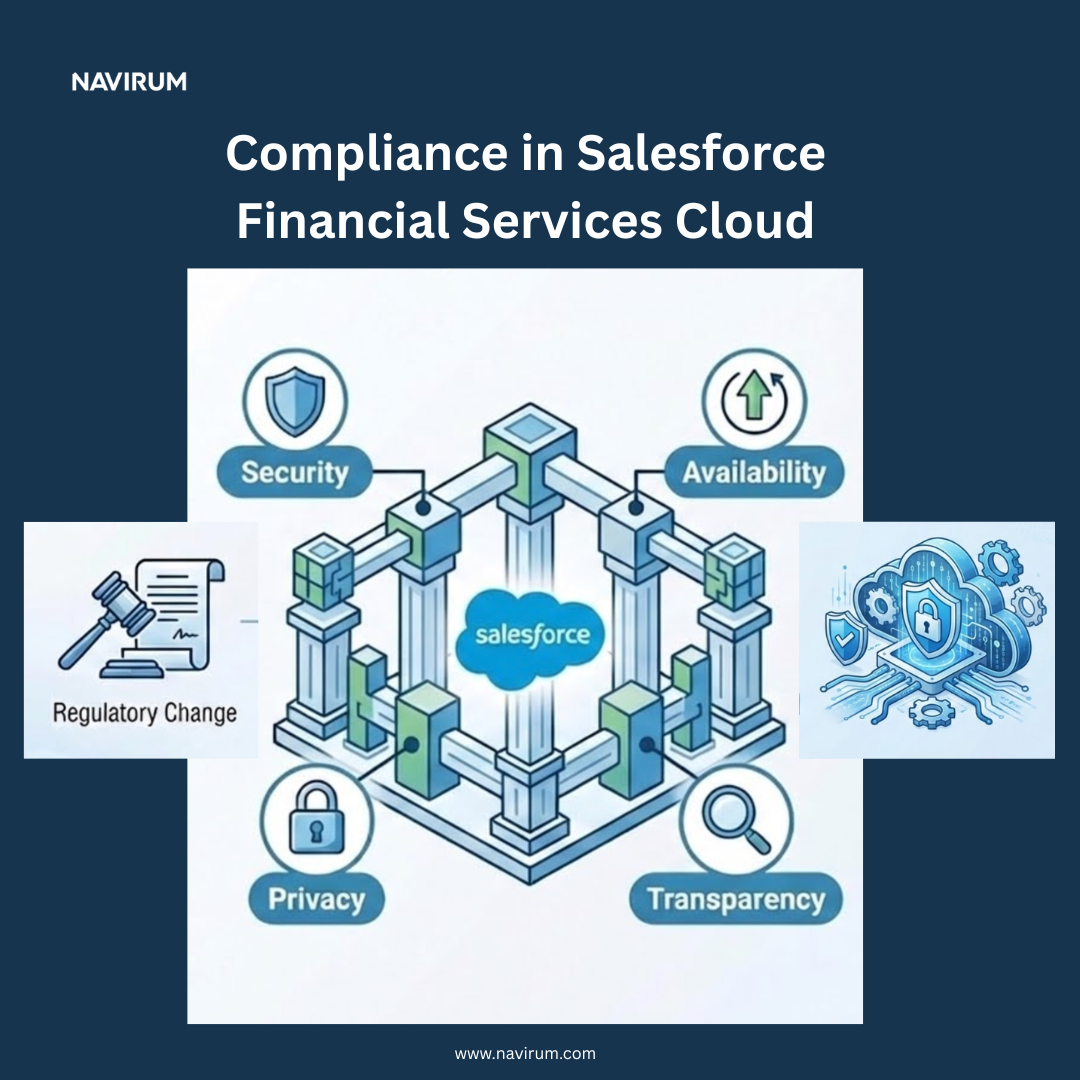
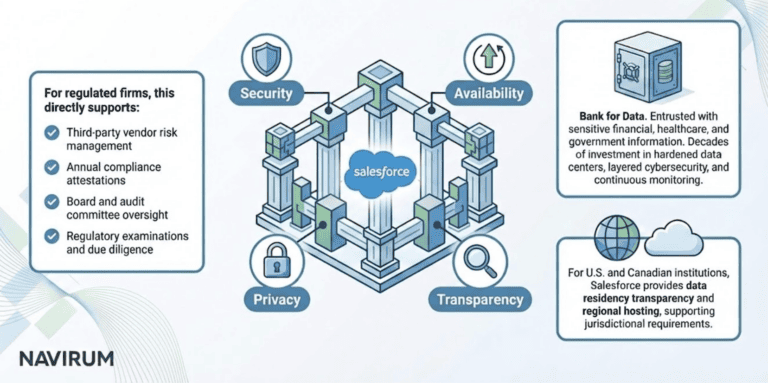
Salesforce’s platform is anchored in its public Trust principles: Security, Availability, Privacy, and Transparency. Through Salesforce Trust , institutions and regulators can view real-time system status, historical uptime, incident communications, and data-center locations.
For regulated firms, this directly supports:
Third-party vendor risk management
Annual compliance attestations and SOC 2 audit reviews
Board and audit committee oversight
Regulatory examinations and due diligence
Salesforce can credibly be thought of as a bank for data, entrusted with some of the most sensitive financial, healthcare, and government information in the world. As one of the original innovators in enterprise cloud computing, Salesforce has invested for decades in hardened data centers, layered cybersecurity controls, continuous monitoring, and independent certifications.
For U.S. and Canadian institutions, Salesforce also provides data residency transparency and regional hosting, supporting jurisdictional requirements.
FSC Compliance Readiness
Need to assess KYC, audit trails, permissions, and supervisory workflows?
Request a quick FSC compliance readiness review. We’ll help you identify gaps before they become audit findings.
Mastering Financial Services Cloud
In modern financial services, “Customer 360” is no longer a buzzword. It is a regulatory and operational requirement. FSC extends Salesforce beyond generic CRM by providing industry-specific data models, workflows, and compliance controls that bridge front-office personalization with back-office governance.
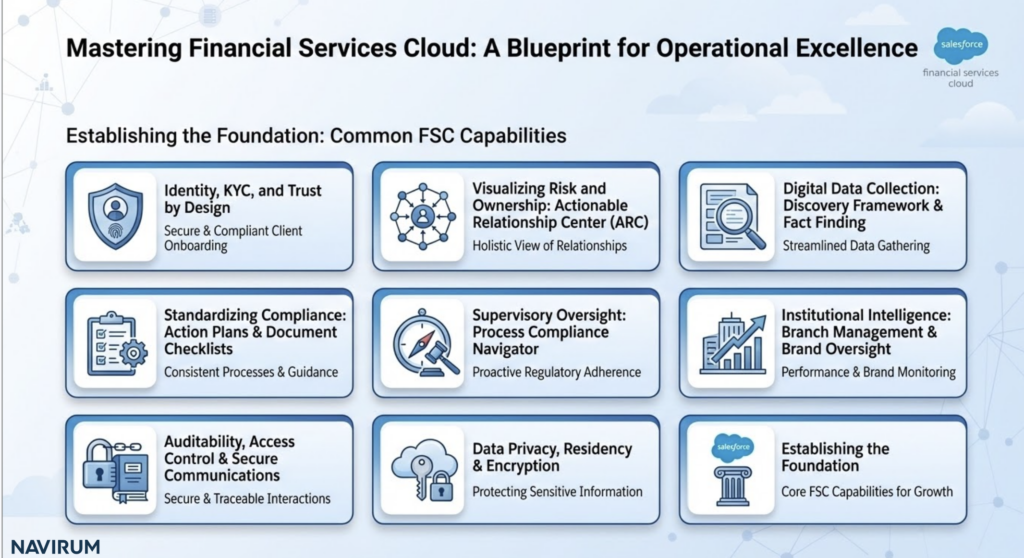
1. Establishing the Foundation: Common FSC Capabilities
Before advanced workflows can be implemented, institutions must understand FSC’s Common Capabilities. These foundational components allow Salesforce to natively model financial services operations.
Key elements include:
Financial Account objects
Household and relationship groupings
Lead-to-Referral tracking
Industry-specific record types and page layouts
These capabilities allow firms to operate in the language regulators and auditors expect, rather than forcing financial data into generic CRM constructs.
Getting this data model right the first time matters more than it looks. Our Salesforce consulting team maps legacy financial data into FSC correctly from day one, rather than leaving institutions to retrofit it later.
Salesforce has significantly streamlined KYC and AML compliance through the Party Profile Assessment framework. This allows firms to capture regulatory data points directly within client and entity profiles, embedding KYC into onboarding rather than managing it as a separate compliance exercise.
For service and contact-center interactions, FSC includes Identity Verification (Caller ID) capabilities. When a client calls in, agents are guided through verification questions tied directly to the client record, balancing security with client experience.
Together, these capabilities ensure identity controls are applied consistently across digital, branch, and call-center channels.
Streamline Onboarding
Transform digital onboarding for financial services with a solution designed specifically for the industry. Create a strong first impression while minimizing abandonment by simplifying applications through AI-driven insights and data integration. Automate manual tasks and connect systems to lower operational costs in what is traditionally a labor-intensive process.
3. Visualizing Risk and Ownership: Actionable Relationship Center (ARC)
Modern AML compliance and risk frameworks require institutions to understand networks, not just individuals, including beneficial ownership tracking across related entities.
The Actionable Relationship Center (ARC) provides a visual, interactive map of relationships between people, households, trusts, and businesses. Users can immediately see ownership structures, affiliations, and exposure, and take action directly from the relationship view.
This capability is particularly valuable for AML programs and complex wealth or commercial banking scenarios.
Mapping beneficial ownership and related-party risk by hand? See how an FSC compliance audit surfaces AML and KYC gaps before an examiner does. jump to the Readiness Review.
4. Digital Data Collection: Discovery Framework & Fact Finding
Manual data entry is one of the largest sources of operational risk.
Discovery Framework
The Discovery Framework allows firms to replace PDFs and spreadsheets with digital, validated forms. Data is captured once, validated in real time, and written directly into Salesforce, reducing errors and improving auditability.
Built on the Discovery Framework, the Fact Finding Questionnaire enables wealth managers to capture comprehensive financial information about a client’s assets, liabilities, income, goals, and risk tolerance.
For credit unions specifically, this digital data collection layer is what turns member onboarding from a paperwork bottleneck into a same-day process. See our credit union digital transformation overview for what that looks like in practice.
Action Plans are reusable templates that enforce repeatability across complex processes such as onboarding, lending, claims, or wealth planning. Each Action Plan defines tasks, owners, sequencing, and deadlines, ensuring consistency regardless of who executes the process.
Document Checklist Items
Financial services compliance depends on documentation. Document Checklist Items allow firms to define required document types (e.g., proof of income, ID, tax forms) and manage their review and approval lifecycle.
Together, Action Plans and document checklists transform compliance from institutional memory into system-enforced execution.
6. Supervisory Oversight: Process Compliance Navigator
TheProcess Compliance Navigator provides a visual roadmap of regulatory workflows, preventing users from skipping required steps. It acts as a compliance guardrail, ensuring disclosures, checks, and approvals are completed before progression.
This is particularly important for regulators who expect demonstrable supervision, not implied control.
For retail and advisory networks, FSC includes Branch Management capabilities. Executives can associate staff with branches, track performance, and monitor operational consistency across regions.
Tear Sheets provide concise, structured summaries of client information, relationships, recent activity, and key stakeholders. These are invaluable for executive reviews, client meetings, and regulatory examinations.
8. Auditability, Access Control & Secure Communications
Salesforce enforces security through:
Role-based access controls
Field-level security
Permission sets
A defensible Salesforce compliance audit trail, the kind SOX and internal audit teams expect to see, is supported through:
Field History Tracking
Setup Audit Trail
Event Monitoring
All client interactions, calls, emails, meetings, trade instructions, and money movement requests, can be logged and retained. Secure SMS integrations further reduce off-channel communication risk.
Not sure your Salesforce audit trail would hold up under review? Talk to Navirum about your permission sets, field history tracking, and event monitoring setup. skip to Talk to a Specialist.
9. Transaction Dispute Management
Empower service agents with AI-driven tools that automate and streamline the dispute process. Reduce manual effort, minimize application switching, and simplify customer communication, all while lowering call volume and accelerating resolution for a more efficient, seamless experience.
As part of a broader Salesforce data governance program built to satisfy FINRA and SEC recordkeeping expectations, the platform supports GDPR and CCPA through:
Consent management
Data classification
Retention policies
Right-to-erasure workflows
With Salesforce Shield, firms gain:
Encryption at rest
Platform encryption
Advanced monitoring
Data residency transparency and regional hosting options support U.S. and Canadian regulatory expectations.
AI Innovation Built on Trust, Not Trade-Offs
While many financial services firms are innovating rapidly with AI, trust and compliance remain the primary gating factors. Salesforce is building its AI capabilities on top of its long-standing governance foundation.
AI operates within: role-based access controls, audit trails, data residency requirements, encryption standards, human-in-the-loop oversight.
Unlike many AI-native vendors where governance commitments remain unclear, Salesforce places trust at the center of its AI strategy, making it suitable for regulated environments.
Built to Adapt as Regulations Evolve
Regulatory requirements will continue to change. Salesforce’s greatest advantage is adaptability. Because it is a configurable platform rather than a fixed compliance tool, firms can update workflows, approval chains, reporting structures, and controls without re-platforming.
This reduces:
Vendor sprawl
Cost of regulatory change
Operational disruption
This is also the case for who monitors the platform day to day. Regulations, integrations, and Salesforce releases all keep moving after go-live, which is exactly what Orbit Managed Services is built to handle on an ongoing basis, not just at launch.
Final Perspective
Salesforce Financial Services Cloud is not just a CRM. It is financial services compliance software: a compliance-ready operating platform. Through structured data models, repeatable Action Plans, relationship intelligence via ARC, supervisory tooling, enterprise-grade security, and responsible AI governance, Salesforce has become the compliance backbone for many North American financial institutions.
In a market crowded with innovation, Salesforce remains the benchmark for trust, governance, and security at scale.
Salesforce FSC compliance: your questions answered
Wondering whether FSC is compliant out of the box? How it handles FINRA, SOX, KYC, and audit trails? Where your current setup falls short? These are the compliance questions we hear most.
View all 8 questions
Compliance coverage and capabilities
Is Salesforce Financial Services Cloud compliant out of the box?
No CRM is compliant on its own, and FSC is no exception. What FSC gives you is the building blocks for compliance: structured KYC and identity data, access controls, encryption, data residency options, and an audit trail. Compliance comes from configuring those controls against your specific regulatory obligations, which is the work we do with financial services firms.
How does Salesforce FSC support KYC and AML compliance?
FSC captures identity, beneficial ownership tracking, and relationship data in a structured model, then uses Actionable Relationship Center to visualise ownership and risk across related parties. Standardised Action Plans and document checklists make each KYC and AML step repeatable and evidenced, so nothing depends on one person remembering the process.
Can Salesforce FSC give regulators a complete audit trail?
Yes. With Salesforce Shield field audit trail, event monitoring, and access controls configured correctly, FSC records who changed what and when, and supports supervisory oversight of that activity. This is the kind of evidence SOC 2, SOX, and FINRA audit reviews expect to see.
FINRA, SEC, SOX and data privacy
How do I ensure FINRA and SEC compliance in Salesforce?
FINRA and SEC compliance in Salesforce comes from configuring supervisory workflows, communication capture, recordkeeping, and access controls to your obligations, then evidencing them. FSC supports supervisory oversight and secure communications; the compliance itself is in mapping those capabilities to FINRA and SEC books-and-records and supervision rules, which is where implementation experience matters.
Does Salesforce FSC support SOX compliance and access controls?
Yes. SOX is fundamentally about control over financial data integrity and who can access it. FSC’s permission model, field-level security, and audit trail provide the segregation-of-duties and change-tracking evidence a SOX review requires, once they are configured to your control framework rather than left at defaults.
How does Salesforce FSC handle data privacy, residency, and encryption?
FSC supports encryption at rest and in transit, data residency options, and Salesforce data governance tooling for consent and data handling. For North American and cross-border financial institutions, this means you can align the platform with privacy obligations across jurisdictions rather than treating privacy as an afterthought.
Working with Navirum
How do we find the compliance gaps in our current FSC setup?
A compliance readiness review maps your existing FSC configuration against KYC, audit-trail, permissions, and supervisory requirements and pinpoints exactly where the gaps are. If you would like Navirum to run one, you can request a readiness review lower on this page.
How long does a compliance-focused FSC implementation take?
It varies based on the complexity of your data and the number of systems you need to integrate, so there is no single answer that fits every firm. We scope a firm timeline in the first phase of the project, once we understand your current setup and obligations, so you are not committing to a date before the work is understood.
Talk to Navirum
Find the compliance gaps in your Salesforce FSC setup
Talk to Navirum about FSC compliance, governance, and AI readiness, no cost, no commitment.
Charles Schwab Salesforce integration connects Schwab custodial data, accounts, balances, and holdings, with Salesforce Financial Services Cloud, so wealth management firms and RIAs get client records, account opening status, and compliance data in one system instead of two. Most firms connect through Schwab’s free, native Salesforce app, which syncs daily; real-time sync is available separately through Schwab’s OpenView Gateway API.
Key Takeaways
Core Integration Timeline: A custodial data link can be established quickly, but full implementation of Salesforce Financial Services Cloud alongside complete data clean-up ranges from 8 to 12 weeks for smaller RIAs, while multi-advisor firms with custom workflows often need 3 to 6 months.
Platform Choice Benefits: Integrating Schwab with standard Salesforce Sales Cloud requires heavy custom development. Utilizing Financial Services Cloud delivers native household objects and banking structures out of the box.
Middleware for Scale: While direct custom API scripts are possible, utilizing a robust middleware tier provides error tracking and easier data normalisation if your firm adds secondary custodians down the road.
Onboarding Optimization: The highest immediate return on investment comes from automating new account openings. Pulling data directly from Salesforce to pre-populate Schwab custodial forms cuts administrative friction down significantly.
The Bottom Line
TL;DR: Siloed tech stacks create administrative drag that blocks firm growth. Combining your Charles Schwab custodial records with Salesforce converts your CRM into a single operational hub, freeing advisors from duplicate data entry and manual system switching.
Charles Schwab Salesforce integration allows RIAs, wealth management firms, and broker-dealers to synchronize custodial data with Salesforce Financial Services Cloud (FSC). By connecting Schwab Advisor Center with Salesforce, firms can centralize client records, automate account opening, enhance compliance oversight, and improve advisor productivity. This guide explains integration options, architecture considerations, business benefits, compliance implications, and best practices for financial services organizations seeking scalable digital transformation.
Why Integration Is No Longer Optional?
In today’s wealth management environment, technology fragmentation is one of the biggest barriers to scale.
Getting the Schwab integration live is only the first step. Keeping it reliable as both platforms evolve is where ongoing Salesforce managed services comes in.
Most independent advisors and wealth management firms rely on Charles Schwab as custodian while using Salesforce as their CRM platform, often Salesforce Financial Services Cloud (FSC). Both systems are powerful. However, when they operate independently, inefficiencies quickly surface:
Advisors toggling between systems during client meetings
Manual entry of account data into Salesforce
Reconciliation delays
Inconsistent reporting across leadership teams
Increased compliance exposure
As firms grow, these inefficiencies multiply.
A thoughtful Charles Schwab Salesforce integration eliminates these silos by connecting custodial data directly into Salesforce. The result is a unified client view, automated workflows, and stronger operational control.
For firms aiming to scale assets under management (AUM) while maintaining compliance and service excellence, integration becomes a strategic initiative, not just a technical enhancement.
Understanding the Strategic Value of Schwab–Salesforce Integration
At its core, integration solves one fundamental problem: disconnected data.
In many firms today:
Client relationship details live in Salesforce
Account balances and holdings live in Schwab Advisor Center
Planning data lives in a third system
Reporting tools pull data independently
This creates friction.
When Schwab and Salesforce are integrated properly, Salesforce becomes the operational command center, while Schwab remains the custodial system of record for investment data.
Instead of advisors working across systems, the system works for the advisor.
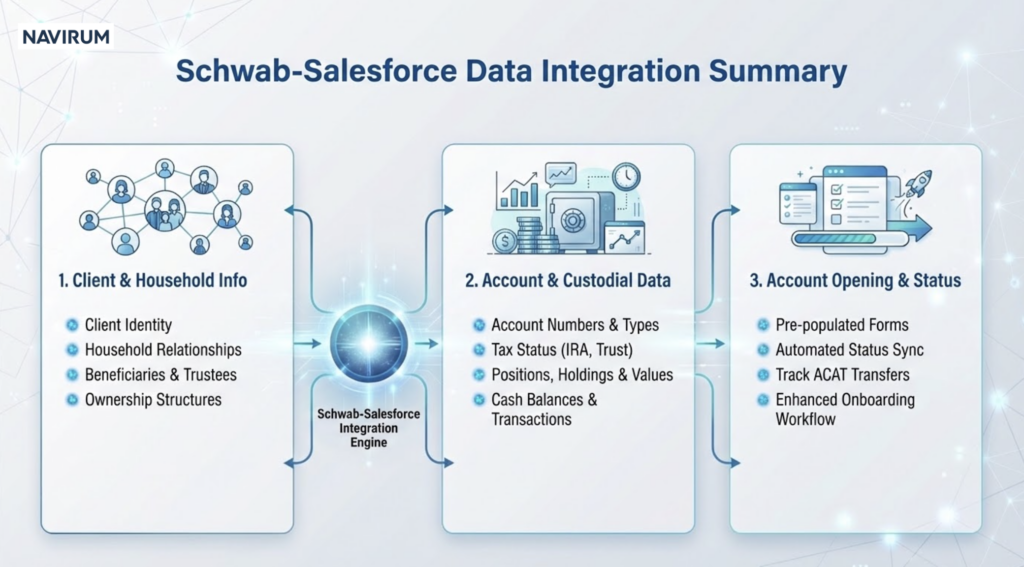
A mature Charles Schwab Salesforce integration does more than import account balances. It enables structured, ongoing synchronization of multiple data layers.
1. Client and Household Information
Client identity and relationship modeling are critical in wealth management. Integration can synchronize:
Account holder names
Contact details
Household relationships
Beneficiaries and trustees
Joint account ownership structures
When aligned with Salesforce Financial Services Cloud, this information enhances household modeling and relationship mapping, two critical FSC capabilities.
2. Account and Custodial Data
Custodial data typically includes:
Account numbers and types
Tax status (IRA, trust, taxable, etc.)
Positions and holdings
Market values
Cash balances
Transaction history
When mapped properly to FSC Financial Account objects, this data feeds dashboards, client reviews, and compliance monitoring workflows.
Key Charles Schwab Banking Integration Features
Beyond brokerage and advisory accounts, Schwab’s banking integration features are increasingly part of what firms sync into Salesforce. Real-time cash balance data is available specifically through the Schwab OpenView Gateway API; other banking data points, such as margin account details, cash sweep programs, and lines of credit, vary by integration route and should be confirmed against your specific Schwab connection before you build reporting around them.
When these banking data points live inside FSC alongside brokerage holdings, advisors get a genuine 360-degree view of the household balance sheet, not just its investment portfolio. That combination turns a client review from a portfolio update into a full financial-picture conversation, and it is a capability firms increasingly expect as Schwab continues to expand its banking integration features for RIAs.
3. Account Opening and Transfer Status
One of the most impactful areas of integration involves onboarding workflows. By connecting Schwab account opening processes to Salesforce:
Forms can be pre-populated
Status updates can sync automatically
Advisors can track ACAT transfers
Operations teams gain visibility without leaving Salesforce
This reduces onboarding friction and shortens time-to-funding.
Scaling Multi-Custodial Operations: Schwab, Fidelity, and Salesforce FSC
Most mid-market RIAs do not run on a single custodian for long. As firms grow, whether organically or through acquisition, it is common to see Schwab alongside Fidelity, Pershing, or another custodial partner within the same practice.
This is where Salesforce Financial Services Cloud earns its keep. Rather than building separate reporting views for each custodian, FSC acts as the aggregation layer: Schwab and Fidelity custodial data integration into Salesforce Financial Services Cloud lets operations teams normalize account structures, tax statuses, and household relationships into a single data model, regardless of where the assets are held.
For firms scaling through acquisition, this matters even more. A well-architected middleware tier makes onboarding an acquired book of business, with its own custodian and its own data quirks, a matter of configuration rather than a custom build. Advisors get one household view. Operations gets one system of record. Leadership gets one reporting layer, not three.
Integration Architecture: How It Works in Practice
There is no single way to implement Charles Schwab Salesforce integration. The right architecture depends on firm size, growth trajectory, and long-term technology strategy.
Integration Route
Cadence
Effort
Best For
Schwab Advisor Center Integration for Salesforce (native app)
Daily batch (prior business day)
Low, point-and-click setup
Most RIAs; standard reporting and account data needs
Firms needing real-time balances or automated workflows
Middleware-based integration
Configurable, typically scheduled batch
Medium to high
Multi-system or multi-custodian environments
Pre-built accelerators
Varies by accelerator, usually daily or scheduled batch
Medium
Firms wanting faster time-to-value with some customization
Daily data files
Batch
Low to medium
Simple, file-based reporting needs
Schwab Advisor Center Integration for Salesforce (Native App)
For most RIAs, the starting point is Schwab’s own Schwab Advisor Center Integration for Salesforce, a free, native managed package available on the Salesforce AppExchange. It syncs account and custodial data on a daily batch basis (prior business day; there is no intraday update), and it is typically the lowest-effort path since it does not require custom development. Firms that need real-time data or bidirectional workflows beyond what the native app supports typically move to the Schwab OpenView Gateway API described below.
Schwab OpenView Gateway® API Integration for RIAs
Schwab offers APIs that allow firms to retrieve custodial data programmatically.
For RIAs evaluating this route, a primary benefit of API connectivity is reducing manual data entry and operational risk, since data moves directly from Schwab into Salesforce rather than being re-keyed by hand.
This approach, built on the Schwab OpenView Gateway® API, offers flexibility and can support real-time synchronization for supported data types and bidirectional workflows, but it requires technical expertise and ongoing maintenance. Firms pursuing this route typically:
Have internal development teams
Work with a Salesforce consulting partner
Require custom workflows beyond standard connectors
While powerful, API-based integrations must account for version changes, authentication management, and API limits.
Middleware-Based Integration
For firms with a multi-system ecosystem, middleware often provides the most scalable architecture.
Middleware solutions can:
Transform and normalize data
Handle error monitoring
Manage retries and synchronization schedules
Support additional integrations beyond Schwab
This approach reduces dependency on direct system-to-system connections and supports long-term scalability.
Pre-Built Accelerators
Many Salesforce consulting firms specializing in financial services offer pre-built accelerators for Schwab integration.
These solutions typically include:
Pre-mapped FSC data structures
Standardized field mapping
Proven onboarding workflows
Reduced implementation timelines
For growing RIAs, this approach balances speed and customization.
How Does the Salesforce Charles Schwab Integration Connection Process Work?
At Navirum, we’ve implemented countless Schwab Salesforce integrations across wealth management firms. While the connection between Salesforce Financial Services Cloud (FSC) and the Charles Schwab custodial platform is well-supported, it does require hands-on experience with Salesforce to complete successfully.
Schwab provides guided support throughout the process, working directly with the Salesforce owner to configure the connection. In our experience, their team is highly responsive and patient, and ensures the setup is completed correctly – particularly when enabling key Charles Schwab banking integration features such as account data synchronization, onboarding status tracking, and custodial data visibility. This reflects our proven track record with custodial integrations.
The setup involves configuring a number of Salesforce components, including fields, roles, profiles, and permissions, followed by structured testing and validation. The full process typically takes a few days (for the technical API data connection itself; full Salesforce FSC implementation typically runs 8–12 weeks) to complete, including initial configuration and data synchronization.
Given the level of detail involved, this is best handled by a Salesforce Administrator or someone highly comfortable with system configuration and your firm’s data model.
Recommended Approach: We strongly recommend completing the setup collaboratively with:
Schwab’s integration team
The internal project lead at your firm
Your Salesforce consultant
Having all parties aligned on the same calls ensures faster setup, fewer errors, and a smoother path to go-live.
Business Impact: Beyond Technical Efficiency
Integration is not just about moving data. It fundamentally changes how advisors and operations teams work.
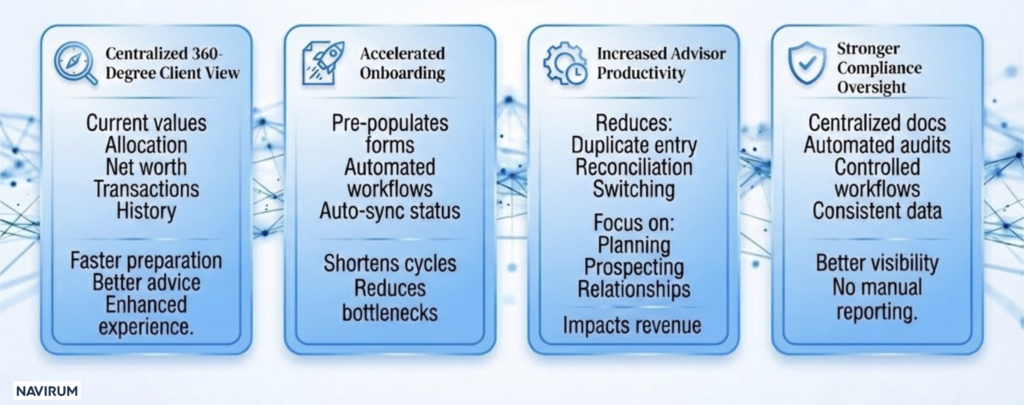
Centralized 360-Degree Client View
When Schwab data flows into Salesforce, advisors gain immediate access to:
Current account values
Asset allocation
Household net worth
Recent transactions
Relationship history
During client meetings, advisors can prepare faster and deliver more personalized advice.
The ability to see relationship history alongside custodial data significantly enhances client experience.
Onboarding Automation and DocuSign Workflow Integration
Manual account onboarding is one of the most resource-intensive processes in wealth management.
Without integration:
Advisors fill forms manually
Operations re-enter data
Status updates require email follow-ups
With integration:
Client data pre-populates forms
Salesforce workflows manage approvals
Status changes sync automatically
This shortens onboarding cycles and reduces operational bottlenecks.
Many firms extend this further with a DocuSign workflow: once forms are pre-populated from Salesforce, they route automatically into an e-signature process, and completed, signed documents flow back into Salesforce, closing the loop without a single manual file upload.
Increased Advisor Productivity
Every hour spent reconciling data is an hour not spent advising clients.
Integration reduces:
Duplicate data entry
Manual reconciliation
System switching
Advisors can focus on:
Financial planning
Prospecting
Deepening client relationships
For firms scaling AUM, advisor productivity improvements directly impact revenue.
Stronger Compliance Oversight
Regulatory scrutiny in financial services continues to increase. Integration helps firms maintain compliance through:
Centralized documentation
Automated audit trails
Controlled approval workflows
Data consistency across systems
Compliance officers gain better visibility without depending on manual reporting.
Schwab + Salesforce
Seeing this opportunity in your firm?
We work exclusively with wealth management firms on Salesforce. Tell us about your setup, and we respond within 1 business day.
Salesforce Financial Services Cloud: Why It Matters
While Schwab can integrate with standard Salesforce Sales Cloud, Financial Services Cloud (FSC) provides structural advantages for wealth management firms.
FSC includes:
Household data modeling
Financial Account objects
Relationship maps
Action plans
Client lifecycle tracking
When Schwab custodial data maps directly into FSC Financial Accounts, firms unlock structured reporting and automation that generic CRM configurations cannot easily replicate.
For firms planning long-term digital transformation, FSC alignment is critical.
Data Governance and Security Considerations
Financial data is highly sensitive. A Schwab–Salesforce integration must prioritize governance from day one. As AI agents enter the picture, that same governance extends to governing AI access to Schwab data.
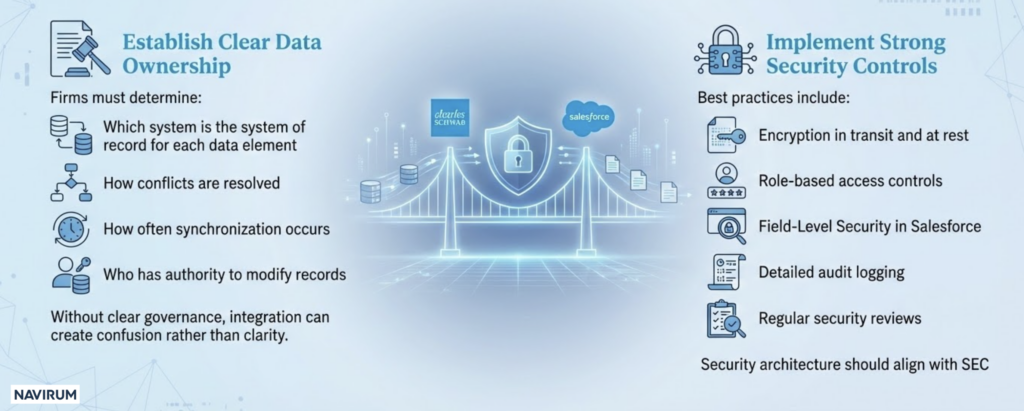
Establish Clear Data Ownership
Firms must determine:
Which system is the system of record for each data element
How conflicts are resolved
How often synchronization occurs
Who has authority to modify records
Without clear governance, integration can create confusion rather than clarity.
Implement Strong Security Controls
Best practices include:
Encryption in transit and at rest
Role-based access controls
Field-level security in Salesforce
Detailed audit logging
Regular security reviews
Security architecture should align with SEC and FINRA requirements, as well as internal compliance frameworks.
Common Pitfalls to Avoid
Even well-intentioned integration projects can face challenges.
Over-Customization
Excessive custom objects or logic increases maintenance complexity. Whenever possible, leverage standard FSC structures.
Inadequate Data Cleanup
Migrating inconsistent or incomplete data into Salesforce undermines reporting accuracy. Data normalization should precede integration.
Lack of User Adoption
Technology alone does not create efficiency. Training, documentation, and phased rollout are essential.
Measuring Return on Investment
Integration ROI should be measured across operational and revenue metrics.
Common indicators include:
Reduced manual data entry time
Faster account funding cycles
Increased advisor capacity
Improved compliance reporting
Enhanced client retention
In Navirum’s implementation experience, the fastest, most measurable ROI usually comes from onboarding automation: firms that pre-populate Schwab account-opening forms from Salesforce typically cut manual data entry on new accounts within the first one to two billing cycles after go-live. Results vary by firm size, starting data quality, and how much of the onboarding workflow is automated versus manual.
Who Benefits Most from Charles Schwab Salesforce Integration?
While any Schwab-custodied firm can benefit, integration delivers the greatest value to:
At scale, manual processes become operational risks. Integration reduces that risk while enabling sustainable growth.
Built for RIA Roll-Up and Aggregator Strategies
Private equity-backed aggregators and regional roll-up firms face a distinct version of this problem: they are absorbing data from multiple acquired firms on an ongoing basis, not managing just one set of records.
For these firms, Salesforce Financial Services Cloud can be configured to filter and report on advisor movement analytics by custodian, surfacing which acquired books are still Schwab-custodied, which have moved, and where consolidation work remains. The same reporting layer can track Form ADV Part 1 filings and flag book-of-business transfers following recent representative departures, giving deal teams and integration leads a single view of what has been absorbed and what is still in flight.
Built-in workflow automation extends this further: as new acquisitions close, standardized onboarding sequences can bring newly acquired advisors and their Schwab-custodied accounts into the same Salesforce instance as every other office, without a one-off integration project each time.
The Future of Wealth Management Is Connected
Digital transformation in financial services is accelerating. Clients expect seamless onboarding, real-time visibility, and personalized advice. Advisors expect intuitive systems that reduce administrative burden.
Charles Schwab Salesforce integration supports both.
By aligning custodial data with CRM workflows, firms create a connected ecosystem that supports:
Data-driven insights
Operational scalability
Regulatory compliance
Superior client experience
For firms serious about modernization, integration is not simply an IT project. It is a strategic growth initiative.
Schwab + Salesforce
Working with Schwab and Salesforce today?
Tell us your situation, and we’ll respond within 1 business day.
Takeaway
Charles Schwab Salesforce integration empowers financial services firms to unify custodial intelligence with CRM workflows. When implemented strategically, it enhances advisor productivity, accelerates onboarding, strengthens compliance oversight, and provides leadership with actionable reporting.
As wealth management firms compete in an increasingly digital marketplace, integrated systems become foundational to long-term success.
For RIAs, broker-dealers, and wealth management organizations leveraging Schwab and Salesforce, integration is no longer optional. It is the infrastructure for scalable growth.
Navirum Recommendations: Make Schwab–Salesforce Integration Work for Your Firm
Who we work with
Navirum implements Schwab–Salesforce integrations exclusively for wealth management and financial services firms. Our clients manage between $500M and $5B+ in AUM, with senior consultants on every engagement, no exceptions.
Integrating Charles Schwab with Salesforce isn’t just a technical project. It’s a strategic opportunity to boost advisor productivity, streamline operations, and ensure compliance. Firms often attempt integration without specialized guidance, resulting in delays, duplicated data, or poor adoption.
Navirum’s approach ensures integration drives real business outcomes:
Reduce Compliance Risk: Embed audit trails, approval workflows, and role-based access from day one, minimizing regulatory exposure.
Start with Outcomes, Not APIs: Identify advisor pain points, onboarding bottlenecks, and reporting gaps first. The technology should solve problems, not just move data.
Design for Advisors: Present curated dashboards, automated workflows, and structured data to simplify daily operations and improve adoption.
Plan for Growth: Build a scalable architecture that supports multi-custodian environments, advanced analytics, and future expansion.
Why Navirum? We specialize exclusively in Salesforce for financial services. That means we understand Schwab data, advisor workflows, and regulatory requirements, and we know how to turn integration into measurable ROI.
Next Step: Don’t let your integration become a manual burden. Schedule a Salesforce Readiness Assessment with Navirum. We’ll evaluate your Schwab–Salesforce setup, surface operational gaps, and build a clear path to go-live.
Ready to assess your Schwab integration?
Get a structured review of your current setup: where the gaps are, what to fix first, and what a full integration would unlock for your firm.
FAQ: Charles Schwab Salesforce Integration
Can Charles Schwab integration work with any Salesforce edition?
While technically possible with Salesforce Sales Cloud, Financial Services Cloud (FSC) provides pre-built objects, household modeling, and financial account structures optimized for wealth management. Integration is smoother and more scalable with FSC.
How long does a typical integration project take?
Project duration varies based on complexity, firm size, and workflow requirements. Small RIAs may complete integration in 8–12 weeks, while multi-advisor firms with custom workflows may require 3–6 months.
Do I need middleware to connect Schwab to Salesforce?
Middleware is recommended for scalability, data transformation, and error monitoring, but smaller firms with limited data complexity may integrate directly via Schwab APIs or pre-built connectors.
Will integration impact compliance reporting?
When designed properly, integration enhances compliance by centralizing custodial data, creating audit trails, and ensuring structured approval workflows. It reduces manual reporting errors rather than creating new compliance burdens.
Can advisors access Schwab data from Salesforce on mobile devices?
Yes. Salesforce mobile apps allow advisors to view integrated account data, balances, and workflows securely, enabling real-time client discussions even when remote.
How is data security managed in this integration?
Security best practices include encryption in transit and at rest, role-based access, field-level security, and audit logging. Compliance with FINRA, SEC, and internal governance policies is essential.
Can this integration automate account opening processes?
Yes. Integrating Schwab with Salesforce allows pre-population of forms, workflow-driven approvals, and status tracking, significantly reducing account opening time and errors.
How do I maintain data accuracy over time?
Regular data audits, defined system-of-record rules, and clear sync schedules ensure ongoing accuracy. Middleware or automated reconciliation processes further reduce the risk of duplicate or outdated records.
Can I integrate multiple custodians in addition to Schwab?
Absolutely. A scalable architecture can accommodate additional custodians, enabling multi-custodian visibility and reporting from a single Salesforce instance.
What are the signs my firm needs this integration?
Typical indicators include:
Repetitive manual data entry
Advisors toggling between systems frequently
Delayed or inconsistent reporting
Compliance inefficiencies
Difficulty scaling operations without adding headcount
If you see these patterns, integration can deliver measurable ROI and operational efficiency.
Stay connected
Not ready to talk yet?
Join 400+ wealth management leaders on the FinSights newsletter, Navirum’s monthly take on Salesforce, AI, and digital transformation in financial services.
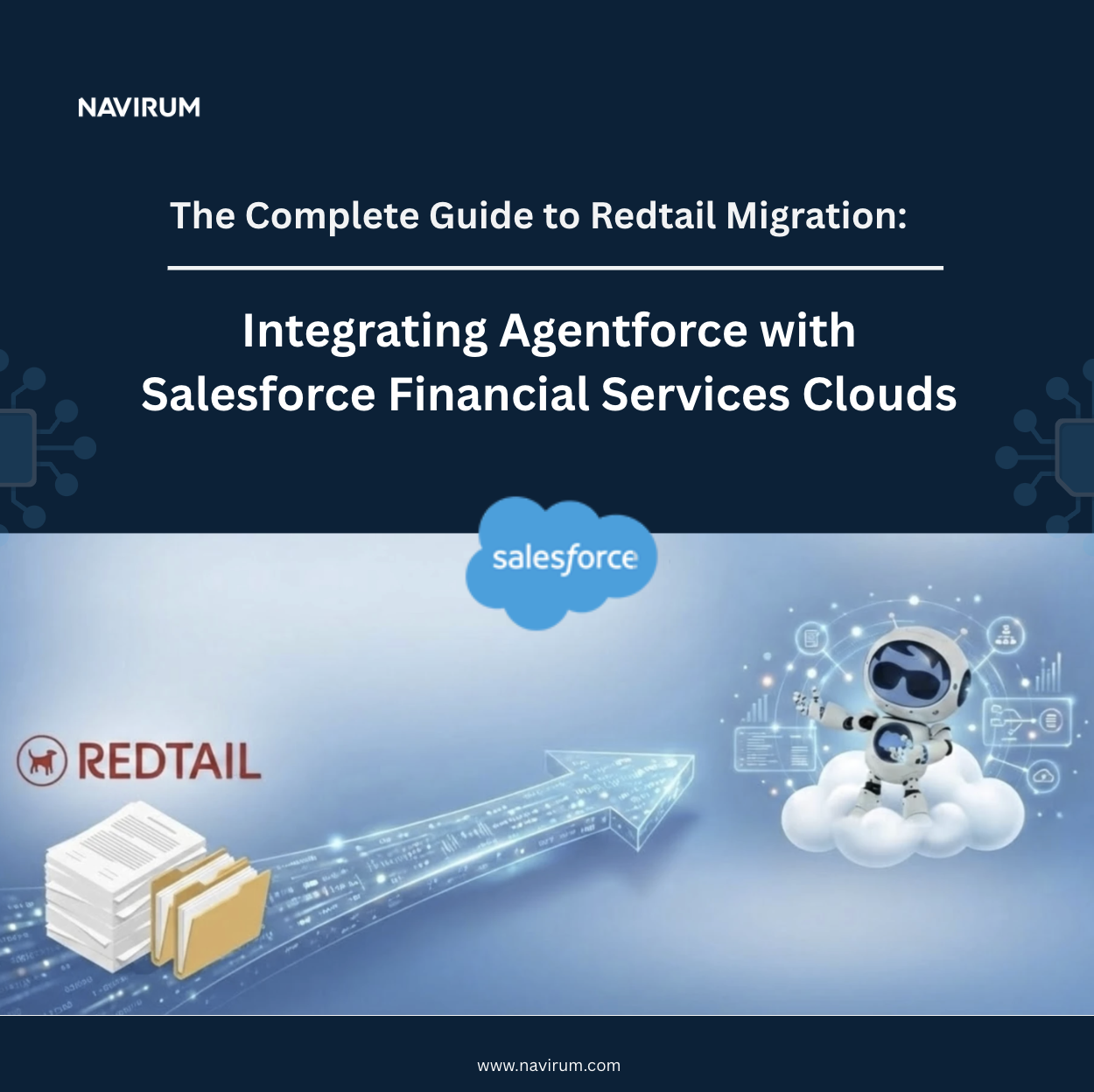
Migrating from Redtail to Salesforce Financial Services Cloud enables wealth management firms to scale with structured financial data, advanced analytics, and integrated compliance. When enhanced with Agentforce, firms gain AI-driven automation that improves advisor productivity, streamlines operations, and elevates client experience.
The shift is not just a CRM upgrade—it’s a strategic move toward long-term growth and digital transformation.
Redtail Migration
In today’s fast-evolving financial services landscape, the expectations placed on wealth management firms are higher than ever. Clients demand personalized, timely, and insightful advice, while regulatory requirements and operational complexity continue to grow. For many advisory firms, Redtail has long served as a reliable CRM, helping teams manage client relationships and streamline basic operations. Yet as firms scale and strive for digital excellence, the limitations of legacy systems become increasingly apparent.
Migrating from Redtail to Salesforce Financial Services Cloud (FSC) offers a pathway to not only modernize CRM infrastructure but also transform the way your firm operates. When paired with Agentforce, an intelligent automation layer, FSC evolves from a simple database into a dynamic platform that drives operational efficiency, enhances client experience, and supports sustainable growth.
This guide explores the strategic, operational, and technical considerations of Redtail migration, illustrating how integrating Agentforce with Salesforce FSC can position your firm for long-term success.
The wealth management industry has transformed dramatically over the past decade. Gone are the days when clients relied solely on in-person meetings and phone calls. Today, clients expect instant access to insights about their portfolios, proactive guidance from their advisors, and digital tools that make managing their wealth simple.
The Advisor’s Perspective
Advisors need a CRM that does more than store contact information—it must unify client profiles, track financial goals, manage household relationships, and provide actionable insights in real time. Legacy platforms, including Redtail, often fall short in supporting these evolving needs. Limited automation, constrained analytics, and fragmented integrations can slow operations and hinder client engagement.
The FSC Advantage
Salesforce FSC addresses these challenges head-on. Designed specifically for financial institutions and advisory practices, FSC offers a robust, scalable architecture that captures client data in structured, meaningful ways. Household and relationship mapping allows advisors to see the full picture of their clients’ financial lives, while integrated compliance features ensure that regulatory obligations are consistently met. Analytics dashboards provide actionable insights, helping managers make informed decisions and track firm performance.
The Role of Agentforce in CRM Modernization
Integrating Agentforce on top of FSC elevates the platform further. Agentforce orchestrates workflows, automates repetitive tasks, and introduces AI-driven intelligence that empowers advisors to work smarter. By automating data collection, alerts, and task management, advisors can focus on what matters most: building relationships and delivering high-quality financial guidance.
Practical Examples
Consider a scenario where an advisor is preparing for quarterly client reviews. Instead of manually compiling account balances, activity logs, and notes, Agentforce can automatically gather all relevant data from FSC and present it in a structured, easy-to-digest view. Alerts can notify advisors about upcoming goals or risk exposures, and automated workflows ensure compliance checks are completed without extra effort.
Preparation is the most critical phase of any migration initiative. Firms must align stakeholders, understand the scope of existing data, and map current workflows. This stage ensures that the migration is not just a technical exercise but a strategic initiative aligned with business objectives.
Data Assessment and Cleansing
A detailed assessment of Redtail data, including contacts, households, historical interactions, and custom fields, lays the foundation for a smooth transition. Data quality is paramount. Firms should cleanse and normalize client records, remove duplicates, and validate historical interactions. Agentforce can support large-scale validation, reducing errors and improving data usability post-migration.
Integration Planning
Migration architecture should encompass the FSC core platform, the Agentforce automation layer, middleware for integrations, and monitoring tools. Many firms rely on additional systems such as portfolio management, document storage, financial planning software, and marketing automation. Ensuring seamless integration preserves workflow continuity and minimizes disruption.
Executing the Migration
A phased approach minimizes business risk. Starting with a pilot dataset allows teams to test mappings, validate data, and gather user feedback. Incremental rollouts by business unit or team reduce risk and allow for adjustments before full-scale deployment. Agentforce’s automation capabilities accelerate these phases, ensuring that tasks such as data import, verification, and workflow activation are completed efficiently.
Post-Migration Optimization
Migration is not complete at go-live. FSC and Agentforce provide tools to refine workflows, create role-specific dashboards, and continuously monitor system performance. Advisors benefit from intelligent alerts, consolidated client profiles, and automated reporting, which streamline daily activities and free up time for strategic engagement. Firms gain centralized oversight, enabling managers to track performance, monitor compliance, and identify areas for improvement.
Enhancing Advisor Productivity
Integrated platforms empower advisors to work more effectively. Unified client profiles, intelligent alerts, automated follow-ups, and streamlined pipeline management reduce administrative burden, allowing advisors to focus on strategic client engagement.
Transforming Client Experience
Automated workflows ensure client communications are timely, personalized, and relevant. Alerts for goal progress, portfolio changes, or life-event milestones help advisors proactively engage with clients. Multi-channel capabilities—email, SMS, portal notifications—provide a consistent experience across touchpoints, fostering trust and loyalty.
Leveraging AI and Intelligent Automation
Predictive analytics identify high-potential opportunities or risks. AI-powered workflows prioritize tasks and flag compliance concerns. Advisors can provide proactive, informed advice rather than reacting to client requests, positioning the firm as a trusted strategic partner.
Integrating FSC with Agentforce standardizes workflows, reduces manual intervention, and enhances governance. Firms gain visibility into processes across departments, ensuring consistency and accountability. Centralized dashboards provide real-time insight into client activity, advisor performance, and operational metrics.
Platform Management and Governance
Long-term success requires robust platform governance: release management, security administration, change control, and ongoing training programs. Establishing a CRM center of excellence helps institutionalize best practices and ensure continuous improvement.
Measuring ROI and Performance
Key performance indicators include migration completion rates, data accuracy, advisor efficiency, client engagement, compliance adherence, and overall firm performance. Dashboards enable managers to monitor these metrics and make informed decisions.
Compliance, Security, and Risk Management
Financial services firms operate in highly regulated environments. Salesforce FSC’s robust security architecture, combined with Agentforce governance, ensures that sensitive client data is protected and compliance obligations are consistently met.
Change Management and Adoption
Technology delivers value only if it is adopted. Structured training, hands-on workshops, and ongoing support help advisors and operations teams leverage the platform’s full capabilities. Agentforce-guided workflows assist new users in learning processes in context, reducing adoption friction and accelerating productivity.
Avoiding Common Pitfalls
Organizations often face challenges such as underestimating data complexity, insufficient testing, weak stakeholder engagement, and inadequate training. Proactive governance and experienced partners help mitigate these risks.
Future-Proofing Your CRM Platform
The financial services industry continues to evolve with AI-driven advisory models, embedded financial services, open banking integrations, and advanced analytics. FSC and Agentforce provide the flexibility to adapt to these trends while maintaining operational resilience.
TakeAway
Redtail migration is more than a technical upgrade—it is a strategic opportunity. Integrating Agentforce with Salesforce FSC enables firms to unlock efficiency, strengthen client relationships, and gain a competitive edge. By approaching migration as a business transformation initiative, wealth management organizations can deliver exceptional client experiences, empower advisors, and achieve sustainable growth in an increasingly competitive industry.
At Navirum, we advise firms to treat Redtail-to-Salesforce Financial Services Cloud migration as a business transformation, not just a system upgrade. Before rebuilding in FSC, firms should redesign workflows, define a minimum viable data model, and embed automation that generates actionable intelligence—such as proactive client engagement, cross-sell opportunities, and compliance triggers. Segmentation by advisor type and role-based dashboards ensures adoption and maximizes productivity.
Long-term success requires strong governance and executive sponsorship. Establish an internal CRM board, track adoption KPIs, and align metrics with firm growth and valuation drivers. By combining intelligent platform architecture with cultural alignment, firms can leverage FSC and Agentforce to drive operational efficiency, advisor excellence, and sustainable competitive advantage.
Frequently Asked Questions
When does it make strategic sense to migrate from Redtail to Salesforce Financial Services Cloud?
Migration becomes strategic—not just technical—when growth exposes operational constraints. Indicators include multi-advisor scaling challenges, inconsistent workflows, increasing compliance complexity, limited automation, and difficulty integrating portfolio, planning, or marketing systems. Firms preparing for M&A, expanding into multi-entity structures, or targeting enterprise-grade reporting often reach this inflection point.
How does FSC’s data model differ structurally from Redtail’s architecture?
FSC uses a financial services–specific data model built around households, relationships, financial accounts, and goals. It enables multidimensional relationship mapping across individuals, trusts, businesses, and beneficiaries. This structured model supports deeper analytics, regulatory traceability, and cross-functional visibility that legacy CRMs typically struggle to deliver.
What role does Agentforce play in a migration strategy?
Agentforce acts as an orchestration and automation layer on top of FSC. It standardizes workflows, automates task routing, triggers compliance checks, and surfaces AI-driven alerts. Rather than simply moving data, firms redesign processes to reduce manual intervention and embed intelligence into daily advisor operations.
How should firms approach data governance during migration?
Migration is an opportunity to redesign governance frameworks. This includes defining data ownership, implementing validation rules, enforcing naming conventions, and establishing lifecycle management policies. Firms that treat migration as a governance reset—not just a data transfer—realize significantly higher long-term ROI.
What integration complexities should firms anticipate?
Most advisory firms rely on portfolio management systems, financial planning tools, custodial feeds, document storage, and marketing automation. Integration strategy must address API compatibility, middleware architecture, data synchronization logic, and latency considerations. A poorly planned integration layer can undermine even the most robust CRM implementation.
How does migration impact compliance and audit readiness?
FSC offers structured activity tracking, role-based access controls, field-level security, and comprehensive audit trails. When properly configured, workflows can enforce compliance checkpoints automatically. Migration provides an opportunity to standardize documentation practices and reduce regulatory exposure through embedded controls.
What are the most common causes of Redtail-to-FSC migration failure?
Frequent pitfalls include underestimating data complexity, inadequate stakeholder alignment, insufficient testing, and weak change management. Another critical risk is replicating legacy processes instead of redesigning them for automation and scalability.
How should firms measure ROI post-migration?
Strategic KPIs may include:
Advisor time reallocated to client-facing activities
Reduction in manual administrative workload
Increased client engagement rates
Improved compliance tracking accuracy
Enhanced pipeline visibility and forecasting
ROI is typically realized through operational efficiency and improved client retention rather than direct cost reduction alone.
How does FSC support long-term scalability and M&A growth?
FSC’s scalable architecture accommodates multi-team structures, segmented reporting, and standardized workflows across offices. For firms pursuing acquisitions, the platform simplifies onboarding new advisors and consolidating disparate data environments into a centralized system.
What organizational changes are required to maximize platform value?
Successful firms establish a CRM center of excellence, define release management processes, invest in structured training programs, and appoint internal platform champions. Technology transformation must be paired with cultural alignment to ensure sustained adoption and continuous optimization.
Modernizing Canadian Finance: Leveraging Salesforce Marketing Cloud and Agentforce for Customer Experience and Loyalty
The Canadian financial services sector, much like its global counterparts, is facing intense competition and higher customer demands for interactions that are personalized, relevant, and secure. As the hurdles to switching financial institutions decrease, clients are more willing to seek out alternatives that offer a superior customer experience.
To foster loyalty and build trust, Canadian financial institutions must bridge the gap between their traditionally strong internal systems for capital and risk management and the evolving digital demands of today’s consumers. The key to this transformation is the strategic integration of Salesforce Marketing Cloud (SFMC), Financial Services Cloud (FSC), and sophisticated AI solutions such as Einstein and Agentforce.
Here are the three great uses for a financial services firm leveraging these technologies to drive growth, compliance, and loyalty.
#1 The Trust-Building Onboarding Journey
First impressions are always important, and a dry “thank you” email is no longer sufficient when competing with agile fintech challengers. A very effective use of SFMC is to automate smart onboarding journeys that educate rather than just confirm.
Using Journey Builder, banks can trigger multi-step flows the moment a new account is opened. Instead of a generic blast, the system delivers educational content tailored to the customer’s specific product usage—such as setting up auto-transfers for a new savings account or explaining treasury services to a new business client.
The AI & Agentforce Edge: This process is accelerated by Agentforce for Financial Services, which is designed to streamline banking and wealth management operations. By integrating Agentforce, banks can deploy autonomous agents to handle routine inquiries during the onboarding phase, while Einstein AI analyzes engagement in real-time. If a high-value client stops engaging with the onboarding emails, the system can automatically pivot to other touchpoints that the advisor decides, such as an SMS with a personal callback offer or an invitation to connect with the advisor.
#2 The Hyper-Relevant Cross-Sell with Lifecycle Logic
Cross-selling is often viewed as intrusive because it is frequently mistimed. A customer who just paid off a student loan does not want another loan promo; they are more likely to need investment advice. SFMC transforms cross-selling by using lifecycle awareness to ensure offers are relevant and timed correctly.
Through Customer 360 Integration, banks can unify data from website interactions, mobile app usage, and transaction history to see the full context of a client’s financial life. This enables precise segmentation, moving beyond broad demographics (e.g., “Millennials”) to behavioural segments (e.g., “Active mobile users who viewed mortgage rates this week”),.
The AI & Agentforce Edge: This is where Data Cloud and Einstein Analytics become essential. They move marketing from “reactive” to “predictive.” Einstein can identify customers likely to respond to specific offers and recommend the “next best action” instantly,. Furthermore, Agentforce solutions can be employed to autonomously draft personalized outreach for advisors based on these predictive insights, ensuring the communication feels human and contextually aware.
#3 Proactive Churn Prevention and Retention
In the competitive Canadian market, insights and proactive actions can help identify and retain disengaged customers. SFMC allows banks to set up retention workflows that detect early warning signs, such as low interaction with emails, websites and apps. If a previously active user hasn’t logged in for 45 days, the system can automatically trigger a re-engagement path, starting with a gentle check-in email and escalating to a tailored incentive, such as a waived fee.
The AI & Agentforce Edge: By utilizing Agentforce, financial institutions can automate the remediation of these at-risk accounts more efficiently. For instance, Agentforce agents can independently manage service inquiries or navigate complex data strategies to uncover why churn is happening, allowing the company to implement effective measures to retain their clients.
The Bottom Line for Canadian Financial Institutions
Implementing this integrated solution is like moving from a generic loudspeaker announcement to giving every client a personal concierge who knows their destination, taps them only when relevant, and hands them exactly the right ticket.
Partner with Navirum to Activate Your Intelligence Strategy
The integration of Salesforce Marketing Cloud, Financial Services Cloud, Einstein AIet Agentforce is more than just a technological upgrade and Navirum is your specialized partner, ready to help you convert these powerful innovations into real, measurable business value.
Contact Navirum today for an initial consultation. Let us explore how we can architect a personalized, intelligent, and scalable client experience strategy that drives loyalty and positions your organization for sustained growth.
What Is A Salesforce Health Check? Why do I need one?
Estimated reading time: 13 minutes
Key Takeaways
A Salesforce Health Check assesses your Salesforce environment to enhance efficiency, security, and compliance for financial services.
It identifies critical areas like regulatory compliance, data integrity, and operational efficiency for executives in finance.
Navirum provides actionable deliverables, including an executive summary, risk analysis, and a strategic roadmap.
Firms trust Navirum due to its deep expertise in Salesforce for financial services and tailored assessments that drive business outcomes.
The Salesforce Health Check helps uncover risks, streamline operations, and maximize your Salesforce investment.
Is Your Salesforce Org Truly Optimized for Financial Services in 2026? Unlock Efficiency, Security, and Compliance Across Your Salesforce Environment
In today’s fast-paced financial services landscape, your Salesforce platform is more than a CRM—it’s a strategic asset. Yet even high-performing organizations risk inefficiencies, security vulnerabilities, and compliance gaps as business requirements evolve. A Salesforce Health Check provides a comprehensive, expert-led assessment that ensures your platform is not only fit for today but positioned to drive growth tomorrow.
Salesforce Org Health Check – The Imperative for Financial Services Leaders
For executives in banking, insurance, wealth management, and fintech, the stakes are high:
Regulatory Compliance: Misaligned permissions or incomplete audit trails can expose your organization to significant risk.
Data Integrity: Duplicate records, outdated client data, or fragmented reporting hinder confident decision-making.
Operational Efficiency: Complex workflows, over-customization, or underutilized functionality can slow your teams.
Platform ROI: Without proactive oversight, organizations risk exceeding limits or underleveraging Salesforce investments.
A Salesforce Health Check provides visibility into these critical areas, benchmarking your organization against industry best practices and delivering actionable recommendations that mitigate risk while unlocking untapped potential.
What a Financial Services-Focused Salesforce Health Check Looks Like | Navirum
Salesforce Optimization & Governance
What a Financial Services-Focused Salesforce Health Check Looks Like
Navirum’s Health Check is designed specifically for the nuanced operational, regulatory, and architectural needs of financial services organizations.
We provide a detailed evaluation across security, data privacy, internal governance, peer benchmarking, custom architecture, and platform limits to ensure your CRM is built to scale safely.
Audit Area 1 • Access Governance
Security & Access Control
Ensure only authorized personnel can access sensitive financial records. We audit role hierarchies, profile permissions, permission sets, multi-factor authentication (MFA), and session security.
Role Hierarchy Review Multi-Factor Auth (MFA) Verification Permission Set Audit Field-Level Security
💡 Audit Focus: Eliminates over-privileged access and protects sensitive client wealth data from internal/external leaks.
Audit Area 2 • Regulatory Compliance
Data Privacy & Regulatory Alignment
Verify compliance with global and regional regulatory frameworks relevant to financial institutions, including PCI-DSS, HIPAA, GDPR, FINRA, SEC, and Canadian CRM3/TCR rules.
SEC / FINRA Compliance PCI & HIPAA Alignment GDPR Data Privacy Controls Canadian CRM3 / TCR Standards
💡 Audit Focus: Protects your firm against regulatory penalties through enforced record retention and data privacy rules.
Audit Area 3 • Information Barriers
Internal Data Sharing & Governance
Implement effective “who sees what” sharing policies. We evaluate sharing rules, team settings, and restricted structures like Chinese Walls for deal advisory or compliance.
Chinese Wall Isolation Sharing Rule Optimization Account & Opportunity Teams Confidential Deal Protection
💡 Audit Focus: Maintains strict ethical walls between research, wealth, investment banking, and retail divisions.
Audit Area 4 • Peer Alignment
Benchmarking Against FS Best Practices
Compare your Salesforce implementation directly against peer benchmarks across Wealth Management, Insurance, Commercial Banking, Fintech, Lending, and Private Equity.
💡 Audit Focus: Highlights operational gaps and adoption hurdles compared to industry-leading financial firms.
Audit Area 5 • Code & Automation
Customizations & System Architecture
Assess custom Apex code, Salesforce Flows, legacy Process Builders, triggers, and integrations to optimize platform scalability, maintainability, and execution speed.
💡 Audit Focus: Eliminates technical debt to prevent system degradation when releasing new business capabilities.
Audit Area 6 • System Limits
Capacity & Platform Limits
Comprehensive review of data storage, file storage, API call limits, custom object thresholds, and automation limits to uncover cost-saving opportunities and avoid outages.
Data & File Storage Optimization API Call Volume Monitoring Custom Object Limit Headroom Cost Reduction Strategies
Deep expertise in Salesforce for financial services, across banking, insurance, wealth management, fintech, and private equity.
Tailored assessments designed to drive measurable business outcomes, not just technical improvements.
Guidance for ongoing optimization, ensuring your Salesforce org remains agile, secure, and compliant in a constantly evolving market.
The Salesforce Health Check can help uncover risks, streamline operations, and maximize your Salesforce investment.
Salesforce Org Health Assessment | Financial Services Edition
Salesforce Org Health Score
Services financiers Edition
Is your Salesforce org actually ready for where your business is going?
Your Salesforce org sits at the center of your client, advisor, operational, and business data. But over time, customizations, integrations, manual processes, and disconnected systems can create technical debt that isn’t always visible.
Take this 3-minute assessment to evaluate the health of your Salesforce environment across architecture, data, integrations, automation, security, adoption, and AI readiness.
15 Strategic Questions
Instant Category Score
Custom Health Profile
Section 1: Salesforce ArchitectureQuestion 1 of 15
Loading Question…
Your Salesforce Org Health Score
0 / 100
Evaluating…
Your Salesforce foundation is evaluated based on your responses across all 6 core functional pillars.
Your Health by Category
Your Salesforce Health Profile
The Optimization Org
Your Salesforce environment is working, but inefficiencies are preventing you from getting maximum value from the platform.
💡 Your Opportunity: Address technical debt, streamline workflows, improve adoption, and eliminate unnecessary manual processes.
Your Top 3 Strategic Priorities
Want to Go Beyond Your Score?
Get a Professional Review of Your Salesforce Org
Your score provides a starting point. A deeper Salesforce Org Health Assessment conducted by Navirum’s Financial Services practice can identify:
<strong class="schema-faq-question">Can a Salesforce Health Check identify whether our current Salesforce setup still reflects how our business operates?</strong>
Yes. A Salesforce environment can remain technically functional while becoming increasingly disconnected from the way a financial services organization actually operates. Business models evolve through acquisitions, new service offerings, changes in advisor structures, new client segments, and shifts in operating models. A deeper assessment can compare the Salesforce experience against current business processes and identify where the platform no longer reflects how teams work. This can reveal unnecessary steps, outdated assumptions in the data model, redundant functionality, or processes that were designed for an earlier stage of the organization’s growth.
<strong class="schema-faq-question">How can we determine whether Salesforce is being used for the right processes?</strong>
Not every process belongs in Salesforce, and forcing every workflow into the platform can create unnecessary complexity. The more important question is whether Salesforce is being used where it provides the greatest business value. An assessment can examine which processes are managed in Salesforce, which remain in other applications, and where information or activities cross between systems. This can help organizations determine which processes should remain in Salesforce, which should be integrated with another platform, and which may be better handled elsewhere. This is particularly useful when a firm has accumulated Salesforce functionality over many years.
<strong class="schema-faq-question">How can a Salesforce assessment help identify opportunities to simplify the user experience?</strong>
A Salesforce org can contain functionality that is individually useful but collectively overwhelming. Users may encounter too many fields, screens, notifications, tasks, approval steps, or navigation options. A health assessment can look at Salesforce from the perspective of different user groups rather than evaluating the system solely from an administrator’s perspective. Advisors, service associates, relationship managers, operations teams, and executives may all require very different experiences. The objective is to identify where Salesforce can be made more intuitive and focused so users can complete important tasks with less friction.
<strong class="schema-faq-question">What should we evaluate before consolidating multiple Salesforce orgs?</strong>
Organizations considering Salesforce consolidation should first understand why separate orgs exist and what dependencies would be affected by bringing them together. Important questions include: Which business units genuinely require separate environments? Are there differences in operating models or regulatory requirements? Which applications and integrations depend on each org? How different are the underlying data models? What functionality has been independently developed? What would users gain or lose through consolidation? What migration and change-management implications would result? The decision should therefore be based on business and technical requirements rather than simply assuming that fewer Salesforce orgs are always better.
<strong class="schema-faq-question">How can a Salesforce Health Check support organizations that have grown through acquisitions?</strong>
Acquisitions frequently introduce multiple CRM environments, inconsistent processes, different Salesforce configurations, and overlapping technology investments. Rather than immediately migrating everything into a single environment, organizations can use an assessment to understand the differences between the acquired and existing Salesforce environments. This can help leadership identify which capabilities should become standardized, which processes are unique to a business unit, which applications should be retained, and where consolidation could create unnecessary disruption. For financial services firms pursuing ongoing M&A activity, this can also become part of a repeatable technology integration strategy.
<strong class="schema-faq-question">How can we tell whether a Salesforce feature should be configured, customized, or handled outside Salesforce?</strong>
This is an important architectural decision that becomes more difficult as an org matures. A useful assessment considers the business value of the requirement, the longevity of the process, the maintenance implications, integration dependencies, user experience, and the availability of native Salesforce capabilities. The question isn’t simply “Can Salesforce do this?” It is: “Is Salesforce the right place to do this?” That distinction can help prevent organizations from introducing unnecessary complexity when a native capability, integration, or external application may provide a better long-term solution.
<strong class="schema-faq-question">What role should business stakeholders play in a Salesforce Org Health Check?</strong>
A Salesforce assessment should not be conducted exclusively by the Salesforce administrator or IT team. Business stakeholders provide critical context about how the platform affects day-to-day operations and strategic priorities. Depending on the organization, this may include representatives from: Wealth management Advisory teams Client service Operations Compliance Marketing Technology Data teams Executive leadership Their input helps distinguish between issues that are technically interesting and issues that actually affect business performance.
<strong class="schema-faq-question">How can a Salesforce Health Check help prioritize competing Salesforce investments?</strong>
Financial services organizations often have more potential Salesforce initiatives than available budget or internal capacity. A health assessment can provide a framework for deciding what should happen first. Instead of treating every requested enhancement as equally important, initiatives can be evaluated according to factors such as business impact, complexity, dependencies, risk, strategic importance, and expected effort. This can help leadership build a practical sequence—for example, determining whether to address a foundational issue before investing in a new customer-facing capability or advanced technology initiative.
<strong class="schema-faq-question">What Salesforce health indicators should executives monitor between formal assessments?</strong>
Executives don’t necessarily need to monitor Salesforce configuration details themselves. Instead, they can track indicators that show whether the platform continues to support the organization effectively. Useful indicators can include: Adoption trends by user group Time required to complete key Salesforce processes Volume of enhancement requests Growth in Salesforce-related support issues Dependency on manual workarounds Number of critical integrations Time required to deliver Salesforce changes Growth in technology costs Business processes increasingly being handled outside Salesforce Progress against the organization’s Salesforce roadmap Monitoring these indicators can help leadership identify when another deeper assessment may be warranted.
<strong class="schema-faq-question">When is the right time to conduct a Salesforce Org Health Check?</strong>
The best time is before a major Salesforce decision becomes difficult to reverse. An assessment can be particularly valuable when an organization is preparing for a major transformation, entering a period of rapid growth, integrating an acquisition, changing its operating model, or evaluating a significant new Salesforce investment. It can also be useful when leadership feels that Salesforce has become increasingly difficult to change or that the organization is not getting the expected value from the platform—even when there is no obvious technical failure. The purpose is not to wait until Salesforce becomes a problem. A proactive assessment gives leadership a clearer understanding of the current environment before making the next major investment.
Online Resources, Knowledge & Insights | Discover Related Articles
Recommended Reading
Online Resources, Knowledge & Insights
Discover related articles on Salesforce Health Checks, organizational change management, AI for insurance, and wealth management platform strategy.
Whether you are getting to know our team, evaluating our Salesforce and AI offerings, or ready to discuss your firm's growth goals, we are here to guide your journey.
About Navirum
Discover our story, mission, and the experienced financial technology specialists guiding your digital transformation.
How LPL Advisors save hours weekly with 5 Salesforce Automations?
Discover the top 5 Salesforce automations every LPL advisor should implement to save hours, improve compliance, and deliver a better client experience. Get actionable workflow ideas that boost efficiency fast.
Salesforce for financial advisors is powerful—but most LPL advisors use only a fraction of what the CRM can do. These quick automations deliver immediate time savings and better compliance.
LPL advisors are spending more time than ever on client reviews, follow-up tasks, onboarding, and compliance documentation. Salesforce can streamline all of this—but only when it’s set up correctly.
The good news? You don’t need a huge CRM overhaul. These five high-impact Salesforce automations can transform an advisory practice in days, not months.
This article covers the best Salesforce automations for LPL advisors, why they matter, and how to implement them.
# 1 Automated Client Review Meeting Prep (A Must-Have for LPL Advisors)
Client review meetings shouldn’t require hours of prep. Salesforce can automatically launch a prep workflow 30 days before a scheduled review by generating:
A tailored prep checklist
A summary of assets, last contact, and pending tasks
Notes reminders for ClientWorks
Questions and agenda items based on client tier
Outcome: ✔ Consistent client experience ✔ Better prep with less effort ✔ No more last-minute scrambling
Harnessing Wealth Management Mega-trends with Salesforce FSC helps stay ahead in a rapidly evolving market
The Wealth Management industry is rapidly evolving into a tech-first environment where advisors are continuously adapting to more savvy and demanding clients who require impactful, digital tools to facilitate their investment journeys and bring them closer to their financial goals. Consequently, banks and asset managers are integrating advanced solutions into their tech stacks to boost their advisors’ productivity and effectiveness. However, amalgamating the different tools presents unique organizational challenges in order to maximize their return on these technology investments as quickly and efficiently as possible.
Salesforce, the global leader in CRM solutions, has positioned its Financial Services Cloud (FSC) as the foundational platform where firms are building their entire ecosystem to capitalize on the industry’s mega trends. In this article we will discuss some of these mega trends and explore how partnering with Navirum, a top Salesforce ISV, can help your organization achieve its objectives by leveraging Salesforce as your foundation and strategically adding relevant AI tools to your tech stack.
Hyper-personalization with a Focus on Trust and Transparency:
Many investment products and services are becoming commoditized, as most firms and advisors can offer comparable solutions. The key to being a trustworthy advisor lies on how well you know your clients and how effectively you can leverage that KYC information to connect with them, and bring forth relevant advice for their current life stage and situation, and proactively anticipate actions that lead to superior client outcomes. Moreover, the client must perceive the added value of the advisory process.
For an advisor managing multiple clients, efficiently condensing available information and preparing for meaningful conversations can be a cumbersome and time-consuming task. Salesforce AI directly addresses this by quickly reviewing and summarizing all client data in a cohesive and concise way, while also suggesting next best actions. Additionally, available tools to segment your clients and anticipate their preferences can be the difference between sounding like any other TV commercial and acting as an advisor who truly understands and anticipates the client’s needs.
Moreover, with regulatory efforts underway focused on fee transparency and accountability, e.g. cracking down on greenwashing disguised as legitimate ESG claims, advisors are pressed to show the work that justifies the fees charged to the client. The hyper-personalization that the clients demand must be supported by a system capable of handling all the necessary information and then suggesting smart actions for the advantage of both clients and advisors.
Capitalizing on the Great Wealth Transfer using Salesforce Households
As the successful generations that currently amass the bigger portion of today’s wealth start to pass down these assets to their beneficiaries, advisors must focus on retaining those assets and capturing new ones. Multiple surveys have documented that spouses and children inhering this wealth are highly likely to explore different advisors, firms or platforms to conduct their investments. This poses a significant retention risk.
Savvy advisors need to actively pursue legacy discussions with their clients to gain deeper visibility into all the household members and be able to generate a communication strategy designed to entice beneficiaries to continue the relationship. To execute this, an advisor needs a system that facilitates:
Due diligence and constructive monitoring of all household members.
Executing targeted marketing and communication strategies created specifically for subsequent asset owners, complete with precise segmentation of leads and opportunities.
The Salesforce household architecture is the ideal configuration to help advisors concentrate their focus on the wealth transfer. It allows them to retain assets and even grow their book of business by leveraging this optimal, interconnected approach. For the assets under management (AUM) that are actively seeking a new advisor, the householding structure provides the evidence needed to highlight a holistic, fact-based approach, rather than relying on mere marketing slogans.
Scaling your business with Vetted Hybrid Tools
In today’s environment, defined by AI and hybrid advisory models where clients have instant access to their portfolio and market information, realizing your full value as an advisor requires more than a single tool. Anticipating these trends, Salesforce has pushed long ago to become an ecosystem of vetted solutions that can turbocharge your CRM data and day-to-day activities and take your firm to soaring new heights.
However, researching the right tools and partners to fully realize your firm’s vision can take countless hours. This is where Navirum’s expertise comes in. Our track record and continuous exposure to innovative solutions and complex projects give us a significant edge when helping clients strategically build out their tech stack.
Bonus: Doing so While Protecting your Data and Minimizing your Cybersecurity Risks
The continuous innovation in cloud-native platforms and mobile applications has understandably heightened concerns about cybersecurity threats and fraud. Robust security measures and compliant communication channels are critical for maintaining client trust and meeting regulatory requirements.
Salesforce has been a pioneer in this department considering the personal information it has handled since its origins, and now new developments such as the Einstein Trusted Layer ensure that AI outputs are safeguarded within the firm’s environment.
Partner with Navirum to Navigate the Great Wealth Transfer
Navirum is your trusted partner to transform the insights discussed in this article into real business value. We will help you assess your current data and architecture, identify high-value and compliant pathways, and build an integration blueprint.
Contact us for an initial consultation to explore the ways Navirum can help your organization reach new heights, with the combined power of Salesforce Financial Services Cloud and Agentforce.