In briefSalesforce managed services provide financial-services firms with ongoing administration, development, security, release management, integration, data, and AI expertise after go-live. Navirum Orbit is a flexible, long-term partnership that helps regulated firms keep Salesforce secure, useful, and closely aligned with changing technology.
Continuous post-go-live evolution for regulated environments
Chapter 01
Why ongoing management matters
Salesforce go-live is only the starting line. Without continuous care, a highly customized environment inevitably drifts from how the active business operates.
Navirum is a Salesforce Ridge Partner with a 5.0 rating on the Salesforce AppExchange, 1,000+ Salesforce projects, 400+ clients and 40+ Salesforce certifications, and has hosted the FinSight Series since 2021.
Let's be honest: Salesforce is hard. Whether you are an executive whose firm has scaled past its current setup with no dedicated technical lead, or an in-house administrator sinking under a mountain of backlog demands, managing this powerful operating system without institutional support is a recipe for system friction.
Salesforce is one of the most powerful technology investments a financial services firm can make, improving client relationships, advisor productivity, and reporting accuracy. However, after going live, the system's footprint naturally expands as team structures, custodians, and API parameters change over time.
⚠️
Platform Drift
Salesforce gradually stops matching how advisors and operations teams operate, resulting in manual workarounds.
👥
Capacity & Knowledge Gaps
Crucial system ownership becomes concentrated within a single point of failure, leaving you vulnerable during talent transitions.
🤖
Change, Security & AI
Frequent releases, complex integrations, and new AI initiatives demand rigorous testing and sandbox governance.
Diagnostics
Common Warning Signs
If your organization flags two or more of these signals, your Salesforce investment is bleeding value daily.
✕ Reports and pipelines are not trusted
✕ High-value workflows remain manual
✕ Integrations require manual syncing
✕ Seasonal releases are ignored
✕ Advisors return to spreadsheets
✕ AI plans are blocked by messy data
Chapter 02
What is a Salesforce Org Health Check?
Evaluate if your Salesforce instance is configured optimally to safely scale operations, secure client trust, and embrace CRM automation.
Interactive Diagnosis
60-Second Salesforce Platform Check
Which best describes your firm?
What is your primary platform challenge?
How are you currently supporting Salesforce?
📋 FSC Strategy Recommendation
FSC Hybrid Co-Delivery Model Assessment
Your combination of sector requirements and platform challenges highlights critical system friction that standard point-and-click teams miss.
Priority Phase 01
Establish Sandbox Regression Cycles
Configure locked sandboxes with representative dummy records to validate seasonal API releases.
Priority Phase 02
Unify Relationship Matrix Hierarchies
Standardize household mapping structures to prevent fragmented reporting views.
Priority Phase 03
Formalize Role-Based Access Controls
Enforce strict custom profiles ensuring only verified compliance users modify critical field parameters.
Get practical, bi-weekly insights covering Salesforce FSC upgrades, AI security protocols, and operational workflows built for modern financial services. Get our Post-Go-Live Value Checklist delivered straight to your inbox.
✓ Agentforce guidelines
✓ Real integration stories
✓ Sandbox testing tips
✓ FinTech development news
✓
Thank you, !
We've sent your verification link and the Post Go-Live Value Checklist to .
Chapter 03
What Is Orbit Services & How Do Managed Services Work?
Managed services must go beyond reactive ticket management. The right model delivers ongoing, programmatic platform improvements month-over-month.
Our FSC certified experts take over user provisioning, troubleshooting, minor configuration tweaks, report setup, and access reviews so internal IT resources are never backlogged.
Capabilities Included
• User licensing & access control
• Custom profiles and permission sets
• Page layout adjustments
CRM Storage Cost Optimization & Adoption
We audit page speeds, database schemas, and workflows to eliminate data bloat, keeping ongoing Salesforce licensing costs flat while supporting long-term data retention needs.
Capabilities Included
• Runaway file storage audits
• Retention-aligned log archiving
• Flow automation cleanups
Controlled Release Management
Seasonal upgrades are fully evaluated in isolated sandboxes, ensuring zero impact on active production features.
Capabilities Included
• Sandbox regression testing
• Change impact mapping
• Deployment validation checks
Access, Security & Compliance Governance
We maintain clear data parameters to protect consumer privacy, restrict layouts based on department roles, and track audit paths.
Capabilities Included
• Field-level access checks
• Multi-factor authentication setups
• Access audit tracking logs
Technical & Licensing Roadmaps
Ongoing strategy reviews align software costs and licensing agreements with long-term technological goals.
Capabilities Included
• Agentforce planning and architecture design
• License usage optimization audits
• Specialized developer capacity scaling
Safe Change Sequences
Controlled Seasonal Release Management
01
Review
02
Assess
03
Test
04
Validate
05
Deploy
06
Notify
07
Log
08
Monitor
1Review platform changes.
2Assess security, access, and workflow implications.
3Test configurations within clean sandbox parameters.
4Validate layouts alongside end users.
5Deploy live during safe scheduled windows.
6Notify platform updates directly to advisors.
7Log architecture updates and data logs.
8Monitor adoption patterns to identify user gaps.
Chapter 04
Why financial-services firms choose Orbit
Financial firms require certified Salesforce competence mapped specifically to regulated business scenarios, compliance guidelines, and complex third-party tools.
🏆
Financial-services expertise
Deep knowledge of FSC, wealth advisor pipelines, broker networks, and regulated custodian integrations.
🔒
Secure, controlled change
Release management, sandbox staging, and access management. We ensure upgrades never disrupt active production flows.
👥
Long-term continuity
A dedicated, structured support team that retains business logic knowledge, eliminating key-person dependency risks.
🎯
Strategic licensing guidance
Platform audits, commercial planning, licensing cost controls, and future AI readiness assessments.
Certified Salesforce Specializations
Financial Services Cloud
Agentforce
Nuage de données
Sales & Service Cloud
Verified Client Success Outcomes
Signet Financial
Florida • Wealth Management
Challenge: Fragmented pipeline management and slow advisor support responses. Result: Boosted platform adoption and streamlined compliance logs.
Cuddy Financial
FSC & Envestnet Integration
Challenge: Broken Envestnet portfolio syncs disrupting operations. Result: Unified household data views with zero page switching.
Berry Wealth
LPL Migration Partner
Challenge: Migrating legacy data stores off client terminals without system downtime. Result: Successful migration with zero operational downtime.
West Coast Wealth Firm
iA Private Wealth Advisor
Challenge: Fragmented systems and an existing Salesforce org not customized for wealth management workflows. Result: Streamlined advisor tools and a scalable architecture built for future growth.
Armada Capital Partners
Multifamily & Commercial Real Estate
Challenge: Complex workflows spanning asset management, accounting, and investor relations. Result: A scalable, efficient system driving growth across the portfolio.
Verified Success Case
Signet Financial Deep Dive
The Challenge: Signet Financial had a highly customized environment but lacked direct internal resources to govern user adoption, support queries, or pipeline data integrity, leading to reporting errors.
The Orbit Intervention: Navirum assigned a dedicated Orbit account team to govern releases and centralize pipeline automation inside clean, compliance-ready dashboards.
The Outcome: Restored pipeline accuracy and consistent client records across advisor teams, supporting higher platform adoption.
The Challenge: Cuddy Financial's advisors had to cycle through multiple windows to reconcile portfolio data from Envestnet against client profiles in Salesforce.
The Orbit Intervention: Navirum restructured account relationship data models and standardized sync processes so custodial data populated directly into native Financial Services Cloud groupings.
The Outcome: Reduced manual entry duplication and restored advisor confidence in pipeline data across branch desks.
Often the strongest model is both: an internal platform owner supported by an external engineering backup squad.
Operating Area
Internal Administrator
Orbit Managed Services
Daily ownership
Immediate daily response
Adds massive technical capacity
Business knowledge
Deep, organic understanding
Documented and systematically retained
Specialist expertise
Limited to general administration
Architectural and development depth
Releases & security
Resource-constrained setups
Structured, regression-tested deployments
Continuity & capacity
Single point of failure risk
Always-on backup, zero vacancy risk
Data and AI
Varies by individual experience
Certified FSC and Data Cloud experts
Daily ownership
AdminImmediate response
OrbitAdded capacity
Business knowledge
AdminOrganic
OrbitSystematically retained
Specialist expertise
AdminGeneral scope
OrbitArchitect depth
Releases & security
AdminConstrained
OrbitRegression-tested
Continuity
AdminSingle point of failure
OrbitMulti-person backup
Data and AI
AdminVaries
OrbitCertified specialists
The business value Orbit delivers
Each stage of the model exists to move a number your firm already watches:
Predictable run cost. A monthly plan from $200 replaces ad hoc consulting invoices, and licensing guidance at every renewal keeps the Salesforce bill honest.
Advisor hours back. AI is pointed at the work where the hours actually go: meeting prep, client follow-ups and service requests inside Salesforce.
Fewer surprises. Three Salesforce releases a year land tested, and monitored custodian and portfolio integrations catch breaks before advisors do.
AI spend under control. Agentforce and Data Cloud are billed by usage; Orbit tracks what drives the spend and cuts waste before it compounds.
Compliance that holds up. Permissions, Einstein Trust Layer settings and an audit trail, reviewed after every release and change.
AI does not reduce the importance of your CRM foundation. It exponentially increases it. To deploy systems like Agentforce safely, you require governed client data.
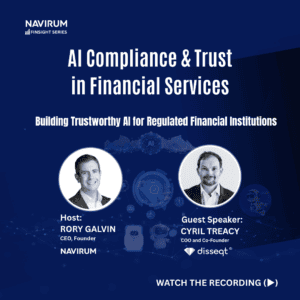
On the Orbit page these are the five AI managed services jobs: putting AI into daily work, piloting it safely, cost management, governance with the Einstein Trust Layer, and change management. The tiers below are what make those jobs safe to run, and the governance discipline is the same one we put on stage in the FinSight session on AI compliance and trust. Partners such as CloudFiles keep document storage costs off the Salesforce bill; see how that works, or browse the full Navirum partner ecosystem.
The Salesforce AI Trust Stack
Tier 5 Details
AI Outcomes & Agentforce
The pinnacle of active ROI: safe automated client scheduling, summarization, and real-time support insights executed within compliance boundaries. Rolling out Agentforce reliably requires this baseline.
Tier 4 Details
Governed Processes
Standardized service paths that guarantee AI modules do not execute unreviewed updates without correct logging, user overrides, or supervisor authorization.
Tier 3 Details
Secure Permissions & FSC Relationship Maps
Field-level permissions and sharing configurations that prevent automated systems from revealing sensitive client records to unauthorized users.
Tier 2 Details
Trusted Connected Data
Harmonized client records fed from active custodian sync points, eliminating duplication so AI engines don't reference outdated addresses or balances.
Tier 1 Details
Well-Managed CRM Foundation
The critical baseline: clean database schemas, documented relationship matrices, and active sandbox workflows managed directly by Orbit certified experts.
Before Navirum Orbit
Fragmented data architectures, security gaps, and frequent sandbox regression errors.
With Navirum Orbit
Continuous roadmapping, secure permissions, clean datasets, and robust compliance controls.
This matters even more under the EU AI Act, whose high-risk AI requirements (transparency, human oversight, and auditability for systems like credit scoring and fraud detection) become enforceable on August 2, 2026. Firms will need to show not just that an AI-driven decision was compliant, but why. A Trust Stack built directly into your Salesforce data model, rather than bolted on as a separate audit layer, is what makes that explanation available on demand instead of reconstructed after the fact.
Salesforce managed services provide ongoing platform support, active optimization, secure release management, and quarterly technology roadmaps — bridging critical functional architecture with day-to-day business change for regulated environments.
No. While we deploy custom setups directly, we also inherit and standardize platforms initially implemented by other vendors, running security and configuration audits during the transition.
Yes. Orbit is built to extend internal teams, not replace them. Your in-house admin retains core system ownership while routing complex development, custodian integrations, and compliance-related work to Navirum's specialized team.
Yes. We monitor and maintain third-party data connections with common wealth-management tools and custodians as part of ongoing managed services.
Orbit audits system schemas, clears database bloat, and helps architect a data retention approach aligned with your compliance obligations — aimed at avoiding unnecessary storage spend as your org grows.
Get More Value from Salesforce
Ready to Optimize Your Platform?
Regulated systems require clean database architectures, safe pipeline stages, and programmatic roadmaps. Partner with consultants who understand your industry's language.
Salesforce Ridge Partner · ★★★★★ 5.0 on Salesforce AppExchange · 1,000+ Projects · North American Financial Services Specialists
By Rory Galvin · Published June 3, 2026 · Updated July 23, 2026 · 24 min read
Claude + Slack + Salesforce Integration
By Rory Galvin, CEO at Navirum Expert in Claude, Slack, Agentforce & Salesforce integration for wealth management · Salesforce Ridge Partner · 7+ years delivering trusted AI architecture to wealth managers across North America
What is the safest way to connect Claude, Slack and Salesforce?
Use Salesforce as the governance and trusted-data layer, Slack as the advisor interface, and Claude or another approved model as the replaceable intelligence layer.
Data processing: confirm where client information is sent and where model inference occurs.
Permissions: validate that Salesforce access controls govern what the model can retrieve and act on.
Identity: preserve the individual advisor’s identity rather than authenticating through a shared account or API key.
Auditability: log every request, response, action and exception in a form compliance teams can inspect.
Navirum designs Salesforce and AI architectures for regulated financial-services firms, with governance, integration and long-term model portability built in from the start.
Advisors want Claude in Slack. Here’s why the Salesforce governance foundation underneath matters more than the interface or the model, and how to architect it so Claude works in Slack, email, and Agentforce interchangeably, all governed by the same Salesforce data foundation.
Key Takeaways
AI does not solve messy data; it makes the mess faster and more confident.
The lasting competitive advantage is a Salesforce data foundation, not which model or interface you pick.
Trust comes down to four concrete boundaries: data travel, permissions, authentication, and audit trails, no matter where Claude is called from.
Testing and ongoing validation matter more than initial vendor selection, because models change, and your assurance process keeps you safe.
Financial services leaders should govern this as a data governance question, not a Slack, Claude, or tooling question.
Why advisors want Claude in Slack, and why that’s not the win
Many wealth firms are asking: “Should we connect Claude to Salesforce?” The right answer depends on a prior question they’re not asking: “Are we set up to give Claude a trusted data foundation, wherever advisors reach it from?”
Step back from any single product and the direction of travel is clear. We are moving toward a world where advisors do their work across many AI assistants and chat surfaces, Claude in Slack, ChatGPT in email, Agentforce inside Salesforce, where increasingly autonomous agents read, reason, and act on business systems on our behalf, and where the interface to your data is no longer a single application you log into. The number of front doors is multiplying. We cover how Slack itself fits into the unified Salesforce-Slack ecosystem in more detail elsewhere.
It is tempting to assume AI will simplify all of this. It usually does the opposite. Most financial services firms already have client information spread across:
CRM systems (Salesforce, legacy platforms)
Portfolio systems (Morningstar, Advent, Tamarac, eMoney)
Planning tools (Advyzon, Wealthtech suites)
Custodians (Schwab, Fidelity, TD, etc., separate logins, separate data)
Email (Outlook, Gmail, unstructured, unsearchable without human memory)
Spreadsheets (Excel, Sheets, the real source of truth for many firms)
Service platforms (Help desk, ticketing, communication history)
Data warehouses (If mature; most firms skip this layer entirely)
Claude in Slack adds one more interface on top of that already fragmented picture. It does not remove the fragmentation. In many cases, it exposes it, and it lets everyone act on it faster.
The fragmentation cost is concrete: an advisor opens Slack and asks Claude, “What’s the client’s current portfolio allocation?” If Claude is wired directly to the custodian API (or no API at all), it sees only the custodial view. It misses the separately held securities, the charitable accounts, the spousal IRA, the tax strategy documented in Salesforce. Claude gives a confident, incomplete answer. The advisor acts on it. The client gets poor advice, delivered fast, with no audit trail in Salesforce of what Claude said.
The good scenario looks different: Claude in Slack is wired to Salesforce, via Agentforce or a governed direct connection. When the advisor asks, Claude reads from the unified Salesforce view, the custodial holdings, the planning assumptions, the recent notes, the open tasks. Same question, same interface, complete picture. Salesforce logs the interaction: which advisor asked, what Claude returned, when.
This is the strategic problem leaders should be solving for: not which assistant to pick, or which chat surface advisors prefer, but how to give every one of them a single, trusted place to stand: Salesforce.
FIGURE 1 • AI GOVERNANCE ARCHITECTURE
How Salesforce Governs the AI Data Journey
Salesforce sits between your advisors and external LLMs to enforce permissions and audit trails.
Select a layer to explore
Advisor request
Salesforce identity, permissions & data controls
Approved model processing
Logged response
TIER 1
01. Front-End Interfaces
The digital surfaces where advisors and wealth managers trigger AI requests during their daily workflows.
Slack Channels & DMs
Outlook / Gmail Integrations
Advisor Service Consoles
Mobile Wealth Apps
Client Portal Chatbots
Planning Tool Dashboards
TIER 2 • CORE ASSET
02. Salesforce Governance Layer
The central governance layer that intercepts requests, authenticates the user, and enforces data boundaries before the model processes anything.
User Authentication & Identity
Field-Level Security Checks
Data Masking & Sensitive Controls
Dynamic Grounding (RAG)
Toxicity & Bias Filtering
Configured Interaction & Audit Logging
TIER 3
03. Model Processing
The secure environment where models generate responses using only permission-scoped data after validated controls.
Approved Claude Deployment Path
Approved OpenAI Deployment Path
Private Hosted Models
Agentic API Callouts
02 · THE TRUSTED FOUNDATION
The durable asset: Salesforce as the trusted data foundation
Here is the durable point. The technology underneath churns constantly; the obligations sitting on top of it do not. Your clients still need their data kept private and used appropriately. You still need an auditable record of who, or what, did what and why. You still answer to the same regulators against the same principles.
The models you read about today will likely have evolved significantly by next quarter. Your duty of care will not change.
Here’s the critical insight: Salesforce is where you should wire Claude, ChatGPT, or Agentforce, not the other way around. This isn’t about Salesforce versus other platforms. It’s about where the control surface lives. When Claude is connected to Salesforce, your governance rules, permission model, and audit trails are already in place. When Claude is wired directly to a custodian, Slack, or email, you’re building governance from scratch for every connection. None of this holds up without the data platform your foundation runs on underneath it.
For wealth management, Salesforce is the natural integration hub because field-level security already restricts what each advisor sees, sharing rules control access at the account and household level, audit trails log everything, and Financial Services Cloud is purpose-built for this. Salesforce provides the permission model that can govern Claude’s access, but inheritance must be explicitly validated for the chosen integration architecture..
The evidence is increasingly strong that this is an operating-model question, not a tooling one. IBM finds that 78% of C-suite executives now say achieving the maximum benefit from agentic AI requires an entirely new operating model, not merely a software update, yet 78% of AI investment to date has gone into improving existing processes. IBM reports that transformation-led organisations are 32 times more likely to reach top-tier business performance than those stuck in minimal implementation.
Bolting Claude in Slack onto today’s fragmented setup is the cheap move. Building the Salesforce foundation it stands on is the one that compounds.
The strategic asset, in other words, is not Claude, and it is not Slack. It is the trusted client database underneath both.
The independent research points the same way:
78%
of C-suite execs say agentic AI needs a new operating model, not just new software
IBM IBV, 2025-2026
32x
more likely for transformation-led firms to reach top-tier business performance
IBM IBV, 2025-2026
3x
more likely for AI high performers to redesign workflows instead of automating old ones
McKinsey QuantumBlack, Nov 2025
CIO Insight
Why Salesforce is the right governance center when advisors use Claude in Slack
Slack is the interface. Salesforce is the control plane. Betting on one model as your permanent AI layer is a losing strategy, so the governance center needs to outlast whichever assistant is fashionable this year.
Where Claude in Salesforce creates value, and where it destroys it
For wealth management leaders, the value of connecting Claude to Salesforce is never Claude itself. It’s what the integration lets your people do: prepare for client meetings faster using a unified Salesforce view, run compliance audits that cross Salesforce, custodian, and activity data, and know that every interaction is governed and audited because Claude is acting as your advisor, not around your advisor. The line between good adoption and poor adoption is sharp, and it is worth naming plainly.
Creates Value
Destroys Value
It’s wired through Salesforce, not around it, so data stays governed
Claude is wired directly to a custodian, email, or other external system, so governance lives nowhere
It inherits user permissions, so it can’t see what the advisor can’t see
Long-lived API keys authenticate “the Claude app,” not the user, and nothing is traceable
Every action is logged in Salesforce, giving a full audit trail for compliance
Model updates silently change behavior with no regression testing in place
It’s replaceable, so your test suite works for Claude today and a different model tomorrow
You’ve hardcoded assumptions about Claude’s capabilities and locked yourself into one model
Humans validate high-stakes outputs, the hybrid intelligence design
The uncomfortable truth: AI does not solve a messy data problem. It makes the mess faster, whether it’s answering in Slack, email, or Agentforce.
A confident assistant working from incomplete or ungoverned data does not give you better decisions; it gives you wrong decisions, delivered with conviction, at scale, wherever the advisor happened to ask the question. The quality of the Salesforce foundation sets the ceiling on the value of Claude in Slack.
This is also where the real performance gap opens up. McKinsey finds that AI high performers are nearly three times as likely as their peers to fundamentally redesign workflows from scratch rather than graft AI onto the process they already had. The value is not in answering faster inside a broken workflow. It is in rebuilding the workflow on a trusted Salesforce foundation so the answer, wherever it’s delivered, is worth having.
03 · TRUST BOUNDARIES
Where trust actually lives: the four integration boundaries
When you integrate Claude into Salesforce, the trust question resolves into four concrete control points. Being precise about each one is what separates a controlled deployment from an audit risk.
01 · Data Processing
Where client data travels, where inference occurs and which contractual or residency controls apply.
02 · Permissions
How Salesforce field-level security, sharing rules and user access govern retrieval and actions.
03 · Identity
How each Slack or AI request maps to a real, revocable Salesforce user identity.
04 · Auditability
How prompts, outputs, actions, exceptions and human reviews are logged and reconstructed.
1. Data travel and processing boundary
The strongest configurations keep the model’s processing inside the Salesforce trust boundary, so sensitive data is governed by the same controls, grounding, and filtering that already wrap your org, rather than being shipped to an external service. For regulated work this is the difference between a pilot and something compliance will approve.
Three model deployment paths
There is no single “best” configuration; the right one depends on data sensitivity, use case, and residency requirements. Verify the specific model, region, and hosting arrangement with Salesforce directly rather than assuming any one path applies by default.
Salesforce-managed model within the trust boundary: certain Salesforce-managed models, including supported Anthropic configurations, can operate within Salesforce’s trust boundary. When configured this way, data and processing remain inside Salesforce with no external API calls for inference.
External model through the Einstein Trust Layer: prompts pass to external model providers under Salesforce’s zero-data-retention agreements. Data is encrypted in transit and not retained by the provider, but processing briefly leaves Salesforce infrastructure.
Direct external API: data passes from Salesforce (or another system) directly to the model provider’s API. This carries the highest data exposure and needs its own review of retention, residency, authentication, and contractual protections.
When you evaluate any option, the first thing to establish is exactly where your client data travels and where the inference happens, whether the request came in through Slack or anywhere else. Ask your vendor:
Does all client data stay inside Salesforce infrastructure?
If external LLMs are called, what data is sent, and under what DPA?
Are there data residency requirements (e.g., EU data must stay in EU)? Does this configuration respect them?
Can you inspect the call logs to see what was sent where?
2. Permission model
Salesforce can ground Claude’s actions in a user’s existing permissions through secure configuration, but the actual access path depends on how Claude is called (Agentforce, native connector, custom integration), whether the integration uses a named credential, service account, or user delegation, and how any custom actions are scoped. “Salesforce permissions automatically apply to Claude” is not something to assume; it requires explicit architectural validation for your specific setup. Source: Salesforce Generative AI Trust Layer
3. Identity and authentication
Connections should authenticate through a proper, revocable mechanism such as OAuth, configured through a managed client app, so access can be scoped, monitored, and switched off. Avoid anything that depends on long-lived credentials pasted into a tool or a shared “Claude app” service account that authenticates as itself rather than as the advisor. The audit trail should be able to show which advisor asked Claude what, via which channel, and what Claude returned, not just “an API key performed an action.” If you cannot reconstruct what an agent did, you cannot supervise it.
4. Audit trails
Salesforce provides a foundation for centralised AI audit and feedback data, but teams must configure, validate, and monitor the specific logging their use case requires. What gets captured depends on the product (Agentforce, Einstein), the model path (Salesforce-managed vs. external), the action type, and your logging and data-collection settings. “All Claude interactions are logged by default” is not a safe assumption. Verify your logging configuration before relying on auditability as a control. Source: Salesforce Copilot Trust and Compliance
Key Risk
Silent model updates shift your risk posture faster than you can test
Claude in Slack without Salesforce governance means the audit trail lives nowhere, and a compliance audit discovers that later, not sooner. The mitigation isn’t picking the “safest” model once; it’s a regression suite you re-run every time a model updates.
Example: preparing an advisor for a client meeting
The framework becomes concrete when applied to an actual workflow. Here’s what a well-governed request looks like end to end.
Advisor initiates in Slack. “Prepare me for my 2pm meeting with the Smith household.”
Identity maps to a Salesforce user. The Slack message carries the advisor’s Salesforce user ID; Salesforce verifies identity and permissions before anything else happens.
Salesforce permissions determine retrieval scope. Claude queries only what that advisor can already see: the linked household account, associated holdings, recent meeting notes, and any outstanding compliance flags.
The model receives only grounded, permissioned data. No client data the advisor cannot see in Salesforce is included in the prompt.
The response includes sources and record links. A meeting summary, suggested talking points, links back to the underlying Salesforce records, and any compliance alerts.
No CRM changes without explicit approval. If Claude suggests logging a note or creating a follow-up task, the advisor approves it before anything is written back.
The interaction is logged per your audit configuration. Advisor identity, timestamp, records accessed, the response, and any actions taken, captured according to whatever logging you’ve configured, not assumed by default.
Exceptions route to a human. An unusual data request, a possible compliance concern, ambiguous permissions, or low model confidence gets escalated rather than answered.
This is what the four trust boundaries look like in practice: identity flows from Slack to Salesforce, permissions are enforced at the data-retrieval layer, the model operates inside the advisor’s existing data scope, human oversight covers anything high-stakes, and auditability is built in from the start rather than bolted on after.
The integration checklist: eight questions before you wire Claude to Salesforce
You do not need to be an architect to govern this well. Before connecting Claude to Salesforce, a leader should be able to get clear answers to eight questions:
Integration path: Is Claude wired through Agentforce, or directly to a Salesforce API? (Agentforce is simpler and more governed.)
Data residency: Does your data stay inside Salesforce infrastructure, or does Claude call external models? (Affects DPA requirements.)
User authentication: Is the Claude connection authenticated as the logged-in user, or via a shared API key?
Permission inheritance: Does Salesforce field-level security, sharing rules, and profile restrictions apply to Claude’s data access?
What Claude can do: Can it read only, or can it write back to Salesforce? (Write access needs stronger testing.)
Audit and logging: Is every Claude interaction logged in Salesforce’s audit trail, regardless of channel?
Who reviews exceptions: If Claude’s output looks wrong, who validates it before it’s used?
Regression testing: When Claude updates, how do you re-test the integration?
If those answers exist and hold up, you have a foundation you can build on. If they do not, you have a risk you have not priced yet.
04 · TESTING & VALIDATION
Testing the Claude + Salesforce integration: the discipline most firms skip
When you integrate Claude with Salesforce, you’re creating a new system. Testing has three phases. This is not a one-time exercise. It needs ongoing managed governance and regression testing every time the model or the workflow changes.
Verify Claude is wired where you think it is, logs should show Agentforce or Salesforce, not direct external calls. Deliberately attempt access that a given user should not have and confirm the connection refuses it. Confirm field-level security genuinely masks the fields you expect. Run your standard vendor-risk assessment against the integration exactly as you would against any system processing client information, because that is what it is.
Functional testing (second)
Agentic systems are probabilistic, so they need to be tested differently from deterministic software. Build real test cases: “Summarize this client’s holdings” (should pull from the Salesforce view, not just the custodian). Test write operations: “Update this client’s risk profile to Conservative,” does Salesforce accept it, log it, and honor the user’s permission? Test edge cases: ambiguous questions, requests Claude should refuse, requests for data Claude doesn’t have access to.
The single biggest contributor to business impact, McKinsey reports, is not raw model capability but “hybrid intelligence,” explicit, deliberate processes for when and how an AI’s output hands back to a human for validation. Confirm Claude flags confidence issues and routes to advisor review within the Salesforce workflow, not outside it. In a regulated firm that is not a nice-to-have; it is the supervision model.
Ongoing validation (continuous)
Anthropic updates Claude regularly, and Salesforce updates Agentforce. A connection that passed every test in January can behave differently in March because the underlying model changed. So your test set becomes a regression suite. Re-run it on a schedule and whenever anything in the chain updates:
Monthly minimum: re-run your functional test suite (representative tasks, edge cases, write operations)
After any model update: if Claude, GPT, or Agentforce updates significantly, re-test before relying on it
Quarterly for compliance: re-run data-residency and permission tests to confirm boundaries still hold
Ongoing audit log monitoring: watch for drift in access patterns, failed permission checks, or unexpected model behavior
Treat a change in behaviour as an incident to investigate, not a curiosity. Monitor Salesforce audit logs for unexpected behavior, Claude accessing data it shouldn’t, write operations without user permission, and treat model updates the same way you treat security patches: scheduled, gated, tested before production.
This is the strongest reason not to over-invest in any one configuration: the ground moves, and your assurance process, especially your hybrid intelligence design, is what keeps you safe.
Architecture and governance: Navirum’s view
There are several ways to wire Claude into Salesforce, and they suit different jobs. Some put the model inside a governed, customer-facing agent. Some give your team conversational, read-and-write access to the org from Slack or the tools they already use. Some are aimed at developers building on the platform.
The right starting point: name the problem, apply Salesforce governance, then let Claude be the replaceable part. See how firms like yours have applied this in practice.
Design the Salesforce governance layer first. Map what data Claude needs, define which user roles can ask which questions, design the integration point (Agentforce? Direct API?), and build the audit trail.
Build the Claude integration. Wire Claude, or ChatGPT, or Agentforce into the governance layer you just built. Test compliance, functional, and ongoing validation, the three phases above.
Plan for replaceability. Your regression test suite is your insurance policy. When a new model arrives, run the suite. If it passes, swap the model; if it fails, stick with the current one until the issue is fixed.
Navirum Perspective
The durable architecture is the governance layer, not the model
Navirum Perspective
<strong style="color:#fff;">Why this integration matters:</strong> advisors want Claude in Slack, they work there all day. Compliance needs governance in Salesforce, audit trails, permissions, logging. The firms that wire Claude in Slack through Salesforce will scale safely. The firms that wire Claude directly to custodians and APIs will rebuild governance for every new tool and every new advisor. The browser wars teach us this pattern: Netscape dominated, lost to Internet Explorer, which lost to Firefox, which lost to Chrome. Each had its era and believed it would be permanent. None were.
<strong style="color:#fff;">What this looks like at Navirum:</strong>
We start with Salesforce governance, not Claude’s capabilities or interfaces. Where do advisors work? What data do they need? Who can see what? What audit trail is required? Then we wire Claude in, via Slack, via Agentforce, into that governance layer.
We architect for multi-tool adoption. Claude in Slack today, ChatGPT in email tomorrow, Agentforce in Salesforce next year, governance stays the same: same Salesforce foundation, same permissions, same audit trail.
We test integration, not just models. The regression suite asks: does Claude in Slack still respect Salesforce field-level security? Does the audit trail still log every interaction? Do write-backs still honor user identity?
We build hybrid intelligence into the integration. For high-stakes decisions, Claude surfaces confidence and routes to human review within the Salesforce workflow, not outside it.
<strong style="color:#fff;">That is the real deliverable. Not a connection. A trust posture, and a data foundation, that outlive the technology.</strong> This is what shapes our M3 (Agentic AI) practice: governance-first, tool-agnostic architecture for wealth management, not interface chasing.
05 · FAQ & NEXT STEPS
Common questions: AI trust in Salesforce
Governance questions from wealth management leaders. Get quick answers on model selection, testing cadence, and compliance.
Architecture and Model Choice
Should we standardize on Claude for all our AI work?
No. Standardizing on a single LLM is a bet that Claude will be the market leader in 2027+. Historical cycles show this bet fails. That’s the same bet firms lost every prior platform cycle. Instead, design your Salesforce foundation for model-agnostic architecture: a single trusted data layer that any LLM can plug into without rebuilding the foundation.
Can we swap LLMs mid-implementation if we build this way?
Illustrative migration pattern, not a verified client example: a firm using Claude through Agentforce could move to a different model if it redesigns prompts for that model’s response patterns, re-tests tools and actions (models differ in tool-calling behavior), re-validates safety and latency, and runs both models in parallel during the transition. Model-agnostic architecture can reduce switching costs, but models are not perfectly interchangeable, Salesforce itself advises retesting prompts and actions whenever the selected model changes. This is why the foundation matters more than the model choice. The model will change. The foundation should not. Source: Salesforce Model Selection & Testing
Can we use this approach with Agentforce instead of Claude?
Absolutely. Agentforce is built on Salesforce, so the trust boundaries are already defined. The same eight-question checklist applies. Agentforce has some advantages (data stays inside Salesforce by default, permissions are inherited automatically), but you still need compliance testing and ongoing validation. The framework is the same whether you’re wiring Agentforce, Claude, or ChatGPT.
Compliance and Operations
Does this approach cost more than just wiring up Claude directly?
Initial setup is similar. The difference is in long-term ownership of risk. Wiring Claude directly costs less upfront but locks you in; wiring through Salesforce costs a little more but keeps you in control and makes future model changes routine. Most firms find the “control cost” pays for itself in the first model upgrade cycle.
What if our compliance team blocks this?
That is a signal you have not answered the eight-question trust checklist yet. Compliance teams block AI adoption that cannot be supervised. If you can show them the four boundaries are real (data doesn’t leave Salesforce, permissions apply, every action is logged, and you have a regression suite), most compliance teams will approve. Start with the trust checklist before you go to compliance.
How often do we need to re-test when models change?
Whenever a model version updates significantly (Anthropic’s Claude updates, OpenAI’s GPT versions, etc.) and whenever your connectors or Salesforce configuration changes. Many firms treat this as a quarterly discipline at minimum. Treat it the same way you handle security patching: scheduled, structured, and non-negotiable.
IBM Institute for Business Value, Agentic AI’s strategic ascent: Shifting operations from incremental gains to net-new impact (2025-2026). More than three-quarters of surveyed executives say their AI investment has gone strictly into optimising existing processes, while 78% of C-suite executives agree that realising the full benefit of agentic AI requires an entirely new operating model. The “transformation-driven” cohort pioneering net-new capabilities is reported to be 32 times more likely to reach top-tier business performance. https://www.ibm.com/thought-leadership/institute-business-value/en-us/report/agentic-ai-operating-model
McKinsey (QuantumBlack), The State of AI in 2025: Agents, innovation, and transformation (November 2025). Across nearly 2,000 organisations, the 6% of “AI high performers” (deriving 5%+ of EBIT from AI) are nearly three times as likely as their peers to redesign workflows from scratch rather than automate existing steps; intentional workflow redesign was among the strongest contributors to business impact. The study also identifies clearly defined governance for when model outputs require human validation as a primary differentiator between high performers and firms stuck in pilots. https://www.mckinsey.com/capabilities/quantumblack/our-insights/the-state-of-ai-in-2025
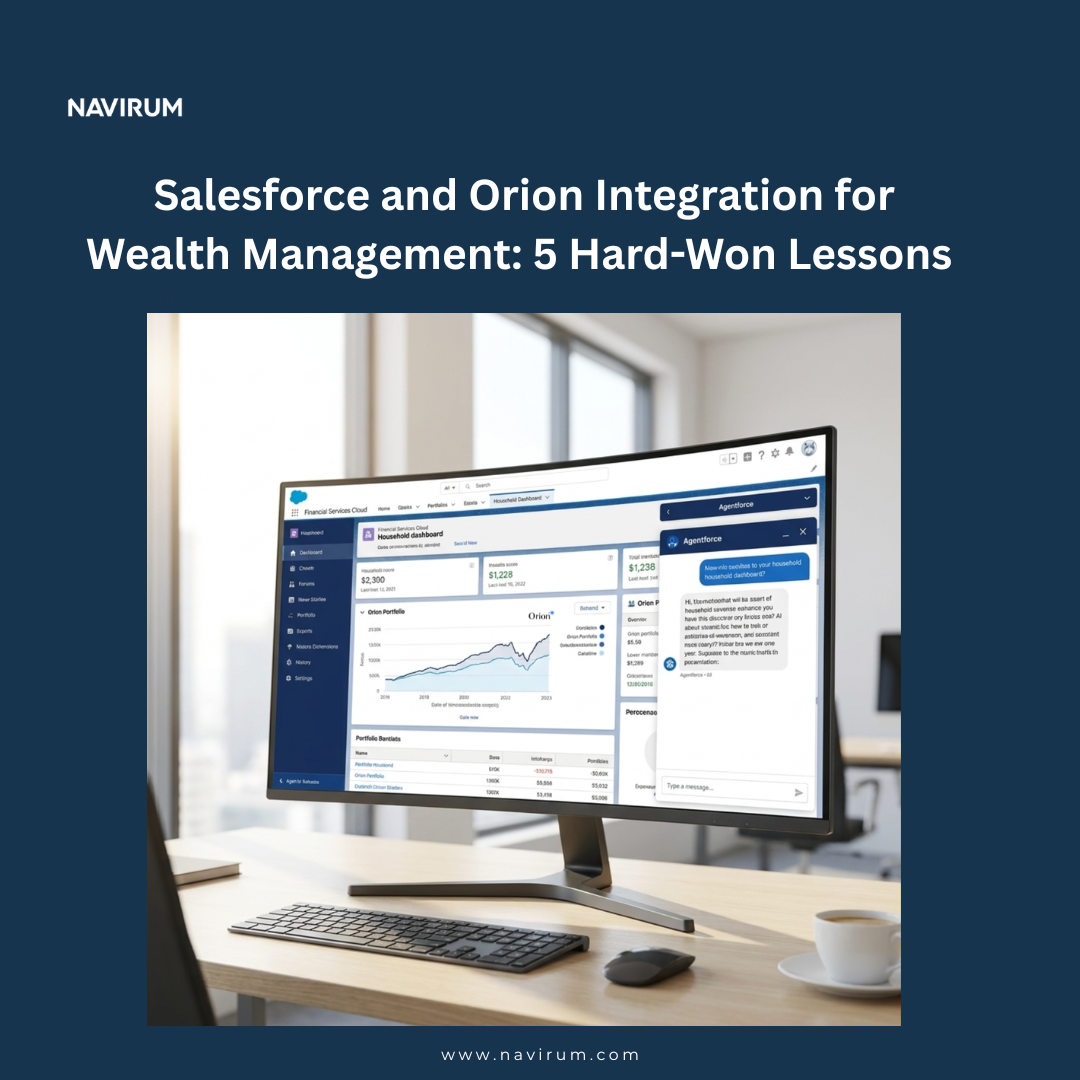
Orion Salesforce integration for wealth management.
Rory
This blog post explores five hard-won lessons for successfully integrating Salesforce Financial Services Cloud with Orion in wealth management. It explains how firms can create a stable, compliant integration by defining data authority at the field level, mapping Orion accounts to Salesforce households, establishing clear single-source-of-truth boundaries, routing custodian data through Orion, and preparing unified data for Agentforce. Rather than replacing Orion, wealth firms can keep it as the system of record for portfolio and custodian data while using Salesforce for relationships, workflows, compliance, and AI. The result is a unified advisor experience, stronger data governance, reduced reconciliation risk, and a foundation for scalable AI-driven workflows.
Salesforce and Orion can run as one integrated system for a wealth-management firm: Orion stays the system of record for accounts, positions, and performance, while Salesforce Financial Services Cloud owns the household relationship, workflows, and compliance record. The two sync on a defined schedule so advisors work from one unified view instead of switching between platforms.
Getting there well means deciding data authority per field before build starts, not after. The five lessons below cover the decisions that determine whether the integration is stable on day one or becomes a source of ongoing reconciliation problems.
Before You Start a Salesforce + Orion Integration
A Salesforce + Orion integration can modernize how a wealth firm manages relationships, portfolios, workflows, compliance, and AI-ready data. But most rework happens before build starts — when firms fail to define field authority, sync direction, household mapping, and the system of record.
Bidirectional SyncDefine data authority per field, not per system, so Salesforce and Orion never fight over the same record.
Household MappingReconcile Orion’s account-centric model with Salesforce’s household model before migration, not after.
Field Authority & ComplianceThe Single-Source-of-Truth Boundary: lock write direction per field so drift never becomes an audit finding.
Custodian ArchitectureKeep Orion as the single ingress point for custodian data — don’t dual-source through Salesforce.
Agentforce ReadinessClean Salesforce + Orion data unlocks safer AI use cases, including meeting prep and compliance support.
Why Wealth Firms Are Integrating Salesforce and Orion in 2026
For most wealth-management firms, the question of what runs the practice used to have a simple answer: a CRM (often Redtail), a portfolio system (often Orion), and a stack of point tools bridged by hand. That answer worked at small scale. In Navirum’s experience, it stops working between roughly 50 and 150 advisors – the band where firms consistently outgrow Redtail’s configurability ceiling and start needing the next tier of platform. What firms typically migrate toward is Salesforce Financial Services Cloud (FSC) — executing the Orion integration in parallel — and they do it for four reasons:
Trust and security. Salesforce’s enterprise security model — granular sharing rules, field-level security, encryption, audit trails, and compliance certifications — is what regulated wealth-management firms can defend in front of auditors, custodians, and clients.
Configurability. FSC is built to be reshaped for the way each firm actually works – household models, custom workflows, advisor-specific layouts, role-based dashboards. Redtail’s configurability flattens out at scale; Salesforce’s keeps going.
Integration ceiling. Modern wealth practices touch ten or more systems. FSC’s API surface and ecosystem (AppExchange, MuleSoft, native connectors) clears the integration ceiling that constrains legacy CRMs.
AI strategy and Agentforce. In our experience, Agentforce is emerging as a leading choice for AI in regulated industries because it runs natively on governed Salesforce data, with the firm’s existing security model intact. Building an AI strategy on top of Redtail is fighting the tools; building it on top of FSC is using them.
What firms typically don’t want to migrate is Orion. Orion is a strong, deeply-integrated wealth platform – portfolio accounting, performance reporting, rebalancing through ASTRO and Eclipse, custodian connections to Schwab, Fidelity, Pershing, Raymond James, integrated risk analytics through HiddenLevers, and an established advisor experience for the portfolio side of the practice. It works. The win is not replacing Orion — it is integrating Salesforce with Orion so the advisor gets a unified surface and the firm gets the next tier of platform without throwing away what works.
This is the path most firms in the outgrowth band end up choosing once they understand it exists. And in our experience, a meaningful proportion of wealth-management leaders are not yet aware that this is the path — they assume migrating the CRM means rebuilding the portfolio side, or that the integration work is harder than it actually is. Neither is true.
(For firms specifically looking at the Redtail-side migration, see our Complete Guide to Redtail Migration – this article is the integration-side companion.)
Here are five lessons that materially change the outcome of a Salesforce + Orion integration project.
What Actually Breaks a Salesforce + Orion Integration
Five hard-won lessons, in the order they tend to bite.
The most common architecture mistake is treating one system as the “master” for everything. It feels clean on the diagram and breaks every time real data flows. This lesson is about the sync mechanics: direction, cadence, and which system’s API is authoritative for a given field at the moment of write. (Lesson 3 covers the governance layer on top of this: who is allowed to edit what, and how drift gets caught after the fact.)
The Bidirectional Sync Pattern treats Salesforce and Orion as co-equal systems of record, with explicit authority defined per data domain:
Salesforce is authoritative for: relationships, households, contacts, advisor workflows, tasks, opportunities, marketing engagement, document linkage, compliance workflows, communication history.
Boundary fields (lives in both): addresses, phones, emails, beneficiaries, risk profile. One side writes; the other reads. Pick which.
Once authority is declared, the sync architecture becomes simple. Orion pushes account, position, and performance data into Salesforce on a scheduled cadence (typically nightly with selective intra-day updates for trade-driven changes). Salesforce pushes relationship and demographic updates back to Orion on a similar cadence. Boundary fields flow one direction only — drift is impossible by design.
Across our wealth-management integrations, the firms that get this right ship a stable production integration in 30 to 60 days. The firms that try to make one system the master for everything spend six months and never quite get it stable.
Orion’s account hierarchy and FSC’s household model are both rich, but they don’t natively mirror each other. Orion thinks in registrations, accounts, and groupings; FSC thinks in households, individuals, and entities. Between them sits the question that has to be answered before any code is written: how does an Orion account roll up to a Salesforce household?
The cases that need explicit mapping decisions:
Joint accounts – one Orion registration, two FSC contacts, one household
Trust accounts – one Orion registration, one FSC entity, one household relationship
Business / entity accounts – distinct from individual households
IRAs and retirement accounts – typically tied to one individual, rolling up to a household
Multi-generational households – multiple Orion accounts across multiple individuals, all rolling up to one FSC household
Split engagements – divorced or separating clients with shared accounts in transition
Closed accounts – keep linked? Detach? Archive?
The Account-Household Mapping Workshop is a structured pre-build session with your operations team, lead advisors, and (ideally) compliance. Walk through every account-type-to-household scenario your firm encounters. Document the mapping rules. Get signoff in writing.
This is the same playbook we run for Junxure migrations et Redtail migrations — in our experience, the workshop typically takes one afternoon and can save four to six weeks of late-stage rework. Skip it and you will be rebuilding the household model in production while advisors are trying to use it.
Compliance drift warning: use the Integration Readiness Checklist to catch field ownership, sync direction, and compliance drift issues before build starts.
Lesson 1 covers the sync mechanics of field authority. This lesson is about the governance layer above it: the field-ownership matrix, who has edit permissions, and how reconciliation and audit trail catch drift after the fact. For any data field that exists in both Salesforce and Orion — client address, phone number, email, beneficiary, risk tolerance, KYC status — declare data authority and lock the direction of write.
The Single-Source-of-Truth Boundary is the compliance-grade discipline that separates well-architected integrations from those that trigger audit findings. Without it, an advisor updates a client address in Salesforce, an operations user updates the same address in Orion an hour later, and overnight the sync overwrites one of them. Now the records disagree. Three months later, a custodian sends statements to the wrong address, and the firm is explaining to a regulator why client demographic data is inconsistent across systems of record.
The fix is mechanical: pick one authoritative source per field, lock the other system to read-only for that field, and document the matrix. We typically end up with something like:
Address, phone, email — authoritative in Salesforce; Orion reads.
Risk tolerance and KYC — authoritative in Salesforce; Orion reads.
Beneficiaries — authoritative in Salesforce; Orion reads (with custodian as the system of legal record).
Trade history — authoritative in Orion; Salesforce reads.
Done well, this becomes invisible to advisors — they edit in the right place and it just works. Done badly, this becomes the single biggest source of operational and compliance friction in the post-go-live period.
Orion Integration Readiness
Get the Salesforce + Orion Integration Readiness Checklist
Get the Integration Readiness Checklist — a practical checklist of the sync, authority, and architecture decisions a well-planned Salesforce + Orion integration should have nailed down before kickoff.
Salesforce Ridge Partner · FSC and Agentforce Certified Team · Wealth Management Integration Specialists
Orion already has battle-tested connections to Schwab Institutional, Fidelity Institutional, Pershing, Raymond James, and the long tail of broker-dealer custodial platforms. These connections are core to what Orion does, and they handle the messy reconciliation, transaction-type normalization, and corporate-actions edge cases that take years of platform investment to get right.
The Custodian-Through-Orion Architecture is the proven integration architecture pattern that keeps Orion as the single ingress point for custodian data. Salesforce reads positions, balances, and transactions from Orion — not directly from the custodians. One pipe, one reconciliation surface, one source of truth for portfolio numbers.
The temptation, especially for firms with Salesforce-savvy in-house teams, is to build direct Salesforce-to-custodian connections in parallel — the thinking being “more is better.” It is not. Dual-sourcing custodian data into two different systems creates two different versions of the same numbers, and reconciling them costs more than the integration ever saves. Let Orion do what Orion is good at, and let Salesforce read the answer.
If a use case genuinely needs intra-day custodian data that Orion does not yet expose, the right answer is to push Orion to expose it (they often will), or to subscribe to a real-time custodian feed and route it through Orion — not to bypass.
Once Salesforce and Orion are integrated, the natural next move is Agentforce. This is where the integration earns its return many times over — and it is also why Agentforce is emerging as a leading standard for AI in regulated industries. Agents that work on your unified, governed, audited data with your existing security model are usable in production. Agents that work on dirty, fragmented data behind a chatbot facade are not.
The agents wealth firms typically deploy first on top of a Salesforce + Orion integration:
Meeting prep agent – pulls household composition, relationship history, and goals from Salesforce; current positions, performance, and rebalancing flags from Orion (via Salesforce); planning context from eMoney or MoneyGuidePro. Produces a structured advisor briefing pack in seconds.
Advisor research agent – surfaces life events, anomalies, and “next-best action” suggestions across the unified household record.
Compliance review agent – scans for review-due triggers across both relationship and account data, generates tasks, documents the audit trail.
Quarterly review prep agent – assembles the client-facing review pack from Salesforce + Orion + planning data.
The Agentforce-on-Unified-Data Strategy is what turns the integration from a technical project into a strategic asset. Each agent is narrow, defined, and runs against the structured, governed data the integration created. Agentforce inherits Salesforce’s security model — sharing rules, field-level security, audit trails, encryption — which is what makes it deployable in regulated wealth-management environments where most generic AI tools cannot pass procurement.
Integration delivery order determines integration success: integration first, agents second. Agents on top of integrated, governed data are remarkable. Agents on top of fragmented data produce confident nonsense.
Integration first, agents second: if your Orion and Salesforce data model isn’t governed, Agentforce will only expose the mess faster. Request an Agentforce Assessment once the integration layer is in place.
Why Wealth Firms Trust This Approach
Two Navirum clients deployed Orion and Agentforce using this playbook.
38-day deployment with zero data loss. Three advisors immediately used Einstein Copilot for client research, with Deterministic Guardrails protecting every query. The compliance team approved the model with no re-audit required.
Phased rollout across 4 offices. Advisors saw 2.1x faster client household reconciliation, with time to value of 6 weeks from integration kickoff to first AI assistant live.
Salesforce vs Orion vs Salesforce + Orion Integrated: Capability Comparison
Capability
Orion alone
Salesforce FSC alone
Salesforce + Orion Integrated
Client / household relationship
modelling
Limited (account
centric)
Rich, multi
generational, entity
aware
+ unified across
both systems
Portfolio accounting
+ performance
Native, deep
Limited to custom
data
+ Orion data
surfaced inside FSC
Custodian data
ingestion
Native (Schwab,
Fidelity, Pershing,
RJ)
Possible but not
Orion’s strength
+ Orion remains the
ingress; FSC reads
Rebalancing (ASTRO
/ Eclipse)
Native
None
Triggered from FSC
workflows where
appropriate
Advisor experience
Portfolio-focused
Relationship-focused
Unified single surface
Compliance workflows
Account-level
Rich, configurable
+ Account-level signals flowing into FSC
AI/Agentforce capability
None native
Full Agentforce platform
Agents work across unified data
Configurability
Constrained
High
Inherited from FSC
Marketing automation / engagement
Limited
Native + ecosystem
Unified to portfolio data for segmentation
Total cost of ownership trajectory
Stable but ceiling-bound for advisor experience
Higher initial; scalable
Highest initial;
lowest TCO at scale
+ AI-ready
Frequently Asked Questions
Can I keep Orion when I move my CRM to Salesforce?
Yes – and this is the recommended path for most firms outgrowing Redtail. The pattern is: migrate the CRM to Salesforce Financial Services Cloud, keep Orion for portfolio accounting, performance reporting, rebalancing, and custodian connections, and integrate the two so advisors get a unified surface.
How does the Salesforce and Orion integration work technically?
The integration uses Orion’s APIs for account, position, performance, and household-grouping data, and Salesforce’s named credentials, custom objects, and queueable / scheduled processing for the sync layer. The cleanest architecture is bidirectional with explicit per-field authority — Salesforce as the system of record for relationships and workflows, Orion for accounts, positions, performance, and rebalancing.
Is the Salesforce and Orion integration bidirectional?
Yes. The Bidirectional Sync Pattern flows account, position, and performance data from Orion into Salesforce on a scheduled cadence, and flows relationship and demographic updates from Salesforce back to Orion. Boundary fields that exist in both systems flow one direction only, with authority declared explicitly to prevent drift.
What is the typical timeline for a Salesforce and Orion integration?
A core Salesforce + Orion integration typically takes 30 to 60 days to stand up the bidirectional sync. When paired with a CRM migration (Redtail or Junxure to Salesforce FSC), the integration ships with the go-live and adds approximately four to six weeks to the overall project plan.
How does Agentforce work with Orion data?
Once the Salesforce + Orion integration is in place, Agentforce agents run on the unified data set with Salesforce’s existing security model. Typical first agents include meeting prep, advisor research, compliance review, quarterly review prep, and long-tail care. Agentforce inherits Salesforce’s sharing rules, field-level security, and audit trails — which is what makes it deployable in regulated wealth-management environments.
Should custodian data flow through Salesforce or Orion?
Through Orion. Orion already has battle-tested connections to Schwab Institutional, Fidelity Institutional, Pershing, and Raymond James, and handles the custodial reconciliation that takes years of platform investment to get right. Salesforce should read custodian-derived data from Orion, not source it directly. This is The Custodian-Through-Orion Architecture.
Do I need to be a Salesforce Ridge Partner to do this integration?
No, but working with one materially reduces project risk. A Ridge Partner has demonstrated repeated successful FSC and Agentforce delivery in the relevant industry. Navirum is a Salesforce Ridge Partner specializing in wealth management.
What is the best Salesforce integration for wealth management firms?
For most firms in the 50–150 advisor range, the best Salesforce integration is the Salesforce + Orion integration: keep Orion for portfolio accounting, performance reporting, rebalancing, and custodian connections, and let Salesforce Financial Services Cloud (FSC) own relationships, workflow, compliance, and Agentforce-ready data. Firms that try to replace both systems at once face far more risk than integrating what already works.
Redtail – CRM software historically popular with U.S. wealth-management advisors. Owned by Orion since 2022.
Salesforce Financial Services Cloud (FSC) – Salesforce’s industry-specific platform for wealth management, banking, and insurance, with native household, financial account, goal, and asset/liability objects.
Agentforce – Salesforce’s enterprise AI agent platform, designed to deploy specialised AI agents on top of governed Salesforce data with the existing security model intact.
Bidirectional Sync Pattern – Integration architecture where two systems exchange data both directions, with authority declared per field rather than per system.
Single-Source-of-Truth Boundary – The explicit declaration of which system is authoritative for any given data field that exists in both.
Custodian-Through-Orion Architecture – Pattern where custodian data ingress remains in Orion and Salesforce reads from Orion rather than dual-sourcing.
Account-Household Mapping – The set of rules defining how Orion’s account hierarchy rolls up to Salesforce FSC’s household model.
Salesforce Ridge Partner – Salesforce’s partner-tier designation indicating demonstrated repeated successful delivery in a specialised cloud or industry.
Orbit Managed Services – Navirum’s predictable, retainer-based post-go-live support offering for Salesforce wealth-management implementations and integrations.
Book a working session with Navirum’s team to define the sync model, field authority, household mapping, compliance controls, and Agentforce-ready data architecture before build starts. Navirum has been delivering Salesforce, Orion, and Agentforce work for wealth-management firms for over seven years and is a recognized Salesforce Ridge Partner, with a proven results across wealth firms. See how that ongoing partnership plays out on the Orbit managed services model.
Book Strategy Session
Schedule Your Session
Let’s find a time to chat about your Salesforce strategy and AUM growth.
In today’s fast-paced world, productivity hinges on seamless collaboration. That’s why more and more financial services firms and enterprises are turning to Salesforce Slack integration.
By connecting Salesforce and Slack, teams can share data, automate workflows, and make faster decisions without switching between platforms.
Whether you call it Slack and Salesforce integration, Salesforce to Slack integration, or simply Salesforce integration Slack, the result is the same: less friction, more focus, and better outcomes.
When you integrate Slack with Salesforce, updates on new leads, opportunity stage changes, or deal approvals show up instantly in Slack channels. Instead of refreshing dashboards, sales teams respond in real time—shortening the path from prospect to closed deal.
#2 – Streamlined Collaboration Across Teams
With Slack and Salesforce connected, every account, opportunity, or case can have its own dedicated Slack channel. This keeps conversations, files, and context together. Whether you’re in sales, service, or marketing, the integration eliminates silos and helps everyone stay aligned.
What is Slack Anyway?
#3 – Automated Workflows That Save Time
The Salesforce app for Slack allows you to automate routine tasks—such as escalating cases, reminding reps of follow-ups, or assigning handoffs. Notifications arrive directly in Slack, ensuring that nothing slips through the cracks.
#4 – Smarter Decisions with Data on Demand
Leaders no longer have to wait for weekly reports. With sales force and Slack connected, pipeline metrics, forecasts, and service dashboards can be pulled into Slack with a quick command. This provides decision-makers with live data to act faster.
#5 – Enhanced Customer Support
Service Cloud users can set up Salesforce to Slack integration so high-priority cases trigger immediate alerts. Support teams can then swarm the issue in Slack, loop in subject matter experts, and resolve it quickly—boosting customer satisfaction.
#6 – A Unified Platform for Growth
From slack sales force notifications to executive-level snapshots, the integration brings CRM data into Slack where people are already working. The connect Slack to Salesforce setup creates transparency, accountability, and better alignment across the business.
Salesforce Slack Demo (Credits to Salesforce Ben)
No Slacking, The Summary
Investing in Salesforce Slack integration is more than just a technical upgrade. It’s about creating a unified digital workspace where deals move faster, support becomes proactive, and teams stay aligned.
With Salesforce continuing to enhance its ecosystem – including the fast-growing Salesforce app for Slack – organizations that adopt early gain a competitive edge.
Contact Us for Salesforce Slack Integration Consultation Today
Navirum Client Success Stories
Salesforce Slack Integration FAQ
<strong class="schema-faq-question">Where can I get the integration?<br/></strong>
<strong class="schema-faq-question">How long does the integration take to setup?</strong>
For a Salesforce professional, about 2-4 hours with testing. This doesn’t include template design, workflows, approvals. A proper implementation can be any from 20 to 50 hours so the RoI needs to start up!
<strong class="schema-faq-question">What is a Salesforce partner?</strong>
A Salesforce partner is a company or organization that has been officially recognized by Salesforce for its expertise in delivering Salesforce-related services, solutions, or products. Salesforce partners may provide consulting, implementation, customization, integration, or third-party applications (AppExchange apps) to help clients maximize the value of the Salesforce platform. They are part of the Salesforce Partner Program, have access to specialized training and resources, and are recognized for meeting Salesforce’s standards for quality, technical capability, and customer success. Navirum is a certified Salesforce partner.
<strong class="schema-faq-question"><strong>How do financial advisors use S</strong>lack<strong> within Salesforce?</strong>
Financial advisors use Slack integrated with Salesforce to collaborate in real time, coordinate client tasks across teams, and receive automated updates on deals and accounts. This streamlines workflows, reduces email traffic, and ensures faster, more efficient client service by keeping conversations and Salesforce data in one place.
<strong class="schema-faq-question"><strong>How does the integration improve compliance?</strong>
The integration provides automated audit trails, status tracking, and secure storage of signed documents within Salesforce, ensuring that regulatory requirements are consistently met and easily verifiable.3
Navirum is a certified Salesforce and Slack partner, specializing in delivering integrated solutions that streamline digital workflows for financial services and other industries. With deep expertise in both platforms, Navirum helps clients automate processes, accelerate agreements, and maximize value from their Salesforce and Slack investments.
The Salesforce DocuSign Integration streamlines document processes, allowing financial services firms to send, sign, track, and manage client documents directly within Salesforce.
It simplifies workflows by connecting electronic signature functionalities with client records, reducing manual processing steps significantly.
Typical implementation takes 1–3 weeks for basic setups, while complex configurations may take 4–8 weeks or longer.
This integration enhances visibility into document signature status and improves client onboarding experiences through automation.
Firms must evaluate their document volume and complexity to determine if they need DocuSign eSignature or the more comprehensive DocuSign CLM.
Integrating DocuSign with Salesforce allows financial services firms to send, sign, track, and manage client documents directly from Salesforce.
Instead of downloading documents, sending emails, tracking signatures manually, and updating Salesforce records afterward, firms can connect the signature process to their existing CRM workflows.
For financial advisors, RIAs, wealth management firms, banks, insurance companies, and other regulated organizations, this can simplify processes such as client onboarding, advisory agreements, account applications, disclosures, and compliance documentation.
A straightforward DocuSign eSignature implementation may take approximately 1–3 weeks, while more complex implementations involving DocuSign CLM, custom automation, multiple document types, or integrations with other financial systems can require 4–8 weeks or longer.
Setup, Benefits, Costs & Best Practices
This guide explains how DocuSign Salesforce integration works, what it can be used for, how DocuSign eSignature compares with DocuSign CLM, what implementation involves, potential costs, and what financial services firms should consider before getting started.
Question
Answer
What does the integration do?
Connects DocuSign electronic signature workflows with Salesforce records and processes.
Who uses it?
Financial advisors, RIAs, wealth managers, banks, insurance firms, and other organizations using Salesforce.
What documents can be supported?
Client agreements, onboarding documents, applications, disclosures, compliance forms, and other documents requiring signatures.
Can Salesforce data populate documents?
Yes, depending on the configuration and document workflow.
Can Salesforce trigger signature requests?
Yes. Workflows and automation can be configured to initiate document processes.
How long does implementation take?
Approximately 1–3 weeks for straightforward implementations; complex projects may take 4–8 weeks or longer.
Do you need DocuSign CLM?
Not necessarily. eSignature is generally sufficient for straightforward signature workflows, while CLM is designed for more complex contract lifecycle requirements.
Can it support financial-services workflows?
Yes, although the exact configuration depends on the firm’s Salesforce architecture, document requirements, compliance processes, and other systems.
What Is DocuSign Salesforce Integration?
DocuSign Salesforce integration connects electronic signature functionality with Salesforce so users can initiate and monitor document workflows from their CRM.
Without an integration, an advisor or operations employee may need to:
Find the client in Salesforce.
Download or prepare a document.
Open DocuSign separately.
Upload the document.
Enter recipient information.
Send the document.
Monitor the signature separately.
Download the completed document.
Update Salesforce manually.
An integrated workflow can reduce many of these manual steps.
For example, an advisor could open a client record in Salesforce, initiate the appropriate document process, send the document for electronic signature, and then track the status from the CRM.
This creates a connection between the client record, document, signature process, and subsequent Salesforce workflow.
How Does DocuSign Integrate With Salesforce?
A typical Salesforce and DocuSign workflow can look like this:
Salesforce client record → document/template → DocuSign envelope → client signature → status returned to Salesforce → signed document associated with the record → next Salesforce workflow
The exact process depends on how the integration is configured.
A financial services firm might configure a workflow such as:
A new client or household is created in Salesforce.
Required onboarding information is entered.
Salesforce identifies the documents that need to be completed.
A document template is populated with available Salesforce information.
The documents are sent through DocuSign.
The client receives and signs the documents electronically.
DocuSign returns the signature status to Salesforce.
The completed documents and relevant information are associated with the appropriate Salesforce record.
Salesforce automation creates the next task or moves the onboarding process forward.
The goal is not simply to replace a paper signature with an electronic signature. The larger opportunity is to connect document completion with the firm’s broader CRM workflow.
How Financial Services Firms Use DocuSign With Salesforce
Digital Agreement Workflows
How Financial Services Firms Use DocuSign With Salesforce
Document workflows are particularly important in financial services because client onboarding and account servicing often require multiple forms, approvals, disclosures, and signatures.
DocuSign and Salesforce can be used together to support several common financial processes—reducing manual coordination for advisors and operations teams while reinforcing compliance.
Workflow 1 • Automated Onboarding
L'accueil du client
New-client onboarding often involves multiple documents and multiple participants. Connecting DocuSign and Salesforce streamlines required paperwork and reduces manual coordination.
💡 Operational Value: Significantly reduces advisor and operations workload while giving clients a modern, digital onboarding experience.
Workflow 2 • Wealth Management
Advisory Agreements
RIAs and wealth management firms can use electronic signature workflows for advisory agreements and related documentation, replacing slow email attachment exchanges.
Connect to Salesforce Client Record Track Signature Status Real-Time Eliminate Email Attachments Seamless Advisor Onboarding Flow
💡 Operational Value: Links agreement execution directly to the client relationship history in Salesforce for total visibility.
Workflow 3 • Account Servicing
Account Applications & Paperwork
Depending on technology architecture and custodian processes, Salesforce and DocuSign manage a wide range of account servicing and client paperwork.
Account Applications Client Agreements Regulatory Disclosures Authorization Forms Beneficiary Designation Investment Management Forms
💡 Operational Value: Tailors document generation and signing directly to regulatory, operational, and custodian requirements.
Workflow 4 • Governance & Audit
Compliance Documentation
Financial organizations must maintain reliable audit trails. Connecting document flows with Salesforce creates a consistent, verifiable tracking system.
Document Dispatch Timestamps Recipient Open Verification Signature Status & Complete Logs Client & Account Binding
💡 Operational Value: Supports the firm’s broader recordkeeping and regulatory compliance framework through automated audit trails.
1
L'accueil du client
Automate required forms, signatures & CRM tasks.
2
Advisory Agreements
Connect RIA agreement flows to client accounts.
3
Account Applications
Streamline disclosures, beneficiaries & forms.
4
Compliance Records
Maintain consistent audit trails for sent/signed docs.
Connecting Salesforce Financial Services Cloud with DocuSign automates client creation, template generation, e-signatures, real-time status tracking, and downstream operational tasks—eliminating printing and manual paper chasing.
Phase 1 • Initial Entry
Step 1: Create the Client in Salesforce
The advisor creates the client or household record in Salesforce Financial Services Cloud and enters all required personal, financial, and account information.
Primary System: Salesforce FSC
💡 Advisor Benefit: Establishes the single source of truth for household data before generating formal legal documentation.
Phase 2 • Package Selection
Step 2: Determine Required Documents
Based on the client’s specific situation, investment strategy, and account type, the firm identifies the exact set of required advisory agreements, custodian applications, disclosures, and authorizations.
Action: Automated Document Checklist
💡 Advisor Benefit: Prevents missing disclosures or wrong application forms by matching document requirements to account criteria.
Phase 3 • Auto-Population
Step 3: Generate the Documents
Relevant client information stored in Salesforce is automatically mapped to populate configured document templates—eliminating repetitive re-keying and manual data entry errors.
Integration: Salesforce Field Mapping
💡 Advisor Benefit: Ensures complete accuracy across complex onboarding packages with zero manual typing on PDF forms.
Phase 4 • Secure Dispatch
Step 4: Send Documents Through DocuSign
The populated documents are bundled into a secure electronic signature envelope and dispatched to the client and any co-signers with configured signing orders and roles.
Execution: DocuSign eSignature Engine
💡 Advisor Benefit: Dispatches multi-party packages in one click without leaving the Salesforce client page.
Phase 5 • Client Execution
Step 5: Client Signs Electronically
The client receives the secure envelope on any mobile or desktop device and completes the intuitive signing process without printing, scanning, or mailing physical paper.
Client Experience: Mobile-Friendly E-Sign
💡 Advisor Benefit: Delivers a seamless, modern experience that accelerates turnaround time from days to minutes.
Phase 6 • Real-Time Tracking
Step 6: Salesforce Receives the Status
Envelope status updates flow back into Salesforce automatically. Advisors and operations teams monitor whether packages are sent, viewed, signed, or requiring attention.
Sync: Automated Status Write-Back
💡 Advisor Benefit: Gives ops teams complete visibility into outstanding paperwork with full audit trails.
Phase 7 • Automated Completion
Step 7: Complete the Onboarding Workflow
Once all required documents are signed, Salesforce automatically attaches completed PDFs to the record and triggers downstream tasks, custodian notifications, or billing setup.
Automation: Salesforce Flow Triggers
💡 Advisor Benefit: Moves new accounts smoothly from agreement signing directly into active portfolio servicing.
1
Create Client
Enter client details into Salesforce FSC.
2
Required Docs
Identify required forms & disclosures.
3
Generate Docs
Auto-populate templates using CRM data.
4
Send via DocuSign
Package & dispatch envelope to signers.
5
Client Signs
Client completes e-signature digitally.
6
Status Update
Salesforce tracks envelope progress.
7
Complete Flow
Trigger follow-up tasks & ops setup.
Key Benefits of Salesforce and DocuSign Integration
1. Reduce Manual Document Processing
Integrating DocuSign with Salesforce can eliminate many repetitive steps associated with printing, scanning, uploading, emailing, and manually updating records.
Instead of moving information between separate systems, users can manage more of the process from the CRM.
2. Connect Documents to Client Records
When document workflows are connected to Salesforce records, advisors and operations teams can more easily understand the status of client documentation without searching through email threads or separate systems.
3. Improve Visibility Into Signature Status
A connected workflow can provide visibility into whether documents are:
Draft
Sent
Viewed
Signed
Completed
Declined
Waiting for another recipient
This can help teams identify outstanding documents and follow up more efficiently.
4. Accelerate Client Onboarding
Electronic signatures can reduce the delays associated with paper-based processes.
When combined with Salesforce automation, firms can create a more continuous onboarding experience instead of treating document signing as a separate administrative process.
5. Create More Consistent Processes
Reusable templates, standardized workflows, permissions, and automation can help firms reduce variation between employees and departments.
This is particularly important for organizations with defined onboarding and compliance procedures.
6. Support Remote Client Interactions
Clients can generally complete electronic signature workflows without being physically present in an office.
For financial advisors working with geographically distributed clients, this can make onboarding and document completion easier.
Discover The Power of Salesforce Integration with DocuSign!
Are you evaluating the best way to streamline your organization’s document workflows? Here’s why choosing Salesforce and DocuSign integration stands out among leading document management solutions:
Salesforce DocuSign Integration – Credits to Salesforce Ben
1. Superior Efficiency Compared to Manual or Other Tools
Integrating DocuSign with Salesforce eliminates the need to print, sign, scan, or email documents back and forth. Unlike standalone e-signature tools or traditional methods, this integration lets users send, sign, and manage documents entirely within Salesforce. The result: shorter turnaround times and major productivity gains versus competing processes.
2. Best-In-Class Collaboration and User Experience
Salesforce and DocuSign enable multiple stakeholders (sales, legal, operations) to review, edit, and sign contracts or NDAs right from your CRM. This is much more efficient than file-based approaches or endless email threads. With real-time notifications and activity tracking, everyone stays aligned and projects move forward faster.
3. Unmatched Visibility and Real-Time Document Tracking
Unlike generic document platforms, DocuSign Salesforce integration gives users full transparency: track every document’s status (sent, signed, returned) directly in Salesforce. This live dashboard approach helps you spot delays, identify bottlenecks, and keep deals on track, advantages you won’t find in disconnected tools.
4. Enterprise-Grade Compliance and Security
DocuSign’s industry-leading security and compliance solutions (including robust audit trails and encryption) are embedded right into Salesforce workflows. This reduces risk compared to less-secure signing tools and supports regulatory requirements in finance, insurance, and other regulated sectors.
5. Seamless Digital Customer Journey
Customers today expect fast, hassle-free digital interactions. Salesforce and DocuSign deliver a seamless, branded experience (whether for onboarding, contracts, or order processing), improving satisfaction and giving your business a competitive edge over slower, less integrated processes.
DocuSign eSignature vs. DocuSign CLM: Which Do You Need?
Not every Salesforce-DocuSign integration is the same, and picking the wrong one is a common mistake for financial services firms. Standard DocuSign eSignature connects Salesforce records to a simple send-for-signature workflow, ideal for routine forms like account applications or basic client agreements.
DocuSign CLM (Contract Lifecycle Management) goes further: it manages the entire contract process inside Salesforce, from clause-level templates and approval routing to obligation tracking after signature, which matters for RIAs and broker-dealers managing advisory agreements, IPS documents, or custodial paperwork with recurring compliance requirements.
For most independent advisory firms and RIAs, standard eSignature inside Salesforce covers client onboarding and routine paperwork. Firms with more complex approval chains, custodial relationships (for example with LPL Financial or Fidelity), or heavier compliance documentation typically get more value from CLM’s workflow automation and audit trail depth. Navirum can help you evaluate which tier fits your firm’s actual document volume and compliance profile before you commit to a licensing tier.
One of the most important decisions when planning a Salesforce and DocuSign implementation is determining whether standard DocuSign eSignature is sufficient or whether the organization needs DocuSign CLM.
These products address related but different requirements.
Capability
DocuSign eSignature
DocuSign CLM
Electronic signatures
✓
✓
Send documents for signature
✓
✓
Reusable templates
✓
✓
Basic document workflows
✓
✓
Salesforce integration
✓
✓
Complex contract workflows
Limited
✓
Contract lifecycle management
—
✓
Clause management
—
✓
Advanced approval processes
Limited
✓
Post-signature contract management
Limited
✓
Best suited for
Routine signature workflows
Complex contract processes
When Is DocuSign eSignature Enough?
Standard eSignature is often appropriate when the firm’s primary requirement is to:
Send documents for signature.
Collect electronic signatures.
Track signature status.
Use repeatable templates.
Associate completed documents with Salesforce records.
Automate straightforward processes.
For many RIAs and advisory firms, this may be sufficient for routine client onboarding and document workflows.
When Should You Consider DocuSign CLM?
DocuSign CLM becomes more relevant when an organization needs to manage the broader contract lifecycle, rather than simply obtain a signature.
For example, a larger organization may need:
Complex approval chains
Contract authoring
Clause management
Version control
Contract repositories
Obligation tracking
More sophisticated lifecycle workflows
Greater control over contract processes
In these situations, CLM may provide capabilities beyond a standard eSignature implementation.
The right choice depends on the firm’s document volume, contract complexity, approval requirements, compliance processes, and existing technology architecture.
How Much Does DocuSign Salesforce Integration Cost?
The total cost of a Salesforce and DocuSign implementation depends on more than the integration itself.
Potential cost components include:
DocuSign licensing
Salesforce licensing
Integration configuration
Salesforce configuration
Document template development
Workflow automation
Custom development
Testing
User training
Ongoing administration
DocuSign CLM licensing, if required
Integration with other systems
A simple implementation involving a limited number of users and document types can require substantially less effort than a large financial-services deployment involving multiple workflows, approval paths, and external systems.
For this reason, firms should evaluate total implementation scope rather than focusing only on the software license price.
A useful first step is to document:
Number of document types
Number of Salesforce objects involved
Number of users
Number of signature recipients
Required approval paths
Required automation
Storage requirements
Compliance and audit requirements
Other systems that must participate in the workflow
This provides a better basis for estimating implementation effort.
How Long Does DocuSign Salesforce Integration Take to Set Up?
Industry benchmarks put a straightforward AppExchange install, managed package, envelope templates, field mapping, at roughly 1-3 weeks. This applies broadly across Salesforce implementations for financial services firms, from RIAs to broker-dealers.
Firms adding custom workflow automation, CLM, or integrations with a broker-dealer’s existing tech stack more commonly see 4-8 weeks, depending on the number of document types and approval paths involved. Treat these as planning ranges, not guarantees; actual timelines depend on your Salesforce org’s complexity and existing document workflows.
Working with a certified DocuSign implementation partner generally shortens this timeline and reduces rework. For firms layering AI-driven workflows on top of Salesforce, Navirum’s Agentforce consulting practice can extend DocuSign-triggered processes into agentic automation.
Typical Implementation Activities | Navirum
Professional Delivery Roadmap
Typical Implementation Activities
A professional can install and configure a basic integration relatively quickly. However, installation is not the same as implementation.
Template development, workflow design, automation, testing, and governance represent the majority of project effort required to deliver true operational value.
Activity 1 • Scope & Discovery
1. Requirements Discovery
The implementation team collaborates with business stakeholders to thoroughly map out technical boundaries, user roles, and compliance expectations before building components.
🎯 Phase Goal: Build a clear functional blueprint aligning legal compliance, CRM architecture, and end-user requirements.
Activity 2 • Environment Setup
2. Salesforce & DocuSign Configuration
The technical team installs, provisions, and configures the appropriate Salesforce packages and DocuSign admin settings tailored to the firm’s specific security and operational model.
🎯 Phase Goal: Establish a robust, secure technical connection between Salesforce FSC and DocuSign engines.
Activity 3 • Template Engineering
3. Template Development
Standardized, reusable document templates are engineered and mapped directly to Salesforce fields for seamless automated population.
Reusable Template Creation Dynamic Salesforce Data Mapping Anchor Tags & Field Positioning Conditional Logic & Dynamic Form Clauses
🎯 Phase Goal: Eliminate double data entry by auto-generating client documents instantly from CRM data.
Activity 4 • Routing Design
4. Workflow Configuration
The project team establishes precise rules dictating when documents are created, recipient routing order, conditional signers, and post-signing actions.
🎯 Phase Goal: Turn signature completion into automated operational progress across your CRM.
Activity 6 • Quality Assurance
6. Testing
Rigorous end-to-end testing across diverse user profiles, document edge-cases, recipient roles, and permissions in a Salesforce Sandbox.
Multi-User Role Validation Complex Signature Scenarios Field Level Security & Sharing Rules Exception & Rejection Case Handling
🎯 Phase Goal: Guarantee zero technical or compliance glitches before exposing workflows to clients.
Activity 7 • Enablement & Go-Live
7. Training and Deployment
End-users and operations personnel receive hands-on role-based training and documentation prior to production rollout to ensure high adoption.
Role-Based User Enablement Operations & Admin Playbooks Production Migration & Go-Live Post-Launch Hypercare Support
🎯 Phase Goal: Empower team members to confidently execute digital document packages from day one.
1
Requirements
Map docs, objects, roles & compliance scope.
2
Configuration
Setup Salesforce & DocuSign environment settings.
3
Templates
Develop reusable templates & field mapping.
4
Workflows
Establish generation, routing & completion rules.
5
Automation
Configure Salesforce Flow for background tasks.
6
Testing
Validate across users, permissions & edge cases.
7
Deployment
Train users & rollout production environment.
How Does Salesforce + DocuSign Stack Up?
When compared to alternative document management strategies, Salesforce and DocuSign integration consistently delivers:
Faster document turnaround and approval cycles
Centralized tracking and transparency
Higher security and compliance (vs. email or simple e-signature apps)
Improved collaboration across teams and with clients
Ready to see how this integration outperforms other options for your organization? Here below are a few things to keep in mind!
DocuSign Salesforce Integration: Implementation Challenges to Consider
Risk & Process Governance
DocuSign Salesforce Integration: Implementation Challenges to Consider
Connecting two applications is usually easier than designing a reliable business process around them.
Financial services firms should proactively plan for document variations, multi-party routing, data hygiene, security models, and edge-case exceptions before configuration begins.
Challenge 1 • Scope & Variability
Document Complexity
A firm with five standard documents has a very different implementation requirement from one with dozens of documents and numerous conditional variations.
💡 Mitigation Insight: Build automated alerts and clear operational procedures to resolve stuck or voided envelopes instantly.
Can DocuSign Salesforce Integration Support Financial Services Cloud?
Salesforce Financial Services Cloud Compatibility
Can DocuSign Salesforce Integration Support Financial Services Cloud?
Yes, DocuSign workflows can be incorporated into Salesforce environments used by financial services organizations, including implementations built around Salesforce Financial Services Cloud (FSC).
However, the exact solution depends on how the firm’s Salesforce org is configured. A financial-services-specific architecture influences how the DocuSign workflow should be designed.
FSC Core Structure
Person Accounts & Households
Financial Services Cloud heavily utilizes Person Accounts and Household groupings. DocuSign workflows must be engineered to correctly map signer details across individual clients and household entities.
💡 Architectural Note: Ensures e-signatures are bound accurately to both individual Person Account records and overall Household rollup summaries in FSC.
FSC Data Model
Financial Accounts & Custom Objects
FSC tracks specialized Financial Accounts (e.g., investment, banking, trust accounts) and Relationships. Document generation must pull dynamic data from standard and custom objects seamlessly.
💡 Architectural Note: Connects DocuSign envelopes directly to financial account opening and servicing objects within your CRM schema.
FSC Automation Engine
Salesforce Flow & Existing Integrations
Orchestrate automated document generation and dispatch using native Salesforce Flow, seamlessly connecting DocuSign status updates with custodian and back-office platforms.
💡 Architectural Note: Triggers follow-up actions and updates back-office financial platforms instantly upon document execution.
FSC Lifecycle & Governance
Client Lifecycle & Security Architecture
Rather than treating DocuSign as a standalone add-on, integrate e-signatures directly into client lifecycle stages, compliance protocols, and strict FSC permission models.
Embed e-signatures into CRM data models & FSC security.
DocuSign, Salesforce, and Custodian Workflows
Multi-System Integration Architecture
DocuSign, Salesforce, and Custodian Workflows
Financial advisors use Salesforce alongside custodial and portfolio technology (e.g., LPL Financial, Fidelity), creating multi-platform operational ecosystems.
In these environments, DocuSign should not be evaluated in isolation. Implementation teams must map the end-to-end flow of data and agreements across all platforms.
End-to-End Client & Account Integration Lifecycle
STEP 1Prospect
→
STEP 2Salesforce
→
STEP 3Documents & Sign
→
STEP 4Custodian Sync
→
STEP 5Account Service
Stage 1 • Lead Capture
1. Prospect Identification
Initial prospect engagement begins in marketing or referral channels before structured onboarding starts. Intake details are gathered to evaluate account readiness.
Stage 2 • CRM Record & Data Prep
2. Salesforce Household Creation
Advisors establish Person Accounts or Household records in Salesforce FSC, populating client details that serve as the primary source of truth for all paperwork.
Stage 3 • Generation & E-Signature
3. Document Package & DocuSign Signature
Salesforce auto-populates required account packages and dispatches DocuSign envelopes. Clients sign digitally, and completion status updates write back into Salesforce automatically.
Stage 4 • Platform Syndication
4. Custodian Platform Integration
Executed agreements and validated client attributes are transmitted from Salesforce into custodial systems (e.g., LPL Financial, Fidelity) to trigger formal account opening.
Stage 5 • Lifecycle Management
5. Account Opening & Ongoing Service
The account becomes active for trading and portfolio management. Ongoing service requests, maintenance forms, and disclosures continue through connected Salesforce + DocuSign flows.
❌ The Narrow Question
“Can DocuSign integrate with Salesforce?”
✅ The Strategic Question
“How should document signing fit into our complete client and account workflow?”
How Does Salesforce + DocuSign Compare With Manual Processes?
The biggest difference is connectivity.
With a manual process, document activity may be distributed across email, shared drives, DocuSign, spreadsheets, and Salesforce.
With an integrated approach, more of the process can be connected to the CRM.
Manual approach
Salesforce + DocuSign
Email documents manually
Initiate structured document workflows
Track signatures in email
Track status through the CRM workflow
Update Salesforce manually
Return relevant status information to Salesforce
Search for completed documents
Associate documents with client records
Follow up manually
Automate reminders and subsequent tasks
Manage separate processes
Connect document completion to client workflows
The objective is not simply to eliminate paper.
It is to reduce disconnected work and make document activity part of the firm’s broader client lifecycle.
Where Can You Get the DocuSign Salesforce Integration?
The DocuSign solution is available through Salesforce’s AppExchange, although the specific package and product requirements should be confirmed before implementation.
An AppExchange installation, however, should not be confused with a complete implementation. Organizations with complex document workflows may need additional Salesforce configuration, template development, automation, testing, and training.
Do You Need a DocuSign Implementation Partner?
A DocuSign implementation partner is a consulting firm or service provider with expertise in deploying DocuSign solutions and integrating them with systems such as Salesforce.
A partner can help with:
Requirements analysis
Salesforce configuration
DocuSign configuration
Document templates
Workflow design
Automation
Security and permissions
Testing
User training
Deployment
Ongoing optimization
For a simple implementation, internal Salesforce expertise may be enough.
For a financial services organization with multiple document types, complex onboarding workflows, or several connected systems, experienced implementation support can reduce configuration errors and rework.
Is DocuSign Salesforce Integration Right for Your Organization?
Workflow Fit Assessment
Is DocuSign Salesforce Integration Right for Your Organization?
DocuSign and Salesforce form a powerful combination when electronic signatures are treated as part of a broader business workflow rather than a standalone document process.
For financial services firms, the biggest opportunity lies in connecting client data, documents, signatures, compliance, and CRM automation. Evaluate your readiness across these 10 core workflow dimensions.
0 / 10
Initial Assessment (0%)
Check off the workflow requirements your firm has resolved.
0 requirements resolved
|
Scope & Routing1. Which documents need signatures?
Scope & Routing2. How many document types are involved?
Scope & Routing3. Who needs to approve or sign each document?
CRM & Storage4. Which Salesforce records should be associated with documents?
CRM & Storage5. What should happen after a document is signed?
CRM & Storage6. How should signed documents be stored?
Ecosystem & Security7. Does the firm need eSignature or CLM?
Ecosystem & Security8. Are custodian or portfolio platforms part of the workflow?
Ecosystem & Security9. What security and compliance requirements apply?
Scope & Routing10. Which processes stay manual and which are automated?
Navirum Workflow Design Recommendations
Tailored next steps based on your current readiness score.
Recommendation 1
Map Document Types & Signers
Inventory your active forms (advisory agreements, account applications, disclosures) and define signing sequences (client, spouse, advisor, compliance) before configuring DocuSign templates.
Recommendation 2
Define CRM Object Relationships
Determine whether envelopes attach to Person Accounts, Financial Accounts, or Opportunities, and plan Salesforce Flow triggers to automate post-signing tasks and status updates.
Recommendation 3
Evaluate Custodian & CLM Fit
Assess whether standard eSignature handles your needs or if complex redlining requires DocuSign CLM. Map data handoffs between Salesforce, DocuSign, and custodial platforms (e.g., LPL, Fidelity).
Transform Your Company Now | Navirum, Salesforce & DocuSign Integration
Digital Workflow & Agreement Automation
Streamline Agreements with DocuSign & Salesforce
Navirum is a certified Salesforce and DocuSign partner, specializing in delivering integrated solutions that streamline digital workflows for financial services and other industries. With deep expertise in both platforms, Navirum helps clients automate processes, accelerate agreements, and maximize value from their Salesforce and DocuSign investments.
Transform manual signing flows into automated, secure, and compliance-ready digital experiences.
Automate Digital Processes
Trigger e-signatures directly from Salesforce FSC records and custom workflows.
Accelerate Agreement Cycles
Reduce document execution turnaround times from days to minutes.
Maximize CRM Investment
Ensure auditability, security, and full compliance for financial transactions.
<strong class="schema-faq-question">Can DocuSign integrate directly with Salesforce?</strong>
Yes. DocuSign provides Salesforce integration capabilities that allow organizations to connect electronic signature workflows with Salesforce records and processes. The exact functionality available depends on the DocuSign products and Salesforce configuration being used.
<strong class="schema-faq-question">How long does the integration take to setup?</strong>
For a Salesforce professional, about 2-4 hours with testing. This doesn't include template design, workflows, approvals. A proper implementation can be any from 20 to 50 hours so the RoI needs to start up!
<strong class="schema-faq-question"><strong>Is the DocuSign Salesforce integration secure and compliant with regulatory requirements?</strong>
DocuSign provides robust security, encryption, and audit trails for all documents processed through its platform. The integration with Salesforce maintains these standards and helps you comply with industry regulations such as eIDAS, ESIGN Act, and GDPR, depending on your organizational needs.
<strong class="schema-faq-question">Can Salesforce automatically send documents through DocuSign?</strong>
Yes, depending on the integration and configuration. Salesforce automation can be used to initiate document processes based on defined business events or workflow conditions.
<strong class="schema-faq-question">What is a Salesforce partner?</strong>
A Salesforce partner is a company or organization that has been officially recognized by Salesforce for its expertise in delivering Salesforce-related services, solutions, or products. Salesforce partners may provide consulting, implementation, customization, integration, or third-party applications (AppExchange apps) to help clients maximize the value of the Salesforce platform. They are part of the Salesforce Partner Program, have access to specialized training and resources, and are recognized for meeting Salesforce’s standards for quality, technical capability, and customer success.
<strong class="schema-faq-question"><strong>How do financial advisors use DocuSign within Salesforce?</strong>
Financial advisors send, track, and manage client agreements (such as onboarding forms, investment mandates, or compliance documents) for electronic signature directly from Salesforce, streamlining client interactions and accelerating paperwork.
<strong class="schema-faq-question"><strong>How does the integration improve compliance?</strong>
The integration provides automated audit trails, status tracking, and secure storage of signed documents within Salesforce, ensuring that regulatory requirements are consistently met and easily verifiable.
<strong class="schema-faq-question"><strong>Does the integration support mobile use for advisors and clients?</strong>
Absolutely. Both advisors and clients can initiate and complete signature processes from any device, providing the flexibility needed for remote or on-the-go client service.
<strong class="schema-faq-question">Can DocuSign automatically populate documents using Salesforce data?</strong>
Salesforce data can be used to populate configured document templates and workflows, depending on the specific DocuSign solution and implementation. Firms should carefully define field mappings and data requirements before automating document generation.
<strong class="schema-faq-question">Where are signed documents stored?</strong>
The exact document-storage architecture depends on the firm's DocuSign and Salesforce configuration. Organizations should define how completed documents, signature information, and related records should be stored and accessed as part of the implementation.
DocuSign provides security features including encryption and audit trails. However, overall security depends on the complete Salesforce and DocuSign configuration, including permissions, access controls, document storage, integrations, and organizational policies.
<strong class="schema-faq-question">Is DocuSign eSignature or CLM better for an RIA?</strong>
There is no universal answer. An RIA primarily looking to send advisory agreements, onboarding documents, and other routine paperwork for signature may only need eSignature. Firms managing complex contracts, approvals, clauses, obligations, and contract lifecycles may benefit from CLM.
<strong class="schema-faq-question">Can financial advisors use DocuSign with Salesforce for client onboarding?</strong>
Yes. A common use case is connecting client records and onboarding workflows in Salesforce with DocuSign signature processes. This can help advisors and operations teams send documents, track signature status, and connect completed documentation to the client's CRM workflow.
<strong class="schema-faq-question">Can DocuSign work with Salesforce Financial Services Cloud?</strong>
DocuSign can be incorporated into Salesforce environments used by financial services organizations, but the implementation should account for the firm's Financial Services Cloud configuration, Salesforce data model, security requirements, workflows, and other integrations.
Main Navigation CTA Showcase | Navirum
Next Steps & Impact
Explore Navirum Success, Culture & Team
Discover real-world outcomes, learn about our collaborative company culture, and meet the financial technology specialists leading your digital transformation.
Proven Results & Impact
Explore Our Success Stories
See how we help financial institutions, wealth managers, and fintechs turn Salesforce and AI into measurable business outcomes and operational growth.
Subscribe to the Navirum Newsletter | Financial Services Tech Insights
Financial Tech Insights
Sign Up for the Navirum Newsletter
Get the latest perspectives on Salesforce Financial Services Cloud, Agentforce AI, data strategy, and compliance frameworks delivered directly to your inbox.
Au Navirum, we’ve partnered with thousands of advisors across North America, and succession planning consistently stands out as the most important – and most difficult – initiative they face. Not because of markets or products, but because it’s about legacy, clients, and the business built over decades.
Yet, 60% of Financial Advisors have no succession plan, even when they’re within 10 years of retirement? [Ref 1, Ref 2]
Some thoughts on what Advisors can do…
The Strategic Approach
Succession works best when it’s treated as a strategic goal, not an afterthought. Advisors who set a clear retirement horizon and work backwards build firms that are fit for today and resilient for tomorrow. A practical rule of thumb: allow at least one month of preparation for every year your practice has been in business. If your systems and processes are solid, plan to reinvest 1-5% of annual revenue to get succession-ready.
The Personal Reality
At Navirum, we’ve seen how personal these projects are – particularly for advisors nearing retirement, knowing they may be engaging in the last major initiative of their careers. Wealth management is fundamentally a people business. Succession is about building a platform so those client relationships can live on beyond any one advisor. Even when legacy isn’t the stated goal, every step taken is building one. A clear reality check on what you want – whether a clean exit, phased transition, or lasting platform – should guide your priorities and investments.
Capturing Institutional Knowledge
Succession isn’t just about the founder’s expertise. Long-time staff and managers also hold critical knowledge that must be captured and built into a living knowledge base. In many firms, consolidating the founder’s institutional knowledge – along with decades of physical and digital information – is the largest task. But it’s equally important to document the insights of other senior team members. Succession is the opportunity to bring all that knowledge into one central place, integrating it into systems and processes. This is one of the most strategic steps in the entire project
The Valuation Impact
Finally, succession is about valuation. Firms with clean data, documented processes, and modern systems don’t just transition smoothly – they also command higher multiples when buyers step in. Below this article I’ve provided answers to 20 FAQs and common questions I success from Advisors on their succession journey
So succession isn’t about leaving. It’s about what you leave behind – and how strong a foundation you create for the next chapter.
– Rory, Navirum Founder and CEO
Interested in discussing solutions further we would be delighted to help
<strong class="schema-faq-question">How should an RIA name successors and build a real bench?</strong>
Name a primary successor and 1 – 2 deputies by function (lead advisor, ops, compliance), then publish a simple RACI so Day-1 decisions are unambiguous. Example: “Prospects → A, Planning → B, Trading → C.” This clarity cuts execution risk and keeps the team focused.
<strong class="schema-faq-question">How do we communicate the change internally without drama?</strong>
Write a one-page “why now / what changes / how we’ll win,” attach a timeline, and schedule short touchpoints. Use a lightweight change model (e.g., awareness → adoption → reinforcement). Consistent messaging kills rumors and accelerates adoption.
<strong class="schema-faq-question">How should we segment clients by retention risk during succession?</strong>
Tier households by risk (e.g., AUM, complexity, multiple relationships) and set outreach cadence by tier. Example: Tier-1 monthly touches, Tier-2 bi-monthly. Proactive communication reduces churn at inflection points.
<strong class="schema-faq-question">Why clean the CRM before any hand-off?</strong>
Standardize fields, dedupe records, and fix ownership now; publish data standards. Clean data drives adoption and enables automation. It also boosts firm valuation in diligence.
<strong class="schema-faq-question">How do we capture “how we do things here”</strong>
Build a knowledge base. This is critical! Write short SOPs for onboarding, KYC, trading, billing, complaints, and store them in a searchable hub. Include links, forms, and owners. This preserves institutional memory beyond any single person. Develop playbooks that bring these SOPs and FAQs together into usable tools
<strong class="schema-faq-question">What makes a playbook usable in real life?</strong>
Keep it to one page with triggers, steps, owners, and “if/then” branches. Add screenshots and the top 3 pitfalls. Short, contextual guidance gets used—long manuals don’t.
How Salesforce supports insurers across the full lifecycle, from lead to policyholder to renewal to claim to retention, not just one policy transaction and not just one claim.
Written by Rory Galvin, Founder, Navirum · 4x Salesforce Certified · Strategic Advisor, Insurance
What determines the right Salesforce fit for insurers?
Salesforce can support acquisition, service, renewals, claims coordination, and policyholder relationships across the insurance lifecycle, but the right foundation varies by insurer. High-volume personal-lines businesses may be better served by Sales Cloud and Service Cloud, life and specialty insurers with broader financial relationships often benefit from Financial Services Cloud, and complex carriers may need a wider architecture combining integration, data, collaboration, and AI. Insurers that match the platform to their business model typically see:
More connected policyholder information: policy, claims, and client data can unify on one record so underwriting, servicing, and claims teams work from the same picture.
Integration without rip-and-replace: FSC, Sales Cloud, and Service Cloud can all connect to core policy admin systems like Guidewire, Duck Creek, and Applied Epic via native connectors or MuleSoft, so insurers aren't forced to replace what already works.
More consistent service and renewal workflows: automated intake, case routing, and renewal reminders reduce manual handoffs across teams.
Governed data for AI: Einstein and Agentforce can surface lapse-risk and cross-sell signals, once policy, claims, and third-party data are unified and properly permissioned.
Compliance built for the industry: where FSC's insurance data model applies, KYC/AML workflows and audit trails come pre-built rather than custom-configured.
A foundation that scales with complexity: the right starting architecture keeps pace as an insurer adds lines of business, brokers, or AI use cases, rather than requiring a rebuild later.
Navirum is a Salesforce Ridge Partner rated 5.0 on the Salesforce AppExchange, and helps insurers choose and govern the right foundation for their specific business model.
The Insurance Customer Journey
Most conversations about Salesforce and insurance start with one piece, claims, or policy administration, or AI. Those all matter, but they sit inside a bigger relationship that runs from the first conversation with a prospect through years of renewals, service touches, and eventually claims. Salesforce’s role is to support that whole relationship, not just one transaction inside it.
A note on scope: Insurance is not a single operating model. A life insurer, a commercial carrier, a benefits provider, and a high-volume personal-lines insurer may all use Salesforce very differently. This guide considers the industry holistically to show how Salesforce’s different products can be combined around the needs of each business. Not every capability discussed here will be relevant to every insurer.
Each stage carries its own Salesforce value: acquisition and broker or advisor engagement at the lead stage, intake and workflow visibility at quote and submission, a unified customer view at bind and onboarding, case management and communications through service, retention signals and next-best-action at renewal, coordinated updates through a claim, and account expansion once the relationship is established.
The platform scales to fit the insurer, not just the policy type. Navirum’s quickstart implementation for Afton Insurance, a startup carrier, deployed a standard Sales Cloud setup with a custom-branded application layout and basic case-management queues and assignment rules, enough to track incoming service requests from day one. The same lifecycle that supports a national carrier’s full claims and renewal operation also supports a startup’s first service queue.
How the Journey Differs in Retail and Commercial Insurance
The lifecycle above is shared across retail and commercial insurance, but the complexity inside each stage is not. A personal auto policy and a multi-entity commercial account move through the same stages (quote, bind, service, renew, claim), but the number of stakeholders, approvals, and data points involved is very different.
Retail
Individual or household policies, faster intake, simpler servicing, more standardized claims, and high-volume renewals.
Navirum client example, Kelson Financial: a personal insurance provider (life, critical illness) where Navirum customized Financial Services Cloud across Opportunities, Cases, Accounts, and Contacts, then supported the relationship on an ongoing basis through Orbit managed services. That ongoing Orbit relationship is itself a retail-lane pattern: high-volume, standardized accounts benefit from continuous optimization more than one-time configuration.
Kelson Financial joins Navirum’s podcast to talk through their Salesforce experience.
Commercial
Broker-led relationships, multiple entities or locations, more approvals and stakeholders, higher-complexity claims, and deeper renewal review.
Navirum client example, a commercial insurance company based in New York City: Navirum’s engagement centered on a refined first phase optimizing usability, security, and data quality. The core of the work was remodeling the Insurance Policy object: six distinct record types, customized page layouts, and dynamic forms, including dynamic insurance-type selection across four categories, the ability to reflect multiple concurrent coverage options for complex client portfolios, and coverage field dependencies that render fields based on selected coverage type rather than cluttering every layout with every possible field. Alongside that, Navirum ran a full Salesforce Health Check, refactored org-wide access into three role-based user groups with field-level permissions across the Insurance, Account, and Contact objects, and led two discovery workshops to align the technology roadmap with the business’s goals. This is what commercial-lane complexity looks like in practice: not more features, but more precisely governed data. Want to see how this plays out across other insurers? Explore more insurance client success stories.
How Salesforce Connects the Journey
None of the stages above happen inside Salesforce alone. Insurers run on policy administration systems, claims platforms, billing applications, broker portals, data warehouses, and third-party providers, and Salesforce’s job is to connect the client relationship across all of them, not replace them. For more on why closing this integration gap matters directly to policyholders, see our take on transforming policyholder experience for North American insurers, and our insurance industry practice page covers how we lead this work end to end.
Salesforce Components by Capability
A breakdown of insurance capabilities and their corresponding Salesforce solutions.
Policy Administration / Digital Insurance, or a connected PAS
Claims lifecycle management
Insurance Claims Management, or a connected claims platform
Unified third-party and cross-system data
Data 360
System integration
MuleSoft, APIs, or partner connectors
AI-assisted service and workflows
Agentforce for Financial Services
Inside the Salesforce FSC Insurance Data Model
FSC’s insurance data model ships with the objects insurers need out of the box: Policies (coverage terms, effective dates, product lines linked to the household or business account), Claims (FNOL through resolution, status tracking visible across underwriting, servicing, and claims teams in real time), Coverages (the specific protections within a policy, structured for cross-sell and lapse-risk analysis), and Insured Parties & Households (the 360° client record tying policies, claims, and referrals together). Insurers still need to configure the model, map source-system fields, and establish data ownership.
MuleSoft and Informatica: Connecting and Governing the Data
MuleSoft provides the integration layer, connecting Salesforce with core insurance platforms, legacy applications, payment systems, document repositories, and external data sources. Its API-led approach helps insurers reuse integrations, reduce point-to-point complexity, and support faster development of digital services for policyholders, brokers, underwriters, and claims teams.
Informatica focuses on data integration, quality, governance, and master data management, standardizing customer, policy, claims, and product information across systems so the business isn’t working from duplicate, incomplete, or inconsistent records. Used together, MuleSoft moves information between systems and enables real-time processes, while Informatica ensures that information is accurate, governed, and fit for use, supporting faster claims handling, more efficient underwriting, better broker service, improved regulatory reporting, and stronger analytics, without insurers having to abandon core legacy platforms to get there.
Once that data is connected and governed, Salesforce Data 360 (formerly Data Cloud) gives Agentforce access to unified, trusted customer and operational data from across the business, bringing together policy, claims, billing, broker, service, and interaction data in near real time. That is what allows AI agents to provide accurate answers, identify relevant next steps, and personalize service while respecting permissions, governance, and compliance requirements, the subject of the next section.
In practice, this integration layer typically spans policy administration systems, claims platforms, billing and payment systems, financial and accounting platforms, document repositories, broker and distributor systems, telephony and contact-centre platforms, identity and compliance services, and legacy databases and data warehouses, rarely just one or two of these for a medium-sized or large insurer. Getting it right determines whether the insurer ends up with a dependable, economically sustainable information architecture, not just a CRM bolted onto everything else.
Telephony and Contact-Centre Integration
Telephony deserves its own mention because it is operationally important for insurers running large service teams and call centres. Salesforce customers can integrate a range of contact-centre and telephony platforms, including services from Amazon Connect, Five9, Vonage, and other providers. The right choice depends on call volume, routing complexity, recording requirements, existing infrastructure, service processes, and regulatory obligations, another area where the platform decision should follow the operating model rather than the latest product trend.
Data and Storage Strategy
Not every piece of information belongs in Salesforce. A sound data strategy distinguishes between information needed immediately to serve the client, information that should be synchronized from core systems, information that can remain in a back-office system, historical information requiring occasional access, documents that should be processed, summarized, or extracted, and information that must be retained for compliance but does not need to sit directly in Salesforce.
A good insurance data strategy does not move everything into Salesforce. It makes the right information accessible at the right time, at an acceptable cost, with appropriate controls.
Storage volumes, API usage, synchronization frequency, and retention requirements all have financial consequences. These choices should be made as part of solution strategy, not after implementation begins.
Pricing and Platform Comparison
Total cost depends on the FSC edition, insurance capabilities selected, usage allocations, Data 360, MuleSoft, migration, and implementation scope. The drivers are consistent across implementations:
Cost Drivers
What to expect when pricing your Salesforce implementation.
Cost Driver
What It Covers
FSC Edition (Enterprise vs. Unlimited)
Per-user licensing; Unlimited adds premium support, more sandboxes, and higher API limits
Implementation
Data migration from your PAS, configuration, and testing, typically the largest line item
Integration (MuleSoft)
Native connectors to Guidewire, Duck Creek, or Applied Epic where a pre-built connector isn't sufficient
Data 360 add-on
Unifies policy, claims, and third-party data for real-time AI and Agentforce use cases
Navirum scopes pricing against your specific PAS, line-of-business mix, and AI ambitions during a free FSC Readiness Assessment.
A common question is how Salesforce compares to a traditional agency management system like Applied Epic. Many insurers run both together rather than choosing one:
Applied Epic vs Salesforce
Comparing traditional agency management systems with Salesforce FSC for insurance.
Requirement
Applied Epic
Salesforce FSC
Typical combined approach
Agency and policy administration
Core strength
May support or connect
Epic often remains the transactional system
Commission workflows
Core strength
Usually integrated
Commission summaries surfaced in Salesforce
Sales and relationship CRM
Limited relative to Salesforce
Core strength
Salesforce owns pipeline and relationships
Service workflows
Available
Highly configurable
Salesforce coordinates service; Epic retains policy data
AI and unified customer data
Depends on architecture
Agentforce and Data 360
Governed Epic data can feed the Salesforce AI layer
Which Salesforce Products Suit Which Insurers?
Financial Services Cloud is central to many of Navirum’s insurance engagements, particularly where household and financial relationships matter. But Salesforce for insurance is an ecosystem, not a single product, and FSC is not the right starting point for every insurer. The right foundation depends on the insurance line being served, the complexity of the customer relationship, the volume and repeatability of transactions, the importance of call-centre and service operations, the number and age of core systems, data and integration requirements, cross-sell and renewal strategy, and compliance, security, and AI ambitions.
The right Salesforce architecture is determined by the insurer’s business model and strategy, not simply by the fact that it operates in insurance.
The table below is a starting point, not a rulebook. Most insurers end up combining more than one of these foundations as their operations mature.
Which Products Fit?
Aligning Salesforce foundations with specific insurance models.
Insurance Model / Requirement
Likely Salesforce Foundation
Why It Fits
High-volume personal lines, home or auto insurance
Sales Cloud and Service Cloud
Supports efficient acquisition, call-centre service, renewals, standardized processes, and cross-sell across a large book of business
Life, critical illness, and personal insurance linked to broader financial relationships
Financial Services Cloud
Connects insurance policies with households, investments, retirement needs, referrals, and the client's wider financial position
Large commercial insurance
Sales Cloud and/or Service Cloud
Configured for commercial workflows. Supports complex opportunities, multiple stakeholders, approvals, account structures, renewals, and servicing processes
Group insurance and employee benefits
Sales Cloud and Service Cloud
Often with additional configuration. Supports employer, plan, member, renewal, and service relationships across B2B and B2B2C operating models
Health-related insurance or care delivery
Health Cloud (or other)
The correct choice depends on whether the organization is acting primarily as an insurer, provider, care coordinator, or service organization
Broker, member, or policyholder communities
Experience Cloud
Enables secure digital experiences for brokers, employers, members, and policyholders
Marketing, renewals, and customer engagement
Marketing Cloud
Supports lifecycle communications, renewal journeys, education, brand development, cross-sell, and community engagement across insurance lines
Complex internal collaboration
Slack
Helps underwriting, service, claims, operations, and leadership teams coordinate around renewals, exceptions, and complex client issues
The Navirum Complexity–Volume Framework
A simple two-axis framework helps explain why two insurers might make very different product choices:
High volume, lower relationship complexity: prioritize streamlined sales, service, automation, contact-centre efficiency, and repeatable renewals.
Lower volume, higher relationship complexity: prioritize household or account relationships, specialist workflows, collaboration, detailed data models, and long-term relationship management.
High volume and high complexity: requires a broader Salesforce architecture combining service, industry data models, integration, collaboration, data unification, and AI.
Lower volume and lower complexity: may benefit from a simpler initial implementation with room to expand.
In insurance, platform selection is often a trade-off between transaction volume and relationship complexity.
As an insurer’s book of business grows, more sophisticated capabilities layer on top of the same journey, from what policyholders and employees experience, down to the controls that keep everything compliant. Getting this right as complexity grows starts with a disciplined rollout, our best practices for Salesforce implementation in insurance companies break down the steps that keep a scaling deployment on track.
Experience Layer
Policyholder, broker, service rep, claims team, the people the whole system exists to serve.
Workflow Layer
Agentforce acts as a digital workforce inside Salesforce, helping teams complete repetitive tasks, surface relevant information, and guide employees through defined processes: summarizing customer histories, preparing claim or policy updates, identifying missing information, and recommending next steps, all designed around approved workflows, permissions, and compliance requirements. Slack is the collaboration layer where people and AI work together, claims teams notified when a case needs escalation, underwriters receiving concise risk summaries, managers monitoring service bottlenecks, all inside the channels teams already use. A Slack bot gives employees a conversational front end to the same capabilities, checking claim status, reviewing a customer’s recent interactions, or routing a request to the right team without switching systems.
Intelligence Layer
Retention insights, risk signals, and AI recommendations turn policy renewal from a manual reminder into a coordinated retention journey, triggering communications based on policy expiration, client preferences, service history, and predicted lapse risk.
<strong style="color:#c0392b;">Platform update, June 2026:</strong> Salesforce has announced an agreement to acquire Fin (formerly Intercom) for approximately $3.6 billion. If completed, this could extend Agentforce to the external, policyholder-facing and broker-facing channel layer, automating routine policy questions, claims-status enquiries, payment support, and quote follow-ups. The transaction remains subject to closing conditions and is not yet part of the platform’s current capabilities.
Insurance may be one of the financial-services sectors with the most to gain from AI. Insurers operate with large document volumes, complex policy wording, diverse product information, fragmented legacy systems, long customer histories, claims documents and correspondence, renewals and service events, and sensitive personal and financial information. AI can help advisors, agents, underwriters, and service teams find, interpret, and act on that information more efficiently, through document classification and extraction, optical character recognition, policy and claim summaries, preparation for client conversations, renewal support, service-response assistance, knowledge retrieval, next-action recommendations, and identification of missing or inconsistent information. Optical character recognition and intelligent document processing are becoming particularly important where insurers receive large numbers of forms, statements, reports, applications, and supporting documents. Installing Agentforce alone does not solve these problems: effective insurance AI depends on connected systems, trustworthy and governed data, appropriate access permissions, defined business processes, human oversight, and security and compliance controls.
The value of insurance AI will be determined less by the sophistication of the model than by whether the insurer can give it secure access to accurate, relevant, and well-governed information.
Integration Layer
MuleSoft, APIs, and source-of-truth connections, covered in the previous section, are what keep this layer connected to the PAS, claims systems, and everything else without requiring a rip-and-replace.
Control Layer
Salesforce Shield, available as an add-on, extends native platform protections with Platform Encryption for selected sensitive data, Event Monitoring, and enhanced audit capabilities. Salesforce completed its acquisition of Own Company in November 2024 (source); now integrated into the product suite, Own provides automated backups, rapid data recovery, secure archiving, and data-seeding, protecting sensitive policy, claims, customer, and broker information and supporting recovery from accidental deletion, data corruption, or system disruption. Approval thresholds and audit rules for AI-assisted recommendations belong here too, set before rollout, not retrofitted after a compliance gap surfaces.
Insurers often hold extensive health, financial, household, and vulnerability-related information, sometimes concerning people in particularly sensitive circumstances. A complete compliance and security posture spans the full control environment: Salesforce Shield where appropriate, encryption and event monitoring, backup and recovery, Own or Salesforce-native backup options depending on the client’s requirements, profiles, permission sets, and role design, identity and access management, secure integration architecture, data-retention policies, AI access controls, monitoring and vulnerability management, and independent security expertise where appropriate.
Salesforce provides a strong enterprise platform, but each insurer remains responsible for configuring, governing, and operating it in line with its specific regulatory obligations and risk profile.
Navirum Perspective
Coexistence, not rip-and-replace, is the default architecture
Across Navirum’s recent insurance engagements, from a startup running a single Sales Cloud queue to a commercial carrier with a six-record-type policy model, the usual architecture has been coexistence: core policy and claims systems stay in place and connect to Salesforce, rather than being replaced. The lifecycle above only works end to end if the underlying systems stay connected, governed, and scaled to where the business actually is.
Scope integration before edition. Decide what MuleSoft or your PAS’s native connector needs to sync before comparing FSC editions, edition choice should follow integration scope, not the other way around.
Sequence Data 360 deliberately. If your first use case is a unified 360° client view, it earns its cost early. If you are starting with policy servicing alone, it can wait for phase two.
Set AI governance before Agentforce, not after. Approval thresholds for AI-assisted recommendations should exist before agents go live.
Choosing the Right Combination, Not the Largest One
Salesforce has become a popular platform across the insurance industry because it can support very different business models, from high-volume personal-lines service and renewal operations to complex commercial relationships, life insurance, employee benefits, and integrated financial planning.
The opportunity is not to select the largest possible collection of Salesforce products. It is to choose the right combination from the outset, align it with the insurer’s strategy, connect it to the systems and information that matter, and build a secure foundation that can evolve as AI becomes more deeply embedded in insurance operations.
A family office offering life insurance may gain substantial value from Financial Services Cloud and its household-based relationship model. A large home insurer focused on acquisition, servicing, renewals, and cross-sell may be better served by a combined Sales Cloud and Service Cloud architecture. A commercial insurer may require highly configured account, opportunity, policy, and renewal workflows supported by extensive integration and collaboration.
Each model is different. The strategic advantage of Salesforce is that the platform is flexible enough to support those differences across growing insurers, mid-sized organizations, and major North American enterprises. The implementation challenge is ensuring that flexibility is translated into an architecture that is economical, secure, and aligned with the business.
Salesforce FSC for Insurance FAQ
Wondering how FSC integrates with your policy admin system, what it costs, or whether it is worth switching from general Salesforce CRM? Here is what insurers ask us most.
View all 15 questions
Fundamentals
What is Salesforce Financial Services Cloud (FSC) for Insurance, and how is it different from general Salesforce CRM?
Salesforce FSC is a cloud-based CRM platform tailored for life, P&C, and specialty insurers. It unifies policy, client, and claims data to streamline operations and deliver personalized, compliant customer experiences. Unlike general-purpose Salesforce CRM, FSC ships with insurance-specific data models, regulation-ready features, and Agentforce and Einstein AI built in, so you are not customizing a generic CRM from scratch.
What are the benefits of using FSC over traditional insurance CRM systems?
FSC offers automation, 3 insurance related releases per year, compliance readiness, AI-powered insights, and a 360° client view, delivering faster service, better client engagement, and reduced operational risk. It is used across the insurance industry, from large national carriers to regional and specialty insurers.
Integration & AI
Can FSC integrate with my existing policy administration system?
Salesforce can integrate with Applied Epic, Guidewire, Duck Creek and proprietary policy platforms through available APIs, MuleSoft, or purpose-built connectors. The complexity depends on the source system’s APIs, data quality, synchronization requirements, and which platform remains the system of record.
What AI features are built into Salesforce FSC for insurers?
Salesforce and Agentforce can support renewal reminders, service summaries, workflow recommendations, and claims triage. Predictive lapse scoring, fraud analysis, and personalized recommendations may require additional products, appropriate data, configuration, governance, and, in some cases, custom or third-party models. Navirum configures these capabilities to fit your existing systems and data quality.
Is Salesforce FSC secure and compliant for insurance firms?
FSC is built on Salesforce’s enterprise-grade security infrastructure and supports industry compliance frameworks such as KYC and AML, aligned with Salesforce’s Trust Commitment. Specific compliance obligations still depend on your configuration, licensing, and regulatory jurisdiction.
Getting Started
How do I get started with Salesforce FSC for my insurance business?
Request a free consultation with Navirum’s strategic consulting team. A Salesforce insurance implementation with Navirum is not just deploying software, it is sector-specific execution: we align FSC to your business goals, set up automation and AI (Agentforce, Einstein), integrate your existing policy systems via APIs or MuleSoft, and keep optimizing after go-live to preserve ROI.
I already use Salesforce, but not Financial Services Cloud. Should I switch?
It depends on your business model, not a default yes. FSC's insurance data model is worth the move when policy, household, and claims data need to work together, or when compliance and AI use cases require a purpose-built structure. If you are running high-volume, standardized personal lines with lighter data-model needs, a well-configured Sales Cloud and Service Cloud setup may serve you just as well without the migration. The right call depends on your current architecture, data model requirements, maintenance burden, and where AI fits into your roadmap, exactly what a Readiness Assessment is built to clarify.
I have already implemented Salesforce Financial Services Cloud, but I am unhappy with the results. What can I do?
You are not alone. Navirum offers a free 30-minute strategic review, our Compass service, to assess your current configuration, identify gaps, and recommend practical fixes to get your platform back on track fast.
Can I use Salesforce FSC for just one line of business, like life or commercial insurance?
Yes. Salesforce FSC is modular, so you can deploy it for one business unit, life, commercial, or specialty insurance, and scale later. Navirum helps insurers start fast and expand FSC over time to reduce disruption and maximize ROI.
Navirum & Results
What makes Navirum different from other Salesforce implementation partners?
Navirum combines deep insurance expertise, strategic consulting, and technical excellence. Our clients rate us 5/5 on the Salesforce AppExchange for delivering high-impact, scalable FSC solutions.
What is the typical ROI from implementing Salesforce FSC with Navirum?
The most common pattern we see: faster policy servicing, quicker claims turnaround, and more consistent cross-sell follow-through once policy, claims, and client data sit in one governed system instead of several disconnected ones. Actual results vary by book of business and starting PAS setup, which is exactly what a Readiness Assessment scopes out before you commit.
Use Cases
What insurance lines can be managed using Salesforce Financial Services Cloud?
Many personal and commercial lines. Within FSC’s core policy, claims, and household data model, Salesforce Financial Services Cloud can be configured to manage:
Car insurance
Life insurance
Travel insurance
Health insurance
Commercial insurance
Personal insurance
Pet insurance
Home insurance
Marine insurance
Title insurance
Mortgage insurance
Can Salesforce FSC help insurers cross-sell wealth or lending products?
Yes. This is one of the most powerful use cases for growing insurers. FSC enables brokers, agents, and underwriters to track referrals and identify cross-sell opportunities across insurance and adjacent services like wealth or lending. Navirum builds strategies that increase policyholder value and wallet share.
How does FSC help agents and brokers collaborate and manage their day-to-day workflow?
FSC provides dashboards, real-time communication tools, mobile access, and shared workspaces so agents and brokers can manage workflows, track referrals, and collaborate across underwriting and claims, all in one system. It is purpose-built for insurance agents to focus on selling and servicing, not data wrangling.
Integrations
Does Marketing Cloud integrate with Salesforce FSC, and how is it used?
Yes, via Marketing Cloud Connect, which syncs client data between the two platforms for:
Personalized onboarding and policy renewal journeys
Claims management and compliance communications
Partner communication, retention, and cross-sell or upsell campaigns
Engagement insights feed back into FSC so advisors see the full picture.
This guide draws on Salesforce product documentation, official acquisition announcements, and Navirum’s experience delivering Salesforce projects for North American insurance organizations. Client examples are named where permission has been provided; other details are anonymized to protect confidentiality.
The Bottom Line: Salesforce can give credit unions a connected member and workflow layer across lending, service, and relationship management. It can integrate with an existing loan origination system and core banking platform, or support parts of the origination journey directly, while giving employees a unified view of the member, their relationships, applications, communications, and next steps.
This guide is for credit union leaders evaluating how Salesforce can improve lending efficiency, member experience, and operational visibility.
Have a specific question about credit union lending on Salesforce?Jump to FAQ ↓
What Credit Unions Are Actually Dealing With
Seven friction points fragmented systems create for staff and members.
Member information divided across core systems, LOS platforms, and spreadsheets
Employees switching between multiple systems to answer basic member questions
Repeated data entry during lending processes
Limited visibility into application status across branches
Inconsistent follow-up across branches and channels
Pressure to deliver digital experiences comparable to large banks, without a comparable technology budget
Six stages, from first inquiry to renewal, and where Salesforce fits in each.
1. Member Inquiry & Prequalification
Member experience problem: Members ask basic questions across channels and get inconsistent answers because branch, contact centre, and digital teams cannot see the same information. Salesforce’s role: A unified member profile so any employee, on any channel, sees the same relationship, accounts, and prior conversations. Outcome: Faster, consistent first response regardless of which channel the member uses.
2. Application & Document Collection
Member experience problem: Members re-enter information already on file and chase down documents manually. Salesforce’s role: Guided application capture and automated document requests tied to the member’s existing profile. Integrations required: Document management and eSignature tools. Outcome: Fewer abandoned applications, less manual chasing.
3. Credit Assessment & Underwriting
Member experience problem: Members have no visibility into where their application stands. Salesforce’s role: Real-time pipeline visibility for staff, with automated status updates to members. Integrations required: Credit bureaus and the underwriting engine within the LOS. Outcome: Reduced back-and-forth, fewer “just checking in” calls to the branch.
4. Approval & Funding
Member experience problem: Approval and funding can feel like a black box after weeks of engagement. Salesforce’s role: Automated approval notifications and funding checklists tied to compliance sign-off. Outcome: A clean, auditable handoff from decision to funded loan.
5. Ongoing Member Communication
Member experience problem: Once a loan is funded, communication often goes quiet until the next renewal. Salesforce’s role: Lifecycle journeys and proactive outreach based on account activity and life events. Outcome: Members hear from the credit union before they have a problem, not just after.
6. Servicing, Renewals & Additional Needs
Member experience problem: Cross-sell and renewal opportunities are missed because staff cannot see the full member relationship. Salesforce’s role: Renewal alerts and next-best-action guidance surfaced directly to frontline staff. Outcome: Higher renewal and cross-sell rates without a hard-sell approach.
Does Salesforce Replace Your Core Banking or Loan Origination System?
One of the first questions credit union leaders ask is “how does Salesforce fit with the systems we already have?” The honest answer: Salesforce does not necessarily replace your core banking system or loan origination system. It sits as a connective layer above them.
Legacy Lending vs. Salesforce FSC
A side-by-side view of what changes when the member and workflow layer moves onto Salesforce.
Capability
Legacy Lending Workflows
Salesforce FSC Workflow
Data Visibility
Siloed across core banking and LOS
Unified, 360-degree member view
Credit Checks
Manual data entry across bureaus
Automated integration with bureaus like Equifax
Compliance
Post-underwriting manual audits
Built-in KYC/AML workflow guardrails
Time-to-Close
Varies, often slowed by manual handoffs between systems
Faster and more consistent, driven by automated status updates
Salesforce Support by Lending Type
How Salesforce adapts across consumer, mortgage, commercial and renewal lending.
Consumer lending: Faster application-to-funding cycles, automated status updates.
Mortgage lending: Document-heavy workflows with LOS integration and compliance checkpoints.
Small business & commercial lending: More complex underwriting with multi-stakeholder relationship visibility.
Lines of credit: Ongoing utilization tracking and proactive member outreach.
Renewals & refinancing: Automated renewal alerts before members start shopping competitors.
Enabling AI Responsibly in Lending
AI’s role here is to summarize member interactions, prepare staff for conversations, and recommend next actions, not to make uncontrolled credit or underwriting decisions on its own. Deterministic guardrails at the data layer keep Agentforce and other AI tools operating within hard limits on what they can see or act on, which matters as much to your examiners as it does to your members.
What Proof Does Navirum Have for Credit Union Lending?
A note on proof: Navirum’s directly-delivered financial services work spans wealth management, insurance, and commercial lending. We do not yet have a named credit union engagement to point to, and we are not going to imply otherwise. The closest adjacent proof is our work with iA Financial Group, a wealth management engagement built on the same Financial Services Cloud foundation described above. The lending-journey stages themselves reflect proven Salesforce FSC patterns (documented in Salesforce’s own published case studies with PenFed Credit Union, Pacific Life, and RBC Wealth Management), applied to a credit union context, not a completed credit union project. If a named credit union case study matters to your decision, ask us directly, we would rather have that conversation than overstate one here.
Salesforce for Credit Unions: FAQ
Straight answers to the questions buyers actually ask.
1. Is Salesforce a loan origination system for credit unions?
Not on its own. Salesforce Financial Services Cloud is a member and workflow layer that typically integrates with your existing LOS rather than replacing it, though it can support parts of the origination journey directly.
2. Can Salesforce integrate with our existing LOS?
Yes. Salesforce integrates with loan origination systems through APIs and AppExchange connectors; Fiserv, FIS, and Equifax are common integrations in credit union environments.
3. How does Salesforce connect with a core banking platform?
Through API-based integration that syncs account, transaction, and member data into Salesforce, giving staff a unified view without duplicating your core banking system’s role.
4. What member information should be stored in Salesforce?
Relationship and interaction data: accounts, applications, communications, service history, and household connections, rather than duplicating full core-system transaction records.
5. Can Salesforce support consumer and commercial lending?
Yes. Both can run on Financial Services Cloud, though commercial lending typically needs more configuration for multi-stakeholder relationships and complex underwriting.
6. Can branch and contact centre teams use the same member view?
Yes, that unified view across channels is one of the core reasons credit unions adopt Salesforce, replacing the inconsistency of siloed systems per department.
7. How can credit unions use AI safely in lending?
By keeping AI in an assistive role, summarizing interactions, preparing staff, recommending next actions, with deterministic guardrails preventing it from making unsupervised credit decisions.
8. Does Salesforce replace our member-service platform?
It can, depending on your current stack, but many credit unions run Salesforce alongside existing service tools during a phased transition rather than a hard cutover.
9. How long does a credit union Salesforce implementation take?
Timelines vary with scope and integration complexity. A focused first phase can launch in weeks; a full lending-journey rollout with multiple integrations typically takes longer.
10. How should a credit union prepare its data before implementation?
Start by identifying where member and lending data currently lives, resolving duplicate records, and deciding which data needs to move into Salesforce versus stay in source systems.
11. Can Salesforce improve loan renewal and cross-sell processes?
Yes, by surfacing renewal timing and next-best-action opportunities directly to frontline staff instead of relying on manual tracking.
12. What should a credit union implement first?
Most credit unions start with a unified member view and one lending workflow (often origination), then expand into servicing, renewals, and AI-assisted workflows.
Next Steps
Start with the Salesforce Readiness Checklist to see where your credit union stands, then go deeper on the service that fits your priority.
A Salesforce Health Check is a structured audit of your Salesforce org — covering data quality, security, integrations, and AI readiness — delivered by certified consultants. Navirum’s complimentary Health Check is purpose-built for financial services firms including RIAs, broker-dealers, and wealth management companies, and delivers a prioritised roadmap to make Salesforce scalable and Agentforce-ready.
If your Salesforce CRM is messy today, AI and Agentforce won’t fix it, they’ll make it worse.
According to Rory Galvin, CEO of Navirum:
We’ve delivered thousands of successful Salesforce projects. The winners are always those with strong business goal alignment and an internal champion driving change.
Your Salesforce Is Costing You More Than You Think
Identify risks, reduce costs, and get a clear roadmap to make your CRM scalable—and AI-ready.
You’ve invested in Salesforce. Added integrations. Rolled out new tools like a financial planning software, a Redtail → Salesforce migration, or connecting Salesforce with Schwab or Fidelity.
But instead of improving efficiency… you’re seeing more manual work, fragmented data, and rising costs.
And with AI and Agentforce on the horizon, these issues don’t disappear—they multiply.
Why Most Salesforce Initiatives Fall Short
On paper, everything looks right: new integrations, financial planning tools, CRM migrations, custodian connections (Schwab, Fidelity, etc.)
But without the right foundation, they lead to: increasing operational costs, fragmented data, broken processes and low user adoption.
Most Salesforce programs don’t fail because of the technology—they fail because of misalignment. Common issues include:
Over-customization → poor usability + high maintenance
No strategic roadmap → low ROI
Lack of industry context → wrong implementation decisions
The #1 issue: Salesforce not aligned to business objectives.
AI Won’t Fix a Broken Foundation
Agentforce represents the future of Salesforce: autonomous agents, less manual work, smarter workflows.
But most firms aren’t ready. So instead of reducing work… AI amplifies the chaos and leads to:
Compliance risks increase
Data isn’t structured
Integrations aren’t stable
Processes aren’t scalable
How Does A health Check Work?
Our certified Salesforce experts perform a comprehensive review of your entire Salesforce org and help you turn your current Salesforce environment into a scalable, high-performing, AI-ready platform.
We assess your entire ecosystem—data, integrations, workflows, and architecture—and give you a clear path forward.
What You Get
Every Health Check delivers clear, actionable outcomes:
✅ Cost reduction + efficiency opportunities
✅ 30-minute 1:1 session with a Salesforce expert
✅ Detailed audit report
✅ Key risks identified + how to fix them
✅ Prioritized roadmap aligned to your business goals
Our Health Checks are complimentary and no-obligation. If you choose to move forward, Navirum can help you implement the recommendations and transform your Salesforce environment into a scalable, high-performing, AI-ready platform.
What Your Salesforce Health Check Covers?
Security, Compliance, Costs, and AI Readiness
What Are The Outputs From Each Salesforce Health Check?
As part of our Salesforce Health Check we deliver the following valuable assets, which can be used to guide the direction of your Salesforce journey.
How Navirum Gets It Right
We take your existing Salesforce environment — integrations, data, workflows — and turn it into an AI-ready platform where Agentforce can actually deliver value:
Based on Navirum’s analysis of Salesforce implementations across financial services, misalignment with business objectives accounts for the majority of underperforming CRM programs – not technical failure.
What is The Value From A Salesforce Health Check?
Worth $500, in each health check, we look at how you can realign Salesforce with your original business goals and get you back on the path to success. As well as the strategic perspective, we check your Salesforce org security for vulnerabilities, financial industry best practices, ways to cut costs, improve user adoption levels, and much more!
With each free Navirum Salesforce health check, you will get a report including:
✅ 30 minute 1:1 session with a highly experienced Salesforce Consultant
✅ Opportunities for improvement report to share with your colleagues
✅ A road map for Salesforce Success aligning with your business goals
All of our Salesforce health checks are performed by highly experienced consultants who have worked on hundreds of projects in their career.
Salesforce Health Check Services are an Ideal Solution for…
Organizations looking to optimize their existing Salesforce implementation.
Organizations concerned about the security and integrity of their Salesforce data.
Organizations preparing to transition from Salesforce Classic to Lightning.
Teams experiencing low user adoption or looking to implement the latest Salesforce features.
Organizations looking to implement Agentforce or AI solutions
How To Book Your Free Salesforce Health Check?
Get clarity on what’s slowing you down—and exactly how to fix it. Click on any of the Book Your Free Salesforce Health Check buttons, or fill out the form below to begin scheduling your free health check. We look forward to hearing from you.
The Navirum team holds over 50 Salesforce certifications, making it one of the most credentialed Salesforce consulting firms specialising in financial services in North America.
Navirum has delivered thousands of Salesforce projects across complex, highly regulated financial environments. This depth of experience allows us to quickly diagnose issues that others miss—from technical debt and over-customization to compliance gaps and data fragmentation.
We embed this expertise into every Health Check, delivering not just insights—but a clear, strategic path forward based on what has consistently driven success across our clients.
Navirum, your input into Salesforce and support with the usability and onboarding was first rate, I would have no hesitation in recommending you.
– J. Hall, VP of Sales, DING
Navirum was very professional and enjoyable to work with during our build out of Salesforce. They were knowledgeable and helped Sterling navigate the process in an efficient manner.
– Erica Chaffee, President and CFO, Sterling Management
I would highly recommend that organized and focused project managers work with Navirum for their CRM transition projects.
-Shelby Murphy, Head of Marketing, Main Management
Salesforce implementations go off track for many reasons, including:
Over-customization of Salesforce leads to poor usability and high maintenance costs.
No plan or strategic roadmap leads to poor value creation over the long term
Gaps in industry knowledge to understand the real needs of the business
Yet, the #1 reason programs veer off course is due to a lack of alignment with the company’s overarching business objectives. This is especially true for financial institutions, which often have distinctive strategic goals. Whether it’s managing suitability obligations for Broker-Dealers, deal pipeline management for Private Equity firms, or efficient client onboarding for Financial Advisors.
Sounds familiar? Some businesses are super successful with Salesforce? Even a smaller company like PenFed Credit Union
How do we get it right? Well is starts with the right foundation… 👇
Get a Free Salesforce Health Check from Certified Experts
Do you need to run a health check for your Salesforce org? Get expert guidance from Navirum.
The certified health-check experts conduct a detailed gap analysis and recommend a roadmap to higher performance and a robust Salesforce ecosystem.
A Salesforce Health Check is a comprehensive review of your org’s data quality, system performance, security settings, integrations, and overall configuration. It identifies inefficiencies, risks, and missed opportunities. You’ll receive clear, prioritized recommendations to improve usability, scalability, and ROI.
How long does a Salesforce Health Check take?
Most health checks are completed within 1–2 weeks, depending on the complexity of your Salesforce environment. This includes analysis, stakeholder input, and a final review session. We focus on delivering actionable insights quickly, without disrupting your operations.
Is a Salesforce Health Check really free?
Yes, the health check is completely free and comes with no obligation. It’s designed to provide immediate value by highlighting areas for improvement. If you choose to move forward with recommendations, that’s entirely up to you.
What is the difference between a Health Check and a full Salesforce audit?
A health check is a high-impact, fast assessment focused on identifying key issues and quick wins. A full audit is more in-depth, involving detailed documentation, process mapping, and long-term transformation planning. Think of a health check as a diagnostic, and an audit as a full overhaul strategy.
How do I know if my Salesforce org is AI-ready?
Your org is AI-ready if your data is clean, structured, and consistently used across processes. You also need well-defined workflows, strong governance, and integrated systems. If these foundations aren’t in place, AI tools like Agentforce can amplify inefficiencies instead of solving them.
What makes Navirum different from other Salesforce consultants?
Navirum combines deep Salesforce expertise with real-world financial services experience, ensuring solutions are both technically sound and business-relevant. We focus on outcomes—efficiency, scalability, and growth—not just implementation. Our approach is practical, senior-led, and built on delivering measurable results, not just recommendations.
RoryWhy Your Salesforce Is Quietly Costing You Time and Money
At Navirum, we are specialists in helping broker-dealers implement Salesforce. Navigating regulatory compliance and growing a business is a challenge. Here are 3 ways Salesforce can help broker deals to streamline and grow without compliance headaches. We’ve included a common FAQs for broker dealers and Salesforce at the end. Enjoy!
<strong data-start="315" data-end="368">#1 Suitability & Segmentation with Broker-Dealer CRM</strong>
A modern <strong data-start="380" data-end="401">broker dealer CRM</strong> built on Salesforce allows firms to create detailed client profiles based on financial goals, risk tolerance, investment preferences, and regulatory needs. This level of segmentation ensures that every recommendation is suitable and tailored, improving both compliance and client satisfaction.
Unmatched segmentation and suitability
<strong data-start="699" data-end="743">#2 Compliance CRM for Regulatory Confidence</strong>
An integrated <strong data-start="760" data-end="778">compliance CRM</strong> enables broker-dealers and financial institutions to track disclosures, risk assessments, and suitability documentation. <strong>Back office and portfolio management (PMS)</strong> systems integrations are possible including <strong>multi-custodial integrations</strong> (see more here) helping create a 360 degree client view. Salesforce workflows automate compliance checks, making it easier to align product recommendations with FINRA, SEC, and other regulatory requirements.
Massive compliance efficiencies
<strong data-start="1060" data-end="1106">#3 AI-Enabled CRM for Smarter Recommendations</strong>
With an <strong data-start="1117" data-end="1135">AI enabled CRM</strong>, financial advisors and broker-dealers can leverage predictive analytics to recommend products that best align with client objectives. AI-driven alerts and portfolio monitoring ensure that product suitability is continuously reviewed and updated.
AI enabled recommendations
Business Impact
Ensure every financial recommendation is suitable and compliant
Automate compliance workflows and reduce manual risk
Use AI-enabled CRM features to personalize client interactions
Strengthen trust with a single source of truth for compliance and client data
<strong data-start="1985" data-end="2001">Bottom line:</strong> By combining Salesforce with an <strong data-start="2034" data-end="2092">AI enabled, compliance-focused, financial services CRM</strong>, broker-dealers gain the tools to stay compliant, strengthen client relationships, and grow their business confidently.
Are you broker dealer needing Salesforce help? Help is a click away …
<strong class="schema-faq-question">How does Salesforce help broker-dealers with regulatory compliance?</strong>
Salesforce provides compliance-focused workflows that track disclosures, risk assessments, and suitability documentation. This ensures broker-dealers meet FINRA, SEC, and other regulatory requirements while reducing manual risk.
<strong class="schema-faq-question">What is suitability and segmentation in a broker-dealer CRM</strong>
Suitability and segmentation allow firms to create detailed client profiles based on goals, risk tolerance, and investment preferences. Salesforce makes it easier to recommend the right products and demonstrate compliance with suitability standards.
<strong class="schema-faq-question">Can Salesforce automate compliance workflows for broker-dealers</strong>
Yes. Salesforce automates critical compliance steps, such as documentation, product approvals, and portfolio reviews, saving time and minimizing errors.
<strong class="schema-faq-question">How does AI improve Salesforce for broker-dealers?</strong>
AI-enabled Salesforce features provide predictive analytics and real-time alerts, helping advisors recommend suitable products and continuously monitor client portfolios for compliance.
<strong class="schema-faq-question">Why should broker-dealers choose Salesforce over other CRMs?</strong>
Salesforce is a trusted financial services CRM that combines compliance tools, AI-powered recommendations, and a single source of truth for client data—helping firms grow while staying compliant.
<strong class="schema-faq-question">What business impact can broker-dealers expect from using Salesforce?</strong>
Broker-dealers can expect streamlined compliance, reduced operational risk, personalized client interactions, and stronger client trust—all driving sustainable business growth.
<strong class="schema-faq-question">How do custodial integrations like Schwab, Pershing, Fidelity, and Raymond James work with Salesforce?</strong>
Custodian integrations – such as Schwab Advisor Center, Pershing, Fidelity Wealthscape, and Raymond James—connect account-level data directly into Salesforce Financial Services Cloud. These integrations bring in balances, transactions, positions, RMDs, and alerts, giving broker-dealers and advisors a 360° client view inside their CRM.
Schwab Advisor Center → Daily sync of account balances, positions, RMD history, and money movement with single sign-on. (Schwab Integration Overview) Fidelity Wealthscape → Allows advisors to view and manage brokerage accounts within Salesforce, streamlining suitability checks and digital workflows. (Fidelity Newsroom Release) Pershing X (Wove) → Deep integration with Salesforce FS Cloud for onboarding, data sharing, and engagement workflows. (Salesforce + Pershing X Announcement) Raymond James → Similar to others, Raymond James offers Salesforce API connectivity to sync custodial data, enabling advisors to see real-time account updates and compliance records.
These custodial integrations transform Salesforce into the single source of truth for client financial data – streamlining suitability reviews, reducing compliance risk, and giving advisors more time to focus on clients.
<strong class="schema-faq-question">How do Portfolio Management Systems like Addepar, Orion, Black Diamond, Advent/APX, and Tamarac integrate with Salesforce?</strong>
Portfolio Management Systems (PMS)- such as Addepar, Orion Advisor Tech, Black Diamond, SS&C Advent/APX, and Envestnet Tamarac—can be integrated with Salesforce to give advisors a real-time view of portfolio performance, holdings, transactions, and reporting directly inside their CRM. This means advisors no longer need to toggle between systems—they can see investment data in the same place they manage client relationships.
Addepar → Integrates with Salesforce to surface performance reporting, portfolio breakdowns, and client-level analytics. (Addepar Salesforce Integration) Orion Advisor Tech → Pushes household performance, account balances, and fee billing data into Salesforce, enhancing client review workflows. (Orion + Salesforce Integration) Black Diamond (SS&C) → Connects portfolio reporting, account aggregation, and client dashboards into Salesforce, providing a unified advisor workspace. (Black Diamond Wealth Platform) SS&C Advent/APX → Delivers institutional-grade portfolio and accounting data into Salesforce for compliance, reporting, and investment analysis. (SS&C Advent APX) Envestnet Tamarac → Links Salesforce with portfolio rebalancing, performance reports, and client portals, streamlining advisor-client interactions. (Envestnet Tamarac Integration)
So PMS integrations ensure Salesforce becomes the hub for both client engagement and investment intelligence, enabling advisors to deliver more personalized service while maintaining compliance and operational efficiency.