The Definitive Guide to Succession Planning for Financial Advisors, RIAs & Wealth Managers
Protect Your Firm’s Legacy and Ensure Business Continuity
The future of your financial advisory firm or Registered Investment Advisor (RIA) is not guaranteed; it must be planned. In an industry defined by trust and long-term client relationships, the transition of leadership—whether due to retirement, partnership changes, or strategic acquisition—is the single most critical event that determines your firm’s enduring value.
Don’t let succession planning be a one-time, reactive event. This guide written by Navirum’s consultants offers a proactive, strategic approach. Our comprehensive ebook, “30 Succession Planning Tips for Advisors, RIAs & Wealth Managers,” provides the actionable framework your firm needs to navigate these complex transitions with confidence. This guide is built to protect your client relationships, secure your Assets Under Management (AUM), and ensure seamless operational continuity.
Why we created this Succession Planning guide?
At Navirum, we work closely with advisors, RIAs, and wealth managers every day. We’ve seen how challenging succession planning can be—from protecting client relationships to ensuring a smooth transition for teams. This ebook was created to share practical, actionable tips based on our experience helping firms like yours plan for the future, preserve their legacy, and unlock opportunities for growth.
Inside, you’ll find strategies to:
- Plan a smooth transition for your clients and team
- Protect your firm’s legacy and value
- Avoid common succession planning pitfalls
- Identify opportunities for growth during succession
We hope this guide helps you confidently plan for the future of your firm.
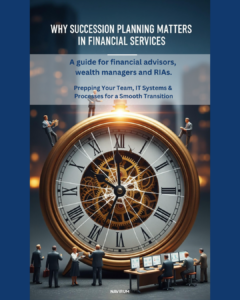
Here’s a glimpse into our FREE ebook, your complete guide to succession planning for advisors, RIAs, and wealth managers. Inside, you’ll find carefully curated strategies, real-world tips, and actionable insights designed to help you navigate every step of the succession process—from protecting your client relationships to ensuring a smooth transition for your team. These excerpts give you a taste of what’s inside, but to explore all 30 expert tips and gain the full roadmap for securing your firm’s future, be sure to download the complete ebook today.
Chapter 1: Team Preparation for a Seamless Transition
A successful succession plan starts and ends with your people. Preparation builds resilience, reduces confusion during the transition phase, and safeguards client confidence. You can’t transfer a business built on personal relationships without meticulously preparing your team.Tip #1: Assign a Dedicated Succession Planning Lead
Why it Matters: Succession planning is a “living strategy,” not a checklist item to be sidelined by daily client demands. Without a central owner, accountability evaporates. McKinsey research indicates that firms with clearly defined leadership roles during strategic transitions are demonstrably more resilient. This role is the hub for momentum and oversight.
How to Implement: The lead, often a Chief Operating Officer (COO), senior advisor, or rising next-gen leader, must have cross-functional visibility and the authority to coordinate between departments.
- Key Responsibilities: Managing timelines, facilitating stakeholder alignment (Compliance, HR, Client Service), tracking internal successors, and ensuring all key policies are documented and accessible.
- Pro Tip: Reinforce the role’s importance by tying a portion of the lead’s compensation or Key Performance Indicators (KPIs) directly to the progress of the succession plan.

Tip #4: Develop a Leadership Shadowing Program
Why it Matters: Succession is a transfer of confidence as much as a transfer of credentials. Technical knowledge is necessary, but the soft skills of high-level decision-making—negotiating, crisis management, and empathetic client interaction—can only be absorbed through direct exposure. This high-impact, low-cost method prepares the next generation by letting them absorb the demeanor of great leadership.
How to Implement: Design a structured 3–6 month mentorship.
- Focus on High-Value Interactions: Schedule observation time during strategic client meetings, internal planning sessions, and difficult conversations.
- Phase Engagement: Start with passive observation, then gradually move the junior advisor to contributing input and leading smaller parts of the agenda.
- Reassure Clients: Inform clients about the shadowing, framing it as part of your firm’s commitment to long-term service and continuity.
Chapter 2: Client Relationship Continuity in Succession Planning
Your client base is your core asset. The way you manage communication and continuity during a transition directly impacts client retention and protects your Assets Under Management (AUM)
Tip #7: Cross-Train a Secondary Advisor Early
Why it Matters: Trust doesn’t happen overnight. Clients are significantly more likely to stay with your firm if they already know and trust the incoming advisor. Co-advising at least 12–24 months before a planned transition is highlighted by Investopedia as a best practice for smoothing transitions, especially for High-Net-Worth (HNW) and multi-generational accounts.
How to Implement: Integrate the successor into the relationship, not just the client file.
- Phased Approach: Introduce the secondary advisor in meetings (Months 0–6), share responsibilities for follow-ups and prep (Months 6–12), and gradually shift the lead role (Months 12–24).
- Focus on Fit: Select a successor whose personality and communication style aligns well with the specific client segment they will inherit.
- Encourage Informal Touchpoints: Trust builds through casual interactions. Encourage the successor to handle small touchpoints like birthday calls or personal check-ins.
Tip #11: Schedule Overlapping Client Reviews
Why it Matters: For high-net-worth clients who expect highly personalized service, joint meetings with both the outgoing and incoming advisors are essential. The Kitces Report emphasizes that these dual-attendance meetings allow the successor to absorb relationship nuances and investment history firsthand, building client confidence in the partnership and ensuring a shared understanding of the client’s long-term goals.
How to Implement: Conduct 1-2 joint reviews per client, ideally 6–12 months out from the transition date.
- Coordinated Agenda: The outgoing advisor provides context and relationship history, while the incoming advisor focuses on future strategy and goals.
- Active Engagement: The incoming advisor should ask thoughtful, probing questions to demonstrate their engagement and quickly build a personal connection.
- Demonstrate Unity: Seeing the advisors work in partnership reassures the client that the change is a collaborative evolution, not a disruptive handoff.
Chapter 3: IT & CRM Systems for Succession Planning in Wealth Management
Your digital infrastructure is the unsung hero of operational continuity. Inadequate system preparation can create compliance gaps, cause operational downtime, and lead to client friction. Your CRM for Succession is the foundation.Tip #13: Centralize Client Data in a Cloud-Based CRM
Why it Matters: Client data is your lifeblood, encompassing not just portfolio holdings, but every note, preference, and compliance document. When this data is scattered across email inboxes, local drives, or personal spreadsheets, your firm is exposed to significant risk during an advisor exit. Forbes identifies a cloud-based CRM as a foundational investment for succession scalability. It ensures a single source of truth accessible anytime, anywhere, by authorized personnel.
How to Implement:
- Migrate and Audit: Implement a clear data migration plan, including a thorough audit to clean and consolidate outdated or duplicated files.
- Ensure Adoption: Train all advisors and support staff on consistent, high-quality data entry, enforcing the CRM as the primary hub for all client interactions.
- Benefits: Real-time updates, security features, and compliance-ready audit trails are critical for regulatory reviews during personnel shifts.
Tip #15: Set Tiered Access Permissions for Sensitive Client Data
Why it Matters: Data security and compliance are paramount, especially during the onboarding of new team members or successors. Role-Based Access Controls (RBAC) are a FINRA best practice for preventing insider threats and limiting data exposure. Not every team member requires—or should have—full access to all client data. Properly tiered permissions safeguard sensitive, confidential client information and maintain client trust.
How to Implement:
- Define Roles: Clearly define tiered roles (e.g., Advisor, Support Staff, Compliance, Operations) and map their minimum necessary access levels to client files, historical data, and privileged documents.
- Audit Logs: Ensure your CRM and document management system maintains detailed audit logs of who accessed what and when, which is critical for compliance reporting.
- Review: Access levels must be reviewed and adjusted immediately when roles change, ensuring former employees or those in transitioning roles are appropriately restricted.
Your Future is Calling. Are You Ready?
Succession planning is the ultimate expression of long-term strategic vision. It is how you ensure that the firm you built not only survives but thrives for generations to come. This e-book compiles the most essential steps—from team development and soft skill transfer to IT system resilience—into a single, easy-to-follow guide.