
What is Future Proof Teck Stack: Integrating Jump, SS&C, and Salesforce?
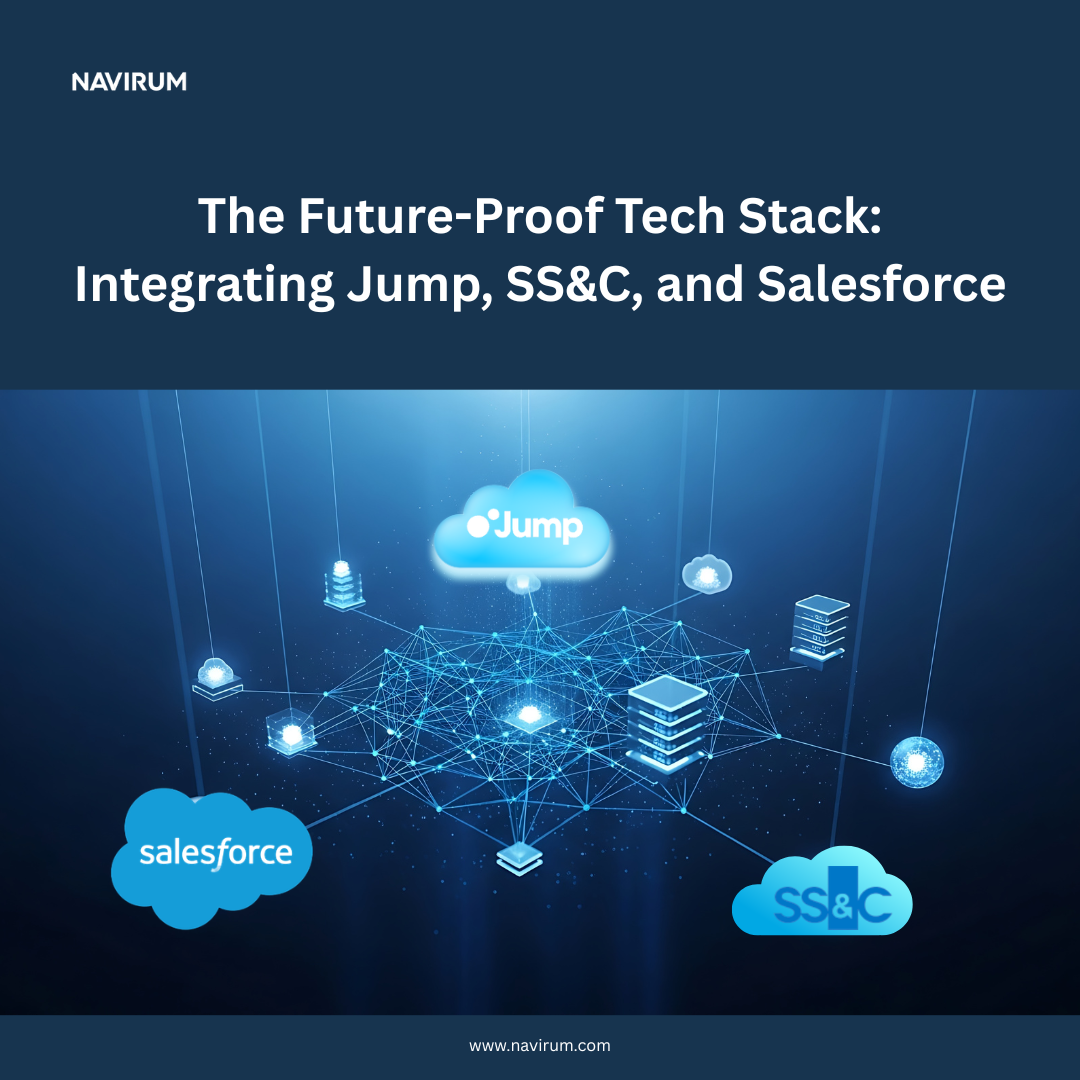
A future-proof tech stack is a strategic necessity for wealth managers to efficiently deliver personalized advice while managing compliance, data, and operations. The proposed solution involves integrating Salesforce, Jump, and SS&C to create a connected ecosystem for client engagement, operational efficiency, and actionable insights.
The financial services industry is evolving faster than ever. Wealth managers face the dual pressure of delivering personalized advice while managing compliance, data, and operations efficiently.
A future-proof tech stack is no longer a luxury—it is a strategic necessity. By integrating Jump, SS&C, and Salesforce, firms can create a connected ecosystem that powers client engagement, operational efficiency, and actionable insights.
How to build and integrate these systems?
This step-by-step guide walks through how to build and integrate these systems, helping advisors and operations teams leverage technology for sustainable growth.
1. Understanding the Components of the Stack

Before diving into integration, it’s important to understand the unique role of each platform. Each tool addresses specific challenges in wealth management, from client engagement to back-office operations.
A clear understanding ensures that the integration strategy aligns with business goals and operational workflows.
1.1 Salesforce: The Client Relationship Hub
Salesforce is the industry-leading CRM platform, widely used for financial services. Its Financial Services Cloud (FSC) allows advisors to manage client relationships, track interactions, and document life events efficiently.
With Salesforce, firms gain a single source of truth, enabling advisors to deliver personalized experiences based on accurate and up-to-date client data.
1.2 Jump: Operational Efficiency and Portfolio Management
Jump is a platform focused on portfolio management and operational automation. It connects custodial systems with the advisor interface to reduce manual processes.
Advisors can monitor accounts, automate trade allocations, and generate performance reports in real time. Jump improves both accuracy and efficiency, freeing advisors to focus on client engagement.
1.3 SS&C: Data Aggregation and Back-Office Automation
SS&C provides robust back-office automation and compliance solutions. It aggregates financial data, automates reporting, and ensures accurate reconciliations.
By integrating SS&C with Salesforce and Jump, firms can deliver timely and reliable data to advisors and clients alike. This ensures that all decisions are data-driven and regulatory-compliant.
2. Step 1: Define Your Business Goals
Successful integration starts with clarity. Wealth managers must define why the integration is needed and what outcomes they expect.
Understanding objectives helps prioritize workflows, avoid unnecessary complexity, and measure success effectively.
2.1 Identify Core Objectives
Ask questions such as: Are you improving client experience, streamlining workflows, or enhancing reporting? Are real-time portfolio insights critical for advisors?
Clear goals ensure that the integration strategy supports the most impactful business outcomes.
2.2 Map Existing Pain Points
Document the current inefficiencies in your processes. For example, manual data entry, delayed reporting, and disconnected client records are common challenges.
Mapping these pain points helps identify integration priorities and ensures the solution addresses real operational gaps.
3. Step 2: Plan Your Data Architecture

Data is the backbone of any tech stack. Proper architecture ensures accuracy, accessibility, and consistency across platforms.
A strong data strategy also reduces errors and improves reporting for both advisors and compliance teams.
3.1 Identify Key Data Sources
Key sources typically include Salesforce for client data, Jump for portfolio information, and SS&C for back-office and accounting data.
Understanding data formats, update frequency, and system dependencies is crucial for smooth integration.
3.2 Define Integration Points
Typical integration points might include syncing account records from Salesforce to Jump, sending portfolio metrics to Salesforce dashboards, or feeding SS&C data into Salesforce for reporting.
Clearly defining these points ensures seamless workflows and accurate data flow.
3.3 Standardize Data Definitions
Standardizing account types, client identifiers, and portfolio categories across systems prevents inconsistencies.
Creating a data dictionary is essential to maintain clarity and reduce errors during integration.
4. Step 3: Select the Right Integration Approach
Choosing the integration method depends on scale, complexity, and business requirements.
The approach should balance real-time access, reliability, and long-term maintainability.
4.1 API-Based Integration
APIs enable real-time, bidirectional data flow between systems. This ensures advisors always have up-to-date information.
While APIs provide flexibility, they require technical expertise and monitoring to prevent errors.
4.2 ETL (Extract, Transform, Load) Processes
ETL pipelines move data from Jump and SS&C to Salesforce on a scheduled basis. This is ideal for batch reporting or compliance workflows.
Although not real-time, ETL provides reliability and controlled data movement.
4.3 Middleware Solutions
Middleware platforms like MuleSoft can act as a central hub, connecting all systems. This approach reduces custom coding and centralizes integration logic.
It’s particularly useful for firms managing multiple custodians or complex legacy systems.
5. Step 4: Implement Data Security and Compliance Measures

Integration in financial services must meet strict regulatory standards.
Data security is critical to protect sensitive client information and ensure compliance with financial regulations.
5.1 Access Controls
Define user roles carefully across Salesforce, Jump, and SS&C. Restrict sensitive information to authorized personnel only.
Proper access controls also improve accountability and traceability.
5.2 Encryption and Transmission
Use TLS/SSL protocols for data in transit and encrypt sensitive information at rest.
This ensures data remains secure and mitigates the risk of breaches.
5.3 Audit and Monitoring
Enable logging for all integration events and create alerts for failed or delayed transfers. Maintain audit trails for regulatory reporting.
Regular monitoring ensures ongoing compliance and system reliability.
6. Step 5: Build Workflows and Automation
Once data is flowing, workflows can be automated to reduce manual effort.
Automation allows advisors to focus on client engagement rather than administrative tasks.
6.1 Client Onboarding
Use Salesforce to capture client information, Jump to process accounts, and generate documents automatically.
Integrate e-signature tools to complete account openings seamlessly, reducing turnaround time.
6.2 Portfolio Reporting
Aggregate performance data from Jump and SS&C and feed it into Salesforce dashboards.
Advisors can view real-time insights, generate client reports, and make data-driven recommendations.
6.3 Compliance and Reconciliation
Automate reconciliations in SS&C and sync results to Salesforce for visibility.
Generate regulatory reports efficiently, reducing manual error risk and ensuring compliance.
7. Step 6: Test and Validate Integration

Testing ensures that integration works as intended before going live.
A staging environment helps identify and correct issues without disrupting operations.
7.1 Data Accuracy
Verify that account balances, transactions, and client records match across all systems.
Accurate data ensures trust in reporting and advisor decision-making.
7.2 Workflow Validation
Simulate onboarding, reporting, and compliance workflows to ensure proper automation.
Testing helps identify gaps or errors before impacting clients.
7.3 Error Handling
Confirm that alerts trigger for failed processes and that exceptions are logged.
Proactive monitoring prevents operational disruptions.
8. Step 7: Train Staff and Build Adoption
Even the best tech stack fails if users don’t adopt it effectively.
Training is essential to maximize ROI and ensure smooth operations.
8.1 Advisor Training
Show advisors how to access dashboards, view reports, and leverage automation.
Demonstrate how Salesforce consolidates data from Jump and SS&C for faster, more informed client interactions.
8.2 Operations Training
Focus on data quality checks, reconciliation processes, and troubleshooting.
Ensure operations staff understand how automation impacts daily workflows.
9. Step 8: Monitor, Optimize, and Scale

Integration is an ongoing process, not a one-time project.
Monitoring KPIs ensures that the stack continues to deliver value as business needs evolve.
9.1 Monitor KPIs
Track metrics such as data accuracy, onboarding speed, and advisor engagement.
Use these metrics to identify areas for improvement and operational optimization.
9.2 Continuous Improvement
Update workflows, add new integration points, and leverage analytics to anticipate future needs.
Continuous improvement ensures your tech stack remains scalable and future-proof.
10. Strategic Benefits of Integrating Jump, SS&C, and Salesforce
A fully integrated stack provides tangible benefits for wealth managers and clients.
- Unified Client View: Advisors have a single dashboard for all accounts and portfolios.
- Operational Efficiency: Automation reduces manual work and errors.
- Compliance Assurance: Streamlined reporting and audit trails simplify regulatory adherence.
- Scalability: Systems support growth without adding manual workload.
- Enhanced Client Experience: Faster onboarding, real-time insights, and personalized advice improve satisfaction.
11. Key Considerations for Wealth Managers
- Choose the integration approach (API, ETL, or middleware) based on scale and technical resources.
- Ensure data governance and consistency across Salesforce, Jump, and SS&C.
- Engage a trusted partner like Navirum for implementation support.
- Plan for future expansion, including e-signature tools, AI analytics, or client portals.
The integration should solve current operational challenges while being flexible enough to support future growth.
12. Future-Proofing Your Tech Stack
Client expectations are rising, compliance requirements are increasing, and portfolios are becoming more complex.
By integrating Salesforce, Jump, and SS&C, firms gain the agility, insights, and operational efficiency needed to succeed in a competitive environment.
A future-proof tech stack is not just a set of tools—it’s a strategic foundation for sustainable growth and excellence in client service.
Final Thoughts
Integrating Salesforce, Jump, and SS&C transforms a fragmented technology landscape into a connected, efficient, and scalable ecosystem.
By following a step-by-step approach—defining goals, planning architecture, selecting integration methods, ensuring security, automating workflows, testing, training, and monitoring—wealth managers can optimize operations, enhance client experiences, and stay competitive.
This future-proof tech stack empowers advisors to focus on advisory excellence, backed by real-time insights and operational efficiency.
Navirum Recommendations

As a specialized integration partner in financial services, Navirum recommends approaching the integration of Salesforce, Jump, and SS&C as a long-term strategic initiative rather than a one-time technical project. Based on real-world implementations, the following best practices help ensure success, scalability, and measurable business impact.
By following the below recommendations, wealth managers can move beyond basic system connectivity and build a truly future-proof tech stack—one that supports growth, enhances client experience, and enables advisors to operate at their highest level.
1. Treat Integration as an Enterprise Architecture Decision
Integration should not be handled as a point-to-point connection between systems. Instead, design a scalable architecture that supports future growth, additional tools, and evolving business models. This ensures flexibility as your tech stack expands.
2. Prioritize a Unified Data Strategy
Establish Salesforce as the system of engagement and define clear roles for Jump and SS&C as systems of operation and record. Create a governed data model with standardized definitions, ensuring consistency across all platforms.
3. Design for Advisor Experience First
Technology should serve advisors—not the other way around. Focus on delivering a clean, intuitive interface within Salesforce where advisors can access portfolio data, client history, and insights without switching systems.
4. Use a Hybrid Integration Approach
Avoid over-reliance on a single integration method. Combine APIs for real-time insights with ETL processes for reporting and compliance. This balance improves performance while maintaining data accuracy and reliability.
5. Build for Compliance and Auditability from Day One
Embed compliance into the architecture by design. Ensure all data flows are traceable, auditable, and aligned with regulatory requirements. This reduces risk and simplifies reporting obligations over time.
6. Automate High-Impact Workflows First
Start with workflows that deliver immediate value, such as client onboarding, portfolio reporting, and reconciliation. Early wins drive adoption and demonstrate ROI quickly across the organization.
7. Implement Strong Data Governance
Assign data ownership, define quality standards, and establish monitoring processes. A governance framework ensures long-term integrity and trust in the data used by advisors and operations teams.
8. Invest in Change Management and Training
User adoption is critical. Provide role-based training for advisors and operations teams, and clearly communicate how the integrated stack improves daily workflows. Adoption drives the real value of integration.
9. Monitor, Measure, and Iterate Continuously
Define KPIs early—such as onboarding time, data accuracy, and advisor productivity—and track them consistently. Use insights to refine workflows and optimize system performance over time.
10. Plan for Future Expansion
Design your integration with the future in mind. Whether adding AI-driven analytics, client portals, or additional custodians, your architecture should be flexible enough to evolve without major rework.
FAQs – Salesforce, Jump, and SS&C Integration
How do wealth managers ensure data consistency across Salesforce, Jump, and SS&C?
Maintaining data consistency requires a strong data governance framework, including standardized data models, a unified client identifier, and clear ownership of data domains. Implementing validation rules and reconciliation processes ensures that discrepancies are identified and resolved quickly across systems.
What are the biggest challenges when integrating portfolio management and CRM systems?
The most common challenges include mismatched data structures, latency between systems, and aligning real-time versus batch processing needs. Additionally, firms must carefully design workflows to avoid duplication of data and ensure that advisors are not overwhelmed by unnecessary information.
How can firms balance real-time data access with system performance?
While APIs enable real-time data flow, overusing them can strain system performance. A hybrid approach—combining real-time APIs for critical data and ETL processes for less time-sensitive information—helps maintain both responsiveness and stability.
What role does middleware play in scaling a multi-system integration?
Middleware acts as an abstraction layer that centralizes integration logic, making it easier to add new systems or modify existing ones without disrupting the entire architecture. This is especially valuable for firms with multiple custodians or evolving technology stacks.
How can integration improve the advisor-client relationship beyond operational efficiency?
Integration enhances the advisor-client relationship by enabling holistic, real-time insights into client portfolios, financial goals, and interactions. This allows advisors to deliver more proactive, personalized advice and engage clients with greater confidence and relevance.
What compliance risks should firms consider when integrating these platforms?
Key risks include improper data access, incomplete audit trails, and inconsistent reporting across systems. Firms must ensure that all integrations support regulatory requirements by maintaining transparency, traceability, and secure handling of sensitive client data.
How do you measure ROI from a fully integrated tech stack?
ROI can be measured through metrics such as reduced onboarding time, fewer manual errors, increased advisor productivity, and improved client retention. Over time, firms should also evaluate revenue growth driven by better client engagement and scalable operations.
How can firms future-proof their integration beyond the initial implementation?
Future-proofing involves designing flexible architectures, using scalable integration methods, and continuously updating systems to incorporate new technologies such as AI-driven analytics, client portals, and advanced reporting tools.
What organizational changes are required to support a successful integration?
Successful integration often requires changes in operating models, including closer collaboration between IT, operations, and advisory teams. Firms may also need to establish new roles focused on data governance, integration management, and continuous optimization. Ongoing optimization after go-live is exactly what Orbit is built for.
When should a firm consider working with an external integration partner?
Firms should consider an external partner when dealing with complex integrations, limited internal technical expertise, or tight implementation timelines. A specialized partner can accelerate deployment, reduce risk, and ensure best practices are followed from the outset.
The Future Proof Tech Stack
Supercharge front-to-back office automation. Bridge your critical financial databases and streamline custody workflows under a single CRM source of truth.
Connect your operations, eradicate blind spots, and empower your advisors.
- Eliminate Silos: Harmonize rich client accounting data from Jump & SS&C instantly with Salesforce.
- Operational Efficiency: Reduce multi-system data entries and speed up transaction matching by 80%.
- Production Grade Security: Maintain fully encrypted, high-availability compliance baselines.
Maximize Integration ROI
Map your legacy platforms with an enterprise architecture specialist. Find custom operational pathways during a 1-on-1 strategy call.
Book a Strategy Session Free 30-Minute Consultation • Secure Video Link Provided