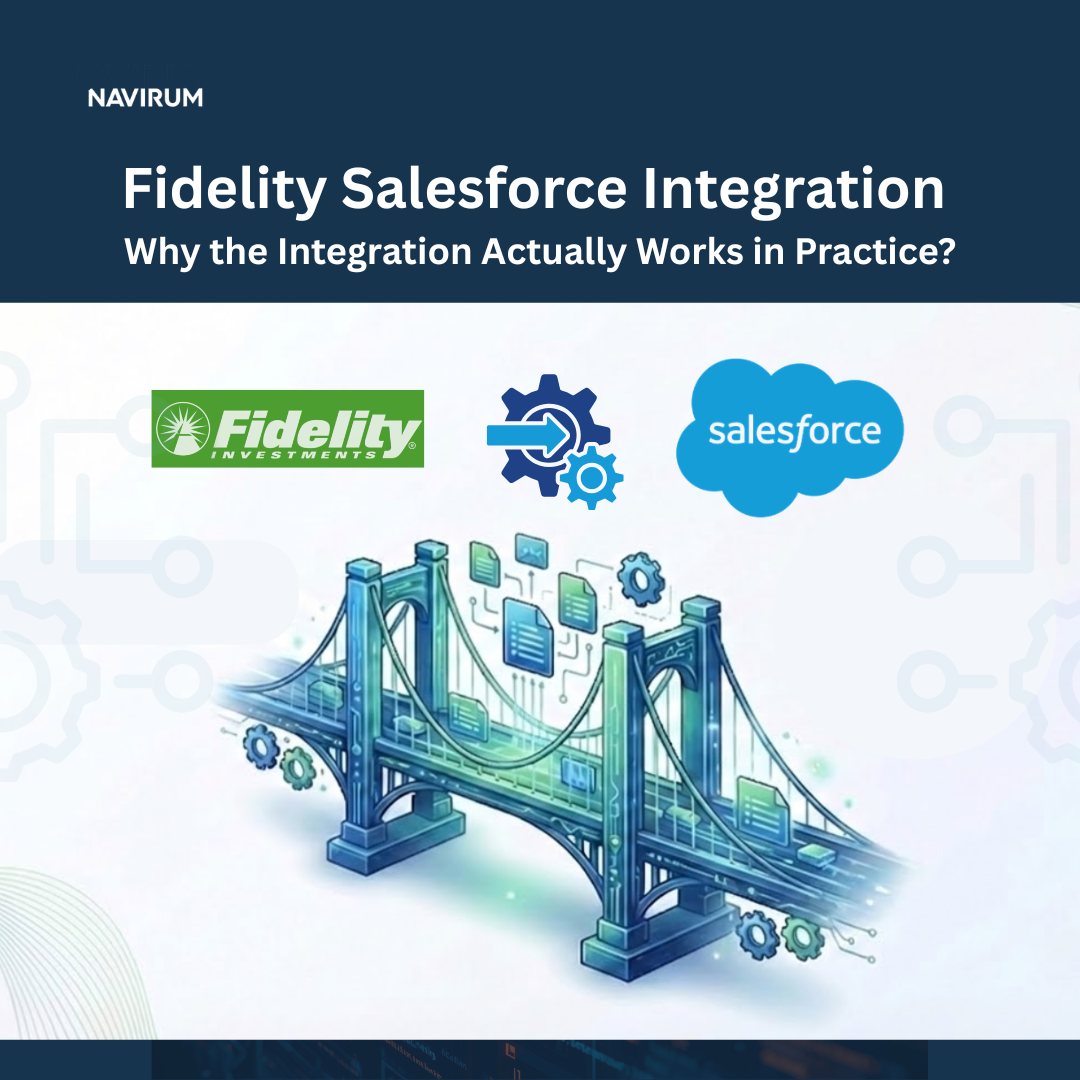
The Fidelity Investments Salesforce integration works effectively because it aligns four critical components: custodian support, platform capability, expert implementation, and firm adoption. Using Salesforce Financial Services Cloud, firms can bring Fidelity custodial data directly into Salesforce, allowing advisors to manage clients, accounts, and workflows in one operational system. When supported by a knowledgeable consulting partner and strong internal adoption, the integration becomes scalable, efficient, and widely used by advisory teams.
Fidelity Integration for Salesforce
What differentiates the Fidelity Salesforce integration from many financial system integrations is the level of alignment between the stakeholders involved.
In financial services, successful integrations rarely depend on technology alone. They require coordinated execution across multiple parties—the custodian, the CRM platform, the consulting partner, and the client firm.
In Fidelity’s case, that alignment is real and measurable.
Fidelity Salesforce Integration: Key Pillars
A strong implementation is supported by four critical pillars working together:
1. Fidelity’s Commitment to the Integration
Fidelity is not simply a passive data provider in this ecosystem.
As a leading custodian, Fidelity Investments actively supports its Salesforce integration strategy, providing structured enablement paths and technical resources to help firms deploy the integration correctly.
This level of institutional commitment significantly reduces friction during onboarding and ongoing usage.
That matters—because integrations often fail when custodians treat connectivity as a secondary initiative rather than a strategic capability.
Fidelity’s engagement helps ensure that advisors and operations teams can reliably access custodial data within Salesforce.
2. Salesforce as the Platform Foundation
The integration works because Salesforce provides a highly extensible platform where custodial data can become operational—not just visible.
When paired with Salesforce Financial Services Cloud, the platform delivers:
- Industry-specific data models designed for wealth management
- Relationship mapping between households, accounts, and advisors
- Workflow automation for onboarding, servicing, and compliance
- Secure data governance and permission controls
Instead of forcing firms to build custom structures, Financial Services Cloud provides purpose-built architecture for financial institutions.
This dramatically accelerates implementation and improves long-term scalability.
3. Your Salesforce Consulting Partner
A knowledgeable Salesforce consulting partner acts as the translation layer between business goals and technical execution.
Integrations succeed when implementation teams understand both Salesforce architecture and wealth management operations.
Key responsibilities include:
Training teams so Salesforce becomes the default system—not an optional one
- Designing advisor workflows that teams will actually adopt
- Aligning custodial data with Financial Services Cloud data structures
- Embedding compliance and governance into operational processes
- Configuring dashboards and reporting for advisor productivity

We consistently see that integrations succeed when consulting partners combine deep Salesforce expertise with financial services domain knowledge.
Without that dual expertise, integrations often become overly technical and fail to drive adoption.
If your firm is evaluating a Fidelity Salesforce integration, working with an experienced implementation partner can significantly reduce risk and accelerate adoption.
At Navirum, we help wealth management firms:
- Design scalable Salesforce architectures
- Integrate custodial data into Financial Services Cloud
- Automate advisor workflows
- Improve advisor productivity and client experience
4. The Client’s Engagement and Adoption
The final pillar is the firm itself.
Clients who invest in training, change management, and user adoption see immediate returns from their Salesforce investment.
Firms that treat integration as purely “IT plumbing” often fall back into old habits—such as logging into the Fidelity portal instead of working inside Salesforce.
True ROI only appears when Salesforce becomes the system advisors trust and use every day.
This requires:
- Leadership buy-in
- Structured onboarding and training
- Clear operational workflows
- Incentives that reinforce Salesforce usage
When firms commit to adoption, the integration quickly becomes a core operational engine rather than a background data feed.
Why This Multi-Pillar Model Matters
Many financial system integrations struggle because one or more of these pillars is missing:
- Custodian support is limited
- Salesforce is underutilized
- The consulting partner lacks financial services depth
- Users aren’t trained or incentivized to change behavior
In the case of Fidelity, the alignment between:
- Fidelity
- Salesforce
- A specialized Salesforce consulting partner
- And an engaged client
This creates a rare situation where all contributors are invested in the outcome.
That alignment dramatically increases the likelihood of success — and explains why Fidelity Salesforce integrations tend to move faster and achieve higher adoption than many other financial system integrations.

5 Proven Ways to End RIA Data Chaos for Good
How To Eliminate Data Chaos with FormAssembly and Salesforce FSC for Compliant Growth?
Bottom Line
Integrating with a financial system is never trivial.
But when the custodian, the platform, the consulting partner, and the client are all aligned — as they are in the Fidelity Salesforce ecosystem — the integration becomes not just achievable, but repeatable and scalable.
That combination of shared ownership is what makes the Fidelity Salesforce integration work — and why it remains a strong recommendation for Fidelity-affiliated wealth management firms investing in Salesforce.
Ready to Connect Your Systems?
Maximize efficiency and eliminate double-data entry with a seamless integration setup.