
Estimated reading time: 16 minutes
Why Private Equity Firms Should Leverage Agentforce?
Discover how Agentforce can drive operational efficiency, boost revenue, and enhance customer experience for private equity firms and their portfolio companies. Learn key benefits, real-world use cases, and NAVIRUM recommendations for maximizing ROI with Salesforce automation.
Agentforce is a Salesforce-native automation platform that helps private equity firms and their portfolio companies streamline workflows, reduce operational costs, and improve data accuracy. This guide explains how PE professionals can evaluate its value across portfolio companies, track measurable KPIs, and assess adoption impact. It highlights EBITDA growth levers, scalability, and customer experience improvements, provides real-world use cases, discusses risks and market positioning, and shares our recommendations for maximizing ROI through strategic implementation and expert Salesforce consulting.
Unlocking Operational Alpha Across Portfolio Companies
Private equity firms are under increasing pressure to deliver returns not just through financial engineering, but through operational excellence. As holding periods evolve and competition intensifies, firms are turning to technology as a lever to accelerate value creation and differentiate their portfolios.
Agentforce represents a new category of enablement—one that allows firms to standardize, scale, and optimize operations across multiple portfolio companies. Rather than treating each asset as a silo, PE firms can implement a unified approach to automation and data, unlocking efficiencies that compound across the portfolio.
This guide explores how Agentforce fits into a modern PE value creation strategy:
- What Agentforce is and why it matters for private equity
- The operational challenges it solves across portfolio companies
- Key value drivers for PE firms
- Measurable KPIs and performance indicators
- Market positioning and competitive landscape
- Risks and mitigation strategies
- Key questions PE firms should ask before investing
- Why Salesforce consulting expertise is critical
What Is Agentforce?
Agentforce is more than a workflow tool, it’s an operational backbone for organizations looking to scale efficiently within the Salesforce ecosystem. By centralizing automation, data, and process orchestration, it allows companies to move faster while maintaining control and consistency.
For private equity firms, this is particularly important. Portfolio companies often operate with fragmented systems and inconsistent processes, making it difficult to drive unified performance improvements. Agentforce provides a standardized layer that enables firms to deploy best practices at scale while maintaining flexibility at the company level.
For private equity firms, the key differentiator is standardization across portfolio companies. Rather than each company building fragmented systems, Agentforce provides a unified approach to automation, data, and reporting.
This allows PE firms to:
- Deploy consistent operating models
- Improve cross-portfolio visibility
- Accelerate digital transformation across assets
Why Portfolio Companies Need Agentforce
Operational inefficiencies are one of the most common barriers to value creation in portfolio companies. While growth strategies may be sound, execution often breaks down due to manual processes, lack of integration, and limited visibility into performance.
These inefficiencies are not just operational issues—they directly impact EBITDA, scalability, and exit readiness. Without a structured approach to automation and data management, companies struggle to scale efficiently or respond to market demands.
Many portfolio companies struggle with the same operational inefficiencies:
- Manual, time-consuming processes
- Disconnected systems and siloed data
- Limited reporting visibility
- Inconsistent customer experience
Agentforce addresses these issues by:
- Automating repetitive workflows
- Standardizing processes across teams
- Integrating Salesforce with other systems
- Enabling scalable, low-code automation
For PE firms, this translates into faster operational improvements and more predictable performance across investments.
Key Value Drivers for Private Equity Firms

Private equity firms evaluate every initiative through the lens of value creation. Technology investments must demonstrate clear, measurable impact on financial performance, not just incremental improvements in efficiency.
Agentforce stands out because it directly influences key drivers of enterprise value—revenue growth, cost optimization, and scalability. These are the same levers PE firms use to improve EBITDA and maximize exit multiples.
Private equity firms evaluate technology based on its ability to drive measurable financial outcomes. Agentforce delivers value across multiple dimensions:
1. EBITDA Growth Through Productivity Gains
Productivity is one of the most immediate levers for improving financial performance. When teams spend less time on administrative work, they can focus on higher-value activities that directly contribute to revenue.
Agentforce enables this shift by automating routine tasks and streamlining workflows, allowing organizations to operate more efficiently without increasing headcount.
- Faster sales cycles
- Increased deal throughput
- Reduced operational bottlenecks
2. Cost Reduction and Margin Expansion
Cost control is critical in driving profitability, especially in competitive or margin-sensitive industries. Manual processes, duplicated work, and inefficient approvals often create hidden costs that accumulate over time.
By introducing automation and standardization, Agentforce helps eliminate these inefficiencies, resulting in leaner and more predictable operations.
- Reducing manual intervention
- Automating approvals and workflows
- Minimizing errors and rework
3. Standardization Across the Portfolio
One of the biggest challenges in private equity is managing a diverse set of portfolio companies with varying levels of maturity and operational discipline. Without standardization, it becomes difficult to replicate success or scale improvements.
Agentforce allows firms to implement consistent processes and frameworks, enabling a more unified and strategic approach to portfolio management.
- Deploy repeatable playbooks
- Standardize workflows and reporting
- Scale best practices across assets
4. Real-Time Data and Visibility
Timely and accurate data is essential for effective decision-making at both the company and fund level. However, many portfolio companies lack the infrastructure needed to deliver reliable insights.
Agentforce ensures that data flows seamlessly across systems, enabling real-time reporting and improved transparency.
- Data consistency across systems
- Real-time dashboards and reporting
- Improved performance visibility
5. Exit Readiness and Valuation Uplift
Exit readiness is a key priority for any private equity firm. Buyers are increasingly looking for companies with modern systems, clean data, and scalable operations.
By implementing Agentforce, portfolio companies can position themselves as well-run, efficient, and future-ready organizations.
- Scalable and standardized systems
- Clean, reliable data
- Efficient, automated processes
Strategic KPIs Private Equity Firms Should Track

To effectively evaluate the success of Agentforce, private equity firms need to move beyond qualitative benefits and focus on measurable outcomes. Clear KPIs provide visibility into whether automation is delivering real value.
Tracking the right metrics also enables firms to benchmark performance across portfolio companies and identify opportunities for further optimization.
To evaluate Agentforce adoption, PE firms should focus on measurable performance indicators:
| Metric Category | What to Track | Why It Matters |
|---|---|---|
| Productivity | Tasks automated per employee | Indicates operational efficiency |
| Cycle Time | Sales or approval cycle duration | Reflects process optimization |
| Cost Efficiency | Operational cost reduction | Impacts EBITDA directly |
| Data Quality | Error rates and data consistency | Ensures reliable reporting |
| Adoption | Active user rates | Measures platform utilization |
| Revenue Impact | Revenue per employee | Signals scalability |
Market Positioning and Competitive Landscape
The automation and workflow orchestration space is evolving rapidly, with increasing demand for platforms that can deliver both flexibility and scalability. Private equity firms need to understand where Agentforce fits within this broader landscape.
Its positioning is particularly compelling because it aligns with macro trends such as digital transformation, low-code adoption, and the need for integrated systems.
Agentforce sits at the intersection of several high-growth technology categories:
- Low-code automation
- Workflow orchestration
- Salesforce-native platforms
Alignment with Digital Transformation Trends
Private equity firms are increasingly prioritizing digital transformation as a core component of their value creation strategies. Platforms like Agentforce enable faster implementation and quicker realization of benefits.
- Faster deployment cycles
- Reduced reliance on engineering resources
- Scalable process improvements
Salesforce Ecosystem Advantage
Integration is often one of the biggest challenges in technology adoption. Agentforce’s native connection to Salesforce significantly reduces this friction.
- Seamless data integration
- Lower implementation risk
- Faster time to value
Competitive Landscape
Understanding the competitive environment is key to assessing long-term viability and differentiation.
- RPA tools
- Custom-built solutions
- Other low-code platforms
Risks and Mitigation Strategies
While the benefits of Agentforce are substantial, successful implementation requires careful planning and execution. Private equity firms must consider potential risks to ensure expected outcomes are achieved.
A proactive approach to risk management can significantly improve the likelihood of success and maximize return on investment.
1. Inconsistent Adoption Across Portfolio Companies
Not all companies may adopt the platform effectively.
Mitigation:
Implement centralized governance and standardized rollout strategies.
2. Change Management Challenges
Teams may resist new workflows.
Mitigation:
Invest in training, leadership alignment, and clear ROI communication.
3. Over-Reliance on Salesforce Ecosystem
Dependency on a single ecosystem can introduce strategic risk.
Mitigation:
Ensure alignment with long-term Salesforce strategy and maintain flexibility where needed.
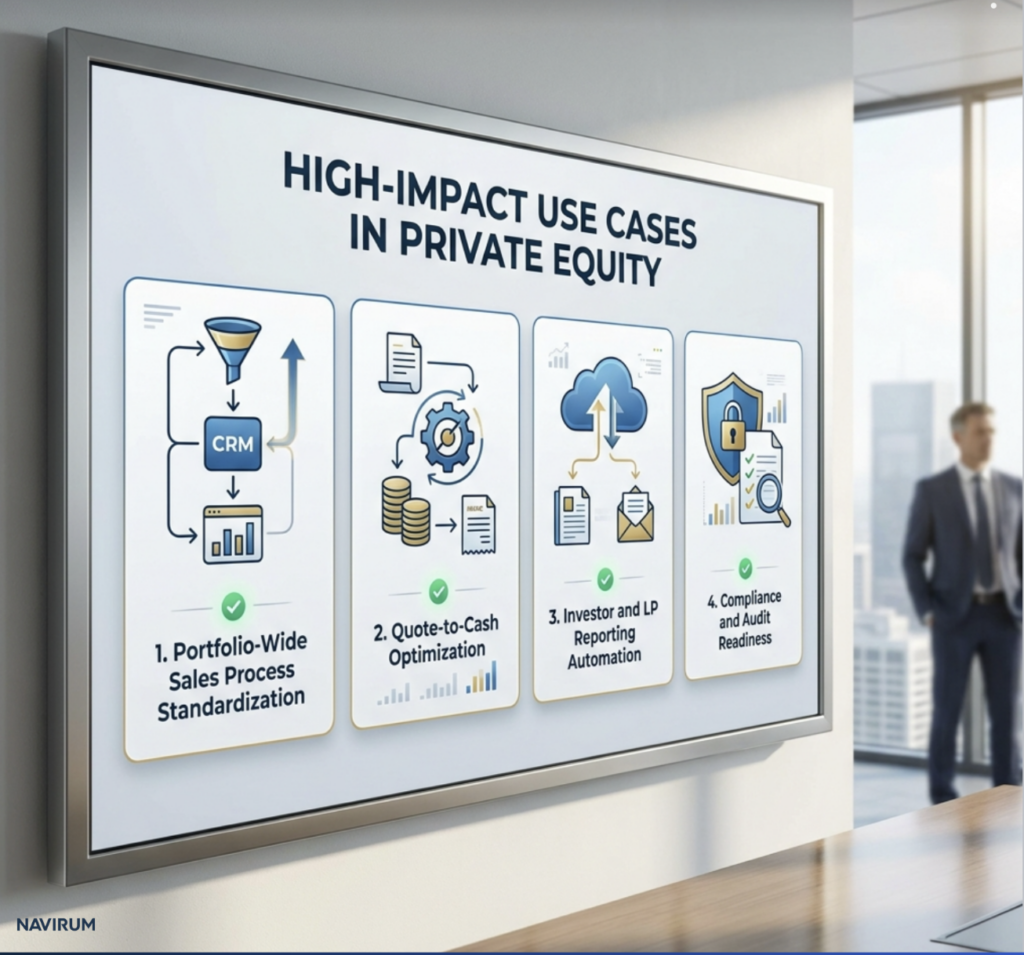
High-Impact Use Cases in Private Equity
Use cases are critical for translating strategy into execution. They help private equity firms understand how Agentforce can be applied in real-world scenarios to drive measurable outcomes.
These examples highlight how automation can directly impact performance across key operational areas.
Use Case 1: Portfolio-Wide Sales Process Standardization
Agentforce can unify lead management, deal tracking, and reporting across companies, improving pipeline visibility and forecasting accuracy.
Use Case 2: Quote-to-Cash Optimization
Automating approvals, contracts, and invoicing reduces delays and improves cash flow predictability.
Use Case 3: Investor and LP Reporting Automation
Streamlining reporting processes enables faster, more accurate communication with stakeholders.
Use Case 4: Compliance and Audit Readiness
Automated audit trails reduce risk and simplify due diligence during exit.
What Private Equity Firms Should Ask Before Investing
Evaluating an Agentforce initiative requires more than understanding the technology—it requires assessing how it will be implemented and measured.
Asking the right questions ensures that the investment is aligned with value creation goals and not just a technology upgrade.
Before backing an Agentforce initiative, PE professionals should ask:
- What operational inefficiencies are being targeted?
- What baseline metrics exist today?
- How will success be measured post-implementation?
- Is there a standardized rollout plan across the portfolio?
- How quickly can value be realized?
- Who owns adoption and optimization?
Why Salesforce Consulting Expertise Matters
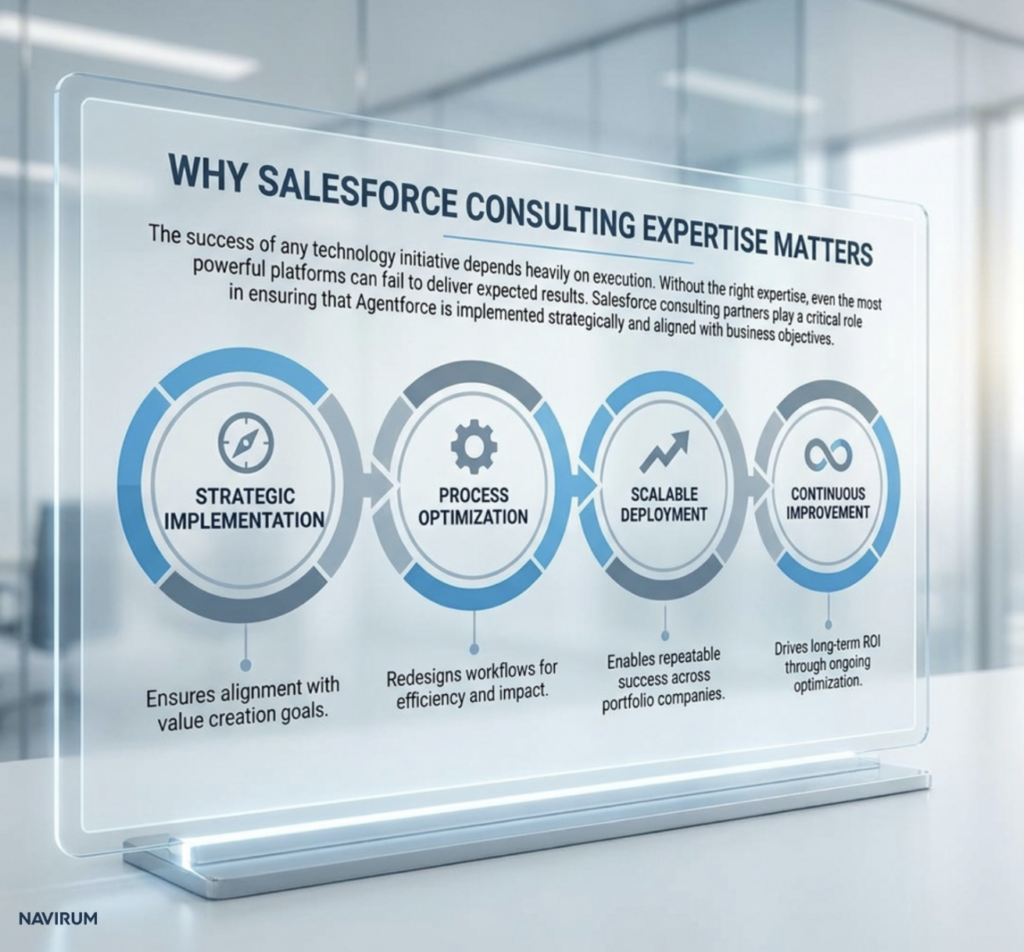
The success of any technology initiative depends heavily on execution. Without the right expertise, even the most powerful platforms can fail to deliver expected results.
Salesforce consulting partners play a critical role in ensuring that Agentforce is implemented strategically and aligned with business objectives.
Strategic Implementation . Ensures alignment with value creation goals.
Process Optimization. Redesigns workflows for efficiency and impact.
Scalable Deployment. Enables repeatable success across portfolio companies.
Continuous Improvement. Drives long-term ROI through ongoing optimization.
Final Thoughts: A Scalable Value Creation Lever
Private equity firms that successfully leverage technology gain a significant competitive advantage. Agentforce represents an opportunity to move beyond fragmented improvements and toward a scalable, repeatable model for operational excellence.
By standardizing processes, improving data visibility, and automating workflows, firms can unlock value across their entire portfolio—not just individual companies.
When deployed effectively, Agentforce enables:
- Faster growth
- Lower costs
- Better data visibility
- Stronger exit positioning
NAVIRUM Recommendations for Private Equity Decision-Makers

Maximizing the value of Agentforce in a private equity portfolio is not just about implementing technology—it’s about using automation as a strategic lever for value creation, risk reduction, and scalable growth. The most successful firms embed it directly into their investment thesis and operating model.
Based on Navirum’s experience with Salesforce and complex operations, here’s how PE firms can ensure Agentforce delivers measurable results across their portfolio:
1. Embed Agentforce Into Your Value Creation Plan
Automation should be tied directly to financial objectives: revenue growth, cost optimization, and EBITDA expansion. Integrate Agentforce initiatives into each portfolio company’s 100-day plan to accelerate impact and make operational improvements measurable from the start.
2. Standardize Operations Across Portfolio Companies
Agentforce allows you to roll out consistent processes, reporting, and governance frameworks across multiple companies. Standardization reduces variability, improves predictability, and enables quicker, repeatable operational improvements—ultimately creating portfolio-wide efficiencies and transparency.
3. Focus on High-Impact Use Cases First
Target initiatives that drive tangible financial outcomes, such as deal-to-cash workflows, sales process automation, and customer onboarding. Early wins build momentum, demonstrate measurable ROI, and reduce implementation risk.
4. Define and Track Portfolio-Level KPIs
Establish metrics that matter to PE decision-makers: productivity, operational cost savings, revenue per employee, and adoption rates. Consistent KPIs across portfolio companies allow leadership to monitor impact, benchmark performance, and identify opportunities for additional value creation.
5. Prioritize Adoption and Change Management
Even the best technology fails without adoption. Structured change management—training, executive sponsorship, and clear ROI communication—is essential to ensure teams embrace automation and it drives measurable results.
6. De-Risk Execution With Expert Partners
Execution risk is one of the top threats to value creation. Partnering with experienced Salesforce consultants ensures Agentforce is deployed efficiently, integrated with existing systems, and aligned with strategic goals—reducing time-to-value and protecting ROI.
7. Build Scalability and Exit Readiness Into Day One
Automation should not only improve current operations but also prepare companies for exit. Scalable workflows, reliable reporting, and clean data increase buyer confidence and can contribute to higher valuation multiples.
8. Commit to Continuous Improvement
Value creation doesn’t stop after go-live. Regularly review workflows, adoption metrics, and KPIs to identify new opportunities for efficiency, scalability, and revenue growth. This ensures Agentforce continues to compound value throughout the hold period.
Bottom Line:
For private equity decision-makers, Agentforce is more than an operational tool—it’s a portfolio-wide value creation engine. When implemented strategically, it drives faster growth, lower costs, better data visibility, and stronger exit positioning, all while reducing execution risk and increasing predictability.
Accelerate Portfolio Growth with Agentic AI
Discover how Agentforce can streamline deal flow analysis, optimize portfolio operations, and reduce manual overhead across your investment lifecycle.
FAQ: Salesforce & Agentforce for Private Equity Professionals
Agentforce should be positioned as an operational lever within the value creation plan (VCP), specifically targeting efficiency, scalability, and data visibility. Rather than treating it as a standalone IT initiative, PE firms should align its deployment with EBITDA improvement goals—such as reducing SG&A costs, accelerating revenue cycles, and improving customer retention. When embedded early (during onboarding or within the first 100 days), it can create compounding value throughout the hold period.
Agentforce enables PE firms to implement repeatable operating models by standardizing workflows, reporting structures, and data governance across portfolio companies. This reduces variability in execution and allows firms to scale best practices more efficiently. Over time, this standardization creates a more cohesive portfolio, making it easier to benchmark performance and implement cross-company initiatives.
While cost reduction is a clear benefit, ROI should also be measured through revenue acceleration, improved conversion rates, and enhanced customer lifetime value. Additional indicators include reduced cycle times, increased productivity per employee, and improved data accuracy. PE firms should also assess qualitative improvements such as decision-making speed and management visibility, which contribute to long-term enterprise value.
Yes. Companies with automated workflows, strong data governance, and scalable systems are more attractive to buyers. Agentforce enhances operational maturity, which can reduce perceived risk during due diligence. This often translates into stronger buyer confidence, faster exit processes, and in some cases, higher valuation multiples due to improved scalability and transparency.
Agentforce creates structured, traceable workflows and maintains detailed audit trails within Salesforce. This improves transparency and simplifies the due diligence process by ensuring that key operational and financial data is accurate, accessible, and consistent. For PE firms, this reduces the time and friction typically associated with exit preparation and regulatory reviews.
Portfolio companies with complex workflows, high transaction volumes, or fragmented systems benefit the most. This includes businesses in financial services, SaaS, healthcare, and B2B services. Companies that rely heavily on Salesforce or have significant customer interaction points are particularly well-positioned to realize rapid ROI.
The primary risks include inconsistent adoption, lack of alignment with business objectives, and insufficient change management. These can be mitigated by establishing centralized governance, defining clear KPIs, and ensuring executive sponsorship at both the fund and portfolio company level. Partnering with experienced Salesforce consultants also reduces implementation risk and accelerates time to value.
Consistency requires a structured rollout strategy, including standardized playbooks, training programs, and performance tracking. PE firms should also designate internal champions within each portfolio company and monitor adoption metrics closely. Aligning incentives with usage and outcomes can further drive engagement and ensure long-term success.
By centralizing and standardizing data across portfolio companies, Agentforce enables real-time reporting and improved visibility into operational performance. This allows PE firms to make faster, more informed decisions, identify underperforming assets, and uncover opportunities for improvement. Enhanced data accuracy also increases confidence in forecasting and strategic planning.
Salesforce consulting partners play a critical role in translating strategy into execution. They help design scalable architectures, optimize workflows, and ensure alignment with business objectives. Beyond implementation, they provide ongoing support, performance monitoring, and continuous improvement strategies—ensuring that Agentforce delivers sustained value throughout the investment lifecycle. See how that ongoing support model works in practice.
Online Resources
Explore strategic guides for private equity firms leveraging Salesforce FSC, AI-driven deal sourcing, fundraising features, and portfolio monitoring.

Best Practices for Implementing Salesforce in PE Firms
Essential strategies for private equity firms looking to streamline fundraising, pipeline management, and deal tracking on Salesforce.

Top 7 Salesforce Features Every PE Firm Should Use
Discover key Financial Services Cloud capabilities designed to accelerate LP management, deal flow visibility, and portfolio tracking.
How Wall Street PE Firms Can Leverage Salesforce & AI
Harness artificial intelligence to automate deal origination, enrich market intelligence, and enhance investor relations in private equity.

How Salesforce Helps Private Equity Firms Grow: Use Cases
Real-world use cases detailing how private equity funds utilize Salesforce to scale operations and improve investor communications.
Still managing deals, diligence, and
reporting the hard way?
Agentforce helps Private Equity firms automate repetitive workflows, surface real-time insights, and move faster on every deal.
Read More About Agentforce & AI Solutions
- Agentforce for RIAs: Boost Advisor Productivity and Client Engagement
- Agentforce for Investors – How To Unlock Strategic Value & Competitive Advantage
- Why Financial Firms Implement Salesforce Agentforce
- The 2026 Roadmap: Building the Agentic Financial Enterprise
- Three High-Impact Use Cases for the Agentic Wealth Management Firm