Dreamforce 2025 Unlocked: Three High-Impact Use Cases for the Agentic Wealth Management Firm

Three High-Impact Use Cases for the Agentic Wealth Management Firm

Introduction: The Agentic Vision Realized

Last month we witnessed how Salesforce is further refining its AI-tools to boost adoption of Agentforce in the Financial Services industry. This revolutionary platform is already helping companies shift from conceptual blueprints to operational imperatives where humans can be removed from certain simple tasks and agents become the new operational backbone of the enterprise. This is the promise of Agentforce 360: a seamless, trusted layer of AI agents embedded directly within your Salesforce Environment.
Our previous article established the wireframes of the agentic enterprise, and in this one we demonstrate the material value it can bring to your wealth management firm: scaling personalization and advice quality while mitigating the mounting burdens of administrative overhead and regulatory risk. 

The Agentforce Advantage: Scaling the Human Touch

The core problem for advisors remains a persistent and costly one: they spend over 70% of their time on administrative tasks—from meeting prep to compliance documentation— or repetitive ones —drafting a marketing campaign for their clients and high-value contacts— rather than on client relationships or growth activities. Here’s where Agentforce directly addresses this productivity gap, by operating within the Einstein Trust Layer and grounded in Data 360 for unified client context with pre-built, role-based agents that amplify the human potential.

Three High-Impact Agentforce Use Cases in Wealth Management

Use Case 1: Hyper-Personalized Client Meeting Automation with a Prep Agent.
For an important meeting with a top client, an advisor traditionally spends hours synthesizing data from various systems: CRM, portfolio management, trust documents, and service history.

The Prep Agent automates this. Hours before a meeting, the agent accesses the unified client record (Data 360), processes all structured and unstructured data, and delivers a 360-Degree Briefing to the advisor’s workspace. This is not just a summary—it’s a prioritized, synthesized agenda that can highlight:

  • Recent service issues or relationship risks.
  • Significant portfolio events (e.g., “Alert: recent market movements offer tax-loss harvesting opportunities review.”).
  • A suggested Next Best Action (e.g., “Propose RESP plan setup based on upcoming birth record in household.”)

Crucially, after the meeting’s happened, an agent will automatically draft the call report and follow-up tasks from the meeting transcript, logging them instantly in the client record in FSC and the advisor’s dashboard. 

The result: Automating manual tasks such as research, meeting preparation, and account updates with industry-trained digital assistants boosts advisor productivity. This allows advisors to focus on clients and cultivate deeper, more strategic relationships by providing them with real-time insights and more time for what truly matters.

Agentforce

Use Case 2: Real-Time Suitability Assurance with a Compliance Agent

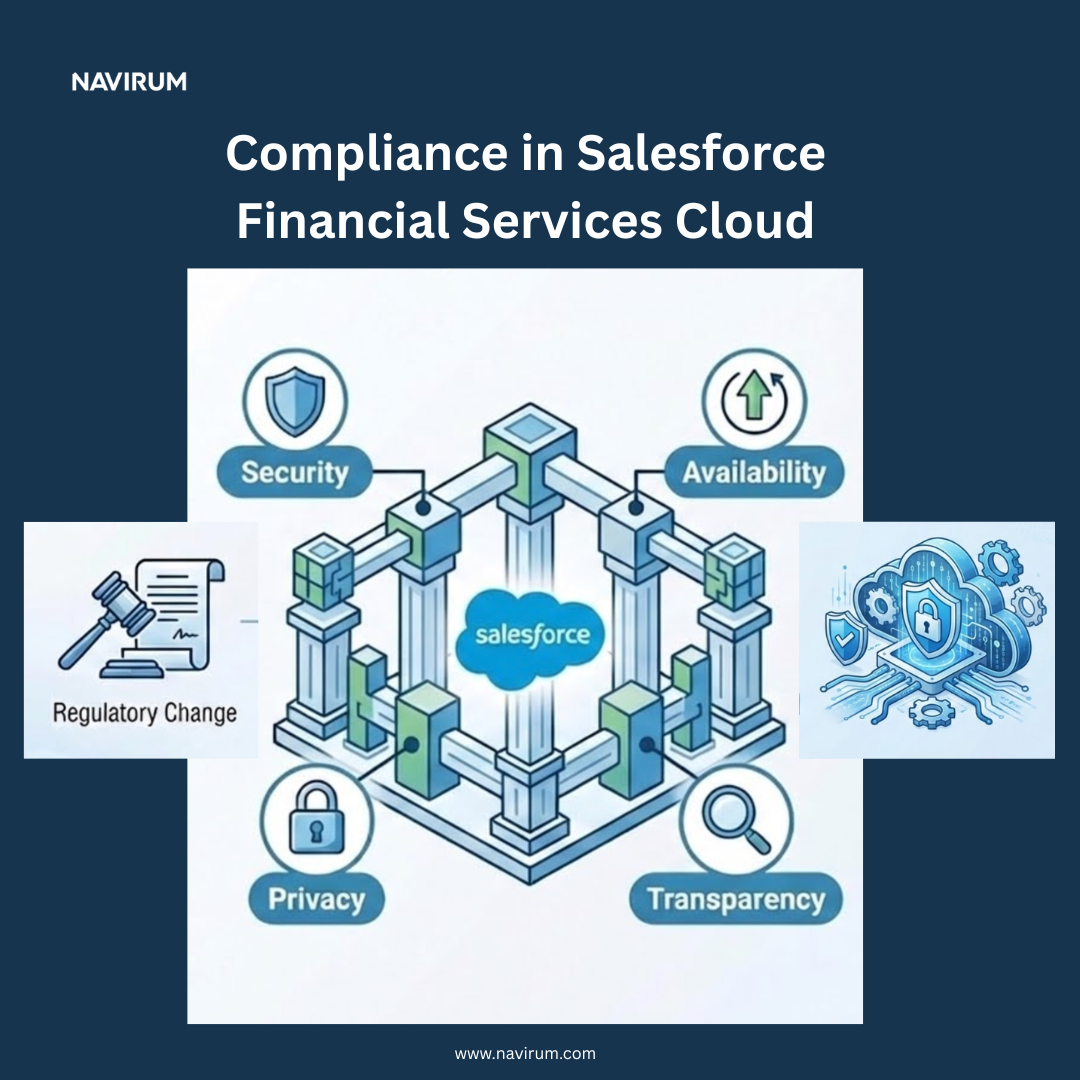
In a highly regulated environment, Salesforce offers the right to tools to ensure Compliance is an automated guardrail and not a manual bottleneck. A Compliance Oversight Agent can facilitate that every action is auditable and within policy.

For example, when an advisor suggests a new product or trade, this agent operates as a real-time risk filter, instantly verifying the recommendation against the client’s documented risk profile, liquidity needs, and long-term financial goals.

  • If the agent detects an exception (e.g., recommending a high-risk product to a conservative client), it proactively flags the discrepancy and triggers a clear, human-in-the-loop review process via Process Compliance Navigator.
  • Every agent action, every check, and every human override is logged in a secure, immutable audit trail—guaranteed by the Einstein Trust Layer.

The result: Seamless, embedded compliance that shifts the firm from reactive auditing to proactive, auditable risk mitigation. Deliver tailored advice at every touchpoint. By leveraging AI to surface timely insights and recommendations, while staying compliant in every step of the process.

Use Case 3: Next-Gen Client Service with Relationship Nurturing Agent

The goal of this Client Service Triage Agent is to scale service excellence without increasing human administrative load. Routine client requests can be addressed by automated processes that maintain the service quality and deliver the necessary information faster than what it would take the advisors to extract it from the right document or dashboard.

The Triage Agent can handle these requests 24/7 via chat, voice, or email. It uses pre-approved knowledge and actions to resolve up to 80% of routine inquiries independently.

For more complex requests, the agent will generate and escalate the ticket without mishandling the communication with the client. It packages the full conversational context, relevant account data, and proposed resolution path, and routes the case to the appropriate human specialist. The human adviser receives the ticket with the adequate contextual information, enabling a fast and informed resolution. 
The result: Seamless client experiences, data-driven growth, and reduced costs, ultimately resulting in faster resolutions and increased client satisfaction. Unified data and AI are used to predict client needs, enabling optimal actions and integrated operations to scale high-touch service. 

The New Operating Model: The Agentic Enterprise is here

Agentforce 360 allows wealth management firms to direct the human advisor toward high-judgment, high-empathy tasks that drive decisive growth. By deploying autonomous agents for prep, compliance, and routine service, firms can avoid spending capital on repetitive processes and instead invest in the exponential capacity of their superhuman teams.

The work of Navirum is to connect the Agentforce architecture to your firm’s unique business logic, moving you from AI ambition to quantifiable, trusted business transformation.

FAQ

What is Agentforce?

Agentforce is Salesforce’s new autonomous AI platform, designed to help organizations deploy trusted AI agents directly within the Salesforce ecosystem.
For wealth management firms, that means virtual agents can now analyze portfolios, surface client insights, automate service requests, and even support advisors in real time — all while staying compliant and secure within your Salesforce environment.

Our consulting team helps firms design Agentforce agents that align with their client engagement strategy, data governance requirements, and compliance standards.

How does Agentforce work?

At its core, Agentforce combines Salesforce’s Atlas Reasoning Engine, Agent Builder, and Einstein Trust Layer.
Together, they let firms build intelligent agents that understand client intent, pull relevant CRM and financial data, execute actions, and hand off to human advisors when needed.

We help clients configure Agent Builder to handle tasks such as lead qualification, account servicing, and personalized reporting — all integrated with your existing Salesforce Financial Services Cloud setup.

What are the key use cases for wealth management?

Agentforce opens up high-impact opportunities across the client lifecycle:

  • Operations: Streamline reporting and internal approvals through autonomous workflows.
  • Client onboarding: Automate KYC data collection and initial portfolio setup.
  • Advisor productivity: Summarize meeting notes, draft follow-up tasks, and prepare recommendations.
  • Client service: Provide instant, compliant answers to policy or performance questions.

How is Agentforce priced and deployed?

Every Salesforce customer can start experimenting with Agentforce for free under the Salesforce Foundations offering.
Beyond that, pricing scales with usage — typically based on the number of AI interactions or data actions processed.
Deployment follows Salesforce’s standard model, allowing firms to launch pilot agents within their existing org and expand incrementally.

Our consultants guide clients through sandbox testing, governance setup, and user adoption planning to ensure smooth rollouts.

What should wealth management firms consider before implementing Agentforce?

Before going live, it’s important to assess the following:

  • Data readiness: Ensure clean, accessible client and product data within Salesforce.
  • Compliance and guardrails: Define what agents can and cannot say or do.
  • Integration: Align Agentforce with financial planning tools, custodial platforms, and internal data systems.
  • Change management: Prepare advisors and support teams for new workflows and AI collaboration.

Our team specializes in financial services implementations, helping firms establish the right governance and security frameworks from day one.

Ready to Build Your Agentic Firm?

Agentforce represents a pivotal shift in how wealth management firms can scale personalized service, streamline advisor operations, and stay compliant in an AI-driven world.

Contact our Salesforce consulting team to explore an Agentforce readiness assessment or a tailored pilot project for your firm.

⭐⭐⭐ DISCOVER NAVIRUM ⭐⭐⭐

CSAT 5/5 – Salesforce AppExchange

Customer Success Stories

Salesforce Expertise

Roger HernandezDreamforce 2025 Unlocked: Three High-Impact Use Cases for the Agentic Wealth Management Firm

How Salesforce Transforms Venture Capital Firms

How Salesforce Transforms Venture Capital Firms’ Operations: From Deal Sourcing to Portfolio Management

Venture Capital’s New Operational Mandate

Venture capital has always been about identifying tomorrow’s winners today. But in today’s increasingly competitive and data-rich landscape, success demands more than instinct and networks—it requires visibility, speed, and operational precision.

Managing hundreds of relationships across LPs, startups, co-investors, and funds—while keeping tabs on performance metrics and fundraising—has become increasingly complex. Excel sheets and fragmented tools are no longer enough.

That’s where Salesforce enters the picture.

Salesforce for Venture Capital is more than just a CRM—it’s an end-to-end platform that connects deal sourcing, pipeline tracking, investor relations, and portfolio insights in one secure, customizable interface. Whether you’re a partner at a growth fund, an investor relations lead, or an operations executive, Salesforce helps you scale your firm’s impact while staying agile and data-driven.

In this article, we explore how Salesforce empowers VC firms to streamline operations, improve collaboration, and make faster, smarter investment decisions.

#1 Centralize Deal Flow and Relationship Intelligence

Venture capital is fundamentally a relationship business. But managing thousands of connections across founders, angels, accelerators, and other funds is nearly impossible without a system of record.

Salesforce allows you to capture every interaction—emails, meetings, notes, follow-ups—linked directly to contacts, startups, and deals. The result? A dynamic, living repository of institutional knowledge accessible across your team.

Benefits:

  • Eliminate duplicate efforts and lost opportunities
  • Instantly access a history of all touchpoints with a founder or startup
  • Customize scoring criteria and funnel stages for your firm’s investment thesis

VC Insight: Partners and investment professionals can instantly identify which team member has the strongest relationship with a founder and prioritize outreach accordingly.

#2 Accelerate Due Diligence and Internal Collaboration

When a high-potential deal hits your inbox, timing is everything. But vetting, collaborating, and coordinating across partners can quickly become a bottleneck—especially across remote teams.

With Salesforce, you can build deal-specific workspaces that integrate data rooms, diligence templates, and task assignments in one shared view. Use Slack for real-time updates and approval workflows to move faster from inbound to term sheet.

Benefits:

  • Centralize notes, documents, and investor memos
  • Automate reminders for follow-ups and stage transitions
  • Ensure consistent evaluation criteria across investment committee members

VC Insight: Associates and analysts save time and reduce context-switching; GPs stay informed and in control without micromanaging.

#3 Better Fundraising and LP Engagement

Managing Limited Partner relationships is just as critical as sourcing top-tier deals. With Salesforce, you can build a full picture of LP touchpoints, fundraising progress, and commitments—so your IR team is always prepared and proactive.

Track fund subscriptions, capital calls, side letters, and communications over time—whether you’re managing one fund or a dozen.

Benefits:

  • Segment LPs by geography, fund, commitment size, and interest
  • Automate capital call reminders and quarterly reporting
  • Use email journeys to keep LPs updated on performance and insights

VC Insight: IR teams can personalize outreach at scale, while partners gain clarity on fundraising cycles and LP sentiment ahead of renewal conversations.

#4 Real-Time Portfolio Management and Insights

Once you’ve invested, the real work begins. Tracking portfolio performance manually across dozens of startups leads to inconsistent data, missed red flags, and reactive rather than proactive support.

With Salesforce, you can build dashboards to track metrics like ARR, burn rate, headcount, and fundraising runway—automatically updated via integrated founder surveys or API connections to financial tools like QuickBooks, Xero, or Carta.

Benefits:

  • Get real-time visibility into portfolio health across sectors and stages
  • Identify companies that need support—or are ready to raise
  • Create investor-ready snapshots for reporting and board decks

VC Insight: Partners can quickly answer questions like “Which companies are at risk?” or “Who’s outperforming benchmarks?” without digging through spreadsheets.

#5 Streamlined Co-Investor Collaboration

In modern venture capital, deals are rarely done alone. Salesforce enables you to track syndicate participation, co-investor preferences, and collaboration history in one place.

Whether you’re co-investing with another firm or sharing deal memos, having a 360-degree view of the ecosystem helps you build trust, reduce friction, and find aligned opportunities faster.

Benefits:

  • Map and manage co-investor networks by focus, geography, and check size
  • Track who’s invested in which portfolio companies and when
  • Share diligence data securely through controlled permissions

VC Insight: Better co-investor visibility supports smoother syndication and faster capital deployment.

#6 Custom Workflows That Match Your Investment Strategy

No two venture firms operate the same way. Seed-focused firms track very different metrics than late-stage growth equity players. Salesforce’s flexibility allows your firm to create custom workflows, deal stages, fields, and dashboards that reflect your exact strategy and fund structure.

Whether you’re tracking SAFE vs. priced rounds, impact metrics, or token-based investments, Salesforce can be configured to your investment lens.

Benefits:

  • Avoid one-size-fits-all tools that limit innovation
  • Build automation into your existing process, not the other way around
  • Scale operations without sacrificing control or customization

VC Insight: Operations and platform teams get the structure they need, while partners retain the strategic flexibility to evolve over time.

#7 Built-In Security, Compliance, and Scalability

Security and data governance are non-negotiable for institutional VC firms. With Salesforce, your data is protected with enterprise-grade encryption, customizable access controls, and audit trails.

Salesforce also integrates easily with tools like DocuSign, Dropbox, ZoomInfo, and Gmail, creating a centralized ecosystem where your data and communications are fully secure and traceable.

Benefits:

  • Ensure full GDPR, SOC 2, and compliance alignment
  • Restrict access based on role, deal stage, or geography
  • Scale globally without introducing security risks

VC Insight: CIOs and compliance leaders can rest easy knowing every document, note, and action is traceable and secure.

Why Choose a Salesforce Consulting Partner for Venture Capital?

Salesforce is a powerful platform—but to unlock its full potential, you need an implementation tailored to the unique nuances of venture capital.

As a certified Salesforce consulting firm specialized in financial services, we bring:

  • Deep knowledge of VC operations and fund dynamics
  • Experience designing custom workflows for deal flow and fundraising
  • Expertise in integrating tools like Affinity, Carta, or PitchBook
  • A track record of successful implementations with 5/5 CSAT scores

We don’t just “install software”—we partner with your team to transform how you work.

Make Salesforce Your Competitive Edge in Venture

The future of venture capital belongs to firms that are not only great investors but also operationally excellent. Salesforce gives you the tools to amplify your edge—whether that’s sourcing better deals, supporting founders, or engaging LPs with clarity and confidence.

Don’t settle for outdated systems or disconnected data. Invest in a platform that grows with your firm.

Ready to See Salesforce for VC in Action?

Let’s talk about how Salesforce can give your venture firm a strategic advantage.

👉 Book a 30-minute discovery call with our VC solutions team
We’ll share use cases and explore how Salesforce can fit your fund’s workflow.

⭐⭐⭐ DISCOVER NAVIRUM ⭐⭐⭐

CSAT 5/5 – Salesforce AppExchange

Salesforce Expertise

Success Stories

Lavinia PicuHow Salesforce Transforms Venture Capital Firms

Top 7 Salesforce Features Every Private Equity Firm Should Use

In today’s fast-paced investment landscape, private equity (PE) firms must balance complex deal pipelines, investor relations, and portfolio management—all while ensuring compliance and data accuracy. The challenge is that many firms still rely on fragmented spreadsheets or disconnected CRMs that can’t scale with their growth.

That’s where Salesforce for Private Equity comes in. More than just a CRM, Salesforce is a complete ecosystem designed to centralize relationships, automate workflows, and surface insights that drive better investment decisions.

Whether your firm is focused on buyouts, growth capital, venture, or fund of funds, the right Salesforce features can give you a competitive edge. Below, we’ll explore the top seven Salesforce capabilities every private equity firm should leverage to optimize operations and enhance investor value.

# 1 Relationship Intelligence with Salesforce Financial Services Cloud

Relationships are the lifeblood of any private equity firm. Salesforce Financial Services Cloud (FSC) provides a unified view of all your contacts, investors, and portfolio companies.

With FSC, PE professionals can:

  • See a 360-degree view of each relationship, including communications, investments, and historical interactions.
  • Map complex relationship hierarchies across limited partners (LPs), general partners (GPs), and portfolio executives.
  • Use relationship insights to identify cross-sell opportunities or potential co-investors.

Instead of relying on static spreadsheets, your team gains real-time access to relationship data that evolves as your firm grows. This insight enables smarter networking and stronger deal sourcing.

# 2 Deal Pipeline Management with Salesforce CRM

Managing the deal pipeline can be one of the most complex parts of PE operations. Salesforce helps simplify this process with Deal Management capabilities that provide transparency and structure.

With Salesforce, you can:

  • Track every stage of the deal lifecycle—from sourcing and due diligence to closing and exit.
  • Automate task assignments, due diligence checklists, and approval workflows.
  • Gain real-time pipeline visibility across teams and funds.
  • Use customizable dashboards to monitor deal velocity, conversion rates, and pipeline value.

By standardizing your deal process within Salesforce, your firm can make faster, data-driven decisions while ensuring accountability across teams.

# 3 Investor Relations and Fundraising Automation

Investor relationships are critical for long-term success in private equity. Salesforce’s tools for Investor Relations (IR) allow you to manage communications, fundraising campaigns, and reporting—all from a single platform.

Key capabilities include:

  • Investor segmentation and personalized communications using Salesforce Marketing Cloud or Pardot.
  • Automated capital call and distribution notifications.
  • Centralized LP reporting with up-to-date performance data.
  • Integration with email and calendar tools to track all interactions.

With these features, IR teams can move from reactive relationship management to proactive engagement—improving LP satisfaction and streamlining fundraising efforts.

# 4 Portfolio Company Performance Tracking

Salesforce isn’t just for fundraising and deal flow—it’s also a powerful platform for portfolio monitoring. PE firms can build or integrate dashboards that track operational and financial metrics across portfolio companies.

Using Salesforce dashboards and analytics, firms can:

  • Consolidate key performance indicators (KPIs) from portfolio companies in real-time.
  • Visualize value creation initiatives and performance trends.
  • Integrate with accounting and ERP systems (like NetSuite or QuickBooks) for unified reporting.
  • Automate portfolio reviews with alerts for underperforming metrics.

This centralized visibility helps deal and operations teams align around data, not assumptions—leading to better portfolio management and value creation.

# 5 Data Analytics and AI Insights with Salesforce Einstein

In a market where data drives decisions, Salesforce Einstein brings the power of artificial intelligence (AI) to private equity. Einstein analyzes your firm’s CRM data to identify patterns, predict outcomes, and recommend next steps.

For example, Einstein can:

  • Predict which deals are most likely to close based on historical patterns.
  • Score LP engagement levels to identify at-risk investors.
  • Recommend next best actions for follow-ups or relationship nurturing.
  • Surface hidden correlations between portfolio performance and operational metrics.

By embedding predictive analytics directly into your workflows, Salesforce transforms your firm’s data into a strategic advantage.

# 6 Seamless Integration and Automation

Private equity firms rely on a variety of tools—data rooms, Excel, DocuSign, and financial reporting systems. Salesforce’s integration ecosystem makes it easy to connect these systems and automate manual processes.

With Salesforce’s open API and tools like MuleSoft, you can:

  • Integrate with deal sourcing platforms such as PitchBook or Preqin.
  • Sync investor data with fund accounting systems.
  • Automate document workflows using DocuSign or Box integrations.
  • Streamline onboarding and compliance processes.

These integrations reduce data silos, eliminate duplicate work, and ensure that your teams operate from a single source of truth.

# 7 Enhanced Compliance and Data Security

Regulatory compliance is non-negotiable in private equity. Salesforce provides robust security and compliance controls designed for the financial services industry.

Firms benefit from:

  • Role-based access controls to manage sensitive investor and deal information.
  • Audit trails for every change made in the system.
  • Data encryption at rest and in transit.
  • Compliance with major standards such as SOC 2, GDPR, and FINRA.

This gives your firm the confidence that all data—whether investor details or portfolio metrics—is protected according to industry best practices.

Customization and Scalability for Growing Firms

Every private equity firm has unique workflows, strategies, and structures. Salesforce’s low-code customization tools let you tailor the platform to your specific needs.

As your firm grows—whether by launching new funds or expanding globally—Salesforce scales effortlessly. You can add new users, integrate new systems, and deploy new functionality without starting from scratch.

Turning Salesforce into a Competitive Advantage for Private Equity

Salesforce has evolved far beyond traditional CRM—it’s now a comprehensive platform that helps private equity firms strengthen relationships, accelerate deal cycles, and make data-driven investment decisions.

By leveraging the top seven features outlined above—Relationship Intelligence, Deal Management, Investor Relations, Portfolio Tracking, AI Insights, Integration, and Compliance—your firm can modernize operations, deepen investor trust, and unlock long-term value creation.

At Navirum, we specialize in Salesforce consulting for private equity and financial services firms. From implementation to optimization, we help firms harness the full potential of Salesforce to drive performance and scalability.

Ready to transform your firm’s Salesforce strategy?
Use the button below to schedule a free consultation with one of our Salesforce for Private Equity experts.

FAQ

What makes Salesforce ideal for private equity firms?

Salesforce offers private equity firms a single platform to manage relationships, deal pipelines, and investor communications. Its flexibility, security, and scalability make it ideal for firms that need to centralize complex data while maintaining compliance and improving collaboration.

Can Salesforce integrate with tools like Preqin, PitchBook, or fund accounting systems?

Yes. Salesforce integrates seamlessly with third-party platforms using APIs or middleware tools like MuleSoft. These integrations allow your firm to sync deal data, investor profiles, and fund performance metrics automatically—reducing manual entry and improving data accuracy.

How long does it take to implement Salesforce for a private equity firm?

Implementation time varies depending on your firm’s size, data complexity, and customization needs. A typical Salesforce rollout for a PE firm can take anywhere from 8 to 16 weeks for a basic configuration, while more advanced deployments with automation and integrations may take longer.

Is Salesforce secure enough for sensitive investor and deal data?

Absolutely. Salesforce is trusted by leading global financial institutions and complies with major regulatory standards such as SOC 2, GDPR, and FINRA. Features like role-based permissions, audit trails, and advanced encryption help ensure data protection at every level.

How can a Salesforce consulting partner help private equity firms?

A certified Salesforce consulting partner—like navirum—helps private equity firms design, implement, and optimize their Salesforce environment. We tailor the platform to your workflows, integrate your existing tools, train your teams, and ensure ongoing ROI through continuous optimization.

⭐⭐⭐ DISCOVER NAVIRUM ⭐⭐⭐

CSAT 5/5 – Salesforce AppExchange

Salesforce Expertise

Success Stories

Lavinia PicuTop 7 Salesforce Features Every Private Equity Firm Should Use

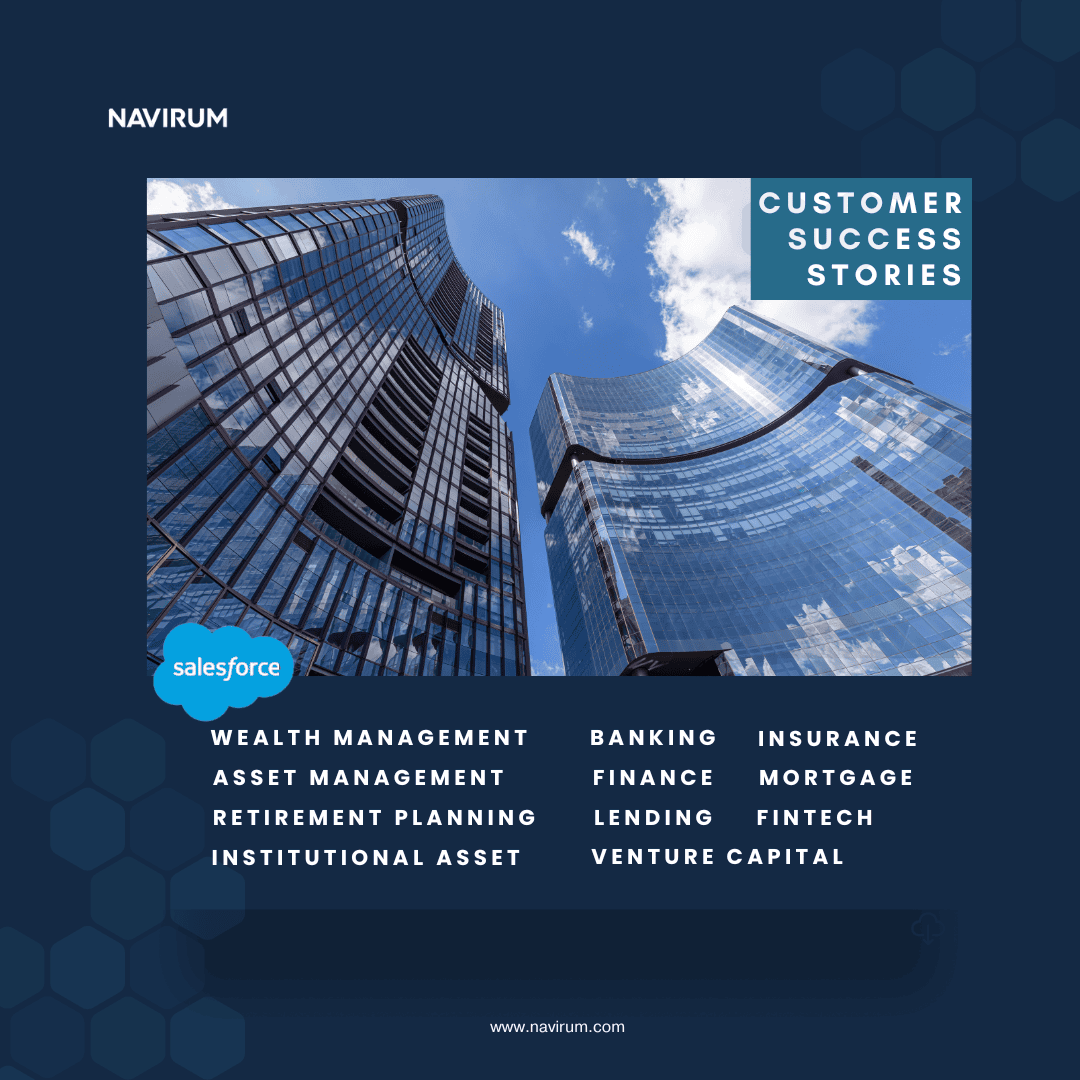
Wealth Management Salesforce Success Stories

See How Leading Wealth Management Firms Worldwide Succeed with Salesforce

In the evolving world of wealth management, client expectations are higher than ever. Forward-thinking firms are leveraging Salesforce Financial Services Cloud to deliver personalized client experiences, increase operational efficiency, and achieve measurable growth.

Our “Wealth Management Salesforce Success Stories” guide highlights real-world examples from Salesforce’s global clients — firms that have successfully transformed their business using Salesforce’s powerful tools and data-driven insights.

Download this free resource to discover how leading wealth management organizations are using Salesforce to:

  • Deepen client relationships with a 360° view of client data and interactions
  • Streamline advisor workflows to improve productivity and collaboration
  • Enhance compliance and transparency across all client engagements
  • Drive growth and retention with intelligent automation and analytics
  • Deliver personalized digital experiences through connected platforms

Whether you’re just starting your Salesforce journey or looking to expand your current implementation, these global success stories will inspire your firm’s next step in digital transformation.

Discover what’s possible with Salesforce for Wealth Management.

Download Now

Complete the form below to get your free copy and explore how wealth management firms around the world are achieving success with Salesforce.

Lead Magnet – Wealth Management Salesforce Success Stories

Download Wealth Management Salesforce Success Stories!

Name
Name
First Name
Last Name

Why Navirum?

As a Salesforce Consulting Partner, we help financial services organizations unlock the full potential of Salesforce — from strategy and implementation to optimization and support.
While the success stories featured in this guide are from Salesforce’s global clients, we bring that same innovation and expertise to every project we deliver.

Let these success stories inspire your next transformation!

⭐⭐⭐ DISCOVER NAVIRUM ⭐⭐⭐

CSAT 5/5 – Salesforce AppExchange

Salesforce Expertise

Success Stories

Lavinia PicuWealth Management Salesforce Success Stories

20 Insurance Salesforce Success Stories

20 Insurance Salesforce Success Stories: How Industry Leaders Are Transforming Financial Services

The financial services and insurance industries are changing faster than ever. From increasing compliance demands to evolving client expectations, firms are under constant pressure to innovate, streamline operations, and deliver personalized client experiences.

At the center of this transformation? Salesforce.

Across the insurance and wealth management sectors, Salesforce is enabling companies to unify data, automate processes, strengthen compliance, and improve advisor productivity.

That’s why we created our latest free resource, “20 Insurance Salesforce Success Stories” — a collection of real-world examples showing how insurance and financial services organizations are driving measurable results with Salesforce.

Why You’ll Want to Check Out This List

Whether you’re in wealth management, insurance, or another area of financial services, this downloadable list of 20 Insurance Salesforce Success Stories provides actionable insights into how Salesforce can solve challenges just like yours.

Here’s a preview of what you’ll discover inside:

  • Boosting Advisor Efficiency – How top firms have automated client onboarding and reporting to free up time for relationship building.
  • Enhancing Compliance & Oversight – Learn how leading insurers use Salesforce to ensure data integrity, audit readiness, and regulatory alignment.
  • Delivering Personalized Client Experiences – See how wealth and insurance advisors leverage integrated data and AI insights to offer tailored advice at scale.
  • Driving Growth Through Data Visibility – Explore how firms are using analytics and dashboards to uncover new business opportunities.
  • Seamless Integration & Scalability – Find out how organizations connect Salesforce with existing systems for a 360° client view.

Each story highlights practical outcomes — increased productivity, stronger compliance, better client retention, and more efficient collaboration across teams.

Who This Is For

This list of Insurance Salesforce Success Stories is a must-read if you’re a:

  • Financial advisor or insurance professional looking to optimize your workflows
  • Operations or compliance leader aiming to streamline regulatory processes
  • Technology or CRM manager responsible for Salesforce enablement in financial services
  • Executive exploring new ways to drive digital transformation and growth

See What’s Possible with Salesforce

At Navirum, we’ve helped dozens of financial services and insurance organizations unlock the full potential of Salesforce. The success stories featured in this guide reflect the real-world transformations happening across the industry — and the opportunities waiting for your business.

Don’t miss the chance to learn from what’s working right now. Get your copy of “20 Insurance Salesforce Success Stories and see how firms like yours are modernizing their operations, staying compliant, and delighting clients through the power of Salesforce.

About Navirum

Navirum helps financial services and insurance organizations implement, optimize, and scale Salesforce. Our experts specialize in CRM strategy, automation, and regulatory alignment, helping firms achieve measurable success.

⭐⭐⭐ DISCOVER NAVIRUM ⭐⭐⭐

CSAT 5/5 – Salesforce AppExchange

Salesforce Expertise

Success Stories

Lavinia Picu20 Insurance Salesforce Success Stories

Leadfeeder for Financial Services: Drive Smarter Leads and Sales Growth

Discover Leadfeeder for Financial Services: Transforming Website Traffic Into Warm Leads

In a highly competitive and regulation-driven industry, generating quality leads is a constant challenge. That’s where Leadfeeder for financial services steps in—helping firms transform anonymous website visitors into actionable sales intelligence.

Whether you’re a private equity firm, wealth advisor, fintech company, or commercial lender, Leadfeeder (now part of Dealfront) offers powerful website visitor tracking that integrates seamlessly with Salesforce to supercharge your lead generation and account-based marketing strategies.

In this guide, we’ll break down how Leadfeeder helps financial professionals identify intent, prioritize prospects, and close more deals—with data-backed confidence.

What Is Leadfeeder (Now Dealfront)?

Leadfeeder, now operating under the Dealfront platform, is a B2B website visitor identification tool that reveals which companies are visiting your site, what content they engage with, and how often they return. It empowers financial firms to understand buyer intent even when visitors don’t submit forms.

By integrating with your Salesforce CRM, Leadfeeder ensures that sales and marketing teams get real-time visibility into high-value visitor behavior—helping financial organizations improve conversion rates, shorten sales cycles, and increase pipeline visibility.

Why Leadfeeder Is a Game-Changer for Financial Services

Financial services firms face a unique set of challenges:

  • Long, relationship-driven sales cycles
  • Regulatory limitations on cold outreach
  • Limited insight into digital buyer behavior
  • High-value but low-volume deals

Leadfeeder for financial services solves these issues by uncovering invisible buying signals from your web traffic and turning them into prioritized leads your team can act on right away.

Key Benefits of Using Leadfeeder in Financial Services

1. Identify Anonymous Website Visitors

Over 95% of website visitors never fill out a form. For financial services professionals, that’s a lot of missed opportunities.

Leadfeeder identifies which companies are visiting your website—even if they remain anonymous—by matching IP addresses with its proprietary database. It surfaces company names, industries, employee counts, locations, and the specific pages they viewed.

Example:
A mid-sized hedge fund visits the “investment strategy” page of your asset management firm’s website multiple times in one week. Leadfeeder flags the company, and your sales team is now empowered to reach out before competitors do.

2. Seamless Salesforce Integration

One of the biggest advantages of Leadfeeder for financial services is its native integration with Salesforce. This allows visitor data to flow directly into your CRM, providing:

  • Automatic lead or account creation
  • Lead scoring based on engagement
  • Workflow triggers and alerts for sales reps

This integration ensures that your business development and relationship managers are always equipped with real-time behavioral data when reaching out to prospects or nurturing existing clients.

3. Supercharge Account-Based Marketing (ABM)

For commercial banks, investment firms, and fintech vendors practicing ABM, Leadfeeder delivers laser-focused visibility into target account engagement.

You can segment site visitors by:

  • Industry (e.g., real estate, manufacturing, healthcare)
  • Location (e.g., targeting U.S.-based companies only)
  • Company size (e.g., 100+ employees for mid-market deals)
  • Specific content viewed (e.g., case studies, whitepapers, pricing pages)

This allows financial marketers to tailor their outreach and sales enablement content to match the prospect’s interests and stage in the buying journey.

4. Better Lead Qualification and Sales Prioritization

Instead of chasing every visitor or contact, financial professionals can use Leadfeeder’s engagement filters and lead scoring to focus only on high-intent leads.

Sales reps can prioritize leads based on:

  • Number of visits
  • Time spent on critical product or service pages
  • Recent repeat visits
  • Specific financial product interest (e.g., “business lending” or “retirement planning”)

This improves sales efficiency and increases conversion rates across the board.

5. Compliant and Privacy-Friendly Lead Generation

Unlike tools that rely on cookies or capture personal data, Leadfeeder only tracks company-level information, keeping your lead generation efforts compliant with privacy laws like GDPR and CCPA—essential in the financial sector.

You can uncover warm prospects without invasive tactics or questionable data sources—an important consideration for regulated industries like finance, insurance, and banking.

6. Unify Sales and Marketing Teams Around Website Data

By feeding website intelligence into Salesforce dashboards and marketing automation platforms, Leadfeeder helps align sales and marketing on what’s actually working.

Both teams can track:

  • Which campaigns drive the most engagement
  • Which companies return frequently without converting
  • What kind of content correlates with closed deals

This helps marketing prove ROI while empowering sales with actionable, context-rich data.

Using Leadfeeder and Salesforce for Real-Time Prospecting

Let’s imagine for example that a commercial bank wants to expand into the healthcare sector in the Southeast. The process below describes how you can turn a lead into a qualified opportunity and eventually convert it.

Process:

  1. A healthcare technology company visits the bank’s “business credit lines” and “industry expertise” pages.
  2. Leadfeeder identifies the company and its location.
  3. Salesforce updates the company’s record and notifies the assigned relationship manager.
  4. An email or call is triggered with messaging focused on healthcare lending solutions.
  5. The lead is nurtured into a qualified opportunity and eventually converted.

This kind of real-time, data-informed outreach is what sets financial leaders apart in a saturated market.

Why Choose a Salesforce Partner for Leadfeeder Integration?

While Leadfeeder for financial services is powerful on its own, integrating it with Salesforce and aligning it with your workflows is where the real magic happens.

As a Salesforce consulting company, we help financial institutions:

  • Integrate Leadfeeder with Salesforce seamlessly
  • Set up automated workflows and scoring models
  • Customize dashboards for marketing and sales
  • Ensure compliance with data handling standards

Our team ensures that your investment in intent data turns into pipeline growth, faster conversions, and measurable ROI.

Leadfeeder for Financial Services Is a Growth Catalyst

In an industry where trust, timing, and relevance are everything, Leadfeeder for financial services provides the data-driven insights needed to reach the right prospects at the right moment.

By combining website intent data with Salesforce CRM workflows, your financial services team can:

  • Maximize lead quality
  • Shorten the sales cycle
  • Improve team alignment
  • Grow revenue—faster and smarter

Get Started Today

Want to learn how Leadfeeder and Salesforce can transform your lead generation strategy? Use the button below to book your FREE Leadfeeder Salesforce consultation. We’ll help you integrate, optimize, and get results—fast.

⭐⭐⭐ DISCOVER NAVIRUM ⭐⭐⭐

CSAT 5/5 – Salesforce AppExchange

Salesforce Expertise

Success Stories

Lavinia PicuLeadfeeder for Financial Services: Drive Smarter Leads and Sales Growth

Unlock the Full Potential of Your Advice with Salesforce FSC and Conquest Planning Integration

Why You Should Choose Salesforce FSC and Conquest Planning integration?

Advisors face increasing demands from compliance regulations, client expectations, and a growing array of software solutions designed to streamline operations. However, the common “swivel-chair” approach, where advisors juggle multiple disparate tools, significantly hinders their productivity and effectiveness.

Seamless integration between Salesforce Financial Services Cloud and leading financial planning solutions, such as Conquest Planning, significantly augments the advisor’s focus on both the immediate and the strategic priorities for each client and prospect. 

This article explores how Navirum’s expertise can integrate your Conquest Planning client data into Salesforce Financial Services Cloud, transforming an operational hurdle into an essential platform unification, ultimately boosting advisor productivity and client satisfaction.

The Unified Advisor Dashboard

For organizations managing multiple clients, extensive data, and complex regulatory landscapes, Salesforce serves as the definitive single source of truth, providing a 360-degree client view. This advanced ecosystem centralizes all client information—including CRM specifics, financial objectives, and portfolio holdings—and in a coherent, actionable way for advisors to act on. This capability extends seamlessly to financial planning, making it an integral part of the platform.

The financial planning process extracts considerable valuable data that can be concentrated in Salesforce, enabling faster preparation and more valuable client conversations. Moreover, when a financial plan is created and the goals of the client have been defined, the advisor can track the progress of said plans and goals in the Salesforce dashboard to quickly identify the clients that need proactive, immediate, attention. Consistent data across platforms allow advisors to confidently see the complete client picture instantly. No more data duplication or deep dives for client information.

From Data to AI-Augmented Insights 

Rich data sets are unlocking more added value for advisors and their clients. Deep financial plan metrics from Conquest can be combined with client information in the CRM to power Salesforce’s AI (Einstein) to create hyper-personalized experiences for the clients and prospects, whether it is a marketing campaign or a follow up email with specific call-to-actions. AI agents can suggest specific tasks related to cash flow milestones and future goals, unused cash or new insurance needs extrapolated from the plan. 

Clients’ persistent need of being heard and understood is addressed with the help of rich data that is converted into relevant touchpoints for the clients. By optimizing workflows, Navirum helps financial advisors leverage rich data to create more meaningful client interactions. This approach fosters engagement and builds trust by ensuring that AI assistants enhance, rather than overshadow, human-led decisions. Advisors maintain critical visibility and control, maximizing the value derived from these tools.

Proactive Compliance and Risk Management

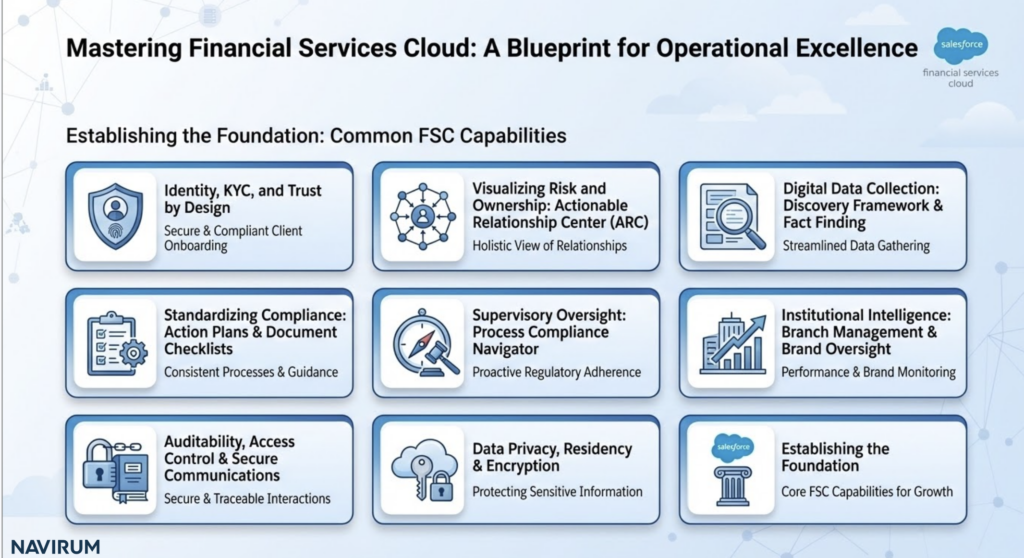
Salesforce Financial Services Cloud (FSC) plays a pivotal role in helping banks and financial institutions proactively manage regulatory compliance, especially with increasing burdens like CRM3. Previously, financial planning and risk assessment workflows were siloed. However, new technologies and unified workflows now enable a more holistic approach to advisor activities. By streamlining compliance operations and aligning financial plan risk and return assumptions with client intake forms and annual reviews, financial services firms can unlock significant value.

Integrating financial plans with Salesforce Financial Services Cloud (FSC) establishes a seamless digital record for compliance, powering automated, real-time checks for investment risk and suitability. All pertinent departments can easily access and manage this information within Salesforce. The system also enhances Client Services and Compliance efficiency through time-stamped audit trails and monitoring dashboards, which streamline regulatory reviews and facilitate proactive oversight and intervention.

Navirum – Your Partner in Integrated Growth

Integrating Salesforce Financial Services Cloud with Conquest Planning creates a unified platform that enhances the value and scope of the advice provided to clients. The integration boosts advisor effectiveness, ensures compliance, and meets client expectations by centralizing financial plan data. It empowers proactive advice, increases client engagement, and significantly improves productivity and retention.

Navirum specializes in making this critical transition a reality. Partner with our integration experts to turn your dual systems into a singular, high-performance revenue engine, delivering a superior experience for both your advisors and your clients. Reach out to us to schedule an exploratory conversation and discuss a proof of concept.

⭐⭐⭐ DISCOVER NAVIRUM ⭐⭐⭐

CSAT 5/5 – Salesforce AppExchange

Salesforce Expertise

Success Stories

Roger HernandezUnlock the Full Potential of Your Advice with Salesforce FSC and Conquest Planning Integration

Dreamforce 2025: The Blueprint for the Agentic Financial Enterprise

Dreamforce 2025: The Blueprint for the Agentic Financial Enterprise (A Navirum Perspective)

Financial Institutions are adopting AI-based solutions at an increasingly fast pace, but the challenge now lies in integrating AI seamlessly into their core banking, wealth, and insurance solutions. More than a side project, AI is now perceived as the operational backbone that will unify all aspects of the business with the help of ‘digital workers’.

Dreamforce 2025 took place last week in San Francisco, CA, where CEO Mark Benioff introduced Salesforce’s latest innovations and launched Agentforce 360, reinforcing Salesforce’s role as the core system in a company’s efforts to harness AI solutions and benefits.

Salesforce is enhancing its AI-driven solutions by implementing additional guardrails. These measures ensure that AI integrations adhere to user-defined boundaries, whether through comprehensive compliance procedures for agents or leveraging Data360 (formerly Data Cloud) services. Data360 will significantly boost agents’ ability to utilize existing cloud information.

Agentforce

Turning AI Hype into Financial Value with an ‘Agentic Enterprise’

Collaboration and teamwork have a new meaning in the agentic era, where humans can leverage AI agents (like Banking Agents or Claims Agents) to handle up to 70% of routine tasks and cut service costs. 

We’ve heard from firms like PenFed Credit Union who are already using these agents and empowering their employees to achieve better results and grow with their companies. Comprehensive 360-degree client views are being prepared effortlessly minutes before a meeting, including personalized reminders and “next best action” suggestions. 

Navirum is the partner that can design and integrate Agentforce to align with existing business rules and systems, via MuleSoft and Financial Services Cloud, to ensure the agents can take action and not just provide information.

Agentforce 360 for Financial Services

Powering Real-Time Compliance with Einstein Trust Layer and Process Compliance Navigator

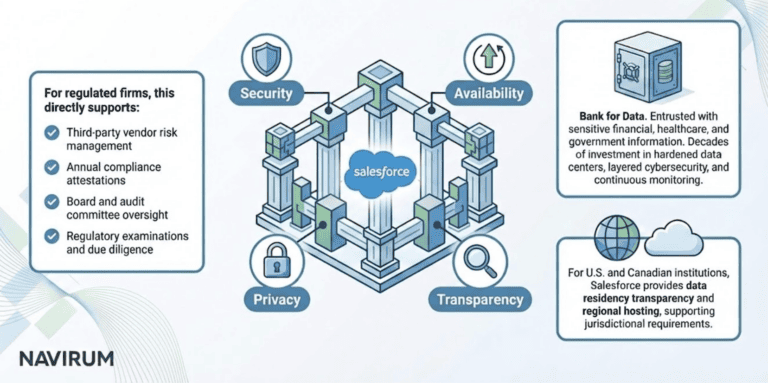
Highly-regulated industries, such as Financial Services, need Salesforce to provide certainty on how AI is using their information in a responsible and compliant way. That’s why during the 2025 Dreamforce, Salesforce emphasized the continuous improvements and enhancements into its Einstein Trust Layer, a secure AI architecture that permeates the whole Salesforce ecosystem. 

This robust set of features keeps sensitive information secure while maintaining audit trails intact, for KYC and AML purposes for example. Its data-masking and zero-data retention policies are helping companies mitigate risks by limiting agentic activities to be reviewed and approved by a human. Moreover, the introduction of the Process Compliance Navigator enables real-time checks into the compliance workflows for seamless oversight, reducing the risk of human error in complex, multi-step compliance tasks.

Navirum partners with financial institutions on optimization projects, leveraging our cybersecurity expertise and deep understanding of the regulatory landscape to address their key priorities.

Salesforce security and compliance in the agentic era

Data360 for Financial Services as the AI Foundation

Data Cloud has been rebranded Data360 to align with the new Agentforce 360 platform. Financial Institutions know well that a 360-degree view is necessary to capitalize on existing opportunities with both clients and prospects, but to do that you need clean, unified data for successful AI adoption.

Data360 unifies unstructured data from various financial services systems like core banking, policy, CRM, and web traffic. This consolidation helps extract insights for AI tools such as Slack and Tableau, ultimately improving efficiency by breaking down traditional silos.

Navirum can map, migrate and consolidate disparate financial data and make it AI-ready for our clients, enabling the creation of hyper-personalized client experiences.

Partnering with Navirum to Navigate the AI Transformation

Dreamforce 2025 has been a great example of Salesforce delivering the tools to empower organizations in today’s AI transformation. Navirum is your trusted partner to assess your current data and architecture, identify high-value and compliant pathways and build an integration blueprint to turn these innovations into real business value. 

Contact us for an initial consultation to explore the ways Navirum can help your organization reach new heights, with the power of Salesforce Financial Services Cloud and Agentforce.

In our next publication we will share some example use cases where Agentforce can unlock high-impact value. 

⭐⭐⭐ DISCOVER NAVIRUM ⭐⭐⭐

CSAT 5/5 – Salesforce AppExchange

Salesforce Expertise

Success Stories

Roger HernandezDreamforce 2025: The Blueprint for the Agentic Financial Enterprise

Women in Tech Spotlight: Insights on Salesforce for Financial Services

Women in Tech Spotlight: Insights on Salesforce for Financial Services

At Navirum, we pride ourselves on the deep industry expertise and technical leadership of our team. This month, we sat down with Cinchana Pushparaj, our Technical Services Manager, to discuss her journey in the Salesforce ecosystem, her experience delivering high-impact solutions for financial services clients, and her perspective on driving transformation with purpose.

With over a decade in IT and seven years of hands-on experience in Salesforce, Cinchana brings unmatched insight, leadership, and dedication to every client engagement.

From Accenture to Navirum: A Journey Built on Purpose

Q1: What inspired your journey into the Salesforce ecosystem, and what continues to excite you about working in this space?

I was drawn to Salesforce early in my career because of its ability to connect technology with real business outcomes. Coming from a traditional IT background, I saw how Salesforce empowered teams to innovate faster and bring customer-centricity to the heart of operations. What continues to excite me is how the platform keeps evolving—AI, automation, and data intelligence are now redefining how businesses serve their clients. There’s always something new to learn and a bigger impact to make.

Q2: You’ve led complex Salesforce implementations within financial services. What are some of the unique challenges financial institutions face, and how does Salesforce help solve them?

One of the biggest challenges I see is that many financial advisors struggle to serve their clients effectively because they’re weighed down by administrative tasks and disconnected data. Ideally, advisors should be focused on guiding clients through financial planning and investment strategies—but that’s difficult when critical information is scattered across multiple systems.

Salesforce addresses this by consolidating all relevant data into a single, unified platform, giving advisors the insights they need instantly. Having worked extensively with legacy systems, I’ve seen firsthand how limited they can be in meeting modern expectations. Salesforce’s ability to integrate with these older systems while providing a modern, intuitive interface fundamentally transforms how advisors work and significantly enhances the client experience.

Q3: Prior to joining Navirum, you played a key role at Accenture in global Salesforce rollouts. What lessons from that experience shape your approach today?

At Accenture, I worked on Salesforce implementations across industries and geographies, which taught me that technology is only as good as its adoption. Success requires understanding each stakeholder’s unique needs, balancing standardization with flexibility, and keeping the end user’s experience at the center of every decision. I also learned the importance of scalability, structured processes, and breaking complex initiatives into manageable phases. These lessons shape how I approach every project at Navirum—I prioritize understanding the “why” before the “how,” ensure solutions are intuitive, and focus on governance and flexibility so teams can adopt them seamlessly and achieve lasting value.

Salesforce in Financial Services: Challenges & Opportunities

Q4: How do you approach designing scalable Salesforce solutions for banking, wealth management, or insurance clients?

Designing scalable Salesforce solutions begins with a deep understanding of the industry, the business, its users, and long-term objectives. I map workflows, identify pain points, and incorporate regulatory and compliance requirements specific to banking, wealth management, or insurance. Scalability is built in from the start through robust data architecture, modular design, and flexible integration with legacy systems. I prioritize user adoption by involving teams early, gathering feedback, and creating intuitive, role-based experiences that minimize repetitive tasks. By balancing technical excellence, usability, and compliance, I deliver solutions that are flexible, efficient, and empower advisors and operations teams to serve their clients effectively.

Q5: Compliance and security are top priorities in financial services. How do you ensure Salesforce implementations stay compliant while remaining flexible?

Compliance and security are core to every Salesforce implementation I lead. I begin by understanding each client’s regulatory requirements—including Canadian legal standards for forms—and incorporate them into the solution from day one. This includes role-based access controls, data segregation, encryption, audit trails, and configurable validation rules to ensure compliance while maintaining flexibility. I also design modular frameworks and governance processes so the system can adapt as regulations or business needs evolve. The result is a solution that is secure, compliant, and practical, enabling advisors to work efficiently without compromising regulatory standards.

Q6: What Salesforce features or tools are making the biggest impact in financial services right now?

Salesforce is transforming financial services with tools built for the industry. Financial Services Cloud (FSC), which provides relationship mapping, household management, and compliance tracking, they enable advisors to work efficiently, stay on top of client needs, and deliver proactive, personalized service. Alongside Agentforce , it also supports advisors in building review meeting templates, fetching recent wire transfers or deposits, and providing relevant client information, enabling more informed and timely client interactions.

Leading with Impact at Navirum

Q7: As Technical Services Manager, how do you maintain technical excellence across all client projects?

What sets Navirum apart is our deep focus on financial services, combined with technical expertise and a client-first approach. We understand the challenges advisors face, the regulatory requirements, and the complexity of integrating with legacy systems or with custodian systems which lets us build solutions that are scalable and compliant. We take the time to understand each client’s needs and long-term goals, rather than offering one-size-fits-all solutions. Across all projects, we maintain technical excellence through best practices, team collaboration, and staying up to date with Salesforce innovations. The goal isn’t just to implement technology—it’s to make work easier, improve efficiency, and help advisors serve their clients better.

Q8: Navirum is known for its specialization in financial services. What do you think sets the company apart in this space?

What distinguishes our Salesforce consulting firm is our unique blend of financial services expertise and technical mastery in Salesforce solutions. We don’t just implement technology—we design solutions that truly align with the unique needs, regulations, and processes of financial institutions. Our team understands the complexities of banking, wealth management, and insurance, which allows us to anticipate challenges, streamline workflows, and deliver outcomes that drive real business value. Coupled with our collaborative approach and focus on customer success, this specialization enables us to provide solutions that are both scalable and practical, helping clients transform how they serve their customers.

Purpose, People, and Progress

Q9: Your work with a Canadian NGO shows a deep commitment to social good. How has that shaped your leadership style?

Working with a Canadian NGO reinforced a belief I’ve long held: technology should serve people, not the other way around. Teaching Salesforce to women in Montreal was particularly rewarding, as it showed me how the right tools can open opportunities and build confidence. That experience shaped my leadership style, teaching me to lead with empathy and consider the human impact of every technical decision. It’s made me a more patient listener, a thoughtful problem-solver, and deeply committed to building solutions that are accessible and genuinely improve people’s lives.

Q10: How do you stay focused and purposeful in such a fast-paced, high-stakes industry?

I stay focused in a fast-paced, high-stakes industry by keeping purpose and structure at the center of my work. I constantly reconnect with the “why/purpose” behind each project, and I’ve learned a lot from the mistakes I’ve made along the way. Breaking complex initiatives into clear steps, reflecting regularly, and staying aligned with outcomes helps me stay energized, resilient, and effective—even when things get busy.

Final Thoughts

Q11: What advice would you give to young professionals — especially women — aspiring to build a career in Salesforce and fintech?

Stay curious, confident, and persistent—Salesforce and fintech are constantly evolving, so a willingness to learn and adapt is key. Seek out challenging projects where you can see the real impact of your work, and don’t be intimidated by technical complexity. Build both your technical and business knowledge, especially in financial services, because understanding the bigger picture makes you invaluable.

For women in particular, trust your perspective, speak up, and own your expertise. Soft skills like communication, empathy, and collaboration are just as important as technical ability. Find mentors, build your network, and remember that diverse voices drive better solutions.

Q12: What’s one trend in the Salesforce world that financial services firms should be paying close attention to right now?

Two major trends are changing how financial companies work today: AI automation and connected data. Agentforce is helping advisors by taking care of repetitive, time-consuming tasks, so they can spend more time focusing on their clients and planning for their future. At the same time, Data Cloud brings information from different systems into one place, giving firms a clear, up-to-date picture of each client instead of having data scattered in different tools.

Stay Connected with Cinchana and Navirum

At Navirum, we’re passionate about helping financial institutions transform their operations through scalable, secure, and strategic Salesforce solutions. If you’d like to speak with one of our experts — or with Cinchana directly — don’t hesitate to book a consultation.

Navirum Client Success Stories in Financial Services

⭐⭐⭐ DISCOVER NAVIRUM ⭐⭐⭐

Thanks for reading!!!

Lavinia PicuWomen in Tech Spotlight: Insights on Salesforce for Financial Services

Tech Due Diligence in Financial Services Consolidation

Tech Due Diligence in Financial Services Consolidation:

How to avoid the new deal-breaker and turn DD into an efficient roadmap that paves the way to growth

In today’s technology-driven market, the risk of overlooking the target firm’s technology infrastructure and savyness, is a direct path to inheriting crippling security liabilities, uncontrollable integration costs and debilitating technical debt.

Financial Services firms in North America are facing growing pressures from compressing fees, rising regulatory costs, and fierce competition both from local and international firms. This environment is driving increased market consolidation, as firms seek to achieve the critical mass necessary for survival and growth. Traditionally, due diligence exercises focused on the commercial advantages, talent pool, sound legal standing and healthy financial ratios, but the technology stack has increasingly become a decisive factor in greenlighting mergers and acquisitions and determining the price tag associated with those.

This article makes the case for partnering with a technology expert like Navirum to perform a deep and strategic due diligence to give peace of mind to companies exploring an acquisition and uncover hidden potential before, during and after the integration. Navirum’s Salesforce Financial Services cloud expertise can transform a standard risk assessment into a clear roadmap aiming for operational excellence and accelerated deployment. Read on to learn how to de-risk your next consolidation and maximize your growth ambitions.

The Imperative for Diligence in a Fast-Paced Environment

The investment management landscape groups participants in those big institutions offering many if not most services, and the boutique providers offering differentiation and personal touch to their clients. However, we have been witnessing an increased willingness from large firms to access differentiated and/or more profitable products and services. Traditionally, the most attractive path to access these differentiators is through acquisitions, in order to quickly integrate the new offerings and resources and drive growth. 

Boutique asset managers, specialized hedge funds, and private capital allocators offer enticing potential for synergies and market differentiation resulting in more consolidation in the market. Moreover, reputable firms focusing on niche strategies are scrambling to meet new and enhanced regulatory requirements, highlighting the need for a bigger critical mass to keep operating efficiently.

However, these smaller, more agile firms can also come with potential pitfalls such as less-refined tech stacks, outdated systems and patchwork integrations that can present integration challenges and overspending, scalability limitations and significant security vulnerabilities. 

What to look for when assessing the target firm’s tech stack

A sound technology due diligence must evaluate existing systems, their data workflows and interoperability across multiple teams and processes. Client, fund and transaction data ideally are already integrated and optimized for scale.  If the potential acquisition has a growth ambition, then the existing systems should be able to handle 2x or 3x their current Assets Under Management (AUM).

Another area of focus is regulatory adherence in terms of data residency and privacy laws, considering the keen interest of both the public and regulators in cybersecurity risks and robots protocols for the future. Financial Services firms are more aware than ever about the reputational risks associated with data breaches. A reputable technology partner like Navirum helps you navigate the complexities of existing protocols and potential operational improvements.

A sound DD should not just flag gaps but also include an integration roadmap, with estimations of lead times and costs associated with achieving the acquisition goals. For this, the experience of your technology partner can be the deciding factor between lagging, meeting, or exceeding the expectations of the amalgamation.

The Advantages of Partnering with Navirum

When assessing the synergy potential and integration roadmap, a reputable technology partner like Navirum is essential for uncovering the additive or detracting value of the target firm’s tech stack. This valuable information effectively de-risk the transaction, stripping away unwanted surprises that may arise when an adequate DD is not performed. 

Moreover, Navirum provides actionable recommendations aimed at boosting the ROI of your partnership. Our experience with Salesforce Financial Services Cloud provides us with an unmatched innovation mindset to enable firms to eliminate data silos and automate compliance workflows and client reporting, supporting efficient operations while driving down cost pressures. 

In today’s landscape, a re-acquisition technology due diligence is a competitive necessity. It not only prevents bitter surprises down the road, but also steers the integration toward success. Navirum ensures that the technology due diligence is performed through the lens of modern, best-in-class technology platforms like Salesforce, providing the acquiring firm with a clear path to an efficient and scalable growth. 

To book a consultation, use the button below:

Navirum Client Success Stories in Financial Services

⭐⭐⭐ DISCOVER NAVIRUM ⭐⭐⭐

Thanks for reading!

Roger HernandezTech Due Diligence in Financial Services Consolidation