
WealthHub vs Salesforce FSC at a Glance
While WealthHub remains a trusted platform for trust administration and accounting, Salesforce Financial Services Cloud (FSC) offers a more comprehensive solution for managing client relationships, automating workflows, leveraging AI, and driving growth. For trust companies looking to modernize operations, improve client experiences, and prepare for the future of wealth management, Salesforce FSC provides a scalable platform that extends far beyond traditional trust administration. Many firms achieve the greatest value through a phased migration strategy that integrates existing trust systems with Salesforce FSC.
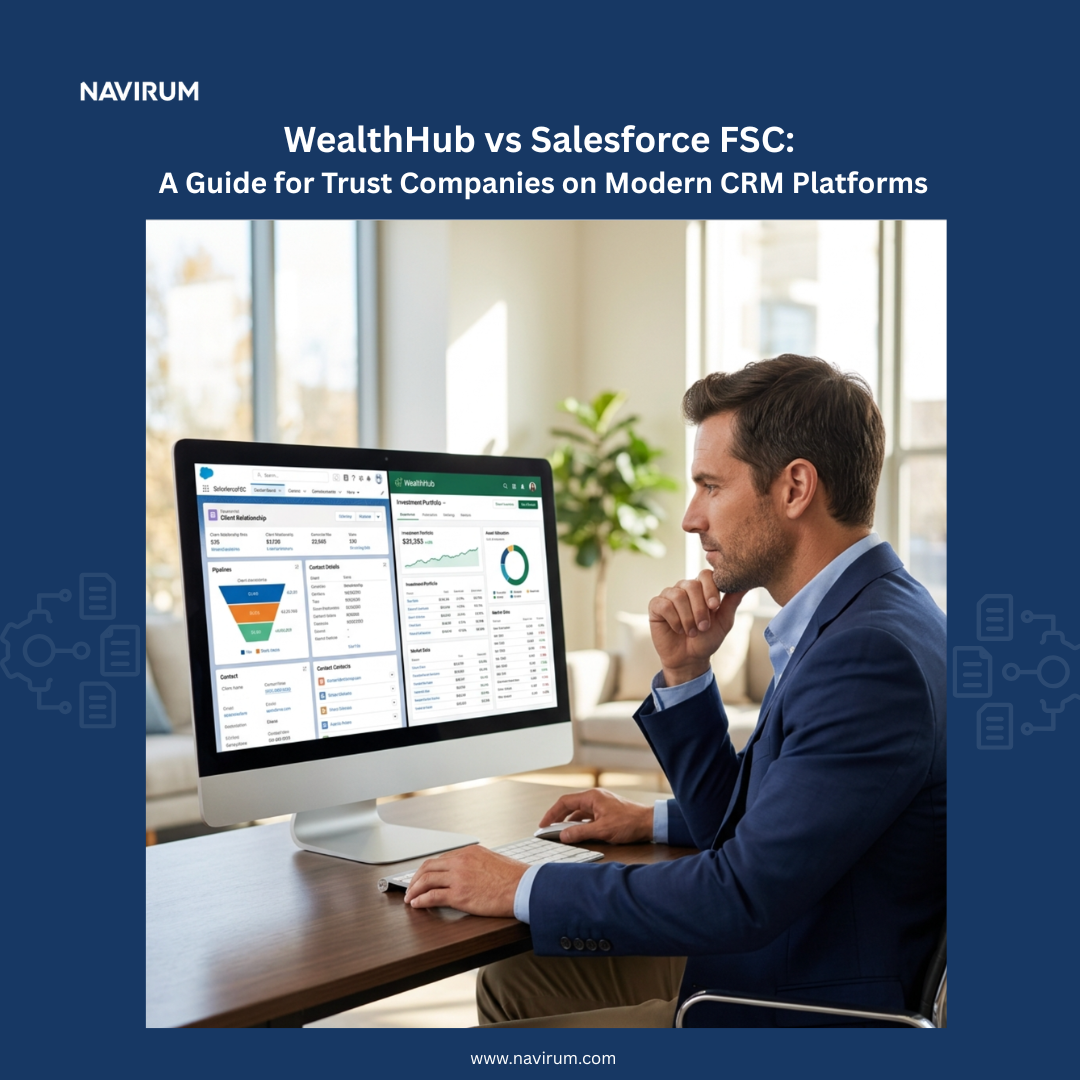
WealthHub vs Salesforce FSC
If your organization is evaluating WealthHub versus Salesforce Financial Services Cloud (FSC), you are not alone. Across the trust and wealth management industry, firms are reassessing their technology platforms as client expectations, regulatory requirements, operational complexity, and digital transformation initiatives continue to evolve.
For years, WealthHub has served as a trusted platform for trust administration, fiduciary services, and wealth management operations. However, many trust companies are discovering that traditional trust administration software alone is no longer enough to support growth, client engagement, advisor productivity, and AI-driven innovation.
At the same time, Salesforce Financial Services Cloud has emerged as a leading trust company CRM and wealth management platform, helping firms unify client relationships, automate processes, gain deeper business insights, and prepare for the future of financial services.
This guide compares WealthHub and Salesforce FSC while exploring why many trust companies are choosing Salesforce as the foundation of their digital transformation strategy.

WealthHub vs Salesforce FSC: At-a-Glance Comparison
While WealthHub excels as a trust administration platform, Salesforce FSC offers a broader digital ecosystem that supports client engagement, business growth, automation, and innovation.
| Capability | WealthHub | Salesforce FSC |
|---|---|---|
| Trust Administration | Excellent | Requires integration |
| Trust Accounting Support | Excellent | Requires integration |
| CRM Functionality | Limited | Advanced |
| Beneficiary Relationship Management | Moderate | Advanced |
| Family Relationship Mapping | Limited | Extensive |
| Workflow Automation | Basic to Moderate | Advanced |
| AI Capabilities | Limited | Extensive |
| Reporting & Dashboards | Moderate | Advanced |
| Mobile Experience | Limited | Modern |
| Integration Ecosystem | Moderate | Extensive |
| Marketing & Client Engagement | Limited | Advanced |
| Scalability | Good | Excellent |
Understanding WealthHub
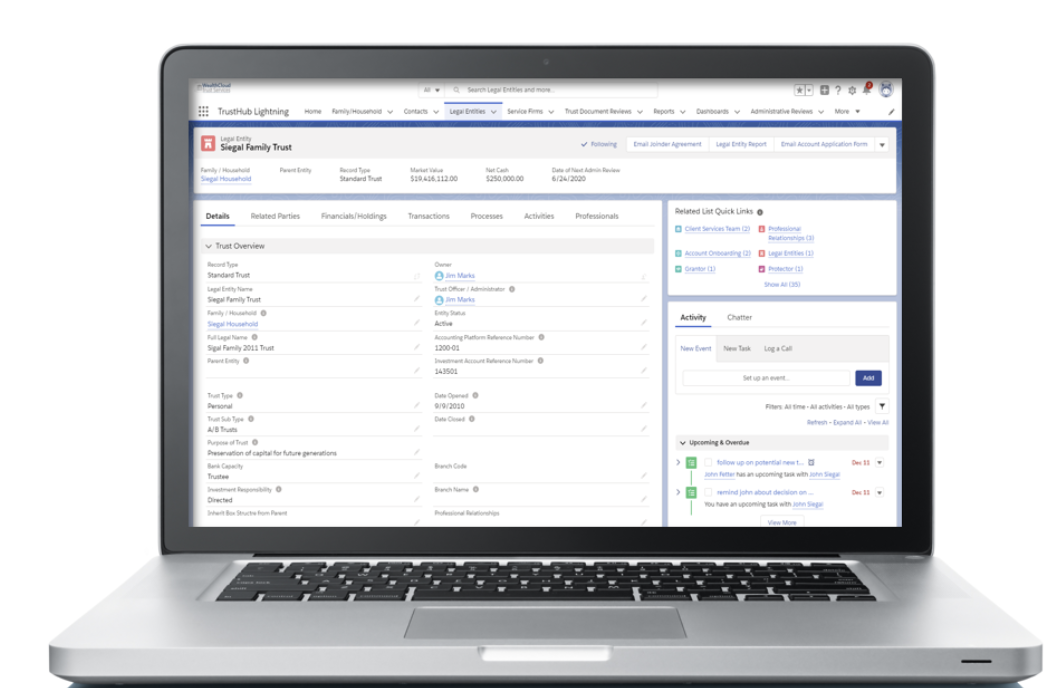
WealthHub was designed primarily to support trust accounting, estate administration, portfolio reporting, and trust operations.
For many trust organizations, WealthHub serves as a system of record that manages:
- Trust account administration
- Estate management
- Beneficiary information
- Trust accounting processes
- Asset tracking
- Reporting functions
- Regulatory documentation
Its strength lies in specialized trust administration capabilities developed specifically for fiduciary organizations.

✓ WealthHub Operational Strengths
WealthHub serves as an excellent operational system of record. Its power lies in specialized, highly detailed administration and bookkeeping designed specifically for fiduciary trust structures.
- ✓Trust account administration
- ✓Estate management
- ✓Beneficiary registration
- ✓Trust accounting processes
- ✓Fiduciary asset tracking
- ✓Financial reporting functions
- ✓Regulatory documentation
! Critical Relationship & Growth Gaps
While effectively handling accounting backbones, firms frequently outgrow the legacy experience. Scaling competitive operations requires modern ecosystem capabilities.
- !Client relationship management
- !Business development tracking
- !Marketing automation pipelines
- !Modern digital onboarding
- !Fully automated workflows
- !Advanced predictive analytics
- !AI-driven servicing models
- !Omnichannel client portals
However, many firms have discovered that while WealthHub effectively manages operational trust processes, it often requires additional systems to support:
- Client relationship management
- Business development
- Marketing automation
- Digital onboarding
- Workflow automation
- Advanced analytics
- AI-driven service models
- Omnichannel client engagement
As a result, organizations frequently operate multiple disconnected systems that create data silos and operational inefficiencies.
Understanding Salesforce Financial Services Cloud
Salesforce Financial Services Cloud is a purpose-built CRM platform designed specifically for financial institutions, wealth management firms, trust companies, private banks, and family offices.
Unlike traditional trust administration systems, FSC provides a unified platform for managing every aspect of the client relationship.
Key capabilities include:
Relationship Management
Track households, beneficiaries, trustees, attorneys, accountants, and related parties through a comprehensive relationship model.
Client Service
Provide advisors and service teams with a complete view of client interactions, requests, communications, and service history.
Digital Onboarding
Automate client onboarding workflows and document collection processes.
Workflow Automation
Streamline repetitive operational tasks through configurable business processes.
Analytics and Reporting
Generate actionable insights across client relationships, service performance, business development, and operational efficiency.
AI and Agentforce
Leverage Salesforce’s AI capabilities to improve productivity, client service, and operational effectiveness.
Ecosystem Connectivity
Integrate with trust accounting systems, custodians, portfolio management platforms, document management solutions, and third-party applications.
Rather than serving solely as a trust administration tool, FSC acts as the digital operating system for the entire organization.
Why Trust Companies Are Re-Evaluating Legacy Technology Platforms
The trust industry is experiencing significant change driven by several market forces.
Growing Client Expectations
Today’s clients expect personalized service, digital accessibility, proactive communication, and seamless interactions across channels.
Generational Wealth Transfer
As trillions of dollars transfer between generations, trust companies must engage digitally savvy beneficiaries who have very different expectations than previous generations.
Increasing Regulatory Complexity
Compliance requirements continue to grow, increasing pressure on firms to improve visibility, documentation, and operational controls.
Operational Efficiency Demands
Trust companies face increasing pressure to scale operations without proportionally increasing headcount.
AI and Automation Opportunities
Artificial intelligence is rapidly transforming financial services, creating both opportunities and competitive risks for firms that fail to modernize.
These industry shifts are causing many organizations to evaluate whether legacy trust administration software can support their long-term strategic goals.
Why Trust Companies Are Choosing Salesforce FSC
While trust accounting remains essential, competitive differentiation increasingly depends on client experience, advisor productivity, and operational agility.
Salesforce FSC helps trust companies modernize several critical areas.
Beneficiary Relationship Management
Trust relationships often involve multiple beneficiaries, trustees, attorneys, accountants, and family members.
Salesforce FSC enables firms to manage these relationships within a unified relationship model, providing employees with a comprehensive view of every stakeholder connected to a trust.
Family Relationship Mapping
Understanding family structures is critical for long-term client retention and succession planning.
Salesforce visually maps complex family relationships, helping advisors identify opportunities, risks, and future wealth transfer events.
Trustee and Advisor Collaboration
Trust administration frequently requires coordination among multiple internal and external stakeholders.
Salesforce centralizes communications, activities, documents, and workflows to improve collaboration and reduce delays.
Multi-Generational Wealth Management
As wealth transfers between generations, maintaining beneficiary engagement becomes increasingly important.
Salesforce helps firms develop stronger relationships with future decision-makers before wealth transitions occur.
Referral and Business Development Management
Many trust companies rely heavily on referrals from attorneys, accountants, family offices, and financial advisors.
Salesforce enables organizations to track referral sources, nurture relationships, and identify new growth opportunities.
WealthHub vs Salesforce FSC: Detailed Comparison
Key Differences
Why Trust Companies Are Moving Beyond Legacy Platforms
FREE CRM ASSESSMENT
Is Your Firm Ready to Move Beyond Legacy Platforms?
Navirum has implemented both WealthHub and Salesforce FSC for trust companies and wealth managers across North America. Let us help you evaluate the right path for your firm’s data, team, and growth roadmap.
No commitment · We follow up within one business day
The industry is undergoing a major transformation.
Trust organizations are facing challenges such as:
Increasing Client Expectations
Clients increasingly expect digital experiences comparable to those offered by leading consumer brands.
Generational Wealth Transfer
As trillions of dollars move between generations, firms must engage younger beneficiaries who demand digital-first experiences.
Talent Retention
Modern technology plays an increasingly important role in attracting and retaining employees.
Regulatory Complexity
Organizations require stronger controls, visibility, and auditability across operations.
Competitive Pressures
Banks, RIAs, family offices, and fintech firms are all competing for the same client relationships.
These trends require technology platforms that extend beyond traditional trust administration capabilities.
The Migration Question: Replace or Integrate?
Whichever path you choose, the decision doesn’t stop at replace-or-integrate. Trust companies moving onto Salesforce also have to decide what sits underneath FSC as the system of record for client and portfolio data. Our Data Cloud, Snowflake, and Databricks comparison breaks down when to lean on Data Cloud alone versus layering in a dedicated warehouse or analytics platform.
A common misconception is that migrating to Salesforce FSC requires abandoning existing trust accounting systems.
In reality, many successful trust companies adopt a hybrid approach.
Salesforce FSC becomes the front-office engagement platform while specialized trust accounting solutions continue supporting operational processes.
This strategy allows organizations to:
- Preserve existing investments
- Minimize disruption
- Modernize client experiences
- Improve employee productivity
- Create a unified data strategy
Over time, firms can determine whether additional modernization initiatives are appropriate.
The objective is not necessarily replacing every legacy application immediately.
The objective is creating a future-ready technology ecosystem.
7 Signs Your Trust Company Has Outgrown WealthHub
Not every organization needs to migrate from WealthHub. However, certain challenges often indicate that modernization should be considered.
1. Client Information Is Stored Across Multiple Systems
Employees must access several platforms to obtain a complete picture of a client relationship.
2. Reporting Requires Significant Manual Effort
Executives struggle to access real-time business insights without relying on spreadsheets and manual data consolidation.
3. Onboarding Processes Are Highly Manual
Client onboarding requires excessive paperwork, repetitive data entry, and multiple handoffs.
4. Relationship Visibility Is Limited
Teams cannot easily understand family structures, beneficiary relationships, or referral networks.
5. Automation Opportunities Are Being Missed
Employees spend valuable time performing repetitive administrative tasks.
6. AI Initiatives Cannot Scale
Legacy technology limits the organization’s ability to leverage modern AI capabilities.
7. Growth Is Being Constrained by Technology
Technology limitations make it difficult to improve service levels, expand operations, or support strategic growth initiatives.
How Agentforce and AI Are Transforming Trust Company Operations
Artificial intelligence is rapidly becoming a competitive differentiator in wealth management and trust services.
Salesforce Agentforce provides trust companies with opportunities to improve productivity while maintaining the human expertise that clients expect.
Potential use cases include:
Meeting and Call Summaries
Automatically capture client interactions and key action items.
Knowledge Management
Enable employees to quickly access trust policies, procedures, and institutional knowledge.
Workflow Assistance
Guide employees through complex trust administration processes.
Client Service Support
Provide service teams with relevant information and recommended next actions.
Operational Efficiency
Reduce manual effort across administrative workflows while improving consistency.
As AI adoption accelerates, firms operating on modern platforms will be better positioned to capitalize on emerging capabilities.
Navirum’s Recommendations
At Navirum, we rarely recommend a “rip-and-replace” approach for trust companies. Trust administration systems often contain years of operational history, specialized workflows, and critical fiduciary processes that remain essential to the organization.

Instead, we typically recommend a phased modernization strategy that focuses on delivering business value while minimizing operational risk.
- Client and Relationship Visibility
- Workflow Automation
- Data and Reporting Modernization
- AI Enablement
- Continuous Innovation
Phase 1: Client and Relationship Visibility
Establish Salesforce FSC as the centralized relationship management platform.
Phase 2: Workflow Automation
Automate onboarding, servicing, compliance, and operational processes.
Phase 3: Data and Reporting Modernization
Create a unified reporting framework that supports management and executive decision-making.
Phase 4: AI Enablement
Deploy Agentforce and AI capabilities to improve employee productivity and client service.
Phase 5: Continuous Innovation
Expand capabilities through integrations, analytics, automation, and new digital experiences.
This approach allows trust companies to modernize at a sustainable pace while protecting existing operational investments.
Takeaway
WealthHub continues to serve an important role for many trust organizations, particularly in trust administration and operational processing.
However, trust companies looking to improve client experience, automate workflows, leverage AI, gain deeper relationship insights, and support long-term growth increasingly find that Salesforce Financial Services Cloud offers a more strategic platform for the future.
The question is no longer whether trust companies need digital transformation.
The question is whether their current technology stack can support the next decade of client expectations, competitive pressures, and innovation.
For organizations seeking a future-ready platform that combines relationship management, automation, analytics, and AI, Salesforce Financial Services Cloud represents a compelling path forward.
FREE CONSULTATION
Still Deciding Between WealthHub and Salesforce FSC?
Navirum’s consultants have implemented both platforms for trust companies and wealth managers. We’ll give you an honest, experience-backed recommendation — tailored to your firm’s data, team, and regulatory requirements. No vendor bias.
No commitment · We follow up within one business day
Frequently Asked Questions
Can Salesforce FSC replace WealthHub entirely?
The answer depends on the specific needs of your trust company. WealthHub was designed to support trust administration, trust accounting, estate management, and fiduciary operations, while Salesforce Financial Services Cloud (FSC) was built as a client relationship and engagement platform for financial institutions.
Some organizations choose to maintain WealthHub as their trust accounting system while using Salesforce FSC as the front-end platform for relationship management, service, workflows, and reporting. Others may gradually reduce reliance on legacy systems as they modernize their technology stack.
For many trust companies, the most practical approach is not an immediate replacement but a phased modernization strategy where Salesforce FSC integrates with existing operational systems while delivering enhanced client experiences and operational efficiency.
Is Salesforce FSC designed specifically for trust companies?
Salesforce Financial Services Cloud was designed for the broader financial services industry, including wealth management firms, private banks, insurance organizations, asset managers, and trust companies. While it is not exclusively a trust administration platform, it offers capabilities that are highly relevant to trust organizations.
One of its greatest strengths is its ability to manage complex relationship structures involving trustees, beneficiaries, grantors, family members, attorneys, accountants, and other stakeholders. Trust companies can customize FSC to reflect their specific business processes while leveraging industry-specific data models and workflows.
This flexibility allows organizations to build a solution tailored to their fiduciary business without being constrained by the limitations of a traditional trust administration system.
How long does a typical migration take?
Migration timelines vary considerably based on the scope of the project. Factors that influence implementation duration include the number of users, complexity of business processes, volume and quality of historical data, integration requirements, and organizational readiness.
A focused Salesforce FSC implementation may take only a few months, while a larger digital transformation initiative involving multiple systems, departments, and integrations can take significantly longer.
Many trust companies choose a phased approach, beginning with relationship management and service capabilities before expanding into workflow automation, analytics, AI, and additional integrations. This strategy often reduces risk while delivering business value more quickly.
Can Salesforce manage beneficiary relationships?
Yes. In fact, managing complex beneficiary and family relationships is one of Salesforce FSC’s most valuable capabilities for trust companies.
Traditional systems often focus on accounts and transactions, whereas FSC focuses on people and relationships. The platform allows organizations to create a comprehensive view of households, family structures, trust relationships, beneficiaries, trustees, and external advisors.
This holistic view helps advisors and service teams understand the broader context of each relationship, identify opportunities for deeper engagement, and provide more personalized service. It is particularly valuable in multi-generational wealth transfer scenarios where understanding family dynamics can significantly impact long-term client retention.
Does Salesforce support regulatory compliance?
While Salesforce itself is not a compliance solution, it can play a significant role in supporting compliance programs across trust and wealth management organizations.
The platform provides detailed audit trails, workflow automation, approval processes, activity tracking, document management integrations, and reporting capabilities that help organizations demonstrate adherence to internal policies and regulatory requirements.
By automating key processes and creating consistent workflows, Salesforce can reduce operational risk and improve transparency. Many trust companies also integrate Salesforce with specialized compliance, governance, risk management, and document retention solutions to create a more comprehensive compliance ecosystem. As AI agents get added to that stack, the same rigor should extend to the AI governance framework for Salesforce.
Can FSC integrate with trust accounting platforms?
Yes. Salesforce is widely recognized for its integration capabilities and can connect with trust accounting systems, custodians, core banking platforms, portfolio management solutions, document management systems, and other third-party applications.
For trust companies, integration often allows Salesforce FSC to serve as the central relationship management platform while operational systems continue to manage accounting and fiduciary administration functions.
This approach enables employees to access relevant client information from multiple systems through a unified interface, reducing the need to switch between applications and improving both productivity and data accuracy.
What are the biggest benefits of migration?
The benefits extend far beyond simply replacing legacy technology. Organizations that implement Salesforce FSC often achieve improvements in client experience, employee productivity, operational efficiency, reporting, and business development.
Employees gain access to a complete view of client relationships, reducing time spent searching for information across multiple systems. Automated workflows eliminate many repetitive manual tasks, allowing teams to focus on higher-value activities.
Leadership teams benefit from real-time reporting and analytics that support more informed decision-making. At the same time, clients often experience faster service, more personalized interactions, and greater consistency across all touchpoints.
How does AI fit into trust company operations?
Artificial intelligence is becoming increasingly important for trust companies seeking to improve efficiency and enhance client service. Salesforce’s AI capabilities, including Agentforce and Einstein, can help organizations automate routine tasks, surface relevant information, and assist employees in making more informed decisions.
Examples include generating meeting summaries, drafting client communications, recommending next-best actions, answering internal knowledge questions, identifying service trends, and streamlining workflow execution.
While AI is unlikely to replace fiduciary expertise, it can significantly reduce administrative burden and enable employees to spend more time focusing on client relationships, strategic planning, and complex trust matters.
Is Salesforce suitable for smaller trust companies?
Absolutely. Salesforce is highly scalable and can support organizations ranging from boutique trust firms to large multinational financial institutions.
Smaller trust companies often benefit from Salesforce because it allows them to operate more efficiently without significantly increasing headcount. Automation, centralized client data, and streamlined workflows can help lean teams deliver a high level of service while maintaining operational discipline.
Additionally, Salesforce’s modular architecture allows organizations to start with a focused implementation and expand capabilities over time as business needs evolve and budgets permit.
What should trust companies evaluate before migrating?
A successful migration begins with a clear understanding of business objectives rather than technology requirements alone. Organizations should evaluate their current challenges, growth plans, client service goals, operational inefficiencies, and future technology strategy.
Key considerations include data quality, integration requirements, regulatory obligations, user adoption risks, process maturity, reporting needs, and long-term scalability. Trust companies should also assess how emerging technologies such as AI, automation, and advanced analytics fit into their future operating model.
Working with an experienced Salesforce consulting partner can help organizations develop a realistic roadmap, avoid common implementation pitfalls, and maximize the return on their technology investment.