
Key Takeaways
- The article lists The Top 10 Financial Planning Tools in Canada, highlighting their features, pricing, and Salesforce integrations.
- Financial planning software helps advisors analyze client finances and personalize recommendations, crucial as digital adoption grows in Canada.
- Key features of modern tools include goal-based planning, cash flow projections, and integration with CRM platforms like Salesforce.
- AI and integrated financial ecosystems are key trends reshaping financial planning tools in Canada.
- Navirum enhances the use of these tools by integrating them with CRM and automation for improved advisor productivity.
Discover the top 10 financial planning tools in Canada. Features, pricing, use cases, and Salesforce integrations for advisors and planners.
Estimated reading time: 20 minutes
What Is Financial Planning Software for Canadian Advisors?
Financial planning software helps advisors analyze client finances, model long-term financial scenarios, and deliver personalized recommendations. In Canada, these platforms are becoming increasingly important as financial institutions adopt digital technologies to improve efficiency and client engagement.
The Canadian fintech ecosystem continues to grow rapidly, with billions invested into financial technology platforms that support advisors, wealth managers, and financial institutions.
Many of these tools connect directly into a firm’s CRM, which is why maintaining strong Salesforce managed services for financial services matters as much as choosing the right planning software itself.
Modern financial planning tools typically support:
- Goal-based financial planning
- Cash flow and retirement projections
- Investment portfolio analysis
- Client collaboration and dashboards
- Integration with CRM platforms like Salesforce
For advisory firms, integrating financial planning tools with CRM and automation platforms allows advisors to deliver more personalized, data-driven advice while improving operational efficiency.
The Financial App Landscape is Far and Wide
Top 10 Financial Planning Tools Canada
In today’s fast-evolving financial landscape, Canadian advisors are increasingly adopting digital tools to strengthen client relationships, improve efficiency, and deliver deeper financial insights. The Canadian financial services sector is expanding rapidly, driven by innovation and supportive government policies around open banking that point to an even brighter future. Whether you’re managing a boutique practice or part of a larger firm, integrating purpose-built financial planning software into your workflow can unlock significant value – for both your business and your clients
Apps? Features, Benefits & Salesforce Integration
This comprehensive guide breaks down the top 10 financial planning tools in Canada—designed specifically to support advisors and planners. Each tool offers unique functionality, and we’ve included Salesforce integration details to help you choose solutions that align with your CRM strategy.
1. YNAB (You Need A Budget)
YNAB has become a go-to tool for budgeting enthusiasts—and for good reason. It applies a zero-based budgeting method that gives every dollar a purpose. While originally built for individuals, it’s gaining traction with financial coaches and advisors who support clients with debt reduction, cash flow management, and financial education.
Main Features:
- Zero-based budgeting approach
- Real-time sync with bank accounts (some Canadian banks require manual imports)
- Goal tracking, reporting, and workshop content
Benefits for Advisors:
- Builds strong spending discipline in clients
- Offers insight into behavioral patterns and habits
Insights:
- Clients using YNAB tend to reduce their debt faster and save more consistently
Cost:
- $18.49 CAD/month or $124.99/year (after 34-day free trial)
Use Cases:
- Coaching clients on monthly spending plans
- Financial literacy sessions for young professionals
Salesforce Integration: ✅ Yes – via Integrately or Zapier
Accessibility: Web, iOS, Android
Request Your Salesforce Readiness Assessment
Not sure if your tech stack is integration-ready? We’ll assess your current setup in one conversation. Designed exclusively for financial services firms.

2. Monarch Money
Monarch is a sleek, modern financial planning dashboard that brings all your clients’ accounts into one intuitive interface. Designed for visual thinkers and strategic planners, it allows users to track net worth, set financial goals, and simulate future financial paths.
Main Features:
- Aggregation of all financial accounts (banking, credit, investment)
- Goal setting and collaboration features
- Real-time updates and personalized insights
Benefits for Advisors:
- Encourages engagement in long-term planning
- Offers clients a clean visual of their full financial picture
Insights:
- Excellent for advisors with tech-savvy, millennial clients who want proactive tools
Cost:
- $20.72 CAD/month or $96.74/year with discount code
Use Cases:
- Quarterly reviews of net worth
- Retirement or milestone planning dashboards
Salesforce Integration: ❌ No native integration
Accessibility: Web, iOS, Android
3. Wealthsimple
As one of Canada’s best-known fintech success stories, Wealthsimple offers a hybrid of robo-advisory and DIY investing. It’s ideal for advisors looking to provide clients with hands-off portfolios or partner with a platform that handles compliance, rebalancing, and tax-loss harvesting.
Main Features:
- Robo-advisory investment management
- Registered and non-registered account support (RRSP, TFSA, etc.)
- Wealthsimple Tax and commission-free trading
Benefits for Advisors:
- Gives clients affordable investing options with minimal maintenance
- Transparent and user-friendly
Insights:
- Particularly useful for entry-level clients and passive investors
Cost:
- 0.4%–0.5% management fee; no account minimums for basic plans
Use Cases:
- Complement to in-house investment strategies
- Clients with small balances or ESG investing interest
Salesforce Integration: ❌ No direct integration
Accessibility: Web, iOS, Android
Guide to Succession Planning for Financial Advisors, RIAs & Wealth Managers
Succession planning for financial advisors is one of the most important — and most delayed — strategic decisions facing RIAs and wealth management firms today.
Whether you’re planning for retirement, preparing for internal succession, exploring external sale options, or building a long-term continuity plan, a structured RIA succession strategy protects your clients, strengthens firm valuation, and ensures business continuity.
Our free ebook, “30 Succession Planning Tips for Advisors, RIAs & Wealth Managers,” provides practical, actionable guidance to help you design and execute a succession plan that aligns with your growth strategy.

Navirum connects financial planning tools to Salesforce for wealth management firms. 30 minutes. No commitment. For financial services firms only.
4. PocketSmith
PocketSmith is a forecasting powerhouse. It’s perfect for advisors who want to help clients look beyond the next paycheck and into multi-decade cash flow scenarios. It’s not just budgeting—it’s financial time travel.
Main Features:
- Future cash flow forecasting up to 60 years
- Scenario analysis and budgeting categories
- Multi-currency and account sync
Benefits for Advisors:
- Helps clients visualize the long-term impact of decisions
- Assists in lifestyle and retirement goal setting
Insights:
- Empowers forward-thinking financial conversations
Cost:
- Free basic plan; premium starts at $9.95 USD/month
Use Cases:
- “What if” scenarios for life events (career changes, real estate, retirement)
- Tax strategy simulations
Salesforce Integration: ✅ Yes – via Zoho Flow
Accessibility: Web, iOS, Android
5. Wealthica
Wealthica is the go-to portfolio aggregator for Canadians. It pulls investment data from over 100 institutions and gives users a detailed, visual snapshot of holdings, returns, and allocation. Ideal for wealth managers, it provides back-office clarity and client-facing transparency.
Main Features:
- Investment portfolio aggregation
- Daily account syncing and performance metrics
- Developer API access
Benefits for Advisors:
- Centralizes multi-institution reporting
- Enables easy client reporting and reviews
Insights:
- Helps advisors identify duplication, underperformance, or misallocation
Cost:
- Free basic; Pro from $39.99/month
Use Cases:
- Quarterly performance reviews
- Integrated investment dashboards
Salesforce Integration: ✅ Yes – via API or custom connector
Accessibility: Web-based
6. Moka
Moka is Canada’s answer to Acorns—a micro-investing app that rounds up everyday purchases and funnels the change into diversified portfolios. For advisors serving first-time investors or low-commitment clients, Moka is a soft introduction to wealth-building.
Main Features:
- Automated round-up investing
- Managed portfolios with simple risk levels
- Goal-based saving tools
Benefits for Advisors:
- Introduces investing concepts without overwhelming clients
- Encourages habit formation around saving
Insights:
- Often a first step for younger clients into broader financial discussions
Cost:
- $3.99/month
Use Cases:
- Starter portfolios for Gen Z
- Habit-building programs in financial literacy campaigns
Cost:
Salesforce Integration: ❌ No integration currently
Accessibility: Mobile-only (iOS, Android)
7. Koho
Koho is more than a prepaid Visa—it’s a complete financial wellness platform. With built-in budgeting tools and savings features, it’s ideal for advisors looking to help clients manage their cash flow while earning cashback on purchases.
Main Features:
- Prepaid Visa card with budgeting dashboard
- Cashback rewards
- Automated savings features
Benefits for Advisors:
- Combines day-to-day spending tracking with financial goals
- No credit check or fees to get started
Insights:
- Helps clients build spending awareness without the debt of credit cards
- Free tier; $9/month for premium
Use Cases:
- Budget coaching clients
- Low-risk payment solutions
Salesforce Integration: ✅ Yes – via Koho – The Ultimate Analytics for Flex & CRE Operators integration
Accessibility: Web, iOS, Android
8. Spendee
Spendee brings design-focused simplicity to budgeting. It’s visually intuitive and ideal for clients who want to track spending with minimal friction. Shared wallets make it especially useful for couples and families.
Main Features:
- Visual expense tracking
- Shared and custom wallets
- Automatic transaction imports
Benefits for Advisors:
- Simple UX ideal for less tech-savvy users
- Collaborative budgeting features for couples
Insights:
- Encourages daily use and accountability
Cost:
- Free plan available; Premium from $14.99/year
Use Cases:
- Family budget coaching
- Daily expense tracking
Salesforce Integration: ❌ Not available
Accessibility: Web, iOS, Android
9. Justwealth
Justwealth is a Canadian robo-advisor offering deeper customization and dedicated human support. It’s positioned between DIY platforms and full-service wealth management, and it’s particularly popular for RESPs and long-term portfolios.
Main Features:
- Custom-built ETF portfolios
- Dedicated portfolio managers
- Tax-efficient strategies
Benefits for Advisors:
- Adds a layer of personalized service to automation
- Strong fit for families and long-term savers
Insights:
- Hybrid service structure appeals to cautious investors
Cost:
Salesforce Integration: ❌ Not supported
- $4.99/month; account minimum of $5,000
Use Cases:
- RESP planning
- Passive growth strategies
Salesforce Integration: ❌ Not currently supported
Accessibility: Web, iOS
The iA Private Wealth Advisor’s Blueprint for Salesforce FSC Success
The iA Private Wealth Advisor’s Blueprint was created based on extensive experience identifying the unique challenges and pain points of iA Private Wealth advisors, providing a clear path to a smooth and efficient Salesforce FSC implementation.

How can financial advisors evaluate ROI when investing in financial technology?
Evaluating the return on investment for financial planning tools requires looking beyond licensing costs and focusing on operational improvements and client outcomes.
Advisory firms typically evaluate ROI across several areas:
- Time saved through automation and reduced manual processes
- Increased advisor capacity to serve more clients
- Improved client retention and engagement
- Enhanced compliance reporting and documentation
Over time, firms that adopt integrated financial planning technology often see improved advisor productivity and stronger client relationships.
10. BMO SmartFolio
BMO SmartFolio is the digital portfolio management arm of BMO. It blends professional advice with a digital interface and is ideal for clients who want a big-bank presence backing their online investing.
Main Features:
- BMO-managed portfolios
- Personalized goal setting
- Automatic rebalancing
Benefits for Advisors:
- Aligns well with conservative clients
- Institutional trust and familiarity
Insights:
- Attractive for clients already banking with BMO
Cost:
- 0.4%–0.7% management fee depending on portfolio size
Use Cases:
- Low-maintenance retirement portfolios
- Cross-selling to BMO clients
Accessibility: Web, iOS, Android
Choosing the Right Tool for Your Practice
While each of these tools brings unique strengths, those like YNAB, PocketSmith, Koho, and Wealthica stand out for financial professionals seeking Salesforce-compatible solutions. By aligning your tools with your CRM, you’ll unlock deeper visibility into client behaviors and deliver more holistic financial planning services.
Key Technology Trends Shaping Financial Planning in Canada
Financial planning technology is evolving rapidly as fintech innovation and artificial intelligence reshape how advisors deliver advice. Canadian financial institutions are increasingly adopting digital platforms to streamline operations, automate processes, and enhance client experiences.
Several major technology trends are shaping the future of financial planning tools.

AI-Powered Financial Advice
Artificial intelligence is becoming a core component of modern planning platforms. AI can analyze large volumes of client data and generate recommendations for retirement planning, tax strategies, and portfolio optimization.
Some AI-based planning platforms can evaluate complex financial scenarios and suggest optimized planning strategies for advisors and clients.
Integrated Financial Ecosystems
Advisors increasingly rely on multiple fintech platforms for budgeting, portfolio tracking, planning, and client engagement. Integration between these tools and CRM platforms enables:
- centralized client data
- automated reporting
- improved advisor productivity
Open Banking and Data Connectivity
Canada is gradually moving toward a consumer-driven banking framework, which will allow secure sharing of financial data between institutions and fintech platforms.
This will significantly improve how financial planning tools connect with banking systems and client accounts.

Discover 3 Top Portfolio Management Tools in Canada
How Navirum Helps Financial Firms Modernize with Digital Transformation and AI

Adopting financial planning tools is only the first step toward building a modern advisory practice. The real value emerges when these platforms are integrated into a unified digital ecosystem that connects client data, planning workflows, compliance processes, and advisor insights. This is where strategic digital transformation becomes essential.
Navirum helps financial advisors, wealth managers, and financial institutions modernize their operations by combining financial technology platforms with CRM, automation, and artificial intelligence. Through deep expertise in financial services and Salesforce-based architectures, Navirum enables firms to create a connected advisor experience where planning tools, client engagement, and operational workflows work together seamlessly.
Key Areas Where Navirum Supports the Industry
1. CRM-Centered Financial Planning Architecture
Navirum helps firms build Salesforce-centric ecosystems where financial planning tools integrate directly with advisor workflows.
- Integration of financial planning platforms with CRM systems
- Unified client profiles combining planning, investment, and interaction data
- Automated client onboarding and data capture
- Centralized reporting and compliance visibility
2. Financial Data Integration and Automation
Financial advisors often struggle with fragmented systems and manual processes. Navirum streamlines data movement between planning tools and operational systems.
- API and middleware integrations between fintech tools and core systems
- Automated client data synchronization
- Workflow automation for financial planning updates
- Elimination of duplicate data entry and manual reconciliation
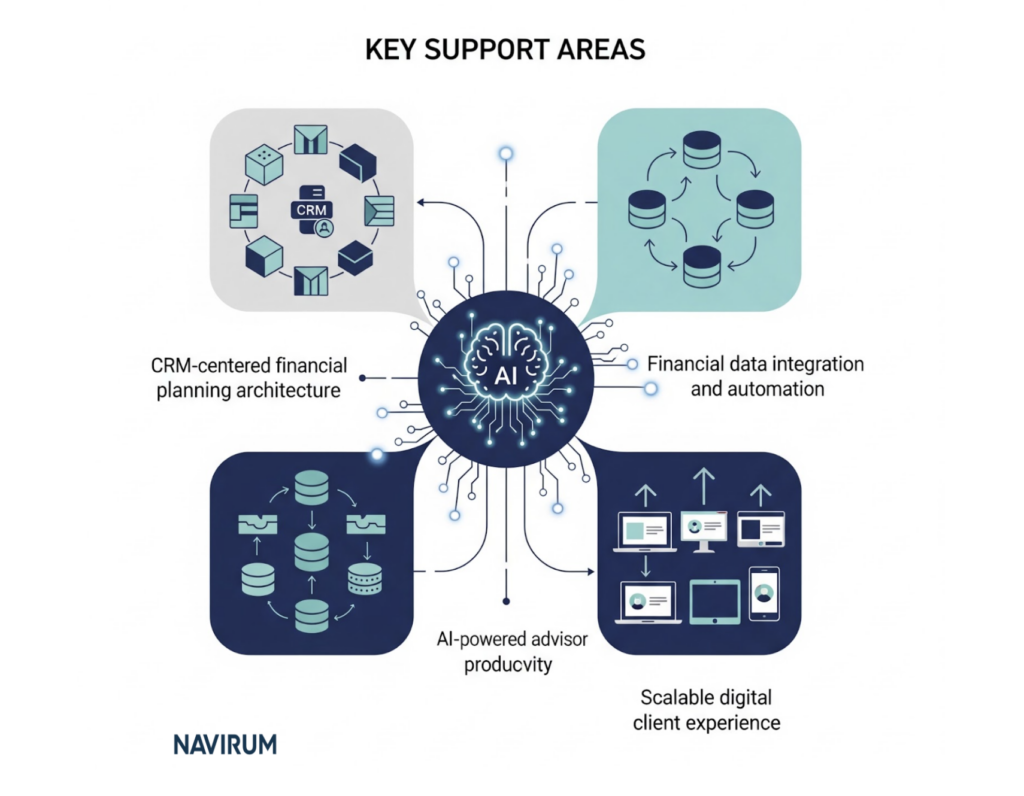
3. AI-Powered Advisor Productivity
Artificial intelligence is rapidly transforming how advisors deliver financial planning. Navirum helps firms deploy AI capabilities that augment advisor productivity and improve client outcomes.
- AI-assisted client insights and portfolio monitoring
- Predictive financial planning scenarios
- Intelligent workflow automation for advisors and service teams
- AI copilots for client servicing and operational tasks
4. Scalable Digital Client Experiences
Today’s investors expect a seamless digital experience similar to modern fintech platforms. Navirum enables firms to deliver client-centric digital journeys.
- Client portals integrated with financial planning dashboards
- Digital onboarding and automated document management
- Secure data sharing and collaboration tools
- Personalized financial insights delivered through digital channels
Turning Financial Tools Into a Strategic Advantage
Financial planning applications such as YNAB, PocketSmith, Wealthica, and Koho provide powerful capabilities individually. However, when integrated into a broader digital strategy, they become part of a much larger transformation that enhances advisor productivity, improves client experiences, and unlocks data-driven financial insights.
Navirum works with financial institutions, RIAs, and advisory firms to turn disconnected fintech tools into a cohesive digital ecosystem—helping advisors spend less time managing systems and more time delivering strategic financial guidance to clients.