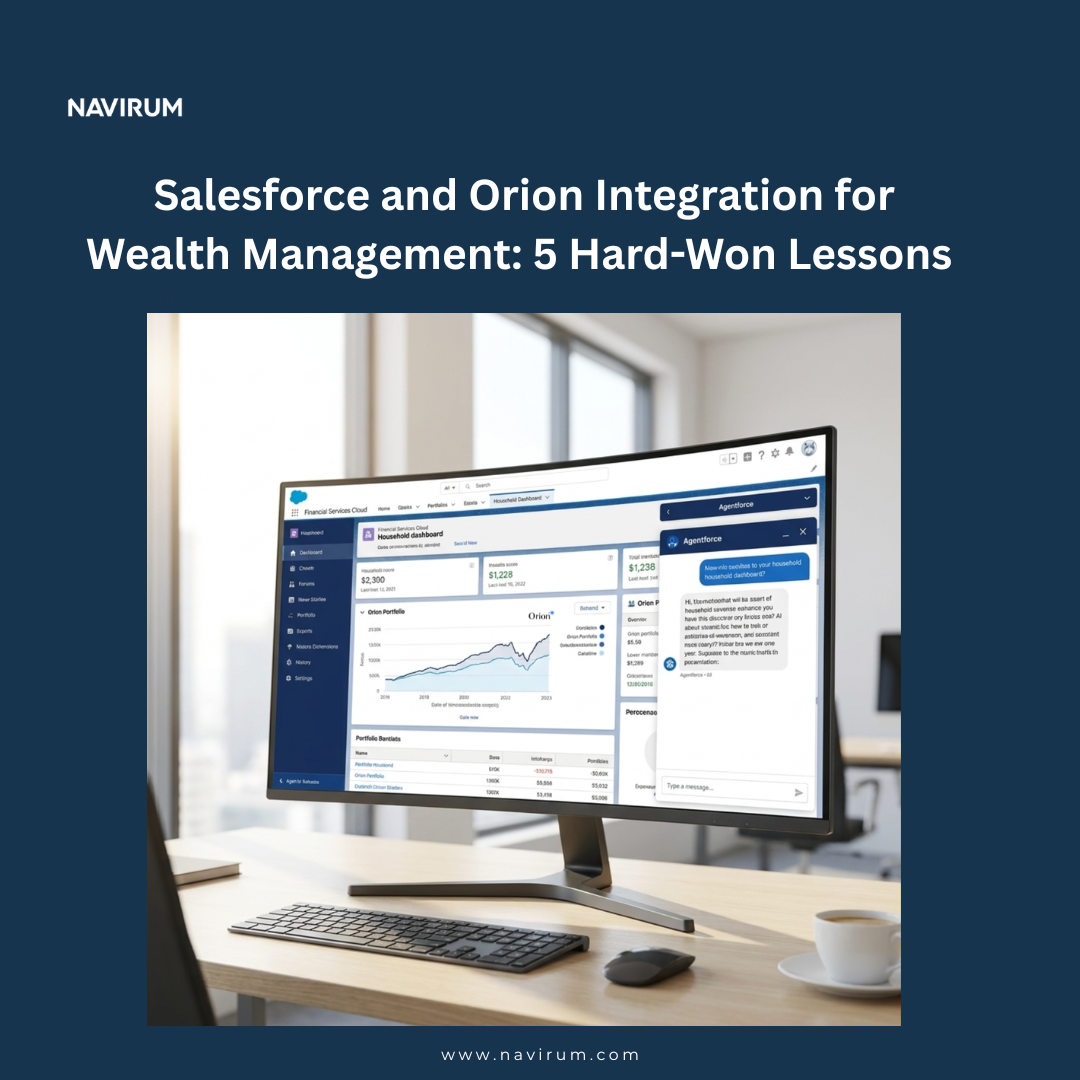
Orion Salesforce integration for wealth management.

This blog post explores five hard-won lessons for successfully integrating Salesforce Financial Services Cloud with Orion in wealth management. It explains how firms can create a stable, compliant integration by defining data authority at the field level, mapping Orion accounts to Salesforce households, establishing clear single-source-of-truth boundaries, routing custodian data through Orion, and preparing unified data for Agentforce. Rather than replacing Orion, wealth firms can keep it as the system of record for portfolio and custodian data while using Salesforce for relationships, workflows, compliance, and AI. The result is a unified advisor experience, stronger data governance, reduced reconciliation risk, and a foundation for scalable AI-driven workflows.
Salesforce and Orion can run as one integrated system for a wealth-management firm: Orion stays the system of record for accounts, positions, and performance, while Salesforce Financial Services Cloud owns the household relationship, workflows, and compliance record. The two sync on a defined schedule so advisors work from one unified view instead of switching between platforms.
Getting there well means deciding data authority per field before build starts, not after. The five lessons below cover the decisions that determine whether the integration is stable on day one or becomes a source of ongoing reconciliation problems.
Before You Start a Salesforce + Orion Integration
A Salesforce + Orion integration can modernize how a wealth firm manages relationships, portfolios, workflows, compliance, and AI-ready data. But most rework happens before build starts — when firms fail to define field authority, sync direction, household mapping, and the system of record.
Why Wealth Firms Are Integrating Salesforce and Orion in 2026
For most wealth-management firms, the question of what runs the practice used to have a simple answer: a CRM (often Redtail), a portfolio system (often Orion), and a stack of point tools bridged by hand. That answer worked at small scale. In Navirum’s experience, it stops working between roughly 50 and 150 advisors – the band where firms consistently outgrow Redtail’s configurability ceiling and start needing the next tier of platform. What firms typically migrate toward is Salesforce Financial Services Cloud (FSC) — executing the Orion integration in parallel — and they do it for four reasons:
Trust and security. Salesforce’s enterprise security model — granular sharing rules, field-level security, encryption, audit trails, and compliance certifications — is what regulated wealth-management firms can defend in front of auditors, custodians, and clients.
Configurability. FSC is built to be reshaped for the way each firm actually works – household models, custom workflows, advisor-specific layouts, role-based dashboards. Redtail’s configurability flattens out at scale; Salesforce’s keeps going.
Integration ceiling. Modern wealth practices touch ten or more systems. FSC’s API surface and ecosystem (AppExchange, MuleSoft, native connectors) clears the integration ceiling that constrains legacy CRMs.
AI strategy and Agentforce. In our experience, Agentforce is emerging as a leading choice for AI in regulated industries because it runs natively on governed Salesforce data, with the firm’s existing security model intact. Building an AI strategy on top of Redtail is fighting the tools; building it on top of FSC is using them.

What firms typically don’t want to migrate is Orion. Orion is a strong, deeply-integrated wealth platform – portfolio accounting, performance reporting, rebalancing through ASTRO and Eclipse, custodian connections to Schwab, Fidelity, Pershing, Raymond James, integrated risk analytics through HiddenLevers, and an established advisor experience for the portfolio side of the practice. It works. The win is not replacing Orion — it is integrating Salesforce with Orion so the advisor gets a unified surface and the firm gets the next tier of platform without throwing away what works.
This is the path most firms in the outgrowth band end up choosing once they understand it exists. And in our experience, a meaningful proportion of wealth-management leaders are not yet aware that this is the path — they assume migrating the CRM means rebuilding the portfolio side, or that the integration work is harder than it actually is. Neither is true.
(For firms specifically looking at the Redtail-side migration, see our Complete Guide to Redtail Migration – this article is the integration-side companion.)
Here are five lessons that materially change the outcome of a Salesforce + Orion integration project.
What Actually Breaks a Salesforce + Orion Integration
Five hard-won lessons, in the order they tend to bite.
The most common architecture mistake is treating one system as the “master” for everything. It feels clean on the diagram and breaks every time real data flows. This lesson is about the sync mechanics: direction, cadence, and which system’s API is authoritative for a given field at the moment of write. (Lesson 3 covers the governance layer on top of this: who is allowed to edit what, and how drift gets caught after the fact.)
The Bidirectional Sync Pattern treats Salesforce and Orion as co-equal systems of record, with explicit authority defined per data domain:
- Salesforce is authoritative for: relationships, households, contacts, advisor workflows, tasks, opportunities, marketing engagement, document linkage, compliance workflows, communication history.
- Orion is authoritative for: accounts, registrations, positions, holdings, transactions, performance returns, rebalancing instructions, custodian connections, billing.
- Boundary fields (lives in both): addresses, phones, emails, beneficiaries, risk profile. One side writes; the other reads. Pick which.
Once authority is declared, the sync architecture becomes simple. Orion pushes account, position, and performance data into Salesforce on a scheduled cadence (typically nightly with selective intra-day updates for trade-driven changes). Salesforce pushes relationship and demographic updates back to Orion on a similar cadence. Boundary fields flow one direction only — drift is impossible by design.
Across our wealth-management integrations, the firms that get this right ship a stable production integration in 30 to 60 days. The firms that try to make one system the master for everything spend six months and never quite get it stable.
Orion’s account hierarchy and FSC’s household model are both rich, but they don’t natively mirror each other. Orion thinks in registrations, accounts, and groupings; FSC thinks in households, individuals, and entities. Between them sits the question that has to be answered before any code is written: how does an Orion account roll up to a Salesforce household?
The cases that need explicit mapping decisions:
- Joint accounts – one Orion registration, two FSC contacts, one household
- Trust accounts – one Orion registration, one FSC entity, one household relationship
- Business / entity accounts – distinct from individual households
- IRAs and retirement accounts – typically tied to one individual, rolling up to a household
- Multi-generational households – multiple Orion accounts across multiple individuals, all rolling up to one FSC household
- Split engagements – divorced or separating clients with shared accounts in transition
- Closed accounts – keep linked? Detach? Archive?
The Account-Household Mapping Workshop is a structured pre-build session with your operations team, lead advisors, and (ideally) compliance. Walk through every account-type-to-household scenario your firm encounters. Document the mapping rules. Get signoff in writing.
This is the same playbook we run for Junxure migrations and Redtail migrations — in our experience, the workshop typically takes one afternoon and can save four to six weeks of late-stage rework. Skip it and you will be rebuilding the household model in production while advisors are trying to use it.
Lesson 1 covers the sync mechanics of field authority. This lesson is about the governance layer above it: the field-ownership matrix, who has edit permissions, and how reconciliation and audit trail catch drift after the fact. For any data field that exists in both Salesforce and Orion — client address, phone number, email, beneficiary, risk tolerance, KYC status — declare data authority and lock the direction of write.
The Single-Source-of-Truth Boundary is the compliance-grade discipline that separates well-architected integrations from those that trigger audit findings. Without it, an advisor updates a client address in Salesforce, an operations user updates the same address in Orion an hour later, and overnight the sync overwrites one of them. Now the records disagree. Three months later, a custodian sends statements to the wrong address, and the firm is explaining to a regulator why client demographic data is inconsistent across systems of record.
The fix is mechanical: pick one authoritative source per field, lock the other system to read-only for that field, and document the matrix. We typically end up with something like:
- Address, phone, email — authoritative in Salesforce; Orion reads.
- Risk tolerance and KYC — authoritative in Salesforce; Orion reads.
- Beneficiaries — authoritative in Salesforce; Orion reads (with custodian as the system of legal record).
- Account number, registration type, performance, balances — authoritative in Orion; Salesforce reads.
- Trade history — authoritative in Orion; Salesforce reads.
-
- Meeting prep agent – pulls household composition, relationship history, and goals from Salesforce; current positions, performance, and rebalancing flags from Orion (via Salesforce); planning context from eMoney or MoneyGuidePro. Produces a structured advisor briefing pack in seconds.
-
- Advisor research agent – surfaces life events, anomalies, and “next-best action” suggestions across the unified household record.
-
- Compliance review agent – scans for review-due triggers across both relationship and account data, generates tasks, documents the audit trail.
-
- Quarterly review prep agent – assembles the client-facing review pack from Salesforce + Orion + planning data.
-
- Long-tail care agent – birthdays, seasonal touches, life-event nudges, renewal window prompts.
- Orion (Orion Advisor Solutions) – Wealth-management technology platform providing portfolio accounting, performance reporting, rebalancing (ASTRO, Eclipse), risk analytics (HiddenLevers), and CRM (Redtail, acquired in 2022).
- Redtail – CRM software historically popular with U.S. wealth-management advisors. Owned by Orion since 2022.
- Salesforce Financial Services Cloud (FSC) – Salesforce’s industry-specific platform for wealth management, banking, and insurance, with native household, financial account, goal, and asset/liability objects.
- Agentforce – Salesforce’s enterprise AI agent platform, designed to deploy specialised AI agents on top of governed Salesforce data with the existing security model intact.
- Bidirectional Sync Pattern – Integration architecture where two systems exchange data both directions, with authority declared per field rather than per system.
- Single-Source-of-Truth Boundary – The explicit declaration of which system is authoritative for any given data field that exists in both.
- Custodian-Through-Orion Architecture – Pattern where custodian data ingress remains in Orion and Salesforce reads from Orion rather than dual-sourcing.
- Account-Household Mapping – The set of rules defining how Orion’s account hierarchy rolls up to Salesforce FSC’s household model.
- Salesforce Ridge Partner – Salesforce’s partner-tier designation indicating demonstrated repeated successful delivery in a specialised cloud or industry.
- Orbit Managed Services – Navirum’s predictable, retainer-based post-go-live support offering for Salesforce wealth-management implementations and integrations.
Done well, this becomes invisible to advisors — they edit in the right place and it just works. Done badly, this becomes the single biggest source of operational and compliance friction in the post-go-live period.
Get the Salesforce + Orion Integration Readiness Checklist
Get the Integration Readiness Checklist — a practical checklist of the sync, authority, and architecture decisions a well-planned Salesforce + Orion integration should have nailed down before kickoff.
Salesforce Ridge Partner · FSC and Agentforce Certified Team · Wealth Management Integration Specialists
Orion already has battle-tested connections to Schwab Institutional, Fidelity Institutional, Pershing, Raymond James, and the long tail of broker-dealer custodial platforms. These connections are core to what Orion does, and they handle the messy reconciliation, transaction-type normalization, and corporate-actions edge cases that take years of platform investment to get right.
The Custodian-Through-Orion Architecture is the proven integration architecture pattern that keeps Orion as the single ingress point for custodian data. Salesforce reads positions, balances, and transactions from Orion — not directly from the custodians. One pipe, one reconciliation surface, one source of truth for portfolio numbers.
The temptation, especially for firms with Salesforce-savvy in-house teams, is to build direct Salesforce-to-custodian connections in parallel — the thinking being “more is better.” It is not. Dual-sourcing custodian data into two different systems creates two different versions of the same numbers, and reconciling them costs more than the integration ever saves. Let Orion do what Orion is good at, and let Salesforce read the answer.
If a use case genuinely needs intra-day custodian data that Orion does not yet expose, the right answer is to push Orion to expose it (they often will), or to subscribe to a real-time custodian feed and route it through Orion — not to bypass.
Once Salesforce and Orion are integrated, the natural next move is Agentforce. This is where the integration earns its return many times over — and it is also why Agentforce is emerging as a leading standard for AI in regulated industries. Agents that work on your unified, governed, audited data with your existing security model are usable in production. Agents that work on dirty, fragmented data behind a chatbot facade are not.
The agents wealth firms typically deploy first on top of a Salesforce + Orion integration:
The Agentforce-on-Unified-Data Strategy is what turns the integration from a technical project into a strategic asset. Each agent is narrow, defined, and runs against the structured, governed data the integration created. Agentforce inherits Salesforce’s security model — sharing rules, field-level security, audit trails, encryption — which is what makes it deployable in regulated wealth-management environments where most generic AI tools cannot pass procurement.
Integration delivery order determines integration success: integration first, agents second. Agents on top of integrated, governed data are remarkable. Agents on top of fragmented data produce confident nonsense.
Integration first, agents second: if your Orion and Salesforce data model isn’t governed, Agentforce will only expose the mess faster. Request an Agentforce Assessment once the integration layer is in place.
Why Wealth Firms Trust This Approach
Two Navirum clients deployed Orion and Agentforce using this playbook.
$8B Tier-1 RIA: 38-Day Deployment (Anonymized Client Example)
38-day deployment with zero data loss. Three advisors immediately used Einstein Copilot for client research, with Deterministic Guardrails protecting every query. The compliance team approved the model with no re-audit required.
Regional Network: 120 Financial Advisors (Anonymized Client Example)
Phased rollout across 4 offices. Advisors saw 2.1x faster client household reconciliation, with time to value of 6 weeks from integration kickoff to first AI assistant live.
Salesforce vs Orion vs Salesforce + Orion Integrated: Capability Comparison
| Capability | Orion alone | Salesforce FSC alone | Salesforce + Orion Integrated |
| Client / household relationship modelling |
Limited (account centric) |
Rich, multi generational, entity aware |
+ unified across both systems |
| Portfolio accounting + performance |
Native, deep | Limited to custom data |
+ Orion data surfaced inside FSC |
| Custodian data ingestion |
Native (Schwab, Fidelity, Pershing, RJ) |
Possible but not Orion’s strength |
+ Orion remains the ingress; FSC reads |
| Rebalancing (ASTRO / Eclipse) |
Native | None | Triggered from FSC workflows where appropriate |
| Advisor experience | Portfolio-focused | Relationship-focused | Unified single surface |
| Compliance workflows | Account-level | Rich, configurable | + Account-level signals flowing into FSC |
| AI/Agentforce capability | None native | Full Agentforce platform | Agents work across unified data |
| Configurability | Constrained | High | Inherited from FSC |
| Marketing automation / engagement | Limited | Native + ecosystem | Unified to portfolio data for segmentation |
| Total cost of ownership trajectory | Stable but ceiling-bound for advisor experience | Higher initial; scalable | Highest initial; lowest TCO at scale + AI-ready |
Frequently Asked Questions
Can I keep Orion when I move my CRM to Salesforce?
How does the Salesforce and Orion integration work technically?
Is the Salesforce and Orion integration bidirectional?
What is the typical timeline for a Salesforce and Orion integration?
How does Agentforce work with Orion data?
Should custodian data flow through Salesforce or Orion?
Do I need to be a Salesforce Ridge Partner to do this integration?
What is the best Salesforce integration for wealth management firms?
Glossary
Discover Navirum


Online Resources, Knowledge and Insights
Explore our latest articles on Orion integrations, trusted AI data strategies, Agentforce innovation, and Junxure CRM migrations.
Elevate Your Financial Strategy with Orion Salesforce Integration
Connect Orion portfolio accounting with Salesforce to streamline operational workflows and unify client relationship management.
The Trusted Data Advantage: Turning AI into Business Value
Discover how establishing a cleansed, permissioned data foundation unlocks true ROI when deploying AI in financial services.
Transforming Wealth Management: Agentforce, FSC & Slack
Unlock advisor productivity by combining Agentforce AI agents, Financial Services Cloud, and Slack for seamless teamwork.
Junxure to Salesforce FSC Migration: 5 Key Lessons
Practical strategies and hard-won lessons for wealth management firms transitioning from legacy Junxure to modern Salesforce FSC.
Get our FREE E-Book!

Get our FREE E-Book!

Beyond Chatbots: How Agentic AI Scales AUM and Liberates Advisors in 2026
See how firms are reducing manual work by up to 90% using autonomous AI agents.

AI Compliance & Trust

AI Governance Gap In Financial Services

Recent Posts
-
The Agentic Advisor – Data Foundation and Quality

-
What Is The Agentic Advisor Architecture And Why It Matters?
-
Navirum Partners with CloudFiles to Enable Smarter Salesforce Document Workflows
-
What Are The Main Challenges For Advisors In Wealth Management And How Agentic AI Helps Solve Them?
-
The Agentic Advisor Is Coming to Wealth Management




Discover Our Podcast

Newsletter Sign Up

Explore Our Services

Book Your Salesforce Health Check Session