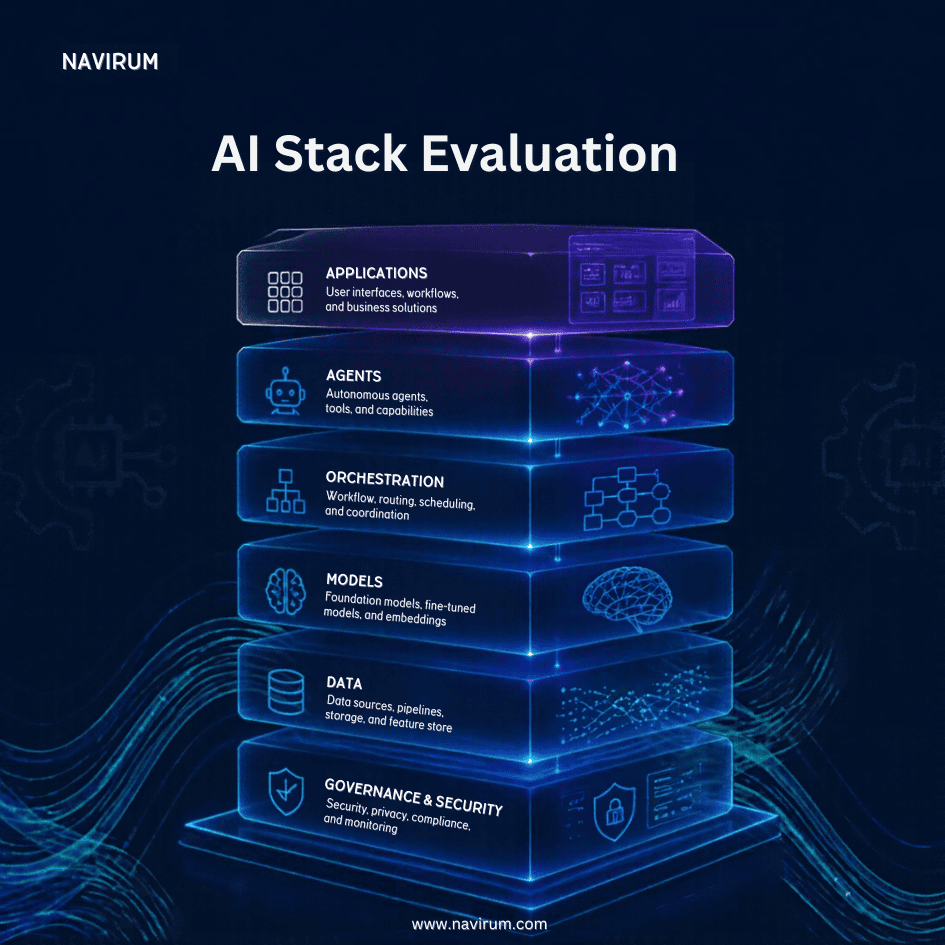
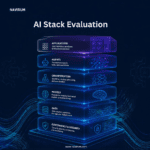
Financial AI Stack Evaluation
This guide compares six AI platforms for financial services: Salesforce Agentforce, Microsoft Copilot, Claude, ChatGPT Enterprise, Jump, and Zocks, across security, compliance, integration, and cost. Learn how each tool supports different financial workflows and what to consider when building a secure, cost-effective AI strategy for regulated environments. Discover how Navirum’s AI Assurance framework helps financial institutions validate AI controls, identify overlapping tools, and strengthen governance.
Key Takeaways
- Evaluate AI beyond model performance. Financial institutions must consider security, data boundaries, regulatory requirements, auditability, integration, and cost when selecting enterprise AI tools.
- Match each platform to the right workflow. Salesforce Agentforce supports CRM-based automation, Microsoft Copilot enhances workplace productivity, Claude supports complex document analysis, ChatGPT Enterprise enables general-purpose knowledge work, and Jump and Zocks focus on wealth advisory workflows.
- Treat governance as a deployment requirement. User permissions, data access controls, logging, and appropriate safeguards should be validated for each implementation rather than assumed from a platform’s enterprise positioning.
- Understand the total cost of ownership. Seat-based subscriptions and usage-based pricing create different cost profiles. Reviewing utilization, overlapping capabilities, and consumption is essential as adoption grows.
- Build an integrated AI strategy. A combination of general-purpose assistants, workflow agents, analytical tools, and specialized applications may serve financial institutions better than a single-platform approach.
- Validate before scaling. AI assurance can help organizations test model behavior, verify access boundaries, identify unnecessary tool overlap, and strengthen operational readiness.
Financial AI Stack Evaluation: Side-by-Side Comparison for Regulated Work
A comprehensive executive guide analyzing Salesforce Agentforce, Microsoft Copilot, Claude, ChatGPT Enterprise, Jump, and Zocks across security, compliance, data boundary handling, and operational cost.
Navigating the Financial Services AI Explosion
Financial institutions—from regional banks and credit unions to wealth management practices, insurers, and private equity firms—are facing an overwhelming array of artificial intelligence offerings. Every major cloud provider, enterprise software vendor, and boutique fintech startup is pitching AI capabilities designed to boost productivity and automate client interactions.
However, financial services leadership cannot evaluate AI purely on conversational fluency or feature velocity. Selecting an AI tool in a regulated institution requires balancing transformative operational efficiency against stringently enforced compliance, data residency, and fiduciary mandates.
The Four Non-Negotiable Evaluation Dimensions
When evaluating AI platforms for banking, wealth management, insurance, or private equity, Navirum assesses solutions across four core operational criteria:
1. Security & Data Boundaries
Guarantees that proprietary customer PII/NPI, portfolio ledgers, and trade secrets are never used for public model retraining, with strict SOC2 Type II, Reg S-P, and ISO27001 compliance.
2. Fit for Regulated Work
In-line enforcement of user permissions, role-based field entitlements, immutable interaction logging, and audit trail generation required for SEC, FINRA, and OCC examination.
3. Action Velocity & Systems Integration
The distinction between passive information retrieval (chatbots) vs. autonomous agentic execution capable of executing multi-system workflows directly in core platforms.
4. Total Cost & Subscription Predictability
Understanding fixed seat licensing versus consumption-based billing (e.g., per-conversation credits), avoiding unexpected cost overruns as usage scales.
Executive AI Comparison Matrix
Below is a side-by-side comparative analysis of the six primary AI platforms frequently evaluated by financial organizations, formatted so all details are immediately visible without horizontal scrolling.
Salesforce Agentforce
Autonomous Enterprise AgentFSC Onboarding, Client Service, KYC, Lead Triage, CRM Automation
Grounded in Data 360 with Trust Layer mask; zero public model training.
Flex / Consumption ($2 per conversation credit)
Microsoft Copilot
Desktop & Productivity AssistantOffice 365 drafting, M365 email summary, Teams notes, Excel analysis
Protected within Microsoft 365 tenant boundary; commercial data protection.
Fixed Seat ($30 / user / month add-on)
Claude (Anthropic)
Advanced Reasoning EngineComplex document analysis, regulatory text parsing, deal DD narrative
API/Bedrock tenant boundary isolated. Zero retention agreements available.
Seat or Token Consumption (API volume pricing)
ChatGPT Enterprise
General Purpose AssistantAd-hoc research, code generation, initial draft content, general Q&A
Enterprise privacy controls; customer data excluded from training. SOC2 compliant.
Fixed Seat (Enterprise tier commitment)
Jump
Wealth Advisory SpecialistAdvisor meeting prep, dictation, auto-generating compliance note-taking
Built for advisors; integrates into CRM with FINRA compliance focus.
Fixed Seat (Per advisor / month subscription)
Zocks
Wealth Meeting IntelligenceIn-person client meeting audio processing, wealth CRM auto-population
No audio recording storage option; structured wealth note extraction.
Fixed Seat (Per advisor / month subscription)
In-Depth Analysis by Platform
1. Salesforce Agentforce
Autonomous Agent PlatformAgentforce represents a shift from passive prompt-and-response AI to autonomous execution. Embedded directly inside Salesforce Financial Services Cloud (FSC), Agentforce agents operate on structured financial records, executing multi-step tasks like onboarding verification, policy changes, and service case resolution without leaving the system of record.
Native access to FSC data, atomic permission enforcement, autonomous action execution via Flow, grounded zero-retention Trust Layer.
Requires well-architected data foundations (Data 360) and defined guardrails to ensure agents operate within intended operational boundaries.
2. Microsoft 360 Copilot
Desktop Productivity AssistantCopilot excels at individual employee productivity across Word, Excel, PowerPoint, Outlook, and Teams. For financial analysts drafting investment memos or wealth managers summarizing lengthy Teams client calls, Copilot delivers immediate personal efficiency within the existing M365 security perimeter.
Seamless integration with M365 suite, leverage existing Azure AD permissions, fixed predictable monthly seat pricing.
Limited capability to execute transactional workflows in core banking engines or update external CRM systems automatically.
3. Claude (Anthropic via AWS Bedrock / GCP)
Deep Reasoning & Document AnalysisClaude (specifically Sonnet and Opus models) leads the industry in processing large context windows (200k+ tokens) with high nuance and reasoning fidelity. In private equity due diligence, insurance policy comparison, or complex regulatory document analysis, Claude minimizes hallucinations and handles dense financial prose exceptionally well.
Unmatched reasoning for long-form legal/financial texts, low hallucination rates, deployable inside private cloud VPCs.
Requires enterprise API orchestration or integration wrapper; lacks an out-of-the-box user interface tailored for non-technical business staff.
4. ChatGPT Enterprise (OpenAI)
General Purpose Enterprise AIChatGPT Enterprise provides a dedicated, privacy-shielded workspace for general knowledge work, coding assistance, and ad-hoc analysis. While popular for individual team research, financial institutions must enforce strict governance to prevent employees from pasting unverified client information into free-form prompts.
High user familiarity, versatile across multi-modal data, enterprise admin console with SSO and data encryption.
Operates as a separate browser tab silo away from core financial applications, making workflow automation difficult without custom API engineering.
5. Specialized Wealth Tools: Jump & Zocks
Wealth Advisory Vertical AIJump and Zocks address the specific pain point of wealth managers and advisors: meeting preparation, dictation, and CRM note entry. By capturing advisor-client dialogues and auto-formatting structured notes into compliance-ready formats, these tools eliminate administrative burdens for advisory practices.
Turnkey wealth advisor workflows, FINRA note formatting, direct integration into wealth CRMs like Salesforce FSC.
Niche point solutions that address meeting capture but do not extend to enterprise banking automation or cross-departmental operations.
Architecting a Balanced Multi-Tool Strategy
Most mature financial institutions do not settle on a single AI tool. Instead, executive teams deploy a multi-layered stack:
1. Core System Agentic Layer (Salesforce Agentforce): Handles structured client interactions, automated workflow execution, and CRM task fulfillment.
2. Desktop Productivity Layer (Microsoft Copilot): Assists individual employees with email drafting, document synthesis, and internal communication.
3. Deep Analytical Reasoning Layer (Claude / Bedrock): Powers specialized document intelligence, underwriting analysis, and legal text processing.
4. Specialized Front-Office Layer (Jump / Zocks): Streamlines advisor-client meeting capture and compliance documentation.
Evaluating or Deploying AI Tools in Your Financial Institution?
Navirum’s AI Assurance framework helps banks, wealth managers, insurers, and PE firms test model behavior, verify permission boundaries, eliminate overlapping tool costs, and maintain audit readiness.
Online Resources • Knowledge & Insights
Explore our latest research, frameworks, and strategic analysis on AI governance, Salesforce innovation, and technology adoption in financial services.
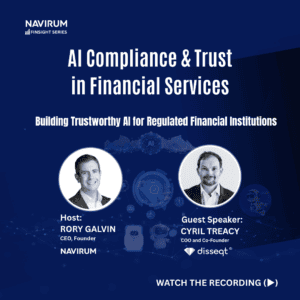
Claude, Slack and Salesforce: An AI Governance Framework
Establishing a trusted data advantage by turning AI into measurable business value, with robust data boundaries and permissions.

How Wall Street Private Equity Firms Can Leverage Salesforce and AI
Accelerating deal flow, streamlining due diligence, and driving portfolio value creation through intelligent platform automation.

Wealth Management Trends 2026: Challenges For Advisors and The Role of AI and Salesforce
Navigating information overload and operational friction to empower wealth advisors with real-time AI context.

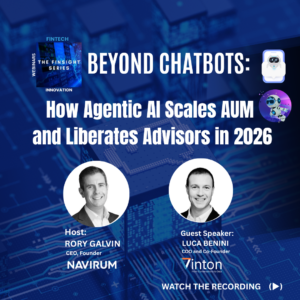
The Agentic Advisor Is Coming to Wealth Management
How autonomous AI agents execute administrative orchestration, liberating advisors to focus on expert fiduciary guidance.
What Are The Main Challenges For Advisors In Wealth Management And How Agentic AI Helps Solve Them?
A deep dive into eliminating context-switching tax, automating meeting prep, and managing larger books of business without sacrificing client touchpoints or human judgment.







Join the conversation