Key Takeaways
- Navirum joined financial services, fintech, and technology leaders at Money20/20 USA in Las Vegas, October 18–21, 2026.
- Conversations across the industry highlighted the growing focus on agentic AI, digital payments, and new financial technology.
- Trust, security, data quality, and governance remain essential to deploying AI in regulated financial services environments.
- Connecting existing systems and integrating new technologies are critical steps in turning innovation into measurable business value.
- Navirum values these industry conversations as an opportunity to exchange perspectives, strengthen relationships, and stay connected to the evolving needs of financial services organizations.
Navirum at Money20/20 USA 2026: From AI Ambition to Practical Impact
From October 18–21, 2026, Navirum joined industry leaders, fintech innovators, and technology providers in Las Vegas for Money20/20 USA, one of the financial services industry’s major gatherings.
The event brought together perspectives from across banking, payments, financial technology, and the broader financial services ecosystem.
A central question connected many of the industry’s conversations:
How can financial services organizations turn emerging technologies into practical, trusted solutions that deliver real business value?
From artificial intelligence and digital payments to the infrastructure supporting modern financial services, the discussions reflected an industry continuing to evolve.
For Navirum, participating in these conversations was an opportunity to exchange ideas, build relationships, and gain further perspective on the challenges and opportunities shaping the industry.
From AI Experimentation to Practical Application
Artificial intelligence continues to influence how financial services organizations approach customer experiences, operations, and business transformation.
At Money20/20, agentic AI and the potential for AI systems to take on more complex tasks were important themes in the broader industry conversation.
The focus is increasingly shifting from what AI can demonstrate to how it can operate within real business processes.
For financial institutions, that transition requires more than selecting the right technology. Organizations must consider how AI connects to their existing systems, accesses information, follows established permissions, and operates within appropriate controls.
Key considerations include:
- Data quality and accessibility: Ensuring AI can work with reliable, relevant information.
- Security and privacy: Protecting sensitive financial and customer data.
- Governance and oversight: Establishing clear boundaries, permissions, and accountability.
- Integration: Connecting AI capabilities with the systems and workflows employees already use.
- Measurable business value: Identifying use cases that improve productivity, service, and operational efficiency.
These considerations are particularly important in regulated financial services environments, where reliability, transparency, and trust are fundamental.
At Navirum, we see AI as an opportunity to improve how financial services organizations work. The objective is not simply to introduce new capabilities, but to integrate them thoughtfully into business processes where they can make a meaningful difference.
Building on Trusted Data and Connected Systems
As AI capabilities advance, the importance of the underlying technology infrastructure becomes increasingly apparent.
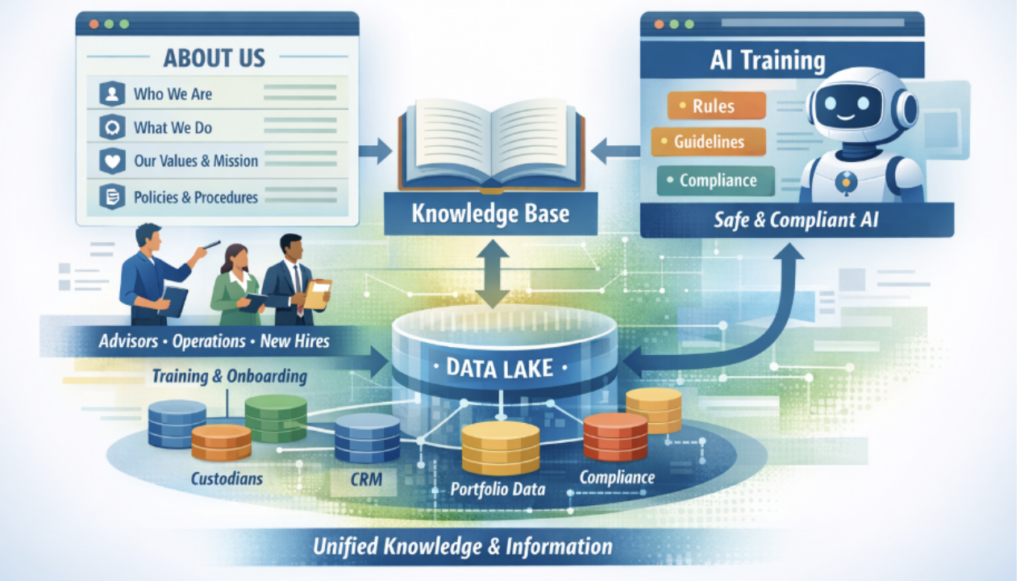
Financial services organizations often rely on multiple platforms to manage customer relationships, financial accounts, transactions, compliance, and operational workflows. When these systems operate in isolation, information can become fragmented, processes can require manual intervention, and employees may struggle to access the context they need.
Connecting these systems creates opportunities to improve both operational efficiency and the quality of information available to employees and AI tools.
For example, a wealth management firm could connect Salesforce Financial Services Cloud with its portfolio management and planning systems to give advisors a more complete view of client relationships and financial information.
With appropriate integration, data access controls, and governance, this foundation can also support AI-assisted meeting preparation, research, and workflow automation.
The same principle applies across banking, insurance, and fintech: AI is only as useful as the data, systems, and processes supporting it.
For organizations exploring AI adoption, establishing this foundation is an important step toward moving from experimentation to scalable implementation.
Trust, Security, and Governance Remain Essential
Innovation in financial services must be accompanied by a clear understanding of risk and responsibility.
As organizations explore AI agents, automated workflows, and increasingly connected platforms, they must determine how these technologies will operate within existing security and compliance requirements.
Questions around data access, authorization, oversight, and accountability become especially important when AI moves beyond generating information and begins supporting or executing business activities.
These considerations are not barriers to innovation. They are part of building solutions that organizations can confidently use in production.
A thoughtful approach to AI adoption considers governance from the beginning, rather than treating it as a final implementation step.
At Navirum, we believe successful financial services technology must balance innovation with the controls needed to protect organizations, their employees, and their clients.

Beyond AI: An Evolving Financial Services Ecosystem
Money20/20 also brought attention to developments across digital payments, stablecoins, financial infrastructure, and the partnerships shaping fintech innovation.
These developments reflect a broader transformation in how financial services organizations build products, connect platforms, and deliver services.
As the ecosystem becomes more interconnected, collaboration between financial institutions, technology providers, and implementation partners becomes increasingly important.
Organizations do not necessarily need to replace every existing platform to take advantage of new capabilities. In many cases, the opportunity lies in connecting established systems with complementary technologies and designing workflows that work across the ecosystem.
For financial services firms, the challenge is determining which innovations address genuine business needs, how they fit into the existing technology environment, and what is required to implement them responsibly.
That practical perspective is essential to translating industry developments into sustainable business improvements.
Connecting Industry Conversations With Client Needs
One of the valuable aspects of participating in industry events such as Money20/20 is the opportunity to engage with people working across different parts of the financial services ecosystem.
These conversations provide a broader perspective on how organizations are approaching technology adoption, where implementation challenges remain, and what capabilities may become increasingly important.
They also reinforce the value of staying connected to the industry beyond individual projects.
For Navirum, these insights inform how we think about Salesforce, AI, data integration, and intelligent automation for financial services organizations.
Our work focuses on helping firms connect their technology investments to practical business outcomes, whether that means modernizing Salesforce Financial Services Cloud, integrating critical systems, improving operational workflows, or preparing for governed AI adoption.
As the industry evolves, understanding both the opportunities and the implementation challenges helps us support our clients more effectively.
Looking Ahead
Money20/20 USA 2026 offered an opportunity to reflect on the direction of financial services technology and the work required to turn innovation into practical outcomes.
AI, digital payments, connected infrastructure, and new financial technology will continue to influence how organizations operate and serve their customers.
But realizing their potential requires more than adopting new tools. It calls for reliable data, thoughtful integration, appropriate governance, and a clear understanding of the business problems technology is meant to solve.
At Navirum, we value the opportunity to participate in these conversations, exchange perspectives with industry peers, and stay connected to the developments shaping financial services.
The future of financial services will be shaped not only by what technology makes possible, but by how effectively organizations put it to work.
As we continue to follow these developments, our focus remains on helping financial services organizations turn innovation into practical, trusted solutions.
Thank you to everyone who connected with us in Las Vegas. We look forward to continuing the conversations.
Connect with Navirum to discuss Salesforce, AI, data integration, and the opportunities shaping your financial services organization.
Navirum On The Road
Catch key takeaways, wealth tech discussions, and industry highlights from recent conferences and summits.


Explore Navirum Success, Culture & Team
Discover real-world outcomes, learn about our collaborative company culture, and meet the financial technology specialists leading your digital transformation.
Explore Our Success Stories
See how we help financial institutions, wealth managers, and fintechs turn Salesforce and AI into measurable business outcomes and operational growth.

About Navirum
Learn about our story, mission, and how our Salesforce consulting services empower financial institutions to grow.
Learn About UsOur Workplace Culture
Discover how we foster daily appreciation, empower remote collaboration, and build a supportive global team environment.
Discover Our CultureLeadership & Experts
Get to know our certified Salesforce architects, consultants, and financial technology leaders driving your success.
Meet The Team