Why Financial Firms Implement Salesforce Agentforce
Building a virtual assistant with Salesforce Agentforce requires integrating Data Cloud for real-time grounding and Flow for action execution. By leveraging Navirum’s proven implementation framework, financial firms can automate up to 40% of routine client inquiries while maintaining strict compliance standards and data security
The solution? Intelligent virtual client support assistants powered by Agentforce and Salesforce technology.
Listen to our Deep Dive here:
or continue reading
Quicklinks To Key Sections
- Why Financial Services Firms Need Virtual Client Assistants?
- What is the integrated technology stack required for an autonomous Salesforce AI Agent?
- What Are The Steps To Build An Agent Solution?
- Why Choose Navirum for Your Agentforce Implementation?
- Interested? Book An Agentforce Consultants Today!
- Navirum Client Success Stories in Financial Services
- FAQs: Virtual Client Support Assistants
- How do virtual client assistants built on Agentforce differ fundamentally from traditional chatbots?
- In what ways does Salesforce CRM enable these virtual assistants to provide trusted financial guidance?
- How does Salesforce Data Cloud enhance predictive support capabilities?
- Why is now the strategic moment for financial firms to invest in virtual client assistants?
- What are the critical data prerequisites for building a high-performing virtual assistant?
- How should firms map workflows for automation without disrupting human-led processes?
- What governance and compliance measures are essential for AI-driven support in financial services?
- How do virtual assistants contribute to advisor productivity and client retention?
- Can these assistants support multi-channel, high-volume client interactions without losing personalization?
- How can firms measure the ROI and effectiveness of a virtual client assistant?
- ⭐⭐⭐ DISCOVER NAVIRUM ⭐⭐⭐
- CSAT 5/5 – Salesforce AppExchange
- Customer Success Stories
- Salesforce Expertise
- Newsletter Sign Up
- FAQs: Virtual Client Support Assistants
Why Financial Services Firms Need Virtual Client Assistants?
Clients no longer tolerate long wait times or generic responses. Whether they’re checking on a claim, updating an address, or asking about transaction limits, they want:
- Instant access to accurate information
- 24/7 support availability
- Personalized, context-aware responses
- Secure and compliant communication
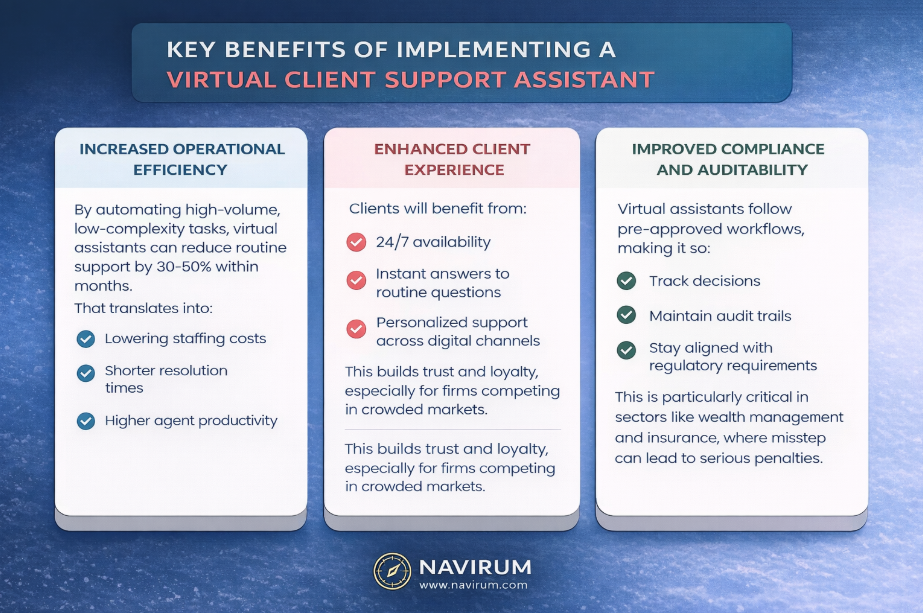
Meanwhile, support teams face growing caseloads and rising pressure to reduce operating costs without compromising service quality. AI-driven assistants solve both sides of this equation by delivering seamless, self-service support for routine inquiries—freeing up human agents for more complex, high-value interactions.
What is the integrated technology stack required for an autonomous Salesforce AI Agent?
To get started with Agentforce, you need a solid Salesforce CRM foundation, Data Cloud, which acts as your company’s ‘center of meaning’ and knowledge base, and the appropriate Agentforce licenses. While the benefits are transformative, navigating the Salesforce stack requires understanding how these layers connect
1. Why is Salesforce CRM the essential for Agentforce success?
At the heart of your virtual assistant is your Salesforce Customer Relationship Management (CRM) platform. This is where all your structured client data lives – accounts, service history, communication logs, case records, and more.
But the effectiveness of your assistant depends heavily on data quality. The CRM must be:
- Well-organized: Clean field structures, accurate records, and no duplicates
- Integrated: Connected to other enterprise systems like policy management, loan origination, or investment platforms
- Actionable: Designed with automation and workflows in mind
For example, if a wealth management client contacts the assistant to check the status of a portfolio transfer, your Salesforce CRM must already have a standardized process in place—so the assistant can reference accurate case data and provide a real-time update.
2. How Will Agentforce Work In Our Firm?
Agentforce is a Salesforce-native platform that allows you to build and deploy AI-driven digital agents within your existing Salesforce environment.
Unlike basic chatbots, Agentforce virtual assistants are:
- Context-aware: They draw on CRM data to personalize every interaction
- Process-oriented: Capable of managing multi-step service flows (e.g., onboarding, loan servicing, address updates)
- Trainable: They learn from past interactions and continuously improve over time
For example, in an insurance context, an Agentforce-powered assistant could walk a client through a claims process by gathering documentation, submitting the claim, and updating the client on its progress – without a single phone call.
Agentforce also allows for omni-channel support – your assistant can interact via web chat, SMS, or in-app messaging, offering a consistent experience across platforms.
3. How Does Data Cloud Work With Agenforce?
Salesforce Data Cloud brings intelligence and context to your virtual assistant by unifying data across systems in real time.
While Salesforce CRM holds structured client records, Data Cloud:
- Ingests real-time data from core banking systems, marketing platforms, compliance tools, and third-party APIs
- Creates unified client profiles using identity resolution and data harmonization
- Enables intelligent automation by identifying triggers and behavioral patterns
This means your virtual assistant doesn’t just “respond”—it can predict, personalize, and proactively assist.
Imagine a client logging into your mobile banking app to ask about recent overdraft fees. Data Cloud can analyze their account behavior, detect an unusual pattern, and trigger a tailored response such as waiving the fee or offering a low-balance alert subscription—all before the client even finishes typing.
What Are The Steps To Build An Agent Solution?
Before diving in, we recommend financial services firms focus on three critical success factors:
1. Data Structure and Hygiene
Ensure your Salesforce CRM is clean, accurate, and integrated. Since poor data quality leads to incorrect responses and undermines user trust, a well-maintained CRM is your most critical asset. Success with Agentforce requires a foundation of enriched, up-to-date data that you can rely on; it isn’t just a preference – it is a prerequisite
2. Process Mapping
Document your common support journeys to identify automation opportunities, human handoff points, and success metrics. Think of Agentforce agents as digital employees: to operate effectively, they must understand your company’s unique workflows. Defining these processes and making them accessible – whether through your Knowledge Base or AI policies – is a critical investment. These documented processes are the ‘roads’ your agents will travel to deliver consistent results
3. Regulatory Review
To ensure your AI operates within the bounds of GDPR, FINRA, and local banking standards, you need a proactive framework. Collaborate with legal teams and Agentforce specialists like Navirum to establish a comprehensive AI policy
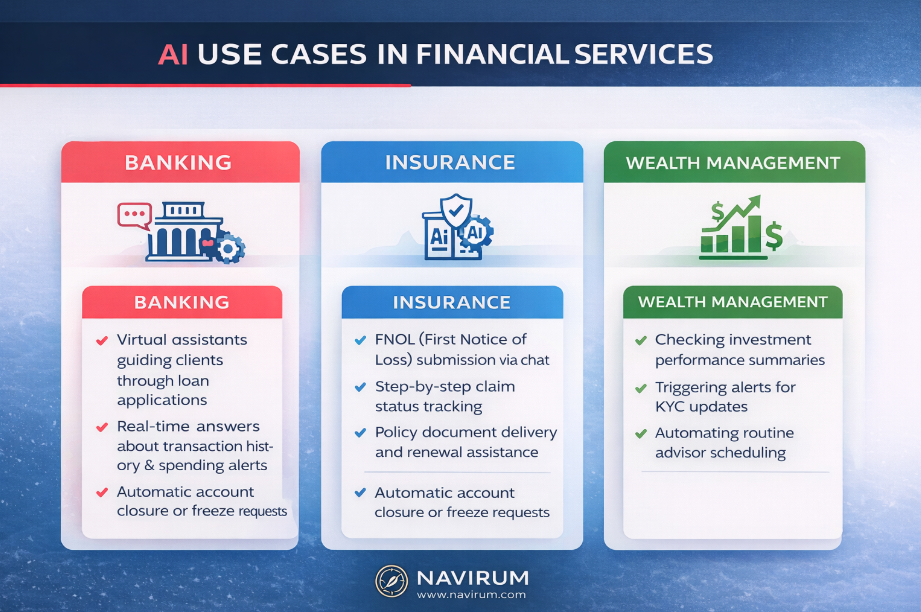
Why Choose Navirum for Your Agentforce Implementation?
At Navirum, we don’t just implement Salesforce – we design intelligent, compliant, and future-ready Agentforce solutions tailored for the unique demands of financial services.
With deep expertise across banking, insurance, and investment management, we know how to translate your processes and regulations into scalable AI-powered workflows.
Interested? Book An Agentforce Consultants Today!
Navirum Client Success Stories in Financial Services
Navirum on LinkedIn | Navirum on AppExchange| Navirum Newsletter Subscription
FAQs: Virtual Client Support Assistants
How do virtual client assistants built on Agentforce differ fundamentally from traditional chatbots?
Unlike rule-based chatbots, Agentforce-powered assistants are context-aware and process-driven. They can orchestrate multi-step workflows, reference structured client data from Salesforce Financial Services Cloud, and adapt interactions dynamically, delivering personalized guidance while adhering to regulatory compliance. This enables advisors to maintain high-touch relationships without sacrificing scalability.
In what ways does Salesforce CRM enable these virtual assistants to provide trusted financial guidance?
Salesforce CRM centralizes client profiles, account histories, and household relationships. Virtual assistants leverage this data to generate real-time responses, ensure consistency across channels, and escalate complex cases with complete context, thereby minimizing errors and reinforcing client trust.
How does Salesforce Data Cloud enhance predictive support capabilities?
Data Cloud unifies structured and unstructured client data from multiple sources, harmonizing it in real time. Its like giant knowledge base for your firm. It allows agents to understand the meaning of your firms data. This allows assistants to anticipate client needs, personalize recommendations, and trigger proactive alerts—transforming support interactions into predictive, high-value engagements rather than reactive responses.
How Do Wealth Manager Use Agentforce?
Advisor and wealth management use cases are unique. To find out more you can dive into these 5 scenarios here
Why is now the strategic moment for financial firms to invest in virtual client assistants?
Clients increasingly demand instant, 24/7, personalized service, while firms face operational cost pressures and compliance challenges. Virtual assistants offer a scalable solution, freeing human teams to focus on high-value advisory tasks while ensuring consistent, auditable support across touchpoints.
What are the critical data prerequisites for building a high-performing virtual assistant?
Success requires clean, normalized, and integrated CRM and external data. Redundant, incomplete, or siloed information can lead to incorrect guidance, compliance risk, and eroded client trust. Firms must also implement ongoing data quality monitoring and governance frameworks.
How should firms map workflows for automation without disrupting human-led processes?
Workflow mapping must identify end-to-end client journeys, pinpoint repetitive tasks, and define handoffs where human intervention is essential. This ensures the assistant augments rather than replaces human advisors, enabling efficiency gains without compromising service quality or regulatory adherence.
What governance and compliance measures are essential for AI-driven support in financial services?
Regulatory oversight includes role-based access control, logging every interaction, validating AI recommendations against compliance rules, and conducting periodic audits. Assistants should operate within defined limits to ensure risk exposure is controlled while maintaining a fully auditable trail.
How do virtual assistants contribute to advisor productivity and client retention?
By automating routine inquiries, scheduling, and alerts, assistants allow advisors to focus on strategic engagement. They can surface cross-sell or upsell opportunities based on predictive analytics and maintain proactive outreach, directly impacting client satisfaction and long-term retention.
Can these assistants support multi-channel, high-volume client interactions without losing personalization?
Yes. Agentforce-powered assistants integrate with email, chat, voice, and portal platforms while maintaining a unified client profile. They remember prior interactions, personalize content dynamically, and escalate only the complex or sensitive cases, preserving human attention where it matters most.
How can firms measure the ROI and effectiveness of a virtual client assistant?
Key metrics include:
- Reduction in response times and operational costs
- Advisor bandwidth freed for high-value activities
- Client satisfaction and Net Promoter Scores
- Compliance adherence and audit accuracy
- Predictive engagement outcomes (e.g., cross-sell conversions)
Tracking these KPIs ensures firms optimize performance, refine workflows, and quantify the assistant’s strategic impact.