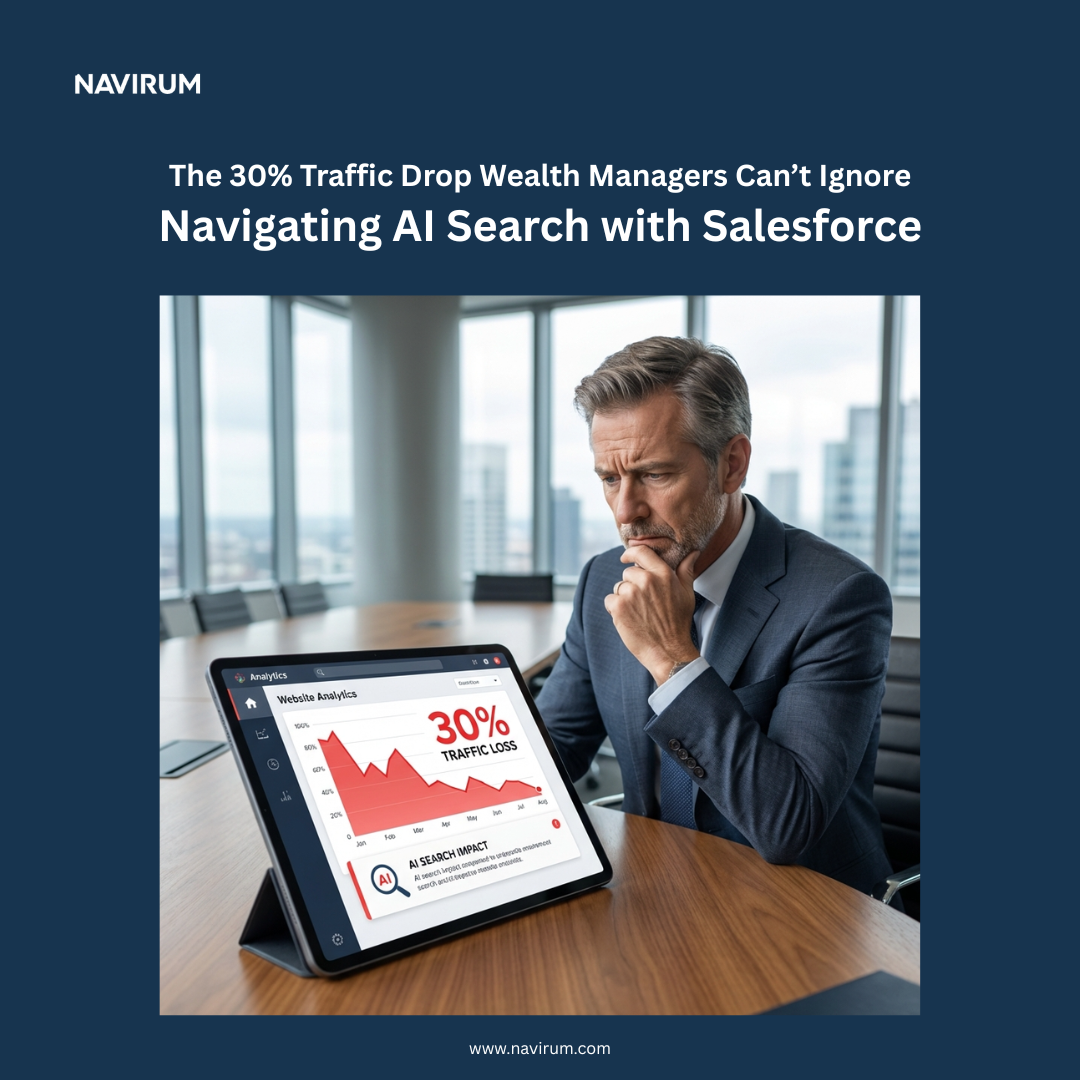

Why Wealth Managers are losing 30% of search traffic to AI Overviews?
AI Overviews are changing how investors find wealth managers, cutting traditional website traffic by up to 30%. Firms that rely on generic content risk losing visibility, but those leveraging Salesforce, AI-enabled workflows, and proprietary insights can turn disruption into growth.
The way investors discover wealth managers is undergoing a structural shift—and most firms are underestimating its impact. What used to be a predictable funnel driven by organic search is now being disrupted by AI-generated answers that sit between your content and your prospects.
For years, organic search has been a reliable growth engine for wealth management firms. Educational content, market insights, retirement guides, and tax strategies have all served as entry points into the client journey, quietly building trust over time.
But today, a new layer has emerged: AI Overviews. These summaries reduce the need for users to click, reshaping how visibility translates into engagement.
The Rise of AI Overviews in Search
Search engines are no longer just directories of links—they are becoming answer engines. AI Overviews synthesize content from multiple sources and present it in a conversational, digestible format directly on the results page.
This fundamentally changes user behavior. Instead of exploring multiple websites, users often get what they need instantly, which significantly reduces click-through rates for traditional content.
For wealth managers, this shift is especially impactful because it targets informational queries—the very foundation of their digital acquisition strategy.
Why Wealth Managers Are Disproportionately Affected?
Not all industries are impacted equally. Wealth management sits at the center of this disruption because its marketing model is deeply tied to education and trust-building.
1. Heavy Dependence on Educational Content
Wealth managers have long relied on educational content to attract and nurture prospects. This includes retirement planning, tax strategies, estate structuring, and investment insights.
These topics are highly structured and repeatable, making them ideal for AI summarization. As a result, content that once drove traffic is now being absorbed into AI-generated responses.
2. High Trust, Low Urgency Buyer Journey
The wealth management buying cycle is long and research-driven. Prospects typically engage with multiple pieces of content before reaching out to an advisor.
AI Overviews compress this journey by delivering immediate answers. This reduces the number of touchpoints where your brand can influence the decision.
3. Content Commoditization
A large portion of wealth management content follows similar formats and themes. This creates a landscape where differentiation is minimal.
AI thrives in these environments, as it can easily synthesize and replicate common insights. Without unique value, your content risks becoming invisible.
What “Losing 30% of Traffic” Actually Means?
A 30% drop in organic traffic is not just a marketing concern—it directly impacts growth and revenue generation. The implications extend far beyond website analytics.

Fewer Qualified Leads. Top-of-funnel traffic is essential for building a steady pipeline of prospects. When this traffic declines, fewer potential clients enter your ecosystem. Over time, this leads to a measurable reduction in inbound opportunities and slows overall business growth.
Reduced Brand Visibility. Visibility during the research phase is critical in wealth management. Even if prospects don’t convert immediately, repeated exposure builds familiarity and trust. When AI Overviews limit clicks, your brand risks being excluded from this early-stage influence.
Increased Acquisition Costs. To compensate for declining organic traffic, firms often increase spending on paid channels and outbound strategies. This shifts the cost structure of client acquisition. As a result, firms may experience higher cost per acquisition (CPA) and reduced marketing efficiency over time.
What Is The New Search Reality: From Clicks to Influence?
The definition of search success is evolving. It is no longer just about ranking on the first page—it’s about being part of the answer itself.
AI Overviews introduce a dual layer of visibility. Your content may still influence the response, even if users don’t click through to your website.
This means wealth managers must rethink their strategy, focusing not only on traffic but also on influence and authority within AI-generated outputs.
How Wealth Managers Can Adapt?
Adapting to this new reality requires a shift in both content strategy and technology enablement. Firms that evolve will gain a competitive edge in AI-driven search.
1. Move Beyond Generic Content
Generic content is increasingly ineffective in an AI-first search environment. If your content can be easily summarized, it will likely be replaced.
Wealth managers need to focus on originality, offering unique insights, proprietary frameworks, and differentiated perspectives that stand out.
2. Build “AI-Resistant” Content
Certain content formats are inherently more resilient to AI summarization. These include interactive tools, personalized experiences, and detailed case studies.
By investing in these formats, firms can create value that cannot be easily replicated by AI-generated summaries.
3. Optimize for Entity Authority, Not Just Keywords
Search engines are evolving toward understanding entities rather than just matching keywords. This shifts the focus from isolated content pieces to overall brand authority.
Wealth managers must build consistent, credible expertise across key topics to ensure they are recognized as trusted sources.
4. Leverage First-Party Data as a Differentiator
First-party data is one of the most underutilized assets in wealth management marketing. It provides a unique opportunity to create truly differentiated content.
By transforming internal insights into external thought leadership, firms can produce content that is both valuable and difficult to replicate.
5. Integrate Content with CRM and Data Platforms
Content strategy cannot operate in isolation. To be effective, it must be connected to client data and engagement systems.
By integrating content with CRM platforms like Salesforce, firms can better understand how content influences client behavior and decision-making.
6. Shift from Traffic Metrics to Revenue Attribution
Traditional SEO metrics such as page views and rankings are becoming less meaningful. They do not fully capture the impact of AI-driven search.
Wealth managers need to adopt more sophisticated metrics that link content performance directly to revenue outcomes.
What Is The Role of AI in Wealth Management Marketing?

While AI is disrupting search, it also presents new opportunities for wealth managers. Firms can leverage AI to enhance their own marketing capabilities.
From personalized content generation to predictive analytics, AI enables more targeted and efficient engagement strategies.
The key is to implement AI within a well-governed data framework, ensuring accuracy, compliance, and strategic alignment.
Why Technology Architecture Now Matters More Than Ever?
The effectiveness of any modern marketing strategy depends on the underlying technology stack. Disconnected systems limit visibility and reduce impact.
Wealth managers need integrated architectures that connect CRM, data platforms, analytics, and AI capabilities into a unified ecosystem.
This allows firms to move from reactive marketing to proactive, data-driven engagement.
Is There A Strategic Inflection Point for Wealth Managers?
The decline in search traffic is not a temporary trend—it represents a long-term shift in how information is consumed and decisions are made.
Wealth managers must decide whether to adapt or maintain their current approach, knowing that the competitive landscape is evolving rapidly.
Those who embrace change will be better positioned to capture attention, build trust, and drive growth in an AI-first world.
AI Overviews are redefining digital visibility in wealth management. They are changing how prospects discover, evaluate, and engage with firms.
Success now depends on differentiation, authority, and integration. Firms that invest in these areas will continue to thrive despite declining traditional traffic.
In this new environment, the goal is not just to attract clicks—but to remain relevant, credible, and influential wherever decisions are being shaped.
How Salesforce Helps Wealth Managers Recover from AI-Driven Traffic Loss?

The shift toward AI Overviews may be reducing website traffic—but it’s also exposing a deeper issue: most wealth managers have been relying too heavily on anonymous, top-of-funnel traffic instead of building connected, data-driven client journeys.
This is where Salesforce becomes a strategic lever—not just a CRM, but a growth and intelligence platform that helps wealth managers adapt to an AI-first discovery model.
1. From Anonymous Traffic to Known Relationships
When fewer users click on your website, every interaction becomes more valuable. Salesforce enables firms to move away from anonymous visits and toward identified, trackable relationships.
By capturing and unifying client data across channels, advisors can:
- Track engagement across email, events, and content
- Build rich client profiles over time
- Reduce reliance on one-time website visits
Instead of asking “How much traffic did we get?”, firms can now ask:
“Who is engaging with us—and how do we deepen that relationship?”
2. Connecting Content to Pipeline and Revenue
One of the biggest challenges in the AI search era is measuring the true impact of content. Salesforce solves this by linking marketing activity directly to pipeline outcomes.
With platforms like Salesforce Marketing Cloud, firms can:
- Track which content influenced a lead or opportunity
- Attribute revenue to specific campaigns or insights
- Understand the full client journey—not just the first click
This allows wealth managers to shift from vanity metrics to revenue-driven marketing decisions.
3. Personalizing Engagement at Scale
AI Overviews may reduce broad traffic, but they increase the importance of relevance and personalization once a prospect engages.
Salesforce enables advisors to deliver tailored experiences by leveraging:
- Behavioral data (what content was consumed)
- Demographic data (client segment, AUM, goals)
- Lifecycle stage (prospect vs client vs HNW segment)
With Salesforce Data Cloud, firms can unify fragmented data sources and activate them in real time—ensuring that every interaction feels personalized and timely.
4. Turning Content into a Guided Client Journey
Instead of relying on search-driven discovery, wealth managers can use Salesforce to orchestrate intentional client journeys.
This includes:
- Automated nurture journeys based on interests (e.g., retirement, tax planning)
- Triggered communications based on behavior
- Advisor alerts when prospects show high intent
With Salesforce Financial Services Cloud, advisors gain a complete view of each client’s financial life—allowing them to align content with real needs and life events.
5. Leveraging AI to Compete with AI
If AI is reshaping search, wealth managers need to use AI internally to stay competitive.
Salesforce integrates AI capabilities through Einstein AI, enabling firms to:
- Predict which prospects are most likely to convert
- Recommend next-best actions for advisors
- Generate personalized content and communications
This transforms AI from a threat into a competitive advantage.
6. Building Authority Beyond Search Engines
As search evolves, brand authority becomes more important than rankings. Salesforce helps firms build and amplify this authority across channels.
By integrating CRM data with marketing and engagement tools, firms can:
- Activate thought leadership campaigns across email, events, and social
- Track engagement from high-value accounts
- Strengthen relationships with existing clients and prospects
This reduces dependence on search engines and builds a multi-channel growth strategy.
7. Creating a Closed-Loop Growth System
Ultimately, Salesforce enables wealth managers to build a closed-loop system where data, content, and client engagement are fully connected.
This system allows firms to:
- Continuously learn from client behavior
- Optimize marketing and advisory strategies
- Align front-office teams around shared insights
In an environment where traffic is declining, this level of integration becomes critical for sustained growth.
Takeaway
AI Overviews are changing how prospects find information—but they are not eliminating the need for trusted advisors. What they are doing is raising the bar for how firms engage, differentiate, and convert.
Salesforce gives wealth managers the infrastructure to adapt:
- From traffic → relationships
- From content → journeys
- From clicks → revenue
In a world where visibility is no longer guaranteed, the firms that win will be those that own their data, orchestrate their engagement, and leverage AI strategically.
Navirum Recommendations
To thrive in an AI-first search environment, wealth managers must take a proactive approach that combines strategy, technology, and organizational alignment. Navirum recommends the following steps:

- Audit and Prioritize Your Digital Assets
- Align Teams Around Data-Driven Client Insights
- Develop AI-Augmented Advisory Workflows
- Invest in Multi-Channel Influence
- Measure What Matters
- Iterate and Evolve Continuously
Audit and Prioritize Your Digital Assets
Evaluate all existing content and digital touchpoints to identify what provides unique value versus what is easily summarized by AI. Focus resources on high-impact content, interactive tools, and proprietary insights that strengthen your competitive positioning.
Align Teams Around Data-Driven Client Insights
Ensure marketing, advisory, and operations teams are collaborating through a unified CRM and data ecosystem. Consistent client data enables personalization at scale, improves segmentation, and ensures that every interaction contributes to measurable business outcomes.
Develop AI-Augmented Advisory Workflows
Leverage AI not just for content creation, but also to enhance internal advisory processes. Tools like predictive analytics, client scoring, and next-best-action recommendations help advisors prioritize their efforts, deepen client relationships, and generate more meaningful outcomes.
Invest in Multi-Channel Influence
With search traffic declining, firms must expand influence beyond traditional web pages. Navirum recommends coordinated campaigns across email, events, social media, and thought leadership platforms to maintain visibility and credibility with high-value prospects.
Measure What Matters
Shift from page views and rankings to metrics that link engagement directly to revenue and client outcomes. Implement reporting frameworks that capture the full client journey, attributing leads and conversions to both digital and human touchpoints.
Iterate and Evolve Continuously
The AI and search landscape is rapidly changing. Regularly review content effectiveness, client engagement patterns, and technology performance to refine strategies. Firms that embrace continuous improvement will be best positioned to adapt and grow in the long term.
By combining these strategies, Navirum helps wealth managers transform AI disruption into a strategic advantage—turning insights into actionable engagement, content into client journeys, and technology into sustained growth.
FAQs
How are AI Overviews affecting wealth management content today?
AI Overviews synthesize multiple sources and deliver instant answers, reducing clicks to traditional content. This shift impacts educational content that wealth managers have relied on for lead generation, making differentiation and unique insights more critical than ever.
What types of content perform best in an AI-driven search environment?
Content that is proprietary, interactive, or highly personalized—such as tools, detailed case studies, and unique frameworks, resists AI summarization. Navirum recommends linking these assets to Salesforce to track engagement and optimize their impact.
Can Salesforce really help recover traffic lost to AI Overviews?
Yes. Salesforce allows firms to move from anonymous traffic to known relationships, orchestrate personalized client journeys, and measure content impact on pipeline and revenue, turning AI disruption into actionable growth.
How can wealth managers use AI internally without compromising compliance?
Navirum advises implementing AI within governed frameworks, ensuring client data privacy and regulatory compliance. AI can enhance advisory workflows, predict client needs, and suggest next-best actions without exposing sensitive information.
How should firms measure content effectiveness in this new landscape?
Traditional metrics like page views are no longer sufficient. Firms should track content engagement linked to revenue, pipeline influence, and client journey progression—metrics that Salesforce and integrated analytics make actionable.
What is the first step firms should take to adapt?
Start by auditing existing content and digital assets to identify what provides unique value. Then, integrate these insights with Salesforce and AI-enabled workflows to strengthen engagement, influence, and measurable outcomes.
How can wealth managers maintain brand authority if AI reduces website clicks?
By consistently publishing thought leadership, engaging across multiple channels, and integrating client data through Salesforce, firms can influence prospects even when AI Overviews dominate search results. Authority comes from multi-touch, data-driven engagement, not just ranking.
What role does multi-channel engagement play in offsetting AI-driven traffic loss?
AI may reduce clicks on website content, but prospects still engage through email, events, social media, and advisor interactions. Navirum helps firms orchestrate these channels within Salesforce to create connected, measurable journeys that drive both awareness and conversion.
Can smaller wealth management firms compete with larger players in this AI-first environment?
Yes. By leveraging unique insights, personalized client journeys, and Salesforce-driven data integration, smaller firms can differentiate themselves. AI actually levels the playing field by rewarding firms that combine expertise, technology, and targeted engagement effectively.
How does Navirum help wealth managers navigate these changes?
Navirum combines expertise in Salesforce, AI-enabled consulting, and financial services transformation to help firms differentiate content, unify client data, personalize engagement, and link marketing to revenue—ensuring growth in an AI-first world.