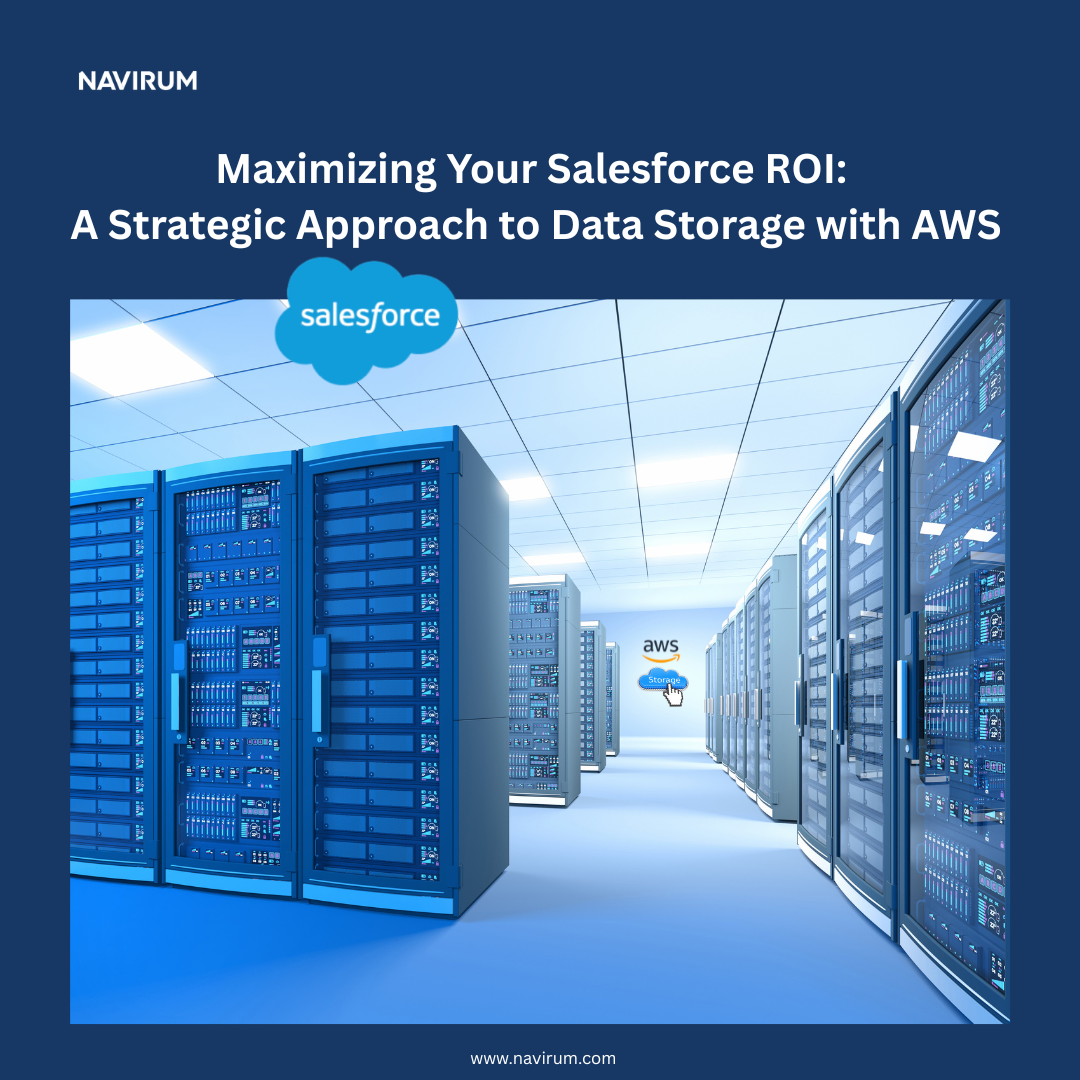

Maximizing Your Salesforce ROI: A Strategic Approach to Data Storage with AWS
As Salesforce data volumes grow, financial services organizations face increasing storage costs that can reduce overall CRM ROI. By combining Salesforce with AWS for long-term data storage and archiving, firms can lower costs, improve system performance, strengthen compliance, and redirect budget toward AI and innovation initiatives.
As financial services organizations scale their use of Salesforce, data growth becomes both an opportunity and a cost challenge. Customer interactions, transactional records, documents, and automation outputs all accumulate quickly, creating continuous pressure on storage capacity and system performance. Over time, this growth directly impacts licensing costs and infrastructure planning.
For CIOs and CFOs, the question is no longer whether to manage Salesforce data growth, but how to do it strategically without compromising performance, compliance, or user experience. Effective data storage strategy is now a core component of digital transformation in regulated industries. Organizations that address it early tend to reduce long-term operational inefficiencies and avoid unexpected cost spikes.
A modern approach increasingly adopted by enterprise architects is to combine Salesforce with cloud-based external storage such as Amazon Web Services (AWS), creating a scalable, cost-efficient data architecture. This hybrid model separates operational CRM data from long-term storage, enabling better performance and cost control. It also allows organizations to align storage strategy with regulatory and business needs more effectively.
Why Salesforce Storage Costs Escalate Quickly
Salesforce storage is typically divided into three categories: data storage, file storage, and backup or archive copies. Each category grows at a different rate depending on business usage and system integrations. Without governance, all three can expand rapidly and unpredictably.
In financial institutions, growth is accelerated by regulatory retention requirements, often spanning 7–10+ years or more. Additional pressure comes from high volumes of client documentation such as KYC files, onboarding forms, and statements. Integration-heavy ecosystems also contribute, as multiple systems continuously write data into Salesforce.
The result is that storage consumption grows faster than CRM adoption value. This creates a scenario where organizations pay increasingly more for infrastructure without a proportional increase in business outcomes. Over time, this reduces overall Salesforce ROI.

The Strategic Shift: Externalizing Storage to AWS
Rather than storing all data directly in Salesforce, organizations are increasingly adopting a hybrid storage model. This model keeps Salesforce focused on real-time business processes while offloading large or historical data to external systems. The goal is to improve efficiency without disrupting user workflows.
In this architecture, Salesforce remains the system of engagement, supporting sales, service, and client interaction workflows. Meanwhile, AWS becomes the system of record for large-scale storage and long-term retention. This separation ensures that each platform is used for its optimal purpose.
This approach leverages Amazon S3 for scalable object storage and lifecycle policies for automated archival. It also enables organizations to store large volumes of data at significantly lower cost. Over time, this creates a more sustainable data management model.
Cost Comparison: Salesforce Native Storage vs AWS External Storage
Below is a simplified illustration of typical enterprise storage cost differences. The comparison highlights both cost structure and scalability differences between platforms. It also reflects how storage strategy impacts long-term financial planning.
| Storage Approach | Typical Use Case | Relative Cost per GB | Scalability | Compliance Control |
|---|---|---|---|---|
| Salesforce Native Storage | Active CRM records, high-performance access | $$$$ (High) | Limited by licensing tiers | Strong, built-in |
| AWS S3 Standard | Active but non-CRM-critical documents | $ (Low) | Virtually unlimited | High (configurable) |
| AWS S3 Glacier / Archive | Long-term retention, compliance archives | $ (Very Low) | Virtually unlimited | High (policy-driven) |
Key takeaway: Moving non-operational data out of Salesforce can reduce storage costs by 50–80% depending on usage profile. This creates immediate financial impact, especially for large-scale enterprises. It also improves predictability in annual IT budgeting.
Architecture Overview (High-Level)
A typical Salesforce–AWS storage architecture integrates CRM operations with external cloud storage. This design ensures seamless user experience while optimizing backend storage costs. It also supports compliance and audit requirements.
Data is created and managed in Salesforce during day-to-day operations. Large files or historical records are then offloaded via APIs, middleware, or integration layers. This ensures that only operational data remains in the CRM.
Data is stored in Amazon Web Services S3 buckets with structured governance policies. A metadata pointer remains in Salesforce, allowing users to access archived data without leaving the platform. Lifecycle rules automatically move older data into Glacier for cost optimization.
Business Benefits for Financial Services
FREE STRATEGY SESSION
Seeing These Benefits in Your Organisation?
Navirum’s Salesforce architects help financial services firms design Salesforce + AWS storage strategies that cut costs and unlock real performance. Let’s talk through your setup.
No commitment · We follow up within one business day
For banks, wealth managers, and capital markets firms, the benefits extend beyond cost savings. These organizations operate under strict regulatory and performance requirements. As a result, storage strategy directly affects both compliance and client experience.
One key benefit is improved Salesforce performance due to reduced data volume. Smaller datasets improve query speed and reduce system lag. This enhances productivity for frontline users such as relationship managers and service agents.
Another benefit is reduced licensing pressure as storage thresholds stabilize. This allows IT leaders to better forecast CRM costs over time. It also reduces the risk of unexpected overage charges.
Organizations also achieve stronger regulatory alignment through structured archival policies in AWS. Data retention becomes more consistent and auditable. This supports compliance with financial regulations and internal governance standards.
Finally, firms gain faster innovation cycles by freeing up CRM resources. Budget previously allocated to storage expansion can be redirected toward AI, analytics, and automation initiatives. This improves overall digital transformation velocity.
Key Considerations Before Implementation
While the model is powerful, success depends on careful planning and governance. Without clear rules, hybrid architectures can become fragmented and difficult to manage. A structured approach is essential.
The first consideration is data classification, defining what stays in Salesforce and what moves to AWS. This ensures that only operational data remains in the CRM system. It also reduces risk of over-archiving critical information.
Latency requirements must also be evaluated, especially for frequently accessed data. Organizations must ensure that archived data retrieval remains fast enough for business users. Poor latency design can negatively impact user experience.
Security and encryption standards are critical, particularly in regulated industries. Data must remain protected both in transit and at rest. This includes alignment with internal security frameworks and external regulatory requirements.
Integration design between Salesforce and AWS is another key factor. A well-designed middleware layer ensures seamless data movement and retrieval. Poor integration can lead to data inconsistencies.
Finally, governance policies must be aligned with compliance teams. This ensures that retention rules, audit trails, and access controls are properly enforced. Strong governance is what makes the architecture sustainable long term.
Navirum Perspective: Turning Storage Strategy into ROI

At Navirum, we see data storage not as an infrastructure problem, but as a CRM value optimization lever. Treating storage strategically allows organizations to unlock hidden financial and operational value. It also improves long-term platform sustainability.
Organizations that treat Salesforce storage strategically can extend platform lifespan without escalating costs. They also improve user experience by reducing system clutter and improving performance. These improvements are often immediately visible to end users.
In addition, firms can reallocate budget from storage licensing to innovation initiatives such as AI, automation, and analytics. This shift directly supports digital transformation goals. It also increases overall return on Salesforce investment.
A well-architected Salesforce–AWS integration is not just a technical upgrade, it is a financial optimization strategy. It aligns IT architecture with business outcomes and cost efficiency. This is where long-term ROI is maximized.
Frequently Asked Questions (FAQs)
What is Salesforce storage and why does it matter?
Salesforce storage refers to the capacity used within the Salesforce environment to store records, files, attachments, and system-generated data. It matters because storage consumption directly affects licensing costs, system performance, and long-term scalability. As usage grows, organizations often face higher costs and the need for more structured data management.
Why do Salesforce storage costs increase so quickly?
Costs increase due to continuous data accumulation from customer interactions, automation processes, integrations, and document uploads. In financial services, this is amplified by strict regulatory retention requirements that require keeping data for many years. Without active governance, both structured and unstructured data expand rapidly, leading to unexpected storage overages.
What types of data consume the most Salesforce storage?
The biggest contributors are typically file storage (such as PDFs, contracts, and onboarding documents), followed by transactional CRM records and email or case attachments. In regulated industries, these volumes are significantly higher due to KYC documentation, audit trails, and client communications. Over time, these large files tend to drive most of the storage cost increase.
What is the benefit of using AWS with Salesforce?
Using Amazon Web Services allows organizations to offload large, infrequently accessed, or historical data from Salesforce into a scalable and lower-cost environment. This reduces pressure on Salesforce storage limits while maintaining secure access through integrations. The result is a more cost-efficient and performance-optimized CRM architecture.
Does moving data to AWS impact Salesforce performance?
Yes, and typically in a positive way. By reducing the volume of data stored directly in Salesforce, organizations improve query performance, reduce page load times, and minimize system lag. Users experience a faster and more responsive CRM, especially in data-heavy environments like financial services.
Is data still accessible if stored in AWS instead of Salesforce?
Yes. In a well-architected solution, metadata or reference links remain within Salesforce, allowing users to access archived files stored in AWS without leaving the CRM interface. This ensures a seamless user experience while keeping large data assets outside the core CRM system.
Is this approach compliant with financial services regulations?
Yes, when properly designed and governed. AWS provides encryption at rest and in transit, detailed audit logging, and configurable retention policies that support regulatory compliance. Financial institutions typically align this architecture with internal governance frameworks and external regulatory requirements to ensure full audit readiness.
What is the difference between AWS S3 and Glacier?
AWS S3 is designed for frequently accessed or active data that requires fast retrieval. AWS Glacier, on the other hand, is optimized for long-term archival storage at significantly lower cost but with slower retrieval times. Many organizations use both together in a tiered storage strategy based on data lifecycle and access frequency.
How much cost savings can organizations expect?
Savings vary depending on data volume, retention policies, and usage patterns, but many enterprises see reductions of approximately 50–80% in storage-related costs. The biggest savings come from moving non-operational and historical data out of Salesforce into lower-cost AWS storage tiers. Over time, this also improves cost predictability and budget control.
10. Is this architecture suitable for all Salesforce users?
It is most suitable for mid-to-large enterprises, particularly in regulated industries such as banking, wealth management, and insurance. These organizations typically have high data volumes, strict retention requirements, and complex integration ecosystems. Smaller organizations may not see the same level of benefit, as their storage needs are usually more manageable within native Salesforce limits.
FREE CONSULTATION
Ready to Turn Storage Costs Into Innovation Budget?
Navirum specialises in Salesforce for wealth management and financial services. Get a free 30-minute review of your data architecture and find out exactly where you’re leaving money on the table.
No commitment · We follow up within one business day
Similar Readings
Empowering Financial Services: How Navirum and AWS Accelerate Cloud Transformation
Why You’re Overpaying for Salesforce Storage (and How to Cut Costs by Up to 90%)