A successful Salesforce Financial Services Cloud implementation starts with a clear understanding of your organization’s readiness.
This practical Salesforce Financial Services Cloud implementation guide and readiness checklist helps financial services organizations identify risks, uncover gaps and establish a stronger foundation before implementation begins.
Created by Navirum, a Salesforce consulting partner specializing in Financial Services Cloud implementations and support, the checklist helps you evaluate five critical areas:
Data quality and architecture
Integrations and custodian connections
Business process alignment
User adoption and change management
Implementation planning and governance
Whether you are preparing for a new Salesforce FSC implementation, migrating from another CRM or improving an existing Salesforce environment, the checklist will help you reduce implementation risk, clarify priorities and build a more realistic delivery plan.
Get Your Free Salesforce FSC Implementation Readiness Checklist
Ensure your organization is fully prepared for a successful Salesforce Financial Services Cloud deployment. Audit your data architectures, assess custodian connections, and fast-track implementation timelines with this free, comprehensive prep guide.
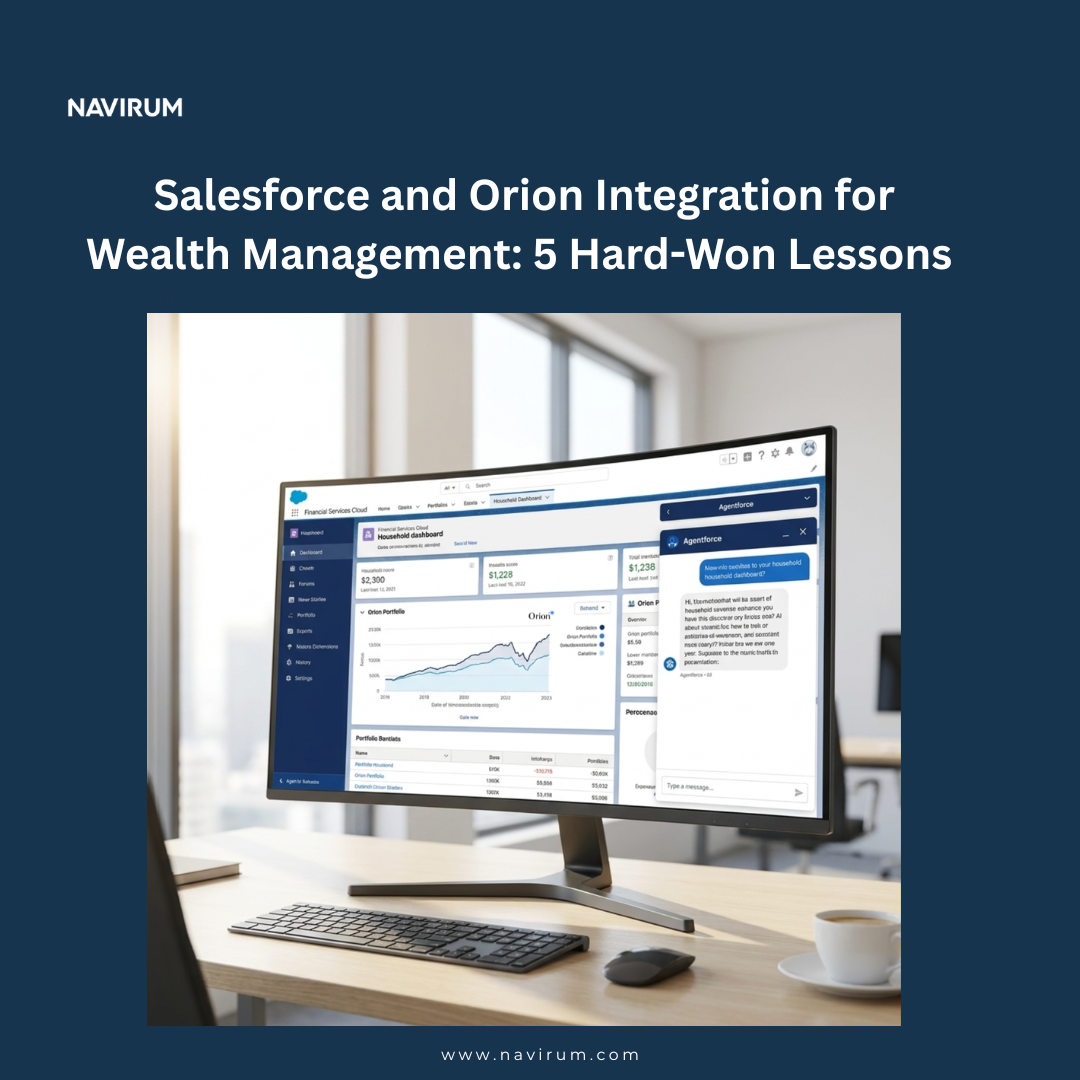
Integrating Orion Advisor Solutions with Salesforce unifies client data, enhances advisor productivity, and streamlines operations.
A 360° client view is possible by combining Orion’s performance metrics with Salesforce’s relationship intelligence.
Automation within the integration reduces manual errors, administrative overhead, and improves compliance processes.
The infrastructure scales with growth, supporting new services and advanced analytics for decision-making.
Proper configuration of the integration maximizes its value, ensuring improved workflows and advisor experience.
Integrating Orion Advisor Solutions with Salesforce unifies portfolio data, CRM insights, and compliance workflows into a single, scalable ecosystem. With the right strategy and implementation, firms gain a 360° client view, increased advisor productivity, and streamlined operations—turning technology into a true growth driver.
Discover How You Can Elevate Your Financial Strategy With Orion Salesforce Integration!
In today’s increasingly competitive and client-centric financial services environment, disconnected systems are no longer sustainable. Wealth managers, RIAs, family offices, and asset managers must deliver personalized, data-driven advice while navigating growing regulatory pressure and operational complexity.
Integrating Orion Advisor Solutions with Salesforce creates a powerful digital backbone for your firm—bringing together portfolio data, CRM intelligence, reporting, compliance, and advisor workflows into one cohesive ecosystem. The result? A unified client experience, operational clarity, and scalable growth.
Below, we explore in depth why the Orion Salesforce integration has become a strategic priority for forward-thinking firms—and how to maximize its value.
1. Holistic Client Management: From Fragmented Data to a 360° View
Your advisors cannot deliver exceptional advice if critical client information lives in silos.
Orion’s portfolio accounting, performance reporting, and billing capabilities generate rich investment data. Salesforce, particularly Financial Services Cloud, houses relationship intelligence, household structures, referrals, opportunities, and engagement history.
When properly integrated, these platforms create a true 360-degree client view, including:
Portfolio performance and asset allocation
Household relationships and beneficiaries
Risk profiles and investment objectives
Client service history and communications
Financial plans and account details
Revenue and fee data
Anticipate client needs before meetings
Identify cross-sell and upsell opportunities
Personalize outreach based on portfolio events
Deliver proactive advice during market volatility
Strengthen multigenerational relationships
Instead of toggling between systems, advisors operate within a connected environment that supports intelligent, client-first conversations.
2. Streamlined Operational Efficiency: Automate What Slows You Down
Manual data entry, reconciliation discrepancies, and redundant workflows consume valuable time—and introduce risk.
A well-architected Orion Salesforce integration can automate:
Account creation and synchronization
Household and contact updates
Performance data flows
Fee and billing reporting
Task generation tied to portfolio events
Compliance-related documentation tracking
This reduces:
Human error
Administrative overhead
Duplicate data management
Onboarding delays
Operational bottlenecks
Compliance Optimization
For firms facing increasing scrutiny around KYC, AML, and onboarding processes, integration enables structured data capture and workflow enforcement within Salesforce while syncing relevant investment data from Orion.
Automation can help:
Trigger compliance reviews when thresholds are met
Maintain consistent audit trails
Reduce rekeying errors that lead to regulatory risk
Accelerate account approvals
The outcome is a more efficient compliance posture—without increasing headcount.
3. Scalable and Adaptable Infrastructure for Growth
Growth creates complexity.
As your firm expands—whether through M&A activity, new service offerings, geographic expansion, or the addition of alternative investments—your systems must scale with you.
Salesforce provides a flexible, configurable platform that adapts to evolving business models. When paired with Orion:
New asset classes can be integrated into reporting structures
Custom dashboards can track AUM growth by segment
Advanced analytics can support executive decision-making
Marketing automation can align with portfolio insights
AI-driven insights can enhance advisor productivity
This integration does not just support today’s workflows—it creates an extensible architecture for tomorrow’s innovation.
Firms leveraging advanced CRM analytics can:
Segment clients by profitability
Identify underserved households
Monitor advisor performance metrics
Forecast revenue with greater precision
Align service tiers to AUM and complexity
Scalability becomes strategic—not reactive.
4. Maximizing Value Through Proper Configuration
While Orion Salesforce integration is popular across the wealth management ecosystem, many firms underutilize its capabilities due to improper implementation.
Common pitfalls include:
Poorly structured data models
Inconsistent household mapping
Incomplete field synchronization
Overly complex automation
Misaligned compliance workflows
Limited dashboard utilization
Without a strategic blueprint, firms risk creating another layer of complexity instead of simplifying operations.
A thoughtful implementation includes:
Clear data governance standards
Defined ownership of fields and objects
Standardized naming conventions
Workflow optimization aligned with advisor behavior
Integration architecture that balances performance and flexibility
When executed correctly, the integration becomes a competitive differentiator—not just a technical connector.
By embedding Orion investment insights into Salesforce workflows, firms empower advisors to:
Prepare faster for client meetings
Access portfolio data within opportunity records
View billing insights alongside relationship data
Track service cases tied to specific accounts
Receive alerts triggered by market or allocation events
This removes friction from daily operations and enables advisors to focus on strategic conversations rather than system navigation.
The integration transforms Salesforce from a static CRM into an active intelligence platform.
6. Data-Driven Decision Making for Leadership
Beyond the advisor level, executive teams benefit significantly from Orion Salesforce connectivity.
Leadership can:
Monitor AUM growth across segments
Track revenue trends by advisor or team
Identify concentration risks
Analyze client acquisition costs
Align marketing campaigns with portfolio analytics
With unified dashboards, decision-makers gain clarity into operational and financial performance—fueling informed strategic planning.
7. Future-Proofing with Innovation and AI
As AI capabilities continue to reshape financial services, integrated ecosystems become even more critical.
When portfolio data and CRM data coexist in a unified environment, firms can:
Leverage predictive analytics for churn prevention
Trigger automated client outreach during volatility
Identify high-propensity cross-sell opportunities
Generate intelligent advisor task prioritization
Enhance segmentation models
Disconnected systems limit AI potential. Integrated platforms unlock it.
Take the Next Step
If your firm is ready to eliminate data silos, enhance advisor productivity, and scale with confidence, Orion Salesforce integration may be the foundation you need.
Explore the Orion connection available on the Salesforce AppExchange and start building a more connected, intelligent financial ecosystem.
Or, connect with Navirum to design a tailored integration strategy that turns your technology stack into a growth engine.
Navirum Recommendation: Turn Your Orion Salesforce Integration into a Strategic Advantage
Integrating Orion Advisor Solutions with Salesforce is not just a technical project—it’s a business transformation initiative. The difference between a basic connection and a high-performing ecosystem lies in the strategy behind the implementation.
At Navirum, we specialize exclusively in Salesforce for financial services firms. We understand the operational, regulatory, and growth challenges facing RIAs, wealth managers, family offices, and asset managers—and we design integrations that solve for them holistically.
Our Approach:
We go beyond configuration. We architect solutions that align technology with business outcomes:
Scalable Data Architecture We design structured, future-proof data models that reflect your household structures, revenue streams, and reporting needs.
Strategic Object Mapping Orion data is mapped thoughtfully into Salesforce to ensure clean synchronization, reporting accuracy, and long-term maintainability.
Advisor-Centric Workflow Design We streamline workflows to enhance productivity, reduce friction, and improve the advisor experience.
Compliance-Aware Automation From onboarding to KYC and AML checkpoints, we reduce compliance friction while maintaining audit integrity.
Right-Sized Automation We optimize processes without overengineering—ensuring your system remains usable, flexible, and scalable.
Budget-Aligned Execution Every integration roadmap is aligned with your firm’s growth stage, operational capacity, and financial objectives.
Collaboration That Drives Results
We work directly with Orion, your internal leadership, operations teams, and compliance stakeholders to ensure your integration reflects real-world workflows—not theoretical system design.
This is not a template deployment. It’s a purpose-built integration strategy designed to:
Increase advisor productivity
Improve client experience
Reduce operational risk
Unlock scalable growth
If you’re ready to move beyond system connectivity and build a fully aligned wealth technology ecosystem, Navirum is your strategic integration partner.
Orion Salesforce Integration CTA Banner | Navirum
Wealth Technology Advisory
Ready to elevate your firm’s performance with Orion Salesforce integrations?
Connect portfolio accounting with Salesforce Financial Services Cloud to streamline operations, eliminate data silos, and scale advisor productivity.
<strong class="schema-faq-question">How complicated is the integration to set up?</strong>
The integration between Orion Advisor Solutions and Salesforce is generally straightforward. Orion provides structured support and documentation, and in many cases the base setup can be completed in days—not weeks. However, while the technical connection is simple, optimizing data structure, workflows, and reporting requires thoughtful planning. With the right implementation partner, the process remains smooth and efficient.
<strong class="schema-faq-question">What data can I sync between Orion and Salesforce?</strong>
Firms can sync: Client profiles Household structures Account details Portfolio holdings Account balances Performance metrics This synchronization creates a single source of truth inside Salesforce, empowering advisors with a 360° client view that blends relationship data with portfolio intelligence.
<strong class="schema-faq-question">What feedback do companies have about the integration?</strong>
Feedback is mixed but generally positive. Many firms report that the integration “gets the job done” and provides strong visibility into financial and client data within Salesforce. Some users mention technical limitations or configuration constraints, particularly when firms have complex data structures. Despite this, it remains a must-have integration for firms leveraging both Orion and Salesforce.
<strong class="schema-faq-question">Wait—doesn’t only Redtail have the Orion integration?</strong>
While Orion acquired Redtail Technology, the Salesforce integration remains available and actively supported. It continues to be listed on the Salesforce AppExchange and is widely used by firms operating within Salesforce environments. If you’re considering migrating from Redtail to Salesforce Financial Services Cloud (FSC), a structured transition plan is essential to preserve data integrity and workflow continuity.
<strong class="schema-faq-question">Will the integration work with Salesforce Financial Services Cloud (FSC)?<br></strong>
Yes. The integration works with Salesforce Sales Cloud and Salesforce Financial Services Cloud (FSC). It functions out of the box but can also be customized to align with your firm’s specific compliance requirements, reporting needs, and advisor workflows.
<strong class="schema-faq-question">Do I need specialized expertise to maximize the integration?<br></strong>
The base integration is relatively simple. However, unlocking its full value—especially around reporting, automation, compliance workflows, and advisor experience—requires specialized expertise. At Navirum, we often assist firms that have completed the initial setup but need deeper process alignment and strategic optimization. In many cases, Salesforce teams refer firms to us for advanced integration refinement.
<strong class="schema-faq-question">How long does a full optimization project typically take?</strong>
While the technical connection may take days, a full strategic optimization—including workflow automation, reporting dashboards, and compliance alignment—typically takes several weeks depending on firm size and complexity. The timeline depends on data cleanliness, customization needs, and internal stakeholder alignment.
<strong class="schema-faq-question">Can the integration support multi-advisor or multi-entity firms?</strong>
Yes. With proper data modeling, the integration can support complex structures such as multi-advisor practices, multiple entities, and segmented service tiers. Proper household mapping and role hierarchy configuration are critical to ensuring accurate reporting and revenue attribution.
<strong class="schema-faq-question">How does the integration impact reporting and dashboards?<br></strong>
When structured correctly, the integration significantly enhances reporting capabilities. Firms can build dashboards that combine AUM, revenue, advisor performance, client segmentation, and pipeline data—offering leadership actionable insights in real time.
<strong class="schema-faq-question">Is the integration secure and compliant?<br></strong>
Yes. Both Orion and Salesforce operate within enterprise-grade security frameworks. However, firms remain responsible for proper configuration, field-level security, permission sets, and data governance policies to ensure compliance with regulatory standards.
<strong class="schema-faq-question">What happens if my firm customizes Salesforce heavily?</strong>
Customizations do not prevent the integration from working—but they do require careful planning. Poorly aligned custom objects or naming conventions can create reporting inconsistencies. A structured review ensures the integration supports, rather than conflicts with, your existing architecture.
If you’re evaluating or optimizing your Orion Salesforce integration, strategic planning is the difference between “connected systems” and a true growth platform. That is exactly the ongoing, full-lifecycle partnership approach worth planning for.
Online Resources| Navirum
Knowledge & Insights
Online Resources, Knowledge and Insights
Explore our latest articles on Orion integrations, trusted AI data foundations, Agentforce FSC innovation, and Junxure CRM migrations.
How to transform advisor experience with LPL ClientWorks Salesforce integration?
The LPL ClientWorks Salesforce integration enables advisors to centralize client data, automate workflows, and gain centralized, up-to-date insights. By leveraging AI tools like Jump and Salesforce Financial Services Cloud, firms can improve operational efficiency, deliver personalized advice, and scale their business effectively.
How does LPL ClientWorks – Salesforce integration work?
In today’s dynamic financial environment, the LPL ClientWorks – Salesforce integrationempowers firms with centralized insights and greater operational efficiency-built specifically for financial professionals. By harnessing the power of Salesforce, this integration delivers comprehensive client management and streamlined processes that reduce complexity and unlock growth.
Holistic Client Management: Consolidate client data in Salesforce with LPL ClientWorks for a unified view of portfolios. This integration enables advisors to deliver personalized advice, proactively address client needs, and nurture strong relationships. Salesforce Financial Services Cloud (FSC) remains the most popular with its rich Advisors functionality.
Streamlined Operational Efficiency: Automate workflows and enhance data synchronization between LPL ClientWorks and Salesforce. By reducing manual tasks and minimizing errors, your team can focus on strategic initiatives that drive growth and value.
Want the LPL ClientWorks integration checklist?
Scalable and Adaptable Solutions: Built on Salesforce’s flexible platform, LPL ClientWorks adapts to your firm’s evolving needs -whether you’re expanding service offerings, entering new markets, or adopting innovative technologies. This integration ensures you remain competitive in a rapidly changing landscape.
Empowering Financial Advisors: With intuitive tools and robust reporting capabilities, advisors gain the insights necessary to optimize client engagement and streamline decision-making efficiently.
Include the benefits of AI for Firm Growth: Now recently introducing Jump’s AI-driven platform scales alongside your business. The Jump AI App – Whether you’re adding advisors, expanding client segments, or layering on new compliance requirements, Jump integrates seamlessly with Salesforce to keep processes streamlined. This AI-driven meeting and compliance copilot syncs directly into Salesforce, and is proving popular in the LPL Advisor community.
New to Salesforce? We can get you up on running quickly and easily on the Salesforce Financial Services Cloud from migrating from existing systems to Salesforce. These are popular moves
Navirum recommendations: transform your advisor experience with Salesforce & ClientWorks
At Navirum, we specialize in helping financial services firms leverage Salesforce and LPL ClientWorks to maximize efficiency, client engagement, and business growth. With deep expertise in both platforms, we guide firms through every step of the integration process to ensure seamless adoption and measurable results.
Our approach includes:
Ongoing Optimization & Support: Our team provides continuous guidance, monitoring, and enhancement of your Salesforce–ClientWorks integration, ensuring it scales with your firm’s growth and evolving regulatory needs.
Strategic Planning: We assess your firm’s current workflows, technology stack, and business objectives to design an integration that drives operational efficiency and advisor productivity.
Seamless Implementation: Navirum manages data migration, system configuration, and workflow automation, minimizing disruption and ensuring a smooth transition to Salesforce Financial Services Cloud.
Customized Advisor Tools: Dashboards, reports, and client management tools are tailored to your firm’s unique requirements, empowering advisors with up-to-date insights and actionable data.
Partnering with Navirum gives your firm a trusted advisor with proven expertise in Salesforce and LPL ClientWorks integrations. We help financial services firms enhance advisor productivity, deliver personalized client experiences, and unlock sustainable growth in a competitive landscape
Not sure where your Salesforce setup stands?
FAQs: LPL ClientWorks Salesforce integration
What is LPL ClientWorks, and why integrate it with Salesforce?
LPL ClientWorks is a platform designed for LPL Advisors to manage client portfolios, compliance, and reporting. Integrating it with Salesforce consolidates client data, streamlines workflows, and provides advisors with a unified, regularly synced view of client relationships
How does Salesforce Financial Services Cloud (FSC) enhance this integration?
FSC adds robust advisor-centric tools, including household management, client lifecycle tracking, and workflow automation. When paired with ClientWorks, it enables personalized advice, improved operational efficiency, and deeper insights into client portfolios.
What types of firms benefit from this integration?
RIAs, independent advisors, credit unions, community banks, private equity firms, and research firms all benefit by reducing manual tasks, improving client engagement, and scaling operations efficiently.
How does this integration improve operational efficiency?
It automates workflows, synchronizes data between ClientWorks and Salesforce, reduces errors, and frees advisors to focus on client-facing and strategic initiatives rather than administrative tasks.
Can the integration scale as my firm grows?
Yes. Salesforce’s flexible platform and the ClientWorks integration can accommodate additional advisors, expanded client segments, new service offerings, and evolving compliance requirements.
How does Jump AI enhance the Salesforce–ClientWorks integration?
Jump AI provides AI-driven insights, automation, and productivity tools that scale alongside your business. It helps advisors manage larger client bases, optimize engagement, and streamline decision-making efficiently.
Is it possible to migrate to Salesforce from other CRM systems?
Yes. Navirum can migrate data and workflows from platforms like Maximizer, Redtail, Zendesk, or others, ensuring a smooth transition to Salesforce FSC.
Can Salesforce integrate with other tools alongside ClientWorks?
Absolutely. Salesforce supports integrations with DocuSign, Slack, Microsoft Teams, marketing automation platforms, and other applications to create a unified, efficient tech ecosystem.
What benefits can advisors expect from this integration?
Advisors gain a holistic view of client portfolios, improved data accuracy, streamlined workflows, actionable reporting, and the ability to deliver highly personalized advice efficiently.
How does Navirum support firms with ClientWorks Salesforce integration?
Navirum provides end-to-end guidance, from planning and implementation to ongoing optimization. We ensure integrations align with your business goals, regulatory requirements, and budget, delivering measurable ROI and enhanced client experiences.
How Financial Services Cloud (FSC) is Transforming Banking? Let’s dive right in!
Dans le monde numérique d'aujourd'hui, les banques et les institutions financières doivent évoluer pour répondre aux attentes croissantes des clients tout en maintenant l'efficacité opérationnelle et la conformité réglementaire. Salesforce Financial Services Cloud (FSC) for banking offers a unified solution that streamlines customer interactions, enhances relationship management, and automates financial services workflows. In this blog post, we will explore how FSC is revolutionizing banking, its key benefits, and real-world use cases that highlight its impact.
What is Financial Services Cloud (FSC)?
Financial Services Cloud (FSC) is a Salesforce-powered platform designed specifically for the financial sector, catering to retail banking, commercial banking, and wealth management. It provides a 360-degree customer view, AI-powered analytics, and workflow automation to enhance customer engagement and drive operational efficiency.
1. 360-Degree Customer View: A Unified Financial Profile
One of FSC’s most powerful capabilities is its ability to consolidate all customer financial data—accounts, transactions, credit history, financial goals—into a single, comprehensive dashboard. This holistic view allows financial professionals to:
Deliver personalized banking experiences based on customer preferences.
Track customer milestones and anticipate future needs.
Improve service efficiency by reducing the time spent retrieving customer data.
2. Enhanced Relationship Management
FSC provides tools to map complex customer relationships, including households, businesses, and co-signers. This is particularly useful in:
Corporate banking, where multiple stakeholders influence financial decisions.
3. AI-Powered Insights and Predictive Analytics
FSC leverages Salesforce Einstein AI to analyze customer behavior, predict financial needs, and provide actionable insights. For example:
AI-driven recommendations suggest relevant financial products such as home loans, investment opportunities, or retirement plans.
Predictive analytics help detect early warning signs of customer churn, allowing proactive engagement.
4.Automated Workflows and Increased Efficiency
Manual processes such as loan approvals, account openings, and KYC (Know Your Customer) compliance can be time-consuming. FSC automates these workflows, resulting in:
Faster turnaround times for customers.
Reduced administrative burden on bank employees.
Compliance with regulatory standards through built-in security measures.
Today’s banking customers demand seamless interactions across multiple channels, whether via mobile apps, web platforms, in-branch visits, or customer service centers. FSC ensures:
Consistent customer experiences across all touchpoints.
Integrated communication via email, chatbots, and social media.
A centralized platform where relationship managers can track interactions in real-time.
6. Regulatory Compliance and Security
FSC includes compliance tools to automate regulatory reporting, KYC, and AML (Anti-Money Laundering) processes. This helps banks:
Mitigate risks associated with financial fraud and identity theft.
Maintain compliance with global standards such as GDPR, PCI DSS, and FINRA.
Securely store and manage sensitive customer data within a cloud environment.
A leading retail bank struggled with fragmented customer data across multiple systems, leading to inefficiencies and inconsistent service. By implementing FSC:
The bank centralized customer information, allowing advisors to access real-time insights.
One of FSC’s biggest strengths is its ability to integrate with existing banking infrastructure, including core banking systems, CRMs, and third-party financial applications. Through Salesforce APIs, FSC enables:
Real-time data synchronization between financial accounts and banking platforms.
Seamless integration with payment gateways, risk management software, and lending platforms.
Automated reporting capabilities for regulatory compliance and performance analysis.
Why FSC is Essential for Modern Banks
In a highly competitive banking industry, adopting Salesforce FSC is no longer an option—it’s a necessity. With its ability to provide a single customer view, AI-powered insights, automation, and omnichannel capabilities, FSC helps banks:
Enhance customer retention through personalized engagement.
Improve operational efficiency by reducing manual processes.
Increase revenue with data-driven cross-selling and up-selling opportunities.
Final thoughts
As digital transformation continues to reshape the financial landscape, Salesforce Financial Services Cloud provides banks with the tools needed to thrive. Whether it’s retail banking, commercial lending, or wealth management, FSC empowers financial institutions to deliver exceptional customer experiences, optimize internal processes, and maintain regulatory compliance.
Are you ready to revolutionize your banking services with FSC? Contact our Salesforce consulting experts today to explore how Financial Services Cloud can drive growth and efficiency for your institution!
Navirum is a leading Salesforce consulting company dedicated to providing exceptional services and solutions to our clients. We are looking for a skilled Salesforce Administrator to join our dynamic team and help us optimize our Salesforce platform to enhance our business processes.
Job Summary:
As a Salesforce Administrator, you will manage and optimize the client’s Salesforce environment to enhance efficiency and productivity. Your role will leverage your Salesforce expertise to implement effective solutions tailored to client needs. Additionally, your Quality Assurance (QA) experience will play a key role in ensuring the reliability and accuracy of system implementations and enhancements.
Key Responsibilities:
Manage Salesforce setup including user accounts, profiles, roles, and permissions.
Customize Salesforce by creating objects, fields, and flows.
Create & maintain reports and dashboards to track business performance.
Upload data using Dataloader.
Monitor system performance and troubleshoot issues.
Ensure data security and integrity within Salesforce.
Integrate Salesforce with other systems as needed.
Create and run test plans to ensure Salesforce works correctly.
Test new Salesforce updates and features before deployment.
Qualifications:
Bachelor’s degree in Business, Information Technology, or a related field.
Proven experience as a Salesforce Administrator or in a similar role.
Proven experience in Quality Assurance or a related position.
Salesforce Administrator certification is strongly preferred.
Strong knowledge of Salesforce best practices and platform functionality.
Proficiency in creating reports and dashboards within Salesforce.
Excellent problem-solving skills with a keen attention to detail.
Strong communication and interpersonal skills to collaborate effectively with teams.
Ability to work independently and thrive in a team environment.
Experience with Financial Services Cloud is preferred.
Benefits:
Life insurance, vision, dental, critical illness
Tuition reimbursement
Wellness days off
Work from home policy
Time off for Volunteering
Bonus program
Opportunities for professional development and growth.
A collaborative and supportive work environment.
How to Apply:
Interested candidates should submit their resume and a cover letter to info@navirum.com.
Please include “Salesforce Administrator Application” in the subject line.
Please provide your Linkedin account as well as Trailblazer profile.
What makes you want to be a Salesforce Admin?
About Navirum
Navirum is an equal opportunity employer. We celebrate diversity and are committed to creating an inclusive environment for all employees.
At Navirum, we are huge believers in the positive impact a diverse and accessible financial system can have on our society. It’s our mission to enable financial services companies to create innovative products and services and in doing so improving the lives of people in our community. We help our customers achieve success through our Salesforce consulting, advisory, and managed services. The combination of these services helps our customers generate long-term value using the world’s leading cloud platform.
Transform the way your organization leverages Salesforce Financial Services Cloud with Navirum’s iA Salesforce services, meticulously designed for the financial services industry.
At Navirum, we understand the unique challenges financial services professionals face—from managing intricate workflows to exceeding client expectations and driving operational efficiency. Our solutions are tailored to address these complexities, empowering organizations like iA Private Wealth and the broader iA Financial Group to achieve exceptional results.
Why Choose Navirum?
Our iA Quickstart for Financial Services Cloud provides a streamlined approach to help your organization optimize processes, enhance user adoption, and elevate the client experience. Beyond the Quickstart, we offer a comprehensive suite of add-ons and components designed to improve productivity and deliver measurable value.
Our Areas of Expertise Include:
Salesforce Financial Services Cloud: Tailored solutions for financial advisors and wealth management professionals.
Salesforce Marketing Cloud: Enhancing engagement with data-driven marketing strategies.
Artificial Intelligence: Leveraging AI to enable smarter, data-driven decision-making.
Navirum specializes in delivering solutions for the unique requirements of iA Advisors, insurance providers, and corporate organizations. We also excel in AX360 integrations, providing a seamless connection between Salesforce and essential compliance, financial planning, and back-office systems.
Ongoing Support and Expertise
Our commitment doesn’t stop at implementation. Navirum offers ongoing support for Salesforce, AppExchange solutions, and system integrations to ensure your organization remains agile and ahead of the curve.
Take the Next Step
Ready to elevate your Salesforce strategy? Download our iA Salesforce Services Overview to discover how Navirum’s expertise can help transform your business. Let us partner with you to unlock the full potential of Salesforce and drive success in the financial services industry.
Lavinia PicuiA Salesforce Services - Résumé des services
Zoho to Salesforce Migration for Smarter, Scalable CRM
Overview
Our client, whose identity has been anonymized to respect confidentiality, is an independent and award-winning financial advisory firm brings decades of advisory expertise, with roots dating back to the 1970s. The firm is recognized for delivering comprehensive, multi-advisor solutions and specializes in strategic wealth management, multigenerational wealth transfer, estate and corporate planning, as well as employee benefit services.
As client base and service offerings grew, their existing Zoho CRM became insufficient to manage complex client relationships, streamline operations, and provide advanced reporting. Recognizing Salesforce as the industry-standard CRM for financial services, our client partnered with Navirum to lead a seamless migration that enhanced data integrity, operational efficiency, and user adoption, while supporting future growth.
Key Steps & Phases
Discovery & Planning
Navirum partnered with company’s leadership to understand their workflows, business processes, and reporting requirements. A detailed data mapping sheet was developed to align every Zoho field with its Salesforce counterpart, ensuring no data was lost or misaligned.
Test Migration & Validation
A test import was executed in a Salesforce sandbox environment. Stonehaven’s team validated the data and provided feedback, allowing for adjustments before the full migration.
Full Migration & Integration
After validation, Navirum carried out the full migration to Salesforce. Post-migration testing ensured all records, accounts, and relationships were accurately transferred. Integrations and reporting tools were configured to support Stonehaven’s operational needs.
Training & Adoption
Navirum delivered hands-on training sessions for client’s staff, enabling them to leverage Salesforce’s advanced features from day one. Ongoing support ensured smooth adoption and optimized workflows.
Challenges
⚠️ Extensive and complex data in Zoho, including Person Accounts, Business Accounts, and Household Accounts ⚠️ High need for data integrity during migration ⚠️ Minimal disruption to daily operations and client service ⚠️ Ensuring full user adoption of the new Salesforce environment ⚠️ Tailoring Salesforce to align with Stonehaven’s unique business model
Solutions
🛠️ Comprehensive discovery and planning to map all Zoho fields to Salesforce equivalents 🛠️ Phased migration approach with sandbox testing and validation to eliminate errors 🛠️ Rigorous data integrity checks and post-migration validation 🛠️ Targeted training and ongoing support to ensure staff confidence and adoption
Results
✅ Migration completed on time with zero data loss or integrity issues ✅ Enhanced data accessibility and advanced reporting capabilities ✅ Streamlined client management and improved operational efficiency ✅ Quick user adoption thanks to hands-on training and support ✅ Improved compliance tracking and scalable CRM platform for future growth
Our client now operates on a robust Salesforce platform that supports their growth strategy, enhances client service, and provides a foundation for long-term success.
Testimonial
Navirum’s expertise and attention to detail made our migration seamless. We now have a CRM that truly supports our business growth and client service goals. - Management
Conclusion
This successful migration from Zoho to Salesforce demonstrates the importance of expert planning, phased execution, and user-focused support. With Navirum’s guidance, the firm is positioned for continued growth and long-term value, operational excellence, and a more strategic approach to client management.
Discover one of the many Navirum’s Customer Success Stories: Salesforce Sales Cloud Implementation! Learn how one of our clients, a leader in real estate investment and management, overcame operational challenges and achieved exceptional results.
With services spanning asset management, accounting, marketing, investor relations, financial analysis, and transactional activities like acquisitions and financing, our client needed a robust solution to streamline its complex workflows and improve efficiency.
Our Salesforce consulting team delivered tailored solutions that optimized processes, enhanced investor relations, and streamlined financial management. The result? A scalable, efficient system empowering the customer to drive growth and deliver superior performance across its multifamily and commercial real estate portfolio.
Want the full story? Subscribe now to uncover the challenges faced by the client, the solutions we implemented, and the remarkable outcomes they achieved!
Lavinia Picu5 Ways a Real Estate Firm Boosted Growth with Salesforce
Maximizing Value at Salesforce’s End-of-Fiscal Quarter: Expert Tips from Navirum in 2025
Lavinia Picu
The end of Salesforce’s fiscal quarter November to January…is not only a prime time for new customers but also an excellent opportunity for existing clients to renew or expand their licenses. With the holiday season approaching, you could secure significant savings, better terms, and added value. Whether you’re looking to renew, upgrade, or expand your current Salesforce solution, now is the time to maximize your investment.
As the yearend draws closer Salesforce Account Executives (AEs) are highly motivated and work hard to align clients with the best opportunities. Unlike many of us, your Salesforce AE won’t be enjoying a relaxed holiday season! They are incentivized to close deals before the fiscal year-end, making it a strategic time to negotiate favorable terms. This motivation, combined with your unique business needs, creates an ideal opportunity to lock in great discounts and terms that can maximize your Salesforce investment.
1. Understand Salesforce Licensing and Align with Your Roadmap
Salesforce offers various licensing options tailored to your specific business needs. It’s essential to assess your immediate requirements and future growth potential. By aligning your licensing with your long-term business strategy, you ensure you’re investing in the right tools without overcommitting to features you may not need yet.
2. Coordinate Licensing with Implementation Services
Purchasing Salesforce licenses is just one part of the equation – implementation is key to unlocking the full value of your investment. Timing your implementation to align with license activation ensures you can start seeing ROI right away and avoid paying for unused licenses.
3. Start Negotiations Early
Don’t wait until the end of the fiscal quarter to start negotiating. By initiating discussions early, you allow yourself the time to explore the best terms and make sure you’re getting maximum value for your investment. Early negotiations also provide a buffer to secure more favourable terms as you approach year-end deadlines.
Salesforce pricing is influenced by several factors. To get the best deal, consider:
Contract Length: Multi-year contracts typically offer better discounts.
License Volume: Bundling more licenses or expanding usage can lead to larger savings.
Total Investment: Larger investments usually result in deeper discounts, especially when negotiations are timed well.
5. Timing and Payment Flexibility
The end of the fiscal year (January 31) is often the best time to lock in significant discounts, but it’s also important to negotiate payment terms. With inflation impacting budgets, ask about more flexible payment frequencies or extended payment deadlines. This can help you manage cash flow while securing a favourable deal.
6. Work With Your AE and the Wider Salesforce Account Team
An experienced Salesforce Account Executive (AE) can create substantial value for your business by leveraging their knowledge of Salesforce’s pricing structure. They can guide you to the right licensing options and benefits. AEs are highly motivated, work hard to align clients with the best opportunities, and are incentivized to close deals before fiscal year-end. However, since AEs may change roles frequently, it’s wise to involve their manager and the wider account team to ensure you get the best terms.
7. Look for Added Value
Salesforce often offers added value that can significantly enhance your deal, such as:
Free Licenses: Additional seats at no extra cost.
Ramping Licenses: Gradually increasing licenses to match your business growth, reducing upfront costs.
Discounted Add-Ons: Like additional support services or extra features.
8. Leverage AI to Enhance Your Salesforce Investment
AI is becoming increasingly important in Salesforce’s offerings. As you evaluate your deal, ask about AI-powered features that can drive efficiencies, streamline workflows, and improve customer experiences. Implementing AI today can future-proof your Salesforce investment, keeping you ahead of industry trends.
9. Partner with Navirum to Align with Your Salesforce Implementation and Program
Salesforce licensing negotiations can be complex, and it’s not always clear if the terms you’re being offered are the best possible. That’s where Navirum can help. Our team, made up of former Salesforce professionals, specializes in ensuring that your Salesforce implementation aligns with your business strategy and licensing agreement. We’ll guide you through the process, acting as a sounding board to help assess whether the terms are fair, ultimately ensuring you get the best value from your Salesforce investment.
Ready to navigate Salesforce licensing and negotiations with confidence? Contact Navirum today to ensure you’re getting the best deal while aligning your Salesforce investment with your business roadmap and implementation needs.
How To Boost Operational Efficiency for LPL Advisors with a Smooth Salesforce Migration
Overview
In a rapidly evolving financial services environment, technology can either streamline growth—or slow it down. For Berry Wealth , an independent advisory firm from Oregon, serving a diverse client base, outdated CRM systems were creating operational bottlenecks and limiting scalability.
Their primary challenge: migrate from a legacy LPL Salesforce platform to a modern, fully integrated Salesforce environment—without risking data integrity, disrupting advisor workflows, or compromising client service.
Key Steps & Phases
#1Discovery & Planning. Navirum began with an in-depth discovery phase, mapping Berry Wealth’s workflows, compliance requirements, and strategic goals. This ensured that all stakeholders were aligned and that the migration process would support every critical business function.
#2 Data Assessment & Preparation. A full audit of the legacy LPL Salesforce instance enabled our team to identify risks, remove duplicates, and prepare a clean data foundation. A secure, step-by-step migration plan was developed to protect sensitive client information throughout the transition.
#3Migration & Integration. With a clear roadmap in place, Navirum seamlessly migrated Berry Wealth to a new Salesforce instance. Integrations with ClientWorks and other core systems were implemented with minimal downtime, ensuring uninterrupted advisor productivity.
#4 Training & Adoption. To guarantee long-term success, Navirum delivered hands-on training for advisors and staff. This tailored approach drove rapid adoption and empowered users to take full advantage of Salesforce’s enhanced capabilities from day one.
Challenges
⚠️ High risk of data loss or corruption during migration ⚠️ Potential service disruptions impacting client experience ⚠️ Compliance concerns related to sensitive financial data ⚠️ Internal resistance to adopting new processes and tools
Solutions
🛠️ Phased, risk-managed migration strategy designed to maintain business continuity 🛠️ Secure data audit, cleanup, and validation process to ensure 100% integrity 🛠️ Custom Salesforce configuration aligned with industry regulations and firm workflows 🛠️ Structured training program to accelerate adoption and ensure advisor confidence
Results
✅ Migration completed on time with zero data loss ✅ Advisors now operate on an integrated, modern CRM platform ✅ Dramatically improved operational efficiency and compliance readiness ✅ Stronger foundation for long-term scale and client service excellence
Berry Wealth can now rely on a streamlined Salesforce ecosystem that supports their growth strategy and delivers a more personalized, efficient client experience.
Why LPL Advisors Trust Navirum
Navirum has extensive experience working with LPL advisors and legacy LPL Salesforce systems, giving us a unique understanding of the workflows, compliance requirements, and operational challenges that advisory firms face.
Deep LPL Expertise: We’ve successfully migrated multiple advisors from legacy LPL Salesforce platforms without disrupting client service or compromising data integrity.
Seamless Integration: Our solutions integrate smoothly with ClientWorks and other LPL tools, ensuring advisors can continue their daily operations without interruption.
Advisor-Centric Approach: We focus on reducing manual tasks, streamlining workflows, and empowering advisors to deliver a superior client experience.
Compliance-First Mindset: Every migration and customization is aligned with regulatory standards, giving advisors peace of mind.
By partnering with Navirum, LPL advisors gain a trusted, knowledgeable ally that understands their unique needs and helps them leverage Salesforce to grow their business confidently. That is the same partnership model behind Orbit’s ongoing managed services.
Discover the Strategy Behind Berry Wealth’s Salesforce Success
Complete the form below to receive the full success story and learn how Berry Wealth improved efficiency, streamlined workflows, and created a stronger foundation for growth with Salesforce.
Book Your LPL Salesforce Migration Consultation | Navirum
Ecosystem Transition Audit
Ready to Migrate? Book Your LPL Salesforce Migration Consultation Now
Accelerate your firm’s growth by moving your operations seamlessly from LPL platforms to Salesforce Financial Services Cloud. Speak with our certified financial technology architects to scope your transition roadmap, audit data dependencies, and secure a seamless integration.