Agentforce Is Changing the Game for Wealth Managers
In today’s fast-evolving wealth management industry, efficiency, personalization, and trust are essential. Salesforce’s Agentforce, now supercharged by Google Gemini, is helping wealth management firms scale like never before by automating manual work, improving advisor productivity, and delivering smarter, AI-powered client interactions.
With the recent expansion of Salesforce’s partnership with Google, Agentforce now integrates real-time capabilities, generative AI, and multi-cloud deployment that elevate both performance and trust. The partnership gives wealth managers access to advanced, secure, and customizable tools to support an “agentic strategy”- one built around openness, trust, and choice.
Let’s explore five key ways wealth managers can use Agentforce to scale their business in this new AI-powered era.
Automate Repetitive Tasks and Free Up Advisor Time
Agentforce is already helping firms eliminate repetitive, entry-level tasks like:
Data entry
Word processing
Paperwork creation
Scheduling
By automating these functions, wealth management advisors can shift focus from admin-heavy routines to high-value client engagement. This operational efficiency leads to better service and increased scalability—without needing to grow headcount proportionally.
Real-Time Decision-Making with Google Search + Agentforce
With real-time access to Google Search embedded into Agentforce, wealth managers can now deliver answers, insights, and recommendations on the fly – directly within the Salesforce experience.
For wealth management firms, this means:
Instantly retrieving market or compliance information during client calls
Making better-informed investment decisions in real-time
Speeding up research time for advisors
In an industry where timing and accuracy matter, this integration allows for proactive decision-making at scale.
Leverage Gemini AI for Personalized Client Experiences
Salesforce + Google’s Gemini integration unlocks greater flexibility and personalization within Agentforce. With Gemini 1.5 Pro and future Gemini models, wealth managers can harness next-generation AI to:
Analyze vast client data sets to surface insights
Generate personalized recommendations and action plans
Power sophisticated client engagement workflows
This is the power of AI choice and openness. Businesses can integrate Gemini into Salesforce workflows and use multiple AI models simultaneously—including open-source options—to craft a unique strategy that reflects their brand, values, and client service model.
What is Agentforce Anyway?
Build a Trust-First AI Strategy on Google Cloud
Trust remains the cornerstone of financial services. That’s why Salesforce has deployed its Salesforce Platform, including Agentforce, on Google Cloud. For wealth management firms, this means:
World-class security and compliance
Multi-cloud flexibility
Data residency options to meet global regulations
Integrated governance tools for responsible AI use
Lastly, an incredible eco-system of AI ready apps to integrate with Agentforce. Check out this popular intelligent app comparison – Jump, Vinton, Zocks, Otter Pilot and others here.
The most forward-thinking wealth managers aren’t just using AI – they’re building agentic strategies. These strategies are defined by:
Openness – Integrating tools and models that suit your business needs
Trust – Securing customer data, ensuring privacy, and using AI responsibly
Choice – Giving firms the flexibility to pick the right AI models and platforms
Agentforce, enhanced by Gemini, allows firms to develop this kind of strategy today. Whether it’s through custom copilots for advisors or real-time workflow automation, Agentforce is the springboard to scalable, intelligent, and compliant growth.
The Future of Wealth Management Is Agentic
Agentforce, fueled by Salesforce and Google’s Gemini, is not just a productivity tool – it’s the backbone of an intelligent, scalable, and trustworthy wealth management operation. Whether your firm is looking to reduce costs, improve client satisfaction, or enable hyper-personalized advice at scale, now is the time to explore what Agentforce can do.
“Agentic” refers to software agents that can act on behalf of humans, not just analyze or predict. Unlike traditional automation (which follows predefined rules), agentic systems use AI to understand intent, reason through options, take actions, and continuously improve. In short: agentic = autonomous, context-aware, action-oriented.
What is an agent?
An agent is an AI-powered digital worker that can perform tasks, interact with systems, and make decisions without constant human input. In Salesforce’s context, agents run securely on the Einstein 1 platform, connecting to CRM data and business processes. They don’t just answer questions – they can update records, trigger workflows, and handle complex, multi-step tasks. Example: An agent could automatically onboard a new wealth-management client by collecting KYC documents, opening accounts, setting up compliance checks, and notifying the advisor when everything is ready.
How long has Salesforce been investing in AI?
Salesforce has been building toward AI for over a decade: 2014 – Initial investments in predictive analytics. 2016 – Launch of Einstein AI, embedded into CRM. 2023 – Introduction of Einstein GPT, bringing generative AI into workflows. 2024 – Rollout of Agentforce, expanding Salesforce AI from insights → conversation → autonomous action.
This long runway means Agentforce isn’t a bolt-on product – it’s the next stage of Salesforce’s AI journey.
What’s happening with Salesforce Einstein now that Agentforce is here?
Einstein isn’t going away — it’s evolving: – Einstein AI = predictive analytics inside Salesforce. – Einstein GPT = generative AI layer for natural conversations. – Agentforce = autonomous agents that act across Salesforce and external systems. Think of it as a stack: – Einstein AI predicts → Einstein GPT explains → Agentforce executes. – Together, they form Salesforce’s AI ecosystem for the next decade.
Why is it different for financial services firms using Agentforce
Because of compliance, security, and complexity. Agents must respect regulations (CIRO, OSFI, SEC, FINRA), protect sensitive data, and integrate across multiple custodians, portfolio systems, and feeds – all while maintaining client trust.
Why is it different for financial services firms using Agentforce
Because of compliance, security, and complexity. Agents must respect regulations (CIRO, OSFI, SEC, FINRA), protect sensitive data, and integrate across multiple custodians, portfolio systems, and feeds – all while maintaining client trust.
Will Agentforce replace the traditional Salesforce CRM?
No – Agentforce will not replace Salesforce CRM. Here’s the distinction: –Salesforce CRM is still the core system of record – where customer, financial, and compliance data lives. A fancy database basically! –Agentforce is a new layer on top of CRM that acts on that data. Agents automate tasks, follow workflows, and interact with clients or systems, but the CRM remains the foundation. – Think of it this way: CRM is the cockpit; Agentforce is the co-pilot that handles routine operations while you stay in control.
For financial services firms, this means your CRM remains central for governance, compliance, and audit trails, while Agentforce accelerates productivity and scale.
Keeping that governance layer solid over time is exactly what Orbit’s managed services are built for.
Whats the best approach to implement Agentforce in 2025, 26?
A proof of concept (POC) for Agentforce is a smart step way to begin. A POC is basically an Agentforce Quickstart with a bigger focus on strategic guidance and Agentforce education throughout. It validates business value, ensures compliance, tests integrations, and builds team trust & understanding before scaling. Start small with a high-impact workflow, define success metrics, and run 6–8 weeks to de-risk and prove measurable outcomes. Costs range from $5k to $150k for a POC depending on requirements.
I’m an asset manager, an ETF wholesaler, How can it help me?
Salesforce AI (Einstein and Agentforce) shifts asset management from reactive reporting to proactive targeting. Automated behavior mapping identifies sales opportunities and “Redemption Risk” alerts, enabling wholesalers to prevent outflows. To find out more, visit
Discover how Salesforce revolutionizes capital markets with powerful CRM features tailored for deal management, compliance, and client engagement. Explore key benefits, real-world use cases, and CRM comparisons.
In today’s high-stakes capital markets environment, firms must navigate complex client relationships, comply with stringent regulations, and remain agile in a fast-evolving landscape. A modern, industry-focused Customer Relationship Management (CRM) system is critical to meeting these demands — and Salesforce has emerged as the go-to platform. With its robust, customizable features, Salesforce delivers real-time insights and automation that drive performance and efficiency across capital markets operations
Key Benefits of Salesforce in Capital Markets
Enhanced Client Engagement
Salesforce centralizes client data into a single, intelligent platform, giving firms a 360-degree view of their clients. This enables personalized communication and a deeper understanding of client needs — essential for building trust and long-term relationships.
Workflow Automation
Automate repetitive tasks such as document processing, data entry, and compliance approvals. Salesforce’s automation tools boost operational efficiency, allowing teams to focus on strategic initiatives that deliver value.
Real-Time Data and Advanced Analytics
Leverage Salesforce’s powerful reporting and analytics tools to make informed decisions in real time. Access actionable insights, track KPIs, and respond quickly to market fluctuations and opportunities.
Streamlined Regulatory Compliance
Salesforce helps capital markets firms stay audit-ready with secure data storage, automated compliance workflows, and robust audit trails. This minimizes regulatory risk and enhances transparency.
Scalability and Customization
From boutique investment banks to global institutions, Salesforce scales with your growth. Customize workflows, dashboards, and integrations to align perfectly with your firm’s unique processes.
Salesforce Use Cases in Capital Markets
Deal Management
Empower investment banking teams to manage deals efficiently with centralized access to deal pipelines, investor communications, and collaboration tools — all within Salesforce.
Risk Assessment
Salesforce integrates diverse data sources for comprehensive risk analysis. Use predictive analytics to identify, assess, and mitigate risks before they impact your business.
Client Onboarding
Simplify and accelerate client onboarding with automated KYC checks, document collection, and validation workflows. Deliver a frictionless onboarding experience that meets regulatory standards.
Benchmarking Salesforce Against Other CRMs
When evaluating CRM solutions for capital markets, it’s essential to consider factors such as customization, scalability, integration capabilities, and industry-specific functionalities. Here’s how Salesforce compares to other prominent CRM platforms:
Customization
Salesforce offers a highly customizable platform, allowing firms to tailor the CRM to their specific needs. This level of flexibility ensures that the system aligns with unique business processes, a critical factor for capital markets firms dealing with complex workflows. In contrast, some other CRM platforms may offer limited customization options, potentially requiring firms to adapt their processes to fit the software’s capabilities.
Scalability
As firms expand, their CRM system must accommodate increased data volumes and user counts. Salesforce’s cloud-based architecture ensures seamless scalability, making it suitable for firms of all sizes, from boutique investment firms to large multinational corporations. Other CRM solutions might face challenges in scaling efficiently, leading to performance issues or the need for significant system overhauls.
Integration Capabilities
Salesforce’s robust integration capabilities allow it to connect seamlessly with various third-party applications and internal systems. This interoperability is crucial for capital markets firms that rely on multiple platforms for trading, compliance, and communication.
While other CRMs also offer integration features, Salesforce’s extensive AppExchange marketplace provides a broader range of pre-built integrations, reducing the time and cost associated with custom development.
Industry-Specific Solutions
Salesforce has developed specialized solutions for the financial services industry, including capital markets. These tailored offerings address specific industry challenges, such as regulatory compliance and complex deal management, providing firms with tools designed for their unique needs. Other CRM platforms may lack such specialized solutions, requiring additional customization to meet industry-specific requirements.
User Adoption & Ecosystem Support
A CRM’s success largely depends on user adoption. Salesforce’s intuitive interface and extensive training resources facilitate user onboarding. Additionally, its active user community offers peer support and shared best practices, enhancing the overall user experience. While other CRMs may also provide training and community support, Salesforce’s established ecosystem offers a more comprehensive support network.
In a sector where efficiency, compliance, and client satisfaction are critical, Salesforce stands out as the premier CRM for capital markets. Its advanced automation, customizable features, and real-time analytics empower firms to make smarter decisions, manage risk, and deepen client relationships.
By choosing Salesforce, capital markets firms gain a competitive edge — positioning themselves for sustainable success in a demanding financial ecosystem.
Ready to Transform Your Capital Markets Firm with Salesforce?
Discover how our expert Salesforce consulting services can help you unlock the full potential of your CRM. Contact Us Today to schedule a free consultation with our capital markets specialists.
Looking for tips for Salesforce CRM to Financial Services Cloud migration? You’re not alone. Many financial institutions are making the move to better serve clients, enhance compliance, and boost productivity. But a successful migration requires planning, precision, and the right partner.
In this blog post, we’ll share actionable tips to help your organization navigate the transition smoothly – based on real-world experience from our Salesforce consulting team.
Why Consider Migrating to Financial Services Cloud?
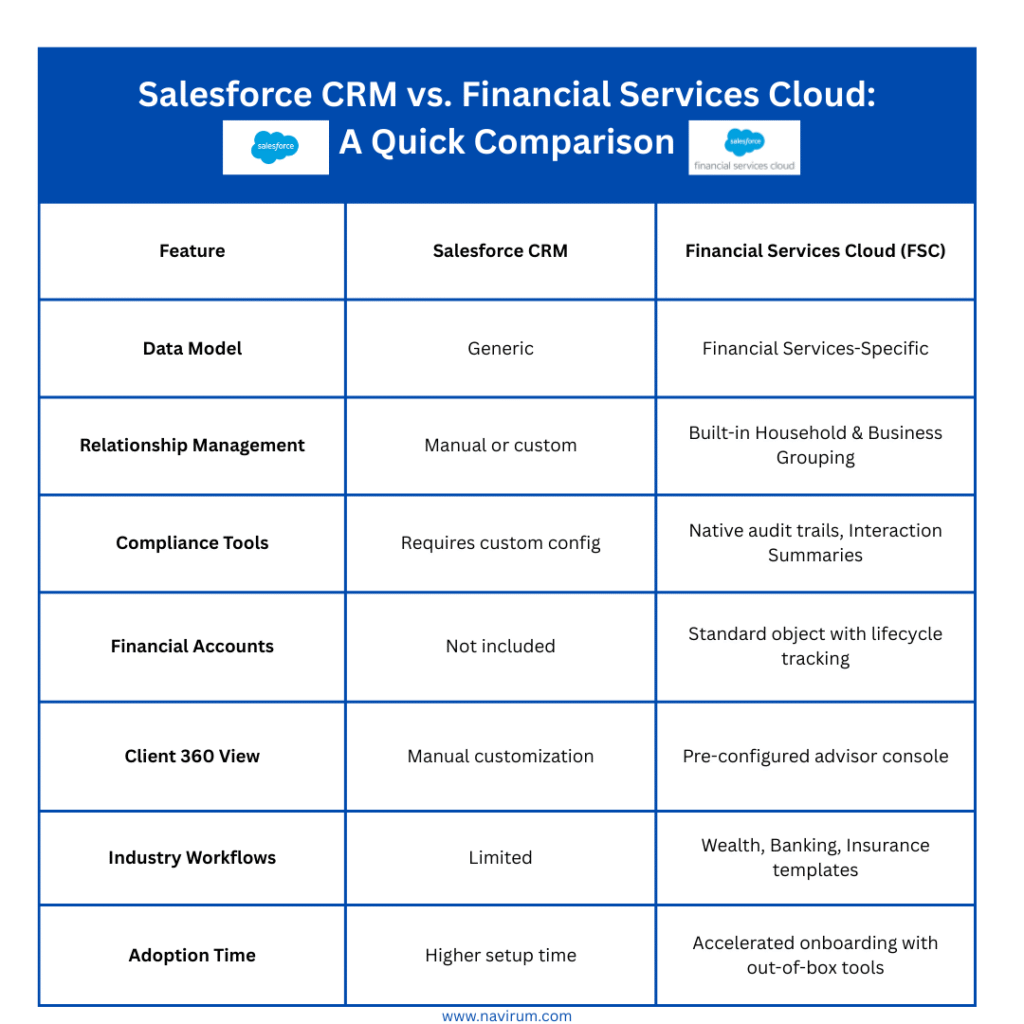
Financial Services Cloud is purpose-built for the financial sector – whether you’re in wealth management, retail banking, commercial banking, insurance, or mortgage services. Unlike the general Salesforce Sales Cloud or Service Cloud, FSC offers:
Pre-built financial data models
Household and relationship management
Client-centric dashboards and analytics
Industry-specific workflows and automation
Tools to enhance compliance and data visibility
🔍 Bottom line: FSC enables your advisors, bankers, and agents to deliver highly personalized service while staying compliant and scalable.
Key Tips for a Successful Migration from Salesforce CRM to FSC
Evaluate Your Current Salesforce Architecture
Start by assessing your current Salesforce environment:
What standard/custom objects are used?
How is your automation configured?
What’s your current data quality level?
🛠 Pro Tip: A full gap analysis will help uncover what’s reusable, what’s redundant, and where FSC can streamline operations.
Map Your Data to FSC’s Financial Data Model
FSC includes unique objects like:
Financial Accounts
Assets & Liabilities
Goals
Person Accounts
Relationships & Affiliations
📊 Best Practice: Test your data mappings in a sandbox before executing a full migration. Use tools like Data Loader, MuleSoft, or third-party ETL solutions.
Optimize Household and Client Management
FSC provides native tools to manage:
Client Households
Related Business Groups
Referrals and Partners
💡 Migration is the ideal time to clean and consolidate duplicate client records for a stronger “single source of truth.”
Plan for Security, Compliance, and Auditing Enhancements
FSC includes:
Interaction Summaries
Field Audit Trail
Shield Platform Encryption (optional)
Train and Support Your Teams for Success
Transitioning to FSC introduces new page layouts, objects, and dashboards. Your users need training that’s role-specific:
Advisors
Operations staff
IT/Admins
👥 Change Management Tip:Identify internal champions, offer sandbox access early, and host regular training touchpoints to reinforce adoption.
Discovery & Assessment : Review current org, data, business needs.
Data Mapping & Architecture Design: Align data models with FSC’s schema
Sandbox Build & Testing: Migrate a sample dataset and configure FSC features.
Training & Change Management: Educate users and admins.
Production Launch & Post-Go-Live Support: Go live with minimal disruption and continuous monitoring.
📌 Pro Tip: Don’t skip UAT (User Acceptance Testing) and back-up protocols.
📥 Book Consultation Below 📥
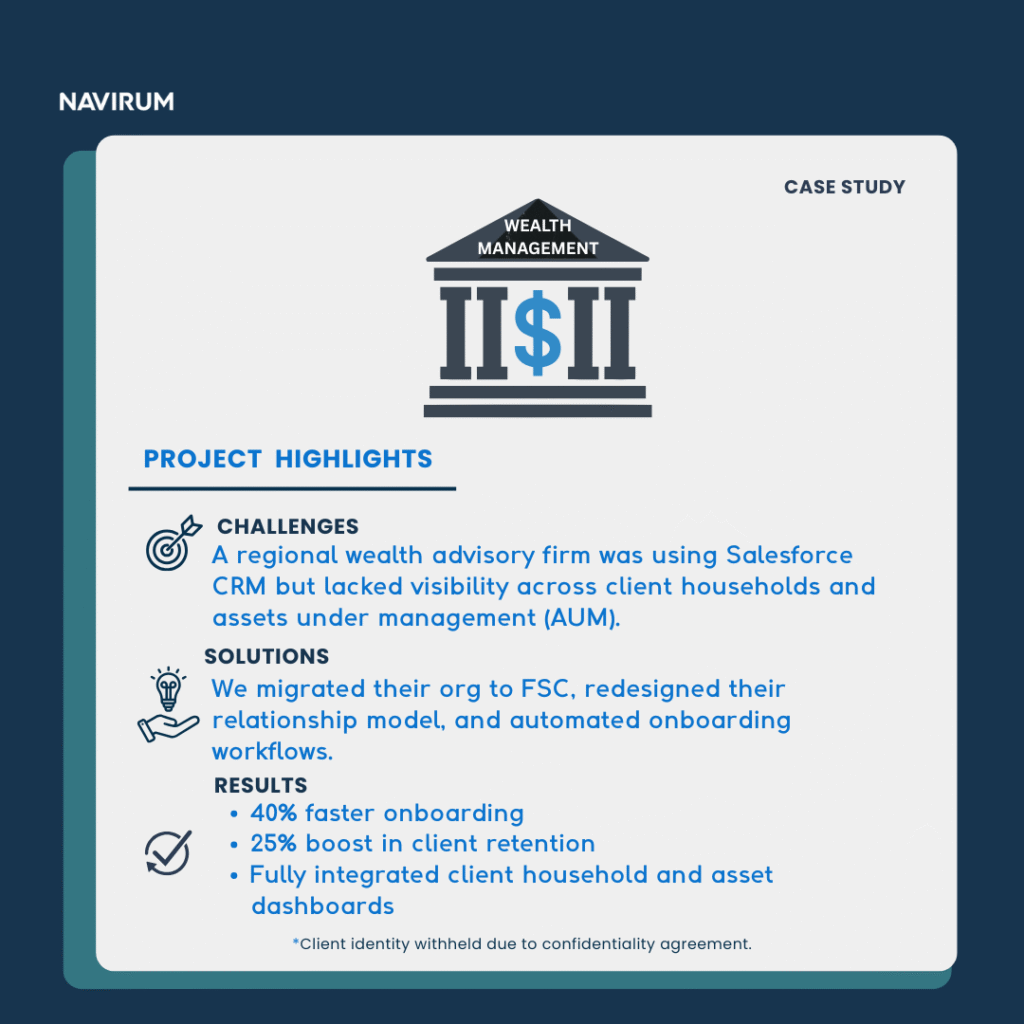
Migrating to Salesforce Financial Services Cloud is more than a tech upgrade – it’s a strategic leap forward for how you serve clients and grow revenue.
No, not if the data is properly mapped and migrated using sandbox testing and back-ups.
Can we roll out FSC in phases?
Absolutely. Many clients start with one business unit or advisory team and scale.
What’s the licensing difference between CRM and FSC?
FSC licenses are industry-specific and include additional objects and features. We’ll help assess your cost-benefit.
Do we need to build from scratch?
No. FSC comes with pre-configured templates, but we customize based on your business model.
How long does a typical FSC migration take?
Timelines vary based on data complexity, integrations, and customization needs. On average, migrations take 8–12 weeks from discovery to go-live, including testing and user training.
Will our existing Salesforce integrations still work after migrating to FSC?
In most cases, yes. Existing integrations can be maintained or optimized during migration. Our team reviews your connected apps and APIs to ensure compatibility and minimize disruption.
How Credit Unions Use Salesforce for Exceptional Customer Experience?
Credit unions can use Salesforce to centralize member data, automate communications, and gain actionable insights. This enables personalized service, faster responses, and stronger member loyalty, helping credit unions improve engagement, retention, and overall member satisfaction.
How to Use Salesforce for Exceptional Customer Experience and Long-Term Loyalty
In the competitive landscape of financial services, credit unions face unique challenges and opportunities. With the rise of digital banking and changing consumer expectations, delivering an exceptional customer experience is more crucial than ever. One powerful tool that can help credit unions achieve this is Salesforce. In this blog post, we will explore how credit unions can use Salesforce to enhance customer experience and build long-term loyalty.
Understanding the Importance of Customer Experience in Credit Unions
Customer experience (CX) is the sum of all interactions a customer has with a credit union. From the first point of contact to ongoing support, every touchpoint matters. A positive customer experience can lead to increased satisfaction, loyalty, and referrals. According to a study by PwC, 73% of consumers say that a good experience is key in influencing their brand loyalties.
Why Salesforce?
Salesforce is a leading customer relationship management (CRM) platform that offers a suite of tools designed to help organizations manage customer relationships effectively. For credit unions, Salesforce provides a comprehensive solution to streamline operations, enhance member engagement, and improve service delivery.
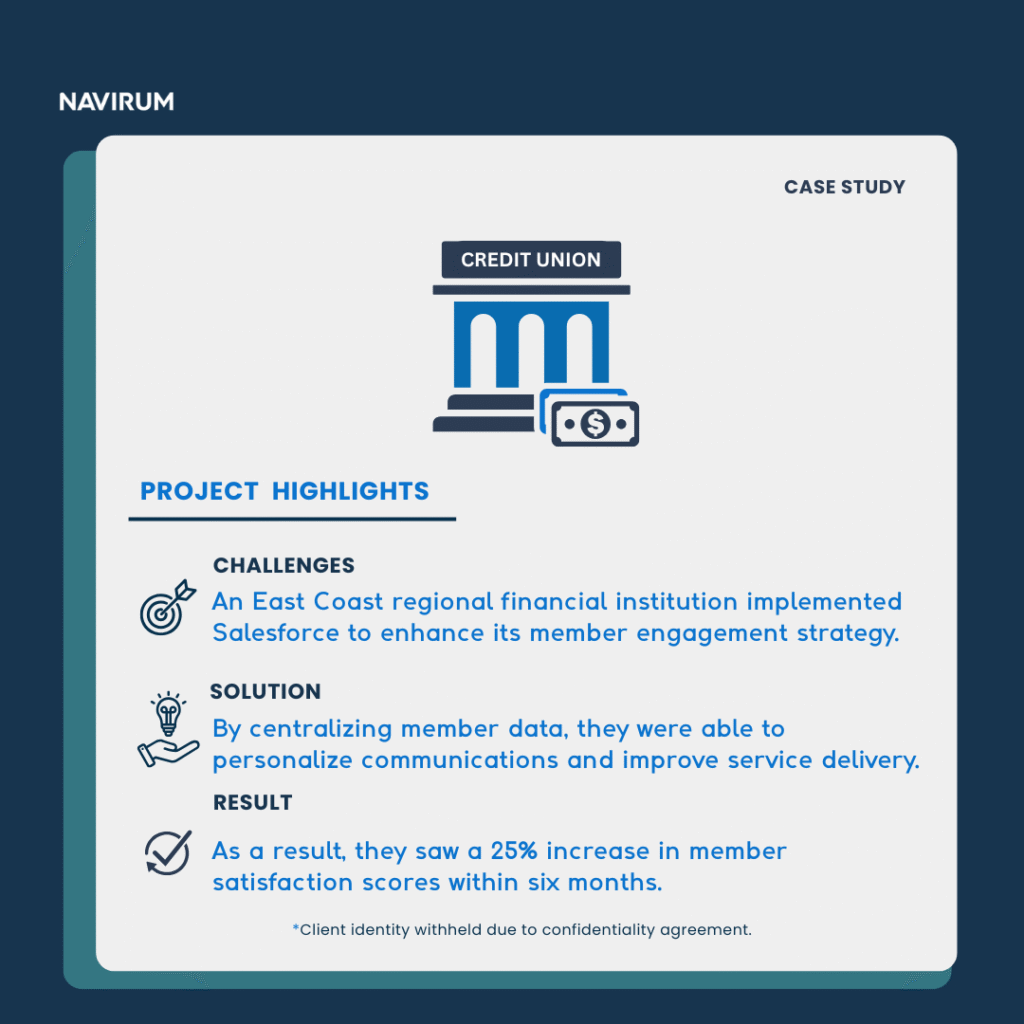
Salesforce allows credit unions to consolidate member information into a single platform. This centralized database enables staff to access comprehensive member profiles, including transaction history, preferences, and communication records.
Benefits:
Improved personalization of services.
Faster response times to member inquiries.
Enhanced understanding of member needs.
Automated Communication
With Salesforce, credit unions can automate communication with members. This includes sending personalized emails, reminders for loan payments, and updates on new services.
Benefits:
Consistent messaging across channels.
Reduced manual workload for staff.
Increased member engagement through timely communication.
Enhanced Member Support
Salesforce offers tools for managing member support requests efficiently. Credit unions can track inquiries, assign tasks to staff, and monitor resolution times.
Benefits:
Improved response times and service quality.
Higher member satisfaction rates.
Ability to identify and address recurring issues.
Data-Driven Insights
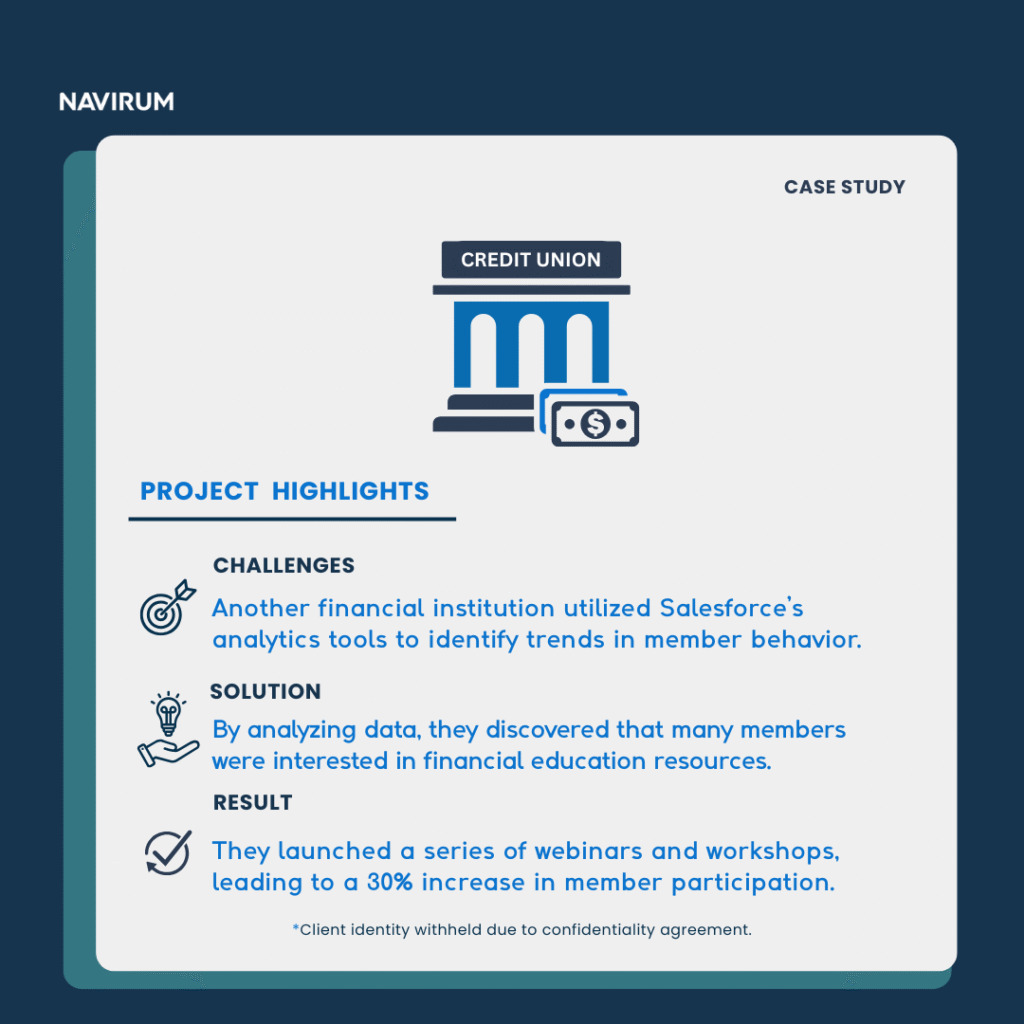
Salesforce provides robust analytics and reporting capabilities. Credit unions can analyze member behavior, track service performance, and identify trends.
Benefits:
Informed decision-making based on real-time data.
Ability to tailor services to meet member needs.
Enhanced marketing strategies through targeted campaigns.
Strategies for Implementing Salesforce in Credit Unions
Define Clear Objectives
Before implementing Salesforce, credit unions should define clear objectives. What specific goals do you want to achieve? Whether it’s improving member retention, increasing cross-selling opportunities, or enhancing service delivery, having clear objectives will guide the implementation process.
Investing in staff training is crucial for successful Salesforce adoption. Ensure that all team members understand how to use the platform effectively. Consider offering ongoing training sessions to keep staff updated on new features and best practices.
Well-trained staff matter just as much on the lending side. If loan turnaround time is a sore spot for your team, see how Salesforce automates loan origination workflows so staff spend less time on data entry and more time with members.
Personalize Member Interactions
Use the data available in Salesforce to personalize interactions with members. Tailor communications based on member preferences and behaviors. For example, if a member frequently inquires about mortgage options, send them relevant information and updates.
Personalization rules like this need occasional tuning as member behavior shifts, which is part of what our Orbit Managed Services team handles after the initial build, not a one-time setup left to drift.
The Path to Long-Term Loyalty
Credit unions can significantly enhance customer experience and foster long-term loyalty by leveraging Salesforce. By centralizing member data, automating communication, and utilizing data-driven insights, credit unions can create a more personalized and efficient service experience.
Ready to transform your credit union’s customer experience? Start exploring Salesforce today and see how it can help you build lasting relationships with your members. Subscribe for updates and tips on enhancing your financial services strategy
Navirum Recommendations: Unlock the Full Potential of Salesforce for Your Credit Union
At Navirum, we specialize in helping credit unions leverage Salesforce to deliver exceptional member experiences, streamline operations, and drive long-term loyalty. With deep expertise in Salesforce Financial Services Cloud and a strong understanding of the credit union sector, we guide organizations through every step of implementation and optimization.
Our approach includes:
Ongoing Support & Optimization: Beyond implementation, we provide continuous guidance to ensure Salesforce evolves with your credit union’s growth and changing member needs.
Strategic Planning: We assess your current systems, workflows, and business goals to design a Salesforce implementation that maximizes efficiency and member satisfaction.
Seamless Implementation: Our team ensures a smooth deployment, from data migration to workflow automation, minimizing disruption to daily operations.
Customized Solutions: We tailor dashboards, reports, and communication workflows to your credit union’s unique needs, enabling advisors and staff to access actionable insights quickly.
By partnering with Navirum, credit unions gain more than just technology—they gain a trusted advisor with proven experience in driving CRM success, improving member engagement, and building scalable processes for future growth.
What is Salesforce, and why is it relevant for credit unions?
Salesforce is a leading CRM platform that helps organizations manage customer relationships, streamline operations, and enhance service delivery. For credit unions, it centralizes member data, automates communications, and provides actionable insights to improve member experience and loyalty. See the fuller picture in our credit union digital transformation overview if you want the full capability list.
How can Salesforce improve the member experience at a credit union?
By centralizing member data, automating communications, and tracking interactions, Salesforce enables personalized service, faster response times, and more meaningful engagement with members.
Can Salesforce help with marketing and member outreach?
Yes. Salesforce includes tools for targeted campaigns, automated emails, and member segmentation. Credit unions can use data-driven insights to send personalized offers, product updates, and relevant content to members.
What types of member data can be managed in Salesforce?
Salesforce allows credit unions to manage comprehensive member profiles, including transaction history, communication records, preferences, account details, and engagement metrics.
Is Salesforce suitable for small or mid-sized credit unions?
Absolutely. Salesforce scales with credit union size. Smaller credit unions can start with core CRM features, while mid-sized and larger organizations can leverage advanced automation, analytics, and personalized member engagement tools.
How long does it take to implement Salesforce at a credit union?
Implementation time varies depending on the credit union’s objectives, data complexity, and level of customization. A basic setup can take a few weeks, while a fully customized deployment may take several months.
Do staff members need technical expertise to use Salesforce?
No. Salesforce is user-friendly, and credit unions can provide training tailored to staff roles. Ongoing training ensures employees stay updated on new features and best practices.
How can Salesforce help with member support and service requests?
Salesforce tracks all member inquiries, assigns tasks to staff, and monitors resolution times. This improves response efficiency, enhances service quality, and allows credit unions to identify recurring issues for proactive resolution.
Can Salesforce integrate with other credit union systems?
Yes. Salesforce can integrate with core banking systems, loan management platforms, marketing tools, and other software. This allows credit unions to consolidate data across platforms for a unified view of member interactions. On the lending side specifically, see which core banking and credit systems Salesforce integrates with.
What are the key benefits of using Salesforce for long-term member loyalty?
Salesforce enables personalized interactions, faster service, and data-driven decision-making. By providing a seamless, consistent experience across all touchpoints, credit unions can increase member satisfaction, retention, and advocacy over time.
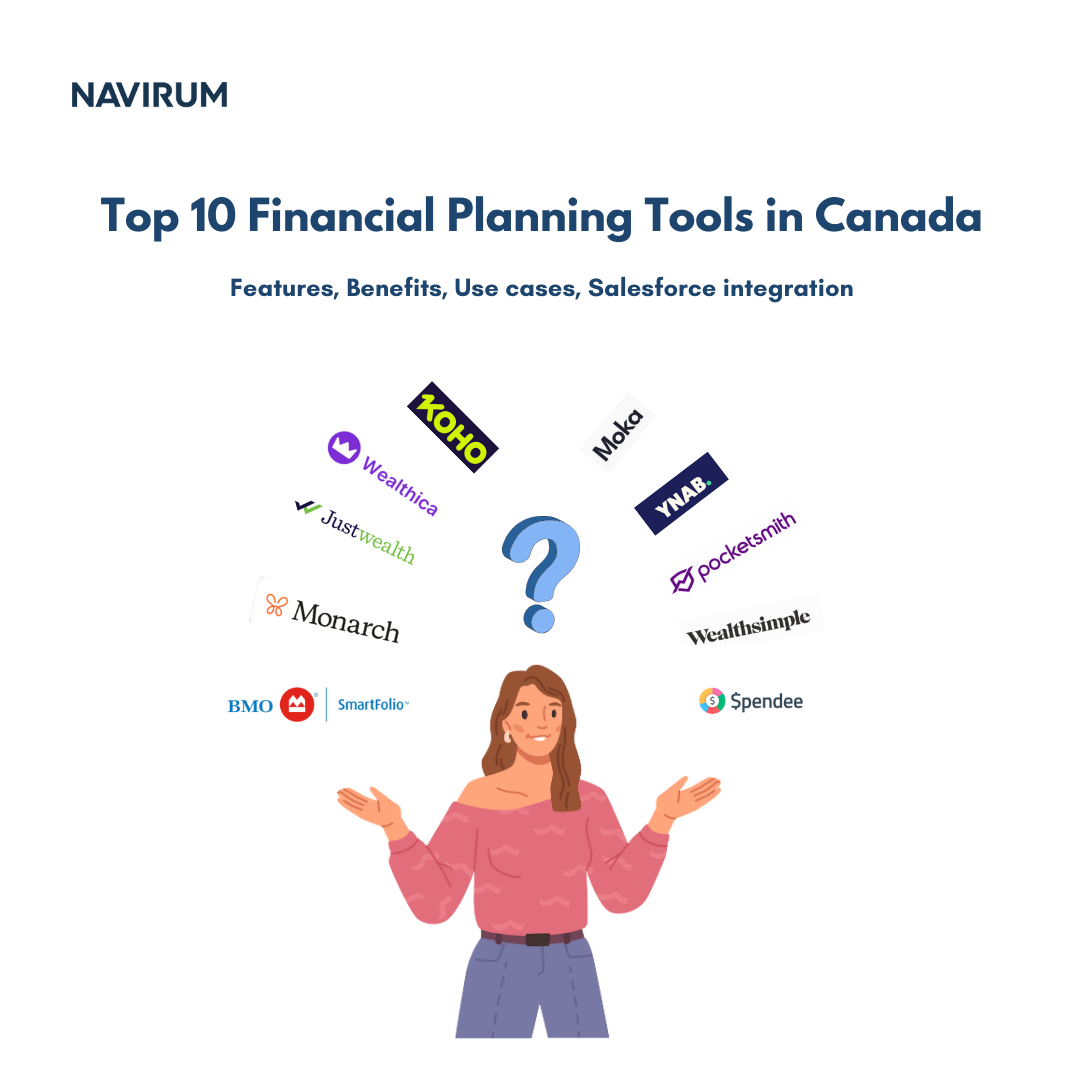
The article lists The Top 10 Financial Planning Tools in Canada, highlighting their features, pricing, and Salesforce integrations.
Financial planning software helps advisors analyze client finances and personalize recommendations, crucial as digital adoption grows in Canada.
Key features of modern tools include goal-based planning, cash flow projections, and integration with CRM platforms like Salesforce.
AI and integrated financial ecosystems are key trends reshaping financial planning tools in Canada.
Navirum enhances the use of these tools by integrating them with CRM and automation for improved advisor productivity.
Discover the top 10 financial planning tools in Canada. Features, pricing, use cases, and Salesforce integrations for advisors and planners.
Estimated reading time: 20 minutes
What Is Financial Planning Software for Canadian Advisors?
Financial planning software helps advisors analyze client finances, model long-term financial scenarios, and deliver personalized recommendations. In Canada, these platforms are becoming increasingly important as financial institutions adopt digital technologies to improve efficiency and client engagement.
The Canadian fintech ecosystem continues to grow rapidly, with billions invested into financial technology platforms that support advisors, wealth managers, and financial institutions.
Many of these tools connect directly into a firm’s CRM, which is why maintaining strong Salesforce managed services for financial services matters as much as choosing the right planning software itself.
Modern financial planning tools typically support:
Goal-based financial planning
Cash flow and retirement projections
Investment portfolio analysis
Client collaboration and dashboards
Integration with CRM platforms like Salesforce
For advisory firms, integrating financial planning tools with CRM and automation platforms allows advisors to deliver more personalized, data-driven advice while improving operational efficiency.
The Financial App Landscape is Far and Wide
Top 10 Financial Planning Tools Canada
In today’s fast-evolving financial landscape, Canadian advisors are increasingly adopting digital tools to strengthen client relationships, improve efficiency, and deliver deeper financial insights. The Canadian financial services sector is expanding rapidly, driven by innovation and supportive government policies around open banking that point to an even brighter future. Whether you’re managing a boutique practice or part of a larger firm, integrating purpose-built financial planning software into your workflow can unlock significant value – for both your business and your clients
Apps? Features, Benefits & Salesforce Integration
This comprehensive guide breaks down the top 10 financial planning tools in Canada—designed specifically to support advisors and planners. Each tool offers unique functionality, and we’ve included Salesforce integration details to help you choose solutions that align with your CRM strategy.
YNAB has become a go-to tool for budgeting enthusiasts—and for good reason. It applies a zero-based budgeting method that gives every dollar a purpose. While originally built for individuals, it’s gaining traction with financial coaches and advisors who support clients with debt reduction, cash flow management, and financial education.
Main Features:
Zero-based budgeting approach
Real-time sync with bank accounts (some Canadian banks require manual imports)
Goal tracking, reporting, and workshop content
Benefits for Advisors:
Builds strong spending discipline in clients
Offers insight into behavioral patterns and habits
Insights:
Clients using YNAB tend to reduce their debt faster and save more consistently
Cost:
$18.49 CAD/month or $124.99/year (after 34-day free trial)
Use Cases:
Coaching clients on monthly spending plans
Financial literacy sessions for young professionals
Salesforce Integration: ✅ Yes – via Integrately or Zapier
Accessibility: Web, iOS, Android
Request Your Salesforce Readiness Assessment | Navirum
Integration Assessment
Request Your Salesforce Readiness Assessment
Not sure if your tech stack is integration-ready? We’ll assess your current setup in one conversation. Designed exclusively for financial services firms.
Monarch is a sleek, modern financial planning dashboard that brings all your clients’ accounts into one intuitive interface. Designed for visual thinkers and strategic planners, it allows users to track net worth, set financial goals, and simulate future financial paths.
Main Features:
Aggregation of all financial accounts (banking, credit, investment)
Goal setting and collaboration features
Real-time updates and personalized insights
Benefits for Advisors:
Encourages engagement in long-term planning
Offers clients a clean visual of their full financial picture
Insights:
Excellent for advisors with tech-savvy, millennial clients who want proactive tools
Cost:
$20.72 CAD/month or $96.74/year with discount code
As one of Canada’s best-known fintech success stories, Wealthsimple offers a hybrid of robo-advisory and DIY investing. It’s ideal for advisors looking to provide clients with hands-off portfolios or partner with a platform that handles compliance, rebalancing, and tax-loss harvesting.
Main Features:
Robo-advisory investment management
Registered and non-registered account support (RRSP, TFSA, etc.)
Wealthsimple Tax and commission-free trading
Benefits for Advisors:
Gives clients affordable investing options with minimal maintenance
Transparent and user-friendly
Insights:
Particularly useful for entry-level clients and passive investors
Cost:
0.4%–0.5% management fee; no account minimums for basic plans
Use Cases:
Complement to in-house investment strategies
Clients with small balances or ESG investing interest
Salesforce Integration: ❌ No direct integration
Accessibility: Web, iOS, Android
Guide to Succession Planning for Financial Advisors, RIAs & Wealth Managers | Navirum
Wealth Management Guide
Guide to Succession Planning for Financial Advisors, RIAs & Wealth Managers
Succession planning for financial advisors is one of the most important — and most delayed — strategic decisions facing RIAs and wealth management firms today.
Whether you’re planning for retirement, preparing for internal succession, exploring external sale options, or building a long-term continuity plan, a structured RIA succession strategy protects your clients, strengthens firm valuation, and ensures business continuity.
Our free ebook, “30 Succession Planning Tips for Advisors, RIAs & Wealth Managers,” provides practical, actionable guidance to help you design and execute a succession plan that aligns with your growth strategy.
PocketSmith is a forecasting powerhouse. It’s perfect for advisors who want to help clients look beyond the next paycheck and into multi-decade cash flow scenarios. It’s not just budgeting—it’s financial time travel.
Main Features:
Future cash flow forecasting up to 60 years
Scenario analysis and budgeting categories
Multi-currency and account sync
Benefits for Advisors:
Helps clients visualize the long-term impact of decisions
Assists in lifestyle and retirement goal setting
Insights:
Empowers forward-thinking financial conversations
Cost:
Free basic plan; premium starts at $9.95 USD/month
Use Cases:
“What if” scenarios for life events (career changes, real estate, retirement)
Wealthica is the go-to portfolio aggregator for Canadians. It pulls investment data from over 100 institutions and gives users a detailed, visual snapshot of holdings, returns, and allocation. Ideal for wealth managers, it provides back-office clarity and client-facing transparency.
Main Features:
Investment portfolio aggregation
Daily account syncing and performance metrics
Developer API access
Benefits for Advisors:
Centralizes multi-institution reporting
Enables easy client reporting and reviews
Insights:
Helps advisors identify duplication, underperformance, or misallocation
Cost:
Free basic; Pro from $39.99/month
Use Cases:
Quarterly performance reviews
Integrated investment dashboards
Salesforce Integration: ✅ Yes – via API or custom connector
Moka is Canada’s answer to Acorns—a micro-investing app that rounds up everyday purchases and funnels the change into diversified portfolios. For advisors serving first-time investors or low-commitment clients, Moka is a soft introduction to wealth-building.
Main Features:
Automated round-up investing
Managed portfolios with simple risk levels
Goal-based saving tools
Benefits for Advisors:
Introduces investing concepts without overwhelming clients
Encourages habit formation around saving
Insights:
Often a first step for younger clients into broader financial discussions
Cost:
$3.99/month
Use Cases:
Starter portfolios for Gen Z
Habit-building programs in financial literacy campaigns
Cost:
Salesforce Integration: ❌ No integration currently
Koho is more than a prepaid Visa—it’s a complete financial wellness platform. With built-in budgeting tools and savings features, it’s ideal for advisors looking to help clients manage their cash flow while earning cashback on purchases.
Main Features:
Prepaid Visa card with budgeting dashboard
Cashback rewards
Automated savings features
Benefits for Advisors:
Combines day-to-day spending tracking with financial goals
No credit check or fees to get started
Insights:
Helps clients build spending awareness without the debt of credit cards
Spendee brings design-focused simplicity to budgeting. It’s visually intuitive and ideal for clients who want to track spending with minimal friction. Shared wallets make it especially useful for couples and families.
Justwealth is a Canadian robo-advisor offering deeper customization and dedicated human support. It’s positioned between DIY platforms and full-service wealth management, and it’s particularly popular for RESPs and long-term portfolios.
Main Features:
Custom-built ETF portfolios
Dedicated portfolio managers
Tax-efficient strategies
Benefits for Advisors:
Adds a layer of personalized service to automation
Strong fit for families and long-term savers
Insights:
Hybrid service structure appeals to cautious investors
Cost:
Salesforce Integration: ❌ Not supported
$4.99/month; account minimum of $5,000
Use Cases:
RESP planning
Passive growth strategies
Salesforce Integration: ❌ Not currently supported
Accessibility: Web, iOS
The iA Private Wealth Advisor’s Blueprint for Salesforce FSC Success | Navirum
Wealth Advisor Guide
The iA Private Wealth Advisor’s Blueprint for Salesforce FSC Success
The iA Private Wealth Advisor’s Blueprint was created based on extensive experience identifying the unique challenges and pain points of iA Private Wealth advisors, providing a clear path to a smooth and efficient Salesforce FSC implementation.
How can financial advisors evaluate ROI when investing in financial technology?
Evaluating the return on investment for financial planning tools requires looking beyond licensing costs and focusing on operational improvements and client outcomes.
Advisory firms typically evaluate ROI across several areas:
Time saved through automation and reduced manual processes
Increased advisor capacity to serve more clients
Improved client retention and engagement
Enhanced compliance reporting and documentation
Over time, firms that adopt integrated financial planning technology often see improved advisor productivity and stronger client relationships.
BMO SmartFolio is the digital portfolio management arm of BMO. It blends professional advice with a digital interface and is ideal for clients who want a big-bank presence backing their online investing.
Main Features:
BMO-managed portfolios
Personalized goal setting
Automatic rebalancing
Benefits for Advisors:
Aligns well with conservative clients
Institutional trust and familiarity
Insights:
Attractive for clients already banking with BMO
Cost:
0.4%–0.7% management fee depending on portfolio size
Use Cases:
Low-maintenance retirement portfolios
Cross-selling to BMO clients
Accessibility: Web, iOS, Android
Choosing the Right Tool for Your Practice
While each of these tools brings unique strengths, those like YNAB, PocketSmith, Kohoet Wealthica stand out for financial professionals seeking Salesforce-compatible solutions. By aligning your tools with your CRM, you’ll unlock deeper visibility into client behaviors and deliver more holistic financial planning services.
Ready to Modernize Your Advisory Workflow? | Navirum
📣 Advisory Tech & Workflows
Ready to Modernize Your Advisory Workflow?
Explore these platforms, take advantage of free trials, and consider integrations with your existing systems like Salesforce. Want a custom recommendation or help setting up your tools? Contact us for a strategy session tailored to your advisory goals.
Key Technology Trends Shaping Financial Planning in Canada
Financial planning technology is evolving rapidly as fintech innovation and artificial intelligence reshape how advisors deliver advice. Canadian financial institutions are increasingly adopting digital platforms to streamline operations, automate processes, and enhance client experiences.
Several major technology trends are shaping the future of financial planning tools.
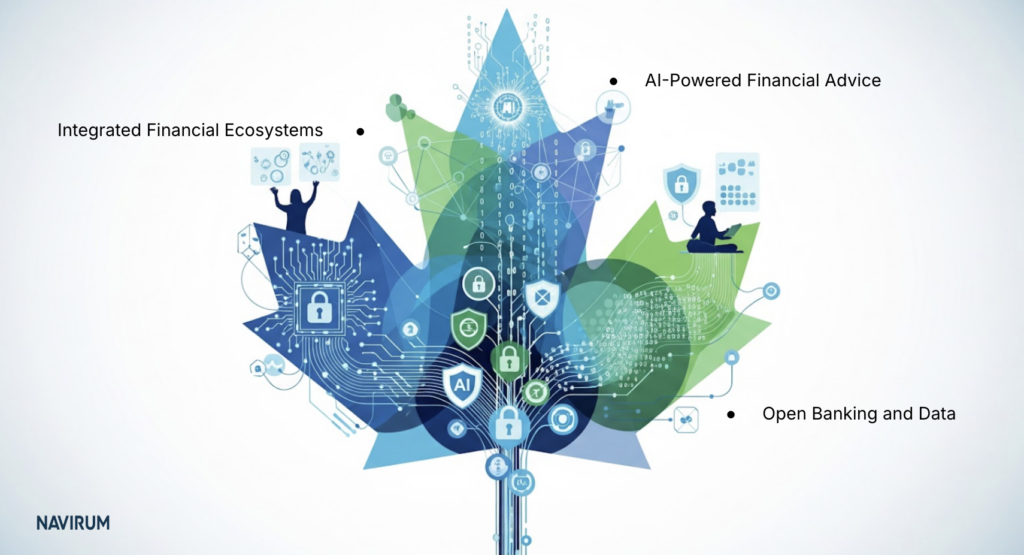
AI-Powered Financial Advice
Artificial intelligence is becoming a core component of modern planning platforms. AI can analyze large volumes of client data and generate recommendations for retirement planning, tax strategies, and portfolio optimization.
Some AI-based planning platforms can evaluate complex financial scenarios and suggest optimized planning strategies for advisors and clients.
Integrated Financial Ecosystems
Advisors increasingly rely on multiple fintech platforms for budgeting, portfolio tracking, planning, and client engagement. Integration between these tools and CRM platforms enables:
centralized client data
automated reporting
improved advisor productivity
Open Banking and Data Connectivity
Canada is gradually moving toward a consumer-driven banking framework, which will allow secure sharing of financial data between institutions and fintech platforms.
This will significantly improve how financial planning tools connect with banking systems and client accounts.
Top Portfolio Management Tools CTA Banner | Navirum
Canadian Wealth Tech Insights
Discover 3 Top Portfolio Management Tools in Canada
How Navirum Helps Financial Firms Modernize with Digital Transformation and AI
Adopting financial planning tools is only the first step toward building a modern advisory practice. The real value emerges when these platforms are integrated into a unified digital ecosystem that connects client data, planning workflows, compliance processes, and advisor insights. This is where strategic digital transformation becomes essential.
Navirum helps financial advisors, wealth managers, and financial institutions modernize their operations by combining financial technology platforms with CRM, automation, and artificial intelligence. Through deep expertise in financial services and Salesforce-based architectures, Navirum enables firms to create a connected advisor experience where planning tools, client engagement, and operational workflows work together seamlessly.
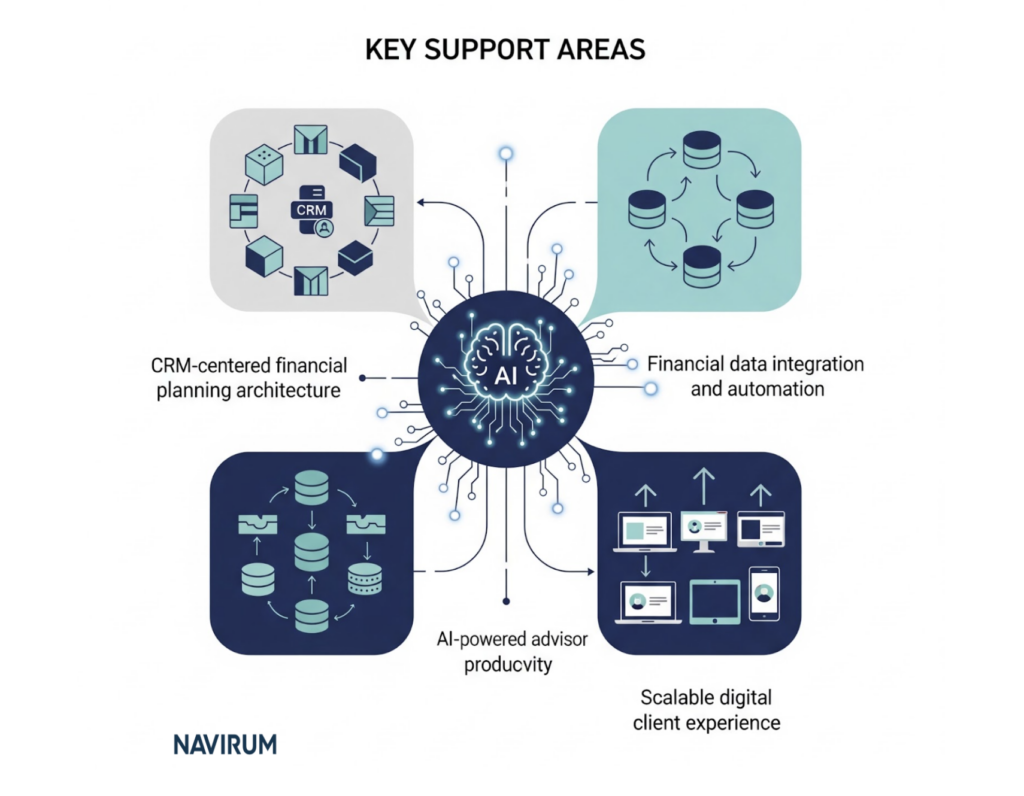
Key Areas Where Navirum Supports the Industry
1. CRM-Centered Financial Planning Architecture
Navirum helps firms build Salesforce-centric ecosystems where financial planning tools integrate directly with advisor workflows.
Integration of financial planning platforms with CRM systems
Unified client profiles combining planning, investment, and interaction data
Automated client onboarding and data capture
Centralized reporting and compliance visibility
2. Financial Data Integration and Automation
Financial advisors often struggle with fragmented systems and manual processes. Navirum streamlines data movement between planning tools and operational systems.
API and middleware integrations between fintech tools and core systems
Automated client data synchronization
Workflow automation for financial planning updates
Elimination of duplicate data entry and manual reconciliation
3. AI-Powered Advisor Productivity
Artificial intelligence is rapidly transforming how advisors deliver financial planning. Navirum helps firms deploy AI capabilities that augment advisor productivity and improve client outcomes.
AI-assisted client insights and portfolio monitoring
Predictive financial planning scenarios
Intelligent workflow automation for advisors and service teams
AI copilots for client servicing and operational tasks
4. Scalable Digital Client Experiences
Today’s investors expect a seamless digital experience similar to modern fintech platforms. Navirum enables firms to deliver client-centric digital journeys.
Client portals integrated with financial planning dashboards
Digital onboarding and automated document management
Secure data sharing and collaboration tools
Personalized financial insights delivered through digital channels
Turning Financial Tools Into a Strategic Advantage
Financial planning applications such as YNAB, PocketSmith, Wealthica, and Koho provide powerful capabilities individually. However, when integrated into a broader digital strategy, they become part of a much larger transformation that enhances advisor productivity, improves client experiences, and unlocks data-driven financial insights.
Navirum works with financial institutions, RIAs, and advisory firms to turn disconnected fintech tools into a cohesive digital ecosystem—helping advisors spend less time managing systems and more time delivering strategic financial guidance to clients.
FAQ: Financial Planning Tools in Canada | Navirum
Canadian Advisory Technology
FAQ: Financial Planning Tools in Canada
Comprehensive insights on selecting software, building integrated advisor technology stacks, ensuring PIPEDA compliance, and deploying AI safely across Canadian wealth management workflows.
What is the best financial planning software for Canadian advisors?
The best financial planning software depends on the advisor’s workflow and client base. Popular options include tools for budgeting, portfolio aggregation, cash-flow forecasting, and robo-advisory platforms. Advisors often combine several tools together to deliver comprehensive financial planning.
How should financial advisory firms build a modern financial planning technology stack?
A modern financial planning technology stack should combine financial planning tools, client data platforms, and automation systems into a unified ecosystem. Rather than relying on isolated applications, leading advisory firms are adopting integrated technology architectures that connect planning software with CRM platforms, investment management systems, and client communication tools.
A well-designed advisor technology stack typically includes:
✓
<strong class="highlight-text">Financial planning software</strong> for projections, cash flow analysis, and retirement modeling
✓
<strong class="highlight-text">CRM platforms</strong> to manage client relationships and advisor workflows
✓
<strong class="highlight-text">Portfolio management and reporting systems</strong> for investment oversight
✓
<strong class="highlight-text">Client portals and collaboration tools</strong> for secure communication and document sharing
✓
<strong class="highlight-text">Automation and AI tools</strong> that help advisors analyze client data and streamline operations
When these systems are integrated effectively, advisors gain a 360-degree view of their clients’ financial lives and can deliver more personalized, proactive advice.
Why is CRM integration becoming critical for financial planning tools?
Financial planning tools generate valuable client insights, but those insights often remain siloed if they are not connected to a central system of record. CRM platforms are increasingly becoming the foundation of modern advisory technology ecosystems because they centralize client data and coordinate workflows across multiple tools.
Integrating financial planning software with CRM platforms enables firms to:
✓
Consolidate client financial data, interactions, and planning insights in one place
✓
Automate workflows such as onboarding, financial plan updates, and compliance documentation
✓
Track client engagement across planning tools, meetings, and communications
✓
Provide advisors with contextual insights before client meetings
For advisory firms scaling their operations, CRM integration ensures that financial planning insights become part of the broader client relationship management process rather than remaining isolated within a single application.
Can AI replace financial advisors?
Artificial intelligence is designed to augment advisors rather than replace them. AI can automate analysis and generate insights, but human advisors remain essential for relationship management, complex planning, and strategic decision-making.
What role will artificial intelligence play in the future of financial planning tools?
Artificial intelligence is expected to significantly expand the capabilities of financial planning platforms in the coming years. AI can analyze large volumes of financial data, identify patterns, and generate predictive insights that help advisors make more informed decisions.
Potential AI-driven capabilities include:
✓
Predictive retirement and investment scenario modeling
✓
Automated financial plan updates based on life events
✓
Behavioral analysis to help advisors understand client spending patterns
✓
Intelligent recommendations for tax optimization and portfolio adjustments
While AI will enhance planning technology, the advisor-client relationship will remain central to delivering personalized financial advice.
How do financial planning tools integrate with portfolio management and investment platforms?
Many modern financial planning tools can connect with portfolio management systems and investment platforms through APIs, data aggregation services, or middleware solutions. This integration allows advisors to pull real-time investment data into planning models, making it easier to analyze asset allocation, forecast retirement outcomes, and monitor progress toward financial goals.
When integrated properly, these systems allow advisors to:
✓
Automatically sync investment portfolios with planning scenarios
✓
Generate consolidated performance reports for clients
✓
Monitor portfolio drift and rebalancing opportunities
✓
Reduce manual data entry across systems
For advisory firms, integrating planning tools with portfolio management systems improves operational efficiency and enhances the accuracy of financial projections.
What security and compliance considerations should advisors evaluate when adopting financial planning software?
Financial advisors operating in Canada must ensure that any financial planning software complies with strict regulatory and security standards. These include requirements related to data protection, client privacy, and auditability.
Key considerations include:
✓
Compliance with <strong class="highlight-text">PIPEDA</strong> and other Canadian privacy regulations
✓
Secure data encryption and storage standards
✓
Role-based access controls for client information
✓
Audit logs for regulatory reporting and compliance reviews
Advisory firms should also evaluate vendor security certifications and ensure that integrations with other systems maintain consistent security policies.
What capabilities should advisors look for when evaluating next-generation financial planning platforms?
Next-generation financial planning platforms go beyond basic budgeting and retirement projections. They increasingly function as <strong class="highlight-text">data-driven advisory platforms</strong> that combine financial modeling, analytics, and client collaboration tools.
Advisors evaluating modern financial planning tools should prioritize platforms that support:
✓
<strong class="highlight-text">Real-time financial data aggregation</strong> across multiple institutions
✓
Scenario modeling and predictive planning capabilities
✓
Integration with CRM and portfolio management systems
✓
AI-driven insights and automation for advisors
✓
Client-friendly dashboards and digital collaboration features
Platforms that support open integrations and flexible data architecture are particularly valuable because they allow firms to evolve their technology stack as new fintech solutions and regulatory requirements emerge.
How can financial planning software support holistic wealth management strategies?
Traditional financial planning focused primarily on retirement projections and cash flow modeling. Modern planning platforms now support a much broader range of wealth management services.
Advanced financial planning tools can help advisors:
✓
Integrate investment planning with tax and estate strategies
✓
Model complex life scenarios such as business sales or inheritance
✓
Align financial plans with client values such as ESG investing
✓
Provide dynamic, continuously updated financial roadmaps
By combining these capabilities with CRM and data analytics platforms, advisors can deliver a more holistic wealth management experience.
How can financial advisors evaluate ROI when investing in financial planning technology?
Evaluating the return on investment for financial planning tools requires looking beyond licensing costs and focusing on operational improvements and client outcomes.
Advisory firms typically evaluate ROI across several areas:
✓
Time saved through automation and reduced manual processes
✓
Increased advisor capacity to serve more clients
✓
Improved client retention and engagement
✓
Enhanced compliance reporting and documentation
Over time, firms that adopt integrated financial planning technology often see improved advisor productivity and stronger client relationships.
How can financial planning software improve the client-advisor relationship?
Financial planning software enhances the advisor-client relationship by improving transparency, collaboration, and communication. Advisors can present interactive financial projections, track progress toward goals, and provide ongoing updates based on real-time financial data.
These capabilities help:
✓
Increase client engagement during planning discussions
✓
Provide visual representations of financial strategies
✓
Enable collaborative goal setting and financial decision-making
✓
Strengthen trust through clear and consistent reporting
When clients have greater visibility into their financial plans, they tend to remain more engaged and committed to long-term strategies.
Ready to Unify Your Advisory Tech Stack?
Contact Navirum to design an integrated Salesforce ecosystem that connects your planning tools, client data, and workflows.
Not Sure Which Tool is Right For You? Advisor Tool Match Quiz
Unlock your personalized recommendation—based on your practice size, goals, and client needs.
Q1What’s the size of your practice?
Top Recommended Match92% Match
YNAB (You Need A Budget)
Perfect for budgeting-focused coaching, solo advisors, and financial literacy sessions. Helps your clients build discipline and track spending behavior effectively.
Alternative Tool Matches for Your Practice
Need Salesforce Integration & Account Aggregation?
Navirum connects your financial planning and aggregation tools directly into Salesforce FSC for back-office clarity.
How Salesforce Helps Commercial Banks Modernize and Grow
Salesforce Financial Services Cloud helps commercial banks unify client data, automate workflows, support compliance and improve relationship management. The result is faster execution, more connected teams and a more consistent client experience.
By Lavinia Picu Reviewed by Navirum Published May 17, 2025 Updated July 18, 2026 9 min read
Salesforce Partner
since 2018
5.0 rating
Salesforce AppExchange
Hundreds of projects
delivered
FSC, integrations & AI
specialists
What are the benefits of using Salesforce for banks?
Salesforce gives banks a single, 360-degree view of every customer and automates the work around it, from loan origination and KYC onboarding to compliance and AI-driven cross-selling, all on one governed data platform. Banks that implement Salesforce Financial Services Cloud typically report these benefits:
A unified 360-degree customer view: retail, commercial and wealth relationships live on one record, so every banker sees the full picture instead of siloed data.
Faster loan origination: industry implementations report roughly 40 to 50% faster loan processing by digitizing origination and centralizing application tracking.
Automated KYC and onboarding compliance: automated identity verification, credit checks and disclosures can cut approval times by up to 70% while keeping a full audit trail.
Higher productivity and satisfaction: firms report around 35% higher employee productivity and 30% higher customer satisfaction after automating manual workflows.
AI-driven cross-selling: a connected data foundation surfaces next-best-product opportunities, lifting cross-sell performance by roughly 15 to 29%.
Lower cost and measurable ROI: around 25% lower operational cost, with most banks realizing measurable ROI within the first 12 months.
Navirum is a Salesforce Ridge Partner rated 5.0 on the Salesforce AppExchange, and builds and governs the data foundation these benefits depend on for banks and financial services firms.
Why Commercial Banks Are Rethinking Their Technology Stack
Commercial banks face increasing pressure from fintech competitors, changing client expectations and a growing regulatory burden. Legacy systems and siloed data make it harder to respond quickly, serve clients proactively and maintain operational efficiency.
Salesforce, with Financial Services Cloud at its core, provides a modern foundation to unify data, automate processes and strengthen compliance workflows. It can also support AI and analytics initiatives that help teams make better decisions and identify growth opportunities.
Where Salesforce Creates Value Across Commercial Banking
Select a banking priority to compare today’s operational challenge with the connected, automated approach enabled by Salesforce Financial Services Cloud.
Core Challenge
Fragmented Data Silos
In traditional commercial banks, data is trapped across disconnected departments and legacy systems. This fragmentation slows decision-making, hampers collaboration, and creates disjointed customer experiences.
Salesforce-Enabled Approach
Salesforce FSC connects customer, financial, and operational data in real time, providing a unified 360-degree view of the client across all commercial, retail, and wealth units.
Consolidate complex client profiles and product holdings.
Ensure relationship managers and underwriters view the exact same data.
Core Challenge
Managing Complex Portfolios
Relationship managers struggle to manually track hundreds of corporate accounts across multiple geographies, leading to missed touchpoints, reactive servicing, and lost cross-sell opportunities.
Salesforce-Enabled Approach
Elevate client engagement with automated workflows and interaction tracking. Salesforce provides a performance cockpit to prioritize high-value actions and streamline outreach.
Automatically track emails and meetings via Salesforce Inbox.
Uncover complex corporate hierarchies and household networks.
Core Challenge
Fragmented, Manual Origination
Traditional loan processing relies on physical paperwork, endless email chains, and manual data entry. This leads to slow turnaround times, compliance gaps, and frustrated borrowers.
Salesforce-Enabled Approach
Digitize and automate end-to-end credit workflows. Use pre-built origination templates and digital intake portals to accelerate decision-making without sacrificing due diligence.
Seamlessly pass data from front-office RMs to back-office credit teams.
Securely collect borrower documents via automated portals.
Core Challenge
Manual, Time-Consuming Knowledge Work
Bankers spend hours preparing for client meetings, summarizing credit reviews, chasing missing documents, and triaging service cases. This manual effort limits capacity and slows response times.
Salesforce-Enabled Approach
Agentforce brings governed AI into daily banking work, grounded in your trusted Salesforce data and guardrails. It assists teams without replacing human judgment or oversight.
Draft relationship-manager meeting prep and credit-review summaries.
Automate missing-document follow-up, case triage, and compliance reminders.
Core Challenge
Manual Compliance and Audit Preparation
Ensuring KYC and AML compliance across disjointed systems requires massive administrative overhead. Preparing for audits means weeks of manual data gathering, increasing the risk of costly fines.
Salesforce-Enabled Approach
FSC can embed configured compliance checks, approvals and evidence collection into daily workflows. Built-in tools support continuous audit readiness, secure data encryption, and role-based access controls.
Automate compliance checks with integrated risk rules.
Maintain a traceable history of client interactions, approvals and workflow activity.
Core Challenge
Rip-and-Replace Risk
Modernizing the front office often feels like it requires replacing core banking systems, a costly and high-risk undertaking most banks want to avoid.
Salesforce-Enabled Approach
Salesforce connects to your existing core banking, loan-origination, treasury, and risk systems through APIs, MuleSoft, and governed integration patterns, so you modernize the client experience without ripping out back-end infrastructure.
Integrate core banking, treasury, and risk platforms via MuleSoft and APIs.
Adopt governed, secure integration patterns that preserve back-end investments.
A Single Source of Truth Across the Bank
In most commercial banks, data lives in silos – between departments, lines of business, and systems. This fragmentation hampers collaboration, slows decision-making, and leads to inconsistent customer experiences.
Salesforce Financial Services Cloud (FSC) solves this by offering a centralized platform that connects customer, financial, and operational data in real time. From relationship managers to underwriting teams, everyone gains a shared 360-degree view of the client.
C-suite Insight: For CIOs and COOs, this enables better system interoperability and IT cost reduction. For CEOs, it improves cross-sell potential and strategic decision-making.
Relationship Management at Scale
In commercial banking, relationships are everything. But managing hundreds or thousands of complex relationships across multiple geographies and products is a challenge – especially in a hybrid work environment.
Salesforce enables banks to elevate client engagement with automation, intelligent workflows, and real-time collaboration tools like Slack and Salesforce Inbox.
Traditional loan processing is manual, error-prone, and time-consuming – leading to delays, poor client experiences, and compliance risks. With Salesforce, commercial banks can digitize and automate end-to-end credit workflows.
Using pre-built loan origination templates, digital intake forms, and automated document management, banks can streamline underwriting and decision-making without sacrificing due diligence.
C-suite Insight: For Heads of Credit, Risk, and Operations, this means lower cost of service, fewer compliance gaps, and a better borrower experience.
From Predictive Analytics to Governed AI Agents
AI is not a buzzword anymore – it’s a business necessity. Salesforce’s native AI, Einstein, provides predictive intelligence such as risk scoring, opportunity spotting and trend forecasting. Agentforce adds governed AI agents that assist teams in everyday banking work, grounded in trusted Salesforce data and guardrails.
In practice that means relationship-manager meeting preparation, credit-review summaries, missing-document follow-up, service-case triage and compliance reminders, alongside predictive risk and opportunity insights. Every action stays subject to permissions, human review and a traceable record, so oversight and accountability remain with your people.
Compliance, Security, and Audit-Readiness
Commercial banks operate in one of the most regulated environments. Ensuring compliance, managing audit trails, and securing sensitive data are not optional – they’re mission-critical.
Salesforce provides built-in tools to support audit readiness, KYC/AML workflows, data encryption, and access controls. Custom dashboards help teams stay ahead of regulatory requirements and internal policies.
C-suite Insight: For CROs and General Counsel, Salesforce reduces regulatory exposure and ensures data governance standards are met without manual overhead.
Standard Bank’s Customer-Centric Transformation
Flexible Integrations with Core Banking Systems
One of the biggest myths about Salesforce is that it can’t integrate with legacy banking systems. In reality, Salesforce is built to integrate with core banking platforms, third-party fintech APIs and open banking, and even mainframe systems via MuleSoft or custom middleware.
This makes it possible for banks to modernize front-office operations while preserving back-end investments.
Actionable Dashboards and Executive-Level Reporting
Data is only valuable if you can act on it. Salesforce offers customizable dashboards and reporting tools tailored to the needs of different stakeholders – from branch managers to the C-suite.
Leadership can monitor KPIs across the organization, evaluate team performance, and make real-time strategic decisions based on clean, live data.
Faster Time-to-Market for New Products and Services
In today’s market, being first often means winning. With Salesforce, banks can quickly roll out new services, digital channels, or client on-boarding experiences using low-code tools like Salesforce Flow and App Builder.
Need to launch a digital small business lending portal? Build a relationship scorecard? Customize onboarding journeys for new commercial clients? Salesforce can deliver, all without lengthy IT roadmaps.
FinSight Series
A banking leader’s briefing on Salesforce, FSC and AI
Practical guidance for commercial banking transformation, delivered twice monthly.
You are subscribed. Watch for FinSight in your inbox.
Navirum’s Strategic Recommendation For Commercial Banking Leaders
The transition to a connected, customer-centric commercial bank is not just about adopting Salesforce Financial Services Cloud. It’s about fundamentally redesigning your operating model. As a specialized Salesforce consulting partner with a proven track record in financial services, Navirum’s expertise lies in transforming the insights from this article into actionable, measurable results.
We strongly advise C-suite leaders to move beyond siloed CRM adoption and focus on a holistic implementation that strategically integrates a single source of truth across all business units (Relationship Management, Loan Origination, Risk). To truly future-proof your bank, we recommend engaging a partner who can align FSC with your core banking systems, operationalize Agentforce and governed AI for well-supervised decision-making, and support the bank’s compliance and audit requirements, turning Salesforce into a lasting advantage for your commercial bank’s core competitive advantage.
Real-World Results: Salesforce in Action for Commercial Banks
Many of the world’s leading commercial banks – large and mid-size alike – are already leveraging Salesforce to modernize client engagement and drive business outcomes. Reported benefits include:
Improved relationship-manager productivity
Faster loan origination and underwriting
Stronger client satisfaction across corporate relationships
Lower operational costs and improved regulatory readiness
As a Salesforce consulting partner specialized in financial services, we can help banks across North America deploy tailored solutions aligned to their growth and compliance goals.
Why Work with a Salesforce Partner ?
While Salesforce offers immense value out of the box, its real power comes to life when implemented with deep industry knowledge and a strategic lens. That’s where we come in to help:
Design scalable architectures aligned with their growth strategies
Customize Salesforce FSC and integrations to fit banking workflows
Optimize performance with data analytics, automation, and AI
Final Thoughts: Make Salesforce Your Strategic Advantage
Salesforce isn’t just a CRM – it’s a catalyst for business transformation. For commercial banks, it offers a practical and powerful way to connect operations, empower teams, and put the customer at the center of everything.
The next generation of banking leaders will be those who embrace intelligent technology and reimagine the way they work.
Planning a Salesforce Transformation for Your Bank?
Salesforce for Commercial Banks: What Leaders Need to Know Before Investing
Straight answers on core-system integrations, compliance, AI, implementation and where Salesforce fits within the banking technology stack.
Does Salesforce replace a commercial bank’s core banking system?
No. Salesforce Financial Services Cloud sits alongside your core banking system, not in place of it. It becomes the relationship and engagement layer, unifying client data and workflows on top of the core, while the core continues to run accounts, ledgers and transactions.
How does Salesforce connect with loan-origination, treasury and risk platforms?
Through APIs and MuleSoft-based integration patterns. Salesforce connects to loan-origination, treasury, risk and other back-office systems so data flows both ways, letting front-office teams act on real-time information without manual re-keying or replacing existing systems.
What client and operational data should a bank manage in Salesforce?
Relationship and engagement data: client and household profiles, corporate hierarchies, interactions, pipeline, service cases, referrals and compliance activity. Systems of record such as the core and ledgers stay where they are and are surfaced in Salesforce through integration.
Can Salesforce support banking compliance and audit preparation?
Yes. Salesforce provides audit-ready dashboards, KYC and AML workflows, data encryption, and role-based access controls, and it maintains a traceable history of client interactions, approvals and workflow activity, which simplifies audit preparation.
How can commercial banks introduce Agentforce safely?
Start with governed, low-risk use cases grounded in trusted Salesforce data, such as meeting preparation, credit-review summaries, missing-document follow-up and compliance reminders. Keep people in the loop, apply clear guardrails and permissions, and expand scope as confidence and controls mature.
Which banking workflow should be modernized first?
Usually the one with the most manual effort and the clearest payback, often loan origination or client onboarding. Starting with a high-friction, high-visibility workflow delivers measurable results quickly and builds momentum for broader transformation.
How long does a typical Salesforce banking transformation take?
It depends on scope, integrations and change management, but most banks see value in phases rather than a single big-bang project. A focused first phase can go live in a few months, with further capabilities and integrations added in later phases.
What should a bank look for in a Salesforce implementation partner?
Financial-services specialization, real banking and FSC experience, a track record of integrations with core and back-office systems, and strength in governance and change management. Delivery is not about Salesforce alone; the right partner aligns technology, data and operating-model change.
Lavinia PicuHow Salesforce Helps Commercial Banks Modernize and Grow
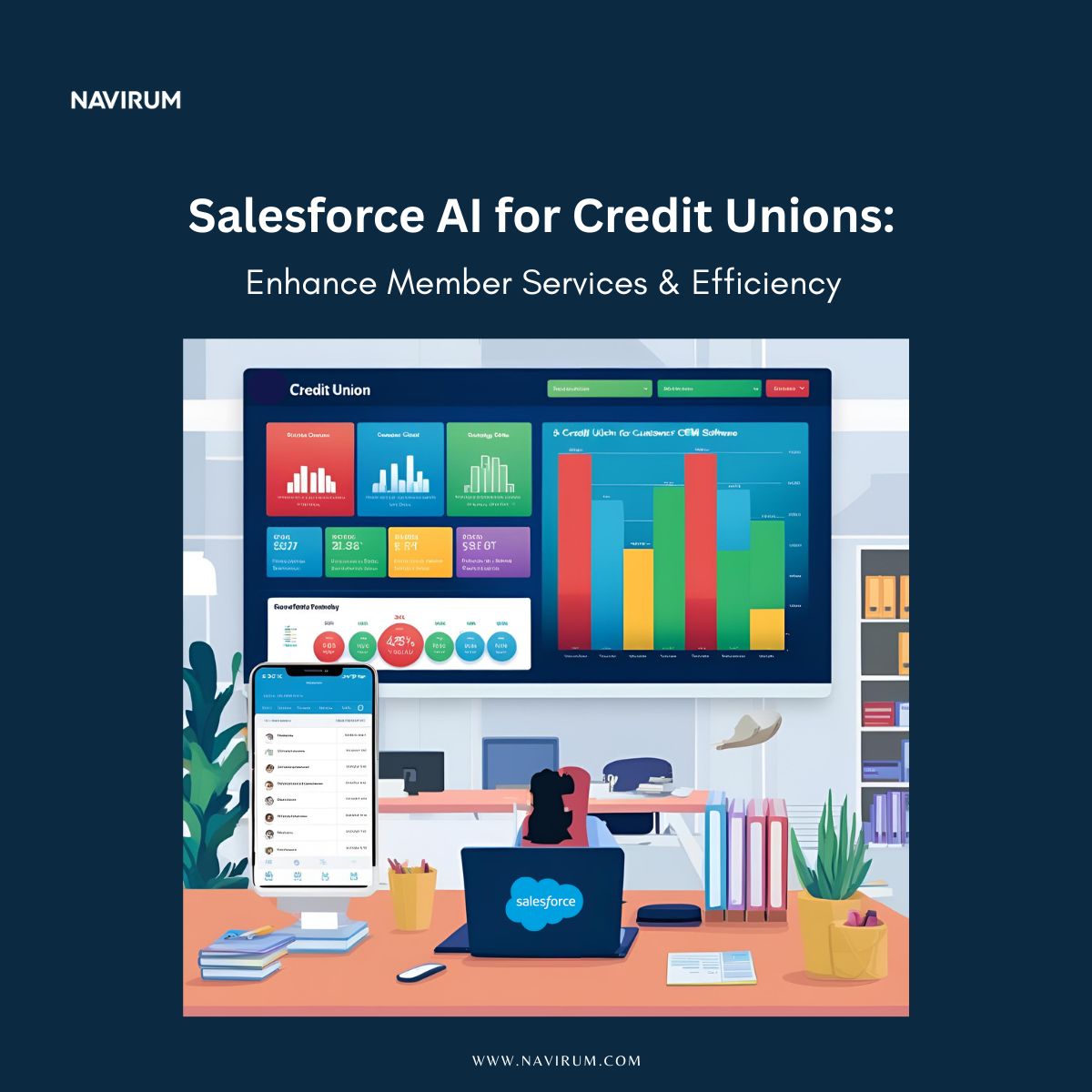
L'IA de Salesforce dans la technologie des coopératives de crédit : Améliorer les services aux membres et l'efficacité
Credit unions are at a pivotal point in their digital transformation journey. As member expectations rise and digital-first competitors grow, credit unions must find innovative ways to deliver exceptional service while maintaining their community-first values. Salesforce AI presents a unique opportunity to meet these challenges head-on, enhancing personalization, streamlining operations, and future-proofing member engagement. As a Salesforce consulting partner, we help credit unions harness this power responsibly and effectively.
The Unique Landscape of Credit Unions
Unlike traditional banks, credit unions operate with a member-first model. This distinction places added importance on trust, personalized service, and community involvement. However, many credit unions are still tied to legacy systems and face hurdles in adopting new technologies. Salesforce AI bridges this gap, offering tools that are not only powerful but also adaptable to the specific workflows and values of credit unions.
Einstein AI, embedded throughout the Salesforce platform, delivers predictive analytics, automation, and insights directly within the CRM. For credit unions, this means:
Salesforce’s integration of generative AI (Einstein GPT) with real-time CRM data creates a powerful engine for automation and content generation. The Trust Layer ensures responsible AI usage by securing sensitive member data and maintaining compliance.
AI Use Cases for Credit Unions
Member Engagement
Personalized financial education and recommendations.
Predictive campaigns targeting members at key financial milestones.
Enhanced digital experiences for improved member retention.
Service Automation
AI-powered chatbots offering 24/7 support.
Intelligent routing of member inquiries to the right team.
Automated service summaries for faster case resolutions.
Risk Management and Compliance
Real-time anomaly detection for fraud prevention.
Automated compliance documentation and reporting.
AI-driven audit trails for regulatory accuracy.
Lending and Credit Decisioning
Predictive credit scoring to speed up approvals.
Personalized loan offers based on member behavior and history.
Customize FSC to align with member-centric workflows.
Build and deploy predictive models with Einstein AI.
Train teams on using AI tools effectively.
Ensure compliance and ongoing optimization.
Provide continuous support for long-term AI success.
The Future is Smarter, and It’s Now
Salesforce AI offers credit unions the ability to serve members with greater intelligence, empathy, and efficiency. As your trusted consulting partner, we’re here to help you navigate this journey and unlock the full potential of AI.
Ready to transform your member experience?
Contact us today to schedule a consultation or download our free AI Readiness Checklist for Credit Unions.
Why You Should Listen to Exec Talk: Salesforce, AI, Financial Services
Whether you’re driving transformation inside a financial institution or building the next generation of fintech tools, this podcast is for you.
Un leader de la transformation numérique au sein d'une banque, d'un gestionnaire d'actifs ou d'une société de gestion de patrimoine.
Architecte, administrateur ou propriétaire de produit Salesforce dans l'écosystème des services financiers
Un fondateur de fintech, un CTO ou un chef de produit qui développe des plateformes SaaS.
Un investisseur en capital-risque ou en capital-investissement qui s'intéresse à l'IA, aux applications natives de Salesforce ou aux SaaS financiers.
Un partenaire Salesforce AppExchange cherchant à se développer ou à atteindre les institutions financières
Une entreprise qui évalue Salesforce pour la première fois
Curieux d'en savoir plus sur la fintech
🎧 Ce que vous apprendrez
Chaque épisode offre des informations pratiques et stratégiques aux professionnels de la finance, Salesforce, and emerging tech.
Restez à l'écoute de nos prochains épisodes qui vous offriront une perspective unique sur des sujets variés tels que :
Cas concrets d'utilisation de Salesforce dans les services financiers (du CRM front-office à l'automatisation du back-office)
L'impact de l'IA et de l'apprentissage automatique dans la fintech et la conformité.
Entretiens avec des chefs de produits AppExchange et des ISV Salesforce
Stratégies de mise sur le marché pour les entreprises SaaS de l'écosystème Salesforce
Ce que les investisseurs veulent dans les startups fintech et SaaS B2B alimentées par l'IA
Stratégies de mise à l'échelle, d'intégration, de sécurité et de données pour les industries réglementées
💡 Pourquoi ce podcast est important
Le secteur des services financiers is undergoing rapid transformation and it’s crucial to stay ahead with Salesforce at the heart of digital ecosystems and AI redefining operations, product development, and client engagement.
Discover How Private Credit and Equity Firms Leverage Salesforce To Drive Business Success
In today’s fast-paced business world, companies are searching for flexible financial solutions and cutting-edge technology to fuel growth. Private credit has emerged as an attractive alternative funding option, offering nimble capital solutions. At the same time, Salesforce has become a leading cloud-based platform that streamlines operations, boosts productivity, and drives innovation. Together, private credit and Salesforce create a powerful growth strategy for modern businesses.
The Rise of Private Credit
Private credit involves non-bank lending solutions provided by specialized investment firms. Its popularity soared after the 2008 financial crisis, when traditional bank lending was disrupted and alternative investments gained momentum. Notably, the private credit market has eclipsed private equity in recent years. From the growth of the naughties onward, both private credit and private equity firms tapped into Salesforce to scale and expand their operations. Key benefits include:
Speed and Flexibility: With streamlined approval processes, private credit lenders provide faster access to funding during volatile market conditions.
Customized Terms: Tailored financing solutions meet the unique needs of each borrower, supporting growth plans and turnaround strategies.
Diversification of Funding Sources: Incorporating private credit reduces reliance on conventional loans and secures more favorable financial terms.
Leveraging Salesforce for Business Transformation
The post-crisis era also marked the rise of cloud technology, with Salesforce emerging as the go-to CRM and business platform. Early industry leaders such as Kleiner Perkins, Blackstone, and Bain Capital adopted Salesforce to fuel impressive growth. Its robust capabilities empower companies in alternative investments and traditional private equity alike. Key features include:
Streamlined Processes: Salesforce automates routine tasks and integrates data across departments, enabling teams to collaborate efficiently.
Enhanced Data Insights: Data is the lifeblood of every Salesforce implementation, particularly for private credit firms. Advanced analytics, customizable dashboards, and integrations with platforms like Dakota (more details), Preqin, With Intelligenceet Seismic deliver critical market intelligence.
Improved Customer Engagement: Salesforce’s comprehensive suite—from lead management to personalized marketing—helps businesses nurture client relationships and convert opportunities into growth.
Mobile Accessibility: The Salesforce mobile app is vital for on-the-go access. Whether pitching to a pension fund or connecting with prospects at an event, mobile access to client information is essential.
Future-Forward Innovations: As private credit promises significant future growth, Salesforce remains a safe bet. Its AI leadership-exemplified by tools such as Agentforce – boosts decision-making and operational efficiency, while enhanced analytics with Tableau and deeper integrations via MuleSoft drive superior data connectivity.
Integrating Private Credit Strategies with Salesforce
Combining private credit with Salesforce’s cloud technology creates an ideal environment for growth. Here are strategies to harness both financial agility and technological efficiency:
Data-Driven Financing Decisions: Utilize Salesforce’s detailed reporting and analytics to monitor key performance indicators (KPIs) like cash flow and customer acquisition. Integrations with Dakota, Preqin, and Seismic add valuable market intelligence during negotiations.
Enhanced Relationship Management: Clear communication and trust are critical in private credit arrangements. Salesforce’s CRM capabilities maintain detailed records and facilitate personalized interactions between lenders and borrowers.
Optimized Workflow Automation: Automate financing processes within Salesforce to manage repayment deadlines, credit performance alerts, and funding milestones, ensuring transparency and accountability.
Strategic Growth Planning: Leverage Salesforce insights to inform private credit strategies. Strong market traction data can be used to secure additional funding for scaling successful product lines.
The 2008 financial crisis triggered a shift toward agile private credit and alternative investments, while Salesforce emerged as a catalyst for growth in both private credit and private equity. By harnessing data-driven insights, robust mobile capabilities, and future-forward innovations like AI through Agentforce, companies are well-equipped for sustainable success in today’s competitive landscape.
Embracing the power of private credit alongside innovative platforms like Salesforce can unlock tremendous growth opportunities for businesses. By leveraging flexible financing options and cutting-edge technology, companies can streamline operations, enhance customer relationships, and expand their market reach. If you’re ready to take your business to the next level, consider exploring how these powerful tools can work together to drive your success. Don’t wait – start unlocking new growth opportunities today!
<strong class="schema-faq-question">What is private credit, and how does it differ from traditional bank loans?<br/></strong>
Private credit refers to non-bank lending provided by specialized investment firms or funds. Unlike traditional bank loans, private credit often offers more flexible terms, quicker approval processes, and tailored financing structures to meet the unique needs of borrowers. It’s especially valuable for companies seeking alternative sources of capital outside the traditional banking system.
<strong class="schema-faq-question">Why is Salesforce important for private credit firms?<br/></strong>
Salesforce helps private credit firms streamline operations, enhance client relationships, and make data-driven decisions. Its CRM capabilities allow firms to manage investor and borrower relationships effectively, automate workflows, and integrate with key data sources like Preqin and Dakota for deeper market insights.
<strong class="schema-faq-question">How can Salesforce and private credit work together to support growth?<br/></strong>
When used together, Salesforce and private credit create a powerful combination of technology and financial flexibility. Businesses can leverage Salesforce for real-time analytics, automated lending processes, and CRM functions while using private credit to access timely capital for expansion, acquisitions, or strategic pivots.
<strong class="schema-faq-question">Which Salesforce tools are most relevant for private credit firms?<br/></strong>
Some of the most valuable Salesforce tools for private credit include:
– Sales Cloud for managing deal pipelines –Tableau for advanced analytics and KPI tracking – MuleSoft for integrating data from external systems like Preqin – Agentforce for AI-driven decision-making and automation – Mobile App for access to CRM data on the go
<strong class="schema-faq-question">What are the benefits of integrating platforms like Preqin and Seismic with Salesforce?<br/></strong>
Integrating platforms like Preqin and Seismic into Salesforce provides private credit firms with enhanced market intelligence and content management. These integrations enable users to access up-to-date investor data, performance benchmarks, and marketing materials directly within their CRM, improving efficiency and deal execution.
<strong class="schema-faq-question">Is Salesforce scalable for growing investment firms?<br/></strong>
Absolutely. Salesforce is built to scale with your business. Whether you’re a boutique investment firm or a global asset manager, Salesforce offers customizable features and integrations that grow with your operational complexity, data needs, and team size.
<strong class="schema-faq-question">How can Navirum help my business implement Salesforce for private credit?<br/></strong>
As a Salesforce consulting partner, Navirum specializes in implementing and customizing Salesforce for financial services firms, including those in private credit and private equity. We help clients:
– Design Salesforce solutions tailored to their workflows – Integrate third-party platforms – Automate manual processes – Train teams for long-term success
The Dakota Marketplace Salesforce Integration enhances investment sales and fundraising by embedding institutional investor intelligence directly into Salesforce.
This integration eliminates manual data entry and provides real-time updates, creating a more connected and efficient workflow for investment firms.
Users can access relevant investor information without switching platforms, resulting in cleaner data management and improved prospecting capabilities.
By maintaining accurate and up-to-date records, the integration supports better decision-making and faster actions on investment opportunities.
Overall, Dakota Marketplace Salesforce Integration transforms how teams manage relationships and drive growth through actionable intelligence.
Dakota Marketplace Salesforce Integration: Turn Investor Intelligence Into a Growth Engine
Estimated reading time: 16 minutes
Investment firms have access to more data than ever—but having the data is only half the challenge.
For investment sales, fundraising, and investor relations teams, the real competitive advantage comes from being able to access the right investor intelligence at the right time and act on it directly within the systems where work happens.
That is where the Dakota Marketplace Salesforce integration can make a significant difference.
By connecting Dakota Marketplace for Salesforce App with Salesforce, firms can bring institution-level investor intelligence directly into their CRM environment. Instead of switching between Salesforce and external research platforms, teams can access relevant investor information, market signals, relationship data, and fundraising intelligence within their existing Salesforce workflows.
For investment managers, private equity firms, real estate managers, hedge funds, and other alternative investment organizations, this creates an opportunity to transform Salesforce from a system of record into a more intelligent platform for prospecting, relationship management, fundraising, and growth.
What Is the Dakota Marketplace Salesforce Integration?
Dakota Marketplace provides institutional investor intelligence designed to help investment professionals research prospects, understand investment activity, and identify fundraising opportunities.
The Salesforce integration brings that intelligence into the CRM.
Rather than requiring users to manually research an investor in Dakota, copy information into Salesforce, update records, and then repeat the process as information changes, the integration creates a more connected workflow between the two platforms.
Relevant Dakota Marketplace information can be surfaced directly within Salesforce, giving users greater visibility into investor accounts, contacts, investment activity, and other intelligence while they manage their relationships.
The result is a more centralized environment where teams can:
Research institutional investors
Identify and prioritize prospects
Monitor changes in investor organizations
Track fundraising opportunities
Manage contacts and relationships
Analyze pipeline activity
Build more targeted outreach campaigns
Automate follow-up activities
Use investor intelligence to support AI-powered workflows
Instead of treating investor intelligence and CRM data as separate resources, firms can connect the two to create a more complete picture of their institutional relationships.
Why Connect Dakota Marketplace to Salesforce?
For many investment organizations, investor intelligence is spread across multiple systems, making it difficult for fundraising and investor relations teams to access the information they need when they need it. A typical fundraising workflow may involve researching an institution in one platform, finding the right contact in another, reviewing recent investment activity somewhere else, and then manually transferring relevant information into Salesforce.
As a result, valuable time is spent moving information between systems rather than acting on it.
Moreover, this fragmented approach can create a range of operational challenges, including:
Duplicate or inconsistent records
Outdated contact and account information
Incomplete investor profiles
Repetitive manual data entry
Inconsistent or duplicated research
Delays in following up on relevant opportunities
Lower Salesforce adoption among fundraising teams
Limited visibility into pipeline activity
Increasing data administration and maintenance costs
Over time, these challenges can affect more than operational efficiency. When investor intelligence is disconnected from CRM data, teams may also miss important signals, struggle to prioritize opportunities, and spend valuable time piecing together information that should already be available in one place.
From Fragmented Data to Actionable Intelligence
Connecting Dakota Marketplace with Salesforce helps address this disconnect by bringing external investor intelligence into the CRM environment where fundraising teams already manage their relationships, opportunities, and activities.
However, the value of the integration goes beyond simply displaying Dakota data inside Salesforce. The real opportunity lies in combining Dakota’s institutional investor intelligence with the firm’s own CRM data to create a more complete and actionable view of each account.
For example, a fundraising professional may already have an established relationship with an institutional investor recorded in Salesforce. Salesforce can provide the firm’s history of interactions, meetings, opportunities, activities, and contacts. At the same time, Dakota Marketplace can add relevant intelligence about the institution, including available information about investment activity, organizational changes, and other market signals.
When these sources of information are brought together, fundraisers no longer have to piece together an investor’s story across multiple platforms. Instead, they can access a richer account view directly within Salesforce and use that context to determine what action should come next.
This shifts the question from:
“Who is this investor?”
to a much more valuable set of questions:
“What do we already know about this investor? What has changed? What is the history of our relationship? Is there a relevant opportunity? And what should we do next?”
Ultimately, connecting Dakota Marketplace to Salesforce helps transform investor data from a collection of disconnected information into actionable intelligence that can support prospecting, relationship management, pipeline development, and more timely decision-making.
A Single Source of Truth for Investor Relationships | Navirum
Marketplace & CRM Sync
A Single Source of Truth for Investor Relationships
Connecting Dakota Marketplace intelligence with Salesforce Financial Services Cloud (FSC) keeps institutional accounts, contact roles, allocations, and market signals updated automatically—eliminating manual research and stale CRM data.
The Data Stale-Out Risk
1. The Investor Data Challenge
One of the biggest challenges facing investment sales and investor relations teams is maintaining accurate CRM data over time. Institutional relationships are dynamic, not static.
What changes constantly across your LP universe:
✕
Investor Organizations: Mergers, name shifts & mandates
✕
People & Roles: Key decision-makers move frequently
✕
AUM & Allocations: Portfolio rebalancing & capital shifts
✕
New Opportunities: Emerging RFPs & searches
⚠️ Manual Danger: Maintaining records manually causes Salesforce data to become quickly outdated, wasting fundraiser hours on stale contacts.
Automated CRM Enrichment
2. Dakota Marketplace + Salesforce FSC
Connecting Dakota Marketplace directly into Salesforce Financial Services Cloud incorporates live, verified institutional market intelligence right into your team’s everyday workspace.
Operational advantages for sales teams:
✓
360° LP Profile: Maintains a current, complete view of institutional accounts
✓
Zero Research Drag: Eliminates manual copying, pasting, and web searches
✓
Automatic Contact Sync: Keeps job roles, phone numbers, and emails live
✓
Proactive Alerts: Triggers notifications when key LP allocations shift
💡 Strategic Impact: Gives fundraisers a real-time single source of truth without spending hours on administrative data entry.
13 Synchronized Data Signals
3. 13 Key Investor Intelligence Points
Depending on integration configuration and Dakota data availability, sales and IR teams can access and work with rich investor intelligence natively inside Salesforce:
Market Signals: Fund presentations, public plan activity, RFPs & news
💡 Strategic Impact: Replaces fragmented web portals with a unified, enriched CRM database.
Downstream Excellence
4. Why Data Quality Matters
Clean CRM data is not merely an administrative checkbox. Data quality directly dictates the accuracy and performance of every sales and marketing initiative.
High-quality data elevates 9 critical business functions:
Relationship Management, Executive Reporting & AI Workflows
💡 Strategic Impact: Clean data transforms Salesforce from a passive archive into an active, high-return revenue engine.
Enterprise Growth Engine
5. Maximizing Platform Utility
The better the underlying data, the more useful Salesforce becomes as a core business platform. High-integrity data fuels advanced automation, Agentforce AI agents, and executive forecasting.
✓
AI Agent Grounding: Powers Agentforce with clean, verified LP contexts
✓
Board-Level Clarity: Reliable pipeline reporting for C-suite decision making
✓
Advisor Adoption: Fundraisers trust the CRM when contact data is guaranteed fresh
💡 The Core Bottom Line: “The better the underlying data, the more useful Salesforce becomes as a business platform.”
13 Key Investor Intelligence Data Signals Integrated into Salesforce
Investment opportunities can be highly time-sensitive.
A contact may move into a new role. An institution may announce a new allocation. A public plan may publish information relevant to an investment strategy. An RFP may create a new opportunity.
When teams discover these signals days or weeks after they occur, the opportunity to engage at the right moment may already be gone.
Dakota Marketplace’s data and update capabilities can help bring relevant changes into Salesforce so teams can incorporate them into their existing workflows.
The integration can support automatic synchronization of relevant information, including updates associated with areas such as:
New allocations
Consultant coverage
13F filings
Fund presentations
Public plan minutes
RFP alerts
Job and role changes
Fundraising news
For organizations using the integration’s available automatic synchronization capabilities, updates can be delivered as frequently as every 15 minutes.
This creates a fundamentally different prospecting model.
Instead of asking:
“Who should we contact?”
teams can begin asking:
“Which accounts have changed, and which changes require action?”
That distinction is important because it moves fundraising from a static list-management process toward a more signal-driven approach to business development.
A major advantage of the integration is that users do not necessarily need to leave Salesforce to access relevant Dakota Marketplace functionality.
The embedded experience can provide access to native Salesforce tabs and views for areas such as:
Accounts
Contacts
Metro Areas
Investments
Searches
News
This creates a more seamless user experience for teams that already rely on Salesforce as their primary CRM.
Instead of switching between applications, users can work within the Salesforce environment they already know.
Why this matters for Salesforce adoption
CRM adoption often suffers when users perceive Salesforce as an administrative system rather than a tool that helps them do their jobs.
If a fundraiser has to leave Salesforce to conduct research, find investor intelligence, or validate account information, Salesforce becomes only one part of the workflow.
Embedding relevant intelligence directly into Salesforce changes that dynamic.
The CRM becomes more useful because it contains not only the firm’s own relationship history but also the external intelligence required to make better decisions.
The goal is simple:
Make Salesforce the place where fundraising professionals work, not another system they have to work around.
5 Ways Dakota Marketplace and Salesforce Can Support Growth | Navirum
Marketplace & CRM Sync
5 Ways Dakota Marketplace & Salesforce Support Growth
Connecting Dakota Marketplace intelligence with Salesforce Financial Services Cloud empowers fundraising, relationship management, and sales teams to scale institutional capital raising.
Institutional Sourcing
1. Improve Institutional Prospecting
Finding the right institutional investors is fundamental to fundraising. However, prospecting is not simply about building a large list of potential investors. Teams need to understand which organizations are relevant, what they invest in, who influences decisions, and when there may be a reason to engage.
By bringing Dakota intelligence into Salesforce, sales teams can:
Prioritize accounts based on available market signals
💡 Strategic Impact: Transforms generic list-building into a targeted, highly informed prospecting engine.
Signal Intelligence
2. Identify High-Intent Opportunities
Not every investor represents the same opportunity at the same time. A change in investment activity, a new role, an RFP, or another market signal may indicate that an account deserves immediate attention.
When Dakota intelligence is available inside Salesforce, teams turn data into action:
✓
Dakota Intelligence: An institutional investor shows a relevant change in investment activity.
✓
Salesforce FSC Data: Your firm already has an established relationship with a decision-maker at that institution.
✓
Automated Workflow: Salesforce creates an immediate follow-up task for the appropriate fundraiser.
✓
Business Outcome: The team acts on the high-intent signal while it is still fresh and relevant.
💡 Strategic Impact: Bridges external market signals with internal relationship context so fundraisers never miss a window of opportunity.
Relationship Engagement
3. Personalize Investor Outreach
Generic outreach is rarely the most effective way to build institutional relationships. Fundraising teams need context. Salesforce contains previous interactions, meetings, opportunities, activities, and relationships, while Dakota provides crucial market context.
Tailor institutional outreach based on rich, combined context:
✓
Investor allocation preferences and asset class interests
Salesforce is the central platform for managing fundraising pipelines, but reporting is only as reliable as the data behind it. Connecting Dakota Marketplace intelligence with Salesforce provides additional data points for segmentation, reporting, and executive analysis.
Helps sales leaders answer critical questions with confidence:
✓
Which prospects are truly active and progressing?
✓
Which accounts require immediate attention or escalation?
✓
Which relationship networks are evolving or shifting?
✓
Which market segments generate the highest fundraising activity?
💡 Strategic Impact: Gives leaders real-time executive dashboards combining live CRM activity with investor market intelligence.
Agentforce & AI
5. Create a Foundation for AI-Powered Fundraising
One of the most compelling opportunities comes from combining connected investor data with Salesforce’s AI capabilities. AI is only as useful as the data it can access. Connecting Dakota Marketplace with Salesforce creates a richer data foundation for AI-driven workflows.
<strong class="schema-faq-question">How does Dakota Marketplace Salesforce integration improve institutional investor data management?</strong>
A Dakota Marketplace Salesforce integration helps investment firms bring institutional investor intelligence into the CRM environment where their teams already manage accounts, contacts, opportunities, and relationships. Instead of manually researching investor information and updating Salesforce records, teams can connect relevant Dakota data with their existing CRM data. This can help reduce duplicate records, minimize manual data entry, improve data consistency, and provide fundraisers with a more complete view of institutional accounts. The integration can also help organizations establish a stronger data foundation for Salesforce reporting, automation, and AI-powered workflows.
<strong class="schema-faq-question">How can investment firms use Dakota Marketplace data to improve Salesforce prospecting and fundraising workflows?</strong>
Investment firms can combine Dakota Marketplace’s institutional investor intelligence with Salesforce account, contact, opportunity, and activity data to create more targeted prospecting workflows. For example, teams can identify relevant investors, monitor changes in roles or investment activity, and use those signals to prioritize accounts for outreach. Salesforce automation can then be used to create tasks, notifications, or follow-up activities based on defined business rules. This allows fundraising teams to move from manually researching large lists of prospects toward a more proactive, signal-driven approach to identifying and engaging potential investors.
<strong class="schema-faq-question">Can Dakota Marketplace Salesforce integration support AI and Agentforce use cases?</strong>
Yes. Connecting Dakota Marketplace data with Salesforce can provide a stronger data foundation for AI-powered workflows, including Salesforce Agentforce. AI agents require access to relevant, reliable, and contextual data to generate useful recommendations and take appropriate actions. With investor intelligence available alongside Salesforce relationship and pipeline data, organizations can explore use cases such as investor account summaries, prospect prioritization, meeting preparation, personalized outreach, follow-up recommendations, and identifying accounts that may require attention. Before deploying these use cases, firms should establish appropriate data governance, permissions, security controls, and human oversight.
<strong class="schema-faq-question">What should investment firms consider when implementing a Dakota Marketplace Salesforce integration?</strong>
A successful implementation requires more than installing an AppExchange application. Firms should first determine which Dakota data is most valuable to their business processes and how that information should relate to existing Salesforce accounts, contacts, opportunities, and custom objects. Other considerations include data mapping, duplicate management, synchronization rules, user permissions, security, reporting requirements, automation, and Salesforce governance. It is also important to define how users will incorporate Dakota intelligence into their daily workflows. A well-designed implementation should improve the user experience rather than simply add another source of information to Salesforce.
<strong class="schema-faq-question">How can Navirum help organizations maximize the value of their Dakota Marketplace Salesforce integration?</strong>
Navirum can help investment and financial services organizations move beyond basic integration and build a Salesforce environment that makes Dakota Marketplace data actionable. This can include integration planning, Salesforce architecture, data mapping, configuration, workflow automation, dashboards and reporting, data governance, and user adoption. Navirum can also help firms identify opportunities to extend the connected data environment into Salesforce AI and Agentforce use cases. The goal is to ensure Dakota Marketplace becomes part of a scalable Salesforce strategy that supports prospecting, fundraising, relationship management, analytics, and long-term growth.