Aligning Sales and Marketing for scalable growth means transforming sales productivity and marketing reach with Salesforce.
One of our clients, an investment management firm in San Francisco was facing several roadblocks that hindered sales productivity and marketing effectiveness.
Challenges
⚠️ Limited engagement with their CRM ⚠️ Inconsistent lead follow-up ⚠️ Siloed operations creating gaps in their pipeline—and in their growth strategy.
Solutions
By partnering with our Salesforce consulting team, they launched a digital transformation focused on unifying their sales and marketing operations. The impact was fast and measurable:
🛠️ CRM adoption surged across the sales team 🛠️ Manual marketing efforts were replaced with automated workflows 🛠️ Pipeline visibility improved dramatically
Results
✅ Streamlined operations ✅ Stronger internal alignment ✅ Built for scale, the new platform enables smarter client engagement and confident growth.
📥 Download the Full Customer Success Story
Download the full success story to see how Salesforce helped unify teams and accelerate performance.
👉 Fill out the contact form below on this page to get instant access.
Driving growth in Wealth Management with Salesforce is not a myth! From Pipeline gaps to Sales Success, here’s a new Salesforce transformation story from Navirum.
A fast-growing wealth and asset management firm based in North Dakota needed to overcome operational roadblocks that were limiting client engagement, slowing lead follow-up, and creating pipeline inefficiencies. Their existing tools couldn’t keep up—and it was costing them opportunities. creating pipeline gaps and reducing team productivity—ultimately limiting growth.
After partnering with Navirum for a Salesforce Sales Cloud implementation, the transformation was swift and measurable.
🛠️ Seamless migration from HubSpot to Salesforce, a scalable CRM platform implemented across departments 🛠️ Improved pipeline visibility and lead management 🛠️ Rapid user adoption with minimal disruption to operations
Results
✅ Immediate improvement in sales performance ✅ Increased client engagement and stronger relationships ✅ Fewer missed opportunities in the sales pipeline
📥 Download the Full Customer Success Story
Download the full success story to see how a strategic Sales Cloud implementation can transform your CRM and drive growth.
Looking to scale your financial services business with Salesforce?
Talk to one of our Salesforce consultants to see how we can help your firm grow.
👉 Fill out the contact form below on this page to get instant access.
Transforming Sales Performance Through Strategic Enablement
A leading player in the telecommunications industry turned to us to help overcome persistent challenges with their Salesforce platform. Despite having invested heavily in Salesforce, the company wasn’t seeing the returns they expected. They trusted our team to lead a strategic enablement initiative—one that would align their sales and marketing operations, boost user engagement, and transform Salesforce into a high-impact growth engine.
Many organizations invest in Salesforce but struggle to realize its full potential. That was the case for this telecom provider.
Challenges
⚠️ Low Salesforce user adoption was limiting ROI and slowing productivity ⚠️ Disconnected sales and marketing teams led to misaligned efforts and missed opportunities ⚠️ Inefficient workflows made it difficult to scale or respond to business needs quickly ⚠️ Technical issues persisted, creating frustration and decreasing platform trust ⚠️ Siloed processes hindered collaboration and visibility across departments
Solutions
🛠️ Partnered with our Salesforce consulting team to develop a strategic enablement roadmap 🛠️ Rolled out customized training programs to boost user adoption and confidence 🛠️ Streamlined marketing operations with advanced automation tools 🛠️ Integrated sales and marketing systems for better alignment and data sharing 🛠️ Provided ongoing support to address technical challenges and improve system performance 🛠️ Fostered cross-team collaboration through a unified Salesforce environment
Results
✅ Salesforce adoption rates saw a measurable and sustained increase ✅ Marketing campaigns became more efficient and data-driven ✅ Sales and marketing teams operated with greater alignment and collaboration ✅ Technical issues were resolved, restoring platform trust and stability ✅ The organization shifted culturally—embracing Salesforce as a true growth enabler ✅ Positioned the company to scale operations and drive smarter performance
📥 Download the Full Customer Success Story
Download the full customer success story to learn more! Ready to see what strategic Salesforce enablement can do for your business? Contact Us!
👉 Fill out the contact form below on this page to get instant access.
What is The Role of AI in Salesforce: What Einstein GPT Means for Financial Services? Why Financial Services Can’t Afford to Miss the AI Wave?
Artificial Intelligence has shifted from a promising frontier to a foundational element of enterprise strategy—especially in financial services. From wealth management and commercial banking to insurance and capital markets, institutions are racing to deploy AI in ways that improve productivity, enhance customer experience, and unlock new insights.
But integrating AI isn’t just about algorithms. It’s about embedding intelligence into the workflows people already use every day.
That’s where Salesforce Einstein GPT comes in.
As the world’s first generative AI for CRM, Einstein GPT brings advanced machine learning and large language models directly into the Salesforce platform—enabling financial institutions to automate more, predict more, and personalize more, all within their existing systems.
In this article, we’ll explore the strategic implications of Einstein GPT for financial services CIOs, technology leaders, and AI/ML stakeholders—and why it matters now more than ever.
What Is Einstein GPT?
Einstein GPT is Salesforce’s next-generation AI engine that combines proprietary Salesforce AI models with public and private large language models (LLMs) like OpenAI’s GPT, enabling dynamic content generation across the entire Salesforce ecosystem.
Unlike traditional predictive AI (which is rules- and model-based), Einstein GPT is generative AI—capable of creating context-aware text, automating interactions, and suggesting actions in real time.
Key Capabilities:
Generate personalized emails, client reports, and outreach
Surface predictive insights like risk scores or churn likelihood
Enable conversational AI in service and sales channels
Integrate private customer data safely and securely
Why it matters:
Einstein GPT doesn’t live outside of Salesforce—it lives inside your CRM, working with your customer data, your workflows, and your business logic.
AI Tailored to Financial Services Workflows
Einstein GPT has been purpose-built to integrate with Salesforce Financial Services Cloud (FSC), making it immediately relevant for use cases in wealth, banking, insurance, and asset management.
Instead of manually compiling investor reports or writing follow-up messages, your advisors, relationship managers, and service teams can generate these assets dynamically—based on real-time customer data and AI recommendations.
Wealth Management: Create custom performance summaries, automate follow-ups for market events, and assist with rebalancing insights
Insurance: Auto-generate policyholder responses or claims summaries with full context
Asset Management: Draft quarterly investment letters or market commentaries tailored by client segment
Einstein GPT bridges the gap between siloed AI projects and production-ready, ROI-focused applications across your front office.
Automate, Don’t Just Inform
Traditional CRM AI is great at surfacing insights, but it leaves the action to the user. Einstein GPT changes that by automating high-value tasks, so users spend less time typing and more time engaging.
For example:
Auto-draft prospecting emails for commercial clients based on engagement history
Generate compliance summaries or pre-filled forms based on prior disclosures
Suggest meeting agendas for client reviews using AI summaries of previous interactions
Business Impact:
Increase productivity by 30–40% for front-line teams
Reduce administrative load and manual data entry
Improve accuracy and consistency in client communications
AI/ML Stakeholder Insight:
The shift from predictive to generative AI is not incremental—it’s transformational. Generative AI creates usable output, not just recommendations.
Secure and Compliant AI for Regulated Environments
One of the top concerns for financial institutions deploying AI is data privacy and compliance. Einstein GPT was designed with these challenges in mind.
Salesforce enables enterprise-grade data governance with:
Grounded AI: Generative responses are anchored in your Salesforce data, ensuring accuracy and reducing hallucinations
Bring Your Own Model (BYOM): Firms can integrate their own private LLMs or use partner models via Salesforce’s AI Cloud
Zero Data Retention: When using external models like OpenAI via Salesforce, customer prompts and responses are not stored
Audit Trails: Every AI-generated suggestion is traceable, with human-in-the-loop governance
This approach balances AI innovation with the rigorous compliance standards of the financial industry—including GDPR, FINRA, and internal policy requirements.
Unified AI Strategy with Salesforce AI Cloud
Einstein GPT is part of the broader Salesforce AI Cloud, which offers a unified platform for deploying, managing, and scaling AI across your enterprise stack.
With AI Cloud, financial institutions can:
Deploy AI across Sales, Service, Marketing, and IT
Control AI access and usage by role or department
Integrate external data sources and third-party models securely
Monitor AI performance and compliance in real time
This gives CIOs and CTOs a central governance layer to orchestrate all AI activity inside the organization, avoiding shadow IT and siloed pilots.
AI/ML Stakeholder Insight:
AI Cloud creates a path for responsible AI at scale—moving from experiments to enterprise-wide impact.
Driving ROI: Where Einstein GPT Delivers Immediate Value
For financial institutions evaluating AI investments, the key question is: Where will we see ROI fastest?
Einstein GPT delivers measurable value in several core areas:
Top Use Cases:
Sales Acceleration: Reduce time to prepare outreach, follow-ups, and reports
Service Optimization: Shorten response time with pre-written, data-informed replies
Marketing Personalization: Auto-generate content aligned to client segments
Risk and Compliance: Draft and review summaries, detect anomalies, and automate documentation
Advisor Productivity: Automate routine tasks and enrich client interactions
Outcome:
More deals closed, higher client satisfaction, and greater operational efficiency—without increasing headcount.
Building AI Maturity: Start Smart, Scale Strategically
Einstein GPT is not a plug-and-play magic button. To unlock its full potential, financial services firms need to align AI deployment with business strategy and internal readiness.
As a Salesforce consulting firm with deep expertise in financial services and AI/ML integration, we help you:
Identify high-impact AI use cases tailored to your lines of business
Configure Salesforce and Einstein GPT to your specific workflows
Ensure data quality and model governance for accurate results
Train your teams to confidently adopt and trust generative AI
Implementation Insight:
Our 5/5 CSAT-rated delivery team works hand-in-hand with your AI leads and business stakeholders to create sustainable, scalable value.
Final Thoughts: Einstein GPT Is a Strategic Advantage, Not Just a Feature
AI will define the next decade of financial services—and the winners will be those who embed it into everyday operations, not just R&D.
Salesforce Einstein GPT offers CIOs and technology leaders a practical, powerful path to embed AI into your organization at scale—driving immediate productivity and long-term differentiation.
This is not just about automating tasks. It’s about transforming how your institution engages clients, manages risk, and scales operations.
Ready to Elevate Your AI Strategy with Salesforce?
Let’s explore how Einstein GPT can deliver measurable impact across your organization—from the front office to compliance to client experience.
👉 Schedule a strategy session with our financial services AI team We’ll review your current setup, identify high-impact AI use cases, and map a practical path to value.
Thinking of scaling your real estate investment firm with Salesforce? Discover how a real estate investment firm transformed deal visibility with a Salesforce Sales Cloud Quickstart!
Trusted by Armada Capital Partners
Project Summary
Many real estate investment firms struggle with disconnected tools, scattered data, and limited visibility into their deal pipeline. These inefficiencies can stall growth, reduce productivity, and make it difficult to maintain strong relationships with brokers, tenants, and partners.
One mid-sized U.S.-based real estate investment firm faced exactly these challenges. their team was struggling to manage deals, relationships, and property data using outdated tools. Relying on spreadsheets, email threads, and manual processes left them without a single source of truth—and without the real-time insights they needed to move quickly in a competitive market.
They turned to our Salesforce consulting team to implement a Sales Cloud Quickstart solution tailored to the unique needs of the real estate sector. The goal was simple but powerful: replace fragmented systems with a centralized CRM that could streamline operations, improve visibility, and lay a foundation for future growth.
Challenges
⚠️ Disconnected tools like spreadsheets and emails created data silos ⚠️ No centralized system to track deals, relationships, or property information ⚠️ Manual processes slowed down collaboration and decision-making ⚠️ Limited visibility into pipeline and team activities ⚠️ Inability to scale operations without a modern CRM in place
Solutions
🛠️ Deployed a customized Salesforce Sales Cloud Quickstart designed for real estate workflows 🛠️ Centralized deal, contact, and property data into a single CRM platform 🛠️ Integrated communication and task tracking to streamline team collaboration 🛠️ Configured dashboards and reports to provide real-time visibility into the sales pipeline 🛠️ Delivered training and enablement to ensure smooth adoption
Results
✅ Replaced fragmented tools with a single source of truth for all deal and client data ✅ Gained real-time insights into pipeline and relationship activity ✅ Improved team collaboration and reduced reliance on manual processes ✅ Enabled faster, more informed decision-making ✅ Positioned the firm for scalable, long-term growth in a competitive market
Get The Full Success Story!
Lavinia PicuHow One Real Estate Firm Supercharged Its Growth and Investor Confidence with Salesforce
Agentforce is Salesforce’s next-generation AI platform, seamlessly built into Financial Services Cloud. It empowers financial firms to reduce administrative work, boost productivity, and enhance client engagement across advisory, service, and operations teams. Whether you’re managing a book of business, handling service inquiries, or preparing for client meetings – Agentforce helps you do it faster and smarter.
Leading financial companies using Agentforce
With Agentforce, teams can generate instant client summaries, automate meeting notes, draft compliant follow-ups, and resolve service cases more efficiently. These features are already driving measurable results across the industry. Just ask Prudential, RBC Wealth, AAA and many more -by using Agentforce to streamline activity capture, they’re freeing up hours each week for more meaningful client interactions.
Industry leading actions transform the experience
Rolling out Agentforce is fast and simple. Within two weeks, most firms are live with core use cases like email drafting, workflow suggestions, and AI-generated meeting prep. With Salesforce’s newAgentforce 3 release, clients benefit from greater transparency, AI governance, and over 100 prebuilt financial services actions ready to use out of the box.
How to Use AI and Financial Services Cloud
At Navirum, we specialize in bringing AI to life within your Salesforce ecosystem. Our team combines deep industry and regulatory expertise with a practical, realistic approach to solution delivery. From boutique family offices to some of the world’s largest financial institutions, we’ve helped firms deploy Salesforce AI quickly and effectively—always with a strong focus on compliance, client value, and long-term ROI.
Scale your financial firm and reduce costs with Agentforce
Salesforce’s strategy has completely shifted over the past 18 months. The company now has its eyes fixed on a post-CRM world – one where smart agents, AI, and industry-specific solutions dominate the enterprise landscape. It’s a world where AI moves beyond insights to deliver real outcomes, and where software evolves into intelligent agents that drive entire business functions. This is the future, and it’s exactly what we’re passionate about at Navirum.
So if you’re considering a quickstart or a proof of concept for Agentforce, we’d love to talk. We recommend an education based approach – crawl, walk, run with this cutting edge technology. Whether it’s a small scoped pilot or a full multi-team rollout, Navirum has the methodology, Salesforce experience, and resources to help you succeed.
Agentforce Implementation FAQs
What is Agentforce and how does it relate to Salesforce Financial Services Cloud?
Agentforce is Salesforce’s next-generation AI platform, embedded directly into Financial Services Cloud. It helps firms reduce administrative tasks, increase productivity, and deliver smarter, compliant client service.
Is Salesforce new to AI?
No. Salesforce has been investing in AI for over 20 years – from early machine learning models to the first wave of large language models. Along the way, it has inspired entrepreneurs such as Bret Taylor (founder of Sierra)and the team behind You.com. Today, Salesforce remains at the forefront of the AI revolution, bringing trusted AI directly into Financial Services Cloud through Agentforce.
Is Agentforce actually popular?
Yes. Agentforce and Data Cloud are Salesforce’s fastest-growing product lines. According to Salesforce’s 2025 financial results, these AI and data-driven solutions delivered over 100% year -over-year growth in recurring revenue – proof that adoption is accelerating across industries and financial services firms in particular. Source: Salesforce Investor Relations
Does Agentforce integrate with other AI apps?
Yes. Salesforce Agentforce is designed as a building-block AI platform – a bit like how CRM became the foundation of client engagement in the past. Firms can integrate it with popular AI-powered tools such as Jump, Vinton, Otter, and Firefly. These integrations extend productivity and compliance use cases across meetings, note-taking, and collaboration. Learn more in our guide on AI meeting assistants for financial firms.
How quickly can my firm get started with Agentforce?
Most firms are live within two weeks on core use cases like automated meeting prep, compliant email drafting, workflow suggestions, and service case resolution. Navirum’s Quickstart makes adoption fast, practical, and compliant.
What types of teams benefit most from Agentforce?
Advisory, service, and operations teams all see measurable gains. Advisors save time on admin, service reps resolve cases faster, and operations staff automate repetitive work – freeing up hours every week for higher-value client interactions.
What are some real-world results from firms using Agentforce?
Financial leaders such as Prudential, RBC Wealth, and AAA report that automating summaries, notes, and follow-ups with Agentforce frees up significant time each week – time that can be reinvested into growing relationships and client value.
How does Agentforce ensure compliance in financial services?
Agentforce 3 provides AI governance, transparency, and over100 prebuilt financial services actions designed with compliance in mind. Navirum also tailors deployments to meet industry-specific regulatory requirements.
Does Navirum offer a pilot or proof of concept before a full rollout?
Yes. We recommend a phased “crawl, walk, run” approach – starting with a scoped pilotto prove value, then expanding to a full rollout as confidence and ROI build.
How does Navirum’s Quickstart differ from going direct with Salesforce?
Navirum combines Salesforce expertise with deep financial services and regulatory knowledge. We focus on delivering compliant, high-value solutions aligned with your firm’s unique workflows, not just technology deployment. See how that same ongoing-partnership philosophy plays out on the Orbit managed services page.
What specific tasks can Agentforce automate today?
Key use cases include instant client summaries, automated meeting notes, compliant follow-ups, AI-powered meeting prep, workflow recommendations, and faster service case resolution.
How is Salesforce’s strategy shifting with Agentforce?
Salesforce is moving beyond traditional CRM into an AI-powered, agent-driven future. Agentforce represents this shift – where intelligent software doesn’t just provide insights but delivers real business outcomes at scale. Salesforce is being rolled out heavily in Salesforce. Founder and CEO Marc Benioff announced 5000 jobs were cutin 2025 using the technology
“I would highly recommend that organized and focused project managers work with Navirum for their CRM transition projects.” – Shelby Murphy, Chief Marketing Officer, Main Management
Discover how to build a scalable sales process in Salesforce. Read our guide for revenue teams in Financial Services.
Why Sales Teams in Financial Services Must Rethink Scale
Financial services firms are under more pressure than ever to grow revenue—faster, smarter, and with fewer resources. Yet many revenue teams still rely on fragmented tools, inconsistent processes, and anecdotal forecasting to drive their pipelines.
The result? Missed quotas, inefficient onboarding, poor pipeline visibility, and a sales process that doesn’t scale with growth.
Enter Salesforce: the world’s #1 CRM platform. When implemented strategically, Salesforce empowers financial institutions to standardize, automate, and optimize their sales processes—delivering predictable revenue growth, better client engagement, and complete pipeline visibility.
This article shows you how to design and implement a scalable sales process in Salesforce, tailored to the needs of sales ops and revenue teams in banking, wealth management, and institutional finance.
Define a Standardized Sales Framework Across Teams
The first step in building a scalable process is creating consistency.
In many firms, each sales rep has their own method of qualifying leads, managing deals, and reporting progress. This leads to chaotic pipelines and unreliable forecasts.
Manual lead assignment is one of the biggest blockers to speed. Whether you’re sourcing leads through events, referrals, or digital campaigns, Salesforce helps you automate lead assignment based on rules like region, product expertise, deal size, or workload.
Use Salesforce assignment rules and queues to:
Route leads instantly to the right rep
Notify teams via Slack or email
Create follow-up tasks automatically
For more advanced needs, Salesforce Flow or third-party apps like LeanData can manage complex round-robins or tier-based distribution.
Revenue Impact:
Respond to leads faster
Increase conversion rates
Avoid lead leakage and duplication
Sales Manager Insight:
Automation frees up time for selling and ensures your best reps are focused on the highest-value opportunities.
Align Sales Process to Buyer Journey
Financial services sales cycles are longer and more complex than most industries—especially for commercial banking, wealth, or institutional accounts. That’s why it’s critical your Salesforce process mirrors how buyers actually buy.
With Salesforce Opportunity Stages and custom fields, you can:
Align sales activities with buyer milestones (e.g., RFP received, committee approval, due diligence complete)
Track decision-makers, influencers, and approval processes using Account and Contact Roles
Surface next-best actions and playbooks using Sales Path
Revenue Impact:
Reduce friction in the buying process
Enable better forecasting by tying stages to real-world criteria
Improve close rates by staying one step ahead of the buyer
Sales Ops Insight:
A sales process built around the buyer builds trust—and accelerates deals.
Without real-time data, sales managers struggle to coach effectively, and leadership can’t forecast revenue with confidence.
With Salesforce dashboards and reports, you can create:
Pipeline coverage ratios (total pipeline vs. quota)
Win/loss trend reports by product, rep, or segment
Deal velocity metrics to identify bottlenecks
Forecast dashboards by region, manager, or team
Salesforce’s Collaborative Forecasting tool allows managers and execs to review pipeline projections, make overrides, and track forecast changes over time.
Revenue Impact:
Align GTM teams around shared metrics
Spot risks early and take corrective action
Make better decisions with confidence
Sales Ops Insight:
Real-time visibility replaces end-of-quarter scramble with proactive pipeline management.
Integrate Sales Tools for a Unified Workflow
Revenue teams often juggle 5–10 tools across CRM, email, calls, proposals, and analytics. The more disconnected your tools, the harder it is to scale.
Salesforce allows you to integrate your full sales tech stack:
Email: Log Gmail or Outlook interactions automatically
Calendars: Sync meetings and events
Dialers: Use tools like Outreach or Salesloft
Proposal & E-signatures: Integrate with DocuSign or Conga
Analytics: Connect Tableau or Salesforce CRM Analytics for deeper insights
Revenue Impact:
Sales reps stay in one platform
Less time on admin, more time selling
Stronger data integrity across systems
Sales Enablement Insight:
A unified workspace improves productivity and reduces tool fatigue.
As your organization grows, your sales process needs to evolve. Whether you’re expanding into new markets, launching new products, or acquiring teams, Salesforce is built to scale.
Key scalability features include:
Custom objects and fields for unique data
Record types for different sales motions (e.g., retail vs. commercial)
Validation rules to maintain data quality
User permissions and role hierarchies to protect sensitive information
Salesforce is also cloud-native and API-first, so it’s easy to integrate with ERP, billing, or onboarding systems down the road.
Revenue Impact:
Scale confidently without rearchitecting
Ensure compliance with data and user controls
Launch new revenue motions quickly
CIO/Sales Ops Insight:
Your CRM should never be a bottleneck to growth. With Salesforce, it becomes a launchpad.
A Scalable Sales Process Starts with the Right Foundation
In financial services, where trust, timing, and compliance are critical, a scalable sales process isn’t optional—it’s essential.
With Salesforce, you can design a revenue engine that aligns teams, improves forecasting, and delivers repeatable growth—without losing the personal touch that financial services clients expect.
From lead to close, every step becomes faster, smarter, and more efficient.
F.A.Q.
How does Salesforce help financial services firms scale their sales process?
Salesforce helps financial services firms scale by standardizing workflows, automating repetitive tasks, improving pipeline visibility, and centralizing client data in one platform. Revenue teams can automate lead routing, track opportunities in real time, forecast more accurately, and create repeatable sales processes that support business growth without increasing operational complexity.
What are the key components of a scalable sales process in Salesforce?
A scalable sales process in Salesforce typically includes standardized opportunity stages, automated lead assignment, buyer journey alignment, real-time dashboards, CRM integrations, and sales enablement tools such as playbooks and onboarding workflows. These components help sales teams operate consistently while maintaining compliance and data quality.
Why is pipeline visibility important for revenue teams in financial services?
Pipeline visibility allows sales leaders to track deal progress, identify bottlenecks, forecast revenue accurately, and make proactive decisions. In financial services—where sales cycles are often long and involve multiple stakeholders—real-time reporting and dashboards are essential for reducing risk and improving close rates.
Can Salesforce integrate with other tools used by financial services sales teams?
Yes. Salesforce integrates with a wide range of tools commonly used by financial services firms, including email platforms like Outlook and Gmail, sales engagement tools, e-signature platforms, ERP systems, marketing automation tools, and analytics solutions. These integrations create a unified workflow and reduce manual data entry.
Is Salesforce Financial Services Cloud better than standard Salesforce Sales Cloud for banks and wealth firms?
For most financial institutions, Salesforce Financial Services Cloud offers advantages over standard Salesforce Sales Cloud because it includes industry-specific data models, compliance-friendly workflows, relationship mapping, household management, and financial account tracking. This makes implementation faster and better aligned with the needs of banks, wealth managers, insurers, and institutional firms.
Ready to Scale Your Sales Process with Salesforce?
Let’s design a Salesforce solution that fits your sales model—and grows with your goals.
Book a consultation with our Financial Services CRM team. We’ll assess your current sales process and show you how to scale it using best-in-class Salesforce strategies. Contact us!
Even with Salesforce already implemented as their core CRM platform, a mid-sized West Coast wealth management firm operating under the iA Private Wealth umbrella found themselves struggling to gain the efficiency and scalability they needed to grow. Like many wealth management firms, they faced a range of persistent obstacles.
iA Private Wealth
Challenges
⚠️ Limited operational efficiency due to fragmented systems and manual processes ⚠️ Lack of real-time data synchronization with back office, slowing decision-making ⚠️ Existing Salesforce implementation not customized for the specific needs of wealth management
Solutions
🛠️ Partnered with a Salesforceconsulting team specialized in financial services and wealth management (more details here) 🛠️ Streamlined advisor tools within Salesforce to reduce manual effort and improve efficiency 🛠️ Established a scalable architecture to support future growth and innovation
Results
CSAT Results 5/5 ⭐⭐⭐⭐⭐
✅ Significantly improved operational efficiency across the organization: ✅ Advisors freed from manual tasks, enabling deeper client engagement ✅ Improved personalization and client experience for high-net-worth individuals
‘This success story is a great example of how clear client goals and team work create amazing outcomes, Rory Galvin, CEO, Navirum‘
Want the Full Story?
iA Private Wealth Advisor? Connect with us to unlock Salesforce done right – first-time implementations, strategic guidance, project rescues, and ongoing managed support.Learn More
Lavinia PicuWealth Manager Cuts Back-Office Waste with Navirum and Salesforce
Why Asset Managers Keep Choosing Salesforce FSC in 2026, To Grow and Scale Their Firms
Key Takeaways
Unified Investor Intelligence: Salesforce Financial Services Cloud consolidates scattered institutional records, family office holdings, and fund tracking files into a definitive single source of truth.
Autonomous Operation Triggers: Deploying Agentforce AI reduces administrative friction by up to 90 percent by streamlining daily KYC checks, transaction validation, and post-meeting distribution briefs.
Frictionless Product Scaling: Open integration layers securely bridge transactional workflows with elite asset management portfolio suites including Addepar, Orion, and D1G1T.
Proactive Outflow Defenses: Einstein AI transforms standard pipe tracking into an active redemption-mitigation engine, alerting asset wholesalers to sudden drop-offs in advisor engagement pattern profiles.
Salesforce Financial Services Cloud (FSC) for Asset Management is a proven Salesforce investment management solution that unifies client data, householding, and institutional relationship mapping into a single 360-degree view. It empowers diverse firms – including Mutual Funds, ETF Issuers, Separately Managed Accounts (SMAs), Private Equity/Venture Capital, and Model Portfolio Providers—to automate administrative tasks with Agentforce AI. By integrating with tools like Orion, Addepar, and D1G1T, asset managers can predict investor needs, scale personalized service, and maintain strict compliance with CIRO, OSFI, and SEC standards.
How Can Asset Managers Leverage Salesforce AI To Scale and Grow?
TL;DR: Salesforce AI moves asset management firms from reactive tracking to proactive sales targeting and redemption protection. By identifying hidden interaction signals within Financial Services Cloud, the ecosystem gives distribution teams immediate insight into accounts showing structural styles or behaviors that indicate high outflow risk.
How Can Asset Managers Leverage Salesforce AI To Scale and Grow?
Salesforce AI (Einstein and Agentforce) transforms asset management by enabling a shift from reactive reporting to proactive sales targeting and redemption mitigation. Automated behavior mapping within Financial Services Cloud (FSC) identifies high-propensity targets and flags accounts showing a sharp decline in interaction or investment style. This provides wholesalers with a proactive ‘Redemption Risk’ alert and allows for tailored outreach before funds are withdrawn.
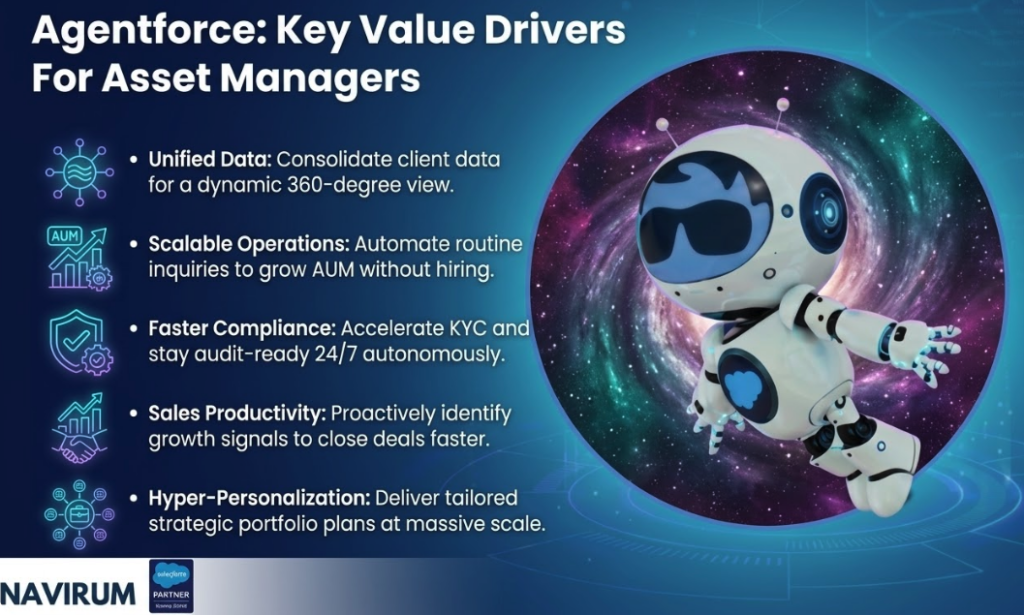
Agentforce Value Drivers For Asset Managers
Agentforce AI unifies multi-channel data—from emails and calendar invites to custodial feeds—to automatically generate post-meeting summaries and ‘next best action’ prompts. This eliminates manual documentation for wholesalers and ensures every interaction is strategic and audit-ready.
The FSC ecosystem, accessible via the AppExchange and AgentExchange, provides a specialized network of pre-built integrations critical for asset management scale. Firms can easily connect to leading WealthTech platforms like Orion and for real-time AUM visibility, and market intelligence tools like Dakota Marketplace to identify high-propensity targets and centers of influence. This modular, integrated platform approach protects technology investments while allowing firms to rapidly adopt new AI capabilities to lower their customer acquisition cost.
Why do asset managers need a unified wealth management platform in 2026?
As alternative asset managers grow their book of business, their operations become increasingly complex. Serving a high-net-worth individual requires a different approach than managing institutional or corporate assets – but often, these clients are interconnected. Advisors must navigate a web of relationships, goals, and financial structures. The need for a centralized technology platform that offers a 360-degree view of the client has never been greater.
Wealth management firms need to move beyond fragmented tools and spreadsheets. They require a comprehensive solution that enables:
Real-time visibility into client, household, and extended relationship networks
Seamless integration with accounting, portfolio management, and planning tools
Scalable processes that allow advisors to focus more on clients and less on administration
AI-driven insights that anticipate client needs and deliver value proactively
Salesforce FSC isused across every segment of wealth and asset management – RIAs, independents, family and multi-family offices, aircraft leasing and lessors, real estate asset managers, endowments, and trusts & foundations, asset and portfolio managers. Fidelity, Schwab,LPL, RBCet Prudential count themselves as clients.
Salesforce Financial Services Cloud vs. Alternatives for Wealth & Asset Management
Mid-sized investment firms evaluating their tech stack often weigh Salesforce FSC against alternative financial CRMs like DealCloud. Choosing the right platform depends entirely on whether your firm prioritizes localized pipeline tracking or a globally integrated AI ecosystem.
Proprietary data integrations, lower AppExchange flexibility
Why choose a specialized CRM for asset management instead of Salesforce?
Firms dealing exclusively in transactional investment banking pipelines sometimes default to DealCloud because it is pre-configured out of the box for deal teams. However, for an asset manager looking to scale both institutional capital raising and wealth management advisory channels under one roof, Salesforce FSC remains the industry benchmark for its flexibility, open API layer, and deep ecosystem support.
Why Is Unifying the Client Experience with Salesforce Financial Services Cloud Important?
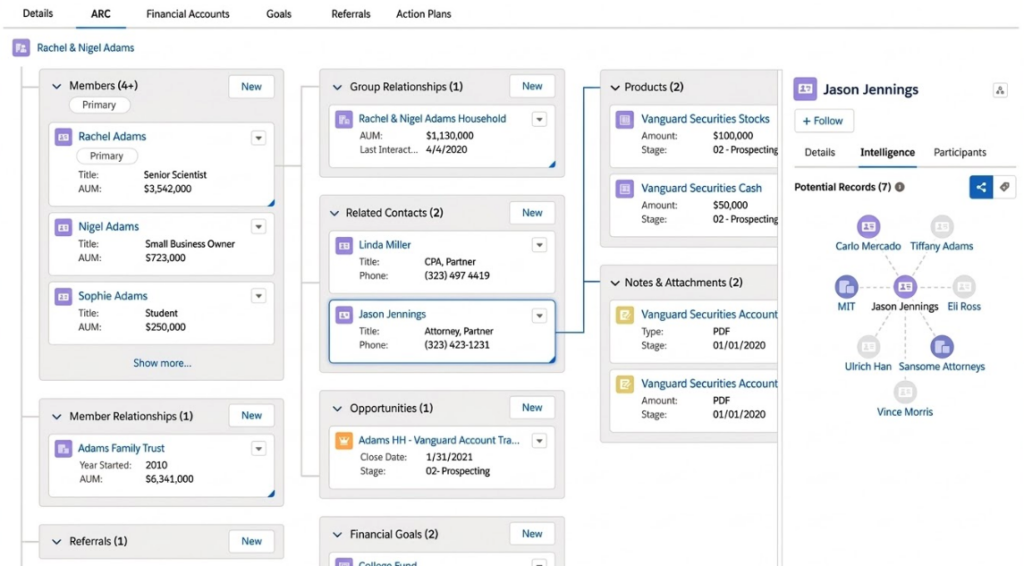
One of the most powerful advantages of Salesforce FSC is its ability to consolidate disparate client information into a single pane of glass. Advisors can view not only individual clients, but their households, related entities, and extended relationships—all in one place.
This capability is essential for alternative asset managers who often work with multi-generational families, trusts, corporate entities, and institutional stakeholders. FSC’s relationship mapping allows firms to untangle the web of affiliations and identify the best way to engage each party involved.
One of our Salesforce consulting clients in the wealth management space recently implemented FSC with this very goal in mind. The firm serves private, institutional, and corporate clients and needed a platform that could support highly personalized advice at scale. By deploying FSC, they transformed their client experience and enabled their advisors to access wealth information holistically, across client networks. As a result, they deepened client relationships and unlocked new business development opportunities
How Do ETF Issuers Use Salesforce Financial Services Cloud?
ETF issuers leverage Salesforce FSC to unify wholesaler distribution and real-time fund flow tracking. By integrating custodial data, firms gain a 360-degree view of AUM and net flows across advisor segments. Agentforce AI identifies high-propensity targets for new fund launches and flags redemption risks through predictive behavior mapping. Additionally, automated audit trails ensure strict compliance with CIRO and SEC standards. This centralized ecosystem drives wholesaler productivity and scales personalized outreach to thousands of intermediaries.
The most popular FSC features for ETF issuers include the Actionable Relationship Center (ARC) for wholesaler distribution mapping, fund flow dashboards for real-time AUM visibility, and Einstein AI for predictive lead scoring and identifying redemption risks. Automated audit trails further ensure strict regulatory compliance.
While standard CRMs track people, FSC’s Actionable Relationship Center (ARC) is specifically designed for the complex “web” of ETF distribution. Add that it allows wholesalers to visually map parent RIAs, sub-advisors, and independent broker-dealers. This helps teams identify “gatekeepers” and key decision-makers within large institutional firms.
Firms also integrate market intelligence tools like Dakota Marketplace to identify high-propensity RIA and wholesaler targets
Maximizing Asset & Wealth Management Growth with Salesforce Marketing Cloud
While Financial Services Cloud handles relationship data, the ultimate growth engine relies on connecting your CRM to specialized marketing tools. Alternative asset managers frequently pair FSC with Salesforce Marketing Cloud (and Account Engagement/Pardot) to scale institutional investor relations.
By unifying wealth and asset management tools with Salesforce Marketing Cloud, distribution teams can:
Automate Institutional Data Dissemination: Instantly distribute monthly fund commentaries, performance fact sheets, and tear sheets to segmented RIA networks as soon as portfolio data updates.
Track Wholesaler Engagement Signals: Alert sales reps via Slack or FSC tasks the moment a high-net-worth advisor clicks on a specific fund performance link.
Onboard Investors Seamlessly: Build customized digital journeys for prospective LPs, moving them from initial lead capture to KYC verification automatically.
How Can Salesforce FSC Drive Advisor Productivity?
Operational efficiency is critical for firms looking to scale. Every hour spent digging through spreadsheets or chasing incomplete data is time lost that could be used to serve clients. Salesforce FSCboosts advisor productivity by providing intuitive dashboards, automated workflows, and intelligent task management.
For example, advisors can:
View daily priorities based on client activity and firm goals
Automate routine touchpoints like birthday greetings, portfolio review reminders, and RMD notifications
Receive AI-generated prompts to engage with clients around major life events or market shifts
Easily track client goals and milestones within the platform
Year after year, Salesforce remains the leading CRM in the industryaccording to Gartner
For Asset Managers, Salesforce Remains The Leading CRM on the Market
By automating administrative tasks and surfacing the most relevant information, Salesforce enables advisors to spend more time advising and less time on manual work. It also creates a more consistent and high-touch client experience across the entire advisor network.
How Can I Gain Intelligent Insights with Salesforce Einstein?
One of the most innovative features of Financial Services Cloud is its use of Salesforce Einstein, theAI engine that transforms raw data into actionable intelligence.
Einstein allows asset managers to analyze historical patterns, predict future behaviors, and identify opportunities to add value. For instance, it can:
Flag clients who may be ready for a new investment product
Recommend personalized services based on client demographics and portfolio trends
Detect anomalies or risks that may require immediate attention
Automate client segmentation for targeted outreach and campaigns
For alternative asset managers who operate in a fast-paced and relationship-driven environment, these capabilities are game-changing. They allow firms to be proactive instead of reactive—delivering value before the client even asks.
How Can Salesforce Ensure Compliance and Security in Wealth Management?
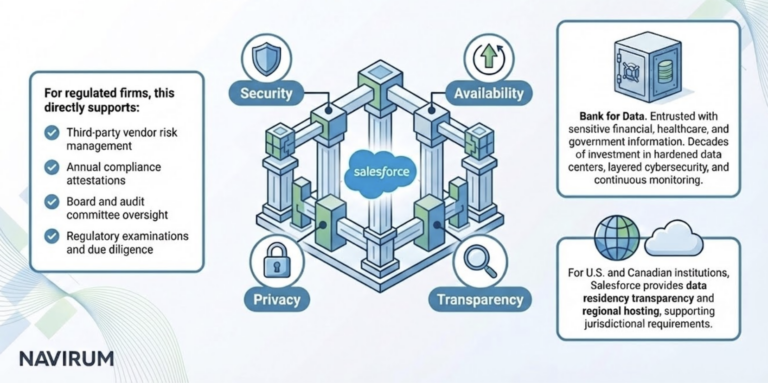
In highly regulated industries like wealth management, compliance and data security are non-negotiable. Salesforce Financial Services Cloud is built with enterprise-grade security features and compliance tools, helping firms meet regulatory requirements without added complexity.
Compliance is key Salesforce use case for asset managers
Advisors can log every interaction, store key documentation, and enforce standardized workflows to maintain audit-readiness. Permissions and data access rules ensure sensitive information is only available to authorized users, reducing risk and supporting best practices. For more details on compliance
How Can Salesforce Scale Growth for Asset Managers?
Perhaps the most compelling reason alternative asset managers turn to Salesforce is its ability to support growth without sacrificing service quality. As firms expand their client base and geographic reach, they need systems that can scale with them.
Salesforce FSC supports multi-entity, multi-region operations, allowing firms to onboard new advisors, open new offices, or expand their offerings without re-architecting their entire infrastructure. Whether managing a $500 million book or scaling to $5 billion in AUM, the platform remains flexible, secure, and powerful.
Final Thoughts: Why Use Salesforce for Wealth Management?
Asset managers are navigating an increasingly complex world – more clients, more data, more regulation, and higher expectations. To thrive, they need a platform that empowers advisors, strengthens client relationships, and enables growth.
Whether you’re a boutique asset manager in Melbourne, an aircraft lessor in Dublin, a fund manager in Toronto, or a large multi-office firm in NYC, Salesforce FSC can help you deliver highly personalized, data-driven advice at scale. With powerful AI, seamless integrations, and a 360-degree client view, Salesforce is redefining how asset managers operate – and how they succeed.
For asset managers evaluating a Salesforce asset management platform, FSC remains the clearest path to unifying client, investment, and relationship data at scale.
Ready to streamline your wealth management operations with Salesforce
<strong class="schema-faq-question"><strong>1. Why are more asset managers adopting Salesforce Financial Services Cloud (FSC) in 2025?</strong>
Asset managers are under pressure to deliver personalized, compliant, and data-driven client experiences at scale. Salesforce FSC provides a single, unified platform that integrates client, investment, and relationship data—empowering advisors to spend more time advising and less time managing spreadsheets or disconnected tools. With new AI capabilities through Salesforce Einstein and Agentforce, firms can proactively identify opportunities, strengthen compliance, and scale without adding operational overhead. Salesforce has a long history of being trust and compliance centric driving popularity
<strong class="schema-faq-question"><strong>2. How does Salesforce FSC integrate with existing WealthTech and portfolio management systems?</strong>
Salesforce FSC integrates seamlessly with leading WealthTech platforms such as Orion, Addepar, NDEX, Croesus, D1G1T, and Infinite (Harmony), as well as accounting, reporting, and client communication tools. Its open API architecture and AppExchange ecosystem make it easy to connect data across custodians, PMS systems, and back-office applications—creating a real-time, accurate, and holistic client view across the organization.
<strong class="schema-faq-question"><strong>3. What makes Salesforce FSC ideal for alternative and institutional asset managers?</strong>
Unlike traditional CRMs, FSC is built specifically for complex client structures—multi-entity, multi-family, or institutional relationships. It provides relationship mapping, householding, and compliance process e.g. onboardingacross investors, funds, and counterparties. For firms managing diverse asset classes and investors, FSC becomes the operational backbone—supporting sophisticated client engagement and reporting while maintaining strict audit and security controls.
<strong class="schema-faq-question"><strong>4. How does Salesforce FSC use AI to enhance decision-making for advisors and executives?</strong>
Powered by Salesforce Einstein and Agentforce FSC turns data into predictive insights. Advisors receive alerts for clients showing behavioral or portfolio shifts, while management gains visibility into advisor productivity, cross-sell opportunities, and risk exposure. AI recommendations help firms anticipate client needs, automate next-best actions, and personalize communications—all of which translate into higher retention and AUM growth.
<strong class="schema-faq-question"><strong>5. Is Salesforce FSC secure and compliant enough for regulated asset management firms?</strong>
Absolutely. Salesforce FSC is built on one of the most secure enterprise platforms in the world, trusted by top financial institutions such as RBC, Prudential, and LPL Financial. It provides robust data encryption, permission-based access controls, audit trails, and compliance automation aligned with North American standards e.g. CIRO, OSFI, and SEC rules. Firms can confidently scale while maintaining strict governance and data privacy requirements.
<strong class="schema-faq-question">6. How Can FSC Help Us Drive ETF Issuer & Wholesaler Productivity and Scale Our Product Launches?<br/></strong>
Wholesalers are expensive assets. ETF issuers need to know that FSC will actually help them sell more efficiently, rather than being just another system to log calls. They are particularly interested in the “ROI on time”: how will this help our wholesalers do more impactful work? The focus in 2026 is on moving from reactive relationship management to proactive, data-driven sales targeting. They are looking for quantifiable efficiencies
<strong class="schema-faq-question">7. Can FSC Successfully Map Our Wholesaler Distribution and Relationship Hierarchies?<br/></strong>
Yes, ETF issuers need to map complex, non-linear relationships across RIAs, broker-dealers, and consultants to identify true decision-makers. Navirum leverages FSC’s Actionable Relationship Center (ARC) to visually clear up these opaque distribution networks, mapping hierarchies and centers of influence to uncover frictionless pathways for introductions.
<strong class="schema-faq-question">8. How does Navirum architect FSC to handle complex, near real-time data integrations for AUM and fund flow analysis<br/></strong>
In 2026, the question isn’t just ‘how much data,’ but ‘how quickly can it be acted upon?’ We build robust, secure connectors- using tools like MuleSoft – that automatically pull daily TA files and custodial data feeds into FSC. For a top 20 Canadian Asset Manager, we unified multiple global data feeds into a custom, real-time ‘AUM 360’ dashboard. When a high-priority RIA or institutional client executed a large inflow or redemption, FSC sent a real-time Slack notification to the wholesaler, allowing for an immediate, personalized follow-up
<strong class="schema-faq-question">9. How long does it typically take to implement Salesforce Financial Services Cloud for an asset manager<br/></strong>
Implementation timelines typically range from 8–20 weeks, depending on integrations, data migration, and customization. Many firms start with a focused rollout – client management, advisor workflows, and reporting – then expand to integrations, AI insights, and automation as the platform matures
<strong class="schema-faq-question">10. Can Salesforce FSC support both wealth management and institutional asset management teams?<br/></strong>
Yes. FSC supports multiple client types including high-net-worth individuals, family offices, RIAs, and institutional investors. Its flexible data model allows firms to manage advisors, consultants, investment committees, and complex entities while maintaining a unified client and relationship view.
<strong class="schema-faq-question">11. Name 5 Key Value Drivers For Agentforce for Asset Managers</strong>
Unified Relationship Intelligence: Unifies client, investor, and market data from platforms like Snowflake and Databricks into a dynamic Client 360 view.
Operational Scalability: Manages routine investor inquiries autonomously, allowing firms to grow AUM without proportionally increasing staff headcount.
Accelerated Compliance Workflows: Automates KYC verification and transaction validation to ensure the firm remains audit-ready 24/7.
Proactive Distribution Productivity: Identifies growth signals in transaction patterns and automates meeting preparation for wholesalers and sales teams.
Hyper-Personalized Client Experience: Interprets investor intent across service channels to deliver relevant, timely solutions and personalized strategic plans at scale.
<strong class="schema-faq-question"><strong>12. What CRM supports multi-entity fund structures out of the box?</strong>
Salesforce Financial Services Cloud (FSC) is uniquely engineered to support complex, multi-entity fund structures, co-investment vehicles, parallel funds, and multi-tiered family trusts. Through FSC’s Actionable Relationship Center (ARC) and flexible data model, asset managers can map relationships across GPs, LPs, holding companies, and individual accounts without losing track of beneficial ownership or capital commitments.
<strong class="schema-faq-question"><strong>13. Is there a solution that assigns quantitative scores to RIAs and exports ranked target lists to Salesforce?</strong>
Yes. Asset management distribution teams frequently integrate market intelligence platforms like Dakota Marketplace or Discovery Data with Salesforce FSC. By feeding external RIA data into Salesforce Einstein Lead Scoring, wholesalers can automatically assign quantitative scores to RIAs based on AUM growth, investment style alignment, and geographic territory. Wholesalers can then generate, rank, and export highly targeted prospect lists directly into their Salesforce dashboards for automated outreach campaigns.
HowSalesforce AI Revolutionizes the Insurance Industry?
Salesforce AI, through tools like Einstein and Financial Services Cloud, is revolutionizing the insurance industry by enabling insurers to leverage data for smarter decision-making, improved operational efficiency, and hyper-personalized customer experiences across the entire value chain.
Artificial intelligence (AI) and Salesforce help insurers face new challenges.
In a rapidly changing insurance landscape, digital transformation is no longer optional. Today’s policyholders expect fast, personalized, and seamless experiences at every touchpoint. Meanwhile, insurers must contend with rising operational costs, complex regulatory environments, and fierce competition.
To meet these challenges head-on, insurers are turning to artificial intelligence (AI) — and Salesforce is leading the charge. With tools like Salesforce Einstein and AI-driven automation built into Financial Services Cloud and Industry Cloud for Insurance, Salesforce AI is helping insurance companies modernize their operations, boost agent productivity, and deliver hyper-personalized service at scale.
In this post, we explore how Salesforce AI is transforming the insurance industry, review high-impact use cases and more.
Why AI Matters in Insurance Today
Insurance is a data-rich industry. Every quote, policy, claim, and customer interaction generates valuable data points. But without the right tools, this data often remains untapped.
AI enables insurers to:
Make sense of massive datasets in real-time
Predict risk and customer behavior more accurately
Personalize services to individual customer needs
Streamline internal workflows and reduce manual effort
Salesforce AI takes these capabilities a step further by embedding intelligence directly into the CRM and operational workflows that insurance professionals use every day. The result is smarter, faster, and more informed decision-making across the value chain. Salesforce integrates with most popular big data analytics platforms like Snowflake and Databricks as well its own solution Data Cloud – see the details here
AI is making huge changes to insurance and society
Key Capabilities of Salesforce AI for Insurance
Salesforce Einstein and Industry Cloud solutions bring AI-powered insights to insurers in a practical, accessible way. Here are some of the most impactful capabilities:
1. Intelligent Lead and Opportunity Scoring
Einstein analyzes lead behavior and historical data to score prospects based on their likelihood to convert. Agents can prioritize high-potential leads, respond faster, and tailor their outreach with recommended messaging.
2. Claims Prediction and Triage
AI models can analyze historical claims data to predict claim severity and flag anomalies. This helps adjusters prioritize claims, reduce fraud risk, and ensure faster settlements for low-risk claims.
Salesforce AI can recommend the next best action, timing, and channel for engaging each customer. Whether it’s a policy renewal reminder or a cross-sell opportunity, advisors receive intelligent prompts to engage clients more effectively.
4. Automated Service and Chatbots
Einstein Bots can handle routine service inquiries like policy lookups, billing questions, and document uploads. This reduces call center volume and ensures 24/7 support without compromising customer satisfaction.
5. Underwriting Efficiency
AI can assist underwriters by automatically gathering third-party data, checking application completeness, and providing risk scoring. This leads to faster application turnaround and more consistent decision-making.
Agentforce. Transforming Health Care and Health Insurance
Use Cases Across the Insurance Value Chain
Let’s look at how Salesforce AI delivers value across different functions within insurance companies:
A. Sales and Distribution
Automatically score and route leads to the right agent
Recommend products based on customer life stage and needs
Track agent performance and provide coaching recommendations
B. Customer Service
Use Einstein Bots to triage cases and escalate complex issues
Provide agents with AI-suggested responses and next steps
Reduce average handling time and improve customer satisfaction
C. Marketing and Engagement
Segment policyholders based on behavior and preferences
Personalize campaigns and outreach with predictive analytics
Optimize campaign timing and channels with AI recommendations
D. Claims and Underwriting
Predict claim cost and time-to-settlement for better resource allocation
Identify potentially fraudulent claims using anomaly detection
Assist underwriters with AI-powered risk assessment tools
E. Policyholder Retention
Flag customers likely to churn and suggest retention offers
Trigger proactive outreach based on key life events or policy usage
Track retention KPIs and fine-tune strategies in real time
Implementing AI isn’t just about technology—it’s about aligning strategy, data, and user experience. That’s why many insurers partner with specialized Salesforce consulting firms to:
Design custom workflows aligned to insurance processes
Integrate Salesforce with policy admin, claims, and billing systems
Train agents and underwriters on how to use AI tools effectively
A Salesforce consulting partner brings the industry knowledge and technical expertise required to ensure a successful, scalable AI implementation.
The Future of Insurance Is AI-Powered
As the insurance industry continues to evolve, the winners will be those who embrace intelligent automation, data-driven engagement, and real-time insights. Salesforce AI provides the foundation insurers need to:
Build stronger relationships with policyholders
Empower agents and advisors to work smarter
Streamline claims and underwriting workflows
Personalize every step of the customer journey
Whether you’re just starting your AI journey or looking to take your Salesforce investment to the next level, the time to act is now.
What is the main driver for insurers to adopt AI and Salesforce?
The main driver is the rapidly changing insurance landscape where policyholders expect fast, personalized, and seamless experiences. Insurers also need to contend with rising operational costs, complex regulatory environments, and fierce competition, which AI and Salesforce help address.
What Salesforce tools are mentioned for driving AI in insurance?
The key tools mentioned are Salesforce Einstein (for AI-driven insights) and AI-driven automation built into Financial Services Cloud and Industry Cloud for Insurance.
Why does AI matter specifically in the insurance industry?
Insurance is a data-rich industry. AI enables insurers to make sense of massive datasets in real-time, predict risk and customer behavior more accurately, personalize services, and streamline internal workflows.
How does Salesforce AI enhance data utilization for insurers?
Salesforce AI embeds intelligence directly into the CRM and operational workflows that insurance professionals use daily, leading to smarter, faster, and more informed decision-making across the value chain.
Name two key capabilities of Salesforce AI for insurance companies.
Intelligent Lead and Opportunity Scoring: Einstein scores prospects based on their likelihood to convert.
Claims Prediction and Triage: AI models predict claim severity and flag anomalies, reducing fraud risk and speeding up low-risk settlements.
How is Salesforce AI used in Customer Service?
It is use in two ways: to employ Einstein Bots to handle routine service inquiries (policy lookups, billing) and triage cases and to provide agents with AI-suggested responses and next steps to reduce average handling time and improve satisfaction.
How does AI improve underwriting efficiency?
AI assists underwriters by automatically gathering third-party data, checking application completeness, and providing risk scoring, resulting in faster application turnaround and more consistent decision-making.
In which areas of the insurance value chain does Salesforce AI deliver value?
Salesforce AI delivers value across:
Policyholder Retention
Sales and Distribution
Customer Service
Marketing and Engagement
Claims and Underwriting
How does Salesforce AI help with policyholder retention?
It can flag customers likely to churn, suggest retention offers, and trigger proactive outreach based on key life events or policy usage.
Why should an insurer partner with a Salesforce consulting firm for AI implementation?
A consulting partner helps align strategy, data, and user experience. They assist with designing custom workflows, integrating Salesforce with other systems (like policy admin), training staff, and ensuring built-in governance and compliance.
Navirum’s Recommendation: Taking The Next Step With AI
At Navirum, we understand that successful AI implementation in the insurance sector is more than just deploying technology—it’s a strategic overhaul of processes and data infrastructure. As a specialized Salesforce consulting partner with deep expertise in the Financial Services Cloud and numerous successful AI-driven projects, we guide insurers through every stage of their digital transformation.
If you are looking to leverage Salesforce AI to reduce operational costs, enhance customer engagement, or streamline complex workflows like claims and underwriting, partnering with an experienced firm is crucial. Navirum provides the industry-specific knowledge and technical rigor to ensure your AI investment is governed, compliant, and delivers scalable, measurable results.
Ready to explore how Salesforce AI can transform your insurance business?