In recent years, the financial services industry has undergone a profound transformation driven by advancements in artificial intelligence (AI) and machine learning (ML). These technologies, particularly when integrated into platforms like Salesforce, offer immense potential for enhancing customer experience, operational efficiency, and decision-making processes. However, with this potential comes a responsibility to ensure that AI is implemented ethically and responsibly.
The Promise of AI in Financial Services
AI and ML technologies are revolutionizing how financial institutions operate. They enable predictive analytics, personalized customer interactions, fraud detection, risk assessment, and compliance monitoring at a scale and speed previously unimaginable. Salesforce, as a leading CRM platform, plays a pivotal role in harnessing these technologies to drive innovation and competitiveness in the financial sector.
Ethical Considerations in AI Implementation
Transparency and Explainability: One of the foremost ethical considerations in AI is ensuring transparency and explainability. Financial institutions must understand how AI algorithms make decisions and be able to explain those decisions to customers and regulatory authorities. When implementing AI solutions through Salesforce, it’s crucial to choose models that can provide insights into their decision-making process.
Fairness and Bias Mitigation: AI systems can inadvertently perpetuate biases present in historical data, leading to unfair outcomes. Financial services companies must proactively mitigate bias by regularly auditing data sources, refining algorithms, and ensuring diversity in the teams developing AI solutions. Salesforce’s AI capabilities should be leveraged with these considerations in mind to promote fairness and equity.
Data Privacy and Security: Financial data is highly sensitive, necessitating stringent data privacy and security measures. AI implementations must comply with regulations such as GDPR and CCPA. Salesforce provides robust data protection features and compliance tools that should be configured appropriately to safeguard customer information and ensure ethical use of AI.
Accountability and Governance: Establishing clear accountability and governance frameworks is essential for ethical AI use. Financial institutions using Salesforce for AI implementations should have policies in place for monitoring AI performance, handling errors or biases, and continuously assessing ethical implications. Regular audits and reviews can help maintain ethical standards over time.
Best Practices for Ethical AI Implementation with Salesforce
Cross-functional Collaboration: Involve stakeholders from compliance, legal, IT, and business units early in the AI implementation process to address ethical concerns comprehensively.
Continuous Monitoring and Evaluation: Implement mechanisms to monitor AI performance, detect biases, and evaluate outcomes regularly. Salesforce’s analytics and reporting tools can facilitate ongoing evaluation and adjustment of AI models.
Ethics Training: Provide ethics training to employees involved in AI development and deployment to raise awareness of ethical considerations and foster a culture of responsible AI use.
Customer-Centric Approach: Prioritize customer interests and expectations when designing AI-driven solutions on Salesforce. Seek feedback and ensure transparency about how AI is used to enhance customer trust.
As financial services organizations embrace AI technologies through platforms like Salesforce, they must navigate complex ethical considerations to foster trust, ensure fairness, and comply with regulatory requirements. By prioritizing transparency, fairness, data privacy, and accountability, companies can harness the full potential of AI while mitigating risks and promoting ethical practices. Ultimately, ethical AI implementation with Salesforce not only enhances operational efficiencies but also reinforces customer confidence and regulatory compliance in the financial services sector.
Interested in discussing solutions further ? We would be delighted to help!
Lavinia PicuEthical AI Use in Financial Services: Considerations for Salesforce Implementation
Salesforce AI Solutions for Financial Advisors help unlock the future of wealth management.
In today’s rapidly evolving financial services arena, staying ahead requires harnessing advanced technology to deliver personalized, efficient, and secure client solutions. Salesforce, renowned for its innovative CRM solutions, has now integrated robust artificial intelligence (AI) capabilities that are reshaping how financial advisors interact with clients and manage their practices.
Personalization at Scale: Salesforce AI enables financial advisors to understand their clients better than ever before. By analyzing client interactions, preferences, and financial goals in real-time, AI empowers advisors to tailor their recommendations and communications precisely to each client’s needs. This level of personalization not only enhances client satisfaction but also strengthens client-advisor relationships, leading to increased retention and loyalty.
Predictive Analytics: AI-driven predictive analytics is a game-changer for financial advisors. By analyzing historical data and market trends, Salesforce AI can forecast potential investment opportunities, detect patterns in client behavior, and even predict life events that may impact financial planning. These insights enable advisors to proactively offer strategic advice and anticipate client needs, positioning themselves as trusted partners in their clients’ financial journeys.
Automation of Routine Tasks: Administrative tasks can consume a significant portion of an advisor’s time. Salesforce AI automates routine tasks such as data entry, scheduling, and compliance monitoring, allowing advisors to focus more on strategic client interactions and business development. This efficiency not only boosts productivity but also ensures accuracy and regulatory compliance, thereby mitigating operational risks.
Enhanced Client Engagement: AI-powered chatbots and virtual assistants enable advisors to provide round-the-clock client support and engagement. Whether it’s answering basic inquiries, scheduling appointments, or delivering personalized financial insights in real-time, these virtual assistants ensure that clients receive timely and relevant information whenever they need it. This seamless interaction fosters a more connected client experience and strengthens client loyalty.
Implementing Salesforce AI solutions for financial advisors involves a strategic approach to maximize its benefits:
Assessment and Customization: Understand your specific business needs and client expectations. Tailor Salesforce AI capabilities to align with your advisory services and client engagement strategies.
Integration with Existing Systems: Ensure seamless integration with your current CRM and other systems to maximize efficiency and data coherence.
Training and Adoption: Invest in comprehensive training programs to empower advisors and staff with the skills to leverage AI effectively. Foster a culture of continuous learning to adapt to AI advancements and industry trends.
Compliance and Security: Prioritize data security and compliance with regulatory standards. Implement robust measures to safeguard client information and maintain trust.
As AI continues to evolve, its role in financial advisory will become increasingly indispensable. Salesforce AI solutions empower financial advisors to deliver personalized, proactive, and insightful services that drive client satisfaction and business growth. By harnessing the power of AI, financial advisory firms can not only stay competitive in a digital-first world but also lead the industry in innovation and client-centric service delivery.
In conclusion, Salesforce AI solutions are transforming the way financial advisors operate, empowering them to build stronger client relationships, drive operational efficiency, and achieve sustainable business growth. Embracing AI is not just about adopting new technology—it’s about embracing a future where human expertise and machine intelligence converge to create unparalleled value for clients and advisors alike.
As you navigate the complexities of modern financial advisory services, consider how Salesforce AI can propel your firm towards greater success and client satisfaction. The future is here, and it’s AI-powered.
Unlock the potential of Salesforce AI for your financial advisory firm. Contact us today to explore how we can help you leverage AI to transform your client engagement and business operations.
Ready to unlock the potential of AI? Book a Free Consultation Below
NAVIRUM Success Stories – Salesforce Financial Service Cloud
FAQ
1. What is Salesforce AI, and how does it apply to financial advisors?
Salesforce AI is a suite of artificial intelligence tools integrated into the Salesforce platform that helps financial advisors automate tasks, personalize client experiences, and make smarter, data-driven decisions. It transforms traditional wealth management into a more proactive, client-centric approach.
2. How does Salesforce AI personalize client experiences in wealth management?
Salesforce AI analyzes real-time client data, preferences, and financial goals to deliver personalized recommendations, communications, and financial plans. This helps advisors build stronger, more meaningful client relationships and boost satisfaction and loyalty.
3.What kind of predictive analytics does Salesforce AI offer?
Salesforce AI uses predictive analytics to forecast market trends, identify investment opportunities, detect behavioral patterns, and even predict significant life events. This enables advisors to provide timely, strategic advice that aligns with each client’s evolving needs.
4. Can Salesforce AI automate administrative tasks for financial advisors?
Yes. Salesforce AI automates time-consuming tasks such as data entry, scheduling, compliance tracking, and report generation. This allows advisors to focus more on client engagement and strategic planning rather than routine admin work.
5. How do AI-powered chatbots enhance client engagement?
AI chatbots and virtual assistants offer 24/7 support for clients, answering common questions, scheduling appointments, and delivering personalized insights. This creates a seamless, always-available client experience that strengthens trust and responsiveness.
6. Is it difficult to integrate Salesforce AI with existing systems?
No. Salesforce AI is designed to integrate seamlessly with existing CRM systems and other digital tools. Proper assessment and configuration ensure a smooth transition and enhanced efficiency across platforms.
7. What training is required to use Salesforce AI effectively?
Salesforce provides training resources and partner support to help financial advisors and their teams understand and utilize AI features effectively. Ongoing learning and internal adoption strategies are key to maximizing ROI.
How does Salesforce AI ensure data security and compliance?
Salesforce AI includes built-in features for regulatory compliance and robust data security measures. Financial firms can maintain full control over data governance and ensure they meet industry regulations like GDPR and SEC standards.
What are the long-term benefits of using Salesforce AI in a financial advisory firm?
Long-term benefits include increased advisor productivity, deeper client relationships, higher client retention, faster decision-making, and the ability to scale services efficiently. It positions firms as forward-thinking leaders in the wealth management industry.
How can my firm get started with implementing Salesforce AI?
Start by assessing your business needs and client engagement goals. Then, work with a certified Salesforce partner to customize and integrate AI features. Training your team and establishing best practices for adoption will ensure a successful implementation.
Discover how Salesforce can help building a 360-Degree View of Clients in Wealth Management
In the dynamic world of wealth management, every interaction is an opportunity to deepen relationships, provide personalized services, and drive business growth. However, achieving this level of insight can be challenging, especially when dealing with vast amounts of data scattered across multiple systems.
Salesforce, a powerhouse in customer relationship management (CRM) solutions, with its robust capabilities and customizable features, it empowers wealth management firms to build a comprehensive 360-degree view of their clients. This holistic perspective enables advisors to anticipate needs, deliver tailored recommendations, and ultimately, foster long-lasting client satisfaction.
Understanding the 360-Degree View
A 360-degree view of clients goes beyond surface-level information. It involves aggregating data from various touchpoints, including account holdings, transaction history, communication preferences, life events, and even external factors like market trends and regulatory changes. By consolidating these insights into a unified platform, advisors gain a panoramic understanding of each client’s financial landscape and personal aspirations.
Benefits of Salesforce in Wealth Management
Centralized Data Management: Salesforce serves as a centralized hub where all client-related information resides. Whether it’s capturing interactions from emails, meetings, or phone calls, advisors have real-time access to a comprehensive profile, eliminating the need to juggle multiple systems.
Personalized Engagement: Armed with a holistic view, advisors can personalize their interactions based on clients’ preferences, risk tolerance, and life goals. Whether it’s crafting tailored investment strategies or proactively addressing concerns, every engagement becomes more meaningful and impactful.
Streamlined Workflows: Salesforce streamlines workflows by automating routine tasks, such as scheduling appointments, updating records, and generating reports. This efficiency allows advisors to focus their time and energy on high-value activities, such as client engagement and strategic planning.
Data-Driven Insights: With robust analytics capabilities, Salesforce provides actionable insights derived from client data. Advisors can uncover patterns, identify opportunities, and mitigate risks, thereby enhancing decision-making and driving better outcomes for clients.
Scalability and Flexibility: As firms grow and evolve, Salesforce scales seamlessly to accommodate changing needs. Its flexible architecture allows for customization, ensuring that the platform aligns with the unique processes and workflows of each wealth management firm.
Request Your Salesforce Readiness Assessment | Navirum
Integration Assessment
Request Your Salesforce Readiness Assessment
Not sure if your tech stack is integration-ready? We’ll assess your current setup in one conversation. Designed exclusively for financial services firms.
Implementing Salesforce for Client-Centric Success
While the benefits of Salesforce are undeniable, successful implementation requires careful planning and execution. Here are some best practices to maximize its effectiveness:
Define Objectives: Clearly outline the goals and objectives of implementing Salesforce, whether it’s improving client satisfaction, increasing efficiency, or driving revenue growth.
Data Integration: Ensure seamless integration with existing systems to facilitate data consolidation and avoid duplication. This includes integrating with core banking systems, portfolio management tools, and third-party data sources.
Customization and Configuration: Tailor Salesforce to meet the specific needs of wealth management firms, including custom fields, workflows, and reporting dashboards.
User Training and Adoption: Invest in comprehensive training programs to familiarize advisors and staff with Salesforce’s functionalities. Encourage adoption by highlighting its benefits and demonstrating its impact on daily workflows.
Continuous Improvement: Embrace a culture of continuous improvement by soliciting feedback from users and stakeholders. Regularly evaluate performance metrics and iterate on processes to drive ongoing success.
In the competitive landscape of wealth management, delivering exceptional client experiences is non-negotiable. Salesforce equips firms with the tools and insights needed to cultivate meaningful relationships, drive business growth, and stay ahead of the curve. By harnessing the power of Salesforce to build a 360-degree view of clients, wealth management firms can unlock new opportunities and chart a course towards lasting success.
Main Navigation CTA Showcase | Navirum
Next Steps & Impact
Explore Navirum Success, Culture & Team
Discover real-world outcomes, learn about our collaborative company culture, and meet the financial technology specialists leading your digital transformation.
Proven Results & Impact
Explore Our Success Stories
See how we help financial institutions, wealth managers, and fintechs turn Salesforce and AI into measurable business outcomes and operational growth.
Streamline Loan Origination Processes with Salesforce
Lavinia Picu
In today’s fast-paced lending environment, Streamlined loan origination on Salesforce can be the difference between winning and losing business. As financial institutions face rising customer expectations and complex regulations, Salesforce Financial Services Cloud provides the tools to simplify origination, boost efficiency, and elevate the borrower experience. This post explores how lenders can leverage Salesforce to drive sustainable growth through smarter, faster loan origination.
One of the primary challenges in loan origination is managing vast amounts of data dispersed across disparate systems and departments. Salesforce serves as a centralized platform for consolidating customer information, credit profiles, collateral details, and transaction history. By capturing and organizing data in a single, unified repository, financial institutions gain a 360-degree view of borrowers, enabling more informed lending decisions and minimizing the risk of errors and duplication.
Manual loan origination processes are not only time-consuming but also prone to inefficiencies and bottlenecks. Salesforce enables financial institutions to automate workflows and standardize processes from application submission to loan approval. By defining rules, triggers, and approval pathways within Salesforce, lenders can expedite loan processing times, reduce administrative overhead, and ensure consistency and compliance across the organization.
Salesforce’s flexibility and customization capabilities empower financial institutions to tailor loan application and underwriting processes to their unique requirements. Through custom-built forms, wizards, and validation rules, lenders can capture relevant borrower information efficiently and accurately. Additionally, Salesforce’s integration with credit bureaus, document management systems, and risk assessment tools enables seamless data exchange and real-time decision-making, enhancing the speed and accuracy of underwriting processes.
Effective communication and collaboration are essential for successful loan origination. Salesforce provides built-in collaboration tools, such as Chatter, enabling lenders, underwriters, and relationship managers to communicate, share insights, and collaborate in real time. By centralizing communication channels within Salesforce, financial institutions foster transparency, accountability, and alignment across cross-functional teams, ultimately accelerating the loan origination lifecycle.
Comprehensive Reporting and Analytics
Data-driven insights are instrumental in optimizing loan origination processes and driving strategic decision-making. Salesforce’s robust reporting and analytics capabilities empower financial institutions to track key performance indicators (KPIs), monitor pipeline activity, and identify trends and patterns in loan origination. With customizable dashboards and predictive analytics, lenders can proactively identify opportunities, mitigate risks, and optimize resource allocation to maximize lending profitability.
Fiserv, FIS, and Equifax integrations do not maintain themselves. Our Orbit Managed Services team keeps these connections working as both platforms evolve, so the automation you launch with does not quietly degrade six months later.
In today’s competitive lending landscape, delivering exceptional customer experiences is paramount. Salesforce’s customer-centric approach enables financial institutions to engage borrowers throughout the loan origination journey. From personalized communications and self-service portals to automated status updates and proactive notifications, Salesforce facilitates meaningful interactions that build trust, loyalty, and satisfaction among borrowers.
In a nutshell, Salesforce offers a comprehensive suite of tools and capabilities to streamline loan origination processes and drive sustainable growth for financial institutions. By leveraging centralized data management, automated workflows, dynamic application and underwriting, collaborative communication channels, comprehensive reporting and analytics, and enhanced customer engagement, lenders can achieve operational excellence, mitigate risks, and capitalize on emerging opportunities in the lending market.
As a trusted partner in Salesforce consulting and advisory, we are committed to helping financial institutions unlock the full potential of Salesforce and accelerate their loan origination success. Contact us today to learn more about how we can support your organization’s digital transformation initiatives.
Navirum Client Success Stories
FAQs – Streamline Loan Origination Processes with Salesforce
How can Salesforce improve our current loan origination process?
Salesforce centralizes all borrower data, automates workflows, enhances team collaboration, and integrates with third-party tools (like credit bureaus and document systems). Salesforce is also used extensively for compliance process automation – the most popular financial process in our view (more here) as well as ESG process automation and reporting (more details here). This reduces manual effort, shortens approval timelines, and improves borrower satisfaction.
Can Salesforce integrate with our existing banking or core lending systems?
Yes. Salesforce offers robust integration capabilities using tools like MuleSoft, APIs, and AppExchange apps. Integrations with Fiserv, FIS, ID-Pal. Laser Credit, Equifax are very popular. We help financial institutions connect Salesforce with core banking, credit scoring, document management, and other mission-critical systems. This is the same unified-data foundation behind a strong member experience for credit unions.
Is Salesforce secure enough to handle sensitive financial and customer data?
Absolutely. Salesforce is a highly secure platform with enterprise-grade compliance certifications, including GDPR, SOC 2, and ISO 27001. We also help customize security settings to match your institution’s compliance requirements.
What kind of automation can be set up for loan origination?
Salesforce can automate application intake, document collection, underwriting workflows, approval routing, and customer notifications. You can define business rules to handle processes consistently and reduce delays or human error.
How long does it take to implement Salesforce for loan origination?
Implementation timelines vary based on project scope and system complexity. A basic setup may take a few weeks, while a full-scale transformation (with integrations and custom workflows) could take several months. Our consultants provide a tailored implementation roadmap.
Do we need Salesforce Financial Services Cloud (FSC), or can we use Sales Cloud?
While Sales Cloud offers strong capabilities, Financial Services Cloud (FSC) provides industry-specific features designed for lenders and financial institutions. We can help assess your needs and recommend the right Salesforce edition for your goals. With FSC you get 3 automatic upgrade per year specific to financial services. More details here
How much does it cost to implement Salesforce for lending operations?
Costs vary based on user licenses, customization, third-party integrations, and consulting support. We offer flexible consulting packages and can provide a detailed quote based on your unique requirements during a discovery call.
Will our staff need extensive training to use Salesforce for loan origination?
Not at all. Salesforce has an intuitive interface, and we offer hands-on training tailored to your workflows. With guided onboarding and ongoing support, your teams can adopt the system quickly and confidently.
Still Have Questions?
Book a free consultation with our Salesforce experts to discuss your unique challenges and explore how we can help transform your loan origination process.
Tumi specializes in driving high-impact Salesforce implementations, streamlining multi-cloud delivery processes, and empowering financial institutions to optimize their digital operational frameworks.
Salesforce Marketing Cloud enables wealth management firms to deliver highly personalized, compliant, and data-driven client engagement. By integrating with Financial Services Cloud, firms can unify client data, automate lifecycle journeys, and deliver targeted communications based on financial goals, life events, and engagement behavior. Successful implementation requires clear KPIs, strong data governance, and automated campaign workflows that support acquisition, onboarding, cross-selling, and retention. When properly deployed, Marketing Cloud helps wealth managers scale personalization, improve client experience, and drive measurable growth while maintaining regulatory compliance.
Unlocking Success: Expert Tips to Implement Marketing Cloud for Wealth Management
In the fast-paced world of wealth management, effective client engagement is paramount to success. With Salesforce Marketing Cloud, wealth management firms have a powerful tool at their disposal to personalize client interactions, drive engagement, and nurture lasting relationships. As a Senior Salesforce Consultant with extensive experience in implementing Marketing Cloud solutions for wealth management, I’m excited to share some expert tips to help firms harness the full potential of this transformative platform.
Before diving into implementation, it’s crucial to define clear objectives and key performance indicators (KPIs) for your Marketing Cloud initiatives. Determine what you aim to achieve—whether it’s increasing client acquisition, driving cross-selling opportunities, or enhancing client retention—and establish metrics to measure success. This clarity ensures alignment across stakeholders and guides decision-making throughout the implementation process.
Leverage Client Data for Personalization and Customization
Wealth management is inherently personal, and clients expect tailored experiences that resonate with their individual needs and preferences. Utilize the wealth of client data available within your organization to drive personalization initiatives in Marketing Cloud. Segment clients based on demographics, financial goals, risk tolerance, and engagement history to deliver targeted messaging that speaks directly to their interests and concerns.
Integrate Marketing Cloud with Financial Services Cloud
Seamless integration between Marketing Cloud and Financial Services Cloud is key to unlocking the full potential of both platforms. By connecting client data, interactions, and insights across systems, you create a unified view of each client’s journey and enable personalized, omnichannel experiences. Leverage out-of-the-box connectors and custom integrations to ensure smooth data flow and synchronization between the two platforms.
Time is a precious commodity in wealth management, and automation is your ally in maximizing efficiency. Leverage Marketing Cloud’s automation capabilities to streamline campaign workflows, from lead nurturing and onboarding to re-engagement and retention. Set up automated journeys based on client triggers, such as account openings, life events, or engagement milestones, to deliver timely and relevant communications at scale.
Ensure Compliance and Data Security
In the highly regulated landscape of wealth management, compliance and data security are non-negotiable. Prioritize adherence to industry regulations, such as GDPR and FINRA guidelines, when implementing Marketing Cloud initiatives. Implement robust data governance policies, encryption measures, and access controls to safeguard sensitive client information and maintain trust and confidentiality.
Measure and Iterate for Continuous Improvement
Measurement is essential for optimizing performance and driving ROI in Marketing Cloud initiatives. Establish a framework for tracking and analyzing key metrics, such as open rates, click-through rates, conversion rates, and client engagement scores. Leverage Marketing Cloud’s analytics capabilities to gain insights into campaign effectiveness, client behavior, and trends, and use these insights to refine your strategies and iterate for continuous improvement.
Implementing Marketing Cloud for wealth management is a strategic investment in enhancing client engagement, driving growth, and differentiating your firm in a competitive landscape. By following these expert tips—defining clear objectives, leveraging client data for personalization, integrating with Financial Services Cloud, automating workflows for efficiency, ensuring compliance and data security, and measuring and iterating for continuous improvement—you can maximize the impact of Marketing Cloud and deliver exceptional experiences that resonate with your clients. If you’re ready to embark on your Marketing Cloud journey, our team of experienced consultants is here to guide you every step of the way. Together, we can unlock new opportunities for success and propel your firm to new heights in the world of wealth management.
Frequently Asked Questions: Marketing Cloud for Wealth Management
How does Salesforce Marketing Cloud improve client engagement in wealth management?
Salesforce Marketing Cloud enables wealth management firms to move beyond generic communications and deliver highly personalized, lifecycle-based client engagement. By using behavioral data, financial goals, and engagement history, firms can create targeted journeys that adapt to each client’s needs.
Key engagement improvements include:
Personalized financial education campaigns
Automated onboarding journeys for new clients
Triggered communications based on life events or portfolio changes
Segmented campaigns for different investor profiles
Multi-channel engagement across email, SMS, and digital channels
This approach helps advisors maintain consistent, relevant communication with clients while scaling engagement across the entire client base.
Why is integration between Marketing Cloud and Financial Services Cloud critical?
Integration between Marketing Cloud and Financial Services Cloud creates a unified client view that allows firms to align marketing activities with advisor relationships and financial data.
This integration enables:
Real-time synchronization of client profiles
Marketing campaigns triggered by financial milestones
Personalized communications based on account activity
Improved collaboration between marketing and advisors
Better tracking of client engagement within Salesforce
Without integration, marketing teams operate with fragmented data, reducing the effectiveness of personalization and automation.
What types of client journeys should wealth management firms automate in Marketing Cloud?
Common automated journeys include:
Wealth management firms can automate multiple client lifecycle journeys to improve engagement and operational efficiency.
New client onboarding and welcome sequences
Prospect nurturing for high-net-worth leads
Retirement planning education journeys
Market update and portfolio insights communications
This level of segmentation allows firms to create marketing strategies that resonate with specific investor groups.
How can Marketing Cloud support compliant marketing in regulated financial environments?
Marketing Cloud can support compliance through governance frameworks, approval workflows, and data security controls designed for financial services organizations.
Compliance best practices include:
Pre-approved content libraries for advisors
Role-based access controls
Campaign approval workflows
Secure storage of client data
Audit trails for communications
Integration with compliance review processes
These controls help firms meet regulatory requirements while still maintaining effective client communication.
What data strategy should wealth management firms adopt before implementing Marketing Cloud?
A strong data foundation is essential for a successful Marketing Cloud implementation. Firms must ensure their client data is clean, structured, and accessible across systems.
Important data considerations include:
Data quality and standardization
Integration with CRM and financial systems
Client consent and communication preferences
Data governance policies
Identity resolution across channels
Without a strong data strategy, personalization and automation initiatives will deliver limited results.
How can Marketing Cloud help advisors scale personalized communication?
One of the biggest challenges in wealth management is maintaining personal relationships as client books grow. Marketing Cloud allows advisors to scale personalization without losing the human touch.
Key capabilities include:
Automated but personalized advisor-branded communications
Dynamic content tailored to client segments
Behavioral triggers that send timely messages
Advisor-specific campaign templates
AI-powered content recommendations
This allows advisors to maintain consistent engagement across hundreds or thousands of clients.
What metrics should wealth management firms track to measure Marketing Cloud success?
To evaluate ROI and campaign performance, firms should establish a measurement framework aligned with their strategic goals.
Key metrics include:
Email open and click-through rates
Client engagement scores
Lead-to-client conversion rates
Cross-sell and upsell campaign performance
Client retention and loyalty metrics
Campaign-attributed revenue
Tracking these metrics allows marketing teams to continuously optimize their engagement strategies.
How does Marketing Cloud support omnichannel engagement for wealth management clients?
Modern investors interact with financial institutions across multiple digital and physical channels. Marketing Cloud enables firms to orchestrate consistent messaging across these touchpoints.
Omnichannel capabilities include:
Email marketing campaigns
SMS and mobile notifications
Personalized web experiences
Social media engagement
Event and webinar communications
Advisor-driven outreach
By coordinating communications across channels, firms can create seamless client experiences.
What are the most common challenges when implementing Marketing Cloud in wealth management?
While Marketing Cloud offers significant benefits, implementation can be complex due to organizational, technical, and regulatory factors.
Common challenges include:
Data silos across financial platforms
Compliance and regulatory requirements
Limited marketing automation expertise
Integration complexity with CRM systems
Aligning marketing teams with advisors
Working with experienced Salesforce consultants and establishing a clear implementation roadmap can significantly reduce these risks and accelerate time-to-value.
Navirum Recommendations: Practical SME Tips for a Successful Marketing Cloud Implementation
From our experience supporting wealth and asset management firms with Salesforce implementations, success with Marketing Cloud often depends on operational alignment—not just technology deployment. Below are a few practical recommendations that help firms accelerate value and avoid common pitfalls
Start with a focused pilot before scaling.
Align marketing and advisors early in the process.
Create a reusable campaign architecture.
Use Marketing Cloud to support thought leadership—not just promotions.
Plan for ongoing optimization and governance.
Start with a focused pilot before scaling. Rather than launching multiple campaigns across all client segments, begin with one or two high-impact journeys—such as new client onboarding or prospect nurturing. This approach allows teams to validate data flows, test personalization strategies, and demonstrate early ROI before expanding the program.
Align marketing and advisors early in the process. In many wealth firms, marketing teams operate separately from advisors, which can limit adoption. Establishing advisor input on messaging, campaign timing, and client segmentation ensures communications remain relevant and strengthens advisor buy-in.
Create a reusable campaign architecture. Building standardized templates, data extensions, and automation frameworks allows marketing teams to launch campaigns faster and maintain consistency across regions, advisors, and client segments. A well-designed architecture significantly reduces operational complexity as programs scale.
Use Marketing Cloud to support thought leadership—not just promotions. Wealth clients respond strongly to educational and market insight content. Structuring campaigns around financial education, market commentary, and planning guidance often drives higher engagement than purely promotional messaging.
Plan for ongoing optimization and governance. Marketing Cloud is not a “set it and forget it” platform. Establish a cadence for reviewing campaign performance, refining segmentation strategies, and updating personalization rules to ensure the platform continues delivering measurable business value.
With the right strategy, governance framework, and advisor alignment, Marketing Cloud can become a powerful engine for scalable, personalized client engagement across the wealth management lifecycle.
Discover The Best Practices for Salesforce Implementation in Insurance Companies
In the ever-evolving landscape of the insurance industry, technological innovation has become a cornerstone of success. As insurance companies strive to adapt to changing customer expectations, regulatory requirements, and market dynamics, the implementation of robust CRM solutions like Salesforce has emerged as a strategic imperative, making Salesforce insurance CRM implementation a top priority for modern insurers.
However, a successful Salesforce implementation in insurance companies requires more than just software deployment, it demands careful planning, meticulous execution, and a commitment to best practices. In this blog post, we’ll explore key best practices for Salesforce implementation tailored to the unique needs of insurance companies.
Define Clear Objectives and Metrics
Before embarking on a Salesforce implementation journey, insurance companies must define clear objectives aligned with their business goals. Whether it’s improving customer engagement, streamlining claims processing, or enhancing agent productivity, articulating specific, measurable, achievable, relevant, and time-bound (SMART) objectives is essential. Additionally, identifying key performance indicators (KPIs) to track progress and measure success ensures accountability and drives continuous improvement throughout the implementation process.
One size does not fit all, especially when it comes to CRM solutions in the insurance industry. Customizing Salesforce to align with insurance-specific workflows, processes, and terminology is crucial for maximizing efficiency and user adoption. Whether it’s configuring custom objects for policy management, automating underwriting workflows, or integrating with third-party systems for claims adjudication, tailoring Salesforce ensures a seamless fit with existing operations and enhances overall system usability.
Empower Agents with Mobile Capabilities
In today’s digital age, insurance agents are often on the go, meeting clients, and closing deals outside the confines of the office. Empowering agents with mobile capabilities through Salesforce’s mobile app enables them to access critical information, manage leads, and collaborate with colleagues anytime, anywhere. By providing agents with real-time access to client data, policy details, and sales tools, insurance companies can drive productivity, responsiveness, and customer satisfaction.
A 360-degree view of customers is indispensable for insurance companies aiming to deliver personalized experiences and anticipate customer needs. Integrating disparate data sources (such as customer profiles, policy information, claims history, and interactions) into Salesforce provides a unified view of each customer’s journey. Leveraging Salesforce’s integration capabilities, insurance companies can break down data silos, enhance cross-functional collaboration, and unlock actionable insights to drive informed decision-making.
Prioritize Data Security and Compliance
With sensitive customer information at stake, data security and compliance are paramount concerns for insurance companies. Salesforce offers robust security features and compliance controls to safeguard sensitive data and meet regulatory requirements, such as GDPR and HIPAA. Implementing encryption, access controls, and audit trails within Salesforce ensures data confidentiality, integrity, and availability, instilling trust among customers and regulatory authorities alike.
The success of a Salesforce implementation hinges not only on technology but also on people. Investing in comprehensive user training and change management programs is essential for driving user adoption and maximizing ROI. Providing tailored training sessions, user guides, and ongoing support equips employees with the skills and confidence needed to leverage Salesforce effectively. Additionally, soliciting feedback, addressing concerns, and fostering a culture of continuous learning and improvement are critical components of successful change management initiatives.
Salesforce implementation holds immense potential for insurance companies seeking to modernize operations, enhance customer experiences, and drive growth. By adhering to best practices such as defining clear objectives, tailoring Salesforce to insurance workflows, empowering agents with mobile capabilities, integrating data sources, prioritizing data security and compliance, and investing in user training and change management, insurance companies can unlock the full potential of Salesforce and thrive in an increasingly competitive marketplace.
As a trusted partner in Salesforce consulting and advisory, we are committed to helping insurance companies navigate their Salesforce implementation journey with confidence and success. Contact us today to learn more about how we can support your organization’s digital transformation initiatives. See our full insurance industry practice for how we approach this end to end.
Unveiling the Benefits of Salesforce CRM Implementation In Financial Services
In the ever-evolving landscape of financial services, customer relationships lie at the heart of success. As financial institutions strive to meet the dynamic needs of clients, deliver personalized experiences, and drive growth, the adoption of robust Customer Relationship Management (CRM) solutions has become imperative. Among the leading CRM platforms, Salesforce stands out as a game-changer, offering a comprehensive suite of tools and capabilities tailored to the unique requirements of the financial services industry. In this blog post, we’ll explore the transformative benefits of implementing Salesforce CRM in financial services and how it empowers organizations to thrive in a digital-first world.
360-Degree View of Clients
Central to Salesforce CRM is its ability to provide a 360-degree view of clients, consolidating data from various touchpoints, channels, and interactions into a single, unified platform. Financial institutions can gain insights into client preferences, behaviors, and needs, enabling personalized engagement and targeted offerings. With a holistic understanding of clients, advisors can anticipate their requirements, deliver tailored recommendations, and foster long-lasting relationships built on trust and value.
Enhanced Sales and Marketing Effectiveness
Salesforce CRM equips financial institutions with powerful sales and marketing tools to drive revenue growth and market penetration. From lead generation and prospecting to campaign management and lead nurturing, Salesforce streamlines sales and marketing processes, enabling teams to identify, prioritize, and convert opportunities more efficiently. By leveraging data-driven insights and automation, financial institutions can optimize marketing spend, increase conversion rates, and accelerate sales cycles.
Improved Operational Efficiency
Manual and siloed processes are significant impediments to operational efficiency in financial services. Salesforce CRM offers a centralized platform for automating workflows, standardizing processes, and streamlining operations across departments. Whether it’s client onboarding, account management, or compliance monitoring, Salesforce enhances efficiency by eliminating redundant tasks, reducing errors, and enabling seamless collaboration among teams. As a result, financial institutions can reallocate resources to value-added activities, driving productivity and cost savings.
Data-Driven Decision-Making
In an era of data abundance, making informed decisions is critical for staying competitive in the financial services industry. Salesforce CRM provides robust reporting and analytics capabilities, enabling financial institutions to derive actionable insights from vast volumes of data. With customizable dashboards, interactive visualizations, and predictive analytics, decision-makers can track key performance indicators, identify trends, and forecast future outcomes. By leveraging data-driven intelligence, financial institutions can make strategic decisions that drive growth, mitigate risks, and enhance competitiveness
Compliance and Risk Management
Regulatory compliance and risk management are top priorities for financial institutions, with stringent requirements governing data security, privacy, and reporting. Salesforce CRM offers built-in compliance features and audit trails to help organizations meet regulatory obligations and adhere to industry standards. From data encryption and access controls to automated compliance monitoring, Salesforce provides the necessary tools to safeguard sensitive information, mitigate risks, and maintain trust and confidence among clients and regulators alike.
Scalability and Innovation
As financial institutions evolve and grow, scalability and innovation are essential for staying ahead of the curve. Salesforce CRM is a flexible and scalable platform that can adapt to evolving business needs and technological advancements. With a vast ecosystem of third-party apps, integrations, and customization options, financial institutions can extend the capabilities of Salesforce to meet their unique requirements. Whether it’s expanding into new markets, launching innovative products, or embracing emerging technologies, Salesforce empowers financial institutions to innovate and thrive in a rapidly changing environment.
In conclusion, the benefits of implementing Salesforce CRM in financial services are undeniable. From providing a 360-degree view of clients and enhancing sales and marketing effectiveness to improving operational efficiency, enabling data-driven decision-making, ensuring compliance and risk management, and fostering scalability and innovation, Salesforce CRM serves as a catalyst for transformation and growth. As a trusted partner in Salesforce consulting and advisory, we are committed to helping financial institutions unlock the full potential of Salesforce and achieve their business objectives. Contact us today to learn more about how we can support your organization’s digital transformation journey.
Lavinia PicuThe Benefits of Implementing Salesforce CRM in Financial Services
Tumi specializes in driving high-impact Salesforce implementations, streamlining multi-cloud delivery processes, and empowering financial institutions to optimize their digital operational frameworks.
In the competitive landscape of wealth management, building strong and lasting relationships with clients is essential for success. With Pardot, Salesforce’s robust marketing automation platform, wealth management firms have a powerful tool at their disposal to engage clients at every stage of their journey—from initial lead generation to ongoing loyalty and advocacy. As a Salesforce consultant specializing in the wealth management industry, I’m excited to explore how Pardot can help firms build meaningful customer relationships and drive business growth.
Understanding the Wealth Management Journey
Before diving into Pardot account engagement strategies, it’s essential to understand the wealth management journey. Clients in the wealth management industry have unique needs, goals, and expectations that evolve over time. From initial prospecting and lead generation to onboarding, portfolio management, and ongoing communication, each stage of the journey presents an opportunity to engage clients and build trust.
Tailoring Communication to Client Needs
Effective communication is the cornerstone of building lasting relationships in wealth management. With Pardot, wealth management firms can tailor their communication to meet the individual needs and preferences of each client. Whether it’s delivering personalized email campaigns, targeted content offers, or customized newsletters, Pardot enables firms to engage clients with relevant and timely messaging that adds value to their experience.
Automating Client Onboarding and Engagement
Client onboarding is a critical stage in the wealth management journey, and automation can streamline this process for firms. With Pardot’s automation tools, wealth management firms can create personalized onboarding sequences that guide clients through the initial stages of their relationship. From welcome emails and introductory calls to educational content delivery and account setup, automation ensures a seamless and engaging onboarding experience for clients.
Nurturing Relationships for Long-Term Success
Building lasting relationships requires ongoing engagement and nurturing. With Pardot, wealth management firms can create automated nurture campaigns that keep clients engaged and informed throughout their journey. Whether it’s providing market insights, financial planning tips, or investment updates, automated nurture campaigns enable firms to stay top-of-mind and demonstrate their value to clients over time.
Measuring and Optimizing Engagement
To drive continuous improvement, it’s essential to measure the effectiveness of Pardot account engagement efforts and optimize strategies accordingly. Pardot’s analytics and reporting tools provide valuable insights into key metrics such as email open rates, click-through rates, and conversion rates. By analyzing engagement data and identifying areas for improvement, wealth management firms can refine their strategies and drive better results.
In the wealth management industry, building lasting customer relationships is essential for driving business growth and success. With Pardot, wealth management firms can engage clients at every stage of their journey—from leads to loyalty—and build trust through personalized communication, automated onboarding, and ongoing engagement. If you’re ready to take your client relationships to the next level with Pardot, our team of experienced consultants is here to help. Together, we can develop a tailored approach that maximizes engagement, drives results, and fosters lasting relationships with your clients in the wealth management industry.
Expertise That Makes an Impact | Navirum
Proven Impact & Results
Expertise That Makes an Impact
At Navirum, our people are at the center of everything we do.
The knowledge, creativity, and experience our team brings to every engagement allow us to deliver meaningful outcomes for our clients. From strategic guidance to complex Salesforce implementations and AI-powered innovation, our experts turn ideas into solutions that create lasting business value.
Whether you are getting to know our team, evaluating our Salesforce and AI offerings, or ready to discuss your firm's growth goals, we are here to guide your journey.
About Navirum
Discover our story, mission, and the experienced financial technology specialists guiding your digital transformation.
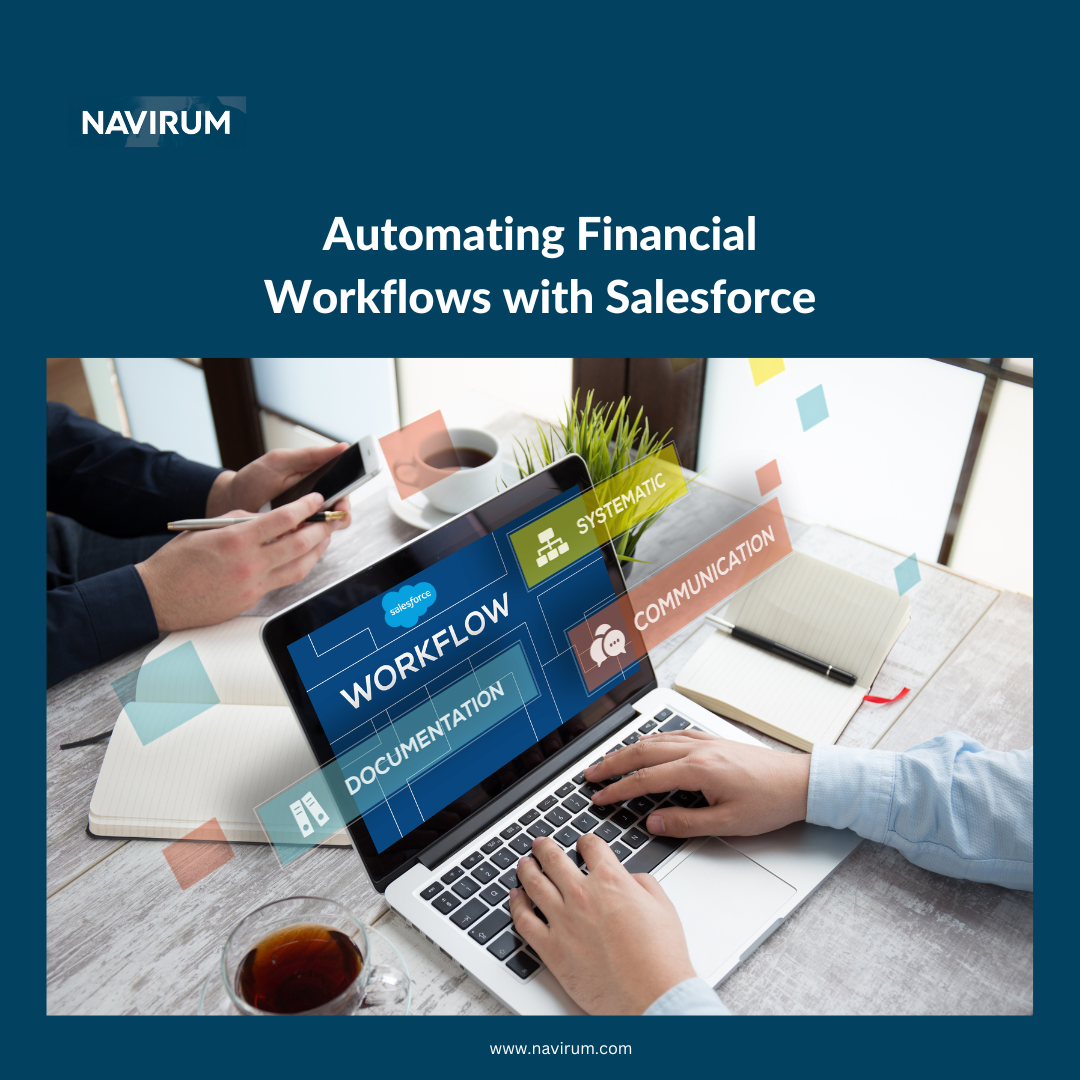
Discover how automating financial workflows with Salesforce can revolutionize your finances!
Revolutionizing Finance: Unleashing the Power of Automation with Salesforce
In the fast-paced world of finance, where every second counts and accuracy is paramount, manual processes are no longer sustainable. The demand for efficiency, agility, and compliance necessitates a paradigm shift towards automation. Enter Salesforce – the leading CRM platform renowned for its robust automation capabilities. In this blog post, we’ll explore how Salesforce revolutionizes financial workflows by streamlining processes, enhancing productivity, and driving business growth.
The Imperative for Automation in Finance
Finance departments are tasked with a myriad of responsibilities, including budgeting, invoicing, financial reporting, and compliance. However, manual execution of these tasks is not only time-consuming but also prone to errors, delays, and inefficiencies. With the increasing complexity of financial operations and the relentless pace of business, automation emerges as a strategic imperative for finance teams to thrive in today’s digital era.
Salesforce Automation: A Game-Changer for Finance
Workflow Automation: Salesforce’s workflow automation capabilities enable finance teams to automate repetitive tasks, such as invoice processing, approvals, and payment reminders. By defining rules and triggers within Salesforce, finance professionals can streamline workflows, reduce manual intervention, and accelerate transaction cycles, thereby enhancing operational efficiency and productivity.
Integration with Financial Systems: Salesforce seamlessly integrates with leading financial systems, such as ERP (Enterprise Resource Planning) platforms and accounting software. Through bidirectional data synchronization, finance teams can eliminate data silos and ensure data consistency across systems, enabling real-time visibility into financial performance and facilitating informed decision-making.
Automated Reporting and Dashboards: Salesforce’s reporting and dashboard functionalities empower finance professionals to create customized reports, analyze financial data, and track key performance indicators (KPIs) in real time. By automating report generation and distribution, Salesforce enables stakeholders to gain actionable insights into financial metrics, trends, and forecasts, facilitating proactive decision-making and strategic planning.
Revenue Recognition Automation: Revenue recognition is a critical aspect of financial management, particularly for subscription-based businesses and those operating under ASC 606 or IFRS 15 standards. Salesforce offers revenue recognition automation solutions that streamline the calculation, allocation, and reporting of revenue, ensuring compliance with accounting standards and enhancing transparency in financial reporting.
Compliance Automation: Compliance with regulatory requirements, such as GDPR, SOX, and PCI-DSS, is a top priority for finance teams. Salesforce’s compliance automation tools help finance professionals enforce data security policies, monitor access controls, and maintain audit trails, ensuring adherence to regulatory mandates and safeguarding sensitive financial information.
Case Study: Transforming Financial Operations with Salesforce Automation
Let’s take an example, one of our recent clients, a financial corporation, that now leverages Salesforce to automate its financial workflows:
Challenge: The company’s finance department grappled with manual invoice processing, disparate systems, and limited visibility into financial performance.
Solution: By implementing Salesforce’s workflow automation and integration capabilities, the company now creates a centralized platform for invoice management, expense tracking, and financial reporting. Custom-built workflows automate invoice approval processes, while integration with the ERP system enables seamless data exchange between Salesforce and the company’s financial infrastructure.
Result: The company experiences significant improvements in operational efficiency, with streamlined invoice processing, reduced cycle times, and enhanced data accuracy. Real-time reporting and dashboards provide finance executives with actionable insights into cash flow, revenue trends, and profitability, enabling informed decision-making and driving business growth.
Conclusion
In an era defined by digital transformation and data-driven decision-making, automation emerges as a cornerstone of success for finance departments seeking to stay ahead of the curve. Salesforce’s robust automation capabilities empower finance professionals to streamline workflows, optimize processes, and elevate the strategic role of finance within their organizations.
By embracing Salesforce as a catalyst for automation, finance teams can unlock new opportunities for efficiency, agility, and innovation, propelling their organizations towards sustained growth and competitive advantage in today’s dynamic business landscape.
Main Navigation CTA Showcase | Navirum
Next Steps & Impact
Explore Navirum Success, Culture & Team
Discover real-world outcomes, learn about our collaborative company culture, and meet the financial technology specialists leading your digital transformation.
Proven Results & Impact
Explore Our Success Stories
See how we help financial institutions, wealth managers, and fintechs turn Salesforce and AI into measurable business outcomes and operational growth.
In today’s fast-paced business landscape, where technological advancements and market dynamics continuously evolve, one crucial aspect often overlooked is fostering a culture of appreciation within the workplace.
A Daily Commitment To Our Team and Stakeholders
At Navirum, we understand that acknowledging and valuing our employees is not just a one-time effort but a daily commitment that fuels productivity, creativity, and overall well-being. In this blog post, we’ll delve into how our company cultivates a culture of workplace appreciation, ensuring that every day is an opportunity to recognize and celebrate the contributions of our team members.
Genuine Recognition
Genuine recognition goes beyond mere words; it encompasses sincere appreciation for the efforts and achievements of individuals within the organization. At Navirum, we believe in acknowledging both big wins and small victories. Whether it’s a successful project completion, a creative solution to a problem, or simply going the extra mile to assist a colleague, we make it a point to express our gratitude authentically and promptly. Our leaders and peers alike actively participate in recognizing and applauding each other’s contributions, fostering a culture where appreciation becomes ingrained in our daily interactions.
Open and Transparent Communication
Effective communication forms the cornerstone of any healthy workplace culture, especially when it comes to expressing appreciation. At Navirum, we prioritize open and transparent communication channels that facilitate feedback and recognition at all levels of the organization. Whether it’s through regular team meetings, one-on-one discussions, or dedicated feedback sessions, we provide avenues for employees to voice their appreciation for their peers and leaders, ensuring that recognition is not confined to top-down initiatives but flows organically across the organization.
Celebrating Milestones and Achievements
In addition to day-to-day recognition, we understand the importance of celebrating significant milestones and achievements collectively. Whether it’s commemorating work anniversaries, project milestones, or personal accomplishments, we try to celebrate the successes of our team members. These celebrations not only serve as morale boosters but also reinforce a sense of camaraderie and shared achievement, strengthening the bonds within our team and fostering a culture of collective appreciation.
Continuous Learning and Development
At Navirum we believe in investing in the growth and development of our employees as a form of appreciation for their dedication and contribution to the organization. Through continuous learning initiatives, and opportunities for skills enhancement, we empower our team members to reach their full potential and achieve their career aspirations. Be it big all small, from new badges on Trailhead, new Salesforce certifications to complex projects, we encourage our employees to go further. By investing in their professional growth, we demonstrate our commitment to their success and well-being, fostering a culture where employees feel valued and supported in their journey of continuous improvement.
Final Thoughts
Building a culture of workplace appreciation is not a one-time endeavor but a continuous commitment that requires dedication, empathy, and proactive engagement from every member of the organization. At Navirum, we recognize the importance of fostering a culture where employees feel valued, respected, and appreciated every day of the year.
By prioritizing genuine recognition, personalized rewards, open communication, collective celebrations, and continuous learning, we strive to create an environment where appreciation becomes ingrained in our organizational DNA, driving employee engagement, satisfaction, and ultimately, success.
For More Information on Life at Navirum, Please Reach Out!