Premium Strategic Consulting to Help Financial Services Navigate Digital Transformation in the Era of AI
New consulting practice builds on client feedback, Salesforce expertise, and decades of industry experience in wealth, banking, and insurance
Navirum, a Salesforce consulting partner for financial services, today announced the launch of its Strategic Consulting practice, a premium offering designed for founders, executives, and managers who need clear direction to achieve their business goals.
Strategic Consulting builds on years of positive client feedback and focuses on the areas where Navirum has delivered the most impact: shaping strategy, guiding roadmaps, and providing trusted advisory at the executive level. The offering addresses growing pressures facing the financial services industry — including mounting compliance regulations, heightened competition, and the paradigm shift brought by AI, which represents the most significant transformation since the rise of the internet.
Deep Salesforce Expertise
At the core of Navirum’s Strategic Consulting practice is its deep expertise in building Salesforce solutions that empower financial services organizations. Navirum has extensive experience with Financial Services Cloud, Agentforce, Experience Cloud, and Marketing Cloud, and is recognized for its ability to integrate Salesforce seamlessly with financial systems across North America. This combination enables firms to unlock the full value of their Salesforce investment while improving compliance, operational efficiency, and client engagement.
Grounded in Industry Experience
Navirum has decades of expertise across wealth management, banking, and insurance, combined with proven experience architecting and designing enterprise solutions. Strategic Consulting consolidates this knowledge into a structured, outcome-focused approach for firms seeking to scale, innovate, and stay compliant.
Powered by Strategic Partnerships
Navirum’s strength is amplified by deep partnerships across the Salesforce ecosystem and the North American financial services landscape. These include collaborations with Salesforce, Addepar, Amazon Web Services, DocuSign, Google, and AI partners such as Vinton.AI. Together, these partnerships allow Navirum to deliver creative, strategically advantageous solutions that align technology and business strategy.
Guided by Client Feedback
Navirum’s Strategic Consulting practice was shaped directly by client input. “We’ve consistently heard from our clients that the most valuable part of our work is the strategic guidance — helping them define their architecture, chart their roadmaps, and make confident decisions” said Rory Galvin, CEO of Navirum. “This new practice is our way of doubling down on what clients value most while preparing them for the future.”
Customer Stories
Book Strategy Session
Schedule Your Session
Let’s find a time to chat about your Salesforce strategy and AUM growth.
Navirum is a Salesforce consulting partner specializing in digital transformation for financial services across North America. With deep expertise in Salesforce Financial Services Cloud, Experience Cloud, Marketing Cloud, and complex system integrations, Navirum helps wealth managers, banks, and insurers scale efficiently, stay compliant, and innovate with confidence. Through consulting, managed services, and strategic partnerships, Navirum transforms financial services companies with Salesforce and the broader technology ecosystem.
Main Navigation CTA Showcase | Navirum
Next Steps & Impact
Explore Navirum Success, Culture & Team
Discover real-world outcomes, learn about our collaborative company culture, and meet the financial technology specialists leading your digital transformation.
Proven Results & Impact
Explore Our Success Stories
See how we help financial institutions, wealth managers, and fintechs turn Salesforce and AI into measurable business outcomes and operational growth.
Build the Future of Trust Services with Confidence | Navirum
Ecosystem Modernization
Build the Future of Trust Services with Confidence
The most successful trust companies are not simply upgrading technology—they are creating connected, client-centric organizations equipped for the next generation of wealth management. With Salesforce Financial Services Cloud, you can unify client relationships, streamline operations, unlock AI-driven productivity, and position your firm for long-term growth.
Navirum helps trust companies navigate every stage of the transformation journey, from strategy and platform selection to implementation, integration, and adoption.
Let’s explore what’s possible for your organization.
Au Navirum, we’ve partnered with thousands of advisors across North America, and succession planning consistently stands out as the most important – and most difficult – initiative they face. Not because of markets or products, but because it’s about legacy, clients, and the business built over decades.
Yet, 60% of Financial Advisors have no succession plan, even when they’re within 10 years of retirement? [Ref 1, Ref 2]
Some thoughts on what Advisors can do…
The Strategic Approach
Succession works best when it’s treated as a strategic goal, not an afterthought. Advisors who set a clear retirement horizon and work backwards build firms that are fit for today and resilient for tomorrow. A practical rule of thumb: allow at least one month of preparation for every year your practice has been in business. If your systems and processes are solid, plan to reinvest 1-5% of annual revenue to get succession-ready.
The Personal Reality
At Navirum, we’ve seen how personal these projects are – particularly for advisors nearing retirement, knowing they may be engaging in the last major initiative of their careers. Wealth management is fundamentally a people business. Succession is about building a platform so those client relationships can live on beyond any one advisor. Even when legacy isn’t the stated goal, every step taken is building one. A clear reality check on what you want – whether a clean exit, phased transition, or lasting platform – should guide your priorities and investments.
Capturing Institutional Knowledge
Succession isn’t just about the founder’s expertise. Long-time staff and managers also hold critical knowledge that must be captured and built into a living knowledge base. In many firms, consolidating the founder’s institutional knowledge – along with decades of physical and digital information – is the largest task. But it’s equally important to document the insights of other senior team members. Succession is the opportunity to bring all that knowledge into one central place, integrating it into systems and processes. This is one of the most strategic steps in the entire project
The Valuation Impact
Finally, succession is about valuation. Firms with clean data, documented processes, and modern systems don’t just transition smoothly – they also command higher multiples when buyers step in. Below this article I’ve provided answers to 20 FAQs and common questions I success from Advisors on their succession journey
So succession isn’t about leaving. It’s about what you leave behind – and how strong a foundation you create for the next chapter.
– Rory, Navirum Founder and CEO
Interested in discussing solutions further we would be delighted to help
<strong class="schema-faq-question">How should an RIA name successors and build a real bench?</strong>
Name a primary successor and 1 – 2 deputies by function (lead advisor, ops, compliance), then publish a simple RACI so Day-1 decisions are unambiguous. Example: “Prospects → A, Planning → B, Trading → C.” This clarity cuts execution risk and keeps the team focused.
<strong class="schema-faq-question">How do we communicate the change internally without drama?</strong>
Write a one-page “why now / what changes / how we’ll win,” attach a timeline, and schedule short touchpoints. Use a lightweight change model (e.g., awareness → adoption → reinforcement). Consistent messaging kills rumors and accelerates adoption.
<strong class="schema-faq-question">How should we segment clients by retention risk during succession?</strong>
Tier households by risk (e.g., AUM, complexity, multiple relationships) and set outreach cadence by tier. Example: Tier-1 monthly touches, Tier-2 bi-monthly. Proactive communication reduces churn at inflection points.
<strong class="schema-faq-question">Why clean the CRM before any hand-off?</strong>
Standardize fields, dedupe records, and fix ownership now; publish data standards. Clean data drives adoption and enables automation. It also boosts firm valuation in diligence.
<strong class="schema-faq-question">How do we capture “how we do things here”</strong>
Build a knowledge base. This is critical! Write short SOPs for onboarding, KYC, trading, billing, complaints, and store them in a searchable hub. Include links, forms, and owners. This preserves institutional memory beyond any single person. Develop playbooks that bring these SOPs and FAQs together into usable tools
<strong class="schema-faq-question">What makes a playbook usable in real life?</strong>
Keep it to one page with triggers, steps, owners, and “if/then” branches. Add screenshots and the top 3 pitfalls. Short, contextual guidance gets used—long manuals don’t.
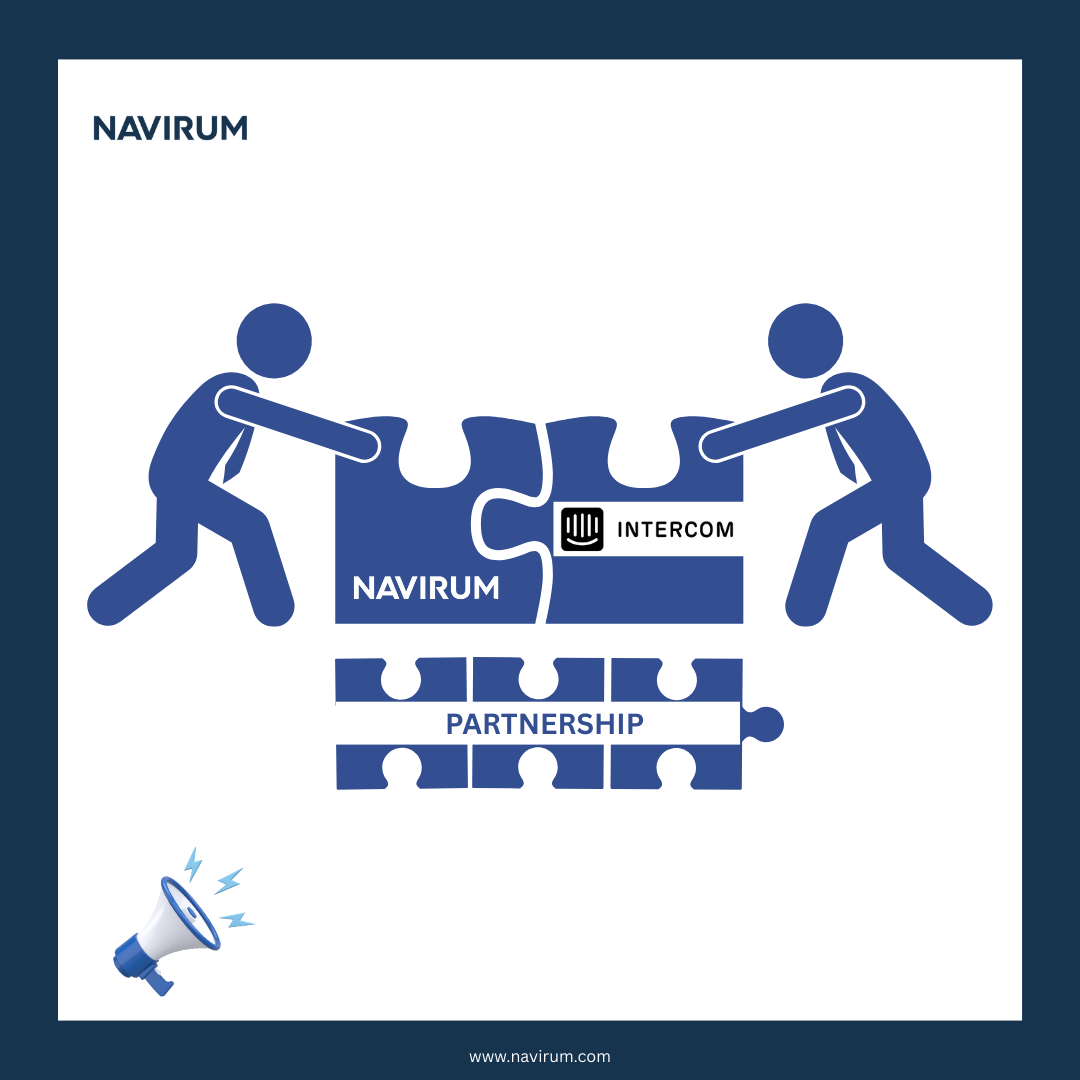
Navirum and Intercom partner to deliver AI Customer Support in Financial Services
At Navirum, we’re excited to announce a strategic partnership with Intercom, the industry leader in AI-powered customer support platforms. Together, we’re bringing a new era of smart, automated, and compliant customer engagement to the wealth management, banking, and insurance sectors.
Through our strategic, solution implementation, and support services combined with Intercom’s market leading customer support platform, Navirum helps financial institutions streamline operations, resolve inquiries faster, and enhance engagement – driving productivity, compliance, and growth.
This collaboration empowers firms to deliver personalized, compliant, and scalable client experiences—built for the digital era.
We’re proud to be working alongside Intercom to transform how financial services engage with their customers through smart automation and intelligent support tools.
This partnership represents a major step forward in digital transformation for financial services. We’re committed to helping firms harness the power of AI to:
Future-proof client engagement
Improve customer satisfaction
Reduce friction and cost
Stay ahead in an increasingly competitive market
Let’s shape the future of financial services—together!
Ready to Transform Your Customer Support? Learn how Navirum and Intercom can help your firm deliver faster, smarter, and more compliant service.
As Signet Financial Management expanded its footprint in the competitive wealth management space, it became clear that unlocking the full potential of Salesforce was critical to their growth strategy. Yet, persistent system hiccups, time-consuming admin tasks, and limited internal resources were holding them back. To remain focused on delivering exceptional client experiences, Signet needed a smarter, more scalable approach to managing Salesforce, and that’s where Orbit Project Assist came in.
The Challenges
Signet Financial Management, a growing wealth management firm, was facing key operational roadblocks in its use of Salesforce:
⚠️ Persistent technical issues were disrupting daily workflows and advisor productivity
⚠️ Routine monthly Salesforce tasks were consuming valuable time better spent with clients
⚠️ Strategic initiatives needed expert Salesforce consulting, but internal bandwidth was limited
⚠️ New advisors and staff required structured, consistent onboarding and CRM training
These challenges were slowing down day-to-day operations and reducing the overall value Signet was receiving from their Salesforce investment.
The Solutions
Navirum delivered a comprehensive Salesforce service model tailored to the fast-paced, relationship-driven world of wealth management:
🛠️ Ongoing Support: Rapid resolution of technical issues to keep the platform running smoothly
🛠️ Managed Services: Handling of routine monthly tasks and administrative support
🛠️ On-Demand Consulting: Flexible access to expert guidance for strategic Salesforce projects
🛠️ Training: Regular onboarding and skills training for new and existing users
The Results
With Orbit’s end-to-end support and consulting services, Signet Financial Management experienced measurable improvements:
✅ Reduced platform issues, freeing advisors to focus on client relationships
✅ Improved CRM adoption, as users became more confident and efficient
✅ Higher return on Salesforce investment, with more advisors fully leveraging the platform
✅ Faster onboarding, ensuring new team members could engage clients sooner
MAXIMIZE ROI
Ready to get more from your Salesforce investment?
Let’s talk about how Navirum can help your advisory firm work smarter, scale faster, and stay focused on what matters most—your clients. Contact us today to get started.
Want to dive deeper into how Signet transformed their Salesforce operations? Download the full customer success story as a PDF to explore the complete details of their journey, key outcomes, and how our Salesforce Support service made a lasting impact.
👉 Fill out the contact form below on this page to get instant access.
Curious what ongoing support like this actually includes? See the full breakdown on the Orbit Managed Services page.
Want more detail before reaching out? This companion piece is a deeper dive into Orbit, including our 60-Second Salesforce Platform Check to help you gauge your current managed service and support strategy.
Lavinia Picu5 Proven Ways Salesforce Support Empowers Wealth Advisors
How Salesforce supports insurers across the full lifecycle, from lead to policyholder to renewal to claim to retention, not just one policy transaction and not just one claim.
Written by Rory Galvin, Founder, Navirum · 4x Salesforce Certified · Strategic Advisor, Insurance
What determines the right Salesforce fit for insurers?
Salesforce can support acquisition, service, renewals, claims coordination, and policyholder relationships across the insurance lifecycle, but the right foundation varies by insurer. High-volume personal-lines businesses may be better served by Sales Cloud and Service Cloud, life and specialty insurers with broader financial relationships often benefit from Financial Services Cloud, and complex carriers may need a wider architecture combining integration, data, collaboration, and AI. Insurers that match the platform to their business model typically see:
More connected policyholder information: policy, claims, and client data can unify on one record so underwriting, servicing, and claims teams work from the same picture.
Integration without rip-and-replace: FSC, Sales Cloud, and Service Cloud can all connect to core policy admin systems like Guidewire, Duck Creek, and Applied Epic via native connectors or MuleSoft, so insurers aren't forced to replace what already works.
More consistent service and renewal workflows: automated intake, case routing, and renewal reminders reduce manual handoffs across teams.
Governed data for AI: Einstein and Agentforce can surface lapse-risk and cross-sell signals, once policy, claims, and third-party data are unified and properly permissioned.
Compliance built for the industry: where FSC's insurance data model applies, KYC/AML workflows and audit trails come pre-built rather than custom-configured.
A foundation that scales with complexity: the right starting architecture keeps pace as an insurer adds lines of business, brokers, or AI use cases, rather than requiring a rebuild later.
Navirum is a Salesforce Ridge Partner rated 5.0 on the Salesforce AppExchange, and helps insurers choose and govern the right foundation for their specific business model.
The Insurance Customer Journey
Most conversations about Salesforce and insurance start with one piece, claims, or policy administration, or AI. Those all matter, but they sit inside a bigger relationship that runs from the first conversation with a prospect through years of renewals, service touches, and eventually claims. Salesforce’s role is to support that whole relationship, not just one transaction inside it.
A note on scope: Insurance is not a single operating model. A life insurer, a commercial carrier, a benefits provider, and a high-volume personal-lines insurer may all use Salesforce very differently. This guide considers the industry holistically to show how Salesforce’s different products can be combined around the needs of each business. Not every capability discussed here will be relevant to every insurer.
Each stage carries its own Salesforce value: acquisition and broker or advisor engagement at the lead stage, intake and workflow visibility at quote and submission, a unified customer view at bind and onboarding, case management and communications through service, retention signals and next-best-action at renewal, coordinated updates through a claim, and account expansion once the relationship is established.
The platform scales to fit the insurer, not just the policy type. Navirum’s quickstart implementation for Afton Insurance, a startup carrier, deployed a standard Sales Cloud setup with a custom-branded application layout and basic case-management queues and assignment rules, enough to track incoming service requests from day one. The same lifecycle that supports a national carrier’s full claims and renewal operation also supports a startup’s first service queue.
How the Journey Differs in Retail and Commercial Insurance
The lifecycle above is shared across retail and commercial insurance, but the complexity inside each stage is not. A personal auto policy and a multi-entity commercial account move through the same stages (quote, bind, service, renew, claim), but the number of stakeholders, approvals, and data points involved is very different.
Retail
Individual or household policies, faster intake, simpler servicing, more standardized claims, and high-volume renewals.
Navirum client example, Kelson Financial: a personal insurance provider (life, critical illness) where Navirum customized Financial Services Cloud across Opportunities, Cases, Accounts, and Contacts, then supported the relationship on an ongoing basis through Orbit managed services. That ongoing Orbit relationship is itself a retail-lane pattern: high-volume, standardized accounts benefit from continuous optimization more than one-time configuration.
Kelson Financial joins Navirum’s podcast to talk through their Salesforce experience.
Commercial
Broker-led relationships, multiple entities or locations, more approvals and stakeholders, higher-complexity claims, and deeper renewal review.
Navirum client example, a commercial insurance company based in New York City: Navirum’s engagement centered on a refined first phase optimizing usability, security, and data quality. The core of the work was remodeling the Insurance Policy object: six distinct record types, customized page layouts, and dynamic forms, including dynamic insurance-type selection across four categories, the ability to reflect multiple concurrent coverage options for complex client portfolios, and coverage field dependencies that render fields based on selected coverage type rather than cluttering every layout with every possible field. Alongside that, Navirum ran a full Salesforce Health Check, refactored org-wide access into three role-based user groups with field-level permissions across the Insurance, Account, and Contact objects, and led two discovery workshops to align the technology roadmap with the business’s goals. This is what commercial-lane complexity looks like in practice: not more features, but more precisely governed data. Want to see how this plays out across other insurers? Explore more insurance client success stories.
How Salesforce Connects the Journey
None of the stages above happen inside Salesforce alone. Insurers run on policy administration systems, claims platforms, billing applications, broker portals, data warehouses, and third-party providers, and Salesforce’s job is to connect the client relationship across all of them, not replace them. For more on why closing this integration gap matters directly to policyholders, see our take on transforming policyholder experience for North American insurers, and our insurance industry practice page covers how we lead this work end to end.
Salesforce Components by Capability
A breakdown of insurance capabilities and their corresponding Salesforce solutions.
Policy Administration / Digital Insurance, or a connected PAS
Claims lifecycle management
Insurance Claims Management, or a connected claims platform
Unified third-party and cross-system data
Data 360
System integration
MuleSoft, APIs, or partner connectors
AI-assisted service and workflows
Agentforce for Financial Services
Inside the Salesforce FSC Insurance Data Model
FSC’s insurance data model ships with the objects insurers need out of the box: Policies (coverage terms, effective dates, product lines linked to the household or business account), Claims (FNOL through resolution, status tracking visible across underwriting, servicing, and claims teams in real time), Coverages (the specific protections within a policy, structured for cross-sell and lapse-risk analysis), and Insured Parties & Households (the 360° client record tying policies, claims, and referrals together). Insurers still need to configure the model, map source-system fields, and establish data ownership.
MuleSoft and Informatica: Connecting and Governing the Data
MuleSoft provides the integration layer, connecting Salesforce with core insurance platforms, legacy applications, payment systems, document repositories, and external data sources. Its API-led approach helps insurers reuse integrations, reduce point-to-point complexity, and support faster development of digital services for policyholders, brokers, underwriters, and claims teams.
Informatica focuses on data integration, quality, governance, and master data management, standardizing customer, policy, claims, and product information across systems so the business isn’t working from duplicate, incomplete, or inconsistent records. Used together, MuleSoft moves information between systems and enables real-time processes, while Informatica ensures that information is accurate, governed, and fit for use, supporting faster claims handling, more efficient underwriting, better broker service, improved regulatory reporting, and stronger analytics, without insurers having to abandon core legacy platforms to get there.
Once that data is connected and governed, Salesforce Data 360 (formerly Data Cloud) gives Agentforce access to unified, trusted customer and operational data from across the business, bringing together policy, claims, billing, broker, service, and interaction data in near real time. That is what allows AI agents to provide accurate answers, identify relevant next steps, and personalize service while respecting permissions, governance, and compliance requirements, the subject of the next section.
In practice, this integration layer typically spans policy administration systems, claims platforms, billing and payment systems, financial and accounting platforms, document repositories, broker and distributor systems, telephony and contact-centre platforms, identity and compliance services, and legacy databases and data warehouses, rarely just one or two of these for a medium-sized or large insurer. Getting it right determines whether the insurer ends up with a dependable, economically sustainable information architecture, not just a CRM bolted onto everything else.
Telephony and Contact-Centre Integration
Telephony deserves its own mention because it is operationally important for insurers running large service teams and call centres. Salesforce customers can integrate a range of contact-centre and telephony platforms, including services from Amazon Connect, Five9, Vonage, and other providers. The right choice depends on call volume, routing complexity, recording requirements, existing infrastructure, service processes, and regulatory obligations, another area where the platform decision should follow the operating model rather than the latest product trend.
Data and Storage Strategy
Not every piece of information belongs in Salesforce. A sound data strategy distinguishes between information needed immediately to serve the client, information that should be synchronized from core systems, information that can remain in a back-office system, historical information requiring occasional access, documents that should be processed, summarized, or extracted, and information that must be retained for compliance but does not need to sit directly in Salesforce.
A good insurance data strategy does not move everything into Salesforce. It makes the right information accessible at the right time, at an acceptable cost, with appropriate controls.
Storage volumes, API usage, synchronization frequency, and retention requirements all have financial consequences. These choices should be made as part of solution strategy, not after implementation begins.
Pricing and Platform Comparison
Total cost depends on the FSC edition, insurance capabilities selected, usage allocations, Data 360, MuleSoft, migration, and implementation scope. The drivers are consistent across implementations:
Cost Drivers
What to expect when pricing your Salesforce implementation.
Cost Driver
What It Covers
FSC Edition (Enterprise vs. Unlimited)
Per-user licensing; Unlimited adds premium support, more sandboxes, and higher API limits
Implementation
Data migration from your PAS, configuration, and testing, typically the largest line item
Integration (MuleSoft)
Native connectors to Guidewire, Duck Creek, or Applied Epic where a pre-built connector isn't sufficient
Data 360 add-on
Unifies policy, claims, and third-party data for real-time AI and Agentforce use cases
Navirum scopes pricing against your specific PAS, line-of-business mix, and AI ambitions during a free FSC Readiness Assessment.
A common question is how Salesforce compares to a traditional agency management system like Applied Epic. Many insurers run both together rather than choosing one:
Applied Epic vs Salesforce
Comparing traditional agency management systems with Salesforce FSC for insurance.
Requirement
Applied Epic
Salesforce FSC
Typical combined approach
Agency and policy administration
Core strength
May support or connect
Epic often remains the transactional system
Commission workflows
Core strength
Usually integrated
Commission summaries surfaced in Salesforce
Sales and relationship CRM
Limited relative to Salesforce
Core strength
Salesforce owns pipeline and relationships
Service workflows
Available
Highly configurable
Salesforce coordinates service; Epic retains policy data
AI and unified customer data
Depends on architecture
Agentforce and Data 360
Governed Epic data can feed the Salesforce AI layer
Which Salesforce Products Suit Which Insurers?
Financial Services Cloud is central to many of Navirum’s insurance engagements, particularly where household and financial relationships matter. But Salesforce for insurance is an ecosystem, not a single product, and FSC is not the right starting point for every insurer. The right foundation depends on the insurance line being served, the complexity of the customer relationship, the volume and repeatability of transactions, the importance of call-centre and service operations, the number and age of core systems, data and integration requirements, cross-sell and renewal strategy, and compliance, security, and AI ambitions.
The right Salesforce architecture is determined by the insurer’s business model and strategy, not simply by the fact that it operates in insurance.
The table below is a starting point, not a rulebook. Most insurers end up combining more than one of these foundations as their operations mature.
Which Products Fit?
Aligning Salesforce foundations with specific insurance models.
Insurance Model / Requirement
Likely Salesforce Foundation
Why It Fits
High-volume personal lines, home or auto insurance
Sales Cloud and Service Cloud
Supports efficient acquisition, call-centre service, renewals, standardized processes, and cross-sell across a large book of business
Life, critical illness, and personal insurance linked to broader financial relationships
Financial Services Cloud
Connects insurance policies with households, investments, retirement needs, referrals, and the client's wider financial position
Large commercial insurance
Sales Cloud and/or Service Cloud
Configured for commercial workflows. Supports complex opportunities, multiple stakeholders, approvals, account structures, renewals, and servicing processes
Group insurance and employee benefits
Sales Cloud and Service Cloud
Often with additional configuration. Supports employer, plan, member, renewal, and service relationships across B2B and B2B2C operating models
Health-related insurance or care delivery
Health Cloud (or other)
The correct choice depends on whether the organization is acting primarily as an insurer, provider, care coordinator, or service organization
Broker, member, or policyholder communities
Experience Cloud
Enables secure digital experiences for brokers, employers, members, and policyholders
Marketing, renewals, and customer engagement
Marketing Cloud
Supports lifecycle communications, renewal journeys, education, brand development, cross-sell, and community engagement across insurance lines
Complex internal collaboration
Slack
Helps underwriting, service, claims, operations, and leadership teams coordinate around renewals, exceptions, and complex client issues
The Navirum Complexity–Volume Framework
A simple two-axis framework helps explain why two insurers might make very different product choices:
High volume, lower relationship complexity: prioritize streamlined sales, service, automation, contact-centre efficiency, and repeatable renewals.
Lower volume, higher relationship complexity: prioritize household or account relationships, specialist workflows, collaboration, detailed data models, and long-term relationship management.
High volume and high complexity: requires a broader Salesforce architecture combining service, industry data models, integration, collaboration, data unification, and AI.
Lower volume and lower complexity: may benefit from a simpler initial implementation with room to expand.
In insurance, platform selection is often a trade-off between transaction volume and relationship complexity.
As an insurer’s book of business grows, more sophisticated capabilities layer on top of the same journey, from what policyholders and employees experience, down to the controls that keep everything compliant. Getting this right as complexity grows starts with a disciplined rollout, our best practices for Salesforce implementation in insurance companies break down the steps that keep a scaling deployment on track.
Experience Layer
Policyholder, broker, service rep, claims team, the people the whole system exists to serve.
Workflow Layer
Agentforce acts as a digital workforce inside Salesforce, helping teams complete repetitive tasks, surface relevant information, and guide employees through defined processes: summarizing customer histories, preparing claim or policy updates, identifying missing information, and recommending next steps, all designed around approved workflows, permissions, and compliance requirements. Slack is the collaboration layer where people and AI work together, claims teams notified when a case needs escalation, underwriters receiving concise risk summaries, managers monitoring service bottlenecks, all inside the channels teams already use. A Slack bot gives employees a conversational front end to the same capabilities, checking claim status, reviewing a customer’s recent interactions, or routing a request to the right team without switching systems.
Intelligence Layer
Retention insights, risk signals, and AI recommendations turn policy renewal from a manual reminder into a coordinated retention journey, triggering communications based on policy expiration, client preferences, service history, and predicted lapse risk.
<strong style="color:#c0392b;">Platform update, June 2026:</strong> Salesforce has announced an agreement to acquire Fin (formerly Intercom) for approximately $3.6 billion. If completed, this could extend Agentforce to the external, policyholder-facing and broker-facing channel layer, automating routine policy questions, claims-status enquiries, payment support, and quote follow-ups. The transaction remains subject to closing conditions and is not yet part of the platform’s current capabilities.
Insurance may be one of the financial-services sectors with the most to gain from AI. Insurers operate with large document volumes, complex policy wording, diverse product information, fragmented legacy systems, long customer histories, claims documents and correspondence, renewals and service events, and sensitive personal and financial information. AI can help advisors, agents, underwriters, and service teams find, interpret, and act on that information more efficiently, through document classification and extraction, optical character recognition, policy and claim summaries, preparation for client conversations, renewal support, service-response assistance, knowledge retrieval, next-action recommendations, and identification of missing or inconsistent information. Optical character recognition and intelligent document processing are becoming particularly important where insurers receive large numbers of forms, statements, reports, applications, and supporting documents. Installing Agentforce alone does not solve these problems: effective insurance AI depends on connected systems, trustworthy and governed data, appropriate access permissions, defined business processes, human oversight, and security and compliance controls.
The value of insurance AI will be determined less by the sophistication of the model than by whether the insurer can give it secure access to accurate, relevant, and well-governed information.
Integration Layer
MuleSoft, APIs, and source-of-truth connections, covered in the previous section, are what keep this layer connected to the PAS, claims systems, and everything else without requiring a rip-and-replace.
Control Layer
Salesforce Shield, available as an add-on, extends native platform protections with Platform Encryption for selected sensitive data, Event Monitoring, and enhanced audit capabilities. Salesforce completed its acquisition of Own Company in November 2024 (source); now integrated into the product suite, Own provides automated backups, rapid data recovery, secure archiving, and data-seeding, protecting sensitive policy, claims, customer, and broker information and supporting recovery from accidental deletion, data corruption, or system disruption. Approval thresholds and audit rules for AI-assisted recommendations belong here too, set before rollout, not retrofitted after a compliance gap surfaces.
Insurers often hold extensive health, financial, household, and vulnerability-related information, sometimes concerning people in particularly sensitive circumstances. A complete compliance and security posture spans the full control environment: Salesforce Shield where appropriate, encryption and event monitoring, backup and recovery, Own or Salesforce-native backup options depending on the client’s requirements, profiles, permission sets, and role design, identity and access management, secure integration architecture, data-retention policies, AI access controls, monitoring and vulnerability management, and independent security expertise where appropriate.
Salesforce provides a strong enterprise platform, but each insurer remains responsible for configuring, governing, and operating it in line with its specific regulatory obligations and risk profile.
Navirum Perspective
Coexistence, not rip-and-replace, is the default architecture
Across Navirum’s recent insurance engagements, from a startup running a single Sales Cloud queue to a commercial carrier with a six-record-type policy model, the usual architecture has been coexistence: core policy and claims systems stay in place and connect to Salesforce, rather than being replaced. The lifecycle above only works end to end if the underlying systems stay connected, governed, and scaled to where the business actually is.
Scope integration before edition. Decide what MuleSoft or your PAS’s native connector needs to sync before comparing FSC editions, edition choice should follow integration scope, not the other way around.
Sequence Data 360 deliberately. If your first use case is a unified 360° client view, it earns its cost early. If you are starting with policy servicing alone, it can wait for phase two.
Set AI governance before Agentforce, not after. Approval thresholds for AI-assisted recommendations should exist before agents go live.
Choosing the Right Combination, Not the Largest One
Salesforce has become a popular platform across the insurance industry because it can support very different business models, from high-volume personal-lines service and renewal operations to complex commercial relationships, life insurance, employee benefits, and integrated financial planning.
The opportunity is not to select the largest possible collection of Salesforce products. It is to choose the right combination from the outset, align it with the insurer’s strategy, connect it to the systems and information that matter, and build a secure foundation that can evolve as AI becomes more deeply embedded in insurance operations.
A family office offering life insurance may gain substantial value from Financial Services Cloud and its household-based relationship model. A large home insurer focused on acquisition, servicing, renewals, and cross-sell may be better served by a combined Sales Cloud and Service Cloud architecture. A commercial insurer may require highly configured account, opportunity, policy, and renewal workflows supported by extensive integration and collaboration.
Each model is different. The strategic advantage of Salesforce is that the platform is flexible enough to support those differences across growing insurers, mid-sized organizations, and major North American enterprises. The implementation challenge is ensuring that flexibility is translated into an architecture that is economical, secure, and aligned with the business.
Salesforce FSC for Insurance FAQ
Wondering how FSC integrates with your policy admin system, what it costs, or whether it is worth switching from general Salesforce CRM? Here is what insurers ask us most.
View all 15 questions
Fundamentals
What is Salesforce Financial Services Cloud (FSC) for Insurance, and how is it different from general Salesforce CRM?
Salesforce FSC is a cloud-based CRM platform tailored for life, P&C, and specialty insurers. It unifies policy, client, and claims data to streamline operations and deliver personalized, compliant customer experiences. Unlike general-purpose Salesforce CRM, FSC ships with insurance-specific data models, regulation-ready features, and Agentforce and Einstein AI built in, so you are not customizing a generic CRM from scratch.
What are the benefits of using FSC over traditional insurance CRM systems?
FSC offers automation, 3 insurance related releases per year, compliance readiness, AI-powered insights, and a 360° client view, delivering faster service, better client engagement, and reduced operational risk. It is used across the insurance industry, from large national carriers to regional and specialty insurers.
Integration & AI
Can FSC integrate with my existing policy administration system?
Salesforce can integrate with Applied Epic, Guidewire, Duck Creek and proprietary policy platforms through available APIs, MuleSoft, or purpose-built connectors. The complexity depends on the source system’s APIs, data quality, synchronization requirements, and which platform remains the system of record.
What AI features are built into Salesforce FSC for insurers?
Salesforce and Agentforce can support renewal reminders, service summaries, workflow recommendations, and claims triage. Predictive lapse scoring, fraud analysis, and personalized recommendations may require additional products, appropriate data, configuration, governance, and, in some cases, custom or third-party models. Navirum configures these capabilities to fit your existing systems and data quality.
Is Salesforce FSC secure and compliant for insurance firms?
FSC is built on Salesforce’s enterprise-grade security infrastructure and supports industry compliance frameworks such as KYC and AML, aligned with Salesforce’s Trust Commitment. Specific compliance obligations still depend on your configuration, licensing, and regulatory jurisdiction.
Getting Started
How do I get started with Salesforce FSC for my insurance business?
Request a free consultation with Navirum’s strategic consulting team. A Salesforce insurance implementation with Navirum is not just deploying software, it is sector-specific execution: we align FSC to your business goals, set up automation and AI (Agentforce, Einstein), integrate your existing policy systems via APIs or MuleSoft, and keep optimizing after go-live to preserve ROI.
I already use Salesforce, but not Financial Services Cloud. Should I switch?
It depends on your business model, not a default yes. FSC's insurance data model is worth the move when policy, household, and claims data need to work together, or when compliance and AI use cases require a purpose-built structure. If you are running high-volume, standardized personal lines with lighter data-model needs, a well-configured Sales Cloud and Service Cloud setup may serve you just as well without the migration. The right call depends on your current architecture, data model requirements, maintenance burden, and where AI fits into your roadmap, exactly what a Readiness Assessment is built to clarify.
I have already implemented Salesforce Financial Services Cloud, but I am unhappy with the results. What can I do?
You are not alone. Navirum offers a free 30-minute strategic review, our Compass service, to assess your current configuration, identify gaps, and recommend practical fixes to get your platform back on track fast.
Can I use Salesforce FSC for just one line of business, like life or commercial insurance?
Yes. Salesforce FSC is modular, so you can deploy it for one business unit, life, commercial, or specialty insurance, and scale later. Navirum helps insurers start fast and expand FSC over time to reduce disruption and maximize ROI.
Navirum & Results
What makes Navirum different from other Salesforce implementation partners?
Navirum combines deep insurance expertise, strategic consulting, and technical excellence. Our clients rate us 5/5 on the Salesforce AppExchange for delivering high-impact, scalable FSC solutions.
What is the typical ROI from implementing Salesforce FSC with Navirum?
The most common pattern we see: faster policy servicing, quicker claims turnaround, and more consistent cross-sell follow-through once policy, claims, and client data sit in one governed system instead of several disconnected ones. Actual results vary by book of business and starting PAS setup, which is exactly what a Readiness Assessment scopes out before you commit.
Use Cases
What insurance lines can be managed using Salesforce Financial Services Cloud?
Many personal and commercial lines. Within FSC’s core policy, claims, and household data model, Salesforce Financial Services Cloud can be configured to manage:
Car insurance
Life insurance
Travel insurance
Health insurance
Commercial insurance
Personal insurance
Pet insurance
Home insurance
Marine insurance
Title insurance
Mortgage insurance
Can Salesforce FSC help insurers cross-sell wealth or lending products?
Yes. This is one of the most powerful use cases for growing insurers. FSC enables brokers, agents, and underwriters to track referrals and identify cross-sell opportunities across insurance and adjacent services like wealth or lending. Navirum builds strategies that increase policyholder value and wallet share.
How does FSC help agents and brokers collaborate and manage their day-to-day workflow?
FSC provides dashboards, real-time communication tools, mobile access, and shared workspaces so agents and brokers can manage workflows, track referrals, and collaborate across underwriting and claims, all in one system. It is purpose-built for insurance agents to focus on selling and servicing, not data wrangling.
Integrations
Does Marketing Cloud integrate with Salesforce FSC, and how is it used?
Yes, via Marketing Cloud Connect, which syncs client data between the two platforms for:
Personalized onboarding and policy renewal journeys
Claims management and compliance communications
Partner communication, retention, and cross-sell or upsell campaigns
Engagement insights feed back into FSC so advisors see the full picture.
This guide draws on Salesforce product documentation, official acquisition announcements, and Navirum’s experience delivering Salesforce projects for North American insurance organizations. Client examples are named where permission has been provided; other details are anonymized to protect confidentiality.
Orbit Project Assist FAQ provides essential information for both new and experienced users.
Users should submit requests through the Orbit Project Assist portal for efficient tracking and management.
Clients can expect a standard response time of less than 2 hours, with priority for Orbit Flex plan users.
Users can manage their requests, update billing details, and ask about charges through the portal.
For any help using the platform, users can reach out via Orbit or email for support.
Orbit Project Assist Overview
Welcome to the Orbit Project Assist Frequently Asked Questions (FAQ)!
Here you’ll find answers to the most common questions about getting started, using key features, troubleshooting issues, and making the most of our platform. Whether you’re a new user or a seasoned pro, this page is designed to help you quickly find the information you need to keep your projects running smoothly.
Orbit Project Assist SLA Overview
Frequently Asked Questions
<strong class="schema-faq-question"><strong>Can I still email you instead of using Orbit?</strong>
For the best experience and quicker response times, we recommend submitting all requests via Orbit Project Assist portal. It helps us track and manage your issues more efficiently.
<strong class="schema-faq-question"><strong>Who sees my tickets</strong> / my requests?
Only your team and our assigned support staff. Everything is kept secure and client-specific.
<strong class="schema-faq-question"><strong>Can I update my request after submitting?</strong>
Yes! Just go to “Requests” and add a comment or attachment.
<strong class="schema-faq-question"><strong>How quickly will I get a response?</strong>
Our standard response time is <2 hrs but clients on Orbit Flex support plans may get priority responses.
<strong class="schema-faq-question">I forgot my login. What do I do?</strong>
Click “Forgot password” on the login page to reset it. If you’re still stuck, email us and we’ll help.
<strong class="schema-faq-question"><strong>Can multiple people from my team use Orbit?</strong>
Absolutely. Just let us know who should have access, and we’ll set them up.
<strong class="schema-faq-question"><strong>Where can I find my invoices?</strong>
Invoices are usually attached to billing-related tickets in Orbit. You can also request copies at any time through the portal.
<strong class="schema-faq-question"><strong>I have a question about a charge on my invoice, what do I do?</strong>
Submit a new ticket under the “Billing” category and include the invoice number and your question. We’ll review and get back to you quickly.
<strong class="schema-faq-question"><strong>Can I request changes to my billing details?</strong>
Yes! You can raise a request in Orbit to update billing contact info, tax details, or payment terms.
<strong class="schema-faq-question"><strong>Where can I update my payment information?</strong>
If your payment method needs to be changed, raise a ticket under “Billing” and our finance team will securely handle the update.
<strong class="schema-faq-question"><strong>How do I check the status of a project?</strong>
You can submit a request under the “Project Assist” category, or check your existing project tickets under “Requests” for the latest updates.
<strong class="schema-faq-question"><strong>Do you provide regular project status reports?</strong>
Yes, we provide monthly status reports depending on your project scope. If you’d like to adjust the frequency or request a custom format or breakdown, just let us know through Orbit. Please note that customizations may involve additional fees depending on the request, as they require more time and resources from our team.
ORBIT PROJECT ASSIST
If you’re stuck or not sure how to use the portal, just drop us a note in Orbit or send us an email to get started. We’re happy to help!
Thanks for using Orbit Project Assist! We built it to make your life easier and give you faster, more organized support.
The Bottom Line: Salesforce can give credit unions a connected member and workflow layer across lending, service, and relationship management. It can integrate with an existing loan origination system and core banking platform, or support parts of the origination journey directly, while giving employees a unified view of the member, their relationships, applications, communications, and next steps.
This guide is for credit union leaders evaluating how Salesforce can improve lending efficiency, member experience, and operational visibility.
Have a specific question about credit union lending on Salesforce?Jump to FAQ ↓
What Credit Unions Are Actually Dealing With
Member information divided across core systems, LOS platforms, and spreadsheets
Employees switching between multiple systems to answer basic member questions
Repeated data entry during lending processes
Limited visibility into application status across branches
Inconsistent follow-up across branches and channels
Pressure to deliver digital experiences comparable to large banks, without a comparable technology budget
Member experience problem: Members ask basic questions across channels and get inconsistent answers because branch, contact centre, and digital teams cannot see the same information. Salesforce’s role: A unified member profile so any employee, on any channel, sees the same relationship, accounts, and prior conversations. Outcome: Faster, consistent first response regardless of which channel the member uses.
2. Application & Document Collection
Member experience problem: Members re-enter information already on file and chase down documents manually. Salesforce’s role: Guided application capture and automated document requests tied to the member’s existing profile. Integrations required: Document management and eSignature tools. Outcome: Fewer abandoned applications, less manual chasing.
3. Credit Assessment & Underwriting
Member experience problem: Members have no visibility into where their application stands. Salesforce’s role: Real-time pipeline visibility for staff, with automated status updates to members. Integrations required: Credit bureaus and the underwriting engine within the LOS. Outcome: Reduced back-and-forth, fewer “just checking in” calls to the branch.
4. Approval & Funding
Member experience problem: Approval and funding can feel like a black box after weeks of engagement. Salesforce’s role: Automated approval notifications and funding checklists tied to compliance sign-off. Outcome: A clean, auditable handoff from decision to funded loan.
5. Ongoing Member Communication
Member experience problem: Once a loan is funded, communication often goes quiet until the next renewal. Salesforce’s role: Lifecycle journeys and proactive outreach based on account activity and life events. Outcome: Members hear from the credit union before they have a problem, not just after.
6. Servicing, Renewals & Additional Needs
Member experience problem: Cross-sell and renewal opportunities are missed because staff cannot see the full member relationship. Salesforce’s role: Renewal alerts and next-best-action guidance surfaced directly to frontline staff. Outcome: Higher renewal and cross-sell rates without a hard-sell approach.
Does Salesforce Replace Your Core Banking or Loan Origination System?
One of the first questions credit union leaders ask is “how does Salesforce fit with the systems we already have?” The honest answer: Salesforce does not necessarily replace your core banking system or loan origination system. It sits as a connective layer above them.
Legacy Lending vs. Salesforce FSC
A side-by-side view of what changes when the member and workflow layer moves onto Salesforce.
Capability
Legacy Lending Workflows
Salesforce FSC Workflow
Data Visibility
Siloed across core banking and LOS
Unified, 360-degree member view
Credit Checks
Manual data entry across bureaus
Automated integration with bureaus like Equifax
Compliance
Post-underwriting manual audits
Built-in KYC/AML workflow guardrails
Time-to-Close
Varies, often slowed by manual handoffs between systems
Faster and more consistent, driven by automated status updates
Salesforce Support by Lending Type
Consumer lending: Faster application-to-funding cycles, automated status updates.
Mortgage lending: Document-heavy workflows with LOS integration and compliance checkpoints.
Small business & commercial lending: More complex underwriting with multi-stakeholder relationship visibility.
Lines of credit: Ongoing utilization tracking and proactive member outreach.
Renewals & refinancing: Automated renewal alerts before members start shopping competitors.
Enabling AI Responsibly in Lending
AI’s role here is to summarize member interactions, prepare staff for conversations, and recommend next actions, not to make uncontrolled credit or underwriting decisions on its own. Deterministic guardrails at the data layer keep Agentforce and other AI tools operating within hard limits on what they can see or act on, which matters as much to your examiners as it does to your members.
What Proof Does Navirum Have for Credit Union Lending?
A note on proof:
Navirum’s directly-delivered financial services work spans wealth management, insurance, and commercial lending. We do not yet have a named credit union engagement to point to, and we are not going to imply otherwise. The closest adjacent proof is our work with iA Financial Group, a wealth management engagement built on the same Financial Services Cloud foundation described above. The lending-journey stages themselves reflect proven Salesforce FSC patterns (documented in Salesforce’s own published case studies with PenFed Credit Union, Pacific Life, and RBC Wealth Management), applied to a credit union context, not a completed credit union project. If a named credit union case study matters to your decision, ask us directly, we would rather have that conversation than overstate one here.
Salesforce for Credit Unions: FAQ
1. Is Salesforce a loan origination system for credit unions?
Not on its own. Salesforce Financial Services Cloud is a member and workflow layer that typically integrates with your existing LOS rather than replacing it, though it can support parts of the origination journey directly.
2. Can Salesforce integrate with our existing LOS?
Yes. Salesforce integrates with loan origination systems through APIs and AppExchange connectors; Fiserv, FIS, and Equifax are common integrations in credit union environments.
3. How does Salesforce connect with a core banking platform?
Through API-based integration that syncs account, transaction, and member data into Salesforce, giving staff a unified view without duplicating your core banking system’s role.
4. What member information should be stored in Salesforce?
Relationship and interaction data: accounts, applications, communications, service history, and household connections, rather than duplicating full core-system transaction records.
5. Can Salesforce support consumer and commercial lending?
Yes. Both can run on Financial Services Cloud, though commercial lending typically needs more configuration for multi-stakeholder relationships and complex underwriting.
6. Can branch and contact centre teams use the same member view?
Yes, that unified view across channels is one of the core reasons credit unions adopt Salesforce, replacing the inconsistency of siloed systems per department.
7. How can credit unions use AI safely in lending?
By keeping AI in an assistive role, summarizing interactions, preparing staff, recommending next actions, with deterministic guardrails preventing it from making unsupervised credit decisions.
8. Does Salesforce replace our member-service platform?
It can, depending on your current stack, but many credit unions run Salesforce alongside existing service tools during a phased transition rather than a hard cutover.
9. How long does a credit union Salesforce implementation take?
Timelines vary with scope and integration complexity. A focused first phase can launch in weeks; a full lending-journey rollout with multiple integrations typically takes longer.
10. How should a credit union prepare its data before implementation?
Start by identifying where member and lending data currently lives, resolving duplicate records, and deciding which data needs to move into Salesforce versus stay in source systems.
11. Can Salesforce improve loan renewal and cross-sell processes?
Yes, by surfacing renewal timing and next-best-action opportunities directly to frontline staff instead of relying on manual tracking.
12. What should a credit union implement first?
Most credit unions start with a unified member view and one lending workflow (often origination), then expand into servicing, renewals, and AI-assisted workflows.
Next Steps
Start with the Salesforce Readiness Checklist to see where your credit union stands, then go deeper on the service that fits your priority.
Empower Member Services with Trusted, Compliant AI
Credit unions are adopting Agentforce and generative AI to automate service queues, resolve loan inquiries, and prevent fraud. Navirum provides end-to-end AI Assurance—establishing rigorous guardrails around member data privacy, NCUA regulatory compliance, and zero-hallucination models.
See how Navirum helps credit unions implement Salesforce FSC to modernize lending.
Main Navigation CTA Showcase | Navirum
Next Steps & Impact
Explore Navirum Success, Culture & Team
Discover real-world outcomes, learn about our collaborative company culture, and meet the financial technology specialists leading your digital transformation.
Proven Results & Impact
Explore Our Success Stories
See how we help financial institutions, wealth managers, and fintechs turn Salesforce and AI into measurable business outcomes and operational growth.
Read our customer success story and discover how scaling personalized marketing in investment management, using Salesforce and Pardot, helped an investment advisory firm achieve marketing excellence.
One of our client, a Manhattan-based investment advisory firm is recognized for offering high-touch, personalized portfolio management. With a mission centered on capital preservation and growth, the firm serves a wide-ranging client base that values trust, transparency, and expert-driven strategies.
Trusted by Adalta Capital Management
Despite strong relationships and a bespoke investment approach, the firm faced challenges in scaling its marketing capabilities to meet the needs of a growing, digitally savvy clientele.
Key Challenges Investment Advisors Faced
As the firm expanded, it encountered several operational and marketing obstacles:
⚠️ Limited ability to engage clients at scale
⚠️ Manual marketing tasks causing pipeline inefficiencies and missed opportunities
⚠️ Lack of automation tools for consistent, timely campaigns
⚠️ Fragmented client data leading to impersonal communications and disjointed experiences
These issues made it difficult to engage prospects and clients effectively and consistently.
Partnering with a Salesforce consulting firm specializing in financial services, the company reimagined its client engagement and marketing operations. The solution was built around their business model, industry requirements, and future growth plans.
🛠️ Salesforce Financial Services Cloud Implementation. Client data was centralized using FSC, creating a 360-degree view of each relationship. This allowed the team to deliver more targeted and proactive service.
🛠️ Pardot (Marketing Cloud Account Engagement) . With the introduction of Pardot, the team could automate and scale marketing initiatives, reducing manual work and enhancing lead nurturing.
🛠️ Seamless Website + CRM Integration. The marketing platform was connected to both the CRM and the firm’s website, enabling automatic lead capture and real-time qualification—ensuring marketing and sales were fully aligned.
🛠️ Custom Dashboards & Training. Tailored dashboards were developed for visibility across the client lifecycle. Staff received hands-on training, accelerating adoption and empowering the team to manage campaigns independently.erating user adoption and long-term success.
Results
The transformation led to substantial improvements in marketing performance, efficiency, and client engagement.
✅ Automated, Scalable Campaigns. Strategic email campaigns replaced manual outreach, allowing for consistent, professional communication.
✅ High Adoption Across Teams. With strong training support, internal adoption was swift, enabling self-sufficient use of both platforms.
✅ Enhanced Efficiency. Automation eliminated repetitive tasks, freeing the team to focus on personalization and strategy—resulting in better engagement and conversion.
✅ Personalized Engagement at Scale. A unified client view and real-time analytics allowed for deeper personalization across a growing audience.
✅ Continued Innovation. The firm continues to explore new marketing initiatives with Pardot, aligning its strategy with evolving business objectives.
In the investment management industry, client relationships must be nurtured thoughtfully and at scale. With Salesforce Financial Services Cloud and Marketing Cloud Account Engagement, this firm now has the tools and insights needed to deliver meaningful client experiences – without sacrificing the personal touch.
Download the Full Customer Success Story
📥
Download the full PDF success story for detailed insights, project phases, and a look at how a modern investment firm continues to innovate.
Looking to modernize your firm’s marketing operations?
Whether you’re an investment manager, bank, wealth advisor, or fintech company, we can help implement and optimize Salesforce and Pardot to drive real results. Contact us to discuss your goals and start building a scalable, high-performing marketing engine.
Identity fraud isn’t slowing down. In fact, it’s accelerating – and credit unions are finding themselves on the front line of this battle. Unlike large banks with extensive fraud budgets and dedicated security teams, credit unions often face unique vulnerabilities that sophisticated fraudsters are quick to exploit.
Request a credit union fraud & CRM consultation
A 60-second start: tell us where to reach you and we’ll show you how a unified Salesforce view helps your team spot fraud red flags siloed systems miss.
AI: A Double-Edged Sword in Fraud Prevention
Artificial Intelligence presents both opportunities and challenges in this fight. While AI helps credit unions strengthen identity verification and detect anomalies in real time, fraudsters are weaponizing the same technology to :
Create hyper-realistic fake IDs that fool traditional verification systems
Automate sophisticated phishing campaigns at unprecedented scale
Mimic legitimate customer behavior patterns to bypass security protocols
Fraud detection rules that were airtight last year are not necessarily airtight today. Our Orbit Managed Services team keeps identity verification logic current as fraud tactics shift, rather than leaving it configured once and forgotten.
The Rise of Synthetic Identity Fraud: A Silent Epidemic
The threat landscape has evolved beyond simple identity theft. Fraudsters are now creating entirely synthetic identities by combining real data elements — like Social Security Numbers — with fabricated names and addresses. These phantom identities pass verification checks, establish credit histories, and then execute devastating “bust out” schemes with large loans before vanishing without a trace.
New synthetic account creation surged 18% year-over-year
Every one of these numbers is a member trust problem before it is a security problem. See how a unified Salesforce view of the member relationship helps staff spot the behavioral red flags that siloed systems miss, in our guide to Salesforce for credit union member experience.
Data Breaches: Fueling the Fraud Engine
Recent data breaches have armed fraudsters with vast troves of Personally Identifiable Information, and credit unions aren’t immune to these attacks:
A September 2024 Massachusetts breach exposed Social Security Numbers and driver’s license details
A two-month breach in Maine compromised sensitive data for approximately 240,000 individuals
Adding to these concerns, credit unions using CRMs like Salesforce face risks from Scattered Spider attacks. This sophisticated threat group targets SaaS platforms to access member data and financial records, exploiting administrative permissions for lateral movement within credit union networks and establishing persistent backdoors for ongoing data theft and potential ransomware deployment.
Attacks like this usually exploit administrative permissions that were never properly scoped in the first place. Our Salesforce consulting team configures permission sets and access controls with this exact risk in mind, not just for launch day.
The Path Forward
Credit unions must recognize that traditional fraud prevention methods are no longer sufficient. The combination of AI-powered fraud tools, synthetic identity creation, and massive data breaches requires a fundamental shift in how we approach member security and identity verification. Will members and their staff be the solution?
The honest answer is both: better-trained staff and deterministic guardrails on the AI tools doing the screening. This is the AI risk governance gap most credit unions have not closed yet, and it is the same gap we walk through in our guide to compliance in Salesforce Financial Services Cloud, including KYC, identity verification, and audit-ready AI.
– Rory – Founder – NAVIRUMHelping financial services firms lead with CRM, AI, and digital transformation.
What strategies is your organization implementing to stay ahead of these evolving threats?
See where your fraud controls stand
Book a short review of your identity-verification logic, permission scoping, and AI governance gaps with our credit union team.
Empower Member Services with Trusted, Compliant AI
Credit unions are adopting Agentforce and generative AI to automate service queues, resolve loan inquiries, and prevent fraud. Navirum provides end-to-end AI Assurance—establishing rigorous guardrails around member data privacy, NCUA regulatory compliance, and zero-hallucination models.
Loan growth is slowing to 5–6% in 2025 while funding costs remain elevated. Rising delinquencies and charge-offs in credit cards and auto lending put additional pressure on margins (NCUA, CUNA). Managing liquidity, interest-rate risk, and credit loss reserves is critical for financial stability.
If margin pressure is pushing your credit union to finally fix fragmented systems, a Salesforce strategy engagement is usually the right first step, mapping the roadmap before committing to a full build.
2. Digital Transformation Is No Longer Optional
Member expectations are evolving rapidly. Legacy systems and fragmented vendor stacks are slowing innovation. With open banking frameworks gaining momentum in the U.S. and Canada, credit unions need integrated platforms, AI-driven workflows, and seamless omnichannel experiences to stay competitive (The Financial Brand, WOCCU).
Cyberattacks are growing in frequency and sophistication, while BSA/AML enforcement and data privacy mandates continue to tighten. Credit unions must implement strong governance, vendor risk management, and secure infrastructure. Meanwhile, AI adoption introduces exciting possibilities – but also new compliance and ethical risks (Comply-Yes, NCUA Supervisory Priorities).
This is exactly where AI risk governance becomes a board-level issue, not just an IT one. Credit unions layering Agentforce or other AI tools onto Salesforce Financial Services Cloud need deterministic guardrails, hard limits on what an AI agent can see or act on, before those tools touch member data. We cover the full architecture, KYC, AML, audit trails, and governance-ready AI, in our guide to compliance in Salesforce Financial Services Cloud, if that is the piece keeping your team up at night.
The Bottom Line
The next two years present a pivotal opportunity for credit unions to modernize operations, enhance member value, and build resilience. Those who embrace digital innovation, proactive risk management, and regulatory readiness will lead the future of financial services.
Discover real-world outcomes, learn about our collaborative company culture, and meet the financial technology specialists leading your digital transformation.
Proven Results & Impact
Explore Our Success Stories
See how we help financial institutions, wealth managers, and fintechs turn Salesforce and AI into measurable business outcomes and operational growth.