Discover 5 reasons why small businesses choose Salesforce as their CRM!
In today’s dynamic business landscape, small businesses are constantly seeking efficient and scalable solutions to streamline their operations, enhance customer relationships, and drive growth. One such powerful tool that has revolutionized how businesses manage their customer interactions is Salesforce.
Tailored to suit businesses of all sizes, Salesforce offers a robust suite of CRM solutions designed to empower small businesses to thrive in the digital age.
If you’re a small business owner evaluating CRM options, you might be wondering why Salesforce stands out among the competition. Let’s delve into the key criteria that make Salesforce the ideal choice for small businesses:
What is Salesforce?
What is Saleforce??
5 Reasons Why Small Business Choose Salesforce
Ease of Use
Salesforce prides itself on its intuitive user interface, making it easy for even non-technical users to navigate and leverage its features effectively. With customizable dashboards, drag-and-drop functionality, and a seamless user experience, Salesforce ensures that your team can quickly adapt to the platform and focus on what matters most—growing your business.
Ease of Setup
Setting up Salesforce for your small business is a breeze, thanks to its user-friendly setup wizard and extensive documentation. Whether you’re migrating from an existing CRM or starting fresh, Salesforce provides step-by-step guidance to configure the system according to your specific business needs, minimizing downtime and ensuring a smooth transition.
Ease of Administration
Salesforce offers powerful administrative tools that simplify the management of user access, data security, and system configurations. Administrators have full control over user permissions, workflow automation, and data governance, allowing them to tailor the platform to align with the unique requirements of your small business without the need for extensive coding or IT resources.
Quality of Support
As a Salesforce customer, you gain access to a wealth of resources, including comprehensive documentation, online training modules, and a vibrant community of users and experts. Additionally, Salesforce offers various support plans, ranging from standard to premier, ensuring that you receive the assistance you need, whenever you need it. Whether it’s troubleshooting technical issues or seeking best practices advice, Salesforce’s dedicated support team is always there to help you maximize your investment.
Customization
One of the standout features of Salesforce is its unparalleled flexibility and customization capabilities. From custom fields and objects to workflow automation and third-party integrations, Salesforce empowers small businesses to tailor the CRM to suit their unique processes and requirements. Whether you’re in retail, manufacturing, professional services, or any other industry, Salesforce can be configured to accommodate your specific business workflows and objectives.
Salesforce emerges as the undisputed choice for small businesses seeking a versatile, user-friendly CRM solution. With its emphasis on ease of use, setup, administration, quality support, and customization, Salesforce empowers small businesses to drive productivity, foster customer relationships, and achieve sustainable growth. Contact one of our consultants, and we will help you unlock the full potential of your business.
In the bustling world of small business, every decision counts. From nurturing customer relationships to optimizing operations, choosing the right CRM solution can be the key to unlocking success.
Amidst a sea of options, Salesforce emerges as the undisputed champion, offering a winning combination of scalability, customization, and comprehensive features tailored to the unique needs of small companies. Join us as we explore why Salesforce reigns supreme in the realm of CRM for small businesses.
⭐⭐⭐ OUR TOP 7 ⭐⭐⭐
Our consultants created a quick overview on why small companies should consider selecting Salesforce over other CRM competitors for several compelling reasons:
Scalability:Salesforce offers a scalable solution that can grow with your business. Whether you’re a small startup or a rapidly expanding company, Salesforce provides the flexibility to adapt to your changing needs and scale your CRM system accordingly.
Salesforce Community and Ecosystem:Being part of a thriving community of users, developers, and partners can provide small businesses with valuable resources, networking opportunities, and access to third-party apps and integrations. Salesforce’s vibrant ecosystem offers a vast marketplace of pre-built apps, industry-specific solutions, and a supportive community to help small businesses succeed. Apps range from data companies like Zoominfo, to e-signature and document management tools like PandaDoc, to popular process and SOP documentation tools like Process Street, to project management tools like ClickUp to digital marketing solutions like Dealfront, Brevo…. the list is endless
Comprehensive Features: Salesforce provides a comprehensive suite of features and modules designed to address various aspects of customer relationship management, including sales, marketing, customer service, analytics, and more. This all-in-one approach simplifies the management of customer data and interactions, eliminating the need for multiple disparate systems.
Customization: Salesforce offers extensive customization capabilities, allowing small companies to tailor the CRM platform to suit their unique business processes and requirements. From custom fields and objects to workflow automation and third-party integrations, Salesforce enables businesses to create a personalized CRM solution that aligns perfectly with their operations.
Ease of Use: Salesforce boasts an intuitive user interface and streamlined workflows that make it easy for users of all skill levels to navigate and utilize the platform effectively. With features like customizable dashboards, drag-and-drop functionality, and mobile access, Salesforce ensures that your team can maximize productivity without extensive training or technical expertise.
Cloud-Based Platform: Salesforce is a cloud-based CRM platform, which means small companies can access their data anytime, anywhere, from any device with an internet connection. This flexibility enables remote work, collaboration, and real-time insights, empowering small businesses to stay agile and responsive in today’s fast-paced business environment.
Support and Resources: Salesforce provides extensive support and resources to help small companies succeed with their CRM implementation. From comprehensive documentation and online training modules to dedicated customer support and a vibrant community of users and experts, Salesforce ensures that small businesses have the guidance and assistance they need every step of the way.
Overall, Salesforce stands out as the preferred choice for small companies looking to streamline their operations, enhance customer relationships, and drive growth. Contact one of our Salesforce experts to learn more about its scalability, comprehensive features, customization capabilities, ease of use, cloud-based platform, integration ecosystem, and robust support and resources, and to discover how Salesforce empowers small businesses to achieve their goals and thrive in today’s competitive marketplace.
Are you afraid your Salesforce implementation is headed for disaster? Learn how to recognize the 5 warning signs ! Embarking on a Salesforce implementation journey can be an exciting endeavor for any organization. However, without careful planning and execution, the dream of a successful deployment can quickly turn into a nightmare. Here are five warning signs that indicate your Salesforce implementation may be doomed to failure and how to course-correct before it’s too late.
Lack of Internal Lead. Every successful Salesforce implementation requires a dedicated internal lead to champion the project. This individual serves as the driving force behind the initiative, ensuring alignment with business objectives, managing stakeholder expectations, and facilitating communication between all parties involved. Without a clear internal lead, the project is likely to lack direction and cohesion, increasing the risk of failure. Assign this role from the outset and communicate it effectively to all stakeholders to set the project up for success.
Lack of Salesforce Understanding. Effective Salesforce implementation requires buy-in and understanding from all stakeholders. From executives to end-users, everyone involved in the project must have a basic understanding of Salesforce, to articulate their requirements effectively, test the system, and engage in the project successfully. Utilize resources like Trailhead, Salesforce’s free online learning platform, to empower stakeholders with the knowledge they need to contribute meaningfully to the implementation process.
Not Using Certified Salesforce Consultants. Choosing the right partner for your Salesforce implementation is crucial to its success. While it may be tempting to cut costs by hiring non-certified consultants, this decision can ultimately cost you more in the long run. Certified Salesforce consultants possess the expertise and experience needed to navigate complex implementation projects effectively. They understand best practices, industry standards, and have access to the latest tools and resources to ensure a successful deployment. Invest in certified consultants to mitigate the risk of failure and maximize the return on your Salesforce investment.
Starting Too Complex. One of the most common pitfalls in Salesforce implementation is starting too complex. Instead of attempting to tackle multiple requirements simultaneously, start simple. Begin with a single phase and a few key requirements, such as adding custom fields to the lead object. Allow your consultant to test the solution thoroughly, before moving on to additional phases. By starting small and building momentum gradually, you can minimize the risk of overwhelm, and ensure a more manageable implementation process.
Lack of Change Management Process. Implementing Salesforce is not a one-and-done endeavor; it requires ongoing management and support to drive user adoption and maximize ROI. Without a robust change management process in place, your organization may struggle to capture new requirements, address bugs, and provide adequate training for users. This can result in demoralized staff, low adoption rates, and ultimately, a failed implementation. Establish a change management process early on to manage Salesforce effectively post-launch and sustain long-term success.
Recognizing and addressing these warning signs early on can help steer your Salesforce implementation away from the path of failure. By appointing an internal lead, fostering Salesforce understanding among stakeholders, partnering with certified consultants, starting simple, and implementing a change management process, you can increase the likelihood of a successful deployment and unlock the full potential of Salesforce for your organization.
Take proactive steps today, to ensure a successful deployment that drives tangible results for your organization. Whether you need assistance with project leadership, stakeholder education, consultant selection, implementation strategy, or change management, our team of experienced Salesforce consultants is here to help.
Contact us today to schedule a consultation and take the first step towards maximizing the potential of Salesforce for your business. Don’t wait until it’s too late – let’s embark on this journey together towards Salesforce success!
Lavinia Picu5 Warning Signs Your Salesforce Implementation is Headed for Disaster
How to Ensure a Smooth Migration from Zendesk to Salesforce: A Step-by-Step Guide
Migrating from Zendesk to Salesforceis a strategic move that can unlock powerful CRM capabilities, streamline operations, and improve customer support. But without careful planning, it can also lead to delays, data issues, and user frustration. To help you avoid common pitfalls, our Salesforce experts have created a step-by-step migration guide that covers everything from data mapping to user adoption, ensuring a smooth, stress-free transition.
Start with a Thorough Assessment
Before you begin, take a close look at your current Zendesk setup:
Analyze existing data structures, custom fields, automations, and integrations.
Identify stakeholders across departments who should be involved in the migration.
Define clear goals and success metrics for the project.
Create a comprehensive migration plan with timelines, roles, and milestones.
💡 Pro Tip: Having a dedicated project manager or migration lead ensures accountability and keeps things on track.
Map and Transform Your Data
Next, plan how your Zendesk data will move into Salesforce:
Map each Zendesk field to its corresponding field in Salesforce.
Identify where data transformations are needed (e.g., status values, date formats).
Use data migration tools or scripts to automate the transformation process and reduce manual work.
🛠️ Tools like Salesforce Data Loader, MuleSoft, or third-party migration tools can simplify this process significantly.
Clean and Validate Your Data
Clean data is key to a successful migration:
Remove duplicates, outdated records, and incomplete entries in Zendesk.
Run data validation checks to ensure accuracy before migration.
Establish ongoing data governance policies to maintain quality after the switch.
⚠️ Skipping this step can result in poor CRM performance and user frustration post-migration.
Make Your Zendesk to Salesforce Migration a Success
The steps above will get you migrated. What separates a good migration from a great one, especially for financial services and other regulated firms, is what happens around the migration: compliance, security, and how well your team adopts the new system.
Compliance and security: implement role-based access, encrypt sensitive customer data, and maintain full audit trails. Non-negotiable for regulated industries.
Process redesign: use the migration to rebuild Zendesk workflows with Salesforce automation, not copy them one-to-one.
Continuous optimization: testing and go-live are the starting line, not the finish line. Budget time for iteration after launch.
Get these fundamentals right alongside the eight steps above, and your Zendesk to Salesforce migration will do more than move data: it will set your team up to grow into the platform for years to come.
At Navirum, we specialize in helping financial service companies and other organizations seamlessly transition to Salesforce. Whether you need help with migration strategy, customization, or post-launch optimization, we’re here to guide you every step of the way.
Ready to Migrate to Salesforce?
Contact Navirum for a free consultation and discover how we can help you unlock the full potential of Salesforce.
How long does a typical migration from Zendesk to Salesforce take?
The timeline varies depending on data complexity, customizations, and integrations. A straightforward migration may take 4–6 weeks, while more complex projects with heavy customization or legacy systems may take 8–12 weeks. Navirum can provide a detailed timeline after a discovery session.
Will we lose any data during the migration process?
No, if done correctly. With proper data mapping, cleansing, and validation, you can migrate all relevant data securely. Our consultants use proven tools and methodologies to preserve data integrity throughout the transition.
Can we migrate historical tickets and customer interactions from Zendesk to Salesforce?
Yes. You can migrate historical tickets, notes, attachments, and customer interactions into Salesforce. We work with you to define what data is critical and ensure it’s accurately migrated and accessible in your new system.
What Salesforce product should we migrate to: Service Cloud or another edition?
If you’re using Zendesk for customer support, Salesforce Service Cloud is the ideal replacement. For more industry-specific use cases (like financial services), we may recommend Financial Services Cloud or other tailored solutions. We’ll help you choose the right one based on your business needs.
Will our agents need a lot of training to switch from Zendesk to Salesforce?
Salesforce has a different interface, but with proper training and onboarding, most users transition smoothly. We provide role-based training, documentation, and live support to help your team get comfortable and productive quickly.
Can we keep our Zendesk workflows and automations in Salesforce?
In most cases, yes. We replicate and often enhance your Zendesk workflows using Salesforce automation tools like Flows, Process Builder, or custom Apex code when necessary.
What tools do you use for the migration?
Depending on your setup, we use tools like: * Salesforce Data Loader * MuleSoft or other iPaaS solutions * Custom scripts or APIs * Third-party tools like Skyvia, Talend, or DBSync We choose the right toolset based on your data volume, complexity, and integration needs.
Is it possible to run Zendesk and Salesforce in parallel during the transition?
Yes, many firms opt for a staged rollout. This allows teams to test Salesforce while Zendesk is still operational. However, we recommend limiting the overlap period to reduce confusion and ensure data consistency.
What are the most common migration risks, and how do you mitigate them?
Common risks include: * Data loss or corruption * Poor user adoption * Workflow misalignment * Integration failures Navirum mitigates these risks with thorough planning, testing, user training, and post-migration support.
What post-migration support do you offer?
We offer full post-migration support, including: * Bug fixes * Workflow optimization * User training * Data quality checks * Ongoing admin support Our goal is not just to get you live on Salesforce, but to ensure you get long-term value from the platform.
How to unlock a seamless integration with Salesforce Addepar?
Integrating Salesforce with Addepar unifies CRM data and portfolio insights in a single system, giving advisors a complete view of client relationships and assets. It automates workflows, reduces manual data entry, supports multi-custodian and complex household structures, and enhances decision-making, client service, and scalable growth.
Revolutionize Your Financial Services
In today’s fast-paced financial services landscape, where clients demand exceptional service and advisors are tasked with navigating complex portfolios and ever-evolving regulatory environments, efficiency and insight are paramount. To meet these demands, wealth managers, family offices, and asset managers must leverage technology to streamline operations, enhance client relationships, and drive growth. One of the most effective ways to achieve these goals is by integrating Addepar, a leading wealth management platform, with Salesforce, the world’s #1 customer relationship management (CRM) tool..
Addepar Salesforce can be integrated in a 2 ways. Using the Salesforce adapter available on the Salesforce AppExchange here and via the bi-directional sync available here. The first option being the most straight forward. The bi-directional will require expert help as well as support from Addepar itself
Integrating Salesforce with Addepar is more than just a technological upgrade; it’s a strategic game-changer for financial services professionals. This seamless integration enables financial institutions to access comprehensive client insights, automate key workflows, and scale operations to support sustainable business growth. But what does this integration really mean for your organization? Let’s explore the powerful benefits and how it can transform your financial services practice.
Banner CTA – LPL Guide to Integrating Advisory Tools in Salesforce
Featured Wealth Management Guide
Discover The LPL Guide to Integrating Advisory Tools in Salesforce
Comprehensive Client Insights: A Complete View of Client Portfolios
The foundation of effective wealth management lies in the ability to truly understand your clients. With the integration of Addepar and Salesforce, financial services professionals can consolidate their wealth management data into one unified system. This comprehensive view of client portfolios provides a deeper, more nuanced understanding of their financial situation, goals, and preferences. By connecting client data in Salesforce with Addepar’s advanced reporting and analytics capabilities, wealth managers can track performance across multiple asset classes, custodians, and tax considerations—all in one place.
This single, integrated view of client portfolios enables financial advisors to offer more personalized guidance. With accurate, real-time data, advisors can anticipate client needs, recommend tailored investment strategies, and adjust plans as circumstances change. Whether you are managing multi-custodial accounts or navigating complex tax strategies, this integration helps streamline and simplify these processes, allowing you to spend more time building meaningful relationships with clients.
How this benefits your firm:
Improved Client Retention: By offering tailored advice based on a complete, up-to-date view of client holdings, you can better meet their financial goals and increase client satisfaction. The ability to respond to client queries quickly and accurately also fosters trust and loyalty.
Data-Driven Decision Making: With robust analytics at your fingertips, you can make more informed decisions about portfolio allocations, risk management, and tax planning, improving overall investment performance.
Operational efficiency is a key concern for any financial services firm, especially as businesses grow and client demands increase. One of the primary advantages of integrating Addepar with Salesforce is the ability to automate manual tasks and streamline workflows. Many firms still rely on cumbersome manual processes to manage client data, track performance, and handle account updates. These inefficiencies are time-consuming and prone to human error, ultimately hindering productivity and service quality.
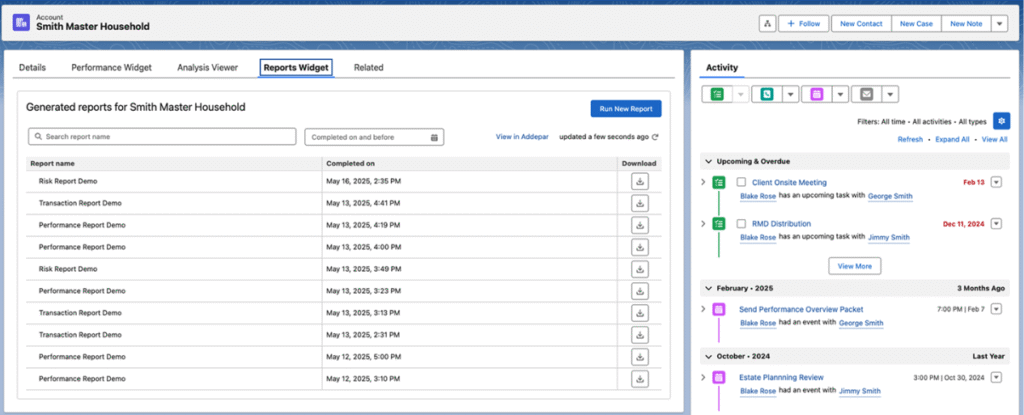
The Salesforce-Addepar integration simplifies data synchronization across multiple systems, reducing the need for manual data entry. With automated workflows, key information – such as portfolio updates, performance reports, and transaction histories – are automatically updated in both Addepar and Salesforce in real time. This not only saves time but also ensures that all team members have access to the most up-to-date information, improving collaboration and reducing the risk of errors.
Salesforce Addepar Integration
How this benefits your firm:
Increased Productivity: By automating routine tasks like data entry, portfolio tracking, and reporting, your team can focus on more strategic activities, such as client outreach and portfolio optimization.
Improved Data Accuracy: Automated data synchronization ensures that both Addepar and Salesforce are always in sync, reducing the risk of errors and discrepancies that can arise from manual data entry.
Enhanced Client Experience: With streamlined workflows, your firm can provide faster, more accurate responses to client inquiries and requests, improving the overall client experience.
Ready to harness the transformative potential of this integration? Contact us today to schedule a consultation and unlock new opportunities for success in the digital age.
Banner CTA – Charles Schwab Salesforce Integration
Custodian Integration Guide
What is the Charles Schwab Salesforce Integration?
Scalable Business Growth & Customization: Build a Foundation for the Future
As financial services firms grow and evolve, their technology needs become more complex. The Salesforce-Addepar integration is designed to scale with your business, offering flexibility and customization options that can evolve as your firm’s needs change. Whether you’re expanding into new markets, launching new products, or adopting new regulatory standards, this integration provides a solid foundation for sustainable growth.
Salesforce’s flexible ecosystem allows financial services firms to customize their CRM tools to suit their specific requirements. This can include creating tailored dashboards, automating client communications, and integrating third-party solutions that further enhance the advisor experience. Furthermore, Addepar’s robust data management capabilities allow you to track performance across a variety of asset classes and custodians, making it easier to manage complex portfolios as your client base grows.
How this benefits your firm:
Scalable Solutions: As your firm grows, the Salesforce-Addepar integration can easily scale to meet the increased demands of a larger client base, helping you maintain high levels of service without sacrificing efficiency.
Customization Options: Whether you need basic reporting or advanced analytics, Salesforce’s flexible platform and Addepar’s rich data model allow you to tailor your tools and workflows to meet the unique needs of your business.
Support for Innovation: As you expand into new markets or launch new services, the integration allows you to quickly adapt, ensuring your firm remains agile and competitive in the ever-changing financial services landscape.
Expert Support Every Step of the Way: Smooth Implementation & Ongoing Optimization
Implementing a new technology solution can be a daunting task, especially in the highly regulated and client-sensitive world of financial services. However, when you integrate Addepar with Salesforce, you gain access to a team of experts who can guide you through the entire process – from initial setup to ongoing optimization.
Navirum, a trusted partner in financial services technology solutions, provides comprehensive support throughout the integration process. We work with you to design your data model, streamline your workflows, and enhance the advisor experience. Our team of experts ensures that your integration is completed on time, on budget, and with minimal disruption to your daily operations.
Moreover, as your firm continues to grow and evolve, Navirum’s ongoing support ensures that your integration remains aligned with your business objectives. We monitor performance, optimize processes, and provide insights to help you get the most out of your Salesforce Addepar integration.
How this benefits your firm:
Seamless Implementation: With expert support from Navirum, you can rest assured that your integration will be executed smoothly and efficiently, with minimal disruption to your business.
Ongoing Optimization: As your business evolves, our team continues to provide guidance and optimization services to ensure that your integration evolves with your needs.
Confidence in Compliance: With financial services firms facing a complex regulatory environment, our team helps ensure that your integration meets all relevant compliance standards, protecting your firm from potential risks.
Unlock New Opportunities for Success in the Digital Age
In an increasingly digital world, the ability to integrate your financial services technology stack is crucial to staying competitive. The Salesforce Addepar integration offers a strategic advantage that enables wealth managers, family offices, and asset managers to deliver unparalleled service, optimize operations, and scale for future growth.
Ready to explore how this integration can help your firm succeed in the digital age? Contact us today to schedule a consultation and learn how you can unlock new opportunities for success in the fast-evolving financial services landscape.
Navirum Recommendations: Leverage Our Expertise for a Seamless Integration
At Navirum, we specialize in helping wealth managers, family offices, and asset managers unlock the full potential of their technology stack. With deep expertise in both Salesforce Financial Services Cloud and Addepar, we guide firms through every step of the integration process—from planning and implementation to ongoing optimization.
Our approach ensures:
Strategic Planning: We assess your current systems, workflows, and business goals to design an integration that maximizes efficiency and ROI.
Seamless Implementation: Leveraging our proven methodology, we handle complex bi-directional integrations, data mapping, and workflow automation while minimizing disruption to your operations.
Customized Solutions: We tailor Salesforce dashboards, reports, and automation to your firm’s unique needs, ensuring advisors can access actionable insights at their fingertips.
Ongoing Support & Optimization: Our team continues to monitor and enhance your integration, keeping it aligned with evolving business requirements and regulatory standards.
By partnering with Navirum, firms gain not just a technical connection between Salesforce and Addepar, but a trusted advisor with deep industry knowledge, ensuring the integration drives real business impact, improves client experiences, and scales as your firm grows.
Addepar Salesforce Integration – FAQs
How long will the integration take?
Implementation timelines depend on the integration method. The standard Salesforce AppExchange adapter can typically be configured within 1–2 days. A fully customized bi-directional integration, however, may take 2–3 months depending on complexity, data mapping requirements, and internal resources. A discovery phase helps define scope and timeline accurately.
How common is the Salesforce Addepar integration?
Very common among firms using both platforms. In our experience, organizations that operate on both Salesforce and Addepar quickly recognize the operational inefficiencies of keeping systems disconnected. Integration becomes a natural next step to improve visibility, efficiency, and advisor productivity.
Does Addepar provide support through the process?
Yes. Addepar is highly collaborative and provides technical documentation and support throughout the integration process. For more complex implementations—especially bi-directional sync—coordination between Addepar, your Salesforce team, and an experienced consulting partner is essential to ensure a smooth deployment.
Which Salesforce editions are compatible with Addepar integration?
Addepar can integrate with multiple Salesforce environments, including Salesforce Platform, Sales Cloud, Service Cloud, and Financial Services Cloud. Enterprise Edition (or higher) is required to support the necessary API access and customization capabilities for integration.
What other portfolio management systems are commonly integrated with Salesforce?
Beyond Addepar, wealth management firms frequently integrate Salesforce with platforms such as Orion, LPL ClientWorks, Black Diamond, eMoney, MoneyGuidePro, D1G1T, and Croesus. Each integration varies in complexity and architecture, but the objective remains the same: creating a unified technology ecosystem that enhances advisor efficiency and client experience.
Is the Salesforce Addepar integration secure and compliant with financial industry standards?
Absolutely. Both platforms are built with enterprise-grade security frameworks. Salesforce provides robust role-based access controls, encryption options, audit trails, and compliance tooling. Addepar maintains strict data governance standards. When implemented correctly—with proper field-level security, user permissions, and governance policies—the integration supports compliance with regulatory requirements common in wealth management.
Can we customize which data fields sync between Salesforce and Addepar?
Yes. Field-level mapping can be customized depending on the integration method used. The AppExchange adapter provides predefined mappings, while a bi-directional integration allows for more advanced customization. Firms can determine which portfolio metrics, performance data, account details, and client attributes sync between systems to align with internal workflows and reporting needs.
Will this integration improve advisor productivity?
Significantly. Advisors no longer need to toggle between systems or manually reconcile portfolio and CRM data. With client profiles enriched by portfolio performance data directly inside Salesforce, advisors can prepare for meetings faster, respond to inquiries with greater accuracy, and automate follow-ups based on portfolio events. This reduces administrative burden and increases client-facing time.
Does the integration support real-time data updates?
Yes — depending on the integration architecture. The standard AppExchange adapter typically syncs data on scheduled intervals, while a custom bi-directional integration can be configured for near real-time updates using APIs. Firms that require immediate portfolio visibility for trading, rebalancing, or high-touch client service often opt for a more advanced integration model.
Can Salesforce automation be triggered by Addepar portfolio data?
Absolutely. Once portfolio data is available inside Salesforce, you can use Flow, Process Builder, or Apex to trigger automated actions. For example, advisors can receive alerts when portfolio allocations drift beyond thresholds, generate proactive client outreach tasks after major performance events, or automatically schedule review meetings. This turns static reporting into actionable intelligence.
How does the integration impact reporting and client communications?
The integration enhances reporting capabilities by combining CRM insights (client goals, lifecycle stage, preferences) with portfolio performance data. Firms can build dynamic dashboards for advisors and management, as well as personalize client communications. Marketing Cloud or automated email workflows can leverage portfolio data to deliver targeted updates and engagement campaigns.
What internal teams should be involved in the integration project?
A successful implementation typically involves: Operations (data validation and workflow design) Compliance (data governance and regulatory alignment) IT or Salesforce administrators (technical configuration) Advisory leadership (business requirements and adoption strategy) Cross-functional collaboration ensures the integration supports both front-office advisors and back-office operations.
What ROI can firms expect from integrating Salesforce and Addepar?
While ROI varies by firm size and maturity, most organizations see measurable gains in advisor efficiency, reduced manual reconciliation time, improved client responsiveness, and stronger retention. Over time, enhanced data visibility supports better decision-making, more personalized advice, and scalable growth — all of which contribute to increased revenue per advisor and improved client lifetime value. Sustaining those gains is an ongoing effort — see how firms build long-term value after go-live.
Book Strategy Session
Schedule Your Session
Let’s find a time to chat about your Salesforce strategy and AUM growth.
Discover real-world outcomes, learn about our collaborative company culture, and meet the financial technology specialists leading your digital transformation.
Proven Results & Impact
Explore Our Success Stories
See how we help financial institutions, wealth managers, and fintechs turn Salesforce and AI into measurable business outcomes and operational growth.
Most wealth management firms do not lose value in the platform they choose. They lose it in the switch. A migration to Salesforce Financial Services Cloud, or a move off a legacy CRM like Redtail, Junxure, DealCloud, or WealthHub, is the moment when advisor adoption, client trust, and years of relationship data are either protected or quietly lost.
The platform decision gets the attention. The change management around the migration decides whether it works. This guide lays out the practical change-management playbook that makes a wealth management CRM migration succeed, so the system you invested in actually gets used.
What your score means: the migration readiness spectrum
Migration readiness is not pass or fail. It is a spectrum, and every firm sits somewhere on it. Where you land is driven less by the size of your database and more by how you are approaching the five pillars, above all advisor adoption. Your score places you in one of three positions on that spectrum.
Data-firstPlanningChange-led
Data-first (score 5 to 8): high adoption risk
You are treating the migration mainly as a technical transfer. The data may move cleanly, but advisors are likely to drift back to spreadsheets. The most valuable next step is to slow down before setting a go-live date and work the change-management playbook below, starting with the advisors themselves.
Planning, not yet aligned (score 9 to 12)
The foundations are there, but the risk is a lift and shift that carries old friction into the new system, and a plan that is not yet advisor-led. Bring a few respected advisors into the design now, and use the migration to standardise the workflows that are actually worth keeping.
Change-led (score 13 to 15): primed to succeed
You are treating the migration as a change programme, not just an IT project. Adoption, workflow redesign, and compliance continuity are already in the plan. Your focus now is sequencing: migrate a pilot team, prove the daily time savings, and protect momentum as you roll out book by book.
Wherever you land today, the playbook below is how you move rightward on the spectrum, from a technical transfer that stalls to a change programme that sticks.
Why wealth management CRM migrations fail, and it is rarely the technology
When a wealth management CRM migration stalls, the cause is almost never the database. It is people. Advisors keep working in spreadsheets and their inbox because the new system feels slower than the old habit. Client data arrives incomplete, so the first week erodes trust in the tool. Compliance steps that used to run automatically go quiet, and no one is sure what replaced them.
A migration is an operational and behavioural change, not just a data transfer. Firms that treat it as a purely technical project tend to hit the same wall. The platform goes live, and adoption does not follow.
What a wealth management Salesforce migration actually involves
A move to Salesforce Financial Services Cloud touches five things at once, and they have to be planned together:
Data. Households, accounts, positions, and years of advisor notes have to map cleanly from the old CRM.
Workflows. Reviews, onboarding, service requests, and suitability or RMD processes need to be rebuilt, not copied blindly.
Integrations. Custodial feeds, planning tools, and portfolio systems have to reconnect.
Compliance. Audit trails, consent, and reporting have to carry over without a gap.
Advisors. The people who live in the CRM every day have to want to use it.
Miss any one of these and the migration feels like a downgrade on day one. The firms that get it right, whether they are moving off Redtail, leaving Junxure, or replacing DealCloud and WealthHub, plan all five together rather than sequencing them after go-live.
The change-management playbook that makes a migration stick
Change management is often described as an abstract discipline. For a wealth management migration it is very concrete. It is the set of decisions that turn a new CRM into the way the firm actually works.
Start with the advisor, not the data model
Involve a few respected advisors before the build, not after. They know which fields matter, which reports they open every morning, and which shortcuts they will refuse to give up. Design the first release around their daily work, and they become the internal champions who bring the rest of the firm along.
Protect the client experience during the switch
Clients should never feel the migration. Review meetings, statements, and service requests need to continue without interruption. Map the client-facing moments first, and cut over the back office around them, so the relationship stays steady while the technology changes underneath it.
Rebuild workflows, do not just lift and shift
A migration is the one moment a firm can retire broken process instead of carrying it into a new system. Copying every old workflow verbatim reproduces the friction that made the last CRM frustrating. Use the move to standardise onboarding, reviews, and handoffs on Financial Services Cloud.
Keep regulatory continuity from day one
Document every compliance control before cutover, including audit trails, consent capture, and reporting. Confirm each one has an equivalent in the new platform on the first day it goes live, not weeks later. A single gap in a supervised workflow can undo the trust the migration was meant to build.
Overcome resistance with proof, not mandates
Advisors adopt what visibly saves them time. Instead of mandating the new system, show a pilot team a task that now takes minutes instead of an afternoon. Momentum built on proof spreads faster than any policy, and it is what separates a technically clean migration from one that actually gets used.
How long does a wealth management CRM migration take?
There is no single answer, but most firms should plan in phases rather than one large switch. A focused single-office practice moving off Redtail can be live in a few weeks. A multi-advisor firm with custodial integrations and heavy compliance requirements should plan for a few months, staged by team or book of business. The timeline is driven less by data volume and more by how much workflow redesign and advisor enablement the firm takes on. Rushing the enablement to hit a date is the most common reason a technically clean migration still fails on adoption.
A workable sequence looks like this. Audit the current CRM and document what actually gets used. Map data and workflows to Financial Services Cloud. Migrate a single pilot team first and prove the daily workflow saves them time. Then roll out book by book, with the pilot advisors acting as internal champions. Each stage has a clear owner and a defined exit test, so the firm is never guessing whether it is ready to move the next group.
Your migration readiness checklist
Use this as a quick self-audit before you commit to a date. If you cannot tick most of the items in a pillar, that is where the readiness work needs to start.
Data
We have mapped how households, accounts, and financial accounts translate to Financial Services Cloud.
Duplicate households and stale records are cleaned, or scoped for cleanup before cutover.
We know which advisor notes and history must carry over.
Workflows
Onboarding, reviews, and service requests are documented, not just remembered.
We have decided which processes to retire rather than copy.
The new workflows are designed around how advisors actually work.
Integrations
Custodial feeds, planning tools, and portfolio systems are inventoried.
We have confirmed what reconnects, and tested the data flow.
The back office can cut over without the client feeling it.
Compliance
Every audit trail, consent, and report has a documented equivalent in FSC.
Supervised workflows are confirmed live on day one, not weeks later.
Someone owns regulatory continuity through the cutover.
Advisors
A few respected advisors are involved before the build, not after.
We can show a task that is visibly faster in the new system.
Champions are lined up to bring the rest of the firm along.
Score yourself honestly. The pillar with the fewest ticks is the one most likely to stall the migration.
Salesforce Change Management FAQs For Wealth Managers
Wondering about advisor adoption, phasing your migration, historical data, or which legacy CRMs we move from? Start here.
View all 4 questions
What is the hardest part of a wealth management Salesforce migration?
Advisor adoption, not the data transfer. The technology can be migrated cleanly and the project can still fail if advisors keep working the old way. Building the first release around their daily work and proving early time savings is what makes adoption follow.
Should we move everything at once or in phases?
Phase it. Migrating a single pilot team first lets you prove the workflow, fix problems on a small group, and create internal champions before a wider rollout. A single big-bang cutover concentrates risk on one date.
Do we lose our historical client data and notes during migration?
No, provided the data is mapped correctly. Households, accounts, positions, and years of advisor notes carry over into Financial Services Cloud when the mapping is planned up front. Incomplete mapping, not the migration itself, is what causes data to appear missing on day one.
Which legacy CRMs does Navirum migrate wealth firms from?
Common starting points include Redtail, Junxure, DealCloud, and WealthHub, among others, each moving to Salesforce Financial Services Cloud.
“I would highly recommend that organized and focused project managers work with Navirum for their CRM transition projects.”
Shelby Murphy, Head of Marketing, Main Management LLC
Zendesk to Salesforce migration has become the most popular path for companies seeking a more powerful CRM alternative. With Zendesk Sell being discontinued, many organizations are re-evaluating their tech stack and choosing to migrate to Salesforce for its unified sales, service, and automation capabilities. While Salesforce integration with Zendesk remains an option for those not ready to make the full leap, migration delivers greater long-term flexibility, scalability, and control. The transition, however, can be complex – the two systems don’t map 1:1, and rushing it risks losing deal and ticket history, breaking SLAs, and confusing users. Below, we unpack the key challenges businesses face during a Zendesk to Salesforce migration – and how to overcome them effectively.
Getting through the migration is one project. Keeping the new Salesforce environment optimized afterward is an ongoing one, which is where Salesforce managed services fits in for most financial services firms.
Migrating from Zendesk to Salesforce can be a complex process, and several challenges may arise during the migration. Some of the major issues encountered include:
#1 – Data Mapping and Mapping Complexity
Mapping data from Zendesk to Salesforce can be challenging due to differences in data structure, field names, and formats between the two platforms. Ensuring accurate mapping while preserving data integrity is crucial but can be time-consuming. This process has to be done properly or forget the rest!
#2 – Customization and Configuration
Zendesk and Salesforce have different customization options and configurations. Translating custom fields, workflows, automations, and business processes from Zendesk to Salesforce requires careful planning and may encounter challenges, especially if the configurations are complex or highly customized. As well as Salesforce you may require other apps to complement old ZenDesk functionality like Intercom, which integrates seamlessly with Salesforce
#3 – Data Cleansing and Quality
Migrating clean and accurate data is essential for a successful migration. However, data in Zendesk may contain inconsistencies, duplicates, or outdated information. Data cleansing efforts, such as deduplication, normalization, and data validation, may be necessary to ensure data quality before migrating to Salesforce. This can be mitigated with solutions like DataGroomr once in Salesforce itself
#4 – Integration with Other Systems
If Zendesk is integrated with other systems or third-party applications, such as CRMs, ERP systems, or ticketing systems, migrating to Salesforce may disrupt these integrations. Ensuring seamless integration and data flow between Salesforce and other systems is critical to maintain business continuity. It may make sense to integrate those systems to Salesforce with 3rd party apps like Jitterbitto enhance cost and efficiency.
Salesforce is a different platform with its own interface, navigation, and features compared to Zendesk. User training and adoption may be a significant blocker, especially if users are accustomed to Zendesk’s interface and workflows. Providing comprehensive training and support resources can help mitigate this challenge.
#6 – Change Management
Migrating from one platform to another requires organizational change management to address resistance to change, align stakeholders, and manage expectations. Lack of buy-in from key stakeholders or resistance from users can impede the migration process.
Migrating data and transitioning to Salesforce may require downtime or disruptions to normal business operations, which can impact productivity, customer service, and revenue generation. Minimizing downtime and mitigating the potential business impact is essential during the migration process. Having a firm communication plan with project stakeholders to keep them updated is essential.
In Summary….
Addressing these challenges requires careful planning, collaboration between stakeholders, and leveraging expertise in both Zendesk and Salesforce platforms. As well as the insights above, our experienced migration consultants can help you navigate these blockers and ensure a smooth transition from Zendesk to Salesforce.
Need Help? Book a Free Consultation Below
Navirum Client Success Stories
Zendesk to Salesforce Data Migration FAQ
What data can be migrated from Zendesk to Salesforce?
* We can migrate a wide range of data including: * Tickets (including custom fields, tags, comments, attachments) * Users and Organizations * Knowledge Base articles * Macros and ticket history (if required) Custom objects and workflows may require additional configuration during the migration process.
Will we lose any data during the migration?
No, our goal is a 100% data integrity migration. Before we begin, we run a test migration in a sandbox to ensure everything transfers correctly. After migration, we also perform validation and provide a report for verification.
How long does the data migration process take?
The timeline depends on: * The amount of data in your Zendesk instance * The complexity of your Salesforce setup * API rate limits For most projects, the process takes from a few days to 2 weeks, including testing and validation phases
Will there be any downtime during the migration?
No, there is no downtime required. Your Zendesk and Salesforce instances remain live and usable throughout the migration. However, we recommend choosing a cutover time (often over a weekend or off-hours) for the final sync to minimize any potential disruption.
Do you offer support after the migration is completed?
Yes. We offer post-migration support to help with: * Data verification * Troubleshooting issues * Adjustments or re-migration (if needed) * Basic training or documentation You’ll also receive a post-migration checklist to help ensure everything is working smoothly.
Navirum is a certified Salesforce partner with deep expertise in delivering integrated digital workflow solutions. We specialize in streamlining service operations for financial services and other industries. Our team ensures a seamless migration from Zendesk to Salesforce, aligning the process with your business goals to maximize long-term value from your Salesforce investment.
A Summary of How This Migration Will Change You Business.
In today’s fast-moving business landscape, strategic planning is essential to long-term success. As you define your goals for the years ahead, maximizing the potential of your CRM system becomes more critical than ever.
ACT!, first launched in 1987 by Pat Sullivan and Mike Muhney, holds a proud place in software history – standing alongside early pioneers like Siebel, SAP, and even the era of mainframes and punch cards 🙂
But the world has changed. AI is reshaping how businesses operate, and legacy systems can’t keep up. If you’re still running ACT! in 2025, it’s time to move on – before you’re left behind completely.
Heres Some Quick Tips to Accelerate Your ACT! to Salesforce Migration Today!
Quick Tip 1: Define Your Business Goals:
Begin by clearly outlining your business objectives for the upcoming years. Whether it’s improving profitability, retaining more customers, enhancing the client experience, or increasing sales, having well-defined goals sets the direction for your CRM strategy.
Back To The Future.. The ACT! Time Machine
Quick Tip 2:Conduct an ACT! Healthcheck:
Perform a thorough audit of your ACT! CRM system to ensure it’s configured to meet your specific needs. Check critical aspects such as email syncing, version updates, backup protocols, and security settings to guarantee smooth operation and data integrity.
What is Salesforce Anyway?
Quick Tip 3: Gather User Feedback:
Engage with your staff to understand any challenges or barriers they face while using ACT! CRM. Addressing their concerns and incorporating their feedback into your CRM strategy fosters better user adoption and overall satisfaction.
Quick Tip 4: Create a Roadmap:
Develop a Salesfore roadmap that aligns with your business goals and incorporates necessary improvements. Whether your focus is on short-term profitability or long-term growth, your roadmap should serve as a guide towards achieving your objectives.
Quick Tip 5: Consider Migration Options:
Depending on your business trajectory and goals, evaluate the feasibility of migrating from ACT! to Salesforce . If your aim is to scale your business, enhance customer experience, and leverage advanced technologies such as AI, a migration may be the strategic move forward. Some tips blow
Aligning your system with your business goals is critical in today’s fast paced business world, and that alignment has to keep evolving after launch — see how a full-lifecycle Salesforce partnership keeps paying off. If you need help with making this decision, please contact us below.
Lavinia PicuMigrating from ACT to Salesforce in 2025 – 5 Quick Tips You Need Now
Learn how to use Dakota Marketplace Salesforce integration for business growth
Businesses across industries are constantly seeking smarter ways to drive growth, streamline operations, strengthen customer relationships, and make better use of their data. As customer expectations continue to evolve, organizations need more than disconnected systems—they need technology that brings data, teams, and workflows together. Integrating powerful platforms can help businesses reduce manual processes, improve visibility, and give teams the information they need to make faster, more informed decisions.
Combining the capabilities of Dakota, a leading customer engagement and relationship intelligence platform, with Salesforce, the world’s #1 CRM, creates a powerful foundation for achieving these objectives. By connecting Dakota’s data and insights with Salesforce, organizations can create a more complete view of prospects and customers, streamline relationship management, improve sales processes, and uncover new opportunities for growth.
Dakota Marketplace integrates Dakota and Salesforce to help businesses bring valuable data and relationship intelligence directly into their Salesforce environment. This connected approach can improve productivity, reduce manual data entry, enhance collaboration, and give teams greater visibility into the relationships and opportunities that matter most. The result is more than simply connecting two platforms. Dakota and Salesforce integration can help organizations turn data into actionable insights, strengthen customer engagement, optimize sales processes, and build a more scalable foundation for business growth. In the sections that follow, we’ll explore the key benefits of the integration and how businesses can use it to maximize the value of both platforms. of success.
Salesforce Dakota Integration is a game changer!
Understanding Dakota Marketplace and Salesforce Integration:
Dakota is renowned for its robust suite of customer engagement and relationship intelligence tools, helping organizations manage interactions, identify opportunities, automate workflows, and deliver more personalized experiences at scale. On the other hand, Salesforce provides a comprehensive CRM platform that centralizes customer data, streamlines sales and service processes, and delivers actionable insights across the organization.
By integrating Dakota with Salesforce, businesses can connect valuable Dakota data and intelligence directly with their Salesforce environment, creating a more complete and connected view of prospects, clients, and business relationships. The integration helps teams reduce manual data entry, improve data consistency, and access relevant information within the workflows they already use. By seamlessly syncing data and aligning processes across both platforms, organizations can improve productivity, strengthen customer relationships, identify new opportunities, and make more informed, data-driven decisions.
For financial services organizations in particular, connecting Dakota and Salesforce can provide relationship managers and sales teams with the information they need to better understand prospects and clients, prioritize opportunities, and build stronger relationships—all while maximizing the value of their Salesforce investment.
Key Benefits of Dakota Marketplace & Salesforce Integration
Explore how connecting Dakota Marketplace market intelligence with Salesforce FSC empowers institutional sales, relationship management, and operations teams to scale revenue.
Relationship Intelligence
1. Unified Customer View
Integration enables a unified view of customer data, bringing together information from Dakota and Salesforce into a single, comprehensive view. This 360-degree perspective empowers sales, marketing, and service teams to better understand customer needs, preferences, relationships, and behaviors, facilitating more personalized interactions and stronger client relationships.
💡 Strategic Impact: Eliminates data silos and gives every team member a complete 360° perspective before every client call.
Pipeline & Workflows
2. Streamlined Workflows
Integration streamlines workflows by automating data synchronization and eliminating manual data entry tasks. This not only saves time and reduces errors but also enables teams to focus on high-value activities, such as engaging with customers, nurturing leads, managing relationships, and closing opportunities.
💡 Strategic Impact: Automates data entry between Dakota and Salesforce so producers focus on closing deals.
Data & Analytics
3. Enhanced Reporting and Analytics
Integration unlocks powerful reporting and analytics capabilities by combining data from Dakota and Salesforce. Organizations can gain deeper insights into sales performance, customer engagement, prospect activity, relationship development, and campaign effectiveness, enabling data-driven decision-making and continuous optimization.
Integration fosters seamless collaboration across departments by providing a centralized platform for sharing information and coordinating activities. Sales, marketing, relationship management, and service teams can work from consistent, up-to-date information, helping deliver a cohesive and consistent customer experience across touchpoints.
💡 Strategic Impact: Aligns sales, marketing, and relationship managers around identical, live prospect datasets.
Relationship Intelligence
5. Better Prospect & Relationship Intelligence
By bringing Dakota’s market and relationship intelligence into Salesforce, teams can access relevant prospect and company information within their existing workflows. This can help relationship managers identify potential opportunities, understand organizational relationships, and prioritize prospects more effectively.
💡 Strategic Impact: Embeds institutional market research directly into everyday Salesforce advisor workspaces.
Pipeline & Workflows
6. Efficient Lead & Opportunity Management
Dakota data can enrich Salesforce records and support more informed lead and opportunity management. Teams can spend less time researching prospects manually and more time identifying qualified opportunities, developing relationships, and moving prospects through the sales pipeline.
💡 Strategic Impact: Enriches opportunity records automatically so sales teams move qualified leads through the pipeline faster.
Relationship Intelligence
7. Personalized Client Engagement
With richer data available within Salesforce, teams can develop a deeper understanding of prospects and clients and tailor outreach accordingly. More relevant communications and relationship strategies can improve engagement and help strengthen long-term client relationships.
💡 Strategic Impact: Powers hyper-personalized communication strategies grounded in accurate investor preferences.
Pipeline & Workflows
8. Increased Productivity
Reducing the need to switch between multiple platforms and manually transfer information allows users to spend more time on revenue-generating and client-facing activities. Employees can access relevant information within Salesforce and work from a more efficient, connected workflow.
💡 Strategic Impact: Eliminates system-switching drag and frees up advisor capacity for high-value client time.
Data & Analytics
9. Improved Data Accuracy and Consistency
Automated data synchronization helps reduce duplicate records, manual input errors, and outdated information. Maintaining more consistent data across systems also improves the reliability of reports, dashboards, workflows, and downstream business processes.
💡 Strategic Impact: Cleanses CRM records automatically and guarantees high data integrity across all reporting.
Data & Analytics
10. Faster Decision-Making
When relevant market, prospect, and customer information is accessible directly within Salesforce, teams can make decisions faster and with greater confidence. Users can spend less time gathering information from disparate sources and more time acting on actionable insights.
💡 Strategic Impact: Provides instant access to key market intelligence so leaders act on deal signals immediately.
Pipeline & Workflows
11. Greater Visibility Across the Sales Pipeline
Combining Dakota intelligence with Salesforce opportunity data can provide sales leaders with greater visibility into prospects, accounts, relationships, and pipeline activity. This supports more effective pipeline management, forecasting, coaching, and prioritization.
💡 Strategic Impact: Delivers complete executive visibility into active deals, stage velocity, and team forecasts.
Platform Value & AI
12. Scalability and Flexibility
Integration offers scalability and flexibility to accommodate evolving business needs and growth objectives. As your organization expands, Dakota and Salesforce integration can scale with you, adapting to changes in processes, workflows, users, and customer requirements.
💡 Strategic Impact: Adapts seamlessly to expanding deal volumes, new user teams, and evolving business strategies.
Platform Value & AI
13. Stronger Foundation for Automation & AI
Connecting external data sources with Salesforce can create a richer and more complete data foundation for automation and AI initiatives. More complete and trusted data can help organizations build smarter workflows, improve recommendations, and support future Salesforce AI and Agentforce use cases.
💡 Strategic Impact: Establishes the clean data layer required to power autonomous Agentforce AI workflows.
Platform Value & AI
14. Greater Return on Salesforce Investment
By extending Salesforce with relevant external data and intelligence, organizations can get more value from their existing Salesforce investment. Instead of using Salesforce solely as a CRM, teams can leverage it as a more connected platform for relationship management, sales execution, analytics, automation, and growth.
💡 Strategic Impact: Transforms Salesforce from an administrative CRM into an active revenue engine.
Relationship Intelligence
15. Enhanced Client Experience
Ultimately, the integration helps organizations deliver a more connected client experience. When teams have access to the right information at the right time, they can respond faster, provide more relevant interactions, and build stronger relationships throughout the customer lifecycle.
💡 Strategic Impact: Delivers a frictionless, responsive investor journey that deepens client loyalty.
Ready to Connect Dakota Marketplace with Salesforce?
Contact Navirum to design an integrated Salesforce ecosystem that connects your Dakota market intelligence, client data, and advisor workflows.
Businesses need cohesive systems to drive growth and enhance customer relationships.
Dakota Marketplace integrates Dakota’s insights with Salesforce, improving data visibility and reducing manual tasks.
Integration of Dakota with Salesforce helps teams make informed decisions and streamline sales processes.
Financial services benefit significantly from this integration by enhancing relationship management and opportunity identification.
Navirum specializes in Dakota Salesforce integration, ensuring a seamless solution tailored to business needs.
At Navirum, we help financial services organizations unlock the full value of Dakota and Salesforce integration. Our certified Salesforce experts combine deep financial services expertise with hands-on integration experience to connect Dakota’s data and intelligence with Salesforce in a way that supports your business processes and growth objectives. From integration strategy and data mapping to implementation, automation, and optimization, we ensure a seamless, scalable solution that delivers measurable value while maximizing your Salesforce investment.
FAQ
What Dakota Marketplace data can be connected to Salesforce?
The specific data available through a Dakota Marketplace Salesforce integration depends on the integration configuration and Dakota’s available data. Relevant investor and institutional relationship information can be connected to Salesforce to help teams maintain more complete records and support fundraising workflows.
Can Dakota Marketplace data automatically update Salesforce?
Yes, an integration can be configured to synchronize relevant data between Dakota Marketplace and Salesforce, reducing the need for teams to manually enter or update information. The exact synchronization frequency and fields depend on the integration architecture and business requirements.
Can Dakota Marketplace and Salesforce automate investor workflows?
Yes. Once Dakota Marketplace data is available in Salesforce, teams can use Salesforce automation to support activities such as lead and prospect management, follow-ups, task creation, notifications, and other fundraising workflows. This can help reduce administrative work and create more consistent processes.
Is Dakota Marketplace Salesforce integration suitable for private equity and alternative investment firms?
Yes. The integration can be particularly valuable for private equity, venture capital, private credit, real estate, and other alternative investment firms that rely on institutional investor relationships. Connecting Dakota intelligence with Salesforce can provide fundraising teams with a more centralized view of prospects and relationship activity.
What should firms consider before implementing a Dakota Marketplace Salesforce integration?
Before implementing the integration, firms should define which Dakota data needs to flow into Salesforce, how records should be mapped, what synchronization rules are required, and which workflows should be automated. Data quality, Salesforce architecture, security, permissions, and user adoption should also be considered to ensure the integration delivers long-term value.
Discover real-world outcomes, learn about our collaborative company culture, and meet the financial technology specialists leading your digital transformation.
Proven Results & Impact
Explore Our Success Stories
See how we help financial institutions, wealth managers, and fintechs turn Salesforce and AI into measurable business outcomes and operational growth.
Maximizing Your CRM Strategy: Evaluating Maximizer and Exploring Migration Options
Looking for way to maximizing your CRM Strategy? You can start by evaluating Maximizer and exploring possible migration options! In today’s competitive business landscape, having an efficient Customer Relationship Management (CRM) system is essential for achieving organizational success. If you find that your current CRM, such as Maximizer, isn’t meeting your evolving needs, it may be time to reassess your strategy.
Here’s a step-by-step approach to evaluating Maximizer and considering migration options, tailored to your business goals:
Define Your Business Goals: Start by clearly defining your business objectives for the next few years. Whether it’s improving profitability, retaining more customers, enhancing the client experience, or increasing sales, understanding your goals is crucial for aligning your CRM strategy.
Future-Proof Your CRM: Evaluate Maximizer’s AI, analytics, and mobile strategy to determine if it aligns with your long-term objectives. Assessing the platform’s capabilities in these areas can help you anticipate future needs and ensure scalability and adaptability as your business grows.
Gather User Feedback: Engage with your staff to understand their experiences with Maximizer. Identify any pain points or limitations that may be hindering their productivity, as well as features they appreciate and find valuable. This feedback will inform your decision-making process and help prioritize improvements.
Create a Roadmap: Develop a roadmap that is guided by your business goals and incorporates necessary enhancements to your Maximizer CRM system. If your focus is on short-term objectives such as selling your company or financing your business, making basic improvements to Maximizer may be the appropriate path forward. However, if your goal is to drive growth, enhance the client experience, and leverage advanced technologies like AI, it may be time to explore migration options.
Consider Migration to Salesforce: If your business trajectory aligns with growth and innovation, migrating from Maximizer to Salesforce could be a strategic move. Salesforce offers robust AI capabilities, advanced analytics, and seamless mobile integration, empowering businesses to scale efficiently and deliver exceptional customer experiences.
By following this structured approach, you can effectively evaluate Maximizer and determine whether it’s the right fit for your evolving business needs. Whether you choose to optimize your current CRM or explore migration options, prioritizing alignment with your long-term goals is key to driving success and staying ahead in today’s dynamic market.
Aligning your system with your business goals is critical in today’s fast paced business world. If you need help with making this decision, please contact us using the form below.
Request Your Salesforce Readiness Assessment | Navirum
Integration Assessment
Request Your Salesforce Readiness Assessment
Not sure if your tech stack is integration-ready? We’ll assess your current setup in one conversation. Designed exclusively for financial services firms.