How to migrate from EquiSoft to Salesforce with less headaches in 2025

Thinking to migrate from EquiSoft to Salesforce? Migrating from one software platform to another is rarely a plug-and-play experience—especially when it involves two robust systems like EquiSoft and Salesforce. Whether you’re seeking better CRM functionality, more powerful analytics, or improved integration with other tools in your tech stack, making the switch to Salesforce can be a game-changer for your organization. But let’s be honest: without a solid plan, the migration process can feel overwhelming.ration process with ease.

5 Useful Migration Tips

EquiSoft has served many financial services organizations well, but as your business evolves, so should your technology. Salesforce offers unmatched flexibility, scalability, and a vast ecosystem of tools that can elevate how you manage data, engage with customers, and make strategic decisions. However, to unlock these benefits without unnecessary stress, a thoughtful and well-executed migration strategy is key.

In this article, we’ll walk you through the essential steps to reduce friction, avoid costly mistakes, and set your organization up for long-term success in Salesforce. Whether you’re still evaluating your options or already preparing for the transition, these best practices will help you approach your migration with clarity and confidence.

# 1 Conduct a Comprehensive Assessment

Before initiating any data migration project, it’s critical to understand exactly what you’re working with. EquiSoft systems often involve complex configurations, custom reports, embedded workflows, and large volumes of client data. Begin by performing a full audit of your current system. This includes:

  • Data Structure: Catalog all data objects, fields, and relationships in EquiSoft. Understand how this data is organized and how it connects across different departments (e.g., sales, operations, compliance).
  • Custom Workflows and Integrations: Identify any customized business processes or third-party tools currently integrated with EquiSoft. These could include automated emails, document generation tools, or compliance-related workflows.
  • Usage Patterns: Analyze how your users are interacting with the platform. Which features are essential? Which ones are underused? This helps determine what’s worth replicating or improving in Salesforce.
  • Data Quality: Flag issues like duplicate records, outdated contact info, missing fields, or inconsistent formatting. Clean, accurate data will make the transition much smoother and reduce post-migration issues.

This phase sets the foundation for a successful migration by ensuring you’re not simply transferring data blindly but rather designing your Salesforce setup to be more efficient and scalable.

#2 Define Your Salesforce Objectives

Rather than replicating your EquiSoft environment in Salesforce, take the opportunity to rethink how your CRM should support your business goals. Ask yourself and your stakeholders the following:

  • What are we trying to achieve with Salesforce? This could range from improving sales pipeline visibility, to enabling more detailed performance reporting, to enhancing client communication workflows.
  • Which business units will use Salesforce? Sales, marketing, operations, service teams—all may have different needs and expectations from the system.
  • What are the KPIs or metrics we want to improve? Are you trying to reduce sales cycle length? Increase client retention? Enhance customer segmentation?

By clearly outlining your objectives, you can prioritize Salesforce features that align with those goals, avoid unnecessary customizations, and drive faster ROI.

# 3 Plan Your Migration Strategy

A successful migration hinges on a well-structured plan. Here’s what to include in your strategy:

  • Migration Method: Choose the best approach—manual entry for small datasets, CSV import for medium complexity, or automated migration tools (like MuleSoft or Dataloader.io) for large-scale migrations. APIs may also be used for more technical, ongoing data syncing.
  • Data Mapping: Define how fields in EquiSoft will map to fields in Salesforce. This includes handling data types (e.g., picklists vs. text fields), object relationships, and ensuring that no critical data is lost in translation.
  • Timeline & Phases: Break the migration down into manageable phases—discovery, development, testing, go-live, and post-launch support. Consider using a sandbox environment in Salesforce to test migrations without affecting live data.
  • Data Cleansing: This is a prime opportunity to clean up your records. Remove duplicates, standardize naming conventions, and archive obsolete data. Clean data ensures better reporting, automation, and user adoption.
  • Risk Management: Anticipate potential challenges—data loss, user resistance, downtime—and put mitigation plans in place.

# 4 Engage with Salesforce Experts

Migrating from EquiSoft to Salesforce isn’t just a technical project—it’s a transformation. Having the right expertise on your side can make or break the experience. Here’s why working with certified Salesforce consultants or implementation partners is a smart investment:

  • Experience Matters: Experts with hands-on experience in both EquiSoft and Salesforce understand the nuances of data structures, regulatory requirements, and workflow logic specific to your industry.
  • Customization Support: Salesforce is highly customizable, but it’s easy to overdo it. An expert can help you strike the right balance—tailoring Salesforce to your processes without creating a maintenance nightmare.
  • User Training & Change Management: A well-implemented system is only useful if your team knows how to use it. Consultants often provide training resources, documentation, and change management support to drive adoption.
  • Integration Assistance: If your business relies on integrations with tools like DocuSign, Outlook, or financial platforms, a partner can ensure smooth and secure connections with Salesforce.
  • Post-Go-Live Support: Ongoing optimization is critical. Having expert support means you can continuously improve your Salesforce environment as your needs evolve.

Think of this as building a long-term relationship, not just hiring someone to “lift and shift” your data.

#5 Continuously Optimize and Iterate

The work doesn’t stop after your data is in Salesforce. In fact, the real benefits start to emerge once your team begins using the system day-to-day. To ensure long-term success, adopt a culture of continuous improvement:

  • User Feedback Loops: Set up regular check-ins with users to understand what’s working, what’s not, and what can be improved. Use surveys, user interviews, or feedback channels in Slack or Teams.
  • Reporting & Dashboards: Monitor key business metrics to see if Salesforce is delivering the expected value. Are deals closing faster? Is client communication improving? Are compliance workflows more efficient?
  • Feature Adoption: Keep an eye on new Salesforce releases and apps. The Salesforce ecosystem is vast, and there may be tools or features (like Einstein AI, Flow automation, or industry clouds) that can further improve operations.
  • Training & Enablement: Keep your team sharp with ongoing training. Consider creating internal “power users” who can champion Salesforce best practices and help onboard new team members.
  • Iterative Development: Use agile methods to roll out small enhancements, gather feedback, and refine your setup continuously. This prevents stagnation and ensures Salesforce evolves with your business.

Treat Salesforce not as a static system, but as a living, breathing platform that grows with you.

Ready to make the move from EquiSoft to Salesforce?

Our experienced consultants specialize in helping organizations transition seamlessly from legacy systems like EquiSoft to Salesforce—without the stress. From initial planning to post-migration optimization, we guide you every step of the way.

Contact us today to schedule your free consultation and start your Salesforce journey with clarity and confidence.

Not Sure if You’re Ready for Salesforce FSC?

Before you dive into migration, make sure your organization is truly prepared.

Our Salesforce Financial Services Cloud (FSC) Readiness Assessment helps you evaluate your readiness across six key dimensions:

  • Business Alignment
  • Data & Integration
  • Compliance & Security
  • Adoption & Change Management
  • Continuous Improvement
  • Time Commitment

This short, practical quiz will help you uncover gaps, highlight strengths, and create a clear action plan for a successful FSC implementation.

👉 Download the Readiness Assessment to get started today.

Salesforce FSC Implementation Readiness Checklist

Lead Magnet – Salesforce FSC Implementation Readiness Checklist

Download Your FREE Salesforce FSC Implementation Readiness Checklist!

Name
Name
First Name
Last Name

Navirum Customer Success Stories

FAQ

Why should I migrate from EquiSoft to Salesforce?

Salesforce offers greater flexibility, customization, and scalability compared to EquiSoft. If your organization is looking to streamline CRM operations, improve data reporting, integrate with other business tools, or enable more automation, Salesforce is a more future-proof platform. It’s also widely supported and constantly evolving with new features.

How long does a typical EquiSoft to Salesforce migration take?

The timeline varies depending on data volume, system complexity, and the level of customization required. For smaller organizations, a migration can take 4–6 weeks. For larger enterprises with significant data and workflow complexity, expect a timeframe of 2–3 months or more. A well-defined project plan is key to staying on track.

Will we lose any data during the migration?

Not if the migration is done correctly. With a thorough data assessment, careful mapping, and validation processes in place, data loss can be avoided. Backup procedures and test migrations (in a sandbox environment) are also important to ensure accuracy before going live.

What are the biggest risks during the migration?

Common risks include:

  • User resistance due to lack of training
  • These risks can be minimized with proper planning, expert guidance, and ongoing testing throughout the process.
  • Data mismatches or corruption during transfer
  • Incomplete mapping of custom fields or objects
  • Integration failures with third-party tools

Can I migrate custom workflows and automation from EquiSoft to Salesforce?

Yes, but it’s rarely a direct 1:1 transfer. EquiSoft workflows will need to be analyzed and rebuilt in Salesforce using tools like Flow, Process Builder, or Apex (for more complex logic). This is often a good time to streamline or improve those workflows based on Salesforce’s enhanced capabilities.

How much does a migration like this typically cost?

Costs vary depending on the scope, data volume, complexity of customizations, and whether you’re using in-house resources or external consultants. A basic migration could cost a few thousand dollars, while enterprise-level migrations involving integrations and custom development can reach tens of thousands. However, the long-term ROI of a properly implemented Salesforce system often outweighs the upfront investment.

What support is available after the migration?

  • Post-migration support can include:
  • Ongoing user training and enablement
  • Technical support for bugs or issues
  • Optimization of workflows and reports
  • Regular system reviews and enhancements
  • If you work with a Salesforce partner (like us), you’ll have access to ongoing advisory and technical support tailored to your evolving needs.

Do I need a Salesforce partner to do this migration?

While it’s technically possible to perform a migration in-house, working with a certified Salesforce partner greatly reduces risk and accelerates the process. A partner brings experience, best practices, and tools that help ensure a smoother and more strategic transition—especially for organizations with complex systems or limited internal bandwidth.

Can I integrate Salesforce with the tools I currently use with EquiSoft?

Most likely, yes. Salesforce integrates with thousands of third-party applications, including document management systems, marketing platforms, financial tools, and more. If your existing tools have APIs or connectors, integration can usually be achieved with minimal disruption.

How do I get started with the migration process?

Start by conducting a system audit and defining your business goals for Salesforce. From there, engage a migration expert or Salesforce partner to assess your current setup and develop a custom migration plan. If you’re unsure where to begin, we offer a free consultation to help you understand your options.

Contact us today to start your migration journey with confidence.

⭐⭐⭐ DISCOVER NAVIRUM ⭐⭐⭐

Thanks for reading!!

Lavinia PicuHow to migrate from EquiSoft to Salesforce with less headaches in 2025

Why Your Salesforce Is Quietly Costing You Time and Money

A Salesforce Health Check is a structured audit of your Salesforce org — covering data quality, security, integrations, and AI readiness — delivered by certified consultants. Navirum’s complimentary Health Check is purpose-built for financial services firms including RIAs, broker-dealers, and wealth management companies, and delivers a prioritised roadmap to make Salesforce scalable and Agentforce-ready.

If your Salesforce CRM is messy today, AI and Agentforce won’t fix it, they’ll make it worse.

According to Rory Galvin, CEO of Navirum:

Your Salesforce Is Costing You More Than You Think

Identify risks, reduce costs, and get a clear roadmap to make your CRM scalable—and AI-ready.

You’ve invested in Salesforce.
Added integrations. Rolled out new tools like a financial planning software, a Redtail → Salesforce migration, or connecting Salesforce with Schwab or Fidelity.

But instead of improving efficiency…
you’re seeing more manual work, fragmented data, and rising costs.

And with AI and Agentforce on the horizon, these issues don’t disappear—they multiply.

Why Most Salesforce Initiatives Fall Short

On paper, everything looks right: new integrations, financial planning tools, CRM migrations, custodian connections (Schwab, Fidelity, etc.)

But without the right foundation, they lead to: increasing operational costs, fragmented data, broken processes and low user adoption.

Most Salesforce programs don’t fail because of the technology—they fail because of misalignment. Common issues include:

  • Over-customization → poor usability + high maintenance
  • No strategic roadmap → low ROI
  • Lack of industry context → wrong implementation decisions

AI Won’t Fix a Broken Foundation

Agentforce represents the future of Salesforce: autonomous agents, less manual work, smarter workflows.

But most firms aren’t ready. So instead of reducing work… AI amplifies the chaos and leads to:

  • Compliance risks increase
  • Data isn’t structured
  • Integrations aren’t stable
  • Processes aren’t scalable

How Does A health Check Work?

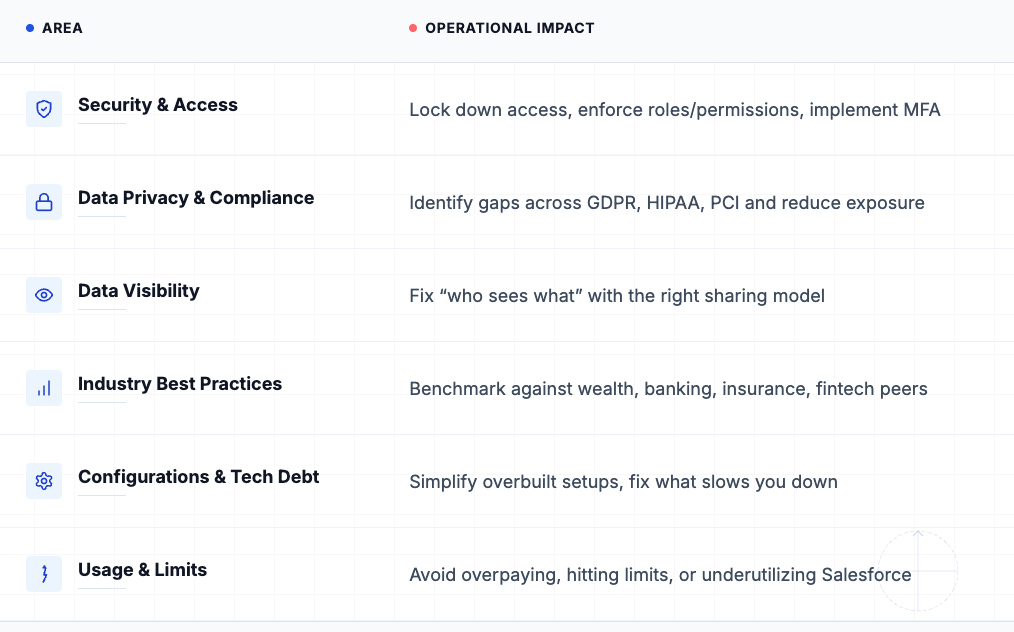
Our certified Salesforce experts perform a comprehensive review of your entire Salesforce org and help you turn your current Salesforce environment into a scalable, high-performing, AI-ready platform.

We assess your entire ecosystem—data, integrations, workflows, and architecture—and give you a clear path forward.

What You Get

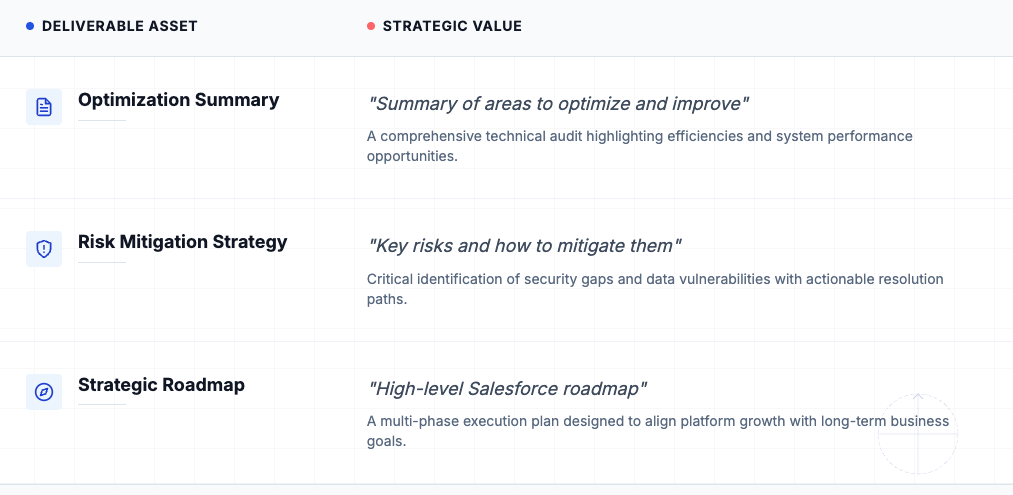
Every Health Check delivers clear, actionable outcomes:

  • ✅ Cost reduction + efficiency opportunities
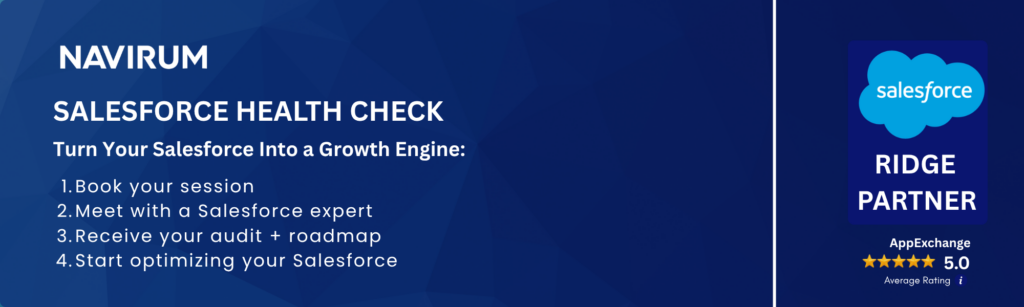
  • ✅ 30-minute 1:1 session with a Salesforce expert
  • ✅ Detailed audit report
  • ✅ Key risks identified + how to fix them
  • ✅ Prioritized roadmap aligned to your business goals

Our Health Checks are complimentary and no-obligation. If you choose to move forward, Navirum can help you implement the recommendations and transform your Salesforce environment into a scalable, high-performing, AI-ready platform.

Salesforce Ecosystem Health Check_Navirum

How Navirum Gets It Right

We take your existing Salesforce environment — integrations, data, workflows — and turn it into an AI-ready platform where Agentforce can actually deliver value:

  • Less manual work.
  • Stronger compliance.
  • Real scalability
  • Better client experiences
  • Scalable growth
  • AI readiness

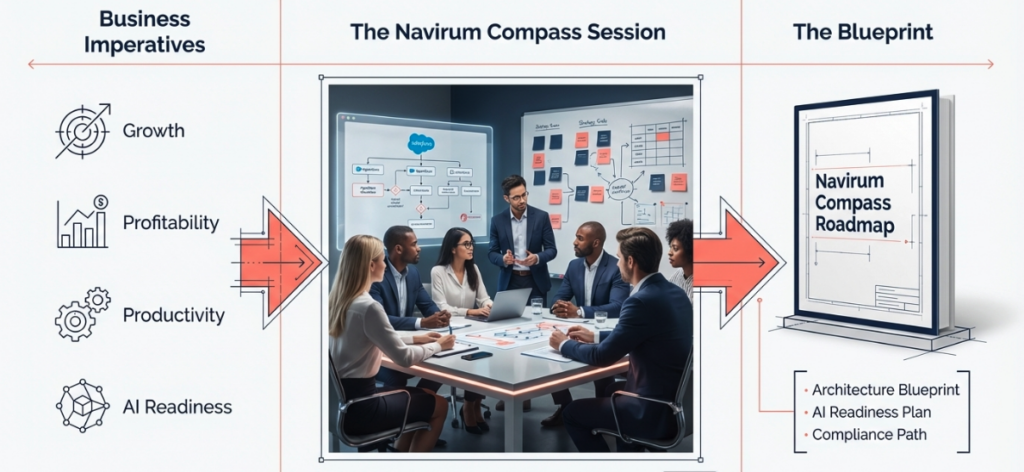
Through our Compass Workshops, we:

What is The Value From A Salesforce Health Check?

Worth $500, in each health check, we look at how you can realign Salesforce with your original business goals and get you back on the path to success. As well as the strategic perspective, we check your Salesforce org security for vulnerabilities, financial industry best practices, ways to cut costs, improve user adoption levels, and much more!

With each free Navirum Salesforce health check, you will get a report including:

  • ✅ 30 minute 1:1 session with a highly experienced Salesforce Consultant
  • ✅ Opportunities for improvement report to share with your colleagues
  • ✅ A road map for Salesforce Success aligning with your business goals

All of our Salesforce health checks are performed by highly experienced consultants who have worked on hundreds of projects in their career.

How To Book Your Free Salesforce Health Check?

Get clarity on what’s slowing you down—and exactly how to fix it. Click on any of the Book Your Free Salesforce Health Check buttons, or fill out the form below to begin scheduling your free health check. We look forward to hearing from you.

Our Salesforce Health Check starts with your business goals and delivers a clear roadmap to success. We use our compass workshops to plot the right direction
Guided by Compass Workshops, we align Salesforce to your goals — with a clear roadmap for results

Proven Results

Navirum has delivered thousands of Salesforce projects across complex, highly regulated financial environments. This depth of experience allows us to quickly diagnose issues that others miss—from technical debt and over-customization to compliance gaps and data fragmentation.

We embed this expertise into every Health Check, delivering not just insights—but a clear, strategic path forward based on what has consistently driven success across our clients.

Navirum, your input into Salesforce and support with the usability and onboarding was first rate, I would have no hesitation in recommending you.

– J. Hall, VP of Sales, DING

Navirum was very professional and enjoyable to work with during our build out of Salesforce. They were knowledgeable and helped Sterling navigate the process in an efficient manner.

– Erica Chaffee, President and CFO, Sterling Management

I would highly recommend that organized and focused project managers work with Navirum for their CRM transition projects.

-Shelby Murphy, Head of Marketing, Main Management

Navirum Client Success Stories in Financial Services

If you think a free Salesforce Health Check will give you a clear direction on your Salesforce program, book below👇

Where do Salesforce projects go wrong?

Salesforce implementations go off track for many reasons, including:

  • Over-customization of Salesforce leads to poor usability and high maintenance costs.
  • No plan or strategic roadmap leads to poor value creation over the long term
  • Gaps in industry knowledge to understand the real needs of the business

Yet, the #1 reason programs veer off course is due to a lack of alignment with the company’s overarching business objectives. This is especially true for financial institutions, which often have distinctive strategic goals. Whether it’s managing suitability obligations for Broker-Dealers, deal pipeline management for Private Equity firms, or efficient client onboarding for Financial Advisors. 

Sounds familiar? Some businesses are super successful with Salesforce? Even a smaller company like PenFed Credit Union

How do we get it right? Well is starts with the right foundation… 👇

Do you need to run a health check for your Salesforce org? Get expert guidance from Navirum.

The certified health-check experts conduct a detailed gap analysis and recommend a roadmap to higher performance and a robust Salesforce ecosystem.

Book Your FREE Health Check Now!

SF Health Check
First
Last

FAQ

What does a Salesforce Health Check include?

A Salesforce Health Check is a comprehensive review of your org’s data quality, system performance, security settings, integrations, and overall configuration. It identifies inefficiencies, risks, and missed opportunities. You’ll receive clear, prioritized recommendations to improve usability, scalability, and ROI.

How long does a Salesforce Health Check take?

Most health checks are completed within 1–2 weeks, depending on the complexity of your Salesforce environment. This includes analysis, stakeholder input, and a final review session. We focus on delivering actionable insights quickly, without disrupting your operations.

Is a Salesforce Health Check really free?

Yes, the health check is completely free and comes with no obligation. It’s designed to provide immediate value by highlighting areas for improvement. If you choose to move forward with recommendations, that’s entirely up to you.

What is the difference between a Health Check and a full Salesforce audit?

A health check is a high-impact, fast assessment focused on identifying key issues and quick wins. A full audit is more in-depth, involving detailed documentation, process mapping, and long-term transformation planning. Think of a health check as a diagnostic, and an audit as a full overhaul strategy.

How do I know if my Salesforce org is AI-ready?

Your org is AI-ready if your data is clean, structured, and consistently used across processes. You also need well-defined workflows, strong governance, and integrated systems. If these foundations aren’t in place, AI tools like Agentforce can amplify inefficiencies instead of solving them.

What makes Navirum different from other Salesforce consultants?

Navirum combines deep Salesforce expertise with real-world financial services experience, ensuring solutions are both technically sound and business-relevant. We focus on outcomes—efficiency, scalability, and growth—not just implementation. Our approach is practical, senior-led, and built on delivering measurable results, not just recommendations.

RoryWhy Your Salesforce Is Quietly Costing You Time and Money

3 Powerful Ways Broker-Dealers Use Salesforce To Stay Compliant

Discover 3 Powerful Ways Broker-Dealers Use Salesforce To Stay Compliant!

Listen in depth:

Salesforce for broker dealers discussion

At Navirum, we are specialists in helping broker-dealers implement Salesforce. Navigating regulatory compliance and growing a business is a challenge. Here are 3 ways Salesforce can help broker deals to streamline and grow without compliance headaches. We’ve included a common FAQs for broker dealers and Salesforce at the end. Enjoy!

#1 Suitability & Segmentation with Broker-Dealer CRM

A modern broker dealer CRM built on Salesforce allows firms to create detailed client profiles based on financial goals, risk tolerance, investment preferences, and regulatory needs. This level of segmentation ensures that every recommendation is suitable and tailored, improving both compliance and client satisfaction.

Unmatched segmentation and suitability

#2 Compliance CRM for Regulatory Confidence


An integrated compliance CRM enables broker-dealers and financial institutions to track disclosures, risk assessments, and suitability documentation. Back office and portfolio management (PMS) systems integrations are possible including multi-custodial integrations (see more here) helping create a 360 degree client view. Salesforce workflows automate compliance checks, making it easier to align product recommendations with FINRA, SEC, and other regulatory requirements.

Massive compliance efficiencies

#3 AI-Enabled CRM for Smarter Recommendations


With an AI enabled CRM, financial advisors and broker-dealers can leverage predictive analytics to recommend products that best align with client objectives. AI-driven alerts and portfolio monitoring ensure that product suitability is continuously reviewed and updated.

AI enabled recommendations

Business Impact

  1. Ensure every financial recommendation is suitable and compliant

  2. Automate compliance workflows and reduce manual risk

  3. Use AI-enabled CRM features to personalize client interactions

  4. Strengthen trust with a single source of truth for compliance and client data

Bottom line: By combining Salesforce with an AI enabled, compliance-focused, financial services CRM, broker-dealers gain the tools to stay compliant, strengthen client relationships, and grow their business confidently.

Are you broker dealer needing Salesforce help? Help is a click away …

Contact Us
First


⭐⭐⭐ DISCOVER NAVIRUM ⭐⭐⭐

CSAT 5/5 – Salesforce AppExchange

Customer Success Stories

Salesforce Expertise


FAQs – Salesforce Broker Dealer – FAQs

How does Salesforce help broker-dealers with regulatory compliance?

Salesforce provides compliance-focused workflows that track disclosures, risk assessments, and suitability documentation. This ensures broker-dealers meet FINRA, SEC, and other regulatory requirements while reducing manual risk.

What is suitability and segmentation in a broker-dealer CRM

Suitability and segmentation allow firms to create detailed client profiles based on goals, risk tolerance, and investment preferences. Salesforce makes it easier to recommend the right products and demonstrate compliance with suitability standards.

Can Salesforce automate compliance workflows for broker-dealers

Yes. Salesforce automates critical compliance steps, such as documentation, product approvals, and portfolio reviews, saving time and minimizing errors.

How does AI improve Salesforce for broker-dealers?

AI-enabled Salesforce features provide predictive analytics and real-time alerts, helping advisors recommend suitable products and continuously monitor client portfolios for compliance.

Why should broker-dealers choose Salesforce over other CRMs?

Salesforce is a trusted financial services CRM that combines compliance tools, AI-powered recommendations, and a single source of truth for client data—helping firms grow while staying compliant.

What business impact can broker-dealers expect from using Salesforce?

Broker-dealers can expect streamlined compliance, reduced operational risk, personalized client interactions, and stronger client trust—all driving sustainable business growth.

How do custodial integrations like Schwab, Pershing, Fidelity, and Raymond James work with Salesforce?

Custodian integrations – such as Schwab Advisor Center, Pershing, Fidelity Wealthscape, and Raymond James—connect account-level data directly into Salesforce Financial Services Cloud. These integrations bring in balances, transactions, positions, RMDs, and alerts, giving broker-dealers and advisors a 360° client view inside their CRM.

Schwab Advisor Center → Daily sync of account balances, positions, RMD history, and money movement with single sign-on.
(Schwab Integration Overview)
Fidelity Wealthscape → Allows advisors to view and manage brokerage accounts within Salesforce, streamlining suitability checks and digital workflows.
(Fidelity Newsroom Release)
Pershing X (Wove) → Deep integration with Salesforce FS Cloud for onboarding, data sharing, and engagement workflows.
(Salesforce + Pershing X Announcement)
Raymond James → Similar to others, Raymond James offers Salesforce API connectivity to sync custodial data, enabling advisors to see real-time account updates and compliance records.

These custodial integrations transform Salesforce into the single source of truth for client financial data – streamlining suitability reviews, reducing compliance risk, and giving advisors more time to focus on clients.

How do Portfolio Management Systems like Addepar, Orion, Black Diamond, Advent/APX, and Tamarac integrate with Salesforce?

Portfolio Management Systems (PMS)- such as Addepar, Orion Advisor Tech, Black Diamond, SS&C Advent/APX, and Envestnet Tamarac—can be integrated with Salesforce to give advisors a real-time view of portfolio performance, holdings, transactions, and reporting directly inside their CRM. This means advisors no longer need to toggle between systems—they can see investment data in the same place they manage client relationships.

Addepar → Integrates with Salesforce to surface performance reporting, portfolio breakdowns, and client-level analytics.
(Addepar Salesforce Integration)
Orion Advisor Tech → Pushes household performance, account balances, and fee billing data into Salesforce, enhancing client review workflows.
(Orion + Salesforce Integration)
Black Diamond (SS&C) → Connects portfolio reporting, account aggregation, and client dashboards into Salesforce, providing a unified advisor workspace.
(Black Diamond Wealth Platform)
SS&C Advent/APX → Delivers institutional-grade portfolio and accounting data into Salesforce for compliance, reporting, and investment analysis.
(SS&C Advent APX)
Envestnet Tamarac → Links Salesforce with portfolio rebalancing, performance reports, and client portals, streamlining advisor-client interactions.
(Envestnet Tamarac Integration)

So PMS integrations ensure Salesforce becomes the hub for both client engagement and investment intelligence, enabling advisors to deliver more personalized service while maintaining compliance and operational efficiency.

Rory3 Powerful Ways Broker-Dealers Use Salesforce To Stay Compliant

4 Powerful Ways Salesforce Helps Group Benefits Providers in 2025

At Navirum, we are specialists in helping group benefits and retirement companies implement Salesforce. Many companies in this industry struggle with high operational and administrative overhead. A properly implemented Salesforce instance can reduce costs by 50%. If you are moving from an excisting CRM to Salesforoce, you might considering this guide

Quicklinks To Key Sections

The 4 Ways Are

1) Client Onboarding

By Streamlining and automating the client onboarding process through automation, workflows, notifications, and marketing automation, customers have dramatically improved their client onboarding process and cost. The downstream impact is happy customers and employees as well as significant cost savings.

    2) Personalized Relationship Management (CRM):

    Group benefits and retirement companies can use Salesforce’s CRM capabilities to create tailored customer profiles, track interactions, and manage client relationships effectively. By centralizing customer data, including communication history, policy details, and retirement plans, companies can provide personalized services and improve overall customer satisfaction. The Salesforce Financial Service Cloud help deliver all of this. Big insurance companies have been doing this for quite some time with Salesforce. Find out more below

      3) Automated Enrolment Processes:

      Salesforce’s workflow automation tools can help simplify and automate the enrolment process for group benefits and retirement plans. Companies can use Salesforce to manage the enrolment workflow, including document collection, data entry, and communication with employees. Automation can reduce manual errors, improve efficiency, and provide a smoother experience for both employers and employees. The Prudential story is a relevant and exciting one for group benefits and insurance firms. Check out

        Find Out How Prudential leverage Salesforce for Group Benefits and Insurance Excellent

        4) Streamlined Plan Management

        Salesforce can be used to manage and track group benefit plans and retirement accounts efficiently. Companies can set up automated alerts for plan renewals, track plan contributions, and provide real-time updates to employers and employees. Companies can also integrate with carriers to improve performance even further. Think you are ready to make the move to Salesforce? Check out Salesforce readiness checklist to measure how ready you are

          Implementing Salesforce in these ways can help group benefits and retirement companies streamline their operations, deliver exceptional customer experiences, and achieve long-term business success in the industry. To find out how Navirum can help you implement Salesforce Financial Service Cloud successfully, please contact us for a free consultation.

          Book a Consultation Now To Get Guidance and Direction

          Contact Us
          First

          FAQs – Salesforce Group Benefits and Insurance Firms

          What makes Salesforce Financial Services Cloud ideal for group benefits and retirement providers?

          FSC is purpose-built for financial services. It enables personalized relationship management, real-time tracking of client data, and visibility across policies, plans, and interactions. For group benefits firms, this means delivering a tailored client experience that drives retention, satisfaction, and competitive advantage.

          Can I integrate with back office systems like claims, carrier systems, and investments?

          Yes, one of the most common requirements. Each integration is different and requires a consultation to provide direction. Contact us.

          How does Salesforce improve the enrolment process for group plans?

          Salesforce’s workflow automation can eliminate manual steps in group plan enrolment, including form submission, eligibility validation, and communications. This not only improves accuracy but also accelerates the process – helping HR teams and brokers serve clients more efficiently. Prudential’s use case illustrates the scale this can unlock.

          What role does Salesforce play in managing and tracking benefit plans?

          Salesforce can automate alerts for renewals, track contributions, and integrate with carriers – creating one system of truth. This reduces admin costs and allows proactive engagement with clients. Navirum specializes in building Salesforce solutions that align directly to your plan management needs.

          What should I consider before migrating from my current CRM to Salesforce?

          Successful migrations hinge on clear goals, data integrity, and aligning Salesforce features with your business model. Navirum’s readiness checklist helps you assess migration complexity and plan effectively. If you’re moving from an existing CRM, our Strategic Consulting team can guide a seamless transition and de-risk the process. Check out these CRM to Salesforce tips


          What real-world AI features in Salesforce FSC benefit insurers today?

          Group benefits providers and insurers can use Agentforce to boost productivity, predict lapse risk, detect fraud, automate renewals, and personalize coverage recommendations. Navirum configures these tools so your insurance firm can act on insights right away – no extra dev needed. Find out more about Agentforce here

          ⭐⭐⭐ DISCOVER NAVIRUM ⭐⭐⭐

          CSAT 5/5 – Salesforce AppExchange

          Customer Success Stories

          Salesforce Expertise

          Thanks for reading!

          Rory4 Powerful Ways Salesforce Helps Group Benefits Providers in 2025

          Salesforce Health Check for Financial Services

          Salesforce Health Check for Financial Services: Turning CRM Findings Into a Strategic Roadmap

          Estimated reading time: 12 minutes

          Salesforce is rarely just a CRM for a financial services organization. It can influence how advisors manage relationships, how service teams support clients, how leadership views business performance, and how data moves across the firm’s technology ecosystem.

          That makes decisions about Salesforce more complicated than simply deciding whether a feature is working correctly.

          As your organization grows, leadership may face questions such as: Should we redesign part of our Salesforce environment? Should we invest in new automation? Is our current architecture ready for AI? Should we consolidate systems? Should we modernize before launching another major initiative?

          A Salesforce Health Check can help answer these questions—but its greatest value comes from using the findings to make better decisions about what happens next.

          For financial services leaders, the objective should not be to produce a long list of technical recommendations. It should be to understand how Salesforce supports the firm’s strategic priorities and where technology decisions could create measurable business value.

          Why Salesforce Health Checks Should Be Connected to Business Strategy

          A common mistake is to treat a Salesforce assessment as an IT exercise.

          Technical findings are important, but they don’t exist in isolation. A Salesforce configuration that looks inefficient from a technical perspective may actually support an important business requirement. Conversely, something that appears minor technically may create significant friction for advisors or client-service teams.

          The more useful question is therefore:

          How well is Salesforce supporting the way our financial services organization operates and where it is going?

          This means evaluating Salesforce decisions against broader business priorities such as:

          • Growth and expansion
          • Advisor productivity
          • Client experience
          • Operational scalability
          • M&A integration
          • Digital transformation
          • Data strategy
          • AI adoption
          • Technology modernization
          • Cost management

          This strategic perspective changes the purpose of a Health Check from “What is wrong with our Salesforce org?” to “Where should we invest in Salesforce next?”

          1. Start With Business Capabilities, Not Salesforce Features

          Financial services firms often approach Salesforce planning from a technology perspective:

          “We need this feature.”

          “We need another integration.”

          “We should implement this Salesforce product.”

          A more strategic approach starts with the business capability the organization is trying to improve.

          For example:

          Business objective: Improve advisor productivity.

          Instead of immediately deciding to add automation, ask:

          • Where is advisor time currently being lost?
          • Which processes require duplicate data entry?
          • Where do advisors switch between systems?
          • Which information do advisors need but struggle to find?
          • Which activities could be simplified?

          Only then should Salesforce capabilities be evaluated.

          This approach prevents the organization from implementing technology simply because it is available and instead focuses investment on the business outcomes Salesforce is expected to support.

          2. Identify Where Salesforce Creates Friction in the Client Lifecycle

          For financial services organizations, Salesforce should ultimately support the relationships that drive the business.

          That means looking at the client lifecycle, rather than examining Salesforce functionality in isolation.

          Consider the journey from prospect to client and beyond:

          At each stage, ask where Salesforce helps and where it creates friction.

          For example:

          Prospecting

          Can teams see relevant relationship information before engaging with a prospect?

          Onboarding

          Are handoffs between teams efficient, or do employees have to coordinate activities manually?

          Relationship management

          Can advisors and relationship managers easily access the information they need to prepare for client interactions?

          Service

          Can service teams understand the context of a request without asking clients or colleagues to provide information that should already be available?

          Expansion and retention

          Can the organization identify opportunities to deepen relationships based on the information it already has?

          This perspective helps connect Salesforce optimization to client and revenue outcomes, rather than treating it solely as a technology project.

          3. Evaluate Salesforce Through the Lens of Different User Roles

          There is rarely a single “Salesforce user” inside a financial services organization.

          The needs of an advisor can be very different from those of a service associate, operations employee, relationship manager, executive, or Salesforce administrator.

          Consequently, a Salesforce environment should be evaluated through multiple perspectives.

          RoleKey question
          AdvisorDoes Salesforce help me prepare for and manage client relationships?
          Relationship ManagerCan I understand relationships, opportunities, and interactions efficiently?
          Client ServiceCan I resolve requests without unnecessary searching or handoffs?
          OperationsCan I execute processes consistently and efficiently?
          LeadershipCan I obtain reliable insight to make decisions?
          Salesforce TeamCan we maintain and evolve the platform efficiently?
          Executive LeadershipIs Salesforce supporting our strategic priorities?

          This approach can reveal something important: a Salesforce org can work well for one group while creating significant friction for another.

          4. Use the Health Check to Support M&A and Organizational Change

          Mergers and acquisitions create a particularly important use case for Salesforce assessments.

          When a financial services firm acquires another organization, it may inherit different CRM processes, technology platforms, data structures, and operating models.

          The immediate temptation may be to migrate everything into the existing Salesforce environment.

          However, that can be risky.

          Before deciding how to integrate the organizations, leadership should understand:

          • Which processes are genuinely different?
          • Which capabilities are duplicated?
          • Which technology investments should be retained?
          • Which business practices should become standardized?
          • What should be migrated?
          • What should be retired?
          • Where are the biggest integration dependencies?

          A Salesforce Health Check can therefore become part of the technology due-diligence and post-acquisition planning process, helping leadership make more informed decisions before committing to a large migration or consolidation project.

          5. Assess Salesforce Readiness Before Major Transformation

          A Salesforce Health Check is particularly valuable before a major transformation.

          Imagine an organization preparing to implement Financial Services Cloud, Data 360, Agentforce, or a major new integration.

          The natural focus is often on the new technology.

          However, the existing Salesforce environment can have a significant influence on the complexity and outcome of the initiative.

          Before moving forward, leadership should understand:

          What can we build upon?

          Existing capabilities, processes, and investments may be reusable.

          What needs to change?

          Some aspects of the current environment may need modernization first.

          What should we stop doing?

          Transformation is often an opportunity to retire unnecessary processes rather than simply rebuilding everything in a new environment.

          What should we standardize?

          Different teams or business units may have developed different approaches to similar processes.

          This turns the Health Check into a pre-transformation planning exercise, rather than simply a technical review.

          6. Connect Salesforce Decisions to Total Cost of Ownership

          Salesforce investment isn’t limited to subscription costs.

          The long-term cost of an environment can also be influenced by:

          • Internal Salesforce administration
          • Development
          • Integration maintenance
          • Testing
          • Support
          • Training
          • Custom development
          • Data management
          • Third-party applications
          • External consulting
          • Technical debt

          A Salesforce Health Check can help leadership understand where complexity is creating ongoing operational costs.

          For example, two solutions may both accomplish the same business objective, but one may require significantly more maintenance over time.

          This leads to a more strategic question:

          What is the long-term cost of maintaining the Salesforce environment we’re building today?

          For financial services organizations making multi-year technology investments, that question can be more valuable than simply asking whether a particular Salesforce feature works.

          7. Treat AI Readiness as a Business Transformation Question

          AI initiatives such as Agentforce should not be evaluated independently from the broader Salesforce strategy.

          Instead of asking:

          leadership should ask:

          For example, AI could potentially support areas such as:

          • Advisor preparation
          • Client-service assistance
          • Knowledge retrieval
          • Internal employee support
          • Onboarding
          • Workflow orchestration
          • Case summarization
          • Administrative tasks

          The opportunity is not simply to deploy an AI capability.

          The opportunity is to determine where AI can create meaningful business value and then assess whether the Salesforce environment can support that use case.

          This makes AI readiness part of the broader Salesforce strategy rather than a separate technology initiative.

          8. Turn Findings Into a Prioritized Investment Plan

          A Salesforce assessment can produce dozens of observations.

          The challenge is deciding what to do with them.

          Financial services leaders rarely need another document containing a long list of technical recommendations. They need to know what matters most.

          A useful prioritization framework can categorize recommendations according to:

          PriorityMeaning
          ImmediateBusiness-critical issue or significant risk
          HighImportant improvement with meaningful business impact
          StrategicSupports a larger transformation or growth initiative
          OptimizationValuable improvement but not urgent
          MonitorNo immediate action required

          You can then evaluate each recommendation against:

          This creates a more actionable Salesforce roadmap and prevents organizations from attempting to fix everything simultaneously.

          9. Establish a Salesforce Decision Framework

          One of the most valuable outcomes of a Health Check can be a clearer framework for making future Salesforce decisions.

          Before approving another customization, integration, application, or automation, leadership can ask:

          Does this solve an important business problem?

          If not, reconsider the request.

          Does this capability already exist?

          If so, determine whether it can be configured or reused rather than rebuilt.

          Is Salesforce the right place for this process?

          Not every process belongs in Salesforce.

          Will this create a long-term dependency?

          Consider the maintenance and operational implications.

          Does this support our broader Salesforce strategy?

          Individual enhancements should contribute to a coherent direction.

          This creates a more disciplined approach to Salesforce governance without turning every technology decision into a lengthy approval process.

          10. Build a Roadmap That Reflects the Business

          The final value of a Salesforce Health Check should be a clearer path forward.

          Instead of a technical document filled with recommendations, leadership should be able to see how Salesforce improvements connect to business priorities.

          For example:

          Now: Foundation

          Focus on issues that prevent the organization from moving forward.

          Next: Optimization

          Improve processes, simplify the user experience, and remove unnecessary complexity.

          Then: Transformation

          Introduce larger capabilities such as new Salesforce products, advanced integrations, Data 360, or AI.

          This phased approach allows organizations to make progress without attempting to transform the entire Salesforce environment at once.

          Online Resources, Knowledge and Insights | Navirum

          Questions Financial Services Leaders Should Ask After a Salesforce Health Check

          Once an assessment is complete, leadership should not stop at reviewing the findings.

          The more valuable discussion is what those findings mean for the organization.

          Consider asking:

          • Which Salesforce issues are actually affecting business performance?
          • Which findings require immediate action?
          • Which issues can safely wait?
          • Where are we spending too much time or money?
          • Which processes should be redesigned rather than automated?
          • Are we investing in Salesforce capabilities that users aren’t fully leveraging?
          • What should our Salesforce environment look like in three years?
          • Which upcoming initiatives depend on improvements to the current environment?
          • What should we standardize across business units?
          • Where could AI create measurable value?
          • What should our next Salesforce investment be?

          These questions help move the conversation from technical maintenance to strategic technology management.

          From Salesforce Assessment to Business Strategy

          A Salesforce Health Check should not be the end of the conversation.

          Its greatest value comes from helping financial services leaders make better decisions about the future of their Salesforce environment.

          The right assessment can help organizations understand where Salesforce is supporting the business effectively, where friction exists, and where investment could create the greatest impact.

          Most importantly, it can provide a foundation for a prioritized Salesforce roadmap that connects technology decisions to business objectives.

          For financial services organizations, that may mean improving advisor productivity, simplifying client journeys, supporting acquisitions, preparing for AI, modernizing the technology ecosystem, or creating a more scalable foundation for growth.

          The goal is not simply to have a healthier Salesforce org.

          The goal is to have a Salesforce environment that is helping the business perform better.

          Take the Salesforce Org Health Score | Navirum Main Navigation CTA Showcase | Navirum

          Schedule Your Session

          Let’s find a time to chat about your Salesforce strategy and AUM growth.

          Continue to Calendar
          Navirum Discover Block
          RorySalesforce Health Check for Financial Services

          5 Powerful Ways Salesforce Helps Mortgage Brokers Win More Deals

          How Salesforce Helps Mortgage Brokers Win More Deals?

          Salesforce Financial Services Cloud (FSC) helps mortgage brokers win more deals by streamlining lead management, automating loan origination, ensuring regulatory compliance, and enhancing client relationships. Brokers can capture and prioritize high-quality leads, track loan applications in real time, and maintain full audit trails for TRID and RESPA compliance. With integrated analytics and reporting, mortgage professionals gain actionable insights into pipeline performance and operational bottlenecks. Supported by Navirum’s expert implementation, Salesforce FSC enables brokers to scale efficiently, deliver personalized client experiences, and make data-driven decisions to grow their business.

          At Navirum, we specialize in helping mortgage brokers grow their business using Salesforce Financial Services Cloud (FSC) — the world’s #1 CRM. In today’s highly competitive mortgage industry, success hinges on efficiency, compliance, and client experience.

          Salesforce gives brokers a powerful edge by automating workflows, enhancing client communications, and ensuring regulatory compliance. Below are five key ways Salesforce FSC can help your mortgage brokerage win more deals and scale efficiently.

          What is Salesforce?

          What is Salesforce Anyway?

          5 Ways to Win More Deals

          #1 Streamline Lead Generation and Management

          Effective lead management is critical for growing a mortgage business. Salesforce Financial Services Cloud helps brokers:

          • Capture and track leads from multiple sources
          • Analyze lead behavior and engagement
          • Prioritize high-quality leads for outreach

          With these insights, brokers can focus their energy where it matters most—on qualified prospects—leading to faster conversions and a stronger sales pipeline.

          #2 Simplify Loan Origination and Processing

          Loan origination can be time-consuming without the right tools. Salesforce helps brokers manage the full loan lifecycle, from initial application to closing, by:

          • Centralizing borrower data
          • Tracking application progress in real time
          • Automating communication with clients and internal teams

          Salesforce also integrates seamlessly with popular mortgage systems like Encompass reducing manual data entry and improving speed-to-close.

          #3 Stay Ahead of Regulatory Compliance

          Compliance is a top concern for mortgage professionals. Salesforce FSC supports brokers by offering:

          • Automated tracking of disclosures and document submissions
          • Real-time alerts on changing regulations
          • Detailed audit trails to ensure full transparency

          This makes it easier to remain compliant while reducing the administrative burden on your team.

          #4 Build Stronger Customer RelationshipsCustomer Relationship Management:

          Great client experience drives repeat business and referrals. Salesforce helps mortgage brokers build trust and loyalty by:

          • Keeping client records and communication history in one place
          • Automating personalized follow-ups and updates
          • Providing secure client portals for real-time loan updates

          This level of customer relationship management improves satisfaction and keeps clients engaged throughout the loan process.

          #5 Gain Insights with Analytics and Reporting

          Data-driven decisions give you a competitive edge. Salesforce provides robust analytics and reporting tools that allow mortgage brokers to:

          • Monitor loan volume and conversion rates
          • Track sales performance and pipeline metrics
          • Identify bottlenecks and optimize processes

          These insights help you run a more efficient and profitable mortgage operation.

          Salesforce Agentforce is Game Changer For Financial Services Firms

          Ready to Grow Your Mortgage Business with Salesforce?

          At Navirum, we help mortgage brokers implement and optimize Salesforce Financial Services Cloud to unlock growth and efficiency. Whether you’re just starting or looking to improve your existing Salesforce setup, our expert team is here to help.

          Ready to Grow Your Mortgage Business with Salesforce? Book A Consultation

          Contact Us
          First

          Recent Navirum Client Success Stories

          Frequently Asked Questions (FAQs)

          What is Salesforce Financial Services Cloud (FSC) and how is it different from regular Salesforce?

          Salesforce Financial Services Cloud (FSC) is a version of Salesforce tailored specifically for financial institutions, including mortgage brokers. It offers industry-specific tools like loan tracking, compliance management, client onboarding workflows, and relationship mapping—features not available in the standard Salesforce platform.

          Can Salesforce integrate with mortgage software like Encompass?

          Yes, Salesforce can be integrated with Encompass and other mortgage solutions through APIs or middleware platforms like MuleSoft. This allows brokers to sync borrower data, loan applications, and compliance documents between systems, reducing manual entry and improving efficiency.

          Is Salesforce FSC compliant with financial regulations?

          Salesforce FSC provides a strong foundation for regulatory compliance. It offers secure data storage, automated audit trails, role-based access controls, and compliance tracking tools to help mortgage brokers meet industry regulations such as TRID, RESPA, and others.

          How long does it take to implement Salesforce for a mortgage brokerage?

          Implementation timelines can vary depending on your business size and customization needs. At Navirum, typical Salesforce Financial Services Cloud implementations for mortgage brokers take 6 to 12 weeks, including planning, configuration, integration, and user training.

          How can Navirum help my brokerage get started with Salesforce?

          Navirum is a certified Salesforce consulting partner with deep experience in the mortgage and financial services sector. We provide end-to-end support—from discovery and design to implementation, integration, and ongoing support—to ensure you get the most value from Salesforce Financial Services Cloud.

          Not sure if you’re ready to implement Salesforce Financial Services Cloud?

          Take the uncertainty out of the equation with our Salesforce FSC Readiness Assessment. This free tool helps you evaluate your organization’s preparedness across critical areas such as:

          • Business Alignment
          • Data & Integration
          • Compliance & Security
          • Adoption & Change Management
          • Continuous Improvement
          • Time & Resource Commitment

          In just a few minutes, you’ll gain insights into your strengths, uncover potential gaps, and walk away with a clearer picture of what’s needed for a successful Salesforce FSC implementation.

          Download the assessment below to get started.

          Salesforce FSC Implementation Readiness Checklist
          Lead Magnet – Salesforce FSC Implementation Readiness Checklist

          Download Your FREE Salesforce FSC Implementation Readiness Checklist!

          Name
          Name
          First Name
          Last Name

          Thanks for reading!

          Kristina5 Powerful Ways Salesforce Helps Mortgage Brokers Win More Deals

          How Salesforce Grows Private Equity Firms: 5 Powerful Use Cases

          How Salesforce Helps Private Equity Firms Grow?

          Discover why private equity firms are turning to Salesforce for scalable growth!

          In today’s fast-moving investment landscape, private equity firms need smarter tools to manage everything from deal sourcing to investor relations. Salesforce—one of the world’s most powerful CRM and business platforms – offers a game-changing solution.

          At Navirum, we specialize in helping private equity firms implement Salesforce to unlock efficiency, drive growth, and enhance transparency.

          In this article, we’ll explore five strategic ways Salesforce helps private equity firms scale their operations and streamline key functions.

          Streamline Deal Sourcing and Due Diligence

          Finding and managing the right deals is the lifeblood of any private equity firm. But tracking dozens—or hundreds—of potential targets can get messy fast.

          With Salesforce, PE firms can:

          • Centralize deal flow data in a single dashboard
          • Track pipeline stages: from lead to letter of intent
          • Log key information on targets, valuations, and contacts
          • Automate due diligence workflows and reminders

          🔗 Salesforce also integrates with data platforms like Pitchbook, Dakota and Preqin, giving firms real-time access to critical market data right inside their CRM.

          📊 Pro Tip: Use Salesforce’s AI features to score and prioritize deals based on historical success metrics.

          Improve Investor Relationship Management

          Investor satisfaction depends on clear, consistent communication and up-to-date information. Salesforce makes investor relations easier and more professional.

          Here’s how private equity firms use Salesforce to manage investors:

          • Track capital commitments and investment history
          • Automate investor communications (emails, updates, reports)
          • Manage document sharing through secure portals
          • Maintain a detailed log of interactions and preferences

          ✅ Result: Better investor experiences, stronger trust, and faster responses during fundraising rounds.

          🛠️ Example: Use Salesforce Experience Cloud to create custom investor dashboards with real-time performance data.

          Request Your Salesforce Readiness Assessment | Navirum

          Simplify and Accelerate Fundraising

          Fundraising is one of the most time-intensive activities for PE firms. Without proper tracking, it’s easy to lose momentum or miss key follow-ups.

          Salesforce helps you:

          • Build a database of qualified LP prospects
          • Track all communications and touchpoints with potential investors
          • Run targeted fundraising campaigns with built-in email tools
          • Analyze pipeline performance by region, firm type, or fund size

          📈 Insight: Salesforce’s campaign analytics show you what’s working—and what’s not—so you can refine your approach and improve capital raise outcomes.

          Optimize Portfolio Company Management

          Once the deal is closed, the real work begins. Managing and monitoring portfolio companies across sectors and geographies requires structure and data visibility.

          With Salesforce, PE firms can:

          • Track financial and operational KPIs per portfolio company
          • Set reminders for board meetings, updates, and milestones
          • Maintain a history of executive communications and strategy updates
          • Share dashboards with internal and external stakeholders

          📍 Use Case: Build customized dashboards by portfolio company or industry vertical to monitor growth metrics in real time.

          💡 Bonus: Integrate third-party tools like Tableau or Excel with Salesforce for advanced reporting.

          Why Private Equity Firms Should Leverage Agentforce CTA | Navirum

          Gain Deeper Insights with Reporting and Analytics

          Data-driven decisions lead to better results. Salesforce’s built-in analytics tools help firms track performance at every stage of the investment lifecycle.

          You can create reports on:

          • Deal pipeline health and close rates
          • Fundraising progress and investor engagement
          • Portfolio performance by sector, region, or fund
          • Team productivity and task completion rates

          Salesforce dashboards are customizable and real-time, helping private equity teams stay informed and make smarter decisions.

          📊 Stat: Firms that use data-driven reporting tools grow 35% faster than firms that rely on manual tracking (source: PwC).

          Ready to Scale Your PE Firm with Salesforce? | Navirum Online Resources — Knowledge & Insights | Navirum Wealth Management Salesforce Success Stories CTA Banner | Navirum

          Schedule Your Session

          Let’s find a time to chat about your Salesforce strategy and AUM growth.

          Continue to Calendar
          Take the Next Step | Navirum Navirum Discover Block

          Lavinia PicuHow Salesforce Grows Private Equity Firms: 5 Powerful Use Cases

          5 Powerful Ways Pardot Can Boost Your Financial Services Marketing Strategy

          5 Ways To Boost Growth in 2025 With Pardot (now Marketing Cloud Account Engagement)

          Marketing automation is a game-changer for financial services companies looking to scale efficiently. One of the best tools for achieving this is Pardot (now Marketing Cloud Account Engagement), a powerful platform that enhances lead generation, nurturing, sales enablement, and compliance management. In this post, we’ll explore 5 ways Pardot can supercharge your business and help you streamline your marketing efforts.

          1. Generate High-Quality Leads with Pardot

          For financial services companies, attracting the right leads is critical. Pardot lead generation tools help you create targeted campaigns that speak directly to your audience’s needs. By tracking user behavior and engagement, Pardot allows you to pinpoint the most effective channels and strategies to reach potential clients at the right time.

          Benefits of Pardot for Lead Generation:

          • Targeted campaigns tailored to specific buyer personas.
          • Behavior tracking to understand customer preferences and interactions.
          • Increased lead quality by focusing on the most promising prospects.

          Pardot helps you craft campaigns that generate leads that are more likely to convert, boosting your marketing ROI.

          Marketing Cloud Account Engagement – Lead Generations and Nurturing

          2. Nurture Leads with Personalized Marketing

          Once you’ve captured leads, the next step is nurturing them. Pardot lead nurturing ensures that your prospects receive the right message at the right time. By sending personalized emails and content based on user behavior, you can build strong relationships with potential clients. This personalized approach can help move them closer to making a purchase.

          How Pardot Nurtures Leads:

          • Personalized emails based on user activity.
          • Dynamic content to engage leads at every stage of the funnel.
          • Automated workflows that send timely follow-ups and reminders.

          Pardot makes it easier to keep leads engaged, ensuring that they don’t slip through the cracks and are constantly moving through your marketing funnel.

          3. Empower Your Sales Team with Pardot’s Sales Enablement Tools

          Your sales team plays a vital role in converting leads into clients. Pardot for sales enablement helps them close deals faster by providing insights into lead behavior and interests. With Pardot’s analytics, sales reps can tailor their outreach, personalize their pitches, and increase their chances of success.

          Key Sales Enablement Features in Pardot:

          • Lead scoring and grading to identify sales-ready leads.
          • Behavioral insights to help sales reps personalize their approach.
          • Seamless CRM integration for easy collaboration between marketing and sales teams.

          By providing your sales team with the right tools, you can improve their efficiency and help them close more deals.

          4. Track Your Marketing Performance with Pardot Analytics

          Understanding how your marketing efforts are performing is essential for ongoing success. Pardot analytics and reporting tools provide real-time insights into your campaigns, allowing you to see what’s working and what needs improvement. This data-driven approach enables financial services companies to optimize their marketing strategies and maximize ROI.

          Key Benefits of Pardot Analytics:

          • Customizable reports to track campaign performance and ROI.
          • Real-time insights into lead activity and engagement.
          • A/B testing to optimize email campaigns and landing pages.

          With Pardot’s powerful reporting capabilities, you can make informed decisions that drive better marketing outcomes.

          Marketing Cloud Account Engagement – Send List Emails 

          5. Ensure Compliance with Pardot’s Regulatory Tools

          Financial services companies face strict regulatory requirements. Pardot helps you stay compliant by offering tools that manage opt-ins, opt-outs, and other compliance-related tasks. This is crucial for avoiding penalties and maintaining trust with your clients.

          Compliance Features in Pardot:

          • Automated opt-in management to ensure compliance with email regulations.
          • Data privacy tools to safeguard customer information.
          • Customizable unsubscribe options to give customers control over their preferences.

          Pardot’s compliance features ensure that your marketing efforts adhere to industry standards, reducing the risk of legal issues.

          Conclusion: Leverage Pardot to Grow Your Financial Services Business

          Salesforce Marketing Cloud Account Engagement A.K.A Pardot, offers financial services companies a comprehensive suite of tools designed to optimize lead generation, nurturing, sales enablement, analytics, and compliance management. By integrating Pardot into your marketing strategy, you can not only streamline your processes but also enhance your ability to connect with prospects and close more deals.

          To learn more on How to boost to power of engagement, read our Strategies for maximizing Pardot account engagement in Financial Services.

          Are you ready to elevate your marketing automation? Start using Pardot today and see the difference it can make in growing your business. Contact us to learn more about how we can help you implement Pardot and achieve your goals.

          Ready to improve your marketing strategy?

          Contact Us
          First

          Kristina5 Powerful Ways Pardot Can Boost Your Financial Services Marketing Strategy

          7 Proven Ways to Boost Salesforce User Adoption

          Salesforce is not just the leading CRM on the market it is arguably one of the best productivity tools for sales, marketing, and customer service. Despite its popularity, Salesforce customers often experience user adoption challenges. This primarily comes from not having a user adoption strategy or support for users. Having implemented Salesforce for thousands of customers, we recognized this and created Orbit. How does Orbit help companies improve user adoption?

          • Salesforce roadmap: With each of our clients, we develop a project roadmap to deliver valuable monthly projects to our clients. We encourage your staff to participate in this process. This gives users visibility of upcoming improvements and gets them involved in the Salesforce program
          • Frequent training sessions: We can schedule training sessions as frequently as you need. From once a week to once a quarter, we do what it takes to ensure your team is fully capable of using Salesforce effectively.
          • Measure progress: We track user progress to see how they are interacting with Salesforce. We also take on board their feedback at different touchpoints. Using the information, we make recommendations to improve your Salesforce instance and build these into your roadmap
          • High touch support: With our sub one hour response time, your Salesforce users will get help from a Salesforce expert quickly to resolve technical issues or answer questions by phone, email, Slack, or your own Orbit portal. As part of Orbit, we get to know your Salesforce org in detail. This allows us to respond with solutions a lot faster due to our understanding of your security, code, configurations, and integration.

          To learn more about our managed services, please contact us below.

          Contact Us
          First
          Kristina7 Proven Ways to Boost Salesforce User Adoption

          Implement Salesforce with reduced cash flow burden and staff time consumption

          How To Implement Salesforce With Reduced Cash Flow Burden and Staff Time Consumption?

          Salesforce is the world’s leading CRM platform, powering growth for some of the most successful companies on the planet—from Cisco to American Express. Its flexibility, scalability, and robust ecosystem make it an attractive choice for organizations seeking to improve sales, customer service, and operational efficiency. Yet, for many businesses, the journey to Salesforce success is daunting. Implementing Salesforce for the first time can be time-consuming and requires a significant upfront investment. Not every company has the internal resources, project management expertise, or bandwidth to dedicate to a Salesforce project, but nearly all want to unlock its benefits.

          At Navirum, we recognized these challenges and created Orbit—a unique program designed to help businesses implement Salesforce successfully over time, without the heavy burden on cash flow or staff. Orbit is more than just a consulting service; it’s a new way to approach Salesforce implementation, one that delivers value predictably, flexibly, and efficiently.

          The Traditional Salesforce Implementation Challenge

          A typical Salesforce implementation can cost tens of thousands of dollars upfront, with moderate projects often reaching $50,000 or more before a single user logs in. This is a significant cash outlay for any business, especially when paired with the internal time commitment required from staff who are already busy with their day jobs. The result? Many companies delay or scale back their Salesforce ambitions, missing out on the platform’s full potential.

          Moreover, the complexity of Salesforce projects means that communication can quickly become a bottleneck. Even a “small” project can involve half a dozen people between Navirum and the client. Larger engagements may require coordination across 20–30 stakeholders, including leadership, subject matter experts, compliance, IT, and delivery teams. Without a disciplined communication model, things slow down, get lost, or become ambiguous—and ambiguity is the enemy of progress.

          How Navirum Orbit Helps Improve Cash Flow and Frees Up Time

          Orbit was designed to address these pain points directly, making Salesforce implementation accessible, affordable, and efficient for businesses of all sizes.

          1. Predictable Value Roadmap

          With Orbit, every client engagement begins with a clear, predictable project roadmap. Instead of overwhelming your team with a massive, all-at-once rollout, we break the implementation into manageable monthly projects. For example:

          • Month One: Salesforce training for your team, ensuring everyone understands the basics and is ready to engage.
          • Month Two: Basic Salesforce setup, tailored to your business needs.
          • Month Three: Integration with a key system, such as your email or accounting platform.

          This phased approach makes it easier for your business to assimilate new functionality and spreads the internal time commitment over several months. Your staff can focus on learning and adopting Salesforce at a sustainable pace, rather than being pulled away from their core responsibilities for an extended period.

          2. Reduced Cash Flow Burden

          One of the biggest barriers to Salesforce adoption is the upfront cost. With Orbit, we’ve reimagined the financial model. Instead of a large, one-time payment, Orbit offers affordable monthly charges that significantly reduce the cash flow burden. You pay as you go, aligning your investment with the value delivered each month.

          This approach not only makes Salesforce implementation more accessible but also allows you to better manage your budget and cash flow. You can start small, prove the value, and scale up as your needs evolve—without the risk of overcommitting resources before you see results.

          3. Stop and Start Your Projects as You Like

          Business priorities are constantly shifting. Maybe your firm is swamped in the run-up to tax season, or you have a seasonal business that ramps up for the holidays. With traditional consulting models, pausing a project can be costly or even impossible. Orbit is different.

          We designed Orbit so you can stop and restart your Salesforce projects at any point. If you need to pause for a few weeks or months, you can “park” the project and pick it up again when your schedule allows. This flexibility ensures that Salesforce implementation fits your business—not the other way around.

          4. Get Up and Running on Your Salesforce Licenses Fast

          A common frustration with large Salesforce implementations is the lag between purchasing licenses and actually using them. Businesses start paying subscription fees immediately, but it can be months before the system is live and delivering value. Orbit solves this with a rapid onboarding program that gets you using Salesforce in days, not months. You start realizing value from your investment right away, maximizing your ROI from day one.

          5. Streamlined Communication with the Orbit Portal

          One of the most underestimated challenges in any Salesforce project is communication. As projects grow, so does the risk of miscommunication, duplicated effort, and lost information. Orbit solves this problem head-on.

          The Orbit Portal becomes the single source of truth for project communication. Each side—Navirum and the client—has clear point people and defined communication channels. There’s no guessing who to contact, no conflicting email threads, and no information disappearing into someone’s inbox.

          Inside the portal, teams can collaborate using text, video, images, files, and embedded media. Clients can upload screenshots, share screen recordings, or attach documents directly to the relevant task or conversation. Everything is timestamped, organized, and searchable. Everyone sees the same information at the same time.

          This eliminates the delay, confusion, and duplication that email inevitably creates. Instead of managing multiple threads and trying to reconcile different versions of the truth, Orbit provides a clean, structured communication layer that keeps the project moving. This is one of the unsung advantages of Orbit: you get a common denominator for communication—a central hub that removes ambiguity, increases clarity, and shortens the feedback loop. Better communication equals faster delivery. Orbit gives you both.

          The Orbit Advantage: Flexibility, Affordability, and Results

          Orbit is more than just a way to implement Salesforce—it’s a smarter, more flexible approach that puts your business needs first. By spreading costs over time, reducing the internal burden on your staff, and providing a robust communication platform, Orbit ensures that Salesforce implementation is achievable for any organization.

          Whether you’re a fast-growing startup or an established enterprise, Orbit gives you the tools, expertise, and flexibility to make Salesforce a true engine of business value—without the cash flow headaches or staff burnout.

          If you’re ready to implement Salesforce with less risk, less stress, and more predictable results, Orbit is your answer.

          Contact Us To Improve ROI on Your Salesforce Investment!

          Lavinia PicuImplement Salesforce with reduced cash flow burden and staff time consumption