A Summary of How This Migration Will Change You Business.
In today’s fast-moving business landscape, strategic planning is essential to long-term success. As you define your goals for the years ahead, maximizing the potential of your CRM system becomes more critical than ever.
ACT!, first launched in 1987 by Pat Sullivan and Mike Muhney, holds a proud place in software history – standing alongside early pioneers like Siebel, SAP, and even the era of mainframes and punch cards 🙂
But the world has changed. AI is reshaping how businesses operate, and legacy systems can’t keep up. If you’re still running ACT! in 2025, it’s time to move on – before you’re left behind completely.
Heres Some Quick Tips to Accelerate Your ACT! to Salesforce Migration Today!
Quick Tip 1: Define Your Business Goals:
Begin by clearly outlining your business objectives for the upcoming years. Whether it’s improving profitability, retaining more customers, enhancing the client experience, or increasing sales, having well-defined goals sets the direction for your CRM strategy.
Back To The Future.. The ACT! Time Machine
Quick Tip 2:Conduct an ACT! Healthcheck:
Perform a thorough audit of your ACT! CRM system to ensure it’s configured to meet your specific needs. Check critical aspects such as email syncing, version updates, backup protocols, and security settings to guarantee smooth operation and data integrity.
What is Salesforce Anyway?
Quick Tip 3: Gather User Feedback:
Engage with your staff to understand any challenges or barriers they face while using ACT! CRM. Addressing their concerns and incorporating their feedback into your CRM strategy fosters better user adoption and overall satisfaction.
Quick Tip 4: Create a Roadmap:
Develop a Salesfore roadmap that aligns with your business goals and incorporates necessary improvements. Whether your focus is on short-term profitability or long-term growth, your roadmap should serve as a guide towards achieving your objectives.
Quick Tip 5: Consider Migration Options:
Depending on your business trajectory and goals, evaluate the feasibility of migrating from ACT! to Salesforce . If your aim is to scale your business, enhance customer experience, and leverage advanced technologies such as AI, a migration may be the strategic move forward. Some tips blow
Aligning your system with your business goals is critical in today’s fast paced business world, and that alignment has to keep evolving after launch — see how a full-lifecycle Salesforce partnership keeps paying off. If you need help with making this decision, please contact us below.
Lavinia PicuMigrating from ACT to Salesforce in 2025 – 5 Quick Tips You Need Now
Learn how to use Dakota Marketplace Salesforce integration for business growth
Businesses across industries are constantly seeking smarter ways to drive growth, streamline operations, strengthen customer relationships, and make better use of their data. As customer expectations continue to evolve, organizations need more than disconnected systems—they need technology that brings data, teams, and workflows together. Integrating powerful platforms can help businesses reduce manual processes, improve visibility, and give teams the information they need to make faster, more informed decisions.
Combining the capabilities of Dakota, a leading customer engagement and relationship intelligence platform, with Salesforce, the world’s #1 CRM, creates a powerful foundation for achieving these objectives. By connecting Dakota’s data and insights with Salesforce, organizations can create a more complete view of prospects and customers, streamline relationship management, improve sales processes, and uncover new opportunities for growth.
Dakota Marketplace integrates Dakota and Salesforce to help businesses bring valuable data and relationship intelligence directly into their Salesforce environment. This connected approach can improve productivity, reduce manual data entry, enhance collaboration, and give teams greater visibility into the relationships and opportunities that matter most. The result is more than simply connecting two platforms. Dakota and Salesforce integration can help organizations turn data into actionable insights, strengthen customer engagement, optimize sales processes, and build a more scalable foundation for business growth. In the sections that follow, we’ll explore the key benefits of the integration and how businesses can use it to maximize the value of both platforms. of success.
Salesforce Dakota Integration is a game changer!
Understanding Dakota Marketplace and Salesforce Integration:
Dakota is renowned for its robust suite of customer engagement and relationship intelligence tools, helping organizations manage interactions, identify opportunities, automate workflows, and deliver more personalized experiences at scale. On the other hand, Salesforce provides a comprehensive CRM platform that centralizes customer data, streamlines sales and service processes, and delivers actionable insights across the organization.
By integrating Dakota with Salesforce, businesses can connect valuable Dakota data and intelligence directly with their Salesforce environment, creating a more complete and connected view of prospects, clients, and business relationships. The integration helps teams reduce manual data entry, improve data consistency, and access relevant information within the workflows they already use. By seamlessly syncing data and aligning processes across both platforms, organizations can improve productivity, strengthen customer relationships, identify new opportunities, and make more informed, data-driven decisions.
For financial services organizations in particular, connecting Dakota and Salesforce can provide relationship managers and sales teams with the information they need to better understand prospects and clients, prioritize opportunities, and build stronger relationships—all while maximizing the value of their Salesforce investment.
Key Benefits of Dakota Marketplace & Salesforce Integration
Explore how connecting Dakota Marketplace market intelligence with Salesforce FSC empowers institutional sales, relationship management, and operations teams to scale revenue.
Relationship Intelligence
1. Unified Customer View
Integration enables a unified view of customer data, bringing together information from Dakota and Salesforce into a single, comprehensive view. This 360-degree perspective empowers sales, marketing, and service teams to better understand customer needs, preferences, relationships, and behaviors, facilitating more personalized interactions and stronger client relationships.
💡 Strategic Impact: Eliminates data silos and gives every team member a complete 360° perspective before every client call.
Pipeline & Workflows
2. Streamlined Workflows
Integration streamlines workflows by automating data synchronization and eliminating manual data entry tasks. This not only saves time and reduces errors but also enables teams to focus on high-value activities, such as engaging with customers, nurturing leads, managing relationships, and closing opportunities.
💡 Strategic Impact: Automates data entry between Dakota and Salesforce so producers focus on closing deals.
Data & Analytics
3. Enhanced Reporting and Analytics
Integration unlocks powerful reporting and analytics capabilities by combining data from Dakota and Salesforce. Organizations can gain deeper insights into sales performance, customer engagement, prospect activity, relationship development, and campaign effectiveness, enabling data-driven decision-making and continuous optimization.
Integration fosters seamless collaboration across departments by providing a centralized platform for sharing information and coordinating activities. Sales, marketing, relationship management, and service teams can work from consistent, up-to-date information, helping deliver a cohesive and consistent customer experience across touchpoints.
💡 Strategic Impact: Aligns sales, marketing, and relationship managers around identical, live prospect datasets.
Relationship Intelligence
5. Better Prospect & Relationship Intelligence
By bringing Dakota’s market and relationship intelligence into Salesforce, teams can access relevant prospect and company information within their existing workflows. This can help relationship managers identify potential opportunities, understand organizational relationships, and prioritize prospects more effectively.
💡 Strategic Impact: Embeds institutional market research directly into everyday Salesforce advisor workspaces.
Pipeline & Workflows
6. Efficient Lead & Opportunity Management
Dakota data can enrich Salesforce records and support more informed lead and opportunity management. Teams can spend less time researching prospects manually and more time identifying qualified opportunities, developing relationships, and moving prospects through the sales pipeline.
💡 Strategic Impact: Enriches opportunity records automatically so sales teams move qualified leads through the pipeline faster.
Relationship Intelligence
7. Personalized Client Engagement
With richer data available within Salesforce, teams can develop a deeper understanding of prospects and clients and tailor outreach accordingly. More relevant communications and relationship strategies can improve engagement and help strengthen long-term client relationships.
💡 Strategic Impact: Powers hyper-personalized communication strategies grounded in accurate investor preferences.
Pipeline & Workflows
8. Increased Productivity
Reducing the need to switch between multiple platforms and manually transfer information allows users to spend more time on revenue-generating and client-facing activities. Employees can access relevant information within Salesforce and work from a more efficient, connected workflow.
💡 Strategic Impact: Eliminates system-switching drag and frees up advisor capacity for high-value client time.
Data & Analytics
9. Improved Data Accuracy and Consistency
Automated data synchronization helps reduce duplicate records, manual input errors, and outdated information. Maintaining more consistent data across systems also improves the reliability of reports, dashboards, workflows, and downstream business processes.
💡 Strategic Impact: Cleanses CRM records automatically and guarantees high data integrity across all reporting.
Data & Analytics
10. Faster Decision-Making
When relevant market, prospect, and customer information is accessible directly within Salesforce, teams can make decisions faster and with greater confidence. Users can spend less time gathering information from disparate sources and more time acting on actionable insights.
💡 Strategic Impact: Provides instant access to key market intelligence so leaders act on deal signals immediately.
Pipeline & Workflows
11. Greater Visibility Across the Sales Pipeline
Combining Dakota intelligence with Salesforce opportunity data can provide sales leaders with greater visibility into prospects, accounts, relationships, and pipeline activity. This supports more effective pipeline management, forecasting, coaching, and prioritization.
💡 Strategic Impact: Delivers complete executive visibility into active deals, stage velocity, and team forecasts.
Platform Value & AI
12. Scalability and Flexibility
Integration offers scalability and flexibility to accommodate evolving business needs and growth objectives. As your organization expands, Dakota and Salesforce integration can scale with you, adapting to changes in processes, workflows, users, and customer requirements.
💡 Strategic Impact: Adapts seamlessly to expanding deal volumes, new user teams, and evolving business strategies.
Platform Value & AI
13. Stronger Foundation for Automation & AI
Connecting external data sources with Salesforce can create a richer and more complete data foundation for automation and AI initiatives. More complete and trusted data can help organizations build smarter workflows, improve recommendations, and support future Salesforce AI and Agentforce use cases.
💡 Strategic Impact: Establishes the clean data layer required to power autonomous Agentforce AI workflows.
Platform Value & AI
14. Greater Return on Salesforce Investment
By extending Salesforce with relevant external data and intelligence, organizations can get more value from their existing Salesforce investment. Instead of using Salesforce solely as a CRM, teams can leverage it as a more connected platform for relationship management, sales execution, analytics, automation, and growth.
💡 Strategic Impact: Transforms Salesforce from an administrative CRM into an active revenue engine.
Relationship Intelligence
15. Enhanced Client Experience
Ultimately, the integration helps organizations deliver a more connected client experience. When teams have access to the right information at the right time, they can respond faster, provide more relevant interactions, and build stronger relationships throughout the customer lifecycle.
💡 Strategic Impact: Delivers a frictionless, responsive investor journey that deepens client loyalty.
Ready to Connect Dakota Marketplace with Salesforce?
Contact Navirum to design an integrated Salesforce ecosystem that connects your Dakota market intelligence, client data, and advisor workflows.
Businesses need cohesive systems to drive growth and enhance customer relationships.
Dakota Marketplace integrates Dakota’s insights with Salesforce, improving data visibility and reducing manual tasks.
Integration of Dakota with Salesforce helps teams make informed decisions and streamline sales processes.
Financial services benefit significantly from this integration by enhancing relationship management and opportunity identification.
Navirum specializes in Dakota Salesforce integration, ensuring a seamless solution tailored to business needs.
At Navirum, we help financial services organizations unlock the full value of Dakota and Salesforce integration. Our certified Salesforce experts combine deep financial services expertise with hands-on integration experience to connect Dakota’s data and intelligence with Salesforce in a way that supports your business processes and growth objectives. From integration strategy and data mapping to implementation, automation, and optimization, we ensure a seamless, scalable solution that delivers measurable value while maximizing your Salesforce investment.
FAQ
What Dakota Marketplace data can be connected to Salesforce?
The specific data available through a Dakota Marketplace Salesforce integration depends on the integration configuration and Dakota’s available data. Relevant investor and institutional relationship information can be connected to Salesforce to help teams maintain more complete records and support fundraising workflows.
Can Dakota Marketplace data automatically update Salesforce?
Yes, an integration can be configured to synchronize relevant data between Dakota Marketplace and Salesforce, reducing the need for teams to manually enter or update information. The exact synchronization frequency and fields depend on the integration architecture and business requirements.
Can Dakota Marketplace and Salesforce automate investor workflows?
Yes. Once Dakota Marketplace data is available in Salesforce, teams can use Salesforce automation to support activities such as lead and prospect management, follow-ups, task creation, notifications, and other fundraising workflows. This can help reduce administrative work and create more consistent processes.
Is Dakota Marketplace Salesforce integration suitable for private equity and alternative investment firms?
Yes. The integration can be particularly valuable for private equity, venture capital, private credit, real estate, and other alternative investment firms that rely on institutional investor relationships. Connecting Dakota intelligence with Salesforce can provide fundraising teams with a more centralized view of prospects and relationship activity.
What should firms consider before implementing a Dakota Marketplace Salesforce integration?
Before implementing the integration, firms should define which Dakota data needs to flow into Salesforce, how records should be mapped, what synchronization rules are required, and which workflows should be automated. Data quality, Salesforce architecture, security, permissions, and user adoption should also be considered to ensure the integration delivers long-term value.
Discover real-world outcomes, learn about our collaborative company culture, and meet the financial technology specialists leading your digital transformation.
Proven Results & Impact
Explore Our Success Stories
See how we help financial institutions, wealth managers, and fintechs turn Salesforce and AI into measurable business outcomes and operational growth.
Maximizing Your CRM Strategy: Evaluating Maximizer and Exploring Migration Options
Looking for way to maximizing your CRM Strategy? You can start by evaluating Maximizer and exploring possible migration options! In today’s competitive business landscape, having an efficient Customer Relationship Management (CRM) system is essential for achieving organizational success. If you find that your current CRM, such as Maximizer, isn’t meeting your evolving needs, it may be time to reassess your strategy.
Here’s a step-by-step approach to evaluating Maximizer and considering migration options, tailored to your business goals:
Define Your Business Goals: Start by clearly defining your business objectives for the next few years. Whether it’s improving profitability, retaining more customers, enhancing the client experience, or increasing sales, understanding your goals is crucial for aligning your CRM strategy.
Future-Proof Your CRM: Evaluate Maximizer’s AI, analytics, and mobile strategy to determine if it aligns with your long-term objectives. Assessing the platform’s capabilities in these areas can help you anticipate future needs and ensure scalability and adaptability as your business grows.
Gather User Feedback: Engage with your staff to understand their experiences with Maximizer. Identify any pain points or limitations that may be hindering their productivity, as well as features they appreciate and find valuable. This feedback will inform your decision-making process and help prioritize improvements.
Create a Roadmap: Develop a roadmap that is guided by your business goals and incorporates necessary enhancements to your Maximizer CRM system. If your focus is on short-term objectives such as selling your company or financing your business, making basic improvements to Maximizer may be the appropriate path forward. However, if your goal is to drive growth, enhance the client experience, and leverage advanced technologies like AI, it may be time to explore migration options.
Consider Migration to Salesforce: If your business trajectory aligns with growth and innovation, migrating from Maximizer to Salesforce could be a strategic move. Salesforce offers robust AI capabilities, advanced analytics, and seamless mobile integration, empowering businesses to scale efficiently and deliver exceptional customer experiences.
By following this structured approach, you can effectively evaluate Maximizer and determine whether it’s the right fit for your evolving business needs. Whether you choose to optimize your current CRM or explore migration options, prioritizing alignment with your long-term goals is key to driving success and staying ahead in today’s dynamic market.
Aligning your system with your business goals is critical in today’s fast paced business world. If you need help with making this decision, please contact us using the form below.
Request Your Salesforce Readiness Assessment | Navirum
Integration Assessment
Request Your Salesforce Readiness Assessment
Not sure if your tech stack is integration-ready? We’ll assess your current setup in one conversation. Designed exclusively for financial services firms.
Salesforce or Redtail: Which Is the Best CRM for Wealth Management Firms?
An honest, practical comparison of Redtail and Salesforce Financial Services Cloud for wealth management firms, across customization, scalability, integrations and analytics, so you can choose the CRM that fits your firm’s growth.
By Lavinia PicuReviewed by Navirum’s certified FSC & Agentforce consultantsPublished February 29, 2024Updated March 20266 min read
Choosing the right CRM is one of the most impactful decisions a wealth management firm can make. In an industry where client experience, compliance, and operational efficiency directly influence business growth, your CRM becomes much more than a database, it becomes the heart of your practice.
Two of the most widely adopted CRM platforms in the wealth management space are Redtail and Salesforce Financial Services Cloud. While both offer strong CRM capabilities, they serve different types of firms with different levels of complexity. Redtail is known for its simplicity and affordability. Salesforce is recognized for its scalability, deep customization, and ability to integrate with virtually any system.
If your team is trying to decide between Redtail or Salesforce, this guide breaks down the differences in clear, practical terms, so you can choose the CRM that fits your firm’s growth goals, service model, and long-term strategy.
Before comparing Salesforce vs Redtail, it’s helpful to define what successful wealth management CRM platforms must support. At minimum, financial advisory teams need:
Centralized client and household profiles
Strong workflow and task management
Compliance-friendly recordkeeping
Integrations with financial planning and portfolio systems
Role-based dashboards and reporting
Secure communication and documentation
Scalable data management
While both CRMs support basic functionality, the depth, flexibility, and customization available within each platform vary widely.
Redtail is a popular CRM for independent advisors and smaller wealth management practices. Its strengths include:
Easy-to-use interface
Affordable cost
Core CRM functionality
Integrations with common advisory tools
Quick implementation
Redtail works well for firms seeking simplicity and standardized workflows.
Salesforce Financial Services Cloud
Salesforce is a global CRM leader with a specialized version, Financial Services Cloud (FSC), built for financial advisors, RIAs, broker-dealers, and wealth management enterprises. Its strengths include:
Industry-leading customization
Enterprise-level scalability
Deep system integrations
AI-driven analytics
Complex householding and relationship tracking
Automation across the client life cycle
Salesforce is designed for firms that want to optimize efficiency, differentiate their client experience, and scale operations long term.
No commitment. We respond within one business day.
1. Customization & Flexibility: Salesforce Leads the Industry
Why Customization Matters
Every wealth management firm operates differently. Your CRM should adapt to your workflows, not the other way around. Customized processes improve consistency, reduce errors, and create a branded client experience across the entire team.
Salesforce: The Most Customizable CRM for Wealth Management
Salesforce’s unmatched customization capabilities allow firms to tailor nearly every element of the platform:
Custom data fields, client segments, and household structures
Automated workflows for onboarding, reviews, and service tasks
Custom dashboards for advisors, operations teams, and leadership
Tailored reporting for compliance, AUM, pipeline, and productivity
Unique approval processes for money movements or trades
Personalized reminders and communication templates
Because Salesforce is a modular platform, it grows and evolves with your firm. You never “outgrow” Salesforce, your system simply expands as your needs do.
Redtail: Good, But Limited
Redtail offers basic customization such as categories, tags, workflows, and custom fields. However, it is not designed for deep process automation or advanced configuration. Firms with complex service models or multi-team workflows may experience limitations.
Takeaway: If your firm needs a highly customizable CRM for wealth management, Salesforce is the superior choice.
2. Scalability & Growth: Salesforce Supports Firms of All Sizes
Why Scalability Matters
Growing firms take on more clients, advisors, compliance requirements, and operational complexity. Technology must support that growth without slowing down or requiring constant workarounds.
Salesforce: Built for Enterprise-Level Scale
Salesforce’s cloud-based design makes scaling seamless:
Add new advisors or offices with ease
Support thousands of client records without performance issues
Introduce new business lines or service tiers
Integrate advanced tools like marketing automation or document management
Standardize operations across multiple locations
For RIAs, broker-dealers, and multi-advisor firms planning to expand, Salesforce offers the infrastructure needed to support long-term growth.
Redtail: Solid for Smaller Firms
Redtail is reliable for small to midsize advisory teams but may struggle with:
Large multi-team operations
Complex reporting needs
Enterprise-level compliance requirements
Multi-entity data sharing
High-volume integrations
Takeaway: Salesforce is the best CRM for scalable wealth management operations.
3. Integration Capabilities: Salesforce Creates a Connected Tech Stack
Why Integrations Matter for Wealth Management
Most advisory firms rely on multiple software solutions every day:
Portfolio management systems (Orion, Black Diamond, Addepar)
Financial planning tools (eMoney, MoneyGuide)
Custodian platforms
Risk analytics
Marketing automation
Compliance software
Digital document management
A CRM that doesn’t integrate well creates inefficiencies and data silos.
Salesforce: The Integration Powerhouse
Salesforce excels with:
A massive marketplace of integrations via AppExchange
Open APIs for custom connections
Deep, bi-directional data sync
Extensive partnerships with leading wealth tech providers
This creates a unified technology ecosystem where data flows smoothly between systems and advisors gain a holistic client view.
Redtail: Integrations Available, But Limited
Redtail does integrate with commonly used advisory tools, but the depth and flexibility of those integrations vary. Many advanced features require workarounds or external applications.
Takeaway: For fully connected wealth management technology, Salesforce provides the strongest integration environment.
4. Advanced Analytics & Insights: Salesforce Turns Data Into Strategy
Why Analytics Matter
Advisors need real-time insights to make better decisions around:
Client behaviors and service needs
Portfolio performance trends
Revenue and profitability
Operational bottlenecks
Pipeline forecasting
Compliance requirements
Salesforce: AI-Powered Analytics
Salesforce offers powerful analytics through:
Custom dashboards
Predictive forecasting
Automated trend identification
Advisor productivity insights
Compliance and risk alerts
AI-driven recommendations via Salesforce Einstein
This turns raw data into actionable insights that improve both client outcomes and business performance.
Redtail: Basic Reporting Functionality
Redtail provides standard reports, contacts, activities, workflows, but lacks advanced analytics or AI. Firms often need third-party tools to achieve similar depth.
SEO takeaway: Salesforce is the best CRM for financial advisors seeking advanced analytics and AI-driven decision support.
Salesforce Delivers More Power, Flexibility, and Long-Term Value
While both Redtail and Salesforce are capable CRMs for wealth management firms, they operate at different levels. Redtail provides simplicity, but Salesforce delivers true scalability, customization, and integration power.
If your firm is focused on growth, operational excellence, and enhancing your client experience, Salesforce Financial Services Cloud stands out as the superior CRM.
Ready to Transform Your Wealth Management Firm With Salesforce?
Our team specializes in helping advisory firms implement and optimize Salesforce to maximize efficiency, streamline operations, and elevate the client journey.
Whether you want a fresh implementation, custom development, or improved integrations, we can help you unlock the full value of Salesforce.
Contact us today to learn how Salesforce can transform your wealth management business.
See where your firm sits and what a move would take. Response within one business day.
Redtail vs Salesforce: frequently asked questions
Common questions from wealth management firms weighing Redtail against Salesforce Financial Services Cloud.
Is Salesforce better than Redtail for wealth management firms?
For larger or growing firms it usually is. Salesforce Financial Services Cloud offers deeper customization, enterprise scalability, a connected integration layer and AI-driven analytics that Redtail does not. Redtail remains a strong, lower-cost choice for very small or solo practices that do not need that depth.
When should a firm move from Redtail to Salesforce?
Most firms feel the ceiling between roughly 50 and 150 advisors, when linear workflows, spreadsheet reporting and a fragmented integration footprint start to slow the business. That is typically the point to plan a move to Financial Services Cloud.
Is Redtail cheaper than Salesforce?
Per user, yes. Redtail is priced for simplicity and small teams. Salesforce costs more but delivers a relational data model, governance and an AI foundation that pay back at scale. The right question is total cost of the operating model, not the license alone.
How hard is it to migrate from Redtail to Salesforce?
It is a structured project, not a rip and replace. Your custodians, portfolio, planning and AI tools carry over, and the main work is transforming Redtail’s flat contact model into Salesforce’s households and relationships and cleaning the data first. See our Redtail to Salesforce migration guide.
Lavinia PicuSalesforce or Redtail – which one is the best CRM for wealth management firms?
Definition: Canadian Open Banking is a financial industry initiative that aims to enhance competition, innovation, and consumer choice within the Canadian financial services sector. It revolves around the idea of allowing consumers to securely share their financial data with third-party providers through standardized APIs. These APIs enable authorized third parties, such as fintech firms or other financial institutions, to access consumers’ banking data, with their consent, in order to develop new financial products, services, and applications.
Understanding
The concept of Canadian Open Banking is rooted in the belief that consumers should have greater control over their financial data and should be able to leverage it to their advantage. By enabling secure data sharing between banks and third-party providers, Canadian Open Banking fosters the creation of innovative solutions that cater to the diverse needs and preferences of consumers. This could include everything from personalized budgeting tools and investment platforms to more efficient payment solutions and lending services.
Regulatory Landscape:
In Canada, the movement towards Open Banking is driven both by industry initiatives and regulatory developments. While there is currently no specific Open Banking regulation in Canada, the federal government and regulatory bodies such as the Office of the Superintendent of Financial Institutions (OSFI) and the Financial Consumer Agency of Canada (FCAC) have been actively exploring the potential benefits and risks of Open Banking. Several consultations and studies have been conducted to assess consumer protection, privacy, security, and competition considerations.
Key Benefits:
Enhanced Financial Management: Canadian Open Banking provides consumers with access to a wider range of financial management tools and services, empowering them to make more informed financial decisions and improve their overall financial well-being.
Increased Competition: By promoting innovation and competition within the financial services industry, Canadian Open Banking encourages the development of new and improved products and services, leading to better outcomes for consumers.
Consumer Choice: Canadian Open Banking gives consumers more options when it comes to managing their finances, allowing them to choose the products and services that best meet their needs and preferences.
Innovation: By facilitating collaboration between banks and third-party providers, Canadian Open Banking stimulates innovation and encourages the development of cutting-edge solutions that address emerging consumer needs and trends.
Challenges and Risks:
Privacy Concerns: One of the primary concerns surrounding Canadian Open Banking is the potential impact on consumer privacy. Sharing sensitive financial data with third-party providers raises questions about how that data will be used, stored, and protected.
Security Risks: There is also the risk of security breaches or unauthorized access to consumers’ financial information, which could lead to identity theft, fraud, or other forms of financial harm.
Regulatory Complexity: Implementing Open Banking in Canada requires navigating complex regulatory frameworks and addressing various legal and compliance challenges, including data protection, consent, liability, and accountability.
Technological Challenges: Building the infrastructure necessary to support Open Banking in Canada presents technical challenges related to data standardization, interoperability, cybersecurity, and scalability.
Future Outlook:
While Canadian Open Banking is still in its early stages, there is significant momentum behind the movement, with growing support from industry stakeholders, policymakers, and consumer advocates. As regulatory frameworks continue to evolve and technological capabilities improve, Canadian consumers can expect to see a wider range of innovative financial products and services that leverage the power of Open Banking to deliver more personalized, efficient, and convenient experiences. However, addressing the challenges and risks associated with Open Banking will be essential to ensuring that consumers can trust and benefit from these emerging innovations.
At Navirum, our consultants are ready to help you embark on this new transformative journey!
Book a 30 minutes appointment with one of our specialists at no charge, and discover how to stay ahead of the curve!
As technology continues to revolutionize various industries, exploring how to leverage AI in the next five years will unlock opportunities to optimize portfolios and redefine traditional approaches to wealth management.
Welcome to the future of wealth management and financial advice—a realm where artificial intelligence (AI) serves as our guiding beacon towards unprecedented possibilities. In this blog post, we embark on a journey to explore how AI is set to redefine the landscape of financial services over the next five years, offering insights and strategies to leverage this transformative technology effectively. Based on current trends and developments, we can expect that in the financial services industry, AI is likely to play an increasingly prominent role, with several implications:
Personalized Client Experiences. AI-powered algorithms have the capability to analyze vast amounts of client data and deliver personalized recommendations tailored to individual needs and preferences. By understanding individual preferences, risk tolerances, and life goals, AI empowers advisors to deliver personalized recommendations that resonate with clients on a deeper level.
Enhanced Investment Decision-Making. AI algorithms can sift through massive datasets, identify patterns, and predict market trends with unprecedented accuracy. This empowers wealth managers and executives to make more informed investment decisions, optimize portfolio performance, and mitigate risks effectively. By integrating AI into investment processes, you can gain a competitive edge and deliver superior returns for their clients.
Robo-Advisors and Automated Wealth Management. AI-powered robo-advisors are revolutionizing the wealth management industry by providing automated investment advice and portfolio management services. Fintechs can leverage AI-driven robo-advisors to reach a broader audience, reduce costs, and scale their operations efficiently. By offering intuitive, user-friendly platforms powered by AI, financial services executives can attract tech-savvy clients, reach previously underserved markets, foster financial inclusion and drive growth in their businesses.
Predictive Analytics for Financial Planning. AI-enabled predictive analytics hold the key to anticipating clients’ future financial needs and proactively addressing them.By analyzing historical data and behavioral patterns, AI algorithms can forecast life events, such as retirement, education expenses, or major purchases, and recommend suitable financial strategies. This proactive approach not only enhances client outcomes but also strengthens client-advisor relationships.
Compliance and Risk Management. AI-powered tools can streamline compliance processes and enhance risk management capabilities within the financial services industry. By automating regulatory compliance checks, detecting fraudulent activities, and identifying potential risks, fintechs and executives can ensure regulatory compliance, protect client assets, and safeguard their reputation.
As AI continues to evolve and mature, its role in wealth management and financial advice promises to be transformative. Therefore, those who embrace its potential stand poised to shape the future of wealth management and redefine the client-advisor relationship. We’re ready to embark on this journey with you and help you navigate the future and drive long-term success!
Main Navigation CTA Showcase | Navirum
Next Steps & Impact
Explore Navirum Success, Culture & Team
Discover real-world outcomes, learn about our collaborative company culture, and meet the financial technology specialists leading your digital transformation.
Proven Results & Impact
Explore Our Success Stories
See how we help financial institutions, wealth managers, and fintechs turn Salesforce and AI into measurable business outcomes and operational growth.
Build the Future of Trust Services with Confidence | Navirum
Ecosystem Modernization
Build the Future of Trust Services with Confidence
The most successful trust companies are not simply upgrading technology—they are creating connected, client-centric organizations equipped for the next generation of wealth management. With Salesforce Financial Services Cloud, you can unify client relationships, streamline operations, unlock AI-driven productivity, and position your firm for long-term growth.
Navirum helps trust companies navigate every stage of the transformation journey, from strategy and platform selection to implementation, integration, and adoption.
Let’s explore what’s possible for your organization.
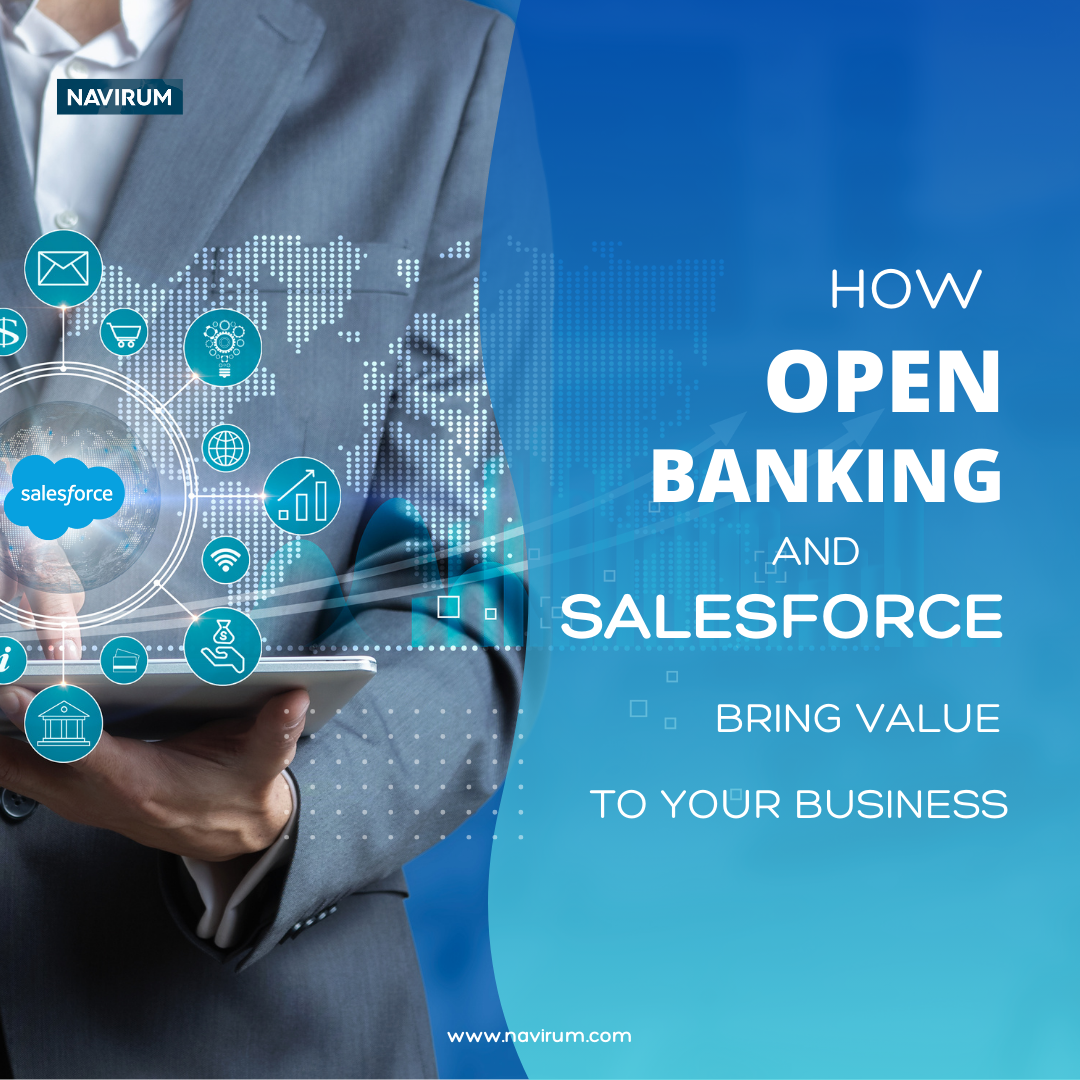
The combination of Canadian Open Banking and Salesforce could offer unparalleled opportunities for financial services businesses to innovate, differentiate, and thrive in today’s competitive landscape. By leveraging the power of Salesforce’s CRM platform and integrating Canadian Open Banking data, businesses could unlock new insights, personalize interactions, streamline operations, and ensure compliance and security.
Bringing Value to Your Financial Services Business
Enhanced Customer Insights
By integrating Canadian Open Banking data with Salesforce, financial services businesses can gain a comprehensive view of their customers’ financial profiles, preferences, and behaviors. This deeper understanding enables businesses to tailor their products and services to meet the unique needs and preferences of individual customers, driving greater customer satisfaction and loyalty.
Personalized Financial Advice
Salesforce empowers financial advisors to deliver more personalized and informed advice to their clients by leveraging Canadian Open Banking data. With access to real-time financial information, advisors can provide tailored recommendations and strategies that align with their clients’ financial goals and objectives, ultimately driving better outcomes for clients and strengthening advisor-client relationships.
Streamlined Operations
Salesforce’s powerful automation capabilities can help financial services businesses streamline their operations and improve efficiency. By automating routine tasks, such as data entry, lead management, and client communications, businesses can free up time for their employees to focus on more value-added activities, such as client engagement and strategic planning.
Compliance and Security
Salesforce provides robust security features and compliance controls that help financial services businesses maintain regulatory compliance and protect customer data. With built-in encryption, access controls, and audit trails, Salesforce enables businesses to safeguard sensitive information and demonstrate compliance with regulatory requirements.
Looking ahead, Canadian Open Banking holds promise for delivering more personalized, efficient, and convenient financial experiences for consumers. As regulatory frameworks evolve and technological capabilities improve, Canadians can expect to see a wider range of innovative financial products and services. However, addressing the challenges and risks associated with Open Banking will be crucial to ensure consumer trust and benefit from these emerging innovations.
How Navirum can help?
At Navirum, we’re committed to helping financial services businesses harness the full potential of this transformative synergy to drive growth, enhance customer experiences, and achieve their business objectives. Contact us today to realize the possibilities of what Salesforce can do for your business!
What is Open Banking, and how does it apply in Canada?
Open Banking refers to a system where financial institutions share customer data securely with third-party providers, with the customer’s consent. In Canada, Open Banking is being rolled out under regulatory guidance, with a focus on transparency, consumer control, and security.
How can Salesforce integrate with Canadian Open Banking systems?
Salesforce can be integrated with Open Banking APIs and third-party data providers to import, manage, and analyze financial data. This allows businesses to have a real-time, 360-degree view of their clients’ financial activities inside their CRM environment.
What are the benefits of combining Open Banking data with Salesforce?
This powerful combination enables: * Deeper customer insights * Personalized financial advice * Streamlined workflows * Real-time financial visibility * Enhanced regulatory compliance Together, they support better decision-making and a more personalized customer experience.
Is integrating Open Banking data with Salesforce secure?
Yes. Salesforce offers enterprise-grade security features including encryption, field-level security, audit trails, and compliance with global standards (like SOC 2, GDPR, and PCI DSS). When set up correctly, these integrations protect customer data and meet regulatory requirements.
What are the challenges of integrating Open Banking data into Salesforce?
Common challenges include: * API compatibility and integration complexity * Data privacy and consent management * Ensuring data accuracy and reliability * Compliance with financial regulations Navirum helps businesses overcome these obstacles through strategic consulting, secure implementation, and tailored integration plans.
Can Open Banking and Salesforce help us deliver personalized financial advice?
Absolutely. With real-time financial data fed into Salesforce, advisors can: Analyze spending patterns Recommend tailored products or services Align investment strategies with real-life cash flow data This leads to more relevant, timely, and impactful client interactions.
How does this integration impact operational efficiency?
Salesforce’s automation features—combined with real-time data from Open Banking—can: * Reduce manual data entry * Automate client onboarding * Trigger alerts based on financial activity * Streamline KYC and compliance checks The result is a more efficient and responsive financial services operation.
Is this solution scalable for firms of all sizes?
Yes. Whether you’re a boutique wealth manager or a large institution, Salesforce and Open Banking integrations are highly scalable. You can start small—with a few use cases—and expand as your business grows or as Open Banking frameworks evolve in Canada.
Will using Open Banking in Salesforce help with compliance and auditability?
Yes. Salesforce provides detailed logging, permission controls, consent tracking, and audit trails, making it easier for financial firms to meet Canadian regulatory requirements. Navirum ensures these features are set up and documented properly.
How can Navirum help us implement this solution?
Navirum specializes in working with financial service firms to strategically implement Salesforce and * Open Banking integrations. We help with: * Business analysis and data strategy * Custom CRM configuration * API integration with Open Banking providers * Workflow automation * Security and compliance setup * Ongoing support and optimization
Canadian wealth management faces challenges with data management, portfolio complexity, and client personalization, necessitating effective technology solutions.
Choosing the right platform involves evaluating capabilities against operating needs, including support for investment strategies and scalability.
This guide covers three top portfolio management tools: D1G1T, Croesus, and SS&C Advent, each offering distinct functionalities for wealth management.
Key considerations for selecting technology include workflow mapping, system dependencies, and real-world scenario evaluations to ensure fit.
Effective portfolio management technology enhances operations by automating processes and delivering insights, ultimately improving client experiences.
Top Portfolio Management Tools in Canada
Portfolio management has become increasingly technology-driven. For Canadian wealth management firms, managing portfolios effectively now involves much more than monitoring investment performance. Portfolio managers must work with growing volumes of data, increasingly sophisticated investment strategies, regulatory requirements, client expectations, and pressure to operate more efficiently.
The right portfolio management technology can help bring these activities together.
Modern platforms can support everything from portfolio construction and rebalancing to performance analysis, reporting, compliance, and client engagement. More importantly, they can help firms establish a more scalable investment operating model.
But selecting a portfolio management platform isn’t simply a matter of comparing feature lists.
For portfolio managers, the more important questions are:
Can the platform support our investment strategies?
Can it handle our current and future portfolio complexity?
How much manual work can we eliminate?
How effectively can it connect with our existing technology?
Can our advisors access the information they need?
Will the platform scale as our assets and client base grow?
Does it support our broader data and technology strategy?
In this guide, we examine three portfolio management technology providers relevant to wealth management and investment professionals: D1G1T, Croesus, and SS&C Advent.
We also explore what portfolio managers should consider when evaluating portfolio management technology and how these platforms can fit into a broader wealth management technology ecosystem.
What Is Portfolio Management Software?
Portfolio management software helps investment professionals manage and monitor investment portfolios throughout their lifecycle.
Depending on the platform, capabilities may include:
Portfolio construction
Model portfolio management
Rebalancing
Trading
Performance measurement
Performance attribution
Risk analysis
Portfolio reporting
Compliance monitoring
Investment accounting
Client reporting
Data aggregation
Workflow automation
For portfolio managers, however, the real value is not the individual features.
The value comes from how effectively those capabilities work together.
A portfolio manager shouldn’t have to spend excessive time locating data, reconciling information, preparing reports, or manually checking portfolios when technology can perform much of that work.
The objective is to create an environment where investment professionals can focus more of their time on portfolio decisions, risk management, and client outcomes.
Why Portfolio Management Technology Matters for Canadian Wealth Managers
Canadian wealth management firms are operating in an increasingly complex environment.
Clients expect greater transparency and personalization. Advisors need faster access to information. Firms need to control operational costs while supporting growth. At the same time, investment teams are dealing with increasingly diverse portfolios and more sophisticated investment strategies.
This creates several technology challenges.
Data is becoming more difficult to manage
Portfolio information can originate from custodians, portfolio management systems, CRM platforms, financial planning applications, market data providers, and internal databases.
When those systems aren’t properly connected, investment teams can end up spending valuable time reconciling information.
Portfolio complexity is increasing
A portfolio may contain traditional securities alongside alternative investments, managed accounts, multiple currencies, and different investment strategies.
Portfolio management technology needs to accommodate that complexity without making the operating model unnecessarily complicated.
Personalization must scale
Clients want portfolios and advice that reflect their individual objectives.
But managing highly customized portfolios manually becomes difficult as the number of clients increases.
Technology can help firms standardize certain processes while still supporting personalization where it matters.
Technology needs to support growth
A process that works for 100 clients may become inefficient at 1,000.
Portfolio managers should therefore consider not only whether a platform meets today’s requirements but whether it can support the firm’s three- to five-year growth strategy.
3 Portfolio Management Tools Canadian Firms Should Know
1. D1G1T
D1G1T is an enterprise wealth management platform designed to support advisors, portfolio managers, and wealth management organizations.
Rather than focusing exclusively on portfolio accounting or reporting, D1G1T covers a broader range of wealth management workflows, including portfolio management, analytics, model management, trading and rebalancing, compliance, billing, reporting, and client engagement.
For portfolio managers, one of D1G1T’s notable capabilities is its focus on investment analytics.
The platform provides tools for analyzing portfolio performance, risk, exposures, asset allocation, and other portfolio characteristics.
This can help investment teams move beyond simply answering:
“What happened to the portfolio?”
and toward questions such as:
“What drove the result?”
“Where is the portfolio taking risk?”
“How does the current portfolio compare with its intended strategy?”
D1G1T also supports sophisticated portfolio and investment analysis across different asset types and complex investment structures
Model management and rebalancing
For firms using model-driven investment strategies, portfolio technology needs to support both standardization and personalization.
D1G1T provides model management, trading, and rebalancing capabilities that can help firms implement investment strategies more consistently across portfolios. This can be particularly useful for firms attempting to scale a centralized investment process without treating every client portfolio as a completely manual exercise.
Connectivity and technology architecture
D1G1T also emphasizes connectivity with other applications through APIs.
This matters because portfolio management rarely operates as a standalone function.
The platform may need to coexist with:
Custodian systems
CRM platforms
Financial planning software
Data platforms
Trading systems
Client portals
For firms developing a broader technology architecture, open connectivity can therefore be an important selection criterion.
Who should consider D1G1T?
D1G1T may be particularly relevant to firms looking for a broader wealth management platform that combines sophisticated portfolio analytics with investment management and client-facing capabilities.
It may be worth evaluating for firms prioritizing:
Advanced portfolio analytics
Model-driven investment management
Portfolio customization
Rebalancing and trading
Integrated wealth management workflows
Scalable investment operations
2. Croesus
Croesus is a Canadian wealth management technology provider with a significant presence in the investment industry.
Its portfolio management offering includes Croesus Advisor, which the company describes as an all-in-one customizable portfolio management system. The platform combines capabilities such as portfolio modeling, performance calculations, risk management, rebalancing, order management, compliance, and reporting. This can be particularly relevant for firms that need to manage standardized investment models while accommodating differences between client portfolios.
Rebalancing and personalization
Croesus also offers Croesus Central, which focuses on portfolio rebalancing and personalization.
This distinction is important for firms managing portfolios at scale.
As the number of accounts grows, manually identifying portfolio drift and determining which accounts require attention can become increasingly inefficient.
Technology that can identify deviations from target allocations and support systematic rebalancing can help investment teams manage that complexity more effectively.
Performance and reporting
Performance measurement is another important part of the platform.
Portfolio managers need reliable performance information not only for internal analysis but also for client reporting and advisor conversations.
Croesus supports performance calculations and customizable reporting capabilities designed to help firms communicate portfolio results more effectively.
A strong Canadian context
One of Croesus’s differentiators is its established presence in the Canadian wealth management market.
Its technology has been used by major Canadian investment organizations, including CIBC Wood Gundy, which implemented Croesus to consolidate systems, manage large volumes of historical data, and support thousands of users.
For Canadian firms evaluating portfolio management technology, this type of market experience can be an important consideration.
Who should consider Croesus?
Croesus may be worth considering for Canadian wealth management organizations looking for a portfolio management environment with strong capabilities around:
Portfolio modeling
Performance measurement
Rebalancing
Reporting
Risk management
Compliance
Wealth management workflows
Canadian market requirements
This can help firms create more consistent investment workflows.
3. SS&C Advent
SS&C Technologies’s Advent business provides investment technology across asset management and wealth management.
Rather than being a single portfolio management application, Advent offers a broader portfolio of solutions covering portfolio management, trading, risk and compliance, performance and accounting, client communications, and other investment workflows.
That makes Advent particularly relevant for firms looking for technology that can support more complex or enterprise-level investment operations.
Axys
One of Advent’s established portfolio management and reporting solutions is Axys.
Axys supports portfolio management and accounting, performance measurement, reporting, reconciliation, multicurrency capabilities, and a broad range of securities.
The platform also provides automated interfaces with custodians, brokerage firms, and other service providers, helping firms reduce manual data entry and reconciliation.
For wealth managers that need robust portfolio accounting and reporting capabilities without completely replacing their existing infrastructure, this can be an important consideration.
Genesis
Advent’s newer Genesis platform takes a broader approach.
Genesis is designed as a cloud-native investment management platform that connects portfolio management, trading, compliance, accounting, reporting, and analytics through a centralized data platform.
This approach is particularly relevant to firms trying to reduce the fragmentation that can develop when different investment functions operate on separate systems.
For portfolio managers, Genesis supports areas such as:
Portfolio construction
Model portfolio management
Customized SMAs
Portfolio monitoring
Performance analysis
Exposure analysis
Trading
Compliance
The platform is also being expanded with AI capabilities designed to support automation and interaction with investment data.
Black Diamond Wealth Solutions
For wealth management organizations with a stronger focus on the advisor and client experience, Advent also offers Black Diamond Wealth Solutions.
The platform combines portfolio management and reporting with capabilities including CRM, client communications, data aggregation, trading and rebalancing, compliance, billing, and client experience.
This makes the Advent ecosystem particularly broad: firms can evaluate solutions according to the complexity of their investment operations and the type of wealth management experience they want to create.
Who should consider SS&C Advent?
Advent may be particularly relevant to:
Larger wealth management organizations
Asset managers
Family offices
Investment managers
Firms managing complex portfolios
Organizations looking for enterprise investment technology
Firms seeking to modernize fragmented investment operations
How Do D1G1T, Croesus, and SS&C Advent Compare?
Rather than asking which platform is “best,” portfolio managers should evaluate which technology aligns most closely with their operating model.
Consideration
D1G1T
Croesus
SS&C Advent
Portfolio management
Strong
Strong
Strong
Portfolio analytics
Strong
Strong
Strong
Model management
Strong
Strong
Strong
Rebalancing
Strong
Strong
Strong
Reporting
Strong
Strong
Strong
Canadian wealth management relevance
Strong
Strong
Strong
Enterprise investment operations
Strong
Strong
Very strong
Broader wealth management capabilities
Strong
Strong
Very strong
Complex investment environments
Strong
Strong
Very strong
Technology ecosystem breadth
Strong
Strong
Very strong
This table should be viewed as a high-level starting point, not a vendor ranking. Each platform has multiple products and configurations, and capabilities can vary depending on the solution selected and how it is implemented.
What Should Portfolio Managers Look for When Evaluating These Platforms?
The most important part of technology selection happens before the vendor demonstration.
Instead of starting with:
“Which features does this platform have?”
start with:
“What problems are we trying to solve?”
1. Map your investment workflows
Document what actually happens from the moment an investment decision is made through to implementation, monitoring, reporting, and client communication.
Look for:
Manual handoffs
Spreadsheet dependencies
Duplicate data entry
Reconciliation points
Approval bottlenecks
Exception management
Reporting delays
This gives you a much clearer picture of where technology can create value.
2. Identify your system of record
A portfolio management platform does not necessarily need to become the source of truth for every piece of information.
Your custodian may own certain transaction information.
Your portfolio platform may own investment calculations.
Your CRM may own client relationship information.
Your financial planning platform may own planning information.
Establishing these boundaries before implementing integrations can prevent unnecessary data duplication and synchronization problems.
3. Evaluate the platform against real scenarios
Don’t rely exclusively on vendor demonstrations.
Give vendors specific scenarios from your investment operation.
For example:
“Show us what happens when a client needs a portfolio adjustment that deviates from the model.”
Or:
“Show us how a portfolio manager identifies accounts requiring rebalancing.”
Or:
“Show us how an advisor accesses portfolio information before a client meeting.”
Real-world scenarios make it easier to determine whether the platform actually fits your workflows.
Portfolio Management Technology and Salesforce
Portfolio management technology is only one part of the wealth management technology ecosystem.
For firms using Salesforce, the CRM may contain important information about the client relationship while the portfolio management platform contains investment information.
Connecting these environments can create a more complete advisor workflow.
For example, an advisor may need to understand:
Who is the client?
What conversations have we had?
What services do they use?
How are their investments positioned?
Are there portfolio issues that need to be discussed?
That information may live across multiple applications.
The objective of integration is not necessarily to move everything into Salesforce.
Instead, firms should determine which information needs to be available within Salesforce and which information should remain in the portfolio management system.
This distinction becomes particularly important as firms consider Salesforce Data 360 and Agentforce.
AI applications require access to reliable, appropriately governed data. A fragmented technology environment can make it much more difficult to provide AI with the context required to support advisors effectively.
How Can Wealth Managers Determine Whether Their Technology Is Mature?
Technology maturity isn’t simply about how many applications a firm has.
A firm can have sophisticated software and still operate inefficiently if the systems aren’t connected or if employees rely heavily on manual workarounds.
A more useful assessment looks at five areas:
Data
Can your investment and client data be accessed reliably and consistently?
Integration
Do your core platforms exchange information effectively?
Automation
How much manual work remains in your investment workflows?
Analytics
Can portfolio managers quickly obtain the insights required to make decisions?
Client Experience
Can advisors provide clients with timely, personalized information?
These five areas provide a useful framework for understanding where technology is supporting the organization—and where it may be creating friction.
What If Your Portfolio Management Technology Isn’t Keeping Up?
Not every technology challenge requires replacing your entire portfolio management platform.
In some cases, the better solution may be:
Improving an existing workflow
Adding an integration
Automating a manual process
Improving data governance
Connecting the portfolio platform with Salesforce
Introducing a data platform
Replacing one outdated component
Developing a phased modernization roadmap
The right approach depends on the firm’s current architecture, investment processes, and strategic priorities.
The objective should be to create a technology environment that supports the investment business rather than forcing the investment business to work around its technology.
Final Thoughts
D1G1T, Croesus, and SS&C Advent each offer different approaches to portfolio management and wealth management technology.
But the platform itself is only one piece of the equation.
For portfolio managers, the bigger opportunity is to build an investment technology environment where data flows reliably, repetitive processes are automated, investment insights are accessible, and advisors can deliver a better client experience.
Before selecting a platform, take the time to understand your current workflows, identify technology bottlenecks, define your system-of-record strategy, and determine what the organization will need as it grows.
The best portfolio management technology isn’t necessarily the platform with the longest feature list.
It’s the platform and architecture that best support the way your firm actually manages investments—and where you want the business to go next.
Is Your Portfolio Management Technology Ready for Growth?
Portfolio management technology should do more than support investment reporting. It should help your team manage data, streamline workflows, connect systems, analyze portfolios, and deliver a better experience to advisors and clients.
Take this 10-question assessment to evaluate your firm’s portfolio management technology maturity across five key areas: Data, Integration, Automation, Analytics, and Client Experience.
10 Benchmark Questions
5 Core Focus Pillars
Estimated time: 3 minutes
Part 1: Data ManagementQuestion 1 of 10
Loading Question…
What We’re Measuring
Loading measurement objective…
Your Technology Maturity
0%
Evaluating…
Your overall portfolio management technology maturity score.
Your Five-Dimension Results
Your Strongest Area
Category Name — 0%
Your results suggest that your firm has a relatively strong capability in this area.
Your Biggest Opportunity
Category Name — 0%
Addressing friction in this area will yield immediate scalability gains.
Personalized Recommendation
Priority: Build a Stronger Data Foundation
Loading tailored advice…
The objective isn’t to automate everything. It’s to allow your investment professionals to spend more time on activities requiring judgment and expertise.
What Should You Do With Your Score?
Your assessment isn’t intended to tell you whether your firm needs to buy a new portfolio management platform. Instead, it helps answer a more important question: Where is our current technology creating the greatest gap between how we operate today and how we want to operate in the future? A low score in one category doesn’t necessarily mean you need a new system—it may indicate that you need a better integration, redesigned workflow, improved data strategy, or more effective use of technology you already own.
Ready to Take the Next Step?
Turn your assessment results into an action plan. Navirum helps wealth management firms optimize Salesforce and connect their CRM with portfolio management platforms, custodians, data sources, and other critical systems. Whether you’re dealing with disconnected systems, manual workflows, or data challenges, we can help you determine where to focus first.
Portfolio management technology doesn’t operate in isolation. For many wealth management firms, the next challenge is connecting investment systems with Salesforce, custodians, data platforms, and other critical applications.
Navirum helps financial services organizations design and optimize Salesforce environments that support their broader technology strategy.
Whether you’re evaluating a new portfolio management platform, dealing with disconnected systems, or preparing your technology environment for greater automation and AI, we can help you identify the highest-impact opportunities.
Start with a free 30-minute Salesforce Health Check to assess your Salesforce environment, integrations, data strategy, and opportunities for greater efficiency.
Navirum connects Salesforce Financial Services Cloud with leading wealth management, portfolio accounting, and client reporting platforms to eliminate operational data silos.
Portfolio Accounting
SS&C Advent
Integrate SS&C Advent portfolio accounting, trade order management, and reporting systems with Salesforce FSC for synchronized operational workflows.
Wealth Management
Croesus
Connect Croesus portfolio management and rebalancing engines directly into Salesforce to unify advisor client views and automated data flows.
Enterprise Analytics
d1g1t
Bridge d1g1t’s enterprise wealth management analytics and risk engine with Salesforce Financial Services Cloud to empower advisor decision-making.
Frequently Asked Questions (F.A.Q. )
Should a portfolio manager choose technology based on current requirements or future growth?
Portfolio managers should evaluate both, but future requirements deserve particular attention. A platform that meets today’s needs may become restrictive as the firm adds advisors, accounts, investment strategies, custodians, or new service offerings. Before selecting a solution, consider where the firm expects to be in three to five years. Will portfolio complexity increase? Will more processes need to be automated? Will the firm introduce new investment products or expand into new markets? Will advisors require access to more real-time information? A useful technology assessment should therefore distinguish between requirements that are essential today and capabilities that will become important as the business scales.
When does a portfolio management system need to be replaced rather than optimized?
Replacement is not always the best answer. Older platforms can sometimes continue to provide value when they can be integrated, supported, and adapted to changing business requirements. Replacement becomes more compelling when the existing system creates persistent limitations that cannot be addressed economically. Warning signs can include an inability to support new investment strategies, increasingly expensive maintenance, limited integration capabilities, declining vendor support, excessive manual workarounds, or difficulty obtaining the data required by the investment team. The decision should be based on the total cost and business impact of maintaining the existing environment, rather than simply the age of the software.
How should portfolio managers approach a portfolio technology modernization project?
Start with the investment operating model rather than the technology. Document the processes involved in areas such as portfolio construction, account opening, investment changes, rebalancing, trading, reporting, and client reviews. Identify where information enters the process, where it is transformed, who uses it, and where manual intervention occurs. This process mapping often reveals that the biggest problem is not a missing software feature but an inefficient process spanning several systems. Once those dependencies are understood, the firm can determine whether the appropriate solution is configuration, integration, automation, replacement, or a combination of these approaches.
How can portfolio managers determine whether their technology stack is creating operational risk?
Look for processes that depend heavily on individual employees, spreadsheets, manual reconciliation, or undocumented procedures. A useful test is to ask: What would happen if the person who normally performs this process were unavailable? If the answer is that the process would be delayed, difficult to reproduce, or impossible to complete without specific institutional knowledge, there may be an operational risk. Portfolio managers can also examine the frequency of data exceptions, manual adjustments, reporting corrections, and reconciliation issues. These indicators can reveal weaknesses that may not be obvious from the functionality of the portfolio management platform itself.
How often should a wealth management firm reassess its portfolio management technology?
A full technology assessment does not necessarily need to happen every year, but firms should reassess their environment whenever there is a significant change in business strategy or operating requirements. Relevant triggers include: A merger or acquisition Significant AUM growth Adding new custodians Launching new investment products Expanding into new markets Major CRM or data-platform changes Introducing AI initiatives Persistent operational bottlenecks Significant changes in regulatory or reporting requirements Technology should evolve with the investment business rather than being treated as a one-time implementation.
What is the difference between a technology problem and a process problem?
This distinction is critical. If a portfolio manager is manually transferring information between two systems, the obvious conclusion may be that an integration is needed. However, the underlying process may itself be inefficient. Before implementing technology, ask: Why is this information being transferred? Who needs it? How often? What decision does it support? Is the same information being entered elsewhere? Sometimes the best solution is an integration. In other cases, it may be eliminating an unnecessary step, changing ownership of a process, or redesigning the workflow. Technology should enable a good process, not simply automate a bad one.
How can portfolio managers build a business case for investing in new technology?
A strong business case should connect technology investment to measurable business outcomes. Instead of presenting the investment as “we need a new portfolio management system,” quantify the problem the technology is intended to solve. For example: How many hours are spent on manual processes? How many employees are involved? How frequently do data errors occur? How long does reporting take? How much advisor time is spent searching for information? How many clients can the current operating model support? What happens to costs as AUM increases? This allows the investment committee to evaluate the technology based on operational and business impact rather than software features alone.
What role should portfolio managers play in technology selection?
Portfolio managers should be directly involved rather than leaving technology selection exclusively to IT. IT teams understand architecture, security, infrastructure, and integration requirements. Portfolio managers understand the investment workflows, decision-making processes, exceptions, and practical requirements that technology needs to support. The strongest selection processes bring together investment, operations, technology, compliance, and executive stakeholders. This reduces the risk of selecting a technically sound platform that does not work effectively for the people who will use it every day.
What should wealth managers do before requesting demonstrations from portfolio management vendors?
Define the firm’s requirements first. Going into vendor demonstrations without a clear set of priorities can make it difficult to distinguish between genuinely important capabilities and impressive but unnecessary features. Create a short list of real-world scenarios that the platform must support. For example, demonstrate how the system would handle a particular portfolio change, exception, reporting requirement, or advisor workflow. Ask vendors to demonstrate your use cases, rather than simply walking through their standard product presentation. This makes vendor comparisons considerably more meaningful.
How can a portfolio management maturity assessment help identify technology priorities?
A maturity assessment provides a structured way to identify where technology is supporting the investment organization effectively and where operational friction remains. Rather than asking whether a firm has “good” or “bad” technology, the assessment can evaluate individual capabilities and highlight gaps that deserve further investigation. For example, a firm may have sophisticated investment analytics but relatively immature operational processes. Another may have strong automation but limited visibility across its broader client ecosystem. This helps portfolio managers prioritize investments based on business impact and maturity gaps, rather than attempting to modernize everything simultaneously.
What should wealth managers prioritize if they are not ready for a major technology transformation?
Modernization does not have to happen all at once. Firms can start by identifying one high-friction process and determining whether it can be simplified or automated. Good candidates are repetitive processes that consume significant employee time and have clearly defined inputs and outputs. This incremental approach can generate measurable improvements while allowing the organization to build the data, integration, and governance capabilities required for larger initiatives later. A phased technology roadmap is often more practical than attempting to replace multiple systems simultaneously.
How does technology modernization affect the valuation and scalability of a wealth management firm?
Technology can influence scalability by determining how much operational infrastructure is required to support additional clients and assets. A highly manual operating model may require significant additional resources as the business grows. A more standardized and automated model can potentially support growth with less proportional operational overhead. This becomes particularly relevant during acquisitions, succession planning, or strategic growth initiatives. Buyers and investors may look beyond AUM and revenue to understand whether the underlying operating model can support continued expansion. For that reason, portfolio technology should be viewed not only as an operational expense but also as part of the firm’s long-term business infrastructure.
Book Strategy Session
Schedule Your Session
Let’s find a time to chat about your Salesforce strategy and AUM growth.
Ready to Modernize Your Portfolio Management Technology? | Navirum
Canadian Wealth Technology Advisory
Ready to Modernize Your Portfolio Management Technology?
The right portfolio management platform can improve more than investment workflows. When your portfolio systems, CRM, data, and other core applications work together, your team can spend less time managing technology and more time serving clients and making informed investment decisions.
Navirum helps Canadian wealth management firms assess, integrate, and optimize their Salesforce environment as part of a connected technology strategy. Whether you’re evaluating a new portfolio management platform, struggling with disconnected systems, or planning your next phase of technology modernization, we can help you identify the highest-impact opportunities.
Start with a free 30-minute Salesforce Health Check. We’ll help you uncover integration, data, automation, and scalability opportunities within your current environment.
Online Resources, Knowledge & Insights | Navirum
Thought Leadership & Insights
Online Resources, Knowledge & Insights
Discover similar articles on Canadian financial planning tools, Salesforce Health Checks, and wealth management change strategies.
In today’s competitive financial landscape, building strong client relationships is paramount to success. At Navirum, we understand the significance of harnessing data-driven insights to enhance client experiences and drive business growth. One critical aspect of achieving this is integrating Salesforce with investment data, enabling financial advisors to gain a comprehensive understanding of their clients and deliver personalized services tailored to their unique needs and preferences.
360 Degree View of the Client: Integrating Salesforce with investment data provides financial advisors with a holistic view of their clients’ financial profiles, including investment portfolios, asset allocation, and performance metrics. This 360-degree view enables advisors to better understand their clients’ financial goals, risk tolerance, and investment preferences, empowering them to provide more personalized and targeted advice.
Improved Reporting and Insights: By consolidating investment data within Salesforce, advisors can generate customized reports and analytics to track portfolio performance, identify trends, and assess client progress towards their financial objectives. These insights not only facilitate more informed decision-making but also enable advisors to proactively anticipate and address their clients’ evolving needs and goals.
AI-Powered Recommendations: Integrating investment data with Salesforce opens the door to leveraging artificial intelligence (AI) algorithms to analyze client data and generate personalized recommendations. AI-driven insights can help advisors identify opportunities for portfolio optimization, risk mitigation, and investment strategy refinement, ultimately enhancing client outcomes and satisfaction.
Streamlined Productivity with Salesforce Flows: Integrating investment data into Salesforce flows enables advisors to streamline their workflows and boost productivity. For example, advisors can set up automated processes to receive alerts when a client’s portfolio experiences significant changes or drops in value, prompting them to take proactive action such as reallocating assets or scheduling a client review. Additionally, advisors can use Salesforce flows to seamlessly transition clients to a new tier in their service model based on predefined criteria such as portfolio size or investment performance.
Ready to unlock the full potential of Salesforce integration with investment data? Our team of experts is here to help you streamline your operations, enhance client experiences, and drive business growth. Contact us today to learn more about how we can tailor Salesforce solutions to meet your specific needs and objectives. Let’s work together to elevate your client relationships to new heights!
Lavinia PicuWhy integrating Salesforce with investment data is essential?
In the realm of wealth management and financial advice, the quest for delivering unparalleled client experiences has never been more crucial. Embracing the digital age, wealth managers are turning to innovative solutions like Salesforce to redefine client engagement and satisfaction.
Salesforce, renowned for its prowess in customer relationship management, emerges as a transformative force empowering wealth managers to sculpt personalized financial journeys for their clientele, offering:
Client-Centric Insights. Salesforce serves as the ultimate repository, offering wealth managers a panoramic view of each client’s financial landscape. With Salesforce’s robust data aggregation capabilities, wealth managers gain invaluable insights into clients’ investment portfolios, risk appetites, and aspirations. Armed with this holistic understanding, wealth managers can tailor their services to align with clients’ unique needs and objectives.
Tailored Engagement Strategies. The hallmark of Salesforce lies in its ability to foster personalized and meaningful interactions between wealth managers and their clients. Through Salesforce’s suite of communication tools, including email campaigns and social media integration, wealth managers can cultivate deeper client relationships by delivering relevant content and timely market insights. This bespoke approach cultivates trust and loyalty, laying the foundation for enduring client partnerships.
Redefined Efficiency. Salesforce streamlines the wealth management process by automating mundane tasks and optimizing workflows. From client onboarding to portfolio management, Salesforce equips wealth managers with the tools to enhance operational efficiency and focus on value-added activities. Moreover, Salesforce’s mobile functionality ensures seamless collaboration and accessibility, empowering wealth managers to serve clients anytime, anywhere.
Insights-driven Decision Making. Salesforce’s analytics prowess empowers wealth managers to glean actionable insights from client data and market trends. By harnessing Salesforce’s analytical capabilities, wealth managers can fine-tune investment strategies, mitigate risks, and drive superior investment outcomes. These data-driven decisions enable wealth managers to provide informed guidance and steer clients towards financial success.
Compliance and Security. In an era fraught with regulatory complexities, Salesforce stands as a bastion of compliance and security. With robust features such as audit trails and data encryption, Salesforce ensures the confidentiality and integrity of client information, safeguarding against regulatory pitfalls. By embracing Salesforce’s compliance capabilities, wealth managers can navigate regulatory landscapes with confidence and peace of mind.
Salesforce empowers wealth managers to craft personalized financial journeys that resonate with clients’ aspirations. Navirum can help you unlock the full potential of Salesforce, driving transformative change and ushering in a new era of wealth management excellence.
Book a free 30 minutes consultation with one of our specialists and start the journey towards client-centric innovation and success!
Discover how leading wealth management practices partnered with Navirum to implement Financial Services Cloud, streamline advisor operations, and accelerate growth.
Whether you are getting to know our team, evaluating our Salesforce and AI offerings, or ready to discuss your firm's growth goals, we are here to guide your journey.
About Navirum
Discover our story, mission, and the experienced financial technology specialists guiding your digital transformation.