Navirum and Intercom partner to deliver AI Customer Support in Financial Services
At Navirum, we’re excited to announce a strategic partnership with Intercom, the industry leader in AI-powered customer support platforms. Together, we’re bringing a new era of smart, automated, and compliant customer engagement to the wealth management, banking, and insurance sectors.
Through our strategic, solution implementation, and support services combined with Intercom’s market leading customer support platform, Navirum helps financial institutions streamline operations, resolve inquiries faster, and enhance engagement – driving productivity, compliance, and growth.
This collaboration empowers firms to deliver personalized, compliant, and scalable client experiences—built for the digital era.
We’re proud to be working alongside Intercom to transform how financial services engage with their customers through smart automation and intelligent support tools.
This partnership represents a major step forward in digital transformation for financial services. We’re committed to helping firms harness the power of AI to:
Future-proof client engagement
Improve customer satisfaction
Reduce friction and cost
Stay ahead in an increasingly competitive market
Let’s shape the future of financial services—together!
Ready to Transform Your Customer Support? Learn how Navirum and Intercom can help your firm deliver faster, smarter, and more compliant service.
As Signet Financial Management expanded its footprint in the competitive wealth management space, it became clear that unlocking the full potential of Salesforce was critical to their growth strategy. Yet, persistent system hiccups, time-consuming admin tasks, and limited internal resources were holding them back. To remain focused on delivering exceptional client experiences, Signet needed a smarter, more scalable approach to managing Salesforce, and that’s where Orbit Project Assist came in.
The Challenges
Signet Financial Management, a growing wealth management firm, was facing key operational roadblocks in its use of Salesforce:
⚠️ Persistent technical issues were disrupting daily workflows and advisor productivity
⚠️ Routine monthly Salesforce tasks were consuming valuable time better spent with clients
⚠️ Strategic initiatives needed expert Salesforce consulting, but internal bandwidth was limited
⚠️ New advisors and staff required structured, consistent onboarding and CRM training
These challenges were slowing down day-to-day operations and reducing the overall value Signet was receiving from their Salesforce investment.
The Solutions
Navirum delivered a comprehensive Salesforce service model tailored to the fast-paced, relationship-driven world of wealth management:
🛠️ Ongoing Support: Rapid resolution of technical issues to keep the platform running smoothly
🛠️ Managed Services: Handling of routine monthly tasks and administrative support
🛠️ On-Demand Consulting: Flexible access to expert guidance for strategic Salesforce projects
🛠️ Training: Regular onboarding and skills training for new and existing users
The Results
With Orbit’s end-to-end support and consulting services, Signet Financial Management experienced measurable improvements:
✅ Reduced platform issues, freeing advisors to focus on client relationships
✅ Improved CRM adoption, as users became more confident and efficient
✅ Higher return on Salesforce investment, with more advisors fully leveraging the platform
✅ Faster onboarding, ensuring new team members could engage clients sooner
Ready to get more from your Salesforce investment?
Let’s talk about how Navirum can help your advisory firm work smarter, scale faster, and stay focused on what matters most, your clients. Contact us today to get started.
Want to dive deeper into how Signet transformed their Salesforce operations? Download the full customer success story as a PDF to explore the complete details of their journey, key outcomes, and how our Salesforce Support service made a lasting impact.
👉 Fill out the contact form below on this page to get instant access.
Curious what ongoing support like this actually includes? See the full breakdown on the Orbit Managed Services page.
Want more detail before reaching out? This companion piece is a deeper dive into Orbit, including our 60-Second Salesforce Platform Check to help you gauge your current managed service and support strategy.
Lavinia Picu5 Proven Ways Salesforce Support Empowers Wealth Advisors
Welcome to the Orbit Project Assist Frequently Asked Questions (FAQ)! Here you’ll find answers to the most common questions about getting started, using key features, troubleshooting issues, and making the most of our platform. Whether you’re a new user or a seasoned pro, this page is designed to help you quickly find the information you need to keep your projects running smoothly.
Can I still email you instead of using Orbit?
For the best experience and quicker response times, we recommend submitting all requests via Orbit Project Assist portal. It helps us track and manage your issues more efficiently.
Who sees my tickets / my requests?
Only your team and our assigned support staff. Everything is kept secure and client-specific.
Can I update my request after submitting?
Yes! Just go to “Requests” and add a comment or attachment.
How quickly will I get a response?
Our standard response time is <2 hrs but clients on Orbit Flex support plans may get priority responses.
I forgot my login. What do I do?
Click “Forgot password” on the login page to reset it. If you’re still stuck, email us and we’ll help.
Can multiple people from my team use Orbit?
Absolutely. Just let us know who should have access, and we’ll set them up.
Where can I find my invoices?
Invoices are usually attached to billing-related tickets in Orbit. You can also request copies at any time through the portal.
I have a question about a charge on my invoice, what do I do?
Submit a new ticket under the “Billing” category and include the invoice number and your question. We’ll review and get back to you quickly.
Can I request changes to my billing details?
Yes! You can raise a request in Orbit to update billing contact info, tax details, or payment terms.
Where can I update my payment information?
If your payment method needs to be changed, raise a ticket under “Billing” and our finance team will securely handle the update.
How do I check the status of a project?
You can submit a request under the “Project Assist” category, or check your existing project tickets under “Requests” for the latest updates.
Do you provide regular project status reports?
Yes, we provide monthly status reports depending on your project scope. If you’d like to adjust the frequency or request a custom format or breakdown, just let us know through Orbit. Please note that customizations may involve additional fees depending on the request, as they require more time and resources from our team.
Need Help?
If you’re stuck or not sure how to use the portal, just drop us a note in Orbit or send us an email to get started. We’re happy to help!
Thanks for using Orbit Project Assist! We built it to make your life easier and give you faster, more organized support.
Transforming Policyholder Experience for North American Insurers. A Bridge Too Far?
The insurance industry is at a tipping point. #insurtech disruptors, the “Uberization” of financial services, and the Venmo effect have reset customer expectations. Policyholders now expect insurance to feel as easy as sending money on Venmo – instant, transparent, and frictionless.
Yet, for many insurers, policies still arrive as hard copies or static PDFs, creating a massive information asymmetry between carrier and client. In an era where trust is table stakes, this gap erodes relationships and puts traditional players at risk.
McKinsey research makes the case for transformation:
AI will define the winners – insurers who deeply integrate AI “will conduct more business, faster, in a more personalized manner.”
Customer experience is non-negotiable – investing in CX boosts both satisfaction and operational efficiency.
The industry is shifting from “detect and repair” to “predict and prevent,” leveraging data and advanced tech to anticipate risk and deliver proactive value.
Digitize and Unify Data – Move beyond PDFs and siloed systems to deliver a real-time, 360° client view. A significant opportunity for carrier and brokers. AI is making this possible.
Speed and Transparency – Make policy servicing as effortless as a Venmo transaction through automation and self-service. Advances in CRM and AI mean policies and can be updated in real time.
Proactive Engagement – Use AI to predict needs and deliver personalized solutions before clients even ask. Seeing and addressing problems before they happen is a growing tread across the board.
As it turns out technology is bridging the digital divide…those who lead on AI, digital experience, and trust-building transparency will define the next decade of insurance. This is not not science fiction, its a reality.
– Rory – Founder – NAVIRUMHelping financial services firms lead with CRM, AI, and digital transformation. For more details on why insurance companies choose Salesforce see
Interested in discussing solutions further ? We would be delighted to help!
Read our customer success story and discover how scaling personalized marketing in investment management, using Salesforce and Pardot, helped an investment advisory firm achieve marketing excellence.
One of our client, a Manhattan-based investment advisory firm is recognized for offering high-touch, personalized portfolio management. With a mission centered on capital preservation and growth, the firm serves a wide-ranging client base that values trust, transparency, and expert-driven strategies.
Trusted by Adalta Capital Management
Despite strong relationships and a bespoke investment approach, the firm faced challenges in scaling its marketing capabilities to meet the needs of a growing, digitally savvy clientele.
Key Challenges Investment Advisors Faced
As the firm expanded, it encountered several operational and marketing obstacles:
⚠️ Limited ability to engage clients at scale
⚠️ Manual marketing tasks causing pipeline inefficiencies and missed opportunities
⚠️ Lack of automation tools for consistent, timely campaigns
⚠️ Fragmented client data leading to impersonal communications and disjointed experiences
These issues made it difficult to engage prospects and clients effectively and consistently.
Partnering with a Salesforce consulting firm specializing in financial services, the company reimagined its client engagement and marketing operations. The solution was built around their business model, industry requirements, and future growth plans.
🛠️ Salesforce Financial Services Cloud Implementation. Client data was centralized using FSC, creating a 360-degree view of each relationship. This allowed the team to deliver more targeted and proactive service.
🛠️ Pardot (Marketing Cloud Account Engagement) . With the introduction of Pardot, the team could automate and scale marketing initiatives, reducing manual work and enhancing lead nurturing.
🛠️ Seamless Website + CRM Integration. The marketing platform was connected to both the CRM and the firm’s website, enabling automatic lead capture and real-time qualification—ensuring marketing and sales were fully aligned.
🛠️ Custom Dashboards & Training. Tailored dashboards were developed for visibility across the client lifecycle. Staff received hands-on training, accelerating adoption and empowering the team to manage campaigns independently.erating user adoption and long-term success.
Results
The transformation led to substantial improvements in marketing performance, efficiency, and client engagement.
✅ Automated, Scalable Campaigns. Strategic email campaigns replaced manual outreach, allowing for consistent, professional communication.
✅ High Adoption Across Teams. With strong training support, internal adoption was swift, enabling self-sufficient use of both platforms.
✅ Enhanced Efficiency. Automation eliminated repetitive tasks, freeing the team to focus on personalization and strategy—resulting in better engagement and conversion.
✅ Personalized Engagement at Scale. A unified client view and real-time analytics allowed for deeper personalization across a growing audience.
✅ Continued Innovation. The firm continues to explore new marketing initiatives with Pardot, aligning its strategy with evolving business objectives.
In the investment management industry, client relationships must be nurtured thoughtfully and at scale. With Salesforce Financial Services Cloud and Marketing Cloud Account Engagement, this firm now has the tools and insights needed to deliver meaningful client experiences – without sacrificing the personal touch.
Download the Full Customer Success Story
📥
Download the full PDF success story for detailed insights, project phases, and a look at how a modern investment firm continues to innovate.
Looking to modernize your firm’s marketing operations?
Whether you’re an investment manager, bank, wealth advisor, or fintech company, we can help implement and optimize Salesforce and Pardot to drive real results. Contact us to discuss your goals and start building a scalable, high-performing marketing engine.
Identity fraud isn’t slowing down. In fact, it’s accelerating – and credit unions are finding themselves on the front line of this battle. Unlike large banks with extensive fraud budgets and dedicated security teams, credit unions often face unique vulnerabilities that sophisticated fraudsters are quick to exploit.
Request a credit union fraud & CRM consultation
A 60-second start: tell us where to reach you and we’ll show you how a unified Salesforce view helps your team spot fraud red flags siloed systems miss.
AI: A Double-Edged Sword in Fraud Prevention
Artificial Intelligence presents both opportunities and challenges in this fight. While AI helps credit unions strengthen identity verification and detect anomalies in real time, fraudsters are weaponizing the same technology to :
Create hyper-realistic fake IDs that fool traditional verification systems
Automate sophisticated phishing campaigns at unprecedented scale
Mimic legitimate customer behavior patterns to bypass security protocols
Fraud detection rules that were airtight last year are not necessarily airtight today. Our Orbit Managed Services team keeps identity verification logic current as fraud tactics shift, rather than leaving it configured once and forgotten.
The Rise of Synthetic Identity Fraud: A Silent Epidemic
The threat landscape has evolved beyond simple identity theft. Fraudsters are now creating entirely synthetic identities by combining real data elements — like Social Security Numbers — with fabricated names and addresses. These phantom identities pass verification checks, establish credit histories, and then execute devastating “bust out” schemes with large loans before vanishing without a trace.
New synthetic account creation surged 18% year-over-year
Every one of these numbers is a member trust problem before it is a security problem. See how a unified Salesforce view of the member relationship helps staff spot the behavioral red flags that siloed systems miss, in our guide to Salesforce for credit union member experience.
Data Breaches: Fueling the Fraud Engine
Recent data breaches have armed fraudsters with vast troves of Personally Identifiable Information, and credit unions aren’t immune to these attacks:
A September 2024 Massachusetts breach exposed Social Security Numbers and driver’s license details
A two-month breach in Maine compromised sensitive data for approximately 240,000 individuals
Adding to these concerns, credit unions using CRMs like Salesforce face risks from Scattered Spider attacks. This sophisticated threat group targets SaaS platforms to access member data and financial records, exploiting administrative permissions for lateral movement within credit union networks and establishing persistent backdoors for ongoing data theft and potential ransomware deployment.
Attacks like this usually exploit administrative permissions that were never properly scoped in the first place. Our Salesforce consulting team configures permission sets and access controls with this exact risk in mind, not just for launch day.
The Path Forward
Credit unions must recognize that traditional fraud prevention methods are no longer sufficient. The combination of AI-powered fraud tools, synthetic identity creation, and massive data breaches requires a fundamental shift in how we approach member security and identity verification. Will members and their staff be the solution?
The honest answer is both: better-trained staff and deterministic guardrails on the AI tools doing the screening. This is the AI risk governance gap most credit unions have not closed yet, and it is the same gap we walk through in our guide to compliance in Salesforce Financial Services Cloud, including KYC, identity verification, and audit-ready AI.
– Rory – Founder – NAVIRUMHelping financial services firms lead with CRM, AI, and digital transformation.
What strategies is your organization implementing to stay ahead of these evolving threats?
See where your fraud controls stand
Book a short review of your identity-verification logic, permission scoping, and AI governance gaps with our credit union team.
Loan growth is slowing to 5–6% in 2025 while funding costs remain elevated. Rising delinquencies and charge-offs in credit cards and auto lending put additional pressure on margins (NCUA, CUNA). Managing liquidity, interest-rate risk, and credit loss reserves is critical for financial stability.
If margin pressure is pushing your credit union to finally fix fragmented systems, a Salesforce strategy engagement is usually the right first step, mapping the roadmap before committing to a full build.
2. Digital Transformation Is No Longer Optional
Member expectations are evolving rapidly. Legacy systems and fragmented vendor stacks are slowing innovation. With open banking frameworks gaining momentum in the U.S. and Canada, credit unions need integrated platforms, AI-driven workflows, and seamless omnichannel experiences to stay competitive (The Financial Brand, WOCCU).
Cyberattacks are growing in frequency and sophistication, while BSA/AML enforcement and data privacy mandates continue to tighten. Credit unions must implement strong governance, vendor risk management, and secure infrastructure. Meanwhile, AI adoption introduces exciting possibilities – but also new compliance and ethical risks (Comply-Yes, NCUA Supervisory Priorities).
This is exactly where AI risk governance becomes a board-level issue, not just an IT one. Credit unions layering Agentforce or other AI tools onto Salesforce Financial Services Cloud need deterministic guardrails, hard limits on what an AI agent can see or act on, before those tools touch member data. We cover the full architecture, KYC, AML, audit trails, and governance-ready AI, in our guide to compliance in Salesforce Financial Services Cloud, if that is the piece keeping your team up at night.
The Bottom Line
The next two years present a pivotal opportunity for credit unions to modernize operations, enhance member value, and build resilience. Those who embrace digital innovation, proactive risk management, and regulatory readiness will lead the future of financial services.
For Canadian wealth and asset managers, multi-custodial data integration is one of the biggest operational challenges in today’s financial landscape. With client data flowing in from multiple custodians, portfolio management systems (PMS), and back-office sources, creating a single, accurate view of the client often feels overwhelming. Yet, with rising client expectations, evolving regulatory requirements, and the push for digital transformation, firms can no longer afford to delay this.
Why Multi-Custodial Data is So Complex
The problem isn’t just about collecting data-it’s about making it usable. Each custodian and PMS uses different formats, transaction codes, and reporting standards. Without proper normalization, this data can’t be easily combined or trusted. Common issues include:
Duplicate or missing identifiers across systems, making it unclear which positions belong to which client.
Conflicting account structures between custodians and PMS platforms.
Gaps in transactional context, which can create compliance and reporting risks.
Simply dumping this data into a CRM is a recipe for disaster-resulting in inaccurate client records, compliance gaps, and frustrated advisors who can’t rely on the system.
What It Takes to Get It Right
To create a true 360° view of the client, the data needs to be structured and mapped correctly before entering Salesforce. That process typically involves:
Normalizing and standardizing the data, assigning unique identifiers for accuracy.
Mapping and linking investments, transactions, and positions to the right household, account, and individual in Salesforce.
Automating the flow using APIs or ETL processes so data stays current without heavy manual intervention.
Why Start with Salesforce Financial Services Cloud
This is whereSalesforce Financial Services Cloud (FSC) comes in. Unlike a generic CRM, FSC is designed for financial services firms. It includes a data model built for client relationships, households, accounts, and financial goals-perfect for firms with multiple custodial relationships.
Benefits of FSC for Canadian firms include:
A structured data model for mapping complex relationships.
Flexibility for multi-custodial environments-whether your clients hold accounts at one or several firms.
Integration-ready architecture, making it easier to connect with PMS platforms and custodial feeds.
Built-in compliance tools that can support Canadian regulations such as CIRO CRM3 fee disclosure requirements.
By leveraging FSC as your foundation, you position your firm for better compliance, improved client experience, and scalability.
Why This Matters in Canada Now
Canadian firms face unique pressures-CRM3 fee disclosure requirements, increasing demand for digital onboarding, and competition from fintechs that promise seamless client experiences. Firms that integrate multi-custodial data effectively can:
Simplify CIRO reporting by pulling data from back-office systems into a single source of truth.
Give advisors a complete client picture across all custodians in real time.
Reduce manual reconciliation, freeing up time for client service.
At Navirum, we’ve worked with Canadian wealth and asset managers across CIRO (former IIROC) and MFDA channels to solve these challenges. Our expertise combines:
Salesforce Financial Services Cloud implementation with deep industry knowledge.
Proven strategies for data normalization and mapping across custodians and PMS systems.
Integration frameworks that are secure, scalable, and future-ready.
Bringing custodial and portfolio data together in Salesforce isn’t just an IT project-it’s the foundation for delivering the experience clients expect and the compliance regulators demand.
Interested In Knowing More? Book a Consultation Below? 👇
Lavinia PicuSimplify Your Multi-Custodial Data Integration with Salesforce FSC
Data Platforms for Financial Services Wealth Management: Which One Fits Your Stack?
Estimated reading time: 24 minutes
Key Takeaways
AI transforms financial services, but the right data foundation is crucial. Salesforce Data Cloud, Snowflake, and Databricks each support different needs.
Salesforce Data Cloud excels in real-time customer engagement and unifying data within its ecosystem.
Snowflake serves as a secure data warehouse ideal for scalability, analytics, and regulatory compliance in financial services.
Databricks focuses on advanced analytics and AI, making it suitable for organizations heavily invested in machine learning.
Choosing between Salesforce Data Cloud vs Snowflake vs Databricks depends on your specific business goals and architecture needs.
Data platforms for financial services
AI is transforming financial services, but success depends on having the right data foundation. This guide compares Salesforce Data Cloud, Snowflake, and Databricks, helping financial institutions understand how each platform supports customer engagement, enterprise data management, analytics, and AI initiatives, and how to choose the right architecture for long-term growth and competitive advantage.
Financial services firms are entering a new era, one where competitive advantage increasingly depends on the ability to turn data into intelligence, and intelligence into action.
From personalized wealth management experiences and AI-powered customer service to fraud detection, risk management, and regulatory compliance, data has become the foundation of modern financial institutions. Yet many banks, credit unions, insurers, wealth management firms, and asset managers still struggle with fragmented systems, disconnected customer records, and data architectures that were never designed for today’s AI-driven environment.
As organizations modernize their technology stacks, one question continues to emerge:
What is the right data platform for financial services? Data Cloud, Snowflake and Databricks? Which one is a more suitable platform for your firm?
Book Strategy Session
Schedule Your Session
Let’s find a time to chat about your Salesforce strategy and AUM growth.
The answer is not always straightforward. Three platforms dominate the conversation today:
Three names dominate the conversation right now: Salesforce Data Cloud, Snowflake, and Databricks. Each platform solves different business challenges. Each offers unique capabilities. And each can play an important role in a modern financial services data strategy.
This guide explores the strengths, use cases, and considerations for each platform, helping financial services leaders determine which solution best aligns with their goals.
What is Salesforce Data Cloud?
Salesforce Data Cloud: Powering Real-Time Personalization
If your business already runs on Salesforce, Data Cloud is a natural fit. It connects data from across your systems, including banking platforms, marketing tools, and third-party feeds, and creates real-time, unified customer profiles.
For financial services firms, this is a game-changer. Imagine a wealth advisor logging into Salesforce and seeing a client’s full history, preferences, risk level, and recent interactions in one place. Or an insurance agent triggering automated outreach when a policyholder’s data suggests a change in life circumstances.
Because it’s fully embedded in the Salesforce ecosystem, Data Cloud doesn’t just analyze data. It acts on it. You can personalize emails, trigger service actions, or alert advisors instantly, all within the same platform.
Snowflake: The Scalable, Secure Data Backbone
What is Snowflake?
Snowflake excels as a centralized data warehouse, especially for highly regulated industries like banking and asset management. It’s designed for organizations that need to consolidate massive volumes of structured data, enforce tight governance, and power analytics across departments.
Think of a large bank that wants to bring together customer data from branches, mobile apps, trading desks, and third-party partners. With Snowflake, they can create a single source of truth and ensure access is controlled by role, geography, or compliance status.
It’s also a favorite for enterprise reporting and integrates smoothly with tools like Tableau, making it ideal for CDOs and compliance teams.
Databricks: The Powerhouse for Advanced Analytics and AI
What is Databricks?
Databricks is built for the most ambitious use cases. If your institution is investing heavily in machine learning, predictive analytics, or real-time decisioning, this is where you want to be.
Databricks combines the flexibility of data lakes with the performance of data warehouses, in what it calls a “lakehouse” architecture. It handles both structured and unstructured data and is designed for data science teams.
An insurance firm might use Databricks to build fraud detection algorithms using claims data, emails, call transcripts, and even images. An investment management company could use it to model trading strategies based on market signals, news feeds, and client sentiment.
So, Which One?
It depends on your goals:
Use Data Cloud if you want to unify data for sales, service, and marketing teams, and trigger real-time action.
Use Snowflake if you’re building a secure, scalable enterprise data warehouse that feeds analytics and reporting.
Use Databricks if you’re investing in AI, machine learning, or advanced analytics across complex, diverse datasets.
At Navirum, we help financial services leaders build out data strategies that align with where they are, and where they’re going. Often, it’s not about choosing just one of these platforms, but connecting them strategically.
If you’re rethinking your data architecture, let’s talk. The right data foundation today is your AI advantage tomorrow.
Salesforce Data Cloud vs Snowflake vs Databricks | Navirum
Wealth Management Architecture
Salesforce Data Cloud vs. Snowflake vs. Databricks
A strategic evaluation guide for financial services firms structuring zero-copy data, predictive analytics, and real-time advisor engagement.
Quick Answer: Which Platform for Wealth Management?
Just need the direct answer for your firm’s core focus?
Salesforce-First Focus
Salesforce Data Cloud
Use if you are a Salesforce-first firm (Financial Services Cloud, Agentforce) and want real-time advisor personalization plus compliance audit trails.
Real-Time Advisor Engagement
Native Agentforce AI Prompts
Zero-Copy Data Architecture
Enterprise Data Warehouse
Snowflake
Use if you need a secure enterprise data warehouse for custodian feeds, transaction history, and regulatory reporting (SEC, FINRA compliance).
Custodian & Clearing Feeds
Structured Transaction Audits
Regulatory Compliance Storage
Advanced Data Science & ML
Databricks
Use if you are building ML models for churn prediction, fraud detection, or portfolio risk modeling over complex datasets.
Predictive Churn & AUM Modeling
Unstructured Document AI
Quantitative Risk Analytics
Capability Dimension
Salesforce Data Cloud
Snowflake
Databricks
Primary Strategic Role
Real-time operational CRM engagement & Agentforce AI enablement
Enterprise data warehousing & regulatory reporting repository
Advanced machine learning, data engineering & risk modeling
Unstructured PDFs, market feeds, semi-structured & big data
Primary Users
Wealth advisors, client service associates (CSAs) & marketers
Data architects, BI analysts & compliance reporting officers
Data scientists, quantitative analysts & ML engineers
Zero-Copy Integration
Native bi-directional zero-copy sharing with Snowflake & Databricks
Zero-copy data sharing with Salesforce Data Cloud
Zero-copy Iceberg delta sharing with Salesforce & Snowflake
How Most Wealth Management Firms Deploy All Three
Rather than picking one platform, modern wealth managers deploy all three in a coordinated architectural sequence:
1
Phase 1: Snowflake as Enterprise Core
Incorporate multi-custodian transaction feeds (Schwab, Fidelity, LPL) and historical ledger data into Snowflake for regulatory reporting and compliance.
2
Phase 2: Databricks for Advanced ML
Process unstructured client agreements and run predictive AUM churn models in Databricks over the central data lakehouse.
3
Phase 3: Data Cloud Zero-Copy Engagement
Expose Snowflake and Databricks insights to advisors inside Salesforce Financial Services Cloud in real time via Zero-Copy—powering Agentforce AI without data movement.
Why Data Platforms Matter More Than Ever in Financial Services
Financial institutions generate enormous volumes of data every day.
Customer transactions, portfolio activity, CRM records, market feeds, loan applications, policy data, service interactions, digital engagement metrics, compliance records, and third-party datasets all contribute to an increasingly complex information ecosystem.
At the same time, organizations face growing pressure to:
Deliver personalized customer experiences
Improve advisor and employee productivity
Strengthen regulatory compliance
Reduce operational costs
Accelerate AI initiatives
Improve decision-making in real time
The challenge is that data often remains trapped in silos.
Customer information may live in CRM systems. Transaction data may reside in core banking platforms. Marketing engagement data may be stored elsewhere. Compliance teams often maintain separate reporting environments. Data science teams frequently build their own isolated analytics platforms.
Without a unified approach, firms struggle to unlock the full value of their information assets.
This is where modern data platforms come in.
The right platform creates a foundation for:
Unified customer views
Real-time insights
Advanced analytics
AI and machine learning
Data governance and compliance
Operational efficiency
However, not all platforms are designed for the same purpose.
Let’s examine how Salesforce Data Cloud, Snowflake, and Databricks differ.
Salesforce Data Cloud: The Customer Intelligence Platform
Already have questions about cost, migration timeline, or where Agentforce fits in? Jump straight to the FAQ Section below for quick answers.
What Is Salesforce Data Cloud?
Salesforce Data Cloud is a real-time customer data platform designed to unify information across systems and make it immediately actionable within the Salesforce ecosystem.
Unlike traditional data warehouses, Data Cloud focuses on creating comprehensive customer profiles that can be used directly by business teams.
Salesforce Data Cloud Connections | Navirum
Interactive Blueprint: Hover or tap nodes to explore Data Cloud feeds
★ Continuous Customer Harmonization
Salesforce Data Cloud acts as the central engine. It ingests, maps, and harmonizes multi-source financial and digital profiles in real time. The ultimate result is a continuously updated, unified 360° view of each customer.
01 Core Banking Systems
Ingests real-time checking, savings, term-deposit ledger transactions, and current balances directly into Data Cloud to reflect up-to-the-second financial standing.
02 Wealth Management Platforms
Streams active asset allocations, portfolio holdings, custodian feeds, household balances, and investment risks to maintain accurate net worth intelligence.
03 Insurance Policy Systems
Integrates active policy limits, premium renewals, underwriting risks, claims histories, and coverage boundaries to align financial advice with liability safeguards.
04 Marketing Automation Tools
Harmonizes outbound email clicks, campaign interactions, landing page visits, preference maps, and marketing consent statuses to optimize journey relevance.
05 Customer Service Applications
Captures live support tickets, chatbot session history, contact center call transcripts, and CSAT scores to alert RMs of open service cases before meetings.
06 Third-Party Data Providers
Bridges external credit scores, demographic enrichment records, market valuations, and KYC identity verification systems natively into your core profiles.
07 Digital Engagement Channels
Streams raw portal clicks, mobile app telemetry, secure message exchanges, and live web interactions to dynamically trigger next-best-action alerts.
Why Financial Services Firms Are Adopting Data Cloud
For financial institutions already invested in Salesforce, Data Cloud provides a powerful way to connect fragmented customer data without creating additional complexity.
Consider a wealth management firm.
An advisor preparing for a client meeting may need information from multiple systems:
Investment portfolios
Banking relationships
Service history
Marketing engagement
Risk tolerance assessments
Family or household relationships
Without a unified platform, gathering this information can be time-consuming. With Data Cloud, all relevant data becomes available within Salesforce, giving advisors a complete view of the client in real time. This enables more meaningful conversations and better outcomes.
Key Benefits of Salesforce Data Cloud
Real-Time Customer Profiles
Data Cloud continuously updates customer records as new information enters the system. This allows organizations to make decisions based on current conditions rather than outdated reports.
Embedded Activation
One of Data Cloud’s biggest advantages is that insights can immediately trigger action.
For example:
A banker receives an alert when a customer reaches a significant account milestone.
A wealth advisor is notified when a client’s investment behavior changes.
An insurer automatically initiates outreach after a life event is detected.
The platform bridges the gap between insight and execution.
Native Salesforce Integration
Organizations using Salesforce Financial Services Cloud, Sales Cloud, Service Cloud, Marketing Cloud, or Agentforce benefit from seamless integration. Business users can access data without switching between systems.
AI Readiness
Data Cloud serves as the foundation for Salesforce’s AI capabilities, including Agentforce. By providing trusted, unified data, organizations can deploy AI agents and predictive models with greater confidence. The next step, once that foundation is in place, is governing the AI assistants on top of that data.
Ideal Use Cases for Data Cloud
Data Cloud is particularly effective for:
Wealth management personalization
Relationship banking
Insurance customer engagement
Advisor productivity enhancement
Marketing segmentation
Service automation
Agentforce implementations
Potential Limitations
While Data Cloud excels at customer intelligence and activation, it is not intended to replace enterprise-scale data engineering platforms. Organizations with extensive data science requirements may require complementary technologies for advanced analytics and machine learning.
Snowflake: The Enterprise Data Foundation
What Is Snowflake?
Snowflake is a cloud-native data platform built primarily for enterprise data warehousing, analytics, governance, and data sharing.
It enables organizations to consolidate massive amounts of data into a centralized environment while maintaining strict security and compliance controls.
For many financial institutions, Snowflake serves as the foundation of their enterprise data architecture.
Why Snowflake Is Popular in Financial Services | Navirum
Interactive Blueprint: Hover or tap nodes to explore financial solutions
★ Independent Scaling Architecture
Snowflake separates storage from compute resources entirely. This allows financial institutions to scale computing power up and down on demand, ensuring optimal query performance while strictly controlling storage costs.
01 Large Transaction Volumes
Financial firms process massive daily volumes of trades, ledger bookings, and telemetry data. Snowflake dynamically provisions infinite multi-cluster compute warehouses to execute complex queries against billions of records in seconds.
02 Strict Regulatory Requirements
Auditing frameworks (such as SEC and FINRA) require absolute tracking of historical data states. On Enterprise Edition and above, Snowflake’s built-in Time Travel feature can be configured to let compliance officers query historical table states for up to 90 days. The default retention on lower tiers is far shorter.
03 Complex Reporting Obligations
Preparing quarterly financial statements and quantitative risk metrics requires compiling heavy, multi-layered queries. Snowflake executes these heavy-compute reports in minutes rather than hours, avoiding system-wide delays.
04 Multiple Lines of Business
Silos between retail banking, commercial lending, and asset divisions cause costly replication. Snowflake’s Secure Data Sharing enables different units to safely query single-copy, live records without copy overhead.
05 Highly Sensitive Customer Information
Financial data requires ironclad protection. Snowflake enforces always-on end-to-end encryption (at rest and in transit), Column-Level Data Masking, and Row-Access Policies to keep PII and account balances completely secure.
Why Snowflake Is Popular in Financial Services
Financial services organizations face unique data challenges.
They must manage:
Large transaction volumes
Strict regulatory requirements
Complex reporting obligations
Multiple lines of business
Highly sensitive customer information
Snowflake was designed to address many of these challenges.
Its architecture allows organizations to scale storage and computing resources independently, improving performance while controlling costs.
Key Benefits of Snowflake
Centralized Data Management
Snowflake creates a single source of truth across the enterprise. Data from multiple systems can be consolidated into one governed environment. This reduces inconsistencies and improves reporting accuracy.
These features help organizations maintain security while enabling broader data access.
Scalability
Whether managing millions or billions of records, Snowflake scales efficiently. This makes it particularly attractive for large banks and multinational financial institutions.
Analytics Enablement
Snowflake integrates with leading business intelligence platforms, enabling organizations to deliver dashboards, reports, and analytics across departments.
Financial Services Use Cases
Snowflake is commonly used for:
Enterprise data warehousing
Regulatory reporting
Risk management analytics
Executive dashboards
Customer profitability analysis
Data sharing across business units
Enterprise-wide reporting initiatives
Example Scenario
Imagine a national bank operating retail, commercial, wealth management, and lending divisions. Each business unit generates large amounts of data. Snowflake enables the bank to consolidate information from all divisions into a centralized platform while maintaining strict access controls. Executives gain a unified view of performance, risk teams improve visibility, and compliance teams streamline reporting processes.
Potential Limitations
Snowflake is excellent for storing, governing, and analyzing data, but it is less focused on activating customer insights directly within business workflows.
Organizations often pair Snowflake with CRM platforms, customer engagement tools, or AI applications to operationalize insights.
Databricks: The AI and Advanced Analytics Platform
What Is Databricks?
Databricks is a unified analytics platform designed for data engineering, machine learning, and artificial intelligence.
It pioneered the concept of the “lakehouse” architecture, combining the flexibility of data lakes with the governance and performance capabilities of data warehouses.
Unlike traditional analytics platforms, Databricks was built with data scientists and AI teams in mind.
Interactive Blueprint: Hover or tap nodes to explore financial solutions
★ Databricks Unified Lakehouse Engine
Traditional reporting platforms struggle to support advanced analytical workloads. Databricks addresses this challenge by combining the best elements of data lakes and data warehouses into a single, unified Lakehouse Architecture.
01 Structured Data
Manage traditional databases, relational tables, customer transactional history, and standard SQL schemas with optimal performance, keeping query times incredibly fast.
02 Unstructured Data
Store and process massive pools of raw, unformatted, and complex files directly within the Lakehouse framework, removing the need for separate siloed data pools.
03 Streaming Data
Process high-velocity streaming computations, event-driven message arrays, and transactional message pipelines smoothly with instant zero-loss synchronization.
04 Text Documents
Process unstructured text files, PDF statements, contractual agreements, and emails. Databricks makes this textual data easily searchable and ready for NLP models.
05 Images
Store, categorize, and process image files at scale, enabling advanced computer vision applications, document extraction, and ID verification pipelines.
06 Audio
Directly analyze and process audio recordings, customer service call logs, voice verifications, and dictations, turning raw soundwaves into valuable text-based data.
07 Real-Time Data Feeds
Ingest live market rates, telemetry signals, fraud signals, and application activity feeds, creating a robust, real-time dataset ideal for sophisticated AI use cases.
Why Financial Institutions Choose Databricks?
As financial services firms accelerate AI initiatives, many discover that traditional reporting platforms cannot support advanced analytical workloads.
Databricks addresses this challenge by enabling organizations to work with:
Structured data
Unstructured data
Streaming data
Text documents
Images
Audio
Real-time data feeds
This flexibility makes it ideal for sophisticated AI use cases.
Key Benefits of Databricks
Advanced Machine Learning
Databricks provides a collaborative environment for developing, training, and deploying machine learning models. Teams can move from experimentation to production more efficiently.
Support for Diverse Data Types
Modern AI initiatives often require more than traditional tabular data. Databricks allows organizations to combine structured and unstructured data sources within a single platform.
Real-Time Analytics
The platform supports streaming data and real-time processing, enabling faster decision-making.
AI and Generative AI Development
Databricks has become a leading platform for organizations building generative AI applications, large language models, and intelligent automation solutions.
Financial Services Use Cases
Common use cases include:
Fraud Detection. Banks and insurers use Databricks to identify suspicious patterns across transactions, claims, communications, and digital interactions.
Risk Modeling. Financial institutions can build sophisticated predictive models to evaluate risk exposure and market scenarios.
Customer Churn Prediction. Organizations can identify customers at risk of leaving and proactively intervene.
Investment Analytics. Asset managers use Databricks to analyze market data, alternative datasets, and client behavior.
AI-Powered Decisioning. Real-time models can support lending decisions, underwriting processes, and portfolio recommendations.
Example Scenario
An insurance company wants to improve fraud detection. The organization combines:
Claims data
Call center transcripts
Email communications
Image submissions
Historical fraud records
Databricks allows data scientists to analyze all these data sources together and create AI models that identify suspicious claims more accurately.
Potential Limitations
Databricks is highly powerful but can be more complex than customer-focused platforms like Data Cloud. Organizations often require specialized data engineering and data science expertise to maximize value.
Data Cloud vs. Snowflake vs. Databricks: Which One Should You Choose?
The answer depends on your primary business objective.
Salesforce vs. Snowflake vs. Databricks | Navirum
Interactive Matrix: Hover or tap platforms to compare objectives
01 Choose Salesforce Data Cloud if:
This platform is ideal for **customer-centric transformation initiatives**, helping wealth advisors and operations managers continuously harmonize disparate client datasets in real time.
✓
Create unified customer profiles
✓
Improve advisor productivity
✓
Personalize customer experiences
✓
Enable Agentforce AI agents
✓
Trigger real-time business actions
✓
Maximize Salesforce investments
02 Choose Snowflake if:
This platform is ideal for organizations focused on **scalability, governance, and heavy corporate analytics**. It excels at centralizing massive, structured records under a secure, shared backbone.
✓
Create an enterprise data warehouse
✓
Consolidate data across departments
✓
Improve governance and compliance
✓
Support enterprise-wide reporting
✓
Build a trusted data foundation
03 Choose Databricks if:
This platform is ideal for organizations pursuing **advanced AI and data science initiatives**. Its lakehouse architecture combines data lakes and warehouses, empowering deep quantitative research.
✓
Build custom machine learning models
✓
Develop generative AI applications
✓
Enable heavy predictive analytics
✓
Analyze large and complex datasets
✓
Support advanced data science teams
The Reality: Most Financial Institutions Need More Than One Platform
One of the biggest misconceptions in the market is that organizations must choose a single platform. In reality, many leading financial institutions use all three. A modern architecture might look like this:
Snowflake serves as the enterprise data foundation.
Databricks powers AI and machine learning initiatives.
Salesforce Data Cloud activates customer insights across sales, service, marketing, and advisor workflows.
Together, these platforms create an ecosystem where data is collected, governed, analyzed, and activated. The key is ensuring they work together strategically rather than operating as isolated technology investments.
Building Your AI-Ready Data Strategy
As AI adoption accelerates across financial services, the quality of your data architecture becomes increasingly important. The organizations seeing the greatest value from AI are not necessarily those with the most advanced algorithms. They are the ones with the most trusted, accessible, and actionable data.
Before selecting a platform, financial services leaders should ask:
What business outcomes are we trying to achieve?
Who will use the data?
How quickly do insights need to be activated?
What governance requirements must we support?
What AI capabilities do we plan to implement over the next three years?
The answers will help determine whether Data Cloud, Snowflake, Databricks, or a combination of all three, provides the strongest foundation.
At Navirum, we help banks, credit unions, insurers, wealth management firms, and asset managers design data strategies that align technology investments with measurable business outcomes.
Because when it comes to AI, personalization, and digital transformation, the right data foundation today becomes your competitive advantage tomorrow.
Takeaway
The future of financial services will be shaped by organizations that can turn data into actionable intelligence faster than their competitors.
Whether you’re pursuing personalized client experiences, operational efficiency, regulatory compliance, or AI-driven innovation, your data platform strategy will play a central role in determining success.
Salesforce Data Cloud, Snowflake, and Databricks each solve different challenges. The most successful firms understand how to leverage the strengths of each platform while creating a connected, scalable, and AI-ready data ecosystem.
At Navirum, we help financial institutions assess their current state, define their target architecture, and build a practical roadmap that aligns data investments with measurable business outcomes. The result is a stronger data foundation, more trusted AI, and a competitive advantage that scales with the business.
Navirum’s Recommendations
How Financial Services Leaders Should Evaluate Data Platforms?
Choosing the right data platform is not simply a technology decision. It is a business strategy decision.
At Navirum, we frequently see organizations focus on platform features before clearly defining the business outcomes they want to achieve. The result is often a costly implementation that delivers limited value.
Before selecting Salesforce Data Cloud, Snowflake, Databricks, or a combination of platforms, we recommend financial services leaders consider the following:
Start With Business Outcomes, Not Technology
Ask yourself:
Are we trying to improve advisor productivity?
Do we need a single customer view?
Are we focused on regulatory reporting?
Are we investing in AI and predictive analytics?
Do we need better customer engagement and personalization?
Different objectives require different data capabilities. Organizations that begin with business goals typically achieve faster ROI than those that start with platform selection.
Don’t Build an AI Strategy Without a Data Strategy
Many firms are rushing to deploy AI tools and agents. However, AI is only as effective as the data behind it. Before launching AI initiatives, organizations should ensure they have:
Trusted data sources
Clear governance policies
Data quality controls
Unified customer records
Security and compliance frameworks
A strong data foundation reduces AI risk while improving outcomes.
Consider Your Existing Technology Investments
Financial institutions rarely start from scratch. If Salesforce is already central to your customer engagement strategy, Salesforce Data Cloud may provide faster time-to-value than introducing an entirely new ecosystem.
Similarly, organizations already invested in enterprise data warehousing may benefit from expanding Snowflake or Databricks rather than replacing existing infrastructure. Technology decisions should build upon existing strengths whenever possible.
Think Beyond Today’s Requirements
Many organizations evaluate platforms based on current needs. The better question is:
Where will your business be three years from now?
Consider future requirements such as:
Agentic AI
Hyper-personalization
Real-time decisioning
Digital servicing
Predictive customer engagement
Regulatory reporting automation
Your data architecture should support both current priorities and future growth.
Avoid Creating New Data Silos
One of the most common mistakes we see is implementing new platforms that create additional silos. Every technology decision should contribute to a connected ecosystem where data can move securely between platforms and teams. The most successful financial institutions focus on integration and interoperability from the beginning.
Recognize That the Answer Is Often “All Three”
The question isn’t always:
“Which platform should we choose?”
Instead, it may be:
“How should these platforms work together?”
Many leading banks, insurers, and wealth management firms use:
Snowflake for enterprise data management
Databricks for AI and machine learning
Salesforce Data Cloud for customer engagement and activation
The competitive advantage comes from connecting these technologies strategically.
Frequently Asked Questions – Best Data Platform for Financial Services
What is the best data platform for financial services?
There is no single best platform for every financial institution. Salesforce Data Cloud is ideal for customer engagement and personalization, Snowflake excels at enterprise data management and governance, and Databricks is best suited for advanced analytics and AI initiatives.
Is Salesforce Data Cloud a data warehouse?
No. Salesforce Data Cloud is not a traditional enterprise data warehouse. Its primary purpose is to unify customer data and activate insights in real time across Salesforce applications such as Financial Services Cloud, Service Cloud, Marketing Cloud, and Agentforce.
What is the difference between Snowflake and Databricks?
Snowflake is primarily focused on data warehousing, governance, analytics, and data sharing. Databricks focuses on data engineering, machine learning, artificial intelligence, and advanced analytics. While there is overlap, Databricks generally provides greater flexibility for AI and data science workloads.
Can Salesforce Data Cloud work with Snowflake?
Yes. Many organizations integrate Salesforce Data Cloud with Snowflake to combine enterprise-grade data storage and governance with real-time customer engagement and activation capabilities. This approach enables a seamless flow of trusted customer data between systems.
Can Databricks and Snowflake be used together?
Absolutely. Many financial services firms use Snowflake as their centralized data repository and Databricks for advanced analytics, machine learning, and AI model development. The two platforms are often complementary rather than competitive.
Which platform is best for AI in financial services?
Databricks is typically the strongest choice for organizations focused on building machine learning models, predictive analytics solutions, and generative AI applications. However, AI success also depends on data quality, governance, and accessibility, which may require platforms such as Snowflake and Data Cloud as part of the broader architecture.
Is Salesforce Data Cloud necessary for Agentforce?
While Agentforce can access information from multiple sources, Salesforce Data Cloud significantly improves Agentforce’s effectiveness by providing unified, trusted, real-time customer data. For many organizations, Data Cloud becomes the foundation for scalable and trustworthy AI experiences.
What should banks prioritize when selecting a data platform?
Banks should evaluate platforms based on: Regulatory requirements Security needs Scalability Customer experience goals Analytics requirements AI strategy Existing technology investments The right platform should align with both operational and strategic objectives.
What data platform is best for wealth management firms?
For wealth management firms focused on advisor productivity, client personalization, and relationship management, Salesforce Data Cloud is often a strong fit. Firms pursuing advanced analytics or AI-driven investment insights may also benefit from Snowflake and Databricks. How do financial institutions create a future-proof data architecture?
How do financial institutions create a future-proof data architecture?
A future-ready architecture typically includes: Strong data governance Unified customer data Enterprise-scale storage AI and analytics capabilities Integration across systems Real-time activation of insights The goal is to create a flexible ecosystem that can evolve alongside business requirements and emerging technologies.
Ready to Build Your AI Strategy? | Navirum Final CTA
Ready to build your AI strategy but unsure where to start?
Discover which combination of Data Cloud, Snowflake, and Databricks best supports your business goals. Book a complimentary data strategy consultation with Navirum today.
Discover real-world outcomes, learn about our collaborative company culture, and meet the financial technology specialists leading your digital transformation.
Proven Results & Impact
Explore Our Success Stories
See how we help financial institutions, wealth managers, and fintechs turn Salesforce and AI into measurable business outcomes and operational growth.
Building a virtual assistant with Salesforce Agentforce requires integrating Data Cloud for real-time grounding and Flow for action execution. By leveraging Navirum’s proven implementation framework, financial firms can automate up to 40% of routine client inquiries while maintaining strict compliance standards and data security
The solution? Intelligent virtual client support assistants powered by Agentforce and Salesforce technology.
Listen to our Deep Dive here:
Building AI Client Support with Agentforce, CRM, and Data Cloud
Why Financial Services Firms Need Virtual Client Assistants?
Clients no longer tolerate long wait times or generic responses. Whether they’re checking on a claim, updating an address, or asking about transaction limits, they want:
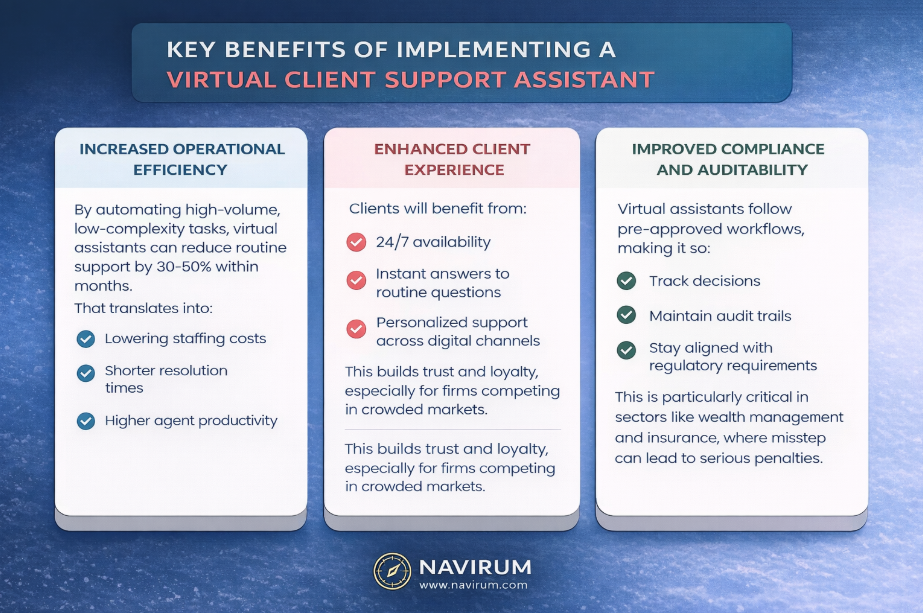
Meanwhile, support teams face growing caseloads and rising pressure to reduce operating costs without compromising service quality. AI-driven assistants solve both sides of this equation by delivering seamless, self-service support for routine inquiries—freeing up human agents for more complex, high-value interactions.
What is the integrated technology stack required for an autonomous Salesforce AI Agent?
To get started with Agentforce, you need a solid Salesforce CRM foundation, Data Cloud, which acts as your company’s ‘center of meaning’ and knowledge base, and the appropriate Agentforce licenses. While the benefits are transformative, navigating the Salesforce stack requires understanding how these layers connect
1. Why is Salesforce CRM the essential for Agentforce success?
At the heart of your virtual assistant is your Salesforce Customer Relationship Management (CRM) platform. This is where all your structured client data lives – accounts, service history, communication logs, case records, and more.
But the effectiveness of your assistant depends heavily on data quality. The CRM must be:
Well-organized: Clean field structures, accurate records, and no duplicates
Integrated: Connected to other enterprise systems like policy management, loan origination, or investment platforms
Actionable: Designed with automation and workflows in mind
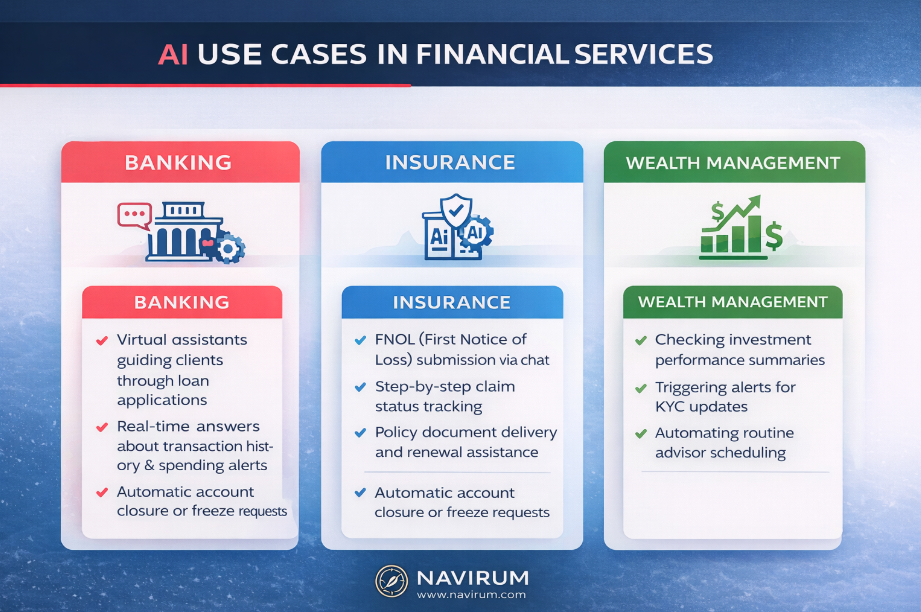
For example, if a wealth management client contacts the assistant to check the status of a portfolio transfer, your Salesforce CRM must already have a standardized process in place—so the assistant can reference accurate case data and provide a real-time update.
Context-aware: They draw on CRM data to personalize every interaction
Process-oriented: Capable of managing multi-step service flows (e.g., onboarding, loan servicing, address updates)
Trainable: They learn from past interactions and continuously improve over time
For example, in an insurance context, an Agentforce-powered assistant could walk a client through a claims process by gathering documentation, submitting the claim, and updating the client on its progress – without a single phone call.
Agentforce also allows for omni-channel support – your assistant can interact via web chat, SMS, or in-app messaging, offering a consistent experience across platforms.
Agentforce Credit Union Success Story – PenFed Unlocks a Competitive Advantage with Agentforce
Salesforce Data Cloud brings intelligence and context to your virtual assistant by unifying data across systems in real time.
While Salesforce CRM holds structured client records, Data Cloud:
Ingests real-time data from core banking systems, marketing platforms, compliance tools, and third-party APIs
Creates unified client profiles using identity resolution and data harmonization
Enables intelligent automation by identifying triggers and behavioral patterns
This means your virtual assistant doesn’t just “respond”—it can predict, personalize, and proactively assist.
Imagine a client logging into your mobile banking app to ask about recent overdraft fees. Data Cloud can analyze their account behavior, detect an unusual pattern, and trigger a tailored response such as waiving the fee or offering a low-balance alert subscription—all before the client even finishes typing.
Agents and Agentforce – Key benefits
What Are The Steps To Build An Agent Solution?
Before diving in, we recommend financial services firms focus on three critical success factors:
1. Data Structure and Hygiene
Ensure your Salesforce CRM is clean, accurate, and integrated. Since poor data quality leads to incorrect responses and undermines user trust, a well-maintained CRM is your most critical asset. Success with Agentforce requires a foundation of enriched, up-to-date data that you can rely on; it isn’t just a preference – it is a prerequisite
Document your common support journeys to identify automation opportunities, human handoff points, and success metrics. Think of Agentforce agents as digital employees: to operate effectively, they must understand your company’s unique workflows. Defining these processes and making them accessible – whether through your Knowledge Base or AI policies – is a critical investment. These documented processes are the ‘roads’ your agents will travel to deliver consistent results
To ensure your AI operates within the bounds of GDPR, FINRA, and local banking standards, you need a proactive framework. Collaborate with legal teams and Agentforce specialists like Navirum to establish a comprehensive AI policy
Why Choose Navirum for Your Agentforce Implementation?
At Navirum, we don’t just implement Salesforce – we design intelligent, compliant, and future-ready Agentforce solutions tailored for the unique demands of financial services.
With deep expertise across banking, insurance, and investment management, we know how to translate your processes and regulations into scalable AI-powered workflows.
How do virtual client assistants built on Agentforce differ fundamentally from traditional chatbots?
Unlike rule-based chatbots, Agentforce-powered assistants are context-aware and process-driven. They can orchestrate multi-step workflows, reference structured client data from Salesforce Financial Services Cloud, and adapt interactions dynamically, delivering personalized guidance while adhering to regulatory compliance. This enables advisors to maintain high-touch relationships without sacrificing scalability.
In what ways does Salesforce CRM enable these virtual assistants to provide trusted financial guidance?
Salesforce CRM centralizes client profiles, account histories, and household relationships. Virtual assistants leverage this data to generate real-time responses, ensure consistency across channels, and escalate complex cases with complete context, thereby minimizing errors and reinforcing client trust.
How does Salesforce Data Cloud enhance predictive support capabilities?
Data Cloud unifies structured and unstructured client data from multiple sources, harmonizing it in real time. Its like giant knowledge base for your firm. It allows agents to understand the meaning of your firms data. This allows assistants to anticipate client needs, personalize recommendations, and trigger proactive alerts—transforming support interactions into predictive, high-value engagements rather than reactive responses.
How Do Wealth Manager Use Agentforce?
Advisor and wealth management use cases are unique. To find out more you can dive into these 5 scenarios here
Why is now the strategic moment for financial firms to invest in virtual client assistants?
Clients increasingly demand instant, 24/7, personalized service, while firms face operational cost pressures and compliance challenges. Virtual assistants offer a scalable solution, freeing human teams to focus on high-value advisory tasks while ensuring consistent, auditable support across touchpoints.
What are the critical data prerequisites for building a high-performing virtual assistant?
Success requires clean, normalized, and integrated CRM and external data. Redundant, incomplete, or siloed information can lead to incorrect guidance, compliance risk, and eroded client trust. Firms must also implement ongoing data quality monitoring and governance frameworks.
How should firms map workflows for automation without disrupting human-led processes?
Workflow mapping must identify end-to-end client journeys, pinpoint repetitive tasks, and define handoffs where human intervention is essential. This ensures the assistant augments rather than replaces human advisors, enabling efficiency gains without compromising service quality or regulatory adherence.
What governance and compliance measures are essential for AI-driven support in financial services?
Regulatory oversight includes role-based access control, logging every interaction, validating AI recommendations against compliance rules, and conducting periodic audits. Assistants should operate within defined limits to ensure risk exposure is controlled while maintaining a fully auditable trail.
How do virtual assistants contribute to advisor productivity and client retention?
By automating routine inquiries, scheduling, and alerts, assistants allow advisors to focus on strategic engagement. They can surface cross-sell or upsell opportunities based on predictive analytics and maintain proactive outreach, directly impacting client satisfaction and long-term retention.
Can these assistants support multi-channel, high-volume client interactions without losing personalization?
Yes. Agentforce-powered assistants integrate with email, chat, voice, and portal platforms while maintaining a unified client profile. They remember prior interactions, personalize content dynamically, and escalate only the complex or sensitive cases, preserving human attention where it matters most.
How can firms measure the ROI and effectiveness of a virtual client assistant?
Tracking these KPIs ensures firms optimize performance, refine workflows, and quantify the assistant’s strategic impact. Ongoing platform support is what keeps those KPIs trending the right direction.