Compliance in Salesforce Financial Services Cloud

What is Compliance in Salesforce Financial Services Cloud?

Salesforce Financial Services Cloud embeds compliance directly into financial services operations through structured data models, KYC and identity controls, relationship intelligence (ARC), standardized Action Plans, and supervisory guardrails. Built on Salesforce’s Trust principles, it delivers enterprise-grade security, auditability, data residency transparency, and governance-ready AI. In a nutshell, FSC is a regulator-aligned, adaptable platform that helps North American financial institutions scale innovation without compromising trust or compliance.

A Trust-First, Regulator-Ready Blueprint for North American Financial Institutions

Salesforce has become one of the most widely adopted enterprise platforms across banks, insurers, credit unions, wealth managers, and asset managers in North America. This is not accidental. Salesforce’s position has been earned by consistently operating at the highest levels of trust, security, compliance, and transparency, long before AI and digital transformation became board-level mandates.

In an era defined by regulatory change, heightened privacy expectations, operational resilience requirements, and accelerating AI adoption, financial institutions need more than innovation. They need defensible, repeatable, regulator-aligned systems. Salesforce delivers this through Salesforce Financial Services Cloud (FSC)—an industry-specific platform designed to embed compliance directly into how financial institutions operate.

Salesforce Trust: The Non-Negotiable Foundation

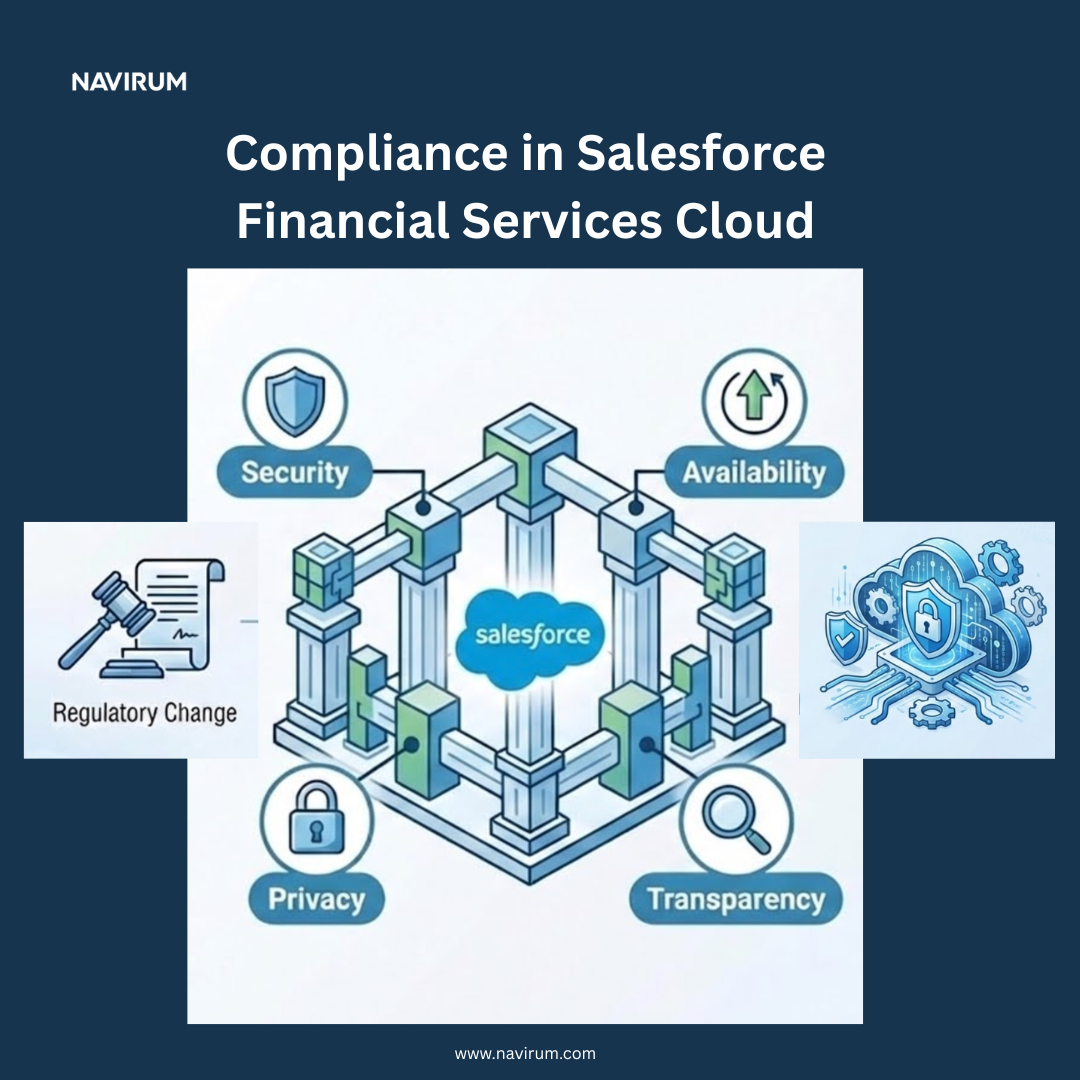
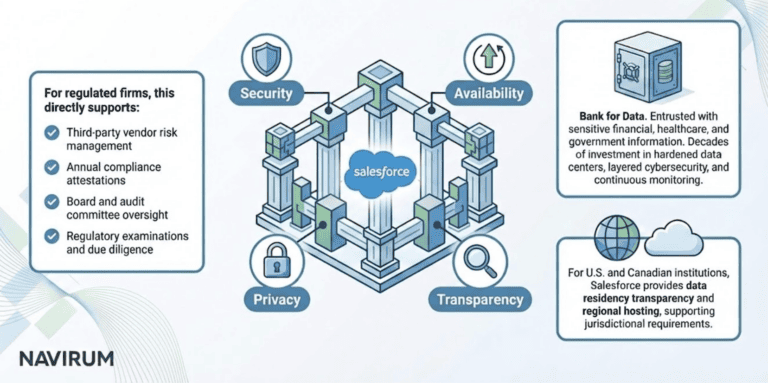
Salesforce’s platform is anchored in its public Trust principles: Security, Availability, Privacy, and Transparency. Through Salesforce Trust , institutions and regulators can view real-time system status, historical uptime, incident communications, and data-center locations.
Salesforce Trust_Navirum

For regulated firms, this directly supports:

  • Third-party vendor risk management
  • Annual compliance attestations
  • Board and audit committee oversight
  • Regulatory examinations and due diligence

Salesforce can credibly be thought of as a bank for data—entrusted with some of the most sensitive financial, healthcare, and government information in the world. As one of the original innovators in enterprise cloud computing, Salesforce has invested for decades in hardened data centers, layered cybersecurity controls, continuous monitoring, and independent certifications.

For U.S. and Canadian institutions, Salesforce also provides data residency transparency and regional hosting, supporting jurisdictional requirements.

Mastering Financial Services Cloud

In modern financial services, “Customer 360” is no longer a buzzword—it is a regulatory and operational requirement. FSC extends Salesforce beyond generic CRM by providing industry-specific data models, workflows, and compliance controls that bridge front-office personalization with back-office governance.
Mastering Salesforce Financial Services Cloud_Navirum

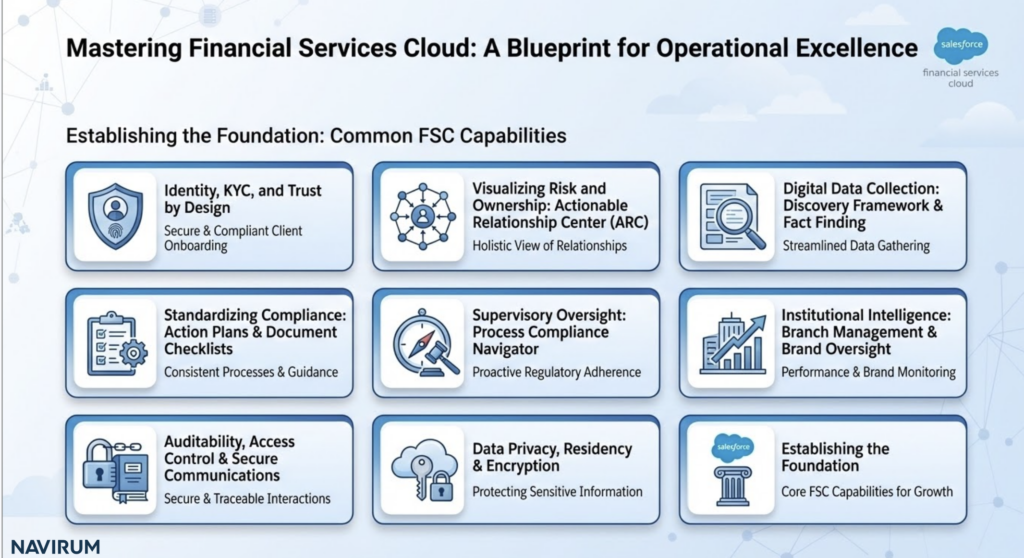
1. Establishing the Foundation: Common FSC Capabilities

Before advanced workflows can be implemented, institutions must understand FSC’s Common Capabilities. These foundational components allow Salesforce to natively model financial services operations.

Key elements include:

  • Financial Account objects
  • Household and relationship groupings
  • Lead-to-Referral tracking
  • Industry-specific record types and page layouts

These capabilities allow firms to operate in the language regulators and auditors expect, rather than forcing financial data into generic CRM constructs.

Admin Resource: Common Capabilities in Financial Services Cloud

2. Identity, KYC, and Trust by Design

KYC with Party Profile Assessment

Salesforce has significantly streamlined KYC through the Party Profile Assessment framework. This allows firms to capture regulatory data points directly within client and entity profiles, embedding KYC into onboarding rather than managing it as a separate compliance exercise.

This approach supports:

  • Structured identity data capture
  • Beneficial ownership tracking
  • Review and approval workflows
  • Auditable KYC status enforcement

KYC Deep Dive: Streamline the Know Your Customer Process For Your Users

Identity Verification & Caller ID

For service and contact-center interactions, FSC includes Identity Verification (Caller ID) capabilities. When a client calls in, agents are guided through verification questions tied directly to the client record—balancing security with client experience.

Identity Verification Setup: Caller Identity Verification

Together, these capabilities ensure identity controls are applied consistently across digital, branch, and call-center channels.

Streamline Onboarding

Transform digital onboarding for financial services with a solution designed specifically for the industry. Create a strong first impression while minimizing abandonment by simplifying applications through AI-driven insights and data integration. Automate manual tasks and connect systems to lower operational costs in what is traditionally a labor-intensive process.

Streamline Onboarding: Power client onboarding in financial services.

3. Visualizing Risk and Ownership: Actionable Relationship Center (ARC)

Modern AML and risk frameworks require institutions to understand networks, not just individuals.

The Actionable Relationship Center (ARC) provides a visual, interactive map of relationships between people, households, trusts, and businesses. Users can immediately see ownership structures, affiliations, and exposure—and take action directly from the relationship view.

ARC supports:

  • Beneficial ownership mapping
  • Related-party risk identification
  • Cross-entity exposure analysis
  • Relationship-driven workflows

ARC Overview: Actionable Relationship Center (ARC) in Financial Services Cloud


This capability is particularly valuable for AML programs and complex wealth or commercial banking scenarios.

4. Digital Data Collection: Discovery Framework & Fact Finding

Manual data entry is one of the largest sources of operational risk.

Discovery Framework

The Discovery Framework allows firms to replace PDFs and spreadsheets with digital, validated forms. Data is captured once, validated in real time, and written directly into Salesforce—reducing errors and improving auditability.

Discovery Framework Guide: Fact Finding for Wealth Managers

Fact Finding Questionnaire

Built on the Discovery Framework, the Fact Finding Questionnaire enables wealth managers to capture comprehensive financial information about a client’s assets, liabilities, income, goals, and risk tolerance.

This data can then drive:

  • Suitability assessments
  • Needs analysis
  • Portfolio recommendations
  • Compliance reporting

Fact Finding Details: Discovery of Client Wealth Goals Using a Fact Finding Questionnaire

5. Standardizing Compliance: Action Plans & Document Checklists

Action Plans

Action Plans are reusable templates that enforce repeatability across complex processes such as onboarding, lending, claims, or wealth planning. Each Action Plan defines tasks, owners, sequencing, and deadlines—ensuring consistency regardless of who executes the process.

Document Checklist Items

Financial services compliance depends on documentation. Document Checklist Items allow firms to define required document types (e.g., proof of income, ID, tax forms) and manage their review and approval lifecycle.

Document Management: Document Checklist Items in Financial Services Cloud

Together, Action Plans and document checklists transform compliance from institutional memory into system-enforced execution.

6. Supervisory Oversight: Process Compliance Navigator

The Process Compliance Navigator provides a visual roadmap of regulatory workflows, preventing users from skipping required steps. It acts as a compliance guardrail—ensuring disclosures, checks, and approvals are completed before progression.

This is particularly important for regulators who expect demonstrable supervision, not implied control.

Process Compliance Navigator: Article Here

7. Institutional Intelligence: Branch Management & Brand Oversight

Branch Management

For retail and advisory networks, FSC includes Branch Management capabilities. Executives can associate staff with branches, track performance, and monitor operational consistency across regions.

Branch Management Admin Guide: Branch Management

Tear Sheets

Tear Sheets provide concise, structured summaries of client information, relationships, recent activity, and key stakeholders. These are invaluable for executive reviews, client meetings, and regulatory examinations.

Tear Sheets Configuration: Tear Sheets Generation

8. Auditability, Access Control & Secure Communications

Salesforce enforces security through:

  • Role-based access controls
  • Field-level security
  • Permission sets

Auditability is supported through:

  • Field History Tracking
  • Setup Audit Trail
  • Event Monitoring

All client interactions—calls, emails, meetings, trade instructions, and money movement requests—can be logged and retained. Secure SMS integrations further reduce off-channel communication risk.

9. Transaction Dispute Management

Empower service agents with AI-driven tools that automate and streamline the dispute process. Reduce manual effort, minimize application switching, and simplify customer communication, all while lowering call volume and accelerating resolution for a more efficient, seamless experience.

  • Dispute Resolution Email
  • Dispute Ackowndgement Email

Transaction Dispute Management

10. Data Privacy, Residency & Encryption

Salesforce supports GDPR and CCPA through:

  • Consent management
  • Data classification
  • Retention policies
  • Right-to-erasure workflows

With Salesforce Shield, firms gain:

  • Encryption at rest
  • Platform encryption
  • Advanced monitoring

Data residency transparency and regional hosting options support U.S. and Canadian regulatory expectations.

AI Innovation Built on Trust, Not Trade-Offs

While many financial services firms are innovating rapidly with AI, trust and compliance remain the primary gating factors. Salesforce is building its AI capabilities on top of its long-standing governance foundation.

AI operates within: role-based access controls, audit trails, data residency requirements, encryption standards, human-in-the-loop oversight.

Unlike many AI-native vendors where governance commitments remain unclear, Salesforce places trust at the center of its AI strategy—making it suitable for regulated environments.

Built to Adapt as Regulations Evolve

Regulatory requirements will continue to change. Salesforce’s greatest advantage is adaptability. Because it is a configurable platform rather than a fixed compliance tool, firms can update workflows, approval chains, reporting structures, and controls without re-platforming.

This reduces:

  • Vendor sprawl
  • Cost of regulatory change
  • Operational disruption

Final Perspective

Salesforce Financial Services Cloud is not just a CRM—it is a compliance-ready operating platform. Through structured data models, repeatable Action Plans, relationship intelligence via ARC, supervisory tooling, enterprise-grade security, and responsible AI governance, Salesforce has become the compliance backbone for many North American financial institutions.

In a market crowded with innovation, Salesforce remains the benchmark for trust, governance, and security at scale.

⭐⭐⭐ DISCOVER NAVIRUM ⭐⭐⭐

navirum_adminCompliance in Salesforce Financial Services Cloud

5 Powerful Reasons Why RIAs Choose Salesforce Financial Services Cloud

How Salesforce Financial Services Cloud Empowers RIAs to Deliver Exceptional Client Experiences

Discover why Registered Investment Advisors (RIAs) choose Salesforce Financial Services Cloud. Learn how FSC streamlines client management, ensures compliance, enables team collaboration, integrates with your tech stack, and delivers actionable analytics to grow AUM and enhance client experiences.

In today’s fast-paced, compliance-heavy financial landscape, Registered Investment Advisors (RIAs) face increasing pressure to deliver personalized client service, manage regulatory demands, and optimize internal workflows. For forward-thinking advisory firms, technology is no longer optional-it’s essential. The total AUM for RIAs, including Fisher Investments, Creative Planning, CAPTRUST, Hightower Advisors, Mariner Wealth Advisors, Osaic Wealth, LPL Financial, Beacon Pointe Advisors, Wealth Enhancement Group, Mercer Advisors, goes into trillions of dollars. The majority of these institutions and their armies of Advisors rely on on Salesforce FSC to run their practices.

Streamlined Client Management with a 360-Degree View

Managing complex client relationships is at the core of every successful RIA practice. Salesforce Financial Services Cloud delivers a real-time, 360-degree view of each client’s financial situation, including:

  • Investment portfolios
  • Financial goals
  • Insurance policies
  • Banking and custodial accounts
  • Key life events

This comprehensive visibility allows RIAs to personalize every interaction, anticipate client needs, and deliver high-touch service at scale. With automated workflows for onboarding, task management, and meeting scheduling, advisors can spend more time building relationships and less time on admin work.

Salesforce FSC for RIAs

Built-In Compliance Management Features

Navigating the regulatory landscape is a daily reality for RIAs. Salesforce Financial Services Cloud simplifies compliance by embedding it directly into the platform’s workflows. Key features include:

  • Automated KYC and AML workflows
  • Document management and audit trails
  • Activity tracking for client interactions
  • Pre-configured compliance templates

These tools make it easier to meet FINRA, SEC, and fiduciary obligations while reducing the risk of errors. RIAs can rest assured knowing that compliance is monitored, documented, and manageable—all within the same system used for daily operations.

Enhanced Collaboration Across Teams and Partners

Advisory firms thrive when their internal teams and external partners can collaborate effectively. Salesforce Financial Services Cloud enables seamless communication and alignment through:

  • Salesforce Chatter for real-time messaging
  • Shared client records and task assignments
  • Integrated workflows with custodians, CPAs, and estate planners

This unified platform ensures that everyone involved in the client experience is on the same page, improving responsiveness and service consistency. It’s especially powerful for distributed teams or multi-office firms.

Actionable Insights with Built-In Reporting and Analytics

Data is only valuable if you can act on it. Salesforce Financial Services Cloud includes powerful reporting and analytics tools that help RIAs:

  • Track client retention and satisfaction
  • Monitor AUM growth and performance
  • Evaluate advisor productivity
  • Analyze marketing ROI and sales pipeline trends

With customizable dashboards, firm leaders and advisors alike can make data-driven decisions, spot trends, and identify growth opportunities in real time.

Salesforce FSC

Seamless Integration with Your Existing Tech Stack

Salesforce Financial Services Cloud doesn’t just stand alone—it integrates seamlessly with the tools you already use, such as:

  • Financial planning tools (e.g., eMoney, MoneyGuidePro)
  • Portfolio management systems (e.g., Orion, Black Diamond)
  • Document storage and digital signature platforms
  • Marketing automation tools

This centralization eliminates data silos, reduces errors, and ensures advisors always work with the most up-to-date information—saving time and reducing manual entry across platforms.

Why Choose Navirum to Implement Salesforce Financial Services Cloud?

Even with a powerful tool like Salesforce, successful implementation requires expertise. That’s where Navirum comes in.

Navirum is a Salesforce consulting partner that specializes in working with RIAs. Our team helps financial advisory firms implement, customize, and optimize Salesforce Financial Services Cloud to:

  • Align with your business model
  • Automate key workflows
  • Ensure full compliance readiness
  • Provide advisor training and change management support

Whether you’re just starting with Salesforce or looking to optimize your current setup, Navirum can help you unlock the full potential of your CRM investment.

Start Your Digital Transformation Today

Salesforce Financial Services Cloud empowers RIAs to modernize operations, deliver exceptional client experiences, and stay ahead of regulatory requirements—all in one platform.

If you’re ready to leverage the power of Salesforce and create a more scalable, compliant, and client-centric firm, contact Navirum today. Our team is ready to help you build the future of your advisory practice.

Not Sure If You’re Ready for Salesforce Financial Services Cloud?

Planning a Salesforce FSC implementation can feel overwhelming—but it doesn’t have to. Our Salesforce FSC Readiness Assessment is designed to help you evaluate your firm’s preparedness across critical areas such as business strategy alignment, data and system integration, compliance and security, user adoption, change management, and ongoing optimization.

This short, actionable quiz will highlight your strengths, pinpoint areas for improvement, and provide a clear framework to guide your implementation journey.

Take the first step—download the assessment today and build a smarter roadmap to Salesforce success.

Salesforce FSC Implementation Readiness Checklist
Salesforce FSC Implementation Readiness Assessment (preview)

Frequently Asked Questions (FAQs)

What is Salesforce Financial Services Cloud?

Salesforce Financial Services Cloud (FSC) is a specialized version of Salesforce CRM designed for the financial services industry. It provides tools for client relationship management, compliance, data analytics, and workflow automation—tailored specifically for Registered Investment Advisors (RIAs), wealth managers, and financial planners.

How does Financial Services Cloud help RIAs manage clients more effectively?

FSC gives RIAs a 360-degree view of each client’s financial life, including accounts, goals, holdings, and key milestones. This enables advisors to personalize service, streamline onboarding, track life events, and deliver high-touch experiences that build lasting client relationships. Get these tips for implementing Salesforce FSC

Is Salesforce Financial Services Cloud compliant with financial regulations?

Yes, FSC includes built-in compliance tools such as automated workflows for KYC/AML, audit trails, document management, and activity logging. These features help RIAs meet regulatory standards set by the SEC, FINRA, and fiduciary obligations more efficiently.

Can Salesforce Financial Services Cloud integrate with other financial tools I already use?

Absolutely. FSC integrates with a wide range of third-party tools used by RIAs, including financial planning software (eMoney, MoneyGuidePro), portfolio management platforms (Orion, Black Diamond), custodians, marketing tools, and document storage systems.

What kind of reporting and analytics does FSC offer?

FSC provides robust reporting and dashboard features that allow RIAs to track KPIs such as assets under management (AUM), client acquisition, retention, investment performance, advisor productivity, and more. These insights support data-driven decision-making and business growth.

How does FSC support collaboration within my team and with external partners?

Salesforce Financial Services Cloud includes tools like Salesforce Chatter for real-time collaboration, shared client profiles, and workflow tracking. Teams can easily work together across departments, while securely collaborating with external partners like CPAs, attorneys, and custodians.

Is Salesforce Financial Services Cloud customizable for my RIA firm?

Yes, FSC is highly customizable. With the help of certified Salesforce partners like Navirum, RIAs can tailor the platform to match their unique business processes, client segmentation, compliance needs, and reporting requirements.

How long does it take to implement Salesforce Financial Services Cloud?

Implementation timelines vary depending on firm size, customization needs, and data migration complexity. However, with expert partners like Navirum, most firms can go live in 8–12 weeks with a phased rollout that minimizes disruption to daily operations.

What are the costs associated with Salesforce Financial Services Cloud?

Salesforce FSC pricing depends on your user count, features required, and customization level. While it is a premium solution, the return on investment is often high due to improved efficiency, compliance, and client retention. Navirum can help assess your needs and provide a cost-effective implementation plan.

Why should I work with Navirum to implement Salesforce?

Navirum specializes in Salesforce solutions for RIAs and financial advisors. We understand the regulatory, operational, and client service challenges in the industry. From initial setup to ongoing support, we help your firm unlock the full potential of Salesforce Financial Services Cloud, ensuring a smooth, strategic implementation.

⭐⭐⭐ DISCOVER NAVIRUM ⭐⭐⭐

Thanks for reading!!

navirum_admin5 Powerful Reasons Why RIAs Choose Salesforce Financial Services Cloud

Introduction to Einstein Activity Capture Updates

Einstein Activity Capture (EAC) is a Salesforce feature that automatically captures emails and calendar events from Outlook or Gmail and links them to Salesforce records. Salesforce has recently clarified upcoming changes regarding EAC reporting and the Sync Email as Salesforce Activity feature.

Key Clarification

To be clear: Einstein Activity Capture (EAC) will continue to function as a tool for syncing emails and calendar events.

However, several legacy EAC reporting features will be retired in the Summer ’26 release.

🛑 What’s Retiring in Summer ’26

The following legacy reporting tools and structures are being phased out:

  • Activity 360 Reporting
  • Activity Metrics
  • Activities Dashboard
  • Unified shadow objects (e.g., UnifiedEmail, UnifiedTask, etc.)

These older features previously made email activity reporting more complex due to non-standard data models. With their retirement, Salesforce aims to simplify how users report on activities.

Summary of Changes

FeatureStatus
EAC (Email/Calendar syncing tool)Continues
Legacy Reporting Tools (Activity 360, Metrics, Dashboard, Unified objects)Retiring
Reporting on email activityMust transition to Sync Email as Salesforce Activity

What’s Next: New Reporting Structure

Starting with upcoming updates:

  • Emails and calendar events will sync as standard Salesforce activity records:
    • Task
    • EmailMessage
  • All reporting will now use standard activity reports and dashboards (not legacy EAC dashboards).
  • Email and activity data will become a native part of the Salesforce CRM data model, removing the need for separate or “shadow” data objects.

Key Features of the New EAC Model

  • Automatic linking of emails to Contacts, Leads, Accounts, and Opportunities
  • Email activity visible in Activity Timelines and Related Lists
  • Fully supports Flows, triggers, and other automations
  • Admins can:
    • Exclude internal domains or specific email addresses
    • Choose between full email body capture or header-only for privacy
  • Respects existing activity sharing rules (visibility, editing, deletion)

Benefits of the Transition

  • Removes reliance on outdated EAC reporting tools
  • Unifies activity data within the core Salesforce CRM model
  • Simplifies reporting, automation, and third-party integrations
  • Enhances data governance, visibility, and control

Conclusion

Salesforce’s shift away from legacy EAC reporting to a fully integrated activity model represents a major improvement for reporting clarity and CRM alignment. Admins and developers should begin planning the transition to Sync Email as Salesforce Activity for a more scalable, future-ready Salesforce environment.

References:

⭐⭐⭐ DISCOVER NAVIRUM ⭐⭐⭐

navirum_adminIntroduction to Einstein Activity Capture Updates

Why Financial Service Companies Need a CRM

Alright, financial service firms, let’s have a chat. It’s 2024, and if your idea of client management still involves a Rolodex or a color-coded spreadsheet, we need to talk.

Why Financial Service Companies Need a CRM (And Why You Shouldn’t Be Using a Rolodex in 2024)

Alright, financial service firms, let’s have a chat. It’s 2024, and if your idea of client management still involves a Rolodex or a color-coded spreadsheet, we need to talk. Yes, the Rolodex had its glory days. It was great. But now, it’s gathering dust, and your clients deserve better. Enter: the CRM (Customer Relationship Management system). If you’re still on the fence about why you need one, let me break it down for you in a way that’ll have you wondering how you ever survived without it.

1. Client Management, Not Client Chaos

Let’s be real—managing clients in financial services is like juggling flaming torches, except the torches are client meetings, compliance checks, portfolio updates, and a thousand emails. Without a CRM, that juggling act is going to drop right on your foot. A CRM is your magic trick to keep all those torches in the air. It tracks every interaction, every email, and every update so you don’t have to search through 15 inbox folders just to find that one time Mr. Jenkins asked about his bond portfolio.

2. Follow-Ups: Because Clients Love to Be Remembered

Let’s be honest: no one wants to be “that guy” who forgets to follow up with a client. (You know who you are.) Your client just told you about their big financial goals, and two weeks later you’re staring at your screen thinking, “Wait, what was that about?” A CRM sends you friendly reminders—like a personal assistant you don’t have to feed or pay—so you can stay on top of things and look like the all-knowing financial wizard you are.

3. Stop Wrestling with Compliance

You know that sinking feeling when you’re deep into paperwork, trying to remember if you’ve checked every compliance box, filed every report, and kept a perfect trail of everything you did? Yeah, we see you. A CRM makes compliance way easier. It keeps track of all the important info, generates reports, and helps you sleep better at night knowing your regulator won’t be knocking down your door.

4. Efficiency: Because You Didn’t Go Into Finance to File Paperwork

Look, you got into financial services to help people build wealth, plan for the future, and maybe wear a power suit or two. But somehow, all your time is getting eaten up by paperwork, client emails, and searching for that one sticky note with “urgent” written on it. A CRM automates a ton of those mundane tasks—client follow-ups, data entry, reporting—so you can get back to doing what you actually like: working with clients (and maybe wearing that power suit).

5. Personalization: Because No One Wants a “Dear Valued Client” Email

Let’s face it, sending the same generic email to 200 clients is a surefire way to make them feel like just another number. A CRM stores all that juicy client data—birthdays, financial goals, favorite coffee order—so you can send emails that are actually personal. Imagine your clients getting messages that show you remember their needs, their preferences, and even that one time they ranted about the market. It’s a level of personalization that’ll make your clients think, “Wow, they really get me.”

6. The “I Can’t Believe I Didn’t Do This Sooner” Moment

If you’re still managing clients with spreadsheets, sticky notes, or—heaven forbid—your memory, the moment you switch to a CRM will feel like the clouds parting and angels singing. Suddenly, everything is in one place. You know where your clients are in their financial journey, you have a bird’s-eye view of your business pipeline, and your team isn’t frantically texting each other for updates on Client X’s latest request.

7. It’s 2024: Time to Level Up

It’s 2024, and the financial services industry isn’t slowing down. Between growing competition, increasing client expectations, and more complex regulations, you need every tool at your disposal to keep up. A CRM is your secret weapon—it’s like giving your team superpowers (minus the capes). Not only will you be able to manage more clients with less effort, but you’ll also give each one of them the attention and care they deserve.

So, Why Haven’t You Made the Switch Yet?

Maybe you’re thinking, “But I’ve got my system—spreadsheets, emails, post-it notes, and a great memory!” Well, sure, but at what cost? Think of all the hours you could save, the clients you could impress, and the stress you could avoid by letting a CRM handle the heavy lifting. It’s like hiring a digital assistant that never sleeps, never forgets, and always has the answers at its fingertips.

Don’t wait for a sticky note to get lost, or a client to slip through the cracks. It’s time to ditch the Rolodex and join the CRM revolution. Your clients (and your sanity) will thank you.

Contact Us
First
navirum_adminWhy Financial Service Companies Need a CRM

From Leads to Loyalty: Building Lasting Customer Relationships with Pardot Account Engagement in Wealth Management

In the competitive landscape of wealth management, building strong and lasting relationships with clients is essential for success. With Pardot, Salesforce’s robust marketing automation platform, wealth management firms have a powerful tool at their disposal to engage clients at every stage of their journey—from initial lead generation to ongoing loyalty and advocacy. As a Salesforce consultant specializing in the wealth management industry, I’m excited to explore how Pardot can help firms build meaningful customer relationships and drive business growth.

Understanding the Wealth Management Journey

Before diving into Pardot account engagement strategies, it’s essential to understand the wealth management journey. Clients in the wealth management industry have unique needs, goals, and expectations that evolve over time. From initial prospecting and lead generation to onboarding, portfolio management, and ongoing communication, each stage of the journey presents an opportunity to engage clients and build trust.

Tailoring Communication to Client Needs

Effective communication is the cornerstone of building lasting relationships in wealth management. With Pardot, wealth management firms can tailor their communication to meet the individual needs and preferences of each client. Whether it’s delivering personalized email campaigns, targeted content offers, or customized newsletters, Pardot enables firms to engage clients with relevant and timely messaging that adds value to their experience.

Automating Client Onboarding and Engagement

Client onboarding is a critical stage in the wealth management journey, and automation can streamline this process for firms. With Pardot’s automation tools, wealth management firms can create personalized onboarding sequences that guide clients through the initial stages of their relationship. From welcome emails and introductory calls to educational content delivery and account setup, automation ensures a seamless and engaging onboarding experience for clients.

Nurturing Relationships for Long-Term Success

Building lasting relationships requires ongoing engagement and nurturing. With Pardot, wealth management firms can create automated nurture campaigns that keep clients engaged and informed throughout their journey. Whether it’s providing market insights, financial planning tips, or investment updates, automated nurture campaigns enable firms to stay top-of-mind and demonstrate their value to clients over time.

Measuring and Optimizing Engagement

To drive continuous improvement, it’s essential to measure the effectiveness of Pardot account engagement efforts and optimize strategies accordingly. Pardot’s analytics and reporting tools provide valuable insights into key metrics such as email open rates, click-through rates, and conversion rates. By analyzing engagement data and identifying areas for improvement, wealth management firms can refine their strategies and drive better results.

In the wealth management industry, building lasting customer relationships is essential for driving business growth and success. With Pardot, wealth management firms can engage clients at every stage of their journey—from leads to loyalty—and build trust through personalized communication, automated onboarding, and ongoing engagement. If you’re ready to take your client relationships to the next level with Pardot, our team of experienced consultants is here to help. Together, we can develop a tailored approach that maximizes engagement, drives results, and fosters lasting relationships with your clients in the wealth management industry.

navirum_adminFrom Leads to Loyalty: Building Lasting Customer Relationships with Pardot Account Engagement in Wealth Management

How to boost your Pardot Account Engagement in Financial Services

In the fast-paced world of financial services, building meaningful connections with clients is paramount to success. With the right strategies in place, Pardot (now Marketing Cloud Account Engagement), Salesforce’s powerful marketing automation platform, can help financial institutions unlock the full potential of engagement and drive business growth.

Understand Your Audience’s Needs

The first step in maximizing Pardot account engagement in financial services is understanding the unique needs and preferences of your audience. Segment your client base based on factors such as demographics, financial goals, risk tolerance, and engagement history. By gaining a deeper understanding of your clients, you can tailor your messaging and content to resonate with their specific needs and interests.

Every client comes with distinct goals, challenges, and market dynamics. It’s imperative to conduct thorough discussions and assessments to comprehend their specific needs. This involves:

  • Identifying Objectives: Determine what the client aims to achieve with Pardot – whether it’s lead generation, lead nurturing, customer engagement, or all of the above.
  • Analyzing Target Audience: Understand the demographics, behaviors, and preferences of the client’s target audience to tailor marketing strategies accordingly.
  • Assessing Current Processes: Evaluate existing marketing processes and technologies to identify pain points and areas for improvement.

Personalize Your Communications

Personalization is key to capturing the attention of clients in the financial services industry. Leverage Pardot’s dynamic content capabilities to deliver personalized communications that speak directly to each client’s individual needs and preferences. Whether it’s personalized email campaigns, targeted landing pages, or customized content offers, personalization demonstrates that you understand your clients and adds value to their experience.Tailor content based on factors like industry, job title, or previous interactions to enhance engagement and conversion rates.

Automate Client Onboarding and Nurturing

Client onboarding and nurturing are critical stages in the client lifecycle, and automation can streamline these processes for financial services firms. Use Pardot’s automation tools to create personalized onboarding sequences that guide clients through the initial stages of their relationship with your firm. Automate follow-up communications, educational content delivery, and appointment scheduling to ensure a seamless and engaging onboarding experience for clients.Implement custom lead scoring models based on the client’s criteria to prioritize leads effectively. Utilize segmentation to deliver personalized content and nurture leads based on their interests and behaviors.

Leverage Compliance-Friendly Messaging

Compliance is a top priority for financial services firms, and it’s essential to ensure that all client communications adhere to regulatory requirements. With Pardot, you can create compliance-friendly messaging templates and workflows that meet industry regulations while still delivering engaging content to clients. Leverage features such as approval processes and audit trails to ensure that all communications are compliant and secure.

Monitor Engagement Metrics

To optimize Pardot account engagement in financial services, it’s essential to monitor key engagement metrics and track performance over time. Use Pardot’s analytics and reporting tools to track metrics such as email open rates, click-through rates, and conversion rates. Configure custom dashboards and reports to track key performance indicators (KPIs) aligned with the client’s objectives. Provide insights into campaign effectiveness, lead quality, and ROI to drive data-driven decision-making.

Harness the Power of AI for Smarter Engagement

Artificial Intelligence (AI) is transforming how financial services firms approach marketing automation, and Pardot’s integration with Salesforce Einstein makes it easier than ever to act on data-driven insights. With AI-powered features such as Einstein Behavior Scoring and Engagement Frequency, marketers can predict which prospects are most likely to convert and determine the optimal time to send communications. This allows financial institutions to fine-tune their outreach strategies, prioritize high-value leads, and deliver hyper-relevant content that improves engagement and shortens sales cycles.

AI also enhances personalization at scale by analyzing past behavior, engagement patterns, and client preferences to automatically suggest the most effective messaging and content for each segment. In a highly regulated industry like financial services, this not only boosts efficiency but also ensures messaging remains compliant and consistent. By incorporating AI into your Pardot strategy, your firm can shift from reactive marketing to proactive engagement—turning data into action and opportunities into long-term client relationships.

Curious how AI can boost your Pardot performance?

Explore Einstein Features for Marketing Cloud Account Engagement or book an appointment with one of our consultants to learn more about how to build an AI-powered engagement strategy tailored for financial services.

In a nutshell,  Pardot offers a robust set of features and capabilities that can be tailored to address diverse client needs effectively. By understanding the client’s objectives, customizing Pardot solutions, and providing ongoing support, businesses can unlock the full potential of marketing automation to drive growth and success. Collaboration between clients and Pardot experts is key to achieving sustainable results and staying ahead in today’s competitive landscape.

 If you’re ready to supercharge your account engagement strategy with Pardot, our team of experienced consultants is here to help. Together, we can develop a tailored approach that maximizes engagement, drives results, and fosters lasting relationships with your clients in the financial services industry.

Tumi. Certified Pardot Consultant, Financial Services Industry Expert

Tumiloju (Tumi) is a Salesforce-certified professional with over a decade of experience in IT and cloud solutions. She holds multiple Salesforce certifications, including Administrator, Platform Developer, and Consultant credentials.

In her current role as a Salesforce Consultant, Tumi delivers scalable, high-impact solutions across diverse industries. She brings deep expertise in Sales Cloud, Service Cloud, and custom development using Apex, Lightning Web Components (LWC), and Flow. Known for her ability to architect smart, efficient solutions, Tumi has a proven track record of solving complex business challenges.

She is also actively exploring the integration of AI capabilities within Salesforce, including Einstein and GPT integrations. Her experience spans the full project lifecycle—from discovery and design to development, deployment, and ongoing support.

A strong communicator and collaborative team player, Tumi works effectively with both business stakeholders and technical teams. She is driven by a commitment to continuous learning, innovation, and delivering measurable business value through technology.

FAQ Pardot (now Marketing Cloud Account Engagement)

What is Pardot (Marketing Cloud Account Engagement), and how is it used in financial services?

Pardot is Salesforce’s B2B marketing automation platform, now part of Marketing Cloud. In financial services, it helps firms generate leads, nurture client relationships, and ensure regulatory compliance through targeted, automated marketing.

Why is Account Engagement important in financial services marketing?

Engagement helps measure how potential clients interact with your marketing content. For financial institutions, higher engagement can lead to stronger relationships, increased trust, and ultimately more conversions — especially in a highly regulated and competitive space.

What are some unique challenges in using Pardot for financial services?

Financial firms must navigate strict compliance regulations, complex buyer journeys, and often siloed data. Ensuring accurate segmentation, data security, and compliant automation are key challenges that require expert configuration.

How can segmentation improve engagement in Pardot for financial institutions?

Using Pardot’s dynamic lists and segmentation rules, financial firms can tailor content to specific client types — such as investors, loan applicants, or advisors — improving relevance and increasing engagement rates.

What types of content perform best in Pardot campaigns for financial services?

Educational content like market insights, financial planning guides, compliance updates, and ROI calculators tend to perform well. Trust and value-driven content is especially effective in building long-term client relationships.

How do you measure engagement success in Pardot?

Key metrics include email open rates, click-through rates, form submissions, and page views. Engagement Studio programs and lead scoring can also track how prospects interact over time, helping to identify sales-ready leads.

Can Pardot integrate with other Salesforce Clouds used in financial services?

Yes. Pardot integrates natively with Salesforce Financial Services Cloud, Sales Cloud, and Service Cloud, enabling a 360-degree view of the client and seamless lead hand-offs between marketing and sales.

How do you ensure compliance with financial regulations in Pardot campaigns?

By implementing permission-based marketing, using custom opt-in processes, maintaining detailed audit trails, and ensuring proper field-level security and data governance, firms can stay compliant while leveraging automation.

What are some advanced Pardot strategies for boosting engagement?

Tactics include A/B testing, personalization tokens, dynamic content, behavioral triggers, and multi-touch nurture programs via Engagement Studio — all tailored to different stages of the financial decision-making journey.

Should we work with a Salesforce consulting partner to optimize our Pardot setup?

Absolutely. A certified Salesforce partner can ensure your Pardot instance is aligned with financial industry best practices, properly integrated with your CRM, and configured to drive measurable ROI through smarter engagement.

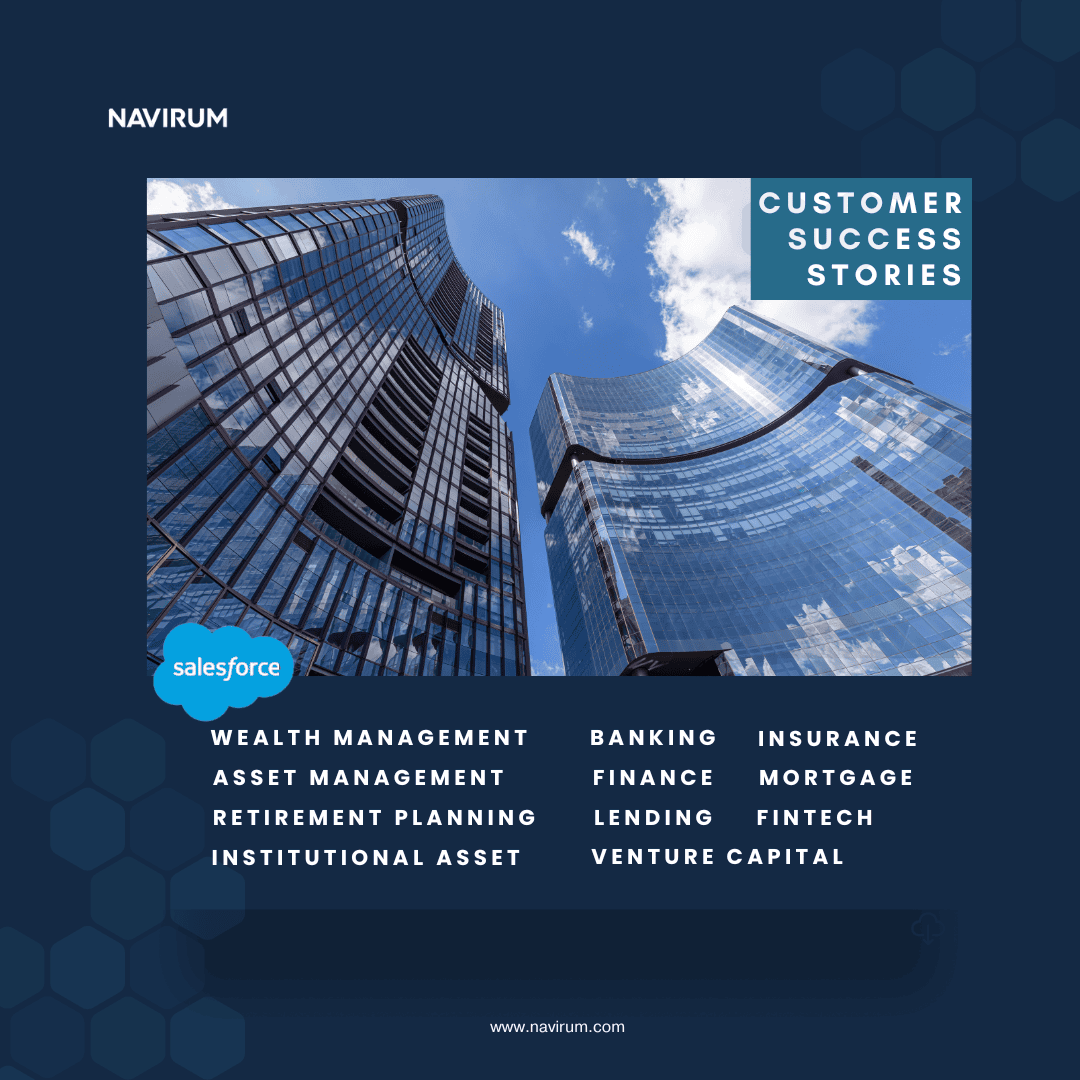
Navirum Customer Success Stories

Thanks for reading!

navirum_adminHow to boost your Pardot Account Engagement in Financial Services

A Day in the Life of a Salesforce Consultant

Discover How A Day Goes in the Life of a Salesforce Consultant

Welcome to our Expert Corner!

Today, we’re focusing on the exciting world of Salesforce consultancy. We will take a closer look at what it’s like to be a Senior Consultant at Navirum. Let’s explore the important skills and qualities needed for success in this role.

Role at Navirum

In every successful project, there’s a team dedicated to delivering the best results. As a Senior Consultant at Navirum, I lead this team to ensure our projects go above and beyond our clients’ expectations. 

My journey starts by diving deep into our clients’ needs through workshops and meetings. This step is super important because it sets the stage for everything else we do. With a clear understanding of what our clients want, I tailor solutions that fit their vision perfectly.

Collaboration is key to our success. I work closely with our clients and our team to make sure everyone’s ideas are heard and valued. Together, we figure out the best strategies and technologies to achieve our goals.

But my job doesn’t stop once we’ve implemented a solution. I continue to support our clients, making sure everything runs smoothly and helping them whenever they need it. This ongoing relationship-building is what makes Navirum a trusted partner in our clients’ success stories.

Let’s step into the shoes of a Salesforce consultant, and explore a typical day in their life:

  • Client Meetings: The morning kicks off with meetings with clients, offering a chance to align goals, gather business requirements, and foster relationships beyond mere transactions.
  •  Requirement Analysis: It’s time to dive deep into analyzing requirements. This involves unraveling the intricacies of client needs and desires to ensure a thorough understanding.
  • Solution Design:Equipped with valuable insights, collaboration with architects & broader team ensues to design solutions. Together, we transform visions into concrete plans for digital transformation.
  • Configuration and Customization: We embark on configuring and customizing Salesforce, and also work with developers to get the requirements implemented. This allows us to unleash the platform’s potential, tailoring it precisely to meet client needs.
  • Teamwork: We work together with our team to solve technical problems. By focusing on excellence, we overcome challenges and move forward.
  • Documenting and Reporting: We write down every important achievement. This shows that we are open and responsible. It helps us keep track of what we’ve done and share it with others.
  • Client Support and Training: Throughout the day, we serve as guides to our clients. Empowering them to unlock Salesforce’s full potential through support and training ensures they can leverage the platform to its fullest extent.
  • Project Management: Time is incredibly important to us, so we use it carefully. By planning out when things need to be done, we make sure projects stay on schedule and get finished the way they should.
  • Continuous Learning:In the ever-evolving landscape of technology, we seize every opportunity to learn and grow. Staying ahead of the curve ensures that we can offer innovative solutions to our clients.

Soft skills are a must!

In the world of Salesforce consulting, being skilled with technology is important, but it’s our soft skills that really make us stand out. Things like clear communication, focusing on what the client needs, solving problems, being able to adapt, working well with others, understanding others’ feelings, giving good presentations, negotiating well, being a leader, and managing time effectively are all key to our success. These skills help us tackle challenges and make the most of opportunities.

In the end, being a Salesforce consultant is more than just a job—it’s a passion. We’re always striving to do better, using our innovation, teamwork, and dedication to help our clients succeed. At Navirum, we don’t just deal with change; we embrace it. We turn challenges into chances and dreams into realities. Come join us on this exciting journey, where we’re pushing the boundaries of what’s possible and unleashing the full power of Salesforce innovation.

⭐⭐⭐ DISCOVER NAVIRUM ⭐⭐⭐

navirum_adminA Day in the Life of a Salesforce Consultant

Salesforce Financial Services Cloud. 5 Tips For a Better Implementation

Author: Navirum Consulting

Salesforce Financial Services Cloud Background

Quicklinks To Key Sections

Jump to key sections using the links below

Background. Who Uses Salesforce FSC?

If you’re a leader in wealth management, banking, or insurance, you’re likely seeking smarter ways to manage client relationships and scale your operations. That’s exactly where Salesforce Financial Services Cloud (FSC) comes in.

FSC isn’t just a CRM. It’s a purpose-built platform that connects your entire business around the client, enabling more personalized service, improved efficiency, and greater visibility across accounts and interactions. For financial services firms serious about digital transformation, FSC is often the foundation.

Salesforce Financial Services Cloud has specialist functionality for the whole industry. Whether you are a financial advisor, a banker or an insurance underwriter Salesforce FSC can help you run business more efficiency. Focusing on the right industry track is essential. Dive into these areas using the links below:

At Navirum, we’ve implemented FSC for thousands of firms across North America (Navirum success stories). From pre-sales discovery and strategy to seamless integration and long-term optimization, we align Salesforce technology with your business objectives, driving measurable value at every stage.

Implementing Salesforce Financial Services Cloud

Listen to the deep dive

Is Salesforce’s Financial Services Cloud Right for You?

Before you dive into Salesforce FSC and begin implementing it, you need to figure out if this Salesforce product is right for you. In other words, you must establish clear business objectives and determine whether the Financial Service Cloud is congruent with these goals. If you begin implementing the FSC service before you have clear objectives and expectations, you risk making errors and possibly using a tool that won’t help you achieve your goals effectively.

Salesforce FSC Demo with AI

Tip 1 – Establishing Your Business Goals

Salesforce’s FSC is a service that’s tailored to improving your financial company’s customer relationship management system. It helps you track your leads and customers, develop marketing strategies to secure more deals, collect lead data, and much more.

If your business management goals involve improving the way your financial service business approaches, attains, and manages customer relationships, then the Financial Services Cloud is the ideal tool for you. The FSC’s value comes from its ability to centralize your CRM with tools that are specific to the financial services industry.

There are many tools out there that can help you improve your customer relationship management systems. Unfortunately, these platforms are offered to everyone, so they lack the specific tools you need to improve your financial business. These tools offer a generic, one-size-fits-all solution that barely scratches the surface of what your company needs in a client relationship management tool. 

The Financial Services Cloud, on the other hand, doesn’t try to help all businesses. It specializes in financial services and offers the tools you need to ensure that your business grows and keeps its specific client happy. In establishing your goals, learning about the Salesforce Financial Services Cloud is highly recommended

Learn About the Financial Services Cloud

As the saying goes, knowledge is power. And when it comes to the Salesforce Financial Services Cloud, that couldn’t be more true. The more you learn about the platform and its features, the clearer a plan you can create for implementing and using it within your financial service company. Salesforce has made significant strides in recent years to provide industry-specific solutions for financial services companies. The Financial Services Cloud is a prime example of this effort. 

By taking the time to learn about all that the FSC platform has to offer, you’ll be in a much better position to develop a plan that takes advantage of its full potential. So if you’re looking to get the most out of Salesforce Financial Services Cloud, make sure you’re armed with as much knowledge as possible. It’ll empower you to create a roadmap for success.

An excellent tool for learning about Salesforce and the Financial Services Cloud is Trailhead and you can sign up here and start learning for free.

Trailhead for Salesforce Financial Services Cloud

Heres some Salesforce FSC trails we recommend to get you started

This platform offers hours of free workshops and courses about Salesforce products that will help you understand the FSC platform and what it can do for you.

Do some research and understand the features and tools that FSC offers. That way, you can get an idea of which features you’d like to implement and which ones you can forgo for the sake of simplicity. Many financial service and wealth management companies struggle with implementing FSC because they haven’t done their research and identified what they want to get out of using this sales cloud. So make sure you do some digging before you start implementing FSC in your financial business.

Tip 2 – Involve More Stakeholders in the Project

One of the most common pitfalls financial services firms face with Salesforce Financial Services Cloud isn’t technical. It’s cultural. The tool gets implemented, the data flows in, and yet no one uses it.

As Salesforce consultants, we hear this all the time: “We invested in Salesforce, but our team still works in spreadsheets, Outlook, or legacy systems.” The issue isn’t the software. It’s lack of internal adoption.

If you want long-term success with FSC, you need to start by building internal alignment now, not after go-live. The single most effective way to drive adoption is to involve stakeholders early and often.

Going back to Trailhead again, there is lots of help and training available like this 30 minutes course on improving Salesforce adoption. This half an hour could transform the outcome of your project and we suggest the whole project team takes it before discussing as a group.

Trailhead course – Improve Salesforce adoption

Stakeholder engagement builds ownership, trust, and momentum. It signals that this is not just another IT initiative. It is a strategic shift in how your firm serves clients.

So, don’t just roll out FSC. Co-create it with your team. Make it theirs. And watch adoption take care of itself.

Tip 3 – Get Help with Financial Services Cloud Implementation

Salesforce’s Financial Services Cloud offers in-depth CRM tools that are custom-built for your financial service business. It gives you access to countless invaluable tools and features that can help supercharge your company’s CRM system. Unfortunately, all of these tools, features, and customization opportunities can get confusing. Many business owners and decision makers get intimidated by the sheer complexity of the Financial Services Cloud and avoid it entirely.

Luckily, you don’t have to face your Salesforce Financial Services Cloud journey alone. If you don’t have an internal sales team that is certified in Salesforce, we recommend hiring a certified Salesforce partner or advisor with the FSC accreditation. They can help you make the most of Salesforce’s capabilities and ensure that your sales and CRM data is compliant with financial regulations. Ensuring they are certified in Salesforce Financial Services Cloud is important as well as experienced implementing the technology.

Salesforce Financial Services Cloud certification

Working with an accredited Salesforce partner lets you access a professional who can help guide your FSC implementation. They will take the time to understand your problem and offer straightforward solutions to help you succeed. Not to mention, the partner can also train your team with the skills and knowledge they need to utilize the Financial Services Cloud as effectively and efficiently as possible. The Salesforce partner will also ensure that the training is recorded and documented so that you can always refer back to it when you need a refresher on how to carry out important tasks and procedures.

At Navirum, we specialize in consulting financial service businesses as they implement the Financial Services Cloud. Whether is your first CRM or a migration from another CRM or system. Popular Salesforce FSC Migrations:

Once migrated to Financial Services Cloud it can be integrated with your core systems from portfolio management systems (key benefits are here) like Orion, Addepar and Black Diamond, DocuSign, Microsoft Teams and Email, to specialist investment data providers like Dakota. Popular Salesforce FSC integrations:

Our team are certified Salesforce Financial Services Cloud consultants. We are specialists in implementing the Salesforce Financial Services Cloud as well as integrating with your business and its systems.

Ensure You Are Ready!

Take the guesswork out of your planning. Download our Salesforce FSC Readiness Assessment to evaluate your preparedness across key business dimensions – including Business AlignmentData & IntegrationCompliance & SecurityAdoption & Change ManagementContinuous Improvement, and Time Commitment.

This quick, practical quiz will help you identify gaps, uncover strengths, and define a clear roadmap for a successful FSC implementation.

Salesforce FSC Implementation Readiness Checklist
Salesforce FSC Readiness Assessment – Sample
Lead Magnet – Salesforce FSC Implementation Readiness Checklist

Download Your FREE Salesforce FSC Implementation Readiness Checklist!

Name
Name
First Name
Last Name

Tip 4 – Supporting Your Team

Salesforce Financial Services Cloud is a powerful platform that can help your team elevate client relationship management. But even the best technology needs support. Without a dedicated technical support team, your implementation is at risk.

No matter how optimized your platform is, technical challenges will arise. Salesforce is a cloud-based system, which means variables outside your control – like connectivity, platform updates, or integration conflicts – can impact performance. That’s why having expert support on hand is essential.

A skilled support team doesn’t just resolve issues. They help your users get the most out of the platform. They provide guidance, resolve friction, and ensure your FSC environment runs smoothly. This kind of support protects your investment and keeps projects on track.

For smaller issues, Salesforce’s Help Center is an excellent resource. It includes detailed guides and documentation, and you can also reach out directly to the Salesforce support team for platform-level concerns.

Navirum Orbit - Their Support Your Team Live on Salesforce Financial Services Cloud
Navirum Orbit – Their Support Your Team Live on Salesforce Financial Services Cloud

If you want your FSC implementation to deliver long-term value, make technical support a non-negotiable. At Navirum we have developed a special support service called Orbit for Salesforce Financial Services Cloud customers. Navirum Orbit acts as your long-term partner, providing the expertise and hands-on support needed to keep your Salesforce org running smoothly, securely, and aligned with your business goals.

Tip 5 – Keep Up with the Latest Upgrades

One of the best aspects of working with a Salesforce tool like Financial Services Cloud is the constant support and upgrades you receive to enhance your operations. Every year, Salesforce releases three big upgrades to the FSC (more details here). These upgrades give you access to new tools and features that you can use to make your client relationship management systems even better. Upgrades are installed automatically, so you should try to implement the new features they offer as soon as you receive them. That way, you can stay ahead of the competition and make your client relationship management process the best it can be. 

Unfortunately, implementing the upgrade into your CRM solutions and using all of the tools can be challenging. Salesforce Financial Services Cloud uses many data-heavy features that can be difficult to navigate when they’re first released.

With Salesforce FSC You Get a Winter, Summer and Spring Release

Salesforce Financial Services Cloud and AI

AI is another major consideration. Salesforce isn’t just dabbling in AI – it’s the clear leader in CRM AI, having poured billions of dollars into the technology over the past 15 years (yes, that long!). Its latest release, Agentforce, is the Navirum-aligned AI platform built to redefine how financial services companies engage, operate, and grow.

If you’re planning a Salesforce project, it’s no longer about whether to adopt AI, but how fast you can implement it. Agentforce should be front and center in that strategy – it’s the future of CRM.

Beyond Salesforce’s native AI, the ecosystem is expanding fast. Other popular AI integrations in financial services include Jump, Vinton, and Otter – each with their own strengths. We’ve put together a comparison guide here to help you evaluate which fits best alongside your Salesforce roadmap. Salesforce FSC also works with the most popular data analytics and warehouses like Snowflake and Databricks, not to mention the Salesforce solution Data Cloud – see the comparison here.

Conclusion

Contact Us
First

NAVIRUM Success Stories – Salesforce Financial Service Cloud

Cheatsheet – Salesforce Financial Services Cloud Implementation

We’ve put together a cheatsheet to get ready for your Salesforce FSC Implementation below

CategoryDetails
5 Proven Tips1. Define Business Goals
Align FSC to strategic objectives; map goals → FSC modules; Pitfall: buying before clarifying.

2. Engage Stakeholders – Involve advisors, ops, compliance early; improves adoption + ownership; Pitfall: users revert to spreadsheets.

3. Leverage Certified Experts – Use accredited Salesforce partners; ensure FSC certification + FS experience; Common migrations: Redtail, Pipedrive, Maximizer, HubSpot.

4. Support Your Team – Invest in long-term support (internal or Orbit); provide role-based training + sandbox practice; Pitfall: assuming “go-live” = success.

5. Stay Current with Upgrades & AI – Adopt 3 annual releases; explore AI (Agentforce, Jump, Vinton, Otter); Pitfall: ignoring new features.
Quick FSC Readiness Checklist[ ] Clear business objectives defined
[ ] Stakeholders engaged across roles
[ ] Migration plan scoped (data + integrations)
[ ] FSC-certified partner selected
[ ] Training + change management plan [ ] Ongoing support model in place
[ ] Plan for releases + AI roadmap
FSC Sub-Industry CoverageWealth: RIAs, family offices, endowments, asset managers, wealthtech Banking: Retail, commercial, private, credit unions, REITs, M&A, VC, fintech Insurance: Life, P&C, health, group benefits, reinsurance, specialty (marine, aviation, cyber), insurtech
Popular IntegrationsPortfolio Mgmt: Addepar, Black Diamond. Discover the benefits of integrating your portfolio management system here
Data Providers: Dakota, Orion, PitchBook Collaboration: Teams, Slack e-Signature: DocuSign Marketing: Marketing Cloud, Pardot.
Key Resources – Level Up Skills With Trailhead Salesforce Financial Services Basics
Salesforce Salesforce Financial Services Cloud Data Model
Client Management With Salesforce FSC

FAQs – Salesforce Financial Services Cloud Implementation – Wealth Management, Banking, and Insurance

Can Financial Services Cloud integrate with core banking or portfolio management systems?

FSC supports integration with core banking systems, portfolio management platforms, and other third-party applications via APIs, middleware (like MuleSoft), or custom connectors. Integration enables seamless data flow between Salesforce and external systems, improving data accuracy and user efficiency. FSC also works well with other Salesforce products like Marketing Cloud, Experience Cloud, Tableau, and Agentforce.

What compliance and security features does FSC offer?

FSC includes several tools and configurations to support compliance with industry regulations (e.g., FINRA, SEC, GDPR):
* Compliance process automation like KYC, KYP, suitability testing, and the most common client onboarding (more here)
* Audit trails and field history tracking
* Role-based access controls
* Encryption at rest and in transit
Consent management and data retention policies
These features help ensure client data is protected and accessible only to authorized users.

How customizable is Financial Services Cloud?

FSC is built on the Salesforce platform, which means it’s highly customizable. You can:
* Add or modify fields, objects, and page layouts
* Create custom workflows, validation rules, and automation
* Use Salesforce Flow to streamline client onboarding or service processes
However, care must be taken to maintain alignment with industry data models and regulatory requirements.

How is client data organized in FSC?

FSC uses a unique householding model that allows you to map clients, their households, and related entities (e.g., legal, business, or trust relationships). This enables relationship managers to see a 360-degree view of both individual clients and their connections, improving personalization and service quality.

What kind of training is needed for FSC users?

Training should be tailored by role – such as for advisors, service agents, and compliance officers. A complete training plan typically includes:
* Hands-on workshops or sandbox training
* Role-based user guides and quick reference materials
* Ongoing support and change management strategies
Salesforce also provides resources via Trailhead, and many implementation partners offer custom training packages.

What as aspects of wealth and asset management does Navirum have with Salesforce and Salesforce Financial Services Cloud?

We have delivered hundreds of successful Salesforce projects across every segment of wealth and asset management, and financial advice and planning – RIAs, independents, family and multi-family offices, endowments, and trusts & foundations, asset and portfolio managers. As well as many of the biggest wealthtech companies.

What as aspects of insurance does Navirum have with Salesforce and Salesforce Financial Services Cloud?

At Navirum we’ve delivered a large number of successful Salesforce projects from retail and commercial banks to private banks, credit unions, community banks, mortgage lenders, REITs, Investment Funds and throughout financeM&A firms, venture capital, private equity, private credit, investment banking, and alternatives. Not to mention countless fintech companies.

Does Salesforce FSC work with big data, data analytics, data lake providers?


Yes, Salesforce Data Cloud, Snowflake, and Databricks are popular solutions. See this comparison here.

What are the most common CRM migrations to Salesforce FSC?

Zoho, Maximizer, Zendesk, Redtail, HubSpot, Salesforce (to FSC), ACT, Pipedrive, Goldmine, EquiSoft .. links and details above in the main article.

⭐⭐⭐ DISCOVER NAVIRUM ⭐⭐⭐

navirum_adminSalesforce Financial Services Cloud. 5 Tips For a Better Implementation

Ep 1: Finsights with Jamie Meldrum

In this week’s podcast, we interview Jamie Meldrum, President of Meldrum Horne, an employee benefits, insurance, and financial planning firm based in Ottawa, Canada. In this wide-ranging discussion, we cover the origins of Meldrum Horne, Jamie’s decision to transition to Salesforce before the pandemic, and his views on the future of the benefits and financial planning industry.

To find out more about how Navirum can you implement or maintain Salesforce, contact Kristina Mustapic, our Marketing Manager at kristina@navirum.com

About Meldrum Horne

At Meldrum Horne, we are here to help you attract and retain the best people. Comprehensive employee benefits, group retirement programs, and individual financial planning for your employees give you a competitive edge in the relentless fight for talent. We also protect and prepare your business for the unexpected with strategies that involve buy-sell insurance and key man (person) insurance. Locally owned and based in Ottawa, Canada, we service the needs of national and international companies with teams ranging from five people to well over 5000. Our independence allows us to be nimble, innovative, and responsive. Each of our clients receives timely, customer service that suits their unique needs.


DISCLAIMER: The views in this recording are personal views and should not be considered as any type of financial advice.

Contact Us
First
navirum_adminEp 1: Finsights with Jamie Meldrum

Salesforce on Demand

What is Salesforce On-Demand?
If you need access to Salesforce administration and support services on a partial or full-time basis, Navirum On-Demand could be for you. Hiring a qualified Salesforce Administrator on a full-time basis is expensive. With Navirum On-Demand you get all of the benefits of a Salesforce Admin on a budget that works for you

What Does The Service Include?

  • Salesforce administration services: Our team of Salesforce consultants is available to customize your Salesforce org, from creating new fields and objects to adding new users, our team of experts is here to help.
  • Salesforce training: We offer a range of Salesforce training across multiple clouds and are available to deliver custom training to our Clients
  • Technical support: If you having technical issues with Salesforce, one of our Salesforce engineers will diagnose the problem and recommend a solution
  • Financial services expertise: The support needs of financial services clients are different from other industries. At Navirum we deliver support services through the lens of banking regulations and privacy constraints, while at the same time advising and guiding clients with support solutions that are in line with peers in their industry.

What Are Benefits?

  • Flexible rates: Starting at two hours per month, Clients can access Navirum On-Demand on a rolling basis with no minimum contract length.
  • Access to a certified Salesforce expert: All of our support staff are fully Salesforce certified and continue to upgrade their skills as part of their personal development
  • Focus on the customer and their unique needs: Our goal at Navirum is to get to know each business and its unique needs and provide support services that are specific to that company
  • Access to your own Navirum portal:  We give each of our customers access to their own support portal to raise and manage tickets
  • Multiple contact channels: As well as access to your own portal, clients can raise tickets via phone, email, and SMS.
  • For more details, please contact us
Contact Us
First
navirum_adminSalesforce on Demand